




Abstract
Objectives:
Loneliness is thought to be more likely to occur in older people and influences their lives. This study aimed to verify the influence of loneliness in older Chinese people on their attitudes toward informal care, as well as the demographic, social, and economic factors that may cause loneliness.
Methods:
Data was collected from older P (age: >60 years) using an online questionnaire. Hierarchical linear regression was used to analyze the associations between demographic, social, and economic factors, loneliness, and attitudes toward informal care.
Results:
Results have shown that cohabitation and family savings could significantly negatively influence loneliness. Educational background and cohabitation could significantly positively influence attitudes toward informal care. However, loneliness could significantly negatively influence attitudes toward informal care.
Conclusion:
Older people living alone and with worse economic conditions may need attention from the community and society because they are more likely to suffer from loneliness. Loneliness may also significantly impact older people’s attitudes toward long-term care. Older people are more likely to feel lonely may have more negative attitudes toward informal care. Communities need to make more efforts to improve community health services or formal care services for these older people to address situations where informal care is not sufficiently provided.
Keywords
Introduction
Background
Loneliness is common in older people and is strongly associated with poor health outcomes and depression. 1 The main reasons why older people are more likely to feel lonely may be reduced social activities due to deteriorating health status,2,3 the death of a spouse and separation from children,4,5 and the emptiness of life due to retirement.6,7 In addition, demographic, social, and economic factors such as gender, 8 age, 9 financial status, and educational background 10 were also found to influence the loneliness of older people.
Long-term care encompasses diverse services, including rehabilitative, restorative, and ongoing-nursing care to address the aged’s individualized health, social, or personal care. Long-term care is divided into informal care and formal care. Informal care is unpaid care provided mainly at home by family members and friends (it can also be referred to as home care or family care). 11 A filial piety culture influences China in long-term care for older people. Filial piety refers to the respect, care, and support children are expected to provide to their parents, especially in their old age. Moreover, in China, there is a legal obligation for adult children to support and take care of their elderly parents under “Law of the People’s Republic of China on Protection of the Rights and Interests of the Elderly.” According to this law, adult children must provide financial and emotional support and be more critical in long-term care for their elderly parents. Elderly parents may have the right to seek legal assistance to claim their support if adult children fail to fulfill their duty of supporting their parents without justifiable reasons. However, with modernization, urbanization, and economic changes, many young people move to bigger cities with more developed economies for better education and job opportunities, leading to “empty nesters.” “Empty-nesters” in China refer to parents whose adult children have grown up, left home, and are living independently elsewhere. The term originates from the idea that the family home becomes empty when the children move out, leaving only the parents behind. Consequently, more and more elderly Chinese feel more deeply lonely than ever. 12
Older people feel lonely primarily because they struggle to maintain close relationships with family, friends, or relatives. Loneliness has also influenced older people’s attitudes toward long-term care. For older people, choosing formal care, such as moving into a nursing home, may further separate them from their family and friends, making them even lonelier. Luo et al 13 indicated that loneliness negatively influenced older Chinese people’s intentions on long-term care, such as enrolling in a nursing home. Moreover, the more lonely older Chinese people are, the lower the intention to use a professional care facility. 13 However, more research needs to be conducted on the impact of loneliness on attitudes toward informal care in China.
In today’s China, where older people are increasingly lonely, this study aimed to verify the factors of loneliness in older Chinese people and their attitudes toward long-term care. Further, to arouse the attention of families, communities, and society to the loneliness of older people. The following hypotheses were established based on the previous studies mentioned above: older Chinese people in urban areas: (1) demographic factors (age, gender, and educational background), social factors (cohabitation and children), and an economic factor (family savings) may cause loneliness; (2) loneliness may influence the attitudes toward informal care.
Materials and Methods
Sample and Data Collection
In China, there are considerable differences in various developments between urban and rural areas, and considering that formal care services in rural areas are not yet sufficiently developed to verify attitudes toward using such services, this study focused on older people in urban areas. Respondents were set to be older than 60 years ( the age of the Chinese definition of “older people”), living in the urban area independently. The 300 (150 male and 150 female) responses were confirmed as valid and adopted by an online questionnaire conducted in March 2022. This online questionnaire used a web-based survey. It is posted on the survey platform, and the respondents who meet the set criteria for respondents could complete the survey online using their electronic devices. All respondents who completed the survey following the requirements were paid a certain amount.
Ethical Considerations
This study was approved by The Research and Ethics Committee of Toyo University (2022-1). Respondents were informed of the purpose and procedure of the study. They were also assured of their anonymity and confidentiality, protection of personal information data disposal, and freedom to withdraw from the study at any time.
Measurements
The questionnaire has included demographic, social, and economic factors, measurements of attitudes toward long-term care and loneliness.
Attitudes toward informal care
Items based on Watanabe et al 14 were used to measure the attitudes toward informal care. The reliability was analyzed with a Cronbach’s alpha value of .895 (Table 1).
Items of Attitudes Toward Long-Term Care.
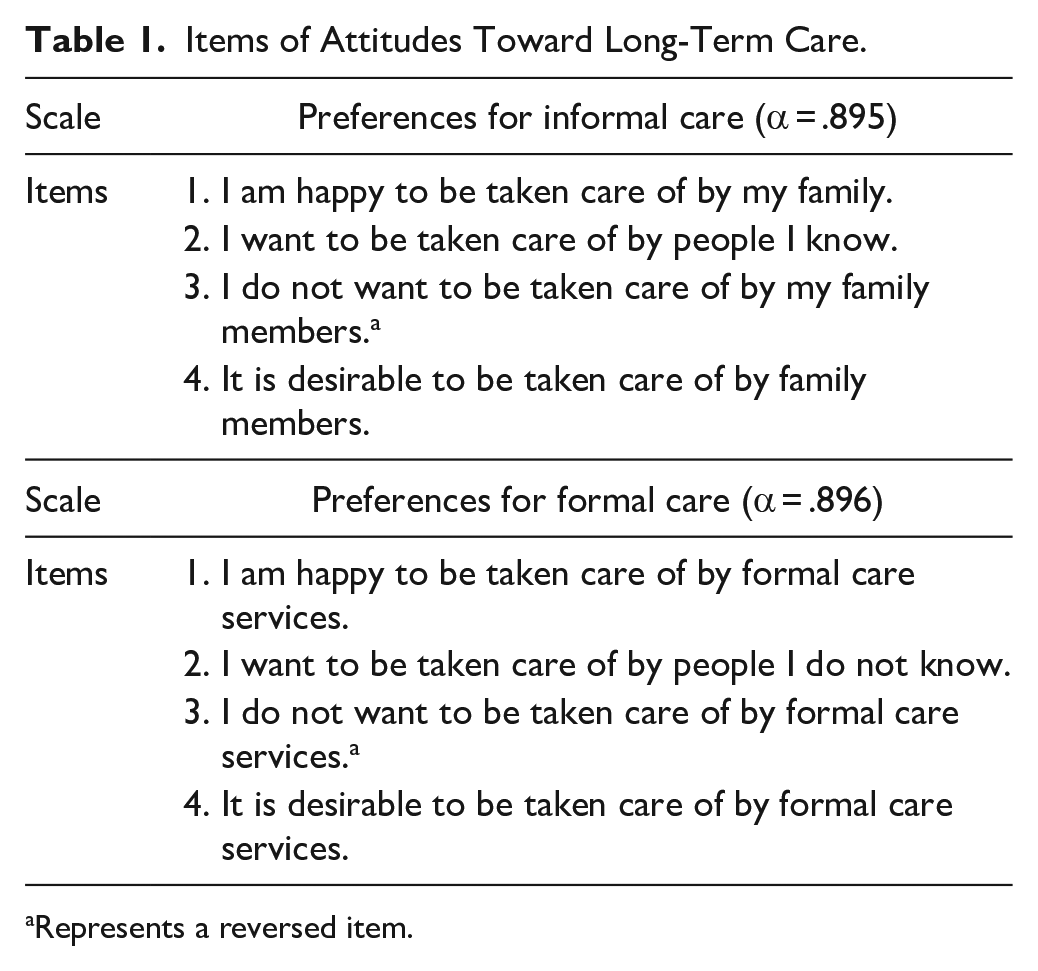
Represents a reversed item.
Loneliness
A 20-item scale was designed by Russell et al. 15 to measure one’s loneliness. The reliability of loneliness was analyzed with a Cronbach’s alpha value of .918 (Table 2).
Items of Loneliness Scale.

Represents a reversed item.
Data Analysis
Demographic, social, and economic factors were analyzed by descriptive analysis. Multivariate hierarchical regressions were conducted to test the predictions. In the first multivariate hierarchical regression, loneliness was used as the dependent variable, demographic factors (age, gender (0 = male, 1 = female), and educational background), social factors (cohabitation and children), and economic factors (family savings) were included as independent variables. In the second multivariate hierarchical regression, attitudes toward informal care was used as the dependent variable, and various factors (demographic, social, and economic factors) and loneliness were analyzed as independent variables of different blocks. The level of significance was set at P < .05.
Results
Table 3 shows the demographic, social, and economic characteristics of the respondents in this study. Most respondents were between 60 and 69 years old, accounting for 91% of all respondents. Most respondents had cohabitants (97.3%) and had 1 child (37.7%) or 2 children (56.7%). The largest number of respondents had a high school level education (Table 3). The scores of scales are presented with min, max, mean, standard error (SE), and standard deviation (SD; Table 4).
Characteristics of Chinese Respondents (n = 300).

Descriptive Analysis of the Results of the Scales.

Table 5 summarizes the correlation matrix for all demographic, social, and economic variables with the dependent variable loneliness as measured in the study. The correlations between loneliness, social factor cohabitation, and economic factor family savings were statistically significant (r = –.286 and –.269, respectively). These results indicate that fewer cohabitants and fewer family savings were associated with more severe feelings of loneliness. Other independent variables that correlated significantly with loneliness were demographic factors age (r = –.069), gender (r = –.109), and educational background (r = –.111). Children was not a significant determinant of loneliness (Table 5).
Correlation Between Independent Variables and Loneliness.

r = Pearson’s correlation coefficient.
P < .05. **P < .01. ***P < .001.
Table 6 shows the results of the multivariate hierarchical regression analysis with loneliness as the dependent variable. From the analysis, it appears that each block with independent variables entailed a substantive contribution to loneliness in the respondents. The demographic factors variables accounted for 3.1% of the explained variance (Model 1). Social factors variables accounted for an additional 7.3% of the explained variance (Model 2) and economic factor variables for 5.3%, respectively (Model 3). The total variance in loneliness that could be explained by the model was 15.7%. The standardized regression coefficients of the final model represent the relative contribution of the variables to the explanation of loneliness. Model 3 shows that the economic factor family savings had the highest standardized regression coefficient: respondents with more family savings experienced fewer feelings of loneliness. Other significant determinant of loneliness were social factor cohabitation indicating that having more cohabitants were directly associated with fewer feelings of loneliness. The demographic factors were not significant determinants of loneliness (Table 6).
Multivariate Hierarchical Regression Analysis of Loneliness.

β = standardized regression coefficient.
P < .05. **P < .01. ***P < .001.
Table 7 summarizes the correlation matrix for all demographic, social, and economic factors, and loneliness as independent variables, with the dependent variable the attitudes toward informal care. The correlation between the attitudes toward informal care and loneliness was statistically significant (r = –.437), indicating that having less loneliness was associated with more positive attitudes toward informal care. Other independent variables that correlated significantly with the attitudes toward informal care were gender (r = .126), educational background (r = .279), cohabitation (r = .319), and family savings (r = .165), indicating that female respondents, respondents with better educational background, more cohabitants, and more family savings were associated with more positive attitudes toward informal care. Age and children were not significant determinants of the attitudes toward informal care (Table 7).
Correlation Between Independent Variables and the Attitudes Toward Informal Care.

r = Pearson’s correlation coefficient.
P < .05. **P < .01. ***P < .001.
Table 8 shows the results of the multivariate hierarchical regression analysis with the attitudes toward informal care as the dependent variable. From the analysis, it appears that each block with independent variables entailed a substantive contribution to loneliness in the respondents. The demographic, social, and economic factors variables accounted for 18.2% of the explained variance (Model 1). Loneliness accounted for an additional 11% of the explained variance (Model 2). The total variance in the attitudes toward informal care that could be explained by the model was 29.2%. The standardized regression coefficients of the final model represent the relative contribution of the variables to the explanation of loneliness. Model 2 shows that loneliness had the highest standardized regression coefficient: respondents who experienced more feelings of loneliness had more negative attitudes toward informal care. Other significant determinants of the attitudes toward informal care were cohabitation and educational background indicating that having more cohabitants or better educational background were directly associated with more positive attitudes toward informal care. Age, gender, children, and family savings were not significant determinants of attitudes toward informal care (Table 8).
Multivariate Hierarchical Regression Analysis of the Attitudes Toward Informal Care.

β = standardized regression coefficient.
P < .05, **P < .01, ***P < .001.
Discussion
This study verified demographic, social, and economic factors that may cause older Chinese people to feel lonely, as well as the influences of loneliness and the factors on their attitudes toward informal care. This study showed that cohabitation and family savings were directly associated with loneliness among older Chinese people living in urban areas of China. Age, gender, educational background, and children had no effect on loneliness. Cohabitation, educational background, and loneliness were directly associated with the attitudes toward informal care. Family savings may be indirectly associated with attitudes toward informal care. Age, gender, children, and family savings had no effect on the attitudes toward informal care.
Based on the results of this study, older Chinese people with cohabitants are significantly less likely to feel lonely than older people who live alone. This is consistent with previous studies4,5 that the loss of a spouse, and the disappearance of decades of companionship, is often the dominant factor in feelings of loneliness. Therefore, older people living alone should be given more attention to reduce the possibility of them suffering from loneliness and isolation. The respondents in this study were older people living in urban areas of China. With the rapid aging of the population and urbanization, the proportion of older Chinese people living alone in urban areas has risen dramatically, and their feelings of loneliness have attracted widespread attention. 16 According to the data of the “Survey on the Situation and Needs of Older Persons Aged 70 and Above Living Alone in Urban Areas of China,” an analysis of the loneliness of older people living alone in urban areas and the factors influencing it reveals that about 40% of the older people living alone never feel lonely, about 45% feel lonely sometimes, and about 15% feel lonely often. 17 In general, the influence of family support is remarkably important for loneliness.18,19 Although older people live with their families, most people living in urban areas in China live in apartments with better privacy and minimal interaction with their neighbors. Also, they often have to deal with “children needing to work, grandchildren needing to go to school.” Therefore, they may not get enough “company” from their family members, which leads to loneliness. Children are the most important social relationship for older people living alone. Communication with children greatly influences the loneliness of older people living alone. The support of friends and neighbors has a weaker influence on loneliness among older people than children and relatives. 20
In addition, older Chinese people with more family savings were less likely to feel lonely. Hawkley’s (2010) findings also suggest that a lower educational background and socioeconomic status increase the likelihood of people feeling lonely. 21 Financial situation often plays an important role in pursuing both material and spiritual life, and creates the possibility for a more prosperous life. Therefore, they may be less likely to feel lonely. In addition, Li et al. 16 concluded that the worse the self-assessed economic condition of older Chinese people, the higher the risk of experiencing loneliness. Their findings showed that the risk of feeling lonely was about 40% higher for older people in poorer economic conditions than those in better economic conditions. 16 The psychological gap between the rich and the poor is also considered a trigger for the less well-off older people to feel lonely. The respondents who participated in this study lived in urban areas with generally better economic conditions and relatively good city amenities, which may have helped alleviate their loneliness. However, the pace of urbanized life tends to be faster, which may be challenging and troubling for older people, perhaps increasing their feelings of helplessness and isolation.
Finally, respondents with higher loneliness had more negative attitudes toward informal care. Loneliness is an unpleasant and distressing experience caused by the subjective assessment that one’s relationships with others are unsatisfactory. 22 Older people feel lonely primarily because it is hard to maintain intimate relationships with their family members, friends, or relatives. 23 Loneliness is unlikely to decrease if they move into a nursing home. Living in a nursing home may further separate them from their family and friends. 13 Although a study conducted in the USA found that lonely older persons were more likely to enroll in a nursing home to enhance their social network and reduce loneliness. 11 This study concluded that when older people are dissatisfied with current-day interpersonal interactions, they are likely to feel lonely, and care facilities such as nursing homes represent a new environment and interpersonal communication network for older people who feel lonely, so they may give up informal care and prefer formal care because of loneliness. Further, the results of the multivariate hierarchical regression analysis also indicated that older Chinese people with better educational backgrounds, more cohabitants, and more family savings may have more positive attitudes toward informal care. In traditional Chinese cultural values, informal care provided by family members is often the preferred option for long-term care, and having more cohabitants often means having access to more family support. 24 This support from the immediate surroundings often plays a role in boosting older people’s confidence in receiving informal care when they need it. In contrast, when older people live alone, the reality is that it is difficult for them to access informal care from relatives, even if they wish to do so. In general, better educational backgrounds tend to be associated with greater economic conditions. As mentioned, in China, adult children are legally obligated to care for their elderly parents. As a way of returning the favor, Chinese parents also have a tradition of providing financial assistance to their children, so when elderly parents have more family savings or property, they may be more likely to be more comfortable with receiving informal care from their children.
Therefore, older people living alone with worse economic conditions should also be given attention and spiritual support, as they are more vulnerable to the “erosion” of loneliness. So those older people who are economically disadvantaged and live alone are often more likely to feel lonely. These older people should be given more attention and support. Furthermore, older people who are less likely to feel lonely, have better educational backgrounds, have more cohabitants, and are more economically advantaged may have a higher need for informal care. The community should provide such families with adequate informal care support, such as community-based informal care training, long-term care prevention workshops for older people, increased intensity of in-home care service.
Conclusion
Loneliness is a subjective feeling of social isolation and the perception of a lack of meaningful connections with others. Loneliness may drive older people to seek companionship, support, and a sense of belonging, which they may perceive as lacking in their living arrangements. Older people living alone and with worse economic conditions may need attention from the community and society because they are more likely to suffer from loneliness. Loneliness may also significantly impact older people’s attitudes toward long-term care. Older people are more likely to feel lonely may have more negative attitudes toward informal care. Communities need to make more efforts to improve community health services or formal care services for these older people to address situations where informal care is not sufficiently provided.
Limitation
Although the above findings were obtained in this study, there are some limitations. For instance, due to the practical difficulties in collecting data and the particularity that the respondents were older people, the data distribution of some personal factors, including age and cohabitants, could have been better, which may influence the accuracy of the analysis results. In addition, the population of older people in China is enormous, and the situation of loneliness and the long-term care conditions of older people living in rural and urban areas are vastly different; the respondents in this study all lived in urban areas. Therefore the results of this study are not representative of the older Chinese people living in rural areas. Moreover, loneliness is a personal psychological trait that is relatively unstable and influenced by various intrinsic and extrinsic factors. Respondents might change their level of loneliness while responding to the questionnaire, which could influence the accuracy and representativeness of the findings. There is a need to improve the data collection and distribution in future studies to obtain more accurate and convincing results.
Footnotes
Acknowledgements
All the patients who volunteered to participate in the study are gratefully acknowledged by the authors.
Declaration of Conflicting Interests
The author(s) declared no potential conflicts of interest with respect to the research, authorship, and/or publication of this article.
Funding
The author(s) received no financial support for the research, authorship, and/or publication of this article.
