



Abstract
Introduction/Objectives:
Social prescribing aims to improve health and well-being by connecting individuals with mental health, housing, and loneliness issues to informal services and support. This approach connects individuals to activities and services in their community to fulfill their practical, social, and emotional needs. However, no reports of community libraries being prescribed as a place to be referred through social prescribing were observed in the literature and the impact of community libraries on community residents and communities in social prescribing. The aim of this study was to identify the functions of a community library operated by medical and social professionals in the social prescribing initiative, its functions, and its impact on community residents and communities.
Methods:
Semi-structured interviews were conducted with the users of the Daikai Bunko Library, a community library in Toyooka City, Japan. The library was established by a primary care physician and community residents as a place where visitors can stay and use it as a library, a bookstore, a café, and a consultation place. Interviews were recorded, and the verbatim transcript was analyzed using the Steps for Coding and Theorization.
Results:
Ten individuals participated. The theoretical description of the interview texts revealed 11 categories as the function of the library and its effect on the individuals and the community: a place to stay, attractive space design, diverse accessibility, choosability of various roles, consultation function, social support, empowerment, mutual trust, formation of connections across generations/attributes, co-creation, and social impact.
Conclusions:
We found that a community library run by medical and social professionals was a useful social prescribing site and had various effects on the community residents who used it. Various functions of the community library, such as consultation functions and attractive space design, may lead to effects on local individuals providing social support and empowerment, with social impacts such as co-creation and formation of connections to the local community.
Introduction
Addressing Health Disparities and Social Challenges
Due to the aging population and changing social conditions, more individuals face multiple diseases, disabilities, and complex challenges. Because of social determinants of health like social isolation, poverty, and discrimination, health disparities significantly affect health status. 1 The World Health Organization has identified measures to assess health disparities, promote collaboration, improve living environments, and reduce health risks. 2 The COVID-19 pandemic further exacerbated health disparities, and support remains inadequate. 3 A comprehensive response, including improving living environments and continuous support, is necessary.
Social Prescribing: A Potential Solution
Social prescribing aims to improve health and well-being by connecting individuals with mental health, housing, and loneliness issues to informal services and support.4 -8 At the societal level, it encourages integrated care and collaboration among health, social, and community sectors. 9 Originating in the United Kingdom, social prescribing has gained global interest over the past decade. 4 According to the website of the NHS of England, 10 social prescribing is “an approach that connects people to activities, groups, and services in their community to meet the practical, social and emotional needs that affect their health and well-being.” It involves local agencies referring individuals to a social prescribing link worker, who co-designs personalized care and support plans with clients.4,9
Japan has introduced a government initiative to create a community-based symbiotic society (Chiiki kyosei shakai), aiming to restructure local support networks and reduce social isolation. 11 Social prescribing, as a countermeasure against isolation and loneliness, is included in Japan’s basic policy and promoted nationwide. 12 Improvements in mental health, reduced hospital admissions, and decreased medical costs have been observed after social prescribing.13,14 Additional benefits include better health behaviors, well-being, increased self-esteem, self-worth, and hope. 14 Social prescribing also assists service users in finding or returning to work after illness or accidents. 15
Community Libraries and Their Impact
Activities recommended in social prescribing include volunteer organizations, self-help groups, art and physical activity groups, adult education, luncheon clubs, and social services. 13 Public libraries, as vital community resources, can play a significant role in promoting social prescribing. 16 Although no research on social prescribing has focused exclusively on public libraries, several examples of initiatives have been reported.16,17 Another type of library is a community library. Community libraries are established based on local needs, funded by community donations, managed by community members, and served by community volunteers. 18 Because community libraries are established by community members, they can contribute to local welfare and social inclusion and strengthen connections. 18 Notably, community libraries in Uganda have reported that women living in poverty under gender discrimination where access to education is low feel safe to gather in community libraries, which has led to empowerment, including the acquisition of local resources and job skills. 19
However, according to a review of the literature, neither community libraries prescribed by social prescribing as a source of activities nor the impact of community libraries on residents and communities in the context of social prescribing have been investigated. Therefore, this study aimed to clarify the role of the community library operated by medical and social professionals in social prescribing, its functions, and its impact on residents and communities.
Methods
A Place With Books and Life: Outline of Daikai Bunko Library (DBL)
DBL is a community library in the central area of Toyooka City, Hyogo Prefecture, Japan. Toyooka City is a regional city with a high aging rate of 35.2% and a declining population, with a current population of approximately 72 000, an area of approximately 700 km2 and a population density of 107 persons/km2. The city is also famous for producing the largest amount of bags in Japan. The founder of DBL is the first author (YM), a primary care physician residing in Toyooka City. DBL was established in November 2020 with the cooperation of an architect and other community residents. The community members who operate DBL and contribute books and funds are called One-box Bookshelf Owners. The One-box Bookshelf Owners pay a monthly membership fee of 2400 yen to have a personal bookshelf, on which they can place approximately 1 dozen books that they own and recommend to others. Some owners use the bookshelves for self-expression, for example, decorating them with flowers or placing Kokeshi dolls on them. Except for a few new books for sale, anyone can borrow books for free from DBL.
The store staff also serves as link workers in social prescribing at wages ranging from 1000 yen to 1450 yen per hour, referring individuals with social issues to relevant social services and local communities. In addition to the DBL staff who are medical and social professionals and link workers, the store is staffed by volunteers from One-box Bookshelf Owners and Store Keeper Interns, who are various community residents, including administrators, artists, teachers, unemployed persons, and students. Store Keeper Interns do not own bookshelves. They are volunteers who want to be involved in DBL and serve as storekeepers approximately twice per month. Coffee and other beverages are provided, and customers can freely spend time in the store browsing, reading, borrowing, and buying books, as well as tending to the store, talking with other customers, and working on their PCs while using Wi-Fi. DBL also provides counseling on problems related to daily life, and their staffs, who are link workers, provide health counseling, loneliness, and living-related help. Community residents visit DBL for consultations of their own volition or at the urging of local medical institutions, welfare centers for handicapped individuals, and the general public. Visitors to the DBL are, for example, mentally disabled, unemployed, in need of grief care, anxious caregivers, and isolated parents with preschool children. The counseling staff recommends DBL as a place to stay where they can easily visit and feel at ease, and, if necessary, refers them to further welfare services and the local community.
Participants and Data Collection
Semi-structured interviews were conducted by the first author (YM) and the second author (YK) with DBL users who agreed to participate in the study, as well as One-box Bookshelf Owners and Store Keeper Interns. The interviews were conducted during the month of September 2022, either at DBL or at the Professional College of Arts and Tourism to which the second author belongs. The interview guide is presented in Table 1. The inclusion criteria were volunteering to participate and being continuously involved in DBL as a user, a One-box Bookshelf Owner who does not act as a storekeeper, a One-box Bookshelf Owner who acts as a storekeeper, or a Store Keeper Intern. Exclusion criteria were being aged under 15 years and having a verbal communication disorder (e.g., Alzheimer’s disease). Eleven individuals were asked to participate in this study, and 10 agreed. After consent was obtained, conversations were recorded with digital recording equipment. The interview was conducted in a private room with a relaxed atmosphere. While asking questions according to the interview guide, we encouraged the participants to speak freely. Transcriptions were made from the recorded conversations. As the interviews were conducted in Japanese, all verbatim transcripts and textual analysis were conducted in Japanese. Translation into English was done after the analysis was completed by the researcher using the translation software DeepL (https://www.deepl.com/ja/translator). The English text was proofread by an English proofreading service with native speakers.
Interview Guide.

Data Analysis
This study was conducted using the Steps for Coding and Theorization (SCAT) method (hereafter, SCAT), a qualitative analysis. 20 SCAT is relatively easy to implement, even for beginners in qualitative research, and the analytical process is explicit; thus, the validity of the analysis can be continuously checked. It comprises a four-step coding process: 1) highlighted words from within the interview text; 2) words outside the text that are replaceable with the words from 1; 3) words that explain the words in 1 and 2; 4) themes and constructs, including the process of writing a storyline and offering theoretical descriptions that weave together the themes and constructs. In this study, to conduct SCAT, YM primarily conducted the analysis, namely, the initial coding and writing storylines, and the co-author (DS), who has extensive SCAT experience, supervised the theoretical description. The validity of the results and the structure of each theme were finalized through discussions among all authors.
Ethical Considerations
A research protocol was submitted to the Ethics Committee of Hyogo Prefectural Tamba Medical Center, and it was determined that an ethical review was not required for this study. Subjects were notified in advance that cooperation in the study was voluntary, and written consent was obtained from all participants.
Results
Ten individuals involved with DBL participated in this study. Table 2 shows the demographics of the study participants. Table 3 shows the categories and theoretical descriptions of the SCAT analysis. The attributes and storylines of each interviewee are also presented in Supplemental Table 1.
Demographics of Study Participants.

Theoretical Description of SCAT and Corresponding Categories.

The analysis of the theoretical descriptions revealed 11 categories: a place to stay, attractive space design, diverse accessibility, choosability of various roles, consultation function, social support, empowerment, mutual trust, formation of connections across generations/attributes, co-creation, and social impact. The 11 categories were divided into effects on individuals, effects on the community, and the functions of DBL that affected the effects on individuals and the community (Figure 1).
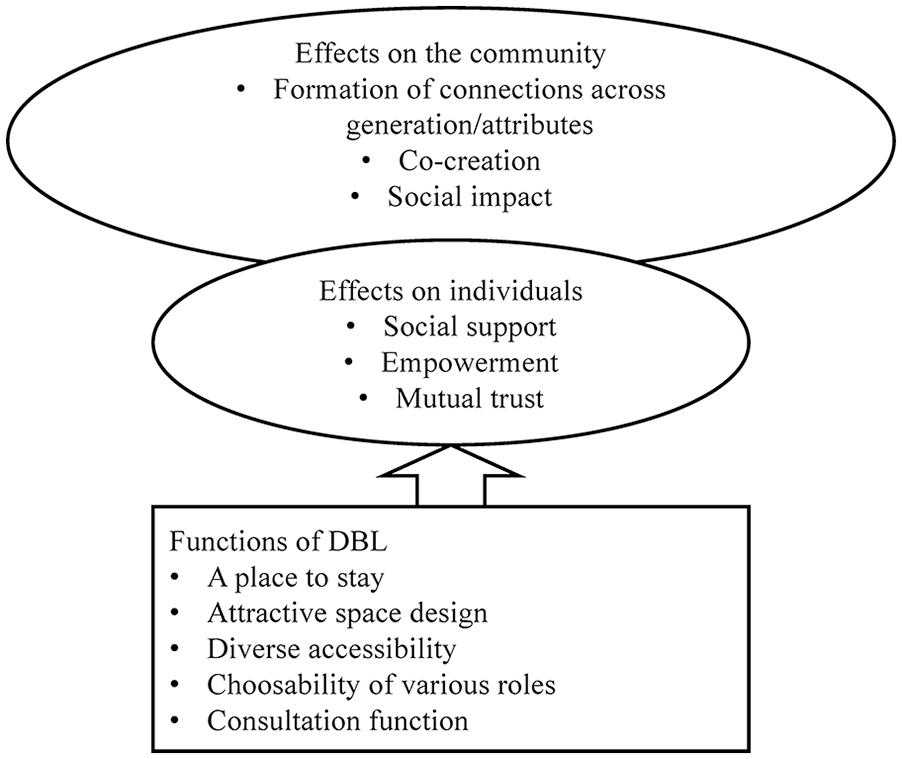
Diagram of functions of DBL and its effect on individuals and the community.
A Place to Stay
DBL is recognized as a place where individuals can feel safe to discuss their illnesses, care issues, and other difficulties in life, which can lead to a reduction in loneliness. Also considered important is having a place open at night that is free of charge.
For those who come here often, it is a place of peace of mind, or an asylum, or even a bit of a refuge, where they can feel a little relieved when they come here, or see someone they know, like seeing the usual Ms. A, or seeing the bookshelf owner. (ID 8, male in his 20s)
Attractive Space Design
The attractive design of the interior, architecture, and other hardware designs, as well as the design of the software that connects users with each other, attracts individuals.
When I first arrived, I thought I was in a mysterious space. It was like I had never been in a place before, a museum, art museum, and library all rolled into one, but I liked the atmosphere. It was a bit like a bookstore in a book world. I remember I was excited when I first entered the store because I thought it was a little romantic or fantastic. (ID 4, female in her 30s)
Diverse Accessibility
Individuals access DBL in various manners, such as through social networking sites, discovering it while walking, or being introduced to it by friends or the local social welfare council. The purposes of using DBL are also diverse, including as a library, for consultation, as a place to stay, and as a place to drop in.
My wife invited me to go for a walk. We usually just go around our house, but we decided to go to a different place, so we came to this side of the shopping street. I was wandering around here and happened to find this place. (ID 3, male in his 60s)
Choosability of Various Roles
Similar to other community libraries, DBL has roles for community residents, inviting their participation. Multiple roles have been established, including users of the library and consultation functions, One-box Bookshelf Owners, and Store Keeper Interns. At DBL, individuals who are unemployed or disabled can volunteer for the role of storekeeper. Residents who participate may also help with problems that arise at DBL. They can deepen their roles by participating in ways that suit them. In some cases, the support from the staff affects the change in roles.
The reason I went from being a user to an intern was because at the time when Mr. B asked me if I was interested in applying for an internship, I was not even working part-time at the time and really had no title. I thought that one day I would have to work part-time or do something like that, so I thought it was a very attractive offer for the first phase of my career. (ID 7, female in her 20s)
Consultation Function
The DBL functions as an accessible consultation center for residents and others who are psychologically reluctant to seek medical care at existing medical and social consultation services or medical institutions. Regardless of the content of the consultation, a sense of security and trust in the staff who listen to them leads to continued use and support. Individuals might more readily discuss difficult topics with strangers than with their neighbors.
I thought the staff at DBL would listen to me. To discuss my work. I have thought about going to DBL to get energy. Yes, Ms. C., or Ms. D., or the counselors. I had different things I wanted to talk to each person, but there were so many things I wanted to talk to them. (ID 9, female in her 30s)
Social Support
Social support can be divided into informational support, emotional support, instrumental support, and evaluative support. Each of these types of support was found to be provided by DBL.
At that time, I was glad that they listened to me anyway, and I think the only concrete advice they gave me was that I should get certified for long-term care insurance as soon as possible, which I am glad I did. It was just the 3rd of January, and I went to City Hall on the 6th anyway. I knew I had to do it sooner or later, but being told objectively made me feel better about going. (ID 10, female in her 60s)
Empowerment
Through the continued involvement at DBL, members who are not medical and social professionals have learned the roles of link workers, such as listening, considering the psychosocial background of others, providing counseling, and referring users to specialized institutions. The experience of being supported promoted the desire to become a supporter. In addition, some of the participants were able to have conversations with others, which had been a complex experience for them. Individuals also acquired digital device skills through their experience as storekeepers. For socially marginalized individuals, gaining skills and alternative values led to their empowerment. There is a sense of being able to do what they want to do at DBL, and an environment where self-expression through books is accepted is provided.
Yes, I think so. I am starting to be able to speak a little bit. I have a complex about it . . . I have a complex because I wonder if my speech is not right. I don’t talk much outside of this place . . . I guess I trust the doctors and the staff. It’s like they are protecting me. I’m hoping that I can talk a little. (ID 1, male in his 50s)
Mutual Trust
Many respondents cite trust in the staff and users. This difference may lead to continued use of the center.
I have come to think that there are a lot of good people who can be trusted, and I think that DBL is a place where there are a lot of such people. It is easy to go to a place like that, and I feel safe in the knowledge that there are not many mean-spirited people or people who try to kick people down. (ID 4, female in her 30s)
Formation of Connections Across Generations/Attributes
Connections are formed through books among multiple generations, including socially vulnerable groups such as those comprising individuals who are unemployed, disabled, or raising children. Unlike the users of public libraries, these users enjoy learning about the books recommended by community members and conversing and interacting with each other in the context of reading and books. These characteristics allow even those who are not good communicators to participate. These interactions are recognized as an attraction of DBL and provide an opportunity for socially vulnerable individuals to participate in society.
I think it is great that there are more places where people of different generations are thinking about going. One of those places is DBL. I see a lot of people come here. There are older people, people of my generation, and I’ve even seen college students come here. (ID 5, female in her 20s)
Co-Creation
As a community library, DBL is recognized as a place where community members collectively donate money and time, collectively operate, and collectively create. There, resident-led activities are conducted collaboratively.
As an owner of a bookshelf, I can enjoy the feeling of building my own community with my own hands, or rather, I can learn from the experience of deciding the rules together with others and watching them take the initiative. It is also a chance to connect with other people, and I feel that I belong here, and that I feel at ease with the people in this community. (ID 8, male in his 20s)
Social Impact
Regarding the social impact of DBL, the results suggest that the activities of residents involved in DBL are a catalyst for change in the city and that the existence of socially inclusive third places could lead to a positive change in the community.
People who know DBL think it’s a good base for something, or that something will change, or that the station street will change. This street is also getting desolate, so I hope that something will change in various ways. There are many people who come here on a whim as tourists. I have a feeling that something is going to change. (ID 1, male in his 50s)
Discussion
Key Functions and Benefits of Community Libraries
This study identified 11 categories as functions of community libraries that exist as part of a social prescription and their impact on the community: a place to stay, attractive space design, diverse accessibility, choosability of various roles, consultation function, social support, empowerment, mutual trust, formation of connections across generations/attributes, co-creation, and social impact. The results suggest that a community library run by a primary care physician and medical staff effectively links the community and local public health services.
Studies have shown that social prescriptive initiatives have led to self-affirmation, well-being, employment support, connection formation, and social support.13,15 Similarly, in this study, the participants involved in the community library were residents, and they created new activities together, which led to the formation of connections and social support. Furthermore, we found new roles of community libraries, such as the empowerment of residents who acquired listening, social care, and linkage work skills. The importance of person-centeredness, co-production of solutions, and empowerment in social prescribing efforts has been noted. 21 This study demonstrated that residents were empowered and new activities were co-created by the residents, suggesting the potential of community libraries in social prescribing. One of the results also shows the possibility of a social impact on the community. This result may be related to the nature of community libraries in which community residents participate. That is, the nature of attractive space design and supporting participation by diverse accessibility. In addition, the nature of such multiple functionality of DBL may have contributed to the formation of connections, mutual aid, and new activities among individuals who had gathered for different purposes.
Involvement of Medical and Social Professionals
One novelty of this study is that the medical and social professionals hosted and were involved in the community library. This may have led to a consultation function because the psychological barrier was reduced for community residents to obtain a second opinion for medical problems which is different from a hospital, and social support. This finding is similar to the role of social support and complementary outpatient functions for community residents that the site played in the literature, in which primary care physicians implemented health café initiatives.22,23 The National Academy of Sciences of the United States defines primary care as “the provision of integrated, accessible health care services by clinicians who are accountable for addressing a large majority of personal health care needs, developing a sustained partnership with patients, and practicing in the context of family and community.” 24 The social support and consultation functions provided by the community library operated by primary care physicians, as demonstrated in this study, have the potential to improve the primary care function in the community. Possible reasons for this result include accessibility owing to the many staff who are link workers and that the local primary care physician operates the community library, which may lead to trust in the place.
Role of Community Libraries in Future Social Prescribing
Community library initiatives involving community residents are spreading throughout Japan and other countries.25,26 These places could become coordination points for social prescribing by linking them with primary care physicians, social workers, public health nurses, and other professionals, with social support expected to be provided through the assignment of link workers. Different from the function of public libraries, which is mainly to lend books, the function of community libraries is to support various citizen-oriented activities and play a role in empowering the community. 26 This study is the first to position libraries in the context of social prescribing, and our expectation is that they will play an important role in social prescribing in the future.
Limitations of the Study
There are several limitations to this study. First, the relatively small sample size of 10 study participants may have prevented sufficient exploration of the current study’s research question. Therefore, thick descriptions including writing detailed storylines and typical case sampling were conducted to enhance the transferability of this study. Second, because the study population was members continuously involved in community libraries, the opinions of other categories of individuals, such as transient users, were not captured. Third, the primary researcher, the first author, is a physician and the manager of DBL, so his relationship with the interviewee may have affected the quality of the interview. In particular, participants working as staff such as storekeepers may have been reluctant to say anything negative for fear of jeopardizing the relationship. Finally, the findings of this study relate to 1 community library in 1 local area in Japan and have limited generalizability to many other community libraries.
Conclusions
We found that a community library run by medical and social professionals was a useful social prescribing site and affected the community residents who used it. Various functions of the community library, such as consultation functions and attractive space design, may lead to effects on local individuals providing social support and empowerment, with social impacts such as co-creation and formation of connections to the local community.
Supplemental Material
sj-docx-1-jpc-10.1177_21501319231181877 – Supplemental material for Social Prescribing Initiative at Community Library and Its Impact on Residents and the Community: A Qualitative Study
Supplemental material, sj-docx-1-jpc-10.1177_21501319231181877 for Social Prescribing Initiative at Community Library and Its Impact on Residents and the Community: A Qualitative Study by Yoichi Morimoto, Yayoi Koga, Tsuneaki Kenzaka and Daisuke Son in Journal of Primary Care & Community Health
Footnotes
Acknowledgements
The authors would like to thank all the study participants for their willingness to cooperate with them in this study.
Declaration of Conflicting Interests
The author(s) declared no potential conflicts of interest with respect to the research, authorship, and/or publication of this article.
Funding
The author(s) received no financial support for the research, authorship, and/or publication of this article.

Supplemental Material
Supplemental material for this article is available online.
References
Supplementary Material
Please find the following supplemental material available below.
For Open Access articles published under a Creative Commons License, all supplemental material carries the same license as the article it is associated with.
For non-Open Access articles published, all supplemental material carries a non-exclusive license, and permission requests for re-use of supplemental material or any part of supplemental material shall be sent directly to the copyright owner as specified in the copyright notice associated with the article.
