



Abstract
The 2018 ‘gene-edited babies incident’ in China catalysed intense global debate, highlighting the critical need to understand public discourse surrounding major techno-ethical controversies. This study investigates the characteristics of Chinese public discourse in response to this event by analysing 3692 comments from the social-media platform Weibo. Employing a mixed-methods approach combining latent Dirichlet allocation topic clustering and grounded theory, the research reveals a hierarchical thematic structure in public discussions. Such discussions are categorized into three types of discourse: (1) event-specific discourse, focusing on the incident itself, the individuals involved, subjects’ rights, the experimenter's ethics and the immediate ethical risks of the technology; (2) societal-context discourse, extending to broader societal issues reflected by the event, including techno-governance, the rule of law, international competition, science communication and popular-science education; and (3) future-oriented discourse, which adopted a macro-perspective to explore the necessity and historicity of technological development and its relationship with ethical constraints. While demonstrating diverse engagement, the analysis also identified prevalent issues in public cognition, such as superficial scientific understanding, pronounced emotional responses and a reliance on monolithic cultural logics. These findings underscore the importance of strengthening research on public techno-ethical cognition. The study advocates for the integration of public perspectives into techno-ethical governance frameworks to complement elite, unidirectional communication, thereby enhancing the inclusiveness, responsiveness and practical effectiveness of science governance in the face of rapid technological advances.
Keywords
Introduction
In November 2018, He Jiankui, then an associate professor at the Southern University of Science and Technology, 1 publicly announced that twin girls, Lulu and Nana, had been born healthy in China following human embryo gene editing. Specifically, He claimed to have used CRISPR-Cas9, a powerful genome-editing tool that enables precise modifications to DNA sequences, to disable the CCR5 gene in the embryos, with the stated aim of conferring innate resistance to HIV infection. This news sparked widespread controversy worldwide, drawing widespread concern and intense discussion among all sectors of society regarding the ethical implications and potential societal impacts of this technology (Doudna, 2019). The act was almost unanimously condemned by the scientific community, both domestically and internationally, as a severe violation of research ethics and academic integrity (Lander et al., 2019). 2 Following the public announcement, Chinese government bodies quickly launched investigations and stated that the matter would be handled according to law and regulations. These bodies included the National Health Commission (China's top health policy and regulatory authority, responsible for overseeing medical practice and research ethics), the Ministry of Science and Technology (the central government agency governing science and technology policy, research funding and research integrity) and the China Association for Science and Technology (a national organization serving as a bridge between the government and the scientific community, with responsibilities in science popularization and professional ethics).
After an investigation, Guangdong Province announced its preliminary findings in January 2019. The investigation was led at the provincial level because He Jiankui's experiment was conducted in Shenzhen, which falls under the administrative jurisdiction of Guangdong Province; under China's governance structure, such investigations are typically initiated and managed by the relevant local authorities before findings are reported to central government bodies. The investigation concluded that ‘He Jiankui, in pursuit of personal fame and fortune, self-funded, deliberately evaded supervision, and privately organized personnel to carry out human embryo gene-editing activities for reproductive purposes, which are explicitly prohibited by the state.’ Ultimately, He Jiankui and his collaborators were convicted of illegal medical practice in December 2019. 3
This incident was not only a major ethical case in biomedical research but also a typical techno-ethical controversy that triggered large-scale online public discussion and debate. An analysis of Baidu Index 4 search trends for the keyword ‘He Jiankui’ (see Figure 1) reveals that public attention to this incident was concentrated around four key time points: after the initial exposure of the event on 26 November 2018, the search index peaked on 28 November (Point A); on 21 January 2019, when Guangdong Province announced the preliminary investigation results, the index reached a second peak (Point B); on 30 December 2019, at the commencement of the public trial, online attention reached a third high point (C); and even in April 2022, when He Jiankui was released from prison, public opinion saw another small peak (Point D). This sustained and concentrated high level of public attention, driven by specific developments, confirms the status of the ‘gene-edited babies incident’ as a landmark techno-ethical public issue.
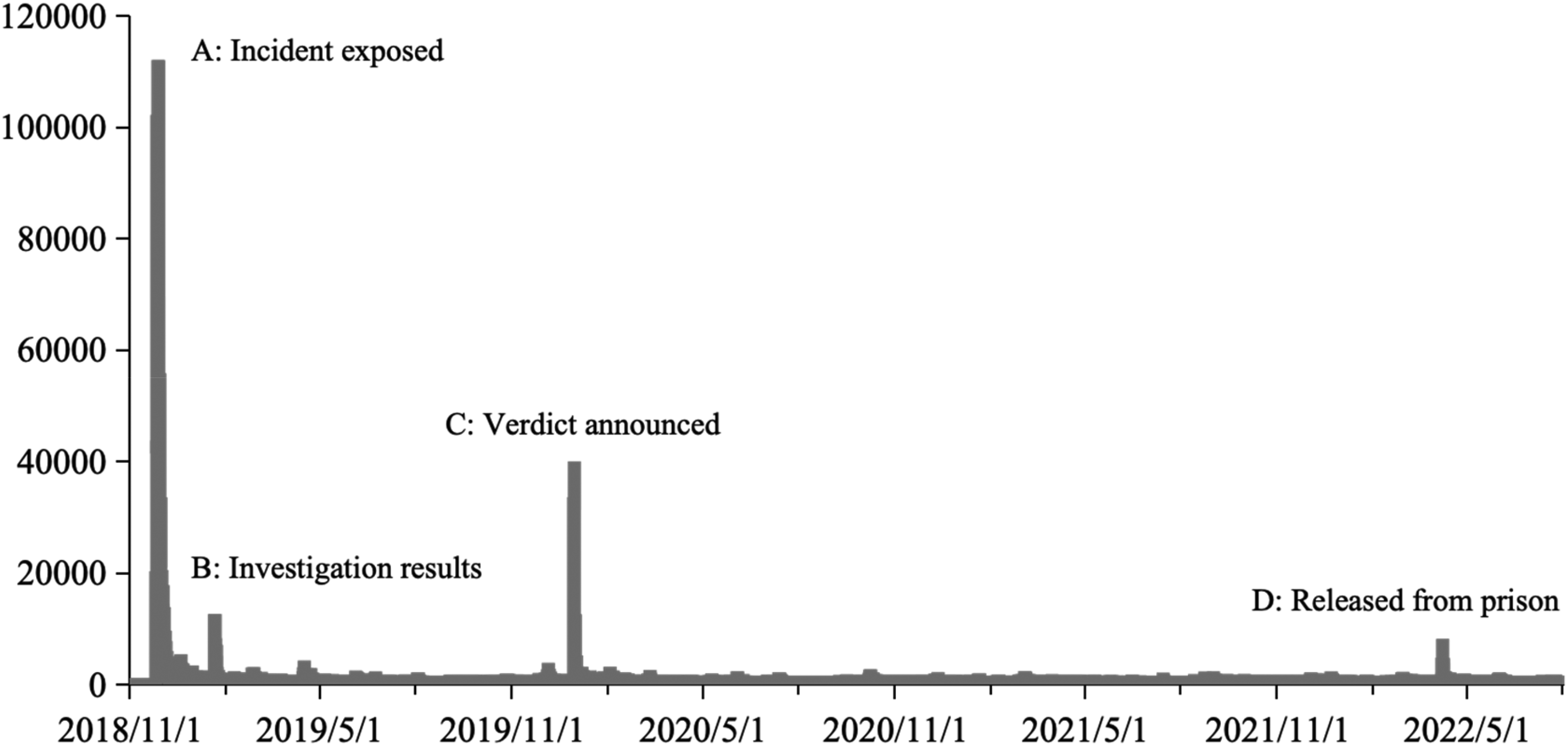
Baidu Index trend for ‘He Jianhui’.
The intense public reaction to the ‘gene-edited babies incident’ highlights the importance of public understanding of and effective participation in techno-ethical governance. Techno-ethical governance requires not only effective government regulation and self-discipline from the scientific community but also, indispensably, the full understanding and active involvement of the public. Public discourse and cognition regarding major techno-ethical events, expressed through online forums, reflect the diversity of people's techno-ethical views and provide a crucial empirical basis for research and practice in techno-ethical governance. However, even as techno-ethical research gains increasing prominence today, public techno-ethical cognition, especially its discursive practices in specific controversial events, is often overlooked. Traditional, mainstream research tends to either focus on metaphysical explorations from ethical and philosophical perspectives or to emphasize government regulation and expert governance from legal and public administration standpoints, rarely analysing the public's techno-ethical conceptions and specific expressions during controversial incidents.
This relative neglect of public discourse in this field is rooted in long-held, stereotyped perceptions of the public's role. First, members of the public are typically seen as lacking substantive channels and rights to participate in technological affairs, and are more often viewed as ‘passive consumers’ of technological outcomes. Second, the public is commonly perceived as lacking the necessary scientific literacy to engage in complex, rational discussions of technology governance and policy (Wynne, 2006). However, high-impact and controversial events, such as the ‘gene-edited babies incident’, provide opportunities for public participation in technological discussions, allowing individuals to express their ethical views and scientific literacy, and potentially enhancing them through public debate. Ignoring the public's authentic voice in these events can not only lead to a disconnection between techno-ethical governance and societal expectations but may even trigger a crisis of trust within the governance community. Therefore, re-examining the public's agency in techno-ethical events, thoroughly exploring people's discursive practices surrounding specific controversies, and investigating their cognitions, understandings, attitudes and viewpoints are urgent theoretical and practical endeavours to aid understanding of technology–society interactions, bridge cognitive gaps and enhance the inclusiveness and effectiveness of techno-ethical governance.
Based on the above considerations, this paper focuses on the landmark techno-ethical controversy of the ‘gene-edited babies incident’, using public comments from Sina Weibo, one of China's largest social-media platforms, as research data. By employing natural language processing techniques and grounded theory methodology, this study conducts an in-depth mining and systematic analysis of these large-scale online text data. It aims to reveal the characteristics of online public discourse, core issues, emotional tendencies, and the diversity of the public's ethical stances expressed during the ‘gene-edited babies incident’. The goal of this empirical investigation of public discourse in this specific event is to provide empirical evidence for understanding how the contemporary Chinese public perceives and participates in major techno-ethical controversies, and to offer theoretical references and practical insights for improving relevant techno-ethical governance frameworks and enhancing the effectiveness of future techno-risk communication.
Prior to the ‘gene-edited babies incident’, both public and expert discussions on human gene editing were already characterized by a complex interplay of hope and apprehension. Public acceptance of gene-editing technologies was typically conditional, highly dependent on their intended application—therapeutic uses (to treat or prevent disease) generally received higher public support than enhancement applications (to alter human traits beyond medical necessity) (Funk and Hefferon, 2018; Gaskell et al., 2017). Heritable germline gene editing, in particular, became a focal point for public prudence and ethical concern due to its potential long-term impact on the human gene pool and the ethical status of embryos (Hendriks et al., 2018). Factors such as scientific literacy, religious beliefs, trust in scientists and media portrayals were all considered to be variables influencing public attitudes. Concurrently, while authoritative bodies like the National Academies of Sciences, Engineering, and Medicine and the Nuffield Council on Bioethics emphasized ongoing public engagement and robust governance, their expert-driven deliberation frameworks showed certain limitations in foreseeing and responding to the real-world shock of breakthrough events such as He Jiankui's announcement.
The ‘gene-edited babies incident’ undoubtedly served as a potent catalyst for global public discussion, with social media rapidly becoming the primary medium for these conversations. Unlike traditional expert deliberations, social media provided an unmediated space in which diverse voices could react instantaneously, share opinions and engage in debate. Cross-platform analyses (e.g., of Twitter, Weibo, Reddit and YouTube) regarding this event revealed a complexity in public sentiment that diverged from the near-unanimous condemnation of the scientific and bioethical elites. Although expert opinion was overwhelmingly negative, a considerable number of online comments expressed support for He Jiankui's experiment, often grounded in an optimistic view of the future therapeutic potential of gene editing, forming a ‘discourse gap’ with opposing voices rooted in ethical and safety concerns. Different social-media platforms also exhibited distinct discursive ecologies. For instance, supportive voices were more prominent on YouTube and Reddit, while opposition was more concentrated on Twitter and Weibo, and the proportion of support on Weibo was higher than that on Twitter (Ni et al., 2022). Comparative research by Ji et al. (2022) indicated that discussions on Weibo appeared to be less extensive in scope and duration than those on Twitter, probably influenced by differences in scientific literacy between China and the West, cultural tendencies and platform-specific characteristics. These findings collectively demonstrate that public discourse is not monolithic but is dynamically shaped by platform affordances, cultural contexts and the specifics of unfolding events.
Despite the surge in attention to human gene editing triggered by the ‘gene-edited babies incident’, existing literature still presents several key limitations. First, early analyses predominantly focused on the perspectives of scientific experts, bioethicists and policymakers. While social-media analyses have begun to capture public voices, a deeper qualitative understanding of the reasoning, values and everyday ethics underpinning these diverse public opinions is still needed, moving beyond mere sentiment analysis or topic modelling. Second, there is a geographical and cultural imbalance in current research. The ‘gene-edited babies incident’ occurred in China, yet detailed, culturally sensitive analyses of Chinese domestic public discourse (especially the complex interactions on key platforms such as Weibo) remain underdeveloped.
Therefore, research in this field urgently needs to fill the cognitive gap in how the publics in various national and cultural contexts (especially in major non-Western countries such as China) understand, participate in and shape the discourse on major techno-ethical controversies. Specifically, there is a lack of systematic, in-depth, mixed-methods analysis of the unique discursive patterns, underlying cultural values, influence of national narratives and trust dynamics exhibited by the Chinese public on social-media platforms in the specific case of the ‘gene-edited babies incident’. By conducting an in-depth qualitative and quantitative analysis of Weibo discourse surrounding the incident, this study aims to provide empirical evidence for understanding how the contemporary Chinese public confronts and shapes major scientific and technological ethical challenges. This research focuses on the interplay of Chinese cultural values, official narratives and trust in shaping public arguments, seeking to reveal its discursive patterns and ethical considerations.
Methodology and analysis
Data source and processing
Social-media data, which encompasses rich user interaction data, provides a systematic lens for understanding aggregated public expressions regarding major events (Yang et al., 2021). As China's largest social-media platform, Sina Weibo (hereafter Weibo) facilitates frequent open and critical debates on high-stakes topics such as technological development, environmental pollution and food safety (Rauchfleisch and Schäfer, 2015). Recent scholarship has increasingly used big-data methods to analyse massive Weibo datasets, exploring public attitudes towards both environmental crises (Pu et al., 2022) and techno-ethical controversies (Zhang et al., 2021). To systematically mine public commentary, this study targeted the comment sections of 10 influential posts published by three primary official media outlets: People's Daily, Xinhua News Agency and CCTV News. These three outlets were selected because they constitute the most authoritative central-level state media organizations in China, collectively commanding the largest audiences and highest levels of institutional credibility on Weibo. Their posts on major public events typically attract the highest volumes of public commentary, making their comment sections a rich site for observing large-scale public discourse.
Data collection was executed through a custom Python web crawler, with the harvesting process concluding in November 2022. This extensive time frame was strategically selected to encompass the full chronological arc of the ‘gene-edited babies incident’, effectively capturing public responses to every critical milestone. The dataset includes reflections on the initial disclosure in late 2018, the announcement of preliminary investigation results and judicial sentencing in 2019, and the resurgence of public attention following the experimenter's release from prison in April 2022. This longitudinal approach ensures that the empirical evidence reflects a matured and evolving public cognition rather than transient emotional reactions. A total of 11,216 direct comments were ultimately obtained, each documented with metadata including the commenter ID, textual content, time stamp and number of likes, with all entries numbered sequentially to facilitate systematic citation (see Table 1).
Overview of data sources.
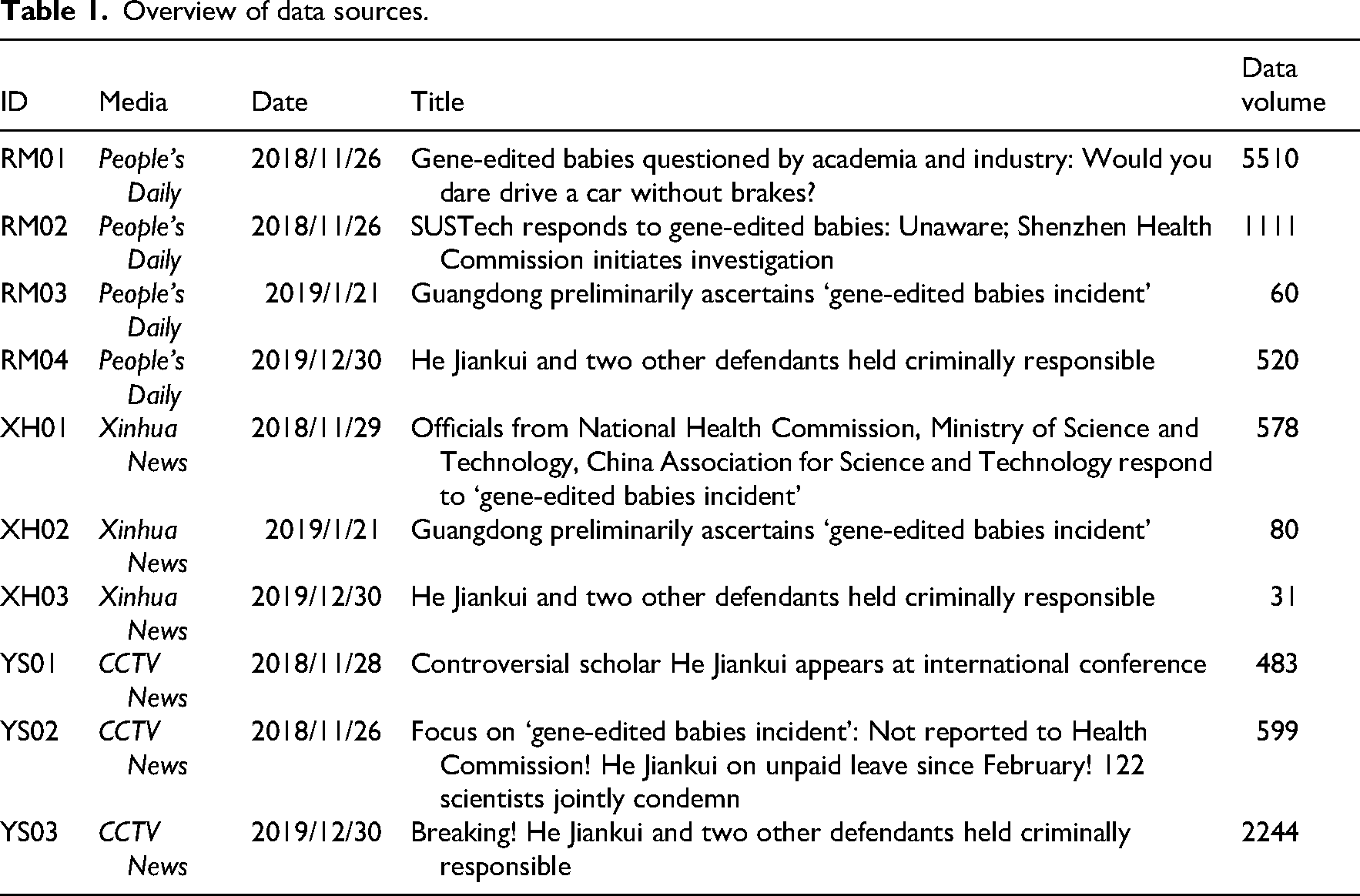
Overview of data sources.
After data acquisition, the data were cleaned and processed. First, forwarded comments, blank comments, emoticon-only comments, colloquialisms, repetitive topic tags and emojis were removed. Traditional Chinese characters were converted to simplified characters, and comments completely unrelated to the event were manually screened and deleted. Then, data filtering was performed: comments were sorted in descending order by word count, and only those with 15 or more characters were retained. Finally, 3692 comment texts were included in the analysis.
Current research on text data processing and analysis mainly follows two paths: traditional qualitative research and machine learning paths based on code and algorithms. This study combines them, first using machine learning methods for an initial thematic exploration through topic clustering, and then employing qualitative analysis using grounded theory for in-depth coding and interpretation to achieve a comprehensive mining of the text data.
For the initial thematic exploration, latent Dirichlet allocation (LDA) was selected. LDA is a probabilistic model that can extract thematic information from large-scale texts by identifying latent topic distributions within a document collection (Blei et al., 2003) and has been widely applied in social-media text analysis and topic clustering (Jelodar et al., 2019).
Subsequently, for in-depth coding and developing a more nuanced understanding of the data, grounded theory was applied. Grounded theory is a qualitative research method that systematically collects and analyses data to refine core concepts and construct connections between them, thereby developing theories grounded in the collected data. This typically involves iterative stages of coding, such as open, axial and selective coding.
This study adopts a descriptive and analytical rather than prescriptive stance: it refrains from judging the scientific validity or ethical correctness of quoted public comments. Aside from obscuring a small amount of uncivil language, the original text and intent of the comments are fully preserved. The purpose of this approach is to authentically capture and analyse the cognitive characteristics, reasoning patterns and value orientations embedded in public expression, rather than to endorse or validate any particular viewpoint. Where public comments contain factual inaccuracies or ethically problematic propositions, these are addressed in the analytical discussion rather than editorially corrected within the data presentation.
LDA-based topic clustering: Application and results
In this study, an LDA topic model was constructed using the Sklearn package in Python to perform topic clustering on the comment texts, with initial word segmentation carried out using Python's Jieba library. Existing research typically determines the optimal number of topic clusters based on perplexity. Perplexity can be understood as the uncertainty of a trained model about whether a document belongs to a given topic; theoretically, the lower the perplexity, the higher the model's prediction accuracy.
The number of LDA topic clusters was set to increase stepwise from 1 to 7, and the perplexity values corresponding to each cluster number were outputted. It was found that when the number of topics was 3, the model's clustering effect was relatively good. Therefore, the optimal number of topics was set to 3, and relevant clustering indicators and results were outputted.
Based on LDA topic clustering, the comment texts were divided into three categories (see Table 2). The first category, termed ‘event-specific discourse’, featured high-frequency words mainly related to the event itself and the individuals involved, with common keywords such as ‘child’, ‘baby’, ‘experiment’ and ‘parents’. This type of discourse focuses on the specifics of the incident, the circumstances and the consequences for those directly involved. The second category, termed ‘societal-context discourse’, expanded the discussion to broader social issues, including typical keywords such as ‘country’, ‘bottom line’ and ‘law’. This category reflects public attention to the wider political, legal, ethical and cultural issues stemming from the event. The third category, termed ‘future-oriented discourse’, contained high-frequency words that pointed more towards technology and the future of humanity—for example, ‘gene’, ‘humanity’ and ‘world’—indicating public reflection on the long-term development of science and technology and its impact on humanity's future. Thus, public cognition and understanding of the ‘gene-edited babies incident’, as revealed through these thematic clusters, can be summarized across these three distinct discursive levels.
LDA topic clustering results and summary.
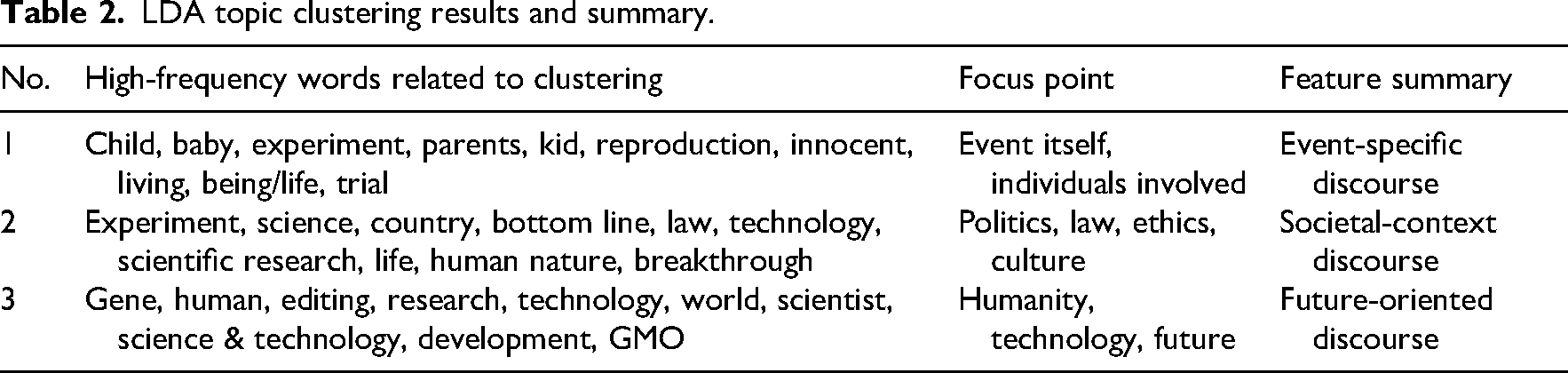
LDA topic clustering results and summary.
To investigate deeper into the specific content of each LDA-identified topic, this study adopted a three-level coding method based on the grounded theory paradigm and systematically applied it to the 3692 comment texts. Using NVivo12 software, texts were coded, summarized and refined item by item, and the process was combined with LDA topic clustering results to analyse public understanding of the techno-ethical event from multiple dimensions.
Specifically, open coding was first performed, summarizing the original texts sentence by sentence to extract 156 initial concepts. After subsequent screening and integration, 30 third-level categories were ultimately retained. Axial coding (relational coding) was then conducted. By comparing and analysing these initial concepts, categories with higher generalizability were identified, forming 13 second-level categories. Finally, selective coding was performed. Since the comment texts had already been classified into three broad themes using LDA, the second-level categories derived from axial coding were further synthesized and aligned with these three first-level categories, corresponding to the LDA clusters. As shown in Figure 2, the final coding system comprehensively covers the public's understanding and discussion of the ‘gene-edited babies incident’ from different perspectives.
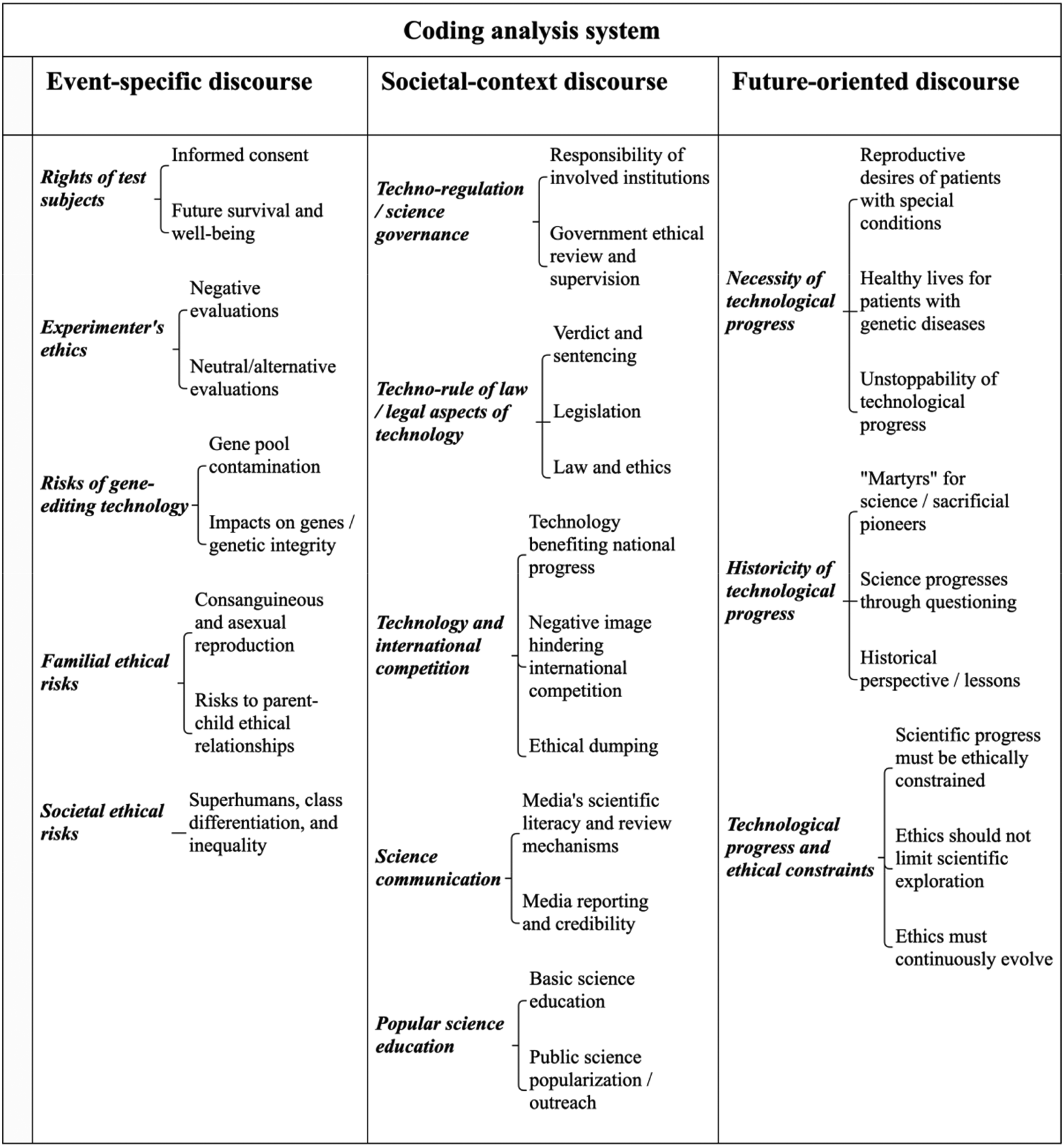
Coding analysis system based on grounded theory.
Event-specific discourse primarily focuses on the incident itself and the circumstances of those involved. It can generally be divided into two dimensions: on the one hand, the public pays attention to the rights of the subjects and the ethical issues surrounding the experimenter in the ‘gene-edited babies incident’; on the other hand, the public is concerned about the risks of gene-editing technology, including genetic, familial and social ethical risks.
Rights of subjects and morality of the experimenter
In discussing social events, commenters often focus on the individuals involved and their associated interest groups. As a highly controversial medical experiment, the ‘gene-edited babies incident’ involved the subjects and the experimenter, and discussions on these core parties formed an important component of public opinion.
Commenters’ discussions on subjects’ rights focused mainly on two aspects: the right to informed consent and the right to future survival. Regarding informed consent, some commenters questioned the experimenter's transparency with the parents. For example, one individual commented: ‘To what extent did the infants’ parents really know the “truth” they claimed to know?’ (YS020010). Meanwhile, other commenters pointed out that the experiment was conducted on a voluntary basis, emphasizing that there was no coercion involved: ‘This experiment was conducted on the premise of mutual consent. It was not forced; the subjects all voluntarily agreed’ (YS020037). Regarding the right to future survival, discussions were more intense and polarized. Some commenters held extreme positions, believing the infants’ existence itself should not be permitted: ‘Strongly demand euthanasia for the two infants’ (YS010234). However, this view was strongly opposed by many: ‘The children are innocent; they are living beings. By what right do any of you sentence someone to death?’ (YS030599). On the issue of the infants’ future marriage and reproduction, a notable cluster of comments converged around the view that, to avoid potential social and ethical risks, the infants’ reproductive capacity should be restricted or eliminated. For example, one comment read: ‘They really shouldn’t marry and have children; if they do, their children will also be treated as monsters. Sterilization is the best solution’ (YS030428). While this position appeared with considerable frequency in the comment data, it is essential to note that such proposals raise profound human rights concerns. Forced sterilization constitutes a violation of fundamental reproductive rights as recognized under international human rights law, and the casual manner in which such measures were advocated in public comments underscores the extent to which emotional reactions and fear of the unknown can override basic rights-based reasoning in public discourse on unfamiliar biotechnologies.
Discussions about the experimenter were similarly polarized. Some commenters expressed strongly negative evaluations, with a few comparing the experimenter to infamous historical perpetrators: ‘How is this different from the Unit 731 human experiments 5 by the Japanese aggressors back then?’ (RM010694); ‘He will become a villain of the ages like Hitler’ (YS020338). Some even suggested malicious intent behind the experiment: ‘This is far more terrifying than Unit 731; the purpose of human gene-editing experiments is large-scale dissemination, polluting the future, making all Chinese people carry targeted edited sterilization genes’ (RM020411). These statements exhibit rhetorical features that resonate with what Mede and Schäfer (2020) conceptualize as ‘science-related populism’—specifically, a deep suspicion of scientific elites’ moral integrity and a perception that credentialed researchers may pursue hidden agendas at the expense of ordinary people's well-being. While these comments do not constitute a fully articulated populist programme demanding the democratization of scientific authority, their framing of the experimenter as either a malevolent elite actor (akin to a war criminal) or, conversely, a persecuted truth-teller (as seen in Section 6.2) reflects the Manichaean logic characteristic of populist discourse, in which scientific institutions are cast as either corrupt establishments or obstacles to progress (Wang et al., 2025).
Other commenters expressed concerns about high-tech crime: ‘The higher the education and knowledge, the greater the harm to society if they commit a crime’ (RM011210). At the same time, some commenters attempted to defend the experimenter. For instance, some refuted the Unit 731 comparison: ‘Scientific experiments are not about achieving success through cruel killing but obtaining results through rigorous data’ (RM020619). Others believed the experimenter's original intentions should be acknowledged: ‘His starting point was also to prevent AIDS; perhaps the means were a bit radical, but one cannot erase his merits’ (RM012512).
Genetic, familial and social ethical risks
Another important dimension of public discussion regarding the ‘gene-edited babies incident’ was the exploration of gene-editing technology itself. For such a cutting-edge high technology, the potential negative impacts of gene editing are still unclear, and commenters heatedly debated its potential threats to genetic diversity, as well as the potential familial and social ethical risks.
On the issue of genetic diversity, views were divided into two main categories. Some worried that gene editing would destroy human genetic diversity, even leading to ‘gene pool pollution’. For example, one person vividly described: ‘Once human modification through gene-editing technology begins, the human gene pool, this pure lake evolved over billions of years of natural selection, will be polluted at an exponential rate! One can imagine that a hundred years from now, our descendants will live in such a world: “pure humans” not gene-encoded, “superhumans” gene-encoded, and “machine humans” of artificial intelligence!’ (RM020135). Other commenters believed that gene editing has a limited impact on the human gene pool, emphasizing nature's self-repair capabilities. One comment read: ‘Even if these few children marry and have children with normal people, it will not pollute human DNA. Human DNA self-corrects during pairing, finding a matching DNA counterpart’ (YS031537).
The potential familial ethical risks of gene-editing technology also received considerable attention. Discussions focused mainly on issues of consanguineous reproduction and parent–child relationships. Regarding consanguineous reproduction, some commenters noted that if the technology matures, it could lead to ethical chaos: ‘If this technology matures in the future, can close relatives also reproduce? Many social orders will be disrupted’ (RM020484). Some commenters even proposed more extreme possibilities: ‘Will future humans move towards asexual reproduction, knowing only their father but not their mother, or only their mother but not their father?’ (RM012879). Regarding the parent–child relationship, technological genetic intervention raised some concerns. For example, one commenter stated: ‘Paternity tests are based on genetic similarity. Since the child's genes have been altered, even though you know it's your child, their genes are not, right?’ (RM011342).
The public was particularly concerned about the social and ethical risks of gene editing, especially the potential emergence of ‘superhumans’ and the resulting class differentiation and inequality issues. As Harari (2017) pointed out, new technologies in the 21st century could create a biological divide between the rich and the poor: wealthy elites could design themselves or their descendants to become physiologically and psychologically superior ‘superhumans’.
Many commenters expressed concern about this possibility, for example: ‘Others, while still embryos, have already reached heights you can never achieve in your lifetime’ (RM020820). Another pointed out: ‘Imagine if one day you had the choice to design your child to have blue eyes, golden hair, an IQ of 130+, and an athlete's physique; it's terrifying just to think about’ (RM010525).
Further discussion extended to the potential for gene-editing technology to exacerbate social inequality. Some commenters worried that this technology might be monopolized by the rich and powerful, thereby solidifying social strata: ‘The rich and powerful classes can use their power and wealth to monopolize this technology, allowing their descendants for generations to gain genetic advantages, thus firmly entrenching their families at the top of the social pyramid. Children from ordinary families who cannot afford gene modification will forever be trampled under the feet of superhumans, with no chance of ever turning things around’ (RM010353).
Societal-context discourse: Techno-governance and techno-culture
Societal-context discourse focuses more on the real-world societal problems raised by the ‘gene-edited babies incident’. It can generally be divided into two dimensions: on the one hand, the public is concerned about issues related to regulation, the rule of law and international competition; on the other hand, the public pays attention to the problems of science communication and popular-science education that were highlighted by this event. It is noteworthy that, when discussing these real-world societal problems, the public often refers to science-fiction movies, TV series, anime and other works of scientific culture as a basis for participating in public discussion and expressing opinions.
Techno-regulation, rule of law and international competition
In social events involving public interest, commenters often focus on the role and influence of the government and the state, including government regulation, public policy, laws and regulations, and even international politics. The ‘gene-edited babies incident’ is essentially an issue of techno-ethical governance; therefore, discussions on techno-regulation, the rule of law and international competition became focal points for public attention.
Discussions on techno-regulation centred mainly on two aspects: the responsibility of the involved institutions and the government's ethical review system. First, the public extensively discussed the responsibility of the institutions involved, which included a hospital and a university. Regarding the hospital's ethical review letter, many pointed out that it came from a Putian-affiliated hospital in Shenzhen, 6 expressing strong doubts: ‘It's Putian-affiliated again, the kind that posts small ads in toilets for “curing STDs”, now grandly appearing in “high society”. Whose tragedy is this?’ (RM011210). Commenters also delivered harsh criticism of the involved university, believing the school's management and culture were to blame: ‘What a university is like largely depends on its teachers; one can imagine what kind of place XX University is! This school is just a den of filth’ (RM040241). Second, the public questioned the government's role in ethical review and supervision. Some comments suggested that there were serious problems with the current techno-ethical regulatory system: ‘All parties are passing the buck; I really hope it can be investigated quickly and give us the truth’ (RM020445). This scepticism reflected public disappointment and dissatisfaction with the government's inadequate supervision of high-tech fields.
Regarding the rule of law, public discussion focused mainly on three aspects: the verdict, legislation and the relationship between ethics and the law. First, opinions were divided regarding the verdict delivered on 30 December 2019, which sentenced He Jiankui to three years in prison and fined him 3 million yuan. Some believed the sentence was too light: ‘A year for each child's life; emotionally, the sentence feels too light’ (YS031010). Others felt the verdict was unfair: ‘So, three years in prison can determine someone else's life’ (YS030323). Still others questioned the basis for the conviction: ‘Illegal medical practice is too far-fetched. This is clearly a complex issue involving academic research, academic ethics, academic practice, etc.’ (YS030097). Meanwhile, some commenters supported the verdict according to the law: ‘It is indeed a bit light, but according to the standard for illegal medical practice, the maximum is three years. In our society governed by law, we must execute according to the law, and then consider legislation to fill the gap in medical ethics’ (YS031388). Second, at the legislative level, the public generally worried that lagging legislation could lead to additional future ethical problems: ‘The speed of Chinese legislation is far behind the actions of these mad scientists; without laws, I believe there will soon be a second and third incident challenging human ethics’ (RM011295). Finally, regarding the relationship between ethics and the law, some believed the actions of those involved only ‘violated ethics and morals, not the law’ (YS031799). This view reflected the public's varied understandings of the boundary between the law and ethics and people's confusion about the legal system's inadequacies in handling techno-ethical issues.
Furthermore, the public engaged in multi-level discussions surrounding international competition. Some argued from a national-interest perspective, emphasizing the importance of gene-editing technology for national progress and competitiveness, displaying clear scientific nationalism. For example, one person commented: ‘If the Chinese take this step, it may not be a bad thing … Even if the Chinese don’t research it, the Americans certainly will’ (RM020144). Another comment mentioned the ‘double standards’ of Western countries: ‘Westerners often say one thing and do another. Why do they oppose it whenever Chinese people research it? They advocate for reducing restrictions on nuclear weapons on the one hand, while blatantly developing small nuclear weapons on the other’ (YS010046). On the other hand, some members of the public were concerned about the event's negative impact on China's national image; these discussions were more rooted in a national-image-centric nationalism. For example, one comment pointed out: ‘This will be a stain on the research community, causing the world public to question the bottom line of research, especially Chinese research’ (RM020972). Another mentioned: ‘One person's mistake makes the entire Chinese scientific community take the blame’ (RM020387). These concerns reflected the public's attention on the reputation of the Chinese scientific community in global competition.
Lastly, the public engaged in in-depth discussions on the issue of ‘ethical dumping’ in transnational research. Ethical dumping refers to researchers conducting studies in countries with lax regulations when these studies are prohibited or controversial in their home countries (Nordling, 2018). The ‘gene-edited babies incident’ was cited by The Economist as a typical case, sparking public questions about China's regulatory loopholes. For example: ‘Actually, the US did this experiment on animals in 1994 and succeeded, but then the US Congress legislated to ban it … There is no clear legal prohibition in this area domestically’ (RM010737). This comment identifies a concrete regulatory gap—the absence of explicit domestic legislation at the time—and represents a structurally grounded concern consistent with the academic understanding of ethical dumping.
However, other comments moved beyond identifying regulatory asymmetries and into conspiratorial territory, attributing deliberate manipulative intent to foreign actors. For instance: ‘Foreigners are very cunning; they let the Chinese do it, observe secretly from behind, share the results if successful, and let the Chinese bear the responsibility’ (RM010032). Some were even more worried: ‘After his sentence ends, if he can’t do it domestically, will he go abroad to do it?’ (YS030646). Unlike the regulatory-gap argument, these comments construct a narrative in which China is cast as the passive victim of a coordinated foreign strategy—a framing for which there is no substantive evidence in the case of the ‘gene-edited babies incident’. The coexistence of these two modes of reasoning within the same thematic cluster—one grounded in identifiable institutional shortcomings, the other driven by conspiratorial suspicion—illustrates the heterogeneity of public discourse on transnational scientific governance. It also suggests that legitimate anxieties about regulatory inequality can, in the absence of adequate public information, readily escalate into conspiratorial narratives.
Science communication and popular-science education
In techno-ethical events, the public's main channels for obtaining information are media news reports and dissemination, while their understanding of events is deeply influenced by past popular science and education. Therefore, when discussing the ‘gene-edited babies incident’, the public focused not only on the event itself but also on issues of science communication and popular-science education.
During the initial stages of the incident, some official media outlets adopted a triumphant announcement style in their news releases, calling it the ‘world's first gene-edited babies immune to AIDS’ and describing it as ‘China achieving a historic breakthrough in the field of gene-editing technology for disease prevention’. However, as the controversy fermented, major media outlets quickly shifted to criticism and condemnation. This drastic change in reporting attitude, as well as the scientific accuracy and professionalism of the report content, sparked widespread public scepticism.
Public discussion of science communication mainly focused on two aspects, both pointing to a lack of professionalism. First, the public criticized the media for lacking basic scientific literacy and review mechanisms. For example, one commenter pointed out: ‘Yesterday they were all praising it. It only took a day to go from promoting to condemning’ (RM011633). Another commenter questioned the scientific accuracy of the report content: ‘Reporting this kind of thing as a scientific achievement, do they have any awareness?’ (RM020707). Second, the public believed that the media's improper reporting had been misleading and weakened its own credibility. One commenter wrote: ‘The mainstream media, which should guide the public towards correct thinking and awareness, also lost its standard in the face of so-called honour’ (YS030613). Another comment pointed out: ‘As a media outlet trusted by the public, it failed to properly review and report this unethical matter as a major scientific breakthrough, misleading public judgement’ (RM020926).
Public discussion on popular-science education also centred around two primary aspects. On the one hand, many members of the public cited knowledge from high-school biology curriculums in their discussions to defend their views. For example: ‘High-school biology students know, and teachers also tell us that life needs to be revered’ (RM040252). Another comment mentioned: ‘The gene section in high-school biology textbooks states from the beginning about research experiments and ethics’ (RM011266). These discussions reflect the important influence of basic education in biology and ethics on the formation of public techno-ethical views. On the other hand, the public expressed a need for broader promotion of popular science. Some commenters stated that they could not understand the scientific background of the event and hoped for simple, easy-to-understand popular-science content: ‘I don’t understand the specific meaning and implications; I request popular science’ (YS031575). Other commenters criticized the lack of scientific literacy in current public discussions: ‘Still talking about guinea pigs, ligation … China's path to popular science and rule of law is still long’ (YS031385). At the same time, some called for a rapid increase in popular-science coverage: ‘The 1% undergraduate rate 7 among netizens is really not just talk’ (YS031279). These views indicate that public discussion of the event not only exposed weak links in popular-science education but also underscored the need to further strengthen popular science.
It is noteworthy that many members of the public, when discussing the ‘gene-edited babies incident’, referred to techno-cultural works they have consumed as the basis for their views. Techno-cultural works play an important role in shaping public understanding of techno-ethics. Table 3 lists some of the techno-cultural works mentioned in public comments, revealing several characteristics of these works in influencing the public's techno-ethical views. First, science-fiction films have the most significant impact on the public. American blockbusters such as Gemini Man, Venom and Gattaca were frequently mentioned in the comments. These films are not only highly entertaining but also express profound techno-ethical propositions through their narrative styles and values. For example, Gattaca focuses on social inequality caused by gene editing, and the ethical dilemmas it conveys are often used by the public to draw analogies to the ‘gene-edited babies incident’. The techno-ethical values exported by such films largely shape the public's understanding and judgement of techno-ethical events. Second, Japanese animation also plays an important role in shaping public techno-ethical views. For example, works such as Mobile Suit Gundam SEED were mentioned multiple times in public comments. These animated series explore the complex relationship between technological progress and war and peace through imaginative narratives, and their inherent techno-ethical values subtly influence public attitudes and opinions. Lastly, the role of Chinese science-fiction novels is also noteworthy. Liu Cixin's representative works, such as The Three-Body Problem, Devil's Blocks and Age of Angels, were mentioned multiple times in public comments. These works, with their grand narrative frameworks and profound philosophical reflections, have prompted deep public thought on the relationship between technology and ethics. The prominence of foreign, particularly American, science-fiction films in public comments suggests that globally circulated cultural products currently play a disproportionate role in shaping Chinese public techno-ethical imagination. This finding points to an opportunity for Chinese science-fiction creators and science communicators to develop culturally grounded narratives that engage more directly with the ethical dilemmas specific to China's technological development context.
Techno-cultural works mentioned in public comments.
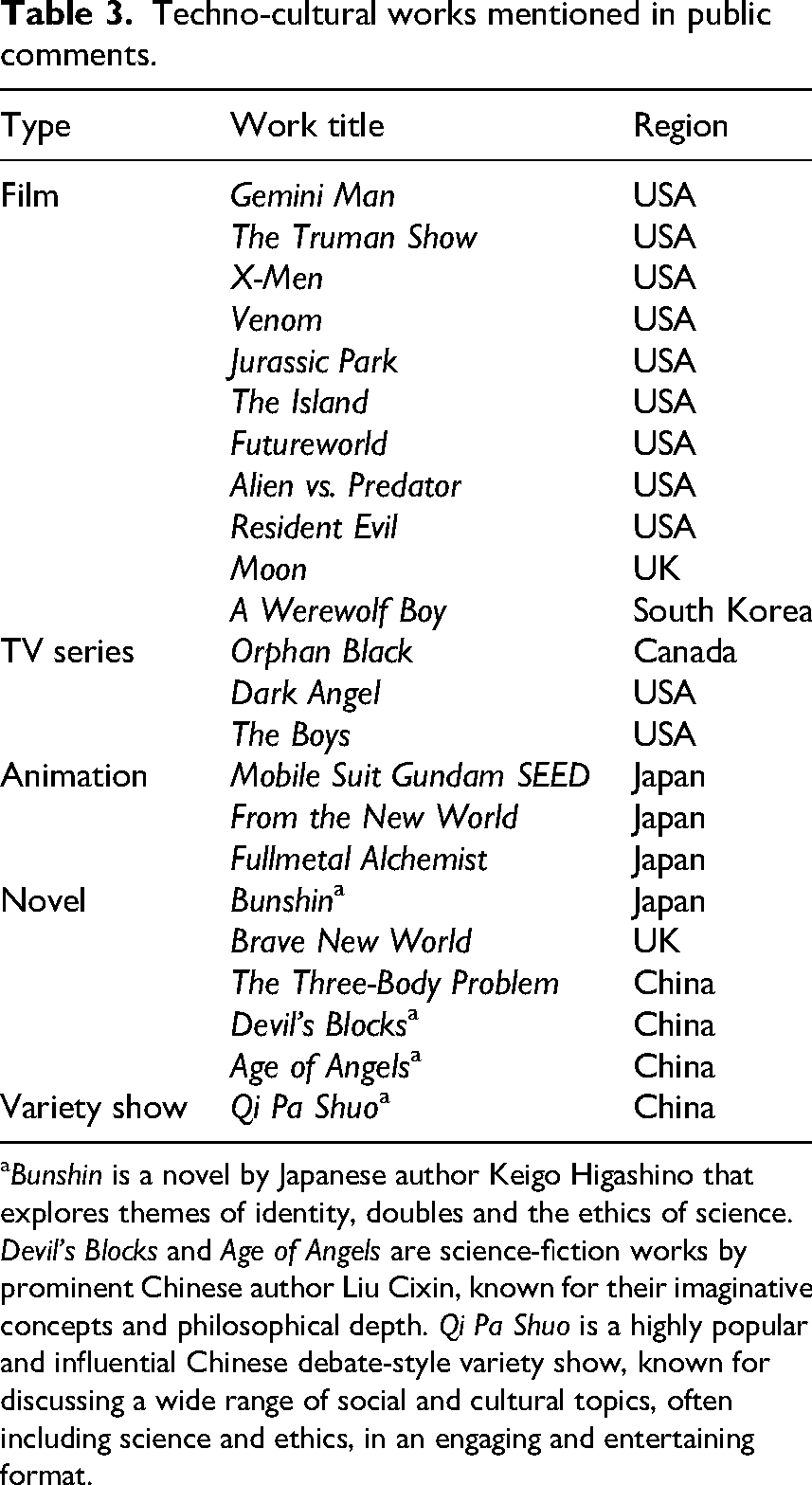
Techno-cultural works mentioned in public comments.
Bunshin is a novel by Japanese author Keigo Higashino that explores themes of identity, doubles and the ethics of science. Devil's Blocks and Age of Angels are science-fiction works by prominent Chinese author Liu Cixin, known for their imaginative concepts and philosophical depth. Qi Pa Shuo is a highly popular and influential Chinese debate-style variety show, known for discussing a wide range of social and cultural topics, often including science and ethics, in an engaging and entertaining format.
Future-oriented discourse focuses on technological development and the future of humanity. It can generally be divided into three dimensions: the first concerns the necessity of technological development; the second examines the nature of technological development from a historical perspective; and the third explores the relationship between technological development and ethical constraints. It is noteworthy that, in this category of discussion, many members of the public do not express opinions based on specific technical features but tend to broadly compare the ‘gene-edited babies incident’ with many progressive events in scientific history, even glorifying the individuals involved. This suggests that the public's understanding of the technology itself remains insufficient, and people's techno-ethical literacy also varies greatly.
The necessity of technological development
A core question arising from the ‘gene-edited babies incident’ is how we can understand the necessity of technological development. Public discussion on this issue presents diverse perspectives but generally reaches a certain consensus on the necessity of technological development. Specifically, these discussions can be roughly divided into three categories.
Some members of the public, proceeding from the reproductive desires of patient groups such as those with AIDS, rare diseases and mental illnesses, believe that the advancement of gene-editing technology is rational and carries humanitarian significance. This perspective emphasizes the choices and hopes that technology creates for special groups. For example, one commenter stated: ‘I feel sorry for AIDS patients; it's just because they hope their offspring won’t be troubled by this incurable disease’ (YS030938). Another commenter described the longing of a patient with mental illness: ‘A male patient with mental illness who has been on medication for a long time and has not relapsed for many years deeply desires a complete family but worries about the illness being inherited. Yet this man really longs for a complete family life’ (RM040284).
Another segment of the public focuses on the potential of gene-editing technology to improve the quality of life for patients with genetic diseases, believing that it can alleviate patients’ suffering and achieve a healthier state. For example, one commenter pointed out: ‘Why not eliminate defects that can be eliminated through technology before birth? Why make them suffer? Is this called humanitarianism?’ (YS020440). Another commented: ‘If editing genes can prevent children with genetic diseases from falling ill, isn’t that great … How many children are there who have to take medication for life or even have no cure and can only die young due to genetic diseases that cannot be completely cured!’ (YS020103). One commenter even stated: ‘If I could sign up for the experiment, I might really send my child to be edited, to give him a chance to be cured’ (YS030582). These views reflect public expectations for gene-editing technology in humanitarian and medical practice.
From a more macro perspective, other members of the public emphasize that technological progress is an inherent driving force and an unstoppable trend in human development. This perspective views gene-editing technology as an important step in promoting human progress. One commenter wrote: ‘Humans need to develop and evolve, and development and evolution must be based on the development of science. Human experimentation should be boldly attempted and done! Without experiments, human development cannot advance; it will only stagnate’ (RM020388). This view highlights the public's positive attitude towards technological development and people's belief that exploration and experimentation are necessary paths for scientific development.
The historicity of technological development
Unlike the ‘elite discourse’ of mainstream media or expert scholars, many members of the public did not entirely criticize the irrationality of the ‘gene-edited babies incident’. Instead, some chose to view it from a historical perspective, believing that the evaluation of technological development should be examined in the long course of history. This historical perspective mainly presented three tendencies.
The first category compared the individuals involved in the event to ‘martyrs’ in scientific history who defended truth, believing they might be seen in the future as pioneers promoting technological development. The most frequently mentioned historical figures include Copernicus, Bruno and Galileo. Copernicus was condemned by the Roman Catholic Church as a ‘heretic’ for proposing the heliocentric theory, which contradicted the Bible; Bruno was sentenced to be burned at the stake by the Inquisition for defending and developing Copernicus's theory; Galileo was sentenced to life imprisonment for ‘opposing the Pope and promoting evil doctrines’. These figures are now regarded as great pioneers of scientific development, but they suffered strong criticism and persecution at the time. One comment pointed out: ‘Bruno, Servetus, Galileo, Vesalius, Copernicus—all of them were denounced as a heretic by the world, some even burned at the stake to great public satisfaction, yet now they are great scientific pioneers’ (YS010210). Another commenter mentioned: ‘When Copernicus died, he was also portrayed as a devil who disrespected all things in the world and violated all settings that a human being should have’ (RM011288). These remarks reflected the public's cognition of historical recurrence and the dynamic nature of scientific evaluation. 8
The second category believed that the emergence of new things is often accompanied by opposition, and that scientific development progresses amid questioning. It argued that it is challenging for any breakthrough technology or idea to be widely accepted at its inception. For example, one commenter mentioned: ‘There are always opposing voices when new things appear. Weren’t there opponents to test-tube babies back then?’ (YS010265). Another commenter emphasized: ‘Any successful new concept, when first proposed, will be opposed by the vast majority of people’ (RM010742). Furthermore, the public also agrees that science needs ‘pioneers’ to bear the risks of exploration, even in the face of criticism and misunderstanding. For example: ‘Someone always has to be the first to stand up and do any experiment; drawing negative conclusions before even trying is not the spirit of scientific research’ (YS010034). Another comment read: ‘History has long proven that countless astonishing inventions and discoveries always faced the pressure of death at birth. We need to give newborns time’ (RM012986).
The third category, from a more macro historical perspective, believed that the value of technological development needs the test of time, and history will ultimately determine its significance. Such discussions often invoked the idea that ‘the victor is crowned king, while the vanquished is branded an outlaw’ (reflecting the sentiment of the Chinese idiom ‘Chéng Wáng Bài Kòu’), 9 emphasizing that scientific achievements may take on entirely different meanings in different eras. For example, one comment read: ‘Perhaps we killed Copernicus, or perhaps Hitler, who knows? Only time will tell’ (YS031234). Another comment mentioned: ‘A prisoner in this century might be a hero in the next’ (YS031788). Still others pointed out: ‘Looking at it from this angle today, perhaps in decades or even centuries, we will look at this matter from another angle’ (YS020255).
Technological development and ethical constraints
When discussing the relationship between technological development and the future of humanity, ethical constraints are often seen as a major challenge. The ‘gene-edited babies incident’ clearly violated the basic consensus of contemporary techno-ethics, but the public engaged in multidimensional discussions about whether technology should be subject to ethical constraints and whether such constraints hinder technological development. These discussions mainly fell into three categories.
The first viewpoint emphasized that technological development must proceed within an ethical framework, believing that unconstrained technology is like ‘Pandora's Box’, which, once opened, may bring uncontrollable consequences. For example, one commenter pointed out: ‘It's better to wait until there's enough technology before opening Pandora's Box; if you open it now, you might not be able to close it’ (RM011585). Another commenter further elaborated: ‘Sooner or later, humanity will take the step of rewriting the genome without violating moral ethics. But the key to this event is … true science shouldn’t be like this; regardless of whether there are laws and regulations, one should not break through the bottom line of human morality’ (YS020233). These views reflect public concern about the social and ethical risks of new technology, while also emphasizing that technological progress needs to be synchronized with ethical development.
The second viewpoint argued that ethical constraints should not become barriers limiting scientific exploration. It viewed ethics as man-made rules and believed that there should be no limits when exploring the mysteries of life. For example, one commenter mentioned: ‘Ethics are all set by people themselves. If no one is harmed, why should it be opposed? There should be no boundaries in the exploration of life; it's not a crime’ (RM020325). Another commenter compared ethical constraints to religious doctrines, criticizing their rigidity: ‘What's the difference between using ethics to limit technology and religious believers?’ (RM040205). This view further extended to a reflection on the nature of ethical rules: ‘So-called ethics, morals and laws are actually barriers that humans set for themselves, tantamount to drawing a prison for oneself’ (YS010336). Such discussions revealed that some members of the public question the role of ethical rules in technological development and strongly support the freedom of scientific exploration.
The third viewpoint believed that ethics should evolve alongside the development of technology. These members of the public advocated that technological progress will bring about dynamic adjustments in morality and ethics, and overly conservative ethical views may hinder technological progress. For example, one commenter pointed out: ‘Technological progress will inevitably lead to the iteration of morality; adhering to old rules will lead to stagnation’ (RM020369). Another commenter added: ‘So-called ethics are just set by people … Ethical standards should change with technological progress and will definitely change with technological progress’ (RM040214). Still others called for promoting technological development while improving systems and concepts: ‘Human progress should not be controlled by so-called backward ethics. When technology advances, systems and thinking will also advance. Instead of strictly guarding against it, it is better to improve it’ (RM010740).
Discussion
This paper focuses on the ‘gene-edited babies incident’, a major techno-ethical controversy that seriously affected the relationship between the public and science. Based on the analysis of 3692 Weibo comment texts, combined with machine learning and grounded theory, this study systematically examined the characteristics of the Chinese public online discourse surrounding this event. The study found that the public discussions exhibited distinct thematic layers, which can be primarily categorized into three types: event-specific discourse, focusing on the event itself and the individuals involved; societal-context discourse, relating to real-world societal issues; and future-oriented discourse, reflecting on technological development and the future of humanity. These layers of discussion also showed a certain degree of interconnectedness and progression. The various discussions on Weibo constituted a vivid and complex public sphere of thought: in event-specific discourse, the rise and surge of science populism were observable; in societal-context discourse debates, nationalist and cosmopolitan views coexisted; and in future-oriented discourse explorations, liberal and conservative ideas intertwined. From an ethical standpoint, diverse perspectives such as consequentialism, deontology, contractualism and virtue ethics also emerged and were blended into the public discourse.
Before discussing these limitations, it is important to acknowledge what the data collectively demonstrate: the Chinese public engaged with the ‘gene-edited babies incident’ across a remarkably wide range of issues—from informed consent and subjects’ rights to legislative gaps, transnational research ethics and the long-term trajectory of human technological development. This breadth of engagement challenges the assumption that the Chinese public lacks either the interest or the capacity to participate meaningfully in techno-ethical deliberation. Moreover, the cognitive limitations identified below—including superficial scientific understanding, emotional polarization and reliance on culturally narrow interpretive frameworks—are by no means unique to the Chinese context. Studies of public responses to the same event on Western social-media platforms have documented strikingly similar patterns. The issues discussed in the following paragraphs should therefore be read as common challenges in public engagement with techno-ethical controversies, not as culturally specific deficiencies of Chinese public discourse.
However, the analysis of public discourse on the ‘gene-edited babies incident’ also revealed some noteworthy issues regarding public techno-ethical cognition and discursive practices. First, many members of the public demonstrated a superficial understanding of the nature of gene-editing technology, exhibiting insufficient awareness of complex scientific principles, technological limitations and potential long-term risks. Discussions at times presented an overly idealized conception of the technology as a ‘panacea’ and, at other times, heavily demonized it as a ‘Pandora's Box’ or ‘monster’, to some extent overlooking the uncertainties and boundary conditions inherent in technological applications.
Second, emotional expression was quite prominent in public discussions, for instance, manifesting as extreme moral judgements of the individuals involved—both severe condemnation and heroic portrayal—or as blind support for or wholesale rejection of the technology itself. This sometimes risked diminishing the space for rational analysis and obscuring in-depth exploration of the complex scientific and ethical issues underlying the event. Such extreme positions, while rhetorically striking and therefore analytically significant, represented a relatively small proportion of the overall dataset; the majority of comments occupied more moderate ground, and extreme statements were frequently contested by other commenters within the same discussion threads. Nevertheless, the visibility and emotional intensity of these minority voices risk disproportionately shaping outside perceptions of the discussion as a whole, which underscores the importance of attending to the distribution rather than merely the content of public opinion when drawing conclusions from social-media data.
Third, the cultural logic that some members of the public relied upon when articulating their views appeared to be somewhat monolithic; they frequently cited Western science-fiction cultural products as evidence, particularly American blockbusters characterized by narratives of technological supremacy or technological backlash. This may reflect a deficiency in localized, diverse resources for techno-ethical thinking. Lastly, public discourse also reflected a certain distrust of existing techno-regulatory and governance mechanisms, particularly concerning the effectiveness of ethical review and legal regulations. This perceived tension between technological development and social governance, if not effectively addressed, could exacerbate public anxiety about and potential resistance to emerging technological advancements in the long run.
Although public discourse surrounding the ‘gene-edited babies incident’ exhibited limitations in certain aspects, the rich social emotions, diverse value claims and specific cultural logics embedded within it are crucial entry points for understanding how such major techno-ethical issues are received, interpreted, debated and reflected upon at the societal level. This discourse not only reflects the adaptation and tensions of social culture in the face of drastic technological change but also reveals the profound impact of technological development on societal value systems and public cognitive patterns. Therefore, in-depth analysis and research of public discourse surrounding specific major techno-ethical events, particularly as undertaken in this study of the ‘gene-edited babies incident’, should receive greater attention from both academia and policymakers. The cognitive patterns, depth of understanding, emotional attitudes and discursive expressions demonstrated by the public regarding such events should rightly serve as important references for the construction of techno-ethical governance frameworks and related policymaking. More fully integrating public perspectives into the techno-ethical governance system can not only effectively compensate for the potential singularity and limitations of relying solely on government regulation and elite discourse but can also enable greater inclusivity, responsiveness and practical effectiveness in techno-ethical governance, ultimately serving the benign interactions between and synergistic development of technology and society.
Limitations
The empirical foundation of this investigation is subject to specific constraints regarding data representativeness and textual depth. The exclusive reliance on Sina Weibo introduces a platform-specific demographic bias because the user base is predominantly younger and more urbanized than the general population. This focus potentially overlooks heterogeneous perspectives existing within semi-private networks or among demographics with lower digital engagement. Furthermore, the selection of comment sections under major official media outlets subjects the data to the influences of institutional moderation and user self-censorship. These environments prioritize a curated form of public discourse, which may marginalize fringe or radical viewpoints that would otherwise appear in less regulated digital spaces. The intrinsic brevity and emotional reactivity of social-media commentary also impose limits on the reconstruction of complex cognitive structures. While these texts provide immediate insights into public sentiment, they lack the extended logical argumentation characteristic of deliberative interviews or systematic surveys.
Conclusion: Why it still matters after six years?
Revisiting the 2018 ‘gene-edited babies incident’ from the vantage point of 2026 provides a critical baseline for assessing the social robustness of contemporary disruptive innovations. This event marks the definitive moment when human germline intervention entered global consciousness and transitioned techno-ethical governance from reactive emergency measures to a normalized systemic framework. In an era defined by the convergence of biotechnology and artificial intelligence, understanding the longitudinal evolution of public cognition following the initial technological shock is indispensable for calibrating the regulatory boundaries of current innovations.
The institutional failure of science communication in 2018, characterized by a rapid shift from celebrating breakthroughs to issuing moral condemnations, underscores the inherent fragility of triumphalist narratives. This instability reveals that one-dimensional progressivist rhetoric is insufficient for managing the complexities of techno-ethical controversy. Modern communication strategies must therefore move beyond oversimplified success stories to incorporate uncertainty and risk forecasting as core components of public engagement. Sustaining communal trust amid rapid technological iteration requires a commitment to transparency rather than the curated optimism of institutional reporting.
Science education must prioritize the cultivation of ethical competency to bridge the persistent gap between technological imagination and governance reality. Evidence suggests that individuals frequently rely on foundational biological concepts and science-fiction archetypes to articulate their ethical stances, confirming that mass culture and basic schooling constitute the primary infrastructure for techno-ethical development. Future educational initiatives should focus on fostering reflexive reasoning and prudent judgement rather than the mere dissemination of biological facts. These capacities enable a society to move beyond symbolic fear or blind compliance towards a consensus grounded in rational critique.
Integrating public perspectives into techno-ethical governance is a strategic necessity for ensuring the synergistic development of technology and society. The 2018 case proves that governance models excluding public voices remain vulnerable to institutional paralysis when confronted with radical scientific practices. A retrospective analysis of public discourse allows governance bodies to identify social sensitivities and trust-triggering mechanisms with greater precision. This shift toward inclusive governance endows techno-ethical norms with genuine social resilience and provides the cultural foundation required for national innovation strategies to endure in an uncertain technological landscape.
Footnotes

Funding
This study was supported by the Major Program of the National Social Science Foundation of China (grant number 21ZDA017).
Declaration of conflicting interests
The authors declared no potential conflicts of interest with respect to the research, authorship, and/or publication of this article.
Notes
Author biographies
Shuo Wang is a PhD candidate at the Center for Science, Technology, and Society, Tsinghua University. His research interests lie in science communication, with a particular focus on science-related populism, public trust in science and artificial intelligence (AI) ethics. Recently, his work has extended to AI for science and the social dynamics of digital society.
Zhengfeng Li is a professor in the Department of Sociology, Tsinghua University, where he serves as the Director of the Center for Science, Technology, and Society. He is also an associate editor of Cultures of Science. His main research areas include S&T policy, the philosophy of science and technology, S&T and society, the history of S&T policy and so on.