




Abstract
In the current development of science communication, to achieve the desired communication objectives, either in formal science education or science popularization for the public, the utilization of resources on the history of science has become a necessity. However, due to the limitations of their professional background, science teachers and science-popularization workers still face problems in understanding the history of science, which naturally affects the appropriate use of resources on the history of science in science communication. One possible way to solve this problem is to learn and gain some basic knowledge of the historiography of science.
Introduction
As research on science-communication theory deepens and practical applications expand, there has been growing public appreciation of the importance of the history of science to science communication. The history of science holds vast potential for application across various platforms, be it within the school curriculum on science education, the exhibitions of science and technology venues, or the diverse array of science-popularization activities. At the same time, the use of the history of science also integrates humanistic culture into science communication, bringing more beneficial changes to the content, concepts and effects of science communication. However, due to the limited numbers of professional historians of science, the vast majority of science teachers and science-popularization workers have not had the opportunity to receive professional training in the history of science. Consequently, within the domain of science communication, the utilization of the history of science often falls short of expectations and even causes problems, primarily due to misinterpretations of the history of science itself. The author of the current paper posits that, for those engaged in science communication, beyond supplementing their knowledge with additional courses on the content and outcomes of scientific research, a more effective strategy lies in gaining a grasp of the foundational theories inherent to the history of science.
Definition of several basic concepts
To ensure a clear understanding of the views expressed in this article, it is necessary to first explain some of the basic concepts involved.
First, historiography of science. The term ‘historiography of science’, when understood fundamentally, pertains to the scholarly examination of how the history of science is documented, its historical development and its interplay with the wider tapestry of societal and cultural movements. It encompasses the methodologies employed by historians of science, their interpretations and the ensuing scholarly discourse surrounding the history of science (Table 1). Additionally, it addresses the scientific and historical perspectives embedded within the narratives about the history of science. The primary subjects of the historiography of science are the historians of science themselves and the historical works they produce. In this sense, it is a ‘historiographic’ analysis of both subjects, and, sometimes, people also call it the study of the ‘theoretical frameworks of the history of science’. In a way, it can also be seen as a critical and reflective study of the history of science itself. In the curriculum of some colleges and universities, it is also called ‘the theory and method of the history of science’.
Research levels and research subjects of science, the history of science and the historiography of science.
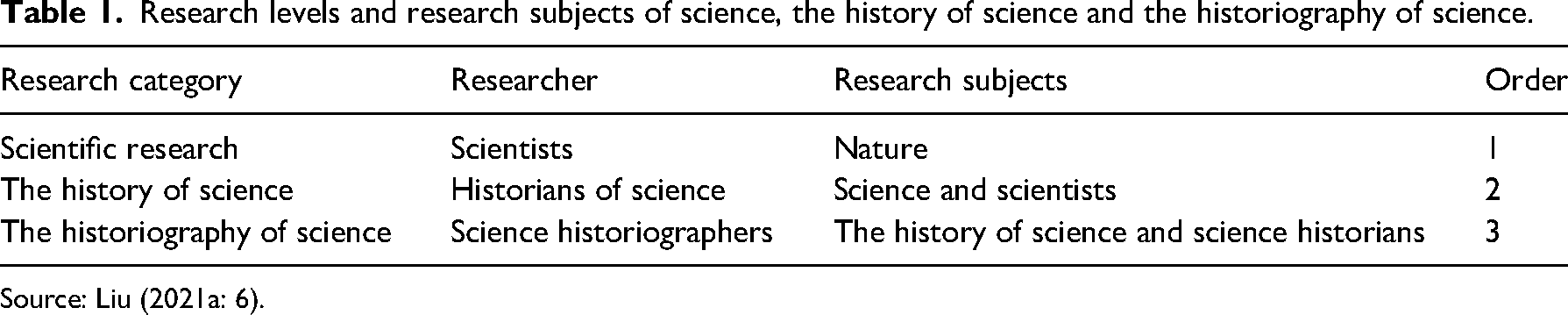
Research levels and research subjects of science, the history of science and the historiography of science.
Source: Liu (2021a: 6).
Second, science communication. The author of the current paper has examined and analysed science communication and its related concepts, such as the popularization of science and public understanding of science, in previous studies (Liu, 2019). Excluding the communication of science among scientists themselves, science communication can be broadly categorized into two main components: formal education in the form of school science education, and informal education in the form of science popularization for the public. The former is a well-defined concept that requires no further clarification, while the latter is often defined as the process of making scientific knowledge accessible to non-specialists in society (i.e., the public), as well as to professionals in other fields who are not experts in the specific content being communicated (such as scientists in unrelated disciplines and historians of science) through various forms of intentional popularization and outreach activities.
The incorporation of the history of science within the formal educational system extends to both higher education and basic education, all for the purpose of achieving specific educational objectives. These objectives include bridging the gap between scientific and humanistic cultures, fostering an understanding of the nature of science and enhancing students’ scientific literacy. In higher education settings, aside from specialized scientific courses, the history of science is primarily integrated into general education courses and the curricula of various specialized disciplines. When it comes to basic education, the focus is on embedding the history of science into the curricula of diverse science courses, with the aim of targeting a broader audience.
Internationally, a pivotal moment was the Harvard Physics Teaching Reform Program during the 1960s and 1970s. This initiative was concurrent with broader educational reforms in the US, financially supported by the National Science Foundation, and involved physicist and historian of physics Gerald Holton, as well as educators, secondary school teachers and historians of science. The culmination of the project was the publication of The Project Physics Course, a secondary school physics textbook, in 1970. The textbook was notable for its substantial inclusion of the history of science and its clear humanistic perspective, making it one of the most influential physics textbooks in the US (Holton, 2003). It has since been translated into Chinese and published in China. Following this, the American Association for the Advancement of Science published the report Science for All Americans in 1989 as an outcome of the renowned ‘Project 2061’. The report clearly articulated the requirements for understanding the nature of science, encompassing the philosophy, ethics and sociology of science. It specifically highlighted the importance of historical perspectives, noting two reasons for incorporating historical knowledge of science: the need for concrete examples to illustrate general scientific processes and the cultural heritage value of the scientific enterprise (Rutherford and Ahlgren, 2011).
In fact, understanding the nature of science is a central requirement in this context. The Next Generation Science Standards introduced by the US in 2013 specifically mentioned the integration of the history of science, acknowledging the use of historical examples as a method for illustrating and developing an understanding of the nature of science. The case studies on the history of science provide a contextual framework for students to grasp the nature of science, which is especially beneficial at the middle and high school levels, where such studies can broaden and deepen their comprehension (NGSS Lead States, 2013).
In the context of basic science education in China, the integration of the history of science is also gaining increasing emphasis. For instance, the new edition of the physics curriculum standards, developed by the Ministry of Education, ‘highlights the nature of physics, extracts educational values from many aspects, which include physics perspective, scientific thinking, scientific inquiry, and scientific attitudes and responsibility, and fully embodies the unique value of physics in improving students’ core competencies’ (Ministry of Education, 2021: 2), and it contains specific teaching requirements on the content of the history of science in multiple paragraphs. Similarly, the Compulsory Education Science Curriculum Standards, released by the Ministry of Education in April 2022, has introduced benchmarks for comprehensive science education (Ministry of Education, 2022). Compared to the previous curriculum standards, there is a notable increase in references to the history of science in the latest version. In the ‘Teaching tips’ and ‘Suggestions for teaching materials’ sections, in particular, the references to the history of science are directly linked to the nature of science. Given the focus of science education on nurturing core competencies, using the resources of the history of science in science teaching is one of the most effective means to illuminate the fundamental nature of science.
Utilizing the resources of the history of science in science popularization
Science popularization is a concept with distinctive Chinese characteristics. This author has once provided a brief overview of the development of the concept and the shifts in its meaning (Liu, 2019). In summary, the concept of science popularization in China has evolved from one that was focused on the dissemination of scientific knowledge and close alignment with production needs to one that encompasses ‘scientific knowledge, scientific methodology, scientific thought, and the spirit of science’ as its core elements. This evolution has been partly influenced by the theory of ‘public understanding of science’ in Western countries and has seen the emergence of the notion of ‘reflective science communication’, which targets the spread of scientific culture. In this transformative landscape, the use of the resources of the history of science becomes significantly important in various forms of science popularization, not only for disseminating scientific knowledge but also for promoting methodological, conceptual, intellectual and cultural content. Particularly in those science-popularization activities that are focused more on scientific culture or referred to as ‘science humanities’, the role of the history of science is even more prominent. For instance, in the genre of popular-science books, there is a growing body of works that integrate the history of science, either by enriching popular reading materials with significant historical content or by publishing books that are specifically centred on the subject of the history of science.
In recent years, beyond the traditional emphasis on the spirit of science in science popularization, the relevant authorities in China have begun to advocate the dissemination of the spirit of scientists, which marks a new trend within the realm of science communication. In response to this advocacy, both in the conduct of science-popularization activities and in the publication of popular-science literature, the spirit of scientists is best captured through biographical accounts of scientific figures, which are also considered the progeny of the history of science. That is because science, at its core, is a human endeavour carried out by scientists. The biographies of scientists concentrate on the personal endeavours of scientists, thereby undertaking functions that are not covered by more general historical accounts. For this reason, they hold a unique position in the history of science. The biographies offer an accessible and tangible portrayal of the scientists’ research endeavours, their aspirations and their day-to-day experiences, making them ideally suited to advance the mission of promoting the spirit of scientists in science popularization.
Science-popularization venues play a pivotal role in disseminating scientific knowledge. Strictly speaking, there are two types of venues that have the closest ties with science popularization: science and technology museums and science centres. Of course, there are also many cultural museums not explicitly dedicated to science or named as such, but that still contributes to the dissemination of scientific and technological knowledge in the broader sense. Science and technology museums, including natural history museums, focus primarily on collecting and displaying exhibits, while science centres prioritize interactive experience with the visitors and put greater emphasis on educational functions. Currently, the majority of science and technology museums in China are in the category of science centres. For these museums, their collection-based exhibitions inherently carry a historical dimension, although the historical perspectives presented may vary greatly. For instance, in the development of the renowned Smithsonian museums in the US, there have also been different understandings, debates and shifts regarding the relationship between the orientation, objectives and contents of exhibitions and the history of science (including technology and engineering histories) at different times (Henson, 1999). In recent years, even science centres have started to integrate elements related to the history of science (particularly content involving the spirit of scientists), either directly or indirectly, into their science-communication efforts through temporary exhibitions and other means (Liu, 2021b). Of course, such evolution is in alignment with the ever-changing concept of science popularization.
Challenges and problems in harnessing the resources of the history of science for science communication
On the surface, the history of science might seem like a straightforward recounting of scientific progress through the ages, and so it is not very difficult to understand and grasp compared to some of the ‘hard’ scientific disciplines. Such a perception is not uncommon among science communicators, who often think that it is more difficult and important to comprehend the content of science rather than its historical context. The history of science is a relatively young academic discipline and could be just an avocation for some scientists in its earlier stage, but, after nearly a century of development, research in this field has become more specialized or, to be more specific, professionalized, and the history of science has also evolved into a distinct discipline, boasting its own professional autonomy, independent value standards and research norms.
For individuals whose responsibilities include communicating the history of science but who lack the benefit of systematic professional training in this area, their grasp of the discipline may be superficial and does not equate to the deep understanding possessed by professional historians of science, who are well versed in the established norms and standards in this field. This divergence in comprehension can create difficulties in effectively utilizing the history of science as a resource in science communication. As a matter of fact, these problems have been present since the early days. For instance, during the 1950s, when the history of science was still in its nascent stage, George Sarton, the father of the discipline, made pointed criticism regarding the substandard teaching of the history of science in American universities: There is a large group of men of science, perhaps a majority, who are interested in the history of science, nay, enthusiastic about it, but hardly see the necessity of studying it. ‘It is all so simple and so easy, hardly a man's job.’ They know well enough [their own] scientific difficulties but have no idea whatsoever of historical methods and pitfalls. History is easy to read, but it does not follow that it is easy to write. Indeed, it is very difficult to find the truth in historical matters, and having found it, to express it clearly. Impromptu lectures on the basis of one or a few incomplete textbooks, there are no others, will not do any longer. The scholar who is privileged to teach the history of science must be prepared to speak from the abundance of his knowledge and experience. His teaching must be a kind of overflow or otherwise it is not worth having. He is obliged to simplify a great deal, because the subject is so large, the time so short, and the students have many other things to study. I believe his teaching should be as simple as possible, but a simplification without an adequate knowledge of a multitude of unmentioned details is spurious and misleading. Teaching is like paper money which is worth nothing without a gold reserve or other guarantee, hidden but substantial. No teaching at all is much cheaper and far less dangerous than bad teaching. (Sarton, 1952: 44–66)
The value of the historiography of science in science communication
The criticisms levelled by science historian George Sarton were specifically aimed at the teaching of science history in universities. However, of teachers involved in primary and secondary school science education, as well as individuals engaged in various forms of science popularization, not many have received systematic training in the history of science. Moreover, due to the demands of their work, time constraints and other practical considerations, it is not easy for these professionals to pursue the systematic study of the history of science during their careers. Considering the evolution of the discipline of the history of science, the research methodologies in the field, people's understanding of the essence of science and history, and also their views of science and history are all in constant change. To effectively leverage the latest research findings on the history of science in science communication, one practical approach is to develop a basic understanding of the historiography of science.
From the perspective of the historiography of science, it is important to recognize that historians of science from different ages and academic schools hold different historiographic positions (including their scientific, philosophical and historical views) and employ diverse research methodologies. These factors significantly influence their historical narratives, resulting in distinct accounts of the history of science. For those engaged in science communication, gaining a basic understanding of the principles of the historiography of science could be helpful as they explore the use of available resources on this subject. This knowledge will enable them to appreciate the diversity of existing works on the history of science and make distinctions between works produced by historians of science from different ages and with different positions. It will also assist them in choosing works that are not only reflective of the most recent scholarly research but also professionally credible and relevant to their specific audiences, and in putting them to use in science communication. Here are two examples.
The first example concerns the ‘Whig’ interpretation of history and the history of science, which is a central issue in the historiography of science. To put it simply, Whiggish historians operate from a modern vantage point, selecting and framing historical narratives by contemporary standards. While this method allows for a direct and unencumbered narrative, it tends to reduce the complexity of historical connections and can lead to a distorted perception of the continuum between the past and the present. Conversely, the anti-Whig approach aims to uncover and explain the disparities between the past and the present, and restore the richness and complexity of life in the past. In its early stage, the history of science was written only by a few professional science historians and a wider group of scientists who had scientific backgrounds but approached the history of science merely as a secondary interest. As a result, their works mostly took a Whig stance. However, by the mid-twentieth century, the growing professionalization of the history of science, coupled with an expanding community of researchers, marked a significant shift. A new generation of historians, from the outset of their careers, benefited from extensive training in the humanities, laying the groundwork for new research traditions and value standards. As some may have noticed, one of the crudest terms that this new generation of professionals likes to use when referring to works on the history of science that they consider outdated is to say that those works are ‘Whiggish’. In practice, to foster scientific literacy and a nuanced understanding of the nature of science, it would be better if science-popularization workers and science teachers could be mindful of the concept of Whig history when selecting the materials they intend to utilize. By discerning and selecting works that are the product of professional historians known for their rigour and expertise, they can steer clear of imparting a reductive, binary perspective on the history of science to their students, but facilitate an appreciation for the rich tapestry of historical events, the unforeseen twists and turns, and the multifaceted evolution that characterizes the scientific endeavour.
The second example concerns biographies of scientists. The biographical method—a distinct approach within the history of science—focuses on the activities of individual scientists. As such, it is able to fulfil functions that other research methods cannot, and is particularly adept at capturing the spirit of scientists. In addition, the intimate, direct and tangible nature of the biographical method also makes it well suited for science communication. However, the Victorian biographies that emerged in the nineteenth century adopted a hero-worshipping, non-critical approach. Such a trend has also left its imprint in the biographies that fall under the umbrella of the history of science. A typical scientist in such biographies is often portrayed as a genius battling against the ignorance of his or her times, holding extraordinary ideas that are either astonishingly prescient or could be seamlessly woven into our modern understanding of science. For this reason, ‘the biographer, however, will often be tempted to identify himself with the subject and present the portrayed scientist as a hero; while his opponents and rivals are presented as villains. When this happens, the biography degenerates into so-called hagiography, uncritical black and white history’ (Kragh, 1989: 168). Moreover, many scientific biographies read like legends and myths. An example of this is Eve Curie's biography of her mother, Madame Curie, which has already been translated into Chinese. Although failing to meet the rigorous standards of modern historical research, such biographies have been very effective in spreading legends and myths (Li and Liu, 2007). Correcting these myths ought to be an essential responsibility of serious research on the history of science. Such corrections should also be reflected in the selection of biographical materials if scientists’ biographies are to be used for the purpose of science communication.
In addition to the two important issues discussed above, there are many more issues involved in science historiography with respect to the understanding of the history of science, which will not be elaborated upon individually here.
Conclusions
In contemporary science communication, leveraging resources related to the history of science has garnered increasing recognition as an indispensable tool for impactful science communication. However, due to their professional backgrounds, most science communicators have not received systematic and comprehensive training in the history of science, and hence lack a proper understanding of the subject. This gap in knowledge can influence their ability to select and effectively employ historical resources in science communication. Compared to the attempt to attain a comprehensive and systematic grasp of each aspect of scientific history (including the general history of science, the social history of science, the history of scientific thought, period-specific histories and histories of individual scientific disciplines, as well as biographies of scientists), studying the foundational principles of the historiography of science is a more time-efficient and effective way for science teachers and science communicators to get a full picture of the history of science. It also enables these professionals to better navigate the diverse resources available and to integrate these resources into their work more effectively.
Footnotes
Declaration of conflicting interests
The author declared no potential conflicts of interest with respect to the research, authorship, and/or publication of this article.
Funding
The author received no financial support for the research, authorship, and/or publication of this article.
Author biography
Bing Liu is a professor of Tsinghua University and an adjunct professor at the Institute for Cultural Heritage and History of Science and Technology, University of Science and Technology Beijing. He is also the director of the Center for Science Communication and Popularization of CAST−Tsinghua University. His research interests include the history of science, the philosophy of science, science education and the communication of scientific culture.