



Abstract
In September 2024, a meeting was held in Paris to celebrate the life and works of the Chinese mathematician Liu Hui. This included a UNESCO-sponsored exhibition devoted to Liu Hui and an international symposium organized under the joint auspices of UNESCO and the Chinese Association for Science and Technology to consider ‘Liu Hui's academic thought’. In this paper, brief descriptions and assessments of Liu Hui's two major works, Nine Chapters on the Art of Mathematics and the Sea Island Mathematical Manual, are presented, along with an evaluation of their importance in the global history of mathematics. Liu Hui was a pioneering mathematician of outstanding significance, as reflected in the UNESCO symposium and exhibition in Paris honouring him as a ‘world treasure’. UNESCO designates World Heritage sites all over the world and, likewise, it has designated Liu Hui as a World Heritage mathematician.
Keywords
Introduction
要取其会通而已。
The key point is to be able to understand the entire problem and then integrate the parts.
—Liu Hui, commentary on Problem 5.22 of the Nine Chapters.
In September 2024, a meeting was held in Paris to celebrate the life and works of the Chinese mathematician Liu Hui, and 2024 was designated the year of his ‘birth anniversary’. The UNESCO website describing this event began with the caption: ‘1800th Anniversary of the Birth of Liu Hui (China with the support of Azerbaijan and Republic of Korea)’ and continued as follows: Liu Hui, from Zouping, Binzhou, Shandong Province, was a great mathematician during the Wei and Jin Dynasties and one of the founders of Chinese classical mathematical theory. His masterpieces Jiuzhang Suanshu zhu (Annotation on the Nine Chapters of Mathematics) and Haidao Suanjing (Sea Island Mathematical Manual) are China's most valuable mathematical heritage. (UNESCO, 2023)
The celebration included a UNESCO-sponsored exhibition devoted to Liu Hui and an international symposium focusing on ‘Liu Hui's academic thought’. Paris, as the world headquarters of UNESCO, was an especially fitting venue, given that the man who has been said to have put the ‘S’ in UNESCO, Joseph Needham, is also well known for having championed the richness and significance of Chinese science and technology (UNESCO, 1985). He did so not only through the well-known series of volumes, Science and Civilisation in China, but through the work of the Needham Research Institute in Cambridge, England, which he founded to promote research internationally on the history of science, technology and medicine in East Asia (Figure 1).
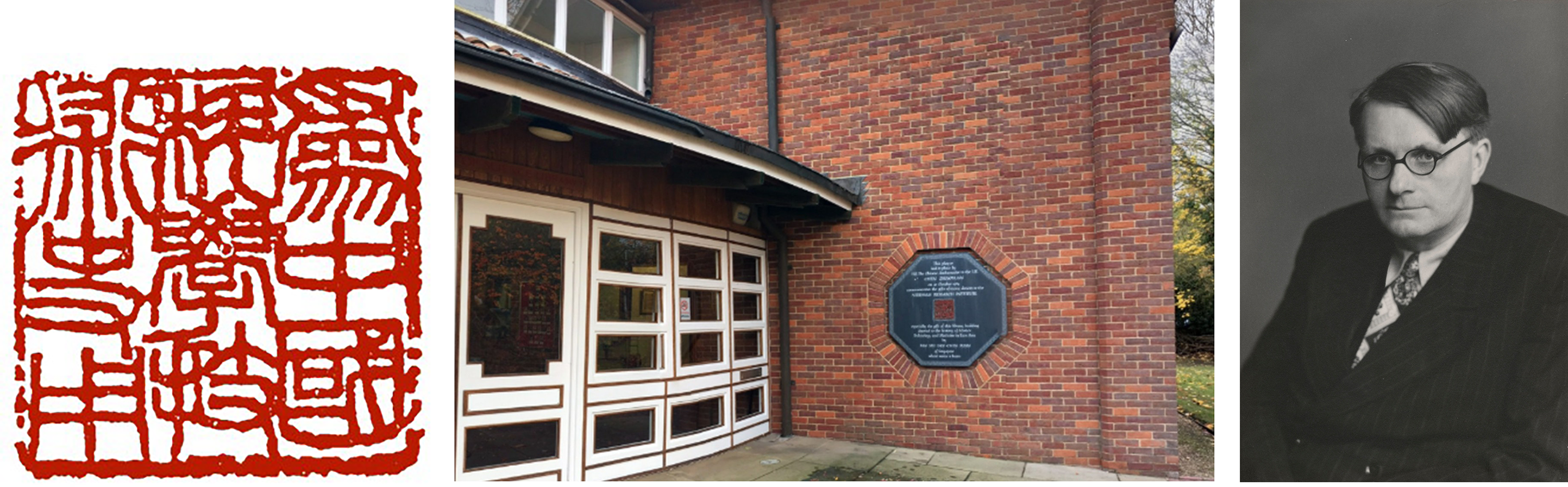
Needham Research Institute and Joseph Needham. Left: Seal of the Needham Research Institute (NRI); Centre: Entrance to the NRI, images reproduced courtesy of the NRI, University of Cambridge; Right: Joseph Needham, FRS, photograph by Walter Stoneman, March 1949, reproduced here by permission of the National Portrait Gallery, London.
Just over a decade ago, another international conference was held in June 2013 to celebrate the 1750th anniversary of Liu Hui's completion of his commentary on the Nine Chapters. The meeting took place in Liu Hui's presumed home town in Zouping County, Shandong Province, from 21 to 26 June 2013. It was sponsored by, among others, the Department of Culture of Shandong Province, the Institute for the History of Natural Sciences of the Chinese Academy of Sciences, the Chinese Mathematical Society, the Chinese Society of History of Science and Technology, the Chinese Society for the History of Mathematics and various committees and government agencies in Shandong Province, but was organized largely through the efforts of Guo Shuchun, Feng Lisheng and Zou Dahai (Figure 2).
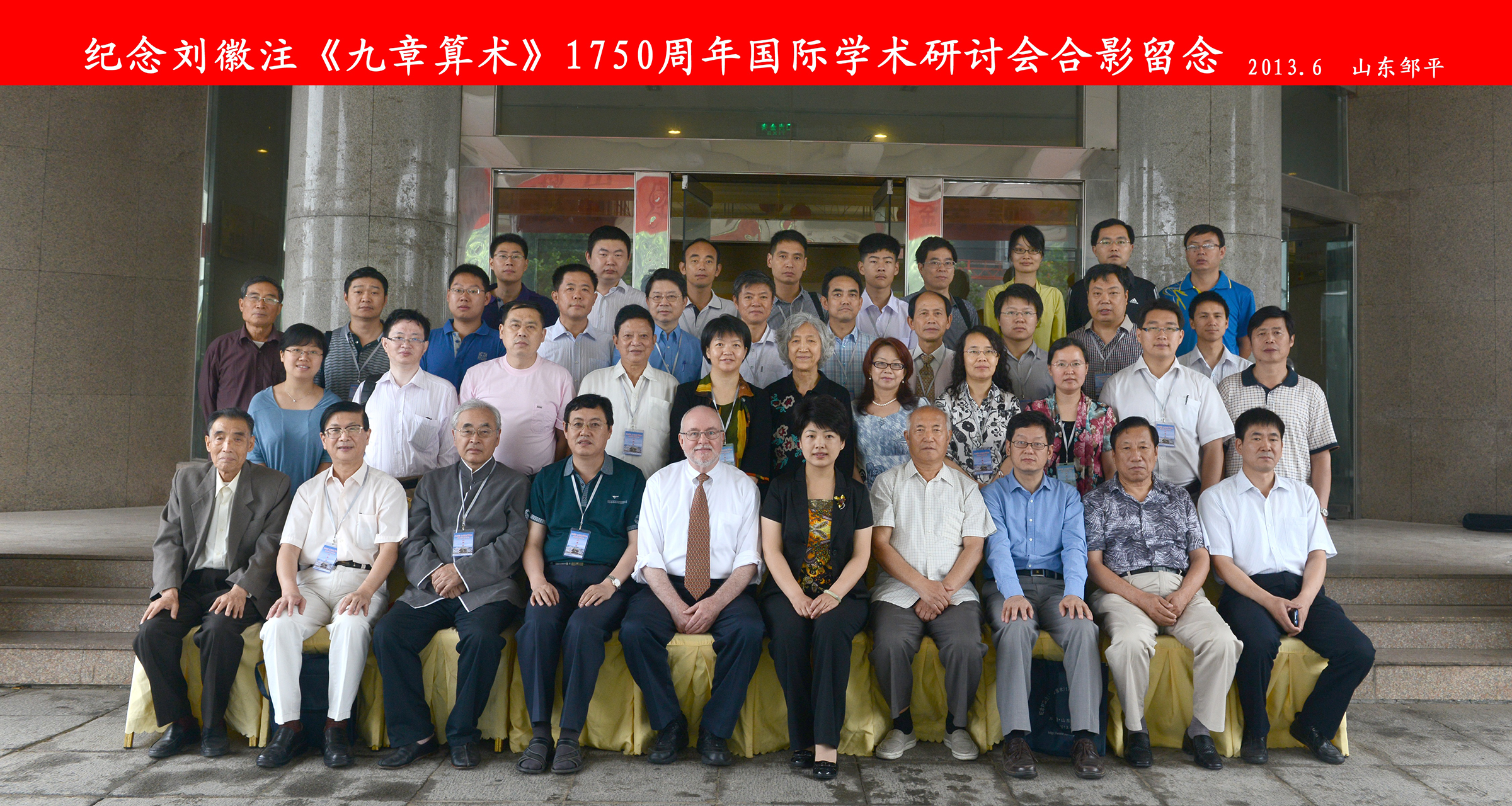
Participants in the meeting organized to celebrate the 1750th anniversary of Liu Hui's completion of his commentary on the Nine Chapters. Photograph courtesy of Zou Dahai, Institute for the History of Natural Sciences (CAS), Beijing.
Like the commemoration slightly more than a decade ago at the Shandong Province meeting, the Paris symposium also sought to reflect on the significance of Liu Hui's achievements. Despite the fact that details about his life remain obscure, the magnitude of his accomplishments cannot be overestimated.
For example, when Liu Hui surveyed the version of the Nine Chapters that had survived the legendary ‘burning of the books’ centuries earlier in 213 BCE, he realized that it was incomplete and far from being in satisfactory condition. As a result, he began to add his own notes in annotating the text to explain what was most difficult, to alert readers to important details, and to address omissions that needed to be filled, to the extent that he even felt it necessary to add a new, additional 10th chapter of his own. Consequently, what we were celebrating in 2024 in addition to the Nine Chapters should really be called the ‘Ten Chapters’—with the addition of his own Sea Island Mathematical Manual.
Nevertheless, the importance of the Nine Chapters throughout the history of Chinese mathematics is confirmed again and again, despite the fact that for long periods it was virtually unknown, only to be rescued again by mathematicians with a desire to know what their earliest forefathers had actually accomplished. But there remain many unanswered questions about the Nine Chapters that might never be answered. In the course of time, archaeological research may well help to add to the record of lost texts from which more might come to be known about the Nine Chapters. This has certainly been the result of the recent discoveries of the Shu (数) and Suan shu shu (算数书), and the new light they have shed on the early development of ancient Chinese mathematics has already made itself felt (Cullen, 2007; Dauben, 2008; Dauben and Zhou, 2025).
Among questions that remain unanswered is the exact time at which the Nine Chapters was actually compiled. Who, in fact, was Liu Hui? Was he responsible for anything other than the commentary on the Nine Chapters and the Sea Island Mathematical Manual, and was he really the author of all the comments attributed to him? Then there is a problematic reference to the Wang Mang standard measure in the Jin dynasty (265–316 CE) arsenal, which contradicts the presumed date of Liu Hui's composition of the Nine Chapters in 263 CE. Either the attribution of the date in the Jin and later Sui dynastic histories is wrong, which is certainly conceivable, or Liu Hui revised the manuscript after it had been finished, or someone else, possibly Zu Chongzhi or his son Zu Gengzhi, may have added the reference to the Jin arsenal standard measure without identifying himself as another commentator on the text (Wagner, 1978a, 1978b).
For the history of Chinese mathematics, the Nine Chapters set a standard for mathematical explanation and analysis that was not to be matched for nearly a thousand years, until the Song dynasty, when there was a renaissance of mathematical activity and a sudden burst of interest in original research and new ideas. Until then, there were only a very few mathematicians of whom we know anything, and who were inspired either by Liu Hui's commentary or their own reasons for improving on the results of the Nine Chapters, as for example the desire for better values of pi (π), or the interest in obtaining a final solution establishing the correct formula for the volume of a sphere.
Liu Hui the mathematician
In his preface to the Nine Chapters, Liu Hui describes his own evolution as a mathematician as follows, noting that he had studied the Nine Chapters as a boy and then read it again as an adult more carefully. Writing in the third person, he explains as follows: By observing the dichotomies of yin and yang, penetrating to the origins and roots of the art of mathematics, and exploring its mysteries at leisure, he succeeded in comprehending its essential meaning … elegant language is used to analyze principles, diagrams are used to dissect [geometric] solids, and hopefully though [the explanations] are brief, they are also thorough and cover everything without being clumsy, and those who read them should understand [al]most everything. (Liu Hui, quoted from Guo et al., 2013: 11) By investigating analogies, it is possible to increase knowledge, thus even though something is remote, distant, or slyly concealed, there is nothing that does not fit [the 重差 chong cha (double-difference) method, i.e., there is nothing that cannot be measured]. Erudite men of noble birth, please read this carefully. (Liu Hui, quoted from Guo et al., 2013: 21)
In addition to results and providing the methods necessary to achieve them, Liu Hui also appreciated the importance of clear explanations. One of his lasting and most consequential influences as a mathematician was the value he placed on proofs as a necessary element in mathematical exposition. Nevertheless, there is a prevailing misconception held by many for far too long that ancient Chinese mathematics contained no proofs. This was expressed quite plainly as recently as 1995 in a general history of mathematics as follows: Mathematics was overwhelmingly concerned with practical matters that were important to a bureaucratic government: Land measurement and surveying, taxation, the making of canals and dikes, granary distributions, and so on … Little mathematics was undertaken for its own sake in China. (Burton, 1995: 26)
But in fact, quite the contrary is true, at least by the time Liu Hui came to write his commentary on the Nine Chapters. His annotations are replete with proofs of many different kinds, but all reflecting the true spirit of the mathematician. As Karine Chemla has put it in a recent book devoted to the subject of proof in ancient mathematics generally, the basic assumption has long been that mathematical proof emerged largely in the works of Euclid, Archimedes and Apollonius, with the theory of demonstration articulated in detail in Aristotle's Posterior Analytics. As Chemla surmises: Before these developments took place in classical Greece, there was no evidence of proof worth mentioning, a fact which has contributed to the promotion of the concept of ‘Greek miracle.’ This account also implies that mathematical proof is distinctive of Europe, for it would appear that no other mathematical tradition has ever shown interest in establishing the truth to statements. Finally, it is assumed that mathematical proof, as it is practiced today, is inherited exclusively from these Greek ancestors. (Chemla, 2012: 1)
One of the great advances of ancient Chinese mathematics was the dramatic change from the pre-Qin and Western Han texts that have survived to the careful proofs to establish the efficacy of the methods presented in the Nine Chapters. While the texts of the Shu, the Suan shu shu and other early sources on bamboo strips are collections of problems, solutions and methods, by the time Liu Hui came to write his commentary on the Nine Chapters, a need to prove the correctness of the methods and results presented had clearly been felt.
Unlike the classic Western mathematical text of Euclid's Elements of Geometry, the original Nine Chapters was not a work devoted to proving results but rather to solving problems. Nevertheless, Liu Hui clearly believed that the straightforward approach of the text of the Nine Chapters required something more, and that the standard presentation of problem‒answer‒method needed refinement and the addition of explanations and arguments that would make clear the correctness of the results given in the Nine Chapters.
There is an important difference between the Greeks and their approach to mathematics and what Chinese mathematicians regarded as necessary in establishing the correctness of their results. The ancient Greeks were accustomed to arguing in courts of law and defending claims in democratic forums; the Chinese were not. The divide between the combative nature of Greek thought compared with a preference for consensus among the Chinese is one to which Geoffrey Lloyd has called attention in his book, Adversaries and Authorities: Investigations into Ancient Greek and Chinese Science (Lloyd, 1996). As far as their differing approaches to mathematics is concerned, Lloyd contrasts them in a chapter devoted to ‘Finite and infinite in Greece and China’, which he brings to a conclusion with the following observation: From the earliest Presocratic philosophers, down to the +6th-century Aristotelian commentators Philoponus and Simplicius, the preferred Greek style of reasoning, on the finite and infinite as on most other topics, was rather to attempt to disprove opponents by argument. But that, we can see, had the effect of prolonging dispute, rather than resolving it, and may thus have been one factor militating against the formation of an orthodoxy, whereas the Chinese, from Han times on especially, worked hard to produce one and largely succeeded in securing a common framework for discussion. (Lloyd, 1996: 164)
Significance of the Nine Chapters
Interpreting the significance of any text is a challenge, whether it is approached on its own terms apart from questions of authorship or with all due respect to contexts of time and place. The editions of the Nine Chapters that survive from antiquity are already several steps removed from either the original text or the prototypes on which the first versions of the Nine Chapters may have been based (Figure 3). The earliest version that survives is relatively late, just following the end of the Eastern Han dynasty, and comes with the commentary of Liu Hui, but not with those of previous compilers and editors, who presumably were responsible for the basic structure if not the entire ordering of the problems as they appear, chapter by chapter, in Liu Hui's version of the text.
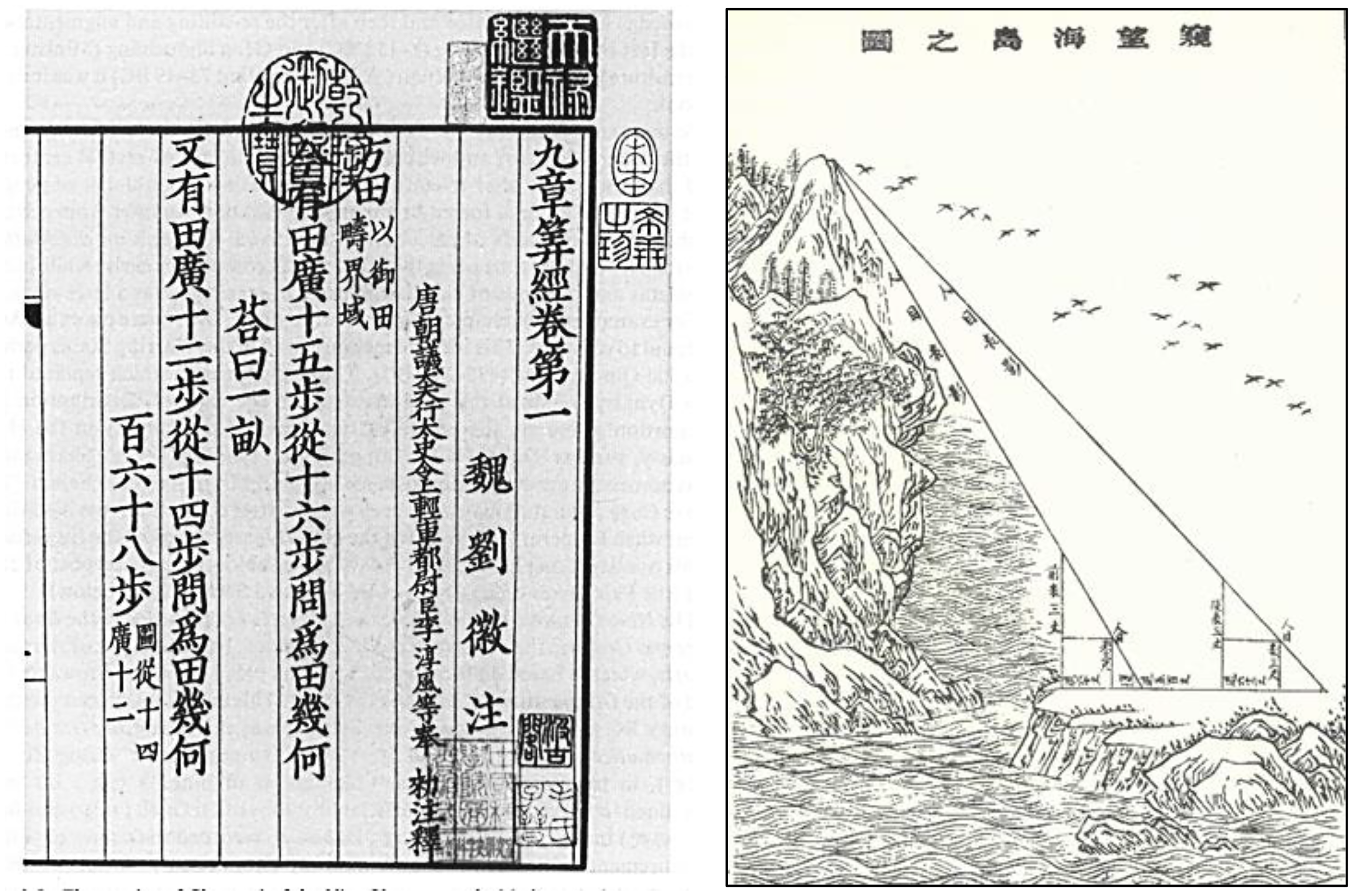
Images of the Nine Chapters and the Sea Island Mathematical Manual. Left: Title page of Chapter 1 of the Nine Chapters; Right: Diagram illustrating Liu Hui's double-difference method in the Sea Island Mathematical Manual (263 CE), from the Gujin tushu jicheng (古今图书集成, Complete Collection of Ancient and Modern Books and Illustrations) in 1726.
In addition to interpreting the basic meaning of the Nine Chapters and the separate issue of the later additions of its commentators, there are also non-verbal elements that comprise the various diagrams and counting-board procedures and layouts that are important components of understanding what ancient Chinese mathematicians did, both physically and mentally, in conceptualizing the problems for which they sought solutions and then found various ways of producing answers that take a variety of forms in the Nine Chapters. Often solutions are given in terms of algorithms, but also in terms of formulas that are simply computed by substitutions for given variables to determine areas or volumes of plane and solid figures.
The most challenging questions that arise with respect to the Nine Chapters are those concerning the basic assumptions and suppositions ancient Chinese mathematicians made in approaching the problems and solutions that the Nine Chapters has to offer. These are of special interest because often the underlying assumptions of Chinese mathematics are quite different from those assumed in Western mathematics, above all by those working in the tradition exemplified by ancient Greek mathematics in particular, where geometry was prized for its generality and arithmetic was taken to be especially problematic given the lack of any concept of incommensurable magnitude or irrational numbers. This was not a problem for Chinese mathematicians, who understood that some numbers could only be given approximately, and simultaneously realized that these approximations could be made as precise as one wished, and that was enough. In the case of pi, while 3 was often used as a practical first approximation, Liu Hui offered his own improvement on the rates of diameter and circumference of the circle, as did Li Chunfeng and others who produced even better rates in order to approximate the value for pi. For them, the meaning and accuracy of the ancient text were compromised by applying so obviously wrong a value for pi as represented by the 3:1 rates.
To give but one example of the thorny hermeneutic issues that arise in interpreting the meaning of important concepts in the Nine Chapters, consider the significance of the word 面 mian (side) in the extraction of square roots (mian is the side of the square representing the number conceived as an area, the root, or side, of which is to be determined). Liu Hui provides a straightforward algorithm whereby the root may be determined, but in cases for which the algorithm does not terminate (or at least the mathematician has reached an acceptable level of accuracy or has lost interest and does not wish to continue with the algorithm), he says the only exact solution is to let the side of the square stand for the square root: 当以面命之 dang yi mian ming zhi (the side should be used to represent the root).
This sounds almost like a tautology: of course the side will be the square root of the number representing the area whose root is to be found. But some have taken this phrase to mean that in fact, Liu Hui has hit upon the fact that the square root in such cases is irrational, and that the mian in fact stands for an irrational number. But this seems to attribute too much to what Liu Hui says. His comment acknowledges the fact that not all numbers or areas have an exact square root. The first to suggest that mian should be read as ‘irrational number’ was Li Jimin in a chapter he contributed to 中国数学简史 Zhongguo shuxue jianshi (A Concise History of Chinese Mathematics) (Li, 1986; see also Chemla, 1992; Chemla and Keller, 2002; Li, 1990).
But there is in fact no statement in what Liu Hui says that would suggest there is a distinction to be drawn between numbers that can be expressed evenly as the rates of two numbers and those that cannot. The fact that the mathematician chooses to abandon the algorithm before it stops does not mean, in the case of the square root, that the number must in fact be irrational. This has yet to be proved. The fraction 1/3, expressed decimally, does not terminate, but is nevertheless a rational number. Nor is there any hint of an argument by anthyphairesis (embodying the Euclidean algorithm to find the greatest common divisor, and one possible means by which Greek mathematicians established the existence of incommensurable magnitudes) that the process can in fact go on indefinitely without terminating (for the concept of anthyphairesis in Greek mathematics, see Dauben, 1984; Fowler, 1999; Knorr, 1975).
Liu Hui actually applies an anthyphairetic sort of argument in his analysis of the yang ma in Problem 5.15 in the Nine Chapters, where he makes a famous observation regarding the fact that the relation between the volumes of the bie nao and yang ma is always the same, 2:1, no matter how often one may divide them to whatever degree of refinement one may wish. However, no such anthyphairetic type of argument is used by Liu Hui to prove the existence of incommensurable magnitudes or irrational numbers. As for Chinese mathematicians, having reached a number the square of which was very nearly the originally given number or area in question seems to have been a satisfactory approximation, as were the various rates they found acceptable for the circumference and diameter of the circle. Surely Liu Hui knew that the square root process could continue with better and better approximations of the root, but possibly to no particular purpose. Had Liu Hui discovered the existence of numbers for which there was no equivalent rational expression, surely he would have made a point of emphasizing this conclusion. Unlike the ancient Greeks, who understood that incommensurable magnitudes posed a problem for the completeness of arithmetic, their emphasis upon geometry which did accommodate incommensurables as opposed to arithmetic finds no parallel in ancient Chinese mathematics (for further discussion of these points, see Lih, 1994).
One final issue should also be mentioned about challenges related to the translation of ancient Chinese mathematical texts. Alexei Volkov has pointed out an interesting problem that all translators and interpreters of texts must face. He notes that ‘one still can wonder whether the conventional format of translation can satisfactorily render Chinese mathematical texts such as Liu Hui's commentary, which in certain cases seems to have been left intentionally ambiguous by its author as well as by later editors. Making the original ambiguity of the commentary less ambiguous in translation would in this case, paradoxically, amount to its misinterpretation’ (Volkov, 2010: 295–296; emphasis added). Volkov himself has taken the approach of ‘double readings’ of certain passages that seem to have possible variant meanings, particularly with respect to Liu Hui's use of infinitesimal methods in his calculation of the volume of a pyramid (for details, see Volkov, 1987).
Who were the mathematicians of ancient China? What were the various relations that linked them to students and patrons, to the bureaucracy that depended upon mathematics in a host of applications, from the construction of calendars to the massive public work projects undertaken by the empire, and on lesser scales in provinces and cities by families living in the rural countryside? Is it possible to identify any common characteristics of mathematicians in ancient China, given that their individual biographies are largely untraceable? While this is not the place to offer any extensive, collective analysis of what is known about this group, some basic patterns of relationships and activities of those who would have been served by the Nine Chapters are useful in elucidating the nature and purpose of the work itself.
What were the relations and connections among those who considered themselves mathematicians? Is it possible to say anything with certainty about the likes of Liu Hui, about whom virtually nothing is known apart from the fact that he was a subject of the Kingdom of Wei in the mid-3rd century CE? One factor related to the problem of determining who the mathematicians of ancient China were is the matter of their status within traditional Chinese society. As Le Xiucheng has observed: The Chinese traditionally regarded calculation as a skill and method. Therefore, mathematicians and mathematical research had no place in Chinese feudal society. In many cases, a mathematician's social status and conditions for conducting mathematical research depended on his work on the astronomical calendar. The evaluation mechanism, which emphasized practicality, was unfavorable to the advancement of mathematical theory, to the effective accumulation of mathematical achievements, and to higher-level development because as the degree of mathematical abstraction continually increased, the practicality of some theoretical achievements in mathematics became very difficult to evaluate. (Le, 1996: 259)
Ho Peng Yoke points out that the dynastic histories of this period reflect the names of a number of individuals whom he identifies as ‘mathematicians’, such as Zhang Cang, Geng Shouchang, Xu Shang, Liu Xin, Zhang Heng, Wang Fan and Liu Hui. Christopher Cullen, in a prosopographical study of the mathematicians of the Han dynasty, has surveyed Ruan Yuan's (阮元) 畴人传Chou ren zhuan (first published in 1799), a biographical compendium of the leading figures of Chinese astronomy and natural sciences, those who were in one way or another identified with 数 shu (number, to count) or 算 suan (computations), and persons well versed in mathematics in any of the many forms this might take in ancient China (Cullen, 2009: 614–616; note that from Ho Peng Yoke's list Cullen does not include Liu Xin, Wang Fan or Liu Hui, the last falling outside the time frame with which he was concerned, i.e., the Qin and Han dynasties).
Cullen's study takes an approach inspired by Ludwig Wittgenstein's (1958) Philosophical Investigations, whereby he seeks to identify the activities in ancient China that ‘would nowadays be called “mathematics”’ (Cullen, 2009: 593). Cullen associates mathematics in general with the practice of suan, and notes that this encompassed such diverse skills as computations, the creation of calendars and harmonics. Looking to the classification of books in the imperial library undertaken by Liu Xin (刘歆, ca. 50 BCE–23 CE) and his father Liu Xiang (刘向, 77–6 BCE) as reported in Chapter 30 of the Han shu, the section devoted to 数术 shu shu (numerical methods) includes works on astrology, calendrical astronomy, divinatory cosmology and divination, which greatly widens the areas in which mathematics or computational skills were regarded as essential.
By the Eastern Han dynasty, Cullen notes that the first example occurs of a master‒pupil relation, where suan is specifically mentioned, and this actually involved two women, the Dowager Empress Deng and Ban Zhao, sister of Ban Gu, one of the scholars most responsible for producing the Han shu (Cullen, 2009: 605). But as he also points out: Outside the palace there are also signs that suan was beginning to be seen as a topic of serious interest amongst the male master‒pupil scholarly lineages that dominated classical studies … It is in this milieu that we first hear of a named book on suan that is still extant today. This is the Jiu zhang suan shu 九章算術. (Cullen, 2009: 606)
Towards the end of his prosopographical study, Cullen devotes several pages to Liu Hui, whose concern for mathematics seems quite different from those of his pre-Qin and Han predecessors. Cullen quotes Liu Hui's preface to the Nine Chapters, and then comments as follows: The words used here by Liu Hui are significant. In his youth, he approached the ‘Nine chapters’ through xi 習, which describes a process of learning how to do something (such as reciting a text) through repetition and practice. In his maturity, he attained a different level of insight, described here as wu 悟, a word used in Buddhist discourse for the sudden break-through to enlightenment. What he aims to do in his book is to help other mature minds to make the same leap. (Cullen, 2009: 611)
This in fact is a reminder of how different were the times in which Liu Hui lived. The unity of the long reign of the Han dynasty was a thing of the past, and in its place were again warring states at odds with each other. The sure foundation of Confucianism upon which the Han dynasty had mostly relied was replaced by the rising influence of Buddhism and interest in diverse philosophies of the past, from Lao zi and Zhuang zi to even Mohist and Daoist ideas, including a renewed interest in some of the logical works of the Mohist canon. This may all help to explain why Liu Hui's thinking is so strikingly different from the known works either about or involving mathematics that preceded him (Cullen, 2009: 611).
As for the mathematics and the mathematicians of the Han dynasty, the period in which the Nine Chapters was crafted and came to serve as the major synthetic work of the mathematics that had been growing as a body of knowledge from the Warring States period and earlier times, the aims were fundamentally practical, and those who put the knowledge of mathematics into practice were those who wielded their counting rods to manage the state bureaucracy, oversee public works, set its calendars and prognosticate its fate, as had been the roles of those adept at suan all along.
The Warring States period in China was a time of significant social and political upheaval, culminating in the unification of the country under the Qin dynasty and Shi Huangdi. During this pre-Qin era, bureaucratic institutions, agriculture, craft industries and trade in a variety of commodities all experienced considerable development. Accompanying these changes were transformations in ideas, education and culture more broadly. Scholars with expertise in administrative computing, astronomy, calendar-making, harmonics and prognostication were widespread, and private schools began to emerge. The ‘hundred schools of thought’ had also appeared by the Warring States period, with debates among scholars and critiques of different philosophies and theories of statecraft further stimulating academic development, including the evolution of mathematics. The ‘nine categories’ (jiu zhang) system of mathematics, which had developed from the ‘nine computations’ (jiu shu) of the Western Zhou and Spring and Autumn periods, achieved a certain level of abstraction during this time, though its practical applications remained concrete. As Liu Dun has observed: [T]he research methods handed down from Confucius to the Han masters of the Confucian classics were still very influential. Scholars urged ‘describe past achievements, but don’t create new,’ and ‘use language which is subtle yet profound in meaning.’ A school of thought would often promulgate its own ideas by annotating the classics of previous dynasties. (Liu, 1996: 280)
Chinese mathematicians were not only expected to address practical issues; the rod numeral system and the algorithms employed on the counting board significantly advanced the fields of arithmetic and algebra, probably at the cost of geometry. Ancient Chinese philosophy introduced methods such as induction, analogy and experiential learning, which endowed scientific theories with both empirical and speculative dimensions. As Liu Dun points out: Liu Hui's technique of cutting circles fully demonstrates the dialectic of the straight and the curved. The concept of limits is just a natural product of this speculative philosophy. His geometric means consisted primarily of the right-triangle theorem and demonstrated perfect mastery of arithmetic. He created the ‘method of little nameless numbers’ of a decimal fraction system, and skillfully carried out multi-decimal calculations (to as many as 12 decimal places) by means of computing rods. His annotations on the Nine Chapters can be seen as an expression of traditional academic standards. (Liu, 1996: 286)
Liu Hui evaluated his own accomplishments and the power of mathematics to measure even distances that could not be measured directly at the very beginning of the Nine Chapters, in his preface, as follows: If one can measure the shape of the circular dome [of heaven] just like the Sun, then so too the height of Mount Tai and even the width of rivers and seas! [Liu] Hui, using current [surviving] historical records and examples of things in the heavens and on earth, examining the discussion [in the records] of their [use of] mathematics, as well as their goals, in order to express the beauty of their noble methods, then wrote the double-difference [chapter], added as a commentary, having studied the ideas of ancient authors, and written to come after the gou-gu [chapter]. To measure heights requires two gnomons, to sound the depths requires set-squares one above the other, [to find the distances of] isolated and distant [objects] requires three observations, and [to find the distances of] distant [objects] oblique to [i.e., not aligned with] the observer requires four observations. By investigating analogies, it is possible to increase knowledge, thus even though something is remote, distant, or slyly concealed, there is nothing that does not fit [the chong cha (double-difference) method, i.e., there is nothing that cannot be measured]. Erudite men of noble birth, please read this carefully (Liu Hui, quoted from Guo et al., 2013: 19–21).
For Liu Hui, mathematics was of profound importance, encompassing not only practical applications but embodying principles of cosmic significance as well. It served as a tool for addressing immediate concerns, such as commercial transactions and all manner of construction projects, while also including the measurement of the Sun's height and the calculation of celestial motions, including the position of the planets and predicting eclipses. Mathematics was also critical in prognosticating future events. At its most subtle, mathematics provided the means of investigating both the infinitely large and the infinitesimally small. Although few attained such elevated levels of understanding, among those who did and who was the earliest to do so in China of which any substantial record survives was Liu Hui.
Liu Hui in Paris
Although the celebratory year of Liu Hui's contributions under the auspices of UNESCO began in Paris in September 2024, this was not the first time Liu Hui had found his way to Paris. That happened as early as the 12th century, when Hugh of St Victor used the indirect method of double-differences to determine the distances of objects that could not be measured directly. This was the same as the 重差 chong cha method that Liu Hui had presented in what is now known as the Sea Island Mathematical Manual (Figure 3). As Kurt Vogel (1983) noted in a work titled ‘Ein Vermessungsproblem reist von China nach Paris’ (A surveying problem travels from China to Paris), Liu Hui was the first to provide both a problem and its solution for such problems in the Sea Island Mathematical Manual. This can be dated to 263 CE
Two hundred years later, the same method appeared in India, in the solution of a problem Āryabhaṭa posed in verse 16 of the mathematical chapter in his Āryabhaṭīya: The shadow, multiplied by the distance between the tips of the shadows, divided by the difference (between the shadows) is one side (koṭī); koṭī multiplied by the gnomon, divided by the shadow, is bhujā (the arm). (Vogel, 2002: 3)
Despite the difference in terminology, the essence of the method remains the same as Liu Hui's double-difference method. But Vogel points out how the presentation of the problem has been changed. Instead of surveying the distance to a far-away mountain, Āryabhaṭa determines the distance from a lamp to two poles, given the distance between the shadows cast by the two poles: It is no longer an exercise in surveying. From a lamp on a lampstand, the light falls on two poles (śaṅku), and what now has to be determined is the distance of the lampstand from the ends of the shadows. (Vogel, 2002: 3)
The double-difference method then travelled further westward when Arab mathematicians translated works by their Indian predecessors from Sanskrit into Arabic. For example, al-Bīrūnī in his astronomical work, The Exhaustive Treatise on Shadows (Kennedy, 1976), devoted an entire chapter to ‘On the determination of distances on land and the heights of mountains’, a title echoing the sorts of problems Liu Hui's method was devoted to solving in his own Sea Island Mathematical Manual, even if al-Bīrūnī had no direct knowledge of that work himself. Al-Bīrūnī specifically mentions Brahmagupta as his source for the problem (this time involving the light from a minaret shining on two gnomons), and the numerical values he uses are the same as in a double-difference problem given by Pṛūdakavāmin (Vogel, 2002: 4).
Vogel then traces the further transmission of Liu Hui's method to the Latin Middle Ages when it was applied to solve a problem in an 11th-century manuscript of the Geometria incerti auctoris (once ascribed to Gerbert), wherein various methods are given for determining the height of a distant mountain. The double-difference method likewise appears in Hugh of St Victor's Practica geometriae. Hugh taught mathematics in Paris, where he died in 1141. As Vogel concludes his survey of how Liu Hui's double-difference method had made its way from China to Paris, he notes: In the middle of the 14th century, the Practica geometriae of Dominicus de Clavasio also originated in Paris and was distributed widely in numerous manuscripts (Busard, 1965). Thus our travels from China to Paris come to an end. (Vogel, 1983, quoted from Vogel, 2002: 6–7)
Conclusion
Just as Liu Hui's double-difference method was transmitted from China westwards as far as Paris by the 12th century, in the years since, his significance as a pioneering mathematician of outstanding significance not only for the history of mathematics in China but on the world stage as well is now widely recognized. In Paris, in 2024, the City of Light served to illuminate the works of Liu Hui in an exhibition extolling his many achievements. Simultaneously, this issue of Cultures of Science serves to commemorate and elucidate further his significance as a world treasure. UNESCO designates World Heritage sites all over the world, and now through the Paris symposium in 2024 and the UNESCO exhibition dedicated to his achievements, it has designated Liu Hui as a World Heritage mathematician.
Also honouring Liu Hui is a forthcoming new collation of the text of the Nine Chapters by Guo Shuchun and Zou Dahai, which includes, in addition to the commentaries by Liu Hui and Li Chunfeng et al., the Song dynasty commentaries of Jia Xian and Yang Hui, offering yet another level of commentary on this classic text. This project is supported by a major grant from the National Social Science Foundation of China. A two-week meeting of the five researchers involved in this project thanks to the Oberwolfach Research Fellows Program also supported the completion of this work. Figure 4 shows (foreground) Joseph W Dauben, Jiang-Ping Jeff Chen and Horng Wann-Sheng at the Mathematisches Forchungsinstitut Oberwolfach (Schwartzwald, Germany), with (background) Guo Shuchun and Zou Dahai Zooming from the Institute for the History of Natural Sciences of the Chinese Academy of Sciences in Beijing in July 2024.
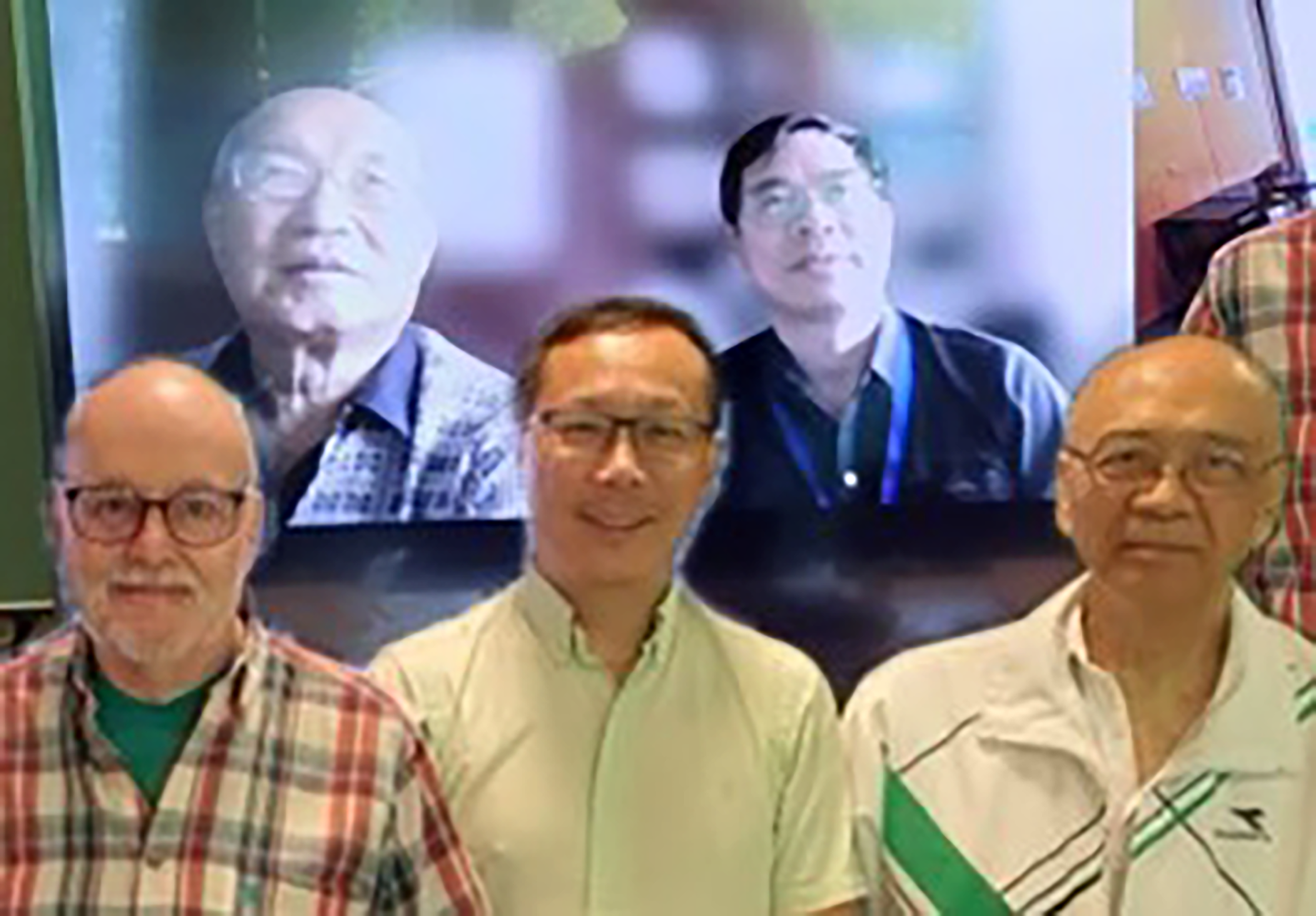
Mathematisches Forchungsinstitut Oberwolfach (Schwartzwald, Germany), Oberwolfach Research Fellows Program, July 2024. Back row: Guo Shuchun and Zou Dahai; foreground: Joseph W Dauben, Jiang-Ping Jeff Chen and Horng Wann-Sheng.
Footnotes
Acknowledgements
The author is pleased to thank the Isaac Newton Institute for Mathematical Sciences, University of Cambridge, for the award of a Simons Fellowship and for the institute's hospitality during its recent Modern History of Mathematics programme, when the final revisions of this article were made in the spring of 2025. This work was supported by EPSRC (grant no. EP/R014604/1).

Funding
The author received no financial support for the research, authorship, and/or publication of this article.
Declaration of conflicting interests
The author declared no potential conflicts of interest with respect to the research, authorship, and/or publication of this article.
Note
1. The material presented here was originally delivered in a slightly different form as a PowerPoint presentation given at the UNESCO forum as a plenary lecture delivered in my absence by Professor Jian-Ping Jeff Chen, Professor of Mathematics at St Cloud State University in Minnesota, USA. The revision and further development of my contribution prepared for this special issue of Cultures of Science in honour of Liu Hui was completed during my residence as a Simons Fellow at the Isaac Newton Institute for Mathematical Sciences, University of Cambridge, during its special ‘Modern History of Mathematics’ programme supported by the Engineering and Physical Sciences Research Council (EPSRC, grant no. EP/R014604/1) in the spring of 2025.