



Abstract
Liu Hui's Principle is the cornerstone of volume theory in ancient China. The proposal and demonstration of the principle resulted from Liu Hui's strong pursuit of mathematical demonstration in the specific social and cultural environment of the 3rd century CE. Liu Hui's demonstration can be divided into two stages. The first stage is a mathematical process involving finite steps. Liu Hui used blocks to perform the division and recombination of geometrical solids, employing the out-in principle, the concept of solid similarity and the method of cyclic recurrence—all of which originated from the early ancient Chinese mathematical tradition focused on algorithms. The second stage involves an infinite process. Liu Hui drew on the ideological methods of the Taoist and Mohist schools, and in particular used the thought of connecting ‘Being’ and ‘Nonbeing’ from the ‘Autumn Flood’ chapter of Zhuang Zi to handle the infinite process and its results, reflecting the application value of the Chinese philosophical tradition in mathematics. The demonstration of this principle indicates that the mathematical tradition and philosophical tradition in ancient China can be effectively combined. Among the many factors leading to this achievement, the most crucial are Liu Hui's personal abilities and qualities, while other factors such as the existing mathematical and philosophical traditions, as well as the social environment and cultural trends of Liu Hui's time, are also indispensable.
Keywords
Introduction
The Nine Chapters on Mathematical Procedures (九章算术 Jiuzhang Suanshu, ca. middle of the 1st century BCE, 1 hereafter the Nine Chapters) is the most important classic of mathematics in ancient China. Organized into nine chapters, it contains various methods for dealing with practical problems. The book collects the main part of mathematical methods and the corresponding problems from the pre-Qin period to the Western Han Dynasty (206 BCE–9 CE). Most of the methods in the Nine Chapters are correct and are expressed in a general and universal way, but the book does not record how they were established or why they are correct. This did not undergo a fundamental change until Liu Hui (刘徽) made his commentary on the Nine Chapters in the 3rd century CE. 2
Liu Hui was one of the two or three most outstanding mathematicians in ancient China, but we have very few sources about his life. Based on the Sui Shu (隋书), we know that he lived in the Kingdom of Wei (魏国, 220–265 CE) of the Three Kingdoms Period (三国时期, 220–280 CE), and he wrote his commentary on the Nine Chapters in 263 CE (see Wei, 1982: 404, 409). Based on the title as it appeared in records of sacrifices in the Song Dynasty, Guo (2013: 335–342) has inferred that Liu Hui's native place was Zixiang (甾乡), modern Zouping (邹平) in Shandong Province. According to the names of scholars and books, words, and expressions used in Liu Hui's commentary, it may be concluded that he was familiar with numerous works of contemporaries and even earlier times.
Liu Hui's commentary shows his effort to establish the basis of the methods in the Nine Chapters as well as to give new methods. Although he did not write out explicit axioms as a framework for his discussions, he indeed made his own effort to demonstrate or to explain why the methods in the Nine Chapters and other methods he provided in his commentary are correct on the basis of common reasoning accepted by most people of his day. One of the most important achievements to be found in his commentary is the so-called ‘Liu Hui's Principle’, for which he gave a creative demonstration. It is one of the most important achievements in the history of geometry in ancient China.
In order to understand what this principle involves, it is first necessary to consider several special solids used in ancient Chinese mathematics. Cutting a cuboid ABCD-A1B1C1D1 (Figure 1-1) by a plane through two parallel diagonals AD1, BC1 of two opposite surfaces creates two right triangular prisms D1DA-C1CB, D1A1A-C1B1B, which are named qiandu (堑堵, Figure 1-2). Cutting a qiandu D1DA-C1CB by a plane through two diagonals D1B, D1C makes a rectangular-based pyramid D1-ABCD with one edge D1D perpendicular to its base ABCD and a tetrahedron D1-C1CB with four right triangle faces, which are respectively called a yangma (阳马, Figure 2-1) and a bienao (鳖臑, Figure 2-2). The width, length and height of a cuboid are also designated as the width, length and height of the qiandu, yangma and bienao derived from the cuboid.
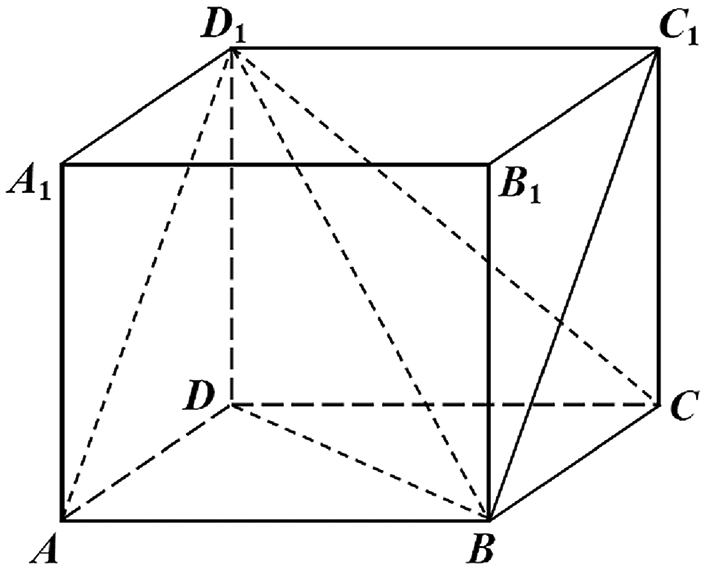
Cuboid.
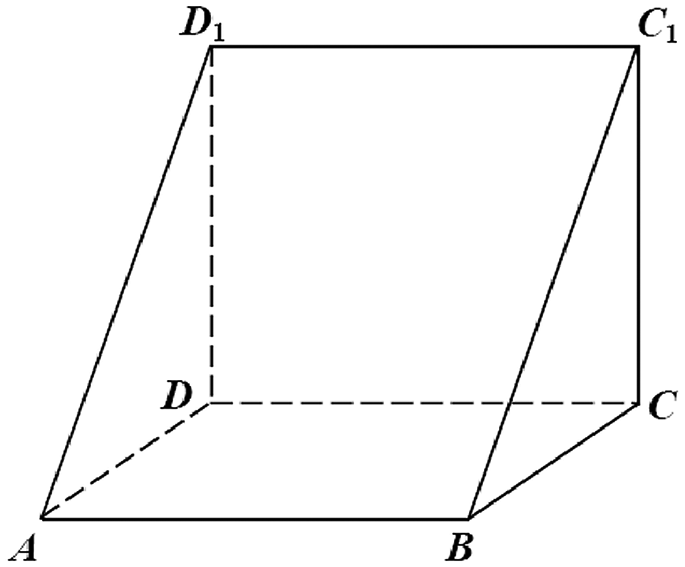
Qiandu.
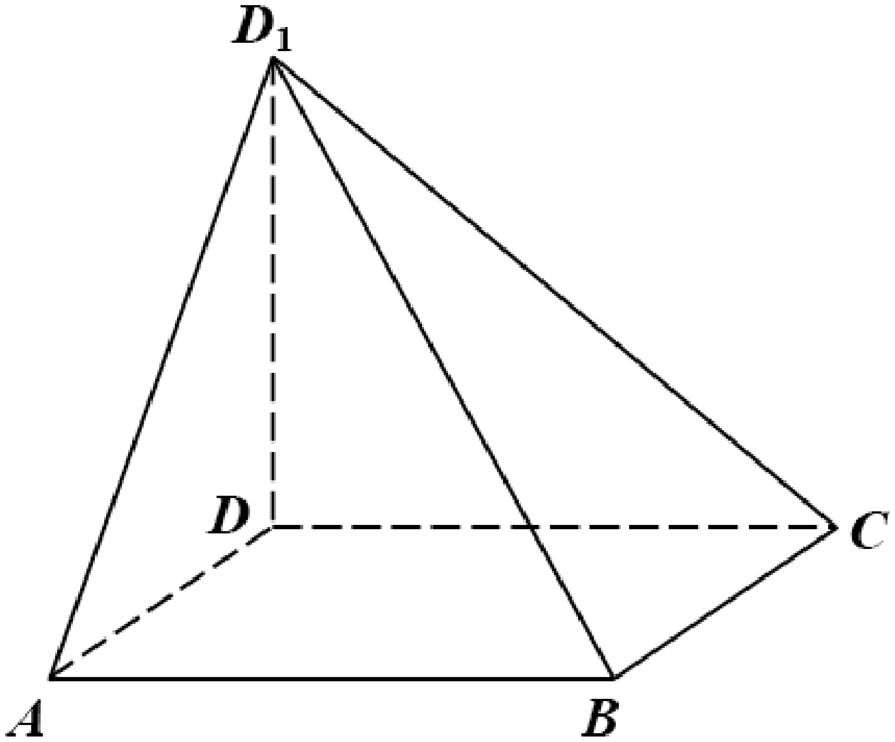
Yangma.
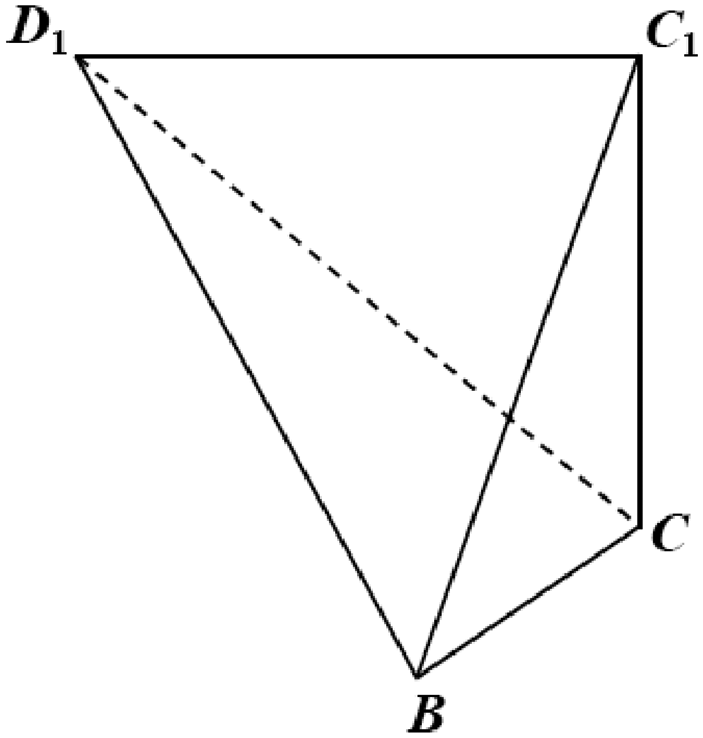
Bienao.
In Liu Hui's commentary on Chapter 5, Problem 15 of the Nine Chapters, he explicitly put forward the proposition that the volume ratio of yangma to bienao derived from the same qiandu is always 2:1, and provided a creative demonstration. Wu Wenjun (吴文俊) thought this proposition is very important and suggested naming it as ‘Liu Hui's Principle’ (Wu, 1978). This name has been used by many historians of ancient mathematics in China ever since.
In Problem 15 mentioned above, the Nine Chapters gives the method for finding the volume of a yangma as follows: ‘mutually multiply the width and length together, and multiply by the height, divide [the product] by 3 (廣袤相乘,以高乘之,三而一)’ (Guo, 2004: 182; Guo et al., 2013: 543). This method is equivalent to the following formula:

In Problem 16 of the same chapter, the method for finding the volume of a bienao is given as follows:

The above two formulae are correct. From these two formulae, ancient mathematicians could apparently find it easy to deduce that the ratio of the volumes of a yangma and a bienao with the same width, length and height is 2 to 1. No such proposition appears in the Nine Chapters. Why did Liu Hui put forward this proposition and provide a demonstration that was not derived based on the formulae in the Nine Chapters? This paper will discuss the motivation behind Liu Hui's formulation and demonstration of this principle, as well as the characteristics of his demonstration methods and their ideological origins.
The Nine Chapters provided a large number of mathematical methods, most of which were correct; however, their derivation processes and the theoretical rationales for their validity were not mentioned in any way. Meanwhile, a tradition of interpreting Confucian classics took shape in the Han Dynasty, which also made the interpretation of the Nine Chapters a natural academic pursuit. From the late Eastern Han Dynasty to the Wei–Jin period, social upheavals weakened intellectual constraints, giving rise to a competitive social environment. During this period, many of the texts of the various pre-Qin schools, which had been neglected during the period from the Qin to mid-Eastern Han dynasties, regained attention, the Xuanxue (玄学 Dark Learning) thought emerged and prevailed, a culture of debate took hold, and the methodological approach of ‘distinguishing terms and analysing principles’ (辨名析理 bianming xili) came into being. All of these provided the ideological and academic context for Liu Hui to explore the theoretical foundations of the methods in the Nine Chapters, and stimulated the development of his consciousness of deliberate demonstration and his pursuit of logical deduction. 3
It was precisely the pursuit of theory that prompted Liu Hui to raise new academic questions and strive to solve them through demonstration. When Liu Hui commented on the Nine Chapters, his aim was to elaborate on why its methods are valid. Liu Hui found that the volume algorithms for the yangma and bienao were the key to deriving the volume algorithms for other solids; 4 therefore, he prioritized deriving these two algorithms first. This was precisely the motivation behind Liu Hui's formulation and demonstration of Liu Hui's Principle.
The overall approach of Liu Hui's demonstration
In the demonstration of Liu Hui's Principle, he creatively devised a method to organically combine the out-in principle in each finite step with the infinite process of ‘continuously dividing’. Although this demonstration might not be rigorous enough to meet the demands of modern mathematics, not only did Liu Hui show no hesitation, but we have not found any ancient Chinese scholar who showed any dissatisfaction with Liu Hui's reasoning and conclusions. This paper will focus on the logical basis of Liu Hui's reasoning, especially on the thinking foundations on the basis of which Liu Hui thought the process of continuous successive division could reach an end wherein the last remainder in the process would have no effect on the whole volume. It will analyse how ancient Chinese mathematicians and philosophers considered such concepts as ‘the small’, ‘the smallest’, ‘nothing’ and ‘number’.
Now let us first examine the overall approach of Liu Hui's demonstration. In his commentary on the procedures for yangma in Problem 15 of Chapter 5, Liu Hui brought forward his principle as follows: Dividing a cube along the diagonals gives 2 qiandu. Dividing a qiandu along the diagonals [results in two solids, of which] one is a yangma, [and] the other is a bienao. The yangma occupies 2 [parts of the qiandu] while the bienao occupies 1 [part of the qiandu], which forms an unchangeable ratio (lü 率). (邪解立方得兩壍堵。邪解壍堵,其一爲陽馬,一爲鼈腝。陽馬居二、鼈腝居一,不易之率也。) (Guo, 2004: 182–183; Guo et al., 2013: 541)
Liu Hui said that the above proposition for yangma and bienao could be verified by using blocks for a cube with equal sides. He further pointed out that the proposition remain correct in the case of a cuboid with unequal sides. He gave his demonstration by referring to blocks. In order to save space, I shall only outline here the basic train of thought to be found in Liu Hui's demonstration, and then discuss in more detail its key components. 5
Liu Hui made use of small blocks in the shape of cubes of 1 chi (尺, ca. 24 cm) on each side, and blocks of qiandu, yangma and bienao, all derived from cubes of 1 chi on each side, to give his demonstration. He first took small red blocks of 2 qiandu and 2 bienao, each 1 chi in width, length and height, which combine to form a large bienao of 2 chi (Figure 3-1-1 and Figures 3-1-2 to 3-1-5). Then he took small black blocks of 1 cube, 2 qiandu and 2 yangma, each 1 chi in width, length and height, which combine to form a large yangma of width, length and height all 2 chi (Figure 3-2-1 and Figures 3-2-2 to 3-2-6). Thus the large bienao of 2 chi and yangma of 2 chi can constitute a large qiandu of 2 chi (Figures 3-1-1, 3-2-1 and 3-3-1).
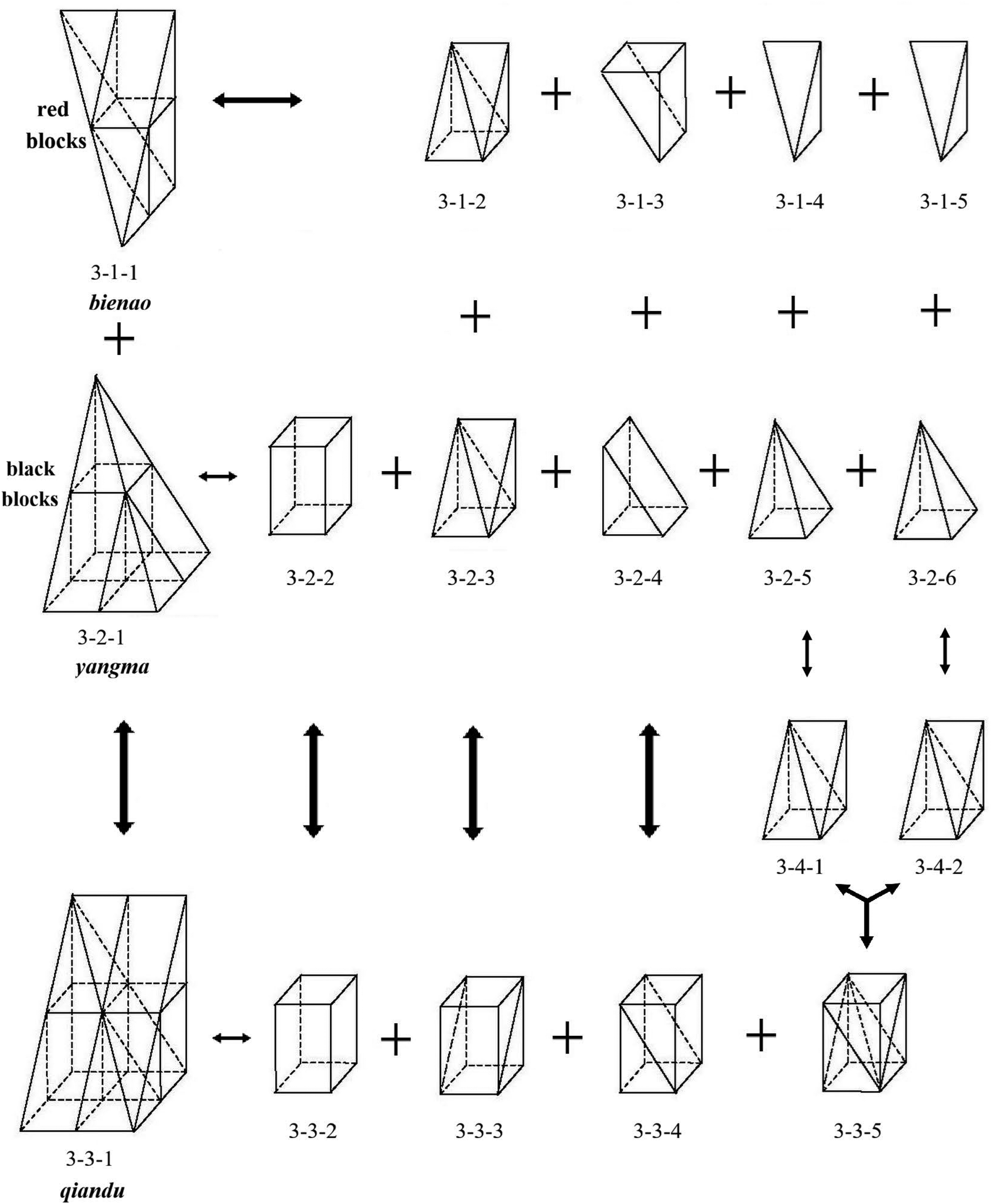
Division and recombination of qiandu, yangma and bienao.
He then halved the width, length and height of the big qiandu of 2 chi and got 9 pieces comprising one small black cube (Figure 3-2-2), two small black qiandu (Figures 3-2-3 and 3-2-4) and two small black yangma (Figures 3-2-5 and 3-2-6) from the large yangma (Figure 3-2-1); two small red qiandu (Figures 3-1-2 and 3-1-3) and two small red bienao (Figures 3-1-4 and 3-1-5) from the large bienao (Figure 3-1-1). He recombined the two small black qiandu (Figures 3-2-3 and 3-2-4) with the two small red qiandu (Figures 3-1-2 and 3-1-3) respectively, and got two small cubes (Figures 3-3-3 and 3-3-4). He then recombined two small black yangma (Figures 3-2-5 and 3-2-6) with two small red bienao (Figures 3-1-4 and 3-1-5) and got two small qiandu (Figures 3-4-1 and 3-4-2), which were then combined into a small cube (Figure 3-3-5). The first small cube (Figure 3-3-2) is a small black block (Figure 3-2-2) from the large yangma (Figure 3-2-1). Each of the second and third small cubes (Figures 3-3-3 and 3-3-4) constitutes one small black qiandu from the large yangma and one small red qiandu from the large bienao. This means that one half of sum of the second and third cubes is from the large yangma (Figure 3-2-1) and the other half is from the large bienao (Figure 3-1-1). Thus, in the first three small cubes (Figures 3-3-2, 3-3-3 and 3-3-4), the large yangma and large bienao respectively occupy two parts and one part; that is to say, in the ¾ part of the large qiandu (Figure 3-3-1), its yangma and bienao occupy respectively 2 parts and 1 part. He found that in the fourth cube (Figure 3-3-5), two small qiandu (Figures 3-4-1 and 3-4-2) are similar in construction to the large one (Figure 3-3-1). He pointed out that the above results and the corresponding process of dividing and recombining the blocks also held for blocks of cuboids with unequal widths, lengths or heights, and for the qiandu, yangma and bienao derived from them. Liu Hui concluded that, if in the remainder (¼ of the large qiandu), the large yangma and large bienao also occupy volumes in the ratio of 2 to 1, then they share the same ratio of 2 to 1 in the entire large qiandu.
Liu Hui found that each of the 2 smaller qiandu (Figures 3-4-1 and 3-4-2) of the fourth cube (Figure 3-3-5) had the structure similar to the original large qiandu (Figure 3-3-1). Therefore, he halved each of the 2 small qiandu as before; he then demonstrated that in ¾ of the remaining part of the large qiandu, the original large yangma and bienao respectively occupy parts of its volume in the ratio of 2 to 1. This process can be repeated continuously, and every time there is the same situation. Thus, he concluded that the ¾ part of the remaining part at each step occupied the volumes of the original yangma and bienao in the same fixed ratio of 2 to 1. Liu Hui then took a further step: ‘even if the cube becomes a cuboid and the corresponding blocks are changed accordingly, the [above] relations doubtless remain the same [as before] (雖方隨棊改,而固有常然之勢也).’ (Guo, 2004: 183) He pointed out that his demonstration also held for the cases when the qiandu, yangma and bienao were also from cuboids with unequal dimensions. 6
Liu Hui then investigated the change and state of the remaining part. He wrote as follows: The smaller into which they are halved, the more minute the remainders are. The most/extremely minute (zhi xi 至細) [remainder] is imperceptible (wei 微, subtle/fine/invisible/imperceptible), now that [the last remainder] is imperceptible (wei, subtle/fine/invisible/imperceptible), then it has no form (wuxing 無形, literally as ‘no form’). In that case, why should [we] take the [last] remainder into consideration? (半之彌少,其餘彌細。至細曰微,微則無形。由是言之,安取餘哉?) (Guo, 2004: 183)
7
Clearly, Liu Hui understood that the successive process of halving would make the remainder become smaller and smaller, and would eventually reach a point where the last remainder would be ‘the most minute’ (zhi xi). This last remainder (the ‘most/extremely minute’ one) was so small that it could be neglected. Thus he thought that he had demonstrated the principle.
Although it would be very interesting to analyse Liu Hui's demonstration in detail, here I only offer a brief, simplified explanation. Basically, his argument can be divided into two stages:
(1) In the first stage, Liu Hui used blocks to illustrate the process of dividing and recombining solids to demonstrate that at each step, in the ¾ part of the original qiandu or of the two qiandu remaining from the earlier step, the volumes from the original yangma and bienao were always in the same proportion of 2 to 1. Liu Hui thought that such division and recombination, as well as the conclusions derived from this, were circular.
(2) In the second stage, Liu Hui assumed the above process of division and recombination to have been successively repeated again and again to the extent that the remainder was most/extremely minute. This continuous and repetitive process involves the concept of infinity. Here, Liu Hui encountered two problems: 1) how to handle the infinite process of successively halving the solids; 2) how to deal with the remainder at the end of the process.
The first stage of Liu Hui's demonstration belongs to the case of limit processes. In this stage, Liu Hui manipulated blocks and used the so called ‘out-in principle’ as the basis for his reasoning. Although he used blocks of special dimensions, his operations, as he indicated, are effective in general situations. The out-in principle is the assumption that when a planar figure closed by curves or a solid closed by surfaces is divided into several pieces without common area or volume, and the pieces are recombined into a new planar closed figure or a new closed solid, then the area of the new figure or the volume of the new solid remains the same as before (Wu, 1978). Such an assumption is intuitively obvious and has long been accepted by different civilizations. When Liu Hui dealt with problems of area or volume, he would divide a figure into several pieces and then recombine them into a new one. Although he did not state explicitly that the new planar figure or the new solid would have the same area or volume as the old figure, he apparently took this as self-evident. The way that Liu Hui used the out-in principle to deal with solids in the first stage of the demonstration of ‘Liu Hui's Principle’ is similar to what is currently used in modern geometry, and it is easy to understand and readily accepted in modern times. 8
Liu Hui also took the similarity of the same kinds of solids (cuboid, qiandu, yangma or bienao) at every step of the process as the basis for his conclusion, but he did not mention this explicitly. It seems that he took this all as self-evident. In modern geometry, one would expect this assumption to be proved as well. Because no corresponding system of common propositions had been established in Liu Hui's day, these seem to have been commonly held ideas apparent to the ancients, and it is therefore not strange that Liu Hui paid no attention to this either. In modern times, geometry demands proofs for such propositions, but because they are very apparent and are very easy to prove, modern mathematicians often omit the proofs of such immediately obvious propositions as well.
Whether it was the division or recombination of solids, or the use of blocks or the out-in principle, these were all traditional methods for solving volume problems before Liu Hui's time. Liu Hui's application of these methods demonstrates his superb mathematical skills.
Additionally, Liu Hui also applied the cyclic recurrence method. The use of this method was probably inspired by the square-root extraction method and cube-root extraction method from the Nine Chapters. However, the cyclic nature of the latter lay in seeking increasingly precise roots, with a clear objective, and it was evident that the method could achieve this objective. In contrast, it was not easily apparent that Liu Hui's cyclic process could lead to his objective. Therefore, Liu Hui's idea to use the cyclic method and his efforts to test it required both extraordinary insight and persistent dedication to research.
Combining the superb techniques of solid division and recombination with the concept of cyclic recurrence from the existing mathematical traditions is one of the two keys to his successful demonstration of Liu Hui's Principle. Another key to Liu Hui's successful demonstration is his application of the concept of infinity by drawing on the ideas of Taoism and Mohism in the second stage.
Problems of the basis of Liu Hui's demonstration
From a modern scientific point of view, the process of Liu Hui's repeatedly halving solids obviously involves an infinite process. However, it is still necessary to investigate whether or not Liu Hui thought the process was infinite. In the original text of his demonstration of ‘Liu Hui's Principle’, he did not say clearly whether the process was infinite or not. But he did clearly say that every time the solid was halved, the remainder was becoming smaller. He also said that the process led to a final result, the ‘most/extremely minute remainder’; but he did not take this last remainder to be nothing, nor did he say that the remainder would become smaller. Similar situations occur in other parts of Liu Hui's commentary. Consider the following two examples.
First, in the commentary on the method for calculating the area of a circle in Chapter 1 of the Nine Chapters, Liu Hui used successive regular inscribed polygons, doubling the sides (at each step, from a polygon of 3·2n sides→polygon of 3·2n + 1 sides) in order to approximate the circle. He argued that: The more one divides [the circle to obtain polygons of] smaller [sides], the less is the loss [when the polygon substitutes for the circle]. Dividing again and again, until [the circle] cannot be divided further, then [the last polygon] coincides with the circumference of the circle, and there is no loss. (割之彌細,所失彌少。割之又割,以至於不可割,則與圓周合體而無所失矣。) (Guo, 2004: 18–19)
9
At any specific step in the dividing process, Liu Hui did not say that there was no loss (in substituting the polygon for the circle); what he did say is that there was still a loss, which was becoming smaller with each successive step. He in fact calculated two approximate values for the ratio of circumference of circle to its diameter, the π. For example, he used two methods to obtain the approximate value of π as 3927/1250. One method is to calculate the side of the regular inscribed polygon with 1536 equal sides and the area of the regular inscribed polygon with 3072 equal sides. Liu Hui explained that he ‘disregarded the very small fractions’ (cai qi wei fen 裁其微分) in the process of calculation (Guo, 2004: 21–22; Guo et al., 2013: 131). Liu Hui's perception of ‘the very small fractions’ was identical to what he also held: there was still a loss, which was becoming smaller at each specific step of the dividing process mentioned above. This means that, for Liu Hui, dividing the circle a finite number of times would not result in a regular inscribed polygon that coincided with the circumference of the circle.
Second, in his commentary on the method of extraction of square roots in Chapter 4 of the Nine Chapters, Liu Hui explained the extraction of square roots in terms of finding the side of a square with a given area. Using decimal fractions, he made the procedure of calculating the successive approximate values of the square root of a non-square integer one that could be applied smoothly. Each decimal digit of the root corresponded to a unit of length of the side of the square. 10 Every time he calculated the root to a smaller decimal place, the smaller the unit 1 was divided, ‘although the vermillion area has a number that has been abandoned, it is not worth mentioning (朱冪雖有所棄之數,不足言之)’ (Guo, 2004: 136; Guo et al., 2013: 402–403). The ‘number that has been abandoned’ corresponds to the main part of the remainder of the radicand. Apparently, Liu Hui thought that, for every specific step in the process of extraction, although the small number mentioned could be neglected for all practical purposes, he did not take it to be zero. On the other hand, Liu Hui also said: ‘only by using the side to determine/name it (i.e., the root), nothing is lost (惟以面命之,爲不失耳)’ (Guo, 2004: 136; Guo et al., 2013: 399). Considering the above two examples together, we know that for Liu Hui, for a non-square integer, no finite number of steps in the extraction process could ever reach the real value of the square root.
In the light of what Liu Hui took the remainder to be in every specific step as well as the final state in the above two examples, we can conclude that Liu Hui gave tacit consent to the infinite process of successive halving in the demonstration of Liu Hui's Principle. Considering the infinite process as a whole, there was thus a final result, but he did not deliberately pay much attention to the character of infinity in the process. Thus, what Liu Hui said clearly is that the process of continuously halving would reach an end, which resulted in a special remainder (the most/extremely minute, zhi xi).
It may seem that there is a contradiction between that the process of dividing had infinite steps and that there was a remainder in the last step of the infinite process, especially in the context influenced by ancient Greek philosophy. 11 This leads to several questions:
Question 1: Why was Liu Hui unaware of such a contradiction?
When something is indefinitely becoming smaller and smaller, and we suppose that there exists a smallest element at the last stage of the process, then how much is the smallest remainder? Is it something or is it nothing? Such a problem clearly puzzled ancient scholars of the Western world (Boyer, 1959: 14–267). We will thus pose the following question:
Question 2: Why did Liu Hui explicitly think the last remainder could be neglected?
To answer these two questions, we need to consider the thoughts of the Mohist and Taoist schools.
The idea of infinite division and its remainder in Mohist texts
In the Warring States period (475–221 BCE), China entered a period of great social change when various political powers struggled against each other, different new ideas and thoughts arose, and many academic schools emerged, resulting in the so-called ‘hundred schools of thought contending’ (baijia zhengming 百家争鸣). Among these schools, the Taoist, Mohist and Logician schools paid considerable attention to ideas related to infinity. The latter two schools declined following the unification of China by the First Emperor of Qin in 221 BCE, and their doctrines and thoughts were rarely inherited. However, in Liu Hui's time, much importance was attached to the Mohists’ documents (Zhou, 1984). Liu Hui mentioned Mo Zi, and there are notable similarities between several sections of Liu Hui's commentary and Mo Zi, which shows that he was very familiar with Mo Zi, and his demonstration in particular of Liu Hui's Principle may well have been influenced by the Mohist school (Guo, 2013: 319–320; Zou, 1994, 1995a).
The Mohists clearly discussed the concept of the infinitely large: [That something of one-dimension is] finite means that there is a place [of it] where the forward part cannot contain 1 chi (窮, 或有前不容尺也). If there is a place where [the forward part] cannot contain 1 chi, then it is finite. If everywhere [the forward part] always contains 1 chi, then it is infinite (或不容尺, 有窮;莫不容尺,無窮也).
12
The above texts can be expressed in modern mathematical terms as follows: For a half line b and a line segment a (=1 chi), if there is an integer n such that b–na < a, then b is finite; if for every integer n, b–na ≥ a, then b is infinite (Zou, 1994, 1995b, 2001a: 387).
For the infinitely small, although the Mohists did not give a mathematical definition, they thought that the process of successively halving a line would finally obtain a duan (端 point) (Zou, 1994, 1997, 2001a: 294–315), which had no magnitude (wu hou 无厚) (Graham, 1978: 310, 432–433; Zou, 1994, 1997, 2001a: 294–315). Furthermore, the Mohists introduced a special concept, ‘ci’ (to be adjacent), which suggests a special way of arranging a collection of objects. The Mohist Canons says: The ci (to be adjacent) is that [every two adjacent objects] have no interval but do not coincide with each other (次,無間而不相攖也). The ci (to be adjacent) is only for [the objects] which have no magnitude (次,無厚而後可).
13
The ‘ci’ (to be adjacent) refers to a special arrangement of elements each of which has no magnitude and for which there was no space between any two adjacent elements (Zou, 2000, 2001a: 346–357, 2010).
The thoughts of the Mohists mentioned above show that the Mohists regarded the process of infinite dividing as leading to a final result, something that had no magnitude (Zou, 1994, 1997, 2001b). These ideas are identical to what Liu Hui thought of the successive process of halving, which finally resulted in a remainder that could be neglected. But considering the language that Liu Hui uses, the terms for infinity adopted in his commentaries suggests that he was influenced much more by Taoist texts, to which we now turn. 14
Ideas from Taoism: The change from ‘small’ to ‘having no form’
Several scholars have suggested the influence of Taoist documents or documents influenced by the Taoist school on Liu Hui's idea of infinity. Wagner (1979) points in particular to Liu Hui's use of the terms xi (细 minute, fine), wei (微 subtle/fine/invisible/imperceptible) and xing (形 form). He notes that the same relationship between wei and xing appears in Chapter 14 of Lao Zi (老子 Master Lao) and its commentary by He Shang Gong (河上公). This is certainly a very perceptive observation. 15 Guo (2013: 256–257, 320–323) also emphasized the influence on Liu Hui of the Lao Zi, Zhuang Zi (庄子) and Zhou Yi (周易) (together, these three books were called the ‘san xuan’ (三玄, three Dark Learnings)), and points out that some paragraphs of the Zhuang Zi and Huainan Zi are related to Liu Hui's ideas, but he did not provide a detailed analysis of this. Based on Wagner's and Guo's examples, Zou (1994, 1995a, 2001a: 201–209) has made use of more sources and has given an extended analysis of the relation between Liu Hui's ideas and those found in documents of the Taoist school or those influenced by Taoist thought.
Taoist scholars took the Tao as a special concept that has many different meanings: way, principle, method and the origin of everything in the world. In the final analysis, everything comes from it and goes back to it. The Tao does not have any perceptible features of actual bodies (like sound, form, colour, etc.), but it has existed before everything in the world (Feng, 1984: 44–52; Zou, 2001a: 184–209). The philosophy of Tao can be traced to the book Lao Zi (老子 Master Lao), attributed to Lao Zi (named Lao Dan 老聃, ca. 6th century BCE, older than Confucius). The earliest editions of Lao Zi were excavated from a tomb closed about 300 BCE at Guodian (郭店), Hubei Province, although they do not contain the complete text of Lao Zi (Jingmen Museum, 1998). Although the book Lao Zi was possibly changed (or written) after Lao Zi, it was still considered to be based on Lao Zi's thought (Qiu, 1999; Wang, 1999).
Lao Zi influenced not only Taoist scholars, but also philosophers of other schools. Until the 3rd century, most documents were influenced by Taoist philosophy, more or less. In the 3rd century, studying the ‘san xuan’ became fashionable. The notion of ‘upholding Nonbeing’ (gui wu 贵无) had a great influence on many scholars. For example, Wang Bi (王弼, 226–249 CE) thought that everything in the world originated from Being (you, 有) which in turn originated from Nonbeing (wu 无), and that everything would also return to Nonbeing (Feng, 1992).
In Taoist philosophy and for Chinese intellectuals of the 3rd century, Being and Nonbeing were reciprocally related. But this does not mean that Liu Hui only took such an idea as the direct basis for his demonstrations, because mathematics is usually more explicit and accurate than philosophy. Something more concrete is needed to connect Being and Nonbeing.
The ‘Autumn Flood’ chapter of the Zhuang Zi records a dialogue between two gods (Lord of the River, Hebo 河伯, and God of the North Sea, Beihai Ruo 北海若). The Lord of the River said, ‘The debaters in the world all claim that the extreme fineness (zhi jing 至精, the finest thing) has no form (wuxing 無形) and the extreme largeness (zhi da 至大, the largest thing) cannot be encompassed. Is this a true statement?’ (河伯曰:“世之議者皆曰:至精無形,至大不可圍。是信情乎?”) The God of the North Sea replied, ‘A thing that we can express by massiveness or fineness should have a form. What has no form (wuxing 無形) cannot be distinguished by numbers, what cannot be encompassed is that we cannot use numbers to exhaust. What we can talk about with our words is a massive thing, what we can visualize with our minds is a fine thing. What we can neither describe with our words nor visualize with our minds cannot be expressed by massiveness or fineness.’ (北海若曰:“夫精粗者,期於有形者也。無形者,數所不能分也。不可圍者,數所不能窮也。可以言論者,物之粗也;可以意致者,物之精也。言之所不能論,意之所不能察致者,不期於精粗焉。”)
16
The God of the North Sea divided all things in the world into three categories: the massive ones (cu zhe 粗者), the fine ones (jing zhe 精者), and the things that cannot be described as either massive or fine (bu qi yu jing cu zhe 不期於精粗者). Among these, the ‘fine’ category plays an important role in the connection between Being and Nonbeing. On the one hand, ‘fine’ things can be regarded as the same kind as ‘massive’ things because both categories have form (you xing 有形) and can be expressed in words or imagined by the mind. On the other hand, the ‘fine’ category can also be regarded as the same kind as the third category, because words cannot be used to describe either of them.
Although we can visualize the ‘fine’ category with our minds, since words cannot express it, then it is still difficult to understand the features of the ‘fine’ things. This means that the ‘fine’ category lacks more or less cognizable features of ordinary things. When a fine thing becomes larger and larger, it will eventually belong to the category of massive things and it can then be described in words. When it becomes finer and finer, it will lose more and more of the cognizable features of ordinary things, at which point ancient Chinese philosophers imagined that extremely fine things will not have cognizable features. The former situation relates to ordinary bodies, while the latter relates to the Tao (Nonbeing).
Although people cannot describe the ‘fine’ things with words, they can still visualize them in their minds. Therefore, in the process in which a fine thing becomes finer and finer, people will not deliberately classify the size of it at different stages into distinct levels. In this context, people will naturally assume that there exists the finest among the fine things, and there exists the largest thing among the large things. In this case, ancient Chinese people did not need to consider whether the process of a fine thing becoming increasingly small was infinite, and thus they did not need to consider whether or not there was any difficulty in concluding that the process reaches an end. Liu Hui was familiar with the Zhuang Zi and Mo Zi, and the thought of these documents gave him confidence that not only would the process of successive dividing finally reach an end, but that there would also exist a final remainder.
In Liu Hui's demonstration, the sentence ‘the most/extremely minute [remainder] is imperceptible (wei), now that [the last remainder] is imperceptible (wei), then it has no form (wuxing 無形)’ indicates that the concepts ‘wei’ (imperceptible/subtle) and ‘wuxing’ (having no form) are very closely related. Wagner points to Chapter 14 of Lao Zi, in which the original text reads: ‘We feel for it, but we do not get hold of it: we name it the Subtle’ (摶之不得名曰微), and the corresponding commentary of Ho-shang Kung (河上公, written as He Shang Gong in the pinyin system) reads: ‘That which is without form [hsing] is called “subtle” [wei], the text says that the One is without form, so that we cannot grasp it …’ (無形曰微。言一無形体,不可摶持而得之). Guo (2013: 256) noticed that Chapter 21 of Huainan Zi has the sentence ‘the zhi wei (most subtle/imperceptible) could infiltrate within wuxing (what has no form) (至微之淪無形也)’ (see also Zhang, 1997: 2126). 17 These passages make it clear that wei and wuxing are very closely related. But there are also differences with respect to what Liu Hui writes. For Liu Hui, the logical structure was ‘if wei (subtle/imperceptible) then wuxing (having no form)’, but this logical proposition does not appear in either of the Lao Zi and its commentary of He Shang Gong just mentioned. For He Shang Gong, the concept of wei was established on the basis of wuxing. In the Huainan Zi, the concept of wei was not used to represent the same grade of smallness as that in Liu Hui's commentary, but the zhi wei (most subtle/imperceptible) was associated with wuxing. Although we can derive the conclusion from the Huainan Zi that something that was wuxing might be larger than zhi wei, it is nevertheless true that the Huainan Zi did not express exactly the same meaning as Liu Hui meant to convey.
There is evidence in the Sun Zi Bingfa (孙子兵法, The Art of War, hereafter Sun Zi, 5–4th century BCE) that sheds light on the logical structure of the relation between wei and wuxing in Liu Hui's commentary. Probably under the influence of Taoism, 18 the chapter Xu shi (虚实 Empty and Solid) of Sun Zi says: Master Sun insisted that in order to make the enemy be unaware of where we defended and where we attacked, our military actions should be very mystical. He said, ‘Subtle (imperceptible) (wei hu)! Subtle (imperceptible)! To the extent of having no form (wuxing) (微乎微乎,至於無形)’ (Li, 1997: 69). Here the ‘wei’ and ‘wuxing’ are connected in a way similar to what is found in Liu Hui's commentary. Just a few decades before Liu Hui, Cao Cao (曹操) wrote a commentary on the Sun Zi, and his edition of Sun Zi was prevalent in Liu Hui's time. 19 Thus, Liu Hui might have been influenced by the thinking of Sun Zi, concluding that the concepts ‘wei’ and ‘wuxing’ share similar characteristics. Liu Hui's conditional notion that if something is wei, then it is wuxing, is identical to that of Sun Zi, namely, that the wei things could become wuxing. 20
On the basis of the thinking reflected in the Zhuang Zi and Sun Zi, we can easily understand why Liu Hui thought the infinite process of halving the solids would reach an end, and would also finally result in a last remainder, in which he did not think there was a contradiction.
It is clear that Liu Hui believed that the last remainder of the infinite process had no form (wuxing), but what did he take the characteristics of the ‘having no form’ to mean? As shown above, the Zhuang Zi says ‘What has no form (wuxing 無形) cannot be distinguished by numbers (無形者, 數之所不能分也)’, which means that no matter how small a number is, it cannot express the measurement value of what has no form. That is to say, the number of the measurement of what has no form is not necessarily taken into consideration. In modern words, the magnitude of what has no form is 0.
There is a passage in Chapter 15 of the Huainan Zi that has some similarities to the Zhuang Zi. It says: ‘[if something] has no form (wuxing), then it cannot be controlled, and cannot be measured (無形,則不可制迫也,不可度量也)’ (Zhang, 1997: 1578). Because measuring something is to give a number for its measurement, ‘[if something] has no form (wuxing), then it … cannot be measured’ means there are no numbers to express the measurement value of what has no form. Although in the context of the Huainan Zi, ‘wuxing’ may have more philosophical meanings, and the ‘cannot be measured’ (buke duliang 不可度量) may also be used in the case that something without form is too large to be measured, it still implies that the book admits that numbers cannot express the characteristics of the wuxing.
When Liu Hui demonstrated his principle, it is possible that he had not considered whether the final remainder was Nonbeing (or nothing), because he only needed to consider the number of a specific type of measurement among the various measurements of the last remainder—the measurement of volume. On the basis of the above words from the Zhuang Zi, it is clear that, for Liu Hui, the volume of the last remainder was too small to be considered. Now that the last remainder could be neglected, in the whole large qiandu, the ratio of volumes of the large yangma and large bienao was really 2:1.
Conclusions
The social environment and cultural trends of the 3rd century CE stimulated Liu Hui's pursuit of mathematical demonstration, which served as the motivation for him to propose and demonstrate Liu Hui's Principle. Liu Hui's demonstration can be divided into two stages.
In the first stage, Liu Hui skilfully used blocks to show the division and recombination of geometrical solids, in order to demonstrate that at each step, in the ¾ part of the qiandu that remained from the previous step, the volumes from the original yangma and bienao were always in the proportion of 2 to 1. The logical principles upon which he based this conclusion were the out-in principle and the geometric similarity of the solids from one step to the next. Although he did not clearly express these assumptions that he regarded as self-evident, they are all straightforward and easily acceptable by both ancient and modern scholars. At this stage, Liu Hui also employed the method of cyclic recurrence. In this stage, the methods and ideas employed by Liu Hui all derived from the mathematical tradition of the earlier period in China that focused on algorithms.
In the second stage of his demonstration, Liu Hui encountered two puzzles that also caused concern for Western mathematicians. One was whether or not the infinite process of successive halving could ever reach an end, and, if so, was there a final remainder? The other was, if there was a final remainder, did it have any magnitude, and if so, how should this be dealt with? Liu Hui seems to have had no hesitation about any of these questions. The ways of thinking in the ancient tradition of Chinese philosophy and culture provided Liu Hui a reference to approaches for overcoming these difficulties.
Generally speaking, scepticism in traditional China was not strong. 21 In the times of Liu Hui, a tendency towards scepticism and debate strengthened somewhat (Wen and Cui, 2001: 180–210). Should he have been concerned by the puzzles posed by the problems concerning the concept of infinity? In his day, the thinking of the Taoist school prevailed (Jing and Kong, 2006: 294–310), and ideas of the Mohist school were also recovered (Zhou, 1984). The thought of these two schools inspired Liu Hui to resolve the puzzles concerning infinity in mathematics. 22
The Mohists held that the infinite division process would reach an end and that the last remainder would have no size. Assuming Liu Hui was familiar with Mo Zi, he might well have been influenced by it. But the demonstration of Liu Hui's Principle seemed to have been influenced more directly by Taoist theory.
Documents of the Taoist school and other documents influenced by it could have provided Liu Hui with the concepts and reasoning to establish the relations among the key concepts that appear in his demonstrations. Among them, the most important is the ‘Autumn Flood’ chapter of the Zhuang Zi, in which there is a spontaneous way of thinking about something that becomes smaller and smaller, and that it will reach a point where it cannot be expressed by words, and can no longer be visualized by the mind, and then it will finally reach an end without form. Furthermore, when Zhuang Zi considers describing the ‘having no form’ with numbers, it characterizes the ‘having no form’ as ‘that which cannot be distinguished by numbers’, namely, ‘no numbers can express the measurement of what has no form’. This means that the magnitude or volume of the last remainder is too small to be numbered, and may therefore be neglected. Zhuang Zi reveals the train of thought connecting ordinary things and things without measurable magnitude, where concepts of language (or words, yan 言), minds (or thoughts, yi 意) and numbers (shu 数) are used as indicators of cognition. These paths of thought were sufficient to help Liu Hui resolve the puzzles that he encountered concerning the very subtle/imperceptible things, the things without form, and the infinite processes.
It should be noted that Liu Hui only held that the size of the last remainder after infinite division does not affect the whole solid; in modern terms, this means that its volume is zero, but he did not take the last remainder as nothing. For the purpose of presenting a mathematical demonstration, Liu Hui had no need to entangle in the dilemma confronted by Taoist philosophy—namely, whether the final remainder is ‘Being’ or ‘Nonbeing’.
In Chinese traditional culture where scepticism was usually unwelcome, the general tendencies of the Taoist school as well as the Mohist school were sufficient to make Liu Hui's demonstrations acceptable. Indeed, according to the extant sources, nothing in his demonstrations or arguments would have aroused suspicion, or attracted much attention in ancient times.
The demonstration of what is now termed ‘Liu Hui's Principle’ was not based on an axiomatic system; nor was it formalized. But it nevertheless represents Liu Hui's effort to demonstrate propositions of the Nine Chapters with arguments that are thoroughly convincing. What would impress a modern mathematician today is the logically coherent reasoning used to establish Liu Hui's Principle—mathematically sound, if not axiomatic.
Liu Hui's Principle is a product of the integration of the mathematical tradition focused on algorithms and the philosophical tradition. However, in the case of this achievement, such a combination was exceptionally difficult to conceive and realize, demanding remarkable creativity, precise thinking and painstaking research. In fact, achievements of similar depth were quite rare in ancient China. Therefore, in the process of creating this achievement, Liu Hui's personal abilities and characteristics were the most crucial factors, while other factors played a role in laying the groundwork and providing inspiration, yet they were also indispensable.
Footnotes
Acknowledgements
During the writing of this paper, Professor JW Dauben from the City University of New York helped polish the English and provided valuable suggestions. I would like to express profound gratitude to him.

Funding
This paper is a phased achievement of the ‘Study on China's Scientific and Technological Traditions and Their Practical Significance’—a major project of the ‘14th Five-Year’ Plan of the Institute for the History of Natural Sciences, CAS, which is one of the Special Strategic Research Projects of the Chinese Academy of Sciences (中国科学院战略研究专项:中国科学自然科学史研究所“十四·五”规划重大项目“中国科技传统及其现实意义研究”).
Declaration of conflicting interests
The author declared no potential conflicts of interest with respect to the research, authorship, and/or publication of this article.
Notes
Author biography
Dahai Zou is a research professor at the Institute for the History of Natural Sciences, Chinese Academy of Sciences; the Editor-in-Chief of Studies in the History of Natural Sciences; and a corresponding member of the International Academy of Sciences (Paris). His main research interests focus on the history of mathematics in China and the history of traditional Chinese scientific thought.