




Abstract
The name of Liu Hui (刘徽) is rarely seen in late imperial Chinese mathematical sources, not to speak of non-Chinese writings, in which his name is never mentioned, except by Alexander Wylie in his Notes on Chinese Literature (1867). But does such silencing of the 3rd-century commentator on the most important collection of mathematical problems from ancient China imply that Liu Hui had no influence on mathematical practices in the 19th century and beyond? By looking at the language, argumentation structures and objects of research of mathematicians, it is possible to uncover the lasting influence of Liu Hui's thought and writings in the context of a rapidly changing scientific landscape, at a time when China became globally more entangled. It was then that the mathematical heritage of ancient China was revived, not for the sake of historical research, but as part of a political and educational programme. This article suggests to equally follow traces of mathematical learning and conceptual developments grounded in Liu Hui's 3rd-century commentary on the canonical Nine Chapters on Mathematical Procedures (九章算术) and thereby identifies an eventual ‘soft power’ 1 of mathematical knowledge from antiquity.
Introduction
As a global historian of Chinese mathematics, I am entirely convinced that the developments of ancient mathematics in China had a long-lasting effect worldwide. But this conviction, which many of my colleagues working on the global history of Chinese mathematics share, has not yet entered persisting Eurocentric historiographies. This may be because it is not easy to formulate precisely what this long-lasting effect exactly was.
As for Liu Hui's impact in China more specifically, one way to tackle the question is to count the hard facts; that is, references to his name in mathematical writings. In modern terms, we would call this the h-index of Liu Hui. We can observe that his name was in vogue in the 17th and 18th centuries, but almost no reference to him can be found in the 19th century. Hence the title of this article: ‘Incognito: The secret lives of Liu Hui in 19th-century China’. 2
Figure 1 shows the occurrences of ‘Liu Hui’ (刘徽) and ‘Liu shi Hui’ (刘氏徽), which we counted in a database of 189 mathematical texts (and their commentaries) from the 1st century AD to 1900, of which 97 are from the Qing dynasty.
3
As one can see, in the 19th century, only one text refers to Liu Hui; it is the 1839 re-edition of the Introduction to Mathematical Learning (Suanxue qimeng, 算学启蒙) by Luo Shilin (罗士琳, 1774‒1853).
4
In the preface, we read:
5
魏、唐間,筭學尤專,如劉徽之注九章,續撰重差,淳風之解十經,發明補問,博綜精微,一時獨步。自時厥後,科目既廢,筭法罕傳,信如是也,則計租庸調
6
,何術可憑。 During the Wei and Tang dynasties, mathematical learning was excellent and flourishing. For example, Liu Hui's commentary on the Nine Chapters
7
and his subsequent writings on the Double Difference [method], or [Li] Chunfeng's explanations of the Ten Classics and his shedding of light by additional problems, were so comprehensive and sophisticated that they were outstanding at one particular point in time. Since then, the subjects have been abolished, and the method of calculation is rarely passed on. If such is the case, then how can the calculation of tax and corvée be relied upon?
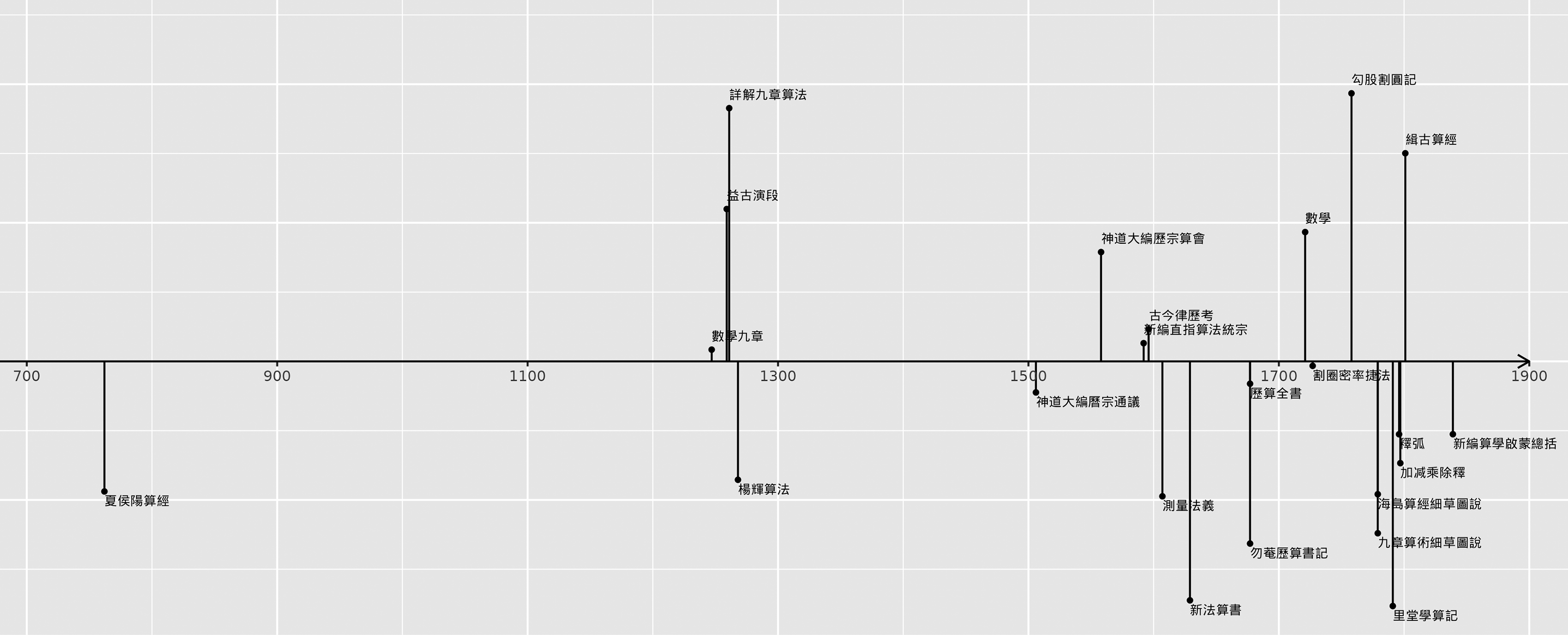
Mentions of Liu Hui in Chinese mathematical texts in the sin-aps database. © Florian Keßler.
Otherwise, Liu Hui's name is mentioned in relation to his authorship of the Sea Island Mathematical Classic (Haidao Suanjing, 海岛算经) in connection with a more precise fraction for approximating the value of π:
8
劉徽新術。劉徽乃魏人也,立此新術,以究圓之幽微。周一百五十七尺,徑五十尺。 The new procedure by Liu Hui. Liu Hui was a man from the Wei, and he established this procedure in order to examine the hidden subtleties of the circle. Circumference: 157 chi, diameter: 50 chi.
Liu Hui's name is also mentioned in Luo's postface, which enters into a detailed discussion of editorial questions and philological issues in establishing a correct edition of the Nine Chapters and Liu Hui's writings. 9
But does such silencing of the name of the 3rd-century commentator on the most important collection of mathematical problems from ancient China imply that Liu Hui had no influence on mathematical practices in the 19th century and beyond? In addition to hard facts such as low citation numbers, there are the secret lives of Liu Hui, his legacy that is transmitted from generation to generation. When Luo Shilin recounts the history of the transmission of mathematical knowledge, he begins with three metaphorical images for the more subtle and intangible traces of transmission and diffusion:
10
嘗觀水一也,散則千流萬泒。木一也,散則千條萬枝。數一也,散則千變萬化。 Whenever I am observing, I see that water is one, yet scattered, it turns into a thousand rivers and myriad streams; I see that wood is one, yet scattered, it turns into a thousand stems and myriad branches; I see that numbers are one, yet scattered, they turn into a thousand alterations and myriad transformations.
In the early 20th century, in the contexts of the Nationalist Government, the National Learning (Guoxue, 国学) movement, and the emphasis on applied knowledge during the early years of the People's Republic of China, we can observe a certain revival of interest in ancient Chinese mathematics. In 1955, an article was published in the People's Daily with the title: ‘How to study China's mathematical heritage’ (怎样研究我国数学遗产).
11
The article laments the absence of ancient Chinese mathematics in histories of science and refers, among other results, to Liu Hui's achievements: An early concept of limit had already begun to emerge in the works of Liu Hui of the Wei dynasty. In his commentary on the Nine Chapters on Mathematical Procedures, when discussing the calculation of π, he stated: ‘The finer the division, the smaller the loss; divide again and again until no further division is possible, and then it will coincide with the circumference of the circle, with no loss whatsoever.’ This means that the finer the division, the smaller the discrepancy; dividing again and again until division is impossible, at that point it becomes identical to the circumference with no difference. This concept arose from the practical need to calculate geometric problems such as the area of a circle. Through contemplation, it was abstracted and then applied to practical problems to be tested. Liu Hui employed this concept to calculate π to approximately 3.14, thereby achieving more precise results in calculating the surface of a circle and other problems. 魏人劉徽的著作里就已有了极限概念的萌芽。他在所注的“九章算術”中論求圓周率時説:“割之彌細,所失彌小,割之又割,以至不可割,則與圓周合體,而無所失矣。”這就是説,割得愈細,所差愈少,割了再割,直到不能割,那時候就同圓周相等而沒有差了。這一概念産生于計算圓面積等實際幾何問題需要,經過思考作用而被加以抽象化,然后又被用到實際問題上去而得到考驗。劉徽運用了這一概念求得圓周率為三點一四,從而在計算圓面積等問題上得到較精确的結果。
In the first half of the 20th century, Liu Hui's name appeared regularly in China, not in mathematical but in historical research, yet often in contexts with strong ideological implications after 1949, as the conclusion of the same article shows: The focus on practical computational methods and concrete solutions is one of the characteristics of our mathematics. This can be illustrated, for example, by the invention of the method of finding the roots of higher algebraic equations and the method of solving systems of higher algebraic equations, as mentioned earlier. This is very similar to some countries in the East, especially in Central Asia and the Near East, and very different from the Greek system of logic (represented by Euclidean geometry). In addition, it remains to be found what other features are characteristic of our mathematics. The study of these features must be linked to the study of general cultural history, the history of philosophy and thought, and even the economic foundations of the time, and thus depends on the joint efforts of mathematicians and scholars of other sciences. Finally, in the study of the history of mathematics, we must fight resolutely against the remnants of the bought-and-paid-for ideology inherited from the semi-colonial societies of the past, and the bourgeois cosmopolitan ideology imported from the imperialist countries, and against the tendency of underestimating, belittling and even wiping out the legacy of mathematics in China. At the same time, it is also necessary to find out more comprehensively the mutual influence of our mathematics with that of other countries, especially Korea, Vietnam, India, Japan and the Near Eastern countries of Central Asia. It is hoped that more mathematicians will work together to care for and value China's mathematical heritage, strengthen the study of Marxist-Leninist theories, and further develop research on the history of Chinese mathematics. 注重實用計算方法和具體解題方法,是我國數學的特色之一。例如,前面所提過的高次代數方程根求法和解聯立等餘式方法的發明,都可以説明這一點。這同東方一些國家,特別是中亞西亞和近東一些國家很相似,而同希臘的著重邏輯體系(以歐幾里得幾何為代表)則很不同。此外,我國數學還有哪些特點,也有待於找出。這些特色的研究,必須同一般文化史、哲學思想史乃至當時經濟基礎的研究聯繫起來,因而要靠數學家和其它科學的學者共同努力。 最後,在數學史的研究中,我們必須同過去半殖民地社會中遺留下來買辦思想的殘餘,同由帝國主義國家傳來的資產階級世界主義思想作堅決鬥爭,反對低估、輕視乃至抹殺我國數學遺產的傾向。同時,也要更全面地找出我國數學同其他國家,特別是朝鮮、越南、印度、日本以及中亞細亞近東諸國的數學的相互影響。 希望有更多的數學家們共同關懷和重視中國的數學遺產,加強馬克思列寧主義理論的學習,進一步開展中國數學史的研究工作。
12
Now that I have described the rough direction in which I will go—instead of looking at explicit references in their political contexts, I will investigate the ‘soft power’ of ancient approaches to mathematics by Liu Hui—we can turn to later mathematical works. But the question remains: how can we approach the question of his influence on Chinese mathematics and mathematical heritage from China more generally and uncover the lasting influence of the Nine Chapters on Mathematical Procedures and Liu Hui's thoughts and writings during the 19th century?
As indicated in the title, Nine Chapters on Mathematical Modernity: Essays on the Global Historical Entanglements of the Science of Numbers in China, my book (Bréard, 2019) addresses the question of the modernization of mathematics in China by analysing the role that ancient Chinese mathematics, and the Nine Chapters in particular, played in the 19th century, in the context of a rapidly changing scientific landscape, when China was becoming globally more and more entangled. By looking at the language of mathematics, argumentation structures and the objects of research and discourse of late Qing mathematicians, the effect of ancient thought, authors and earlier writings was brought to light. It was during the late Qing that the mathematical heritage of ancient China was revived, not for the sake of historical research, as was mainly the case in the 20th century, but as part of a political and educational programme. Whether symbolically as a landmark of indigenous tradition, a paradigm for mathematical style, or as a benchmark against which new, foreign knowledge was measured, the classic and its many layers of commentaries remained the text of reference in mathematical learning until the turn of the 20th century and had an agency comparable to that of Euclid's Elements in the West.
In the following paragraphs, I will indicate two other modalities of reliance on ancient actors in the field of mathematics, in particular on Liu Hui, which allow us to identify traces of his implicit influence in the 19th century: reading the Nine Chapters and discussing, reinterpreting or engineering concepts developed by Liu Hui. I have added a methodological caveat by way of conclusion.
By the 19th century, all available versions of the Nine Chapters included Liu Hui's commentary. 13 Reading the canon thus naturally involved the consultation of Liu Hui's explanations and theoretical discussions interspersed between the lines of the classic. Li Rui (李锐, 1769–1817), for example, was a mathematician born in Suzhou, Jiangsu Province. It is said that, as a child, he understood the Nine Chapters based on his reading of Cheng Dawei's (程大位, 1533–1606) Unified Lineage of Mathematical Methods (Suanfa tongzong, 算法统宗, 1592). 14 Later, at the age of 23, Li began studying trigonometry and conic sections under the guidance of Qian Daxin (钱大昕, 1728–1804). Impressed by Li's intelligence, Qian asked his student to write the postscript to his calendar treatise that same year. When Li travelled to Beijing in 1810 to take the civil service examinations, without success, he stayed with one of the commentators of the Nine Chapters. 15 Although further research would be necessary to gauge the impact of his exposure to commentaries on the Nine Chapters in his own works, 16 it is noteworthy that the official history of the Qing dynasty records Li's reading of the Nine Chapters as formative in developing his thoughts.
A different case of the effects of reading the Nine Chapters and its commentaries is Li Shanlan (李善兰, 1811–1882), 17 from Haining Prefecture in Zhejiang Province. Born into a family of Confucian scholars, Li was educated in poetry and the Five Classics as a child, but also in mathematics. We know that his teacher in this discipline was a certain Wu Zhaoqi (吴兆圻), although Li himself claims to have read the Nine Chapters at the age of eight as a self-taught student and, five years later, Ricci and Xu's translation of the first six books of Euclid's Elements. 18 Li also recalls that, in his 16th or 17th year, he obtained Li Ye's Sea Mirror of Circle Measurements (Ceyuan haijing, 测圆海镜, 1248), a work that at first reading seemed incomprehensible to him. It was only ‘after thinking deeply about it for seven days and seven nights, even forgetting to eat or sleep, that he began to penetrate the heart of the principles of addition, subtraction, multiplication and division’, as well as operations specific to the Song algebraic tradition. 19
Li Shanlan's first poems date from the same early period,
20
but it was his talent for mathematics and astronomy that caught the attention of Chen Huan (陈奂), his teacher of Confucian classics, a compulsory subject for young men's education at the time. Chen reports that his student was ‘familiar with the mathematical procedures of the Nine Chapters’ and that, rather than devoting himself to learning the teachings of Confucius, he preferred to spend his time ‘erecting a gnomon with a string
21
and using a scale graduated according to the seasons to facilitate the observation of the shadows of the sun’.
22
Later, in his own work, Li did not remain within the framework provided by the Nine Chapters. He described himself as a revolutionary, one who established a new theory outside the canonical disciplines developed by the Nine Chapters. This is how Li Shanlan positions his work on combinatorial analysis in the preface to his Comparable Categories of Discrete Accumulations (Duoji bilei, 垛积比类, 1867): Discrete accumulations are a branch of the chapter ‘Small Breadth’
23
… I would like to inform those who practise mathematics that discrete accumulation procedures constitute a specific branch outside the Nine Chapters, and that the first person to theorise them was none other than Shanlan himself. 垛積為少廣一支。……欲令習算家知垛積之術於九章外別立一幟,其說自善蘭始。
24
Before him, Chen Houyao (陈厚耀, 1648–1722) had already noted the absence of any method dealing with permutations and combinations in the Nine Chapters. Li Shanlan differed from his predecessor in that he referred to his own theory as a ‘new pillar’ of mathematical knowledge in general, a field of inquiry outside the Nine Chapters and, to a certain extent, outside the Euclidean tradition with which he was familiar. He thus enriched the scope of Chinese mathematics, while emphasizing the fact that there were gaps not only in his own tradition, but also in those practised outside the borders of the empire. It is unclear whether Li Shanlan's concepts in the Calculation Sketches for the Millet and Hulled Grains (Sumi yancao, 粟米演草)—a chapter from the Nine Chapters—are also a methodological breakaway from his readings of the Nine Chapters, since the work, published together with Ding Quzhong (丁取忠, 1810–1877), has not been transmitted. 25 Given the title, it might well be that the concepts in the book Calculation Sketches for the Millet and Hulled Grains were an extension of Liu Hui's commentary on the respective chapter in the Nine Chapters, or provided a new theoretically structured framework, just as discrete accumulations were a novel domain grounded in what Li Shanlan found in the ‘Small Breadth’ chapter.
Developing Liu Hui's concepts
Beyond explicit extensions and exegeses of chapters from the Nine Chapters or Liu Hui's writings, such as Li Huang's (李潢) Detailed Workings and Diagrammatic Explanations for the Sea Island Mathematical Classic (Haidao suanjing xicao tushuo, 海岛算经细草图说, 1812), 26 there were other authors who elaborated further on Liu's concepts covertly.
Jiao Xun (焦循, 1763–1820), for example, was one of the major mathematicians during the Qianlong‒Jiaqing period (1736–1820). He was part of the so-called Qian‒Jia school, which devoted philological research to textual criticism (kaozheng xue, 考证学). The leading scholars of the school played major roles in promoting mathematical studies for comprehending more technical passages of the classics.
27
Jiao's book Explanation of Addition, Subtraction, Multiplication and Division (Jiajian chengchu shi, 加减乘除释, 1797) relies on Liu Hui's concepts that span various domains and mathematical applications: Liu Hui's commentary on the Nine Chapters on Mathematical Procedures is akin to Xu Shen's compilation of the Explaining Graphs and Unravelling Characters.
28
Scholars born centuries later who wish to comprehend the ancients’ principles of observing the heavens above and examining the earth below cannot do so without consulting Xu's work; nor can they grasp the origins of the ancients’ contemplation of heaven and earth without Liu's treatise … It is said that the learning of the ancients aimed at practical application to serve the myriad craftsmen, to observe the myriad products, and to create written symbols. These distinguished the locations of things, enabling scholars to study forms and grasp sounds. As for the subtle meanings between sound and tone, not everyone could grasp their intent; this is why form was prioritized over sound. The same holds true for calculation. Having established concepts like ‘lesser breadth’ and ‘base and height’ [of a right-angled triangle], one must further specify them as ‘rectangular fields’ and ‘estimating workload’. Having defined ‘proportional distribution’, ‘excess and deficit’ and ‘systems of linear equations’, one must clarify them as ‘millet and hulled grains’ and ‘equitable transport’. This too points to the existence of things, enabling every scholar to grasp the techniques by consulting the names. Yet names arise after the establishment of laws, while principles exist before the establishment of laws. What are these principles? They are the intricate transformations of addition, subtraction, multiplication and division. And the intermingling of these four within the Nine Chapters is no different from the mingling of the sounds of the Six Scripts within their respective sections. Thus, the same technique existing today is applied to ‘proportional distribution’ and again to ‘millet and hulled grains’; the same technique of equalization and harmonization is applied to ‘rectangular fields’ and again to ‘equitable transport’. The same method for determining chords and arrows applies to ‘right-angled triangles’ and to ‘small breadth’, yet, in cubing, methods beyond the third power are not detailed; in measuring four boundaries, the principles of mutual calculation through three ratios are not fully explored. Subsequent commentators further fragmented ‘millet and hulled grains’ into ‘proportional distribution according to value’. They transformed ‘equitable transport’ into ‘cumulative loans and mutual levies’. With names proliferating, the fundamental principles became increasingly obscure. Indeed, the Nine Chapters cannot encompass all applications of addition, subtraction, multiplication and division, yet these four operations can penetrate the depths of the Nine Chapters. The works of Sunzi and Zhang Qiujian seem to grasp this principle, yet their explanations are not detailed enough, leaving no means to achieve a comprehensive understanding. In my humble capacity, drawing upon Liu's writings, I take addition, subtraction, multiplication and division as the framework, employing the Nine Chapters’ annotations to clarify and elucidate them.
29
劉氏徽之注九章算術,猶許氏慎之撰説文解字。士生千百年後,欲知古人仰觀俯察之旨,舍許氏之書不可,欲知古人參天兩地之原,舍劉氏之書亦不可。……循謂古人之學,期以實用,以父百工,察萬品,而作書契,分別其事物之所在,俾學者案形而得聲。 若夫聲音之間,義蘊精微,未可人人使悟其旨趣,此所以主形而不主聲也。惟算亦然,既有少廣句股,又必指而別之曰方田、曰商功。既有衰分、盈不足、方程,又必明以示之曰粟米、曰均輸,亦指其事物之所在,而使學者人人可以案名以知術也。然名起於立法之後,理存於立法之先。理者何?加減乘除四者之錯綜變化也。而四者之雜於九章,則不啻六書之聲,雜於各部。故同一今有之術,用於衰分,复用於粟米。同一齊同之術,用於方田,復用於均輸。同一弦矢之術,用於句股,復用於少廣,而立方之上,不詳三乘以上之方。四表之測,未盡三率相求之例。 踵其後者,又截粟米為貴賤衰分。移均輸為疊借互徵。名目既繁,本原益晦。蓋九章不能盡加減乘除之用,而加減乘除,可以通九章之窮。孫子張邱建書,似得此意,乃説之不詳,亦無由得其會通。不揆淺陋,本劉氏之書,以加減乘除為綱,以九章分注而辨明之。
30
According to Guo (2004: 81), this is the ‘first time in Chinese history that someone has given a fair and favourable assessment of Liu Hui’. Jiao Xun was particularly interested in applying the concepts of ‘equalization and harmonization’ (qitong, 齐同) and ‘proportion’ (bili, 比例) as a kind of universal principle according to which not only mathematical procedures but also other fields of knowledge could be structured. Adopting these concepts from Liu Hui's commentary on the Nine Chapters and using others from Song dynasty algebra allowed him to reread the system of the divinatory hexagrams in the canonical Classic of Changes (Yijing, 易经):
31
If one does not understand the equalization and harmonization of [fractions or] ratios, [which are methods] from the Nine Chapters on Mathematical Procedures, it is impossible to comprehend the line movements in the hexagrams. 非明九數之齊同,比例,不足以知掛畫之行。
Jiao Xun finds analogies between algebra and the transformations of lines in a hexagram. In his Explanation of Addition, Subtraction, Multiplication and Division, he links the structure of the ‘Arithmetic Triangle’
32
shown up to the sixth power of a binomial to the hexagrams (see Figure 2). The bottom line in the Arithmetic Triangle contains the coefficients 1, 6, 15, 20, 15, 6 and 1, which sum up to 64. This is also the total number of different mantic figures in the Classic of Changes, since hexagrams are composed of six lines, either broken or unbroken: That it ends with the fifth square-multiplication (wu cheng fang, 五乘方)
33
is to carry the signification of hexagrams which end with sixty-four.
34
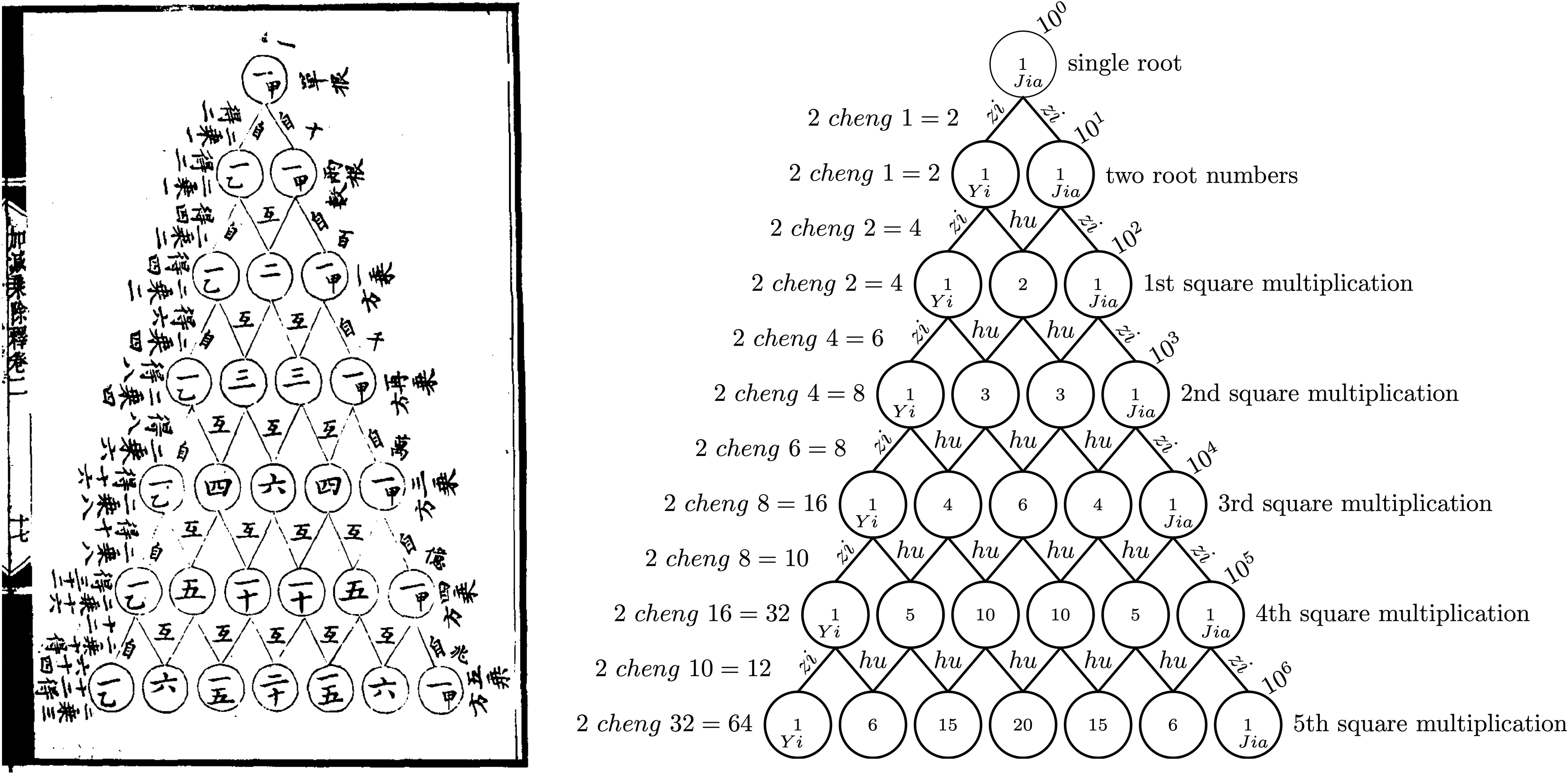
“The ancient diagram of the origins of root extraction” in Jiao Xun’s Explanation of Addition, Subtraction, Multiplication and Division. Left: Jiao Xun (1799), right: Bréard (2019).
As the hexagrams show, Jiao Xun not only applies Liu Hui's concepts and ideas on ‘proof’ to another field of numerical knowledge but also considers algebraic methods (i.e., arithmetical operations on symbols). 35 Jiao Xun thus systematized and organized the computational principles of traditional Chinese mathematics, developing them into a coherent theoretical framework. 36
This was also pointed out by Huang Chengji (黃承吉, 1771–1842) in his preface to Jiao Xun's Collection on Mathematical Learning (Litang xuesuan ji, 里堂学算记), in which he acknowledges Liu Hui as the main source of inspiration: The works of Litang
37
represent the definitive chronicle of mathematical treatises since the Gnomon of Zhou, and are not solely attributable to the contributions of Master Liu. 里堂之書,殆周髀以來著書之統紀,不獨劉氏之功臣也。
38
Evaluating the influence of a mathematical actor 16 centuries later is challenging for several reasons, and this does not seem specific to China. First, for the development of science itself, conceptual changes are considered an evident part and have played an important role in post-Kuhnian debates on the ‘Scientific Revolution’. Epistemological and philosophical issues concern the nature of conceptual change, and positions vary, for example, over whether the change in the concept of length during the transition from classical to relativistic kinematics is a change of belief or a change of meaning. 39 For mathematics, it is generally assumed that knowledge is cumulative and that conceptual change—characterized as retaining the old structure as a substructure of the new—is therefore less revolutionary. After all, non-Euclidean geometry did not overthrow Euclidean geometry, and both theories live happily together in an abstract paradise of many possible concepts of space. Euclidean geometry has merely lost its monopoly on the description of space, but Euclid remains the reference, even when departing from his system of axioms. 40
The cumulative character of mathematics thus makes it particularly difficult to follow an actor across centuries, before the invention of plagiarism. If there is no continuous, explicit back-reference to earlier authors and sources, only diachronic studies of the development of specific mathematical concepts allow us to identify possible intellectual lineages and genealogies. 41 Singular traces of explicit mentions of Liu Hui in the 19th century, as shown in this article, thus need to be complemented by further study of the anonymous, secret lives of Liu Hui, that is, by deep time studies of the evolution of concepts developed in his commentary on the Nine Chapters, to truly gauge his long-term historical significance beyond traditionally, politically or strategically motivated uses of his name.
Footnotes
Acknowledgements
Next to Christmas Day, the commemoration of the 1800th anniversary of Liu Hui on 24 September 2024 in Paris was, numerically speaking, probably the highest anniversary event I have ever attended. It was my great honour to be invited to participate in this special event organized by Professor Zou Dahai and his team from the Chinese Academy of Sciences. My heartful thanks for their generous hospitality, for all the work they invested into the organization, and for convincing UNESCO that mathematical heritage from China deserves such a celebration.

Funding
The author disclosed receipt of the following financial support for the research, authorship, and/or publication of this article: This work was supported by the Alexander von Humboldt-Stiftung (Alexander von Humboldt Professorship 2021).
Declaration of conflicting interests
The author declared no potential conflicts of interest with respect to the research, authorship, and/or publication of this article.