




Abstract
This research examines how science museum teams in different countries addressed crises during the COVID-19 pandemic, and what values, priorities and practices emerged during this challenging time. Informed by theoretical perspectives related to broken world thinking and care, this paper summarizes and discusses findings related to four qualitative case studies: the Museum of Tomorrow (Brazil), the Royal BC Museum (Canada), Heureka the Finnish Science Centre (Finland) and the National Museum of Natural History and Science (Portugal). Data gathered during 2023–2024 centred on the voices and lived experiences of 26 museum professionals, as well as documents and artefacts shared by them. Findings highlight how local realities shaped institutional responses to the pandemic, and how all four institutions nurtured caring relationships, faced uncertainty through reflective attentiveness and became relevant civic and scientific resources in a time of crisis. The research shed light on how care can become a central pathway to guide the transformation of science museums both inwardly and outwardly.
Introduction
The COVID-19 pandemic was a challenging event that affected the work and practices of museums around the world. International reports reveal that, nearly 85,000 museums closed for varying lengths of time in 2020 (UNESCO, 2021). The most visible impacts of these closures were the interruption of educational activities and decreases in revenue. However, responses to the pandemic also encompassed renewed commitments to contemporary social issues (ICOM, 2020; Raved and Yahel, 2022) and led to an ‘awakening to civic life’ (UNESCO, 2021: 21). In response to these trends, this research examines how science museum teams in different countries addressed crises during the pandemic, and what values, priorities and practices emerged during this time, considering local sociocultural contexts and institutional histories. This paper summarizes and discusses findings from four qualitative case studies: the Museum of Tomorrow (Brazil), the Royal BC Museum (Canada), Heureka the Finnish Science Centre (Finland) and the National Museum of Natural History and Science (Portugal). The discussion is informed by data gathered in 2023–2024, centring on the voices and lived experiences of 26 museum professionals, as well as documents and artefacts they shared.
Science museums, care and broken world thinking
Broken world thinking can help us understand the pandemic in the specific contexts in which science museums were located. This post-humanistic approach invites us to actively consider how the orders and structures of contemporary societies are coming apart. For Jackson (2014), breaking is generative and can help us identify negligence and irresponsibility. Drawing on Jackson, Morse (2021) brings broken world thinking to the museum landscape as an invitation to revisit work and practice, and to identify (local) issues that museums might attentively reflect upon and respond to. In this context, humble acts of care and repair can be substantial.
Drawing on feminist scholarship, Tronto (1996) reflects upon phases that create conditions for care to prosper: attentiveness—noticing unmet caring needs and struggles; responsibility—taking on the burden of meeting those needs; competence—the work of care; and responsiveness—ensuring that caring needs have been met. In the museum context, Silverman (2010) discusses eight perspectives with the potential to shape cultures of care: (1) developing planned change; (2) adopting a visitor-centred perspective; (3) sustaining attention to how relationships with visitors are shaped by the broader social environment; (4) meeting basic relational needs; (5) treating the experience of being at risk as a shared problem; (6) planning for social work interventions; (7) integrating theories of justice into thinking (and practice); and (8) caring for diverse relationships. The work of care in museums is deeply intertwined with empathy and compassion (Latham and Cowan, 2023). Together, those calls, approaches and perspectives can help us understand what science museum teams experienced in a time of crisis and how they navigated the pandemic.
Local realities shaping institutional responses to the pandemic
The Museum of Tomorrow: Rio de Janeiro
The Museum of Tomorrow (MofT) is a cultural and scientific institution. It is a public facility of the City of Rio de Janeiro that was inaugurated in 2015 on a deactivated pier in the port zone. It was conceptualized as part of the Marvelous Port project (2011–2016), an initiative to revitalize the city centre, which brought with it a strong social and historical responsibility towards the low-income communities of the area. The museum includes a Community Relations team that fostered collaboration with these communities before and during the pandemic. Due to severe funding cuts by the city hall in 2020, different museum teams (e.g., Scientific Development, Curatorship, Community Relations) relied on varied sponsors, partnerships with research institutes (e.g., Fundação Oswaldo Cruz) and national television networks (e.g., Globo) to sustain their responses to COVID-19.
Royal BC Museum: Victoria
The Royal BC Museum (RBCM) is a large natural and cultural history museum located in British Columbia. This government-owned institution demonstrated strong adaptability during the pandemic, rapidly pivoting to virtual programming, innovative digital engagement strategies and strengthened connections with underserved communities online. Between 2020 and 2021, the museum launched the initiative Collecting for Our Time, the web page Tell Us Your COVID-19 Story, the Online Community Gallery platform, a series of digital field trips and the programme RBCM@Home. As the pandemic passed, significant and ongoing leadership changes led to a gradual return to pre-pandemic organizational and outreach structures. Despite the deep regret expressed by front-line employees who had driven the rapid transformation from in-person to online programming, some of the socially relevant digital initiatives could not be sustained without institutional support.
National Museum of Natural History and Sciences: Lisbon
The National Museum of Natural History and Sciences (NMNHS) is a specialized services unit of the University of Lisbon that centres on natural sciences, the history of science and medicine and the conservation of scientific heritage. Despite its affiliation with the university, staff recognized that the museum was not widely perceived as a valued scientific or civic resource before the pandemic. Collaboration with the faculties of Medicine and Pharmacy to create and host COVID-19-themed exhibits that displayed national technoscientific advances related to the pandemic helped to reposition the museum in society and awaken it to civic life. This movement was tied to the strengthening of the museum's online presence (which had not been a priority before the pandemic), its outreach to previously underserved communities and the opening of a space to reconsider how to materialize social inclusion as an institutional value.
Heureka the Finnish Science Centre: Vantaa
Heureka is the largest interactive science centre in Finland. This public institution is committed to developing and producing hands-on exhibitions, often in collaboration with national organizations, research institutes and universities. Preserving this social and educational function, and recognizing its strength in the ‘physical encounter’, Heureka continued to produce and maintain hands-on exhibitions during the lockdowns—work accompanied by hopeful expectations of welcoming visitors back. Unlike the staff of other science museums, Heureka staff did not view online programming and digitalization as particular strengths during this challenging period. The centre chose not to develop COVID-19-related programming, citing the high-quality, extensive scientific coverage already provided by communicators and scientists, as well as the strong trust that Finns place in both government and media (Varpula, 2024).
Similarities across case studies
Nurturing caring relationships with visitors and among co-workers
The pandemic led all four institutions to redefine relationships through care in their specific contexts. At the MofT, the Community Relations team identified unmet needs among low-income schools registered in the ‘Between Museums’ programme, which were unable to access new online content due to a lack of devices and connectivity. Taking responsibility for addressing these needs, the team reunited a group of apprentices who delivered printed versions of all digital materials produced for the programme. This work of care was sustained throughout 2020, while the programme continued online. At the NMNHS, the director reflected on how the intentional shift towards strengthening the museum's online presence and digital work allowed her to know staff more closely than ever before: From knowing if they lived in a small or big house, with their parent, grandparent, a senior person, to how many kids they had … I ended up knowing if they had conditions to keep working or not. And people said ‘I cannot make it!’ … personal struggles that I had no idea about. For me, that was very important because I have a relationship with them, and people ended up establishing strong relationships with one another.
Being in the present: Facing uncertainty through reflective attentiveness
Kupper (2020) reminds us that ‘Uncertainty is clearly not a key element of museum concepts’—and that is particularly true for science museums, which have historically served as holders of facts. During a time when neither museum professionals nor visitors could anticipate what was to come, making sense of what was happening was a challenging endeavour. Uncertainty prompted the four science museums in this study to be in the present and practice reflective attentiveness. During the lockdown, the RBCM created the web page Tell Us Your COVID-19 Story (Figure 1), where members of the public were invited to share perspectives, photos, videos and mementoes. Staff acknowledged how this initiative shifted the museum's perspective and fostered a desire to actively pay attention to what was happening locally and globally (RBCM, 2020).
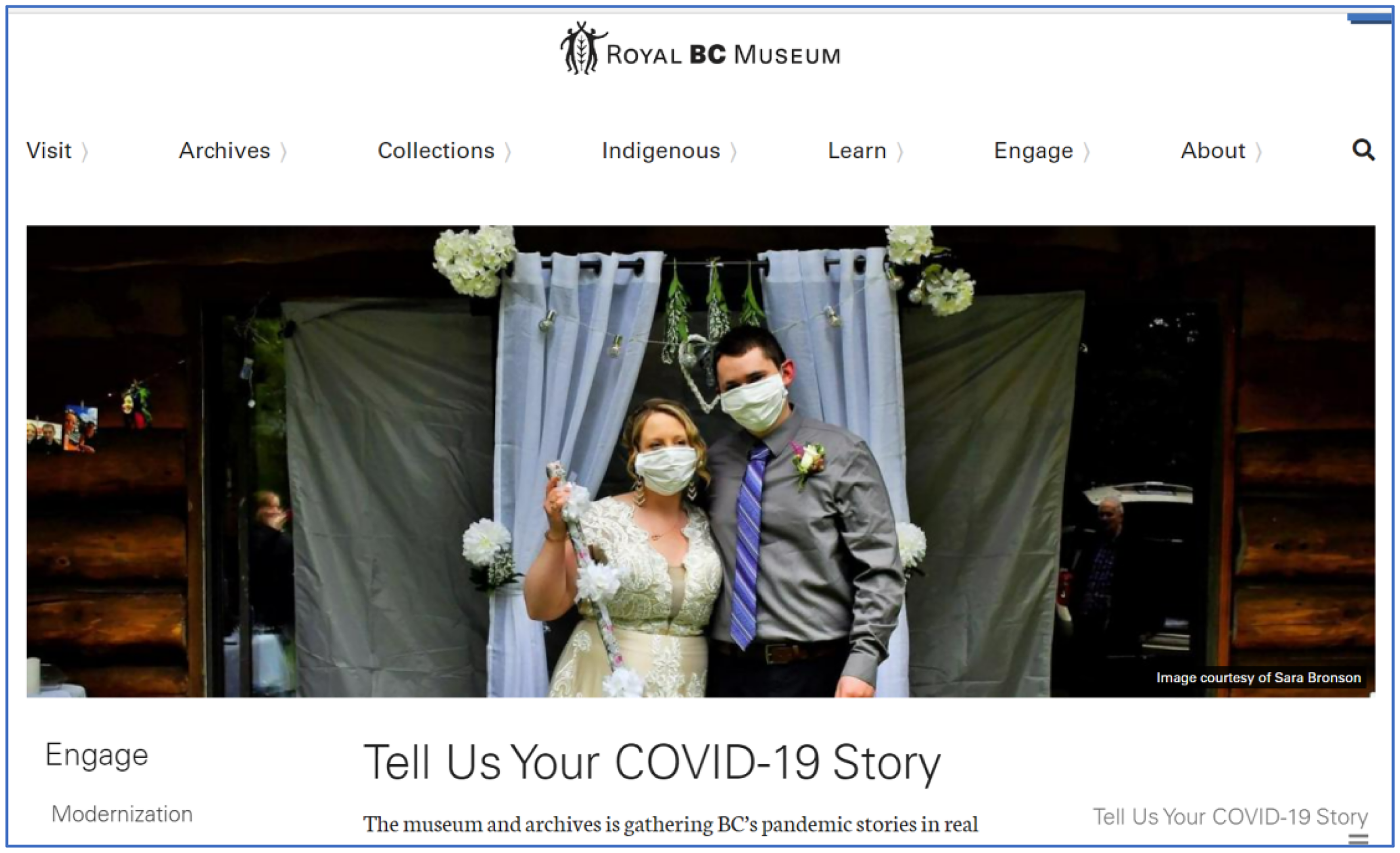
Screenshot of the Tell Us Your COVID-19 Story web page.
Reflective attentiveness also informed decisions not to develop work on certain topics. Staff at the MofT and Heureka chose not to disseminate information about COVID-19 during the peak of the pandemic, recognizing that the public was already well served by existing information sources. Similarly, the NMNHS team enacted an attentional shift by prioritizing family-oriented online programming over school initiatives: ‘During the pandemic … we had to be there for those who were looking for us, and they were the families in their households’ (Head of Education).
In different ways, all four institutions committed to social responsibility and became important civic and scientific resources during and after the pandemic (Janes, 2024). The MofT and the NMNHS partnered with local-government agencies to address public health needs, serving as vaccination sites. In Brazil, the MofT responded to the urgent need to support vaccination campaigns and counter the anti-vaccine movement promoted by the then-president. By contrast, the NMNHS collaborated with multiple institutions to support a national vaccination effort that reached over 90% of Portugal's population. In 2021—alongside its involvement in vaccination efforts and through collaborations with research institutes and television networks—the MofT also became a key scientific communicator on the coronavirus. It launched the exhibition Coronacene and a related series of YouTube live events called Conversations for Tomorrow. Similarly, the NMNHS, in partnership with academic units at ULisboa, hosted the exhibition Collecting COVID-19 ULisboa from 2021 to 2022.
In Finland, Heureka renewed its commitment to supporting visitors’ lives and well-being after the pandemic. The CEO made explicit reference to the personal, intellectual, social and physical dimensions of well-being, as well as current research in this area developed in collaboration with other Finnish museums (Falk et al., 2025).
At the RBCM, staff shared that, during the pandemic, they were finally able to materialize the idea of an online community gallery, conceived as a public platform for visitors to explore pressing contemporary issues.
Final thoughts
Although the four museums in this study faced different local realities that shaped what could (or should) become institutional priorities during the pandemic, a new social role defined by care began to emerge. Drawing on the work of Tronto (1996), Silverman (2010) and Morse (2021), it is evident that caring relationships—with visitors, co-workers and underserved communities—were placed at the core of museums’ work and practice. Humble acts of care sustained educational programmes (at the MofT and the RBCM) and supported preparation for future attendance (at Heureka), while acts of care and repair enabled solidarity (at the NMNHS). In centring care and practising reflective attentiveness, ‘other roles and commitments in museum work surface[d]’ (Silverman, 2010, 34). Through initiatives responding to situated circumstances (Jackson, 2014)—such as COVID-19-themed exhibits, an online community gallery, research on well-being and vaccination hubs—those institutions positioned themselves as relevant social, civic and scientific resources in a time of crisis.
As a concluding thought, this study revealed that, while the pandemic was a challenging and unforeseen event, it also created opportunities to rethink (or reaffirm) priorities, strengthen commitments to social responsibility and enact intentional systemic change. This research further highlights how care can become a central pathway for transforming science museums, both inwardly, through renewed values and practices, and outwardly, through evolving relationships with publics that reconfigure the interconnections among knowledge, affect and society.
Footnotes
Acknowledgements
I am especially grateful to all the museum professionals who generously contributed to this research. Thank you to Erminia Pedretti for her involvement and participation in various stages of the project. I also wish to acknowledge Karine Fernandes and Emmeline Hoogland for their support as research assistants, particularly with data collection and analysis. Finally, sincere thanks to the Social Sciences and Humanities Research Council for making this work possible through an Insight Development Grant.

Ethical approval
This research was approved by SFU Research Ethics protocol # 30001764.
Funding
This work was supported by the Social Sciences and Humanities Research Council of Canada (grant number 430-2023-00230) and by SFU/SSHRC Small Research (Grant Proposal # 28737).
Declaration of conflicting interests
The author declared no potential conflicts of interest with respect to the research, authorship, and/or publication of this article.