




Abstract
The World Federation of Science Journalists, established in 2002, marked a significant achievement by uniting global associations and organizing international conferences in science journalism. Its formation was preceded by decades of internationalization efforts from the late 1960s, involving precursor organizations such as the International Science Writers Association, the Ibero-American Association of Science Journalism and the European Union of Science Journalists’ Associations. This article explores the evolution of international science journalism associations, highlighting key figures, milestones and challenges while emphasizing the role of global associations in shaping the field.
Keywords
Introduction
By training and inclination, journalists are competitive creatures. But … they can also work together for the mutual benefit of both journalism and science. James Cornell, 1991 1
The history of science journalism appears to be deeply intertwined with the role of professional associations, which have played a key role in supporting the field's development and consolidation. This has been documented in studies of national associations, such as the National Association of Science Writers (NASW) in the US and the Association of British Science Writers (ABSW) (Lewenstein, 1987, 1989; Nelkin, 1987). Additionally, research on the Ibero-American Association of Science Journalism (AIPC) 2 suggests that similar patterns may apply to regional contexts (Massarani and Magalhães, 2024), although further studies are needed to fully assess this trend on a global scale.
These associations provide training, networking and knowledge exchange, fostering a sense of community among often-isolated professionals, especially in regions with limited traditions of science coverage. Although not all journalists engage in associative activities due to time constraints or disinterest, science journalists have shown a distinct tendency to form networks, both formal and informal (Cornell, 2012; Dunwoody, 1980).
In 2002, the World Federation of Science Journalists (WFSJ) was founded, uniting national and regional associations globally, organizing global conferences, and implementing diverse training and mentoring initiatives for professionals worldwide. Its establishment marked a significant milestone for the international science journalism community, fostering a global network and supporting national organizations.
Nevertheless, the WFSJ's creation was not solely the result of efforts by groups and individuals in the 1990s. It also culminated from a long history of attempts and achievements in the internationalization of the field. The origins of the WFSJ can be traced back to the late 1960s and early 1970s, when the first initiatives to internationalize science journalists’ organizations began to take shape (Cornell, 2010; Goede, 2012; Morin, 2012). Three processes were occurring in parallel—the three ‘forerunners of a world union’ as Cornell (2012: 12) described: the activities of 1) the International Science Writers Association (ISWA), established in 1967; 2) the AIPC, created in 1969; and 3) the European Union of Science Journalists’ Associations (EUSJA), formed in 1971.
As noted by Riedlinger et al. (2018), the investigation of science communication associations as social or cultural movements can provide important insights regarding their roles in society, their influence on how science communication is practised, and the future directions of the field. However, despite this relevance, there is little research on science journalism associations, and even less on science communication associations specifically. The relationship between the associations and professional dynamics in science journalism has been examined in a few cases, notably by Lewenstein (1987, 1989). More recently, research has started to address this issue in the Latin American context (Massarani and Magalhães, 2024), but a comprehensive understanding of the organizations’ role at national and international levels remains largely unexplored.
In this article, we aim to analyse the evolving internationalization of science journalism, offering a historical overview of stakeholders, milestones, concepts and persistent challenges. We seek to establish connections between events and processes still under-recognized by the global science journalism community, while underscoring the pivotal role of international associative traditions in shaping professional practices. We focus on how initiatives to internationalize journalist networks emerged, evolved and ultimately led to the creation of the WFSJ, extending our analysis through the organization's early years, until approximately 2004. Although more recent developments are highly relevant, they fall outside the scope of this study. By examining the transnational exchanges between associations in North America, Europe and Ibero-America, this article contributes to the historiography of science journalism, highlighting how both these exchanges and the discourse of ‘developed’ and ‘underdeveloped’ countries played intertwined roles in shaping the formation of the WFSJ.
This paper has seven sections, including this introduction. In the following section, we present the methods used in our research. In the subsequent section, we review the existing data on the creation of national, regional and international science journalism associations and analyse the late 1960s and the 1970s as a turning point in the history of the internationalization of science journalism, examining the three concurrent strands that operated during this period. We then observe significant changes in science and science journalism, as well as the events marking the late 1980s and early 1990s, when key stakeholders in the formation of international networks of science writers met in person. In the fifth section, we examine the process of creation and consolidation of the WFSJ from the first World Conference of Science Journalists in 1992 in Tokyo to the 2004 conference in Montreal. In the sixth section, we focus on a specific issue in this last process and examine how the exchange between developed and developing countries’ journalists, and the training of journalists from the latter, were central to the debates and actions that led to the establishment of the WFSJ in the early twenty-first century. A concluding section with suggestions for future research and comments on the current role of international science journalism associations in the face of contemporary challenges closes the paper.
Methods
Documents from professional associations—such as meeting records, correspondence and newsletters—provide valuable insights into the history of science journalism, revealing journalists’ perspectives on its formats and objectives. The trajectory of these organizations has both reflected and shaped journalistic practice, making their history integral to the broader history of science journalism.
In addition to bibliographic research, this study of the history of science journalism associations is based on the analysis of two documentary sources and interviews with science journalists. These sources were selected based on their relevance to key moments in the internationalization process of the field and their potential to reveal the interactions between associations in different contexts.
The first documentary source is the ‘National Association of Science Writers and Council for the Advancement of Science Writing records, 1934–2018’, number 4448, contained in the Division of Rare and Manuscript Collections at Cornell University Library. The collection—created by the NASW, Bruce Lewenstein and the Council for the Advancement of Science Writing—includes documents from the NASW and the council, as well as materials donated by science writer James Cornell related to the international activities of the ISWA. The documents were accessed in April 2024. A total of 349 items were inspected for this study, including 193 letters, 18 event programmes, 15 newspaper clippings, and photographs. These materials document, among other topics, Cornell's involvement in the Ibero-American Congresses of 1977 and 1990 and other international science journalism events in the 1980s and 1990s. They also often reflect explicit uses of the terminology of ‘developed’ and ‘underdeveloped’ countries, particularly in arguments for creating structures to support science journalism in the Global South. While not all the documents are cited directly, they informed the historical reconstruction and contextual understanding presented in this article.
The second source consulted is the personal archive of Spanish science journalist Manuel Calvo Hernando—a leading figure in the AIPC and a key person for understanding the development of science journalism in the Ibero-American region. His archive consists of letters, diaries, photographs and documents from journalism and science communication events held in Ibero-America throughout the second half of the twentieth century, in which Calvo Hernando was actively involved and a reference for other journalists in the region. Only documents related to the AIPC were analysed for this article. His documents were consulted in January and February 2023, with the collaboration of his family—particularly his son Antonio Calvo Roy, who is also a science journalist—in three locations: the house in Madrid where he lived until his passing in 2012; the Spanish Agency for International Development Cooperation (AECID), formerly the Hispanic Culture Institute, where Calvo Hernando worked for years; and the National Museum of Science and Technology (MuNCyT) in A Coruña, in northern Spain. This source was especially valuable in tracing how the AIPC was formed, how it contributed to the professionalization of the Latin American field, and how Latin American journalists interacted with peers in Europe and North America.
The interviews were conducted with three science journalists directly involved in the events of the 1990s and 2000s, selected for their availability and accessibility. The interviewees included James Cornell, former president of ISWA (on two occasions, once in October 2023 and again in May 2024); Jean-Marc Fleury, former executive director of the WFSJ (in May 2024); and Véronique Morin, the first president of the WFSJ (in June 2024). The questions focused on events in the formative period and the early years of the WFSJ. For James Cornell, additional questions were asked about his involvement in events organized by the AIPC in Ibero-America in the 1970s and 1990s. Interviews provide individual perspectives and help to interpret the processes under analysis. As this study aims to demonstrate, James Cornell played a crucial role in internationalization efforts and in bridging the North American context with other regions. His insights are valuable for the scope proposed here. Fleury and Morin were highly active in the early years of the WFSJ, offering an insider's view of the organization's formation, as well as its initial challenges and tensions. The interviews helped to clarify the actors’ perspectives on the regional disparities in science journalism, including how ideas about ‘underdevelopment’ influenced decisions and priorities during the formation of the WFSJ.
No significant contradictions were found among the different sources analysed, which supports the coherence and reliability of the study's findings.
Based on selected sources, this study reconstructs a historical perspective on the internationalization of science journalism associations, emphasizing actors from the Americas and, to a lesser extent, Europe. This emphasis reflects the nature of the available sources rather than a deliberate exclusion of other dynamics. While the role of Asian actors—particularly from China and Japan—was significant in the later stages of internationalization, their contributions are not extensively explored here due to the limitations of the consulted materials. By highlighting the role of Latin America in the early internationalization processes, this study also contributes to challenging traditional North-centred narratives about the global development of science journalism. This is an initial effort to systematize the history of international associationism in science journalism; further research based on additional documents may reveal alternative or complementary narratives.
The context in which professional science journalism associations flourished during the twentieth century
The history of professional associations of science journalists dates back to the first half of the twentieth century and the growing interest in science coverage, fuelled by technical advances and medical breakthroughs arising from World War I. In 1928, German science journalists formed the Journalists’ Association for Technical Scientific Publicism (TELI). By 1934, the NASW was established in the US. As shown by Lewenstein (1987), the NASW worked intensively to elevate the status and professionalization of science journalism, explicitly aligning with scientific community values, and advocating for public appreciation and support for scientific endeavours. In 1947, shortly after World War II, the ABSW was established as a way to organize science journalists in the UK and institutionalize the connections between science journalism and science itself (Lewenstein, 1989). A few years later, in 1955, French journalists created the French Association of Science Journalists (AJSPI), forming the set of the first associations of science journalists in the most scientifically and technologically advanced wealthier countries.
Following World War II, science journalism established itself as a distinct specialty in the media landscape with the rapid advance of science and technology. During and immediately after the conflict, journalists extensively covered the promises of atomic energy, advances in aviation and developments in areas such as pesticides and medicines. This era marked a paradigm shift, in which science and technology were viewed as central to social and economic progress, despite the war's devastating scientific applications, such as the atomic bomb. States prioritized scientific innovation for national competitiveness, creating ministries and policies to support the field (Gascoigne and Schiele, 2020). Optimism about science's potential to improve living conditions prevailed, particularly in the US, where journalism played a crucial role in connecting science and society. This period ushered in a modern era of science communication in wealthier nations.
A central characteristic of the period was the classical dissemination model, which positioned journalism as a tool for promoting public understanding of and literacy in scientific culture. Often, it was the journalists themselves who simultaneously adhered to and contributed to the construction of the ‘public understanding of science’ as ‘public appreciation for the benefits that science brings to society’ (Lewenstein, 1992), increasingly leaning the activity towards the logic of press releases and science promotion, rather than practices oriented towards a more critical approach to the scientific field, 3 frequently at odds with journalistic norms such as impartiality, diverse sourcing and contextualization (Rosen, 2018). The model mirrored the scientific community's concerns about public intellectual and material support for science (Brossard and Lewenstein, 2010). In the US and the UK, science journalists, with varying degrees of autonomy, aligned with the scientific community's values, acting as advocates for public support for and appreciation of science (Dunwoody, 1980; Lewenstein, 1987, 1989). In this context, national associations of scientific journalists from wealthier countries actively worked to promote the status and professionalization of the profession, measured by the level of acceptance by the scientific community.
The launch of Sputnik by the Soviet Union in October 1957, the first artificial satellite to orbit the Earth, within a context of intense geopolitical competition in which science and technology were increasingly seen as central, marked a turning point in the history of journalism and science communication. The event surprised the US, which saw this achievement as a threat to its scientific supremacy, leading to a significant increase in investment in science and technology, with an emphasis on science education and literacy for the population (Lewenstein, 1993). The strengthening of science and technology—the foundation of the US's economic and military power—would depend, according to this narrative, on, among other things, the systematic identification and subsequent training of talented young individuals with the goal of creating new generations of scientists and engineers. Reporting on scientific and technical developments during the post-Sputnik era was generally optimistic and enthusiastic, setting a tone of reverence, admiration and awe towards science and scientists that would characterize science journalism for a long time. Science coverage aligned with national goals, and, among science journalists, the belief prevailed that if the public knew more about science, they would understand the need to continue supporting it. In the following years, the space race and the Moon landing in 1969 intensified interest in covering science and technology issues in the media, which adopted a predominantly uncritical ‘cheerleader’ attitude towards science. The US space programme played a crucial role in the development of science journalism as a profession (Nelkin, 1987). Cape Canaveral became a gathering point for journalists interested in science and technology and served as a gateway for newcomers to science reporting. Press coverage of the early space launches included imagery that, for years, shaped the media's portrayal of dramatic adventures in science and technology. Until the Challenger disaster in 1986, probing, sceptical and critical science journalism was very uncommon. The intense coverage of the space race created an environment for international interaction among science journalists. These encounters fostered both a sense of shared purpose and the realization of shared challenges, laying the groundwork for stronger professional networks.
On the other hand, around the late 1960s and the 1970s, science journalism in wealthier countries began to adopt more critical stances and create some distance from the scientific community. One example was among environmental journalists, who pressured their editors to get more environmental news into the press, while at the same time actively helping environmentalists to learn how to use the press in the best possible way (Lewenstein, 1989). These journalists were much less concerned with scientific developments than with the consequences of modern technology (including population growth) on Earth. At the same time, criticisms were rising against the so-called ‘deficit model’ of science communication; that is, the one-way and vertical communication dynamic from science to its audiences.
The social and counterculture movements of the late 1960s and early 1970s incited the questioning of the autonomy of science and the solely positive view of its impacts. Science was considered by political activists and by some scientists as the private ally of central authorities, and the public understanding of science began to have its objectives and formats rethought. The simplistic role assumed by science journalism as the popularizer of science, establishing a one-way and vertical communication dynamic from science to its audiences, primarily reflecting the scientific community's concern with public understanding of science and lack of public support, was already showing signs of fatigue but nonetheless persisted for a long time. A new, more critical, era of science communication began to emerge in the 1960s, albeit unevenly. In this context, science journalists moved towards greater autonomy as a professional field, reinforcing their own values and codes of conduct, and increasingly distinguishing themselves from the scientific community (Nelkin, 1987).
As science and its problems became increasingly global—with debates about environmental degradation, nuclear risks and technological control—so did the perceived need for international cooperation and dialogue among science journalists. It was in this context that the profession became professionalized and institutionalized, the science journalism community began to expand, and associative practices flourished. The existing national associations gained relevance and prominence, and new national associations, especially in Europe, began to emerge in the early 1970s.
While the trends outlined thus far apply to wealthier countries, for which they are reasonably well documented, the development of science journalism has followed quite distinct paths elsewhere. In the Global South, and particularly in Latin America, historical accounts are still limited and largely based on scattered documents and a small number of studies (Massarani et al., 2017).
Drawing from the private archive of Spanish journalist Calvo Hernando and this still incipient literature, it is possible to trace how, in Latin America, the first dedicated professionals in this emerging field began to gain recognition in the late 1960s and the 1970s, gradually finding their place in newsrooms and organizing into professional associations. By the 1980s, Asian associations began to provide shelter for the first science journalists from the region. In Africa, this movement is even more recent. Only in 1998 did the launch of the Southern African Science Communication Network (SASCON) finally signal Africa's entry into the global network of science communicators, even though, at the time, science communication in that region—and throughout the African continent—was just emerging (Riedlinger et al., 2018).
Unlike their counterparts in the Global North, journalists in the Global South were very scarce. By the mid-1970s, the NASW already had about 1000 members and the ABSW had about 200 members (Lewenstein, 1989), while, in Latin America, nascent national associations’ membership rarely exceeded 10. The Southern journalists formed extremely small professional associations to carve out a place within the journalistic community, media landscape and governmental spheres. Their associations also aimed to gain recognition from the scientific community, with which they were closely intertwined, often being perceived as part of it.
In Latin America, the consolidation of the field of science journalism came later than in the Anglo-Saxon world, and the professionalization and legitimization of this specialty began in the 1960s within a very particular context for science and journalism in the region. We are talking about authoritarian modernization projects, for the most part, in which policy instruments sought to direct scientific development, linking it to the technological needs and economic development of those countries. In this context, with newspapers and public debate under censorship and major development projects aligned with US policies, science journalists gradually gained space in the media and among the scientific community and its organizations by presenting a science that was both neutral and applicable to national development, and presenting themselves as mass educators and advocates for science.
Latin American science journalism associations emerged within the framework of certain members of the scientific communities who were more engaged in advancing science policies and the role of science in society. It is evident that this did not lead to widespread acceptance of science journalism by scientific communities in developing countries. As Yakary Prado (2008) notes, the pioneers of Latin American science journalism needed to earn the trust of scientists, decode information in a way that could be understood by highly diverse populations, and tackle the challenging task of convincing media owners that this type of information was attractive, interesting and, above all, important. Criticisms, misunderstandings and tensions marked the early stages of this relationship. However, it is worth noting that, since the first events promoting science journalism in Latin America in the 1960s, individuals connected to the scientific community, its values and its interests have been predominant (Massarani, 2021), shaping the movement in many respects.
In Latin America, the movement of the pioneers of science journalism was closely linked to the actions of international organizations such as the Organization of American States (OAS), the Inter American Press Association, the Spanish Institute of Hispanic Culture, 4 and the United Nations Educational, Scientific and Cultural Organization (UNESCO). In 1962, a first inter-American seminar on science journalism was organized in Chile (Massarani, 2021) as part of the newly created Inter-American Science Journalism Program—a first systematic attempt to professionalize science journalism in Latin America—which ‘envisioned the use of the press as a means of promoting science, creating a favorable public opinion environment for investments in science, seen as one of the main engines of national development’ (Massarani and Magalhães, 2024: 6). Unlike the American and British cases, where professional associations of science journalists were established with the intention of institutionalizing the connections between science journalism and science itself, in a movement of journalists reaching out to scientists (Lewenstein, 1989), in Latin America, the associative movement of science journalism began as a movement led by both journalists and members of scientific communities, supported by international development agencies. They were interested in garnering public support from the masses and the rulers for public funding in science and technology within a national development project in which science and technology would play a central role oriented towards social and, above all, economic development. In this context, it is evident that these actors were engaging with regional theories emphasizing the role of science and technology in national development. To some extent, they were also influenced by debates surrounding the New World Information and Communication Order (NWICO). Emerging during the Cold War and the Non-Aligned Movement, particularly within UNESCO, the NWICO sought to address imbalances in the political economy of global information systems. It also emphasized the importance of local media as tools for development.
The late 1960s and the 1970s as an associative turning point for science journalism
With the optimism of the era and the prominence of science journalism as part of grand national development projects and geopolitical hegemony, the late 1960s and the 1970s marked an associative turning point for European and, predominantly, American science journalism. This period also saw the formation of many national science journalism associations (Gascoigne and Schiele, 2020; White, 2007).
To illustrate this point, we observed the available information in the literature and on the internet regarding the founding dates of national, regional and international science journalism associations. We analysed data compiled by White (2007) in a survey conducted by the WFSJ, by Massarani and Magalhães (2024) in their recovery of the history of Latin American associations, and by the authors gathered in the book Communicating Science: A Global Perspective (Gascoigne et al., 2020), and from the associations’ websites. The 2023 study—based entirely on documents from the private archive of Calvo Hernando—identified the creation of several Latin American associations in the 1970s, the founding dates of which had not been previously recorded in the literature, thus expanding the known history of the field in the region.
This analysis led us to an unprecedented dataset of 93 founding dates of science journalism and science writing associations since the 1920s, detailed in the Appendix (80 national associations and 13 regional or international associations). Many ceased to exist, while others were replaced by new ones.
With this data gathered and distributed by decades (Figure 1), we can see that the late 1960s and the 1970s indeed mark a turning point in the history of science journalism associations. The momentum continued into the 1980s, although it weakened significantly in the 1990s. Starting from the 2000s, with the creation of the WFSJ, we observe a resurgence of this movement and the establishment of 40 new associations.
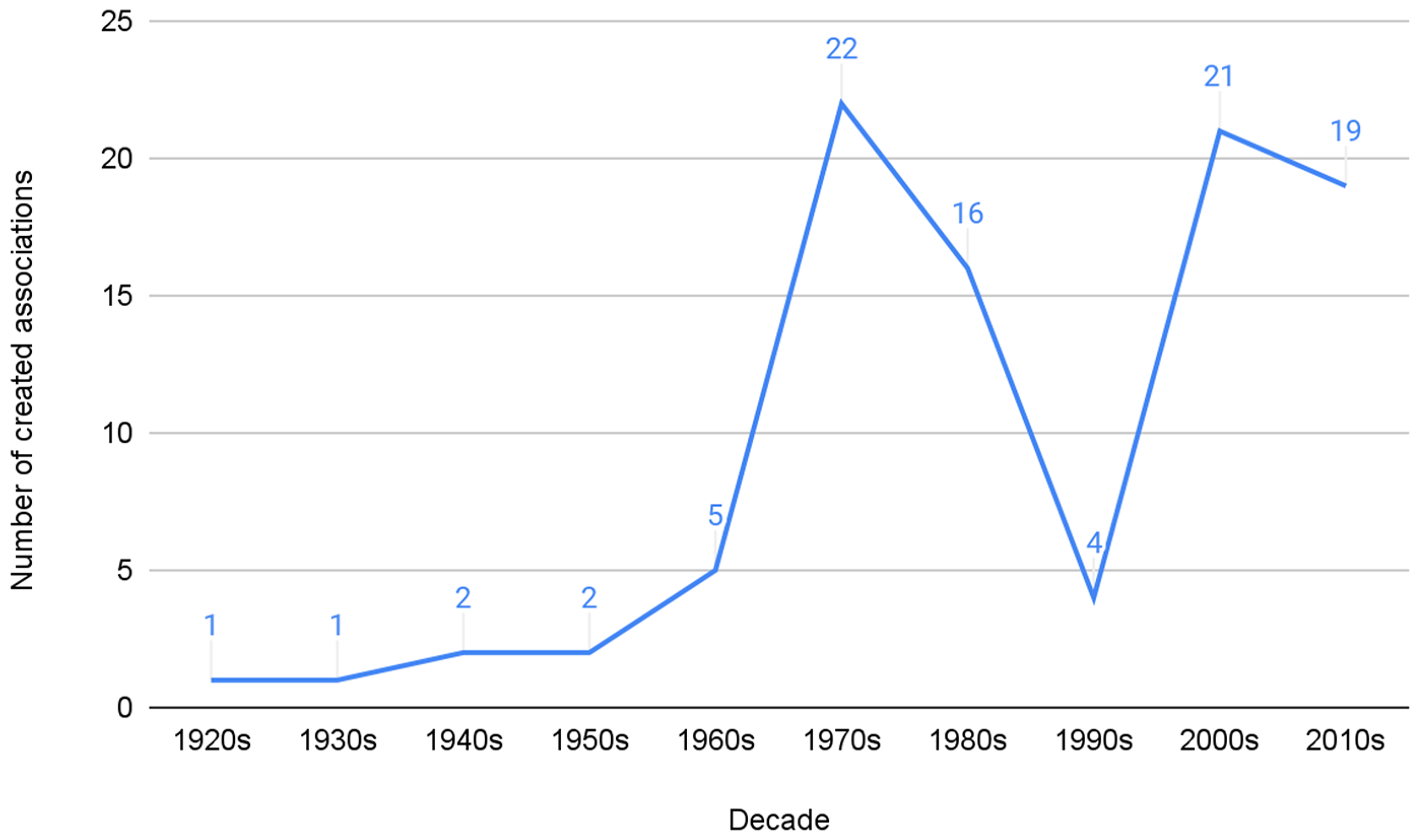
Distribution of the founding dates of national, regional and international science journalism associations worldwide over the decades.
However, if we look at the distribution of founding dates for national associations grouped by continent (Figure 2), we see that the movement of the 1970s was primarily Latin American and, to a lesser extent, European. We also observe that the creation of national associations of science journalists is a more recent trend in Asia and a much more recent one in Africa, mainly concentrated from the 2000s onward.
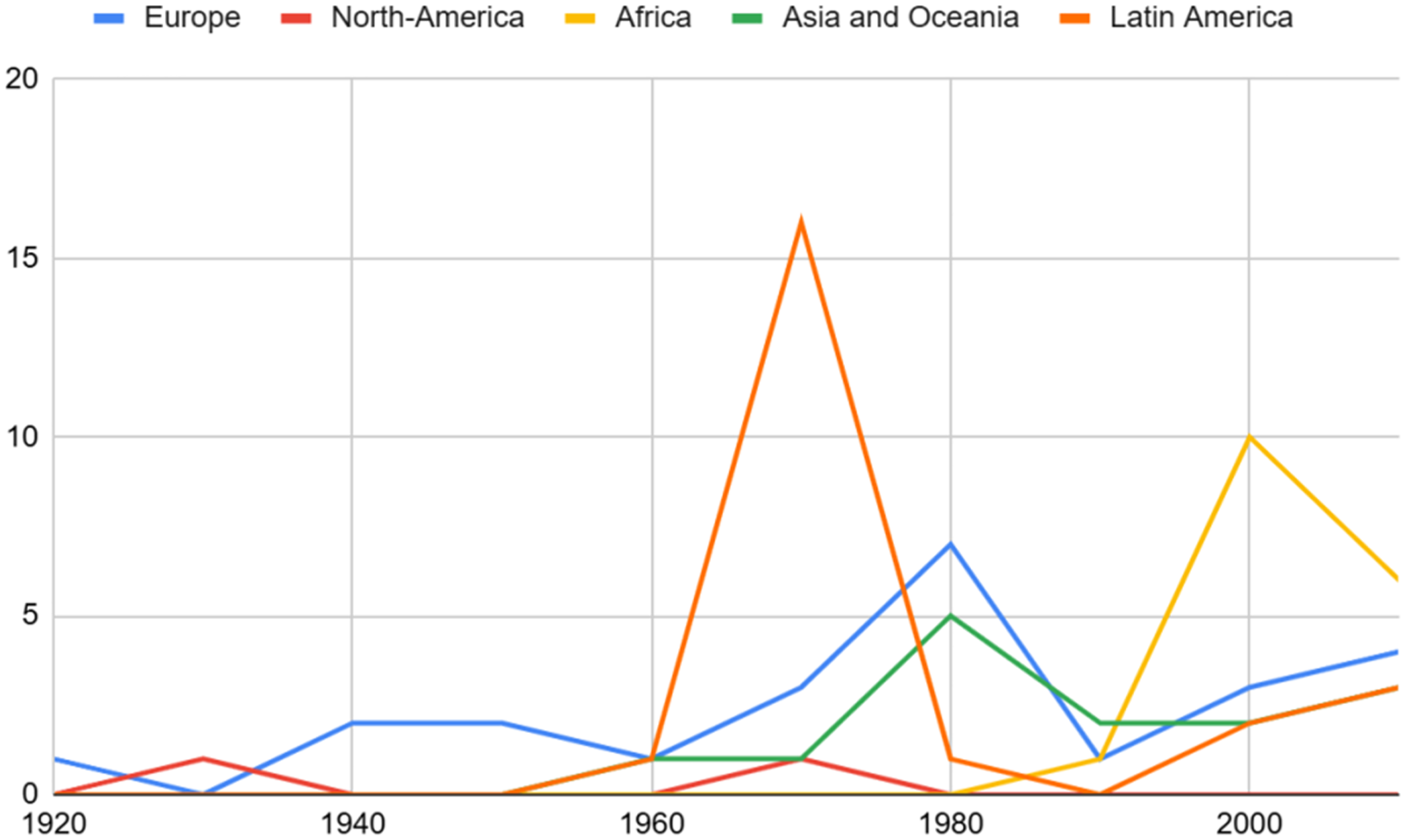
Distribution of the founding dates of national science journalism associations worldwide over the decades, by continent.
In this context of a boom in science journalism associations, the first three initiatives to internationalize the organization of science journalists emerged: two regional (Ibero-American and European) and one international (the ISWA, which, despite its international intent, was primarily Anglo-Saxon in its origin).
During the coverage of the epic of man's journey to the Moon (a significant milestone for global and particularly North American science journalism), a generation of science journalists from the US, as well as from other countries such as the UK and Canada, began to solidify their connections. Some of these journalists—initially generalists with little scientific background—gradually became science journalists during the space race. They were predominantly male, with a thematic preference for astronomy and the ‘hard sciences’, and they started to strengthen their ties and adopt collaborative practices (Dunwoody, 1980). In this context, science reporters who covered scientific events and especially space launches began to point out the importance of expanding international contacts. Science coverage was becoming increasingly internationalized. American scientific events attracted journalists from other parts of the world, as did the rocket launches of space exploration. The annual meetings of the American Association for the Advancement of Science (AAAS) also increasingly drew journalists interested in the coverage of major scientific topics discussed in venues other than scientific events, serving as the primary source and main meeting point for the generation of the 1960s and 1970s (Dunwoody, 1980). It is in this context that the ISWA was born.
In 1967, a group of journalists from the US, Canada and the UK, covering the space race, founded the ISWA to establish mutual support systems for science writers. A year before, a group of senior science writers and editors (among them Gordon Rattray Taylor of the BBC, John Maddox of Nature and Dennis Flanagan of Scientific American) met in London to discuss the benefits of forming a loose network (Cornell, 2010). As James Cornell (2010: 1), ISWA president for 32 years, stated: Using the occasion of the World's Fair in Montreal (EXPO 67), this core group, joined by several other prominent writers (including Robert Cowen of the Christian Science Monitor, Howard Lewis of the US National Academy of Sciences, and Fred Poland of the Montreal Star), met to write and approve a draft constitution, to elect officers, and to debate, and finally dismiss, a motion to create a ‘federation of associations’ in favor of what ISWA would become … : an ‘organization of individual membership’.
ISWA adopted an individual membership model, and, for many years, Cornell advocated that ISWA should remain the type of organization that represents the interests of science writers in all parts of the world, rather than promoting the philosophy or aims of a nation or region.
During the 1980s, ISWA expanded its membership, actively reaching out to young journalists from emerging nations, promoting a global network for mutual support and expanding its members beyond the group of white, Anglo-Saxon men (Cornell, 2010). By the 1990s, ISWA's network had grown to 200 members in 26 countries, and one-third of attendees at the 1992 World Conference of Science Journalists were ISWA members. 5 However, despite its growth, ISWA remained a small fraction of the global science journalism community, reflecting limited interest among well-established journalists from the Global North.
In the early years of the WFSJ's existence, ISWA reinforced its identity as an ‘organization of individual membership’ and began to serve as a home for ‘orphan’ journalists who lacked professional organizations in their own countries, providing a network of personal contacts for mutual assistance and support among colleagues. It offered an alternative for international journalists seeking a more personal and direct relationship with colleagues worldwide. However, in the twenty-first century, as the WFSJ consolidated and new national associations emerged in various countries, ISWA gradually lost its vitality.
Ibero-American Association of Science Journalists and the Latin American science journalism movement
In 1969, included in the movement around the Inter-American Science Journalism Program, the AIPC was created at the conclusion of a round table in Colombia, bringing together journalists from Latin America and Spain. The Spanish journalist Manuel Calvo Hernando and the Venezuelan Arístides Bastidas led the efforts of the association. Calvo Hernando assumed the hands-on role of AIPC Secretary-General and was an important organizer and leader of a generation of science journalists who had until then worked in a scattered way, playing a driving role in the creation of national associations by Latin American countries and in giving unity to all the actors around the region (Massarani and Magalhães, 2024). Goede (2012: 16) regarded Calvo Hernando as the pioneer and forefather of global science journalism for leading the establishment of the AIPC. Cornell (2024) stated: The creation of the AIPC … was the first step toward what would one day become the World Federation of Science Journalists … In addition to promoting exchanges of journalists and conducting training programs, the AIPC sponsored a series of bi-hemispheric congresses that would become models for future international conferences.
Unlike the EUSJA, which was created to bring together pre-existing national associations, the AIPC had the clear function of promoting the creation of regional associations (Massarani and Magalhães, 2024). There was an effort to create associations in all Latin American countries, even those without traditions in the field. The 1970s were marked by intense mobilization towards the creation of national associations of science journalism in Latin America, driven by the AIPC (Massarani and Magalhães, 2024). To the emerging field of Latin American science journalism, the establishment of national associations and the role of AIPC throughout the 1970s were crucial drivers for legitimizing the field.
European Union of Science Journalists’ Associations
In 1971, it was the turn of European science journalists to create the EUSJA in Belgium, bringing together the newly created associations of the European continent. The Italian science journalist Giancarlo Massini persuaded a group of like-minded European science journalists to form the union (Bourne, 2012), thus forming the third axis of internationalizing efforts in science journalism of that time. The EUSJA was created under the auspices of the European Economic Community (EEC) based on the concept of an organization made up of national associations. Unlike the AIPC, which was created before national associations with the aim of fostering their creation throughout the region, the EUSJA was founded as a gathering of already existing associations. Unfortunately, the process of founding and the early activities of the EUSJA still lack in-depth studies. What can be said is that, in terms of context, what has already been stated about science journalism in wealthier countries applies to the context of the organization's creation. The original union included seven associations, but expanded. In the turn from the 1980s to the 1990s, with the dissolution of the Soviet Union, the EUSJA experienced expansion through the accession of several newly established associations from Eastern Europe (Bourne, 2012).
A world union of science journalists in 1977?
A little-known episode in the history of science journalists’ associations, identified through the analysis of archival documents and correspondence, is the 1977 attempt to create a World Organization of Science Journalism—a full 25 years before the establishment of the WFSJ. Although this initiative did not persist for various possible reasons, it is significant because it demonstrates that, as early as the late 1970s, there was a clear intention among the journalists most involved in international meetings to expand the organization of science journalists to a global scale.
The effort emerged during the second AIPC Congress in Madrid, organized by Manuel Calvo Hernando, which brought together journalists from Latin America, Europe, North America and beyond—including James Cornell (NASW) and Alexander Braun (ISWA) as observers. The event marked a key moment for fostering ties between American and European journalists and advancing the internationalization of science journalism.
At the summit's conclusion, James Cornell called for greater international cooperation, and the Venezuelan delegation proposed creating a world association. This motion, endorsed in Madrid, was presented at the First International Conference of Science Editors in Israel
6
the following month, gaining support from journalists and editors across Africa, Asia and Oceania. Five continental executive secretaries were elected, along with an International Council.
7
Potential funders such as UNESCO, OAS and AAAS were approached, and a World Congress was planned for 1982. In a letter dated 12 May 1977,
8
Hugo Obergottsberger of the Austrian Association of Science Journalism discussed the creation of the World Union with Cornell: I feel that the World Union might become a truly exciting thing, provided that we succeed in making it more than a mere office. Science and research have achieved such eminent international aspects that we shall have to act accordingly on an international and global basis.
Despite this enthusiasm, the project did not survive beyond the following year. According to Cornell (2010), its collapse stemmed from internal political disputes within the Venezuelan leadership, funding challenges, communication barriers (letters being the main channel), and language asymmetries, with Spanish predominating over English. Its formal announcement was limited to a few Venezuelan newspapers.
The attempt to create a global association in 1977 reveals that, already in the 1970s, there was a growing network of internationally engaged actors aiming to connect science journalists across borders. The prominence of Ibero-American actors in initiating this global endeavour—as seen in the documents—underscores the extent to which the internationalization of science journalism at the time resonated most strongly in that region. While the field might not yet have been mature enough to sustain this effort, the boldness and early leadership of these journalists remain significant.
The late 1980s and the 1990s as a period of a ‘growing atmosphere of internationalism’: The Spanish meetings and the Tokyo conference
Later, in the late 1980s and early 1990s, a series of international meetings revitalized the movement, bringing together some of the main stakeholders in science journalism and science communication, both in practice and in research. This period shaped what British science journalist Arthur Bourne (2012: 4) described as a ‘growing atmosphere of internationalism’. Closer to the present day and more familiar to the current community of science journalists, this context was the result of the two preceding decades of internationalization initiatives, which are less well known. During these decades, significant economic, social and technological restructurings changed the media, science and, as expected, science journalism. Important questions about models for conducting science journalism and science communication also reshaped the practice in many ways.
In the 1980s and 1990s, profound transformations reshaped the landscape of science communication. The Bodmer Report, published by the Royal Society in 1985, was a significant milestone in the history of science communication in the UK (Gouyon, 2016). Titled The Public Understanding of Science, the report highlighted the urgent need to improve scientific communication with the public and urged scientists to engage more actively in publicizing their work (Royal Society, 1985). From this point on, the Committee for the Public Understanding of Science (CoPUS) was established to promote better understanding of science among Britons and to support science communication initiatives.
The report had a notable impact, leading to increased public investment in science communication and the development of institutional infrastructure to support the field. In response to the report, various initiatives emerged, such as science weeks and the inclusion of science communication courses in academic curriculums. Additionally, the Economic and Social Research Council began supporting research on the public understanding of science. New journals focused on science communication appeared in the early 1990s (Public Understanding of Science and the newly renamed Science Communication), and, as noted below, the International Network on Public Communication of Science & Technology grew from a 1989 seed into a formal organization by the mid-1990s (Fayard et al., 2004).
Despite these advances, the 1995 evaluation of CoPUS revealed that scientific literacy in the UK had changed little since the first survey in 1989. This period highlighted the complexity of the interaction between scientific information and the public, and research began to show that opinion formation and decision-making were more complex and multifaceted processes, involving social and cultural aspects beyond the mere dissemination of scientific information (Miller, 2005).
The advent of the internet in the 1990s also revolutionized the communication of scientific information, accelerating globalization and facilitating the formation of extensive international networks among science communicators. The 1980s and 1990s thus represent a transformative period in which science and its communication transcended national boundaries, ushering in a new era of interconnectedness and collaboration in the scientific community and among science communicators worldwide.
In a 1991 ISWA newsletter, James Cornell observed that, while science had long been international, popular science communication lagged due to reliance on local languages and interests. He noted, however, that advances in communication, transportation and education were fostering global networks of science communicators, paralleling those of scientists. 9
The rise of environmental journalism in the 1980s and 1990s illustrates how science and science journalism increasingly addressed transnational issues, focusing on their local impacts. At the 1989 seminar ‘The Press and the Planet’ in Brazil, James Cornell emphasized that environmental challenges transcend borders and offer opportunities for faster information exchange between scientists, the press and the public.
10
The Asia–Pacific Forum of Environmental Journalists exemplified these dynamics, initially embracing Western development notions before adopting a critical stance through environmental perspectives. By the 1990s, many science journalists in the Global South viewed themselves as defenders of the planet, driven by a sense of mission.
11
The formation of the International Federation of Environmental Journalists in 1993, uniting members from 88 countries, marked a key step in the internationalization of science journalism (Cornell, 2012). Reflecting on these trends in 2012, Cornell (2012: 11) noted that interconnected global issues such as climate change and pandemics highlighted the need for effective international networks among science journalists: Because global problems demanded global solutions, many science journalists hoped to establish effective global networks for sharing vital information, ideally through a world ‘union’ or ‘federation’ of the many new national groups.
In this context, the Delta network was formed in 1989, and is now known as the Public Communication of Science and Technology (PCST) Network. It promotes the exchange of knowledge and best practices among professionals and researchers involved in science communication. PCST organizes international conferences, publishes research and provides resources to support the development of strategies aimed at making science communication activities more effective. Although it is not predominantly composed of science journalists like the WFSJ, the PCST Network has effectively become a space for exchanges and learning for science journalists. Some of its earliest meetings, especially in Madrid in 1991 and Montreal in 1994, recruited participants through the ISWA network.
The first large-scale international conferences for professionals, educators and researchers in the field of science communication took place in the late 1980s and early 1990s, initially still very restricted to Western Europe and North America (Trench et al., 2014). Four European events marked an advance in the international organization movement of science journalists: the First Conference of the PCST Network in May 1989, at Poitiers, France, under the leadership of Pierre Fayard; the First National Congress of Science Journalism of Spain, organized by the Spanish Science Journalism Association on 19–20 April 1990, in Madrid, Spain; the Fifth Congress of the AIPC from 21 to 24 November 1990, in Valencia, Spain; and the Second International Conference of the PCST Network, from 21 to 24 May 1991, in Madrid, Spain. We would like to demonstrate how, within them, some of the main stakeholders of the international science journalism organization movement met and gradually shaped the First World Conference of Science Journalists in 1992 in Tokyo, Japan—the first meeting organized by UNESCO.
As Bourne (2012) notes, Calvo Hernando seized the opportunity of the events in Valencia and Madrid in 1990 to promote meetings between journalists from Latin America and their European counterparts. The 1990 event's programme—part of the documents of the archive at Cornell University—suggests a clear shift from the Latin American focus of earlier Ibero-American congresses to a more global perspective on science journalism, featuring guests from multiple continents and addressing issues more aligned with global debates. James Cornell (ISWA), Pierre Fayard (PCST Network) and Manuel Calvo Hernando (AIPC) attended the First National Congress of Science Journalism in Spain in 1990 and spoke at a round table titled ‘Science and journalism worldwide’. A few months later, during the Fifth Congress of the AIPC, in Valencia, in 1990, James Cornell, Pierre Fayard, Manuel Calvo Hernando and a new actor—Arthur Bourne, then president of the EUSJA—met again. As Cornell (2010: 2) noted: ‘Arthur Bourne … had tried for nearly two decades to organize a truly “international conference” of journalists from all parts of the world—and particularly from the emerging nations of Africa and Asia’. At the Valencia meeting, Cornell and Bourne discussed holding a first world conference of science journalists, laying the groundwork for the above-mentioned UNESCO World Conference of Science Journalists in 1992 in Japan. Rather than being the result of a single initiative, this event reflected long-standing aspirations and parallel efforts by numerous actors across continents.
The encounters in Madrid, Valencia and Tokyo were not isolated events, but rather key moments in a longer process of convergence, in which previously disparate initiatives began to coalesce. The involvement of figures such as Cornell, Bourne, Fayard and Calvo Hernando in these gatherings highlights the growing cohesion among various efforts aimed at internationalizing science journalism. This process was not spontaneous; it reflected decades of cumulative work by individuals and associations committed to fostering transnational cooperation.
The years of debate, persuasion and consolidation of the World Federation of Science Journalists
The efforts to create the WFSJ were initially confined to a small group of journalists, as noted in personal communication by Morin (2024). Until the Montreal conference in 2004, the broader international community of science journalists remained largely unaware of the ongoing efforts to establish the federation.
In the early 1990s, Japan's economic boom provided an opportunity to highlight its advances in science and technology by hosting the First World Conference of Science Journalists (FWCSJ) in 1992 (Fleury, 2012: 6). The conference, as documented in archival materials and personal accounts, did not yet propose the idea of a global federation, but it planted the seeds for future international cooperation. According to Bourne (2012), ISWA officers played a crucial role in identifying journalists from developing countries to participate in the FWCSJ, highlighting early efforts towards international inclusivity. The conference had 165 participants from 31 countries.
During the 1992 conference, Istvan Palugyai, a Hungarian science journalist, sparked discussions about global cooperation, setting the stage for future deliberations (Fleury, 2012: 7). These discussions, as reported in personal communication (Fleury, 2024), laid the groundwork for future deliberations on a more structured and formalized international body.
The concept of a world federation began to take clearer form during the Second World Conference of Science Journalists in Budapest in 1999, held alongside the UNESCO World Conference of Science, and thus maintaining ties with scientific institutions. However, correspondence found in archival materials and personal recollections reveals that financial constraints and scepticism from journalists at major media outlets such as the BBC and The New York Times cast significant doubt on the feasibility of the project. The creation of the WFSJ was gradual, lacking widespread enthusiasm in its early years, and it was built incrementally over the course of a decade.
The scepticism expressed by journalists from major media outlets went beyond financial doubts. It revealed a deeper divide in professional cultures and expectations. For journalists based in strong national media ecosystems, particularly in the Global North, the idea of an international federation may have seemed unnecessary, even counterproductive. This perspective often reflected a view of science journalism as intrinsically tied to leading centres of scientific production, reinforcing asymmetries in what was considered valuable or newsworthy. These reactions exposed the limits of a universalistic vision of science journalism and highlighted tensions between journalists from different regions. Early resistance from Northern journalists thus pointed to a broader challenge: building a truly global federation would require not only logistical coordination, but also a redefinition of what it means to share a professional identity across diverse and unequal contexts.
By the time of the third conference in 2002, doubts about the federation's viability persisted, but significant steps were taken towards its creation. As reflected in Cornell's retrospective (Cornell, 2012), the event was instrumental in moving discussions from the theoretical to the actionable, leading to the establishment of the WFSJ by the end of the conference.
Between 2002 and 2004, efforts to secure support from major stakeholders bore fruit. The Fourth World Conference of Science Journalists, held in Montreal in 2004, represented a decisive moment in the federation's trajectory. For many key actors, particularly those from powerful national associations, this was when the idea of a world federation gained legitimacy. As Fleury (2024) recalls, the scale and diversity of international participation left a strong impression on sceptical observers: ‘the Americans, I remember, were telling me: “oh, we didn’t know there were all these people in other countries”. They were amazed.’ What had previously seemed like a fragile initiative driven by a small group of idealists now appeared to be a credible and growing global movement.
However, affiliation with UNESCO was a challenge in establishing the WFSJ. As the archival records and interviews indicate, UNESCO's bureaucratic processes and limited funding posed obstacles. Moreover, journalists from the US, the UK and France viewed it as politically influenced, conflicting with the WFSJ's aim for journalistic independence. For those involved in creating the WFSJ, maintaining independence was crucial, reflecting their professional values. This was emphasized in discussions with UNESCO, as Morin (2024) argued for the importance of journalistic independence from both scientific and political agendas. This stance helped to gain support from major associations such as the British and American associations.
Between 2002 and 2004, the consolidation of the WFSJ relied on two key funding strategies that compensated for the lack of substantial support from UNESCO: partnerships with Canada's International Development Research Centre and the Canadian International Development Agency and the fundraising opportunities created by the growing visibility of the world conferences.
Independence from the scientific community remained a critical issue for the federation's founders. Fleury (2012) noted that the WFSJ constitution distanced journalists from scientists, emphasizing journalists' role as independent investigators reporting at the intersection of science and society. Morin (2024) highlighted the federation's mission to protect journalists’ independence and critical stance. This process marked a shift towards greater autonomy and professionalism, shaping science journalists as independent investigators at the science–society nexus.
One of the distinguishing features of the WFSJ in its early years was its long-term training programmes for young science journalists from developing countries, focusing on their education, quality and employability, particularly in Africa and Asia. These programmes highlight an issue that was central to the advancement of the WFSJ in its early years: strengthening relationships between journalists from developed and developing countries.
Narrowing the gap between developed and developing countries at the core of science journalism internationalization
The coverage of scientific advances between countries in the Global North and the Global South is uneven and faces numerous challenges. Even today, very little information about the scientific production of the South finds resonance in the media of the North. Key factors behind this disparity include the indifference of Northern countries to the scientific contributions of developing nations. Historically, science journalists in the Global North have shown little interest or knowledge about the science of the South or the activities of their peers in the Global South. This indifference was starkly illustrated in a letter dated 9 April 1976, in which James Cornell noted that board members of the NASW were unaware of similar organizations in developing countries. 12 This lack of awareness underscores the insular nature of North-based science journalism at the time—an isolation that reflected not only a disinterest in the scientific achievements of the Global South but also a broader disengagement from the global scientific community.
Cornell, however, sees himself as an exception in this context. Since the mid-1970s, he has worked to build ties between science journalists across regions, recognizing the need for greater international collaboration. He was the public relations officer at Interciencia, a federation founded in 1974 in Venezuela and aimed at connecting journalists in the Americas. Yet, this international effort largely went unnoticed by established journalists in major global media. Reflecting on the climate of the time, Cornell explained: During the 70s there was very little interest amongst American journalists in making contact with other science writing groups. I was one of the rare … We were very insular. It was a golden age of American science writing, but it was about American science. And unless there was an American component of a foreign activity or a foreign research, it never got reported in the US. Much of that has changed since. (Cornell, 2023)
On the other hand, science journalism in the Global South is still largely characterized by strong dependence on foreign sources, especially the media in the hegemonic centres of scientific production, while national scientific news often holds a marginal status within local newsrooms (Nguyen and Tran, 2019). This dependence not only limits the ability of journalists to provide a more nuanced and critical perspective on scientific developments but also distorts the local context by recycling foreign narratives that might not be fully relevant to regional challenges and realities. As noted by Nguyen and Tran (2019), in many countries, science news is often republished without adequate adaptation to the local context, which compromises its relevance and potential impact on public understanding and decision-making.
Despite these structural imbalances, the 1990s marked the beginning of transformations that seemed to promise a more integrated and equitable global field. The internet, the internationalization of science and the formation of science journalists’ associations transformed the field. Internationalization gained momentum through world conferences and the increased flow of people and information. The formation of the WFSJ and other associations helped to reduce disparities in scientific information dissemination. This evolution led to the professionalization of science journalists in Latin America, Africa and Asia, strengthened global connections, and raised awareness of diverse research. Nevertheless, these promising developments have not fully overcome the historical asymmetries in the global circulation of science news. Among the many challenges of internationalization, one ongoing issue has been ensuring that the Global South is not merely a passive recipient of information, but an active participant in shaping and producing science journalism.
The notion of inequality between what actors at the time referred to as ‘developed’ and ‘developing’ countries was a central theme to internationalization efforts, as the analysis of documents and interviews reveals. Fleury (2012) notes that the science and technology information gap was a key concern at the 1992 World Conference. Early global conferences and the WFSJ's initial years saw limited interest from journalists in wealthier countries in joining an international association. Fleury (2012) recalls James Cornell's observation that many American journalists were uninterested in international issues, unlike their counterparts in developing countries, who strongly supported a global federation. The goal of the federation to ‘support the professional training of science journalists, especially in the developing world’ was crucial in garnering support from key stakeholders (Fleury, 2012: 9). According to Fleury (2012), journalists from the Global South at the 1992 conference explicitly called for global collaboration and support for emerging local associations.
While major players were sceptical about the creation of a federation, Fleury (2024) argued that the WFSJ could help colleagues in developing countries: ‘Everybody kept telling me: “we have our own national association. We don’t need an international body.” My answer was: “maybe we can help colleagues in the developing world”’. Fleury (2024) emphasized that this argument, combined with his experience of organizing workshops in Congo and other parts of Africa, motivated journalists to support the WFSJ's creation in 2002: ‘What made people come together? I think it was this interest in helping colleagues from other countries’.
That perspective was not one-sided. Véronique Morin observed that journalists from developing countries often felt undervalued, suggesting a two-way approach: There was this sentiment from developing countries journalists that they were being belittled by the big players … I thought that we should have an approach of actually: ‘We’re learning from you. We’re going to create a tandem’—like duos of associations where the associations in Africa or elsewhere would also teach, would also inform and accompany science journalists from Canada, from the US, in their way of doing journalism and their way of finding stories, in their cultural perspective. (Morin, 2024)
Fleury (2024) also noted that one of the WFSJ's guiding goals was to strengthen local associations, particularly in Africa, to enhance journalists’ autonomy and independence. These objectives are echoed in Goede's (2012) evaluation, which emphasized the role of the federation in closing the information gap, professionalizing science journalists in Africa, and building connections between the West and the Arab world.
Such efforts were anticipated years earlier by James Cornell, who, in 1991, pointed to the emergence of international associations as a promising way to narrow the information gap between North and South: ‘One of the most positive developments in recent years has been the emergence of international associations of journalists, which informally, independently, and often unofficially, are helping to bridge the information gap’ (Cornell, 1991: 15).
13
He also noted that: Little by little, as contacts between journalists and between journalists and scientists have expanded, so has the awareness of the richness and diversity of research everywhere. Furthermore, as the number of channels for exchanging information about science and technology has increased, the amount of news without journalistic coverage has consequently decreased. Over time, developing countries may become important sources of news, in addition to being recipients, which would be a global benefit. (Cornell, 1991: 25–26)
14
Our analysis of documents and interviews reveals that efforts to bridge the scientific information gap between journalists from developed and developing countries, to address the lack of interest among journalists from wealthier countries in global issues, to support journalists from developing countries, and to foster new voices in the science writing community were central to internationalization initiatives from the late 20th to the early twenty-first century. Yet these efforts were marked by persistent asymmetries, competing expectations and tensions over the direction of international cooperation. The hope for a more horizontal, mutual model of exchange—in which journalists from the Global South are not only recipients of training and support but also active contributors to the field's development—remains an unfinished project.
Final considerations
In this article, we have examined the historical trajectory of national and international science journalism associations, which were pivotal in fostering recognition and professionalization across different continents. We have aimed to provide a comprehensive overview of key milestones, figures and challenges encountered by these associations, highlighting their role in shaping science journalism practices globally. Based on primary sources, including personal archives and interviews with key stakeholders, our study traced the evolution from the mid-twentieth century to the establishment of the WFSJ in 2002.
While national associations have been the subject of some research, little attention has been given to efforts to internationalize and build global networks of science journalists. This article contributes to filling this gap by examining not only well-documented associations from the Global North—such as the NASW and the ABSW—but also the role of Latin American professional associations and their connections to international processes. By exploring these connections, the study uncovers a largely overlooked aspect in the literature.
Looking ahead, the historical tradition of international science journalism associations provides a foundation for the future of the global community of science journalists. The associations have fostered collaboration, professionalization and transnational exchanges of knowledge. Yet, persistent challenges—especially the underrepresentation and marginalization of Global South perspectives—suggest that true integration remains an ongoing project.
In this context, a critical examination of the structures and practices within science journalism is essential. Despite significant advances, the field still reproduces Eurocentric views of knowledge, often relegating contributions from the Global South to a peripheral position. While the internationalization of science journalism offers a potential pathway to challenge dominant logics of knowledge production in the Global North, and to foster a decentring process, the extent of this shift remains uncertain.
Since the formation of the WFSJ in 2002, science journalism has faced growing challenges—including misinformation, job precariousness and fast-paced technological change—that demand collective and critical responses. A truly internationalized field, guided by horizontality and epistemic diversity, must move beyond universalist frameworks to embrace local knowledge and the plurality of scientific practices worldwide. By fostering inclusive exchanges between the Global North and South, international associations such as the WFSJ can help to reshape the narrative, support more democratic and equitable journalism, and promote a public discourse that reflects the complexities of global science.
Furthermore, historical research on the professional associations holds significant potential. Their archives offer valuable insights into the evolution of professional practices and the shifting role of science journalists over time. Future studies could delve deeper into regional and cultural dynamics, the impacts of technological change, and the ways in which science journalists negotiate their roles in different contexts. Such ongoing inquiry is crucial not only for preserving the legacies of these organizations, but also for imagining new forms of solidarity and innovation in a rapidly evolving global landscape.
Footnotes
Acknowledgments
The authors would like to express their gratitude to Antonio Calvo Roy and the Calvo family for their hospitality and access to their personal archive. They also extend their thanks to the teams at MuNCyT and the Central Archive Service and Assistance Office in Registry Matters of AECID for granting access to their respective archives and for their willingness to assist in the analysis of documents. They are equally grateful to the Division of Rare and Manuscript Collections at Cornell University Library for their generous assistance in accessing the documents in their collection. Special thanks are also extended to the interviewees.
Declaration of conflicting interests
The authors declared no potential conflicts of interest with respect to the research, authorship, and/or publication of this article.
Ethical approval and informed consent statements
The study was approved by the Ethics Committee of Federal University of Rio de Janeiro (UFRJ). All interviewed participants provided informed consent via video conference or email prior to their inclusion in the study.
Funding
The authors disclosed receipt of the following financial support for the research, authorship, and/or publication of this article: This study was carried out in the scope of the Brazilian Institute of Public Communication of Science and Technology, with support of the National Council for Scientific and Technological Development (CNPq) and the Rio de Janeiro State Research Support Foundation (FAPERJ). Luisa Massarani thanks CNPq for the Productivity Grant 1B and FAPERJ for the Scientist of Our State grant. Danilo Magalhães thanks FAPERJ for the Doctoral Grant.

Notes
Author biographies
Luisa Massarani is the coordinator of the Brazilian Institute of Public Communication of Science and Technology, a researcher at Casa de Oswaldo Cruz, Oswaldo Cruz Foundation, and the coordinator for Latin America for SciDev.Net. She is the recipient of the Productivity Researcher Scholarship of the National Council for Scientific and Technological Development and of the Scientist of Our State Scholarship of the Rio de Janeiro Research Foundation Carlos Chagas Filho.
Danilo Magalhães is a PhD candidate in Education, Management and Communication in Biosciences at the Federal University of Rio de Janeiro and a researcher at the Brazilian Institute of Public Communication of Science and Technology.
Bruce V Lewenstein is a professor of science communication at Cornell University. He has worked across the field of public communication of science and technology for more than 45 years, as a science writer, a researcher, an evaluator and a teacher.
Appendix: Tables with founding dates of national,regional and international associations.
Regional and international associations.
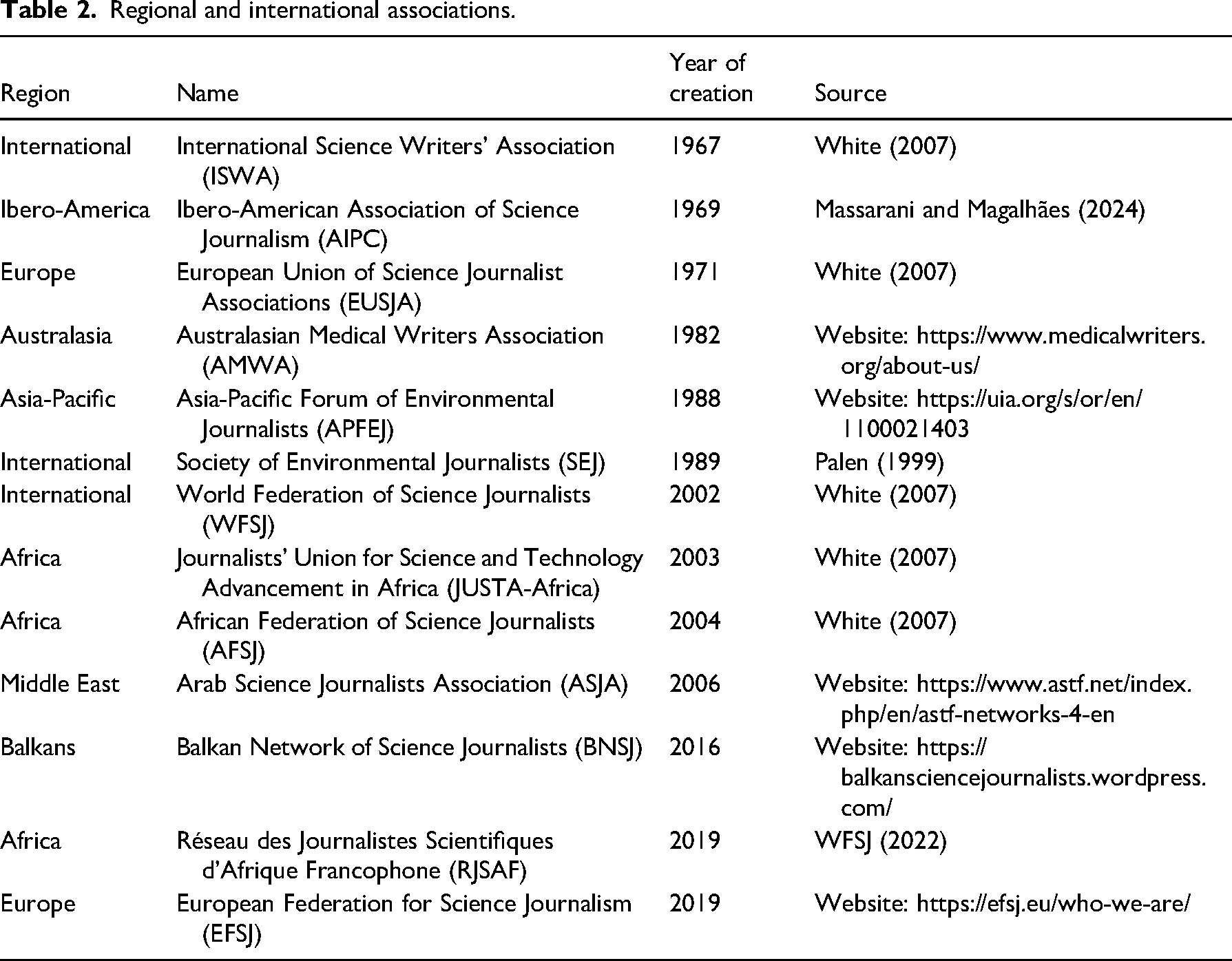
| Region | Name | Year of creation | Source |
|---|---|---|---|
| International | International Science Writers’ Association (ISWA) | 1967 | White (2007) |
| Ibero-America | Ibero-American Association of Science Journalism (AIPC) | 1969 | Massarani and Magalhães (2024) |
| Europe | European Union of Science Journalist Associations (EUSJA) | 1971 | White (2007) |
| Australasia | Australasian Medical Writers Association (AMWA) | 1982 | Website: https://www.medicalwriters.org/about-us/ |
| Asia-Pacific | Asia-Pacific Forum of Environmental Journalists (APFEJ) | 1988 | Website: https://uia.org/s/or/en/1100021403 |
| International | Society of Environmental Journalists (SEJ) | 1989 | Palen (1999) |
| International | World Federation of Science Journalists (WFSJ) | 2002 | White (2007) |
| Africa | Journalists’ Union for Science and Technology Advancement in Africa (JUSTA-Africa) | 2003 | White (2007) |
| Africa | African Federation of Science Journalists (AFSJ) | 2004 | White (2007) |
| Middle East | Arab Science Journalists Association (ASJA) | 2006 | Website: https://www.astf.net/index.php/en/astf-networks-4-en |
| Balkans | Balkan Network of Science Journalists (BNSJ) | 2016 | Website: https://balkansciencejournalists.wordpress.com/ |
| Africa | Réseau des Journalistes Scientifiques d’Afrique Francophone (RJSAF) | 2019 | WFSJ (2022) |
| Europe | European Federation for Science Journalism (EFSJ) | 2019 | Website: https://efsj.eu/who-we-are/ |