




Abstract
The landscape of contemporary media presents challenges and opportunities for science writers and communicators. These issues have not yet been fully understood. This paper presents the findings of collaborative work conducted to identify the growth in numbers of social media communicators who are writing about science for the Canadian public. We used emerging media research tools, including Altmetrics, and traditional survey tools. Our goal was to help Canada's professional member associations—Science Writers and Communicators of Canada (SWCC) and the Association des Communicateurs Scientifiques du Québec (ACS)— map the changing science communication landscape in Canada. Using an online survey tool, we compared survey responses from social media science communicators we identified to those of professional science communication members of SWCC and the ACS. We found that Canadian social media science communicators were younger, were paid less (or not at all) for their science communication activities, and had been communicating science for fewer years than other science communicators. They were more likely to have a science background (rather than communication, journalism or education) and were less likely to be members of professional associations. They tended to communicate with one another through their own informal networks. These findings provide professional science communication organizations in Canada with an empirical base from which to develop training, support and outreach activities aimed at improving the quality of public engagement with science in Canada.
Keywords
Introduction
The rise of social media, starting in the first decade of the 21st century, poses new challenges and opportunities for science communication that are not yet fully understood. The birth of the ‘post-truth’ era has come at a time when science is being made more public than ever before (Piwowar et al., 2017). The so-called Web 2.0 provides the public with access to content and the ability to produce, share and respond to content. The traditional communication that occurs between members of scientific communities has also been affected by more public access to data and scientific information. Science communication has been transformed as multiple sources of information emerge. This could be seen as creating more dialogue between science and society and more collaborative work between non-experts and scientists (that is, citizen science), leading to what some consider to be more democratic access to knowledge and the redistribution of power (Delfanti, 2010).
However, having public access to information may not be enough to transform the culture of science, which involves how science appears, is perceived and is communicated in society. The proliferation of science information produced by many different actors poses challenges for determining the credibility of sources and the accuracy of content. As the boundaries between scientists, journalists and the public become blurred, Brossard and Scheufele (2013) urge scientists and social scientists to develop better understandings of how the public interacts with scientific information to develop more effective strategies for communicating science online.
As Schiele (2018) concludes:
Unlike the outmoded conception of [the public communication of science and technology] as an exercise dispensing would-be neutral truths to a so-called lay audience, only an approach that fosters a confrontation of ideas between actors engaged in a reflection yields a critical appropriation of knowledge in a world governed by complexity. (pp. 21–22)
The changing landscape of science communication
Science journalists have long been recognized as credible agents for transferring knowledge to society, leading them to be considered as elite journalists (Henningham, 1995; Blum et al., 2006). Recently, however, the number of full-time science journalists has declined in many countries, leading some researchers to argue that high-quality science coverage has declined too (Saari et al., 1998; Schäfer, 2017). In addition, researchers have noted that, as the number of science journalists dwindles, science communication is moving from traditional media outlets to online channels (Brumfield, 2009; Allan, 2011; Fahy and Nisbet, 2011). Bucchi (2013) argues that changing media conditions, which include the loss of media filters and processes to guarantee the quality of information, have led to a ‘crisis of mediators’.
The new media landscape undeniably presents new challenges for communicators. For example, science communicators have reported a greater need for images and videos to convey complex scientific content (Pinholster and O'Malley, 2006). There are also additional demands on communicators' time, as audiences become content producers or co-producers. There is also a greater need, in many cases, for collaborative work with scientists to gain exclusive access to information (Fahy and Nisbet, 2011). Science communicators working mainly in social media environments may also have different interpretations of information quality, accountability and professionalism. For example, Schmidt (2014) has found that social media communicators are more likely to select and display information according to personal relevance, that their content explicitly addresses people in their networks (rather than an amorphous public) and that their content also tends to be more conversational, rather than transmissional. Recent research into the work of scientists as communicators on social media and blogs has also identified a number of motivations for ‘scientist’ communicators on social media, including self-promotion and influencing public opinion and political decision-making (Allgaier et al., 2013; Besley, 2014; Liang et al., 2014; Peters et al., 2014; Trench, 2012).
Overall, research points to an increasing role for scientists and others in online science communication activities (both a consequence and a cause of the reduction in science journalism). This changing landscape has led some to call for greater public outreach and engagement from these new perspectives (Nisbet and Scheufele, 2009). Bucchi (2017) calls on researchers and institutions to take greater responsibility for producing high-quality science communication and critiquing science where that is needed. If discussions about science in society are to be democratic, he argues, then greater recognition and support may be needed for the growing number of people working outside institutional structures who communicate science in the contemporary media landscape.
In practice, however, the authority and production of content remains with scientists (Besley, 2014) and journalists (Brumfield, 2009). In addition, Peters et al. (2014) emphasize that using social media to communicate science does not necessarily mean finding new ways of producing new content, but rather new ways of sharing it. They argue that the new platforms offer ‘new opportunities and options for science to communicate with the public’ (p. 752). Social media platforms may provide an increasingly open space for sharing different perspectives and creative endeavours for a wide range of communicators, including research students, artists and communicators who refer to themselves as YouTubers, Instagrammers and storytellers.
At the same time, journalists have also adapted to the new forms of public interaction as a way to invest in more participatory relationships and avoid losing readers and viewers (Holliman, 2011). As the social relevance of science gains prominence, Holliman argues for the need to better engage science and society in digital spaces:
As science communication teachers, trainers and researchers we need to facilitate strategies where scientists and citizens can engage with the development of digital stories about the sciences, how they are represented in the digitally mediated public sphere, and how audiences consume and respond to them. (p. 4)
While he focuses on dialogue between scientists and the public, it is equally important to consider the social network of science writers and communicators. If, as Weingart and Taubert (2017) argue, trust in science relies on trust in science communication, then an important focus of research is identifying who is communicating science in the changing social media landscape. It is also important to understand what high-quality science communication looks like for these communicators. This may help inform the activities of the professional member associations.
The science communication landscape in Canada
As in many other countries, Canada's science communication reflects the early professionalization of science-writing and broadcasting. In addition, increased government investments reflect the recognition that economic and social progress cannot be separated from science and technological progress (Schiele and Landry, 2012). During the latter part of the 20th century, science communication in Canada focused on informing the public, promoting scientific careers to support economic development, and increasing science literacy in the Canadian population.
More recently, Canadian science communication has focused on public engagement, knowledge co-creation (Einsiedel, 2008), and a ‘science in culture’—or thinking about how society talks about science (Schiele, 2018). Science communication practices have taken a ‘dialogic’ turn—a term applied by Einsiedel (2008) and documented by others (Phillips, 2011; Fahy and Nisbet, 2011; Braun and Könninger, 2017). Dialogic science communication moves beyond ‘translating’ scientific knowledge for the public and recognizes people's need for direct engagement with each other in scientific processes and involvement in policy formation (Bucchi, 2008; Stilgoe et al., 2014). That is, a dialogic approach calls for the greater willingness and capacity of science communicators to engage with hard-to-reach audiences. Many of these science communication engagement activities are now initiated or conducted wholly online.
Canadian journalists are also seeing a change in how people prefer to receive news. In 2018, 74% of the Canadian population spent between three and four hours online daily, and nearly 61% of Canadians used social media and the internet to search for news and reports of current events (CIRA, 2018). Canadians prefer to be informed through the media, but at their own time and with little or no cost to themselves (Public Policy Forum, 2017).
Concurrent with the recent rise of social media communication has been a reduction in federal and provincial government support for science and science communication in Canada (Boon, 2017). Yet scientific researchers in Canada are increasingly pressured to demonstrate research impact as part of the current audit culture of research institutes and universities, prompting many to take on roles as ‘scientist’ communicators in social media settings. Along with the dissemination of science through social media, another factor is the blurring of boundaries between institutionalized journalism and communication systems (Rollwagen et al., 2017). Many former science journalists now work as freelancers. In 2015, Rollwagen et al. surveyed Canadian journalists to explore the impacts of the changing media landscape. They found that some of the greatest impacts on the work of journalists were procedural, including access to information, journalistic ethics, media laws and regulations, available news-gathering resources, and time constraints. Many of these procedural influences are quite feasibly different for science communicators working online and outside mainstream journalistic systems.
Professional member associations in Canada recognize that they play an important role in supporting critical innovation in science-writing and communication. Science Writers and Communicators of Canada (SWCC; founded in 1971) is paying close attention to these issues. After much debate over many years, the organization recently changed its name from the Canadian Association of Science Writers to recognize its changing membership base and the important role of science communicators in Canada. Both SWCC and the Association des Communicateurs Scientifiques du Québec (ACS; founded in 1977) are keenly interested in who is communicating science in Canada and how, so that they can better develop new policies and practices. These are two of the most relevant organizations for science communicators in Canada.
Here, we report on the findings from surveys of SWCC and ACS members about their communication practices. We compare their responses to those gathered from Canadian social media communicators, who were identified through social media mapping methods.
Identifying social media science communicators in Canada through social media mapping
Veltri and Atanasova (2017) argue that, due to the hybrid and changing nature of social media platforms, science communication researchers have reached little agreement on how to study social media or what can be achieved from its study. They advise researchers to draw on various complementary theories and accompanying methods.
We began this project by identifying Canadian science communicators on Twitter and Instagram, which are two of the most popular social media platforms in Canada (Barata et al., 2018). For Twitter, we obtained data from Altmetrics.com, which produces alternative metrics to track how papers are shared on social media and other online platforms such as Wikipedia, news outlets and blogs (Priem et al., 2010; Adie and Roe, 2013). We identified Twitter science communicators with the tag ‘science communicators’ using geolocation to narrow the population down to Canadian communicators. We gathered 855,016 tweets between 2015 and 2016 and then tracked keywords and #hashtags related to ‘science communicator’, in both French and English, on the biographies of Twitter handles. After cleaning the data, we identified a total of 197 unique Twitter IDs.
We used Netlytic software, developed by Ryerson University in Canada, to identify Instagram communicators. General geolocation on Instagram is reported to be around 6%, so we extracted different sets of data using four hashtags: scicomm, commsci, vulgarisation and sciart. We also tracked keywords related to Canada in the biographies of Instagram users as a way to identify their geolocation (provinces, capitals, as well as #cdn, Canadian). After cleaning the data, we identified 59 Instagram science communicators posting from Canada.
The geographical patterns of science communicators affiliated with the two professional associations and those identified through social media methods were similar, with strong concentrations in the provinces of Ontario, Quebec, and, to a lesser extent, British Columbia.
Surveying science communicators in Canada
We invited science communicators identified through Twitter and Instagram, together with SWCC and ACS members, to complete an identical online survey. The survey was designed to compare the demographics of these populations, their activities related to science-writing and communication, their attitudes towards science-writing and communication, and their social media practices. We sent out an initial survey invitation and three reminders. We had responses rate of over 25% for each population group (143/524 or 27% of SWCC members; 87/309 or 28% of ACS members, and 74/256 or 29% of social media communicators identified through Altmetrics and Netlytic).
We conducted quantitative data analysis on the responses we received using IMB SPSS 24 statistics software. Qualitative data from the open-ended questions was coded using NVivo 11 qualitative analysis software. Data is reported below as descriptive statistics and associations through cross tabulations (chi square).
Demographic comparisons
As Table 1 shows, the demographics of the SWCC and ACS respondents were similar. The ACS group had the highest proportion of respondents who were paid employees, and the social media respondents we identified through social media mapping had the lowest proportion. Over 40% of social media group respondents identified through Altmetrics and other online mapping tools were not paid for their science-writing and communication work.
Relationships between survey respondents from each group and demographic variables
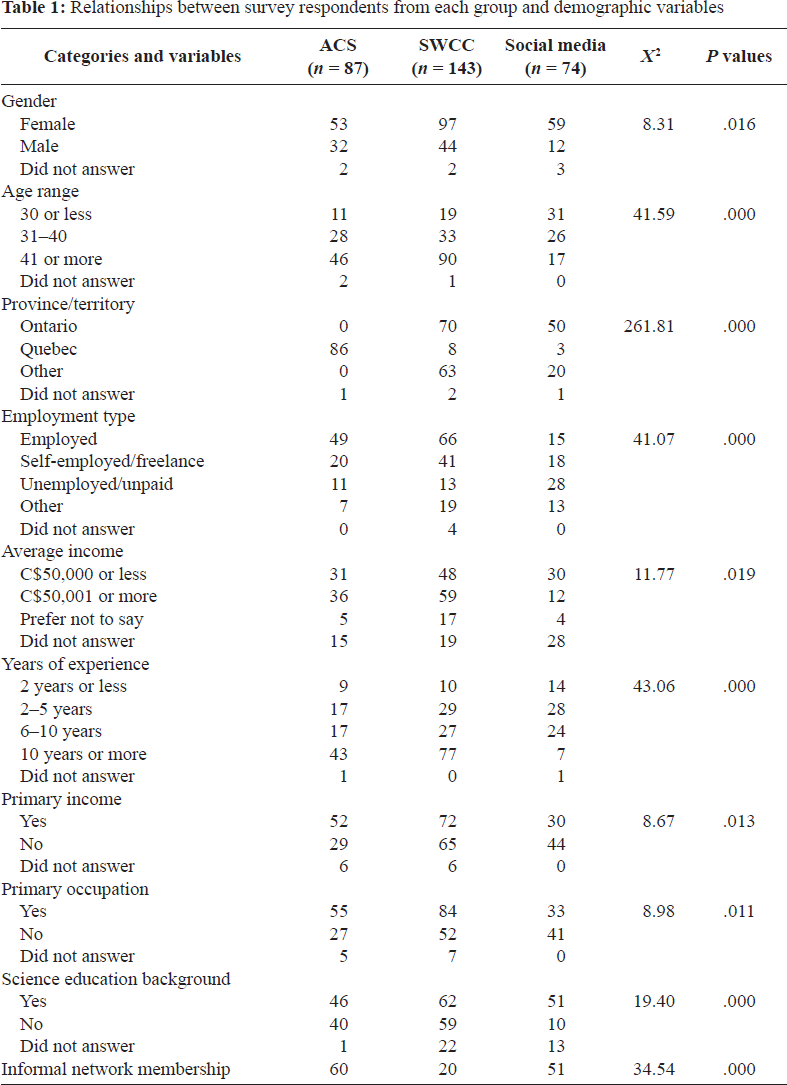
Relationships between survey respondents from each group and demographic variables
Compared to professional association members, the social media communicators we identified through new media mapping were more likely to be female. SWCC respondents were more likely than respondents from the social media group to indicate that they earned more than C$50,000 per year (approximately US$37,000) for science-writing or communication work and were more likely to have 10 or more years of experience in the field when compared with respondents from the social media group. There were no significant differences between SWCC members and respondents from the social media group in terms of respondents' main source of income. However, SWCC members were more likely than social media group respondents to state that science-writing or communication was their primary occupation.
Respondents from the social media group were less likely to have a professional background in areas other than science (that is, in journalism, communication, education, public relations or marketing). However, there were no significant relationships between these groups in terms of the level of training they had received (certificate, degree, graduate study and so on). The number of social media respondents who belonged to a professional science-writing or communication association was much smaller than the number of respondents from the SWCC group. We could not demonstrate a statistical difference because we asked respondents only to name the professional associations they belonged to, so numbers were based on counting those respondents who named a professional association. Only 14/74 respondents from the social media group indicated that they belonged to a professional science-writing/communication association. However, social media group respondents were more likely than SWCC members to be involved in an informal network of science writers or communicators. Those networks included informal social media groups, local event groups or groups that informally got together face to face, and ongoing meetings with trusted colleagues and alumni from university and college courses.
The main purpose SWCC members gave for science-writing and communication was increasing public awareness, while ACS members stated that their main purpose was helping the public form opinions. Social media group respondents nominated quite mixed purposes, but when the three groups were compared, the patterns were not significantly different at P < 0.05. Similarly, any differences we identified in the patterns of findings associated with the key challenges facing science-writing and communication were not statistically significant. All science writers and communicators identified major challenges associated with funding and time (Table 2).
Purposes of and challenges for science communication
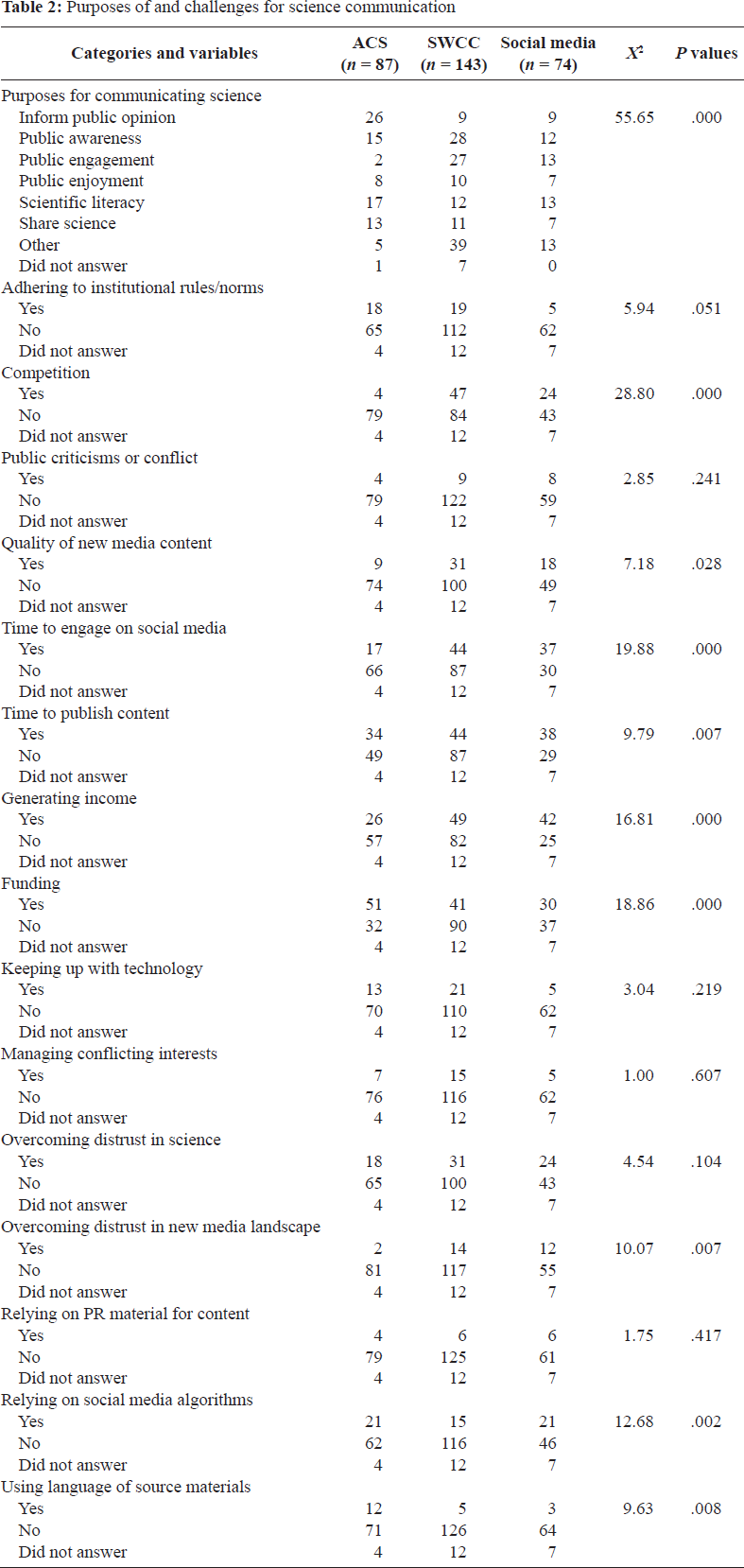
Purposes of and challenges for science communication
In an open-ended question, we asked respondents to describe what made science-writing or communication ‘good’. For all three groups, accuracy was nominated as one of the top five values. Both members of the social media group and SWCC members focused on science-writing/communication that was engaging, relatable and clear. ACS members were the only ones to use the term vulgarized, which refers to the use of non-specialized language. Other words associated with ‘good’ science-writing/communication for ACS members were targeted, rigorous, and entertaining. SWCC members used words associated with storytelling. Respondents from the social media group particularly focused on science-writing/communication that was appropriate to their audience, in terms of language choice.
We also asked respondents to cite up to three groups or individuals who, in their opinion, were engaging in good science-writing and communication practices. In comparison to the social media group of communicators, SWCC and ACS respondents focused more on mainstream journalists, traditional publications and broadcast media. Respondents from all groups included communicators and organizations that aimed their activities at schools and young people, including museums and science centres, and outreach activities from universities and research institutes. Respondents from the social media group particularly emphasized the work of ‘scientist’ communicators who aimed their communication at adults through social media and broadcast media, such as Samantha Yammine (a PhD candidate at the University of Toronto, who particularly targets young women via Instagram), Vicky Forster (a childhood cancer survivor, now a research scientist at the Hospital for Sick Children [SickKids] in Toronto, who communicates via Twitter), Tim Caulfield (a professor at the University of Alberta and the host of the documentary series A User's Guide to Cheating Death), and Jennifer Gardy (an assistant professor at the University of British Columbia, who makes regular appearances on the Canadian Broadcasting Corporation's documentary series The Nature of Things).
SWCC and social media respondents also noted the good practices of emerging English-language independent online publications aimed at all ages, such as the blogging platform Science Borealis and Hakai magazine. They also recognized science communication aimed at adults through YouTube and podcasts such as AsapSCIENCE (a YouTube channel created by Mitchell Moffit and Gregory Brown, posting weekly videos that touch on many different science topics) and Jonathan Jarry (a science communicator with McGill University's Office for Science and Society, who hosts a YouTube show called Cracked Science and co-hosts the podcast Body of Evidence).
Unsurprisingly, respondents identified through the social media mapping work were more prolific users of social media for science-writing and communication compared to members of the ACS and SWCC. We could not identify statistically significant patterns in the use of particular social media platforms because the number of respondents from the professional associations who nominated particular platforms was small. However, first preferences for all groups were divided between Twitter and Facebook. Social media group respondents in particular appeared to actively engage in the range of social media platforms we asked them about: Twitter, Facebook, YouTube, Instagram, Google+, Tumblr, Pinterest and Snapchat. SWCC respondents who used social media were more likely to receive funding for social media activities (23/67 respondents) than respondents in the social media group (7/57 respondents) (χ2(2) = 9.00, P = 0.011). Over 75% of respondents from the group identified through social media mapping (50/57 respondents) stated that their social media activities were self-funded or unfunded. Finally, we coded responses to an open-ended question asking respondents in the three groups to explain why they used social media for science communication. Of the top four responses, the first three were common across the three groups:
The broad reach of social media;
Targeting or engaging with particular interested audiences or communities;
Being able to see social media users interact with each other;
Marketing or promotion purposes.
In addition, SWCC respondents indicated that they used social media for science communication because it was enjoyable. ACS members also indicated that they also used social media for networking, while social media group respondents used it for maintaining professional connections.
In this study, we set out to compare survey responses from professional member association respondents to those of science communicators identified through social media mapping. The aim was to help inform Canada's professional member associations about who is operating in Canada's changing science communication landscape. We were also prompted by calls for greater recognition of public engagement and science outreach activities occurring through social media (Nisbet and Scheufele, 2009) and calls for researchers and research institutions to take greater responsibility for the quality of science communication content and to provide critiques when required (Bucchi, 2017). The findings of this project directly respond to those calls.
The respondents we identified through social media mapping were demographically different from professional association members in many ways. Many were ‘scientist’ communicators or others participating in science communication activities in unpaid or self-funded capacities. Of particular importance, most of the social media science communicators were not affiliated to a professional science communication member organization. They relied more on informal networks to connect with others doing similar work, indicating concurrent streams of activity between professional and informal science communication networks in Canada. These findings are important for those involved in science communication training and accreditation programmes.
We also identified some commonalities across the groups that could represent opportunities for greater connection between these communities and opportunities to bring these communicators together. Peters et al. (2014) particularly emphasize the importance of recognizing the opportunities provided by social media environments. We found that social media communicators and those who belonged to professional member associations faced similar challenges: time and funding were the biggest challenges for all groups. Accuracy in science-writing and communication was a key value for respondents from all groups, as were traditional journalistic values (relevance, accessibility, storytelling, independent research, and credible/trusted sources of information). Language choices (that is, style) associated with user engagement were particularly important for social media communicators. We view these commonalities as opportunities for professional member organizations to engage social media communicators on shared professional standards.
Canada's professional science communication associations could use the findings of this study to inform their future activities, including encouraging a diversity of science-writing and communication practices (without conflating science journalism and communication), making stronger connections with existing informal networks, providing better networking opportunities for science writers and communicators who are working with social media platforms, and promoting the work of freelance science writers and social media communicators.
These organizations could create closer relationships with social media communicators to better understand their professional practices and career trajectories, and exchange experiences on social media, especially considering the variety of media and language used by those science communicators. They could use this information to further strengthen Canada's professional science communication and writing communities, helping to develop training courses for members and themes for future professional conferences related to social media norms and practices. As Schiele (2018) states, the interface between individual expectations and timely access to information is an important focus for science communicators who wish to understand how social media spaces can better function as venues for deliberative discussion.
As time and funding were particular concerns for all science communicators working in social media environments, future research could investigate how social media communicators are balancing the concerns of generating income and increasing demands on their time with producing accurate and engaging science-related content. Building on the work of Rollwagen et al. (2017) and findings from this study, future research could also investigate the professional norms and conduct (such as hype, accuracy and conflicts of interest) of communicators identified through social media mapping efforts.
Footnotes
Acknowledgements
This study was supported by a Social Science and Humanities Research Council (SSHRC) Partnership Grant (892-2017-2019) held by Juan Pablo Alperin at Simon Fraser University (SFU), Michelle Riedlinger at the University of the Fraser Valley (UFV) and Science Writers and Communicators of Canada (SWCC). The funders had no role in the study design, data collection and analysis, decision to publish, or preparation of the manuscript. We are grateful for the continued support of Juan Pablo Alperin from the School of Publishing at SFU and the assistance of Shelley McIvor, Janice Benthin and Tim Lougheed from SWCC and Stéphanie Thibault from the Association des Communicateurs Scientifiques du Québec. We would also like to thank Chantal Chapman from UFV for her assistance with data analysis. Finally, we wish to thank everyone who participated in the survey. Without their input, we would have nothing to report. Their contribution to this project is significant and gratefully appreciated.
Author biographies
Michelle Riedlinger is an associate professor at the University of the Fraser Valley, British Columbia, Canada. She is the secretary for the Public Communication of Science and Technology (PCST) global network and a board member of the Science Writers and Communicators of Canada (SWCC). She has published on the communication of environmental science and genres of risk assessment. She is particularly interested in the boundary communication practices of environmental science and community collaborations using social and new media technologies.
Germana Barata is a science communication researcher at the Laboratory of Advanced Studies in Journalism (Labjor), Centre for the Development of Creativity (Nudecri) at the State University of Campinas (UNICAMP), Brazil. She was a visiting faculty at Simon Fraser University, Canada in 2017-2018. She is a member of the PCST global network and a Council Committee member of the Brazilian Association of Scientific Editors (ABEC). She has focused her research on social media and altmetrics as ways to track the social impact of science.
Alexandre Schiele is a postdoctoral researcher at the Louis Frieberg Center for East Asian Studies at the University of Jerusalem. He holds a PhD in communication science (Sorbonne Paris Cité, 2017) and another in political science (University of Quebec at Montreal, 2018). He cowrote the report ‘Science communication in Canada: An inventory of the major PCST initiatives carried out in Canada’ (2011) for the Korean Foundation for the Advancement of Science and Creativity. Publications of particular interest include ‘Science what? What concepts are we using? An analysis of official concepts’ (2015) and ‘Science/pseudoscience TV series, a comparison’ (2018).