




Abstract
In this paper, 18 scientists from China and other countries were selected for consideration as case studies of ‘strategic scientists’. They were chosen according to their involvement in science and technology policy decision-making, development of key and advantageous fields, creation of new disciplines, construction of academic traditions, and intersections between science and industry. On this basis, we found that the growth paths of strategic scientists can be divided into three phases: as talented young scientists, as gatekeepers in related disciplines or research fields, and as consultants for national science and technology decision-making. Based on this trichotomy, we explored the characteristics of strategic scientists and the conditions required for their growth in each phase. Finally, policy suggestions are proposed for the cultivation and use of strategic scientists.
Keywords
Introduction
‘Strategic scientists’ are outstanding scientists who are also thinkers with visions for the overall development of their disciplines and of science as a whole; in this way, they participate in regional or national science and technology (S&T) decision-making processes. But how can scientists with the potential qualities to become strategic scientists be identified and discovered at an early stage? What kind of institutional conditions and cultural environments are needed for the cultivation and growth of strategic scientists? In this study, we reviewed the cases of 18 strategic scientists to explore their growth paths and the institutional and cultural conditions conducive to their growth. As a result, we have been able to suggest a three-phase trajectory for the growth of strategic scientists: young talented scientists, gatekeepers in related disciplines or research fields, and consultants for national S&T decision-making. On this basis, we go on to provide policy recommendations for the identification, cultivation and utilization of strategic scientists in China.
Measurement criteria, sample selection and research methodology for the case studies
Strategic scientists are the ‘critical minority’ in the national strategic workforce. They are not only the gatekeepers for advancing disciplines and the key drivers of major scientific endeavors, but they are also important participants, consultants and even decision-makers in the formulation of national or regional S&T policies. As scientists, they are committed to the cultivation of key and leading S&T sectors, the creation of new disciplines and the construction of first-class academic traditions and excellent academic genealogy. As a bridge between science and society, they are capable of intervening in or promoting the intersection of science, technology and industry, and they can play an important role in the decision-making processes for national or regional S&T policies. Considering these two aspects, this study established criteria for assessing strategic scientists and set conditions for choosing sample cases. As a result, 18 scientists from China (9) and elsewhere (9), such as Vannevar Bush and Qian Xuesen, were selected as case studies (see Table 1).
Measurement criteria and samples of strategic scientists.
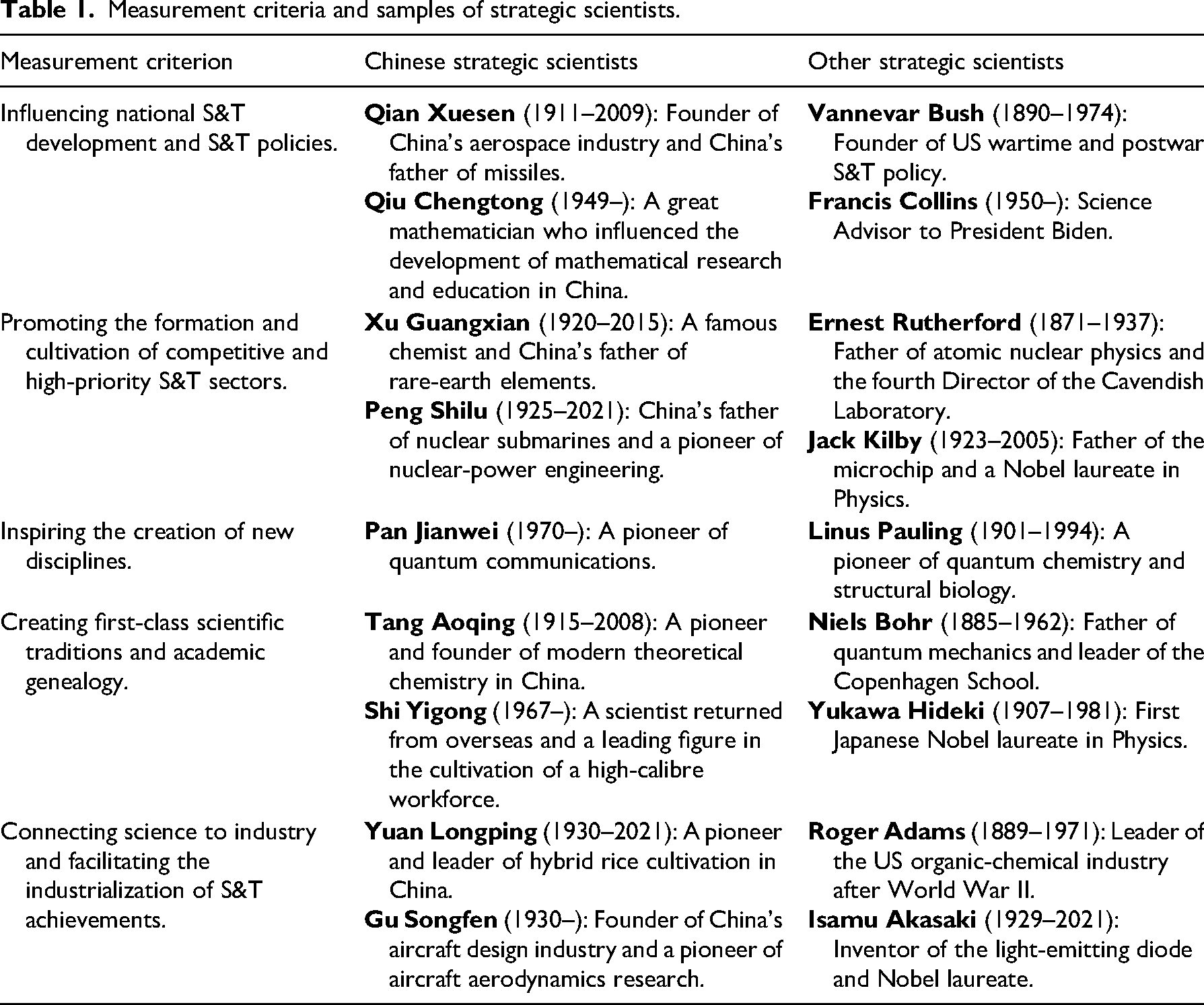
Measurement criteria and samples of strategic scientists.
The scientists selected for case studies have one or more of the following five qualities. First, they have a deep understanding of the S&T landscape and conditions, and thus play an instrumental role in the formation and cultivation of their country's high-priority and competitive S&T sectors. Second, they are able to propose concepts of disruptive significance and address challenging topics that inspire the creation and evolution of new disciplines. Third, they are able to create first-class academic traditions and can help to promote the growth of outstanding scientists, thus leading to the formation of first-class academic genealogy. Fourth, they are able to seize the opportunities presented by the synergies between S&T advances and the development of their society and country, and they can command influence and have the ability to act and deliver across the boundaries of science and politics or science and industry. Fifth, they have a keen grasp of the development processes and overall patterns of science or individual disciplines. At the same time, they understand their country's strategic needs and are able to make appropriate S&T policy recommendations from the perspective of national S&T strategy.
This paper reports the results of a thorough investigation and analysis of the educational backgrounds, research progress and social experiences of the 18 selected strategic scientists, as well as the abilities and qualities that they possessed at different phases. On this basis, chronologies of the career development of these scientists are presented, their growth trajectories are studied and summarized using a phased approach, and the key institutional and cultural factors that influenced their growth are examined.
Strategic scientists emerge from the practice of scientific research. After entering their respective fields of scientific research and exploration, they have all achieved extraordinary successes and grown to become the gatekeepers of their respective discipline or research field. Eventually, they have all become involved in national or regional S&T decision-making mechanisms—either on their own initiative or by invitation—and played an important role in national S&T strategies. Thus, we can divide the growth trajectories of strategic scientists into three phases based on two important time points: the moment they achieve their first major scientific accomplishments and establish themselves as gatekeepers in their respective fields, and the point at which they become involved in national or regional S&T decision-making processes.
The first phase represents the growth period of a talented young scientist. During this phase, each of the selected scientists completed their early schooling and exciting youthful years; at the end of this phase, they were still young but had already achieved remarkable scientific successes, standing out from their peers and starting to gain authority in their discipline or research field.
The gatekeeper theory was first proposed in the 1940s by Kurt Lewin (1890–1947), an American social psychologist and sociologist, in his study of information-dissemination channels in groups. Lewin (1947) argued that there are gatekeepers in group communication, and that only information content that conforms to group norms can enter the communication process. When discussing the role of scientists in his book The Sociology of Science, the famous sociologist Robert K Merton (1973) talked about the four roles played by scientists in scientific organizations: research, teaching, institutional governance and gatekeeping. Here, the job of the ‘gatekeeper’ is to judge the performance of scientists in undertaking their roles and to determine the mechanism for providing and distributing roles and opportunities. In this paper, we expand the notion of gatekeeper to encompass a wider range of the scientific community; it is used to refer to key individuals who decide on the research direction, cognitive approaches and value standards within a regional or national scientific organization, within a discipline, or even across the entire scientific community. Gatekeepers have a deep understanding of the developmental landscape, research frontiers and research methodologies of their discipline or of science as a whole, and they are able to identify key problem domains in their discipline or across science as a whole and give targeted instructions regarding research methods and norms.
The second phase is the period when scientists become gatekeepers in their respective disciplines or research fields. Scientists in this phase may lead the frontier research and key research programmes in their own field, devoting themselves to the cultivation of talented assistants and disciples, which over time will lead to the creation of a fine academic genealogy and first-class research traditions; or they may instead develop applications based on the results of their research and achieve initial success. At the end of this phase, they start to develop the qualifications and ability to enter the regional or national S&T policy-advisory system, which will enable their influence to go beyond their specific profession or industry. As a matter of fact, scientists who have grown to become gatekeepers in their research fields or disciplines can all be regarded as strategic scientists at the disciplinary level.
The third phase is the period when scientists become consultants for national S&T decisions. In this phase, the influence of strategic scientists goes far beyond the realm of their profession. They are involved in regional and even national S&T, industrial and political mechanisms, exerting significant influence on regional and national S&T policymaking.
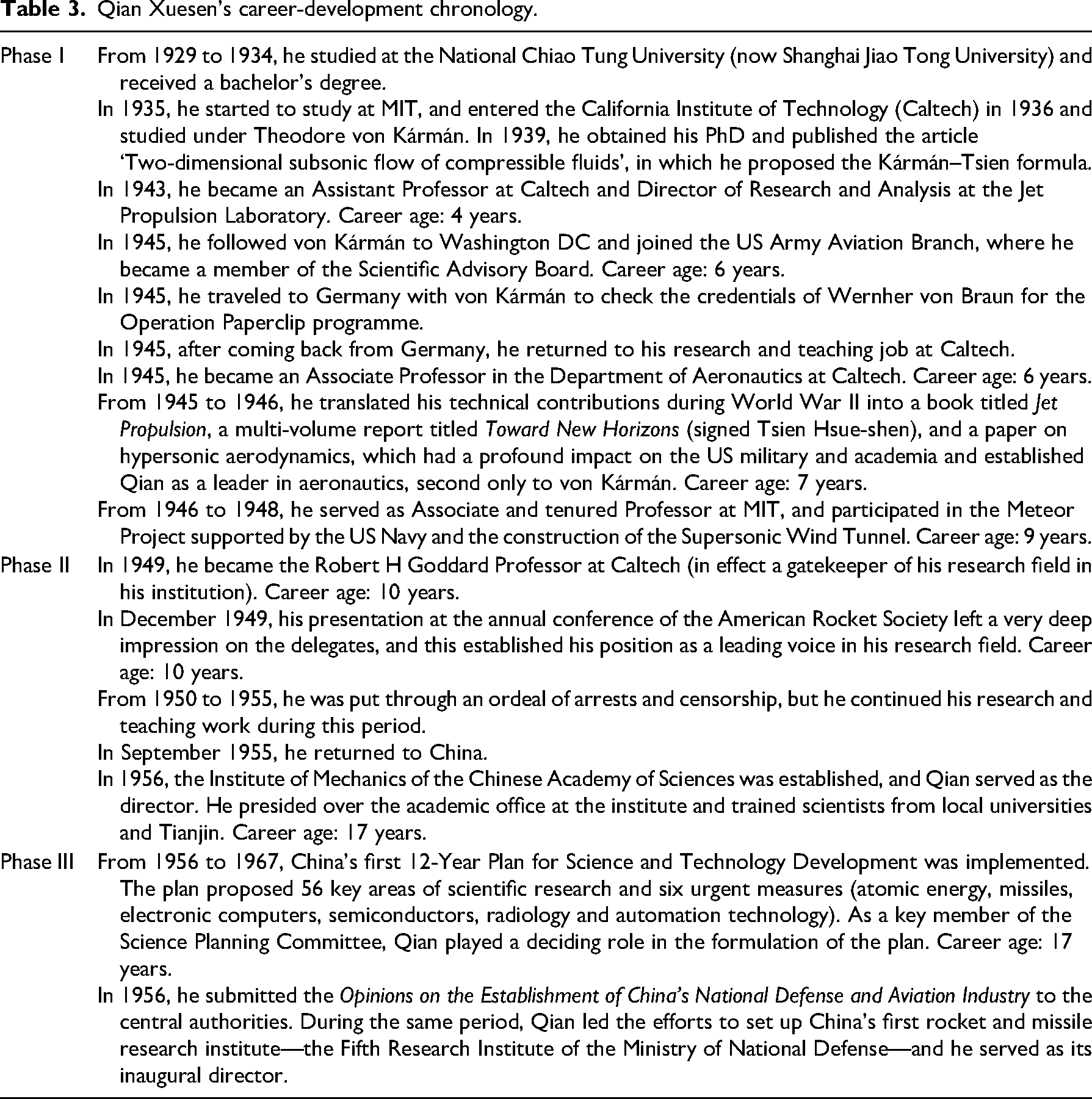
We take Vannevar Bush and Qian Xuesen as examples to present the three phases of their growth (see Table 2 and Table 3; the other 16 scientists are not described in detail in this paper due to space constraints). In drawing the career-development chronologies of the strategic scientists, we take the year in which they each received their academic degree and entered the relevant research field as the starting point of their career. We also summarize the career ages of each of the scientists at the end of their first two career phases, as listed in Table 4.
Vannevar Bush's career-development chronology.
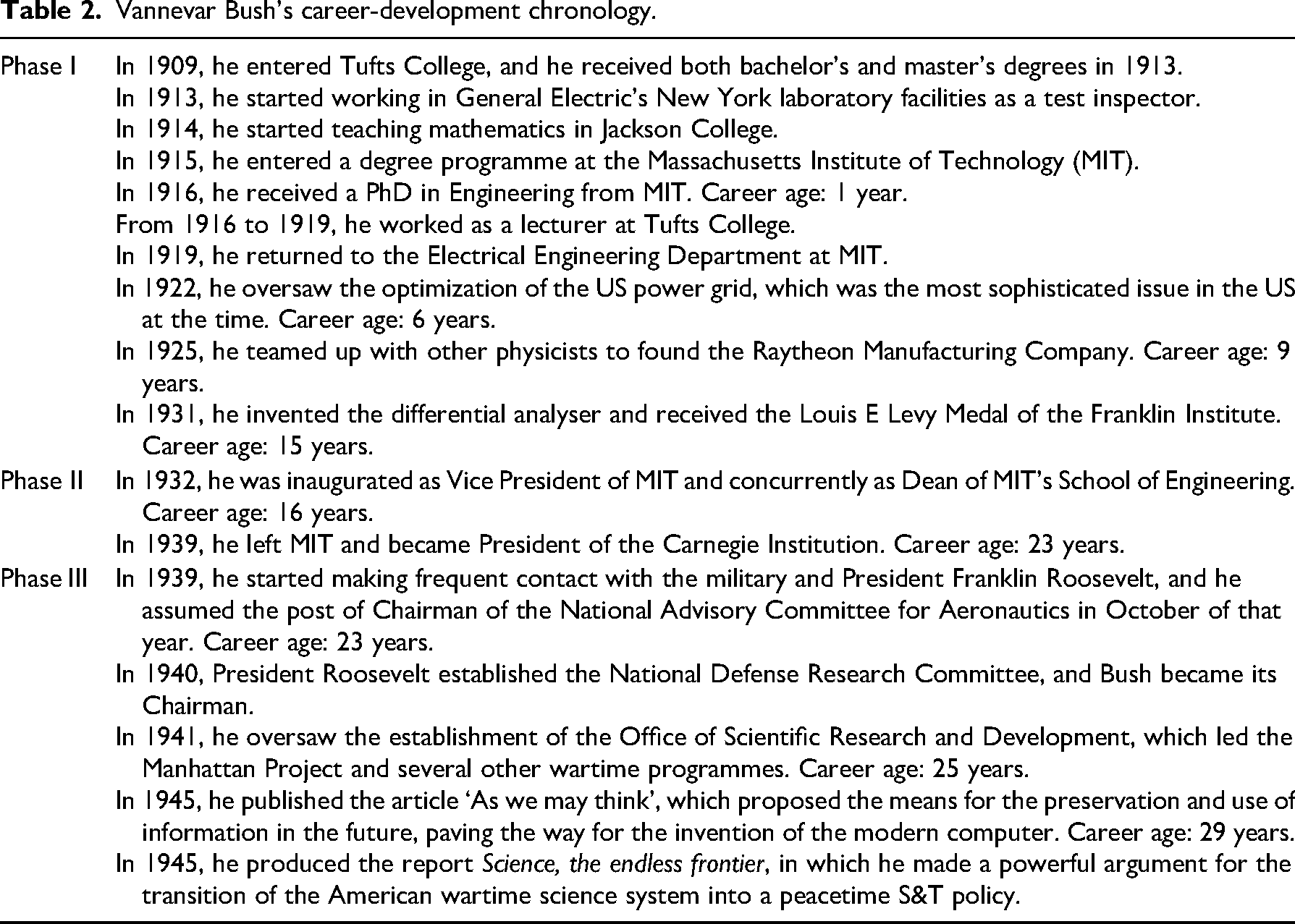
Vannevar Bush's career-development chronology.
Qian Xuesen's career-development chronology.
Career ages of strategic scientists in their first two growth phases.1
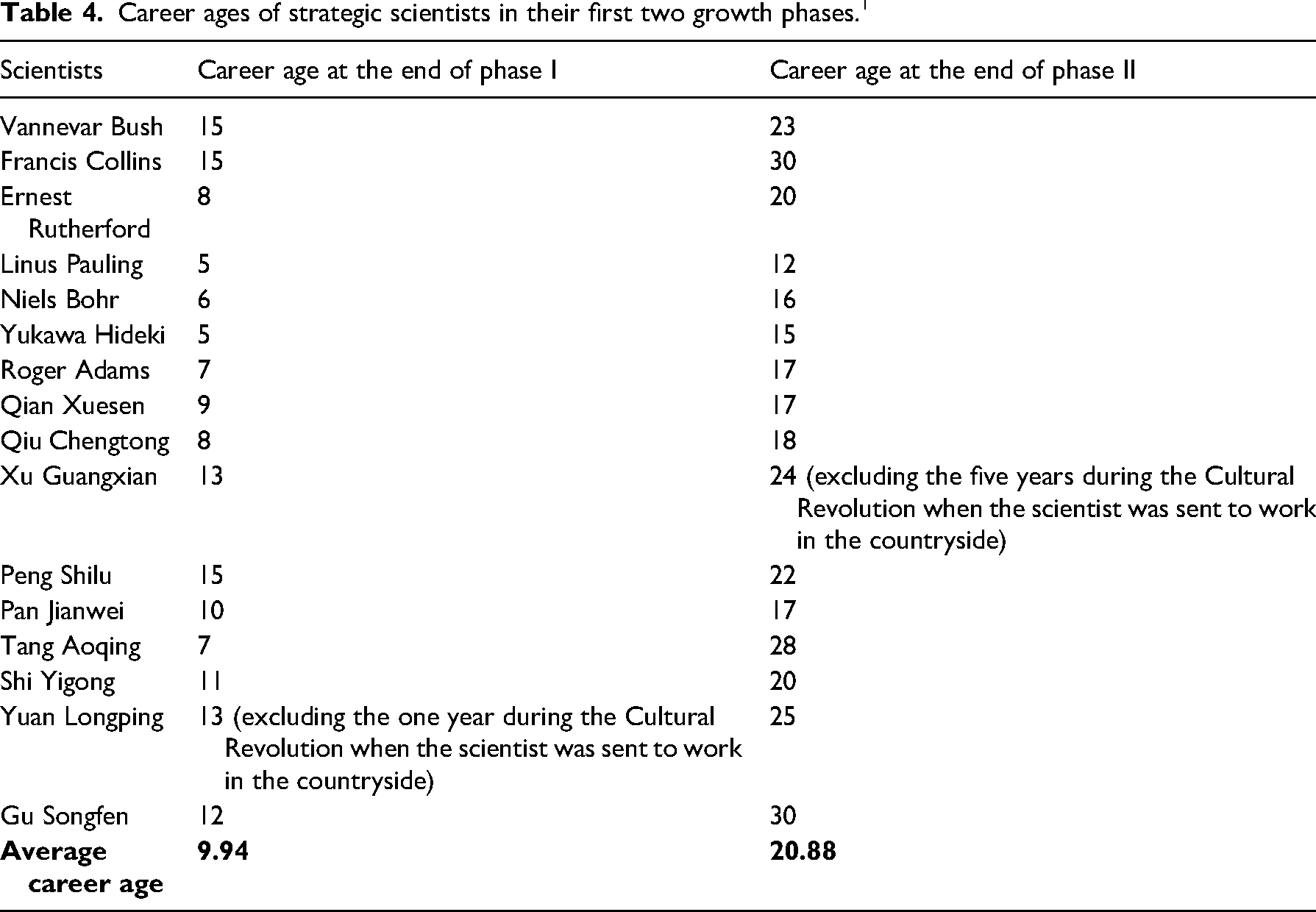
Table 4 shows that the career ages of strategic scientists at the end of the first phase were between 5 and 15 years, with an average of about 9.94 years. This result is in line with the findings of a scientometric study that found that the average career age of Nobel Prize winners in science when they make their discovery is 11.63–12.08 years (Liu, 2018). For example, Vannevar Bush was 32 years old when he solved the most challenging problem for the US at the time—optimizing the power grid—and his career age was 6 years. When he invented the differential analyser, he was 41, and his career age was 15 years. Qian Xuesen was 29 years old when he assisted Theodore von Kármán in proposing the Kármán–Tsien formula, just one year into his research position. When he established his stature as a leading figure in the field of aeronautical dynamics, second only to von Kármán, he was 35 years old and had a career age of 7 years. Yukawa Hideki was 28 years old—only five years after college—when he published a research paper on mesons that would later win him the Nobel Prize in Physics.
Table 4 also shows that the career ages of the selected strategic scientists at the end of the second phase when they became strategic scientists at the national level was between 16 and 30 years, with an average of 20.88 years. This means that, after deducting the time spent in the first phase, the average length of the second phase is about 11 years.
For example, during the second phase of his career, Vannevar Bush grew from a professor at MIT and de facto head of the Electrical Engineering Department to Vice President of MIT, Dean of the School of Electrical Engineering, member of the MIT Corporation, and member of the National Academy of Sciences. He became President of the Carnegie Institution at the age of 49, firmly establishing himself as a first-rate scholar, administrator and gatekeeper of his research field. The period in which he expanded his career lasted 8 years. Ernest Rutherford, during his own second phase, was appointed Chair of the Physics Department at the University of Manchester due to his outstanding performance at McGill University. He received the Nobel Prize in Chemistry and the Bressa Prize from the Turin Academy of Sciences; he also opened a new laboratory at the University of Dundee to conduct naval military research and was sent to the US to provide consultancy on naval-related projects. At the age of 48, he was appointed the fourth head of the Cavendish Laboratory, and he became the gatekeeper of the physics community in the UK and Europe. For Rutherford, the second phase lasted 12 years.
As their academic prestige and managerial competence grow, a gatekeeper has the opportunity to enter the third phase of the growth of strategic scientists, in which they can become a strategic scientist who is able to cross the boundaries and play an important role in national S&T decision-making mechanisms. Whether a scientist can become a strategic scientist at the national level typically depends on two factors: first, they must have the opportunity to participate in national S&T policy decision-making, either through their own initiative or by invitation; and second, they need exceptional cross-disciplinary skills and strong political acumen, along with a willingness to act as a bridge between science, industry and politics. Only scientists who have entered this phase can be called ‘strategic scientists’ and make a significant impact on the development of science, technology and innovation and the formulation of national S&T policies.
Take Francis Collins as an example. Collins successfully led the Human Genome Project as Chief Scientist and Coordinator from 1993 to 2003, and he was subsequently elevated to the highest management position in the US public-health sector. From 2009 to 2021, he served as Director of the National Institutes of Health (NIH) for 12 consecutive years. The fact that Collins stayed in this important position through the Obama, Trump and Biden administrations speaks volumes about his political wisdom. Being a strong advocate for big-science programmes, he initiated the BRAIN Initiative, the Precision Medicine Initiative and the All of Us Research Program during Obama's presidency; he also co-sponsored the Cancer Moonshot Initiative with then Vice President Biden, contributing significantly to the development of big-science and disruptive innovation programmes in the US. After completing his long tenure at NIH, Collins was appointed as the Science Advisor to President Biden at the age of 71 (Kaiser, 2019).
In the first two phases, scientists primarily concentrate on enhancing their research capabilities and personal skills. Only after distinguishing themselves among their peers and acquiring the qualities and abilities of gatekeepers within their disciplines or research fields can they have the opportunity to evolve into true strategic scientists. By examining the personal qualities and growth paths of the selected scientists, along with analysing the related scientific systems and cultural factors, we have collated the following seven summary traits of strategic scientists in terms of their personal characters and growth environments.
Growing in a strong academic tradition and academic genealogy
It is a blessing if a scientist can be guided by a mentor who is adept at molding a talented young person into an outstanding scientist. For example, when Vannevar Bush was pursuing his PhD at MIT, Dugald C Jackson (1865–1951), the head of the Electrical Engineering Department, appreciated his talent and provided him with significant support. Jackson was a former chief engineer of railways and power plants, and he was not good at teaching, but he was sensitive to the needs of business and knew where to get the money to support the R&D programmes of the Electrical Engineering Department. Bush recalled that Jackson inspired him to continually think about the connections between industry, academia and government. This line of thinking provided the intellectual foundation for the wartime mobilization system and the postwar government‒industry‒academia system that Bush later developed (Zachary, 1999). In the case of Linus Pauling, his decisions to study at Caltech and then travel to Europe, subsequently returning to Caltech, were all based on the advice of a knowledgeable teacher: the chemist Arthur Amos Noyes (1866–1936). Furthermore, in quantum physics, Pauling also received tutoring from the German physicist Arnold Sommerfeld (1868–1951). In another example, just when Qian Xuesen was becoming frustrated with his study at MIT, Theodore von Kármán (1881–1963) discovered his talent for mathematics and enrolled him into Caltech. He put Qian under his own tutelage and collaborated deeply with Qian in the ensuing years. He put Qian on his research team and led him into the S&T advisory body of the US government. In 1945, von Kármán took Qian on to the Operation Paperclip programme (a US government operation to bring German scientists to the US), and recommended that Qian join the Scientific Advisory Board of the US Army Aviation Branch alongside him (Chang, 1996).
In summary, being born at the right time, meeting the right mentor and growing in a strong academic tradition and genealogy are notable factors shared by many of the selected scientists.
Growing rapidly with the support of a superior scientific system
A robust scientific research system can offer young scientists who have recently earned their degrees the necessary financial and cultural support. This support can instil hope for success and enable them to quickly advance to the frontiers of discovery, immerse themselves in academic research and achieve initial successes in their scientific endeavors.
For example, after Linus Pauling received his PhD in chemistry from Caltech, his mentor, Arthur Noyes, applied for a Guggenheim Fellowship for him, and this enabled him to travel to Sommerfeld's laboratory, Bohr's laboratory and Schrödinger's research group, where he gained exposure to the most advanced knowledge in quantum mechanics. It was through this experience that Pauling was able to quickly combine his quantum theory with his chemical research, making the achievements in quantum chemistry that established his international academic reputation (Hager, 1995). In another example, after completing his three-year university education and graduating from Kyoto University with a bachelor's degree, Yukawa Hideki was given a research job in the laboratory of Tamaki Kajūrō (1886–1938). Even though he was only an unpaid lecturer for the first two years, with the support of Tamaki, Yukawa was able to carry out his research without any distractions, and this laid a solid foundation for him to later complete his thesis on mesons at Osaka University (Yukawa, 1973).
In the case of Roger Adams, after receiving his PhD from Harvard, he traveled to Europe on the Parker Traveling Fellowship. There, he met Otto Paul Hermann Diels, Richard Martin Willstätter and other towering figures in chemistry, and he carried out research with the support of their funding. After returning to the US, Adams quickly rose to the rank of professor and started his journey into original academic research. He served as the head of the Chemistry Department at the University of Illinois for a long time, and he received the Priestley Prize, the Franklin Medal and the National Medal of Science (Tarbell and Tarbell, 1982). Focusing on research at the frontiers of chemistry on the one hand, and the practical needs of chemical engineering on the other, Adams served as an important bridge between chemistry and chemical engineering. During World War II, he was a member of the science advisory group led by Vannevar Bush and was responsible for decision-making and coordination on matters related to chemistry and chemical engineering. Perhaps more worthy of attention is that Adams attached great importance to the construction of a first-class academic tradition and the cultivation of an excellent academic genealogy. During his career, Adams trained 250 PhD students, including two Nobel Prize winners: Wendell M Meredith Stanley (1904–1971, Nobel Prize in Chemistry in 1946) and Vincent du Vigneaud (1901–1978, Nobel Prize in Chemistry in 1955). He also trained Carl S Marvel (1894–1988), the father of polymer chemistry in the US; Wallace Carothers (1896–1937), the inventor of nylon and a famous chemist of DuPont; and seven Chinese students who returned to China after receiving their doctoral degrees and made outstanding achievements: Yuan Hanqing (1905–1994), Zhang Jin (1910–1965), Li Jingsheng (1906–1976), Qian Siliang (1907–1983), Xing Qiyi (1911–2002), Jiang Mingqian (1910–1995) and Chen Guangxu (1905–1987) (Fan, 2014).
Having the intellectual prowess to grasp the entirety of a discipline or science and achieve breakthroughs by revisiting the fundamental origins of scientific exploration
Our case studies show that an exceptional scientific outlook and a deep understanding of scientific methodology—and even history and philosophy—are common traits of strategic scientists. These qualities give them the courage and competence to go back to the fundamental origins of scientific exploration, re-examine the essence of a problem from a commanding height, and choose the right methodology to find a solution.
For example, when Niels Bohr was thinking about ways to study quantum phenomena and to explain wave–particle duality, he put forward the ‘complementarity principle’, pointing out that the concepts of particles and waves are complementary and contradictory at the same time, and that they can be seen as two complementary images in the process of motion (Bohr, 1934). The scientific methodology underlying Bohr's complementarity principle was not only recognized by physicists of the Copenhagen School and had important implications for the development of quantum mechanics, but it also influenced scientists in the fields of biology and chemistry. For example, Linus Pauling's work in biochemistry benefited greatly from the complementarity principle, and the foundations laid by the physicist Max Delbruck (1906–1981) in the field of molecular biology also stemmed from the principle (Rozental, 1988).
Take another example. Yukawa Hideki was a member of societies of the history of science and the philosophy of science in Japan. He had studied the history of physics and presented his research at the International Conference on the History of Science and Technology in Tokyo (Yukawa, 2007). In addition, he attached great importance to philosophical reflection on science. When he was studying at Kyoto University, he frequently attended the Introduction to Philosophy class of the famous philosopher Nishida Kitaro. He also interpreted the ideas of Laozi, Zhuangzi and Mozi. His intuitionism, which was derived from Eastern philosophical thought, profoundly influenced his scientific methodology and inspired his approach to science (Yukawa, 1973).
Great scientists, including those with the potential to become strategic scientists, are able to see the whole picture of disciplinary development, and even the history of scientific development; they are also good at philosophical reflection, which enables them to achieve breakthroughs with their intellectual prowess when faced with major new scientific problems.
Having rich experiences of career mobility that help to improve strategic thinking in S&T
As can be seen from our case studies, career mobility and diversification are important for the growth of strategic scientists. Vannevar Bush had both managed and founded companies2 during his scientific work and teaching career. Bush's experiences in education, engineering and management gave him a unique understanding of the relationship between basic research, engineering research and industry, and this prompted him to propose and act on the philosophy of maintaining the independence of basic research when structuring the funding mechanism of the National Science Foundation. Even under the wartime system, he still tried his best to maintain the independence of basic research; he suggested a mechanism under which the Defense Department should entrust universities to carry out R&D in the form of contracts, and this is still being practised today.
Qian Xuesen's experience of studying and working under Theodore von Kármán is another example. He continually conducted explorations in basic research, engaged in engineering R&D, and tested his ability in the fields of decision-making and consulting. After he became Director of the Jet Propulsion Laboratory at Caltech, his management abilities and social skills in dealing with people from government, industry and all sectors of society were both enhanced. These experiences enabled Qian to quickly understand China's situation after he returned from the US and to grow into a strategic scientist with overarching influence. He played an important role in designing and implementing China's blueprint for missile engineering and also emerged as a leading figure in cybernetics and operations research in the country.
Having undertaken major research tasks that provide an opportunity for career promotion
Of the selected cases, Francis Collins, Peng Shilu and Gu Songfen all presided over and undertook major research tasks, and they made rapid career progress as a result. When James Watson (1928–) resigned from his position as head of the Human Genome Project due to a conflict in academic vision with Craig Venter (1946–),3 Collins was called upon to take on the mission of chief scientist and coordinator of the project, and he successfully executed the overall research plan. Peng Shilu, the first chief designer of China's nuclear-submarine research programme, began overseeing the demonstration of the nuclear-submarine power plant and the pre-development of its main equipment in 1962 when he was only 37 years old; in 1970, China successfully launched its first nuclear submarine. Gu Songfen started serving as the chief designer of the Shenyang J-8 fighter jet at the age of 35, and then as the chief designer of the J-8 II, successfully completing the research tasks assigned by the state.
Entering the national S&T consulting system and serving as key strategic advisers
Many of the American scientists in the selected cases acted as consultants to businesses and the government. For example, both Vannevar Bush and Roger Adams provided consulting services to several corporations, and they joined the military's consulting system during World War I and developed weapons at the request of the government. By the time of World War II, they were even more deeply involved in the government's S&T decision-making and implementation processes, and they had achieved outstanding results. Take another example. Qian Xuesen followed Theodore von Kármán and worked as an S&T adviser in the US Air Force during his youth. Later, as the Director of the Jet Propulsion Laboratory at Caltech, he also engaged with the business sector to promote the peaceful and commercial use of rockets.
Playing a bridging role between science and industry and between science and politics
Whether an outstanding scientist can grow into a strategic scientist and put their strategic talent to best use is closely related to their ability to adapt to the social and political environment in which they live. Generally, strategic scientists play important bridging roles, both between science and industry and between science and politics, and they can successfully navigate and act across these boundaries. In this sense, a strategic scientist must have the ability to deal with businesses and must have strong political qualities; their ability to deal with the relationships between science and industry or politics will determine how far they can go along the path towards becoming a strategic scientist.
For example, Qian Xuesen was 24 years old when he graduated from university and went to the US. He spent 20 years in the US, and, when he returned to China, the country was in a period of economic construction. The social and political environments in the three phases of Qian's growth were completely different. In the late stage of his career in the US, Qian experienced political oppression. After returning to China, he consciously improved his political qualities, quickly adapting to the social environment and political system of China and striking a balance between science and politics. In the case of Francis Collins, his service as NIH Director under three presidents and his successful push for a significant increase in health-sector investment demonstrated his great political wisdom.
Identification, cultivation and use of strategic scientists
Given the increasingly visible role of strategic scientists, it is worth thinking about how a country might identify, cultivate and use them. Based on our case studies, we believe that the following action points are of particular note for government policymakers.
Following the growth patterns of outstanding scientists and providing special support for young talent
In view of the importance of mentors and the growing trend of interdisciplinary integration, we suggest establishing a mechanism for the cultivation of talented young scientists under a dual-department, dual-discipline and dual-mentor system so that talented young people can receive cross-boundary guidance from masters in different fields. At the same time, to create a favorable research environment for young scientists, diversified funding channels should be established for talent cultivation, the participation of private capital in the talent-cultivation system should be encouraged and promoted, and talented young scientists should be provided with broader channels to pursue their careers. In addition, general education courses on the history of science (especially the history of individual disciplines) and the philosophy of science (especially the methodology of science) should be introduced and strengthened. This will help young scientists to better understand the history of S&T development, give them a deeper knowledge of the philosophy of science, and equip them with the creativity and problem-solving skills needed to make key breakthroughs when confronting challenging new problems.
Cultivating strategic thinking of outstanding young scientists
Efforts can be made from three aspects to elevate scientists from the disciplinary level to the strategic level and develop their global vision and strategic thinking. First, barriers to the movement of talented people between academia, industry and government should be removed, thus enhancing their cross-boundary visions and abilities. Second, outstanding scientists should be allowed to take charge of major tasks through the ‘bounty system’ and other incentive means. Third, it is necessary to draw on international experience to establish a sound consulting system for decision-making, expand the channels for scientists to give advice and suggestions, and enable outstanding scientists with a career age of about 10 years to participate in S&T consulting at all levels and in all sectors as early as possible.
Identifying strategic scientists based on diverse metrics
The identification of strategic scientists cannot be based solely on the commonly used measures of scientific achievement, such as the publication of research papers, the granting of patents and the receiving of awards; new and diverse measurement criteria should be established. For example, the five metrics outlined in this paper (as listed in Table 1) can relate to different types of scientists. When identifying strategic scientists, their academic cohesion, organizational and management skills, and communication skills also need to be examined. Strategic scientists may also come from the business sector. Therefore, it is necessary to include senior corporate executives with experience in undertaking major key projects in the list of potential candidates.
Discovering, nurturing and using strategic scientists in the course of practice, and avoiding the selection and use of strategic scientists based on academic ‘hats’
As can be seen from the case studies, talented young scientists often grow into disciplinary gatekeepers at a career age of about 10 years and become strategic scientists with national status at a career age of about 21 years. Therefore, when identifying strategic scientists, it is important to focus on two groups: first, those with a career age of about 10 years who have already distinguished themselves in their respective research fields and gained a holistic grasp of the development of individual disciplines and science as a whole and will soon become gatekeepers in their disciplines or research fields; second, established disciplinary gatekeepers with a career age of about 20 years who have a deep understanding of developments in science and society.
Finally, we would like to point out that strategic scientists are not cultivated following a fixed pattern, but they are born out of scientific practice; it is important to discover rather than cultivate strategic scientists. The role of ‘cultivating’ in this process is nothing more than providing appropriate opportunities and institutional support for outstanding gatekeepers of different disciplines and research fields so that they can display their talents. Therefore, we suggest avoiding the simplistic approach of selecting strategic scientists solely based on existing titles or positions, or, colloquially, their particular ‘hats’. Moreover, to avoid the negative effects that have been seen in relation to other hats, we suggest that the title of ‘strategic scientist’ should not in itself be used as a hat: it is not a mere label or title, but a level attained through a complex interplay of talent and opportunity.
Footnotes
Declaration of conflicting interests
The authors declared no potential conflicts of interest with respect to the research, authorship, and/or publication of this article.
Funding
The authors disclosed receipt of the following financial support for the research, authorship, and/or publication of this article: This study was supported by a research project titled ‘The Growth Path of Strategic Scientists based on case studies’ launched by the National Academy of Innovation Strategy, CAST (grant no 2022-sjzx-05).
Notes
Author biographies
Wuyunqiqige holds a PhD from the Institute for the History of Science, Chinese Academy of Sciences. She was a researcher at the Institute of Scientific and Technological Information of China from 2001 to 2022, and now she is working at the Institutes of Science and Development, Chinese Academy of Sciences. She worked in Tokyo University from 2002 to 2004 supported by Postdoctoral Fellowships for Research in Japan. Her research interests include science and technology policy and management, scientific and technological talent studies, the history of science and Japan studies.
Jiangyang Yuan holds a PhD from Peking University. He was a researcher at the Institute for the History of Natural Sciences, Chinese Academy of Sciences from 1998 to 2015, and now he is a professor of history at the University of Chinese Academy of Sciences. He went to Oxford University and Imperial College London for a scholarly exchange in 2001. His research interests include the history of Western science, the historiography of science, the philosophy of science, science and culture, and the sociology of science.