



Abstract
In today’s media landscape, audiences increasingly turn to online communities for media consumption and to exchange information about specific niche interests such as health-related topics. This calls for a segmented approach in which interventions are targeted at online communities, tailored to their specific cultures and health-related perceptions, and leverage the dynamics of conversation and social influence in online networks. Strategies drawn from the field of influencer marketing provide interesting opportunities to reach and engage with audiences in a personally relevant manner, including with those who may disagree with an intervention’s message.
This article reflects on what health communicators might learn from influencer strategies and proposes digital methods to target and tailor health communication in the digital era. More concretely, we present methods to: (a) identify online communities engaging on a specific health issue; (b) map community specific cultures and health-related perceptions; and (c) identify influencers as potential collaboration partners. As such, we adopt a slightly different take on tailoring by putting the creative and cultural competences of social influencers central, and by aligning our methods with a media mapping protocol to create influencer strategies that are tailored to the cultures and health-related perceptions of multiple online audience segments. We illustrate the potential of these methods with a study of how vaccination is discussed among Dutch Twitter users.
Keywords
Tailoring is an effective method for increasing the relevance of health communication programs, in that it adapts messages to audiences’ knowledge, beliefs, circumstances and prior experiences on specific health issues.1,2 In practice, tailoring usually involves the computer-aided personalization of letters, leaflets, websites or apps, and provides audiences with feedback and personal advice for a relatively low cost.3–5 However, the media behaviors of today’s audiences have diversified,6–11 and they are increasingly drawn to online communities to consume and exchange information and stories on a diverse range of topics and niche interests,12,13 including health. 14 Against the background of these open communication networks, where there is less control over how content ultimately arrives at end-users’ screens, how can we tailor health communication interventions to be more personally relevant? How can we leverage the dynamics of conversations and social influence in online networks to create and deliver tailored health interventions more effectively?
In many online communities, content-creating audience members have become particularly influential and act as opinion leaders, introducing new information and ideas to their social circles and setting the agenda for conversations. It is for good reason that these so-called social media influencers have sparked the interest of marketeers. 15 Collaboration with these influencers offers new opportunities to engage with audiences, for example in modeling health behaviors, breaking taboos and initiating conversations. There are also opportunities to amplify tailored health communications in the target audiences’ media realities not merely by focusing on sending tailored messages, but also by stimulating (online) conversations and other forms of online audience engagement. The STD AIDS Foundation in the Netherlands, for instance, has intuitively applied this in practice, building a legacy of collaborations with social influencers such as beauty vloggers, rappers and gamers in order to engage with online audiences.16,17 An example is its collaboration with rappers in the intervention Beat the Macho.a This targeted young audiences with an interest in urban culture with a view to challenging community specific perceptions on masculinity through raps and dance, encouraging them to think and talk about what it means to be a “real man.” a In another of the Foundation’s collaborations, beauty vlogger Linda de Munck created an episode in which she visited the consultation hour of the municipal health services for personal advice on birth control methods. b These cases show that working with influencers can tailor a message to the perceptions and cultures of online communities in an organic way, as influencers are already culturally fluent in engaging with members of these communities. As such, we have a slightly different take on tailoring by putting the creative and cultural competences of social influencers central.
Engaging with audiences in this way calls for a segmented approach that tailors interventions to the unique cultures and salient health-related beliefs across different online communities.18,19 This article addresses this need by reflecting on how digital methods can be used to: (a) identify online communities; (b) understand community specific perceptions, beliefs and norms; and (c) identify social media influencers as potential collaboration partners. Furthermore, we align these digital methods with a media mapping protocol to improve the design of segmented health communication strategies that aim to engage with different online communities. We illustrate our argument with a case study on conversations about vaccination among Dutch Twitter users, which was commissioned by the Dutch National Institute for Public Health and the Environment (RIVM).20,21
Tailoring in the digital era
Studies have shown that tailoring is an effective method for increasing the relevance of health communication programs.1,2 Tailoring distinguishes between two types of goal: “enhancing cognitive preconditions for message processing or acceptance”; and “enhancing message impact by selectively modifying initial behavioral determinants of desired outcomes.” 22 In addition to tailoring a message’s contents, it is also important to ensure that it reaches its prospective audience. Tailoring therefore often overlaps with targeted communication in practice.22,23 If health interventions in online audience segments in the digital age are to be appropriately targeted and tailored, it is important to understand how specific target audiences are organized. This section therefore reflects on changes in the media landscape and explores how open data collection methods can be leveraged to: (a) identify online communities; (b) map their health-related perceptions, beliefs, and cultures; and (c) identify social influencers as potential collaboration partners to create interventions tailored to community specific beliefs and perceptions.
Identifying online communities
Locke 24 has aptly characterized changes in the media landscape by stating that we have shifted from the age of broadcasting schedules, where audiences would have to adapt to scheduled broadcasting times to see their favorite television shows, to the age of the stream, where audiences are subjected to a constant stream of information that adapts to them, using tools such as social media sites, search engines and messaging services. Locke argues that (mediated) interpersonal conversations are the main interface for navigating the stream, for example, by consuming and talking about media messages that are recommended by peers or media suggested by personalization algorithms in search engines or social networks. To reach audiences, it is therefore important to study media networks in order to identify online communities. This is not only with the goal of determining audience segments, but also to tailor health interventions to community-specific beliefs and perceptions, and to leverage social influence in networked conversations that collectively direct the audiences’ media gazes. 25
A variety of interests can be distinguished when we look at an individual’s media usage. A community is the sum of individual media behaviors related to a specific topic. To conceptualize this, it is helpful to distinguish between (individual) media repertoires and (collective) media ensembles. 12 Today’s audiences actively make use of a mix of traditional and online media. Such cross-media usage is often referred to as a media repertoire.6–11 Media repertoires transcend passive media use and comprise media-related communicative practices that individuals use to relate to online communities focusing on niche interests. In defining online communities, we follow what Hasebrink and Hepp call “social domains”—figurations of organizations and individuals engaging with each other on a common topic or issue. 12 Individuals engaging with these social domains collectively make sense of various issues by creating, sharing and engaging with media content.26,27 The sum of these communicative practices around a social domain is called a media ensemble 12 and can be seen as the collective voice of a community, or the voices of different communities that engage with the same topic from different perspectives.
For health communication purposes, open data collection methods can be leveraged to retrieve these media ensembles from the web, social media or content platforms to create media networks in which we can distinguish between different online communities, as these are the audience segments for targeted communication strategies. For example, we can examine relationships between websites, Twitter users or YouTube videos to detect media clusters that represent the platform-specific aspects of media ensembles around a specific issue.
Understanding community perceptions
It is important to understand how communities engage with each other on health issues if we are to appropriately target and tailor health communication interventions to online audience segments. What are their health-related beliefs? And how do these relate to their community-specific media preferences and cultures? Analyzing conversations on specific health topics among different online communities contributes to understanding the communities’ knowledge, attitudes and social norms, which are important determinants for behavioral change22,28,29 that can be taken into account when creating tailored health interventions.
Zooming into specific media ensembles, we can use text mining techniques and qualitative content analysis approaches to disentangle the voices of the stakeholders engaging with the issue. For example, content analyses of what information is circulated, what sources are referred to and how this information is presented unveil issue-related media exposure for the different communities. This enables us to tailor health communications in order to address the most prominent misconceptions about health-related issues across different online communities.
Health communicators can also study salient social norms around health issues in online communities. Social norms are not static; instead, in online networks they “are constantly being negotiated through interpersonal discussions, direct observations, and vicarious interactions through the media.” 30 So, as a type of discourse, which is “language reflecting social order but also language shaping social order and shaping individuals’ interaction with society,” 31 analyzing the conversation in different online communities helps researchers to identify salient health-related social norms and take these into account when creating tailored health interventions.
As such, health communication is also related to the concept of cultural competence, 32 meaning that a health intervention should fit the culture of the target communities to foster empowerment. 33 In order to design an intervention that fits the culture of a certain community, Hixon 34 has argued that health communication professionals need to work with and within communities and must try to understand their culture by being flexible, open and self-reflective. Analyses of the conversations in an online community may therefore contribute to our understanding of its culture.
Identifying influencers
In today’s media landscape, platforms such as Google, Facebook or Twitter tailor the content they offer—either search results, timelines or friend suggestions—to match individual preferences.35,36 Platforms derive preferences from their users’ platform-related behaviors and the behaviors of their peers. In doing this, these platforms aim to be as relevant as possible, maximizing the time audiences spend online and thereby increasing the amount of potential advertising space.37,38 A consequence of algorithmic personalization is that similar audiences are presented with similar information. 39 This means that online community members are exposed to ideas similar to their own—a phenomenon often referred to as the filter bubble. 35 Moreover, as individuals engaging within a specific community are more closely connected with each other, they also engage with each other more intensely. As they are like-minded, this often reinforces their existing opinions. This phenomenon is commonly referred to as an echo chamber. 40 Algorithmic personalization leads to echo chambers and filter bubbles that are difficult to burst, especially when a message is at odds with a community’s perceptions and culture. The field of influencer marketing offers health communicators interesting opportunities to bypass the boundaries of filter bubbles and introduce new ideas into online communities. In collaborating with social influencers, health communicators can engage with various audience segments while applying targeting and tailoring techniques to enhance the preconditions for careful processing and behavioral impact.
Social influencers can be ordinary citizens as well as established celebrities who share parts of their personal life, promote political views or advertise services or products through their Twitter, Facebook, Instagram or YouTube accounts. 41 The role of social influencers in online communities resembles that of opinion leaders in the classic two-step flow model of Katz and Lazarsfeld. 42 This model states that ideas flow from mass media to opinion leaders who, in turn, further develop and disseminate them to their peers. In mass media models, opinion leaders rely on interpersonal communication to publicize their thoughts. In the digital age, however, (mediated) interpersonal communication functions as the interface to navigate an abundance of content, implicitly directing audiences’ media gazes. Moreover, opinion leaders use the internet to share their thoughts with the world, radically speeding and scaling up the dissemination process. Following the spreadability paradigm of Jenkins, Ford and Green, 43 we believe that human agency in the networks of participatory audiences is central to reaching and engaging with them. Simply put, media content will not spread itself, no matter how appealing it is. Nevertheless, when messages are strategically embedded in the technical and social infrastructures of the internet, audiences are likely to engage with them and spread them widely. As the most influential and visible members of their communities, social influencers play a key role in shaping the flow of information to them.
Social influencers can make an important contribution to setting and shifting the public agenda of online communities. For example, in interacting with their peers, they invite their followers to leave their thoughts in the comments section, vote in a poll or react by creating memes.44,45 As such, they foster digital story circles46,47 and set the agenda for conversations in online communities. As noted earlier, conversations are capable of pushing the boundaries of social norms. 29 Furthermore, conversations about health topics also contribute to greater levels of awareness about an issue within a community. Higher levels of engagement around a topic mean that personalization algorithms favor content with a similar theme. 36 Accordingly, conversations can implicitly and explicitly raise awareness, increase exposure and make audiences more receptive to information about a specific health issue.48,49
In targeting and tailoring health interventions, two kinds of influencer would make suitable collaboration partners: (a) social influencers who are influential in one specific community (opinion leaders); and (b) social influencers who are influential among more than one community, thereby facilitating the flow of information from one community to another (gatekeepers), 42 and who act as bridge builders. The field of network analysis offers different methods to determine the influence of individuals in a network, such as degree centrality, betweenness centrality or eigenvector centrality.50,51 Betweenness centrality, for example, quantifies the extent to which an individual acts as a bridge to other individuals, meaning that it can be used to identify gatekeepers. PageRank, meanwhile, expresses the extent to which an individual is influential by quantifying its connectedness with other influential individuals, so that it can be used to identify opinion leaders.
Next, we will turn to a case study that illustrates how digital methods can be used for tailoring by realizing three goals: (a) detecting online communities; (b) mapping health-related norms and perceptions; and (c) identifying social influencers as potential collaboration partners.
Case: vaccine hesitancy in the Netherlands
Following a global trend, 52 vaccination rates in the Netherlands have been declining. In 2015, 95.5% of eligible children received a measles-mumps-rubella shot; this figure was 94.8% in 2016 and 93.8% in 2017. 53 Alarmed by these numbers, the RIVM invited a Vaccine Hesitancy Commission (VHC)—a group of social and communication scientists—to study the situation. 21 The VHC wanted to increase its understanding of the (mis)information that is circulated online and commissioned us at the Center for Media & Health to explore how vaccination is being discussed on Twitter. 20
Method
We used a set of custom scripts in Rstudio54,55 based on the rtweet package 56 to retrieve all the tweets between 28 August and 9 October 2017 that included the Dutch words “vaccineren,” “vaccinatie,” “vaccinaties,” “inenten,” “inenting,” or “inentingen.” c This produced a data set with 10,710 tweets written by a total of 2,600 unique authors, including associated quotes, retweets and replies. The authors’ followers and accounts they were following were also retrieved. These data were combined and a network file was created that included 125,746 accounts and 3,822,000 connections. Iterating through a cycle of network analysis, text mining, and qualitative analysis, we identified online communities, distinguished them by common characteristics in their profile texts and tweets, and analyzed how they talked about vaccination.
Researchers interested in employing our methods can use our scripts to gather, process and analyze Twitter data that we have made publicly available via GitHub. d
Identifying communities
Figure 1 shows a plot of the network created in Gephi, 57 in which the communities—some of which will later serve as audience segments for targeted communication—are distinguished by color. We used the Louvain algorithm 58 for community detection. The nodes (Twitter accounts) are sized according to the number of times they are followed by co-members of the network. Analysis of the profile description texts confirmed our expectation that the communities are inhabited by like-minded audiences.

Communities of like-minded audiences in the vaccination network. This plot is a zoomed-out view that includes all the analyzed Twitter accounts and the connections between them. The accounts and connections are colored along the detected communities to which they belong. The communities have been named after the analysis of the patterns in the accounts’ profile descriptions.
The health community is inhabited by general practitioners, pharmacists, and public health and other health-related professionals. The anti-establishment community is inhabited by independent bloggers, homeopathy advocates, people advocating a strong Dutch nationality, and troll profiles, and is tightly entangled with a small alternative media community with independent journalists and news outlets that are mainly based in the United States. We also identified a Dutch media community and a community of Flemish media from Belgium, which are also in the Dutch language. Each community comprises the country’s broadcasting organizations, newspapers and public figures. We also identified a small farmers and veterinarians community, which approaches vaccination from their professional perspective. At the center, we identified a community that is mainly populated with politicians, media and communication professionals, and a mix of profiles that seem to be rooted in one of the surrounding communities. This nucleus community represents the space where a critical general audience engages in conversations about vaccination, and where Twitter users that are aligned with the surrounding communities try to influence the debate.
Mapping perceptions
To determine audience segments and appropriately target and tailor a health communication intervention to their perceptions, it is important to understand how the communities engage with each other on vaccination issues. What are their vaccination-related beliefs? What are their cultures?
We identified patterns in the tweets using text mining techniques from the tidytext package. 59 Using a constant comparative procedure, 60 these patterns were followed in a subsequent step of the qualitative content analysis in order to identify recurring themes, frames and narratives. We also traced back chains of retweets, quotes and replies to determine how the communities engage with each other. Figure 2 shows the different themes, frames and narratives and how they flow through the network.
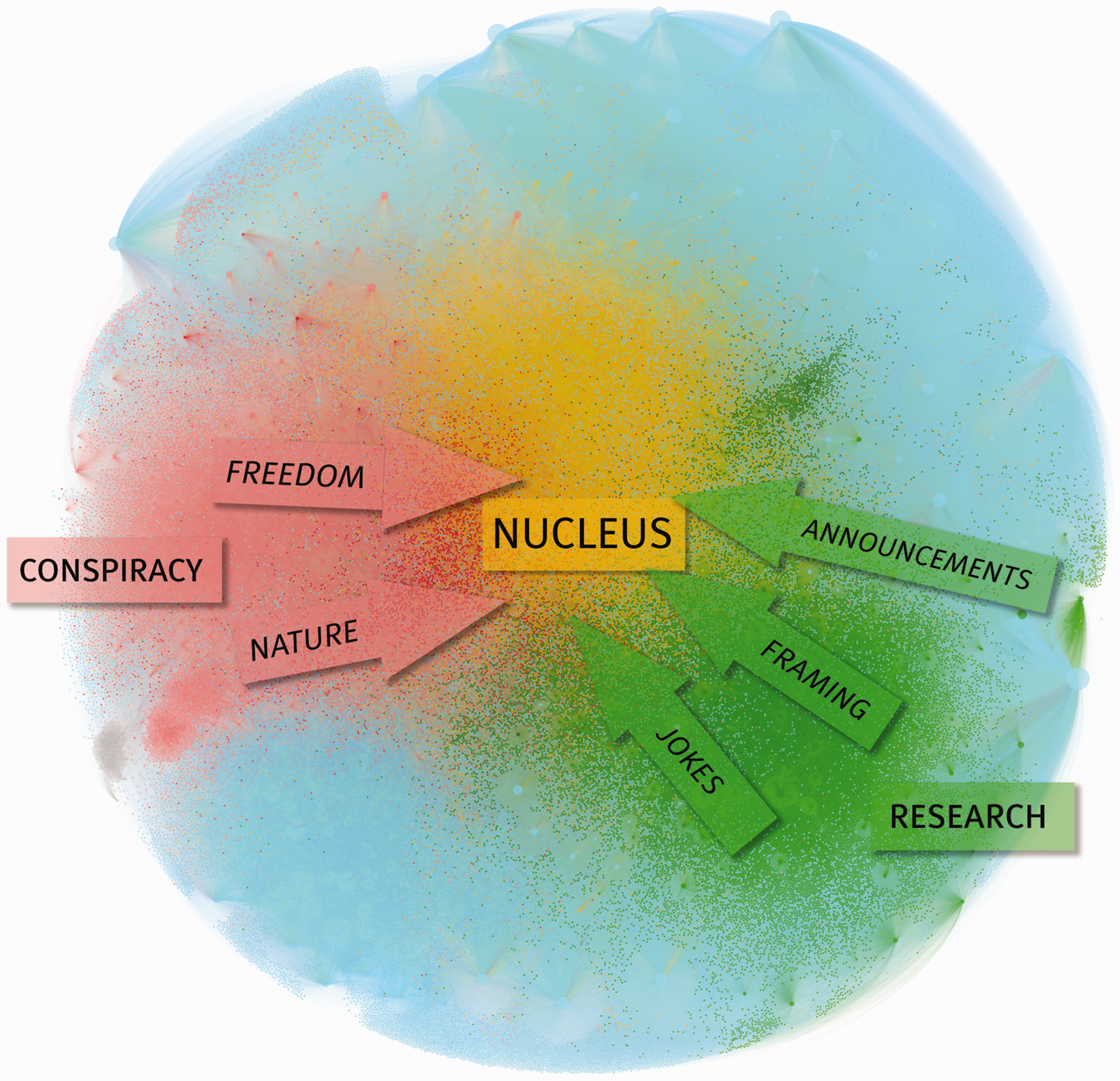
Flow of themes, frames and narratives from the anti-establishment and health communities to the nucleus community.
Most of the themes, frames and narratives originate in the health-care and anti-establishment communities and are discussed in the nucleus community. The health-care community tweeted in favor of vaccination, sharing reports on scientific studies and peer-reviewed articles (research), announcing informative events about vaccination (announcements), and criticizing media that showed images of crying children to portray vaccination as something scary and painful (framing).
The anti-establishment community was largely tweeting against vaccination, sharing articles exposing its supposedly harmful effects and framing it as a conspiracy by large pharmaceutical companies (conspiracy) and an infringement of the right to self-determination (freedom); not vaccinating, meanwhile, was proclaimed as a natural way to build a resilient immune system (nature). The sentiment about vaccination in this community has similarities with a wider sense of distrust toward doctors, science, politicians and other traditional institutions observed in other studies.61,62
The Dutch and Flemish media communities rarely engaged in discussions on vaccination, although the health and anti-establishment communities both used media coverage to back up their arguments. In Figure 1, the so-called hubs—which are the nodes in our network that are followed widely, but rarely follow other nodes back—are positioned toward the edges. Notably, the anti-establishment community is not well-connected to the media cluster. Instead, it is linked to a small cluster of alternative media. These alternative media sources do not engage actively with the other communities, but are retweeted and quoted often by members of the anti-establishment community.
In the nucleus community, representing the space where the health communities and anti-establishment community engage with a general audience, a mix of frames in favor of and against vaccination was observed. From the frames against vaccination, the conspiracy frame hardly reoccurred at the nucleus, possibly because it is too much at odds with more moderate world views. From the frames in favor of vaccination, the research frame rarely reoccurred in the nucleus community. The reason why the research narrative did not spread may be because the high information density and medical jargon posed a cognitive barrier.63,64 Similarly, the members of the health communities antagonize and joke about anti-vaccination activists (jokes) who, in turn, see their prejudice about the arrogance of the traditional elite confirmed. For some audiences, the fact that a doctor, researcher or someone from what is perceived as “the establishment” is sharing this information may be enough reason to dismiss the message.61,62
Mapping the discourse on vaccination in and between communities produced results that can be used to define and tailor health communications to the perceptions of the different online communities. It also provided input when deciding which frames to support and which misconceptions to address.
Identifying social influencers
The analysis shows that most of the misconceptions around vaccination are rooted in the anti-establishment community, whereas the health community tries to debunk these misconceptions by sharing facts and ridiculing anti-vaccination activists. However, this seems to alienate the anti-establishment community and to fuel its prejudices about what it perceives to be “the elite.” This makes the anti-establishment community elusive and difficult to reach via traditional means. Moreover, some of this sentiment also resonates in the nucleus communities.
In targeting and tailoring health interventions to this situation, health communicators could collaborate with opinion leaders to develop formats that address and stimulate conversations about misconceptions on vaccination in the anti-establishment and nucleus communities. They could also collaborate with gatekeepers to enhance the flow of ideas between communities. To identify gatekeepers and opinion leaders, we used the igraph package 65 to compute PageRank 66 and betweenness centrality. 50 Sorting the individual Twitter accounts in each community by their respective PageRank and betweenness centrality scores yielded a list of the most influential opinion leaders and gatekeepers.
Finding suitable influencers to collaborate with is not about identifying the most influential nodes in general, but finding the most influential nodes for every community. To illustrate this, some of the most influential nodes in our vaccination network reside in the health-care community, but the anti-establishment community largely lies beyond its reach. We were specifically interested in influencers that are native to the target communities, as it is in these communities where they are most influential. Ideally, the RIVM would collaborate with social influencers who can create their own media content, or already do so (semi-)professionally. Social influencers should also be willing to collaborate on a pro-vaccination campaign, so they should not be specifically against vaccination. A curious, critical attitude, however, would add to the authenticity of the prospective media content. After inspecting the profiles of the most influential nodes, many potential collaboration partners surfaced. Figure 3 highlights three social influencers in the network.

Potential collaboration partners highlighted in the vaccination network. The highlighted influencers are anonymized.
Discussion
Our case study shows that digital methods provide an opportunity for targeting in the digital era by identifying online communities with specific health perceptions. Before discussing the methodological limitations of our research, we will now demonstrate more precisely how this kind of analysis can contribute to tailoring.
Targeting and tailoring in the digital age
One could argue that influencer marketing is an opportunity to use the communication channels of social influencers to send tailored messages to passive audiences, which is a sender-driven approach. However, it is unlikely that a message in which the contents or the sender are at odds with the reigning perceptions and norms around an issue will make any impact, as audiences will not be receptive to it. Instead, we have a slightly different take on tailoring by putting the creative and cultural competences of social influencers central. This differs greatly from computer-aided tailoring, where messages are typically the result of leveraging personal data using a pre-determined content formula. However, both approaches may lead to communication that is more relevant on a personal level, which is why tailoring is applied in the first place. The STD AIDS Foundation’s Beat the Macho and contraception cases described in the Introduction show that working with influencers tailors a message to the perceptions and cultures of online communities in an organic way, as influencers are naturally culturally competent when it comes to engaging with these communities’ members.
Targeted health interventions require collaboration strategies in which health communicators and social influencers work closely together. In such collaborations, there is a need for a common frame of reference that guides the collaboration process, 63 balancing tasks and responsibilities between health communication professionals and social influencers. In the STD AIDS Foundation’s examples, social influencers were responsible for the social and creative aspects of the interventions, whereas the health communicators remained in control of aspects that concerned behavioral impact and contributed to the intervention’s objectives. In our case study on vaccine hesitancy, this might translate into: letting the hosts of existing podcasts lead discussions about vaccination; making vaccine-related data sources available to data bloggers, artists and other enthusiasts; and (co-)producing live discussion events about vaccination.
To strengthen this common frame of reference, we suggest following a media mapping procedure 67 that effectively integrates the efforts of the different stakeholders. The media mapping procedure distinguishes different phases that can be used to guide the creation of health interventions in which the digital research methods from our case study play an important supporting role. During the orientation phase, in which researchers and health communicators work toward a deeper understanding of the health issue, health communicators can use digital methods to identify online communities, understand their health-related perceptions and define audience segments. During the crystallization phase, when potential collaboration partners are identified, approached and briefed, health communicators can use digital methods to further increase their understanding of health-related perceptions and find potential collaboration partners across online communities. During the dissemination phase, which monitors and measures whether beliefs, perceptions and norms around the health-related issue have changed, digital methods can be used to detect changes in online conversations about the issue across the different target communities.
Methodological limitations
In terms of the methodological limitations of our case study, it should first be noted that previous research shows that the cross-media use of audiences has diversified.6–11 Nevertheless, our research on vaccine hesitancy is limited to Twitter. Facebook, YouTube, Instagram and many other platforms are also likely to be used to discuss vaccination. Accordingly, to incorporate the expanding media landscape and diversified media repertoires in future studies, we propose the extraction of links to other platforms from Twitter messages. These links can be used to understand: what media content audiences are linking to as “evidence”; which websites or sources are further referred to; or which websites, channels or Instagram accounts are most popular. These links can also serve as inputs for a digital equivalent of snowball sampling, unfolding networks of websites, YouTube videos and/or channels 68 or networks of Instagram hashtags. 69
Secondly, we used the Louvain algorithm in our case study 58 to detect communities. This algorithm is known for providing quick and adequate results for large networks. However, it does not take directionality into account, meaning that it does not distinguish between a node following a node and a node being followed by a node. Nonetheless, the Louvain algorithm served the purpose of detecting like-minded audiences in our case study exceptionally well. Another limitation of the Louvain algorithm is that nodes can only be members of one community, whereas in reality it is possible for individuals to engage with multiple communities. Algorithms that are capable of taking directionality or multiple-community membership into account require more computing power. In future studies, researchers could experiment with more powerful computing clusters or applying different community detection algorithms.
In addition to community detection, quantifying node influence is complex; there are several methods available and which of these is best depends on a study’s goals. In our research, we used PageRank and betweenness centrality to identify social influencers, as these are well-equipped to identify influential nodes, as well as nodes that serve as bridges. 50 In future studies, researchers could experiment with the application of other indicators such as degree centrality, closeness centrality or eigenvector centrality.
Thirdly, we have mainly focused on analyzing textual content, whereas much of today’s content is visual. In future studies, researchers could analyze visual content by making use of machine-learning resources such as Google’s Vision API. 70 Such cloud-based machine-learning services make it possible to convert visual data into textual data to render them analyzable. So, when sending images to Google’s Vision API, the system’s interpretation of these images is returned to the user. Such systems are also able to recognize people, locations or even memes, providing richer levels of context. Analyses of such data could further enhance the mixed-methods approach we used in our case study, as the output of these systems may point to objects, places or people that occur more often than others in a set of images.
Conclusion
Recent changes in the media landscape include the formation of online communities and algorithmic personalization. These developments have made reaching and engaging with target audiences more challenging. We propose that health communication professionals and social influencers can collaborate effectively to create health interventions that are tailored to the preferences, perceptions and cultures of these online communities. To enable the creation of such interventions, we have presented a combination of network and content analysis to: (a) identify online communities; (b) increase our understanding of their health-related perceptions and cultures; and (c) identify appropriate social influencers as potential collaboration partners. The case study has demonstrated how digital methods can be used successfully to target and tailor health interventions in the digital era.
Finally, we adopted an alternative approach to tailoring by putting the creative and cultural competences of social influencers central, resulting in health communication that is more personally relevant. We propose a media mapping procedure that integrates digital research methods into a collaborative process to define audience segments, identify collaboration partners and design messages that are tailored to the target communities’ perceptions, guiding interdisciplinary collaborations between health communicators, social influencers, researchers, data scientists and influencer agencies. This contribution is especially useful for those who: seek to raise awareness; promote conversations and/or educate online audiences on specific health issues; and are open to experimenting with collaborative partnerships.
Footnotes
Acknowledgments
None.
Contributorship
ROL wrote the first draft of the manuscript. JJ and MPAB reviewed and edited the manuscript and approved the final version of the manuscript. ROL also wrote the first and second revised versions of the manuscript. These were commented on by JJ and MPAB, the comments were followed up on by ROL, and a final version of the manuscript was copy edited by BTek Services Ltd. The research presented in the case study in this paper was commissioned to the Center for Media & Health and conducted by ROL under supervision of MPAB.
Conflict of interest
The authors declare there is no conflict of interest.
Ethical approval
The study complies with the professional and ethical standards of Dutch academia. Ethical Review Board approval is not required for this kind of study.
Funding
This work is supported by a grant from the Friends Lottery (MediaLab Project).
Guarantor
Jeroen Jansz (JJ)s
Peer review
This manuscript was reviewed by Tessa Dekkers, Faculty of Industrial Design Engineering , Delft University of Technology, Netherlands.