



Abstract
The COVID-19 pandemic severely affected everyday life in Africa, a continent that is known for its high levels of religious belief. Using a corpus of news articles and the social representations research paradigm, this study examines African understandings of the pandemic. It uses installation theory, the wind rose model and the accommodation hypothesis to explore the coexistence between science and belief. The accommodation hypothesis demonstrates that the representations were hierarchical, to elevate God above science. Faith leaders also used the pandemic to enhance faith by blaming sin and urging repentance or blaming science by espousing conspiracy theories about the pandemic being a grand design to draw believers away from God. This paper highlights the great disparity in experience between Africa and the West, initially fuelling conspiracy theories. The findings also reinforce two key conceptual approaches: installation theory on the influence of rules imposed by society on behaviour, and the wind rose model in which representations change over time and in response to social interactions.
Keywords
Introduction
The severe acute respiratory syndrome coronavirus 2 (SARS-CoV-2) was categorised as an emerging infectious (EI) disease and first isolated in late 2019. It spread very quickly to and across Africa in the first quarter of 2020, aided by increasing globalisation and air travel. As the virulence of this new disease was initially unknown, containment measures were proffered by scientists when its capacity to spread and very high mortality rate raised global alarm. The measures severely affected the observance of religious obligations across the African continent, as well as in other parts of the world, setting religious belief against science. The pandemic also grounded most economies to a halt, which had severe implications for already weak African economies.
EI diseases are those that have newly appeared in a population or have existed previously but are rapidly increasing in incidence or geographic range (Morens et al., 2004). The initial public understanding of the risks associated with such diseases is informed by previous experience with other ailments, often imbued with non-scientific meanings (Falade and Coultas, 2017) aided by culture, beliefs, rumours and conspiracy theories (Falade and Murire, 2021). Using the social representations research paradigm and its extensions (installation theory, the wind rose model and the accommodation hypothesis), this study examines the public reception of SARS-CoV-2 (or COVID-19), an EI disease whose epidemiology and capacity to globalise were relatively unknown at the onset of the pandemic. The study has implications both for the social representations research paradigm and for public understanding of science and health communication more generally.
Culture and public understanding of EI diseases
In the Middle Ages, the spread of the Black Death devastated the Mediterranean basin populations. The colonisation of the New World by Europeans in the 1500s led to epidemics of smallpox in modern-day Mexico, while the Europeans were themselves exposed to syphilis. The end of the 1800s saw the spread of tuberculosis, and the Spanish flu of 1918–1919 is estimated to have killed millions worldwide. Smallpox, now successfully eradicated, was regarded as one of the most devastating diseases known to humankind. More recent outbreaks of EI diseases include acquired immunodeficiency syndrome (AIDS); the Ebola virus disease, which claimed over 11,000 lives in West Africa; the Zika virus disease, which spread from Africa to the Americas; and several coronaviruses (CoV) including Middle East respiratory syndrome (MERS-CoV), severe acute respiratory syndrome (SARS-CoV-1) and now the new strain, SARS-CoV-2.
Scientific explanations and measures to control EI diseases have always been met with resistance from the public. In 1796, when Edward Jenner introduced the smallpox vaccine, it received opposition from religious leaders, scientists, liberal reformers, politicians and a host of other social groups who expressed safety concerns and fears that the process could transmit other diseases. While the vaccination scar was labelled the ‘mark of the beast’, compulsory vaccination laws were described as ‘medical tyranny’, a ‘torture code’ and an invasion of civil liberties, with resistance spreading across continents from the Americas to Europe and Asia (Beck, 1960; Durbach, 2000; Colgrove, 2005; Stern and Markel, 2005). Safety concerns re-emerged in the latter half of the 20th century over the diphtheria, tetanus and pertussis vaccine (Kulenkampff et al., 1974) and the measles, mumps and rubella vaccine (Burgess et al., 2006). In Africa, safety concerns led to vaccine revolts in Cameroon (Feldman-Savelsberg et al., 2000) and Nigeria (Falade, 2014), as well as Tanzania, Uganda and Kenya (Clements and Drake, 2002).
While religion was a major factor in vaccination resistance in 18th- and 19th-century Europe and America, 20th-century resistance was largely informed by concerns over the safety and effectiveness of vaccines compared with alternative strategies such as natural immunity. ‘Resistance’ has also been replaced by ‘hesitancy’, which better describes a continuum from active participation to total rejection of all vaccines, and several profiles in between, rather than binary pro- and anti-vaccination categories (Dubé et al., 2015; Larson et al., 2014). In Africa, however, religion remains central to vaccination controversies.
Culture, as an embodiment of shared values, informs standards for communication, perception and actions (Gartstein et al., 2016; Triandis, 1996). Growing globalisation draws attention to cultural differences between people from different countries or from different cultures within the countries (Wagner et al., 2014). As a distribution of meaning systems, culture plays a strong role in public understanding of science (Bauer et al., 2018). While knowledge of basic science is also thought to have an important role (Durant et al., 1992; Miller, 1998), other researchers have argued that knowledge does not directly translate into appreciation and can even lead to more critical views (Gregory, 2001). Other studies highlight the role of beliefs in public understanding of science (Ecklund et al., 2018; Li and Tsai, 2018). For instance, Rogers (1983) argues that compatibility with the values, beliefs and past experiences of a social system is an important factor in the adoption rate of any innovation.
At the core of science and society research is how local culture, defence of group position and prior beliefs drive the familiarisation of unfamiliar science. This provides the context for this study of COVID-19 and its representations across Africa.
African culture, beliefs and health
During the Ebola crisis in West Africa, Western and traditional beliefs played strong roles, sometimes aiding the spread of disease (Falade and Coultas, 2017). In the past, religious groups have also opposed vaccination campaigns, citing conspiracies (Falade, 2014; Feldman-Savelsberg et al., 2000). HIV was described in South Africa as an attempt by the apartheid government to reduce the population of blacks and as a bioweapon manufactured by the United States Army (Hogg et al., 2017; Nattrass, 2013). President Thabo Mbeki also dissociated HIV from AIDS (Cohen, 2000), while President Zuma implied that a bath after unprotected sex can stop its transmission (BBC, 2006). African culture and traditions also contribute to sense-making about non-communicable diseases. Obesity is seen as an enviable artefact of wealth (Neema et al., 2021), Alzheimer's is attributed to witchcraft (Maduna and Loos, 2021), while deaths in pregnancy and HIV/AIDS are attributed to the will of God or witchcraft (Aliyu, 2021; Ashforth, 2002). Of note, medical pluralism, or healer shopping, is also common across Africa, as the public searches for cures from traditional healers, churches and hospitals, at times in parallel or in sequence (Falade and Bauer, 2018; Moshabela et al., 2017).
Culture, social groups and social representations
We understand the world using common sense, which comprises shared norms, values and beliefs about what is permissible and what is frowned upon in society. Thus, for an unfamiliar phenomenon to become part of our world view, we seek to understand it through previous images found in common sense. Moscovici's (2008) social representations approach, with its focus on the familiarisation of the unfamiliar, examines the way in which scientific language becomes common dialect, pervades judgement and directs behaviour. The interest with this paradigm, according to Joffe (2002), is not whether a response is right or wrong, but the ‘why’ and ‘how’, and the new common sense that evolves. For Moscovici (1984), the images, ideas and languages shared by a group always seem to dictate the initial direction in which it attempts to come to terms with the unfamiliar. Moscovici (1976/2008) studied psychoanalysis, an unfamiliar science in 1950s France, as a cultural phenomenon, exploring how it penetrated the lifeworld of different social groups and created social representations. After the Second World War, psychoanalysis and Marxism had become widespread in French culture, permeating and influencing different social groups. Using newspapers aligned with the Catholics, the communists and the liberals, Moscovici showed how three distinct subcultures of French society responded to the same scientific phenomenon.
The communist press described psychoanalysis as an invasion of French culture and morals, and an instrument of Western imperialism, and sought its rejection. It was indeed surprising, Duveen (2008) noted, that the ideological conflict over the Cold War could powerfully influence the framing of the social representation of psychoanalysis. Falade (2014) also found that the initial rejection of the oral polio vaccine in Nigeria was influenced by the war in Iraq, which was viewed by some as targeting Muslims. While newspapers catering for the urban liberal professionals in Moscovici's study diffused information to their readers with the aim of influencing opinions without indicating courses of action, the Catholic press presented a third way, somewhere in between. The Catholic press saw the similarity between the psychoanalysts' dealings with their patients and those of priests with penitents – in terms of confession – but they firmly rejected the aspect of sexuality. Therefore, while the theory and practice derived from psychoanalysis were seen as dangerous, the church was urged to adopt its findings. Bauer and Gaskell (1999, 2008) argue that the intention of the Catholic press was to make limited concessions to a subgroup of Catholics with affinities for psychoanalysis and to simultaneously set limits on its acceptance within the established orthodoxy of the church.
The social representations paradigm updates Durkheim's theory of collective representations. According to Farr (1987), Moscovici regarded the adjective ‘social’ as more appropriate than ‘collective’ (as used by Durkheim) to qualify representations. Bauer and Gaskell (2008) proposed an extension of Moscovici's theory, arguing for a ‘wind rose’ model that sees social representations as a function of the subject, object, project, time, medium and intergroup context. The subject is a collective of conscious selves who come together for a project of common intentionality, while the medium is the genre of communication identified in relation to the object. The authors also argue that representations are formed in relation to other communities; hence, the intergroup context and the object may change over time as a function of their own dynamics or in response to common sense.
Lahlou (2015, 2021) also proposed an extension to the social representations theory, arguing that human behaviour is guided by installations that simultaneously support and control human behaviour. For Lahlou (2021), a social representation is a set of individual representations that are similar, and the similarity supports the intersubjective understanding of objects that characterise a culture and define different groups within it. However, the plurality of social representations does not mean that different people accept and grant equal value to all, as certain social groups are able to impose their interests, meanings and projects over other groups with less material and symbolic power (Jovchelovitch and Priego-Hernandez, 2015).
In Lahlou's (2015) installation theory of social representations, human behaviour is determined at three levels: the physical or material properties of objects; the psychological or interpretive systems in humans; and the social affordances of the environment or rules enforced by institutions that constrain what society members can do in a specific situation. All three, he argues, guide a specific activity. These installations simultaneously support and control human behaviour (Lahlou, 2021).
Social affordances can also include economic circumstances (Falade and Murire, 2021), where behavioural outcomes are not only constrained by social norms but also by individual financial circumstances, national economies and global inequalities.
Moscovici's work first appeared in French, with the title La psychanalyse: Son image et son public, in 1961, with a second edition published in 1976. The English version, Psychoanalysis: Its Image and Its Public, was published in 2008. Moscovici's approach has been variously criticised, but the amount of research it has influenced today is a testimony to its acceptability among social psychologists. A journal dedicated to the topic, Papers in Social Representations (PSR), first appeared online in 1999 and is published in four languages: Spanish, French, Portuguese and English. The journal describes the conceptual approach as ‘a theory of social cognition, culture and communication connecting knowledge practices, identity processes, psychological processes, ideology and social change’. 1
Voelklein and Howarth (2005) grouped criticisms of the theory into four categories: theoretical ambiguity; social determinism; cognitive reductionism; and failing to address issues of power and ideology. Specifically, Jahoda (1988) accused Moscovici of attempting to resuscitate the notion of ‘group mind’ determining individual thought. Other critics regarded the idea of consensus or sharedness as fundamentally flawed, describing social representations as ‘linguistic repertoires’ (McKinlay and Potter, 1987; Potter and Edwards, 1999; Potter and Litton, 1985). Bauer and Gaskell (1999) argued that elaboration and clarification are needed on the key conceptual distinctions and their implications for the conduct of research. Moscovici (2001) responded to the criticism that the theory is neither experimental nor predictive, noting that there is a diversity of theories wherein some explain and predict, and others explain without predicting. He observed that mainstream social psychology has tended to opt for the former, while his theory belongs to the latter.
Moscovici also identified the coexistence of different modalities of knowledge in the same individual or group, a phenomenon he described as ‘cognitive polyphasia’. In this coexistence, Moscovici (1984) argues, one knowledge learns from the other (assimilation), as one (common sense) moves up and the other (science) moves down. Jovchelovitch and Priego-Hernandez (2015) suggested three varieties of cognitive polyphasia, each defined by a specific modality of coexistence and cognitive outcomes: selective prevalence, hybridisation and displacement. Falade and Bauer (2018) proposed two modalities: the hierarchical and the complementary. In the hierarchical route, one knowledge system is elevated above the other, whereas the complementary route is about parallel and empowerment forms. In a parallel relationship, different approaches explain different aspects of our lives (Gould, 1997), and empowerment is when one form enhances the other. However, while Moscovici argues for assimilation, Falade and Bauer (2018) propose accommodation, as in several instances, both systems coexist as separate entities.
This paper is therefore approached using the conceptual framework of Moscovici's social representations theory, with further updates from Bauer and Gaskell's (2008) wind rose model, Lahlou's (2015, 2021) installation theory and Falade and Bauer's (2018) accommodation hypothesis.
Research objectives
This study examines the familiarisation of an unfamiliar scientific phenomenon: the COVID-19 pandemic. The social representations approach was chosen because it shifts the focus from science versus the public to science in society and the evolution of a new common sense. The theory shows how communication across social groups both generates and sustains social representations and highlights the role of the material properties of objects (COVID-19). It also draws attention to the interpretive systems (beliefs, culture, etc) embodied in humans, and the social affordances (economic) and rules enforced by institutions (lockdowns, travel bans, vaccinations) that constrain what the public can do during the pandemic. The paradigm is also better suited to characterising the voices and images of public concern (Bauer and Gaskell, 1999) in response to challenging developments such as the pandemic.
Specifically, the paper seeks to confirm social representations theory and its extensions, the installation, wind rose and accommodation models. As in Moscovici's research, this study examines the content and coverage of the COVID-19 pandemic in selected African newspapers. It also uses data on monthly deaths from the pandemic to provide context for different countries. The research questions are as follows:
What was the intensity of coverage of the pandemic in African newspapers, and how did the number of disease-related deaths affect public anxiety? What were the representations of COVID-19, and how and why did these representations evolve? How stable were these representations over time?
Methods and data
Gaskell (2001) identified two traditions within the programme of research into social representations. One tradition focuses on the production of knowledge, and the other on the structure of knowledge. Abric (2001) describes the structural approach as a direct extension of social representations theory, proposing the hypothesis of a central core consisting of one or several elements that give the representation its meaning, and peripheral elements that constitute the context of the representation. This study uses the production of knowledge approach to examine the contents of common sense, the constraints on representations and how they change over time, using content analysis of media coverage. The study also examines the death rates from the virus across countries to contextualise the intensity of coverage and the ensuing public panic (or otherwise) in the countries under study, in comparison with other countries outside Africa. Alternative approaches used in studies of social representations include ethnography, interviews, focus groups, statistical analysis of word associations, questionnaires and experiments (Wagner et al., 1999).
The news reports for this study were gathered from two sources: the LexisNexis international newspaper database and Google searches. For LexisNexis, the study used the keywords ‘COVID’, ‘COVID-19’ and ‘coronavirus’ for two newspapers each from Nigeria, South Africa and Tanzania. The search identified 812 articles from the Daily Trust and 1061 from Vanguard for Nigeria, 651 articles from The Citizen and 507 from the Daily News for Tanzania, and 506 from The Sowetan and 483 from Business Day for South Africa. A total of 4020 articles were downloaded, covering the period from 1 January 2020 to 31 December 2021.
The study also searched for the names of notable African religious leaders and presidents on Google, broadening the search to foreign media and personal and group websites. For the Tanzanian President, for example, the search criteria consisted of ‘COVID’, ‘COVID-19’, ‘coronavirus’ and ‘Magufuli’. The study then adopted a follow-up system where an interesting representation was probed further for more in-depth narratives, leading to the inclusion of other newspapers (Premium Times, Daily Trust, Punch, The Guardian of Nigeria and The Guardian of the United Kingdom) in the qualitative section. The analysis focused on the social representations theoretical approach (Moscovici, 2008) and the three extensions provided by Lahlou (2015, 2021), Bauer and Gaskell (1999, 2008) and Falade and Bauer (2018).
Data on deaths were used to contextualise public anxiety and were obtained from the World Health Organization (WHO) coronavirus (COVID-19) dashboard (WHO, 2022) for the period from 1 January 2020 to 31 December 2021. The WHO coronavirus dashboard presents official daily counts of COVID-19 cases, deaths and vaccine utilisation reported by countries, territories and areas. The dashboard, however, notes that updates are made retrospectively to correct counts on previous days as needed, based on subsequent information received, and all data are subject to continuous verification and change. For a global context, the paper included the number of cases and deaths for the United States and United Kingdom. The total cases and deaths were as follows: Nigeria 241,513 cases and 3030 deaths; South Africa 3,446,532 cases and 91,061 deaths; the Tanzania 29,306 cases and 737 deaths; the United Kingdom 13,442,037 cases and 149,790 deaths; and the United States 53,543,438 cases and 818,954 deaths.
Findings
RQ1: What was the intensity of coverage of the pandemic in African newspapers, and how did the number of disease-related deaths affect public anxiety?
(1) Disease incidence and death tolls in Africa
The first case in Nigeria was announced on 27 February 2020 and involved a 44-year-old Italian citizen who arrived in the country through the Murtala Muhammed International Airport, Lagos, from Milan, Italy. The first death was announced on 23 March 2020, barely one month later. By the end of the study period in December 2021, the total number of deaths was estimated at 3030. For South Africa, the index case was announced on 5 March 2020 as a 38-year-old male who had travelled to Italy with his wife and had fallen ill on his return. The first death was reported on 27 March 2020. Total deaths during the study period were estimated at 91,061. Tanzania reported its first case as a 46-year-old female who had visited Belgium, Denmark and Sweden in early March 2020. She had fallen ill on her return to Tanzania and was confirmed positive on 16 March 2020. The first death was announced on 31 March 2020, and deaths totalled 737 by the end of the study period. There is, however, a period of several months in which Tanzania did not report any new cases and deaths to the WHO, so their data need to be read with caution.
Figure 1 shows the monthly death toll for Nigeria, South Africa, the UK and the US over the review period (WHO, 2022). Compared with South Africa, Nigeria's death rate was comparatively low. However, the deaths reported in South Africa were also comparatively lower than the figures for the United Kingdom and the United States.
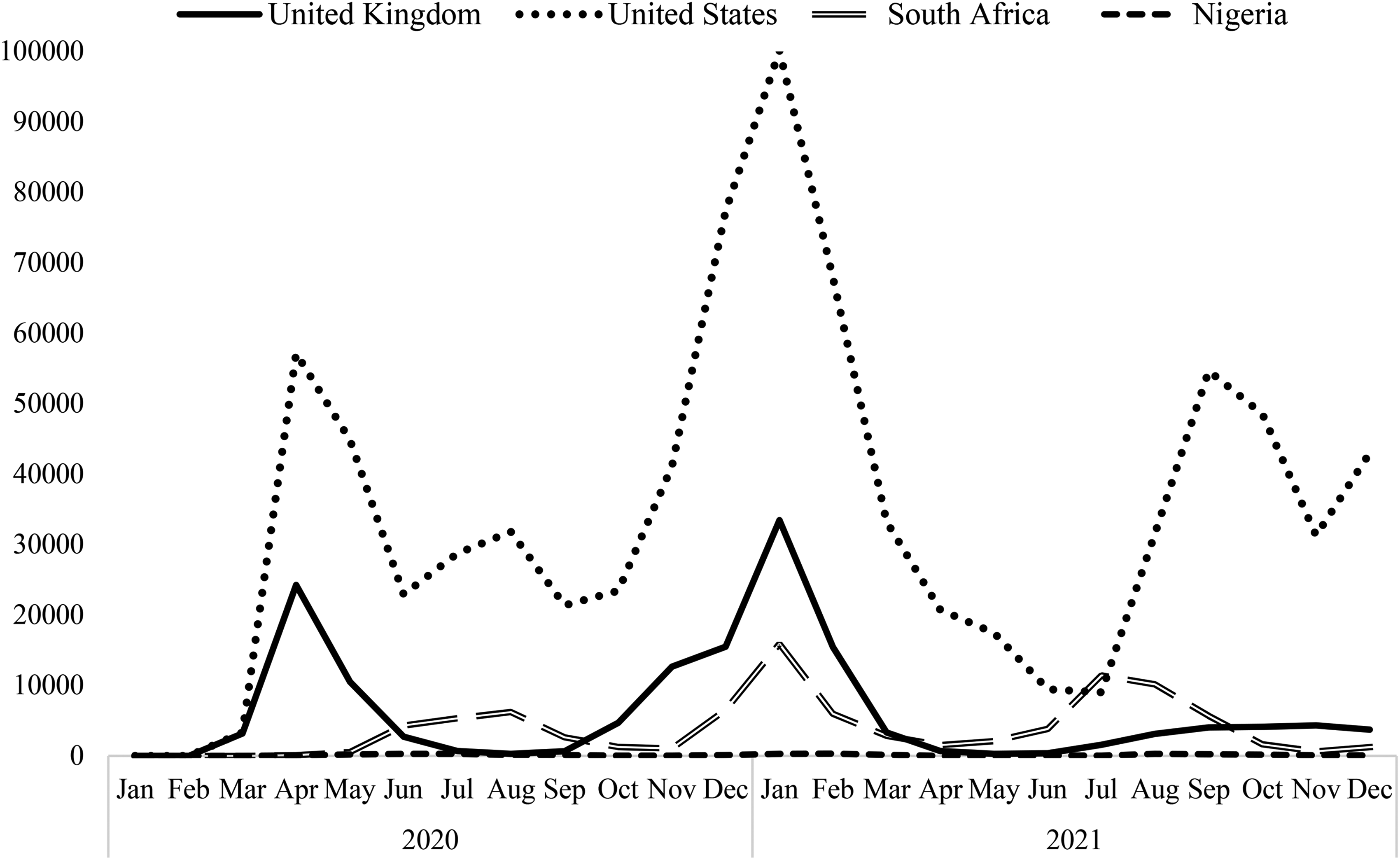
Monthly death tolls as reported by the WHO for Nigeria, South Africa, the United Kingdom and the United States in 2020 and 2021.
Nigeria also had comparatively fewer confirmed cases, at 241,513, when compared with South Africa, at 3,446,532. Both countries had much lower figures when compared with the numbers of cases in the United Kingdom and the United States. By April 2020, which marked the first peak for the United States (Figure 1), there were a total of 1,029,446 confirmed cases and 60,490 deaths. In the United Kingdom, there were 166,396 cumulative cases and over 27,423 confirmed deaths. In Africa, however, Nigeria recorded 53 fatalities from 1728 confirmed cases, and South Africa had 103 casualties from 5350 confirmed cases. The huge difference in death rates and confirmed cases extended to the first half of the year and was maintained throughout the review period.
While the causes of the lower number of cases in Nigeria and indeed the whole of Africa compared with Europe and the United States are still under investigation, it is not the focus of this research, but the figures allow a better understanding of public anxiety during the pandemic within Africa compared with countries outside Africa. The fear factor resulting from mounting corpses and overflowing hospitals was thus not as high in Nigeria as in South Africa.
(2) Media coverage as a measure of news salience
Figure 2 shows the monthly coverage of the pandemic as a percentage of total coverage for Vanguard and the Daily Trust newspapers during the period under review. The graph shows a peak for both newspapers in April 2020, following a steep rise in March and the first reports in February. This coincided with the first peak of deaths reported in the United States and United Kingdom (Figure 1). A much lower peak followed for the Daily Trust in July before it plateaued, while Vanguard had two smaller peaks in August and December before it also levelled off in 2021.
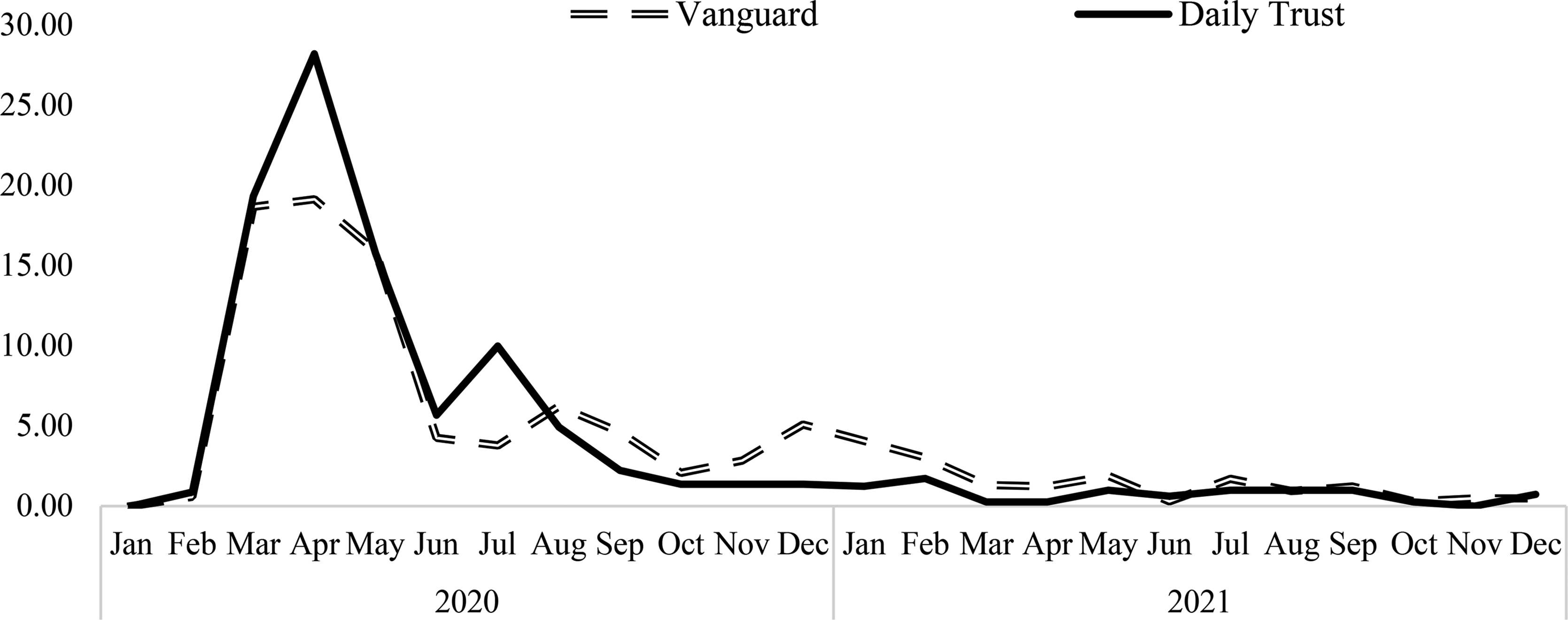
Monthly percentage of total news coverage for Nigeria: Vanguard and Daily Trust.
Figure 3 shows a similar pattern, with a steep rise in February 2020, but a peak in March, earlier than Nigeria's peak in April. Two smaller peaks followed for Business Day in July and October 2020 and one in January 2021 before the count also levelled off. The Sowetan also had a sharp peak in January 2021.
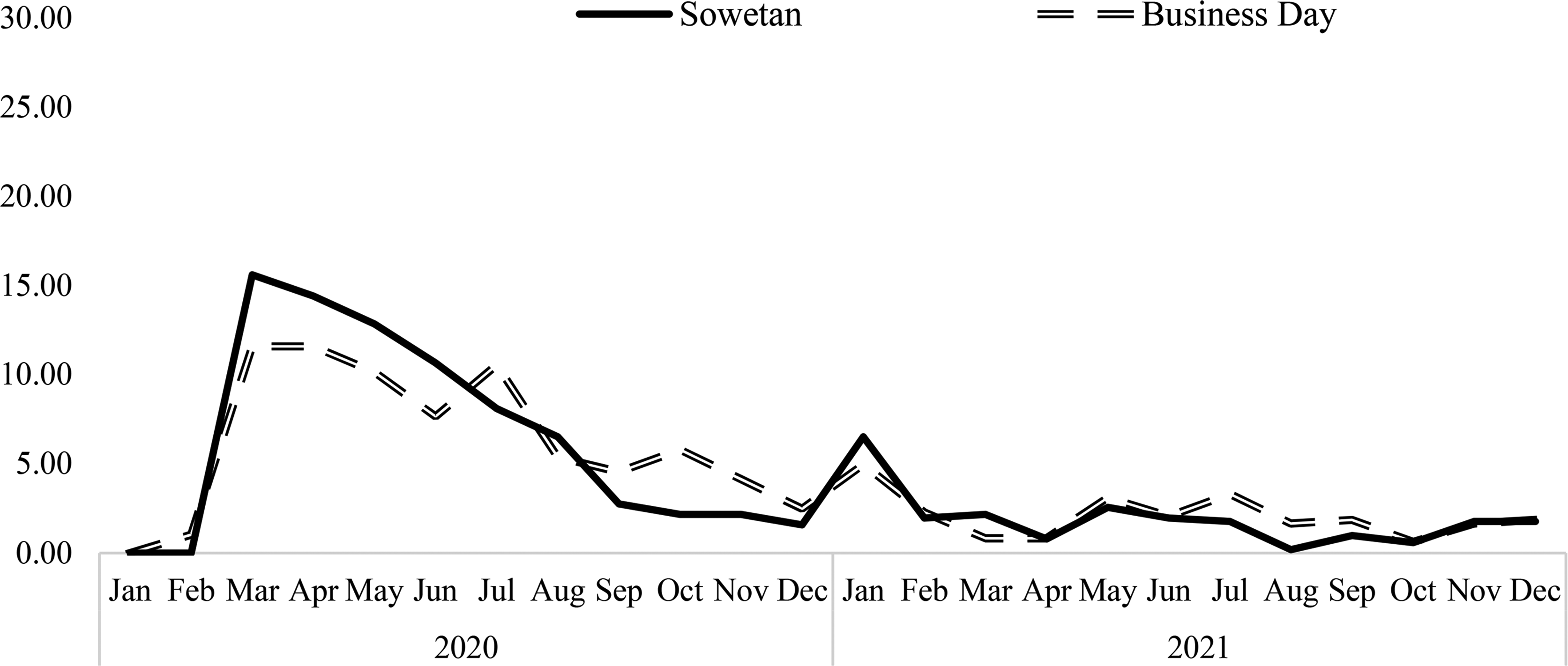
Monthly percentage of total news coverage for South Africa: The Sowetan and Business Day.
The Tanzanian dailies (Figure 4), however, had their first peak in April with The Citizen, and the Daily News reached its first peak in June 2020. Smaller peaks followed for both newspapers, eventually levelling off at lower levels.
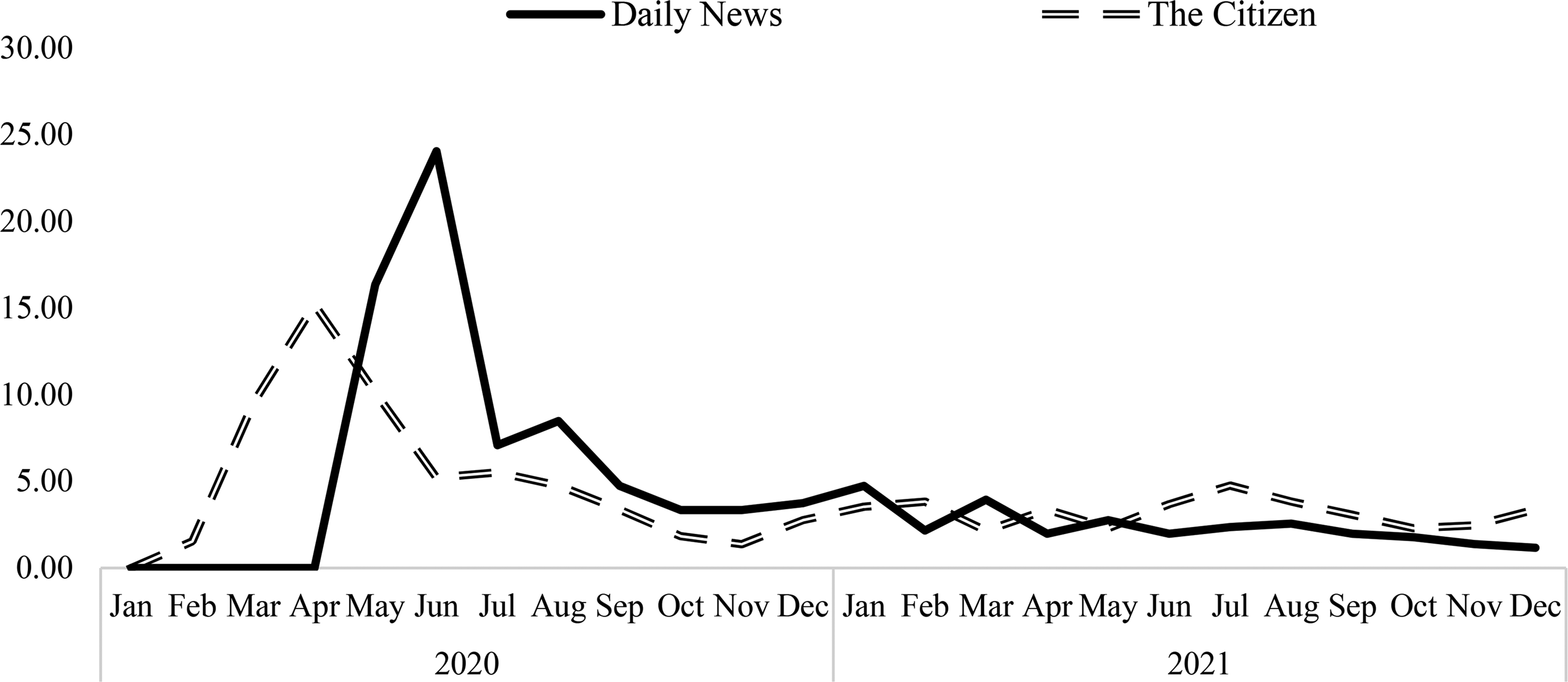
Monthly percentage of total news coverage for Tanzania: Daily News and The Citizen.
The above figures show when an unfamiliar disease, COVID-19, entered public discourse and the ensuing peaks in newspaper coverage, and how the coverage soon flattened as the disease became familiar. We can thus split the coverage into unfamiliar (first peak) and familiar (flattened) stages, but these are not absolute and are country specific. The death toll indicates that public fear/anxiety over infection or death may have been lower in Nigeria due to its lower death rates compared to South Africa, the United States and United Kingdom; hence the different representations of the disease. The media coverage and death tolls both show the strong role of the wind rose model in understanding representations as a function of subject, object, project, time, medium and intergroup context (more on this in RQ3). RQ2: What were the representations of COVID-19, and how and why did these representations evolve?
(1) Public panic and institutional constraints on behaviour
According to Lahlou (2015), the properties of an object, human cognition and institutional rules inform its social representations and simultaneously support and control human behaviour in respect to the object. The severity of COVID-19 (the object in reference) for the infected, and the hospitalisation and death rates, caused panic worldwide. Images of oxygen masks on patients in hospital with breathing difficulties, lack of bed spaces forcing many to be treated in makeshift spaces and mass graves for thousands who died daily sent shock waves around the world, creating heightened fear among the public. The stay-at-home rules from governments worldwide were thus largely complied with, leading to images of empty streets being beamed across the world, which reinforced representations of the severity of the disease. The situation for the African public was not different from other parts of the world, as these images of the object became etched in people's minds. While the disease was first diagnosed in late 2019 in Asia, Nigeria's index case was reported on 27 February 2020. This was followed by South Africa on 5 March, Kenya on 12 March and Tanzania on 16 March. The disease soon spread across the continent, forcing governments to place restrictions on movement and introduce bans on public gatherings.
Three religious festivals took place in Nigeria within weeks of each other in July and August, about six months into the pandemic when its effects, hospitalisation and deaths had become manifest in the local population. They reflect the country's (and indeed Africa's) religious diversity, with citizens spreading across the Abrahamic faiths and African beliefs. The annual convention of the Redeemed Christian Church of God (RCCG), one of Africa's largest Pentecostal movements, is a global event that attracts thousands of worshippers from around the world to its headquarters in Ogun State, South-West Nigeria (RCCG, 2020). However, the headquarters was closed and its 68th annual convention was held from 3–9 August 2020 in a virtual format on radio, television and the internet, aided by the church's highly advanced use of technology. Friday 31 July 2020 was also the day of Eid-el-Kabir, the Grand Eid, which is regarded as the most important festival in the Islamic calendar. It begins with the Eid prayers, held in several large open prayer grounds across the country, where Muslims gather to pray in large numbers. In 2020, the prayer grounds were closed, and Muslims in Nigeria were asked to pray inside their local mosques (Olugbemi, 2020). The Osun Osogbo festival of African beliefs, held at the Osun sacred grove, in Osogbo, South-West Nigeria, also attracts thousands of worshippers and tourists from within and outside the country (Murphy and Sanford, 2001; Probst, 2004). The festival went ahead despite state-imposed limitations on gatherings (Abubakar, 2020a). However, the ceremony was stripped of most of its glamour, as restrictions on movement significantly limited attendance to those in the town and neighbouring villages.
The fact that the African religious festival went ahead while the churches and mosques were closed shows the effect of institutional constraints on human behaviour and how the object (COVID-19) might not have the same representations across social groups if rules are interpreted differently, leading to differences in behavioural outcomes. Notably also, the RCCG did not postpone its convention during the outbreak of Ebola virus disease in West Africa in 2014 (Falade and Coultas, 2017) but closed the convention ground during the COVID-19 epidemic, indicating the different interpretations of similar and equally devastating objects and the influence of social affordances in each context.
(2) Cognitive polyphasia and knowledge encounters
While religious groups largely complied with containment directives, the communication of believers and their leaders reveals more than a simple acceptance of science at face value. Instead, there was a struggle between two systems of knowledge about disease – science and beliefs – in what have been described as knowledge encounters (Jovchelovitch and Priego-Hernandez, 2015). This article concerns an encounter between two competing knowledge systems that are highly venerated by the public. Moscovici proposed the concept of cognitive polyphasia: the coexistence of different modalities of knowledge in the same individual or group. This was extended by Falade and Bauer (2018) into two forms of representations: the hierarchical route, where one knowledge system is elevated above the other, and the complementary route, which is about parallel and empowerment forms. More than one form can exist in an individual or group, always serving multiple functions.
My God is not dead, He is alive and He is in control.
God told your papa, who is not a prophet, but a pastor, that the virus will be there until the whole world has had a compulsory holiday. Until he proves to the whole world that he is God. He wants to prove to the world that he is in charge.
The communication strategy of the church leader here is to elevate God above science in the encounter between the two knowledge systems. His hierarchical approach also uses the pandemic to enhance faith in God through complementary enhancement. Hierarchical representation was also the position of the president of the Christian Association of Nigeria, Rev. Samson Ayokunle, when he attributed the pandemic to the wrath of God, the arrogance of humans and the need to return to godly ways. Ayokunle said in March 2020 (Ramon, 2020): All practices that would make us worship God we reject or abandon under the guise of fundamental human rights … In some advanced nations, anything about God must not be mentioned in any public event neither can people worship God nor share the gospel with their neighbours … We feel we can do many things without God … Technological advancement should make us to reference God the more …
Ayokunle's communication strategy was not only to elevate God, but also to use the pandemic to advance faith, arguing that the knowledge that has led to advances in technology is from God himself, and this should make the public worship him more. Rev. Father Ejike Mbaka of the Adoration Ministries also elevated God above the disease, praying to God to heal the sick and release a cure. He said in March 2020 (Agbo, 2020): Under the priestly anointing, I release healing to the entire world, particularly where the disease is ravaging so much, let there be healing, let there be sun rays always, which is one of the antidotes to the disease. God release [a] drug that will cure it in Jesus’ name.
Asking God to release a drug to cure the disease is crediting God with advances in science that will lead to a cure, echoing Rev. Ayokunle's suggestion that the knowledge that has led to advances in technology is from God himself. Rev. Father Mbaka showed further awareness about the science of the disease by also asking God for more sunlight, in which the disease is less likely to thrive.
In March 2020, African traditional priests also offered spiritual sacrifice to “appease the gods of the lands, as well as the deities with a view to cleansing the land” (Abubakar, 2020b). The propitiation was carried by an Egungun masquerade after divination by Ifa on what to do to appease the gods, spirits and ancestors. Their approach was also hierarchical, indicating that the gods can exercise control over scientific advances.
Some pastors, however, elevated science above God in the context of the pandemic. In his hierarchical and complementary approach, Pastor Tunde Bakare of the Citadel Global Community Church, Nigeria, also in March 2020, urged Christians to follow scientific advice on the pandemic while also calling for God's protection (Eyoboka et al., 2020): We need to follow instructions concerning COVID-19. It is for our good. I cannot imagine how we will cope with the disaster if it breaks on a massive scale in Nigeria.
It is the prerogative of God to protect people. May God envelop you and protect you in this season.
Bishop David Oyedepo of the Winners Chapel, during a sermon reported in June 2020, called on his church members to disregard the restrictions on attending church service. His communication strategy was to rally against the closure of churches at a time when markets were open, describing the virus as “anti-church” (Sobowale, 2020). The marketplace is rocking. We have videos and I will show you. People are running over themselves. Social distance zero. Hand washing zero. And yet, Nigeria coronavirus never goes to the market. It only goes to church.
The church where healing takes place all around the world is the one that shut down. The marketplace where people collect diseases is one that is open. This is an anti-church virus.
Oyedepo's strategy was to elevate God over science and encourage church attendance. While he elevated the power of God over disease, his church members were in more of a dilemma, wanting to embrace both forms of knowledge (scientific and religious) in a complementary enhancement mode. They attended a 22 March service called by the preacher in fear, but looked towards God for protection. According to a Premium Times report, the service was held without temperature checks and the provision of hand sanitiser to members. One attendee said: ‘They also did not check for our temperature before hundreds of us went into the church for service … But everyone was visibly afraid throughout the service.’ While the attendee noted that they attended the programme to see whether Bishop Oyedepo would announce an indefinite suspension of services pending the containment of COVID-19, she did say that she was ‘not too disappointed that he did not postpone’ and ‘the anointing that we received at church yesterday was very important to myself and other members’. She was, however, conscious of the risk she took, adding, ‘but I am not sure I will take the risk again next week’ (Ogundipe, 2020).
The object and the rules enforced by institutions led to different representations among the religious body itself. Perhaps the greatest problem for the religious leaders was the constraint on gatherings and the lockdown of churches. While some church leaders called for a rejection of the rules, preaching God's power over disease, others argued for compliance, allowing some scientific advice into their beliefs. This was the same dilemma experienced by the Catholic Church in Moscovici's (2008) study, as some members wanted to embrace psychoanalysis while others wanted to uphold the sanctity of the faith. The church opted to accommodate psychoanalysis into the existing doctrine.
In March 2020, health ministers of the six partner states in the East African Community, one of Africa's largest trading blocs, announced the continuation of free movement of goods and services within the bloc, with new rules such as the disinfection of trucks and 14 days of quarantine for drivers. The partner states are Burundi, Kenya, Rwanda, South Sudan, Tanzania and Uganda. Rwanda was the first to be placed under lockdown, with bans on unnecessary movement and visits outside the home except for essential services such as health care, food shopping or banking, and for the personnel performing such services. Rwanda also closed its borders, except for shipments of goods and cargo (The Citizen, 2020a).
The late Tanzanian President, John Magufuli, had warned in April 2020 that the pandemic would result in food shortages across the country (The Citizen, 2020b). Magufuli, a devout Catholic, said in a statement to the church on Good Friday that through ‘Christ's crucifixion, God will save humanity from the disasters happening around the world, including the outbreak of the COVID-19 pandemic’. He also argued that closing the borders would create untold problems for the eight mostly landlocked countries that depend on Dar es Salaam port and the central transport corridor for their trade and livelihoods. The interpretive system and social affordances for Magufuli here are religious belief and the economy, respectively, and both may have informed his behavioural approach: not ruling out science but believing in God for a solution.
In May 2020, speaking during a Sunday church service, President Magufuli said that Tanzania would not allow itself to be ruled by COVID-19 (The Citizen, 2020c): We have had a number of viral diseases, including AIDS and measles. Our economy must come first. It must not sleep. If we allow our economy to sleep, we will not receive salaries.
Church offerings will cease if we announce a lockdown. Life must go on.
We share borders with about eight countries and if we close our borders, we will be destroying their economies. They get maize, rice, meat … and milk from us. If we close the borders, you also close economic opportunities to people but more importantly, you deny food to those who depend on you.
He also opposed the lockdown of Dar es Salam on economic grounds for Tanzania, arguing that ‘this is not possible as this is the only centre where we collect almost 80 per cent of the country's revenue’. In a 1 January 2020 news article, Magufuli also cited food shortages in Tanzania itself (Daily News, 2021): We had a shortage of sugar recently, I called the Ugandan President … he agreed to sell us 26,000 tonnes, and the consignment has already been shipped into the country. It would have been difficult to bring in sugar if our borders were closed.
It was also an election year in Tanzania (October 2020), which became another constraint given that physical distancing measures would severely affect political campaigns. Magufuli said in March 2020 that, despite the threat that the novel coronavirus posed, the country would hold the general elections in October as scheduled (The Citizen, 2020d). Indeed, large crowds turned up at rallies for both Magufuli and the opposition in October, despite physical distancing requirements (The Citizen, 2020e). Political and economic exigencies and religious beliefs thus guided his representations of the pandemic and the rejection of lockdown measures.
In May 2020, Magufuli said that false positives in COVID-19 laboratory tests on sheep, goat and pawpaw samples were evidence of a ‘dirty game’ and possible ‘sabotage’ as ‘equipment may have been compromised’. He also suggested that some health workers might have been put on the payroll of imperialists. Magufuli touted the effectiveness of natural remedies, using the case of his son who was cured after taking a lemon and ginger solution (Beaumont, 2020; Daily News, 2020; The Citizen, 2020f).
On a live TV programme in early April 2020, Nigerian pastor, Chris Oyakhilome, of Christ Embassy International, said that COVID-19 and the 5G network are part of the Antichrist's plan for a new world order (Akinkuotu, 2020): The Federal Government was pushed to lock down Abuja and Lagos specifically because of 5G in Abuja and Lagos. They had already tested 5G in Abuja and now they are digging in Lagos to get it ready. That is why they locked down Abuja and Lagos so that the 5G can be installed. I have said before that what killed people … was not the virus but the 5G. If you say it is not, tell us how you discovered yours. The world is not dealing with a virus. This is the biggest deception in the world. You cannot hide from a virus by staying in your house.
In the same way that some people credited God with the origin of and solution to the pandemic, blaming science and technology for the pandemic is a hierarchical communication strategy that aims to enhance belief. Oyakhilome's science- and technology-related conspiracy theory was, however, disputed by other pastors. Pastor Sam Adeyemi of the Daystar Christian Centre recalled a research article written by a Nigerian historian that detailed the influenza pandemic of 1918 (Augoye, 2020): In 1918 September, when the thing [influenza] hit … it was sea travel that spread influenza around then. The ships that brought sick people into the Lagos port, I got the names, the dates they arrived, how it spread in Nigeria. I’d tell you the one that I saw and almost screamed: they closed churches, they closed mosques, they shut down schools, they shut down markets, in 1918. So, some of us now think it is the anti-Christ that is at work …
Pastor Matthew Ashimolowo of Kingsway International Christian Centre, in a May 2020 news article, disagreed with Oyakhilome and other pastors who attributed the COVID-19 pandemic to 5G and the Antichrist. He described any claims of links between the 5G network and the coronavirus epidemic as fake news (Gabriel, 2020).
A conspiracy argument was also used in a sermon on Izala TV by the leader of the Izala Muslim group in Nigeria, Sheikh Sani Yahaya Jingir, reported on 26 March 2020. He described COVID-19 as an international deceit and Western conspiracy to stop Muslims from performing their religious rites. Sheikh Jingir used religious, scientific and political actors as well as experience with a cholera epidemic to make his case (Daka, 2020): Is the virus as effective as fire that could not burn Prophet Ibrahim (AS)? Then the virus is a lie … A professor has said it was a lie. President of Turkey declared that they shouldn’t stop the Juma’at congregation because of coronavirus … Another country in Europe, also took the same path. Ask United States President Donald Trump … We were witnesses to the cholera epidemic in Kano, and we saw how massive burials were done. We saw the graves, but where are those of coronavirus victims?
The absence of mass graves in Nigeria from COVID-19-related deaths, compared with the visuals broadcast worldwide by the media in Europe and America and previous experience with a cholera outbreak in Kano, fuelled allegations of deceit and a conspiracy. Conspiracy arguments on disease incidence, development and interventions are common in Africa, having occurred in representations of the oral polio vaccine (Falade, 2014), Ebola virus in West Africa (Falade and Coultas, 2017), vaccination campaigns in Cameroon (Feldman–Savelsberg et al., 2000) and the HIV pandemic in South Africa (Hogg et al., 2017; Nattrass, 2013). RQ3: How stable were these representations over time?
Both Sheikh Yahaya Jingir and Pastor Chris Oyakhilome later modified their positions. Pastor Oyakhilome, following public outcry at home and abroad, and even from within his congregation, took a step back in April 2020, arguing that his comments were predicated on his calling (Aworinde, 2020). I’m into healing; I know what it means for people to be sick … And so, no matter how interested I am in the 5G, I’m going to put health first. Are there health risks?
The leadership of the Izala Muslim group also issued a statement on 31 March 2020 urging followers to abide by government regulations after Sheik Jingir had promised the Nigerian police that he would comply with the restrictions on gatherings following a consultation with them (Kehinde, 2020).
Institutional requirements for vaccine passports also required religious leaders to take the vaccine if they wanted to continue their missions worldwide. In October 2021, after vaccines and vaccine passports were introduced for international travel, the leader of the RCCG, Pastor Adeboye, said that he was going to take the vaccine (Oyero, 2021a): If there are nations in the world that say that I cannot come to preach the gospel there because of vaccination, I will do anything for Jesus Christ. If vaccination or no vaccination is going to hinder me from doing the work God has called me to do, even if they ask me to be vaccinated 100 times, I will be vaccinated.
Adeboye also urged his followers to be vaccinated: ‘Rather than live in fear or doubt, get vaccinated. If you believe that getting vaccinated will put your mind at rest, then go ahead’. His statement also clarified an ongoing debate in the church on the appropriateness of the vaccine, as with the dilemma of the Catholic Church over psychoanalysis in Moscovici's study. However, in April 2021, Bishop Oyedepo was still opposed to the science of the virus and compulsory vaccination (Oyero, 2021b). Bishop Oyedepo told his congregation: I have never seen a generation where you force people to take vaccines. It is inhuman; it is immoral. I’m not a lawyer but I don’t think it is legal. Did you see any outbreak of virus here [referring to the church]? How will it enter the gate? The world is confused but the church is lighted … They don’t know what to do … don’t take it [vaccine], they are deceivers.
The three properties of installation theory – object, subject and environment – are thus interwoven in social representations, and changes to any of these factors may affect public behaviour. These changes also inform the hierarchical or complementary forms of cognitive polyphasia, and the changing representations of some religious leaders over time indicate that they are not static.
The narratives exemplify the role of time, interactions among social groups and the nature of the object and project in social representations (Bauer and Gaskell, 2008). The desire of some Christians and Muslims to accommodate science (Falade and Bauer, 2018) and the roles of the object, cognition and social affordances in representations are also evident (Lahlou, 2015).
The lockdown of worship centres severely restricted communal gatherings, one of the main pillars of Abrahamic and African religions. This set the stage for a clash of authority between science and beliefs, a similar scenario to the dilemma faced by the Catholic Church in 1950s France over the spread of psychoanalysis in society. The church opted for a third way, between rejection and diffusion, with the coexistence of two systems of knowledge. The foreign origin of the COVID-19 index cases and the absence of mass burials due to a much lower death toll fuelled scepticism and conspiracy theories about the virus. The wind rose model, installation theory and the accommodation hypothesis provided critical insights into the communication strategies of religious and political leaders and followers in the early and later days of the pandemic. This study is not about the rightness of the communication, but about why and how society creates social representations.
The accommodation hypothesis approach of hierarchical and complementary relationships largely defined the communication strategy of worshippers and leaders regarding the pandemic and its containment measures. All forms of representation coexisted among believers as a social group, indicating within-group heterogeneity. Religious leaders, in searching for answers to the pandemic, adopted different strategies for communication. One approach elevated religious belief over science, intending to present belief as superior to science; in essence, seeking answers in faith. Another group elevated science over belief in this context, encouraging believers to obey the science and observe all containment and treatment protocols, but also to pray to God. This group found answers in science and sought comfort in faith. Another strategy was to blame science and scientists, essentially finding answers in conspiracy theories about science. This can also be viewed as communication that aims to enhance faith, as it seeks to avoid blaming God by blaming scientists for a conspiracy against believers. The analysis indicates that different communications coexist among religious leaders, each serving different strategies.
The findings demonstrate, beyond the African context, that communicating science alone does not guarantee desired behavioural outcomes, even in the face of deadly pandemics. Installation theory showed the effects of institutional constraints on behaviour, nudging believers to take the vaccines, but also showed that rules can be variously interpreted in relation to the object. Meanwhile, the wind rose model showed the influence of time and intergroup communication on the stability of representations and social change processes.
The findings show that political and economic exigencies are social affordances that may guide behaviour towards the object, and beliefs are part of the psychological or interpretive systems in humans, which also direct behaviour towards the object or its physical properties. However, these representations are not static and change over time.
The findings of this study are related to the object, COVID-19, during the period from 2020 to 2021. Future changes to the object or the social affordances may cause changes to the social representations. The representations of religious leaders concerning other objects in the social environment may also differ. The study used secondary data within the specified period, and the accommodation approach would benefit from more data in the form of interviews and surveys on the relationship between science and belief in Africa, particularly as it relates to infectious diseases and public health.
Footnotes
Declaration of conflicting interests
The author declared no potential conflicts of interest with respect to the research, authorship and/or publication of this article.
Funding
This project/publication was made possible through the support of a grant from Templeton Religion Trust, awarded via the International Research Network for the Study of Science and Belief in Society (INSBS). The opinions expressed in this publication are those of the author and do not necessarily reflect the views of Templeton Religion Trust or the INSBS. IRN, (grant number 1957089_IRN Grant Scheme_Small_Falade_UoB_28012022).

Notes
Author biography
Bankole Adebayo Falade is a research fellow with the South African Research Chair in Science Communication, Centre for Research on Evaluation, Science and Technology, Stellenbosch University. His research areas include interactions between science and religion; perceptions of health and disease; and public trust, interest, engagement with and attitudes to science.