




Abstract
Objective
In the past 2 years, the number of scientific publications has grown exponentially. The COVID-19 outbreak hugely contributed to this dramatic increase in the volume of published research. Currently, text mining of the volume of SARS-CoV-2 and COVID-19 publications is limited to the first months of the outbreak. We aim to identify the major topics in COVID-19 literature collected from several citational sources and analyze the temporal trend from November 2019 to December 2021.
Methods
We performed an extensive literature search on SARS-Cov-2 and COVID-19 publications on PubMed, Scopus, and Web of Science (WoS) and a structural topic modelling on the retrieved abstracts. The temporal trend of the recognized topics was analyzed. Furthermore, a comparison between our corpus and the COVID-19 Open Research Dataset (CORD-19) repository was performed.
Results
We collected 269,186 publications and identified 10 topics. The most popular topic was related to the clinical pictures of the COVID-19 outbreak, which has a constant trend, and the least popular includes studies on COVID-19 literature and databases. “Telemedicine”, “Vaccine development”, and “Epidemiology” were popular topics in the early phase of the pandemic; increasing topics in the last period are “COVID-19 impact on mental health”, “Forecasting”, and “Molecular Biology”. “Education” was the second most popular topic, which emerged in September 2020.
Conclusions
We identified 10 topics for classifying COVID-19 research publications and estimated a nonlinear temporal trend that gives an overview of their unfolding over time. Several citational databases must be searched to retrieve a complete set of studies despite the efforts to build repositories for COVID-19 literature. Our collected data can help build a more focused literature search between November 2019 and December 2021 when carrying out systematic and rapid reviews and our findings can give a complete picture on the topic.
Introduction
The volume of published research has exponentially grown in the past 2 years. To give some figures, in 2020, the total number of publications indexed by PubMed was more than 1.4 million, corresponding to a 15% increase over 2019. 1
The COVID-19 outbreak hugely contributed to this unprecedented number of publications. On one side, during the pandemic, many countries adopted a lockdown, which forced many researchers to home working, thus focusing more on writing papers than carrying out experiments in laboratories. 2 On the other side, the fast spread of COVID-19 became the new priority, so publication time was sped up, 3 producing a flood of new research focused on coronavirus. Accordingly, the need to mine such a volume of SARS-CoV-2 and COVID-19 publications emerged. 4
Special repositories were created to collect the scientific literature on Coronavirus research. An example is COVID-19 Open Research Dataset (CORD-19) collected at the Allen Institute for AI,
5
which includes the literature corresponding to the following query run in PubMed, PMC, medRxiv, bioRxiv, and World Health Organization (WHO) repository: “COVID-19"[All Fields] OR (“coronavirus"[MeSH Terms] OR “coronavirus"[All Fields]) OR “Corona virus"[All Fields] OR “2019-nCoV"[All Fields] OR “SARS-CoV"[All Fields] OR “MERS-CoV"[All Fields] OR “Severe Acute Respiratory Syndrome"[All Fields] OR “Middle East Respiratory Syndrome"[All Fields]”.
As seen emerging from the query, CORD-19 contains not only publications about COVID-19 but also on coronaviruses and viruses in general. 6 Another COVID-19-specific database is LitCovid, which comprises all the relevant publications indexed in PubMed. 7 LitCovid organizes the relevant literature into curated categories or research topics. By the end of December 2021, nine categories were identified: (1) “Mechanism”, comprising publications pointing up the causes of infections and the possible drug mechanisms of action; (2) “Transmission”, for publications related to the ways of transmission in human interactions; (3) “Diagnosis”, comprising publications related to symptoms and tests; (4) “Treatment”, related to treatment strategies, therapeutic procedures, and vaccine development; (5) “Prevention”, considering strategies and management for prevention and control; (6) “Case reports”; (7) “Forecasting”, to predict the temporal trend of SARS-CoV-2 spread; (8) “Long Covid”, related to long-term COVID-19 syndrome, and finally, (9) “General”, a category which covers all the other eight and includes the articles that cannot fit the previous filters. While LitCovid focuses on COVID-19 research, CORD-19 is more generic. 7 However, neither database retrieves data from larger citational repositories such as Web of Science (WoS) or Scopus.
The massive amount of literature available on a specific research theme also stimulated several analyses based on text analysis and network analysis to compare the scientific production among countries, detect the collaborations among institutes and carry out bibliometric analyses.6,8 These investigations within the Coronavirus research allowed more detailed analysis of the content and the publications’ characteristics. Earlier works6,8–15 are limited to a narrow range of time and do not consider the evolution over time of literature. To get a clear picture, it is necessary to reconstruct the timeline of COVID-19. 16 The first cases emerged at the end of 2019 when a cluster of pneumonia cases was reported in Wuhan on December. 16 Transmission most likely started beforehand; in fact, dating back to 17 November, 2019, patient zero was a 55-year-old man from the province of Hubei. 17 In January, the first COVID-19 death was registered in China, and then Wuhan was placed in quarantine. 16 As cases of COVID-19 spread worldwide, the WHO declared that the outbreak constituted a Public Health Emergency of International Concern (PHEIC). 18 In March, the Italian Prime Minister announced the first lockdown in Europe, and other countries followed soon afterwards.16,19 The lockdowns limited the spread of COVID-19 but brought several economic and health impacts, especially a rising in mental illness associated with the isolation.20–22 After the lockdown, not all economic and social activities resumed as before the emergency, among which were the schools. 23 The advent of vaccines helped reduce these burdens. 24
The problem we address in this work is the rapid growth of literature since (1) quality of publications is not guaranteed,3,25,26 (2) the search about a specific topic is time expensive and the results include noisy data, 4 and (3) repositories on COVID-19 literature built so far still lack available data.5,7 Previous studies6,8–15 tried to give an overview about the COVID-19 literature, but they were mainly published in 2020 and cannot therefore include later data. Furthermore, the approaches used aimed to describe the data instead of modeling them. The purpose of our work is to extend the analysis of the literature for a wide range of time and databases using Structural Topic Model (STM), 27 which allows to account for time, improving the latest findings and providing a complete repository focused on COVID-19 to facilitate future research on the theme.
Methods
Data source
We retrieved publications related to SARS-Cov-2 and COVID-19 research from PubMed, Scopus, and WoS, starting from 1 November 2019, when the first cases were discovered to 7 December 2021, when the analyses were performed. For the data extraction, we used the following R packages: easyPubmed, 28 rscopus, 29 scopusAPI, 30 and wosr. 31
Search strategy
To retrieve the publications related to SARS-Cov-2 and COVID-19 research, we ran the following query on the paper titles, abstracts, and keywords, which was used to track the literature about the 2019 Coronavirus in the PubMed LitCovid web-based system: (“COVID-19” OR “COVID-19"[MeSH Terms] OR “COVID-19 Vaccines” OR “COVID-19 Vaccines"[MeSH Terms] OR “COVID-19 serotherapy” OR “COVID-19 serotherapy"[Supplementary Concept] OR “COVID-19 Nucleic Acid Testing” OR “COVID-19 nucleic acid testing"[MeSH Terms] OR “COVID-19 Serological Testing” OR “COVID-19 serological testing"[MeSH Terms] OR “COVID-19 Testing” OR “COVID-19 testing"[MeSH Terms] OR “SARS-CoV-2” OR “sars-cov-2"[MeSH Terms] OR “Severe Acute Respiratory Syndrome Coronavirus 2” OR “NCOV” OR “2019 NCOV” OR ((“coronavirus"[MeSH Terms] OR “coronavirus” OR “COV”) AND 2019/11/01[PDAT] : 3000/12/31[PDAT]))
We adapted the query for WoS and Scopus using the Polyglot Search Translator. 32
Data preprocessing
We considered only articles with DOI, to guarantee uniqueness and publication, and abstract, to perform the text analysis. Duplicates, that is, papers with the same DOI, were removed, as well as non-English abstracts. For the latter purpose, Google's Compact Language Detector (CLD) algorithm for language identification was applied. Following basic recommendations, 33 we adopted a combination of CLD2, based on a neural network model, 34 and CLD3, which uses a Bayesian approach. 33 We retained only the abstracts of articles, reviews, and proceeding papers classified as English by both algorithms. Then we lowercased text and removed punctuation, numbers, stop words, and words with less than three characters. Finally, we stemmed the remaining words, that is, suffixes were removed, so that words that differed only by their ending were treated as one.
Data analysis
We performed STM 27 on the preprocessed text of the retained abstracts. STM is a generative process of word counts. The word distribution, that is, the frequency and the co-occurrence of words, generates the topic distribution, that is, the probability that a set of words occurs in the text. In turn, the topic distribution generates documents; in other words, each document is seen as a distribution of topics. The innovation of STM regarding the standard topic model methods such as Latent Dirichlet Allocation (LDA) is the possibility of allowing for correlation among topics and including metadata. By assumption, topics are not necessarily considered independent from each other, and covariates can be used to estimate the topic prevalence, that is, the distribution of the topics, and the topic content, that is, the distribution of words in each topic. Since we were interested in topic trends over time, a trimester indicator was included to estimate the topic prevalence assuming a nonlinear relationship: we applied a B-spline basis with four degrees of freedom, that is, a smooth curve joining polynomial functions.
We ran STM over a range of 8 to 20 topics, and we chose the better performing one according to two specific metrics: semantic coherence (SC) and exclusivity of words. SC measures the co-occurrence of the most frequent words in a topic. Exclusivity, instead, measures how much a word is topic-specific and is computed using the FRequency and EXclusivity (FREX) metrics. FREX is a univariate measure that combines the importance of a word considering exclusivity and frequency together.27,35 SC and FREX are calculated for every topic. Then, the average over all the topics is used to choose the best model fit.
Data analysis was performed in R version 4.1.0 36 using the stm package. 27
Comparison with CORD-19
As CORD-19 5 is the largest repository of COVID-19 publications, a comparison with our corpus is performed to highlight the weaknesses and the strengths of our search strategy, counting the number of articles included in CORD-19 but not in our corpus and vice versa.
Results
Up to 7 December 2021, we retrieved a total of 295,313 publications from Scopus, 199,317 from PubMed, and 216,039 from WoS using the adapted query of LitCovid. We included only English language abstracts of articles, reviews, and proceeding papers. After removing abstracts without DOI and duplicates, we obtained a corpus of 269,186 documents (Figure 1).

Data were extracted from Scopus, PubMed, and Web of Science (WoS). Duplicates based on DOI and abstract were removed together with non-English texts.
The number of publications has continually grown: a peak in January 2021 can be seen in Figure 2 because in Scopus and WoS, many articles are indexed the first day of the year.

Time distribution of publications.
The corpus was preprocessed to remove useless characters, symbols, and terms. We started from a vocabulary of 357,781 terms extracted from our corpus. Then we excluded words that appeared in less than 100 documents corresponding to 0.04% of the corpus. Finally, a vocabulary of 8813 words was used to calculate topics and document distributions.
To determine the adequate number of topics, we ran STM for a number of topics ranging between 8 and 20. Overall, 10, 11, and 12 topics maximized both SC and exclusivity. We chose the parsimonious model with 10 topics.
Topic description
We assigned a label to each topic, according to the most frequent and exclusive words (Figure 3).

Topic prevalence for the model with 10 topics. High probability word and FRequency and Exclusivity (FREX) terms are shown. Topic 1 (Clinical presentation), Topic 2 (Education), Topic 3 (Vaccine development), Topic 4 (Epidemiology), Topic 5 (Telemedicine), Topic 6 (COVID-19 impact on mental health), Topic 7 (Forecasting), Topic 8 (Molecular biology), Topic 9 (COVID-19 impact on economy), and Topic 10 (Literature analysis).
Topic 1 (clinical presentation) has the highest expected proportion (13.9%) and corresponds to the published papers that focused on the clinical picture of the COVID-19 outbreak. It is the most general topic on COVID-19, which started to be relevant at the beginning of the outbreak and has remained constant until now (Figure 4).

Topic trends by month since the beginning of the pandemic.
Topic 2 (education) covers a proportion of 12.1% and focuses on schools and students; it is characterized by words related to online learning. Topic 3 (vaccine development), with 10.5% of documents, comprises the research related to vaccine development, which dramatically grew in the first months of the pandemic (Figure 4), following the increasing knowledge on the virus (Topic 3).
Topics 4, 5, and 6 share approximately the same proportion of articles, around 10%. In more detail, Topic 4 (epidemiology) is composed of epidemiological articles tracking and describing the COVID-19 spread over time and across borders. Topic 5 (telemedicine) is about telemedicine and telehealth as novel approaches to take care of patients in a safe manner. Topic 6 (COVID-19 impact on mental health) describes the COVID-19 impact on mental health as an increasing level of anxiety and depression in patients and, more generally, in people.
At the beginning of the pandemic, several researchers contributed in developing predictive models to forecast the unfolding of the SARS-CoV-2 spread, thus topic 7 (forecasting) is still an increasing topic, and it includes 9.6% of the literature.
Topic 8 (molecular biology), with 8.9% of documents, explains the characteristics of the SARS-CoV-2 virus such as its structure and genomic and how to identify its presence in the human body.
Topic 9 (COVID-19 impact on the economy) comprises papers related to the impact of COVID-19 on the economy from the markets to tourism (8.8%).
Finally, topic 10 (literature analysis) shares the smallest set of documents (3.3%), and it includes the analyses of COVID-19 literature: systematic reviews, meta-analyses, and databases. It predictably grew, albeit slightly, alongside COVID-19 literature as a whole.
Figure 3 shows the expected proportions of topics and the most frequent and exclusive words for each topic, while Figure 4 shows the topic trends from November 2019 to November 2021.
Comparison with CORD-19
CORD-19 is the largest citational database related to COVID-19 publications; for this reason, a comparison with the literature included in other databases can be helpful to underline the weaknesses and strengths of both CORD-19 and our corpus. CORD-19 collected 845,575 publications up to 29 November 2021. Applying the same strategy that we followed to get the corpus for our analysis (selecting articles, reviews, and proceeding papers with abstracts and excluding duplicates), the number of publications has been reduced to 299,075. This number is slightly greater than our corpus (271,838). When comparing the two datasets (Figure 5) we observed that almost half of the publications included in CORD-19 are not present in our corpus. This is due to the more general query used for retrieving publications in CORD-19 and the inclusion of 7334 preprint articles and 28,281 WHO reports. Nevertheless, our corpus contains many articles not included in CORD-19. Only 2202 out of 128,330 publications indexed in WoS and 33,727 out of 228,769 in Scopus are included in CORD-19. Table 1 shows the distribution of publications, both from our corpus and CORD-19, according to their occurrence in the specific databases considered (Scopus, WoS, and PubMed). Each row of Table 1 reports the number of publications appearing in all the databases indicated in the “Source” column and none of the other databases. For example, if one investigates Scopus, they can notice that 75,533 publications are included in all the other repositories as well, 67,503 are in Scopus only, 33,727 are both in Scopus and CORD-19, and so on.
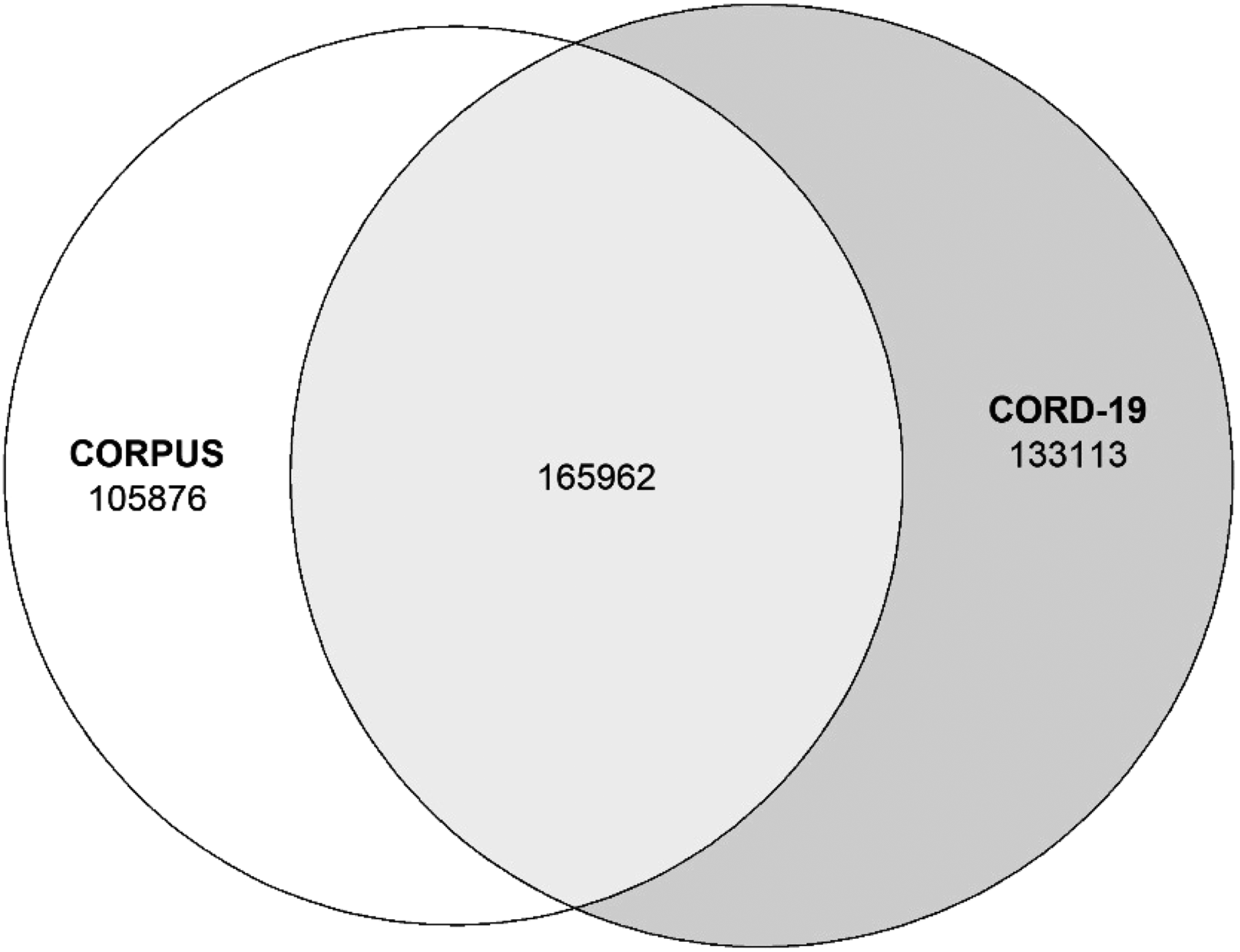
Comparison between coverage of COVID-19 Open Research Dataset (CORD-19) and coverage of our corpus of articles, reviews, and proceeding papers indexed in PubMed, Scopus, and Web of Science (WoS).
Distribution of publications among COVID-19 Open Research Dataset (CORD-19), PubMed, Scopus, and Web of Science (WoS).

Discussion
Topic evolution over time
In this work, we performed an analysis based on topic modeling on COVID-19 publications’ abstracts retrieved from PubMed, WoS, and Scopus. We identified 10 topics and studied their distribution over time. The most popular topic was “Clinical presentation”, while the less recurrent was “Literature analysis”. The temporal trend of the former remained constant after rapid growth, probably due to the need to provide an updated clinical picture of the disease. 37 The latter includes studies on COVID-19 literature and databases that increased over time as expected to grow as the pandemic progresses. Rising topics over time were also the “COVID-19 impact on mental health” and “Forecasting”.
“COVID-19 impact on mental health” started to grow in May 2020, after several countries loosened isolation measures .21,38,39 Depressive symptoms showed up in Europe, especially in women and elderly populations.20,22
“Forecasting” started its growth in October 2020; at this point, a large amount of data on COVID-19 was available and almost a 1000 models were performed and published in Scopus and WoS. 40
“Epidemiology” was increasing in the early phase when there was the need to understand how the virus spread to make decisions about distancing, mask wearing, and other prevention measures. It peaked in June 2020 when restrictions started to be less severe in several countries, like for instance New Zealand which was declared “virus-free”, and France which reopened its borders with most European countries. 16
“Telemedicine” arose in April 2020 when lockdown measures took place in many countries (e.g. China, Italy, the UK, and Spain). It comprises publications related to technology services applied as a remote monitoring tool for managing of the COVID-19 patients. 41
“COVID-19 impact on economy” grew to start from October 2021 when businesses restarted. Lockdown halted most economic activities by reducing production, consumption, and employment in most sectors. On the contrary, the pharmaceutical industry benefited considerably from the vaccine demand. 42
“Vaccine development” became immediately urgent, reflected by its rapid growth. The topic remained popular except for a slight drop between October 2020 and March 2021, coincident with the starting of vaccine administration to the population in the United States 43 and Europe. 44
“Education” suffered greatly because of restrictions. During the first lockdowns, schools were not prepared for alternative ways of learning, but later online platforms became very popular. 45
“Molecular biology” had an increasing trend justified by the appearance of new variants. 46
Related works
As we highlighted in the introduction, the massive quantity of COVID-19 publications stimulated several literature analyses. In Table 2, the main related works are reported.
Characteristics of studies that analyze COVID-19 research literature.

CORd-19, COVID-19 Open Research Dataset; DTM, Dynamic Topic Model. LDH, Latent Dirichlet Allocation; WoS, Web of Science.
Table 2 shows that LDA 47 was the most used method6,10,13,14,48 to analyze text and classify publication. STM, the method for topic modeling we used, was applied only by Ebadi et al. 12 who considered PubMed and ArXiv literature and included the month of publication to estimate the prevalence of topics using a linear relationship. Dynamic Topic Model (DTM) 49 is another approach used to analyze the change of topics in a text corpus, which has been used by Bai et al. 11 to track the evolution of topics over time in COVID-19 research.
Previous studies6,10,12–14 performed topic models using a concatenated string of titles, keywords, and abstracts of COVID-19 publications, which can be redundant and produce a bias in calculating word frequency. LDA does not allow the inclusion of information other than text, so the temporal evolution of the topics presented by Alga et al. 10 and Colavizza et al. 6 is just qualitative. On the contrary, STM has less restrictive assumptions; topic prevalence and content can be modeled, considering authors’ country, journal, and publication time.
Together with LDA, network analysis has been used often with two aims: mapping collaborations between countries and institutions8,9 which showed that the top four productive countries in the early pandemic were the United States, China, Italy, and the UK,8,9,50 and getting a term map using co-occurrence words from a set of Mesh terms, 9 UMLS terms, 15 or title, abstract, and keywords.8,50
Bibliometric analysis was performed by Colavizza et al., 6 using citation clustering and altimetric analysis to describe how the research was perceived on social media, and by Dehghanbanadaki et al., considering journals and their impact factors, citation scores, and H-index. 8
Despite the development of open search databases such as CORD-19 and LitCovid, which facilitate the extraction of COVID-19 publications with a string query already prepared, many researchers conducted their search on other sources.
The number of topics
Wang and Hong 9 identified only four topics using a co-occurrence network of MeSH Terms: epidemiology and public health interventions, virus infection and immunity, clinical symptoms and diagnosis, drug treatments, and clinical studies. Each of their topics includes several topics which are distinguished in our analysis, for example, their first two topics also included vaccine and mental health issues that we identified as different topics. Clinical symptoms and diagnosis were in the spotlight during the early stage of the pandemic; thus, the different times we collected published research could explain the dissimilarity. The drug treatment topic was barely identified in Wang and Hong 9 and did not emerge as a single topic in our analysis. We agree with Wang and Hong's conclusion that there is still little research in this area.
Colavizza et al., 6 in their analysis of CORD-19, identified 15 topics that were merged into broader categories: clinical medicine, coronavirus outbreak, epidemics, immunology, molecular biology, and public health. This overlap of the topics hints that a smaller number would probably lead to better classification. Furthermore, the topic on coronavirus outbreak refers to the broad literature on coronavirus in CORD-19 and not only to COVID-19.
Quality issues of research
Overall, 10 topics seem to be a good solution. To further support this, the results of the models we performed with 11 and 12 topics were quite similar, but the topics were not clearly defined. Interestingly we noticed that the former identified a small group of retracted articles, pointing out the quality issue of some rushed COVID-19 research. 1 In fact, one of the FREX words characterizing one topic of the model with 11 topics was “withdraw” (Supplemental Figure S1). We delved into it by isolating the publications whose probability of containing this topic was higher than all the other topics; we found 37 articles whose abstract or title were characterized by at least one of the following: “withdrawal notice”, “withdrawn”, “retraction”, and “correction” (Supplemental Table S2). Publication process was sped up during the pandemic 3 because of the need to inform the community as fast as the virus spread, but little attention was given to details 4 causing a “pandemic of publications” as well. In particular, the retraction of a study concluding that COVID-19 patients taking chloroquine or hydroxychloroquine were more likely to die and a study made a major scandal in the scientific community, 51 but also had great consequences on several randomized clinical trials which stopped administering the drug to patients and recruiting them. Quality of research is questioned also from a statistical point of view: Wynants et al. 52 reviewed the prediction models for COVID-19 and concluded that they are affected by poor reporting, high risk of bias. and optimistic performances.
Strengths and limitations
To our knowledge, our work is the first considering both publications from a 2-year range of the pandemic and with an application of STM. STM allowed the inclusion of time to compute the topic prevalence. In this way, we also modelled the topic prevalence change over time, allowing for a potential non-linear trend.
STM has been proposed to overcome LDA limitations. However, its weaknesses still need to be investigated. Interpretability is a crucial point: topics are generated from a bag of words, but the context is not considered; hence the assigned labels could be misinterpreted. It is fundamental to find the most suitable set of words used to calculate topic and document distributions, so particular attention in the preprocessing phase is needed. 53 Moreover, since citational databases include non-English publications, a more accurate algorithm for language filtering than CLD2 and CLD3 are suggested to improve the quality of the results such as the convolutional neural network model proposed in 2020 by Vo and Khoury. 54
When analyzing a vast corpus, machine learning algorithms can better understand the content than map term or graph network.
Deep learning approaches such as BERT, 55 neural networks, and their variations can be applied to the analysis of COVID-19 literature, as shown by teams who participated in the BioCreative IV challenge for the multilabel topic classification of LitCovid.56,57 Our corpus focuses on COVID-19 and includes data from several citational databases such as Scopus, PubMed, and WoS. LitCovid is daily updated and COVID-19 specific, but it is limited to PubMed data. CORD-19 is an extensive database updated once a week. However, it focuses on coronaviruses and viruses in general, making it challenging to filter COVID-19 literature, and lacks much of the research indexed in Scopus and WoS. Future development could add data from other sources and analyze the preprint articles.
Conclusions
Despite the efforts to build repositories for COVID-19 literature, several citational databases must still be searched to get complete knowledge.
This work identified the main topics in COVID-19 literature collected from several citational sources. We analyzed the temporal trend from November 2019 to December 2021, obtaining an up-to-date overview of COVID-19 research literature. In doing it, we gathered a corpus of articles, reviews, and proceeding papers that focuses on COVID-19 and are indexed on Scopus, PubMed, and Web of Science. Our corpus provides a more extensive coverage than the other repositories, such as LitCovid, which is limited to PubMed data, and CORD-19, which focuses on coronaviruses and viruses in general, making it challenging to filter COVID-19 literature, and lacks much of the research indexed in Scopus and Web of Science. Thus, our findings can help build a more focused literature search when carrying out systematic and quick reviews.
Supplemental Material
sj-docx-1-dhj-10.1177_20552076221133696 - Supplemental material for A topic trend analysis on COVID-19 literature
Supplemental material, sj-docx-1-dhj-10.1177_20552076221133696 for A topic trend analysis on COVID-19 literature by Sara Urru, Veronica Sciannameo, Corrado Lanera, Silvano Salaris, Dario Gregori and Paola Berchialla in Digital Health
Footnotes
Declaration of conflicting interests
The authors declared no potential conflicts of interest with respect to the research, authorship, and/or publication of this article.
Contributorship
Conceptualization: PB, VS, and SU; data analysis: SU; writing—original draft preparation: SU; writing—review and editing: VS, SS, CL, and PB; methodology: PB and DG; data interpretation: SU, VS, PB, and CL; supervision: PB and DG.
Ethical approval
Not applicable, because this study does not contain data on human subjects.
Funding
The author(s) disclosed receipt of the following financial support for the research, authorship, and/or publication of this article: This work was funded by the University of Turin (BERP_RILO_21_01).
Guarantor
PB.
Data availability
Data are available upon request from the corresponding author.

Supplemental material
Supplemental material for this article is available online.
References
Supplementary Material
Please find the following supplemental material available below.
For Open Access articles published under a Creative Commons License, all supplemental material carries the same license as the article it is associated with.
For non-Open Access articles published, all supplemental material carries a non-exclusive license, and permission requests for re-use of supplemental material or any part of supplemental material shall be sent directly to the copyright owner as specified in the copyright notice associated with the article.
