




Abstract
This paper examines the scientific and non-scientific influences on doctorates in South African universities by analyzing the acknowledgements in their theses. The data was extracted from 5644 PhD theses drawn from four South African universities. Using data-mining techniques, we identified sources of inspiration, targets of dedication and subjects of acknowledgement. The findings show that over 90% of doctoral candidates expressed appreciation to supervisors and other academics and colleagues, as had been found in previous research. We also found that almost half of the sample acknowledged funding agencies, which indicates the strong role of external finance. The spread of academic networks across Africa, North America and Europe was noteworthy. The findings also show the strong role of religious beliefs, as 39% of the theses acknowledged the assistance of God. The figure was as high as 51% in one of the universities and statistically significant across institutions and faculties. Religious beliefs among scientists also confirm previous research in the US, indicating that ‘scientists are still keeping the faith’.
Keywords
Introduction
The PhD research process is a very taxing engagement with ideas that form the basis for a thesis that extends the boundaries of knowledge into new areas. While the author takes responsibility for his or her thesis—a product that evolves from ideas, theories, research methods and tools in existing literature—the process also benefits immensely from the author's interactions with senior academics, colleagues, institutions, funding agencies, family and friends. Those contributors, scientific and sociocultural, are often named in the front matter of the thesis, comprising the acknowledgement, dedication and inspirational quotes.
Commonplace in academic books, research articles and dissertations, acknowledgements offer insights into the persona of the writer and the patterns of engagement that define collaboration and interdependence among scholars (Hyland, 2003; 2004). They provide an account of the scientific, social and cultural contributions to the research process. They have become an important feature of scholarly texts and are of great interest to bibliometricians seeking to trace the lines of research networks and academic cooperation (Cheng, 2012).
Acknowledgements in PhD theses have been the subject of academic research in the US (Hubbard et al., 2018), Asia (Hyland, 2004; Hyland and Tse, 2004), among native Arabic speakers (Al-Ali, 2006, 2010) and in Pakistan (Rofess and Mahmood, 2015), revealing the scientific and non-scientific influences on doctorates. Castelló et al. (2021) also examined the experiences, scholarly trajectory and networking capabilities of Spanish post-PhD researchers.
The present study examines the entire written communication in the front matter of doctoral theses (acknowledgements, inspirations and dedications) from four South African universities, combining three research traditions: bibliometrics, genre analysis, and science and society studies. The study outlines the generic structure and linguistic patterns of the acknowledgement genre, traces the lines of research networks and academic cooperation and examines the social, psychological and religious support structures drawn upon by researchers for what has been routinely described as a ‘lonely journey’. This is the first such study on South African doctoral theses, and we hope it will contribute to international literature in the field.
The acknowledgement genre
The completion of a PhD thesis can cause diverse feelings and emotions, from a profound sense of relief to elation and perhaps sadness (Hubbard et al., 2018). Graduates often feel the need to recognize the wide variety of assistance they received during the programme. The final output is often described by a metaphor that could be traced back to the 12th century and was popularized by Sir Isaac Newton: ‘If I have seen further, it is by standing on the shoulders of giants’ (Newton, 1675). Acknowledging the assistance and contributions of those ‘giants’ is now a well-established feature of the scholarly communication process, and the significance of this optional genre is confirmed by its positional prominence, by survey data and by its widespread use in a range of forums (Hyland and Tse, 2004).
Acknowledgements are neither strictly academic nor entirely personal. They stand apart from the research and they have considerable socio-pragmatic relevance, making them integral to the research output (Hyland, 2003). They offer a reconstruction of the external contributions that have gone towards the realization of the dissertation and they reflect the disciplinary proclivities and the dialogical process of academic research (Ben-Ari, 1987; Hyland, 2003). Acknowledgement, as with other genres, is at the nexus of human sense-making (Bazerman, 2010). It is characterized by substance and form (Yates and Orlikowski, 1992) and shares some communicative purpose, textual features and content (Luzon, 2005). It is the central case of Austin's ‘behabitives’, expressing perfunctorily, if not genuinely, certain feelings towards the hearer (see Bach and Harnish, 1979). Even though perfunctory acknowledgements do not express genuine feelings, they are seen as acts of courtesy and thanking. As a form, they express gratitude for having received something mutually recognized by both parties, and they satisfy a social expectation (Bach and Harnish, 1979).
The acknowledgements, dedications and inspirational quotes in the front matter form a trove of documents amenable to academic research, providing aggregable bibliometric information across universities about young researchers and their networks. The data provides evidence of collaboration patterns and funding sources. Collaboration is important for African institutions and plays a central role in knowledge creation and innovation (Katz and Martin, 1997; Lee and Bozeman, 2005). A recent study (Lutomiah, 2020) in Kenya found higher occurrences of international collaborations compared with national collaborations, and the occurrences were spread largely across the US and the UK. Taken together, co-authorship and acknowledgement data provides a robust indicator of collaboration and interdependence trends in science and scholarship. However, while multiple authorship has been extensively analyzed, acknowledgement behaviour has been benignly neglected (Cronin, 2001), particularly in African research literature; hence, this effort to contribute to the field.
As a genre, acknowledgements also record the multifarious contributions of colleagues and sundry others to the reported research and reflect a rich mix of personal, moral, financial, technical and conceptual support received from institutions, agencies, co-workers, peers, family, subjects and mentors (Cronin et al., 1993). Cronin et al. argue that these expressions of gratitude can range from ritualized genuflection in the direction of a funding body through detailed expressions of thanks to fellow researchers for sharing data sets to the sincere acknowledgement of intellectual stimulation provided by a professional peer. In the past, disciplinary variations were identified in the frequency of occurrence of acknowledgements, suggesting a continuum across the soft and the hard spectrum in which virtually all articles in the hard sciences carry an acknowledgement (Cronin et al., 1993; McCain, 1991). The present research examines the contributions of academic and non-academic colleagues and the disciplinary and institutional variations in the patterns across South African universities.
In addition to scientific, social and cultural support, Hyland (2003), in a study of MA and PhD dissertations, and Al-Ali (2006), in a study of native Arab speakers, found references to God in the front matter of the theses examined. Acknowledging God has also been identified in academic writings on the African continent. A Nigerian biochemistry student dedicated her dissertation ‘to God Almighty, the source of my life’ (Obikoya, 2010). This should not be a surprise among Africans, given that a majority of the population self-report faith in God and that confidence and trust levels in religion are as high as 86% in Zimbabwe, 89% in Ghana and 92% in Nigeria, compared with 59% in the US (Falade, 2018). However, this should be surprising among African scientists in the context of their expected role in ‘deciphering the mysteries of the natural order without recourse to supernatural aid or guidance’ (Ecklund and Long, 2011) and the expectation that, as science grows, religious beliefs and belief in magic should decline among scientists (Durkheim, 1912).
Scientists, beliefs and society
Obikoya's acknowledgement ‘to God Almighty, the source of my life’ is similar to those credited to Michael Faraday, Charles Darwin and Isaac Newton in the early stages of their careers. Newton, in the second edition of his Principia, wrote ‘this most beautiful system of the sun, the planets, and comets could only proceed from the counsel and dominion of an intelligent and powerful being’. Faraday alluded to the powers that the Creator has gifted to matter, one of which is gravitational attraction. Darwin, in his writings in Sketch and Essay, implied that the law he had found exalts the notion of an omniscient creator (Cantor, 2005; Sydow, 2005). However, those views, expressed in the 18th and early 19th centuries, changed over time in line with events outside science. Knight (2004) observed that, between the time of the French Revolution (1789) and the outbreak of the First World War (1914), public and academic promotion of ‘natural theology’ (God's mind visible in His creation) collapsed, and, at the same time, the position of organized religion was weakening all over Europe—a situation that could not all be attributed to Darwin.
For Turner (1978), the dispute between science and religion reached a crescendo in the decade following the publication of Darwin's The Origin of Species in 1859, becoming a ‘professional’ conflict for ‘authority and prestige’ rather than an academic debate. Only the rhetorical style of boundary-work by John Tyndall, which attributed selected characteristics to science that effectively demarcated it from religion or mechanics, provided a rationale for the superiority of scientists in designated intellectual and technical domains (see Gieryn, 1983). Subsequent scientists formed more radical philosophical opinions on the boundaries between science and non-science, particularly regarding religion.
Durkheim (1912) argued that religion should progressively fade as science becomes more adept at completing its tasks. Durkheim's approach has been called the ‘replacement hypothesis’ and is seen as stemming from a perceived conflict between the two ways of knowing. Luckmann (1990, 2003) disagreed, arguing that this replacement model was erroneous because ‘experiences of transcendence are a universal component of human life’. For Fuller (2010, 2011), science's progressive outlook comes from sublimating and not eliminating God. Habermas (2003, 2006) is also in disagreement with Durkheim, arguing that both the taming of religion by the rational superior equivalent model and the expropriation model, which suggests a theory of decline, are wrong. He argues that secularization is not a zero-sum game, being inconsistent with a post-secular society and a democratic common sense that remains osmotically open to both sides. He also argues that Europe appears to be moving forward alone on the path that separates religion and faith—a path formerly trodden side by side with the US.
Are scientists still keeping the faith?
Larson and Witham's (1997) commentary in Nature, titled ‘Scientists are still keeping the faith’, was a follow-up to James Leuba’s (1916) writing that progress in sciences required religious disbelief to grow among American scientists and Americans in general. Larson and Witham observed that not much has changed regarding the number of scientists with religious beliefs, as the 40% figure remained constant. They described professional science as a three-layer pyramid in which the top layer of elite scientists experiences acute disbelief, those in the middle are significantly less believing than citizens in general, and those in the bottom layer are more like the general public. A 1969 Carnegie Commission survey of 60,000 professors across almost all disciplines in the US showed that over 50% regarded themselves as religious (Stark and Finke, 2000). A more recent survey of members of the American Association for the Advancement of Science (PEW, 2009) showed that just over half of scientists (51%) believed in some form of deity or higher power. Equally important are findings of variations among disciplines, demographics and religiosity (Ecklund and Scheitle, 2007; Larson and Witham, 1999; Leuba, 1934; PEW 2009; Stark and Finke, 2000; Ecklund et al., 2019).
Scientists and religion: The coexistence approach
The idea of relationships, dependencies and harmony informs the coexistence approach. For Legare and Gelman (2008) and Legare et al. (2012), the assumption that natural and supernatural explanations are incompatible is psychologically inaccurate, and the same individuals use both types of explanation to interpret the very same events in multiple coexisting ways. In his study of the reception of psychoanalysis in France in the 1950s, Moscovici (2008) showed how the Catholic Church embraced science, a competing way of knowing, by accommodating it into religious doctrine. He described this coexistence of different modalities of knowledge as cognitive polyphasia (Moscovici and Markova, 1998). Moscovici's cognitive polyphasia is further elaborated in Falade and Bauer (2018) as comprising hierarchical and complementary relationships.
Research objectives
This study examines the front matter of PhD theses from South African universities, comprising dedications, inspirational quotations and acknowledgements, in order to:
contribute to the growing scholarship in bibliometrics and the acknowledgement genre by identifying and categorizing the individuals, groups, funding agencies and collaborating countries that are featured and how this reflects the scientific, social, cultural and economic drivers of the research process contribute to a growing body of knowledge on the beliefs of scientists across academic disciplines.
Specific research questions are tailored to address these objectives using quantitative and qualitative approaches.
Quantitative analysis
The quantitative approach examines the occurrence, in numbers, of the scientific and non-scientific influences on doctorates, guided by past research in the fields of bibliometrics (Ben-Ari, 1987; Cronin et al., 1993; Hyland, 2003; Hyland and Tse, 2004; McCain, 1991) and science, beliefs and society studies (Al-Ali, 2006; Larson and Witham, 1999; PEW 2009), and asking the following questions: Research question 1 (RQ1): Who were the subjects with sociocultural, economic and scientific influences that were cited in the front matter? In which countries were the collaborating institutions found, and what was the distribution of those influences among the doctorates, faculties and institutions?
Research question 2 (RQ2): How many doctorates acknowledged God and how did the percentages vary across universities and academic disciplines?
Qualitative analysis
The qualitative approach examines the related textual material, the conversations around the themes (Attride-Stirling, 2001) and the numbers in RQ1 and RQ2. The approach follows that of previous research in the field, elaborating on the who, what, why and how of social knowledge. It provides more information on the roles assigned to God and other social and economic actors, and how they influenced the doctorates (Al-Ali, 2006; 2010; Larson and Witham, 1999; Mohammadi, 2013; PEW 2009; Rofess and Mahmood, 2015).
Research question 3 (RQ3): What were the scientific, sociocultural and economic roles assigned to the subjects in RQ1 and to God in RQ2?
Research methods
Sampling procedure
Four universities were selected for the study and, for anonymity purposes, will subsequently be referred to as A, B, C and D. Data was obtained from the database of the Centre for Research on Evaluation, Science and Technology (CREST) at Stellenbosch University. CREST warehouses the uniform resource locators (URLs) of PhD theses from many South African universities. The choice of institution was informed by the availability of working URLs and the spread of institutions across South Africa. All working URLs for one of the universities in the database were used, while for others, we used every other article (odd or even numbers) with working links. The corpus of 5644 theses spanned the years from 1934 to 2018. Theses from University A (1254) were from 1934 to 2015; those from University B (1685) were from 1999 to 2018; those from University C (1143) were from 2000 to 2017; and those from University D (1562) were from 2000 to 2018 (Table 1). University A, the pilot project, was coded only for the acknowledgement of God in the front matter. The entire front matter for the theses from the other universities was uploaded to data-mining software.
Number of theses per year from all universities.
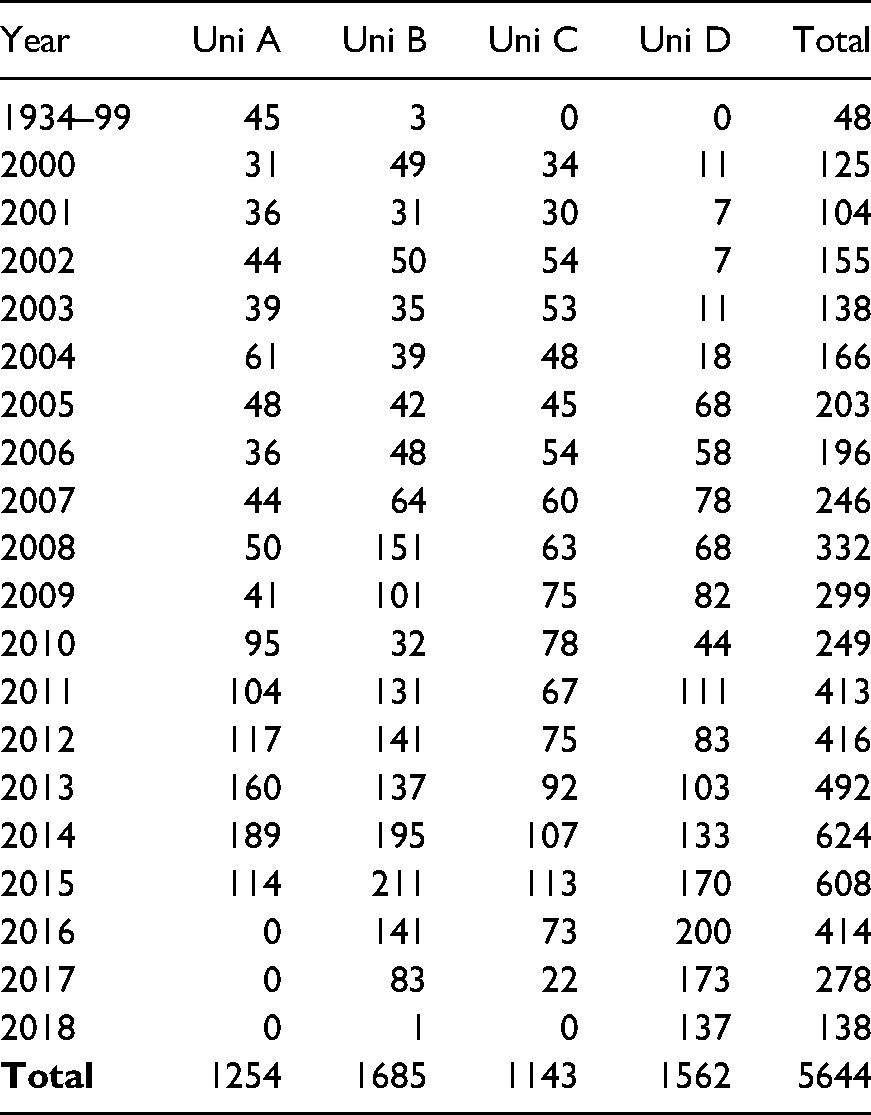
Number of theses per year from all universities.
A near uniform categorization, reducing the number of faculties to five, was adopted for anonymity and to meet ethical requirements. One of the universities could only be categorized into four faculties, because science and engineering were grouped together. The categorizations are Law, Economics and Commerce; Medicine and Health Sciences; Agriculture and Engineering; Humanities; and Science. We also note that the departments in each faculty vary slightly. We worked to reduce the effect by separating the analysis of universities and by not making assumptions of uniformity.
Giannoni (2002) developed a typology of moves and steps, identifying a two-tier structure of main move and introductory move. Rattan (2014) enumerated a typology citing existing literature in the field to include access support, financial support, moral support, technical support, peer interactive communication support, clerical support, editorial and linguistic support, and unclassified support. Hyland's (2003, 2004) typology was adopted by other researchers in this field. He used three main categories: reflecting move, thanking move and announcing move. Thanking was further coded as thanking participants, thanking for academic assistance, thanking for resources and thanking for moral support. Announcing was split into accepting responsibility and dedication. Hyland's typology was modified by subsequent authors to cope with the coding requirements of different cultural contexts (see Cheng, 2012; Zhao and Jiang, 2010; Rofess and Mahmood, 2015; Chan, 2015; Al-Ali, 2010; Mohammadi, 2013). Al-Ali (2010) added a section called ‘opening’, focusing on Qur’anic verses, prophetic sayings, prayers of the Prophet and invocations. Al-Ali's ‘opening’ and its focus on the beliefs of Muslims was also adopted in Rofess and Mahmood’s (2015) study of Pakistani doctoral thesis acknowledgements.
For this paper, we also adopted a modified approach by examining the entire front matter comprising dedications, inspirational quotations and acknowledgement sections and used a code to accommodate religious beliefs as in Al-Ali (2010) and Rofess and Mahmood (2015). The modification adopted for this paper combined the approach of Hyland (2003; 2004) with the Attride-Stirling (2001) bottom-up thematic network approach, thereby organizing the analysis into three levels (Table 2):
The global theme, defined as the entire front matter or the non-scientific thoughts as separate from the scientific content of the theses. The three organizing themes: inspiration, dedication and acknowledgement. The basic themes comprising the components of the organizing themes.
Thematic structure for data analysis.
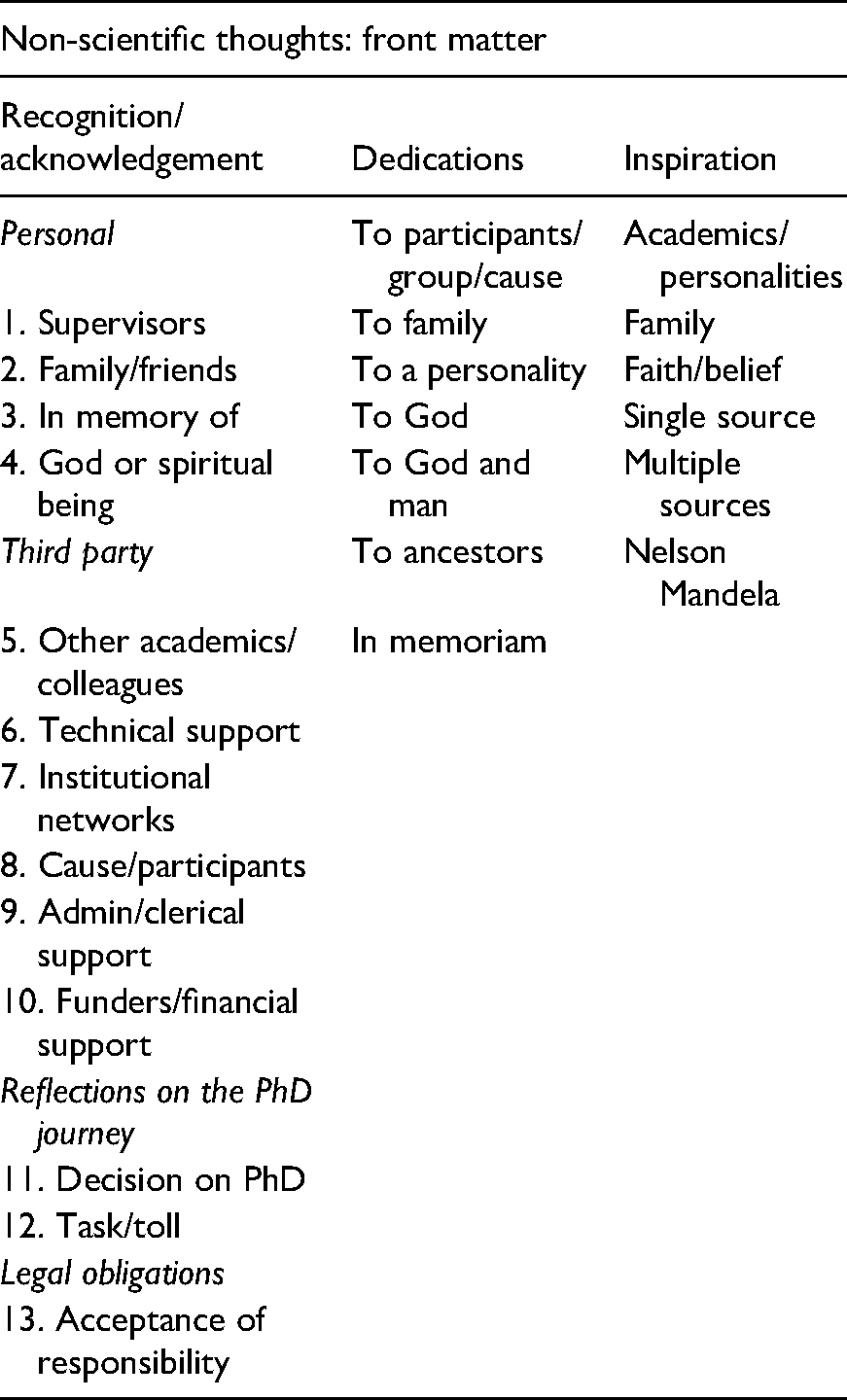
Thematic structure for data analysis.
The acknowledgement was grouped into 13 themes. Dedications had seven themes, and inspiration had six themes.
The traditional content analysis cost–benefit approach (Krippendorff, 2018) was aided by computerized coding using the WordStat function of QDA Miner, which is data-mining software. The user-defined dictionary (UDD) approach for data mining was used for the quantitative analysis in RQ1 and RQ2 due to its advantages in accuracy, speed and replicability over manual coding. UDD is also simpler to use compared with supervised machine learning, which requires complex algorithms to mimic human coders and advanced statistics to summarize model performance (Grimmer and Stewart, 2013; Iliev et al., 2015; Seale, 2016; Falade et al., 2019). Data from RQ2 was transferred to SPSS for further analysis, leading to logistic regression modelling to analyse the differences in the percentages observed across universities and disciplines. For RQ3, the Keyword-in-Context function of the WordStat program was used to identify the basic themes and to select examples for the discussion of the roles assigned to the subjects in RQ1 and to God in RQ2.
Dictionaries were created in QDA Miner for the first 10 themes under acknowledgement in Table 2. The themes were pilot tested using the Keyword-in-Context menu of WordStat for the reliability of selection. For the theme ‘God’, for example, the keywords used were Alhamdulillah, Allah, Almighty, Apostolic, Beneficent, Bible, Christ, Church, Creator, Glory, God, Heaven, Heavenly, Imam, Jehovah, Jesus, King of Kings, Lord, Pastor, Pastoral, Pastors, Prayers, Quran, Saviour, Soli Deo Gloria and Stay Blessed. We used Microsoft Excel to perform pilot manual coding for the theme ‘God’ for all the universities, returning 36.5%. The WordStat function in QDA Miner software produced a result of 38.6%, which is a reasonable percentage agreement for the computerized analysis of big data and an indication of the reliability of the measures (Bauer, 2000; Krippendorff, 2018; Perreault and Leigh, 1989).
Findings: Quantitative analysis
The quantitative approach, guided by past bibliometric research, examined the numerical occurrence of the scientific and non-scientific influences on doctorates.
Table 3 shows the frequency distribution of the appearance of themes/subjects by the number of theses for universities B, C and D. University A, the pilot project, was coded only for the presence or absence of mention of God (see Table 4). Thanking the supervisor appeared in about 81.7% of cases in all three universities, with slight variations (some theses did not include an acknowledgement in the front matter).
Percentage distribution of support structures across universities B, C and D (N = 4390) .
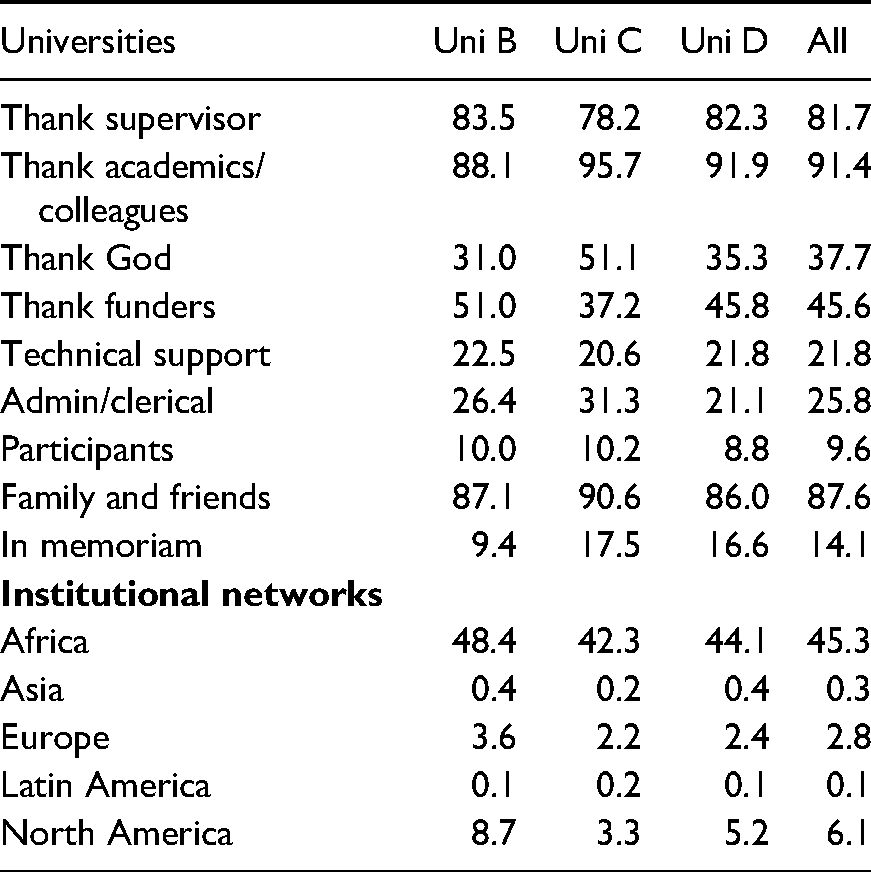
Percentage distribution of support structures across universities B, C and D (N = 4390) .
Percentage distribution of expressions of God for universities and faculties.
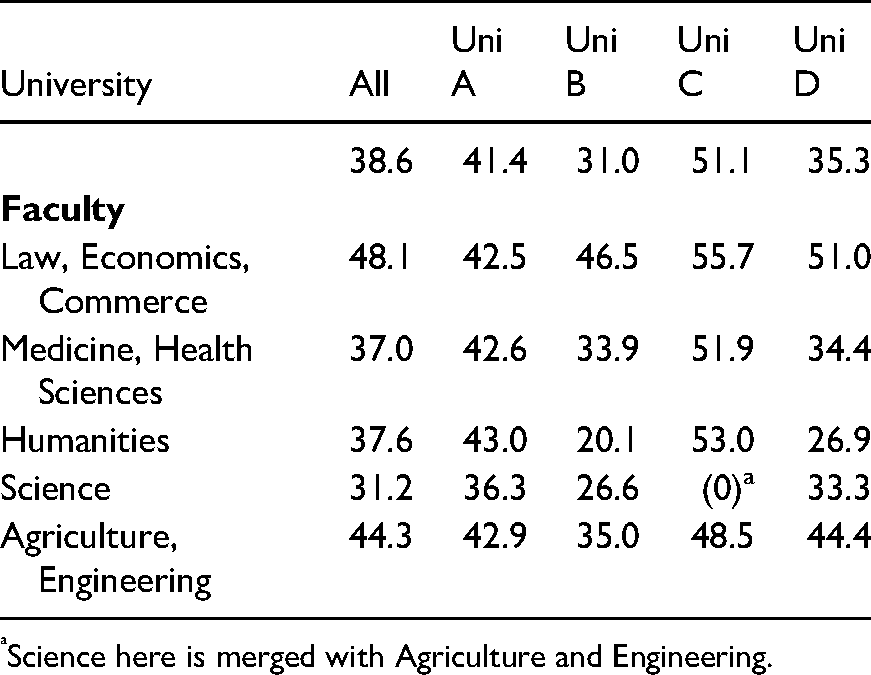
Science here is merged with Agriculture and Engineering.
The top three thanking themes were supervisors, colleagues, and family and friends. The percentages of thanking academics and colleagues across the institutions may have benefited from the inclusion of academic titles (Professor and Dr). The findings indicate the relative importance of expressing appreciation to these support structures by the doctorates. About 46% of the doctorates from universities B, C and D acknowledged funding agencies, and about 37.7% acknowledged God.
The academic network category reflects the doctorates’ research links with other universities in Africa and other parts of the world. This would have arisen through collaborations regarding data analysis, equipment fabrication, chemical and other analysis, and research visits. We created a dictionary for universities in Africa, Asia, Europe, North America and Latin America using a list of the top 200 universities from the IREG Observatory on Academic Ranking and Excellence (https://www.4icu.org). Apart from African universities acknowledged in about half of cases (Table 3), which may also indicate the students’ home universities, North America was the highest for University B, followed by Europe. The trend was similar for universities D and C. There is also evidence of more networks with Asian universities than with Latin American universities.
The statistical significance of the observed differences was tested using logistic regression modelling. The model used universities A (1254), B (1685) and D (1562), making a total of 4501 cases. Using the simple contrast function of logistic regression in SPSS, the output shows significant differences when universities B and D are compared with A (Table 5). Model B also shows that the significance for the universities remains unchanged when faculty is controlled for. This is also an improvement on Model A, given the increase in R square and the decrease in − 2 log-likelihood.
Logistic regression model outputs comparing universities and faculties.
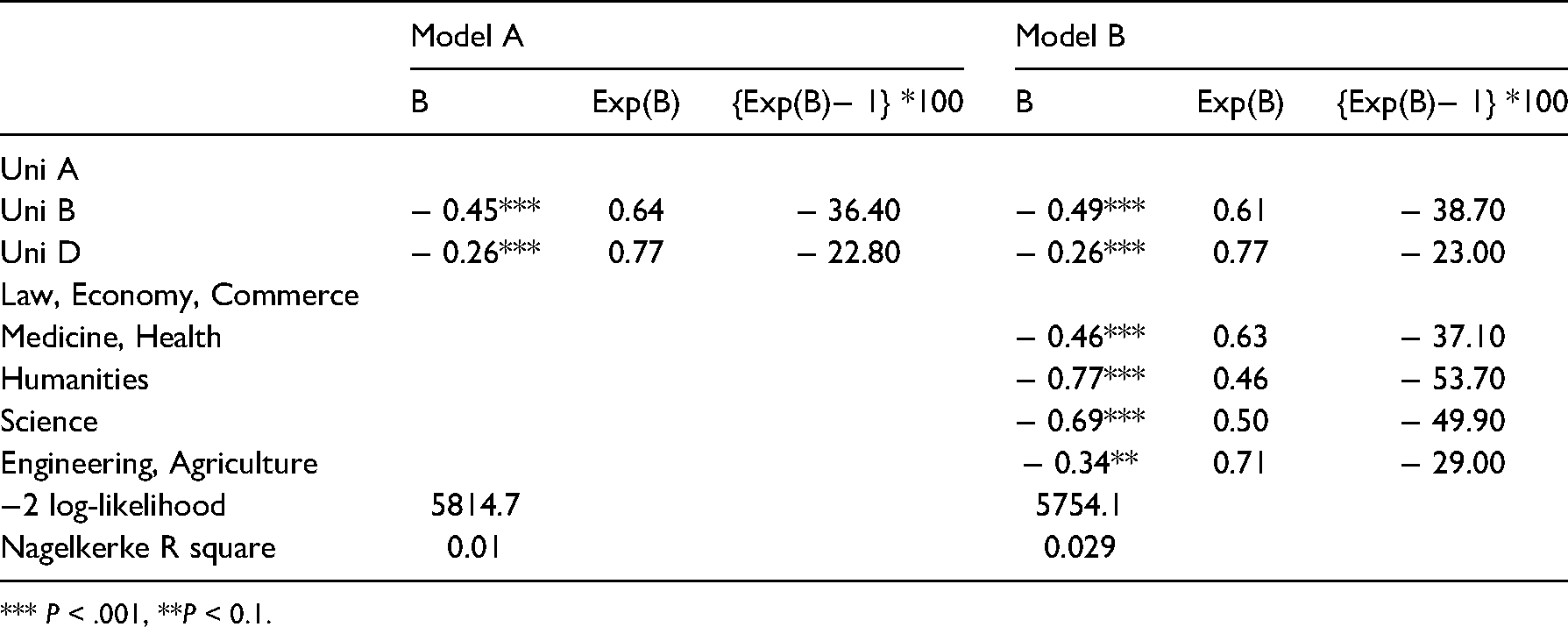
*** P < .001, **P < 0.1.
The significance of the field-specific differences is in line with findings in the US on American scientists by Ecklund and Scheitle (2007), PEW (2009), Stark and Finke (2000), Larson and Witham (1999) and Leuba (1934). Survey research is needed to show the influence of demographic factors such as age, marital status and beliefs among senior scientists.
The qualitative approach examines the conversations on the themes and the numbers and provides more information on the roles assigned to God and other social and economic actors and how they influenced the doctorates.
The PhD programme was variously described as a ‘long and lonely research journey’, ‘learning journey’, ‘earthly journey’, ‘long and tough journey’ and ‘wondrous journey’, among others. An excited doctoral candidate wrote, ‘When I started this PhD, I expected an exciting journey, and I was not disappointed!’ Many doctoral candidates acknowledged that they were not alone and had support from their supervisors, colleagues, religious institutions, friends and family to help them weather the many storms along the way. Some doctoral candidates found inspiration in literature, poetry, plays, scripture, notable scientists and political personalities. Sources referenced for inspiration included Plato, Albert Einstein, Isaac Newton, Nelson Mandela, Louis Pasteur, Marie Curie, Descartes, William Shakespeare, Ludwig Wittgenstein, Michel Foucault, Niccolò Machiavelli, Thirukkuṛaḷ, Martin Luther King Jr, Stephen Jay Gould, Isaac Asimov, Baba Dioum, Sigmund Freud and Winston Churchill.
Organizing theme: Acknowledgement
Thanking move: supervisors
Virtually all doctoral candidates expressed gratitude to their supervisors using glowing and often emotional phrases such as ‘he is an incredible supervisor’ and ‘it was a blessing to have philosophers of your calibre’. A doctoral candidate thanked the supervisor ‘for taking care of my academic, social and emotional needs’, and another said, ‘He has supported my work through thick and thin, and his endless enthusiasm and commitment go far beyond the norm.’ A doctoral candidate from Law, Economics and Commerce described the supervisor as ‘the ultimate [in] training and motivation. He trained me to think rigorously, calculate carefully and write-up clearly … motivated me in a number of ways, for instance, bedtime stories “you can do this”, nightmares “why did you do this” and wakeup calls “you have to do this”.’
Thanking move: family and friends
The doctoral candidates recognized the role of their parents in their upbringing and education. They were also appreciative of their spouses, children and friends, who, like parents, contributed the often-needed emotional support as the thesis progressed. For example, a doctoral candidate from Health Sciences wrote: ‘I would especially like to thank my wife … for unflagging support, love, encouragement and proofreading. And thanks to …[son], who arrived unplanned during the final stages of a thesis about planning and put it all in perspective.’
Posthumous acknowledgement
Some doctoral candidates acknowledged the contributions of some individuals posthumously. Some mentioned supervisors who passed away before the study was completed, while others remembered family and friends who had died. A doctoral candidate wrote: ‘I feel a deep sense of obligation to Professor … he was generous with his supportive guidance and valuable advice … Sadly, he passed away far too soon.’
Thanking move: God or spiritual being
The finding that many scientists recognized the contribution of God through prayers is interesting. This was true of the Abrahamic religions and of other beliefs. The words and phrases used served two broad functions: the ‘who’, which identifies a supreme being as contributing to the successful completion of the thesis, and the ‘how’, which also specifies the role played. The ‘who’ phrases used included God, Allah, Heavenly Father, Almighty God and Jesus Christ. The ‘how’ words included strength, wisdom, health, perseverance and faith.
Moscovici's cognitive polyphasia provides a theoretical elaboration of the role of beliefs in doctoral research. In what was presented as a coexistence but hierarchical relationship (Falade and Bauer, 2018), one of the doctoral candidates started the acknowledgement section by thanking God: ‘Firstly, I want to thank the Creator of the Universe—Allah for granting me the necessary qualities and mental strength to complete this study.’ Others, such as a candidate from the same faculty group, waited until the end of the acknowledgement section: ‘Finally, but most importantly, I give glory to the almighty God, for thus far he has taken me.’ For both doctoral candidates, God was acknowledged as the most important influence on the research process. For others in the hierarchical approach, the whole process would have been impossible without the grace of God. For example, a candidate from Health Sciences wrote: ‘With great humility and respect, I would like to thank the almighty God for granting me the energy, motivation, patience … Without His grace, mercies, protection and guidance, all this would not have been possible.’
Thanking move: other academics and colleagues
Doctoral candidates acknowledged the contribution of co-supervisors and other academics who contributed to the knowledge-creation process and their fellow doctoral candidates. A doctoral candidate from the Sciences wrote: ‘I would like to thank my co-supervisor (…) for her contribution and support during my PhD studies. My very sincere thanks to Dr (…) and Dr (…) for their friendship, mentorship, selfless support and generous care. I have learnt a lot from them, and I enjoyed working with them. In them, I have found a brother and a sister. I would like to thank my colleagues and friends … for their help and encouragement.’
Thanking move: technical support/institutional networks
Some doctoral candidates showed the extent of collaboration within the university, with other universities in South Africa, with others in Africa and with partners outside the continent. They revealed the linkages that contributed to the technical and other aspects of their theses, including equipment fabrication and use, data analysis, chemical analysis and the design of experiments. A doctoral candidate from Health Sciences wrote: ‘Thanks go to … Head of Anatomical Pathology … for supervising and training me on how to interpret kidney histology and immunohistochemistry slides. To … Head of Surgery … for training me to acquire microsurgical skills. To the Head of Medical Virology … for performing VCP immunostaining.’
Thanking move: cause/participants
This category thanked those who volunteered as participants in interviews, focus groups, surveys and other data-gathering efforts. A doctoral candidate from Law, Economics and Commerce wrote: ‘Appreciation goes to members of the households visited, who … responded to numerous questions, some of which touched on sensitive issues … Without their trust and generosity, this study would never have seen the light of day.’
Thanking move: administration and clerical
The assistance of administrators was required to secure access to resources for experiments, travel and finance. Towards the final writing and submission, assistance was also sourced for translation, editing, proofreading and formatting. A doctoral candidate expressed thanks for the ‘improvement of language as well as punctuation, style, consistency, etc.’
Thanking move: funding agencies
Several funding agencies in Africa and abroad were acknowledged for their contributions to the research process. They included the National Research Foundation (NRF) of South Africa, the Bill and Melinda Gates Foundation and the African Economic Research Consortium.
Reflecting move: reflections on the PhD journey
The acknowledgement theme was used by doctoral candidates to reflect on the PhD journey—why it was embarked upon and the toll on self, family and friends. A doctoral candidate from Health Sciences attributed the journey to that of a dreamer in search of greatness, quoting Harriet Tubman, an African-American abolitionist: ‘Every great dream begins with a dreamer. Always remember, you have within you the strength, the patience, and the passion to reach for the stars to change the world.’
The process was, however, not without pain. A doctoral candidate wrote that he felt like abandoning the journey: ‘I was wondering if it is all worth it.’ A Health Sciences doctoral candidate said the thesis was ‘written in blood, sweat, tears, and occasionally coffee’. The journey also took its toll on spouses and family: ‘You can have me back now!’ a delighted spouse in Health Sciences wrote.
The end of the journey was summed up by a quote (anonymous) referenced by a doctoral candidate: ‘Look not upon a man in his hour of triumph, and say it was luck that has brought this, for no man can see or anyone guess the agony by which it was achieved while other men slept.’
Legal obligations
Doctoral candidates also absolved all those who contributed to the making of their theses of responsibility for any errors in the final document. This is mandatory for most research processes. A candidate from Agriculture and Engineering wrote: ‘Opinions expressed in this work, or conclusions arrived at, are those of the author and are not necessarily to be attributed to the …[funders].’
Organizing theme: Sources of inspiration
Personalities and scientists
Some doctoral candidates found inspiration in Nelson Mandela, the former South African President and an icon of the anti-apartheid struggle, with the quotes, ‘It always seems impossible until it's done’ and ‘After climbing a great hill, one only finds that there are many more hills to climb’, both of which are indicators of the nature of the research process. Others found inspiration in the works of renowned scientists, writers and personalities. A doctoral candidate in Agriculture and Engineering quoted Einstein: ‘If we knew what it was we were doing, it would not be called research, would it?’
Others cited literature and philosophy. A doctoral candidate from the Health Sciences found inspiration in William Shakespeare:
Another doctoral candidate from Law, Economics and Commerce quoted Niccolò Machiavelli: I liken her [the stock market] to one of these violent rivers, which, when they become enraged, flood the plains, ruin the trees and the buildings, lift earth from this part, drop in another; each person flees before them.
—Niccolò Machiavelli, The Prince
Multiple sources of inspiration
Inspiration, as an organizing theme, provided further evidence of cognitive polyphasia, as some doctoral candidates credited multiple sources (scientists, God and notable personalities) for inspiration in what appear as parallel forms (Falade and Bauer, 2018).
A doctoral candidate from Medicine and Health Sciences quoted the Bible, a renowned scientist and a renowned personality: For by Jesus, all things were created, in heaven and on earth, visible and invisible …
—Colossians 1: 16–17
The more I study nature, the more I am amazed at the work of the Creator.
—Louis Pasteur
We live on an island surrounded by a sea of ignorance. As our island of knowledge grows, so does the shore of our ignorance.
—John Archibald Wheeler
Organizing theme: Dedication
The front matter on dedications was equally revealing in its content and in the level of appreciation accorded to those mentioned. The subjects were living and deceased family members, personalities and academics. There were also dedications to social causes, such as mine workers and those living with HIV, but those subjects were not necessarily in academic fields. As in the inspiration theme, there were single and multiple dedications. A doctoral candidate from Law, Economics and Commerce dedicated the thesis to the subjects of his study: ‘all the spinal cord-injured mineworkers following underground or surface mine accidents’. A doctoral candidate from Agriculture and Engineering dedicated the thesis to the girls captured by extremists in northern Nigeria: ‘to the safe arrival of Nigerian Chibok girls’.
Conclusions
Academic writings reveal the persona of the writer, and the acknowledgement genre from the four universities studied here offers a reconstruction of the external contributions and personal sacrifices involved in the research process. The academic and sociocultural influences identified in this study align with findings from previous research: Most doctoral candidates thanked their supervisors, other academics, colleagues and subjects who participated in various experiments. The present study also highlights the importance of finance, as 46% of the sample acknowledged funding of some sort, including a figure higher than half in one of the universities. Institutional networks also indicate the uniqueness of the genre in bibliometric studies of doctorates, showing a spread across Africa and with the largest links to North America, followed by Europe and lesser collaboration with universities in Asia and Latin America.
About 39% of young scientists in South African universities acknowledged the hand of God in the research process, and that figure rose above 50% in one of the universities. These numbers are close to those found among American scientists by Larson and Witham (1997) and among scientists across the world (Ecklund et al., 2019). The study confirms Ecklund and Long’s (2011) perspective that religious beliefs continue to exist, even among scientists, despite expectations that scientists should be above supernatural guidance. Therefore, the ‘conflict’ narrative remains a topic of debate and an empirical issue. Some scientists placed God first, above science, in a hierarchical thanking move, while others were not so explicit about the position of their faith, but they acknowledged support from a supreme being in a complementary thanking move.
These findings are based on secondary data, which has limitations when compared with direct surveys of scientists. The percentages observed are also for a subsection of scientists (that is, doctoral candidates), necessitating contextualizing with other studies that follow scientists from graduation to future collaborations and co-authorships to the top layer of elite scientists.
This pioneering study will, we hope, act as a baseline and spur further interest in the relationship between science and beliefs among African scientists and across the three-layer pyramid structure of young, middle and elite.
Footnotes
Acknowledgements
This work is based on research supported by the South African Research Chairs Initiative of the Department of Science and Technology (DST) and the National Research Foundation (NRF) of South Africa (Grant number 93097). Special thanks to Professor Johann Mouton, Director of the DSI-NRF Centre of Excellence for Scientometrics and STI Policy and Professor in CREST for his insightful comments on earlier drafts and to our colleague, Dr Colia Meyer, who was involved in the initial data analysis. Special thanks also to Kyle Ford of CREST for his excellent work with the URL database.
Declaration of conflicting interests
The authors declared no potential conflicts of interest with respect to the research, authorship and/or publication of this article.
Funding
This work is supported by the South African Research Chairs Initiative of the Department of Science and Technology and the National Research Foundation (NRF) of South Africa (Grant number 93097). Any opinion, finding, conclusion, or recommendation expressed in this material is that of the authors, and the NRF does not accept any liability in this regard. The study (Project number 14900) was approved by the Research Ethics Committee: Social, Behavioural and Education Research of Stellenbosch University.

Data availability
The data used for the paper is available on request from the corresponding author or from the Centre for Research on Evaluation, Science and Technology (CREST), Faculty of Arts and Social Sciences, Stellenbosch University, South Africa.