




Abstract
China's social development strategy has evidently shifted from a focus on economic growth and material sustenance to balanced development and the enrichment of cultural and spiritual resources. In other words, Chinese society has transformed from a phase seeking rapid development to one seeking steady and all-round development. China's science popularization since the founding of the People's Republic of China has been focusing on the immediacy and timeliness of science communication but, in its current efforts to build a new science culture, it is more concerned with the cultivation of scientific values and the quality of persistence. In this era that upholds science culture, the mission of both science popularization and science culture is to make science go beyond the scientific community and to develop values and practice paths that support the public's pursuit of a better life. For that purpose, this paper proposes five projects based on the action network of science culture construction: fostering scientific spirit; disseminating science culture; institutionalizing science culture; science culture infrastructure for public benefits; and public engagement with science.
From science popularization to science culture construction
In contemporary China, the transition from the phase of science popularization to the development of a science culture is in line with the general background of China's transformation in social and economic development patterns. The report of the 19th National Congress of the Communist Party of China convened in October 2017 stated clearly that the principal contradiction facing Chinese society has shifted from that existing between the ever-growing material and cultural needs of the people and the backwardness of social production to one that exists between unbalanced and inadequate development and the people's ever-growing needs for a better life. This declaration is indicative of a strategic shift within Chinese society from the prioritization of economic growth and material sustenance to an emphasis on balanced development and the enrichment of cultural and spiritual resources.
Science popularization is a kind of verbal and interactive communication that emphasizes immediacy and timeliness, while cultural development stresses persistence in a long-term process.
There are several understandings about China's science culture construction. First, big data is making the world more open and energetic. It is a requirement for China's traditional industries to embrace the ‘Internet plus’ initiative for better development. Second, China's recent policy initiatives relating to crowdfunding, crowd innovation, crowd-sourcing and crowd support have provided new options for establishing open, multidisci-plinary and cross-sectoral collaborations. They have, together with Web 2.0 and above technologies and advances in artificial intelligence, created new insights and action options for the endeavours of public understanding of science and science communication. The application of new cross-sectoral technologies and platforms in manufacturing, services and even people's daily lives marks the beginning of a new era of human civilization.
Over the past several years, the Chinese Government has introduced a series of new guidelines and models. Compared to previous ones, they place greater emphasis on long-term persistence, balance and diversity. These changes relate not only to existing issues in China, such as overcapacity and excessive infrastructure accumulated over the years, but also to ecological constraints, the complexity of cultural values and widening gaps in wealth. A historical survey of developed societies over almost a century shows that they have all experienced a pattern of social, scientific, technological and economic development, from rapid development focusing on the achievement of specific short-term goals to slowerpaced development focusing on the achievement of medium- and long-term goals. This pattern has been observed in the United States, Japan and European countries.
A question that arises is: in which areas will efforts be focused during the phase of slowerpaced development in China? Whereas the faster phase has been geared towards the production and utilization of hardware such as products, equipment and infrastructure, and the development of land and natural resources, the emphasis during the slower phase will be on software, such as structures, mechanisms, culture and spiritual life. During the faster phase, the gap between software and hardware tends to widen because resources and efforts are focused on hardware development, while projects focusing on software are relegated to secondary roles of coordination and support. There are positive and negative examples of countries that have made both successful and less successful efforts to advance their status from developing to developed countries.
It is important for a country to slow down its pace after undergoing a phase of rapid development and to foster a quality of persistence. Persistence is a requirement in the construction of foundational projects that need continuous long-term efforts. At a prominent national science and technology conference in May 2016, when speaking of China's innovation-driven development strategy in science popularization, Xi Jinping emphasized that ‘technological innovation and science popularization are the two wings of innovation-driven development, and it is important to put science popularization in the same important position as technological innovation.’ This comment shows that science popularization, which is the soft side in scientific research, is becoming increasingly important in China's development and that China has high expectations for the development of the soft side.
In recent years, many science popularization researchers and practitioners have found that the concept of science popularization and related practices are too narrowly defined. Some people have begun to advocate science dissemination and divide it into several developmental stages, with reference to the Western model; some others believe that science dissemination alone is not sufficient and that it is necessary to develop a science culture.
There are three concepts involved here: science popularization, science dissemination and science culture. Some researchers and practitioners have proposed replacing science popularization with science dissemination or science culture. Although that proposal is not necessarily a practical option at present, it reflects an expectation for a transformation from science popularization to science culture construction.
The traditional framework of science popularization, which entails a non-interactive process in which science is disseminated by active communicators to passive audiences, is incompatible with the spirit of open innovation that currently prevails. In the contemporary world, in which the engagement of various participants is emphasized, the traditional framework can no longer meet people's needs to learn, use, enjoy and engage in science. New service platforms should inspire people's love for science and encourage their use of science instead of regarding them as passive audiences for scientific knowledge, methods and spirit.
Facing new conditions, in China's efforts to reconstruct the pathways of science popularization, dissemination and science culture, it is important to adapt to the new mainstream value of open innovation. A question that merits a response is whether the initiatives centring on ‘crowdfunding, crowd innovation, crowdsourcing, and crowd support’ as well as ‘mass innovation and entrepreneur-ship’ imply the mainstream values of science. The answer to that question is clearly affirmative. The ‘Internet plus’ initiative is also aligned with those mainstream values. Therefore, to integrate those values with science culture is a key role for the culture to play. Culture is about concepts and ideas, so the establishment of scientific values is more important in science culture construction than in science popularization and dissemination.
Traditional science popularization focuses on the supply of scientific knowledge by the scientific community to the general public through a one-way process that is based on the assumption that scientists and engineers represent the authority of science and technology, and that the general public is not sufficiently well versed in those aspects to interact with them. This arrogant assumption has become increasingly tenuous, as science is no longer considered an exclusive endeavour of the scientific community. Therefore, it is a requirement of the new era that science culture construction should not be confined to the small scientific community. Advances in science and technology need the efforts of all people and should benefit all people.
The new science culture is different from the traditional one, which mostly involves the institutional culture, norms and values of the scientific community. It can be understood in three dimensions. First, it represents the spirit and philosophy of the scientific community. This is the traditional understanding of a science culture that has been propounded in the earliest Western theories. Second, it is a cultural form that extends beyond the sphere of science and technology. Third, it provides the institutional environment and social atmosphere that support and regulate scientific activities.
Proposals for science culture construction
This study reaches the conclusion that science culture is a by-product of the production of scientific knowledge and methods. The key task in developing a science culture is to build a network of actors, because science culture concerns not only the scientific community but also the political, economic, social and educational communities, as well as other actors and stakeholders.
Figure 1 depicts the action network for science culture construction. The block on the left side shows the different actors; the central block shows the supporting system, which includes values, institutional regulations, material elements and activities; and the block on the right side shows the action proposals involving five projects: fostering scientific spirit; disseminating science culture; institutionalizing science culture; science culture infrastructure for public benefits; and public engagement with science.
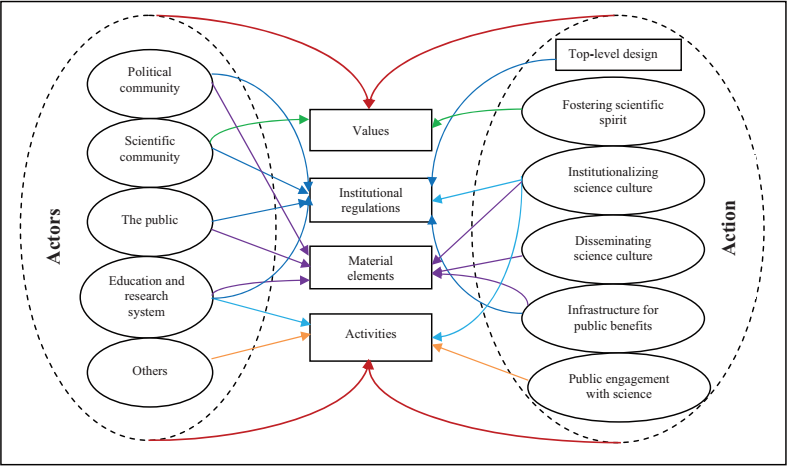
The action network for science culture construction
Amid growing interest in indigenous innovations and concerns about academic malpractice, the Chinese public has expressed increasingly strong dissatisfaction with the country's scientific community.
Specifically, the public is dissatisfied with the insignificant presence of indigenous innovations. Some people have even expressed their doubts about the innovative ability of academic institutions. Another issue that has raised public anxiety and indignation is the increasing incidence of malpractice within the academic community. The public's increasing dissatisfaction is starting to have a negative effect on the image of the traditional scientific community and on its work.
To accomplish the task of developing a science culture in contemporary China in the face of increasing doubts concerning the academic community and the challenges facing it, I think we should first extract the cultural gene from the traditional culture that can be used to explain the connotations of contemporary science culture. The cultural gene implied in China's current innovation-driven development strategy and its drive to build a modern nation is significantly different from China's traditional culture. To promote the scientific spirit of the Chinese nation, instead of merely that of its scientists and engineers, it is very important to extract some excellent core values from traditional Chinese culture and integrate them with the mainstream scientific values of contemporary society. There is still a long way to go in this regard.
Disseminating science culture
We should make efforts in three dimensions of science culture dissemination. First, improve the policy system relating to dissemination. Second, adopt a new approach that encourages diversification of the actors involved in culture dissemination. Third, accelerate and prioritize the development of visual products that appeal to the general public.
Improve the policy system relating to science culture dissemination
The policy system concerning the dissemination of science culture includes related laws and regulations. One example is China's Science Popularization Law of 2002, which made China the first country to enact a law dedicated to science popularization. However, almost two decades after its enactment, the law remains unaccompanied by detailed implementation rules, despite futile attempts and proposals to draft and adopt such rules as national laws. Consequently, in the absence of detailed implementation rules, the Science Popularization Law with its general principles and guidelines cannot be actualized by actors engaged in science popularization at the grassroots level.
It is important to ensure that an accountability mechanism is introduced in alignment with efforts to promote science culture, because disjunctures existing between the scientific community and the media (especially the new media) seem to have caused scientists' worries about inaccuracies and serious mistakes in communication. The findings of a national survey of the Chinese scientific community indicated that widespread hesitation prevails among research institutions regarding the sharing of their latest discoveries with the media because of the fear that inaccurate reporting could lead to misunderstandings and other undesirable consequences. This often leads to a significant time lag in the broadcasting of science-related news. However, it is also important to take punitive measures against those who fabricate or distort scientific information and to strengthen the development of a review system of scientific information dissemination.
Diversify the actors involved in disseminating science culture
Disseminating science culture entails broad-based participation of actors to include not only relevant government agencies and research institutions but also actors from the wider society. There are three ways to accomplish this goal.
First, establish an official dissemination system that serves as the guiding force and authority, and encourage other organizations' engagement with science culture dissemination in an attempt to form a diversified and coordinated system. For example, Guokr is a non-governmental popular science organization that has millions of fans in China. There is a proposal that 100 organizations like Guokr would significantly advance China's science popularization. Guokr exemplifies the important role that non-governmental organizations can play in the dissemination of scientific knowledge and the promotion of science culture.
Second, continue to support the development of traditional popular science media such as newspapers, magazines, books, radio and TV programmes, and encourage new media operators to develop and promote popular science products based on new media. The traditional media are inclusive and rich in resources that have been accumulated over a long period. Policymakers should introduce supportive policies rather than relegating traditional media to the sidelines because of the emergence of new technologies.
Third, encourage the effective use of new media by all of the actors concerned, including the government, the scientific community and non-governmental organizations, so as to create an interactive mechanism to increase the public's engagement with science and its ability to communicate through digital media. Science should go beyond the scientific community and step into a new open era. In other words, science should not be confined to research institutions, universities and industries. Scientific results should be widely spread and benefit the general public, rather than being selectively promoted by researchers. This view has gained momentum, reflecting a widespread demand for changes in science culture.
Strengthen the development of visual products
We can take the following measures to strengthen the development of visual products.
First, support science popularization initiated by businesses aiming to promote new products, encourage the development of online science popularization and online science centres, and establish new media brands with Chinese characteristics.
Second, carry out regular popular science activities related to people's daily lives and life in the future, and thus narrow the gap between science and everyday life and improve public scientific literacy.
Newly developed visual products should make science easier for the general public to understand. Chinese society is still significantly stratified in terms of scientific literacy. It is therefore important to provide popular science products that appeal to the varied preferences and levels of knowledge of different groups. For example, the traditional appearance of highbrow popular science works is ill-suited to the general public, especially young people below the age of 15 or even 25 years who have grown up in a visual media environment. Thus, the challenge of creating popular science products that cater to and meet the needs of the young generation merits consideration.
Visualization is not just about making content more vivid. It reflects an entirely different means of consumption by the current generation, which has developed in a completely visualized environment (including augmented reality and virtual reality), and of future generations. A supply-side reform is needed because the current pattern of visualized consumption will last for decades or even longer before a new mainstream consumption pattern takes shape. The development of visual products does not mean an expedient strategy of simply adding decorative visual elements to traditional popular science works.
Institutionalizing science culture
There are three tasks in the institutionalization of science culture. First, improve the regulatory framework of the scientific community. Second, construct comprehensive scientific procedures and rules. Third, optimize the administrative mechanism for scientific research. This project encompasses academic disciplines, universities, research institutes and enterprises. We can promote the project through efforts in the following dimensions.
First, try to meet the needs of companies to engage in science popularization through the promotion of new products. Companies have an increasingly stronger need for product-based science popularization. While the inclusion of science-focused marketing activity within the scope of science popularization remains controversial, companies are strongly motivated to spread scientific knowledge related to their products. Consequently, this mode of disseminating scientific knowledge can potentially become a driving force for science popularization.
Second, make full use of the advantages of science and technology associations in uniting research personnel and promoting research ethics and academic integrity. Academic integrity cannot be achieved merely by the efforts of research institutions and science popularization departments. It is part of China's larger social credit system, which is much more complicated and not easy to implement. Efforts to promote academic integrity should be implemented at approximately the same pace as the development of the social credit system.
Third, promote the China Association for Science and Technology's project for collecting data on scientists' academic growth. The project is an important academic event and has a strategic meaning. If it could cover a long period and be institutionalized and implemented on a large scale, it would be a very significant database on Chinese science culture.
Science culture infrastructure for public benefits
Science culture infrastructure for public benefits extends beyond science popularization per se. I think there are two core aspects in science popularization: knowledge popularization and public benefits. During the first phase of China's science popularization, which extended from the time of the founding of the People's Republic of China (PRC) to the end of the 20th century, the overall emphasis was on the popularization of scientific knowledge, which was in line with the social background and needs of that specific historical period. However, in the current new era in which science and technology deeply integrate with people's everyday life, making science benefit all people may be more important than knowledge popularization.
Over the decades since the founding of the PRC, we have undertaken extensive efforts in science popularization, although there is still a long way to go for us to catch up with the developed countries in terms of scientific literacy and the application of science and technology. How, then, can we assess the achievements of China in its efforts to make science culture infrastructure inclusive? Against the backdrop of China's ongoing efforts to drive development through investments in infrastructure, the introduction of a system to assess the performance of the country's science popularization work has assumed particular importance.
Here, I identify three key measures to substantiate science popularization achievements:
Encourage the engagement of the private sector in science popularization and the development of science culture infrastructure.
Effectively use the existing infrastructure, such as the now widespread hack-erspaces, to arrange scientific resources.
Expand global collaboration to build open science popularization platforms and strengthen the use value and efficient use of them.
The development of science culture infrastructure that benefits all people can focus on the following aspects:
Use the existing infrastructure to protect the heritage of science culture.
Accelerate the construction of national demonstration bases and thematic venues for science culture.
Develop video platforms dedicated to science culture dissemination, including explorative social media platforms.
In addition, the Chinese Government attaches great importance to the supply of resources in rural and other underdeveloped areas and to balanced urban–rural development, which is evidenced by China's commitment to its ‘poverty alleviation’ strategy. Specifically, in promoting science culture, efforts should be made to balance resource deployment between rural and urban areas while preserving the cultural identities (such as ethnic cultures and religious cultures) of those areas, and thus to accelerate the development of science culture in rural and rural-urban areas and promote the establishment of a mechanism whereby advanced areas in eastern China assist remote areas in western China.
Public engagement with science involves two main tasks: establish a science culture education system that includes all people; and launch activities to increase public engagement with science culture.
Construction of a system involving all people
It is important to involve all social forces in the construction of a comprehensive science culture system. The resources provided by the government, such as funds and personnel, are limited. Moreover, a significant increase in expenditure within the national budget incurred in the promotion of public engagement with science is not feasible in the short term. Therefore, all related initiatives at the national and local levels should encourage the involvement of diverse social forces.
There is also a need to establish a system of science culture norms promoted by all people. This work should focus on making science culture education a continuous long-term effort, keeping educational content up-to-date, combining science culture education with academic integrity education, improving the researchers' training system by highlighting training in research ethics, and establishing a diversified and flexible cultivation system by using the internet.
Launching of scientific activities
The goal of increasing public engagement with science by launching scientific activities can be achieved through the following two measures.
First, encourage scientists to popularize science within society and evaluate their effectiveness in doing so as part of their overall performance evaluations. The challenge is how to include science popularization in the performance evaluation system of researchers, given that the work is often done by retired scientists who have much spare time, and that it would be difficult for young scientists to do it. If this evaluation method is not feasible, young scientists might not see it as their responsibility to popularize science among the public. In this way, the action network for science culture construction would end up being fragmented.
Second, develop science activity brands and launch demonstration projects to engage the public in science culture. In particular, mobile social media can be used for science popularization, such as by establishing virtual science museums, social websites or apps focusing on popular science, and science dissemination platforms using artificial or virtual intelligence.
Footnotes
Author biography
Shukun Tang is a professor and the director of the Centre for Science Communication Research and Development at the University of Science and Technology of China. He also serves as the deputy chairman of the 7th governing board of the China Science Writers Association (CSWA) and as the director of CSWA's Professional Committee on Popular Science Education.