




Abstract
This article presents a brief review of the history, main achievements and challenges faced during the 40-year evolution of science popularization (SP) in China that began with the reform and opening up process. Four distinct phases are noted in the development of SP: institutional reconstruction, structural maturity, fast development of a legal system and comprehensive strategic upgrading. China has achieved much during these phases in the areas of SP mechanisms, funding, personnel, infrastructure, resources and civic scientific literacy. At the same time, it is also facing challenges in strategic positioning, the effectiveness of SP policies, internationalization, the construction of the SP system and scientific culture. Evidently, the government's prioritization of SP is critical for advancing this initiative. In the future, under the government's leadership, the following directions should be pursued: expanding and improving civic scientific literacy through a focus on internationalization; promoting scientific cooperation from a global perspective; establishing a long-term SP mechanism; and building a service platform to promote ‘smart SP’. SP in China is clearly on the right track and will continue to advance in the future.
Keywords
The National Science Conference in 1978 brought a ‘spring of science’ to China and prompted unprecedented opportunities for advancing science popularization (SP). In the 41 years since then, SP has assumed growing importance within China's national development strategy. China has strengthened its ability to develop SP, deepened its reform of the SP mechanism, improved the SP policy system, developed its SP forces and increased civic scientific literacy. These developments lay a solid social foundation for innovations in science and technology.
The development of SP in China over four decades
SP in China has made significant progress since its initiation in 1978. The country's achievements in this regard reflect an increasing commitment to promoting SP.
Resumption of institutionalized SP (1978 to 1993)
At the National Science Conference convened in 1978, Deng Xiaoping proclaimed that ‘science and technology constitute a force of production' and emphasized that ‘great efforts must be made to popularize science’. His speech provided a powerful boost for the resumption of SP. With the reinstatement of SP organizations, human resources in this field were strengthened and a number of influential SP initiatives were launched. Consequently, a systematic SP network was formed, which ushered in what has been referred to as ‘a spring of SP development’ (Shen, 2003).
Maturity of the SP system (1994 to 2001)
In the 1990s, SP received a high level of attention from the government. In 1994, the State Council issued Several Opinions on Strengthening the Popularization of Science and Technology (‘the Opinions’). This was the first programmatic document to be issued since the founding of the People's Republic of China and elevated SP to the status of a national strategy (Tong, 2008). In accordance with the guidelines framed in the Opinions, the State Council established the National Joint Committee on Science Popularization in 1996 to coordinate SP efforts nationwide and provide institutional support for SP (Ren, 2008). Following State Council's introduction of a strategy of rejuvenating the country through science education, a series of related policies were introduced. At the same time, numerous SP activities were launched, and local governments introduced their own regulations on SP. In 2001, SP was included in the Special Plan for the Development of Science Education under the 10th Five-Year Plan for National Economic and Social Development. Thus, SP in China entered a phase of overall development led by the government (Ren, 2009a, 2009b).
Fast development of SP laws and system (2002 to 2015)
In the 21st century, public awareness of the importance of SP has increased, the tasks of SP have been clearly defined, and the legal system of SP has been improved. The Law of the People's Republic of China on the Popularization of Science and Technology (the ‘Science Popularization Law’), which was promulgated in 2002, was the country's first law that specifically addressed issues relating to SP, including organization, management, social responsibilities, measures for development and legal obligations. The law provided legal support for science popularization. It was followed by a succession of national and local regulations on SP, leading to the formation of a national system of SP laws, regulations and policies (Ren, 2009b; Zhang and Ren, 2012).
In 2005, the development of SP and an innovative culture was included as a special issue in the National Medium- and Long-Term Plan for Scientific and Technological Development (2006–2020). The plan explicitly expressed a commitment to a nationwide scheme for scientific literacy to strengthen China's ability to develop SP and establish a sound operating mechanism for the SP cause (Ren, 2009a). In 2006, the State Council promulgated the Outline of a National Scheme for Scientific Literacy (2006–2020), marking another milestone in China's SP cause by elevating civic scientific literacy improvement to the status of a national-level programme. The outline was followed by a spate of SP policies that were made to advance national scientific literacy. Those policies covered various aspects of SP, such as top-down designs and specific measures. Gradually, a national SP policy system was established, encompassing the state, ministries and local governments, with the Opinions, the Science Popularization Law and the National Scheme for Scientific Literacy at the core (Zhang and Ren, 2012). Guided by those policies, a multilayered network of SP organizations was formed at the central, local and grassroots levels, incorporating all sectors, including the countryside, cities, schools and enterprises. Thus, an SP mechanism involving all people and an atmosphere in which all people support SP were developed (Ren and Zhai, 2014; Ren and Yin, 2018; Ren and Zhai, 2018).
Comprehensive strategic upgrading (2016 to the present)
In May 2016, the State Council issued the Outline of the National Strategy of Innovation-Driven Development, which prioritized SP as one of the driving forces for the strategy. At a top-level science event that was held on 30 May 2016, President Xi Jinping importantly observed that scientific and technological innovation and SP are two wings of innovation-driven development, thus further highlighting the importance of SP and its role in supporting the national strategy and elevating SP to an unprecedented degree (Ren and Yin, 2018; Ren and Zhai, 2018).
In October 2017, in his report to the 19th National Congress of the Communist Party of China, President Xi noted the requirement of ‘promoting the scientific spirit and making scientific knowledge widely attainable'. At the Meeting of Academicians of the Chinese Academy of Sciences and the Chinese Academy of Engineering held on 28 May 2018, President Xi called on scientists to ‘continue to spread scientific knowledge and promote the scientific spirit’ (Ren and Zhai, 2018). On 17 September 2018, President Xi sent a congratulatory letter to the World Conference on Science Literacy in which he strongly advocated strengthening civic scientific literacy to build a shared future for the community of humankind. With the Chinese Government's support, SP has entered a phase of unprecedented expansion and is assuming a new role in comprehensively supporting national development strategies.
China's main achievements in SP
In four decades of development, China has successfully established an SP mobilization mechanism, as evidenced by increases in funds, personnel, infrastructure, resources and public literacy relating to SP.
The formation of an SP mobilization mechanism led by the government and featuring public engagement
The institutionalization of SP in China has made giant strides. With the mushrooming of diverse and specialized SP organizations and the rollout of SP policies, laws and regulations, a comprehensive multi-tiered SP policy framework has been established, and an SP mobilization mechanism and SP forces have been developed at the central, local and grassroots levels and covering all regions and groups. These developments are indicative of the gradual formation of an SP system with Chinese characteristics (Ren and Yin, 2018; Ren and Zhai, 2018).
At the state level, the Science Popularization Law expressly stipulates the responsibilities of various levels of government, relevant departments, and associations of science and technology, as well as institutional mechanisms for advancing SP. In addition to the National Joint Committee on Science Popularization mentioned above, the Leading Work Group of Civic Scientific Literacy was established in 2006. This group has evolved into a body comprising 34 member organizations tasked with implementing the National Scheme for Scientific Literacy, which has effectively advanced civic scientific literacy within the country. SP in China has thus entered a phase of orderly and organized implementation, entailing goals, plans and priorities (Ren, 2009b; Zhang and Ren, 2012; Ren and Zhai, 2014; Ren and Yin, 2018; Ren and Zhai, 2018).
At the local level, under the guidance of local party committees and governments, all province-level divisions (provinces, autonomous regions and municipalities directly under the central government) and the overwhelming majority of prefecture-level cities and counties have established agencies responsible for implementing the National Scheme for Scientific Literacy along with corresponding working mechanisms. A total of 25 province-level divisions have included civic scientific literacy in their economic and social development plans. All province-level divisions have formulated their plans for implementing the National Scheme for Scientific Literacy during the 13th Five-Year Plan period. Among them, 16 have included civic scientific literacy in the performance evaluation system of party committees and government departments. In particular, the inclusion of civic scientific literacy in the government work evaluation system has effectively increased local governments' commitment to advancing civic scientific literacy (Ren, 2009b; Zhang and Ren, 2012; Ren and Zhai, 2014; Ren and Yin, 2018; Ren and Zhai, 2018).
The comprehensive implementation of the National Scheme for Scientific Literacy has led to a proliferation of SP initiatives along with widespread public awareness, support and engagement in this effort. In addition to relevant government agencies, many other organizations, notably universities, research institutes, science and technology museums, grassroots organizations and the media, have been actively involved in SP activities. As a result of the government's promotion and widespread participation across sectors, a matrix of public social platforms demonstrating large-scale combination and collaboration has been established, creating favourable conditions for inclusive public engagement in SP (Ren, 2009b; Zhang and Ren, 2012; Ren and Zhai, 2014; Ren and Yin, 2018; Ren and Zhai, 2018).
Increase in SP funding
Nationwide SP statistics reveal that SP funding in China amounted to Ұ16.005 billion in 2017, indicating an increase of 241.77% compared with funding in 2006. This amount included a sum of Ұ12.296 billion appropriated by all levels of government, accounting for 76.82% of the total funds, which indicates an increase of 278.33% compared with the figure in 2006 (MST, 2008–2017). Of that amount, Ұ6.269 billion was earmarked for SP, reachingҰ4.51 per person (increases of 302.38% and 282.20%, respectively, compared with the figures in 2006). Thus, the total SP funding has shown a significant increase.
Private-sector donations to support SP amounted to Ұ187 million, and self-raised funding amounted to Ұ2.881 billion in 2017 (MST, 2008–2017), indicating increases of 139.74% and 171.28%, respectively, compared with figures in 2006 and pointing to increasingly diversified channels of SP funding. Figure 1 shows the structure and sources of SP funding.
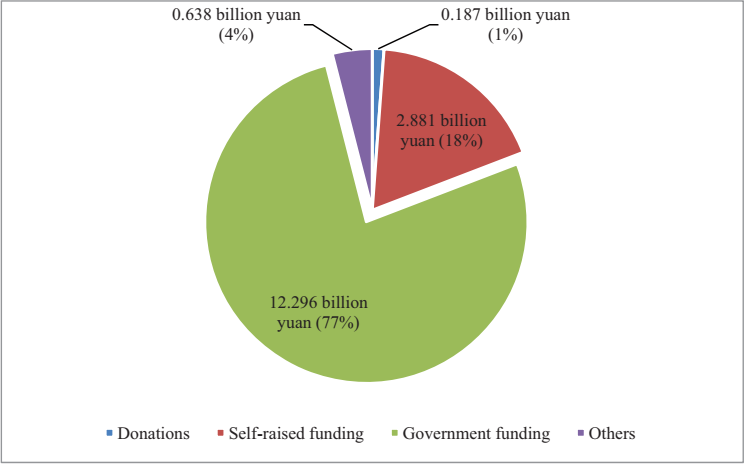
Funding sources and proportions relating to China's SP in 2017
The Science Popularization Law and various other policies have strengthened the SP workforce in China. This workforce mainly comprises administrators, professional workers and volunteers in this field. As Figure 2 shows, the total number of individuals involved in this sector reached 1,794,500 in 2017, which was an increase of 10.53% from 2006 (MST, 2008–2017). The number of full-time workers in 2017 was 227,000 (an increase of 13.56% compared with the figure in 2006), accounting for 12.65% of the total SP workforce. In terms of the workforce structure, there were 139,500 full-time SP workers with a mid-level or above occupational title or a bachelor's degree or above, indicating a rise of 53.80% compared with the figure in 2006 and accounting for 61.45% of all full-time workers engaged in this field.
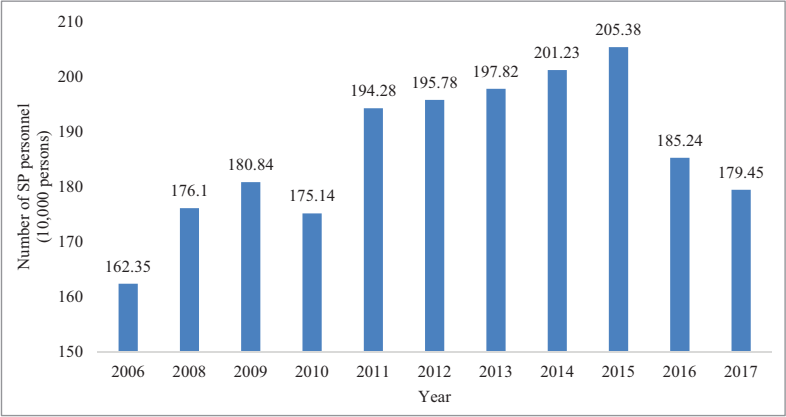
The development of China's SP workforce from 2006 to 2017
SP infrastructure includes museums focusing on science and technology, specialized popular science museums, science education bases, grassroots popular science facilities, SP caravans, popular science websites, and digital science and technology museums. As shown in Figure 3, in 2017, China had 951 science centres nationwide with a total exhibition area of 3,199,900 square metres (an increase of 373.35% compared with the figure in 2006) and 488 science and technology museums with a total exhibition area of 1,800,400 square metres (a 198.97% increase compared with the figure in 2006). In 2017, science centres and science and technology museums received total visits of 205 million person-times (an increase of 520% compared with the number of visits in 2006) (MST, 2008–2017).
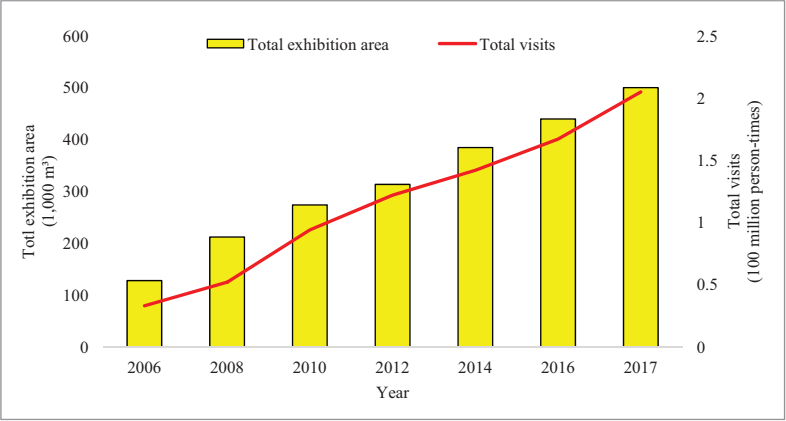
Exhibition areas and visits to science and technology museums and science centres
The formulation of the National Scheme for Scientific Literacy has promoted the development of a system of SP public service. For example, there has been steady progress in the development of modern science and technology museums with Chinese characteristics. A new structure comprising four types of venues has been formed. It includes general and specialized science and technology museums; mobile science and technology museums; SP caravans and science and technology centres in rural middle schools; and digital science and technology museums. The new structure has promoted the sharing of high-quality SP resources.
Mass media are an important means of promoting SP as well as the main channel through which the Chinese public can access information on science and technology. In 2017, 14,100 popular science books were published in China, which was an increase of 344.62% compared with the number of books published in 2006. A total of 112 million copies were printed, accounting for 1.21% of all books printed nationwide in 2017. In the same year, 491 million science and technology newspapers were distributed nationwide, and 89,700 hours of TV programmes and 73,700 hours of radio programmes were devoted to science and technology (MST, 2008–2017).
The rapid informatization and increased diversity of the media, which encompass the internet and new media, have increased scientific literacy among the public. Social media platforms, including WeChat accounts, Weibo accounts and mobile reading apps, are the primary channels through which the public can access information on science and technology. Initiatives such as ‘Internet + SP’ and SP programmes to promote informatization have promoted the integration of traditional SP with modern means of communication, resulting in a steady increase in up-to-date coverage of popular science. Internet-based SP represented by leading platforms such as China Science Communication and Guokr has gained traction. In 2017, a total of 2,570 popular science websites published 1,367,100 articles and 49,700 videos and received 921 million visits. Further, 2,065 SP Weibo accounts published a total of 664,500 posts and received 4,409 million views (MST, 2008–2017).
Steadily increasing public scientific literacy
The promotion of civic scientific literacy has become an important responsibility and mission of China's SP workforce. With the development of SP, and especially since the introduction of the National Scheme for Scientific Literacy, China's civic scientific literacy has been steadily improving, and the percentage of scientifically literate citizens increased from 1.44% in 2001 to 8.47% in 2018 (see Figure 4).
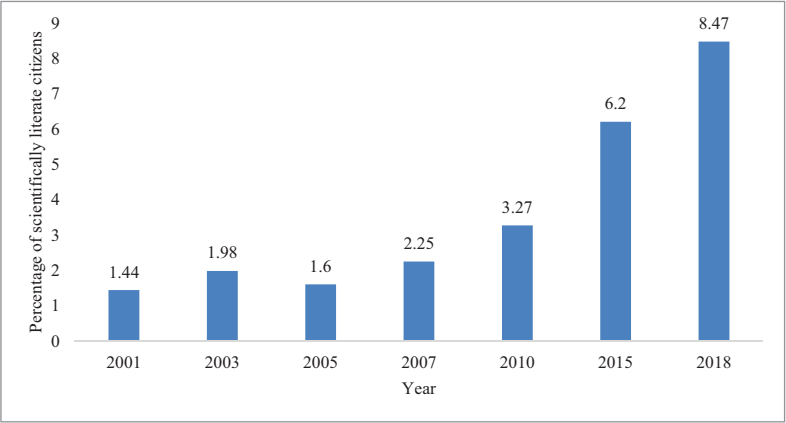
The evolution of civic scientific literacy in China from 2001 to 2018
The Chinese public has shown increasing interest in and support for science and technology development. According to the findings of the 2018 Chinese Civic Scientific Literacy Survey, the three top-ranked professions in China are the teaching, medical and scientific professions; 83.7% of respondents agreed that modern science and technology will create more development opportunities for future generations; and 77.3% endorsed the view that, although basic research cannot generate immediate results, it is necessary and should be supported by the government. Thus, an environment that is conducive for science and technology innovation is being fostered.
While China has made giant strides in promoting SP over the past four decades, various constraints and deficits have also been evident.
For example, less attention is paid to promoting the scientific spirit and scientific thinking compared with scientific knowledge; and imbalanced development between SP and scientific innovation will continue. There is significant room for improvement in various areas, including strategic positioning, theoretical development, practices, the policy framework and international expansion. Therefore, reflections on the current challenges facing China's SP endeavour are crucially important for sustaining the future development of SP in this country.
Weak strategic positioning and imbalanced development of SP and scientific innovation
Although scientific innovation and SP are emphasized as two wings of innovation-driven development in China's national strategy, the latter currently takes a backseat and receives less support in the national innovation ecosystem than the former. Governments at all levels generally accord more attention to scientific research than to SP. In 2017, SP funding accounted only for 0.9% of the funding allocated for R&D and for 1.4% of fiscal expenditure on science and technology. These figures are indicative of a significant funding deficit relating to SP. A mechanism for converting R&D results into SP resources is yet to be established, and the incentive mechanism for promoting SP requires further improvement. The SP workforce also needs to be strengthened, given that the number of full-time writers in this field has remained constant at around 10,000 for some years now, while there has been a decline in the total SP workforce in recent years. Given the massive demand for SP, there is a major shortage of science popularization workers (MST, 2008–2017). Moreover, concerned actors, notably scientists, enterprises and the mass media, have been less than enthusiastic in supporting SP.
Low effectiveness of SP policies and long-term operating mechanisms
While China has established a comprehensive SP policy framework and SP mechanism, the role of long-term mechanisms still needs to be strengthened, and relevant policy measures need to be more effectively implemented.
Some key issues need to be addressed in relation to those constraints:
There is a need to develop an improved mechanism for leveraging the market to enable the broad-based mobilization and participation of social actors in SP activities.
A lack of supporting regulations and detailed rules for implementing the Science Popularization Law and other policies has resulted in their limited effectiveness.
Existing mechanisms for promoting interdepartmental coordination and local coordination should be strengthened.
There is a need to establish a standard, institutionalized and long-term evaluation mechanism.
Currently, China's SP has a low level of internationalization, and the aspiration of building a shared future for the community of humankind remains a distant goal. Theories on public understanding of science and science communication are developing vigorously in the international academic community, but only a few researchers in China have paid attention to this field, and there is a need to learn from internationally advanced theories and practices relating to SP. International cooperation and exchanges in this field are yet to be strengthened, and there is still considerable scope for sharing SP resources among the countries involved in China's Belt and Road Initiative. Moreover, efforts to internationalize the SP industry, improve innovative SP services and import and export SP products remain at a preliminary explorative stage (Ren et al., 2018).
Inadequate and imbalanced development of the SP system
China is yet to establish a comprehensive system integrating SP theories, practices, policies, markets and internationalization and to develop a systematic synergy of SP efforts and resources, as evidenced by varying degrees of inadequate and imbalanced development in different fields, sectors and regions.
Some key issues need to be addressed to accomplish this synergy:
The position of SP within the national innovation system needs to be defined more clearly in a way that enables it to play an effective role in supporting an innovation-driven development strategy.
The supplyside of SP cannot meet rapidly growing demand from the public, and the SP industry remains undeveloped. Therefore, there is a need to improve the mechanism of private-sector investment in SP (Ren et al., 2018).
The overall level of the country's civic scientific literacy is still relatively low, and there are significant urban–rural and regional differences; for example, the percentages of scientifically literate citizens in first-tier cities such as Beijing and Shanghai are nearly five times higher than those in the western provinces. Significant developmental imbalances between urban and rural areas and among regions are indicative of the prevalence of inequality relating to SP, which is considered a public good.
More efforts are needed to expand innovative theoretical research on SP in China and to provide theoretical support for the development of scientific culture.
On the one hand, SP is an emerging interdisciplinary field of study that is not yet well established in China. For example, there is no single published book that provides a systematic overview of SP history, and academic interest in and research on related frontier topics, such as scientific culture, open science and scientific ethics, remain limited.
On the other hand, the existing SP theoretical framework is a conventional one that is not well informed by insights derived from other disciplines, such as psychology, pedagogy, management science and communication science. The development of SP-related theories remains weak because of the lack of support from first-level disciplines and lack of funding from national research programmes.
The future of SP in China
In conclusion, this review of China's SP development over the past four decades has revealed that government support is a key factor in the advancement of SP. Looking forward, as socialism with Chinese characteristics enters a new era, China should, under the leadership of the government, strengthen civic scientific literacy by improving internationalization, promote open cooperation from the perspective of a global horizon, establish a long-term SP mechanism through the collaboration of all forces, and introduce new service models and platforms of civic scientific literacy through informatization. SP in China is sure to be more prosperous in the future.
Footnotes
Author biography
Fujun Ren, Professor, PhD supervisor, is an expert enjoying the State Council Special Allowance. He is the general director of the National Academy of Innovation Strategy and the chief editor of Modern Science and Cultures of Science. He holds a PhD from the Harbin Institute of Technology and a postdoctoral degree from Tsinghua University. He previously served as the director of the China Research Institute for Science Popularization; as the vice president of the China Science Writers Association and of the Beijing Association for Science and Technology; and as the chief editor of Studies on Science Popularization. His areas of expertise include science popularization, innovative culture, scientific culture and scientific policy.