




Abstract
This study explores the external features and content of 254 policy files promulgated by Chinese central government organs and people's organizations from 2011 to 2015. The study shows that policy is a powerful means to promote science popularization in China. The China Association for Science and Technology (CAST) takes the lead in policymaking. Science popularization policies cover a wide range of subjects, and diversified tools have been adopted to support policy implementation. Some problems remain and need to be tackled, such as the unbalanced distribution of policymakers, poor adaptability of policy to development and insufficient dissemination. On the basis of our analysis, we propose suggestions for future science popularization policymaking, including enhancing the awareness of policymakers, strengthening coordination and cooperation, meeting the needs of the times, and enriching channels of communication.
Keywords
There is a close relationship between the development of science popularization (SP) capacity and national, regional and industrial SP policies in China. As a supply-side factor of national, regional and industrial SP capacity building, SP policy provides a legal basis for SP work. It is of great significance for creating a favourable environment for SP and promoting the development of SP work (Ren and Zhai, 2011). SP policies of government organs and people's organizations are an important part of China's SP policy. They are formulated and released independently or jointly, and constitute a code of conduct for their makers in guiding and managing their SP work. The content of these policies involves legal system building, development planning, resource allocation, organizational construction, cooperation and coordination, and so on. These policies take the national SP policy as the guide and offer directional guidance for their makers' specific SP work deployments so as to achieve their SP goals.
Public policy documents are a specific phenomenon of public policy. Policy document research takes understanding and interpreting this phenomenon as the basis to reveal the possible meanings, connections and structural forms behind the phenomenon (Ning, 2011; Yang, 2007). As far as existing research is concerned, most SP policy document studies in China have been concerned with SP policy history and typical case analyses (Tong, 2008; Pei et al., 2012; Zhu, 2008; Liu and Chang, 2010). There are few systematic studies on SP policy, especially on policies during the 12th five-year plan period (2011–2015). Therefore, this study systematically analyses SP policy documents promulgated by different central government organs and people's organizations in China during that period, examining their features, structures, changes and contexts. We hope this study will play a role in future SP policymaking in China.
Research framework
Based on public policy research theory, literature research results and the fact that the information contained in policy documents has a rich suite of characteristics, this study has used an SP policy analysis model as shown in Figure 1. Within this framework, the external features and content of policy documents were analysed to reveal the features of different factors from inside out and from multiple dimensions (Ma, 2000). External features analysis focuses mainly on four aspects: the number of documents issued, document-issuing entities, categories of policy, and the status and structure of cooperation between joint document-issuing entities. Content features analysis is based on policy content, focusing on the fields of action, policy tools, citation relationships and policy themes.
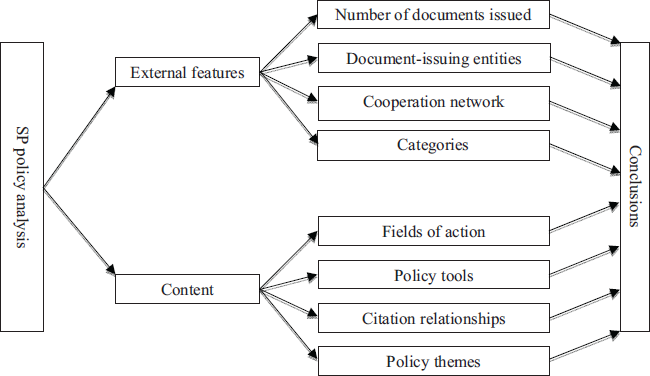
SP policy analysis model
Government organs and people's organizations involved in this study were divided according to the 30 types of departments defined in the 2015 China SP survey (Ministry of Science and Technology, 2016). The specific research object was the SP policy documents issued by representative central government organs and people's organizations. For example, the administrative departments for science and technology (S&T) are represented by the Ministry of Science and Technology of China; S&T associations are represented by China Association for Science and Technology (CAST).
To ensure the authoritativeness, openness, relevance and availability of data, we selected policy documents issued from 2011 to 2015. Through database retrieval (by using Wanfang Data and www.pkulaw.cn), online searches (by visiting the portal websites of various central government ministries and people's organizations and using Baidu), literature research (by studying collections of policy documents) and other means, we searched for key words such as ‘popular science’, ‘S&T popularization’, ‘science popularization’, ‘technology popularization’, ‘science communication’, ‘S&T communication’, ‘scientific literacy’, ‘scientific qualities’, ‘public understanding of science’ and ‘science education’ to collect the policy documents of the central government organs and people's organizations. All the selected policy documents were publicly released, and those not made public or unavailable were not included in this study. After screening and sorting, documents that did not conform to the research content of this study were eliminated, leaving a sample size of 254 documents. Those documents were then classified and indexed.
This section describes the following external features of SP policies: number of documents issued, types of document-issuing entities, cooperation networks of joint document-issuing bodies, and categories of documents issued.
Number of documents issued
From 2011 to 2015, a total of 254 SP policy documents were publicly released by central government organs and people's organizations in China, with an average annual release of more than 50, as shown in Figure 2. Among them, 179 were issued independently by various entities, and 75 (just under 30%) were issued jointly by different entities. The number of jointly issued documents each year ranged from 10 to 20.
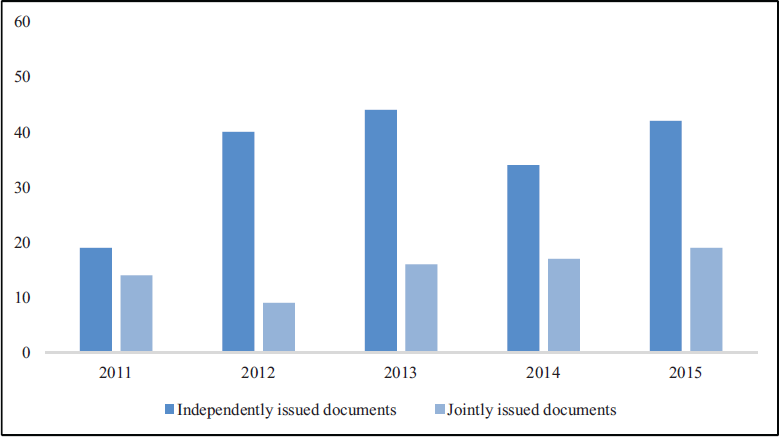
Number of SP policy documents issued, by year
The 254 policy documents were formulated by a large number of entities, as shown in Figure 3. Of the 30 types of document-issuing entities, only the General Administration of Sport, the Forestry Administration, the Tourism Administration and the Chinese Academy of Social Sciences did not issue SP policies, while the other 26 types of entities all did so 1 . Among them, CAST participated in the formulation of 156 policies, showing its core leading and guiding role in promoting SP development in China. The Ministry of Science and Technology and the Ministry of Education are the backbone in the formulation of SP policies in China. The work of the former is closely related to the research, development and application of S&T, while the latter is the most important practitioner of science communication. Thus their business involves much SP work.
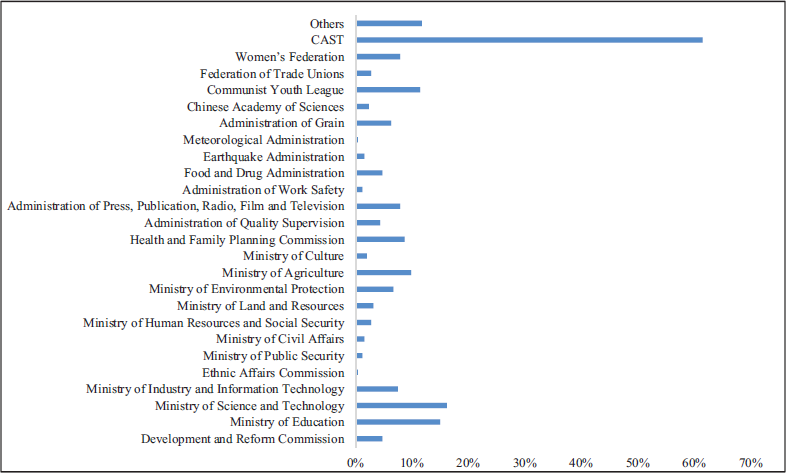
Proportions of SP policy documents issued by different entities
The Communist Youth League and the Women's Federation include the major target audiences of SP; while the work of the Ministry of Agriculture, the Ministry of Environmental Protection, and the Health and Family Planning Commission covers disaster prevention, agricultural technology application, the environment, ecology, sustainable development and health, all of which are the key contents of SP work in China. Therefore, those entities have also played a strong role in the formulation of SP policies.
Seventy-five jointly issued policies were formulated by 53 central entities. Among them, 17 entities took part in the formulation of only one or two joint policies. To consider operability and effect, we selected 36 entities that participated in the formulation of more than two jointly issued policies as the research object. They were the actors in the social network analysis.
Ucinet software was used to calculate the strength of membership relationships in the cooperation network. The average strength of membership relationships was 5.1491, the standard deviation was 3.0298, and the network cohesion index was 0.770. The average geodesic distance between two members among the connectable members was 1.467, which means that on average two members in the network could establish cooperative relationships through fewer than two other members. This shows that the network has strong overall cohesion and close ties among members, making it easier to establish closer cooperation among members.
Figure 4 shows centrality analysis results based on degree centrality, betweenness centrality and closeness centrality. It reveals members who were prominent in promoting the formation of the cooperation network.
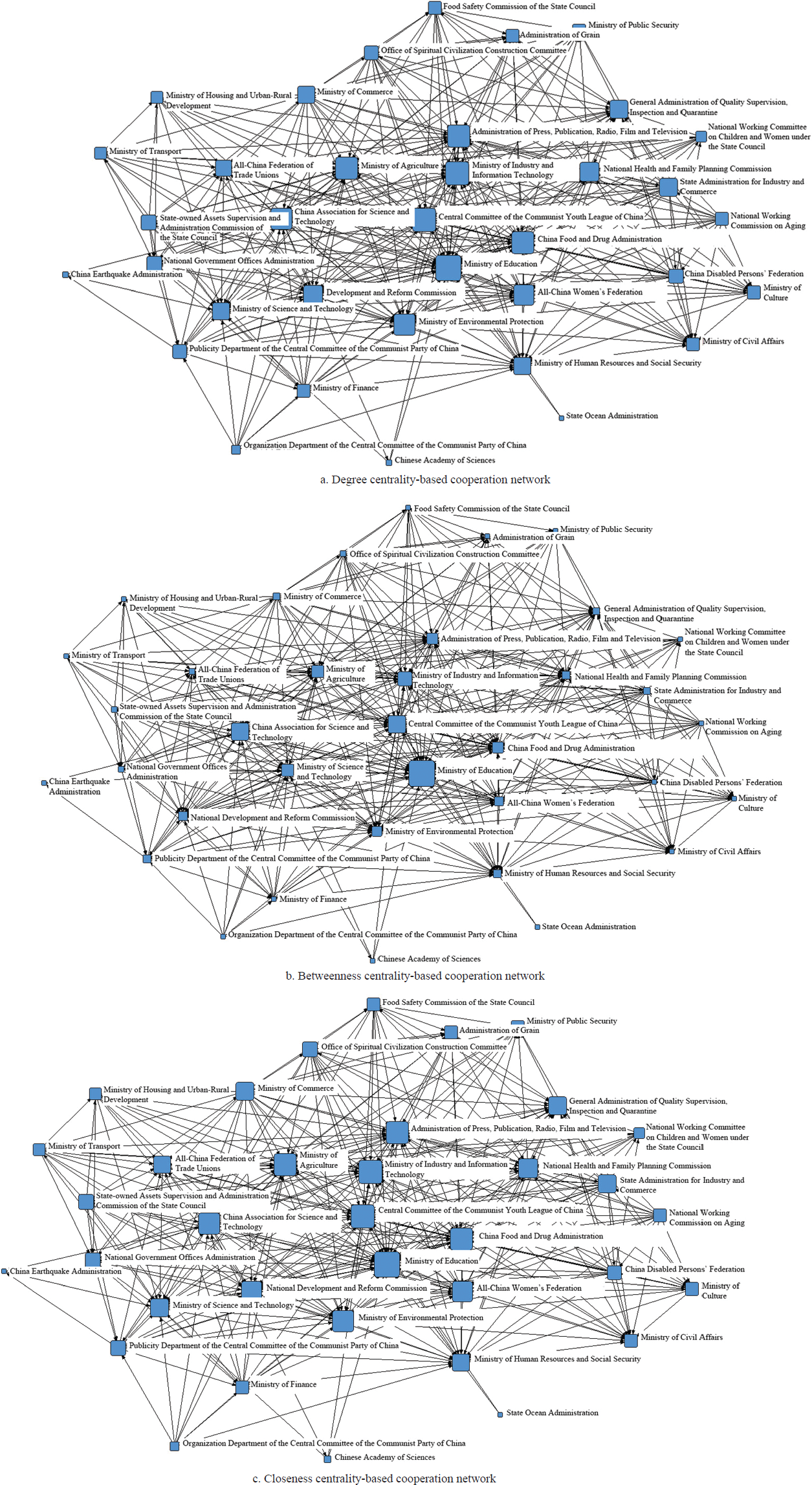
Cooperation network of joint document-issuing entities
The leading networker is the Ministry of Education. It performed outstandingly in the three aspects of communication ability, control ability and independence, and played the most critical role in promoting the establishment of the cooperation network. The ministry is in charge of overall planning of all kinds of education work at all levels, and coordinates and administers other education organizations in the country. It has many unrivalled advantages over other departments in organizing and coordinating SP resources, such as talent training, providing knowledge resources, the construction of SP venues and target audiences. As such, it easily becomes the partner favoured by many other departments in knowledge communication and thus indisputably plays the most vital role of an intermediary in this social network.
The next best networkers are the Central Committee of the Communist Youth League of China and the Ministry of Industry and Information Technology. The former is an organization guiding, organizing, serving and maintaining more than 80 million young people in China. It is closely related to SP talent training and the target audiences of the SP effort. The latter has responsibilities in the co-construction and sharing of network resources and the promotion of informatization and provides important support for SP channels. Therefore, the two have also become strong pushers in the network.
The third best networkers are CAST and the Ministry of Science and Technology. Although they were not in the top five in terms of communication ability and independence, they were in the top five by control ability. This shows that they have a fairly big influence on the behaviour of other members in the network. The reason is that their functions are directly related to the subject (researchers) and the object (research and development) of S&T work. Therefore, they have advantages in guiding the choice of SP topics and building SP forces.
The 254 policies issued during the 12th five-year plan period can be grouped into eight categories, as shown in Figure 5. About 91% of all the documents were issued in the form of circulars, the contents of which were mostly specific deployments of SP work in a specific field. Other document types with a relatively large prevalence were decisions and opinions.
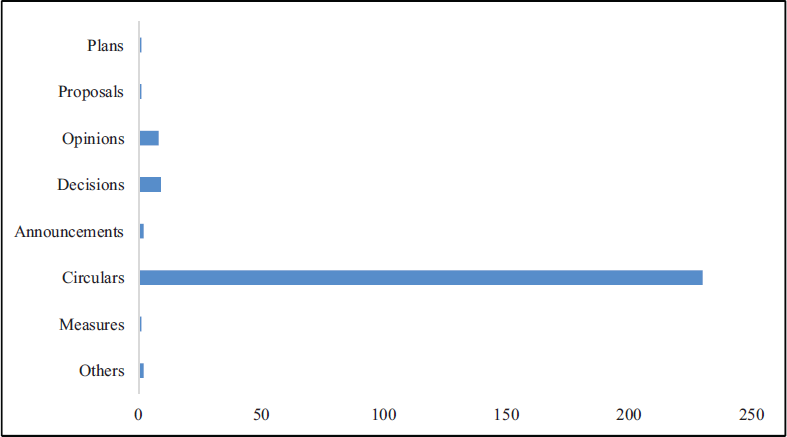
Distribution of SP policies, by type
Among the eight types of documents, circulars and opinions were relatively weak in standardization but strong in guidance; decisions, proposals, measures and announcements were relatively strong in standardization but weak in guidance; and plans had medium standardization and guidance. This is in line with the background of SP policy in China at that time. In 2006 and 2007, China successively promulgated two programmatic documents: the Outline of the National Scheme for Scientific Literacy (2006–2010–2020) and Several Opinions on Strengthening National Science Popularization Capacity Building. They made long-term, framework, comprehensive and systematic arrangements for the development of China's SP cause. Based on this situation, the policy documents issued by various departments during the 12th five-year plan period placed greater stress on strengthening the operability of their work at the guidance level, so that the focus of those forward-looking programmatic documents could be accepted and implemented through specific work.
This section examines the content of SP policies, including policy action domains, policy tools, policy citations and key words during the period of the 12th five-year plan.
Policy action domains
The 254 policy documents covered six action domains, as shown in Figure 6. About 37% of the policies were in the field of SP activities. This shows that during the period, all central government organs and people's organizations attached the greatest importance to achieving their SP goals through various specific activities. Those policies also focused on another two fields. One was SP venues, emphasizing the construction of bases and facilities to support SP activities (accounting for approximately 25% of the total number of documents). The other was SP media, which were regarded as important channels for SP work. Furthermore, the policies paid much attention to the cultivation of science communicators and strove to push forward effective SP work by developing outstanding SP forces. Policies directly related to SP funds were relatively fewer. Although the proportion of other policy documents was not low, the contents involved were nevertheless scattered, covering various topics such as meetings, inspections, assessments and so on.
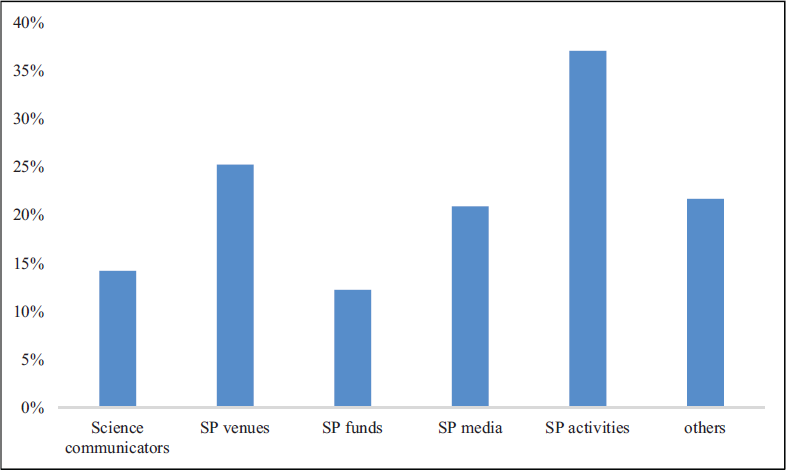
Distribution of SP policies, by action domain
By dividing the SP policies issued by various entities by action domain, some common features and unique features can be found in the focal points of those policies, as shown in Figure 7.
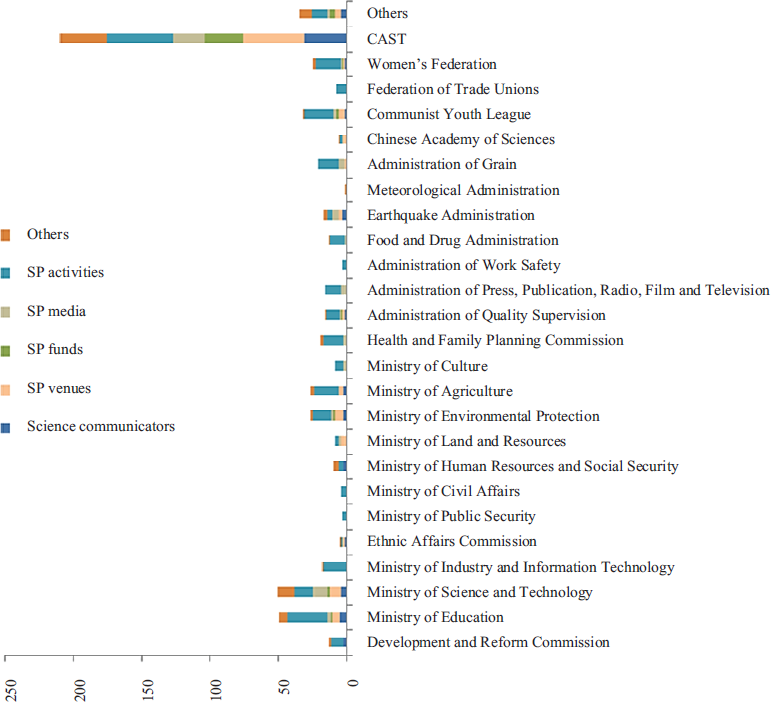
Distribution of SP policies issued by various entities, by action domain
It is clear that CAST, the Ministry of Science and Technology and the Ministry of Education all played the leading roles in most action domains of SP policies. ‘SP activities’ was a field favoured by the Development and Reform Commission, the Ministry of Education, the Ministry of Industry and Information Technology, the Ministry of Environmental Protection, the Ministry of Agriculture, the Health and Family Planning Commission, the Administration of Work Safety, the Administration of Press, Publication, Radio, Film and Television, the Food and Drug Administration, the Administration of Grain, the Communist Youth League and the Women's Federation. Specialized departments, including the Ministry of Environmental Protection, the Ministry of Agriculture, the Earthquake Administration and the Administration of Grain, all emphasized the use of SP activities to generate more output from their input into SP in their own fields. Those departments also supported the development of SP venues and SP media to fulfil their SP work. However, CAST and the Ministry of Science and Technology performed differently from the other organizations. Their policies had broader horizons, covering all six policy domains, and had greater force and relatively balanced distribution in the policy domains. This shows from another perspective that CAST and the Ministry of Science and Technology are powerful entities that vigorously promote the development of SP work through SP policies. Both are involved in SP work by making policies about content, approach, method, manpower, material resources, super vision and various other aspects, thus basically forming a policy system that covers the entire SP chain.
Policy tools are the strategies, methods, technologies, mechanisms and actions adopted to achieve certain policy objectives, and the human resources, equipment and resources that are allocated for such purposes (Zhao and Su, 2007). Statistics show that during the 12th five-year plan period a total of 10 policy tools were adopted to support the realization of policy objectives (Figure 8).
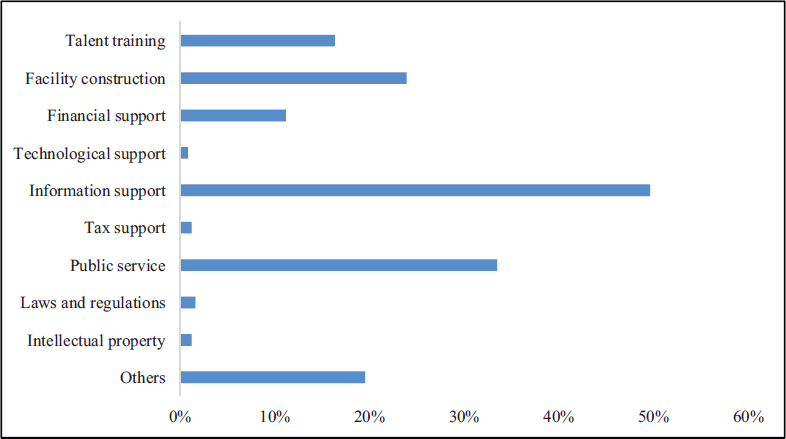
Distribution of SP policies, by policy tool
Approximately 50% of policy documents adopted the ‘information support’ tool, which reflects the features of SP work. S&T communication involves the transmission and exchange of a large amount of information and knowledge. Therefore, the means to provide information were most commonly used to promote SP. Approximately 33% of the policy documents adopted the ‘public service’ tool, which reflects the responsibilities of the public sector in providing SP services for society. Those public services include holding Science Week and S&T Publicity Day; communicating knowledge of specific topics and assisting specific groups; carrying out skills training; and so on. The two tools of ‘facility construction’ and ‘talent training’ also attracted the attention of central government organs and people's organizations, which were committed to consolidating the foundation of SP work by strengthening the construction of both tools. Some 11% of the policies directly adopted the ‘financial support’ tool to offer merit-based support to SP projects and personnel. There was relatively less use of policy tools concerning preferential tax and intellectual property management in the SP field during the period. Work on this aspect still needs to be explored.
Figure 9 reflects the preferences of 26 types of entities for policy tools. The common feature is that the two policy tools of ‘information support’ and ‘public service’ were used by most entities. Out-performers in this aspect were the Ministry of Public Security, the Ministry of Civil Affairs, the Ministry of Culture, the Health and Family Planning Commission, the Food and Drug Administration, the Administration of Work Safety, the Administration of Grain, the Federation of Trade Unions and the Women's Federation. Although other types of entities also attached importance to ‘information support’ and ‘public service’ tools, they used other policy tools as well to guide the development of SP work. For example, the ‘talent training’ tool was used by the Ministry of Education, the Ministry of Science and Technology, the Ministry of Human Resources and Social Security, the Ministry of Agriculture, the Earthquake Administration, and CAST; the ‘facility construction’ tool was preferred by the Ministry of Science and Technology, the Ministry of Land and Resources, the Ministry of Environmental Protection, the Earthquake Administration, the Chinese Academy of Sciences and CAST. CAST was prominent in the use of the ‘financial support’ tool.
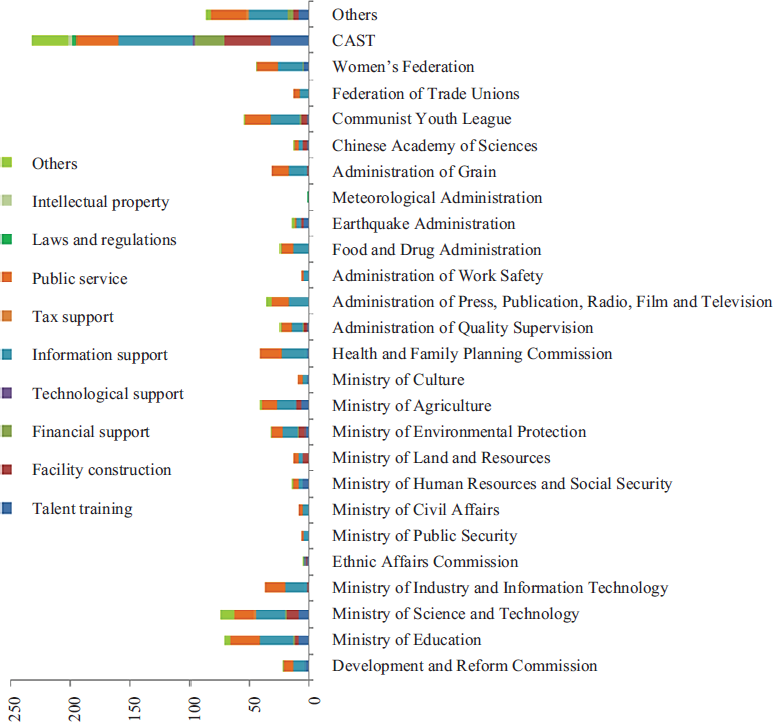
Distribution of SP policies issued by different entities, by policy tool
Among the 25 types of entities except ‘Others’, 10 adopted five or more policy tools, including the Ministry of Education (six), the Ministry of Science and Technology (seven), the Ministry of Environmental Protection (six), the Ministry of Agriculture (five), the Administration of Quality Supervision (six), the Earthquake Administration (five), the Chinese Academy of Sciences (five), the Communist Youth League (six), the Women's Federation (six) and CAST (nine). CAST not only adopted the most diverse policy tools, but also had a better balance among various tools compared with other entities. To a certain extent, this reflected CAST's adoption of multi-pronged cooperation in the organization of SP policies.
The citation relationship between policy documents is an important information resource. The cited policies can provide strong arguments for those that cite them to increase their value, authority and information. This citation relationship also reflects the relevance of and inheritance between policies, thus showing the history of policy development.
Among the 254 SP documents, 178 cited a total of 129 other policy documents. There was a clear long tail effect in the citation of the documents. Policy citations concentrated on a few documents, while most documents were only cited a few times. Among the cited documents, 13 were cited more than three times, as shown in Table 1.
Policy documents cited more than three times
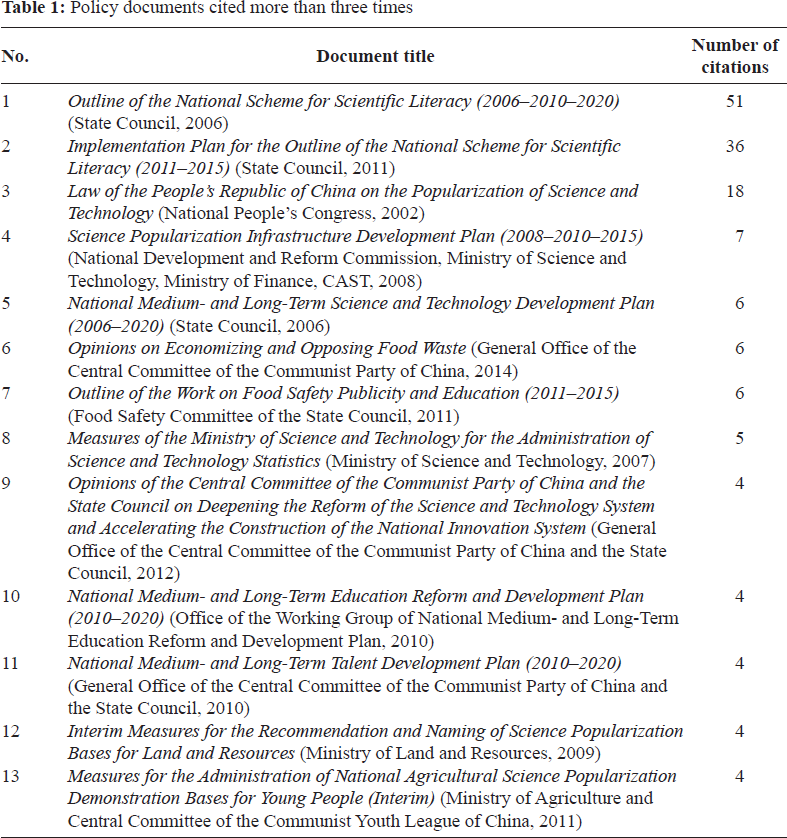
Policy documents cited more than three times
Based on their citations, the 13 documents can be clearly divided into two groups. The first group included the three documents with two-digit citations, and the second group contained the remaining 10 documents. There was a clear difference in the number of citations between the two. This shows that a few policies are the origin of all SP policies in China. As programmatic documents supporting the development of the SP cause in the country, they are at the top level of SP policy discourse in China. They are meta-policies and have strong restrictive functions on other policy discourses in the SP policy system.
In terms of content, all the 13 documents showed general relevance to S&T. Most of them were specialized SP policies, while a few were policies related to SP work. Moreover, most policies were oriented to nationwide SP work. Nine of the 13 policies were national top-level policies formulated by the Central Committee of the Communist Party of China, the State Council and the National People's Congress, which are level-one bodies in China; four were formulated jointly or independently by different departments at the ministerial level. Therefore, there was a level-by-level gradient in policymakers.
Using the NLPIR Chinese lexical analysis system developed by the Chinese Academy of Sciences, we carried out word segmentation of the 254 policy documents. Based on the information entropy, the first 50 key words were extracted, and 39 key words were obtained after manual screening. The results are shown in Table 2.
Key words of high information entropy in the 254 policy documents
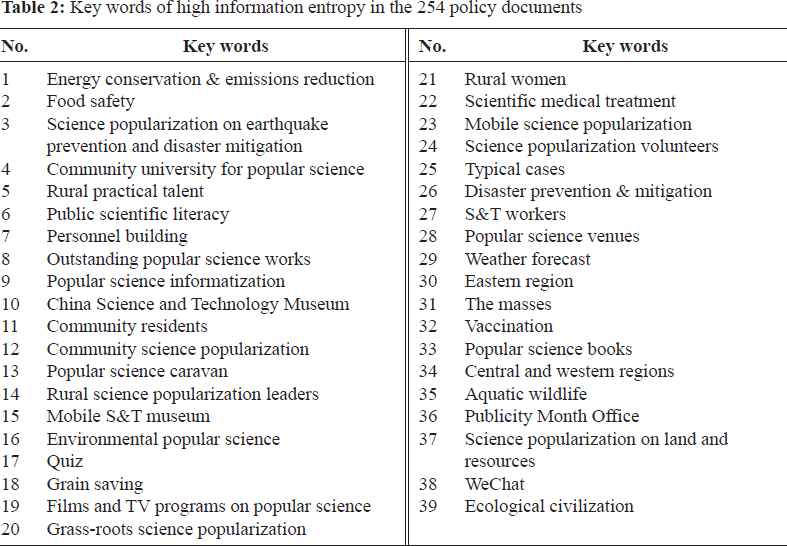
Key words of high information entropy in the 254 policy documents
It can be seen that the SP policies of central government organs and people's organizations in China from 2011 to 2015 were a leading force in the following aspects.
First, under the guidance of the Outline of the National Scheme for Scientific Literacy and its Implementation Plan, SP policies emphasized promoting national scientific innovation through improving the public's scientific literacy so as to realize the supporting role of SP in China's innovation-driven development strategy.
Second, policy support focused mainly on people's basic needs and on promoting S&T for public wellbeing. Such support covered a wide range of areas, such as energy conservation and emissions reduction; food safety; disaster prevention and mitigation; food security; scientific medical treatment; health care; geological environment protection; animal protection; and various other aspects. The idea was to continuously explore the application of livelihood-related S&T in these fields in a way that was easily understood by the public. In particular, SP policies released during the 12th five-year plan period prioritized the publicity of environmental protection through energy conservation and emissions reduction, emphasizing the achievement of all-round development in a healthy cycle through harmonious coexistence between man, nature and society. This policy tendency was in line with China's will to put ecological civilization construction in a prominent position since the 18th National Congress of the Communist Party of China, reflecting the implementation of the national development strategy in the SP field.
Third, the focus of SP work was on the grass roots. On the one hand, the policies stressed the importance of the community as the foundation of SP work. Different measures, such as establishing community universities and strengthening SP activities for community residents, should be taken to bring popular science close to residents, to everyday life and to people's needs. New ways of SP work in the new era should be explored. On the other hand, particular stress was placed on SP work aiming at special groups in rural areas (including rural women, rural practical talents and so on). Efforts should be made to boost economic, social and ecological improvement in the vast rural areas of China by improving the scientific qualities and skills of those groups.
Fourth, the adoption of diversified SP means and channels was advocated. Approximately 30% of the key words were related to communication means and channels, including traditional media and channels such as films and TV programs, books and S&T Publicity Month, and advanced technical means such as mobile SP, which was stressed in promoting SP informatization. This shows that national policies during the period encouraged different media and channels to use their competitive advantages. At the same time, they actively promoted SP media innovation in the hope of fully tapping the publicity functions of new media, thus promoting SP development to adapt to social trends.
Fifth, efforts were made to strengthen the construction of SP forces. Policies emphasized the training and use of rural SP leaders and SP volunteers and the introduction of researchers to address the shortage of SP talents at the grass-roots level and the lack of high-level SP talents, so as to improve the abilities of SP personnel.
Sixth, in the construction of SP venues and facilities, much support was given to S&T caravans, mobile S&T museums and many other forms. SP public service was strengthened at the grass roots and in remote areas, thus fully leveraging the radiating effect and leading role of SP venues.
Based on our analysis of the policy documents issued by central government organs and people's organizations during the 12th five-year plan period, the following judgments can be made.
Conclusions
First, SP policy was a powerful driver for central government organs and people's organizations to promote SP work during the period.
During the period, central government organs and people's organizations issued more than 50 SP policies each year. Those policies were specific versions of national systematic and programmatic documents made by various departments based on their specific situations, reflecting the values that their makers placed on SP work. Through direct or indirect means, those policies aimed to play a guiding and supporting role in allocating SP resources, in solving relevant problems of adapting to social development needs and related issues with S&T, and in standardizing conduct in SP work. More emphasis was placed on enhancing the operability of specific work from the guidance level, so that the focal points in national programmatic documents could be implemented through specific work.
Second, SP policies showed a pattern in which CAST played a dominant role, with other departments serving in supplementary roles. According to the available data, more than 85% of the 30 departments introduced SP policies during the 12th five-year plan period. Those policies were generally characterized by CAST playing a dominant role, supplemented by other government organs. This reflects the implementation of the mechanism of ‘dividing work and responsibility while keeping unity and collaboration’ among various central government organs and people's organizations in SP work. There was a pyramid structure in the number of policies issued, with CAST at the top (being a leading force), the Ministry of Education and the Ministry of Science and Technology at the middle (being the backbone), and the departments of Agriculture, Environmental Protection, Health and so on at the bottom (being the foundation). More than 75% of the 30 departments established collaborative relationships covering a wide scope of cooperation. Among them, the Ministry of Education played the most important role in the cooperation network and was the most critical player in promoting the establishment of departmental collaboration relationships. The Communist Youth League of China, CAST and the Ministry of Science and Technology also played an important role in the cooperation network because of their respective advantages in SP target audiences, SP human resources and SP content.
Third, SP policies had wide-ranging content and were full of features specific to the issuing entities. The policies stressed the effort to promote S&T for public well-being through formal and informal learning and training channels, while enhancing people's necessary knowledge and skills so that they could continuously adapt to the needs of social development. They also emphasized promoting public engagement and creativity in science by improving public scientific literacy, thus speeding up scientific and technological progress and innovation in the whole society. Moreover, they advocated the establishment of a resource-saving and environmentally friendly society under the idea of ‘ecological civilization’, so as to achieve harmony between man and nature and promote the comprehensive, balanced and sustainable development of the economy and society. Finally, all specialized departments emphasized the input of resources to support SP work in their fields. Among the policies of various departments, those of CAST and the Ministry of Science and Technology had a broader horizon and made balanced efforts in various policy action domains, including content, approach, method, manpower, material resources and supervision.
Fourth, diversified policy tools offered powerful support for the implementation of SP policies. During the period, the SP policies of central government organs and people's organizations were basically incentive policies. They used all kinds of incentives covering strategies, methods, mechanisms, actions and other factors to fully mobilize the enthusiasm of participants and promote SP development towards certain goals. Among policy tools, providing ‘public service’ for the society through the ‘information support’ tool was a widely used means. In addition, ‘facility construction’ and ‘talent training’, as the basic hard and soft conditions to ensure the normal operation of SP work, also became important measures for central government organs and people's organizations. The interactive use of different policy tools constituted a flexible and orderly network of SP policies.
Fifth, problems such as unbalanced distribution in departments, insufficient development and inadequate publicity still existed in SP policies. During the period, there were still some problems in the SP policies of different central government organs and people's organizations. A few departments gave weak support for SP policies, and a few SP policies did not have clear content or purpose. Some SP policies had stereotyped content and narrow implementation channels, and were deficient in innovation and adaptation to the developments of the time, such as the development of the popular science industry. In addition, some government departments and people's organizations did not do adequate work to publicize SP policies, which inevitably made it impossible for the public to obtain SP policy information, or resulted in the loss of some information.
Suggestions
Given those problems, and in order to develop a social environment favourable to SP and push forward the continuous development of SP in China, we suggest that central government organs and people's organizations consider undertaking more work on the following aspects in the future development of SP policies.
First, some central government organs and people's organizations should strengthen their consciousness of SP work and increase the formulation of SP policies. The promotion of SP work (especially the SP cause involving public interest) cannot be separated from the support of strong public policies. Within the scope of efficiency and law, SP is a public issue that needs to be solved by central government organs and people's organizations. Policy is an important support for those entities to raise their level of SP management and effectively perform their duties. Therefore, some entities need to strengthen their awareness of the importance of SP work, enhance the application of different policy means and tools, and systematically plan and deploy SP work in their functional fields through policy means so as to achieve the mutual promotion and win–win of their SP work and business work.
Second, the leading departments for SP work should further strengthen their cooperation and coordination with other departments by taking policies as a link. The leading entities for SP in China, including CAST, the Ministry of Science and Technology and the Ministry of Education, should capitalize on their own advantages and help weaker entities to integrate into SP circles as soon as possible by jointly formulating policies and pushing forward relevant work. This will enable them to carry out their work through joint efforts, draw upon the experience of others, gradually develop their own thinking and methods for SP work, improve work abilities, and gradually narrow the gap with other departments.
Third, departmental SP policy content should be adjusted to meet the needs of the times. Under the premise of conforming to China's national development strategies, departmental SP policies should be development-oriented public policies that reflect the work ideas of specific departments. Those policies should reflect the features and inheritability of departmental work and strive to solve the ‘hot-spot’ and difficult problems facing today's society and related to S&T in their fields. At the same time, policymakers need to cultivate their own forward-looking awareness. China's social development needs to constantly meet the growing needs of the people for a better life. The whole society will have higher requirements for security, stability, harmony and environmental stewardship. Therefore, policymakers must have development insights and be able to predict the development of SP in their fields in advance, so as to ensure that the policy layout of their departments provides sufficient development space for future work.
Fourth, communication channels for SP policies should be improved. The public's enthusiasm for participating in SP work depends on its understanding of related policies. Therefore, central government organs and people's organizations should actively incorporate multichannel and full media publicity of SP policies into their work. They should foster the two-way communication of policies by organizing SP activities such as training sessions, publicity meetings, Science Week and S&T Day. More traditional media work should give full play to the publicity role of books, newspapers, radio and television, carrying out one-way communication through special issues, special editions and special columns. A third method is to make full use of the advantages of ubiquitous new media, and use text, picture, video and other forms and easy-to-understand ways to expand the coverage of SP policy information through websites, Weibo, WeChat and other channels.
Fifth, a feedback mechanism to measure the implementation effect of SP policies should be established. From the perspective of policy implementation, the audience's understanding has a big impact on the smooth implementation of policies and the realization of policy value. At the same time, many new problems and situations will arise in the process of policy implementation, and the audience will constantly form new thinking based on those problems and situations while experiencing existing policies. Such understanding is of great significance to the communication of policy. Therefore, we suggest that SP policymakers carry out multidimensional evaluations of the implementation effect of important SP policies. Those evaluations can be based on the audience's understanding, or on social well-being and the economy. This ‘bottom-up’ feedback mode is an effective supplement to the traditional ‘top-down’ SP policy formulation mechanism and will offer strong support for the continuous improvement of SP policies.
Funding
This study is funded by the Research on the Science Popularization Capacity Building of Chinese Central Government Organs and People's Organizations academic project organized by the China Research Institute for Science Popularization.
Footnotes
1
According to the Chinese government's organizational reform policy in 2018, some of the central government organs were reorganized, and their names were correspondingly changed. In this study, we used their original names because this study was conducted before the change.
Author biographies
Ya Liu is a Research Fellow at the Institute of Scientific and Technical Information of China. Her research interest is in S&T policy and its management.
Hefeng Tong is a Research Fellow at the Institute of Scientific and Technical Information of China. His research interests are in system dynamics modelling and S&T policy.
Xuan Zhao is a research intern at the Institute of Scientific and Technical Information of China. Her research interest is in scientific and technical information services.
Lei Gao is a master's student at the Institute of Scientific and Technical Information of China.
Yidan Jiao is a master's student at the Institute of Scientific and Technical Information of China.