



Abstract
Engineering science at the University of Science and Technology of China (USTC) is hosted by its School of Engineering Science. From the perspective of scientific culture, this article examines Qian Xuesen's initial concept of engineering science and the formation of the discipline's cultural elements at USTC, such as institute–department integration (research–teaching integration), the training model, its emphasis on practice and its development as a research platform.
Keywords
What is culture? It is a conceptual system marked by diversity that developed with human knowledge and also a set of patterns of actions underlying the formation of all civilizations. According to German cultural thought, culture encompasses all designs made by us to achieve our own and our posterity's happiness. Of course, happiness is desirable to all, and the pursuit of happiness is a fundamental right of everyone. However, the attainment of happiness is not that easy. It depends on the soundness and operability of our designs.
Qian Xuesen's initial concept of engineering science and the formation of its cultural elements at USTC
Since the 16th and 17th centuries, science and technology (S&T) have developed rapidly. With the sharp growth in independent scientific research, specialized science education and industrial technology applications, a relatively independent system of scientific culture has gradually emerged. It is a result of the efforts of the scientific community—an emerging civilization community—to carry forward values, create paradigms and form rules. The scientific culture system encompasses three dimensions: scientific spirit and concepts (the directional and ethical layer), scientific methods and thinking paradigms (the utility layer) and scientific knowledge (the foundation layer). Scientific spirit, which is at the core of scientific culture, is defined as a spiritual temperament and a value orientation formed in the research activities of the scientific community and individual scientists, such as seeking the truth underlying nature and the world.
At the 2018 Science and You international conference, Han Qide noted that, in early modern China, the mainstream of scientific culture was characterized by the pursuit of national survival, development and prosperity, and that S&T were embraced as a way to save, stabilize and rejuvenate the nation. It was in the process of accepting, safeguarding, spreading and promoting scientific culture that Chinese scientists and technologists developed a rational spirit, democratic thinking and the concept of freedom—ideas that were foreign to traditional intellectuals—and were imbued with a profound collective feeling, national awareness and patriotism. This spiritual attribute of scientific culture has been passed down till today and has manifested itself in generations of Chinese scientists. It was against this backdrop that Qian Xuesen (Figure 1) posed the question ‘Why have our universities been unable to cultivate top-notch talent?’ as a special cultural appeal.
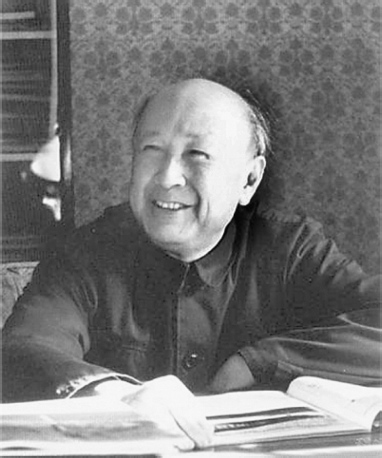
Qian Xuesen.
In the early days after the founding of the People's Republic of China, because of enormous pressure from international actors who wanted to ‘contain’ China, there was a pressing need to modernize its industries and national defence, and that need highlighted the importance of modern mechanics. The functional layout of the modern scientific system is based on the belief that mechanics is theoretical and methodological but, as a basic discipline of engineering, mechanics is the bridge between the natural sciences and engineering technology, and it provides a fundamental support for major national projects, including in aerospace, mechanical engineering, civil engineering and national defence. It can be said that a country's level of development in mechanics reflects to a large extent its industrial and national defence strength.
Before 1949, Chinese universities offered only a limited range of courses in mechanics through their machinery, civil engineering and water conservancy programmes, but there was no programme or research institute dedicated to mechanics or to the development of talent specializing in mechanics. This led to a lack of talent and a low level of research in that field. In 1956, China formulated the Long-Term Plan for Scientific and Technological Development (1956–1967) (the ‘12-year plan’), which specifically identified an urgent need to develop atomic energy and rocket technology. Against that backdrop, China's educational development plan for the basic disciplines began to emphasize subjects related to mechanics, such as aerodynamics and physical mechanics, in support of the development of the country's aviation industry. To provide theoretical support for many major construction projects, disciplines including solid mechanics and fluid mechanics were identified as priorities for development. The national scientific and technological strategy raised the importance of mechanics to an unprecedented level.
However, there was a yawning gap between the weak foundation and the national strategic goal, which Qian Xuesen and other experts in mechanics immediately became aware of and began thinking about. At that time, China's top mechanics institute, the Institute of Mechanics of the Chinese Academy of Sciences (CAS), had 86 senior and junior researchers, including only five first-rate mechanics experts at or near the international level. Barely 40 students graduated from the mechanics programme of Peking University each year, and, even if they were added to the mechanics graduates from other universities, there would be only about 300 graduates after two or three years. That talent base was obviously insufficient to meet the massive demand for mechanics talent from the top scientific projects specified in the 12-year plan. In 1958, Qian Xuesen, then serving as the director of the Institute of Mechanics, put forward a plan for conducting research to meet the requirement of ‘going up to the sky, going down into the earth and the sea and serving industrial and agricultural production’ in line with national needs. At that time, China's Two Bombs and One Satellite programme was at its initial stages. The targets were the development of atomic and hydrogen bombs and artificial satellites. CAS was an important participant in the programme and had a great need for high-calibre research talent to support its work.
On 9 May 1958, on the advice of scientists such as Qian Xuesen, Guo Yonghuai and Yan Jici, and taking advantage of the vigorous development of the ‘Great Leap Forward in Education’, the leading party group of CAS presented a proposal for the establishment of a new university to Vice Premier Nie Rongzhen, who was in charge of the programme, and the Publicity Department of the Central Committee of the Communist Party of China (CPC) (CAS, 1958). Later, Qian Xuesen mentioned this matter in his letter to Zhu Qingshi, USTC president from 1998 to 2008: ‘Forty years ago, China formulated a 12-year plan for scientific development, which required talent versed in both worlds of S&T; in view of aeronautics and astronautics as the integration of engineering and mechanics, USTC was established’ (Qian, 2008). It was against this backdrop that the Department of Modern Mechanics at USTC was conceived.
Applying the model initiated by Qian Xuesen to develop mechanics at USTC
After a massive reorganization of higher education institutions on the Chinese mainland in 1952 in accordance with the Soviet Union's model, the higher education system focused on training industrial construction talent and teaching faculty in comprehensive universities and on developing engineering science colleges, particularly specialized colleges dedicated to specific disciplines. The result was stronger technological education, and the expanded engineering colleges and disciplines provided talent that was able to absorb the technologies being introduced from the Soviet Union. In line with talent development goals at that time, the reform strengthened the development of teaching faculty and engineering talent needed for the Soviet Union's aid projects, but it also weakened the importance of basic research.
Another characteristic of the reform was the separation between sciences and engineering. Mechanics was included in the departments of mathematics and mechanics of comprehensive universities in order to develop engineers with a science background, as represented by the Department of Mathematics and Mechanics at Peking University. In contrast, engineering science colleges were geared to developing technical engineers through academic programmes designed according to industry or product categories. As a result, engineering programmes were further differentiated to serve specific industries directly. The reform shortened the duration of training and condensed and simplified relevant basic subjects, including mechanics, which was a compulsory course in all engineering programmes. This training model, while effective in developing engineers and technicians and in driving the rapid development of general industries, led to engineering graduates having a weak grounding in the basic sciences.
According to Professor Li Pei, the wife of Guo Yonghuai, a winner of the Two Bombs and One Satellite Meritorious Award, when Qian Xuesen, Guo Yonghuai and Yang Gangyi discussed the tasks of the Institute of Mechanics based on the 12-year plan in April 1958, they agreed on the need for a large number of young new-generation scientists (Guo was vice director and Yang was party secretary of the institute at that time). They also agreed that university graduates assigned to the institute in recent years had not been solidly trained, as those from Peking University were oriented towards the sciences and those from Tsinghua University towards engineering; however, the institute had a pressing need for graduates who were strong in both science and engineering (Huang, 2012). As a result, they proposed the establishment by the institute of a ‘University of Astronautics’. They discussed the idea several times, and the proposal was supported by all senior researchers at the institute.
In late April 1958, at a meeting of the directors of the Beijing-based CAS institutes chaired by Guo Moruo (the CAS president), Qian Xuesen officially submitted the institute's proposal to establish a university. The proposal received immediate support from all directors attending the meeting, as they had experienced similar problems when young researchers assigned to their institutes failed to meet their research needs. At that time, the directors of the CAS research institutes were mostly leading scientists, such as Zhao Zhongyao of the Institute of Atomic Energy, Shi Ruwei of the Institute of Physics, Ma Dayou of the Institute of Electronics, Wu Ruyang of the Institute of Automation, Wu Zhonghua of the Laboratory of Dynamics, Hou Defeng of the Institute of Geology, Hua Luogeng of the Institute of Mathematics, Bei Shizhang of the Institute of Biology, and Zhao Jiuzhang of the Institute of Geophysics. They expressed a strong interest in a new university established to meet national needs.
With the strong support of Guo Moruo, a consensus was quickly reached for CAS to establish a new university. On 9 May, CAS vice president Zhang Jinfu submitted a report concerning the matter to Vice Premier Nie Rongzhen, who was in charge of S&T. On 21 May, Nie reported it to the secretariat of the CPC Central Committee and received the approval of Premier Zhou Enlai. At a meeting of the secretariat chaired by Deng Xiaoping on 2 June, CAS was officially approved to establish a new university. A preparatory committee was formed, comprising nine members: CAS president Guo Moruo, Vice Minister of Education Huang Songling, CAS vice presidents Zhu Kezhen and Wu Youxun, CAS Academic Division Committee director Yan Jici, Qian Xuesen, Du Runsheng, Yu Wen and Zhao Shougong. The preparatory committee worked very efficiently, and, after only three months of preparation, USTC, a new university integrating sciences and engineering, opened officially at 19 Yuquan Road in the western suburbs of Beijing on 20 September 1958. All these milestone events are fully recorded in the CAS archives.
Even before the preparation for USTC, Qian Xuesen had been facing an onerous workload. He returned from the United States to China with his family on 8 October 1955. Premier Chen Yi approved the CAS report on the establishment of the Institute of Mechanics on 16 January 1956, and Qian was appointed by CAS as the director of the institute. In February 1956, Qian submitted the ‘Proposal for establishing China's defence aviation industry’; in April 1956, the Aviation Industry Commission of the People's Republic of China was founded, with Nie Rongzhen as its chair. On 18 February 1957, Premier Zhou Enlai appointed Qian as the director of the Fifth Institute of the Ministry of National Defense and the director of its first branch institute (the predecessor of today's China Academy of Launch Vehicle Technology).
Qian was the only director among all the Beijing-based CAS institutes to join the preparatory committee. To support the committee, he agreed to serve as the dean of the Department of Mechanics and Mechanical Engineering, a position that he went on to hold for 20 years (1958–1978). He recommended Guo Yonghuai, deputy director of the Institute of Mechanics, for the position of dean of the Department of Chemistry and Physics; Wu Zhonghua, director of the Laboratory of Dynamics, for the position of dean of the Department of Engineering Thermo-physics; and Jin Zengyi, deputy director of the Institute of Mechanics, for the position of vice president of USTC.
At the inception of the Department of Modern Mechanics and based on his broad international view and rich experience in big science projects related to national defence, Qian realized the importance of aligning the development of talent in mechanics with the needs of national defence projects. Despite his heavy workload, he was personally involved in the design of curricula, academic programmes and teaching plans, and he created a highly visionary talent development framework, in addition to personally giving classes and instructing students in scientific research.
Regarding the kind of talent urgently required by the nation and to be trained by the department, Qian said:
The work to integrate natural science and engineering technology and produce scientifically based engineering theories requires a different type of specialists. And this work itself constitutes a new department of knowledge: engineering science. It can be seen that, in the effort to continuously improve methods of production, we need to advance all the three departments of natural science, engineering science and engineering technology at once. It is necessary for these three departments to specialize in their own respective fields, for we definitely need natural scientists and engineering scientists as well as engineers. (Qian, 1957)
In applied mechanics, which serves engineering technology directly, engineering scientists are indispensable for making breakthroughs in key areas of aeronautics and astronautics. In China's higher education system at that time, there was no programme dedicated to training engineering scientists, which indicated a great need for a university to explore a model for their training. The training model, as an important cultural element in the initial design of mechanics at USTC, holds a special significance to this day as a concept and practice.
Today, the world is undergoing a profound transformation in science, technology, economy and society. A new round of industrial revolution gains momentum, driven by emerging technologies such as big data, cloud computing, the Internet of things (IoT) and artificial intelligence (AI). As part of this development, engineering has assumed new characteristics that are expected to become more pronounced in the coming years. Advances in engineering technology will lead to disruptive changes that will increasingly become the norm in engineering and manufacturing. Examples include digitalization, informatization and the IoT in technology; diversification, personalization and customization in scale; and macro-thinking, interconnection and platformization in industrial development. This process will be accompanied by disruptive changes in production and services as the conceptual and cultural orientation towards ‘harmonious coexistence’ gains increasing currency. These changes include cross-regional interaction and extensive collaboration in the political arena, greater empathy and inclusiveness in popular culture, and so on.
It is beyond all doubt that, as emerging technologies develop and converge to trigger disruptive trends and needs for industrial development, higher education in engineering is facing new opportunities and new challenges worldwide. In China, there are still a number of prominent structural issues in engineering education and talent training, including the gravitation of engineering education towards science education, engineering talent's lack of comprehensive hands-on abilities, a lack of clarification of the core abilities required of engineering education and a mismatch between the knowledge and skills acquired and the needs of big science projects on a national scale. It can be expected that, in the medium- and long-term strategy for the next 20 to 40 years, the new face of engineering caused by technological and industrial reform will be likely to place new disruptive requirements on the training of engineering science talent.
Since 2016, there has been an increasingly heated discussion on engineering education from a ‘new engineering’ perspective, partly because of the Ministry of Education's emphasis on the concept. The ‘new engineering’ initiative reflects China's engineering educators’ support for and reflections on major national strategies, including Internet+, Made in China 2025 and the Belt and Road Initiative. Its core goal is to create a large-scale talent training plan to meet major national and industrial needs and to include the plan quickly as part of China's higher education system to reverse the shortage of engineering science talent needed by emerging industries. As the discussion goes deeper, a series of programmatic documents, such as the Fudan Consensus, Tianjin University Action and Beijing Guidelines, has gradually been developed.
Based on the ‘new engineering’ initiative and cultural traditions such as willingness to serve the country, educational philosophy and operational wisdom passed down from the founders of engineering science, USTC has adopted a model of combining science, technology and art (design) in talent training, as proposed by Qian Xuesen in his letter to the university in 2008. According to a speech by Bao Xinhe, president of USTC, at the second Micius Forum on 14 April 2018, USTC will prioritize 18 academic disciplines in accordance with its ‘11+6+1’ blueprint (11 world-class disciplines, six interdisciplinary subjects and one system of disciplines of environment and ecology). Besides ‘new medicine’, USTC will develop ‘new engineering’, including such subjects as quantum information science, AI, big data, engineering science and new energy. In interdisciplinary subjects, it will prioritize brain science and brain-inspired intelligence; quantum information and network security; medical physics and biomedical engineering; management science and big data; mechanics and material design; information computing and communication engineering; and so on. For example, the university's collaborative teaching programme, launched in 2015, has been committed to expanding and extending ‘new engineering’ and developing talent versed in science, technology and art in cooperation with partners such as the School of Design in the China Academy of Art, Intel, IBM, Baidu and iFLYTEK.
Research–teaching integration: Then and now
From the outset, and based on his experience at the California Institute of Technology (Caltech), Qian Xuesen based his pedagogy of engineering science on a radical integration of research and teaching. With the development and deepening of this integration, collaborative innovation by USTC and CAS institutes has become a new model for talent training.
Qian Xuesen's talent development plan and its implementation
After the large-scale integration of military and civil industries in World War II, the cycle of transformation of basic scientific theories into engineering and technological applications was greatly shortened. By the middle of the 20th century, S&T required and reinforced each other and developed rapidly. This led gradually to the formation of the S&T system and the S&T education system. Technological inventions were increasingly dependent on science. In many fields, basic science research had reached a mature stage. Basic science theories continuously opened up new directions for technological advances and accelerated the application and industrialization of technology. Similarly, the advance of modern science required support from technical equipment. Driven by national science projects, equipment technology developed into a systematic supporting force after the middle of the 20th century.
In 1955, China announced its commitment to developing science. Economically, a fundamental consensus was reached: that the attainment of major economic goals would rely on advances in S&T. Politically, the international situation required China to develop top S&T for national defence to protect the country, which was a daunting task in view of the weakness at that time of the scientific community and the nation's S&T foundations. The 12-year plan put scientific and technological advances high on the agenda. It became important to make breakthroughs as soon as possible in the scientific and technological fields of key importance to national defence. There was a great need for talent equipped with both science and engineering abilities in many high-tech and national defence fields, such as atomic energy, aeronautics, astronautics, computing technology and automation. In 1957, CAS and the Ministry of Education jointly launched a temporary mechanics programme at Tsinghua University. Later, engineering universities such as Dalian University of Technology and Harbin Institute of Technology, and comprehensive universities such as Fudan University and Sun Yat-sen University, also launched their departments or programmes of mechanics.
Qian Xuesen, influenced by the Göttingen school of applied mechanics and with experience in scientific research, military science projects and teaching at prestigious institutions in the United States, had a deep understanding of developing S&T. In his view, scientific development in the 20th century had led to revolutionary changes in engineering technology, especially the invention and use of important weapons and equipment such as missiles, high-speed aircraft, radar and nuclear weapons during World War II, which fundamentally transformed production and warfare. These major inventions were clearly different from previous ones. They were not designed on the basis of engineering practice and experience; instead, they had theoretical bases in mathematics, mechanics and physics. They came about as the products of close collaboration between scientists and engineers. With this S&T relationship in mind, Qian, at the inception of the Department of Mechanics at USTC, clearly put forward its mission as being to serve major national needs through engineering science education.
The new university operated by pooling the resources of CAS and its institutes. Under this mechanism, the Institute of Mechanics was responsible for the design of the Department of Modern Mechanics, and Qian Xuesen, as the director of the institute, set about developing the department's educational goals and programmes with the aim of developing engineering science talent. Qian benchmarked the department against Peking University in sciences and Tsinghua University in engineering, and his opinions and suggestions were largely implemented in all relevant aspects, including curriculum design and the selection of teaching staff. He planned four majors for the department: high-speed aerodynamics; high-temperature solid mechanics; rock mechanics and soil mechanics; and chemical fluid mechanics. The majors represented the developmental trends of the discipline in the world at that time (USTC Archives, 1958).
Specialized courses were emphasized from the second semester of the junior year (for a long period, USTC implemented a five-year system). Besides the required courses on their respective majors, students of the department were also required to take courses in engineering mechanics (including material mechanics), theoretical mechanics and rocket technology, totalling approximately 800 class hours. These new majors in mechanics had never been offered by most departments of mechanics at other universities in China, and the courses in high-speed aerodynamics, for example, were experimental attempts never before attempted in the country.
In the senior year, in addition to graduation thesis writing, the curriculum was organized into three layers: basic courses, specialized courses and thematic courses. The specialized courses, which gave full expression to ‘institute–department integration’ (the integration of research and teaching), demonstrated the characteristics of frontier, emerging and interdisciplinary majors. Emphasis was placed on combining basic sciences and frontier research. According to Tong Binggang, a retired professor at the Department of Modern Mechanics, the high-speed aerodynamics major was led by Lin Tongji, an expert in fluid mechanics and a researcher at the Institute of Mechanics, who had rich front-line experience in the aviation industry and experience of studying in the United States and the United Kingdom. He also took charge of a full range of matters relating to the major, including curriculum design, textbook compilation, teaching staff appointments and thesis writing in the second half of the last academic year. Lin was assisted by Bian Yingui, a researcher at the Institute of Mechanics, who also had front-line experience in aeronautics and astronautics and experience of learning and working in first-rate institutions in the United States. Both Lin and Bian devoted a huge amount of effort to the work. For a time, Tong Binggang visited the 11th Office of the Institute of Mechanics almost every week to meet Lin and Bian and discuss issues involving the major and its courses before attending to specific matters at the university.
With the advocacy of Qian Xuesen, curriculum design placed a particular emphasis on interdisciplinary development. Thanks to his coordination, the courses were also delivered by first-rate researchers and experts from relevant research institutes, such as Guo Yonghuai (viscous fluid mechanics), Lin Tongji (hypersonic aerodynamics), Li Minhua (plastic mechanics) and Hu Haichang (bar and truss system, and sandwich structure). These top mechanists, who were participants in the country's cutting-edge research projects, had a solid understanding of the knowledge system of mechanics and deep insights into relevant technical issues. They informed students of the latest developments, frontier issues and solutions in their fields of study and helped them gain a solid grounding in their research fields as quickly as possible. All thematic courses were based on ongoing research programmes at the Institute of Mechanics (such as rarefied gas dynamics, high-temperature and high-enthalpy devices and testing technologies) and were usually given by young teachers.
Due to the completely new curriculum design, suitable textbooks were not available for many courses. Through the efforts of Qian Xuesen, the Department of Modern Mechanics and the Institute of Mechanics collaborated to compile 11 teaching handouts in a short time. By 1962, the first junior students (enrolled in 1958) had received their textbooks. Based on teaching practice and continuous improvement, USTC had by 1965 put in place China's first curriculum system dedicated to high-speed aerodynamics, along with the corresponding textbooks. Those textbooks represented China's latest research achievements and constituted an internationally advanced knowledge and solution case system.
Qian attached great importance to student thesis writing, considering it a transition from systematic classroom learning to the application of knowledge to real-world research work (including research on engineering solutions) and a mentored hands-on exercise of scientific research and engineering practice. Speaking of how to conduct research and write papers, Qian once shared his story of carrying out research on the nonlinear instability of cylindrical shells under axial compression—a hot issue in the international mechanics community. The issue defied classical theories with a significant difference between calculation results and experimental data. His sheets of calculations (more than 600) ended up going nowhere, but the process took him closer to the truth, step by step. Eventually, it was found that the linear theory applied only to small deformations and that a nonlinear theory was needed for large deformations. Hitting the nail on the head, Qian established a model of nonlinear instability. The final draft was a little more than 60 pages long, further reduced to 10 pages when the study was published. The story did not end there, however. Qian had spoken of this in 1961. In the 1990s, when more than 15,000 pages of his research paperwork were taken back to China from the United States, it was found that on the cover of the expanding file containing the 10 pages of manuscript, the word ‘final’ was written, crossed out and replaced by ‘nothing is final’. This episode speaks volumes for Qian's consistently rigorous attitude towards scientific research. In the eight years from 1958 to 1965, USTC produced a total of 1,000 graduates, including eight who would become academicians and nine who would become military generals. Its unique educational model of ‘research–teaching integration’ was extraordinary and prominent, and it was in no small part attributable to Qian's visionary pedagogical thought and practices.
From research–teaching integration to collaborative innovation
USTC was founded on the principle of ‘Being both responsible and professional, integrating theory with practice.’ In this motto, ‘responsible’ means serving the country through S&T, ‘professional’ means being professionally competent, and ‘integrating theory with practice’ brings out the true meaning of engineering science put forward by Qian: emphasizing the importance of theoretical knowledge and the ability to use that knowledge to solve practical problems. Being responsible is about having the right attitude, and being professional means having the required set of abilities. Over the 60 years since its founding in 1958, USTC has fully leveraged the advantages of research–teaching integration and created a unique talent development model of ‘two parts, three integrations, and a long term’, which holds a seminal significance in the history of China's higher education. ‘Two parts’ refers to the division of study into classroom learning on the university campus and the completion of specialized courses and some master's courses in research institutes. ‘Three integrations’ refers to department–institute integration, research–teaching integration and theory–practice integration. ‘A long term’ refers to comprehensively integrating undergraduate and postgraduate programmes in terms of teaching resources, curriculum systems and talent development plans to develop a long-term talent development system that integrates bachelor's, master's and PhD programmes.
On 7 July 2014, the National S&T System Reform and Innovation System Construction Leading Group adopted CAS's ‘Pioneer action plan and outline for comprehensively deepening reforms’. The plan put forward four ‘pioneer initiatives’: to achieve leapfrog development in S&T, to establish a national innovation talent centre, to establish a national high-level think tank and to build an internationally first-rate research institution. To become actively involved in the plan, the School of Engineering Science at USTC, the successor of the Department of Modern Mechanics, has entered into new types of collaboration with relevant research institutes of CAS, including the Institute of Nuclear Energy Safety Technology and the Guangzhou Institute of Energy Conversion. With steadily widening and deepening collaboration between the school and CAS institutes, the ‘base + network’ concept in the strategic design has been implemented, and various new integration platforms, such as joint colleges, S&T elite classes and joint laboratories, have been launched.
A compelling example is the CAS Research Centre for Solar Thermal Conversion, which was established jointly by the School of Engineering Science and CAS on 27 July 2009, in line with the Solar Energy Action Plan of CAS. The centre specializes in solar thermal conversion, the integrated utilization of light, thermal energy and electricity, and the development of large-scale technologies by integrating CAS strengths in fields such as thermodynamics, thermochemistry, heat and mass transfer and materials science. It aims to solve key scientific issues of solar energy conversion related to thermodynamics and energy conversion, storage and transfer; to advance the development of energy technology and technologies related to thermal energy, light and electricity; and to develop a solar thermal conversion research platform with distinctive characteristics that guides national basic research and applied research on the integrated utilization of solar energy. It works in line with the USTC spirit of ‘being both responsible and professional’. With its focus on the research and development (R&D) of key technologies, including building-integrated photovoltaics/thermal systems, low- and medium-temperature solar thermal technology and low- and medium-temperature solar power generation, the centre has established an integrated testing and demonstration platform committed to developing innovative talent in solar energy and has exemplified the meaning of ‘engineering science’.
Education based on science–engineering integration to produce top scientists and national defence researchers
In a People's Daily article of 13 November 2018 titled ‘Being responsible and professional, serving the country through S&T’, Yang Jinlong, vice president of USTC and executive vice president of the USTC Graduate School, was quoted as saying, ‘Being professional speaks of USTC's scientific spirit and pursuit of innovation and expertise. Over 60 years, USTC has produced a large number of top scientists and engineers in diverse fields who are trained across disciplines and versed in both sciences and engineering.’
The period from its establishment in 1958 to the eve of the ‘Cultural Revolution’ in 1965 was the first stage of USTC's development and a golden period for the university. In those seven years, the Department of Modern Mechanics had established a complete and new training system and had cultivated an impressive amount of top talent.
The Department of Modern Mechanics of the School of Engineering Science currently has 46 full-time faculty members, including 30 professors and 14 associate professors. The faculty team is young and highly competitive. It includes one CAS academician, six recipients of the National Science Fund for Distinguished Young Scholars, six recipients of the Excellent Young Scientists Fund, five scholars supported by the national ‘1,000 Talent Plan’ Youth Project, and nine supported by the CAS Hundred Talent Programme. The discipline of mechanics is a national key first-level discipline. The research team consists mainly of the innovative research group for ‘complex flow with vortex and interface’ supported by the National Natural Science Foundation of China, the CAS Key Laboratory of Mechanical Behaviour and Design of Materials, and the Institute of Applied Mechanics.
Among the 1,000 graduates in the eight years from 1958 to 1965, there were eight academicians (Bai Yilong, Xu Jianzhong and Wang Ziqiang enrolled in 1958, Wu Yousheng and Du Shanyi enrolled in 1959, and Yang Xiumin, Fan Weicheng and Liu Lianyuan enrolled in 1960). In particular, the first two classes (1958 and 1959) of the Department of Modern Mechanics, to which Qian Xuesen gave courses in person, graduated five academicians, or one academician per 100 graduates. In addition, graduates of the department during the eight years included nine generals, including seven major generals and two lieutenant generals (Yang Xiumin enrolled in 1960, and Jiao Anchang enrolled in 1961). They worked on the development of national defence technology. Therefore, in addition to one academician per 100 graduates, there were nine generals per 1,000 graduates. Yang Xiumin was both a general and an academician, so the combination of the eight academicians and nine generals gives a total of 16 people rather than 17. In addition, according to incomplete statistics, the 1,000 graduates also included 375 professors, researchers and professor-level senior engineers. With the academicians and generals, the total number is brought to 391. In other words, nearly 40% of the 1,000 graduates were promoted to senior specialized technical positions.
Bai Yilong graduated from the Department of Modern Mechanics in 1963. He was elected to CAS as an academician in 1991 and was elected to the European Academy of Sciences in 2002. He served as president of the Chinese Society of Theoretical and Applied Mechanics, director of the Academic Committee of the State Key Laboratory of Nonlinear Mechanics, and director of the Department of Mathematics and Physics of the National Natural Science Foundation of China. He received many prestigious prizes and awards, including Second Prize of the National Natural Science Award (1992, first winner, in thermoplastic shear belts), the Ho Leung Ho Lee Prize (1999) and the John Rinehart Award (2007).
Xu Jianzhong graduated from the Department of Modern Mechanics in 1963. He was elected to CAS as an academician in 1995. As an expert in engineering thermophysics, he serves as a researcher at the Institute of Engineering Thermophysics and as director of the National Energy Wind Turbine Blade R&D Centre.
Du Shanyi graduated from the Department of Modern Mechanics in 1964. He is an expert in the structural mechanics of aircraft and composite materials and an academician of the Chinese Academy of Engineering. He served as vice president of the Chinese Society of Theoretical and Applied Mechanics, president of the Chinese Society for Composite Materials, and a member of the advisory group of major national research programmes. He is currently the dean of the School of Engineering Science at USTC, a member of the S&T Committee of the State Administration of Science, Technology and Industry for National Defence, and a member of the advisory group of the Commercial Aircraft Corporation of China.
Fan Weicheng graduated from the Department of Modern Mechanics in 1965 with a major in engineering thermophysics and has been working at the university since graduation. He became vice president of USTC in 1996 and was elected to the Chinese Academy of Engineering in 2001. As an expert in fire safety science and engineering, he serves as director of the State Key Laboratory of Fire Science and dean of Hefei Institute for Public Safety Research, Tsinghua University.
Jiao Anchang graduated from the Department of Modern Mechanics in 1966 with a major in aerodynamics. He served as deputy director of the S&T Committee of the General Armaments Department of the Chinese People's Liberation Army (PLA) from January 2002 to December 2005. With the rank of lieutenant general, he is the commander of a military base and director of China Aerodynamics R&D Centre.
Jing Yinglong graduated from the Department of Modern Mechanics in 1965. He served as deputy director and director of the Political Department of the Air Force of Ji'nan Military Area from April 1994 to 1999. He was awarded the rank of major general in July 1995. He became deputy director of the Political Department of the PLA Air Force in December 1997.
Yang Xiumin graduated from the Department of Modern Mechanics in 1965. He was a senior engineer at the Fourth Institute for Engineering Staff of the General Political Department of the PLA. His expertise covers the numerical simulation of weapons explosion effects, theoretical analysis of protection engineering, and systems verification. He has participated in several nuclear field tests.
There are many scientists and defence technology experts like them. By following Qian Xuesen's concept of training engineering science talent and adhering to the ‘two integrations’ (sciences–engineering integration and teaching–research integration) and the ‘three first-rates’ (first rate top-down design, first-rate teaching faculty and first-rate students), the Department of Modern Mechanics achieved glorious success in USTC's first stage of development.
Orienting theoretical disciplines to real-world applications
Involving students in scientific research from the early years of study is a tradition at USTC, where students are required to do laboratory research with their supervisors and PhD students from the first year.
Emphasizing practice in the education process
USTC's emphasis on practice equips students with high-quality research skills, such as the ability to consult frontier work and research literature.
Students’ involvement in scientific research and engineering projects from the freshman year
USTC was established as a science-focused university, it has encouraged students to be involved in scientific research from their first year, so that they can combine theoretical knowledge with practice. For example, the Department of Modern Mechanics established an artificial rain rocket R&D group and a pulse jet engine R&D group in 1958 and a wind turbine generator R&D group in 1959. Despite his heavy workload, Qian Xuesen managed to answer questions for the rocket R&D group (such as by explaining the reason for unstable combustion in solid-fuel rocket engines) and offer suggestions (such as putting small rockets into the service of agriculture and meteorology through such applications as artificial rain generation and hail mitigation).
According to Zheng Zhemin, a colleague of Qian at the Department of Modern Mechanics and at the Institute of Mechanics, Qian had very rich experience in field research as well as theoretical research and teaching. As early as 1937, when Qian was studying at the Aerospace Engineering Department of Caltech, he and his classmates formed a five-member rocket research group to research solid-fuel rockets. The group's first result was a small rocket designed to help aircraft take off from short runways. The group later formed a company to which Qian served as adviser. After the company began achieving positive results, Qian gave a summary report at USTC's first scientific research conference on its attempts to make artificial rain rockets and pulse jet engines, and in this way inspired the innovative spirit of the students.
After several discussions, the students of the class of 1958 decided to dedicate the results of their pulse jet engine R&D project to the 10th anniversary of the establishment of the People's Republic of China. By the beginning of the second semester of 1959, the project had made significant progress. In early September, however, the assembled rocket failed to ignite and did not work properly despite several attempts. Just when everyone was at their wits’ end, Qian Xuesen came to the R&D group and explained to them the thermal process of the pulse jet engine. On 28 February 1960, USTC convened a scientific research conference where Zhu Xiaoguang, representing the majors of mechanics and engineering thermophysics, gave a report on the trial production of the artificial rain rocket, and Huang Kaixi gave a report on the trial production of the pulse jet engine. Qian summarized the reports. He spoke highly of the R&D activities of the sophomore students. In his view, they had reason to be proud of their accomplishments, which, though not scientifically significant, allowed them to get close to leading-edge technologies and would prepare them well for their future scientific research work.
Currently, USTC has many interest groups through which students can participate in laboratory research activities according to their interests. As a result, USTC undergraduates have reached the academic level of postgraduates of many other universities.
Developing talent through frontier research in S&T
In an article published in the People's Daily on 26 May 1959, Qian Xuesen stated that, apart from the division into specialized basic courses and general basic courses, courses at USTC could also be divided into basic theoretical courses and basic technological courses. This arrangement was in line with USTC's mission to train engineering science talent, which differentiated it from all other Chinese universities. According to Qian (1959), ‘USTC graduates will engage in research in new sciences and new technologies after graduation, which will lead them into uncharted waters and require them to explore and feel their way ahead. Their exploration should not be blind, but be based on previous research.’ Previous research constitutes a mature system of basic disciplines. ‘USTC is for training scientific and technological leaders, and its students must be well prepared for their future research work.’ Research in new sciences and new technologies requires talent versed in both sciences and engineering.
Emphasis on theories and technologies was a key characteristic of the courses of the Department of Modern Mechanics (Qian, 1959). For example, the two disciplines of highspeed aerodynamics and high-temperature solid mechanics had the same basic courses and credit hours; their basic courses were divided primarily into basic theories and basic technologies, with the former mainly consisting of advanced mathematics, general physics and general chemistry.
Basic disciplines were emphasized because mechanics, as a classic discipline in engineering science, is founded on them. Physics is the source of the most fundamental principles of mechanics, mathematics is an indispensable research tool, and engineering science provides the theoretical base for engineering technologies. Therefore, at the third meeting of deans at USTC, the participants focused their discussions on the allocation of credit hours to basic courses and arrived at the decision to divide advanced mathematics into two types: Type 1, spanning two and a half years with 430 credit hours, and Type 2, spanning a year and a half with 260 credit hours. The departments of mechanics, applied mathematics and computer technology were included in Type 1 (Qian, 1959).
In the two disciplines of high-speed aerodynamics and high-temperature solid mechanics, complex chemical changes should be fully considered. In the development of cutting-edge engineering technologies, in particular, mechanists were supposed to come up with solutions to problems encountered in production, and this called for the full use of existing physical and chemical achievements, pointing to the necessity of a strong grounding in mathematics, physics and chemistry. Given the complexity of real-world engineering problems, which often involve different disciplines, researchers were required to have a solid training in a broad range of basic disciplines in order to investigate and solve problems of engineering science.
Another important course category was basic technological courses, including engineering design technology (mechanical drawing and mechanical design), experimental technology (electrical engineering and electronics; electronic measuring of non-electrical quantities) and computing technology (computing methods and computers). These courses offered the most basic training for engineering students. They were tools for engineering implementation, and they were as indispensable in scientific research as physics and mathematics. Only by mastering the basic tools of engineering technology could students apply basic scientific knowledge to solve engineering science problems and make experimental data go beyond the laboratory to practical engineering.
Basic courses in both categories were included in the general courses at USTC, where the first three years were mainly dedicated to basic courses. General courses took up half of the total credit hours, and basic theoretical courses and basic technological courses featured prominently. Compared to the departments of mechanics at comprehensive universities, such as the Department of Mathematical Mechanics at Peking University, and engineering programmes at multidisciplinary engineering universities, such as Tsinghua University, the Department of Mechanics at USTC had more credit hours for basic theoretical courses than the related programmes at Tsinghua University (which focused on engineering design) and also far more credit hours for basic technological courses than the Department of Mathematical Mechanics at Peking University (which focused on mathematical and scientific computations). This emphasis reflected the concept of science–engineering integration in the training of engineering science talent, which differentiated itself from the talent training philosophies of basic disciplines and engineering disciplines.
In Qian Xuesen's view, while natural science was undoubtedly the foundation of engineering technology, it did not inherently include the laws of engineering technology. Actually, the research methodology of engineering science is based on the integration of the research methods of natural science and those of engineering technology. However, applying theories of natural science to engineering technology is not a straightforward matter of theoretical reasoning; it requires the integration of scientific theories with engineering technology. Therefore, a scientifically grounded engineering theory is neither natural science nor engineering technology but an organic combination of the two. Research in new sciences and new technologies requires talent that spans both science and engineering. In the process of exploring new knowledge, it is important to adhere not only to theory and technology but also to an objective scientific spirit and noble scientific ideals and values from a cultural perspective.
Engineering science at USTC in its third stage: Frontier undergraduate education epitomized by RoboGame
At USTC, robotics is not only a field of frontier research but also a training ground for innovative talent. The Intelligent Mechanics and Robotics Laboratory at the School of Engineering Science began training robotics talent as early as the late 1990s and sent its first team to the fourth RoboCup held in Australia in 2000. The school offers a course in robotics study that combines theoretical learning and hands-on practice to build undergraduates’ practical ability and develop their innovative spirit. After completing the course, interested students can apply to study in the laboratory. After some time spent there, top-performing participants are selected and assigned research tasks. If RoboCup is an arena of top-level competition, then the annual RoboGame competition at USTC is an extracurricular S&T event geared to promoting robotics among USTC students, and it attracts hundreds of students every year. The participants design programmes, fabricate and assemble hardware in their spare time, and put on show the robots they have created using multidisciplinary knowledge and skills. The competition has created a strong environment for robotic research at the university.
USTC organizes a RoboGame competition each year. It has been a tradition since 2001. To participate in the competition, each team is given five months and a certain amount of funds for the design and creation of a robot. A team cannot have more than five members. They must be junior and lower grade students, and may be from different schools or departments. The competition has two components: one is performance-oriented and the other is contest-oriented. Every year has a unique theme selected from many alternatives solicited from the students and decided by the students through a vote. After years of development, RoboGame has become a unique and widely influential hands-on programme for education, students’ innovative research and science popularization at USTC that integrates a robot design course, competition and performance. Students can take optional courses to acquire the necessary knowledge and skills to participate in the competition, and their class performance, design and creation will serve as the basis for the determination of course credits. In addition, innovation practice credits are awarded on the basis of performance in the competition. By integrating education with competition and by combining technological innovation and stage performance, RoboGame has played a positive role in stimulating students’ enthusiasm for learning, exploration and innovation, fostering their innovation, collaboration and leadership abilities.
Kejia, an intelligent service robot independently developed by USTC, won the 18th RoboCup championship. This is the first time a Chinese-made robot has taken first place in the international standard service robot test, marking a historic breakthrough for China's service robot R&D. Meanwhile, USTC has won five 2-D robot simulator championships and five runner-up titles.
The spirit of engineering science at USTC is not only reflected in real-world applications of frontier knowledge, as in robot competitions and the effective release of innovation potential, but is also known beyond the academic community through achievements with social impacts, such as the robot Jiajia. The university began research in intelligent robotics in 1998. In 2008, on the eve of the ‘birth’ of Jiajia, the university launched the Kejia Project, dedicated to independent R&D on service robots, including both software and hardware. The Kejia Project has become an interdisciplinary robotics research platform. Since 2012, Kejia has received a succession of awards, including first place in the national standard test of service robots for three consecutive years. Despite being one of the intelligent service robots to receive the greatest number of awards internationally, Kejia lacked a recognizable public identity of the kind most of its international peers had, which was much to the embarrassment of the USTC team. Therefore, designing a visual identity for Kejia was put on the agenda.
In July 2012, the Kejia team solicited real-life models among female USTC students for the visual identity design of Kejia, and five students were selected as the prototype for Kejia's appearance. After discussions, it was determined that the visual identity should manifest kindness, diligence and intelligence. The result was the now well-known Jiajia. According to the research team, Jiajia displayed the three qualities well.
In 2015, after much research and deliberation, the team further refined the visual identity of Jiajia and finalized the overall image by endowing it with a unique temperament and personality. Later, the team collaborated with a mannequin manufacturer in Xi'an to create a lifelike Jiajia with intelligent and graceful looks. In April 2016, the third-generation intelligent interactive robot developed by USTC, Jiajia 3.0 (Figure 2), came into being. The new-generation Jiajia is capable of extensive advanced functions, including conversation, matching of facial micro-expressions and body gestures and dynamic autonomous navigation. In addition to being a USTC brand in its own right, Jiajia expresses the spirit of engineering science on the USTC campus.
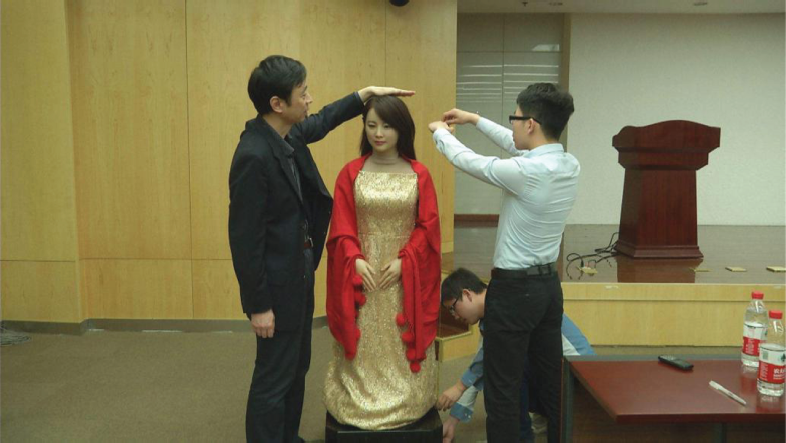
Jiajia, the interactive robot.
Scientific culture is an important part of the human economic and social system, and its characteristics evolve with economic and social development. This determines that the advocacy of scientific culture has different values and emphases at different stages of economic and social development. Scientific culture not only enriches science with a cultural dimension but also reveals the social and cultural effects of science in a critical or reflective way. It thereby provides inspiration for the construction, enrichment and renovation of human culture. Our mission is to construct a cultural prototype, an ideal cultural blueprint and a cultural value system on the basis of the normal development of the scientific community, so as to provide spiritual underpinning and conceptual support for social progress. It is through navigation by the scientists and leaders in cultural design, such as Qian Xuesen, that USTC has formed its unique cultural ambience and orientation in a thoughtfully constructed scientific community culture.
Interdisciplinary education, science–engineering integration and science–engineering–art integration
USTC has been committed to expanding its philosophy of educational integration to encompass new fields.
Training talent by integrating science and engineering
With the rise of Internet technology and emerging technologies such as AI and the IoT, two major approaches to scientific and technological research and higher education have emerged. The first approach is applied science, such as applied mechanics, which was born out of the transition from the separation between basic sciences and engineering technologies to their integration. The process was significantly driven by the Göttingen school of applied mechanics represented by Felix Klein and Ludwig Prandtl, and the GALCIT (Graduate Aerospace Laboratories of the California Institute of Technology) school of applied mechanics represented by Theodore von Kármán. For example, in the development of aerodynamics and aircraft technology, the boundary layer theory and the aerofoil theory led to the advance from biplane to monoplane, and the compressible flow theory led to the breaking of the sonic barrier, realizing supersonic flight. In his book, Aerodynamics: Selected Topics in the Light of their Historical Development (written in 1954 in commemoration of the 50th anniversary of powered flight), von Kármán noted that aerodynamics was an example of cooperation between mathematicians and creative engineers. Mathematical theories were found suitable to describe the airflow produced by aircraft with such accuracy that they could be applied directly to aeroplane design. It was this kind of marriage between S&T that gave rise to a model of higher education centred on academic research, represented by modern research universities that integrate scientific research and teaching to train innovative talent.
Qian Xuesen was a student of von Kármán and also an outstanding representative of the GALCIT school of applied mechanics. He played an important role in driving the development of high-speed aerodynamics and jet propulsion technology, integrated and carried forward the quintessential ideas of the Göttingen and GALCIT schools of applied mechanics, and developed his own concept of engineering science and related educational concepts. As early as the 1940s and 1950s, Qian had anticipated the rise of high technology in extensive areas and was advocating the development of a group of applied sciences, which he collectively referred to as ‘engineering science’, to support it.
In his words, ‘The sector of natural science and technology has basic sciences (such as physics and chemistry) at its top layer and finds actual application through engineering technology at its bottom layer and between the two is engineering science.’ He sandwiched the two layers together with a middle layer called engineering science, which ‘is born from the integration of natural science and engineering technology and is a science in the service of engineering technology’. He advocated that ‘we need to advance natural science, engineering science and engineering technology at once.’ Qian considered it to be infeasible to train talent in engineering science through conventional engineering education, because engineering science was on a mission to create scientifically sound engineering theories, which ‘is highly difficult and highly creative’. Thus an entirely different type of specialist was needed to do the work (Qian, 1957).
The establishment of the Department of Modern Mechanics at USTC provided a platform through which Qian could put into practice his educational concept of training engineering science talent. It was the longest, most committed and most systematic educational activity conducted by Qian after his return to China, and it created a successful paradigm for training engineering science talent in a new model. Qian and other scientists of the older generation had, at the very inception of USTC, laid down its educational principle of ‘running the university based on all available resources of CAS and integrating departments and CAS institutes’ and specified the goal of training top-level scientific and technological talent. The top-down framework design, including the majors and the curriculum system, also demonstrated the concept of science–engineering integration and teaching–research integration. Based on the principle and concept, the university has developed its distinctive educational model.
Emphasis on basic courses is one of the signature features that differentiates USTC from other engineering universities, and it is a tradition that the university has adhered to over the 60 years since its establishment. In his article titled ‘Basic courses at USTC’ published in People's Daily, Qian (1959) exposited the significance, scope and learning methods of the basic courses:
We emphasize basic theories for the reason that USTC graduates will engage in research in new sciences and new technologies, which will lead them into uncharted waters …Therefore, they will have to rely more on general knowledge …[and] general laws of nature …especially the laws about the structure, properties and motion of things, i.e., physics and chemistry, which will serve as a compass in their research exploration …the development and growth of new fields of mechanics cannot go without the progress of experimental techniques, and these experimental techniques have been developed on the basis of many achievements of modern physics and chemistry.
At USTC, the basic courses were divided into theoretical courses, including mathematics, physics and chemistry; technological courses, including engineering design technology, experimental technology and computing technology; and foreign languages (Figure 3). Theoretical courses accounted for approximately one-third of the total credit hours, and technological courses for more than 10 percent. Therefore, the university had significantly more theoretical courses than conventional engineering universities and significantly more technological courses than conventional science programmes. This arrangement clearly expressed the concept of science–engineering integration.
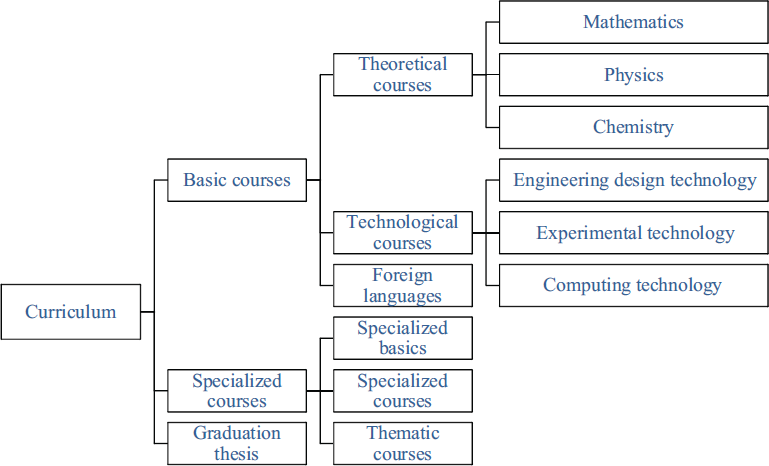
The curriculum system at USTC.
In 1958, when China developed its first electronic computer, Qian Xuesen added the Theory of Electronic Computer course to the curriculum of the Department of Modern Mechanics. As there was no algorithmic language at that time, students had to write programmes using binary code, completely unlike today, when computers have become a common tool used in all complex mechanical computations. After rigorous basic training, students mastered three sets of basic knowledge and abilities: solid mathematical grounding and computational and analytical skills; solid basic physical and chemical knowledge; and principles and corresponding practices of engineering design.
Qian Xuesen planned the academic disciplines of mechanics and engineering at USTC with the strategic aim of accelerating the training of top-level talent for China's aerospace programmes. The university's educational system focused on the integration of science and engineering and was geared to training engineering science talent: research-oriented engineers capable of keeping abreast of the latest developments of engineering technology and equipped with solid natural science knowledge and leadership abilities. Under the guidance of Qian's thinking on the development of engineering science talent, the Department of Modern Mechanics became a pioneer in training talent that spans science and engineering, and its approach influenced other departments at the university. By adhering to the goal of training talent with solid and broad basic knowledge and deep up-to-date expertise in specialized areas, and by promoting the ‘2 + X’ model of general science education and specialized training (students take general courses in the first two years and select a specialized discipline in the third year, according to their interests), USTC formed a distinctive educational system for training top innovative talent in S&T and graduated a great number of interdisciplinary scientists and engineers.
Although there have been many updates and changes in extensive aspects of the academic programmes (including teaching plans, curricula and textbook content) in line with developments in S&T, USTC has always adhered to the goal of training research talent in engineering science and has always emphasized the integration of science and engineering and of teaching and research.
In his later years, Qian Xuesen continued to pay close attention to the development of USTC. During the 50th anniversary of the university in 2008, he wrote a letter to CAS vice president Bai Chunli to celebrate the anniversary. In the letter, he said:
USTC has selected a right path in its emphasis on integrating science and engineering. As it develops further, it can aim at the greater integration of science, engineering and art. I believe USTC will certainly be able to train internationally first-rate scientists and technology leaders in the future. 1
With the quick succession of technological breakthroughs and cross-boundary integrations since the dawn of the 21st century, emerging technologies such as AI, clean energy, automated control, quantum communication, virtual reality, bioinformatics and genetic engineering have come to take centre stage in S&T. The inherent need of modern S&T for cross-boundary integration and interdisciplinary research has further advanced the integration of S&T at a deeper level, and this has validated the concept of engineering science put forward in the early part of the 20th century.
The requirement for talent with broad interdisciplinary expertise in both science and engineering has significantly influenced not only frontier research areas but also the transformation of education in engineering universities. The Excellent Engineer Training Programme and the design of ‘new engineering’ are appropriate adjustments to address new challenges after the inadequacy of traditional science and engineering education has been realized. With the business world attaching increasing importance to user needs and user experience, the integration of science and art represents new thinking and exploration, as well as a new trend. This is reflected, for example, in the progression of industrial design to information and network design (interface design, interaction design and so on), information aesthetics, AI agents design and the new field of life aesthetics, including gene editing, which poses new challenges for greater integration of engineering science and technology. Qian Xuesen, with his keen foresight, conveyed this visionary concept to USTC, which he served for 20 years.
Summarizing the educational concept and spiritual values of the Department of Modern Mechanics and the School of Engineering Science
Scientific culture is science seen from the cultural perspective. It penetrates a broad spectrum of scientific activities by speaking not only to the technological, empirical, mathematical and logical dimensions but also to the dimensions of spirit, concepts, ideals and values. USTC was established as a new type of university, drawing upon the example of Caltech. The integration of science and engineering has always played a crucial role in shaping its scientific culture.
According to CAS academician Tong Binggang, who enrolled in 1958 in highspeed aerodynamics, the scientific spirit of the Department of Modern Mechanics, the predecessor of today's School of Engineering Science, was shown in four main aspects. The first aspect was its striving spirit. At that time, courses were very strenuous and demanding, to the extent that the dorms were mostly still empty at 11:00 at night, and Sundays were for self-study in the classroom rather than rest. During the busiest periods, classrooms were always full of students night and day, because the early risers would arrive before those burning the midnight oil had left. This reflected USTC's characteristics of heavy academic load, long class hours and deep lecture content. In the words of a popular saying of that time, ‘Poor students go to Tsinghua University, rich students go to Peking University, and strong-willed students go to USTC.’ The second aspect was its innovative spirit. USTC was on a mission to train top talent in frontier S&T, which could be demonstrated in the words of its anthem, ‘We scale the height of science, the steadily ever rising height of science.’ Thanks to the integration of institutes and departments, students were able to learn the latest scientific knowledge and access the newest scientific findings. The third aspect was its rigorous scientific spirit. Qian Xuesen often urged students to be serious, rigorous and strict in scientific research. The fourth aspect was its democratic spirit. Imbued with the scientific spirit of scientists of the older generation, the USTC campus always had an encouraging academic environment and rich academic atmosphere. Most teachers in the early years of USTC also served the CAS institutes. The full-time teachers were very young and took on important research projects at a very early stage; they quickly stood out and had a lot of research opportunities to choose from.
An organization's culture is always faced with a colourful road map of options in its orientation, formation and development. USTC's development in engineering science, including the formation of its cultural elements, the talent training model, its emphasis on practice and development as a platform, is based on the wisdom of its designers and the practice of countless successors. USTC has been able to live up to its motto of ‘being both responsible and professional, integrating theory with practice’ and to form the distinctive scientific spirit and cultural orientation of the engineering discipline that integrates science and engineering.
Footnotes

Author biographies
Yumei Tang is an assistant researcher at the Institute of New Media Research, University of Science and Technology of China. She graduated in 2016 with a master's degree from the Product, Ceramic and Industrial Design Programme at Central Saint Martins.
Yun Zhu is a lecturer at the School of Cultural Creativity, Communication University of Zhejiang. She graduated in 2017 with a PhD from the Centre for Scientific Communication Research and Development, University of Science and Technology of China. Her main research area is cultural communication.