




Abstract
Purpose:
This article examines how 34 teachers self-assessed their work with the nine Assessment for Learning (AfL) strategies in teaching and their own suggestions for improvement as evidenced by the reflective statements given on reflection forms.
Design/Approach/Methods:
The sample was a group of 34 teachers from 10 primary schools and 10 kindergartens who have participated in the project. School Development Officers (SDOs) were assigned to conduct class observations in the schools, in which they recorded whether the teachers had used the AfL strategies in teaching. The SDOs would also share and discuss the comments with the teachers who had returned the self-reflection forms in which they wrote their feedback on the research questions.
Findings:
The findings show that teachers in kindergartens and teachers in primary schools might have different emphases on the nine AfL strategies in teaching. Their own suggested room for improvement in practicing AfL skills has provided insights for enhancing teaching effectiveness.
Originality/Value:
We propose that reflective practices can generate a “reflective spiral” of planning, acting, observing, and then reflecting. The study shows that reflective practitioners become professional experts who are able to assure the quality of teaching by self-enhancement and self-improvement.
Keywords
Background
While Early Childhood Education in Hong Kong has undergone dramatic changes related to the education reform of curriculum development and school improvement during the past few years, the Education Bureau of Hong Kong SAR (EDB, 2010a) states that “the aim of pre-primary education in Hong Kong is to provide children with a relaxing and pleasurable learning environment to promote a balanced development of different aspects necessary to a child’s development, such as the physical, intellectual, language, social, emotional and aesthetic aspects” (section 1 “pre-primary services,” para. 3). Therefore, pre-primary education is intended to provide children with a significant foundation for life-long learning and whole-person development.
Although both kindergarten and primary school teachers are now facing the increased expectations of the present education reform, they can also benefit directly from the professional development and training available from the process of academic expansion. What teachers need most is to enhance their teaching skills from pedagogic knowledge. When discussing the instructional practice of teachers, it is believed that “effective self-reflection is a key component of excellent teaching” (Bell et al., 2010, p. 57), and “reflective practice can be a beneficial process in teacher professional development” (Ferraro, 2000, para. 1).
The aim of this article is to review the work on teachers’ reflective practice, which has been identified from teachers’ reflective statements followed by class observation of their teaching exercise in a school improvement project.
The trend of reflective practice in Early Childhood Education in Hong Kong
In 2000, the Hong Kong SAR Education Commission (2000) published Learning for Life, Learning Through Life: Reform Proposals for the Education System in Hong Kong, which proposed initiatives “to enhance the professional standards of early childhood educators” (p. 49, para. 8.1.4) and “to enhance quality assurance mechanisms” (p. 56, para. 8.1.19). Learning from this, it is essential to upgrade the academic qualifications of early childhood teachers. Later, the Curriculum Development Council of Hong Kong SAR (CDC, 2006) published the Guide to the Pre-Primary Curriculum to provide “general directions for curriculum development for pre-primary practitioners: to widen the space for learning; to be child-centered; to respect individual differences; to promote motivation for learning and to care for children’s needs” (p. 10). In other words, there is a trend toward educating kindergarten teachers to be reflective practitioners “who review, reconstruct, reenact, and critically analyze their own and their students’ performances, and who formulate explanations with evidence” (McIntyre & O’Hair, 1996, p. 2). To put it simply, reflective teachers determine the curriculum and instruction proactively. They introduce practices to improve classroom teaching and make an impact on their students, school, and community. Bell et al. (2010) highlight Kahn et al.’s (2006) review that reflective practice exerts several benefits for academic development, including “increased capacity for reflective processes; enhanced capacity for practice; development of personal qualities; establishment of supportive relationships between those involved in the reflective processes; and transformation of practice” (p. 58). It is understandable that self-reflective exercises can enhance teachers’ ability to facilitate and support teaching and learning with appropriate performance. In short, “reflective teachers scrutinize their procedures, make decisions, and alter their behavior” (Tompkins, 2009, p. 223) when practicing teaching and promoting a good learning environment for students. Indeed, if engaging teachers in analyzing their own thoughts for personal inspection, introspection, and analysis, teaching can be improved (McIntyre & O’Hair, 1996). That is why there is a trend of carrying out self-reflection by teachers after teaching, in order to enhance professional effectiveness. Reflecting on their practice, teachers can improve their teaching techniques and acquire new knowledge of learning theories and teaching methods.
What is Assessment for Learning?
Traditionally, assessment has been used in competitive ranking students’ achievement in learning (Connell et al., 1982, p. 185) and inevitably produces academic winners and losers even since the children first enter their elementary class. Students, who succeed early, will build on winning streaks to learn more as they grow; whereas, those who fail early will often fall farther and farther behind (Stiggins, 2007, p. 22).
According to Nisbet (1993), assessment has pervasive influence in schooling as it affects how children learn and how teachers teach. It always impacts on the learning process through the washback effect (Alderson & Wall, 1993), cramming and rote learning—to the extent that learning for assessment is almost as important as the genuine learning, which these assessments are originally devised to measure (Nisbet, 1993, p. 25).
Education today has shifted from its “sorter and sifter” role to a gap-bridging role for learning differences found in classrooms. As teachers, our mission is not to “let students who have not yet met standards fall into losing streaks, succumb to hopelessness, and stop trying” (Nisbet, 1993, p. 25), instead we must strive on assisting them to experience success in learning according to their own pace. Thus, the purpose of adopting assessments in the curriculum evolutes from verifying learning to supporting learning, that is, Assessment for Learning (AfL)—assessment that has learning as its object and through which our students understand where they are and what they can do next in the process of learning (Connell et al., 1982, p. 200). As Stiggins (2007, p. 22) states, “Rather than sorting students into winners and losers, assessment for learning can put all students on a winning streak.” By analyzing 250 papers on formative assessments in classrooms by researchers in different countries, Black and Wiliam (1998a, 1998b) found that formative assessment could improve students’ learning substantially through:
provision of effective feedback to students;
active involvement of students in their own learning;
adjustment of teaching after taking account of assessment results;
recognition of the profound influence of assessment on students’ motivation and self-esteem; and
the need for students to assess themselves and understand how to improve.
Black et al. (2004, p. 10) further define that AfL “is any assessment for which the first priority in its design and practice is to serve the purpose of promoting students’ learning” through providing useful information in modifying learning and teaching. In order to promote better learning, schools are encouraged to put more emphasis on AfL as an integral part of the learning, teaching, and assessment cycle. This means that the curriculum is responsible for setting out what students should learn in terms of learning targets or objectives, while the assessment serves as a means to collect evidence of student learning by assessing both the learning product (i.e., the learning targets and content that students are expected to achieve) and the learning process (i.e., how they learn). Most importantly, teachers should use the information collected by the assessment practice as the basis for decisions on improving learning and teaching, and informing students about their strengths and weaknesses. At the same time, students’ motivation and interest of learning will be reinforced with teachers’ recognition of their achievements and provision of necessary steps for improvement (Black & Wiliam, 1998a; CDC, 2001). Another important function of AfL is facilitating students’ self-evaluation so that they can become independent learners in the future.
AfL is a connection of learning and teaching with assessment. This is a way to narrow the “gap” between students’ learning and the desired goal. When teachers practice AfL, students know what they are expected to learn. Throughout the teaching process, teachers and students work together to assess students’ learning and achieve learning improvement ultimately as students are informed with their learning performance. In this case, self-reflective formative assessment is urged, and AfL will occur at different stages of the learning process.
It is acknowledged that every student is unique and has his/her own ability and various potentials. In order to promote better learning, AfL has been conducted “as an integral part of the curriculum, learning and teaching, and feedback cycle” (EDB, 2010b, para. 2). In the report entitled Learning to Learn—The Way Forward in Curriculum Development, it was recommended that more emphasis be put on AfL (CDC, 2001, pp. 80–81). It is important that teachers “identify and diagnose student learning problems, and provide quality feedback to students on how to improve their work” (EDB, 2010b, para. 1). In line with the above ideas, teachers in the AfL project are encouraged to (a) share their learning goals with their students at the beginning of the lesson, (b) utilize effective questioning techniques to tap students’ understanding, (c) use effective feedback strategies, and (d) encourage peer and self-assessment to enable students to recognize their strengths and weaknesses for improving their own learning. Besides, “collection of pupil’s learning evidence” and “reflection on teaching and learning” are the other two dominant elements to achieve the aim of AfL (see Figure 1). Teachers regularly collect evidence and revise data from a variety of information sources including students’ work in progress, portfolios, observation, interactive conversation, and so on. With the evidence and revised data, teachers can provide quality feedback to the learners who are then capable of reaching new levels of learning and achieving their full potential. In the self-reflective process, “the individuality of feedback, by its very nature, has the facility to support weaker learners and challenge more able learners” (Jones, 2005, p. 5). With formative assessment, teachers can know the progress of students’ learning and make necessary adjustment, try alternative instructional approaches with minor modifications or major changes to support further teaching and learning, and offer more chances for practice in order to permit students to set their own goals (Boston, 2002).
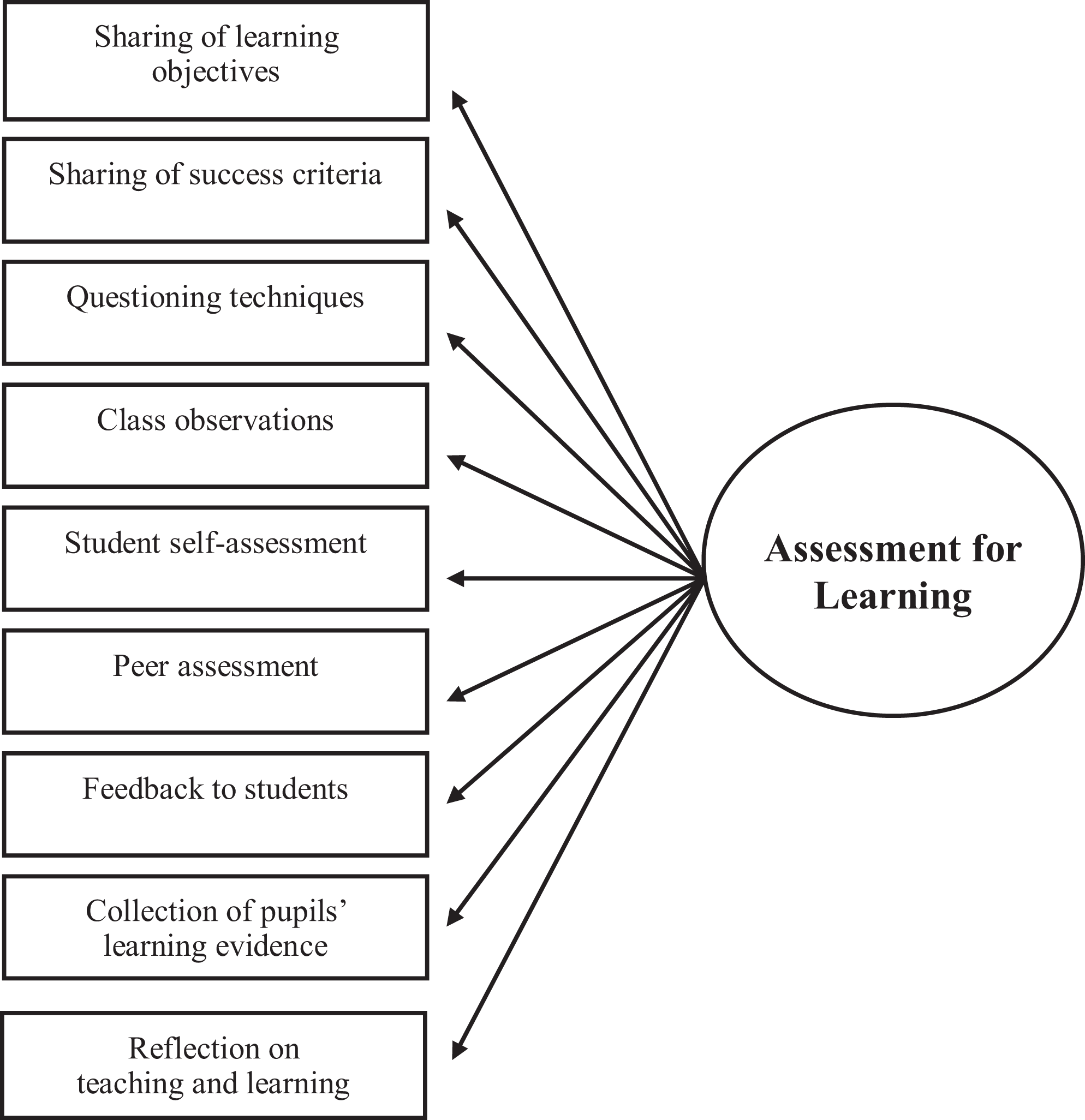
Theoretical framework for AfL in classroom teaching. Note. AfL = Assessment for Learning.
These advantages of formative assessment can also help to enhance students’ success when the previously mentioned evidence or feedback is broadly used to support the adaptation of teaching and learning to meet students’ needs. Thus, AfL is mutually beneficial to teachers and students.
An overview of reflective teaching
What is reflective teaching?
Educators almost always reveal characteristics identified in the fundamental works of John Dewey. Dewey tended to consider reflection as “notions of open-mindedness, responsibility, and wholeheartedness” (cited in Tompkins, 2009, p. 224): Open-mindedness implies that one looks for and listens to multiple viewpoints even if an alternative stance challenges deep-seated beliefs. Responsibility entails a search for the truth, taking into account any unintended consequences. Wholeheartedness involves a commitment to an examination of values, actions, consequences with the intent to learn something new.
Pollard (2002) considers that “reflective teaching is applied in a cyclical or spiraling process, in which teachers monitor, evaluate and revise their own practice continuously” (p. 15). As mentioned by Pollard, there are numerous key stages in the reflective process. First, practitioners plan their teaching and make decision on plans as well as pedagogies. Then, they act on teaching. After that, they collect data for further reflective process. At last, they analyze and evaluate the data for reflection practice. The cycle is iterative, continuous, and sometimes repeated.
Reflective teaching as action research
Ferraro (2000) claims that reflective practice can be defined as action research. Action research is rooted in Dewey’s proposition of reflective practice. Price (2001) states that “action research has been frequently advocated as a means of engendering reflective practice and promoting educational change” (p. 43). Sowa (2009) also relates reflective teaching to action research, which is a form of practitioner research. Action research “encourages teachers to become lifelong learners, makes them more open to developing a variety of teaching methods and verifying whether these methods work” (Sowa, 2009, p. 1027); it can promote professional growth and encourage classroom teachers to think and build “their own practical theories of teaching” (p. 1027). Furthermore, action research can help teacher-educators in teacher training. Teachers may think of the interconnection among action research, pedagogies, and teaching changes. Through this, teachers can learn more about the pedagogical knowledge. In this circumstance, teachers always act as reflective practitioners. Elliott (1991) considers action research as “the study of a social situation with a view to improving the quality of action within it” (p. 69). Like the process of reflective teaching, action research is a “self-reflective spiral”—a cycle of action and reflection, including different phases of planning, acting, observing, and reflecting. This cycle of research is cyclical and iterative.
Reflective teaching with situated practice
Being reflective practitioners in real teaching situations, teachers take critical and continuous feedback upon teaching experience in their particular school setting. Ovens and Tinning (2009) pointed out that “it is apparent that a different form of reflection is enacted within the different settings” (p. 1130). We do believe that reflection is a situation embedded practice that enables a relationship between participation and social context. Teachers encounter their journey of teaching under different situations when pedagogical thinking is informed by various reflective activities. As suggested by Lave and Wenger (1991), there is no activity that is not socially situated. From this perspective, it is suggested that the reflection of teachers on different conditions and contexts of their work will support them to learn more and change their teaching practices so that they fit their own or unique classroom settings.
Reflective practitioners in Early Childhood Education
With reference to this study, the in-service kindergarten teachers and primary school teachers are reflective practitioners who enrich their work by their own personal reflection and try to refine teaching practices as a result. They are the so-called action researchers who improve their understanding of teaching and develop their learning after gaining feedback from their colleagues or peers. Actually, “conducting action research and generating practical theories can help teachers develop praxis, transform their perceptions of themselves and help connect them to the values they espouse” (Sowa, 2009, p. 1027). Teachers enact self-reflection differently in different settings—according to situated practice (i.e., in different levels in schools and in different schools). Proactive reflective practitioners reflect different situations and constraints embedded within their schools and social contexts in which they teach and work (McIntyre & O’Hair, 1996).
The role of peer coaching in reflective teaching
Peer coaching is originally advocated by Joyce and Showers (1983). It is a form of professional development strategy for educators to consult, discuss, evaluate, and share about one another’s instructional practices with a view to ensuring quality teaching. It is an important tool for effective reflective teaching. By sharing in conversations with the coaches, teachers can reflect on their teaching and refine their practices; they can learn and grow in the process of coaching. When refining the concept of reflective practice, Schön posits “reflective practice involves thoughtfully considering one’s own experiences in applying knowledge to practice while being coached by professionals in the discipline” (Ferraro, 2000, para. 2). Vagle (2009) contends that “teachers develop new skills through an iterative process that involves learning, experimenting, and reflecting—and suggest that this learning process can be supported by skilled coaching in peer support groups” (p. 584). Bell et al. (2010) also state that “reflective practice is an iterative process rather than a one-off event” (p. 58). It is recommended that with peer coaching, which is accompanied by mutual reflection, teachers can share their knowledge and skills at a newer and more fruitful level. By this, a whole-school development culture will be established.
Self-directed professional development
According to Minott (2010), self-directed professional development is “the development of practical and/or work-related knowledge under the direction of the individual” (p. 330). It can be connected with reflective teaching in the following ways. First, reflective teaching shifts the responsibility for developing knowledge away from a preceptor and places this on the individual. In other words, it enables the development of self-directed autonomous professionals, who take the responsibility for their own professional learning. Secondly, the employment of reflection-on-action and reflection-in-action are processes that create knowledge about classroom practice and students (Schön, 1983; Zeichner & Liston, 1996), and the building of knowledge is an important aim of all professional development activities. Thirdly, an attitude of self-directed inquiry into one’s practice and the development of knowledge based on inquiry are requirements of reflective teaching (Minott, 2010, p. 331).
It is important for teachers to act in accordance with professional expertise to guarantee high-quality teaching, and hence effective student learning. In view of the nature of teaching, it is believed that professional development and learning should not stop at all (Pollard, 2002). Since reflective practice occurs in a classroom setting, the professional development of teachers should be integrated with educational practice and the role of the reflective practitioner should be shaped in a supportive school community. With the competence of reflection, reflective practitioners will act as professionals, which involves exploration, articulation in teaching, and representation of their own ideas and knowledge throughout the process of reflective practice (Osterman & Kottkamp, 2004).
A research into teachers’ reflective practices in Hong Kong schools
There were 10 primary schools and 10 kindergartens participating in the school development project. Since AfL is an important component in learning and teaching, it is worthy to examine teachers’ practice in adopting AfL teaching strategies in their daily teaching. This study aims at exploring (a) teachers’ practices of self-reflection on the effectiveness of using the nine AfL elements and the respective recommendations for improvement and (b) how teachers use the evidence collected inside and outside the lessons to adjust their teaching practice. Attempts were made to answer the following two questions: (1) What would be the teachers’ practices of AfL strategies in classroom teaching from their own assessment? (2) What would be the teachers’ suggestions for improvement in AfL strategies, based on their own reflection? (See the Appendix)
Data collection
In the research, School Development Officers (SDOs) visited each participating school and conducted class observations. The SDOs, who also acted as peer coaches, have given specific and appropriate verbal and written feedback to the teachers who will use the feedback to guide further teaching improvement. The feedback will also be used as a reference for self-reflection on the practice of the AfL strategies.
The sample was from a group of 10 primary schools and 10 kindergartens that have participated in the project of AfL. SDOs were assigned to conduct class observation (N = 34). They observed whether the teachers had used the AfL skills and teaching strategies in the observed lessons and completed the observation forms when conducting the observation. After that, teachers were asked to rate their perception of the practice of the AfL strategies in the lesson observed, according to a 5-point scale (“0” for not using the technique, “1” for weak, “2” for satisfactory, “3” for good, and “4” for excellent).
In the second part of the research, the SDOs would guide the teachers reflecting on these AfL elements after class observation and advised them to adjust their instruction to lead student learning. Thus, the reflective elements in the theoretical framework are those practical items/approaches used to develop reflective practice for teachers in the mode of formative assessment, which is carried out formally and informally in daily learning and teaching. The findings from the reflective statements and ideas will be reported and illustrated in the following sections.
Research findings
Teachers’ self-assessment on the practice of AfL strategies
After conducting observation of the 34 lessons, teachers were asked to assess their practices on the AfL skills during the lessons, based on their own reflection. The quantitative results of the self-assessments were summarized in Table 1, which shows the extents to which teachers in primary schools and teachers in kindergartens had practiced on the AfL strategies.
Comparison of self-assessment on the AfL strategies between kindergarten teachers (N = 17) and primary school teachers (N = 17) in the study.
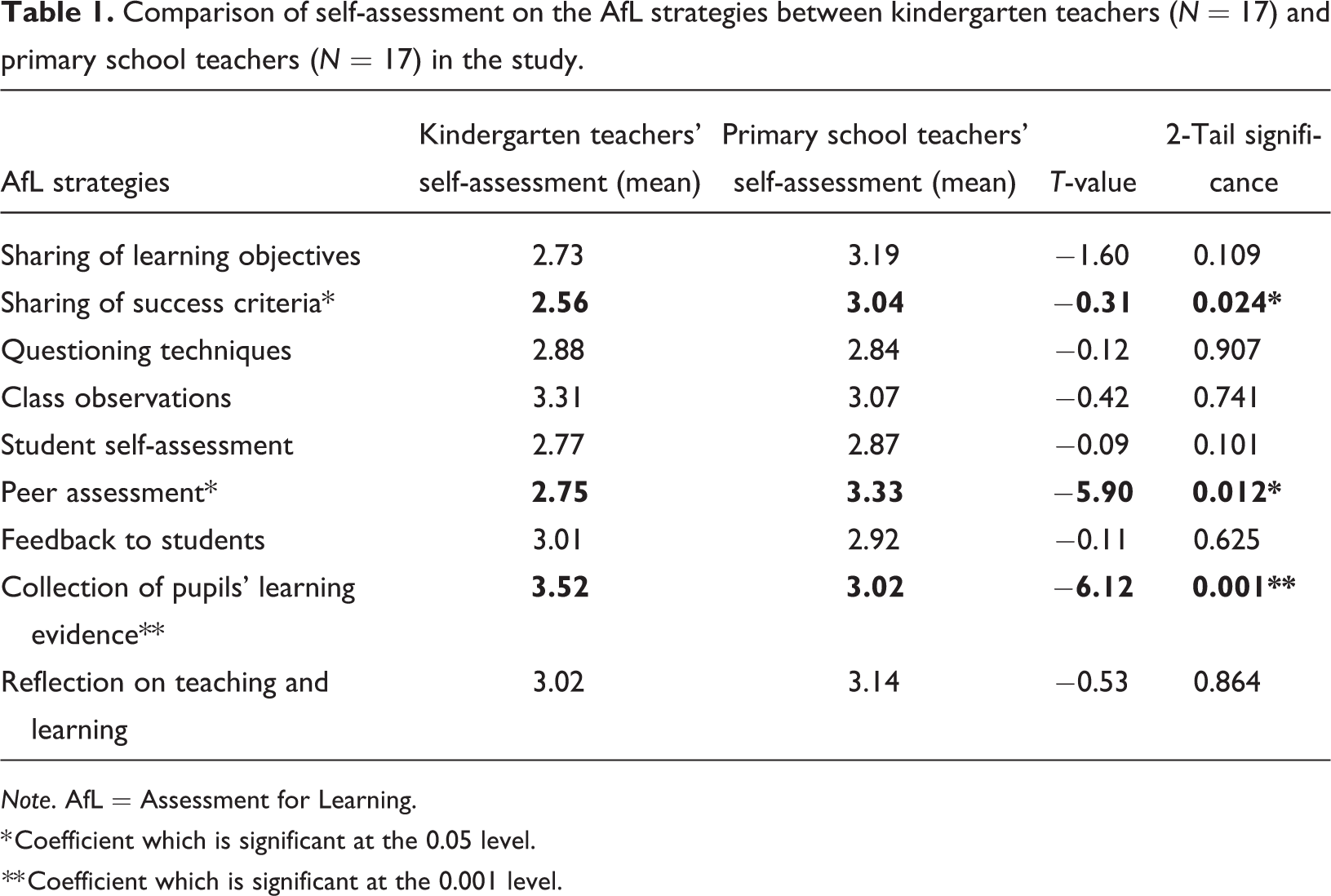
Note. AfL = Assessment for Learning.
* Coefficient, which is significant at the 0.05 level.
** Coefficient, which is significant at the 0.001 level.
When comparing the AfL teaching strategies used between kindergartens and primary schools in the study, there are significant differences between them in the use of “sharing of success criteria,” “peer assessment,” and “collection of pupils’ learning evidence” in the lessons observed (see Table 1). For example, primary school teachers outperformed kindergarten teachers in adopting the first two AfL strategies but were weaker than the latter in “collection of pupils’ learning evidence” during the lessons.
The results of the present study indicate that all the AfL teaching strategies were well utilized (mean > 2.50) by the participating schools as a whole in the study, particularly in the areas of “class observations,” “peer assessment,” “collection of pupils’ learning evidence,” and “reflection on teaching and learning” (mean > 3.00).
It could be interpreted that the project has a positive impact on teachers of the participating schools through promoting the importance of AfL in classrooms. Through the training program and whole-school workshops in the project, teachers’ awareness and competence of AfL strategies have been enhanced to a certain extent.
With reference to the quality assurance inspection annual reports (EDB, 2008, 2009) that Hong Kong teachers are generally weak in using AfL skills in their daily teaching, it seems that the findings of the present study have yielded a rather different result. This discrepancy may be due to the fact that the 2-year intervention is successful in cultivating an AfL teaching and learning atmosphere in the project schools. The training program, whole-school workshops, and lesson observations among peer teachers may be effective in helping the participating schools to institutionalize an AfL framework in their daily practices, assisting teachers to understand the AfL principles and to acquire the necessary skills and techniques for planning and implementing AfL in their everyday teaching, as well as promoting professional exchange concerning AfL practice among the project schools.
It is interesting to note that primary school teachers are more inclined to share the success criteria of the task(s) with their students and incorporate peer assessment in their lessons than kindergarten teachers. It generally agrees that teachers seem to provide explicit success criteria for learning activities to older children more frequently than to younger ones. It can be interpreted that kindergarten teachers may perceive that it is rather difficult for them to explain the success criteria to younger children owing to the children’s limited vocabulary. A similar reason may contribute to the significant difference in incorporating peer assessment between kindergarten and primary school classes, where kindergarten teachers may assume that the toddlers may not be able to make comments on their classmates’ work or performance owing to a lack of vocabulary.
In terms of “collection of pupils’ learning evidence” in the lessons, kindergarten teachers seem to use this AfL strategy much more often than primary school teachers. It may be due to the fact that EDB (2009) has stated clearly that kindergarten teachers should not use dictations, tests, or examinations to assess young children’s ability or performance. Instead, teachers are highly recommended to have assessments based on continuous observations, where evidence for students’ achievement or progress made in various aspects should be collected or recorded. Thus, it is rather legitimate for kindergarten teachers to incorporate this AfL strategy in their lessons than their counterparts. On the other hand, because of the large class size and packed curriculum, it is rather difficult for primary school teachers to make observations on individual students in class; therefore, they may mainly rely on test and examination results to evaluate their students’ progress.
Teachers’ reflection on the practice of AfL strategies and suggestions for improvement
As to the rooms for improvement in the practice of the AfL strategies, the findings were drawn from the self-reflection forms returned by the 34 teachers who participated in the class observation. Every teacher filled in the form as shown in the Appendix. From the reflection forms, there is substantial evidence showing that the teachers learn and know during the clinical portions—reflective practices of the AfL project. The following findings are summaries of 34 teachers’ critiques on their own teaching performance or teaching effectiveness and their recommendations for improvement on the nine AfL strategies.
Sharing of learning objectives
First, on the main ideas of teaching objectives, most teachers agreed to make connection with students’ daily life and the theme of the teaching unit. Also, teaching objectives should have a focus to help students concentrate on a point of study easily. Secondly, teachers reflected that when they teach in class, they must clearly state the teaching objectives to the students. Some teachers suggested using written format on the board to show the objectives precisely and concisely to be easily understood by the students. Thirdly, for the mode of presenting the objectives, students can read them aloud together as this will reinforce their memorization of the objectives. Fourthly, in order to let students clearly know the objectives, teachers advised that the objectives should be posted up to an observable place in the classroom. Besides, teaching objectives should not be presented only at the beginning of the lesson; they should also be restated at the end of the lesson so that students can reframe their understanding with the main points of their learning.
Sharing of success criteria
Similar to sharing of learning objectives, the success criteria should also be stated clearly before the teacher carries out teaching activities. Teachers can deliver the success criteria to students directly by their own description, illustration, and explanation. Teachers can also try to lead students to speak out the criteria by themselves or to share with other students. The main advantage of this method is that there will be interaction between students and the teacher and that the lesson will move from teacher-centered to student-centered. Throughout the process of the teaching activities, teachers can repeat the success criteria for the students to remind them about the central ideas of the lesson. Needless to say, teachers should make these ideas easy to understand, more concrete, and approachable but not intangible or abstract. In addition to oral reminder, teachers can also use written words to highlight what students need to do to complete the learning tasks.
Questioning techniques
Questioning skills are important in quality teaching and learning. Most of the teachers agreed that they should become effective questioners. Some teachers thought that they are the models of questioners in front of their students. Therefore, they need to use professional questioning techniques and ask quality questions. With respect to the AfL project, some teachers emphasized the frequent use of Question-Pause-Name-Praise technique, which is an effective and efficient way of driving students to think and respond. Teachers also have to raise their awareness of clarifying the questions repeatedly when asking a question. Besides, teachers need to give sufficient wait-time for the students to prepare for answering the questions. If students do not understand the questions, the questioners (teachers) should rephrase or edit the questions in order to make the answering or responding process smooth and successful. Teachers also suggested asking a range of relevant questions to motivate students to think, to respond, and to act accordingly. Other teachers pointed out the wise use of redirecting and relating questioning techniques as well as high-order thinking questions and open-ended questions. As regarding to the target of students asking questions, the teachers advised inviting more passive students to answer the questions and those responding actively are encouraged to help the weaker ones. This can help to narrow the individual differences. However, some of the teachers thought that they could not easily manage those techniques in their lessons. Therefore, they need to practice more and expose themselves to more varied classes and students to gain more experience.
Class observations
Only a few teachers suggested improvement in the area of “observation.” Their opinions are all useful and meaningful to enhance observation skills. Teachers themselves are expected to:
Observe student responses more to respond to them with some questions raised;
Observe students’ facial expression to check whether or not they are attentive and interested in the questions;
Observe students’ performance in taking a task in the teaching and learning activities to adjust the arrangement and schedule of the lesson plan;
Observe students’ use and response to their own prior knowledge with a view to adjusting the teaching progress;
Observe and listen to students’ dialogues and questions so that teachers can motivate students to work and respond to them positively and actively.
Student self-assessment
Self-assessment is a mode of assessment in AfL educational setting. It involves making judgments about students’ own work. Students can reflect on their own presentations, reports, projects, and so on. It is highly valuable because self-assessment can help students to make a critique of their own work, and thus the teachers in the project of AfL greatly encourage their students to do so. Teachers agreed that self-assessment is a form of formative assessment. One teacher recommended that students can assess themselves with the score sheets while others suggested using oral assessment. Some teachers also admitted that self-assessment can nurture the habit and motive of self-evaluation, which is a good means of self-reflection. In the self-assessment process, students can know their own strengths and weaknesses, hence achieving self-enhancement and self-improvement. However, self-reflection may cause harm to students’ self-concept and self-esteem. Teachers agreed that students need to share more with others, to be more active to show their ideas in self-assessment, and to treasure the chance of self-assessment. Teachers recommended that self-assessment should be carried out during the teaching process or after teaching. Some teachers found that their students do not have good enough assessment skills to evaluate themselves. Therefore, it is important to equip students with the necessary self-assessment skills during the lesson.
Peer assessment
In peer assessment, teachers reflected that the role of assessor shifts from teachers to students who will review and evaluate others’ work during or after the lessons. One teacher proposed that demonstration of peer assessment is needed for students. With this, they can have better understanding of its requirements and standards, and know how to assess or evaluate others with appropriate comments and how to give achievable targets for others to work on. Another teacher asserted that more opportunities should be provided to students to conduct peer assessment for reinforcing student–student and student–teacher interaction. Throughout the process, students can have in-depth and profound thinking. Such work can stimulate advanced learners to be more active and to have self-reflection and improvement. For less advanced or proficient learners, they can get some fruitful feedback from the capable ones. A teacher suggested that peer assessment can be carried out at the end of a teaching activity as a summative assessment, but the teacher also suggested having it during an activity. Both oral and written assessment is welcome and accepted. More time is needed for this kind of assessment for enhancing teaching and learning.
Feedback to students
Quality feedback to students is very important to teaching and learning. During the teaching and learning progress, teachers thought that they could identify students’ strengths and weaknesses and in turn give suitable and appropriate feedback to students so that students can have a better understanding of their learning performance. It is believed that if students know their own strengths, they will be more confident in learning and more willing to learn if there is encouragement. It is also true that, if students know their own weaknesses, they will be eager to improve with some goals and targets in their learning. It is important that the feedback from teachers should be concrete and solid so that students can enrich their learning skills effectively. Apart from quality, some teachers of the AfL project also claimed that quantity of feedback is essential as this creates a necessity for students to think and reflect on their own learning.
Collection of pupils’ learning evidence
Keeping learning evidence is another important work for teachers. The teachers of the AfL project admitted that with more understanding of students and their performance from their projects, portfolios, pictures, essays, and so on, the teaching progress will be benefited in return. Teachers agreed to take follow-up actions to justify the progress of teaching and learning and get further improvement. Teachers can also adjust their teaching goals and content according to students’ needs and interests. Nevertheless, teachers should remember to give adequate time for students to finish their work and allow more time and space for their thinking.
Reflection on teaching and learning
This is an action for the reflection on teaching and learning. Teachers thought that reflection is taken for students. Teachers must be mindful that reflection is a process. They agreed that good reflective teachers dedicate their time, experiences, and effort. In addition to this, teachers should provide an appropriate atmosphere for students to ask for help when they encounter learning problems during the lesson because teachers know that students’ questions are also a source of reflection. Besides, students can evaluate their own work by taking their pictures, written work, and situated learning into consideration. However, students may not know the reflection techniques, so teachers are the main contributors guiding students’ self-reflection. It is well known that self-reflection can be a process of evaluating one’s strengths and limitations. In short, throughout the reflective process, teachers are the leaders or guidance for bringing students together to revise the teaching progress and the learning content.
Suggestions for improvement on the processes of learning
Provision of discussion time—In the process of AfL, students need much more time to think and learn. Teachers preferred that students can “learn from errors” when they are discussing with others in the learning activities. Moreover, students can also practice high-order thinking when sharing their ideas with teammates. During the discussion, peer assessment and learning opportunities are enhanced simultaneously in the classroom.
Situated learning practice—Teachers found that when students could follow the success criteria already, it might be good for them to add more different situations related to teaching. For example, when teaching for the questions “What do you like to eat/drink?” teachers are advised to set up different situations for students to learn (e.g., in the supermarket, in the toy shop, in the book shop, etc.). This can allow them to understand more about the complexity, uncertainty, and various natures in learning and teaching.
Timely feedback and constructive guidance—This can provide clear goals for students to learn. When teachers do this, students can know their own strengths and weaknesses for later improvement. Teachers can also compare the performance of students during or after teaching and give feedback to them to reinforce their learning.
Demonstration strategy—After students share the ideas within their own groups, some students will be selected to give a presentation in front of the class. The lesson will be more interesting, and there will be more interaction among the students and the teacher.
Suggestions for improvement on the processes of teaching
Relevance and coherence for teaching—Teacher reflection has great importance in a planned change of the curriculum. It can prevent fragmentation of the curriculum since teachers have collected enough evidence inside and outside the classroom. The evidence provides supporting data for teachers to reconstruct the curriculum in advance. The reflection emphasizes the significance of connecting the curriculum in meaningful ways related to students’ learning experiences.
Reflecting on competences—Reflection involves a “willingness to engage in constant self-appraisal and development” (Pollard, 1997, p. 10). Teachers reflected that they had known more about the “individual differences” of students and they suggested how to cater to them. This includes their active concern about the ability of their students and their own competences in teaching them. Teachers will thereby know their holistic capacity to teach and the way to further development. They can become self-reflective and self-managing at the end.
Awareness of professional development—Teachers can confidently achieve an appropriate state of professional competence through adopting processes of reflective teaching (Pollard, 1997). Teachers emphasized the observation of students’ performance, the analysis of students’ answers, the checking of students’ work, and the correctness of students’ assessment (self and peer). In other words, teachers often based their teaching on careful connection to students’ learning. With the practically relevant and useful evidence from it, teachers will educate themselves to be concerned with the wholeness of the classroom and aware of the importance of professional growth.
Communication with parents—Teachers reflected that students could collect interesting materials for lessons with the support and help from their families. The intention for teachers to propose parent–child relationship in the process of learning for their students is to encourage the social settings in their sphere of teaching.
Discussion
With the above evidence of reflection by the teachers, which was extracted and generalized from the reflective statements on the 34 reflection forms, it is believed that they can contribute to “supporting the progressive development of higher standards of teaching” (Pollard, 2002, p. 16). The process of reflective teaching provides a dynamic basis for teacher action. This is a teacher-based and action-research movement with self-reflection on teachers’ teaching. As a reflective practitioner, a teacher should have good analytical and evaluative skills to process practical inquiry about teaching and make pragmatic judgment. The participating teachers in this study have got reflective teaching, which requires specific attitudes of “open-mindedness, responsibility, and wholeheartedness.” These three attitudes are the central and vital ingredients for the kind of professional commitment—reflective practice. Being a reflective practitioner, a teacher will be attentive to self-awareness about the impact of his or her performance that will create chances for professional growth and development (Osterman & Kottkamp, 2004; Pollard, 2002).
When talking about the reflective practice or teachers as reflective practitioners, it is to say “thinking about teaching” (Dymoke & Harrison, 2008). The participating teachers in this study have self-reflection by themselves according to the nine AfL elements.
With the findings of the reflection form, it is to highlight the two perspectives of reflection for students and teachers—that is, for learning and teaching. It is believed that both the learners and instructors can take the role of practitioners. They are the most important sources of insight into teaching that we can access.
When conducting reflective teaching for students, it is suggested that teachers should provide sufficient time for students to discuss and share the teaching content within a situated learning environment. This is very important because too little time for discussion in an AfL lesson will block the way for students to get a holistic picture with a reflective sight. As a result, both students and teachers cannot critically reflect on learning and teaching. However, the purpose of reflective teaching is for teachers to explore how much they, as reflective practitioners, can see from their practice in new ways. Time is essential for the practice of self-reflection. In the process of reflection, students are expected to receive timely feedback or guidance since these are constructive and useful for their further learning. Demonstration of students’ learning and work is encouraged (Brookfield, 1995, p. 121). “Students say that hearing their own anonymous comments reported back to them as part of a commonly articulated class concern somehow legitimized what had formerly been felt as a purely private and personal reaction” (Brookfield, 1995, p. 122). This has shown that students among themselves can benefit from reflection also.
For teachers, the advantages of self-reflection on teaching are: Knowing how to better design the planned curriculum and implement the taught curriculum so that teachers can draw on several disciplines from reflection to construct a holistic, hopeful, and meaningful focus for study. Understanding more of their own teaching competence and students’ learning capacities so that they can make changes through mediating, scaffolding, and extending their understanding. Promoting professional development by the idea of “flow.” This “means the degree of continuity and coherence which is achieved in a learning session” (Pollard, 2002, p. 246). Teachers will learn from the beginnings, the transitions, and the endings of the lessons. It is believed that “consistency and reinforcement of desirable behaviors can be important here” (Pollard, 2002, p. 246). Teachers can work on the “recurring challenges” (Pollard, 2002, p. 246). On the other hand, professional development can be obtained by different teaching and learning strategies through the process of self-reflection achieved by self-assessment, self-actualization, self-enhancement, and self-improvement. Facilitating the work with parents. Reflection shows that teacher–parent and student–parent interaction is highly recommended and appreciated. It is also suggested that school behavioral policies (e.g., the study work of the students, the application of daily life context in learning and teaching) can be more relevant to the community it serves. With this, the effect and influence will be more positive.
Conclusion
This article aims to reintroduce the concepts of reflective teaching to both teachers and policymakers and recall the importance of teachers playing the role of reflective practitioners.
In the literature review, it is to define what “reflective teaching” is since it is subject to differing orientations. By showing the process of reflective teaching, it is to highlight how it relates to the “reflective spiral.” Reflective practice is interrelated with action research in the “spiral cycle,” starting with planning, then acting, observing, and reflecting. The form of research for this article is similar to this iterative and cyclical process, which reflects on practice, takes an action, reflects again, and takes further action. In fact, each cycle points the way to different actions for improvement in the next stage. Very often, reflective practitioners will act within the situated context that they will find various ways to change their own behaviors and improve themselves. Indeed, peer coaching is usually integrated into reflective practice when practitioners get oral and written feedback from their coaches. In the process of peer coaching, practitioners also reflect on their own practices and try to apply the knowledge to their own teaching. Teachers, as reflective practitioners, are professional experts who can assure the quality of teaching and the initiators of professional development.
This university–school partnership project is a case in point for the successful implementation of the reflective spiral in the process of school improvement. Most teachers may not be aware of its importance in self-reflection and self-determination in improvement. The SDOs in this project have played a role of peer coaches to the participating schools and introduced the concept of and practice on how reflective spiral can contribute to school improvement. After the completion of the project, the teachers who have experienced the process of reflective spiral can still keep their momentum and motivation to lead and manage the school improvement processes.
There were 20 participating schools, with 34 teachers for taking the role of reflective practitioners in the AfL project. The findings have shown that teachers reflected positively with the nine AfL elements. They obtained a lot of positive ideas to support further teaching practices. They had feedback from the coaches (SDOs) and started to reflect and present themselves with the reflective statements on the self-reflection forms (N = 34). When stating how to make use of the learning evidence that teachers collected inside/outside the classroom to revise their teaching schedule and content, most teachers claimed that two reflection aspects would be particularly helpful: one for students/learners and the other for teachers/instructors. When talking about how to revise the teaching schedule and content, it was found that time for discussion, self-assessment and peer assessment, and demonstration are all very important. Using reflective teaching, practitioners should strongly and consistently associate their reflection with effective teaching behaviors for improving the curriculum, understanding the competence of teachers and students, promoting professional development, and facilitating the work within the community.
Footnotes
Author’s note
Consents for class observation, filling the self-reflection forms and participation in the post-observation discussions were granted orally by the 34 teachers before starting the research.
Declaration of conflicting interests
The author declared no potential conflicts of interest with respect to the research, authorship, and/or publication of this article.
Funding
The author received no financial support for the research, authorship, and/or publication of this article.

Correction (December 2022):
Article updated online; for further details please see the Author's note at the end of the article.