



Abstract
Purpose
This study aimed to identify the potential attributes of teacher leadership among preservice teachers with higher levels of reflection, especially in the Chinese context.
Design/Approach/Methods
A mixed research method was adopted in this study. First, a quantitative research method was conducted to examine preservice teachers’ reflection depth. The top 10% of the preservice teachers with higher levels of reflection were selected as the target respondents for comparison. Second, qualitative data analysis was conducted to identify potential attributes of emergent teacher leadership in these preservice teachers.
Findings
This study identified five potential attributes of emergent teacher leadership among preservice teachers who showed deeper reflection depth. Additionally, this study identified how the unique attributes fit into preservice teachers’ professional development in the Chinese context.
Originality/Value
This study proposes a new development model to develop preservice teachers that emphasizes the role of continuous reflections in context for professional growth. This study holds implications for understanding the potential attributes of emergent teacher leadership among Chinese preservice teachers. Additionally, this study appeals to the importance of cultivating preservice teachers to practice teacher leadership during the teacher training stage to support them to become outstanding future teachers.
Introduction
With China's curriculum and institutional reform (Ministry of Education of China [MOE], 2011, 2020a), teachers are expected to exert more teacher leadership to help develop students’ autonomous learning capacity. Teacher leadership reflects teacher agency and professionalism in teaching, which ultimately determines positive student learning outcomes (Wenner & Campbell, 2017; York-Barr & Duke, 2004). Unlike traditional positional leadership, which is often the arena of a few expert teachers, it is believed that each teacher can become a leader as long as they can exert influence on peers (Carver, 2016; Harris, 2008). Teachers with strong teacher leadership capacity are crucial to helping other teachers to improve their teaching performance and serving students better to meet the challenges of the new reform.
Teacher leadership is advocated widely in China among in-service teachers. Some successful teacher leaders are identified as backbone teachers who take leading roles in teaching and research activities in China (Leslie & Chen, 2007; Wang, 2013). Backbone teachers are believed to play critical roles in improving the professional development of novice teachers, leading curriculum development, and supporting school improvement (Pang & Miao, 2017). While teacher leaders with formal positions and leadership capacities (i.e., professional quality, management capabilities, and personal relations) tend to fulfill teacher leadership roles more effectively (Hu & Gu, 2012; Zhang et al., 2014), the leadership of teachers without backbone titles is often neglected. There have been even fewer studies on teacher the leadership among preservice teachers. Thus far, little is known about the emergent attributes that shed light on the potential capacity of teacher leadership among preservice teachers.
Not many opportunities are provided for preservice teachers to teach in an authentic classroom during practicum practice (Chen, 2008; Li & Qin, 2015), let alone the chance to collaborate with other teachers in placement schools. Preservice teachers are often passive if their goal is to just complete the tasks assigned by their mentor teachers or practicum schools. As a result, preservice teachers’ teaching enthusiasm might be reduced or even suffer from burnout before they grow professionally and mature in teacher leadership.
Preservice teachers’ teaching effectiveness during practicum practice in schools reflects their capacities during the teacher preparation stage. Leadership and work management skills impact preservice teachers’ teaching performance during practicum practice and their career path aspirations (Reeves & Lowenhaupt, 2016; Suhre et al., 2022). Therefore, teacher education programs need to cultivate preservice teachers’ teacher leadership. It can facilitate preservice teachers’ initiatives to realize their full potential and accelerate their professional growth to become expert teachers (Rutherford, 2006). Many studies have proposed that cultivating preservice teachers’ emergent teacher leadership to enhance their passion for teaching and improve their teaching quality can be achieved through regular reflections (Collinson, 2012; Taylor et al., 2011). This study aims to identify the potential attributes of emergent teacher leadership among preservice teachers who show deeper reflection. Additionally, the study will advance our understanding of its attributes in preservice teachers and advise instructional leaders on what they must do.
Policies on developing teacher leadership in the Chinese context
During the past two decades, the Chinese government has issued several supportive policies to improve teachers’ teacher leadership. In 2010, the Ministry of Education (MOE) released The Middle- and Long-Term Planning of National Education Reform and Development (2010–2020) to improve the development of backbone teachers to play a leading role in improving the overall quality of teachers in educational teaching reform (MOE, 2010). With the increasing complexity of the educational environment, MOE (2012) developed The Professional Standards for Primary and Middle School Teachers (Trial) to cultivate more excellent teachers to meet the requirements for more diversified and professional teachers. The document proposed to strengthen teachers’ abilities in classroom management and cooperation skills. In addition, it presented three new demands for teachers: the priority of teacher morality, the importance of capacity, and lifelong learning. In 2020, MOE released The Notice of Doing a Good Job in Training Primary and Secondary School Teachers, emphasizing the backbone teachers’ exemplary roles to function as teacher leaders in teaching and daily management routine (MOE, 2020b). The policy offers 5 to 10 days of intensive training in specific areas or 1-year in-service training based on various disciplines at the national level.
The above policies indicate that developing teachers’ leadership is essential to improving teaching quality. However, teachers are not born with such teacher leadership; their leadership capacities must be nurtured, mainly before they acquire teaching posts. Teacher leadership development plays a critical role in the growth of preservice teachers. It is essential to foster preservice teachers’ teacher leadership early, thus promoting their teaching competency and cultivating outstanding future teachers. Recently, two new documents, titled Opinions on Comprehensively Deepening the Reform of Teacher Group Construction in the New Era (MOE, 2018a) and The Action Plan for the Revitalisation of Teacher Education (2018–2022) (MOE, 2018b), were issued. These documents concerned the requirements for improving preservice teachers’ teacher identity and responsibility, which are essential for establishing preservice teachers’ teacher leadership in teacher education programs.
Emergent teacher leadership
Teacher leadership has shifted from teacher leaders with formal positions and titles to those without formal leadership roles but who carry out a broader range of informal practices such as mentoring, coaching, and liaising with parents and local communities (Baecher, 2012; Darling-Hammond et al., 1995; Harris, 2008). Katzenmeyer and Moller (2009) proposed that teacher leaders are those teachers who are willing to contribute to the teacher community, improve the teaching quality of the whole teacher group, and take responsibility for achieving leadership goals. Teachers are encouraged to take the initiative and exert their autonomy to influence other people based on their professional knowledge and skills in a professional learning community, eventually promoting students’ achievement (Katyal & Evers, 2014; York-Barr & Duke, 2004).
Building leadership capacity in implementing effective teaching is considered necessary in different educational leadership standards and training programs. For example, the National Board Certification for Educational Leaders (National Board for Professional Teaching Standards [NBPTS], 2010) in the United States sets standards for new teacher leaders, in which strong content knowledge and sufficient pedagogical knowledge and skills are crucial factors for teachers to grow as teacher leaders. Angelle and DeHart (2010) emphasized pedagogical and classroom management skills in a four-factor teacher leadership model. Emergent teachers’ leadership development has been taken as a continuum in the Principles and Indicators for Mathematics Education Leaders (PRIME) Leadership Framework (National Council of Supervisors of Mathematics [NCSM], 2008). Based on this framework, Yow and Lotter (2016) determined that teachers grew and gained confidence by implementing effective and meaningful teaching practices in their classroom at the first stage. Their knowledge developed as their sense of agency further improved through these experiences. The teachers who shared their more profound knowledge and collaborated with colleagues in professional activities moved to the second stage. In short, the logic behind these standards and programs assumes a positive correlation between the implementation of effective teaching practices and teacher leadership.
While engaging in leadership activities is how teacher leaders take on their roles, identity, which refers to how teachers view themselves as leaders, becomes an essential element in exploring emergent teacher leadership (Sinha & Hanuscin, 2017; Swanson et al., 2017). Teacher leadership perception is indispensable for novice teachers as it deepens their understanding of the role of acquired knowledge and skills in shaping leadership roles and fostering emergent teacher leadership (Komives et al., 2005; Lord & Hall, 2005). Sinha and Hanuscin (2017) investigated teacher leadership identity in connection with teacher leadership views and practices. They found that teachers’ leadership identity developed and became more substantial with their views as teacher leaders and their success in leadership activities developed. Additionally, teachers’ confidence in teaching improved gradually with the identity transformation of teacher leadership.
Teacher identity, which refers to people's perceptions of and beliefs about teaching and being a teacher (Walkington, 2005), can be crucial for preservice teachers to develop emergent teacher leadership. Teacher identity is essential in improving preservice teachers’ teaching quality and eventually developing their emergent teacher leadership. For instance, Beijaard et al. (2004) believed that teacher identity influences how teachers make decisions on the teaching content, how they carry out teaching practice, and their relationship with peers and their students. It is also crucial for preservice teachers to understand teaching in depth and pursue continuous professional development (Izadinia, 2013). Teacher education programs should pay close attention to developing and supporting the transformation of the teacher's roles among preservice teachers to help them grow as emergent teacher leaders.
There have been few empirical studies of teacher leadership among in-service teachers in Chinese mainland. Among the few empirical studies, one recent study demonstrated that teacher efficacy and competency significantly influence teacher leadership (Zhang, Tian et al., 2021). Another found that individual (i.e., teachers’ sense of responsibility, beliefs in teacher leadership capacity), organizational (i.e., harmonious and collaborative relationships with colleagues), and social factors (i.e., Chinese cultural values) have effects on teacher leadership identity (Liu et al., 2021). However, little is known about emergent teacher leadership among preservice teachers.
Ability to reflect more deeply than peers in emergent teacher leaders
Thinking more deeply about teaching practice would make preservice teachers more effective teachers in the classroom; subsequently, it would gradually help preservice teachers expand their responsibility and ability to influence other colleagues beyond the classroom (Carver, 2016; Collinson, 2012). Reflection involves conscious and explicit thinking on the learning process and the outcome of that learning and action (Moon, 2013). Many studies have shown that reflection improves teaching quality among preservice teachers. For example, reflection could be a tool for preservice teachers to visualize their progress through reflective practice (Ward & McCotter, 2004). Preservice teachers gain new knowledge and generate novel insights actively through reflection, thus reframing their professional understanding by applying the newly constructed knowledge in future teaching practice (Lee, 2005). Classroom observation is also vital to improving preservice teachers’ reflection depth in teacher education. It provides a direct way for teachers to learn to observe and analyze teaching activities (Wragg, 2011). To improve students’ reflection depths, Ryan and Ryan (2013) developed a reflection model with four hierarchical levels: reporting and responding, relating, reasoning, and reconstructing. Preservice teachers could enhance their pedagogical knowledge and improve their ability to solve teaching problems through critical reflection.
Additionally, reflection allows preservice teachers to re-examine themselves as teachers and their beliefs about teaching. Through reflection, teachers critically think about and redefine their perceptions of teacher leadership both within and beyond the classroom, and they see themselves as leaders and explore leadership practices (Carver, 2016; Smulyan, 2016). Sinha and Hanuscin (2017) reported that teachers better aligned their leadership views and identity with leadership practices through reflection. Luehmann's study (2007) showed that novice teachers could recognize and develop their new leadership roles through continuous reflection.
Research questions
Since preservice teachers are at the beginning stage of becoming teachers, they are expected to become effective teachers before growing as leaders. Based on the above literature, we believe that generating profound reflections is crucial for preservice teachers to develop a more robust understanding of effective teaching, from which they would eventually develop the capacity for emergent teacher leadership. Therefore, this study aimed to identify the potential attributes of teacher leadership among preservice teachers with higher-level reflections, assuming the attributes of teacher leadership of these teachers have emerged during the teacher education stage, especially in China. The research questions are as follows:
What potential attributes of teacher leadership emerged among preservice teachers who show deeper reflection? How do these attributes fit into the Chinese professional development and cultural context?
Methodology
A secondary analysis (Hinds et al., 1997) was conducted in this study. The initial study examined preservice teachers’ reflection depths after a series of online training sessions, thus improving their teaching quality in practicum practice. A pilot study of the original research design verified the beneficial effects of online training and reflection tasks on preservice teachers’ reflection depths (Wang et al., in press). However, through the analysis of reflective logs and focus group interviews, we found that the preservice teachers who had deeper reflection also showed a potential capacity for emergent teacher leadership. Therefore, this study applied a mixed research method to identify the potential attributes of emergent teacher leadership among preservice teachers who showed deeper reflection. Figure 1 shows the initial framework of this study.
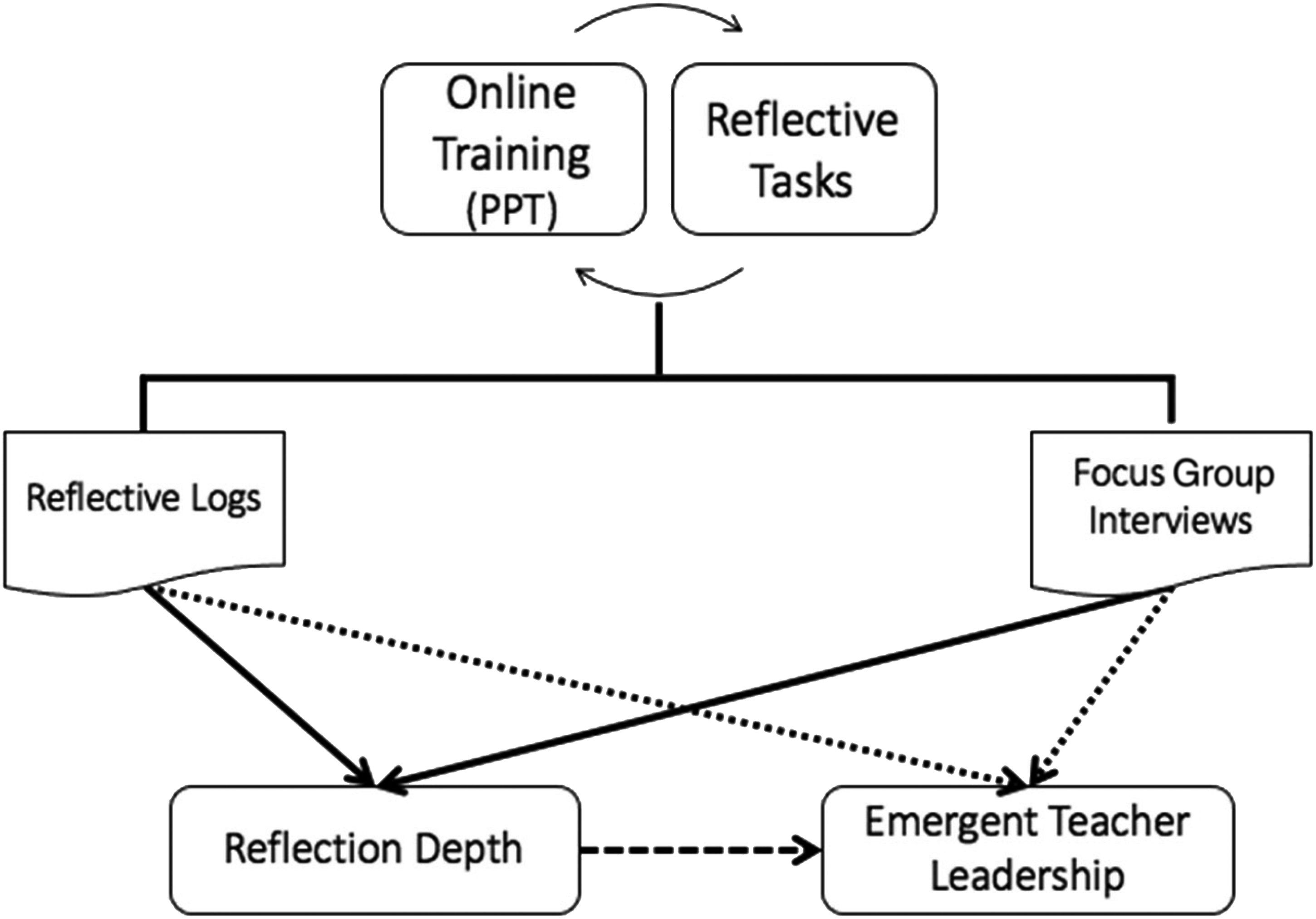
Initial framework of emergent teacher leadership.
Data collection
In all, 94 preservice teachers in a teacher education university in Northern China were recruited and randomly assigned to experimental groups with varied training sequences or no training. There were 33 participants in the RT-CO group, 31 in the CO-RT group, and 30 in the Control group; 10 participants were assigned to primary schools and 84 to secondary schools based on their majors in the practicum practice. Before practicum practice, preservice teachers in the two experimental groups were asked to take a series of four narrated online training sessions on two themes: reflective teaching (Hall & Simeral, 2015; Moon, 2007) and classroom observation (Borich, 2010; Maulana et al., 2019).
After each training session, a reflective task with open questions was provided for preservice teachers to generate more profound reflections in reflective logs. For instance, in Task 2 in reflective teaching training, participants were asked to write a self-reflection log with the following questions (i.e., Why did you choose teacher education as your university major? How do you solve your teaching problems?)
After practicum practice, all participants joined in the semi-structured focus group interviews to reflect on their teaching and perspectives after class. Each interview involved four to six participants from the same group as they took the online training. The interview questions included three aspects: formative assessment and feedback to students, perceptions of online practicum practice, and areas for pedagogical improvement (Ko & Maulana, 2017). Examples include, “How do you stimulate students to give feedback to you? Do you gain confidence to teach after your teaching practicum? What challenges do you face during online teaching? In what ways do you think you become more confident to teach?”
Ethical considerations
The data are confidential. All personal information related to the participants has been anonymized. All participants in this study joined voluntarily and were informed they had the right to withdraw from the study at any time without negative consequences before submitting their written consent. This study is a part of a thesis research project that received approval from the Human Research Ethics Committee, The Education University of Hong Kong (approval number 2019-2020-0189).
Data analysis
First, preservice teachers’ reflection depths were scored according to the four levels of the Teaching and Assessing Reflective Learning (TARL) model (Ryan & Ryan, 2013). Preservice teachers’ reflective logs were transcribed based on the reflective statements. Each reflective statement was scored from 1 to 4 points based on the four dimensions of reflection depths. For example, reflective statements that described what happened in the scenarios received 1 point, while the statements that showed reframed knowledge from a theoretical perspective for improving future practice received 4 points.
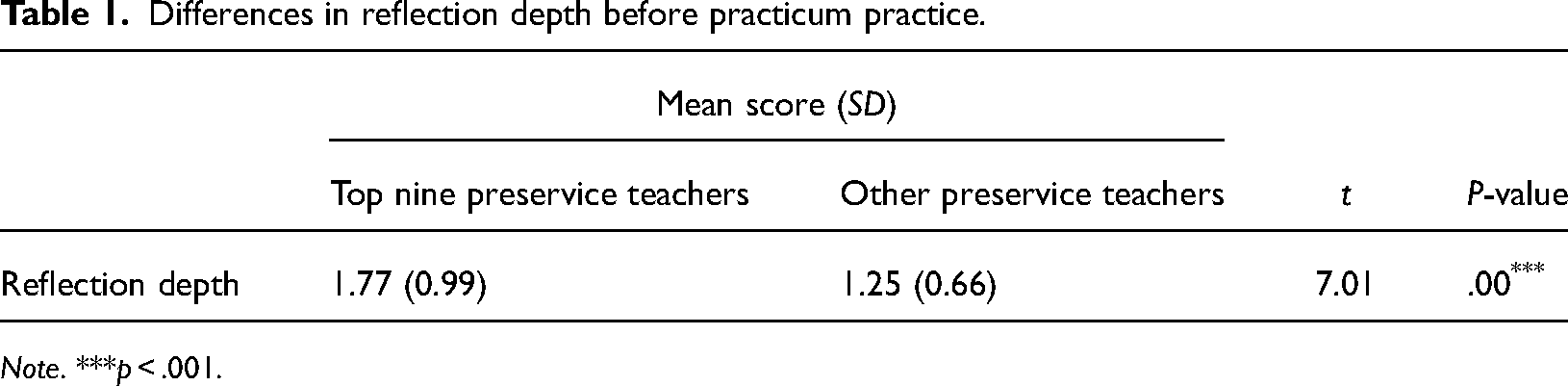
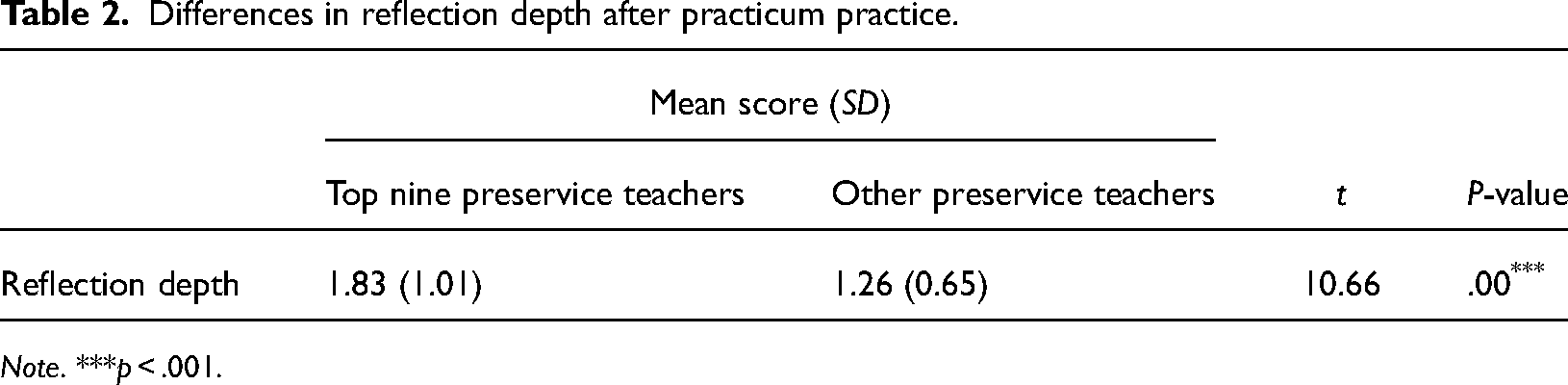
Then, the mean score of each participant was calculated to measure his/her reflection depth. The nine highest-scoring preservice teachers, representing the top 10% of the 94 participants, were selected as the target respondents for this study. Comparisons were also made of their reflection depths in reflective logs and dialogues in the focus group interviews to identify the attributes of emergent teacher leadership. The results showed that the reflection depths of these top nine preservice teachers (M = 1.77, 0.99) were significantly higher than those of the other 85 preservice teachers (M = 1.25, 0.66) before practicum practice, t(219.39) = 7.01, p < .001 (Table 1). The total mean score of the nine preservice teachers’ reflection depths increased to (M = 1.83, 1.01) after practicum practice. Their reflection depths were significantly higher than the others, t(459.59) = 10.66, p < .001 (Table 2).
Differences in reflection depth before practicum practice.
Note. ***p < .001.
Differences in reflection depth after practicum practice.
Note. ***p < .001.
Second, thematic analysis (Braun & Clarke, 2006) was conducted to identify the potential attributes of emergent teacher leadership among these nine preservice teachers who showed deep reflections. We generated initial codes through coding each reflective statement relevant to the research questions. Then, we sorted and classified the codes into three broader themes: in-depth reflections, collaborative learning, and teacher identity. For example, based on the above literature, we explored whether preservice teachers who reached more advanced reflection levels showed the potential capacity for teacher leadership. In the initial study, we coded the reflection depths of the reflective statements based on the TARL model (Ryan & Ryan, 2013) through an in-depth qualitative dialogue analysis (Hennessy et al., 2016). Therefore, in the current study, we collated codes of deeper levels (i.e., Reasoning and Reconstructing levels) into the theme of “in-depth reflections.” Additionally, we noticed several codes related to collaborative learning, such as peer collaboration, mentor support, and teacher-research activities in placement schools. Then, these codes were collated into the theme “collaborative learning.”
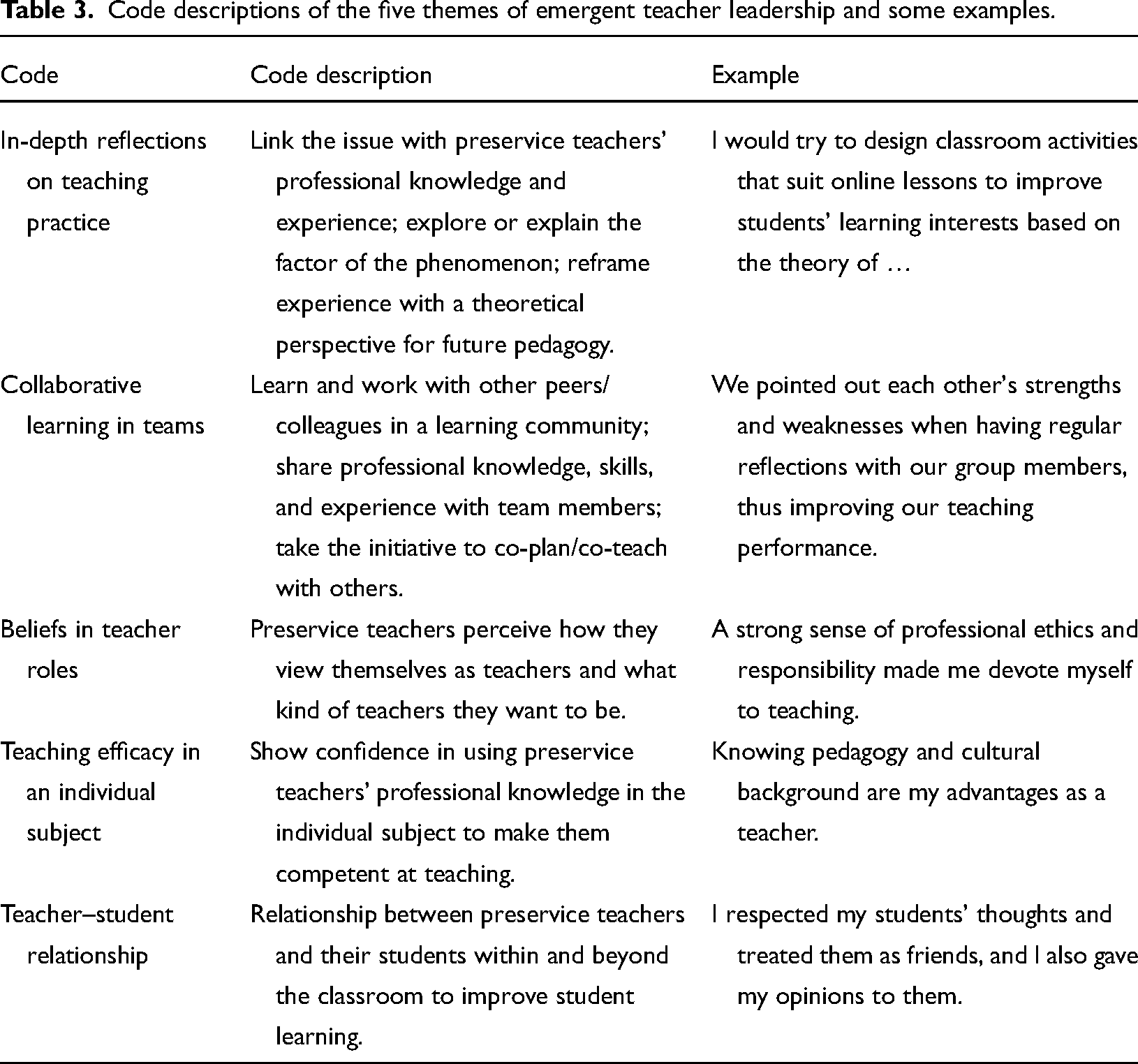
However, we later considered that some codes did not fit the theme of teacher identity. We then split it into two more specific themes (i.e., role models and teaching efficacy) that can capture the reflective statements accurately. For example, the codes “teacher's roles,” “teacher perceptions,” and “teacher responsibility” that related to preservice teachers’ perceptions of teaching and their viewpoints of being teachers have been collated into a new theme: “role models.” At last, five themes that represented the potential attributes of emergent teacher leadership were generated and refined: in-depth reflection on teaching practice, collaborative learning in teams, beliefs in the teacher's roles, teaching efficacy in an individual subject, and the teacher–student relationship. Table 3 shows the code description of the five themes with some examples.
Code descriptions of the five themes of emergent teacher leadership and some examples.
Findings
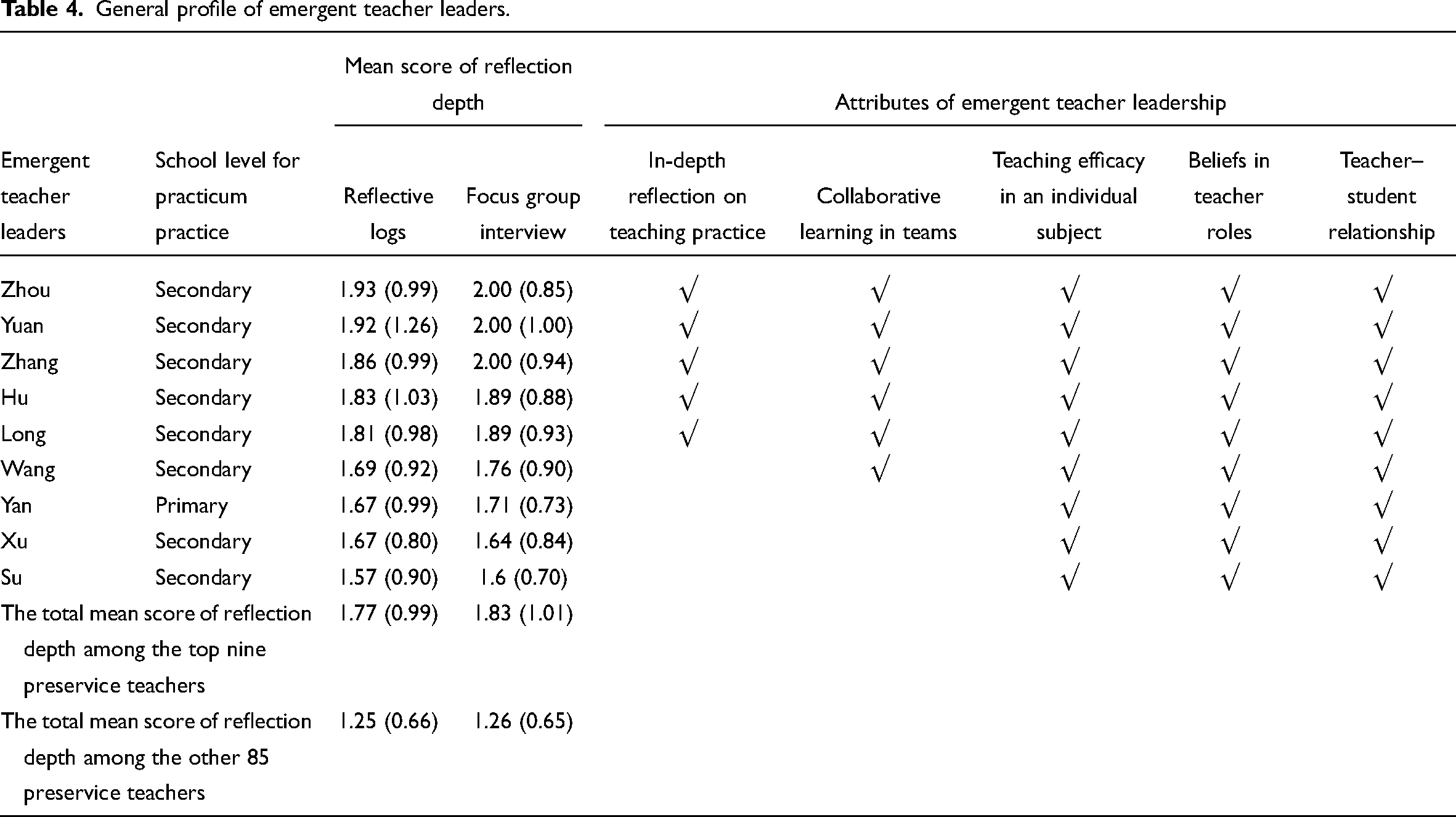
Based on the thematic analysis, we identified five primary attributes of emergent teacher leadership among the top nine preservice teachers: in-depth reflections on teaching practice, teaching efficacy in an individual subject, beliefs in the teacher's roles, teacher–student relationships, and collaborative learning in teams. The last three attributes appeared to be unique attributes that fit into the Chinese professional development and cultural context. The findings were reported by directly giving these preservice teachers’ voices to identify emergent teacher leadership (Aubusson & Schuck, 2013). The reflective statements were shown in italics in the following sections and combined statements with the same perspectives. Table 4 shows the general profile of teacher leadership and reflection depths among these nine preservice teachers as emergent teacher leaders.
General profile of emergent teacher leaders.
In-depth reflections on teaching practice
More profound reflections help preservice teachers strengthen their teaching competencies and support them to grow as effective teachers, which is the first step to becoming teacher leaders. The results showed that the reflective statements of five preservice teachers were related to more advanced levels. These preservice teachers connected the incidents with their learned knowledge and experience when they explored the exact reasons behind them, approaching the Reasoning level. For example, in self-reflection logs, one participant found that students’ low engagement in class was because of their low learning motivation, and she attempted to link the students’ learning conditions with her learning experience in the middle school to solve this issue: The students’ learning motivation was very low in my class. However, I can understand these students because I also experienced it as a student. I would deal with these problems from their perspectives. (Zhang)
Some of them reached the Reasoning level to explain and solve the problems from a theoretical perspective. They showed the capacity to integrate practice with theory to master higher teaching skills and achieve quality teaching. For example, two participants attempted to solve the problems they met during teaching with their learned theoretical knowledge: We need to call students’ names to answer our questions most of the time. Despite this, some students still did not respond to us. We would try to design some activities that suit online lessons to improve students’ learning interests based on the theory of constructivism. (Yuan, Long)
A few were approaching the Reconstructing level, where they reconstruct their knowledge and teaching practice with integrating theories. They showed the ability to reflect on their teaching practice deeper than others, in that they attempted to reframe their knowledge (i.e., fully explore the teaching materials) to improve teaching quality. One participant proposed the importance of teaching research to improve teaching performance: We should do some research on teaching to improve our teaching quality, for example, how to better use textbooks to support teaching. (Hu)
One participant reframed her existing practice with a theoretical perspective and attempted to apply the new knowledge to future practice. This preservice teacher reached the most advanced reflection level. She can adopt teaching research to support her improvement in future teaching. Additionally, she tended to explore new teaching methods to promote teaching innovation. I use “action research” to improve my teaching. Action research refers to teachers’ inquiry and research of the teaching problems in class. It requires teachers to combine action and research in teaching and to refine their perspectives through teaching practice and practise these new perspectives in future teaching. (Zhou)
Teaching efficacy in an individual subject
These preservice teachers showed that they were confident in using their professional knowledge in the individual subject to become competent at teaching. In self-reflection logs, several preservice teachers showed high teaching efficacy because they prepared themselves with strong subject knowledge and cultural background knowledge of the specific subject. We have a solid foundation of subject content knowledge. And we are good at giving examples and simply explaining questions so that the students can understand easily. (Zhang, Hu, Yan, Xu)
Knowing pedagogy and cultural background are our advantages as teachers. We understand the way that a teacher needs to develop professionalism. However, we still need to raise awareness of lifelong learning. We need to keep learning and improving. (Zhou, Wang, Su)
In the focus group interview, a preservice teacher who taught mathematics during practicum reflected that he doubted his teaching performance initially and gradually gained confidence after successfully improving his students’ learning. I felt very nervous at the beginning of practicum because mathematics is a rigorous discipline. I cannot make any mistakes when teaching formulas or mathematical symbols. Afterwards, I realised I should pay more attention to students’ learning levels. Furthermore, I felt confident because students understood the basic concepts and received positive feedback. (Long)
A preservice teacher who taught the Chinese language said she could guide students to use the correct thinking mode when doing Chinese exercises. Furthermore, she developed a novel idea for teaching Chinese during practicum: I attempted to teach students to do the exercises and solve the same problems by adopting the fixed pattern, just like doing mathematics, rather than feeling vague while mentioning Chinese. For example, I would summarise several aspects for students to consider when appreciating and analysing classical Chinese poems. (Yuan)
Beliefs in the teacher's roles in Chinese traditions
Beliefs in the teacher's roles greatly influence the shaping of leadership roles among preservice teachers. All these nine preservice teachers showed positive perceptions of how they view themselves as teachers and what kind of teachers they want to be. As in the West, three participants said that prior good teacher experiences influenced them in this study. In our educational career, we met a lot of excellent teachers. They helped us to improve our learning performance. Their companionship gave us strength and energy. We will never forget and appreciate what they have told us. We want to be teachers like them and to influence our students. (Zhang, Zhou, Long, Su)
However, teacher morality has long been a value emphasized and highly demanded in Chinese society. Chinese preservice teachers were influenced by the traditional teacher morality that they need to set positive examples for their students. In the self-reflection logs, these preservice teachers took teaching as their responsibility and wanted to be student role models. A teacher should be a guide to lighten students’ development. Moreover, she/he must also be “Bole” (a good judge of talent). (Hu)
Holding the concept of “educating and cultivating people,” we would transfer our knowledge to the young generations and help them to become excellent people. We hope we can influence the naughty and disobedient students. We hope to contribute our strengths to flourishing education. (Yan, Long, Xu)
“Learn to be an excellent teacher, act as an exemplary person” is what I constantly pursue in my educational career. A strong sense of professional ethics and responsibility made me devote myself to teaching. (Yuan)
Tightened teacher–student relationship with communication
In China, maintaining positive relationships with students plays an essential role in facilitating student achievement for teachers. Preservice teachers regarded the parental-style relationship between teachers and students as a facilitator for students’ learning. Therefore, they tended to provide familial care for their students. These preservice teachers shared their experiences of maintaining positive relationships with students during online teaching practice. They thought it was an excellent way to arouse students’ learning interests and motivation. Sometimes we communicated with students individually, respected their thoughts, treated them as friends, and gave them our opinions. (Zhang, Hu, Yan, Xu)
We understand that some students lost learning motivation because their parents were out at work. Therefore, we often chatted with those students and gave them opportunities to let them express their thoughts and feelings. (Zhou, Wang)
We think we can have better communication with students online. Nowadays, many children like to chat online. Using students’ preference for online chatting, we always chatted with them about their studies and life online after class casually. Thus, we can keep a closer relationship with them. (Yuan, Long, Su)
Willingness to participate in collaborative learning in teams
Six out of nine preservice teachers actively shared their experience in learning and working with others in a team. Believing in collective power, Chinese preservice teachers often bring collective strength into problem-solving, thus improving their teaching performance. In self-reflection logs, one participant realized the importance of collaborative learning with peers and would use this approach to improve her teaching quality. I would ask my peers and mentor teachers to observe my classes, study the textbooks, and prepare lessons together. (Hu)
Serving as the traditional teaching approach in stimulating learning engagement and overall learning performance, collaborative learning with peers and learning under mentor teachers’ supervision are highly recognized as deepening preservice teachers’ understanding of the advantages and disadvantages of teaching in the teacher preparation stage. Three participants expressed that they benefited from collaborative learning activities when they learned with peers together as a team during practicum practice. During micro-teaching, the members of our group provide comments and suggestions on each other's micro-teaching. This group learning activity helped us significantly improve our teaching skills. (Zhou)
We have regular reflections with our group members together. We pointed out each other's strengths and weaknesses, thus improving our teaching performance. (Zhang, Wang)
Additionally, preservice teachers regarded practicum practice as an effective way to experience collaborative learning and to get along with others in a specific local school environment. Two participants joined the teacher research activities in placement schools. They valued this experience as they got help from the senior teachers, and the harmonious atmosphere helped them rapidly adapt to the new teaching environment. I prepared lessons with other teachers together in a teaching research group. Those teachers gave me many suggestions on teaching students and solving problems from teacher perspectives. (Long)
Our office and the whole school embodied an excellent collaborative learning atmosphere among teachers. My enthusiasm would also be burned when I participated in the discussions with other teachers. (Yuan)
Discussion
This study identified the attributes of emergent teacher leadership among Chinese preservice teachers who showed deeper reflection depths. Additionally, this study discussed the unique attributes that serve to enhance preservice teachers’ professional development in the Chinese context.
Fitting unique attributes into Chinese professional development
We identified three unique attributes in developing preservice teachers’ professional development in the Chinese context: beliefs in the teacher's roles, the homelike teacher–student relationship, and collaborative learning in teams.
In this study, it was noted that the preservice teachers thought it was their responsibility to influence students’ learning, and they regarded becoming a role model for students as an outstanding achievement. The traditional culture influenced them in choosing teacher education as their university major and deciding what kind of teacher they wanted to be. As a unique teaching practice in China, teacher responsibility for student learning shapes teachers’ daily teaching and professional development (Chen, 2015). The teacher's role has also been emphasized in Teachers Law as one of fulfilling teaching responsibilities to impart knowledge and educate people, and teachers must devote themselves to teaching (MOE, 2021).
The homelike relationship between teacher and student shown in the results reflected the unique attribute of teachers in the Chinese traditional educational culture. Other than treating students as equals in the West (Goodman, 2009), Confucianism attaches great importance to benevolence (ren) to cultivate harmonious interpersonal relationships (Chen & Lee, 2008). Therefore, Chinese preservice teachers believe that caring for students and showing them parental love is the foundation for establishing a harmonious teacher–student relationship. Moreover, this type of interrelationship is the driving force for students to learn autonomously.
Collaborations in teams created specific working cultures and contexts for preservice teachers’ professional growth. The preservice teacher recognized the benefits of peer collaboration, mentor support, and teacher-research activities in placement schools. In Confucianism, individuals are the foundation of a larger collective group (Marginson & Yang, 2021). For example, teaching research activities (i.e., subject-based teacher-research groups and outstanding teachers’ offices) are widely used in China to support collective teacher learning, improve teaching quality, and maintain harmonious relationships in schools (Qian et al., 2017). The preservice teachers in this study were stimulated by this collective sense to integrate their abilities into the collaborative group and work autonomously toward a common goal in the learning community.
However, the results showed that only two preservice teachers experienced teacher activities during practicum practice. Emergent teacher leadership is highly vulnerable to attrition and a lack of professional support. Preservice teachers have limited opportunities to practice in the classroom and interact with other teachers in the placement schools (Li & Qin, 2015). A recent study found that teacher-research implementation differed significantly across the regions of China (Wei et al., 2021). It also showed that teachers without teacher leader positions, such as novice teachers, were less involved in subject-based teacher-research activities. The results indicated that limited collaborative learning in a professional learning community might be an external factor that hinders preservice teachers’ development in China. For example, Liu (2022) reported the significant contributions of expert teachers in building teacher capacity through professional learning communities in turnaround primary schools in Shanghai.
Integrating reflection into a new development model for emergent teacher leaders
Based on our findings, we propose a new development model (Figure 2) that sets reflection as the starting point for preservice teachers in developing teacher leadership capacity. In this model, the development of preservice teachers’ capacity to become emergent teacher leaders is a recursive, dynamic development process of professional learning in contexts through reflections where professional growth is determined by or manifested in the reflection depths of emergent teacher leaders. Developing reflection and reflective inquiry should be considered a goal for teacher education (Zeichner & Liu, 2010). Our findings indicated that it is vital for preservice teachers to repeatedly improve their reflection depth until they can achieve effective teaching and promote teaching innovation. In addition, the results indicated that the preservice teachers who showed deeper reflections were more likely to influence others and tended to maintain positive relationships with others. Online training with different reflection tasks and practicum practice could be adopted to improve preservice teachers’ reflection depths during the initial teacher education stage, thus enhancing their ability to cope with challenges of dynamic teaching situations and grow as master teachers. Bryant and Walker (2022) provided a model for senior teachers and middle-ranking leaders to expand their professional capacity in a teacher inquiry program to emerge as specialists in specific areas.
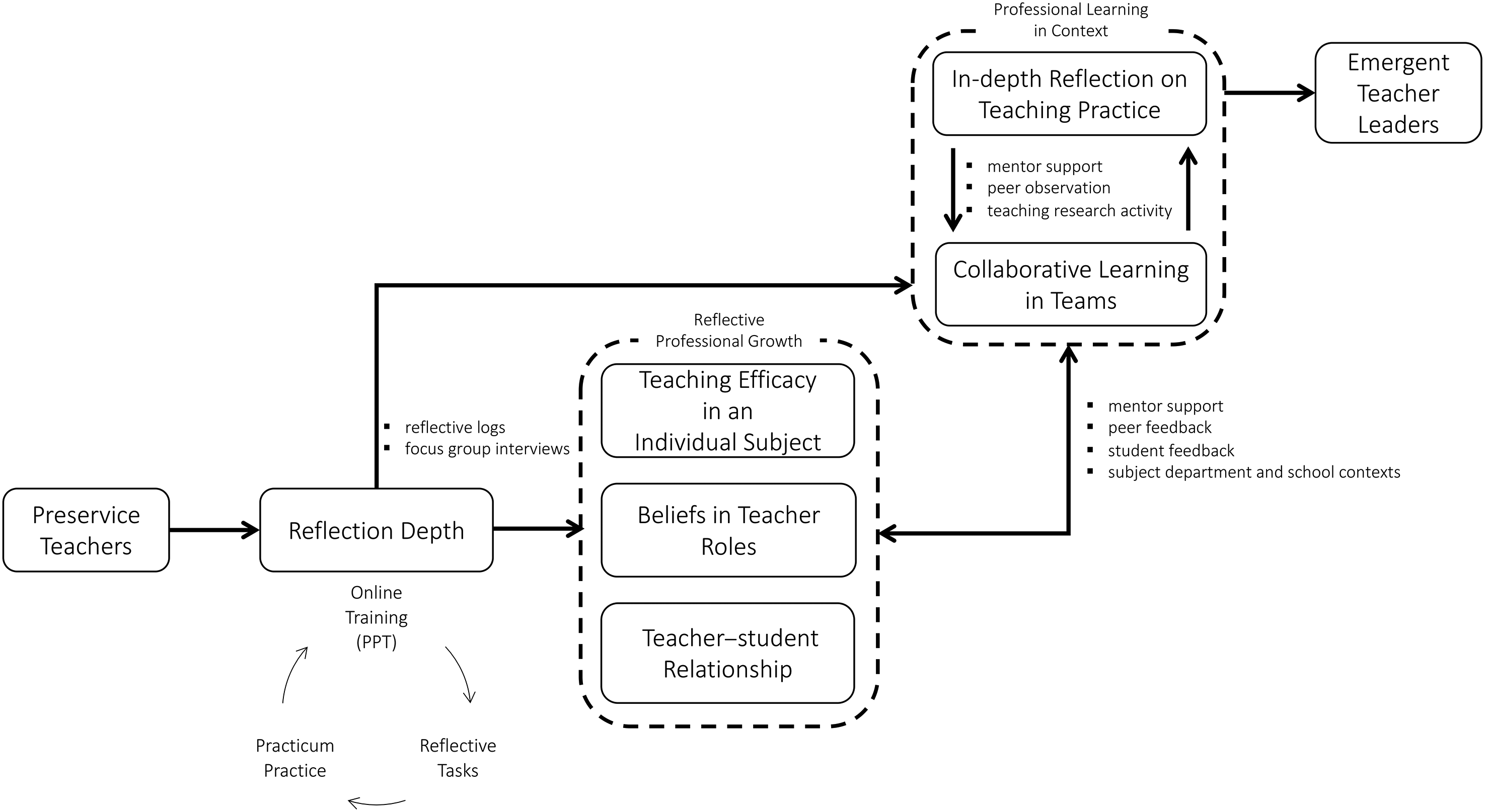
The dynamic development process of emergent teacher leaders.
Three attributes emerged as indicative of the potential leadership capacity to support preservice teachers’ professional growth. First, the results showed that preservice teachers’ teaching efficacy differed from that of subjects, and all of them showed a higher sense of teaching efficacy after gaining a deeper understanding of teaching in practicum practice. Teachers’ self-efficacy is well represented in their teaching efforts and persistence in completing the expected teaching goals (Klassen & Tze, 2014). The preservice teachers who show a higher sense of teaching efficacy in specific subjects are more likely to achieve effective teaching if they can transfer their understanding of specific subject knowledge so that students can better understand.
Second, the results showed that preservice teachers strongly believed in teaching roles. Teachers’ perceptions and beliefs influence their acts (Riveros et al., 2013; Smulyan, 2016). The teachers who viewed themselves as leaders within the classroom tended to expand their roles and responsibilities beyond the classroom, eventually influencing their progress as teacher leaders (Carver, 2016; Hunzicker, 2017).
Third, positive teacher–student relationships were often mentioned in preservice teachers’ reflections in this study. Maintaining positive relationships with students is one of the specific attributes of more flexible, reflective, and innovative teachers (Ko et al., 2019). These results indicated that preservice teachers’ emergent teacher leadership could be developed by enhancing stronger beliefs in the teacher's roles, a higher sense of teaching efficacy in an individual subject, and a more positive teacher–student relationship. In-depth reflections help preservice teachers to achieve this goal.
Additionally, collaborative learning in teams was identified as a potential attribute for preservice teachers to develop emergent teacher leadership. On the one hand, collaborative learning, such as mentor support (Davis, 2006), participating in learning communities in practicum schools (Seban, 2015), colleague recognition (Sinha & Hanuscin, 2017), and student feedback, reshape preservice teachers’ perceptions and beliefs in teaching. On the other hand, collaborative learning, such as peer observation (Bacharach et al., 2010) and guidance for teacher leaders in professional learning activities in local schools (Zhang, Walker et al., 2021), stimulate preservice teachers to generate meaningful reflections and improve teaching quality.
However, the results showed that not all nine preservice teachers generated in-depth reflections, indicating that the capacity for in-depth reflection is the determining factor for preservice teachers to grow as emergent teacher leaders. Maintaining reflection in teaching is essential for teacher leadership (Harris & Lambert, 2003). Through critical reflection, preservice teachers could grow to master teachers with abundant professional knowledge and skills and eventually emerge as teacher leaders (Hunzicker, 2017; Snell & Swanson, 2000). Therefore, building the capability to reflect deeply on the acquired knowledge and teaching performance is essential in developing emergent teacher leadership and shaping early professional growth among preservice teachers.
Conclusion
In conclusion, this study identified the potential attributes of emergent teacher leadership among preservice teachers who showed deeper reflection depths and the attributes that fit into the Chinese professional development and cultural context. This study also provided a model that contributed to the dynamic development process of emergent teacher leaders. Teacher education programs should foster preservice teachers’ emergent teacher leadership with a combination of social and cultural conditions, thus helping them grow faster to become teacher leaders in the future.
The study holds implications for understanding the potential attributes of emergent teacher leadership among Chinese preservice teachers, and enhances our understanding of the importance of preservice teachers developing and practicing emergent teacher leadership during the preparation stage. This study should raise policymakers’ awareness of the importance of cultivating emergent teacher leadership for preservice teachers to become future outstanding teachers in the teacher education program.
However, there are some limitations to this study. First, this study conducted a secondary analysis to identify emergent teacher leadership among preservice teachers. Future studies should adopt other data collection methods that focus on teacher leadership. Second, this study does not explore the dispositional traits of preservice teachers. We acknowledge that disposition is an essential factor influencing the development of teacher leadership capacity, and will collect more data in future research. Third, this study did not measure preservice teachers’ teaching performance. Future studies should explore emergent teacher leadership capacity by linking it with preservice teachers’ teaching quality. Fourth, the focus group interview was conducted online due to COVID-19. In future studies, face-to-face interviews should be adopted to improve preservice teachers’ engagement, so that they may actively share their experiences and perspectives.
Footnotes
Contributorship
Ye Wang contributed to collecting and analyzing the data, and drafting and finalizing the manuscript. James Ko commented on the data analysis, reframed the consolidated themes, and revised draft versions of the manuscript. Haiyan Qian made critical revisions to the manuscript. All authors have agreed to the published version of the manuscript.
Declaration of conflicting interests
The authors declared no potential conflicts of interest with respect to the research, authorship, and/or publication of this article.
Ethical statement
Ethical approval for this study was obtained from the Human Research Ethics Committee, The Education University of Hong Kong (approval number 2019-2020-0189).
Funding
The authors received no financial support for the research, authorship, and/or publication of this article.