




Abstract
Purpose
This study investigated the relationships between leadership styles (transformational, transactional, and passive) and teachers’ autonomous motivation (intrinsic and identified) in teachers with high and low levels of organizational citizenship behavior (OCB).
Design/Approach/Methods
In a sample of 651 teachers from Israeli schools, several groups were identified: 107 teachers with the highest OCB scores (saints), 104 teachers with the lowest OCB scores (sinners), and 440 teachers with OCB scores in the middle range.
Findings
Regression analysis indicated that the intrinsic motivation of OCB saints was significantly predicted by passive leadership style, whereas that of the OCB norm by transformational leadership style. The analysis further indicated that the identified motivation of OCB sinners was significantly predicted by transactional leadership style, whereas that of the OCB norm by transformational leadership style.
Originality/Value
The results challenge the assumption of a one-size-fits-all approach to “effective” principals’ leadership styles and suggest that to cultivate teachers’ autonomous motivation they should be treated differently in leadership efforts. The implications of the study may be useful in improving school effectiveness and designing training programs for school leaders to enhance their leadership skills.
Keywords
Introduction
Leadership plays a critical role in shaping the culture and environment of educational organizations (Leithwood et al., 2020). Research indicates that effective leadership can significantly boost teacher motivation, engagement, and job satisfaction, ultimately resulting in enhanced student outcomes (Berkovich & Eyal, 2017; Bogler, 2001; Robinson & Gray, 2019). Full-range leadership theory and its various suggested leadership styles, mainly the active and effective ones, have sparked considerable interest in leadership studies (Antonakis & House, 2013; Berkovich, 2016, 2018a, 2018b). According to the theory, the two active and effective styles are transformational and transactional leadership. Transformational leaders inspire and motivate their followers to achieve their potential by providing a clear vision, setting high standards, and offering individual support (Barth & Benoliel, 2019; Da’as, 2020). Transactional leaders offer rewards and punishments for meeting or failing to meet certain goals and objectives (Barth & Benoliel, 2019; Da’as, 2020). By contrast, the theory also notes ineffective and passive leadership. Passive leaders 1 display no leadership behaviors or engagement in decision making (Da’as, 2020). The full-range leadership theory proposes a framework for understanding various leadership styles and their different effects. In this study, elements of the theory (specifically, styles) are applied to better understand how the effects of various leadership behaviors differ based on followers’ characteristics.
One of the key followers’ characteristics that leadership style researchers have explored is organizational citizenship behavior (OCB). OCB refers to discretionary behaviors displayed by employees that are not explicitly mandated by formal job requirements but contribute to the overall effectiveness and wellbeing of the organization (Bogler & Somech, 2023). In this study, teachers with very high levels of OCB, displaying altruism and commitment to the school, peers, and students above and beyond their prescribed roles, are defined as “organizational saints”; teachers with very low levels of OCB, showing minimal altruism and commitment to the school, peers, and students, are defined as “organizational sinners.” This terminology is based on prior literature. Employees with an internalized sense of morality who act for the good of the organization, its clients, and the community in which it is located are referred to as “organizational saints,” reflecting their high ethical commitment (Ashforth & Lange, 2016). Conversely, employees with low respect for work norms or workplace spirit are referred to as “organizational sinners,” and they may appear unethical because of their limited engagement in behaviors that contribute to the organization (Ashforth & Lange, 2016). The present study investigated the effects of leadership styles (transformational, transactional, and passive) on teachers’ outcomes among teachers exhibiting different levels of OCB (high OCB = saints, low OCB = sinners).
One of the key desired teachers’ attitudes is autonomous motivation (Roth et al., 2007). Ryan and Deci (2017) defined autonomous motivation as the extent to which an objective is pursued based on feelings of determination and meaning, which represent one's fundamental self. Two key types of autonomous motivation exist (see Shuck et al., 2018, p. 199): identified (e.g., “I do this work because I believe in the cause it represents”) and intrinsic (e.g., “I do this work because I enjoy the process of it”). Studies have explored the effect of principals’ leadership styles on teacher's autonomous motivation (Berkovich, 2018a, 2018b; Berkovich & Eyal, 2017). However, there has been little focus on examining the relationship between principals’ leadership styles and teachers’ autonomous motivation contingent on OCB levels. Understanding how the effects of leadership styles depend on teachers’ OCB levels may provide valuable insights for school leaders, which can improve students’ learning outcomes.
The study addressed the following research questions (RQs):
What is the relationship between leadership styles (transformational, transactional, and passive) and intrinsic motivation in teachers with low/ high levels of OCB? What is the relationship between leadership styles (transformational, transactional, and passive) and identified motivation in teachers with low/ high levels of OCB?
The study uses existing theoretical frameworks and instruments but its contribution lies in uncovering nuanced relationships between leadership styles and teachers’ autonomous motivation by challenging the conventional notion of a one-size-fits-all leadership. Specifically, it uses OCB to represent context, thereby extending contingency theory and questioning the universality assumptions of full-range theory.
A review of the literature on contingency theory, teachers’ OCB, principals’ leadership styles, and teacher's autonomous motivation is followed by a description of the methodology used in the study. Next, the findings of the study are presented and a conclusion is provided, summarizing the main findings, limitations, and suggestions for future research.
Literature review
Contingency theory
Contingency theory is a prominent leadership approach that emphasizes the importance of situational factors in determining effective leadership strategies (Bush & Glover, 2014; Haider et al., 2023). Unlike some other theories that propose a universal one-size-fits-all approach to leadership (Antonakis et al., 2003; Berkovich, 2018a, 2018b), contingency theory recognizes that different situations require different leadership behaviors. According to contingency theory, effective leadership is contingent upon various factors such as the characteristics of the leader, the characteristics of the followers, and the nature of the task or environment (Shala et al., 2021). One of the key aspects of contingency theory is the concept of “fit” (Dikova & Veselova, 2021), which suggests that leaders should assess and match their leadership style to the demands of the situation (Bush & Glover, 2014; Haider et al., 2023). For example, in a highly structured and high-risk environment, a monitoring leadership style may be more effective because it provides clear instructions to followers and makes sure that they are followed (Antonakis et al., 2003). A review of the popularity of leadership theories in peer-reviewed educational research using the ERIC search engine suggests that contingency theory was mentioned less than 50 times between 1990–2016 (Berkovich, 2018b), suggesting that the theory and its ideas have been marginalized. Building on this theory makes the present work unique.
Teachers’ OCB level as a contingency factor
The origin of OCB is in early twentieth-century classical management works (e.g., Barnard, 1938; Roethlisberger & Dickson, 1939) pointing out that cooperative, constructive behaviors that go above and beyond an employee's job requirements are essential for the successful operation of an organization. The early attempt to conceptualize and operationalize the concept in applied psychology can be traced to Organ's works in the 1980s (Organ, 1988; Smith et al., 1983). OCB, also known as the “good soldier syndrome” (Knez et al., 2019), has often been theorized by contrasting it with the notion of in-role performance (Somech, 2016). Scholars defined OCB as organizationally helpful behaviors and gestures that cannot be enforced by formal role obligations or elicited by a contractual guarantee of remuneration (Nassir & Benoliel, 2022). Organ (1988) suggested five dimensions of OCB: conscientiousness (e.g., self-adhering to organizational policies), sportsmanship (e.g., treating organizational nuisances lightly), civic virtue (e.g., doing willingly un-mandated work), courtesy (e.g., considering the effect of work actions on coworkers), and altruism (e.g., helping coworkers). Teachers’ OCB encompasses a variety of voluntary behaviors that contribute to school performance or success but are not formally required or compensated (Bogler & Somech, 2023; Somech, 2016; Somech & Oplatka, 2009, 2014). OCB has been linked, among others, to increased student achievement, teachers’ positive attitudes toward teaching and school, improved school discipline, positive school reputation, and an extremely collegial school climate (Oplatka, 2009; Somech & Oplatka, 2014). Several scholars suggested that OCB in educational settings can be directed at students, colleagues, and the organization at large (Bogler & Somech, 2004; Somech & Drach-Zahavy, 2000). For instance, teachers create unrequired specialized assignments for advanced or lower-level students, assist colleagues by giving them lesson plans, volunteer to serve on school committees, and so on.
OCB levels are known to moderate links between followers’ attitudes and behaviors. For instance, a high OCB level of employees was found to moderate the relationship between abusive supervision and employees’ organizational deviance (Liang et al., 2022). Also, the associations between personality characteristics and counterproductive work behavior were found to be moderated by OCB (Chang & Smithikrai, 2010). Counterproductive work behaviors, such as absenteeism, are largely in-role performance. A study exploring 2,224 Romanian teachers, comparing high and low OCB levels, found that workload significantly reduced teachers’ performance and enhanced their stress only in the high OCB group (Muntean et al., 2022). This is much like the suggestion made in this study that correlations between principals’ leadership styles and teachers’ motivations differ in OCB sinners vs OCB saints. Guillén et al. (2015) argued that organizational research ignores the ethical and spiritual motivations of employees in the workplace. According to them, the “moral and spiritual motivations capture people's need and desire to go beyond mere self-interest” (Guillén et al., 2015, p. 814). The word “saint” is often used to describe individuals who act as a paragon of virtue and live by the highest ideals (Palmer et al., 2013). Organ's (1988) conceptualization of OCB stresses key moral components such as altruism and conscientiousness. To summarize, research has used OCB as a moderator of supervisors’ effects, personality traits, and work conditions, but there is a gap in scholarly knowledge regarding OCB as a moderator of the effects of leadership styles. In this study, OCB is viewed as a contingency factor representing individual predisposition that can influence how contextual effects such as leadership actions are interpreted by followers.
Principals’ leadership styles
The full-range leadership theory, also known as “leadership styles theory,” is among the most popular theories in education administration (Kovačević & Hallinger, 2019). The theory suggests that leadership is not limited to a specific behavioral manifestation, but there is a range of leadership behaviors that differ in effectiveness and proactivity (Bass & Avolio, 1994). The full-range theory naturally based some of its focuses and conceptualizations on early leadership theories that differentiated between the degrees of effectiveness of leaders’ behaviors (e.g., Fiedler's “contingency model,” see Hollander & Julian, 1969) and studies on the passivity of leaders (Kipnis & Lane, 1962). These elements make it ideal for focusing the present study on it, which explores a contingency model combining variations in leadership behaviors and effects. A review of the topics of education administration textbooks suggests that the transformational leadership model predominates (see Berkovich, 2018b). The theory identifies transformational, transactional, and passive styles. Transformational behaviors are aimed at altering followers’ views, principles, and abilities to increase their propensity to act for the good of the organization rather than their own (Eyal & Roth, 2011). Transactional behaviors are more instrumental than transformational ones and are typically associated with task management and leader-subordinate interaction (Bogler, 2001). The passive leadership approach is perceived as “the absence of leadership” (Wong & Giessner, 2015). According to a foundational argument in the field of full-range leadership theory, some leadership styles are inherently more effective than others. The traditional assumption is that leadership styles can be ranked from transformational, which is the most effective, through transactional, which is less effective, to passive, which is ineffective (Berkovich, 2018a, 2018b; Menon, 2014; Nir & Hameiri, 2014; Van Knippenberg & Sitkin, 2013). Because of the ample research evidence on the positive effects of transformational leadership, the idea of this style has become a normative model in many countries (e.g., the US, Australia, Estonia, Indonesia, Iran, Tanzania, and many more) and has affected the formal curriculum of principals’ training programs in Israel and the US (Berkovich, 2018b).
Most writing on leadership styles argues that the transformational leadership style is universally effective, regardless of situational factors. But some works suggest the opposite. For example, Jansen et al. (2009) proposed that transformational leadership is negatively correlated with the exploitation of existing resources in dynamic environments but it effectively promotes the advancement of services in stable settings. Other research suggests that transactional leadership can be more productive in work environments that have particular instrumental task requirements or high contextual challenges (Antonakis et al., 2003; Berkovich, 2018a). Wong and Giessner (2015) suggested that in some circumstances, a passive leadership approach is associated with empowering staff members. From a critical point of view, the attempts to challenge the idea that transformational leadership style is universally effective are few, indicating a wide tendency in the research community to affirm and support the full-range theory. The present study departs from the assumptions of the original theory.
Teachers’ autonomous motivation
Work motivation is the personal urge to engage in job-related activities or behaviors aiming to pursue job-related objectives (Kooij & Van den Broeck, 2022). Motivation is considered most beneficial in its autonomous form, when objectives are pursued out of personal interest or because the individual values them (Blašková et al., 2019). According to self-determination theory, individuals experience autonomous motivation in their activities when their psychological needs for autonomy, self-competence, and relatedness are met (Ryan & Deci, 2017). They additionally feel autonomous motivation (i.e., self-determination) when they consider themselves to be choosing objectives for action out of internal agency and initiative (Roth et al., 2007), so that their passion, or the recognition of the significance of external objectives and principles, leads to self-determination (Ryan & Deci, 2017). Two subtypes of autonomous motivation are frequently discussed: intrinsic, when one is driven by internal variables, such as personal interest or curiosity, and is more likely to engage in an activity because it is intriguing or enjoyable; and identified, when one participates in an activity because it aligns with one's personal convictions and principles (Howard et al., 2017). Individuals are more likely to experience autonomous motivation when they feel competent (Ryan & Deci, 2017).
Because teachers work behind closed doors (Carswell, 2021), the importance of autonomous motivation in teaching is high (Berkovich & Eyal, 2017). Employees’ intrinsic motivation appears to be affected by their perception of the environment as non-controlling and supporting autonomy, and their psychological needs as being met (Berkovich & Eyal, 2017; Eyal & Roth, 2011; Klaeijsen et al., 2018). A recent meta-analysis of 102 samples indicated that teachers’ autonomous motives predict their wellbeing and supportive teaching styles (Slemp et al., 2020). Another meta-analysis indicated that principals’ leadership practices of empowering and motivating (which are part of transformational leadership) have a large positive effect on teachers’ capacity, including motivation, and that this effect was stable across different levels of education (Tan et al., 2022). Transformational leaders are said to express a vision that centers around the value that defines the meaning of work (Ng, 2017), which is shared with the employees and respected by them, boosting their identified motivation (Eyal & Roth, 2011). Synthesizing empirical research across various domains, including education and beyond, indicates a substantial influence of transformational leadership in promoting autonomous motivation among followers (Berkovich & Eyal, 2017; Chua & Ayoko, 2021; Eyal & Roth, 2011; Nielsen et al., 2019). Nevertheless, these studies support a universal claim of effectiveness and do not challenge it by looking into specific situations where the effect might not work.
Moreover, the effects of other leadership styles on autonomous motivation have rarely been explored. Some indirect evidence suggests a mixed picture. A longitudinal study indicated that transactional behavioral elements of verbal reward were positively related to employees’ intrinsic motivation, but martial rewards and sanctions were non-significantly related to this type of motivation (Nielsen et al., 2019). This study mixed data from different industries (e.g., schools, daycare centers, tax offices, and banks). In addition, close monitoring by supervisor was found to correlate negatively with employees’ intrinsic motivation (Kim et al., 2023), but principals’ digital instructional transactional behaviors were found to be positively related to teachers’ intrinsic motivation for online teaching (Berkovich & Hassan, 2022). Evidence concerning passive leadership and motivation is scarce. A study of current and aspiring managers found non-significant correlations between passive leadership and intrinsic and identified motivations (Graves et al., 2019), but we know that contrary to what may be expected in schools with favourable circumstances and few challenges, principals’ passive behaviors may promote student achievement (Berkovich, 2018a), possibly as the principals’ “absent” conduct leaves space for teachers’ autonomous motivation. Thus, there are evident knowledge gaps in our understanding of the relationship between transformational leadership and autonomous motivation in various situations. It also remains unclear whether other transactional and passive leadership styles are associated with this type of motivation, both in a general sense and in specific situations. These gaps also exist in educational leadership research, where they take even more acute and dire forms because school leadership is heavily influenced by contextual factors (Berkovich, 2018a, 2018b; Hallinger, 2018). The present study sought to bridge these gaps by examining situations that vary by employees’ inclinations to perform OCB.
Method
Context of the research
The study was conducted in Israel. Schools in Israel are either formal public or independent (Berkovich, 2018c). Modernized Western conceptions serve as the foundation for the formal education system, which largely follows American and European educational norms. The Jewish formal public system, which is the focus of the present study, includes the state-secular (coeducation and individualistic) and state-religious (mainly gender-segregated and combining individualistic and collectivist views) schools. When Israel was founded, its schooling system was centralized. This characteristic is evident in the stringent financial, administrative, organizational, didactic, and structural oversight of public primary education (Addi-Raccah, 2015; Berkovich, 2018c). In recent decades, public primary education has changed. The introduction of autonomous schools, parental choice, and self-based management in the 1990s and national standardized examinations in the first decade of the 2000s promoted commodification and accountability in primary public education (Addi-Raccah, 2015; Berkovich, 2014; Feniger et al., 2016). Changes in education, especially those motivated by neoliberal ideas, have been connected to decreased intrinsic motivation of teachers (Van Veen & Sleegers, 2009). Moreover, in a decentralized and accountability-oriented policy environment such as in Israel (Berkovich, 2018c), principals face growing pressure to produce results (Berkovich, 2014). Within the public system, however, they must often do so without additional resources, relying more heavily on leadership to generate school effectiveness.
Participants and procedure
The study received approval from an Institutional Review Board (3032013). Data were collected from a randomly selected group of 69 Israeli primary schools. The basis for the sampling was a Ministry of Education list (64% recruitment rate out of 107 approached institutions). The majority of schools in the sample were located in urban areas (81.6%), with an average parental education level of 11.2 years. On average, the proportion of students from low-income households in the sampled schools was 16%, and the ratio of students who had migrated to the country in the last 5 years was 4.8%.
Teachers’ participation in the research was voluntary, individuals had the right to withdraw at any time (79% response rate). A total of 651 teachers responded to the survey. Participants provided their informed consent by signing written consent forms. Similarly to their proportion in the national system, 92% of these were women (CBS, 2013). Their average age was 41.62 (SD = 10.20) years, and their mean tenure was 16.82 (SD = 9.70) years. It is important to acknowledge that the study data may be affected by biases because of non-responses and a notably higher female participant ratio, which may have influenced the teachers’ responses. The researcher took necessary measures to ensure the privacy and confidentiality of the participants. All collected data was securely stored and accessible exclusively to the research team.
Instruments
Principals’ leadership styles
Principals’ leadership style was measured using the multifactor leadership questionnaire (MLQ 5) (Bass & Avolio, 1994). Teachers evaluated their principals’ conduct from the perspectives of (a) transformational leadership, encompassing idealized influence behavior, inspirational motivation, intellectual stimulation, and individualized consideration behaviors (16 items, e.g., “My principal talks optimistically about the future”); (b) transactional leadership, encompassing active management by exception behaviors (4 items, e.g., “My principal focuses attention on irregularities, mistakes, exceptions, and deviations from standards”); and (c) passive leadership, encompassing passive management by exception and laissez-faire leadership behaviors (8 items, e.g., “My principal waits for problems to arise before taking action”). Respondents ranked items on a 5-point scale ranging from 5 = Frequently, if not always, to 1 = Never. Confirmatory factor analysis (CFA) was carried out using the AMOS software to explore construct validity. The fit indices used in the study were the chi-square value (χ2), the comparative fit index (CFI), the Tucker-Lewis index (TLI), and the root mean square error of approximation (RMSEA). The literature indicates that when both the CFI and TLI are larger than .95, data fit is excellent and when larger than .90, it is acceptable (Byrne, 2010; Hair et al., 2010). When the RMSEA is less than .06, the data fit is good and when less than .08, it is acceptable (Byrne, 2010; Hair et al., 2010). CFA indicated good construct validity of the three leadership styles structure (χ2 = 1009.81, df = 340, p < .001, CFI = .91, TLI = .90, RMSEA = .05).
Organizational citizenship behavior
The extra-role behavior of teachers at school was measured using 23 items from Somech and Drach-Zahavy's (2000) OCB scale, e.g., “I stay after school hours to help students with materials covered in class.” Participants responded on a 5-point scale ranging from 1 = Strongly disagree to 5 = Strongly agree. The results were averaged to create a single index that represents the extra-role behavior of teachers at school. The validity of the scale was determined by Somech and Drach-Zahavy (2000). CFA indicated good construct validity of the one-factor OCB model (χ2 = 541.82, df = 167, p < .001, CFI = .92, TLI = .90, RMSEA = .06).
Teacher's autonomous motivation
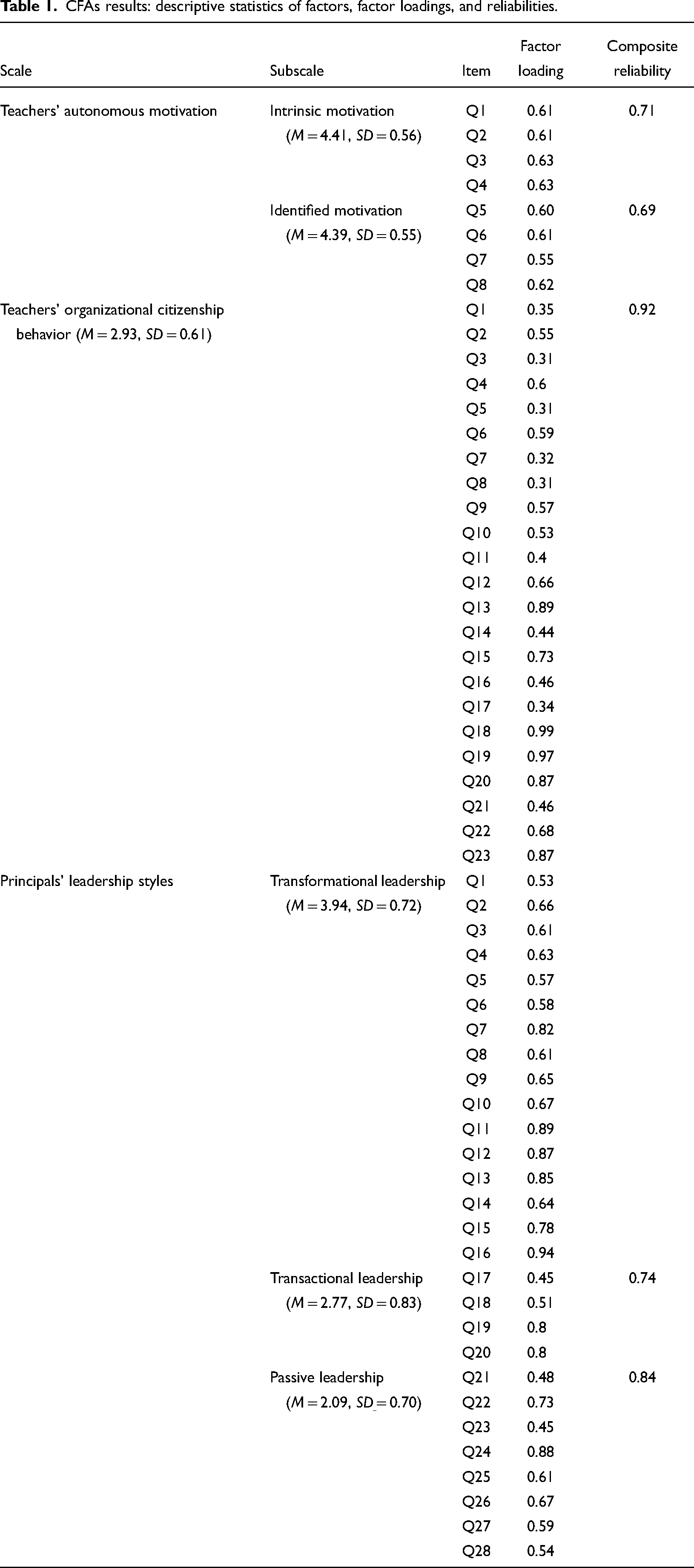
The scale created by Roth et al. (2007) was used to assess teachers’ autonomous motivation. Two subscales of autonomous motivation were used: identified and intrinsic, each one comprising four items. Respondents were asked to rate the degree to which they concurred with several causes affecting their commitment to work. Sample item representing identified motivation: “[…] because it is important for me to make children feel that I care about them;” sample item representing intrinsic motivation: “[…] because I enjoy finding unique solutions for various students.” Participants answered on a 5-point scale, ranging from 1 = Strongly disagree to 5 = Strongly agree. CFA indicated excellent construct validity of the two-factor structure (χ2 = 48.05, df = 14, p < .001, CFI = .97, TLI = .95, RMSEA = .06). The descriptive statistics and factor loadings and reliabilities from CFAs are reported in Table 1 below.
CFAs results: descriptive statistics of factors, factor loadings, and reliabilities.
Results
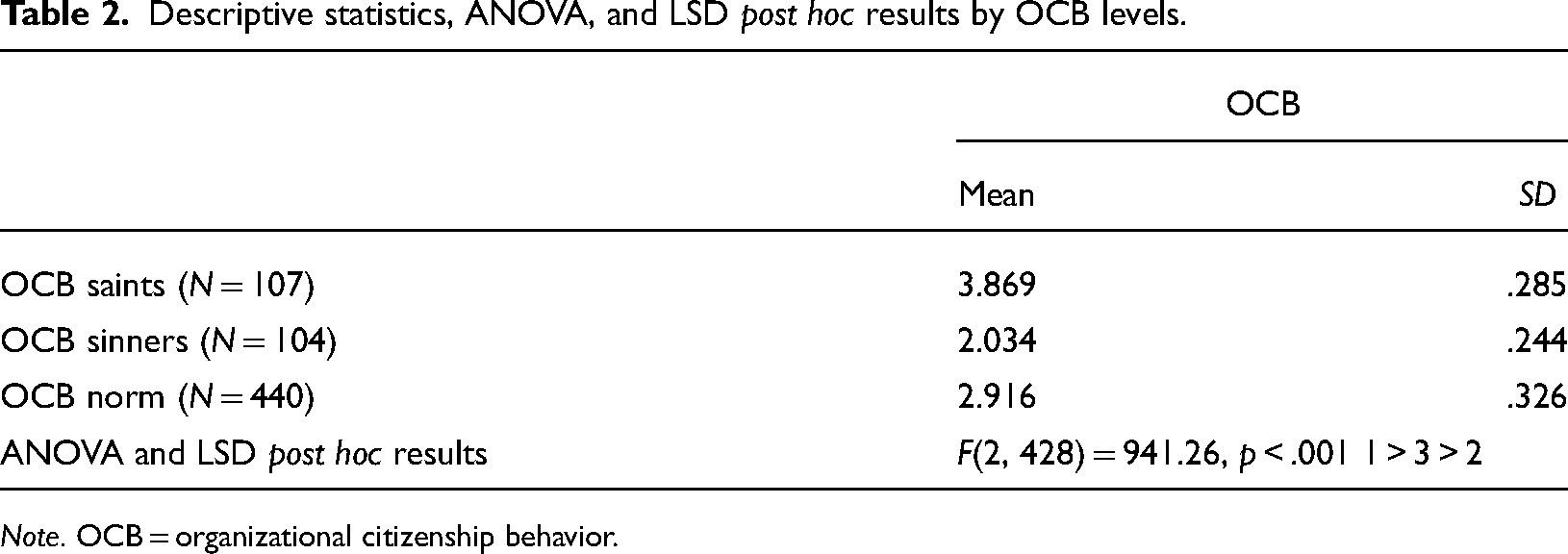
Analyses were conducted using SPSS software. The teachers’ sample OCB scores (N = 651) were converted to Z-scores. Teachers with an OCB Z-score above 1 were defined as “saints” (N = 107) and those with an OCB Z-score below −1 were defined as “sinners” (N = 104). The OCB norm group included 440 teachers. Analysis of variance (ANOVA) test and LSD post hoc results were used to ascertain differences in OCB scores between the three groups. The teachers in the saints’ group had an average OCB score of 3.869 (SD = .285), in the OCB norm group an average score of 2.916 (SD = .326), and in the sinners’ group an average score of 2.034 (SD = .244). The effect was significant, F(2, 428) = 941.26, p < .001. The descriptive statistics of means and standard deviations, and the ANOVA and post hoc tests by OCB levels, are shown in Table 2.
Descriptive statistics, ANOVA, and LSD post hoc results by OCB levels.
Note. OCB = organizational citizenship behavior.
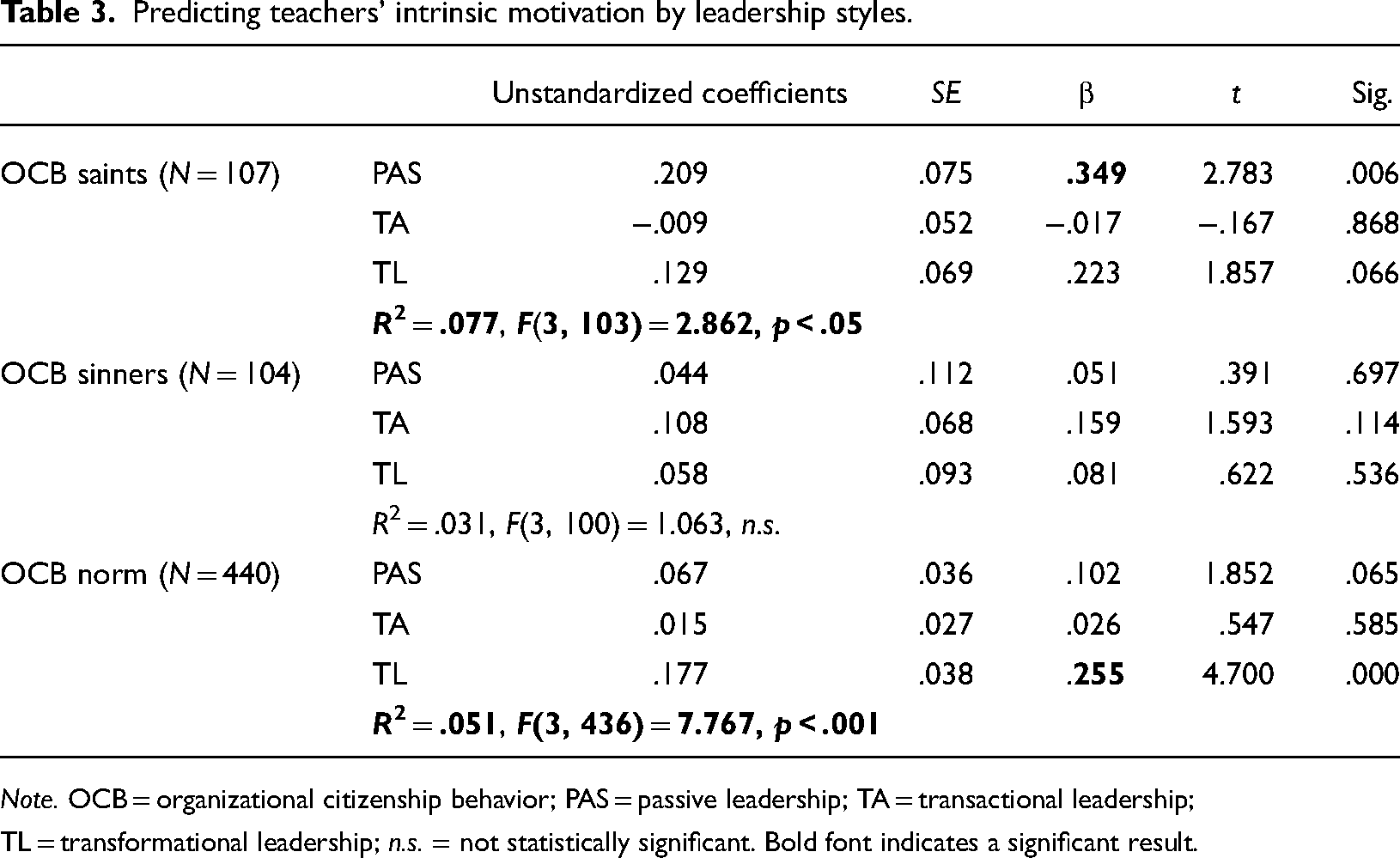
Regression analyses were performed to explore the two research questions. Table 3 shows the regression analysis predicting teachers’ intrinsic motivation based on the principals’ leadership styles (RQ1). The results indicate that for the OCB saints group, passive leadership significantly predicted intrinsic motivation scores (β = .349, p < .01), unlike the OCB norm group, in which transformational leadership significantly predicted intrinsic motivation scores (β = .349, p < .001).
Predicting teachers’ intrinsic motivation by leadership styles.
Note. OCB = organizational citizenship behavior; PAS = passive leadership; TA = transactional leadership; TL = transformational leadership; n.s. = not statistically significant. Bold font indicates a significant result.
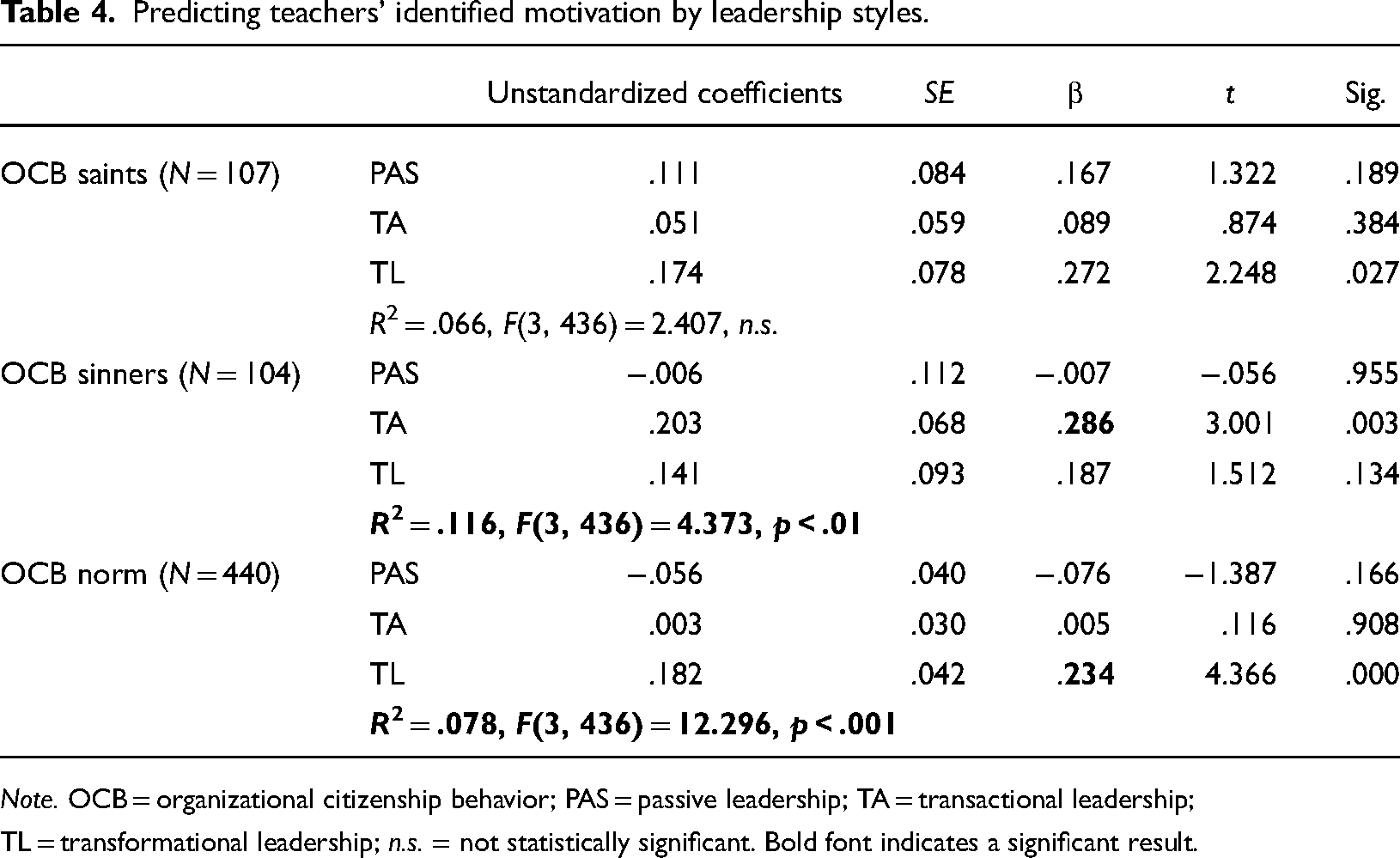
To investigate RQ2, additional regressions were calculated. Table 4 presents the regression analysis predicting teachers’ identified motivation using the principals’ leadership styles. The results indicate that for the OCB sinners group, transactional leadership significantly predicted identified motivation scores (β = .286, p < .01), unlike the OCB norm group, for which transformational leadership significantly predicted identified motivation scores (β = .234, p < .01).
Predicting teachers’ identified motivation by leadership styles.
Note. OCB = organizational citizenship behavior; PAS = passive leadership; TA = transactional leadership; TL = transformational leadership; n.s. = not statistically significant. Bold font indicates a significant result.
Discussion
This study aimed to explore the links between leadership styles (specifically transformational, transactional, and passive), and teacher autonomous motivation within different groups of teachers exhibiting varying levels of OCB. The findings provide empirical evidence to support the notion that effective leadership requires a tailored approach to cater the diverse needs and behaviors of teachers. These results echo previous research that challenges the assumption of a one-size-fits-all approach to “effective” principals’ leadership styles, acknowledging the complexity of leadership dynamics (Berkovich, 2018a, 2018b) and their dependence on individual, school, and national factors (Berkovich, 2018a, 2018b; Hallinger, 2018).
The study makes several contributions to the scholarship. First, the results of the regression analysis provide insights into the correlations between leadership styles and teachers’ intrinsic motivation. These findings have implications for self-determination theory, which emphasizes the importance of autonomy, competence, and relatedness in boosting intrinsic motivation (Ryan & Deci, 2017). While prior research based on self-determination theory suggested that autonomy-supportive leadership, such as transformational leadership, plays a central role in nurturing intrinsic motivation (Berkovich & Eyal, 2017; Eyal & Roth, 2011), this study found that teachers displaying high OCB (often referred to as “saints”) were significantly influenced by a passive leadership style regarding their intrinsic motivation. These results challenge the notion that supportive leadership is universally essential for motivation, suggesting that in specific contexts, a more hands-off approach may prove beneficial. It is conceivable that these saints may have already internalized a strong sense of purpose and motivation for their work, making them less reliant on external support from their leaders. By allowing OCB saints greater autonomy and freedom, passive leaders create an environment that empowers teachers to pursue their intrinsic goals and values. A potential explanation for the contradiction in the literature is that the study involved experienced teachers who had long-standing relationships with their leaders. Over time, trust can develop, leading to changes in the initial dynamics (Berkovich, 2018d). By contrast, for teachers with normative OCB scores, the transformational leadership style emerged as a significant predictor of intrinsic motivation. This finding is consistent with claims that by creating a vision and providing personal consideration, transformational school leaders foster a climate where teachers’ intrinsic motivation flourishes (Berkovich & Eyal, 2017; Eyal & Roth, 2011).
Second, the study also shed light on the correlations between leadership styles and teachers’ identified motivation. The identified motivation of teachers with low OCB (often referred to as “sinners”) was significantly predicated by a transactional leadership style. Specifically, this finding was linked to a particular type of transactional leaders who proactively communicate expectations and closely monitor to foster compliance and enhance performance, namely, those who employ the active management by exception style. For teachers with low OCB, who may be less inclined to engage in extra-role behaviors for the school's benefit, the close supervision of a transactional leader played a pivotal role in supporting their motivation. Close monitoring may validate teachers, demonstrating that their actions matter to the school leadership. This validation boosts motivation, leading to a stronger connection with their tasks and a deeper appreciation of school goals. Through this identification, teachers’ motivation becomes more deeply rooted and self-directed. This finding contradicts previous evidence regarding the connection between leaders’ active management-by-exception style and identified motivation (Gagné et al., 2012), warranting further research. An optional explanation is that in different industries (business and education) the way leadership styles and motivation are related may be different. In education, employees typically have a high emotional investment in their work, driven by a passion for teaching and a deep commitment to nurturing the development of students (Berkovich & Eyal, 2020). This heightened emotional investment can lead to outcomes distinct from those observed in the business sector.
The findings of the study have important practical implications. For acting principals, understanding the differential effects of leadership styles on teachers’ motivation based on their levels of OCB is important. For principals, OCB and extra-role behaviors are easier to assess than in-role behaviors that occur behind the closed doors of classrooms (Carswell, 2021). Acting principals should recognize the diverse nature of teachers and adapt their leadership approaches accordingly. They should consider these differential effects and tailor their leadership strategies to optimize teachers’ motivation and engagement. From a pragmatic perspective, school leaders have the flexibility to adapt their leadership approaches to suit various scenarios. For example, when dealing with teacher leaders who consistently exhibit high OCB, adopting a more passive leadership style can be effective. Conversely, when faced with teachers experiencing burnout and demonstrating low OCB, a transactional leadership style may prove beneficial. This adaptability in leadership styles can serve as a catalyst for enhancing autonomous motivation among educators, fostering a more conducive and engaging educational work environment. The study findings may be also used to improve the training and development of principals. Training programs should equip school leaders with the knowledge and skills needed to adopt various leadership styles based on the individual needs of teachers with different OCB levels. By enhancing their leadership repertoire, principals will be able to create an environment that cultivates teachers’ OCB levels and improves overall educational outcomes.
Limitations and future research
Several limitations of the study should be acknowledged. First, the research was conducted in Israeli schools, which may limit the generalizability of the findings to other cultures and educational systems. For example, the Mediterranean culture of Israel is characterized by a relatively low level of formality, which means that the conduct of school leadership rests more on personal judgment and is less reliant on formal norms or rules. Cultural factors and educational systems can influence leadership practices and their effects, attesting to the need for cross-cultural studies to explore the universality of these relationships. Second, the study focused exclusively on leadership styles and teachers’ motivation based on different levels of OCB, ignoring other factors that may influence these relationships. Future research could explore additional variables, such as personality traits and perceived organizational support to provide a more comprehensive understanding of these processes in educational settings. Third, the study used a cross-sectional design that limits the ability to establish causal relationships. A longitudinal design could provide more robust evidence of the causal effects of leadership styles on teachers’ motivation based on different levels of OCB, and further validate the findings. Fourth, the study was based on self-report data; consequently, it may have been susceptible to social desirability bias, potentially reducing its validity. To address this, future research should prioritize mitigating such limitations, for example, by basing scores of school leadership styles and teachers’ OCB levels on observation.
Conclusion
In sum, the study demonstrates how school leaders can significantly enhance the intrinsic motivation of their teachers by applying tailored leadership styles. According to the findings, OCB saints, individuals inclined toward OCB, respond positively to a passive leadership style. These teachers thrive when leaders provide autonomy and space for self-driven contributions. By contrast, for the OCB norm group, using a transformational leadership style proves effective. Inspiring and visionary leadership fosters a sense of purpose and engagement in these students. The research showed that a transactional leadership style is appropriate for OCB sinners. Setting clear expectations and offering rewards for performance can motivate this group effectively. These findings demonstrate the need for school leaders to recognize and adapt their leadership approaches to match individual teacher profiles, eventually enhancing autonomous motivation and creating a more productive and engaged work environment. By doing so, principals can improve academic performance and create a more harmonious school environment. These insights attest to the significance of personalized leadership in educational work settings, offering a clear roadmap for enhancing teacher engagement and school performance.
Footnotes
Declaration of conflicting interests
The author declared no potential conflicts of interest with respect to the research, authorship, and/or publication of this article.
Ethical statement
Ethical approval was obtained from an Institutional Review Board (3032013). Participation was voluntary and informed consent was received from each participant.
Funding
The author received no financial support for the research, authorship, and/or publication of this article.
