




Abstract
Purpose
This study examined the factors influencing the tokenization of international faculty in Korean universities. It also explored how domestic faculty and staff perceive the role of international faculty and the process by which they adapt to the Korean education system.
Design/Approach/Methods
The study used a qualitative design. Universities were arranged by region and objectives (research-oriented, teaching-oriented, or combined teaching and research) for sampling, and in-depth interviews were conducted with three groups: international faculty, Korean faculty, and Korean staff.
Findings
First, Korean faculty and staff expressed low expectations of international faculty based on their different definitions of internationalization. Second, these low expectations resulted in role encapsulation, limiting the functions of international faculty. In addition, although Korean universities compete to hire international faculty, they do not provide them with adequate support post-hire. The burden of this lack of support is often passed on to Korean faculty, instilling a negative perception of international faculty.
Originality/Value
Using the framework of tokenism, this study analyzed Korean universities’ efforts to hire international faculty as part of university internationalization; it determined whether the latter ultimately became major actors in the internationalization strategy.
Introduction
The hiring of international faculty in Korean universities has increased since the 2000s, when the government began awarding financial subsidies to encourage this practice. Simultaneously, Korean universities have been experiencing a chronic financial decline due to a decrease in the school-age population, so to supplement their budgets, they have begun focusing more on attracting international students. This trend of internationalizing higher education has driven and continues to drive significant changes throughout Korean universities, from alterations to the physical design of campuses to shifts in the job market for professors (De Wit, 2002). The internationalization of higher education is progressing rapidly; as such, the world university rankings and the university quality assurance system have begun to emphasize the tangible results of internationalization in their ranking criteria, such as the ratio of international students and international faculty.
However, scholars have criticized efforts to recruit international faculty, which are driven by external pressure rather than the internal needs of the university. In addition to criticizing the goal of increasing the number of international faculty simply to appease the evaluation index (Cho & Palmer, 2013), researchers have begun to understand the factors at play in international faculty's adaptation and alienation as a result of this process. Particularly, recent studies point to the systematic marginalization and alienation of international faculty at the organizational level across universities (Kim, 2016). These variables at the organizational level must be considered when examining the adaptation of non-native professors, rather than simply focusing on individual cultural and linguistic differences. Accordingly, this study was designed to analyze the hiring of international faculty to build an image of internationalization through the concept of tokenism.
Tokenism is a useful concept for defining international faculty as a minority group in universities. The Merriam-Webster online dictionary defines a “token” (in this sense) as “a member of a group (such as a minority) that is included within a larger group through tokenism.” This definition emerged when organizations began to intentionally demonstrate non-discriminatory practices by hiring a “symbol” of a racial or sexual minority group to avoid social criticism (Kanter, 1977). Tokenism reflects a distorted status and reactive mechanism; tokenized individuals are not viewed as full group members. Against this background, the concept of tokenism can be used as a tool for the in-depth analysis of the status of international faculty as incomplete members of Korean universities, different aspects of their marginalization, and the factors that reinforce this marginalization. Particularly, to confirm the organization-level aspects of marginalization, the dynamics among major university members, including not only international faculty but also Korean faculty and staff, must be examined.
Therefore, this study explored the tokenization patterns applied to international faculty in Korean universities and compared perceptions of international faculty held by Korean faculty and staff (Korean universities’ key actors) with those of the international faculty themselves. The study is based on the following research questions:
In what ways are international faculty tokenized in Korean universities? What factors deepen their tokenization? What are Korean faculty and staff members’ perceptions of the role of international faculty?
Literature review
International academics in Korean universities
University faculty are important actors in leading education and research; as such, evidence has shown that universities cannot realize their internationalization strategies without faculty participation (Stohl, 2007). However, despite Korean universities’ hiring of non-native faculty to internationalize their campuses, few studies have examined their role in the university internationalization process (Friesen, 2013). International faculty are considered key agents of internationalization: The belief that global talent plays a major role in an institution's research performance and innovation achievements has led to the drive to attract them as a national policy (Van Der Wende, 2015). Accordingly, previous empirical studies have demonstrated that international academics outperform domestic academics (Franzoni et al., 2014; Mamiseishvili & Rosser, 2010), providing a basis for hiring international faculty.
In the early 2000s, Korean universities began actively hiring and inviting international faculty members; these efforts were accelerated when the government began providing financial support for the recruitment of international faculty. Large-scale projects, such as Brain Korea 21 (1999–present) and the World Class University Project (2008–2013), recognized the need to recruit prominent international faculty to enhance the competitiveness of Korean universities. Specifically, with the goals of both increasing Korean universities’ world rankings and quantitatively and qualitatively improving research performance, an active international faculty recruitment strategy was implemented. As the number of international faculty members in universities increased based on the Korean government's provision of financial support, interest in the adaptation and integration of these faculty members grew. Previous studies have shown that international faculty's alienation from university decision-making processes, their social isolation, and the emphasis placed on quantitative research results can lead to their mass exodus (Cho & Palmer, 2013; Kim, 2016). Moreover, scholars have pointed out that Korean universities only hire international faculty to raise their global rankings and enhance their reputations as internationalized universities; they have demonstrated a deep lack of concern for the actual role of international faculty (Park, 2018).
While prior studies have analyzed the adaptation of international faculty through individual-level variables, such as cultural differences and social relationships (Hsieh, 2012; Jiang et al., 2010; Pherali, 2012), few studies have investigated what motivates universities to hire international faculty, the perceived roles and expectations of international faculty among fellow university members, and the relationship between organizational culture and international faculty. Considering that international faculty experience systematic marginalization and alienation at the organizational level (Kim, 2016), simply identifying the causes of maladjustment at the individual level may not represent a comprehensive solution.
Integration and tokenism of international academics
An important element of Asian universities’ recruitment of international faculty is the institutional perception of them as symbols of an internationalized university campus. This approach has been criticized as an attempt to create the image of internationalized higher education merely through the quantitative expansion of a university's international faculty rather than through a qualitative content change (McVeigh, 2002).
Several studies have been conducted to analyze this phenomenon—that is, placing more emphasis on the recruitment of symbolic figures than on actual changes at universities—using the concept of tokenism (Brotherhood et al., 2020; Brown, 2019). As explained previously, tokenization refers to the practice by which an organization makes an intentional effort to reflect a culture of non-discrimination by employing a “symbolic figure” (i.e., a token; representatives of their categories rather than independent individuals) belonging to a minority group (Kanter, 1977).
Token group members are greatly influenced by performance at the individual level, and they experience lower levels of job satisfaction than their non-token peers (King et al., 2010; Niemann & Dovidio, 1998). Evidence has also illustrated that token group members experience negative psychological states (Jackson et al., 1995), such as depression and stress, and experience a variety of negative effects on their individual-level performance, such as low organizational attachment (Young & James, 2001).
Being a token employee within an organization also affects the type and depth of social relationships. For example, previous studies have shown that the turnover and retention of tokenized employees is affected by whether other people of the same minority group are recruited or leave the organization. Sørensen (2004) found that the turnover rate was affected by race representation, and Zatzick et al. (2003) found that as the percentage of token employees within an organization increases, the chances of them leaving the organization decreases. These results suggest that among the organizational-level variables that affect international faculty adaptation, turnover, and retention, the presence of and interactions among homogeneous groups within organizations have an important effect.
Existing studies of tokenism have analyzed cases highlighting the experiences of women or Black people who have been marginalized from the mainstream (Flores, 2011; Yoder & Berendsen, 2001). Notably, because tokenism deals with organizational behavior quantitatively, groups classified as mainstream in terms of existing social norms relating to race or gender may also be classified as minorities, depending on the organization (Wingfield & Wingfield, 2014). Korea has a linguistically and racially homogeneous collectivist culture (Froese et al., 2012). Therefore, the degree to which being classified as a minority influences the strength and effectiveness of tokenism in the context of East Asian universities must be examined, even for individuals whose race or gender is regarded as having a high status in existing social norms. In addition, inbreeding academic networks among domestic professors acts as a factor in determining their academic performance in countries with a strong university hierarchy (Shin et al., 2016). This provides a new perspective on the recruitment and adaptation of international faculty at East Asian universities. As Kim (2016) mentioned, the process of adaptation of international faculty in East Asian countries differs from that of those from developing countries at North American universities.
Methods
The interview participants were allocated and sampled according to the location (urban/rural) and objective of the university in which they worked. Partially utilizing the results of Shin's (2009) research, which classified four-year universities in Korea according to their objective and mission, this study divided these organizations into three types: (1) research-oriented universities, (2) combined teaching–research universities, and (3) teaching-oriented universities, and interview participants were selected from each type of university.
To confirm which aspects of tokenism are present in the process of integrating international faculty in Korean universities, interviewees from three groups were recruited: international faculty, Korean faculty, and Korean staff and senior managers. As tokenism as a dynamic occurs between minority and majority groups within an organization, it was imperative to include not only international faculty but also domestic faculty and staff members in the analysis to fully investigate the aspects and causes of tokenism. This study was approved by Korea University IRB at Korea University, Republic of Korea (KUIRB-2019-0351-02).
In the study sample, international faculty were foreign nationals working at a four-year comprehensive Korean university at the time of the interview. Korean faculty were included in the interview list if they had experience working in the same department as the international faculty. Staff and senior managers with more than one year of experience in human resources and recruitment-related work for international faculty were also interviewed. Additional international faculty participants were recruited via other interviewees using snowball sampling. The 25 interview participants were selected from the three types of universities: 8 from research-oriented universities, 6 from combined teaching–research universities, and 11 from teaching-oriented universities. In total, 8 were staff and senior managers, 10 were international faculty, and 7 were Korean faculty. Table 1 provides detailed information on the participants.
Interview participants’ characteristics.
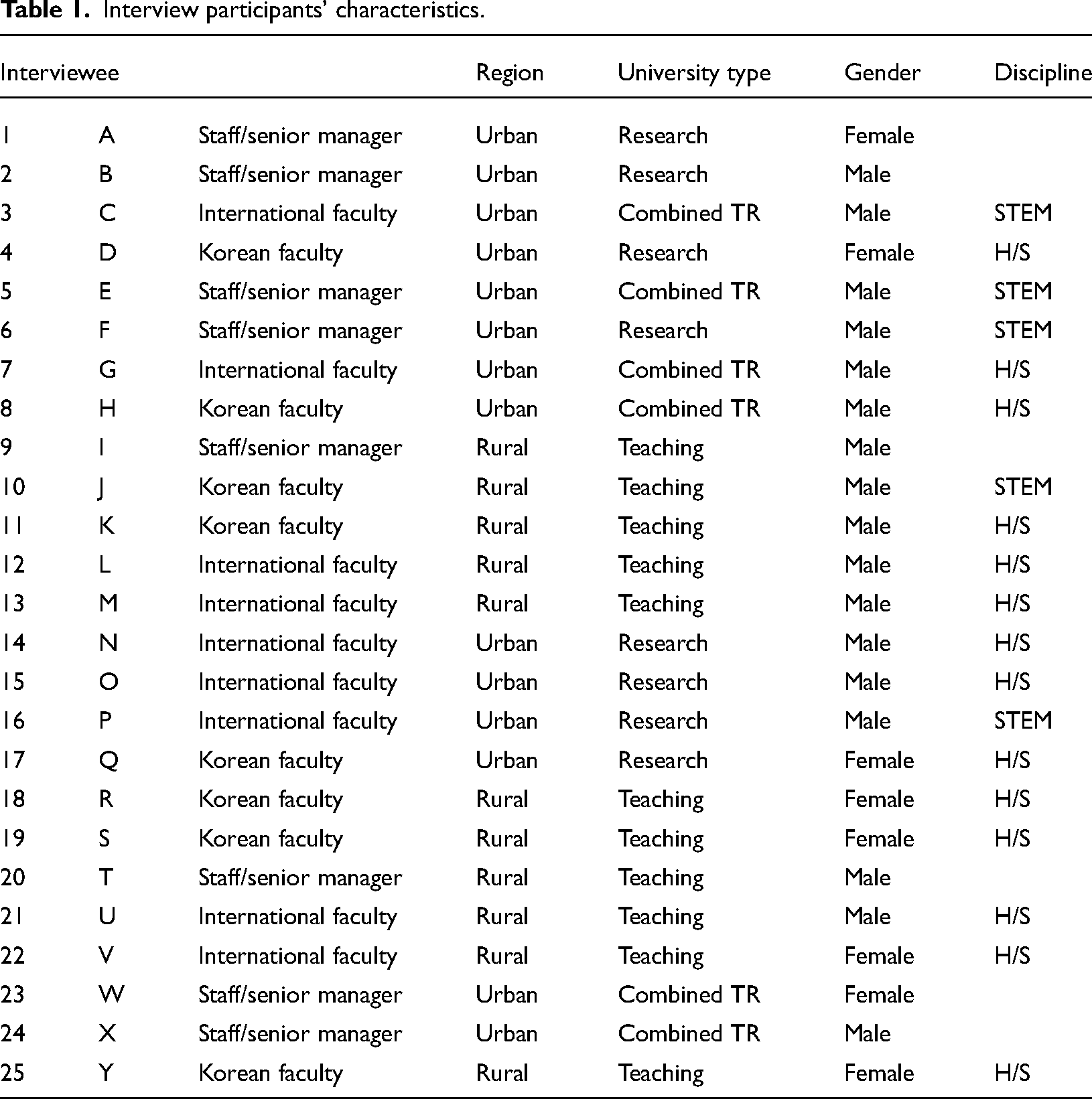
As this study targeted three groups (international faculty, Korean faculty, and Korean staff and senior managers), interview questionnaires were designed and used specifically for participants in each of the three groups (though there were some common questions in all the interviews). The interviews were conducted from December 2019 to April 2020. Individual, in-person interviews were preferred, but online interviews were conducted when necessary owing to the pandemic restrictions. In total, 19 participants were interviewed offline and 6 online. Korean faculty and staff/senior manager groups were interviewed in Korean, and the international faculty were interviewed in English.
All interviews were recorded and transcribed with the consent of the interviewees. In the open coding stage, which is the first step of the qualitative data analysis, the process of capturing and segmenting the data related to the research question was initiated for all transcribed data. The second step structured the relationships among the concepts captured in the first step, and the themes derived from the analysis were classified into four major categories: (1) differences in perceptions of the internationalization of higher education between international and Korean faculty, (2) expectations of international faculty among Korean faculty and staff, (3) Korean faculty and staff's perceptions of international faculty, and (4) the lack of support from universities.
Data triangulation was used to establish and validate the analysis. This approach incorporates data from various sources to increase the validity of the study results. After conducting interview, authors reviewed official government documents and data related to such topics as public disclosure information (by the Korean government based on law), the university's vision, and the current status of international faculty, enabling them to grasp the overall situation of the university where they were working and to compare public data with the collected qualitative data.
Findings
What is internationalization?: Different perceptions
Members of Korean universities perceived the concept of “internationalization” differently, with senior managers recognizing it as an unavoidable trend driven by external pressure. One senior manager equated the competitiveness of a university to its level of internationalization. Further, a university that can maintain the level of global competitiveness expected by international students is considered internationalized: From the standpoint of managing the entire university, I understand that internationalization is an unavoidable trend. Full-fledged internationalization is an objective that all universities have no choice but to follow because internationalization indicators have been included in university evaluations, and the other [reason is that it] is a means to increase tuition income. … A good internationalization policy can only come from an internal need of the university, but I should say that the two things I just mentioned are external conditions, given in a situation where we have no choice but to follow them. (E; staff/senior manager) What does proper internationalization mean? I mean, look at it from the point of view of selling a university degree. Whether this university has real ticket power is [based on whether it meets] the concept of an internationalized university. … Getting international students to buy university degrees. After all, does this degree have the [superior quality] that universities [are expected to] provide? (F; staff/senior manager) Many people consider that the many international students walking around the campus constitute an important measure of internationalization. … I guess that makes sense, too. If there are a lot of people, I think it's not a bad thing because universities respond according to the needs of those people. I think that the concept of internationalization is not simply defined by numbers, but that policies, exchanges and these things should be internationalized, and especially, standards should be internationalized. (D; Korean faculty) For our university, internationalization is survival. As the higher education ecosystem changes, the income of universities decreases, and universities bring in many international students to survive. (S; Korean faculty) Most universities seem similar, but there is an ideal [form of] internationalization. Practically speaking, it seems people are trying to internationalize according to the indicators. I think the focus is much more on internationalization indicators, such as the ratio of hiring international faculty or the ratio of international students. (Y; Korean faculty) I guess I provide another perspective. Not better, not worse—[just] different. And then, with this different perspective, it is up to the people who are interested in me—it's up to them how to make use of it. It's just one piece of information, one extra data point. And whoever interacts with me, they will have this extra data point, and how they use it is all pretty much up to them. (P; international faculty) It's been interesting to watch because I speak Korean, and I’m quite familiar with Korean culture, and I can play on both sides of that aisle every day, so [it's been interesting] to watch; particularly, I understand the desire of Korean faculty to be international, but unless they’ve had an international experience, they can’t. They can’t learn English overnight. I see kind of an artificial barrier there. I don’t think that they’ve learned completely how to overcome [and] to embrace and accommodate this different style and the different faculty that come here. I think, I see a lot, they want the international faculty to come in and do it the Korean way, and actually, it usually doesn’t work like that. (L; international faculty) I’m cynical about these things. I’d like to think that the university wants to encourage a more international climate, so I don’t really think it's the idea of bringing the Western style, Western ideas, or Western teaching techniques into Korea as much as it is the rankings and sort of international reputation. I mean, maybe it's also branding for international students who might think about coming and might want to see international faculty. But I honestly don’t think it's an intellectual [preference] or, sort of, that there's a real desire for a cultural change or anything like that. I don’t see that the role of bringing us here is to bring institutional change or cultural change as much as to augment the system as it is, which is a little frustrating at times because my colleagues and I and some other junior faculty, and maybe this is the case for all junior faculty, would like to introduce some innovations, but somehow, it's impossible to implement these innovations. … [Interviewer]: Well, maybe the university has some reason to hire you. [Interviewee]: QS [Quacquarelli Symonds World University Rankings]. (O; international faculty)
Role encapsulation: Second-tier faculty?
Korean faculty and staff who participated in the interviews defined the role of international faculty as more limited than that of Korean professors. Specifically, their expectations for international faculty to conduct service work (one axis among the three representative roles of professors—research, teaching, and service) were extremely low: In principle, if you select a tenure-track professor for a research-oriented university, research is the most important, followed by teaching, then service. The problem that arises here is that no matter who is hired, they must adopt the three roles of educator, researcher, and service personnel, but in the case of international faculty, they have no ability [to do service work] given their [low] capacity to speak Korean, so they can’t provide any services. (D; Korean faculty) I’m a bit negative about the international faculty's adaptation; more than half of international faculty will be isolated from the department. They can’t even attend a faculty meeting. It's stressful for Korean professors to suddenly speak in English from [the position of] speaking comfortably in Korean during department meetings, right? It's crazy because there are no Korean administrative documents in English. (F; staff/senior manager) Should I say I had low expectations in the beginning? Because usually Korean professors oversee a little bit of service. They do various things, like government report writing and administration, but international faculty are not assigned any of these tasks. I think I had low expectations of them because they only do classes. (Y; Korean faculty) That's why I think it would be nice to use them as helpful resources whenever there is something [occurring that is] international rather than subjects for international faculty to adapt and examine how they adapt to the university, just as resources. (A; staff/senior manager) It's always overseas: people they know, who they’ve worked with—which is kind of useful because Korean faculty don’t have that kind of network. I’m trying to grow this because it's useful, and they don’t have any ability to collaborate with faculty within Korea usually. (L; international faculty) Hiring international faculty was really helpful. No matter how hard Korean professors research and instruct students at our university, international academics are biased, so they view us as “just Koreans from the University in Korea.” However, when famous international faculty are hired, they become known on campus, even if they do nothing. Nothing is more effective than bringing in a well-known international faculty member to change the perception of overseas academia. (D; Korean faculty) Yeah, definitely, if I had darker skin, it would be much more difficult. I mean, it's still—there is still the positive discrimination whereby you’re always aware, maybe when you’re studying overseas or what have you; the sensitivity that you’re different all the time, right? But in my case, I’m the best possible option, right? (O; international faculty)
Lack of support systems: Factors exacerbating the tokenization of international faculty
Despite the many international faculty working in Korean universities, support for their adaptation and settlement has been severely lacking. Although Korean universities compete to recruit international faculty, they do not allocate many resources to the adaptation of these international scholars’ post-hire. In fact, the support available to them is generally limited to housing support for basic living, their children's education, and beginner-level Korean classes: Universities tell us to bring in international faculty. However, hiring international faculty is not the end. They have to do what they need to do without discomfort in Korea, but basic things are not prepared. There is an international center, but this institution cannot solve everything, and it is overloaded. If there is any problem, the Korean professor has to make a call to solve the problem … Since this situation was repeated, I felt skeptical about the kind of internationalization the university described on several occasions. (D; Korean faculty) Until a few years ago, they [the university] had the Korean language program here [which] offered some night classes for foreign faculty. I don’t think they do that anymore. But they really only have, like, a beginner level, and I’m not really beginner level, so I got into a lower intermediate class, and there's one other student in there, and it was a really poor dynamic with only two students. So, after a while, I kind of quit. They don’t do that program anymore, so otherwise, I don’t really have foreign language support. It's up to me on my own, and I haven’t had time or the motivation to do it. (N; international faculty) Without better Korean language ability, there's no way we can be effective … My perennial concern again is that, for those of us with limited Korean—and again, it's the same inversion—on the hangjeong [administration] portal, online materials, all this stuff that we could read in Korean, but they’ve translated to English. But all the hard stuff … [laughter] [like the] chulchang-sincheong [application for travel expenses], these things, all the more delicate administrative content has not been translated, so there is definitely a barrier to us participating effectively in administration. (O; international faculty) For example, they don’t treat the faculty members from foreign countries differently … I think in our university the situation is now better, but most of the time, we must figure out the thing by ourselves or ask the Korean faculty members. The university, I don’t want to say never, sometimes they don’t provide any kind of help. But the problem is, if you want to recruit more faculty members from overseas, we need to provide these kinds of services to attract [them] because, for example, we cannot compete with Hong Kong Polytech or others. The rankings are high. Here, we kind of have to invite people, and we provide different help or not only the salary but also some incentives to help you survive here easily. (G; international faculty)
Reverse discrimination? The perspective of Korean faculty members
Although international faculty occupy a minority position within Korean universities, in some cases, Korean faculty feel a sense of relative deprivation or face reverse discrimination in relation to international faculty. Owing to the lack of university support systems, the burden of helping international faculty adapt has naturally shifted to Korean faculty, and this trend is intensifying. Indeed, for international faculty to play their role fully within the organization, Korean faculty have been required to take on a liaison role: The thing that made me frustrated was that I did all kinds of services, and I took care of everything, from housing problems to children's school problems, for international faculty. Honestly, I also want to focus only on research, but I’m a Korean professor, so that's not possible. I have to do programs and be the head of the department, and these are the roles that Korean universities demand from professors, but since international faculty don’t provide any services at all, I can’t help but complain that it's not fair from the point of view of fellow professors working together. (D; Korean faculty) Korean universities pay a lot of money to bring in international faculty. What I am dissatisfied with is that when hiring international faculty, we need to bring in people who will really help our department and our university, whether it be [through] teaching or research. It's about paying taxes. It has to be worth the money. But sometimes, I think like this. Why do many universities bring in such people at such high salaries? Just because they have different nationalities? I am very angry when I see this situation where I feel discriminated against because I am a Korean, even though Korean faculty perform ten times better than them. (D; Korean faculty) There are enough and overflowing international faculty to run our university curriculum. However, I think the best way to secure full-time faculty is to hire international faculty. Their salaries are lower than those of Korean professors, so it is not that we needed international faculty for our university's curriculum. It is a situation where international faculty are first selected, and the school curriculum must be reorganized accordingly. … Most Korean professors at our university think there are too many international faculty. As the problem of a lack of classes for international faculty to teach continues, we worry about how we should assign classes to them. (Y; Korean faculty) When it comes to hiring professors, there is something called Table of Organization (TO; i.e., a vacancy), which is a problem because recruiting new professors is complicated. People believe that if one international professor is hired, they will take the TO assigned to the department, so although everyone agrees on the need for an international faculty, it is challenging to convince [people] because it is recognized that if you consider hiring one more international faculty, you will lose the opportunity to hire a local one. (D; Korean faculty) There's always difficulty. Sure, absolutely. I think it's the organizational memory. To me, it's very difficult for many of the staff who have been here for a very long time. That's something in the West; we move jobs a lot. There's no feeling like you have a lifetime job. Here in Korea, you do. So, they’ve been here a long time, and they really have a hard time with this. “Why do I have to change today? Why do I have to do this new thing today? Why are you bothering me with this new idea?” They just want things to be stable. Yet, at the same time, they’ll look at this population problem and know that they must do something different. It reminds me of all those Xerox and other companies that have gone out of business. They couldn’t find a way to change, and that's what I worry about here. (L; international faculty) Administrative staff never talk to international faculty—it's embarrassing; and they can’t speak English well. International faculty think that they are ignored because the staff does not even look at them, and if they are from Asia, such as China, they could think that they are ignored because of their nationality. Administrative staff do not treat international faculty well. It doesn’t help at all in their lives. Because they are foreigners, they won’t [become] deans later, and they won’t be the ones who will give staff a performance evaluation, so staff don’t need to be kind [to them]. If there is a misunderstanding, an accident, or a problem after saying something wrong, they must take responsibility. (H; Korean faculty)
Conclusion and discussion
The present results partially explain the outcomes of Korean universities’ efforts toward internationalization (i.e., continuously increasing the number of international faculty); notably, international faculty are not functioning as major actors in the internationalization strategy. Members of Korean universities perceive the concept of “internationalization” as an “irresistible external pressure,” emphasizing that internationalization is a survival strategy for enhancing the competitiveness of universities to attract international students. In this way, the concept of “practical internationalization” is distinct from the concept of “ideal internationalization.” This awareness of internationalization shows how Korean university members have assimilated the goal of “raising the world university rankings” that underlies the recruitment of international faculty.
In addition, Korean faculty and staff describe a limited role for international faculty in universities. Specifically, they clearly express low role expectations owing to the difficulty for international faculty in performing administrative and service tasks, which constitute a primary faculty role. These low expectations of the mainstream group result in the role encapsulation of the token group; the mainstream group's distorted expectations of the behavioral style and abilities of the token group shape the limited role of international faculty. Further, low expectations at the institutional level suggest that changes at the organizational level are needed to address the individual-level variables affecting international faculty's adaptation.
Notably, Korean universities are eager to recruit international faculty, but these faculty members do not receive satisfactory support after being hired. Institutional support for international faculty is mostly limited to the needs of everyday life, such as housing and children's education. Furthermore, a lack of administrative support for international faculty to play their role as equal members of the university faculty is described. This may have stemmed from the low expectations that Korean faculty and staff have of international faculty, whom they perceive as complete strangers focusing solely on research activities and exempt from performing the administrative and service tasks required of domestic faculty. Providing support for international faculty to participate in decision-making processes and handle administrative tasks was not considered a priority by universities.
This study aimed to capture the various aspects of tokenism in differing organizational environments and to explore the factors that intensify tokenization. One finding relates to whether racial differences among international faculty may offset the negative effects of tokenization. Kanter (1977) saw that the status of minority groups was affected by characteristics such as visibility, contrast, and assimilation, which affect organizational dynamics. Another study showed that belonging to a high-status social group could influence the strength and outcomes of tokenism (Zimmer, 1988). Among international faculty who are classified as minorities in Korean universities, White (typically Western) people may be considered a more visible minority than Asians; however, the interviews revealed that despite their visibility (which typically intensifies tokenism), their high status as White people somewhat offset this impact.
The fact that international faculty are tokenized in Korean universities is not a new finding. Some previous studies on tokenized international faculty have criticized the symbolic internationalization strategy of East Asian universities (Brotherhood et al., 2020; Brown, 2019). However, there have been few studies on international faculty using the framework of tokenism that examine the ways majority and minority groups within an organization perceive each other. This is important topic at a time when international faculty dropout rates are presenting a serious problem; such research may increase the possibility that adaptation can occur through mutual change in both directions (Gheorghiu & Stephens, 2016).
These results show that Korean faculty demonstrated low role expectations of international faculty, and, simultaneously, felt a sense of relative deprivation for various reasons. Korean faculty perceive international faculty to have an easier recruitment process than Koreans owing to their foreign nationality, and they are antipathetic toward international faculty for replacing Korean faculty quotas. Notably, when international faculty function as actors for internationalization within universities without essential support, Korean faculty are expected to supplement this scant support, creating another source of conflict. University support has been mentioned in numerous previous studies dealing with the adaptation of international faculty (Richardson & Zikic, 2007), but it has not been confirmed to have a decisive effect on adaptation. One clear policy implication is that universities should make more active efforts to help international faculty adapt after hiring them.
Highly educated and skilled immigrants, especially those not targeted by typical forms of racism, tend to be treated as individuals who are acting according to rational economic choices rather than as victims of discrimination (Gheorghiu & Stephens, 2016). However, international faculty in universities, seen through the frame of tokenism, seem to be experiencing more subtle forms of discrimination. Their adaptation and settlement should be recognized as a multifaceted problem that can be addressed only when the entire organization and its members change together rather than depending on individual efforts.
Despite these findings, this study has several limitations. As only a limited number of international faculty were interviewed, there are limitations in comparing how the aspects of tokenism differ depending on the sociodemographic characteristics of international faculty. In further studies, in addition to race, there is a need to more broadly research the aspects of tokenism experienced by international faculty based on such characteristics as gender and the degree of development of the origin country.
These findings imply that organizational-level changes are needed beyond those made to individual-level variables, because the mainstream group's perception of international faculty influences their marginalization. However, it was difficult to specifically derive the direction in which organizational-level change should take place. If international faculty and university members must change to reduce the dropout rate of international faculty, future research must investigate which changes are needed from the perspective of domestic faculty.
Footnotes
Contributorship
Inyoung Song, as the first author, was responsible for analyzing qualitative data and writing main body of article. She covered various parts of the article including collecting and analyzing interview data, triangulation, theorizing, and drawing policy implications. Yangson Kim contributed to develop the framework, analyze interview data with triangulation. In addition, she reviewed literature and confirmed discussion points based on literature review and main findings of this study.
Declaration of conflicting interests
The authors declared no potential conflicts of interest with respect to the research, authorship, and/or publication of this article.
Ethical statement
This study was approved by Korea University IRB at Korea University, Republic of Korea (KUIRB-2019-0351-02). All interviewees were informed of the content of the research in advance and provided written consent form.
Funding
The authors disclosed receipt of the following financial support for the research, authorship, and/or publication of this article: This work was supported by the Japan Society for the Promotion of Science (grant number 20K13906).
