




Abstract
Purpose
To align with the artificial intelligence and robotics (AIR) research and policy agenda, this paper puts forth an adapted five big ideas framework specifically tailored to teaching young children about artificial intelligence (AI) via robotics.
Design/Approach/Methods
Grounded in early childhood education research, the proposed framework emphasizes the use of robotics and play-based learning to make AI accessible and encourage engagement among young children who have not started formal schooling.
Findings
We comparatively analyze the commonalities and differences in AI big ideas between the original K-12 framework and the redeveloped early childhood education framework. To pique children's interest, key concepts are presented through interactions with robotics and robot role-play. This paper also provides recommendations for age-appropriate topics, storytelling, and play-based teaching methods.
Originality/Value
This framework aims to equip researchers and educators with strategies for successfully integrating introductory AI education into early childhood classrooms. Teaching AI in a developmentally responsive manner can help nurture young children's curiosity toward and understanding of an increasingly AI-driven world.
Introduction
The term “artificial intelligence and robotics” (AIR) refers to the intersection of two fields: artificial intelligence (AI) and robotics. AI involves developing computer systems that can perform tasks that would typically require human intelligence, such as problem solving, learning, and decision making (Nilsson, 2010). Robotics focuses on designing and creating physical machines capable of interacting with their environment and performing specific tasks (Nilsson, 2010). AIR has recently emerged as a significant research topic and policy agenda. The intersection of AI and robotics has garnered substantial attention from researchers, policymakers, and industrial leaders worldwide. AIR's potential to transform various sectors, including healthcare, transportation, education, and manufacturing, has prompted focused efforts to understand its implications and harness its benefits (Wisskirchen et al., 2017). The growing research and policy agenda surrounding AIR reflects recognition of its transformative potential and the need for a comprehensive understanding of its implications for early childhood education (ECE). Although interactive robots or AI-powered learning platforms can enrich learning experiences, adapt to individual needs, and make education more enjoyable and interactive, content frameworks for age-appropriate learning activities for young children to learn AIR are lacking.
AI literacy for young children
AI literacy has become an important skill in the rapidly evolving digital society (Ng et al., 2021; Su, Ng et al., 2023b). This is especially true given that generative AI applications such as ChatGPT have demonstrated their power as early as 2023 (Su & Yang, 2023c). Teachers are attempting to introduce AI into K-12 education to equip students with the digital skills needed for learning and living in today's digital world (United Nations Educational, Scientific and Cultural Organization [UNESCO], 2022). With the emergence of numerous AI-driven applications and virtual assistants, such as Siri, Google Assistant, and ChatGPT, the demand for AI literacy is increasing. AI literacy encompasses not only a grasp of the technical aspects but also an understanding of AI's impact on society, the economy, and individual lives, as well as how to effectively interact with and apply these technologies.
Prior studies have shown that AI courses can enhance students’ AI literacy (e.g., Kandlhofer et al., 2016; Williams et al., 2019). In recent years, various age-appropriate AI tools and platforms such as WeChat remote control (Nan, 2020), Teachable Machine (Vartiainen et al., 2020), Zhorai (Lin et al., 2020), and PopBots (Williams et al., 2019) have been designed to allow young learners to experience and learn basic AI concepts. Recently, scholars have proposed that AI should be introduced in the early years of education, allowing children to adapt to the world of AI and utilize related applications (e.g., Quick, Draw!, AI for Oceans, and Teachable Machine) to better facilitate their learning and daily life (Su & Yang, 2023a, 2023b).
However, most extant research has focused on teaching AI literacy to middle school and university students (e.g., Ng et al., 2021; Su, Guo et al., 2023). Only a few studies have explored how to incorporate an AI curriculum into ECE (Su, Ng et al., 2023; Su & Yang, 2022, 2023b; Williams et al., 2019). These studies have begun discussing why AI should be taught at the preschool level, what types of knowledge and skills children should acquire, and how to meaningfully engage young students (Su & Yang, 2023a, 2023b).
Robotics for young children
According to Su and Yang's (2022) review, playful robotics are widely used in ECE. Educational smart toys, such as programmable robotics and AI-driven games, provide children with a playful learning environment in which to develop their theory of mind skills and increase their perceptions of robotics and creativity (Su & Yang, 2023b; Williams et al., 2019).
Intelligent robotics can enhance children's social interactions, making them more willing to engage in activities and collaborate with other learners (Druga et al., 2019; Kewalramani et al., 2021). For instance, AI-driven conversational robotics such as KIBO, LEGO, PopBots, and Zhorai can offer students positive learning influences, enhancing their engagement and aiding in the cultivation of their understanding of AI and machine learning concepts (Lin et al., 2020; Williams et al., 2019). Whereas these studies focused on how young learners can engage with AI have identified positive outcomes (e.g., Lin et al., 2020; Vartiainen et al., 2020; Williams et al., 2019), the question of how to teach and learn AI remains a challenge, particularly for educators. Although AI literacy education has been incorporated into 21st-century technological skills, teachers still express concerns and lack confidence in teaching AI. Hence, there is a need to develop appropriate curricula, methods, and recommendations for early childhood teachers to learn about and teach AI.
Five big ideas of AI for K-12
The Association for the Advancement of Artificial Intelligence (AAAI) and the Computer Science Teachers Association (CSTA) established a joint working group responsible for developing national guidelines for teaching AI to K-12 students (Touretzky et al., 2019). In 2018, the AI4K12 initiative developed national guidelines for teaching AI in K-12 education (Touretzky et al., 2019). AI4K12 (2020) developed the five big ideas of AI for K-12 students, namely, perception, representation and reasoning, learning, natural interaction, and societal impact. The term “big ideas” refers to fundamental concepts or key principles that serve as foundational pillars in a particular field or domain (The Early Math Collaborative of Erikson Institute, 2013). These ideas encapsulate the core principles, theories, and frameworks that are essential for understanding and advancing knowledge in the field. Big ideas often represent overarching concepts that have broad applicability and significance, providing a framework for organizing and comprehending complex information and phenomena within a specific domain (The Early Math Collaborative of Erikson Institute, 2013). In the context of AI, the five big ideas framework refers to a set of key concepts or principles that help conceptualize and understand the fundamental aspects of AI and its various components and applications. However, the existing five big ideas of AI (AI4K12, 2020) might not be suitable for children aged 2–6 years. To address this gap, this study presents five new AI-related ideas tailored specifically for preschoolers.
This conceptual paper aims to identify five big ideas of AI that are suitable for young children, especially those who have not started formal schooling, such as preschoolers. Specifically, we revisited AI4K12's five big ideas framework in the ECE context. These five big ideas will also be connected to robotics activities that can be applied to young children.
Five big ideas of AI for young children
AI4K12 (2020) developed five big ideas of AI for K-12 students, namely, perception, representation and reasoning, learning, natural interaction, and societal impact. However, the learning content might be too challenging for children below 5 years old to understand. Therefore, this study developed an updated five big ideas of AI framework specifically designed for young children (Figure 1).
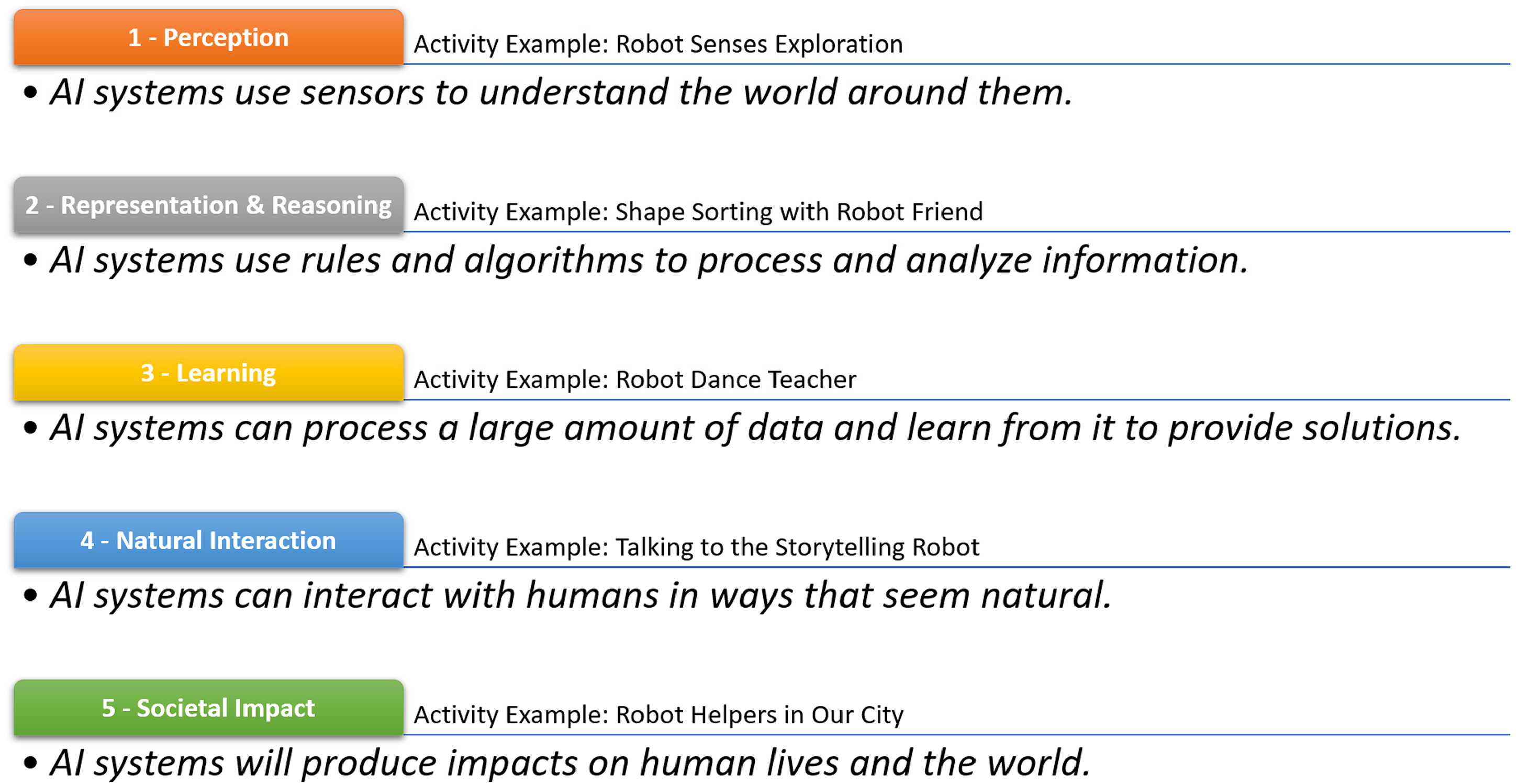
The five big ideas of AI for young children.
Big AI idea #1: Perception
Perception is the process of extracting meaning from sensory signals (Touretzky et al., 2019). Enabling computers to “see” and “hear” effectively for practical use is among the most significant achievements in AI to date. Children can experience the world of AI through their vision, hearing, touch, taste, and smell. By allowing children to engage with AI's sensory aspects, we can foster their interest, knowledge, and skills, enabling them to adapt better to advancements in modern technological society. Young children should understand that AI is present, and they should know how to interact with digital assistants such as Siri. Moreover, they can recognize objects in their surroundings through sound. For example, when their parents/caregivers speak to them, they can identify those persons’ voices and comprehend their speech.
For young children, the “perception” big idea of AI refers to AI systems’ utilization of input and predetermined rules to make decisions. This explains how AI systems use sensors to understand their environment and make decisions based on received inputs. Essentially, this is the AI perception process.
Big AI idea #2: Representation and reasoning
Young children understand that AI operates through representations that differ from the ways humans understand and think. Imagine teaching a robot to recognize different animals. You can show pictures of cats, dogs, or birds. Each picture has a code, a pattern of numbers and symbols representing the animal's features. The robot learns to associate these codes with specific animals. Thus, when the robot is shown a new picture, it compares that picture's code to the codes it has already learned. This helps the robot determine whether the animal in the picture is a cat, a dog, or a bird. Humans’ understanding of things differs slightly. We use our senses, such as sight and hearing, as well as our accumulated experiences, to recognize objects. For example, if we see a ball, we instantly know that it is a ball because we have seen and played with balls before. We do not need codes or patterns to recognize things; we rely on our memories and the things we have learned over time. Although AI's way of understanding the world may seem different from ours, AI is a powerful tool that helps us solve complex problems and make new discoveries. By knowing that AI uses representations to process information, young children can begin appreciating the technology's unique capabilities and how they complement human abilities.
For young children, the “representation and reasoning” big idea of AI refers to the fact that AI does not possess the same thought processes as humans do, nor does it exhibit any sign of being alive. AI systems use rules and algorithms to process and analyze information, a form of representation and reasoning that differs fundamentally from human thinking.
Big AI idea #3: Learning
Young children should understand that AI has limitations and that AI may encounter new situations that it is unable to handle. For example, the following activities can achieve this learning aim.
Start by placing several small toys on a table. The teacher invites the preschoolers to put on a blindfold covering their eyes. They will pretend to be AI robotics in a game called Treasure Hunt in the Dark. The preschoolers listen to the teacher's instructions and perform corresponding actions to find the small toys. Repeat the game 5–6 times. Second, the teacher then adjusts the game based on the children's physical condition and emotions. The teacher suddenly stops giving instructional prompts, observing whether the preschoolers can correctly locate the toys. Third, the teacher engages in reflection. When a robot encounters new situations it has not experienced before, unexpected circumstances might arise. This emphasizes the need for humans to perform continuous technological updates to enhance AI's effectiveness. Young children should also understand that AI arrives at its final accurate result by extracting key elements and synthesizing information. For example, perform a roleplaying activity flow. To begin, preschoolers roleplay as AI robots. The teacher presents pictures of different colored fruits and asks, “Are they the same? What is different about them?” The preschoolers notice that the fruits have different colors. Second, preschoolers continue pretending to be AI robots and are shown pictures of various colored vegetables. The teacher asks, “There are many-colored vegetables here. What colors are they? Who would like to help classify the vegetables by their colors?” The preschoolers correctly categorize vegetables of different colors as instructed. Third, the preschoolers continue roleplaying as AI robots. Mixed images of vegetables and fruits are presented. The preschoolers are guided to carefully listen to cues such as “red fruits,” “red vegetables,” and “red fruits and vegetables,” and then sort the corresponding picture cards correctly. Finally, the teacher chooses when to conclude based on the children's progress through the activity. The teacher clarifies that robotics must extract crucial, comprehensive information to arrive at the correct result. Successfully completing the task involves attentive listening and accurate execution.
For young children, the “learning” big idea of AI refers to the fact that AI can assist individuals in resolving complex issues. AI systems can process and learn from large amounts of data to provide solutions. For instance, through its learning capabilities, AI can help climate scientists predict weather patterns and help doctors diagnose diseases.
Big AI idea #4: Natural interaction
Young children need to understand AI robotics in their social context and grasp that AI robotics learn through interactions with humans. By observing AI robots in environments in which they interact with and learn from humans, children are exposed to a technology that mirrors human communication. These interactions could involve storytelling, games, and collaborative activities, which foster a sense of companionship and understanding between children and robots. As AI robots engage children, the robots can adapt their responses and behaviors based on the children's input, similar to how humans adjust their communication styles when interacting with different people. This adaptability not only enhances the child–robot relationship but also encourages children to develop their social and cognitive skills (Tazume et al., 2020). In conclusion, the integration of AI robotics into young children's social context has immense holistic development potential. By mirroring human communication and adapting to individual interactions, these robots can create personalized and engaging learning experiences. As children build meaningful relationships with AI robotics, they not only develop social and cognitive skills but also enhance their language skills.
For young children, the “natural interaction” big idea of AI refers to the fact that AI is a human-created instrument. Although AI systems can interact with humans in ways that seem natural (e.g., speaking with humans), it is important to understand that these systems are created by humans and do not possess consciousness or self-awareness.
Big AI idea #5: Societal impact
AI can influence society both positively and negatively (AI4K12, 2020). Although AI technology is transforming various facets of our lives, including work, travel, and communication methods, it also has the potential to cause harm (Ng et al., 2021). The ethical use of AI is a concern, particularly in areas such as data privacy and bias. AI systems can inadvertently perpetuate existing biases in the data on which they are trained, leading to unfair or discriminatory outcomes (Martin et al., 2022).
It is necessary for young children to understand how AI functions in their daily lives and the greater contributions it may make in the future. We recommend using storytelling as a teaching method (e.g., AI Robotic Story; Su & Yang, 2023b). By listening to relevant stories, young children can grasp how AI is involved in their everyday activities and the potential advancements it could bring about in the future. Storytelling, as an instructional approach, can assist students in immersing themselves in scenarios and can help foster positive attitudes and interests related to AI and robotics.
For young children, the “societal impact” big idea of AI refers to children learning about technology, computers, coding, and AI at a young age and understanding that these will impact human lives and the world at large. Understanding AI and its implications from an early age can empower students to use this technology responsibly and productively, thereby contributing positively to society.
Applying the five big ideas of AI to K-12 in ECE: A comparative analysis
As shown above, although the five big ideas of AI for K-12 framework aims to integrate AI concepts into K-12 education (AI4K12, 2020), the framework can also be useful in the ECE context, provided changes are made to increase its suitability to younger children's learning experiences and abilities. This is mainly because the way these concepts should be presented and taught would differ between K-12 education and early preschool contexts. For instance, in K-12 education, concepts might be taught in a more abstract and theoretical manner, whereas in ECE, they are likely to be introduced through play-based and hands-on activities (Inan & Inan, 2015).
Table 1 shows the commonalities and differences in AI big ideas between the original K-12 framework and the redeveloped ECE framework.
Comparison of AI big ideas in the K-12 framework versus the ECE framework.
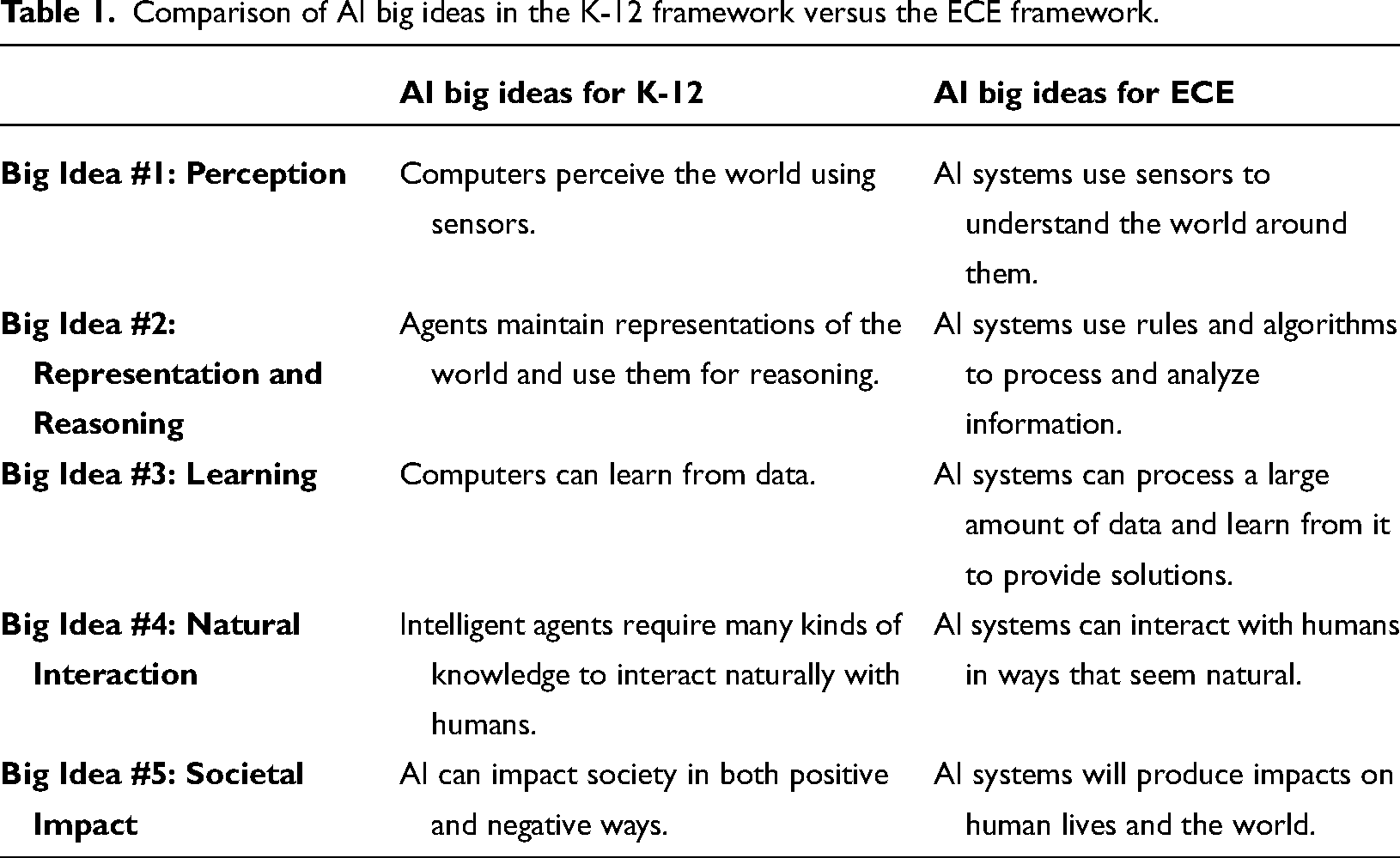
As shown in Table 1, the commonalities between the two frameworks include the recognition of perception, learning, and societal impact in the context of AI. However, the differences lie in the emphasis on representation and reasoning as well as the understanding of natural interactions in AI systems. The commonalities between the AI big ideas in the original K-12 framework and the redeveloped ECE framework are as follows:
Perception: Both frameworks acknowledge the importance of computers and AI systems in perceiving the world around them. Both recognize the role of sensors in enabling computers or AI systems to understand and perceive their environment. Learning: Both frameworks emphasize the ability of computers and AI systems to learn from data. Both recognize that computers and AI systems can process a large amount of data and use the data to learn and provide solutions. Societal impact: Both frameworks acknowledge that AI can have both positive and negative effects on society. Both recognize that AI systems can affect human lives and the world.
However, there are some key differences between the two frameworks:
Representation and reasoning: In the original K-12 framework, agents (computers or AI systems) maintain representations of the world and use them for reasoning. In contrast, the redeveloped ECE framework states that AI systems use rules and algorithms to process and analyze information. The original framework emphasizes the maintenance of representations, whereas the redeveloped framework focuses more on the use of rules and algorithms to process and analyze information. Natural interaction: In the original K-12 framework, intelligent agents require many types of knowledge to interact naturally with humans. However, the redeveloped ECE framework highlights that AI systems can interact with humans in ways that appear natural. Although both frameworks recognize the importance of natural interaction, the original framework focuses on the knowledge required for natural interaction, whereas the redeveloped framework emphasizes AI systems’ ability to interact naturally.
It is worth noting that the ECE context focuses on young children, typically ranging from birth to age 8 (Bijou, 1976). These adjustments aim to ensure that the AI framework aligns with young children's developmental abilities and needs. The language and concepts used have been simplified and made accessible to young learners. Additionally, because young children have different cognitive abilities than older students (Bijou, 1976), these adjustments consider young children's cognitive development and present AI concepts in a manner that is easier for them to understand. This will help foster engagement with and learning of AI-related topics. These adjustments aim to create more engaging and interactive learning experiences for young children. The languages and concepts used in the redeveloped framework are designed to capture young children's attention and maintain their interest. This involves incorporating the elements of play, exploration, and hands-on activities to make the learning experience more enjoyable and meaningful for young learners (Inan & Inan, 2015; Xiang et al., 2023; Yang et al., 2020). By introducing AI concepts in an accessible and meaningful way, the redeveloped framework lays the foundation for future learning and fosters children's curiosity, interest, and understanding of AI technologies.
Using robotics to engage young children in learning the five big ideas of AI
A more detailed outline of the AI robotics activities designed specifically to facilitate young children learning the five big ideas of AI is presented in Table 2. These activities are designed to engage young children while introducing them to the big ideas of AI in a playful and interactive manner. The activities encourage hands-on exploration, creativity, and discussions to foster a basic understanding of AI concepts.
AI robotics activities based on the five big ideas framework.
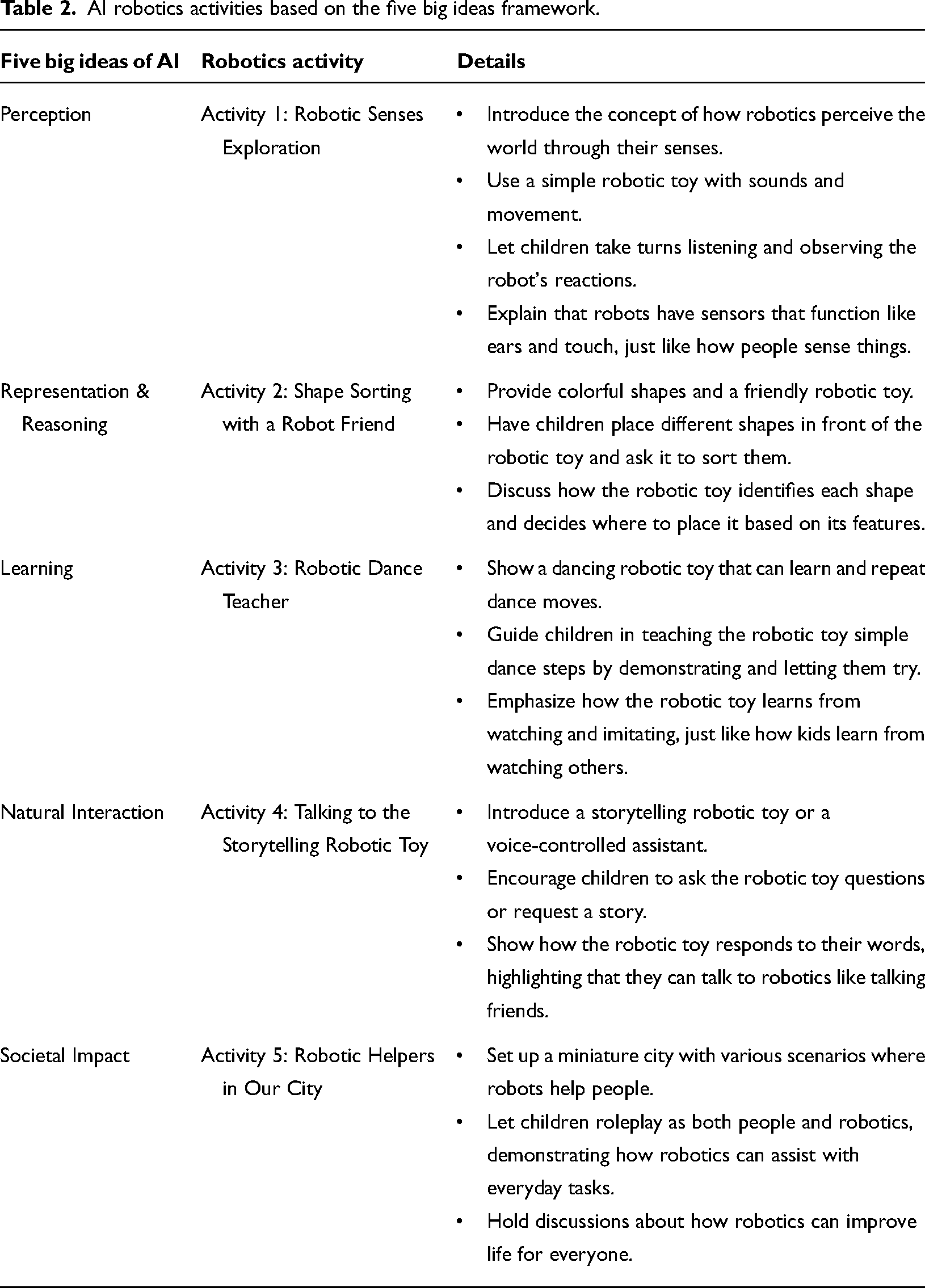
Table 2 summarizes the AI robotics activities based on the five big AI ideas framework. These activities aim to introduce children to different aspects of AI and robotics, namely, perception, representation and reasoning, learning, natural interaction, and societal impact. Through interactive experiences with robotic toys, such as exploring sensors, sorting shapes, teaching dance moves, engaging in conversations, and simulating robot-assisted scenarios, children can learn how robots perceive, reason, and learn about, interact with, and contribute to society. These activities will provide hands-on opportunities for children to understand and appreciate AI systems’ capabilities and potential impacts.
Conclusions and future directions
Recent research has demonstrated the numerous benefits of teaching young children AIR topics, including improved creativity, theory of mind skills, and AI knowledge (Su & Yang, 2022; Williams et al., 2019). However, many preschool teachers are unsure about how to teach AI and lack confidence in delivering AI lessons (Chiu, 2021; Su & Zhong, 2022). To address this need, we introduced a five big ideas of AI framework that is appropriate for ECE (Su & Zhong, 2022). We also presented methods for using robotics as a technological tool to engage young children in learning the five big ideas of AI. Young children who are introduced to AI concepts in their early years can begin to build a basic understanding of AI and its applications, which prepares them for more advanced learning opportunities and helps lay the groundwork for future science, technology, engineering, and mathematics education.
Based on the five big ideas framework, we recommend an interdisciplinary approach that integrates storytelling and play-based learning to teach core AIR issues. The storytelling approach for integrated learning captures narratives that connect content and activities across subjects (Li & Chau, 2010). AI lessons can be embedded in compelling stories that reference AI applications in daily life, thereby providing an engaging learning context. Play-based learning involves active learning through games and hands-on activities that are ideal for young students (Danniels & Pyle, 2018). For example, roleplaying AI robotics allows children to explore AI functionality through play.
In today's technologically advanced world, young children are increasingly exposed to AI systems and technologies. The proposed adjustments to the ECE framework aim to familiarize children with AI concepts and terminology, enabling them to develop a basic understanding of AI and its role in everyday life. This will help promote digital literacy and the responsible use of AI technologies from an early age. Further research should focus on how to adapt and implement the five big ideas of AI for K-12 in ECE in a way that is developmentally appropriate and engaging for young learners, especially via child–robot interactions. To implement the five big ideas framework in early childhood classrooms, we suggest focusing on AIR topics that are highly relevant to students’ lives, such as conversational interactions with robotics and facial recognition. The framework provides guidance on age-appropriate content, and storytelling and play-based learning methods facilitate an enriched understanding. With the correct approach, AIR education can be made accessible, meaningful, and enjoyable for young learners.
Footnotes
Contributorship
Jiahong Su was involved in the following contributing roles: conceptualization, formal analysis, writing—original draft preparation, and writing—reviewing and editing. Weipeng Yang was involved in the following contributing roles: visualization, writing—original draft preparation, and writing—reviewing and editing. All the authors have read and approved the final version of the manuscript.
Declaration of conflicting interests
The authors declared no potential conflicts of interest with respect to the research, authorship, and/or publication of this article.
Funding
The authors received no financial support for the research, authorship, and/or publication of this article.
