



Abstract
Purpose
Countries with unique developmental paths and cultural lineages display significant variations in their out-of-school education systems. In this landscape, Belarus, a vestige of the disbanded Soviet Union, illustrates a distinct out-of-school education system, profoundly shaped by both Soviet and European Union countries' influences. A meticulous examination and scholarly investigation into the Belarusian out-of-school educational framework could enable a more profound comprehension of the metamorphosis and transitions in the out-of-school education systems of nations that surfaced following the dissolution of the Soviet Union. This knowledge could subsequently render a more transparent understanding of the patterns guiding the evolution of global out-of-school educational systems.
Design/Approach/Methods
This article focuses on out-of-school education in Belarus and discusses its development status and the following main characteristics: the dimensions of its historical development stage, legislative guarantee, essence and extension, training goals, and typical cases.
Findings
Influenced by historical and geopolitical factors, Belarusian out-of-school education is found to embody the characteristics of both the Soviet Union and European countries. National resources are found to play an important role in the development of out-of-school education, effectively reducing the cost of education for families and shaping students’ positive values.
Originality/Value
This study analyzes both the history and the current situation of out-of-school education in Belarus and summarizes the country's successful experience in the development of out-of-school education. It can provide a positive point of reference for optimizing the public out-of-school education system in China and exert a positive influence on related educational reforms.
Belarus is a landlocked country in Eastern Europe, which is bounded to the east by Russia and the west by European Union (EU) countries. It was one of the 15 republics of the Union of Soviet Socialist Republics (USSR) and declared independence in 1991. Influenced by geopolitical factors, the Belarusian educational system was strongly affected by the USSR. Since the collapse of the Soviet Union, Belarus has steadily absorbed a considerable number of educational ideas from EU countries, which have gradually and successfully been integrated into the Belarusian education system. Thus, the current education pattern in Belarus combines the advantages of the USSR and EU countries and possesses its own distinctive features.
Out-of-school education 1 is a significant component of the Belarusian education system. Between the 1920s and the 1950s, the importance of out-of-school education was realized and discussed by famous Soviet educators, such as Anton Makarenko, Vasily Sukhomlinsky, and Stanislav Shatsky. Starting from the concepts of the systemicity of knowledge and quality-oriented education, these thinkers soon elaborated on the necessity for the development of out-of-school education to cultivate students’ full potential. As Makarenko pointed out, “A person is not brought up in parts; he is created synthetically by the total amount of influences to which he is subjected” (Makarenko, 1984, p. 119). Under the guidance of Soviet educational theory and practice, Belarus placed considerable value on complementarity between education in and out of school, striving for a unity of knowledge, practice, and labor education by developing out-of-school education. After entering the 21st century, Belarus actively participated in global sociocultural processes. Under the framework of the EU's “Action Program in the field of Lifelong Learning 2007–2013” (Recommendation of the European Parliament and of the Council, 2006) (henceforth referred to as “Lifelong Learning program in the EU”), Belarusian authorities energetically explored a new education system oriented toward personal development. Through this process of educational reform, Belarus consolidated and optimized traditional out-of-school resources using theoretical guidance, legislative guarantees, and financial allocation. These measures have achieved positive results.
Historical stages, main features, and legislative guarantee of Belarusian out-of-school education
Historical stages
The development process of out-of-school education in Belarus can be divided into three historical stages. The first phase, from the beginning of the 20th century to the establishment of the USSR, was mainly aimed at literacy activities and programs for the poor and uneducated population. Owing to the uneven development present at that time, or, more precisely, because of the imbalance in the distribution of resources and wealth, many deprived Belarusians could not receive formal schooling. Some non-formal education and learning, essentially simple literacy courses run by training organizations, were organized during this initial phase. The second educational phase occurred during the Soviet Union. Over almost 70 years, and under the influence of the USSR, an out-of-school education system was built in Belarus, which accumulated considerable experience in the fields of labor education, outdoor practice, occupation choice, and youth talent identification and selection. Finally, the third phase followed the collapse of the Soviet Union. Learning from the past, Belarusian authorities combined the Soviet-style out-of-school education with EU educational ideas and successfully designed a set of relevant laws and regulations. In this period, out-of-school education focused more on promoting students’ individual development concerning their mental health, which had positive implications for Belarusian adolescents’ lifelong learning habits.
Main features and legislative guarantee
In September 2011, Belarus enacted amendments to “The Code of the Republic of Belarus about Education” (Council of the Republic of Belarus, 2011) (henceforth referred to as “The Code”), in which out-of-school education is clearly defined as a part of the lifelong learning system. “Out-of-school education for children and youth is a type of additional education aimed at developing the personality of the pupil, the formation and development of his creative abilities, the satisfaction of his individual needs for intellectual, moral, physical improvement, adaptation to life in society, the organization of free time, professional orientation” (Council of the Republic of Belarus, 2011, art 1.18). Chapters 46–49 of The Code specifically deal with the out-of-school education system, its institutions, training processes, and scientific methodology. Regarding the education system, The Code states that Belarus should provide out-of-school education to its citizens in compliance with national education plans and education standards. Further, its institutions must ensure the rationality and universality of education, and pupils must have access to education and training regardless of gender, race, religion, social status, financial status, residence, or language. Moreover, laws, regulations, and social norms must protect and meet the diverse needs of students. According to The Code, out-of-school education institutions should satisfy students’ goals of achieving creative self-realization and concentrate on students’ intellectual, psychological, and physical development. Additionally, they should organize activities conforming to the ability, aptitude, and physical fitness of students and support students’ enterprises and initiatives in job seeking and social activities. Briefly, institutions should construct a social system that has a rational structure and an effective mechanism. Complying with the provisions of The Code, activities organized by out-of-school institutions should cover the fields of art, technology, and social practice, improve the intelligence and creativity of students, and aim to enrich and deepen general secondary education. The Code also stipulates the role of the Belarusian government in out-of-school educational processes. The government should provide financial support and build an effective out-of-school educational network by coordinating relationships between local governments, local autonomous institutions, enterprises, social organizations, associations, and families. Equally, out-of-school educational institutions should create conditions conducive to the training process and maintain and develop national and local educational resources. The nature and purpose of these institutions should not change, and their venues and equipment should not be merged, closed, or transferred, and equipment should not be leased.
Subsequently, focusing on the core essence of out-of-school education, Belarus has successively issued the following decrees to improve laws and regulations for out-of-school education: “The Regulations on Out-of-school Education for Children and Adolescents” (National Legal Portal of Belarus, 2017); “The Implementation Rules for Out-of-school Education Institutions to Organize National Activities” (MOE, 2013); “Notice on Designating and Implementing Subject Tutoring Syllabus in Out-of-school Educational Institutions” (MOE, 2009); “Lifelong Learning Plan for Belarusian Children and Adolescents” (Council of the Republic of Belarus, 2011). According to the latest “Lifelong Learning Plan for Children and Adolescents in Belarus,” Belarusian authorities require out-of-school educational institutions to focus on the following areas: civic awareness, education and patriotism education, moral and aesthetic education, cultivation of self-awareness and self-regulation, training healthy lifestyles to assist family education, labor and occupation choice education, ecological environment education, safe living and working education, common-sense training, leisure and entertainment education, and psychological health education (i.e., providing psychological and mental health aid for students).
The above discussion shows that the current out-of-school education system in Belarus blends the core character of Soviet and EU countries' out-of-school education to embody the advantages of these two different systems. Belarus also focuses on establishing and perfecting the legal system for almost all aspects of the out-of-school education sector.
Overview and the central characteristics of the current out-of-school education in Belarus
Overview
By the end of 2021, there were 318 out-of-school educational institutions in Belarus. Institutions can be sub-divided according to various categorization methods. By region, these institutions can be classified into two groups: 3 national institutions and 315 regional institutions. According to the specific training content, they can be divided into two categories: comprehensive (providing multidisciplinary training) and specialized (providing single-subject training) (Nadzeya, 2017; Press Service of the President of Belarus, 2017). There are 185 comprehensive out-of-school education institutions and 133 specialized institutions in Belarus. Comprehensive institutions refer to children's playschools, children's activity centers, adolescents’ activity centers, and so forth. While there are various specialized institutions, they generally refer to institutions that organize regional study tours, institutions for ecosystem protection and physical training, science and technology training institutions, art training institutions, and so forth. The specific data are outlined in Table 1.
Out-of-school institutions in Belarus.
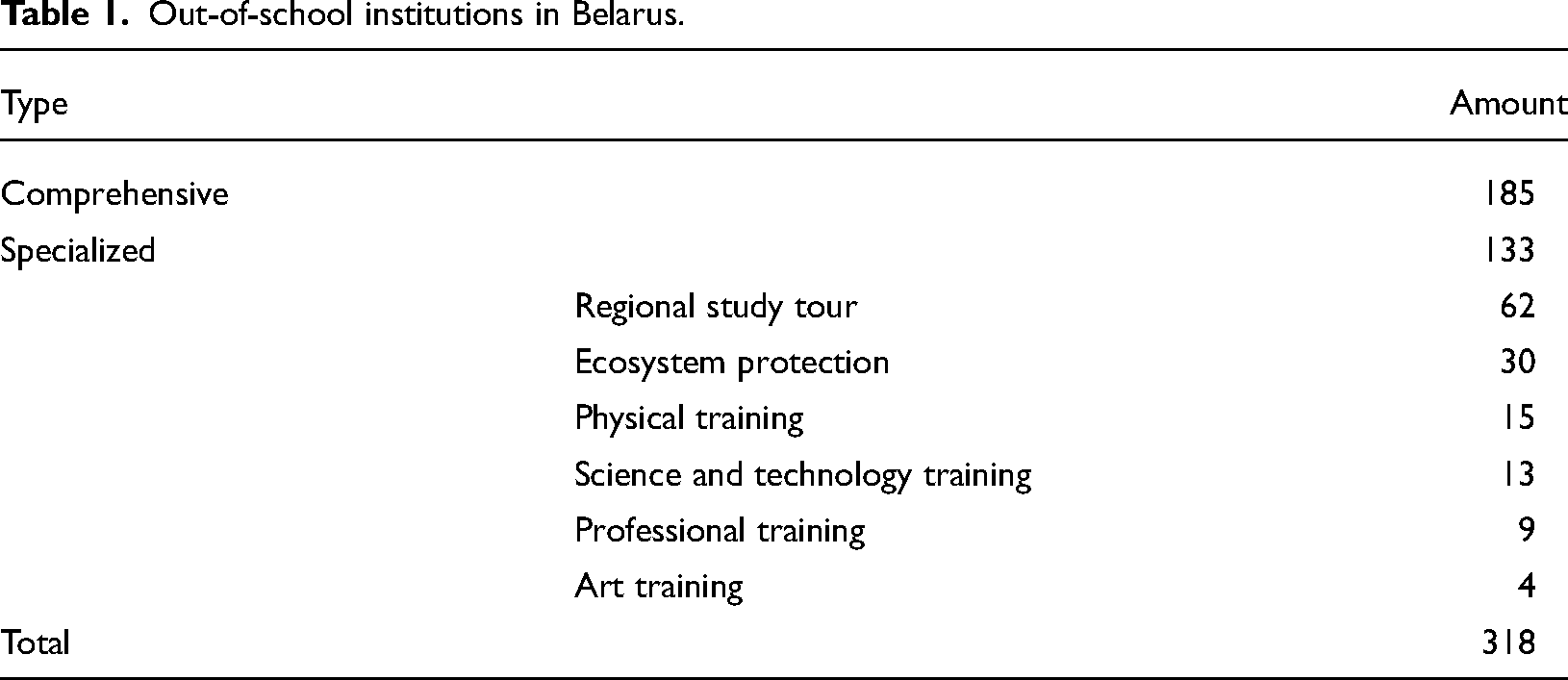
When comparing comprehensive and specialized institutions, comprehensive institutions are usually preferred because students can avail of multidisciplinary training in one institution, reducing the time spent traveling to diverse specialized educational establishments. Further, comprehensive out-of-school educational institutions have a significant price advantage. The standard fee for comprehensive institutions is approximately one-third lower than that of their commercial counterparts. Among specialized institutions, the “regional study tour” sector accounts for the highest proportion, reaching 47% (by the end of 2021). Such institutions are essentially devoted to helping students better appreciate the geographical features, local customs, and traditional cultures of their hometowns. This is realized through various outdoor and indoor activities, such as hiking, summer camps, lectures, visiting museums, and expositions. Through these organized activities, Belarusian students’ sense of patriotism and their national and cultural identity are effectively cultivated and enhanced. Ecosystem protection institutions, which ranked second (23%), focus on environmental protection activities, popularizing environmental knowledge, and aim to guide students to appreciate nature and protect the Earth. Physical training institutions were the third largest group, followed by science and technology institutions, professional training, and art training. From the distribution of specialized out-of-school education institutions, we learn that, in the field of out-of-school education, Belarus attaches considerable importance to cultivating students’ patriotic enthusiasm and environmental awareness and creating opportunities for students to build their bodies through outdoor activities and training courses in physical educational establishments. However, notably, this distribution changes every year with respect to shifts in students’ interest, the poor financial condition of some institutions, and various support policies.
Among these institutions, some enjoy a good reputation among students and parents. Their names and training targets are given in Table 2.
Typical specialized out-of-school education institutions.
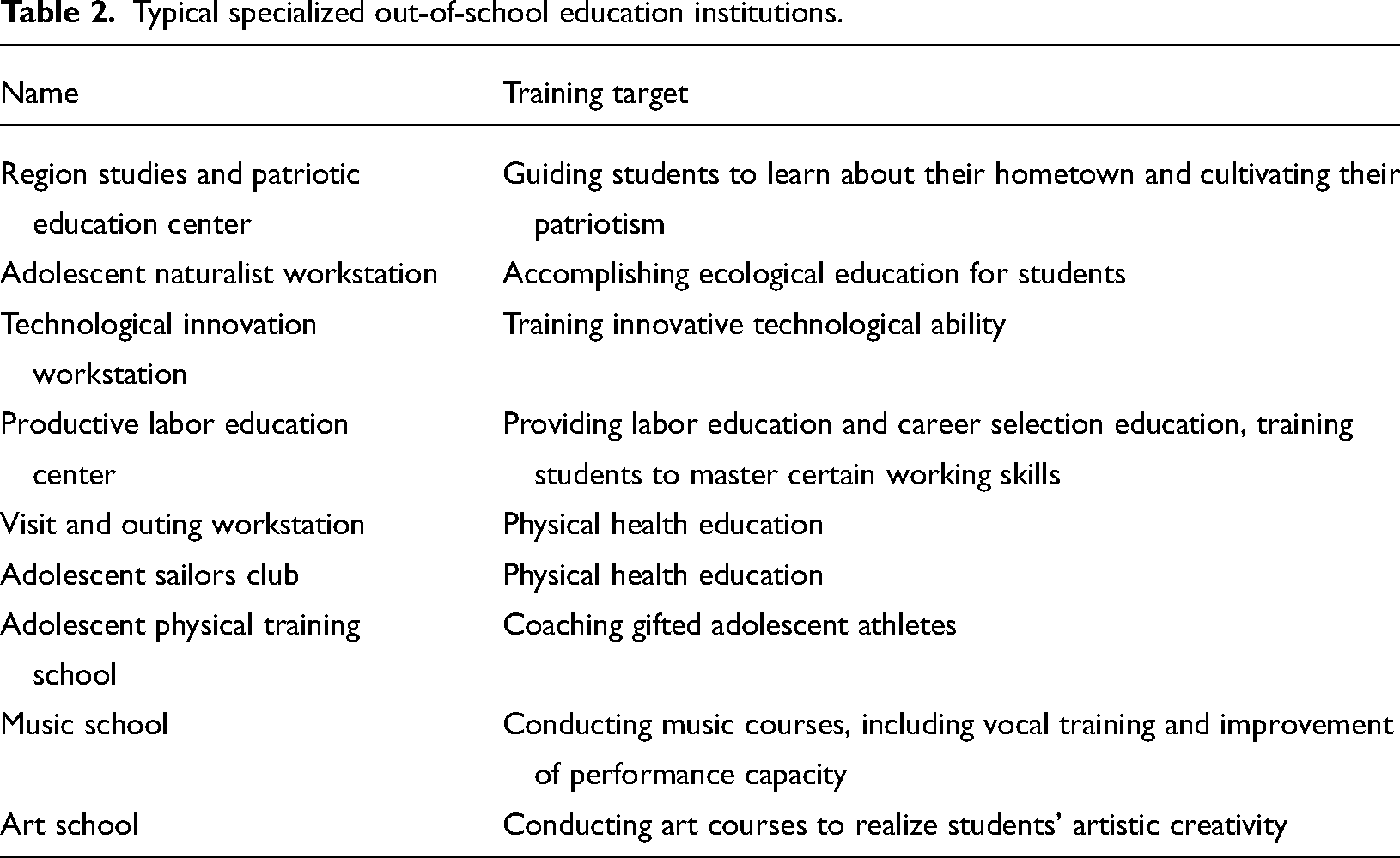
Table 2 shows that most popular institutions are commonly referred to as education centers, workstations, clubs, or schools; this naming preference indicates that they are state-run establishments. Nevertheless, some institutions are named in a livelier manner, which has attracted significant attention. According to data (Press Service of the President of Belarus, 2017), there are currently more than 30 thousand students in Belarus, and approximately one-third of Belarusian children and adolescents are trained in out-of-school education institutions. State-run institutions enjoy a good reputation and high status for two reasons. First, the state's explicit endorsement usually implies stability, a highly qualified faculty, and a lower attendance fee. Second, most of the important academic competitions are organized and held by state-run institutions, and winning grand prizes (gold, silver, or bronze) in these competitions essentially guarantees admission to top universities in Belarus and even Russia without an entry exam (Belarusian State Pedagogical University named after Maxim Tank, 2017). The academic competitions primarily focus on mathematics, physics, chemistry, biology, and informatics while also including some competitions in arts, humanities, and social sciences. In fact, in both the Soviet Union and the Commonwealth and Independent States, one of the most significant functions of out-of-school education was the selection of talented adolescents in mathematics, physics, and chemistry. From their inception, these centralized academic competitions adhered to the principles that the examination was organized by the state and that the process was executed by carefully selected and highly qualified teachers. These central authorities did not organize competitions for all adolescents but selected young talent through the state-run out-of-school education system. In Belarus, these competitions remain an important factor for parents and students in their decision to choose public out-of-school education.
Main characteristics of Belarusian out-of-school education
Considering the above discussion, we can summarize the major characteristics of Belarusian out-of-school education as follows. First, it has a clear orientation and strong legislative guarantees. It is an open social system for children and adolescents, providing the necessary resources for them to develop national identity, leadership qualities, social competence, and creativity in art, cultural leisure, social education, social humanitarian education, and so forth. Belarus enacted and promulgated a series of laws and regulations for this purpose, striving to define the fundamental principles and applications of out-of-school education. Second, the available options are diverse, and the focus on the personality development is prominent. In addition to comprehensive out-of-school educational institutions, Belarus has a wealth of specialized out-of-school educational institutions that provide students with many opportunities for independent choices. Simultaneously, judging from the number and distribution of these professional institutions, their training orientation under the leadership and guidance of the government is extremely clear. These institutions place patriotism and national identity at their core and emphasize students’ physical fitness, ecological awareness, and scientific literacy. They hope to cultivate a new generation of young people who share common values and are healthy and eager to take on the responsibility of rejuvenating the country through science and technology. A third major characteristic of Belarusian public out-of-school education is that it is the first choice for most parents and children, a high popularity in part due to a smooth selection mechanism. Among out-of-school institutions, paid training accounts for 10%–30%; in some areas, all public out-of-school education is free. As analyzed above, in addition to being attractive in terms of price, the close connection with the selection of talented children through competitions is an important factor in this popularity. Simultaneously, the entry of private capital into the out-of-school education market in recent years has brought many high-quality resources and services and the original public out-of-school education market has gradually been eroded.
Cultivation objectives and typical cases of out-of-school education in Belarus
In 1996, the European Commission proposed new goals for education—five key competencies that everyone should have: political and social competencies, multicultural society viability, language control capabilities, competencies related to the increasing informationization of society, and “self”-development-related abilities (Council for Cultural Co-operation [CDCC], 1996). The famous Russian educator I. A. Zimnyaya defines education as follows: “The most basic and broadest abilities that a person must have in order to adapt to life in modern society” (Zimnyaya, 2004, p. 102). Considering the Belarusian national condition, the cultivating objectives of their out-of-school education are summarized as the following four key abilities: mastering information technology (IT) knowledge, developing social personality, surviving in a multicultural world, and sustaining lifelong study. These abilities are incorporated throughout the whole process of out-of-school education in Belarus and are also the major developmental blueprint for the country's out-of-school education. In the following section, we analyze how these goals are achieved from four perspectives: implementation background, training content, relevant institutions, and implementation methods. These perspectives are then explored through typical cases of Belarusian out-of-school education, and some of the system's shortcomings are briefly considered.
Ability to master information technology knowledge
The ability to master IT knowledge is an important aspect of modern education. The Belarusian education sector pays considerable attention to the development of modern IT and is committed to cultivating students’ digital technology, scientific and technological knowledge, and related artistic aesthetics through out-of-school educational institutions. “Minsk State Children's Palace” 2 is one of the most prominent out-of-school educational institutions in the field of IT training. Engineering technology laboratories, computer centers, and innovation technology centers can provide training courses such as art design, 3D modeling, photography, film technology, animation technology, digital theater, and media production for primary and secondary school students across the city of Minsk. Lessons are specifically designed for certain age cohorts: “Robotics and Vlogging” for 6–9-year-olds; “Lego Programming” for 10–12-year-olds; “Coding and Digital Technology” for 11–13-year-olds; “Shortwave Frequency Modulation” for 13–15-year-olds.
However, implementation process has some deficiencies, which are mainly reflected in a shortage of funds for out-of-school educational institutions, relatively outdated technical equipment, and the slow introduction of new technologies and equipment. Simultaneously, because of the sufficient number of students, such institutions seldom need to advertise themselves. The resulting asymmetry in knowledge about what is available means that some students cannot obtain the same learning opportunities. Additionally, as this type of out-of-school education is not free of charge, students from disadvantaged family backgrounds are largely excluded, and the inequality in educational resources is exacerbated.
Ability to develop social personality
The ability to develop social personality refers to the ability of young people to form social adaptability and interpersonal skills gradually by participating in activities and learning. These activities are aimed to help students understand and accept the core values of the country and nation, integrate well into society, and treat various social phenomena appropriately. In the process of making personal choices, students can weigh advantages and disadvantages, actively initiate or join communication between people, and maintain good interaction with others. The aim in developing this ability is mainly related to the complex and changeable social and cultural environment at home and abroad. This environment requires children and adolescents to have highly developed personalities. Belarus hopes to utilize the power of out-of-school education to cultivate healthy minds, sound personalities, and good communication among adolescents. The Belarusian Youth League, 3 a state-level out-of-school educational institution, is a representative of this field. It has branches for all age groups across the country and is mainly responsible for organizing large-scale group activities, competitions, and voluntary services such as national sports competitions (ice hockey, football, handball), and hiking. It also organizes various activities to prevent and address bad habits of young people, such as the following: “Everyone has a Non-smoking Handbook”; “I Use Candy Instead of Cigarettes”; “Don't Smoke!”; “Staying Away From AIDS!”; “The Future World Formula: Future = Youth + Health.” The League also has a national volunteer service organization called “Love Association” with more than 50,000 members. Their activities mainly fall into the categories of environmental protection and poverty alleviation.
The purpose of this kind of education is to transform young people into qualified “social people,” enhance the cohesion of young people through large-scale social activities, cultivate their healthy physique through sports events, and shape their values through devotion and love. Notably, as such activities are organized by nationwide out-of-school educational institutions with many participants, the training of young people's small-scale interpersonal skills is sometimes neglected.
Ability to survive in a multicultural world
The ability to survive in a multicultural world refers to students’ ability to understand different cultures and learn to adapt to the global context of the coexistence of multiple cultures. In today's world, with increasing conflicts and cultural confrontations, it is considerably significant to cultivate young people to have an appreciation of the differences inherent in multiculturalism, strive to seek common ground while preserving differences, fully respect other countries’ cultures based on cherishing their own culture, and establish correct cultural values. Simultaneously, this ability includes resisting political and religious extremism. This process is implemented through holding a series of activities related to cultural learning and cultural exchange, providing opportunities for young people to come into contact with different cultures. Such activities include cultural roundtables, cultural debates, national traditional sports competitions, traditional game competitions, cultural-themed research student forums, and organized foreign trips. It also includes relaxing and entertaining cultural activities, such as folk evening parties, folk music meetings, folk drama performances, and ethnic ritual learning.
Over the years, Belarus has insisted on holding international youth education activities within the framework of transnational cooperation, such as the International Youth Forum, the theme day of sister cities, and so on. To date, all six Belarusian states and the city of Minsk have each established sister province/city relations with relevant Chinese provinces and cities, playing an important role in enhancing, understanding, and cultivating friendships between the young people of the two countries. One disadvantage of such activities is that their platforms are mostly short “cultural festivals” or “cultural days.” These programs could be extended through the introduction of semester courses, allowing students to access the cultures of various countries through experiencing their daily life and enhancing students’ cultural appreciation and tolerance.
Ability for lifelong study
The Lifelong Learning Program in the EU considers “lifelong learning” as a guiding principle for the development of EU education. When Belarus formulated and promulgated the new version of The Code, it made many references to the concepts and implementation of the EU plan. Among them is the definition of “lifelong learning ability.” It is understood as follows: “citizens make Belarus a developed knowledge society through lifelong learning, and promote sustainable economic development, provide more and better jobs, enhance social cohesion, and protect the living environment of future generations.” In out-of-school education, lifelong learning ability is mainly reflected in the cultivation of young people's awareness of life, safety, and occupation. The “Belarusian Organization of Young Public Rescuers—Firefighters’ Association” 4 (henceforth referred to as “Firefighters Association”) is a representative out-of-school educational institution in this field. It is also one of the founders of the “International Youth Public Rescuers Organization—Firefighters Association.” The slogan of the association is “For a safe world!” The educational purpose of the association is mainly to cultivate safety awareness in the younger generation, popularize the profession of firefighters and related professions, educate young people to ensure their safety, contribute to ecological protection, and stimulate their imagination and creativity. The activities often organized by the association include research on safety regulations, physical training, and festivals related to firefighting. In addition to the theme of firefighting, exploring the professional experience of rescue was a highlight of the training content of this association. The association hopes to give young people an understanding of various professions through various experiential activities so that they make an informed and appropriate choice when choosing their profession. The association's activities are rich, colorful, and well organized. Every year, various exchanges and competition activities are held, such as charity activities, concerts, the Belarusian children's creation competitions—“Firefighters in the Eyes of Children,” and “Safe School,” Belarusian “Rescuer Field Camp,” and so on.
In summary, Belarus's achievements in out-of-school education largely benefit from the core concept of top-level and well-managed out-of-school education systems. Belarusian authorities have successfully clarified the orientation of out-of-school education, strengthening labor education for adolescents and cultivating youth trans-cultural communication abilities, which has a good reference value for the creation and operation of public out-of-school education policy in China.
Conclusion
In the context of the coexistence of diverse educational ideas worldwide, Belarus organically combined the Soviet out-of-school education system with EU standards and opened up an entirely new way for the development of out-of-school education. In terms of legislative construction, Belarus pays considerable attention to legislative guarantees for out-of-school education. The state defines the essence and application of out-of-school education in the form of laws and regulations and continues to promulgate new laws and regulations to manage this sector. In terms of cultivating objectives, Belarus emphasized the development of four key abilities in adolescents. Out-of-school education was reorganized and rearranged according to these central aims. As for the institutions in Belarus, out-of-school education is widespread, and one-third of students participate in training in public institutions. In terms of educational content, Belarus is devoted to developing physical qualities and forming the social personalities of adolescents and underlines the importance of the balanced development of both. In brief, the outstanding achievements and valuable experiences of Belarus in out-of-school education are available for China to optimize the public out-of-school education system. By applying the lessons from Belarus, the education authorities in China could certainly improve the policy and regulation, find a better balance of resources in and out of school, direct scientific and technological development trends, and create valuable cultural characteristics.
Footnotes
Contributorship
Miao Liu was responsible for writing the abstract and the bulk of the main body, finalizing the paper, and responding to the reviewers' comments. Zubko Darya was responsible for locating and summarizing data and writing the relevant sections of the paper. They collaboratively wrote the conclusions of this paper.
Declaration of conflicting interests
The authors declared no potential conflicts of interest with respect to the research, authorship, and/or publication of this article.
Funding
The authors disclosed receipt of the following financial support for the research, authorship, and/or publication of this article: This work was supported by the Shanghai Pujiang Talent Program, the Program for Professor of Special Appointment (Eastern Scholar) (grant numbers 2019PJC037, TP2019017).
