




Abstract
Purpose:
This article investigates the mathematics educational values of Pāsifika students in New Zealand. It draws on student voice to examine Pāsifika students’ understanding of mathematics educational values and their reasons for rating values at different levels of importance.
Design/Approach/Methods:
The study involved Years 7 and 8 Pāsifika students from two low-socioeconomic middle schools. Students selected their most and least important mathematics educational value statements on a survey. Semi-structured individual interviews were used to investigate their reasons for selecting the values.
Findings:
The mathematics educational values ranked highly by the greatest percentage of students were practice, family, respect, and persistence. In contrast, the values of accuracy and utility were rated as least important. Student interview data revealed commonalities in accounting for the importance of different values. The findings indicate an intersection between the mathematics educational values and cultural values of Pāsifika people.
Originality/Value:
There have been few studies that have explored the mathematics educational values of Pāsifika students. The current study provides insight into why specific values are important to Pāsifika students and how these may influence classroom interactions. The use of student interview data widens the existing literature focused on values in mathematics education.
Introduction
Achieving equity in education is an urgent challenge facing educators. Both in New Zealand and internationally, the current educational climate places a major emphasis on all children in the 21st century becoming literate and numerate and achieving at high levels across the curriculum (New Zealand Ministry of Education, 2010). Teachers positioned within the constantly changing context of education are charged with the responsibility to equip all students to be knowledgeable and able to succeed within diverse global communities (Alton-Lee, 2011). New Zealand, like many other countries, has an increasingly diverse and changing student population. This includes a large percentage of underachieving and disengaged Pāsifika students who have traditionally been marginalized by inequitable schooling practices (Ferguson et al., 2008). Pāsifika people are those of Pacific-heritage resident in New Zealand (and the diaspora located in other Pacific rim nations), whose cultural origins lie within the small Pacific nations (e.g., Fiji, Samoa, Tonga, Niue, Cook Islands, Tokelau). This is a heterogeneous, multiethnic grouping which includes both those born in the Pacific nations who have recently migrated and others who are second- or third-generation New Zealand born (Coxon et al., 2002). Key to developing equitable classrooms is the need for inclusion of diverse learners, such as Pāsifika students in New Zealand, culture, values, and ways of being within the classroom (Battey & Leyva, 2016; Rogoff et al., 2017).
Traditionally, mathematics as a school subject was positioned as both value and culture free (Presmeg, 2007). However, there has been growing recognition of the inherently cultural nature of mathematics (Bishop, 1988; D’Ambrosio, 1985) and the impact of values in mathematics education on both cognitive and affective outcomes for students (Seah, 2018). In the case of New Zealand, the underachievement and disengagement from mathematics of specific groups such as Pāsifika students can be attributed to a predominantly Eurocentric education system (Barton, 1995; Civil & Hunter, 2015; Hunter & Anthony, 2011; Sharma et al., 2011; Thaman, 2005). For example, in New Zealand mathematics classrooms, there is wide use of ability grouping, along with a focus on competition, Thaman (2005) describes this as indicative of values of individualism and self-promotion. This contrasts with the collectivist values of other groups of people such as those of Pāsifika heritage. For educators to develop awareness of the values of diverse students and then develop pedagogical practices to align with student values necessitates both the exploration of diverse students’ values and their perceptions. Currently, there is limited research that has explored Pāsifika students’ mathematics educational values and their understanding of these values. The study reported on in this article investigates Pāsifika students’ ranking of mathematics educational values. It draws on student voice from interview data to examine both Pāsifika students’ understanding of mathematics educational values and their reasons for rating values at different levels of importance. Specifically, the following research questions are explored, firstly: What mathematics educational values do Pāsifika students in New Zealand schools rank as important and less important? Secondly, what reasons do Pāsifika students give for ranking specific mathematics educational values as of greater and lesser importance?
Pāsifika cultural values and education
Within the New Zealand education system, a key element of educational policy to address both disparities in achievement and support the development of a more equitable education system has looked to the values of Pāsifika people. This is evident in the inclusion of Pāsifika values in official policy documents such as the Pāsifika Education Plan (PEP) (2013) and Tapasā (2018) both developed by the New Zealand Ministry of Education (MOE). However, as Averill and Rimoni (2019) contend, policy implementation is hindered by a lack of deep understanding of Pāsifika values from educators of different cultural backgrounds. Consequently, the values identified in the policy documents are potentially interpreted by those with little understanding of Pāsifika cultural knowledge through their own cultural lenses and worldviews. Previous research (e.g., Averill & Rimoni, 2019; Hunter et al., 2016; Phan, 2010; Thaman, 2005; Uehara et al., 2018) has drawn on the voices of Pāsifika researchers, parents, teachers, and in some studies, Pāsifika students, to explore their perceptions of values and how these are both understood and influence Pāsifika practices and learning.
Key to the values of Pāsifika people is collectivism. A New Zealand-based study (Podsiadlowski & Fox, 2011) used a survey to investigate the values and behaviors, which indicated collectivism versus individualism, of tertiary students from four ethnic groups in New Zealand. The findings indicated that Pāsifika participants had the highest levels of collectivist value orientations. In contrast, participants from a New Zealand European background had the lowest level of collectivist value orientation. Interestingly, Pāsifika participants also distinguished the least among family, friends, and strangers when describing their collectivist value orientations. Other researchers (e.g., Uehara et al., 2018) describe how Pāsifika culture puts an emphasis on obligations to the group and individuals within the group are seen as interdependent and needing to work with others to achieve group success while maintaining adherence to traditional values. For example, Phan (2010) notes the importance of the value of reciprocity, given that communal learning, sharing, and caring are seen as part of normalized behavior for Pāsifika people.
Across different Pāsifika cultural groups, there is an emphasis on the value of respect. Phan (2010) identifies that within Fijian culture, children are taught to respect authority figures who hold power and high social status. In relation to education, this would include teachers and school leadership. Importantly, a key element of how respect is demonstrated is to refrain from asking questions of those seen as the authority. Similarly, Uehara et al. (2018) drew on data generated from discussions with Pāsifika tertiary students in Hawaii. These students perceived respect as being demonstrated through humility. They described that at home, they were taught to sit and listen and wait to be told what to do when learning a new activity. Questioning was also seen as rude but something which could be discreetly done through drawing on the knowledge of peers such as siblings or cousins. Different cultural notions of how to show the value of respect has important implications in relation to education, where this behavior may be interpreted in differing ways by educators. For example, Fletcher et al. (2009) reported that teachers described Pāsifika learners as showing high levels of respect by being well-behaved, listening, and doing what they were told. In other instances, Pāsifika learners enacting the value of respect through listening and remaining quiet are perceived by teachers as passive and reluctant to participate (Hunter et al., 2016).
For Pāsifika people, reciprocal relationships are viewed as a key element to respect. Within educational settings, significant indicators of respect are interpreted by students as teachers both knowing who they are and where they are socially and culturally located. For example, a participant in Hannant’s (2013) study of successful young Pāsifika males highlighted the importance of teachers knowing his country of origin. In another study by Averill and Clark (2012), students viewed the value of respect as being enacted when teachers had high expectations of their learning and belief in their ability to achieve. Teachers of Pāsifika heritage in Averill and Rimoni’s (2019) study described Pāsifika children as showing respect by giving service by assisting family, elders, and the wider community with the organization of events.
Family takes an important role in Pāsifika culture and is also identified as a key value in policy documents (e.g., PEP, 2013; Tapasa, 2018). Within Pāsifika culture, notions of family extend beyond immediate family to also include extended family (e.g., grandparents, cousins) and the neighbors, members of the church attended, and local community (Hunter et al., 2016). Family is fundamentally important to supporting student learning for Pāsifika people. In a study focused on literacy, Fletcher and her colleagues (2009) found that high-performing students in reading attributed parental support and love as variables that were important for success. Also related to this was the importance of high expectations from both parents and teachers. Conversely, education is also viewed by Pāsifika people as part of a larger responsibility to both family and the wider community (Hannant, 2013; Thaman, 2005; Uehara et al., 2018). This is because education is a gateway to success that then enables individuals to support and contribute to both the family and wider community. Education and greater opportunities to access education have often been cited as a key reason for migration to New Zealand by Pāsifika people (Siope, 2011).
Mathematics educational values
Seminal work focused on values in Western mathematics classrooms by Bishop (1988, 1996) developed three different groups into which values might be categorized. These are general education, mathematics, and mathematics educational values which, respectively, reflect three sources—society, mathematics, and mathematics education. However, the sources of values are neither discreet nor independent and as Seah (2008) notes values exist together and overlap with each other rather than being mutually exclusive. This means that a value such as respect can both be a general education value sourced from the society and culture in which a student lives and a mathematics educational value. Mathematics educational values relate specifically to learning and pedagogy for mathematics as a subject. As Seah (2016) writes, these take “place in the context of activities and decisions that are executed to enhance mathematics teaching and learning” (p. 47). This means that mathematics educational values may be embedded within mathematics textbooks, curriculum documents, and classroom practices. It is also important to note that mathematics educational values differ from country to country, vary depending on the culture of the learner, and are highly sensitive to cultural influences (Lee & Seah, 2015; Zhang, 2019; Zhang et al., 2016). They can also be indicative of the dominant pedagogical practices within a schooling system. For example, Zhang highlights that in Eastern education systems, practicing and memorizing are valued highly which contrasts with the emphasis in Western education systems on both communication and critical thinking. We can look to a range of international studies, many of these part of the international “What I find important” (WIFI) study (e.g., Lim, 2015; Österling & Andersson, 2013; Österling et al., 2015; Seah & Barkatas, 2014; Seah & Wong, 2012; Zhang, 2019; Zhang et al., 2016) to understand the mathematics educational values of students from different cultural backgrounds.
Studies from the Asian region (e.g., Lim, 2015; Zhang, 2019; Zhang et al., 2016) reporting on student values in relation to mathematics educational values most commonly note an emphasis on achievement and practice. For example, Lim (2015) collected data from primary age students in Malaysia using classroom observations and photo-elicited group interviews. The researcher found that the students valued board work as a means to learn from their peers, drill, and practice to enhance understanding, learning through mistakes, and active involvement in classroom tasks. Embedded within these student statements, we can see mathematics educational values such as collaboration, practice, and persistence reflected. Another study by Zhang and colleagues (2016) used the WIFI survey to compare the values of ethnic Chinese students from the Chinese mainland, Hong Kong SAR, and Taiwan region. The students strongly emphasized the value of achievement, including the development of basic skills and strategies (e.g., memorization of formulae), emphasizing solutions, and looking for different ways to solve problems (flexibility). They also valued relevance, practice, and communication. A more recent study by Zhang (2019) used a questionnaire with students from China that asked students to choose from contrasting values and a more open-ended question that asked students to nominate three most important values. The results indicated that these students put greater emphasis on the process of finding the answer than the answer itself. They also valued enjoyment and ability over effort and hard work, using concepts to solve a problem rather than using a formula, and valued remembering concepts, rules, and formulas as more important than creating them.
There are also studies from Western countries including Sweden and Australia that highlight the values of students within these contexts. In Sweden, Österling and Andersson (2013) undertook interviews with students and compared these to the values which were highlighted on the WIFI survey instrument. They found that students valued memorization and recalling facts along with practice and deeper learning such as problem-solving. The students also valued connecting mathematics to real-life and highlighted the importance of utility as a value. A subsequent study in Sweden by Österling and colleagues (2015) used the WIFI questionnaire and found that Swedish students chose the two most important values as explanations by the teacher and knowing times tables. An Australian study by Seah and Barkatas (2014) using the WIFI questionnaire reported that Australian primary students (including migrant students) most valued achievement, open-endedness, humanism, relevance, and information and communications technology (ICT) for their mathematical learning. However, the researchers noted that the results may have been affected by the relatively large number of migrant students included in the sample.
There have been few studies involving specific investigation of mathematics educational values of Pāsifika students in New Zealand. Most studies (e.g., Anthony, 2013; Hunter & Anthony, 2011; Sharma et al., 2011) undertaken within New Zealand with this group of students provide insight into valuing through examining student perceptions of what it means to be a “good” teacher or student perspectives of mathematical learning in the classroom. Overall, these studies appear to indicate that Pāsifika students’ values within schooling align with their collectivist cultural values from the home and community. One study by Hill et al. (2019) specifically examined and reported on the mathematics educational values of middle school Pāsifika students. These students were from classrooms in schools undertaking a professional development intervention that focused both on culturally responsive pedagogy and ambitious mathematics teaching. The researchers found that the students most frequently ranked the following mathematics educational values as important to them: utility, peer collaboration/group work, effort/practice, and family/familial support. The researchers noted the influence of the students’ cultural background particularly in relation to the valuing of opportunities for collaboration in the mathematics classroom and the importance of family support to succeed in mathematics. However, given the professional development that was taking place in the classrooms, it was possible that the value rankings were influenced by the shift in pedagogical practices as a result of the classroom intervention. The current article aims to further contribute to the limited body of research literature specifically examining the mathematics educational values of Pāsifika students in New Zealand. It will further interrogate the intersection of mathematics educational values and cultural values for Pāsifika students.
It is important to investigate the valuing of marginalized groups of students because, as Seah (2016) highlights, aligning and developing appropriate valuing may support students to overcome barriers to success in mathematics. For example, if students value perseverance, this then might support them to continue to work to solve challenging mathematical problems within the classroom. Kalogeropoulos and Clarkson (2019) also note that teachers within the mathematics classroom make decisions based on their own values. This can potentially pose difficulties, for example, if a teacher is making pedagogical decisions on a valuing basis that conflict with the students’ values. As Kalogeropoulos and Clarkson contend, a clash in values can result in a student withdrawing in regards to engagement within the classroom. However, by investigating and accounting for marginalized students’ mathematics educational values, then strategies can be used to adapt to differences in values and accommodate and address these both from teachers’ and students’ perspectives.
Methodology
The data included in this study are from a larger study examining the mathematics educational values of middle school (Years 7 and 8) students in New Zealand. Specifically, the study explores the values of groups of students from different schools and cultural backgrounds and draws on interview data to gain their perspectives of both the values and why these are important or unimportant in their perception. In this article, we focus on the responses of 134 Pāsifika students from two low-socioeconomic schools which were involved in the wider study. This includes both Year 7 students who entered middle school from a range of primary schools and Year 8 students who were generally in their second year of schooling at the middle school which they attended.
The data collection reported in this article was undertaken at the beginning of the school year. The students were presented with 15 mathematical learning statements representing mathematics educational values on an online survey. They were asked to individually read all the statements and reflect on which they thought were the most and least important. They were then asked to choose three statements that were the most important to them and statement that they considered least important from the 15 statements.
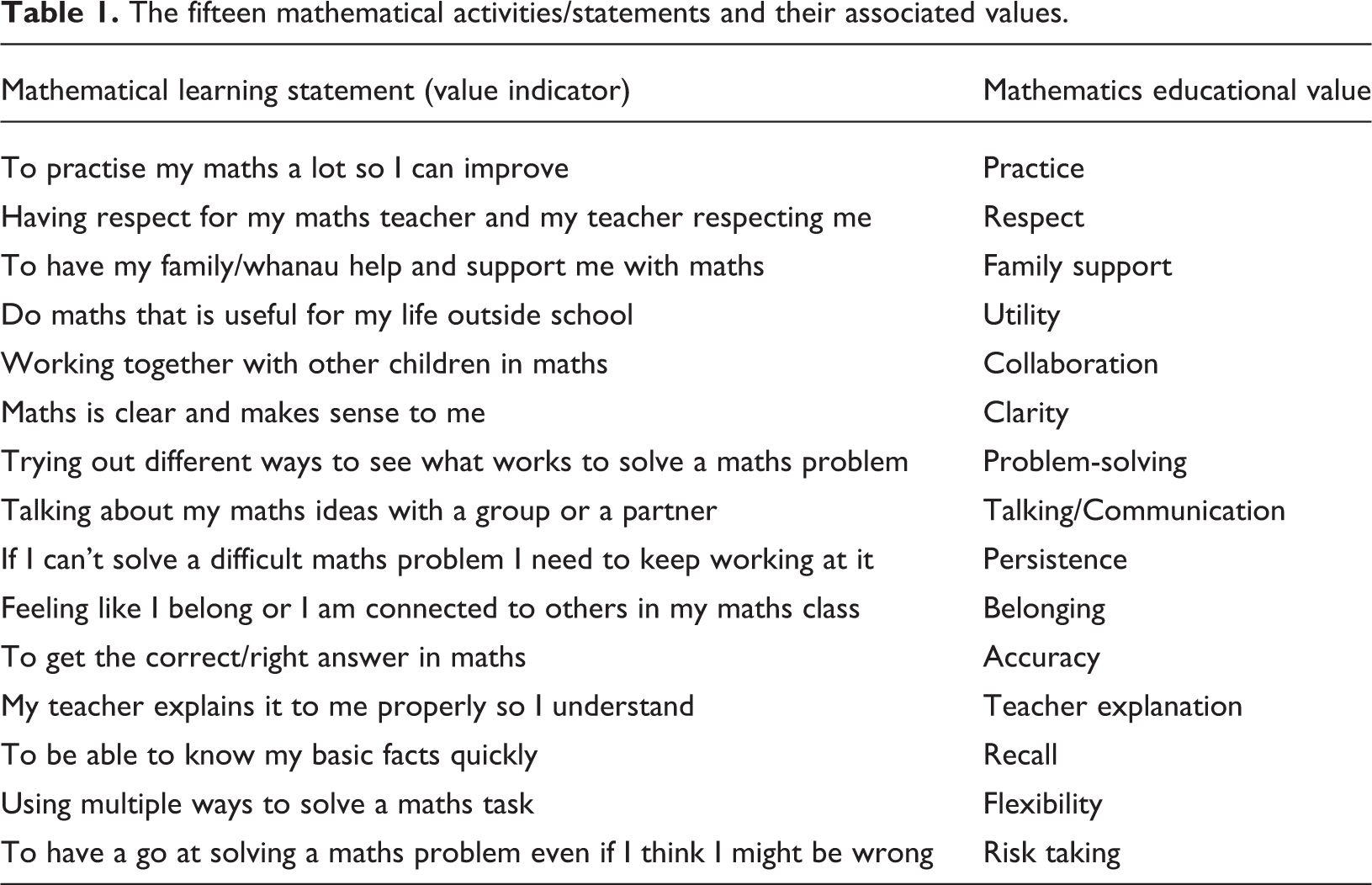
All of the values used in the survey were derived from research literature and policy documents (e.g., Clarkson et al., 2000; MOE, 2013, 2018; Seah & Wong, 2012). The decision to develop the survey rather than use an existing survey tool was due to the need to incorporate and capture the unique indigenous perspectives and societal sources of values of students in the wider study from indigenous Maori and Pāsifika backgrounds. As children may find it difficult to relate and respond directly to particular values, each value was incorporated into a specific mathematical learning statement (see Table 1). For example, the statement “working together with other children in maths” was understood to indicate the value of collaboration in mathematics.
The fifteen mathematical activities/statements and their associated values.
All students were individually interviewed immediately after completing the survey. During the interview, the students were asked to explain the reasons for their selection of the three most important statements and the least important statement. All interviews were wholly transcribed.
To investigate the degree of importance of each mathematics educational value to these students, the total percentage of students who ranked each statement in their top three values was examined. Analysis was also undertaken to determine the total percentage of students who ranked each of the 15 statements as the least important. Following the initial analysis of the survey data, the interview transcripts were then analyzed using a grounded approach through NVivo software (Version 12). This included the identification and development of common codes, categories, themes, and patterns. Each response was coded once into the category which best aligned with the response. For example, a student response explaining why the value of family was ranked highly was: “My family has always got my back and when I get their support I feel like I can do this” which was coded into the node of emotional support and encouragement. Another response: “Sometimes the answers are really tricky and I can’t figure out what the answer is. I ask my Aunty or my Dad to come and help me” was coded into the node of help.
Findings
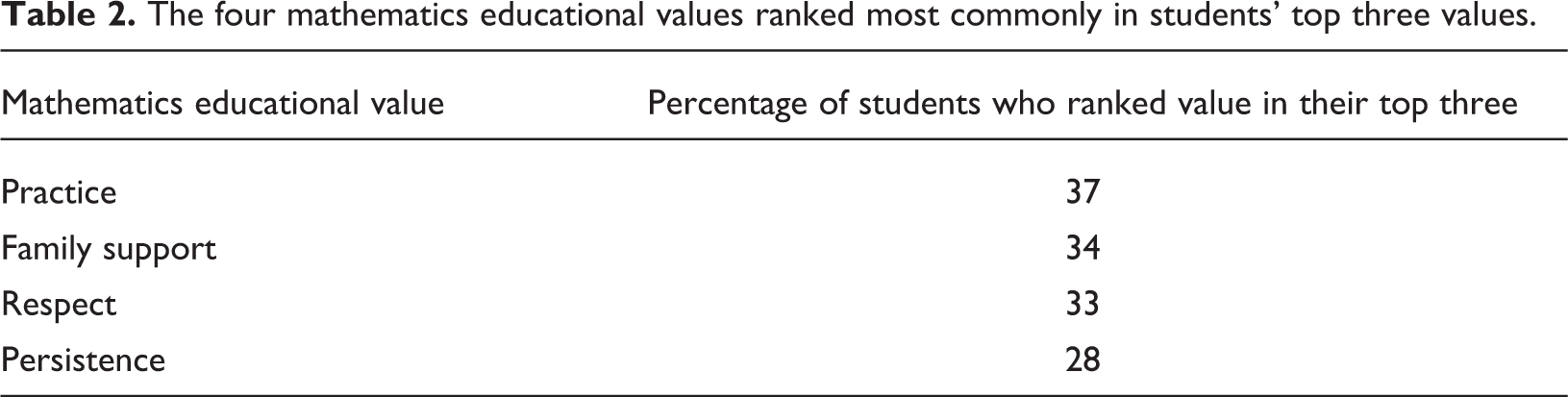
In this first section of the findings, the four mathematics educational value statements that were ranked highly by the greatest percentage of students are presented (see Table 2) to show what these Pāsifika students value most in relation to mathematics educational values. An analysis of student explanations of why they choose the value is presented in the following section.
The four mathematics educational values ranked most commonly in students’ top three values.
In the second section of the findings, the two mathematics educational values that were ranked as the least important value by the greatest percentage of students are presented (see Table 3). This shows what these students valued least in relation to mathematics educational values. An analysis of student explanations of these rankings is also presented.
The two mathematics educational values ranked most commonly as students’ least important value.

The most important mathematics educational values for Pāsifika students in New Zealand
Practice
The statement “To practise my maths a lot so I can improve” was used as a value indicator of the mathematics educational value of practice. This was the value ranked in the top three value rankings by the greatest percentage (37%) of students.
Most commonly, students (74%) accounted for their choice of this value by linking practice with a way of getting better at mathematics: So I can get better at it and I don’t have to keep on making mistakes. Within this theme, students also noted practice as both a way of improvement and developing understanding: I just really don’t understand maths that much and I really just want to understand it so I can improve. Similarly, students linked their selection of the practice as a way to improve assessment results: Practice makes perfect and when I practise, I get the answers better than I got in my last maths test. Also evident in student responses within this theme was the intersection between the students’ family and cultural values and their selection of practice as an important mathematics educational value. A number of the students (12%) referred to their parents or families and stated that practice was important to improve: so that I can make my parents proud of me. Other students (26%) linked practice with their future goals for success in education and employment. For example, one student stated: I can improve more when I go to college…and the more I have a chance of getting a job. Another student referring to his ambition to be a builder stated: When I get older I will need it for the job that I am going to do.
Evident in the student responses was the perception that to succeed in mathematics requires a personal effort. Earlier studies in different cultural contexts (e.g., Lim, 2015; Österling & Andersson, 2013) have also indicated students’ valuing of effort and practice in mathematical learning. The student responses while strongly indicating that practice was important to improve in mathematics also illustrated a wide range of motivations related to why students wanted to improve. These ranged from avoiding mistakes, developing understanding, improving assessment results, to making parents proud. Similar to the findings of Hill et al. (2019), Pāsifika students in the current study also gave responses that linked practice to future goals for success. Earlier studies (e.g., Fletcher et al., 2009; Hunter et al., 2016) have noted the importance of family support for Pāsifika students to succeed in New Zealand schools. The responses of the students in this study also highlight the importance that students place on their family relationship and the obligation that they have to their parents. The link that students made with future educational and employment opportunities also aligns with the view of education as part of a wider responsibility to family.
Family support
A significant percentage of students (34%) ranked the value of family support in their top three value rankings. The statement “To have my family/whanau help and support me with maths” was used as a value indicator for family support.
More than half of the students (64%) who selected this value within their top three most important values attributed this to the help that they received from their family to complete homework, make sense of mathematics, and develop understanding. For example, one student said: Sometimes the answers are really tricky and I can’t figure out what the answer is. I ask my Aunty or my Dad to come and help me. Students also indicated that at times it was easier to understand their family members than a teacher: It’s easier to relate to your Mum teaching you, not like the teacher telling you and that. Additionally, some student responses indicated that they were more comfortable making mistakes with their maths at home: If I get something wrong, they won’t mock me or anything. Other student responses noted that they felt more comfortable asking questions at home: When I am stuck with maths and I need help, I normally ask Mum and Dad or I go and ask my family, my parents and my sisters what kind of stuff this is and then they will support me and help me to sort it out and tell me what it means. Also common within the student responses was that they viewed other members of their family as having expertise in maths: My family are all good at maths or I like my Dad and when he does maths, he knows everything. Evident in these responses were the importance of family as a resource for mathematical learning.
Other students (25%) explained their selection of family as an important value for learning mathematics by describing the emotional support and encouragement they received from their family. For example, a student described how her family: push me to reach my goals. Similarly, a student expressed that her family: has always got my back and when I get their support I feel like I can do this. Another group of students (11%) described the importance of family in relation to their obligation to succeed in mathematics to make their family happy: I want them to know that I love maths and that I am good at it and will learn it. Similarly, a student said: So I can make them feel happy about my education.
The student responses reflect the strong importance of family in Pāsifika culture and are similar to the findings of Hill and colleagues (2019). Also evident in the student responses was the role of the extended family in supporting these students’ mathematical learning. Different members of their families played a role, including parents, siblings, aunties, uncles, and cousins. This is similar to findings reported by Hunter and colleagues (2016). Interestingly, students noted that at times they could understand their family better but also indicated that they felt more comfortable asking their family questions and for help when they did not understand mathematics. This can be linked with how the value of respect is understood and enacted in Pāsifika culture, particularly, as noted by Phan (2010) and Uehara et al. (2018) in refraining from asking questions of those in authority. While this learning behavior in classrooms can be perceived by teachers as passive (Hunter et al., 2016), it is interesting to note that these Pāsifika students drew on the resource of family at home and saw their family members as having expertise that could be shared. Consequently, while they may appear to be passive learners in the classroom, their responses show that they actively sought help outside of school in ways that aligned with their cultural ways of being. Parallel to the findings of Fletcher and her colleagues (2009), students also noted the importance of parental support and love to help them succeed and give them motivation. Student responses also indicated their understanding of success in education as a responsibility to their family.
Respect
The value of respect was indicated by the statement “Having respect for my maths teacher and my teacher respecting me.” Approximately one third (33%) of the students ranked this value statement within their top three value rankings.
Most commonly, students (55%) accounted for their selection of respect as an important mathematics educational value by referring to the need for reciprocal respect between the teacher and student: If you don’t respect them, they won’t respect you back. For these students, learning mathematics in the classroom required them to have a respectful relationship with the teacher. For example, a student explained her choice of this value:
Because if I get it wrong I don’t want him to get angry or anything, and if he’s writing down a question then I can just listen to him, and ask him if I’m stuck, to explain it to me, so I can understand.
So what does respect look like to you, what are some things that you do to show respect for your teacher?
Listening to him and not talking while he’s talking.
And what are some things that your teacher does to show you that he respects you?
If I’m talking then he won’t talk and he’ll wait until I finish talking and he helps me with my maths.
As the student above noted, for these Pāsifika students, it was both important for them to show respect for their teacher but also for the teacher to behave in a respectful way toward them. Interestingly, when students were asked a follow-up question related to how respect was demonstrated, many of the student responses (46%) referenced listening as part of how respect was shown: Listening to them to do what they say and then when you ask them to listen, they all listen.
Other students (32%) accounted for their selection of the value of respect by acknowledging the important role that the teacher took in helping them learn mathematics. For these students, giving respect to the teacher was an important value to show their appreciation: Because they also help me with my maths and they help me get better at maths. Another student stated: Having respect for my teacher is important because she is going to give me an education for when I am older. Finally, a small group of students (13%) linked the importance of respect to a perception that there was a possibility that the teacher may not teach them if they did not behave in a respectful way. For example, a student stated: If I don’t respect them then they’ll just be disappointed at me, and the rest of the students, if they don’t listen to the teacher, she might leave and not teach us.
Notable throughout the student responses was the emphasis on listening as an action that indicated that an individual was behaving in a respectful manner. This aligns with previous research (e.g., Phan, 2010; Uehara et al., 2018) which has focused on how respect as a value is demonstrated by Pāsifika people. The Pāsifika tertiary students in Hawaii in the study by Uehara and colleagues noted how respect is enacted through humility, including listening and waiting to be told what to do when learning a new activity. Similarly, in the current study, many of the students described listening as a key way of showing respect. Also evident in the student responses was the notion of respect being linked with a reciprocal relationship with the teacher. This parallels earlier studies by Hannant (2013) and Averill and Clark (2012) where students discussed the importance of teachers behaving in a respectful manner toward them. Interestingly, the results of this study are different than an earlier study by Hill (2017) whereby Pāsifika students ranked respect as a value of medium importance rather than as one of their most important mathematics educational values.
Persistence
The value of persistence was ranked by 28% of the Pāsifika students within their top three value rankings. This value was indicated by the statement “If I can’t solve a difficult maths problem I need to keep working at it.”
Most commonly, students (56%) described persistence as a way of improving and becoming better at mathematics: If I keep on trying then I would be able to know it. Within this, students also noted that at times by persisting in a mathematics lesson, they were able to solve problems: If I keep working on it, I know what the question is saying and I can answer it. Another group of students (31%) viewed persistence as important due to the utility of mathematics. For example, one student noted: Some maths can be important and I don’t want to give up on maths so I need to keep working on it. Additionally, students noted particular areas of mathematics where they needed to persist to succeed in mathematics. Other students (13%) associated the value of persistence with trying their best: I always just try my best. Interestingly, a number of students (38%) across the different responses referred to persistence as something that their family had taught them to value. For example, one student stated: So I can learn to never give up on anything. When the interviewer asked: Who taught you that? The student responded: My Nan, perseverance.
Although this value was classified as persistence, many of the student responses indicated that they aligned the value statement used with the value of effort. As Österling and Andersson (2013) contend when learning activities are used as an indicator of certain values, depending on the context, student responses can potentially show that the learning activity is interpreted as a different value or even as representing multiple values. Student valuing of persistence and effort aligns with studies from different cultural contexts including Australia and China (e.g., Seah & Barkatas, 2014; Zhang et al., 2016). Again the importance of family as a key cultural value is notable in the responses of the students.
The least important mathematics educational values for Pāsifika students in New Zealand
Accuracy
The value of accuracy was ranked as the least important mathematics educational value by the greatest percentage of students (26%). This value was indicated by the statement: “To get the correct/right answer in maths.”
The majority of student responses (62%) demonstrated a view that effort was more important than getting a correct answer. Consequently, the students put emphasis on having a go at challenging problems rather than valuing correctness. For example, one student stated: Sometimes when I do maths, it gets me confused. Sometimes I work hard to get the right answer and it doesn’t turn into the right answer but I tried hard. The last part of the student explanation: I tried hard was indicative of many of the student responses within this category. Other student responses (38%) accounting for why they did not view this value as important indicated that mistakes were viewed as a valuable learning opportunity. For example, in the interview below, the student positioned mistakes as an important part of the learning process:
Because it’s not always about getting stuff right.
What is it about?
It’s getting stuff wrong the first time then the next time you can get it right…You’re actually helping yourself, and then you can get better at it.
It is important to note that similar to this student, many of the student responses referenced mistakes as a way to learn and correct mathematical thinking, thereby improving their mathematical learning.
The low ranking of accuracy as a mathematics educational value aligns with another New Zealand study by Hill (2017). In this study, students from different cultural backgrounds (European, Pāsifika, Maori, and Asian) completing a survey using value statements, overall ranked accuracy as the least important value. Similarly, students in Hill’s study emphasized the importance of making attempts in mathematics and learning from mistakes rather than the accuracy of the answer. It is interesting to note the continuity of this finding between studies with different groups of participants.
Utility
The value of utility was measured by the statement: “Do maths that is useful for my life outside school.” Although this was the value ranked least important by the second highest percentage of students (10%), this group was still relatively small.
All of the students who ranked utility as the least important value gave responses that indicated a narrow view of mathematics. The students referred to mathematics as a school subject that did not have relevance beyond the mathematics classroom: I don’t do maths outside of school. Another student stated: There is not that much stuff to do outside in life that contributes to mathematics. Following these responses, probing questions from the interviewer asked the students to consider how mathematics might be part of their life outside of school. Most of the students (60%) were unable to give examples beyond homework. A smaller group of students (40%) gave limited examples such as telling the time or measuring ingredients.
The low ranking of utility as a mathematics educational value is surprising, given that in previous studies (e.g., Hill, 2017; Hill et al., 2019; Österling & Andersson, 2013; Seah & Barkatas, 2014; Zhang et al., 2016) across different cultural contexts, students have frequently ranked utility as an important value. Analysis of the student responses highlights that this finding may be indicative of the mathematics tasks and contexts that Pāsifika students experience within schooling. Previous research (e.g., Cunningham, 2019; Hunter & Hunter, 2018) in New Zealand mathematics classrooms has noted that Pāsifika students are frequently given mathematical tasks that are set within contexts which do not relate to the students’ cultural heritage or align with their lives outside of school. As the current findings highlight, this can result in students’ developing a narrow view of mathematics as a subject that does not relate to their culture or lives outside of school.
Discussion and conclusion
New Zealand educational policy for marginalized students such as those from a Pāsifika background advocates the use of values to develop a more equitable and supportive environment. However, given that many teachers in New Zealand come from a different cultural background than Pāsifika learners, as Averill and Rimoni (2019) contend, this policy implementation is hindered by a lack of understanding of the influence of values on learning and behavior in the classroom. This article provides an initial view of the mathematics educational values of a group of Pāsifika learners while also investigating their understanding of the values. Undertaking studies in this area has the potential to support educators to better understand the needs and actions of their students while learning mathematics and other school subjects. For example, the acts of listening and refraining from asking questions may be interpreted as passive or disinterested behavior within the classroom by some teachers. However, as shown in the findings, it was clear that the Pāsifika students in this study associated this behavior with a key way of demonstrating respect. An implication of this is the need for teachers to recognize listening as a respectful action in Pāsifika culture while also thinking of ways in which students can be taught to productively listen and sense-make. This could include the consideration of ways to provide students with the space during lessons to collaborate with peers who they may feel more comfortable to ask questions. By doing this, educators can both honor the values of students that are influenced by their cultural background while also addressing equitable outcomes by supporting students to engage in productive mathematical learning in the classroom.
Earlier studies (e.g., Hunter & Hunter, 2018; Rubie-Davies, 2016; Turner et al., 2015) have shown how Pāsifika students and their families in New Zealand are often framed within deficit perspectives. This is also similar for other groups of marginalized students in different countries (e.g., Battey & Leyva, 2016; Dunleavy, 2018; Louie, 2017). The exploration of students’ mathematics educational values and both their understanding and reason for selecting these offers challenges to a deficit view of learners. For example, Turner and her colleagues (2015) reported commonly held teacher beliefs in New Zealand about Pāsifika students’ underachievement as being related to a lack of effort and laziness. However, as noted in this study, many of these students highlighted both practice and persistence (relating this to effort) as key values which they perceived as necessary to succeed in the mathematics classroom. Providing students with a voice to share their values across the curriculum could support teachers to refrain from making assumptions and to better understand marginalized students’ perspectives. Teachers could also empower students and build on their valuing of practice and effort by explicitly teaching study skills. This would enable students to practice mathematics in ways which support their understanding and progress.
Zhang (2019) noted that although the same values have been reported from different countries, the meanings of these values may differ subtly. This researcher also noted the lack of research literature that focuses on values from the students’ perspective. Throughout this article, the student voice was drawn upon to explore the meanings that these Pāsifika students ascribed to value statements. It was apparent that the understanding of values was influenced by the cultural lenses and worldviews of the students. There were many intersections between these Pāsifika students’ cultural values and their selection and understanding of mathematics educational values. Evident across the findings was the strong influence of the high regard and importance of the value of family. As a teacher in the previous study by Hunter and Hunter (2018) noted, for Pāsifika students “family is big, it’s everything.” Students in this study described the help they received from a wide range of family members along with the influence of emotional support, encouragement, and high expectations. These findings highlight the importance of developing strong relationships between schools and the community including both parents/caregivers and the extended family. Further to this, the analysis of the reasons for which a group of students ranked utility as the least important value provide evidence for the need for teachers to be able to recognize and make links to the mathematical assets of marginalized students and their families such as Pāsifika people in New Zealand.
There are a growing number of Pāsifika people in New Zealand, Australia, and the U.S. The experiences and achievement of these students also parallel the experiences of other marginalized migrant groups within international contexts. Both in the mathematics classroom and across other curriculum areas, there is a need to further examine the values of diverse groups of students to develop more equitable classrooms where students’ culture, values, and ways of being are honored and built upon. The current study provides one window into the perspectives of Pāsifika students in New Zealand schools and begins to provide some insight into why specific values are important and how these may influence classroom interactions. The use of student interview data widens the existing literature focused on values in mathematics education. However, future studies may benefit from examining both students’ self-reported values and understanding of these and also whether their behavior and actions in the classroom align with their self-reported values.
Footnotes
Author’s note
This work involves working closely with schools and in classrooms with teachers to support a shift in pedagogical practices to better serve the diverse learners that comprise mathematics classrooms in New Zealand.
Declaration of conflicting interests
The author declared no potential conflicts of interest with respect to the research, authorship, and/or publication of this article.
Funding
The author received no financial support for the research, authorship, and/or publication of this article.
