




Abstract
Purpose
This study was conducted to review the ongoing competency-based education reform in Thailand during the 21st century. In particular, the historical development of Thai competency-based education and the ideological foundation of its competency-based curriculum were explored.
Design/Approach/Methods
Publicly available policy-related documents addressing competency-based education reform in Thailand were reviewed, and key points that established the ideological foundation of the Thai competency-based curriculum were examined.
Findings
The development of competency-based education reform in Thailand has changed over time in response to government direction and societal conditions. However, unified ideologies for developing competency-based education are lacking, potentially leading to confusion among the various stakeholders involved. The results of this study indicate that although Thailand's competency-based education system has been developed systematically, it lacks clear communication regarding the driving forces behind the curriculum.
Originality/Value
This policy review investigated the foundations of Thailand's competency-based education reform to highlight the direction and trends of competency-based education in the country. Competency-based education reforms in Thailand differ from international education reforms—they are founded on a standards-based curriculum and are developed further. This distinction should be considered when assessing the necessity of a competency-based curriculum.
Introduction
Competency-based education reform is a crucial phenomenon that has been observed across various education systems worldwide (Anderson-Levitt & Gardinier, 2021; Joo & Halx, 2022; Zhao, 2020). Thailand also initiated this reform in the late 2010s as a result of the advocacy of various international multilateral organizations (Lertdechapat & Pimthong, 2021), such as the World Bank (2005), the Organisation for Economic Co-operation and Development (OECD, 2018), and the United Nations Educational, Scientific and Cultural Organization (UNESCO, 2019). These organizations have widely developed competency-based education models that aim to ensure the provision of quality education (OECD, 2018).
In terms of competency-based education on a global scale, curricula have been developed to enhance student competencies (Anderson-Levitt & Gardinier, 2021), and their implementation can be traced back to the 1980s in the United States (Chehayl, 2010). The application of competency-based education extends beyond basic education, with these curricula gaining popularity in the field of medical research because of their distinct features (Riley & Riley, 2017). Competency-based curricula aim to cultivate the essential competencies that will be required of students in their professional careers (Chehayl, 2010).
As competency-based education and curricula at the basic education level constitute a relatively new field in Thailand, research on these topics is limited. For example, Lertdechapat and Pimthong (2021) conducted a document analysis to compare Thailand's competency-based education framework as presented by the Office of the Education Council of Thailand (OEC, 2019) with those proposed by the OECD (2018) and UNESCO (2019). They found that international approaches strongly influenced the competency framework proposed by the OEC and played a substantial role in shaping the competency-based curriculum in Thailand. Further, Thummaphan et al. (2022) examined how a competency-based curriculum could be localized in a school context in Thailand. The researchers specifically focused on a draft of the competency-based curriculum provided by the Office of the Basic Education Commission of Thailand (OBEC, 2022). Although Lertdechapat and Pimthong (2021) and Thummaphan et al. (2022) provided valuable insight into competency-based education trends in Thailand, some aspects remain unexplored.
Two main aspects remain unaddressed in the context of Thai competency-based education. First, the historical development of competency-based education in Thailand has not been thoroughly explored. Second, while the aforementioned studies (Lertdechapat & Pimthong, 2021; Thummaphan et al., 2022) provide useful information regarding competency-based education development, they do not mention the ideological foundations of the latest competency-based curriculum (OBEC, 2022), which represents the most recent development in competency-based educational reform. This review adds value to the existing literature by identifying potential directions for competency-based education in Thailand.
In this policy review, a selection of publicly available policy documents in Thailand issued by working groups or offices administered by the Ministry of Education are analyzed (OBEC, 2022; OEC, 2017, 2019, 2021; Office of the National Economic and Social Development Council of Thailand, 2018; Sangbuaphuen, 2020). The review was conducted in two stages. The first stage focuses on the historical development of competency-based education. At this stage, the key ideas of competency frameworks and related curricula were interpreted by comparing the similarities and differences among a range of versions to obtain a better understanding of how competency-based education frameworks were developed over time. In the second stage, the 2022 draft of the competency-based curriculum developed by the OBEC was analyzed by examining the intentions, competencies, assessments, and evaluations reflected in the curriculum. At this stage, the ideologies underpinning the latest draft of the competency-based curriculum were dissected to clarify the curriculum ideology and the direction in which it should be employed. This analysis was performed using Morris and Adamson's (2010) curriculum ideology framework.
Historical development of Thailand's competency-based education reform
The historical development of competency-based education in Thailand was explored using two documents as the starting point. The first document that clearly mentions competency-based education is The National Scheme of Education B.E. 2560–2579 (2017–2036) (OEC, 2017), which highlights the problem of inconsistent competencies between graduates and job market requirements and notes that these inconsistencies may hinder societal progress in Thailand. To address this issue, key education policies such as “Education for All” and “Inclusive Education” (OEC, 2017, p. 76) were proposed. The second document examined in this study was Thailand's National Strategy B.E. 2561–2580 (A.D. 2018–2037) (Office of the National Economic and Social Development Council of Thailand, 2018); it was argued that Thai people lack the skills and competencies necessary to meet the needs of Thailand's economic system. However, this document emphasizes that these competencies can be developed and that education plays a crucial role in equipping Thai students with the necessary competencies.
The two aforementioned documents (OEC, 2017; Office of the National Economic and Social Development Council of Thailand, 2018) formed the basis for the Thai government's consideration of competency-based education. An interesting aspect of these documents was the duration of the two plans. As the development of competency-based education is a long-term process, a step-by-step approach is required. Moreover, the types of competencies within the curricula changed throughout the development period (Sangbuaphuen, 2020), and different versions of competency-based education were in play.
Since the implementation of the OEC (2017) and the Office of the National Economic and Social Development Council of Thailand (2018), competencies have developed over time, as indicated in three documents (OEC, 2019, 2021; Sangbuaphuen, 2020). As shown in Table 1, some common threads are evident in all the relevant documents detailing the development of competency-based education in Thailand.
Comparisons of the competency-based education frameworks in Thailand.
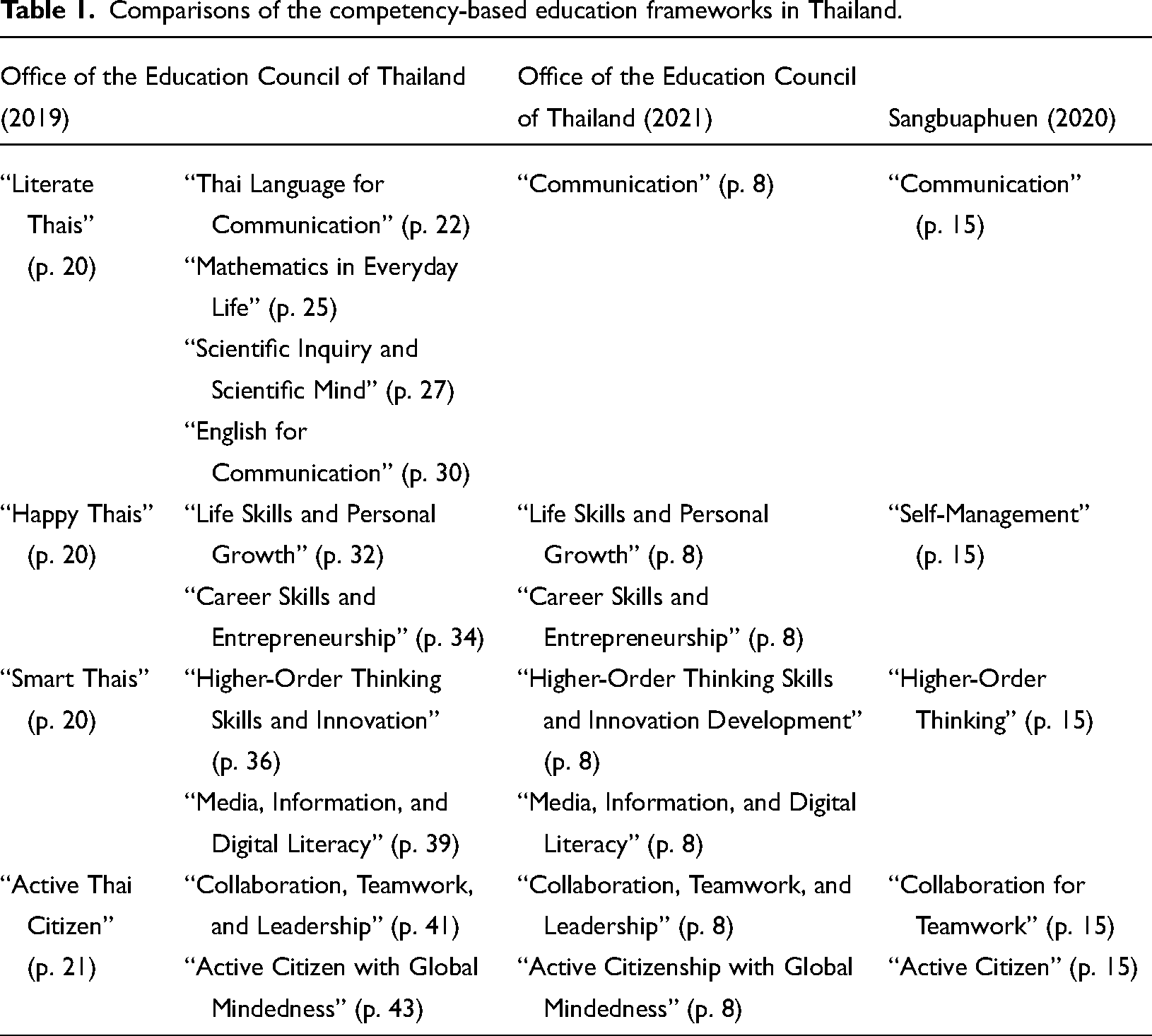
Table 1 illustrates the first draft of the 10 competencies developed by the OEC (2019), which were divided into four categories—“Literate Thais,” “Happy Thais,” “Smart Thais,” and “Active Thai Citizen” (pp. 20–21), with a clearer delineation within each competence category. Furthermore, the inclusion of the concepts of literacy, happiness, intellect, and citizenship in this framework can be considered a reflection of the discourse consistently presented in documents worldwide (Anderson-Levitt & Gardinier, 2021). The second OEC document (2021) can be considered a revision of the previous competency framework. Although most competencies in the second document are similar to those in the previous version (Table 1), the OEC (2021) changed the placement of the competencies previously presented in “Literate Thais” (OEC, 2019, p. 20) to “Communication” (OEC, 2021, p. 8). The working groups for this document considered this change a shift of literacy to become a fundamental element that can improve students’ competencies.
Although the OEC (2021) report defined various core competencies, the first curriculum draft issued by the Office of Basic Education of Thailand (Sangbuaphuen, 2020) included the five competencies listed in Table 1. Compared to the competency frameworks proposed by the OEC (2019, 2021), the competencies in the curriculum draft prepared by Sangbuaphuen (2020) were less complex and superficial because some competencies had not yet been defined. It remains unclear whether the omission of these competencies from the curriculum draft was intentional. Sangbuaphuen outlined general competencies similar to those highlighted in Thailand's standards-based curriculum (Ministry of Education of Thailand [MOE], 2008). This can be attributed to the influence of the standards-based curriculum on Sangbuaphuen's work. The competencies outlined in the latest competency-based curriculum development plan (OBEC, 2022) may have been based on a draft prepared by Sangbuaphuen (2020).
The three competency frameworks (OEC, 2019, 2021; Sangbuaphuen, 2020) have demonstrated a clear commitment to educational reform since the OEC announced The National Scheme of Education B.E. 2560–2579 (2017–2036) in 2017. Nevertheless, competency-based educational frameworks have been adjusted over time.
2021–2022 draft of the competency-based curriculum
The latest version of the Thai competency-based curriculum was incomplete at the time of writing this paper because the current draft was released for only the primary education level in 2021–2022 (OBEC, 2022). Thus, the details of the secondary education curriculum are not yet available online, and the Thai vice prime minister paused the curriculum's development in May 2022 (Matichon Weekly, 2022). Nonetheless, although secondary education curriculum content cannot be provided, the draft prepared by the OBEC (2022) for the primary education level offers insight into the intentions for all levels. Therefore, the current analysis is based on the available information.
The OBEC (2022) document begins by describing why the new competency-based curriculum should replace the previous standards-based curriculum (MOE, 2008) in Thailand. The first justification provided was the impact of the pandemic: “The severity of COVID-19 has obliged every country, including Thailand, to make social, cultural, and economic changes that affect people, which also increases social stratification” (OBEC, 2022, p. 1). This justification is appropriate because students and teachers have experienced substantial challenges in preparing for learning and teaching during the pandemic. Therefore, the need to change educational practices, as highlighted in the argument, is an issue the Thai government should urgently address to improve the quality of education and, thus, society as a whole. Additionally, the OBEC (2022) has emphasized that advancements in technology are a driving force for change, which necessitates a transition from the previous curriculum to the current one.
Regarding the competencies outlined in the OBEC (2022) document, policymakers have formulated two main types of competencies aiming to enhance students’ learning: “core competency” (p. 6) and “specific competency” (p. 31). These two types are presented in Figure 1.
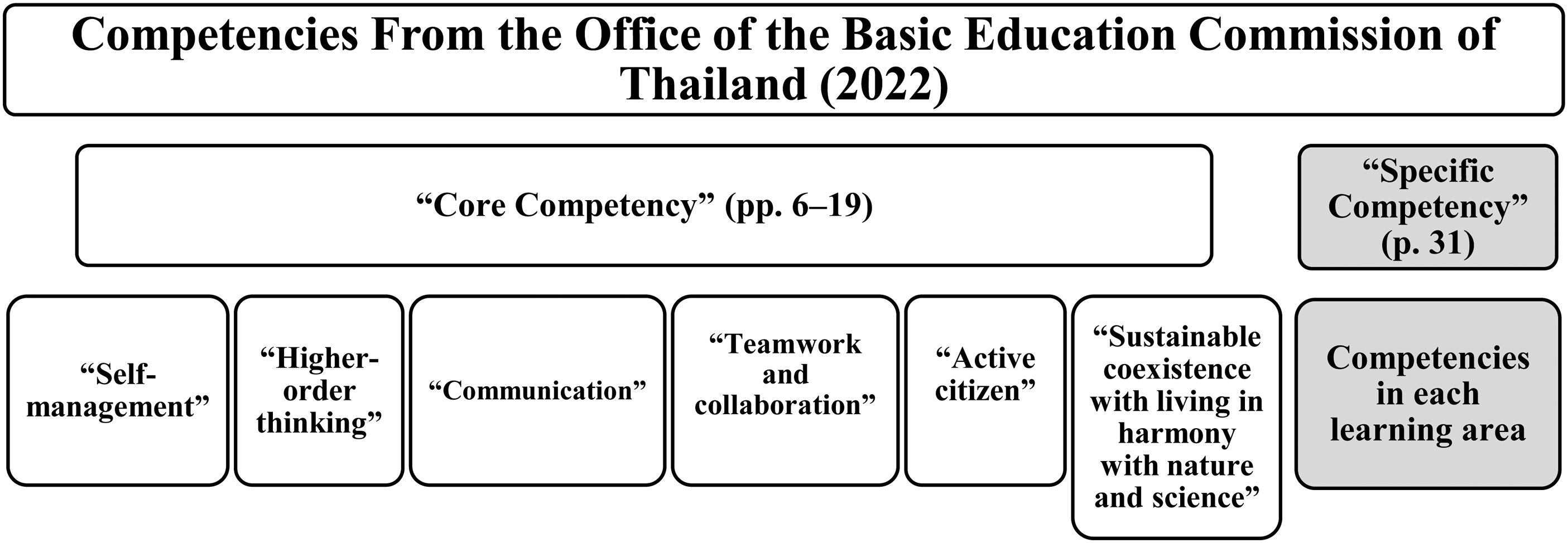
Types of competencies in the framework of the Office of the Basic Education Commission of Thailand (2022).
As shown in Figure 1, some competencies in the core elements indicated in the OBEC (2022) framework, such as citizenship, are universal for students in the 21st century (Anderson-Levitt & Gardinier, 2021). This aligns with the proposals of the OECD (2018) and UNESCO (2019) and indicates that the latest competency-based education in Thailand considers the international discourse in education and that it has been incorporated into the curriculum. Furthermore, specific competencies are included (OBEC, 2022). These competencies are more discipline-specific and their nature varies depending on the field of study.
Within each core competency, the curriculum includes criteria for students’ expected achievement level (OBEC, 2022). The Thai basic education draft outlined by the OBEC incorporates 10 levels throughout the stages of education. Each stage is further divided into four main levels: beginner, development, capability, and beyond expectations (p. 123). Although this approach is promising for promoting learner diversity, how this scale can be used effectively remains unclear. Furthermore, it is uncertain whether these competencies can be combined with specific learning areas when linked to subject knowledge. Moreover, whether this scale truly reflects students’ learning competencies must be evaluated. For example, Figure 2 illustrates the competencies for “teamwork and collaboration” at Level 7 (OBEC, 2022, p. 15) at the lower secondary level (i.e., Stage 3).
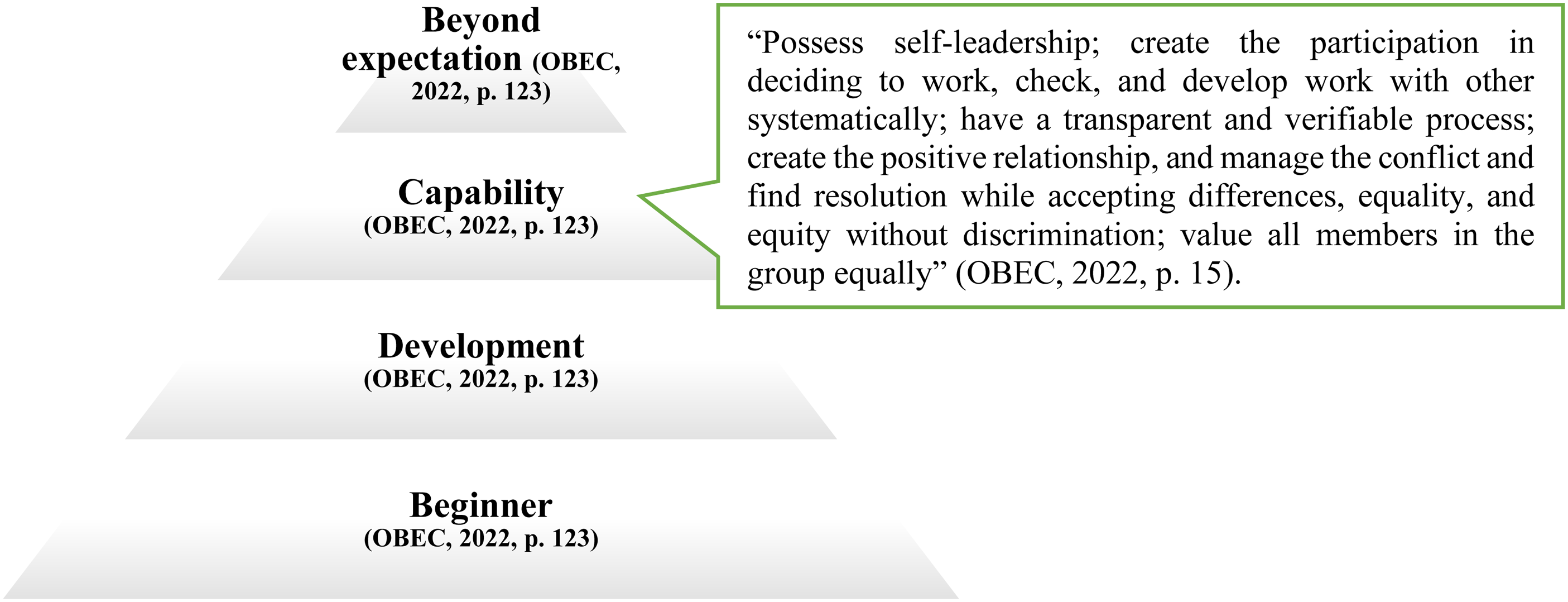
Level of achievement in the competency-based curriculum: An example from Level 7 (Office of the Basic Education Commission of Thailand, 2022).
As shown in Figure 2, the written description provided by the OBEC (2022) for lower secondary education students is not realistic because they are expected to meet all the specified criteria to achieve a particular competency. The current educational landscape, particularly in schools with more than 40 students per class, may not facilitate learning in these specific ways (Sumrankit, 2018). In reality, teachers may not be able to observe and determine whether all students have achieved the applicable competency. Furthermore, teachers may experience difficulty promoting their students’ learning within the confines of these criteria because of the nature of the content. Therefore, policymakers should consider how these criteria can be made more suitable for Thai students at the lower secondary level.
Although competencies are included in the OBEC (2022) document, the learning content to be taught is not specified in the curriculum. Instead, each learning area is assigned specific competencies, as shown in Figure 1. In some learning areas, such as mathematics, the specific competencies are described as “mathematical problem-solving” and “mathematical reasoning” (OBEC, 2022, p. 67) without explicitly mentioning content knowledge. This is contrary to learning areas in social studies, in which specific competencies include content knowledge such as “abiding by the morality in Buddhism and/or other religions that students follow; being capable of adapting themselves intellectually; bearing and solving the everyday life problems” (OBEC, 2022, p. 49). These two examples of specific competencies differ in nature; therefore, it is recommended that curriculum content be unified and further development be undertaken. The latter example represents a specific competency within the social studies learning area, which indicates that the standards-based curriculum directly influenced the development of a particular competency in the Thai competency-based curriculum.
In conclusion, an analysis of the latest draft of the competency-based curriculum (OBEC, 2022) revealed the relationship between the competency- and standards-based curricula, the latter of which is being implemented in Thailand. Although the new competency-based education program (OBEC, 2022) aims to replace the previous curriculum (MOE, 2008), it is crucial to consider that the world has undergone changes during the development of this competency-based education. It remains uncertain whether a competency-based curriculum can truly supersede a standards-based curriculum.
Curriculum ideology of competency-based education in Thailand
The ideology underlying the competency-based curriculum is the most important aspect of analysis when assessing the Thai curriculum's status and position. This analysis used the curriculum ideology presented by Morris and Adamson (2010), which comprises five main categories: “academic rationalism,” “social and economic efficiency,” “child-centered,” “social reconstructionism,” and “orthodoxy/ideological transfer” (p. 51). Morris and Adamson (2010) argued that their set of curriculum ideologies is sufficiently comprehensive for application in different types of schools and curriculum preparation. The curriculum ideologies were developed in an Asian context, and the authors comprehensively considered the expected ideas in a curriculum ideology specific to the Asian context. Other ideologies, such as those of Schiro (2008), were mainly developed in the Western context; therefore, it is difficult to fully contextualize them in Thai education.
The primary goal stated in the document presented by the OBEC (2022) must be addressed first: “This curriculum has the goal of developing each student so that they will have the necessary skills to cultivate, develop, and apply the main and other competencies based on their capability for self-development” (p. 1). This goal aligns with the “child-centered” and “social and economic efficiency” curriculum ideologies proposed by Morris and Adamson (2010, p. 51). According to the authors, the “child-centered” ideology aims “to provide pupils with opportunities for enhancing their personal and intellectual development” (p. 51). The goals of Thai competency-based education plans align with the suggestions of Morris and Adamson (2010) because of their emphasis on the idea that Thai students must develop themselves to meet the evolving needs of a changing world. Moreover, the goal of the curriculum ideology of “social and economic efficiency” is “to provide for the current and future manpower needs of a society” (Morris & Adamson, 2010, p. 51). The spirit of competency-based education proposed by the OBEC (2022) implies that this curriculum ideology aims to enhance student capabilities. Therefore, the intentions of this competency-based education draft are as follows: (1) encourage students to explore their interests; (2) predict the requirements of Thai society so that the education system can produce students who can better serve the future job market and interests of Thailand.
One interesting characteristic of the draft of the competency-based curriculum is the desirable characteristics proposed by the OBEC (2022). These desirable characteristics can be considered “orthodoxy/ideological transfer” (Morris & Adamson, 2010, p. 51) because the curriculum aims to guide people's thoughts and how citizenship in Thailand is reflected. Morris and Adamson (2010) argued that “schools should pass on the prevailing values and beliefs of that society/culture” (p. 51). One example highlighted by the OBEC (2022) is self-discipline, which involves students’ realization of their responsibilities and knowing what they should do while learning. The Thai government seeks to assimilate this value through their provision of competency-based education. Notably, the intention of the curriculum proposed by the OBEC (2022) is not completely aligned with the competencies with which the Thai government would like Thai students to be equipped after completing their studies.
Another characteristic that requires examination is the philosophical foundation of the competencies used across different learning areas. As mentioned in the previous section, the foundations of the six main competencies provided by the OBEC (2022) are based on different curriculum ideologies. While the primary ideologies are “child-centered,” “social and economic efficiency,” and “orthodoxy/ideological transfer” (Morris & Adamson, 2010, p. 51), the major ideology discussed in this section is “social and economic efficiency” (p. 51) because it forms part of the main discourse in Thai competency-based education reform. It may be the most appropriate ideology because it can help create students who can meet the demands of the Thai market economy, as indicated by the OEC (2017) and the Office of the National Economic and Social Development Council of Thailand (2018).
The specific learning outcomes of the competency-based curriculum outlined in the OBEC (2022) are important. Some areas of knowledge, such as religious studies, which are incorporated within social studies education, may be viewed as a form of “orthodoxy/ideological transfer,” as this field aims to disseminate what people in Thai society believe to be the permanent truth from one generation to another, fostering a sense of social belonging (Morris & Adamson, 2010, p. 51). However, most of the content knowledge observed in the OBEC (2022) is based on the “social and economic efficiency” ideology (Morris & Adamson, 2010, p. 51), which focuses on developing the skills that students need to live in society. This finding is consistent with the argument put forth by Magnusson and Osborne (1990), who deconstructed the logic of competencies and asserted that this type of education aims to meet social goals. Teachers should focus on their students’ needs and abilities to promote learning. Nevertheless, the documents currently available are only applicable to students at the primary education level (OBEC, 2022). Therefore, the organization of the Thai secondary education curriculum should be presented clearly. Nonetheless, questions remain regarding how the Thai competency-based curriculum will be structured and implemented at the secondary education level.
Future trends in Thailand's competency-based education
A competency-based curriculum is a promising approach to improving curriculum studies and educational policies in Thailand (Komchadluek Online, 2021). However, the implementation of such a curriculum has been postponed by the deputy secretary of the Office of Basic Education of Thailand, who argued that the transition to a new competency-based curriculum is unnecessary because the current standards-based curriculum already addresses the required student competencies (Matichon Weekly, 2022). This idea is supported by Sundberg and Wahlström (2012), who indicated that standards-based education could be one of many approaches used to improve students’ competencies. Thus, the direction of competency-based education reform must be confirmed.
The new government elected in the Thai general election on May 14, 2023, will begin working in August 2023 (Thai PBS, 2023). According to the OEC (2017) and the Office of the National Economic and Social Development Council of Thailand (2018), competency-based education is expected to be emphasized continuously. This educational system can be developed using two approaches. First, it should be promoted as part of a standards-based curriculum on an ongoing basis (Matichon Weekly, 2022). Similar efforts have been made in other education systems that aim to develop competencies, such as in Sweden (Sundberg & Wahlström, 2012). Nevertheless, the Thai standards-based curriculum should be revised and updated using new knowledge and standards because it has been applied in Thailand for more than 10 years since its initial implementation by the MOE (2008). Second, the pandemic affected curriculum implementation by disrupting knowledge transfer. Therefore, the entire curriculum must be updated. An alternative is to reform the curriculum based on Thailand's efforts to develop a competency-based curriculum during the 2010s and early 2020s (OEC, 2021; Sangbuaphuen, 2020). If this path were to be chosen, either the OBEC (2022) draft of the Thai competency-based curriculum should be revised and implemented, or a newer version would need to be developed.
Thus, an important consideration for future trends is the alignment between the ideology in the new curriculum and the necessity of the Thai market economy, as indicated by the OEC (2017) and the Office of the National Economic and Social Development Council of Thailand (2018). The analysis in the previous section revealed that although various ideologies have been integrated into the OBEC (2022) draft of the Thai competency-based curriculum, a clear consensus is necessary on which curriculum ideology should serve as the central discourse. Based on the present analysis, curriculum developers should prioritize the “social and economic efficiency” ideology (Morris & Adamson, 2010, p. 51) to ensure that the appropriate direction is followed when developing the new framework for competency-based education. This ideology resonates with different sources, indicating that it reflects the goal of education in the current era of change (Komchadluek Online, 2021).
Footnotes
Declaration of conflicting interests
The author declared no potential conflicts of interest with respect to the research, authorship, and/or publication of this article.
Funding
The author received no financial support for the research, authorship, and/or publication of this article.
