




Abstract
Highlights
Amid rapid technological development in the Fourth Industrial Revolution, this article engages with an important question, especially in the context of science, technology, engineering, and mathematics (STEM) education: Can technology transform STEM teaching and learning? Constructionist learning responds to the current “maker movement,” which draws upon the innate human desire to make things with our hands. Two important elements of constructionist learning—technology literacy and engineering design—have implications for meeting the global need for expertise in the STEM disciplines. This article discusses how constructionist learning can play an important role in teaching and learning school mathematics via a transdisciplinary approach to STEM education. Two examples of the authors’ empirical research on constructionist learning in school mathematics classrooms with 3D printing are illustrated. Findings suggest that the 3D Printing Pens played an active role in the construction of artifacts (physical) and mathematical meaning (cognitive).
Introduction
The Fourth Industrial Revolution embraces a range of emergent technologies that can erase boundaries of the physical, digital, and biological worlds and even challenge ideas about what it means to be human (Schwab, 2016). Its focus has been on shaping a future economy that utilizes new technologies to power the way we live, work, and relate to one another. From this perspective, the Fourth Industrial Revolution is “not only about smart and connected machines and systems” (Schwab, 2016, p. 12) but has a much wider scope. Its impact on education is the imperative to “develop education models to work with, and alongside, increasingly capable, connected and intelligent machines” (Schwab, 2016, p. 43). Palka and Ciukaj (2019) capture the trajectory from the First Industrial Revolution as shown in Figure 1.
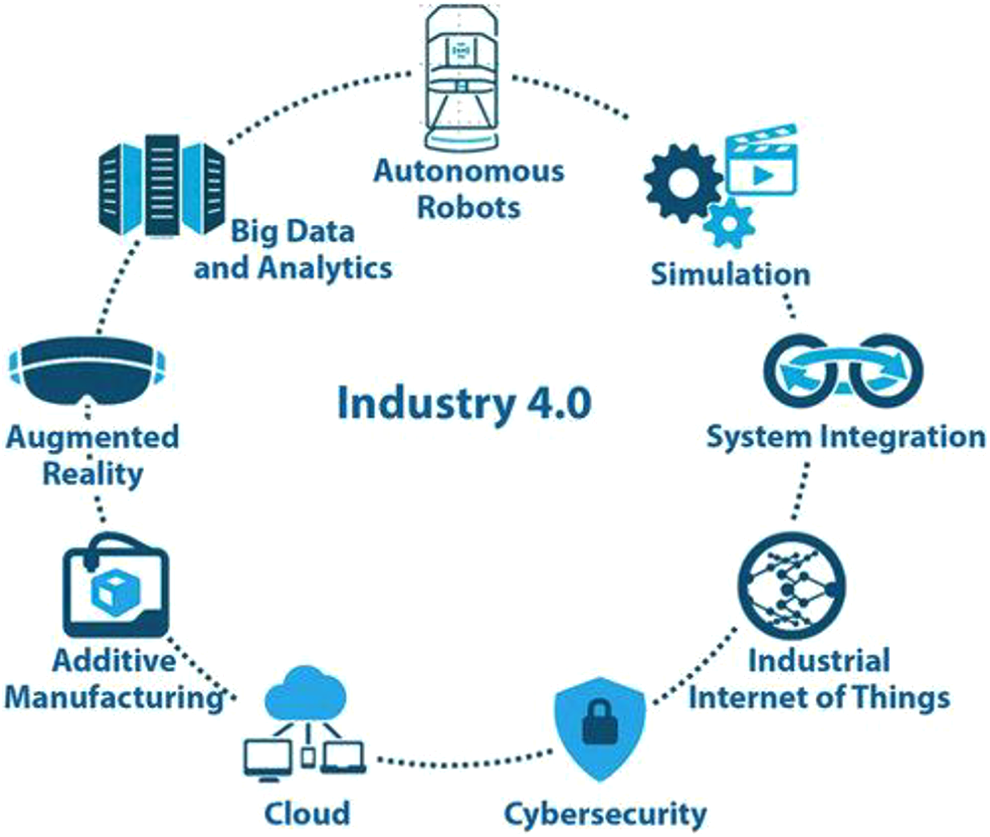
The Fourth Industrial Revolution.
Along with the rapid technological development of the Fourth Industrial Revolution, this is a time of equally swift advances in educational technology and technology-enhanced pedagogies. During the past two decades, for example, the introduction of digital technology in schools has given rise to new ways of doing and representing mathematics. More recently, there has been increasing focus on the impact of making, pointing to new opportunities to engage learners in constructionist practices with digital technology (Hughes et al., 2016). Indeed, the recent, worldwide “maker movement” (Halverson & Sheridan, 2014) has revived creativity, art and design, humans with tools, and digital experiences beyond the flat screen. However, such developments have mainly evolved outside the realm of schooling. One important application of making in education is a constructionist approach to learning, that is, through producing artifacts that are technologically enhanced, which has implications for meeting the global need for expertise in the science, technology, engineering, and mathematics (STEM) disciplines (Ng & Chan, 2019).
Davis et al. (2015) pose a timely question, “How might we describe a teaching that fits with the time and place we find ourselves?” (p. 6). To begin to answer it, a transdisciplinary approach must be evoked, whereby K-12 STEM education engages students with real-life phenomena and problems (English, 2016). Understanding that real-life problems are open-ended and ill-structured and lack simple solutions reflects the global, 21st-century competence of a problem-solver (Organisation for Economic Co-operation and Development, 2018). Meanwhile, the mere presence of technology changes nothing regarding how problem-solving will be learned. Importantly, it is the educators who can design learning conditions for problem-solving that draw upon mathematics and technological literacy to meet complex demands in an ever-changing world.
Likewise, the authors argue that technology itself will not transform STEM education; rather, it is pedagogies that can realize the transformative, educational potential of emergent technologies. In her Papert-inspired research on 3D printing, 3D computer-aided design, and physical programming (Figure 2), the first author conceptualizes learning as making in STEM education, a form of constructionist learning that renders learners innovators and producers of knowledge as opposed to consumers of meaning determined by others (e.g., Ng & Chan, 2019). Making situates students as constructing artifacts meaningfully and flexibly in technology-enhanced ways, through which mathematical thinking, technology literacy, and engineering design also emerge in the activity as integrated STEM learning. Learning as making supports innovation-oriented learning and nonroutine problem-solving as, opposed to finding the correct answer per se. This conceptualization responds to Renert (2011), who observed that mathematical learning “in today’s classrooms relies on the unchallenged assumptions that each problem has one correct answer and that the teacher knows this answer. Students’ creativity is therefore limited to replicating solutions that are already known” (p. 223).
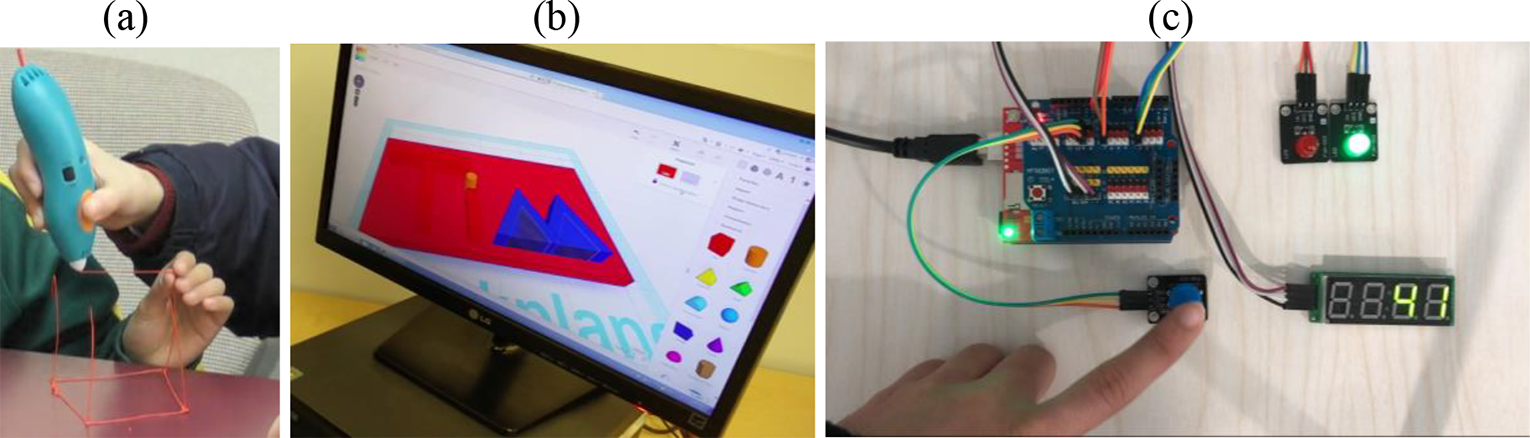
Constructionist learning with (a) 3D printing technology, (b) 3D computer-aided design, and (c) programmable electronics.
This article examines how constructionist learning can play an important role in school mathematics classrooms. It is informed by the authors’ empirical work investigating the effect of constructionist pedagogies in the primary school setting. In particular, two examples of technology-enhanced mathematics learning with 3D printing are illustrated in detail. This article ends with a discussion of the potential transformations in mathematics education afforded by constructionist learning as well as areas of future research directions.
Conceptual framework
Theory of constructionism
The notion of making is rooted in the theory of constructionism (Papert, 1980), which argues that learning is most effective when it involves constructing a meaningful product. Constructionism is itself an extension of constructivism, which suggests that knowledge is not delivered to the learner but is constructed and organized into “mental schemata” cognitively. On the other hand, constructionism highlights the context by which the learner engages in producing something that is personal, real, and sharable (Papert, 1980); hence, it initiates an epistemology of thinking and doing mathematics as socially and intellectually engaged in defining problems to be solved and meaningful artifacts to be built. Moreover, drawing attention to the tool- and technology-enhanced learning, constructionism emphasizes on how learners’ ideas get formulated and transformed when expressed through different media and actualized contexts. Papert’s (1980) revolutionary work has shown that in constructionist learning situations, schoolchildren can in fact construct rich mathematics meanings while using technology flexibly. Other studies show that learners develop their design thinking and construct cognitive models, thus internalizing their knowledge during making activities (Benton et al., 2018; Gadanidis et al., 2017).
Today, a variety of emergent computer hardware, such as 3D printing, is similarly assisting students’ problem-solving and providing meaningful experiences for students’ artifact creation. This notion of making is much more direct and hands-on than “Logo” programming in Papert’s time, for students can realize and transform their ideas into 3D models without any programming skills, yet it is an equally powerful and flexible learning process. As shown in Ng and Chan (2019), the physicality of creating 3D models supported the students to engage in the engineering design cycle: Some students revised and others completely abandoned their original designs, given that their products needed to satisfy a mathematical constraint. It was concluded that through constructionist learning, the students developed spatial skills and achieved mathematics learning far beyond skills in using formulae and performing procedures.
A transdisciplinary STEM education
STEM education is referred to as the education of the science, technology, engineering, and mathematics disciplines across all grade levels in both formal (e.g., classrooms) and informal (e.g., after-school programs) settings. More recently, there has been an urgent needs to educate schoolchildren with technological literacy in knowledge about STEM in learning environments that foster 21st-century competence such as innovation and problem-solving. Despite its wide and significant implications for the society, STEM-integrated education implementation and development have been extremely slow in schools worldwide, primarily due to a lack of understanding of the fundamentals and best practices of STEM pedagogies. While it is imperative to promote and implement STEM education, schoolteachers have often expressed that they have inadequate knowledge and resources to integrate STEM concepts and practices in their classrooms. Meanwhile, mathematics in particular has not received the focus it deserves regarding STEM integration (English, 2016), and limited research has addressed how mathematics can influence and contribute to the understanding of ideas and concepts from other STEM disciplines (Fitzallen, 2015). With a vision focusing on the “M” in STEM, Stohlmann (2018) argues for the integration of mathematics as a core learning outcome while being supported and enhanced by science, technology, and/or engineering.
Constructionist learning offers a type of transdisciplinary solution for STEM education in which knowledge and skills learned from two or more disciplines are applied to real-world problems and projects (English, 2016). In particular, constructionist practices in mathematics classrooms fulfill integrated STEM learning by highlighting mathematics practice as going beyond using formulae and performing arithmetic calculations, while being connected with technological literacy and engineering design (Kelley & Knowles, 2016). In response to Pang and Good’s (2000) review, which stated that the dominant approach of STEM integration was on science content with mathematics having a supporting role, constructionist mathematics learning fills the research gap by focusing on mathematics as the basis for an integrated STEM curriculum.
3D printing in school mathematics
The 3D Printing Pen is a handheld device that operates on the same principle as some 3D printers. It extrudes small, flattened strings of molten thermoplastic and forms a volume of “ink” as the material hardens immediately after extrusion from the nozzle. As the Pen moves with the hand holding it, a 3D model is created at once, either on a surface or in the air (as shown in Figure 2a). The process of drawing quickly transforms into a made object—that is, a concrete object that can be manipulated. A 2D diagram that would have stayed dormant on the page when drawn with paper-and-pencil thereby becomes a physical object that can be held, moved, and turned when drawn with the Pen. In other words, the 3D Printing Pen enables teachers and students to interact with mathematics in ways not possible in the era of paper-and-pencil or computer screens, as 3D-printed models can be touched, transformed, or manipulated physically during the meaning-making process. In terms of Bruner’s (1966) theory of cognitive development, enactive (i.e., action-based) and iconic (i.e., image-based) modes of learning are thus activated as a result of diagramming with the Pen and manipulating the 3D-printed model (Ng et al., 2018). At the same time, the technology itself lends itself naturally to constructionist activities, thus fostering a form of transdisciplinary STEM education. In what follows, we provide two examples of primary school mathematics lessons that can be complemented by the 3D Printing Pens, where the learning outcomes concerned cross-sections and properties of prisms and pyramids, respectively. The participants provided informed consent to participate in the study.
Example 1: Constructing cross sections
In this first example of constructionist learning, upper primary (age 10–12) students were tasked with constructing the outline of various cross-sections of 3D solids with the 3D Printing Pens. Having just learned the meaning of cross-sections, the students used the 3D Printing Pens to anticipate and trace the outline of a cut through two given solids (a cylinder and a square pyramid). Figure 3 captures some of these constructions, namely the cross-sections of a cylinder. Each student received a worksheet, enabling them to complete seven cross-sections with various cuts (horizontal to the base, vertical to the base, and oblique) through the given cylinders and square pyramids. The first part of the worksheet asked students to guess what shape the cross-sections would take on before they began their constructions. The students then used the 3D Printing Pens to construct the outline of the anticipated cross sections physically (Figure 3). As mentioned, the artifacts constructed can be picked up when they are detached from the solids. Having observed their artifacts, the students answered the worksheet again to solidify their knowledge.
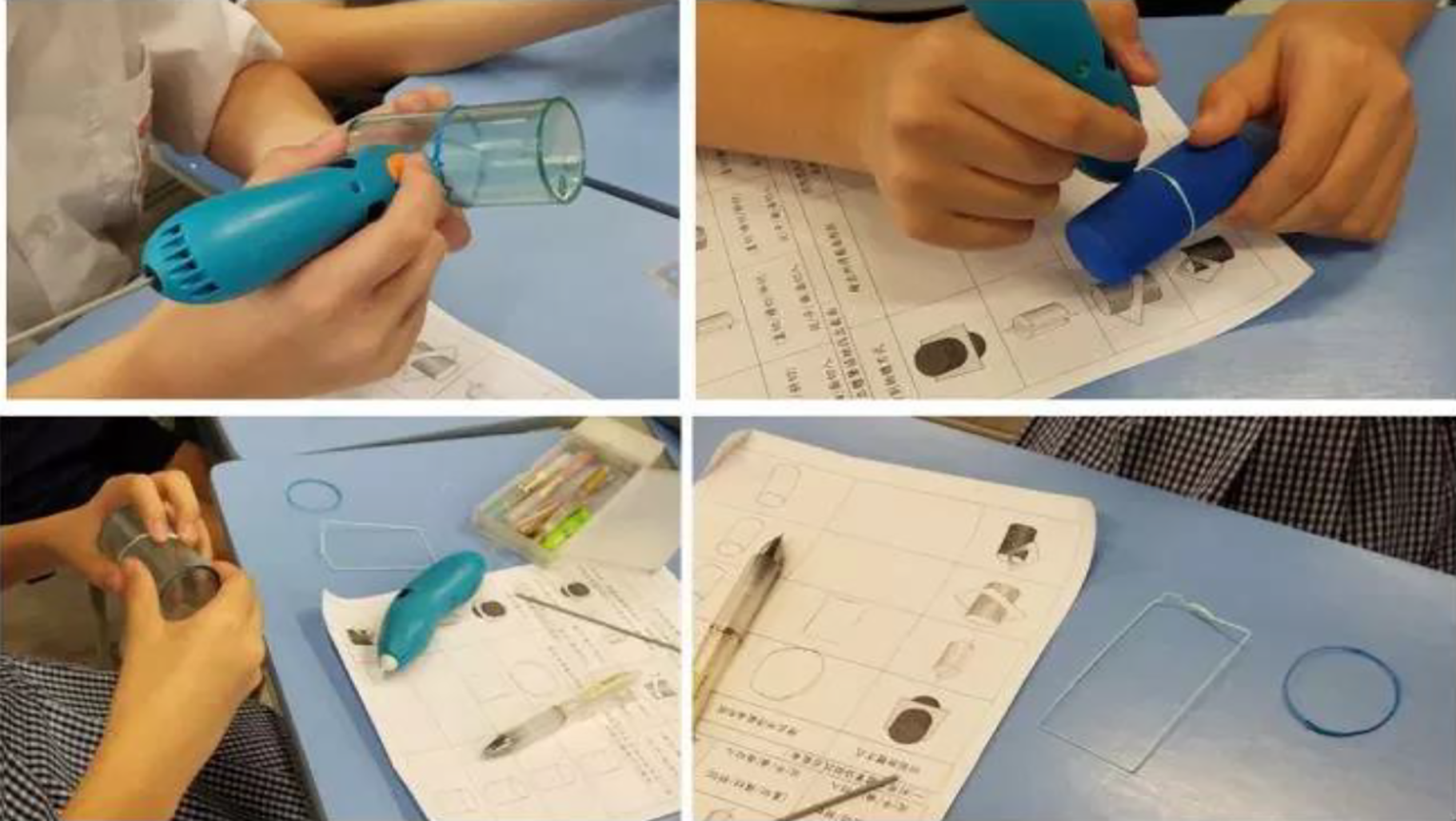
Constructing cross-sections of 3D shapes.
By studying the students’ discourse (verbal communication and hand movements with the 3D Printing Pens) during the lessons, the researchers intended to explore what learning entails in a constructionist mathematics activity (Ng & Ferrara, 2020). The results characterized students’ geometry learning as occurring in the interplay between the students’ hands and the emerging 3D models. Thus, the 3D Printing Pens played an active role in the construction of artifact (physically) and mathematical meaning (cognitively). Upon examining the lesson, the classroom teachers commented that without a tool like 3D Printing Pens, students would find it very difficult to visualize what various cross sections look like, especially for pyramids. The study also revealed that even when 3D Printing Pens were not available for students to use after the lesson, they produced gestures that imitated their drawing processes with 3D Printing Pens when solving problems related to cross-sections. This suggests that the activity with 3D Printing Pens supported the students with cognitive tools (i.e., gestures) for visualizing cross-sections of 3D solids.
Example 2: Exploring properties of 3D shapes
The second chosen example illustrates constructionist learning of the topic “Properties of Prisms and Pyramids” (Hong Kong Curriculum Development Council, 2015) from the upper primary (age 10–12) mathematics curricula. Specifically, the expected learning outcomes for the respective grade levels were to identify the total number and shape of faces of any prism or pyramid (both lateral faces and bases; Primary 5) and the total number of faces, vertices, and edges of any prism or pyramid (Primary 6). In two lessons totaling 70 min, the students engaged in the active creation of different forms of prisms (the first lesson) and pyramids (the second lesson). The lessons adopted an inquiry-based, student-centered approach combined with the constructionist learning activities of students actively creating different forms (triangular, rectangular, pentagonal, etc.) of prisms and pyramids with a class set of 3D Printing Pens (Figure 4). After a quick review of how to name different prisms and pyramids, each student was given ample time to construct different forms of prisms and pyramids. Papert and Harel’s (1991) notion of constructionist practice involves offering personal choices and flexibility in making, and accordingly the students were given minimal guidance on how to construct the 3D solids. Near the end of the lessons, the classroom teachers facilitated class discussions on the learning targets, inviting students to visualize their 3D models and complete a chart with the numbers of vertices, edges, and faces in a base-n prism and pyramid. During this discussion, the students were asked to document their construction processes and how they used the 3D models to determine the target properties.
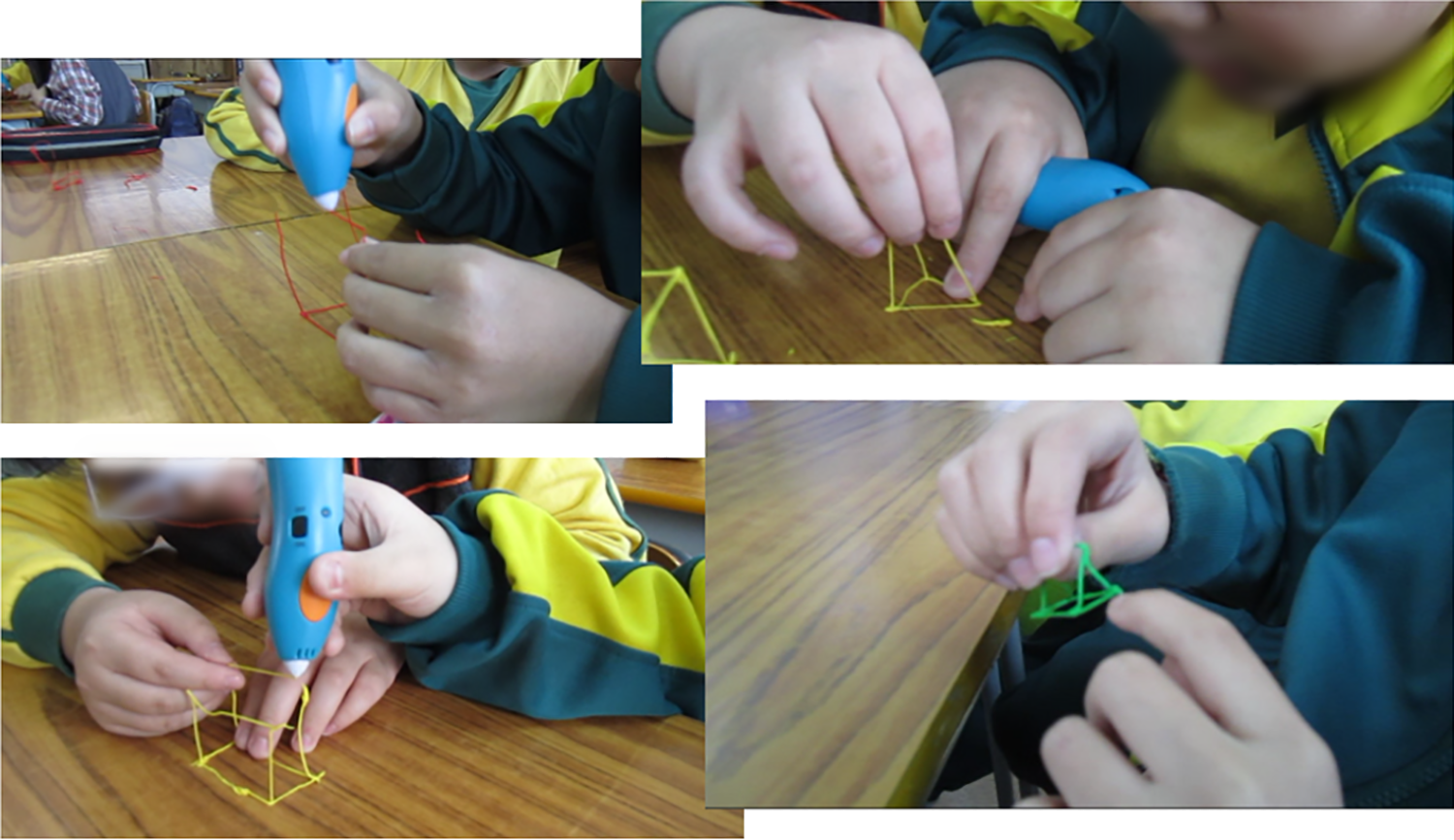
Constructing 3D shapes and exploring their properties.
In terms of mathematics learning, students developed a strong spatial sense through the designed constructionist activities. For example, a quantitative analysis with pretest and posttest design revealed that students could visualize the properties of prisms and pyramids with high accuracy and long-term retention (Ng et al., 2020). Qualitatively, it was observed that the students were engaged in the activities, and this included students with low motivation to learn and who were identified as weak in mathematics. This could be traced by the fact that constructionist learning was a personal, hands-on experience for the students, who could access the problem through multiple entry points (Ng & Ferrara, 2020). In this respect, the lessons provided low-floor, high-ceiling opportunities to learn about mathematical concepts.
Discussion and future directions
In the Fourth Industrial Revolution, with recent technological advances offering new avenues for mathematics learning, the future direction of mathematics education will depend on devising appropriate pedagogies to work with emergent technologies. This article discusses the transformational potential of constructionist learning in the context of mathematics classrooms, which also has implications for transdisciplinary STEM education. In particular, the authors have gathered insights into evidence-based practices of constructionist learning with 3D printing. Such learning environments enable students to learn abstract mathematical concepts physically through a playful medium (Papert, 1980) not limited to 3D printing. These results point to a three-fold characterization of constructionist learning in school mathematics (Figure 5) that: (1) it supports mathematics learning as hands-on and goal-oriented making, allowing learners to construct knowledge actively rather than receiving information passively (i.e., active learning via artifact construction); (2) aligns with transdisciplinary STEM learning because the 3D, tangible, and technologically enhanced nature of artifact constructions makes them applicable to real-world problems and projects, thereby helping to shape the learning experience of STE(A)M; (3) provides low-floor, high-ceiling learning opportunities to engage with mathematical ideas and to invent new ways to do mathematics without the constraints of paper and pencil (i.e., new tools for thinking).
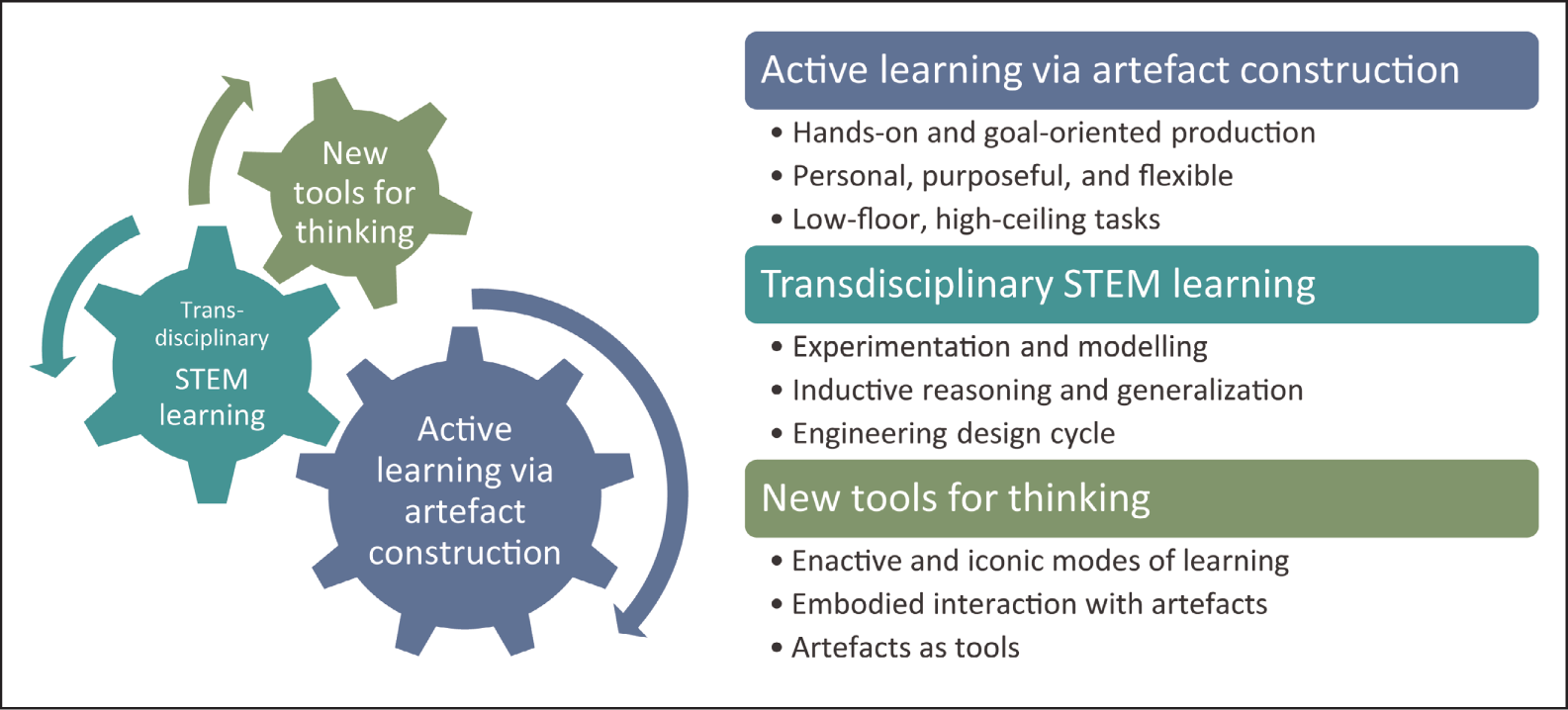
A three-fold characterization of constructionist learning in school mathematics.
As a result, more design-based classroom interventions are warranted to further investigate students’ constructionist learning in technological, hands-on, and innovation-oriented environments. This is because classroom-based interventions can potentially influence practice directly in naturalistic settings while advances in theory can resolve educational problems. In line with the design-based methodology, iterative cycles of lesson design, enactment, analysis, and redesign are proposed to be conducted jointly by the classroom teachers and researchers (Barab & Squire, 2004). This is a fruitful line of research that will advance the future of constructionist learning in school mathematics, as well as contribute to characterizing effective tool-based STEM learning tasks and documenting the potential growth of teachers’ constructionist pedagogical practices in mathematics classrooms.
Conclusion
Without a doubt, smart, artificial intelligence, and 3D printing technology cultivated by the Fourth Industrial Revolution can improve the efficiency of classroom operations. However, Roschelle (2006) cautions that while efficiency is an essential feature of technologies that successfully transform classrooms, another key characteristic of effective technology integration is that the innovation enhances learning in meaningful ways. Hence, in the case of 3D printing, it should be emphasized that 3D printing itself does not transform teaching and learning. While 3D printing may contribute to a paradigm shift that challenges a long-lasting tradition of teaching and learning in 2D modes (paper and pencil and the computer screen) and of curricular topics that render 3D concepts in 2D representations, it is ultimately the educators and stakeholders who will transform what and how mathematics is taught and learned through their pedagogies and curricula implementations.
Footnotes
Acknowledgments
The authors would like to thank the anonymous teachers and students who participated in the research.
Contributorship
The first author contributed to the design and implementation of the research and analysis of the results; both authors contributed to the writing of the manuscript.
Declaration of conflicting interests
The authors declared no potential conflicts of interest with respect to the research, authorship, and/or publication of this article.
Ethical statement
All original research procedures were conducted in line with the principles of research ethics as governed by the Survey and Behavioural Research Ethics Committee at the Chinese University of Hong Kong. The participants provided informed consent to participate in the study.
Funding
The authors disclosed receipt of the following financial support for the research, authorship, and/or publication of this article: This article is supported by the Research Grant Council of Hong Kong, Early Career Scheme (ECS Ref #24615919).
