




Abstract
Purpose:
Meeting “others,” especially so-called “local” students, is usually seen as a sign of success for intercultural learning and integration in research on study abroad and internationalization of higher education. Previous studies have focused on how international students themselves describe their (mis-)encounters. In this article, the authors consider lecturers’ voices about this phenomenon. Lecturers have an influence on the students’ experiences since they spend a lot of time together in and outside class.
Design/Approach/Methods:
Using a thematic analysis and social network analysis of interview data with lecturers, and a critical perspective toward the dichotomy of “local” versus “international” students, a university in Finland, a popular destination thanks to its positive image in global education, serves as a case study.
Findings:
The article identifies privileges, limits, and (missed) opportunities of encounters, as shared by the lecturers in focus group discussions. Furthermore, the lecturers created hierarchies in the way they described the encounters between different kinds of students. Some signs of pluralizing both local and international students were also found in some lecturers’ discourses.
Originality/Value:
The article ends with recommendations for institutions regarding the lecturers’ problematic role of gatekeepers in student encounters and the limiting categories used in institutions of higher education to refer to students.
Introduction
The more people I meet the happier I become.
Although internationalization of higher education is often presented as a typically contemporary phenomenon, discussions and research on the experiences of the homo peregrinus academicus go back centuries. As such, in Europe, the Ancient Greek historian Herodotus of Halicarnassus traveled extensively during his lifetime to study and do research (Lacarrière, 1997). Sophists and Socratics also traveled intensively since mobility was considered as one of the ideals of education (Verger, 1973, p. 15). It is also important to note that this was not just a “Western” phenomenon. At the birth of higher education in Europe, the very word university, from Latin Universitas, referred to people coming together from different parts of the world (Sallinen, 2003). Interestingly, each historical period has produced its own narrative about the experiences and expected outcomes of studying in another place. For example, at a Finnish university in the 17th century, 16 oratios and dissertatios (equivalent to PhD dissertations today) were written in Latin about international university traveling. The model of the Ars Apodemica of the time (“the art and methodology of travel”) described how student travelers should learn foreign languages; acquaint themselves with the arts, style, and elegance of different places; and practice diplomacy (Enenkel & de Jong, 2019). Papatsiba (2003) explains that the discourses in such documents contain many overlapping ideologies with the ones constructed today by, for example, the European Union about the benefits of study abroad and international education. One enduring ideology that she notes (Papatsiba, 2003) is the insistence on student travelers focusing and encountering so-called local people.
Today, study abroad is much more complex than in other historical periods. It can be long-term, short-term, organized, spontaneous, and so on (see Szarka, 2003). What is more, we can observe a shift from South to North, or East to West mobility, to South to South and West to East. Research on study abroad and internationalization has increased over the last decades, many and varied aspects of students’ experiences have been discussed and examined. In her review on interculturality in international education, Jackson (2018) notes the problems international students face as far as social and intercultural aspects are concerned during their time abroad: Encounters with “local” people are limited, see nonexistent (we refer to these as “mis-encounters”), while “cocooning” with conationals and other international students prevail. This has been confirmed by most studies around the world (see Tian et al., 2020).
This article has identified a gap in the literature on social and intercultural aspects of the study-abroad experience. As such, all the studies that we have consulted solely rely on the voices of international students themselves on these aspects. The perceptions and representations of other actors involved in their experiences are absent from global research. These include so-called local/domestic students, administrators, decision-makers, and lecturers. Using a Finnish university as a case study, we have collected data among some lecturers, whose influence on international students’ experiences is central. Our justification is based on the fact that international students—like all other students—spend most of their time sitting in lecture halls and working with lecturers. Lecturers have a privileged position to appreciate the encounters among the students. Furthermore, lecturers often have the power to decide on the (absence of) encounters that students have with each other in the learning activities inside or outside their lessons by, for example, mixing students or letting them choose their peers for tasks. This part of the narrative about their social and intercultural experiences is thus central in expanding our knowledge about the study-abroad experience. The Finnish context is interesting in this sense. It is becoming a popular destination for international students since the Nordic country of five million inhabitants is famous for its education focusing on autonomy and cooperation between, for example, students and educators. The fact that its nation branding emphasizes general happiness and well-being also attracts hundreds of new international students every year (Sahlberg, 2015). In addition, the number of English Medium Instruction of degree programs in Finland is high and increasing rapidly, and they are run alongside programs in the official languages of the Nordic country (Finnish and Swedish). The multiple use of languages in Finnish higher education can frame and influence the encounters among students.
Based on focus groups with lecturers at the chosen institution, during which they were presented, among others, with excerpts from international students’ voices about (mis-)encounters, the article provides some answers to the following questions:
Internationalization of higher education and (mis-)encounters
Research on (mis-)encounters and interactions in study abroad is plentiful
Research on encounters and interactions in the context of internationalization dates back from the 1970s. The hundreds of studies that were identified tend to classify international students as a monolith—regardless of their status as degree, exchange, or intern students—or focus on students from specific parts of the world/countries: Africans, Asians, Chinese, or Europeans (see, for example Baxter [2019] about Rwandan students). The examined contexts of interaction seem to be formal, within the university or campus (dormitories and/or canteens). Shively’s (2011) study about international students’ service encounters in Spain appears to be a rare exception.
Bochner et al.’s (1977) model of friendship formation of international students seems to have had an influence on the global research agenda of (mis-)encounters. Scholars tend to divide “friendship” into three categories: conational, host national, and multinational interactions (1977). Conational friendships have often been described as primary for international students, serving the purpose of, for example, providing a feeling of “cultural identity” and emotional support (e.g., Kim, 2001). Many scholars note, however, that such friendships reduce the “quality” of intercultural transformation (e.g., Jackson, 2015). The category of host national friendship is often preferred and desired by international students, although most scholars who have worked on this issue note that it is very difficult to achieve (e.g., Yu & Moskal, 2018). Host national friendships are often claimed to lead to intercultural awareness, social integration, and to adjustment to the “host society.” Several reasons have been identified for the lack of interaction with “local” people: language (Kudo & Simkin, 2003), discrimination and prejudices (Ballatore, 2015), and different social conditions (separate accommodations, different courses, etc.). The final category of multinational friendships contains other international students, with whom students study, live, and interact on a daily basis. This category is often represented as a “strong” societal category, which is described by means of metaphors such as the “bubble,” the “cruising ship” (Papatsiba, 2003).
Reading through the studies that have examined the students’ encounters, one notices that most scholars emphasize the importance of interactions and encounters with the “locals” (sometimes referred to as “domestic students” or “majority students”). Hendrickson et al. (2015) show, for example, that there is a correlation between having more host country friends and satisfaction, contentment, decreased homesickness, and social connectedness. As to why such encounters do not always materialize, working on the interaction patterns of European Erasmus students, Van Mol and Michielsen (2015) demonstrate that both institutional and group practices encourage or impede this kind of interaction.
Over the past decades, many studies have also examined how institutional interventions try to boost interactions between foreign students and “locals.” We review selected studies in what follows. In Australia, Nesdale and Todd (2000) study the influence of an intervention on local and international students living in halls of residence and taking part in, for example, joint flood-group activities. They note that domestic students’ intercultural competences increased through such encounters. In a similar vein, Pritchard and Skinner (2002) ask international students to carry out “existential tasks” with home students or local people. Their analysis shows that the students developed long-term friendships and their intercultural awareness. In a Korean study, Jon (2013) proposes a similar study but for the benefit of domestic students, within the context of internationalization at home. The author argues that the described intervention led to “a positive and indirect effect on their intercultural competence” (2013). Interestingly, a recent study by Goren (2020) examines how outgoing international students from Israel are “uncoupled” from discourses of global and intercultural competence when they are prepared for study abroad. In her analysis of a mandatory course developed by the Israeli Ministry of Education, she shows how the students are encouraged to meet locals for state benefits rather than developing their own intercultural competence and learning about other “cultures”—which she refers to as “commodification of international relationships” (2020).
Critiques of scholarship on international students’ (mis-)encounters
Scholarship on international students’ (mis-)encounters tends to draw very similar conclusions. Often limited to the students’ voices, urged to respond to “oriented” questions about (mis-)encounters (e.g., with a preference for encounters with “locals”), these studies tend to ignore the perspectives of those whom the students meet or, even, do not get to interact with.
Two papers, which are critical of the perspective that most scholars have had on international students’ (mis-)encounters, can also help us problematize (mis-)encounters. The first paper from 2017, written by Machart, discusses the pressures of adaptation and encounters with locals that Asian students often experience when they are abroad. Machart argues that this represents an “idealistic, utopian goal which can only lead to dillusionment (sic)” (2017, p. 126). He is critical at the same time of the culturalist/essentialist perspectives that such pressure entails, by constructing “two culturally opposed environments” (2017, p. 128). The second paper, published by Page and Chahboun (2019), is eye-opening in terms of the ideologies that are contained in the hierarchy of others that have been created by previous research: conationals, host nationals, and multinationals. The authors start by critiquing the loose and somewhat unfounded argument that “a more international campus will engender cross-cultural skills” and that the lack of local–foreigner interaction is seen as a problem (2019, p. 871). They add that these ideologies, which often translate “the social connections valued by policy makers,” disregard the students’ own experiences and goals, which might not correspond to these ideologies (2019, p. 871). However, Page and Chahboun (2019, p. 876) note that some research, which makes the students’ reflexive and critical voices heard on these questions, is now more nuanced and question the hierarchy between desired encounters.
To conclude this review of the literature on issues of international students’ (mis-)encounters, we believe that a different path to these issues represents an important addition to the field. As such, a path of “non-discriminatory research” practices, whereby categories of research participants and foci are questioned, should be explored. For example, although the categories “international” and “local” students are used as administrative labels by institutions, we believe that they represent methodological biases, which blind us, especially when they are associated with ideological devices such as interculturality and encounters.
As scholars, we need to beware of the categories that we create regarding research participants when we plan research, collect data, and analyze them and of the injustice that goes with these processes. For example, in the dichotomy of local versus international students, there is a tendency to lump together many different kinds of individuals, who have different identities and who represent different cases of “locality” and “internationality.” For instance, “locals” can also be binationals, “naturalized” individuals, which makes them fall out of this “neat” category. Behind these somewhat problematic labels also lays a hierarchy of wish for the Other, which could be considered discriminatory and ethically dubious (e.g., students must focus on and meet local people and avoid conationals).
Another element of critique relates to the ideologies that permeate international education research, practice, and policy in terms of what is “good,” “acceptable,” “bad,” and “objectionable.” In the studies that we reviewed, one could see at times the scholars’ subjectivity appears in the way they discussed the lack of interaction between nationals and international students (e.g., in the use of words such as “failure,” “disturbing,” or “fruitful to meet”). For example, spending time with conationals is often judged as counterproductive and going against intercultural learning—maybe to use a Kristevan metaphor (Kristeva, 1996): They are seen as mere “anti-depressants,” as dangers. Scientifically, these are ideological positionings turned into “ready-to-think” (Dervin, 2016). What is more they represent unfair judgment of students, who should have the freedom to meet who they wish to meet, and not make them feel guilty by telling them that they are failures for not meeting the people the system “fantasises” them to meet.
As far as the notion of interculturality is concerned, it is clear in the studies that we have reviewed that the authors’ ideological position toward this notion relates mostly to that of cultural difference. This view of interculturality, which ignores potential similarity and especially the continuum of difference–similarity, mixing and mélange, is an ideological position that needs to be positioned as such and not as the “truth” (Abdallah-Pretceille, 2004).
There is also a contradiction that scholars need to bear in mind when they research the issues of adaption and (mis-)encounters. The conditions behind these elements are rarely met in universities. International students often find themselves in the position of marginals and/or outsiders because of the conditions that are prepared for them (separate lodgings, different courses, tourist activities organized especially for them, etc.). How to expect encounters with, for example, the locals when their paths do not cross?
Treating international students beyond the international?
Based on these critiques, which remind us that the issue of adaptation and (mis-)encounters in study abroad is first and foremost based on political beliefs and ideologies of preferred social interaction and encounters, in what follows, we examine Finnish lecturers’ representations and discourses about international students’ (mis-)encounters. Although the focus of the study was the specific category of international students, in the analysis we are interested in the ways the lecturers talk about international students’ social interactions and (mis-)encounters against the continuum of difference and similarity in relation to other types of students in the institution (e.g., “local” students). Like all other students, we treat international students first and foremost as “strangers” who have joined an institution and have to study, live, and work with other “strangers.” The sociology of the stranger has a long history, dating back to the early 20th century with the work of Simmel’s Der Fremde (1908/1950) as a milestone. It is not our goal here to review this literature but just to highlight some of the points that can help us justify our departing from the usual approach in international education of dichotomizing people according to their belonging (national/international). For Simmel (1908/1950) and other sociologists of the stranger like Park (1928), the stranger was not the foreigner only, but the one who came from another place and represented an “oddity.” That stranger came and went, entered and exited, they were close by and also far. The stranger represented such types as the immigrant, the newly arrived, the emancipated Jew, the cosmopolite, racial hybrids, and the city man (Park, 1928). When one thinks of a complex educational institution such as a university, one can easily understand that many different kinds of “strangers” join the university community: people from other cities, towns, the countryside; people from other city districts in the city where the campus is located; people with various social, cultural, economic, and/or intercultural capitals; different genders; different generations; and so on. This means that any member of a university is a potential stranger, who has to negotiate membership, identities, interactions, and (mis-)encounters. Bauman (1997, p. 25) summarizes this well when he writes: “the differences between the normal and the abnormal, the expectable and the unexpected, the ordinary and the bizarre, domesticated and wild are blurred, as are those between the familiar and the strange, ‘us’ and the strangers.” Therefore, by examining what happens to individuals in a university when they meet others, beyond the usual categories of international and local people, we disrupt a system of classification and understanding that needs renewing. The ways lecturers construct, express, and negotiate international students’ (mis-)encounters in the institution under review, while discussing other “strangers,” might help us identify new research perspectives.
Methodology
Focus group discussions (FGDs) were selected for this study to provide insights to understand and determine the lecturers’ ideologies about (mis-)encounters of students in higher educator. For Althusser (2001, p. 45), “Man (sic) is an ideological animal by nature.” Through a regime of discourses, images, and ideas in which people grow up, live, think, interact, and create, ideologies become the “obvious” and are taken for granted—although they represent illusions on reality (Althusser, 2001). Ideologies are created, processed, and spread by various institutions such as families, courts, schools, advertising companies, (social) media, and supranational organizations. By analyzing what lecturers have to say about students’ (mis-)encounters, we expect many ideological positions to emerge.
We chose FGDs to collect data since they can allow us to explore a particular issue or a set of issues by having participants negotiate meanings, create new meanings, and generate diversities as well as consensus of opinions (Marková et al., 2007). In FGDs, participants can interrupt each other, finish each other’s sentences, play roles, get angry, tell stories, crack jokes, or even sing (Salazar Orvig & Grossen, 2004, p. 267). Confrontation of ideas, polemics, multidialogues, but also unexpectedness, can also occur. This makes FGDs very suitable for collecting data on the complex issue of representations of (mis-)encounters in study abroad.
Participants and data
One of us served as the focus group facilitator and invited all the students from “two generations” of an international bachelor’s (IB) program and all their lecturers to participate in separate FGDs.
A total of about 20 lecturers from different disciplines (e.g., engineering, Finnish as a second language, mathematics, and physics) are involved in international programs at the specific university where the data were collected. We were able to attract 11 lecturers, divided into three FGDs. They were all Finnish nationals who had taught on the IB program offered at the institution under review. Each FGD took approximately one hour and were transcribed verbatim. They were all teaching courses that were compulsory or elective for the IB students. Some of the courses in the IB program were designed to be taught exclusively for them. In addition, other courses could be joined by other types of students (local and foreign exchange students). In the university where this study took place, there is only one English bachelor’s program while other bachelor’s studies are offered in the Finnish language.
The goals of the FGDs were explained to the participants. They were informed that their students from the IB program had participated in similar FGDs. From the FGDs of 16 students from the IB program, diverse ideas about the pedagogical practices and (mis-)encounters between students and their lecturers were selected as material to be shown to the lecturers during their FGDs. By presenting the lecturers with the students’ voices, we wanted to confront them directly with their perspectives to stimulate conversations about (mis-)encounters. The lecturers were divided into small groups and asked to watch a short video about pedagogical practices in international communication produced by the British Council in 2013. The lecturers then discussed the information from the video, in relation to their own experience teaching in the IB program.
In the second part of the FGDs, the lecturers were given a sheet with different perspectives about teaching–learning perspectives taken from the IB students’ FGDs. The lecturers discussed these perspectives and their own ideas related to the topics mentioned on the sheet. Figure 1 presents the procedure of the focus groups and the data taken for this study.
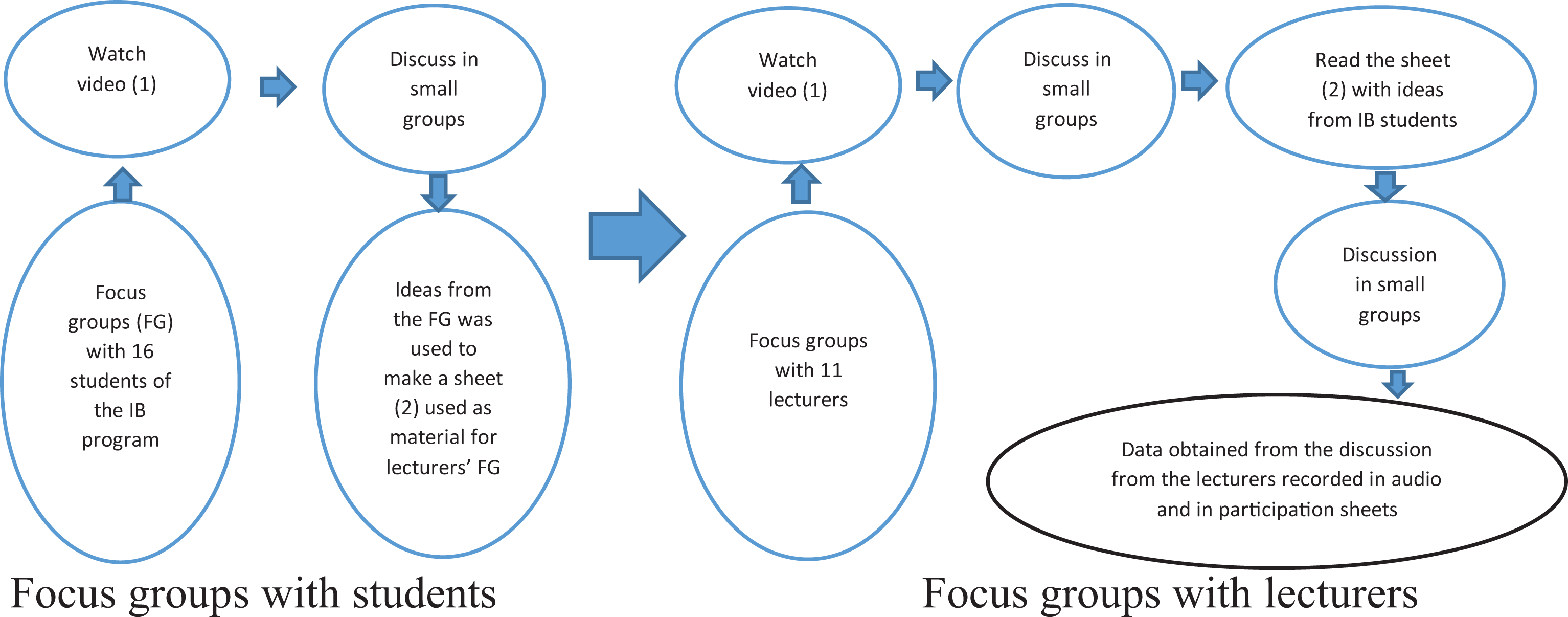
Details about FGDs. Note. FGDs = focus group discussions.
Analytical perspectives: Thematic and social network analysis (SNA)
The FGDs were conducted in English. The data from the recordings of the FGDs and the information in the sheets were analyzed through both thematic analysis and SNA.
A thematic analysis allows the identification of themes based on the patterns found in the data (Braun & Clarke, 2006). An inductive analysis approach was used to analyze the data, which intends to code the data without trying to fit it into a preexisting coding frame (Braun & Clarke, 2006, p. 10).
SNA appeared to be an interesting way of examining the lecturers’ representations and construction of their students’ (mis-)encounters. The idea of social networks is often associated with the online interaction of people through social networking sites/applications. However, social networks are the structures in which people can create opportunities to access information, jobs, material goods or services through their interactions (Haythornthwaite & de Laat, 2010).
A social network is defined by Quardokus and Henderson (2015) as the sum of all relational connections among individuals. The elements that construct a social network are the actors or nodes and their connections within the network known as dyads (Haythornthwaite & de Laat, 2010). Haythornthwaite and de Laat (2010) argue that the actors are usually (among others) people, organizations, and different collectives. The network types can be unipartite, consisting of the same kind of actor, or monopartite, with varying forms of actors (Grunspan et al., 2014). The actors are connected through attributes and ties. The attributes consist of the measurement of the characteristics of the actors (Brewe et al., 2012). Ties can be formed by all the interactions, transactions, communication, and collaboration they have in the network (Haythornthwaite, 2011). The strength of a tie is a combination of the frequency and level of intimacy and reciprocal services that actors have during their interactions (Granovetter, 1973). A tie is considered weak when the interaction is incidental, not frequent, neither important, and it is considered strong when the tie is based on various types of interactions, reciprocity, and self-disclosure in the relationship.
SNA involves the use and application of specific perspectives, methods, techniques, and vocabulary to study social relationships and structures (Haythornthwaite, 2011). Although SNA is usually approached through a quantitatively orientated approach, the qualitative-orientated approach has a long tradition in SNA (Heath et al., 2009). SNA can allow us to analyze the lecturers’ FGDs against the interests of actors to interact and the path of encounters that they have at their disposal (Löblich & Pfaff-Rüdiger, 2011).
SNA allows researchers to identify how individuals can combine and function in a group and how social ties and possible subdivisions of a given group have an influence on behavior (Wasserman & Faust, 1994). SNA has been used to understand different phenomena in higher education such as the role of social networks in student commitment and retention (Zwolak et al., 2018), student engagement on campus and friendship formation (McFaul, 2016), and the development of undergraduate science education (Quardokus & Henderson, 2015).
SNA studies an individual’s social environment to understand whether it has an effect on influence processes such as choosing a professional path. In addition, SNA looks at how the social environment influences leveraging processes such as finding a job through the connections an individual has with other powerful actors in the network (Borgatti et al., 2009). These authors maintain that one of the most important goals of SNA is to create graph-theoretic properties that distinguish positions and dyadic properties that display the cohesion and connectedness of the structures. These graph-theoretic properties allow scientists to identify the opportunities of actors to come into contact and how their position in the network determines the opportunities and constraints they face to encounter each other.
Finally, SNA puts an emphasis on understanding how relational behavior is created instead of looking at aggregate behavior (Haythornthwaite, 2011). The networks can also vary based on the nature of ties. If it is bidirectional, the directionality is inherently linked to the essence of the interaction. In the case of students in a course where all the students are together, the ties are referred to as undirected. If the relationship between actors is based on the perception of one another, it is considered a directed network (Grunspan et al., 2014).
Some words about how networks were identified and analyzed are provided here. Networks are drawn because they represent social network pictures that are an important aspect of SNA (Haythornthwaite & de Laat, 2010). Modeling a social network may be done by using dots or nodes that intend to represent the actors and lines to connect them to represent the ties between them (Dempwolf & Lyles, 2012). All the nodes and ties represent a network structure (Wasserman & Faust, 1994). The ties between two of the actors and their ties represent the most simple dyad, and it is possible to measure the structure of the networks from the point of view of one single actor, which is known as the ego. When this perspective is taken, all the other actors that are connected to the ego are known as alters (Dempwolf & Lyles, 2012). According to Burt (2009), the absence of a tie between two actors in the network is known as a structural hole. The absence of structural holes around an actor means that the contacts of an actor are bound together and they can communicate and coordinate, which, in consequence, gives them power to negotiate among them and with other actors (Borgatti et al., 2009). Borgatti et al. (2009) also state that the presence of several structural holes represents the lack of connectedness among actors, which excludes them from the benefits of being part of the network such as being able to deal with each other and have bargaining power.
SNA measures are often used to evaluate a group’s or an individual’s centrality in the network (Otte & Rousseau, 2002). Betweenness is defined as the importance that a given actor has in the network based on their position between two other actors (Freeman, 1977). Betweenness centrality is usually defined as the measure of how much other actors depend on a specific actor (Brandes et al., 2016). Actors who have high betweenness in the network are named as gatekeepers or brokers because they control the access that other actors have to information and resources in the network (Lipponen et al., 2003).
A final central principle in SNA is homophily, which is the contact between similar people that happens more often than among people who are different (McPherson et al., 2001). This principle implies that the more differences in terms of social characteristics, the more network distance will occur between individuals (McPherson et al., 2001).
Results
The analytical section of the article is composed of two main sections. By means of an SNA, the first section examines privileges, limits, and opportunities of encounters, as constructed by the lecturers in the FGDs. Their privileged position is exposed as well as structural holes and missed opportunities. The second section is based on an examination of the creation of hierarchies of encounters and of the way some lecturers manage to “pluralize” both local and international students.
SNA: Privileges, limits, and (missed) opportunities
Privileged position of the lecturers as observers of the network
We used SNA to investigate the lecturers’ perceptions and ideological positions about students’ (mis-)encounters. Different actors are considered in what the lecturers discussed: international, domestic, and exchange students as well as the lecturers themselves (Haythornthwaite & de Laat, 2010). We kept the terms used by the lecturers to refer to the actors such as “international” and “Finnish” students. The lecturers described different encounters among students and between students and the lecturers. Although not all the 11 lecturers described the same type and depth of (mis-)encounters, they did not contradict each other’s information about which actors meet in the network. Figure 2 describes the full network between all the different actors, as constructed by the lecturers during the FGDs.
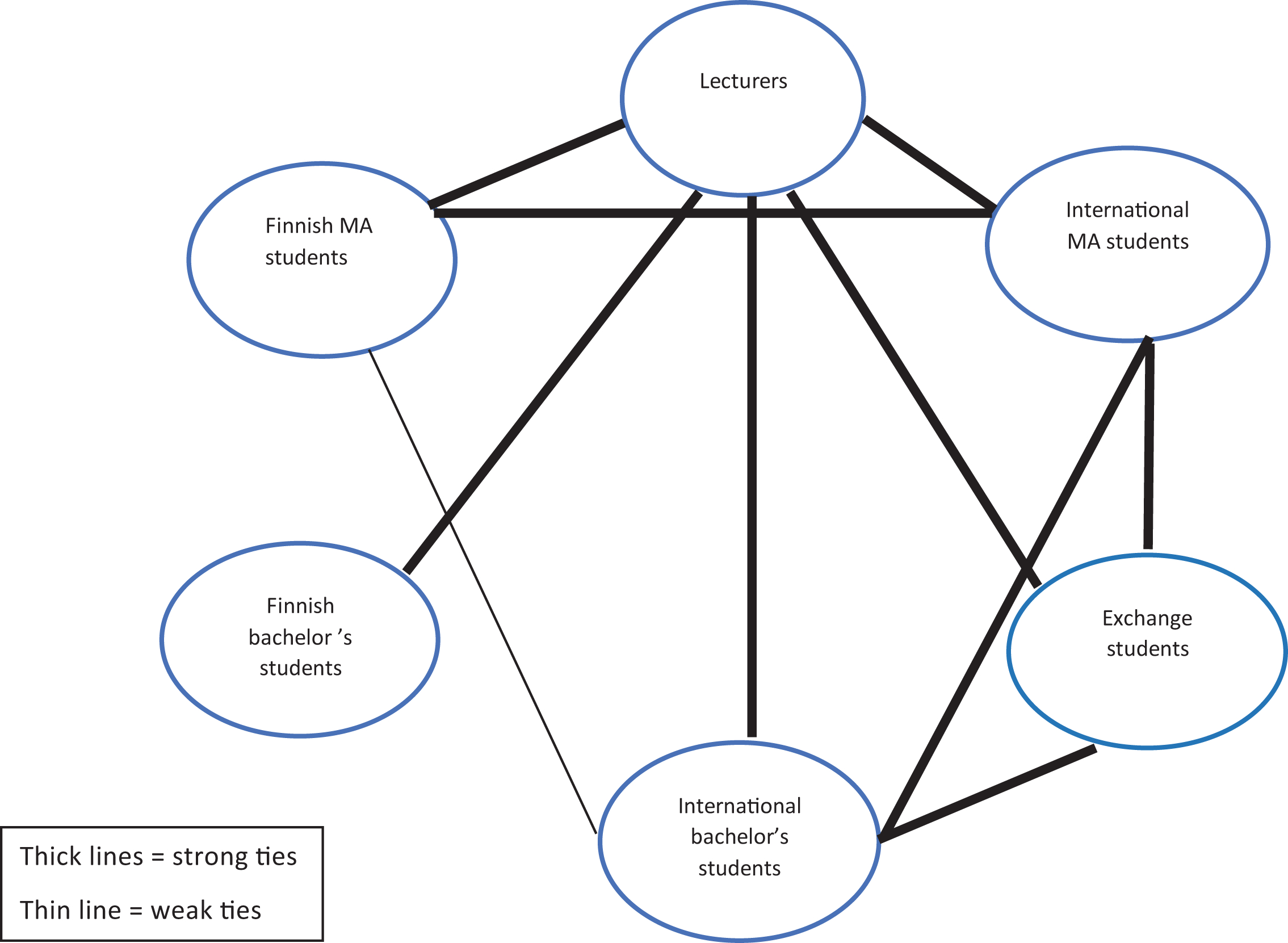
Description of the full network between lecturers, international bachelor’s and master’s students, as well as domestic bachelor’s and MA students with weak and strong ties.
The strength of the ties (Haythornthwaite, 2011) in the network was based on required or accidental, as well as frequent or infrequent encounters in the courses students attended. Although the strength of the ties considers the perceived importance and quality of the interactions among students inside and outside the classroom, we decided to define the boundaries of our network in the (mis-)encounters the actors have in both the courses and the project teamwork that they need to do as part of their studies. We believe that it is more important to visualize the paths of encounters that are stable among the actors.
The strong ties are represented with a thick black line and the weak ties (Granovetter, 1973) with a thin black line in Figure 1. These ties are based on the information shared by several lecturers about the encounters between IB’s, international master’s, and domestic bachelor’s and master’s students among them and with their lecturers. As an example, in relation to the way we set the strength of the ties, let us consider the excerpt 1 below:
Yeah, I see those kinds of international…these bachelor students…they have been explained everything in the beginning…
They follow our path (laughing). You know what I meant.
Yeah, I notice that problem because we also have this Lab which are compulsory in these courses and actually because we have four one-period courses, they are maybe exchange students who come to the course…
Lecturer 3 mentions that the encounters between IB and exchange students in the Lab are frequent and required because attendance is compulsory, which makes the ties strong. Other lecturers also mention these types of interactions in courses such as Finnish as a second language where attendance is often compulsory. This excerpt presents an example of a “weak” tie:
But then again I have had some difficulties because we have most of the students are from the English bachelor program and they are good students and then I have like one third of other programs.
exchange students…
…exchange students and there are also some master students that come from ammatikorkeakoulu [Finnish word for University of Applied Sciences] it is kind of really difficult, because one third they don’t have the skills necessary for the course…
We categorized this tie as weak in Figure 1 because the lecturer mentions that the presence of these master’s students was not frequent because only a small percentage of these students participated in his course. At the time of the collection of the data, the university where this study took place had recently started allowing students from the polytechnic university to take courses from its programs. This might be a reason why their presence in courses of this university was not frequent. We deduced that this lecturer referred to “Finnish” master’s students, because previously in the FGD, he had identified the international students through their foreign nationality or their status as international or exchange students. Finally, this lecturer described the lack of necessary skills of these master’s students for the course, which affects negatively the reciprocity of mutual learning between them and the IB students.
The attributes (Brewe et al., 2012) are the characteristics described by the lecturers in an explicit or implicit way such as age, level of studies, skills, and nationality. This excerpt presents an example of how we obtained the attributes of the actors in the network:
And also those bachelor students, we meet them in the first week they are…they come here…to get more acquainted to us…so…
The lecturer is a human too.
Yeah, yeah, but if you are an exchange student, you don’t know.
Yeah and the exchange students is fifty percent studying and fifty percent having a year of fun time and then go and back to their university…
Lecturer 2 describes the differences between students based on their belonging to the IB or exchange programs. This lecturer also argues that exchange students are just “passing” in this university, which gives them, in a sense, less value in comparison with the undergraduate (international) students.
Table 1 summarizes the attributes and ties among the actors in the network as identified in the FGDs.
Description of the actors, attributes, and strength of ties of the actors according to the perception in the lecturers’ focus groups.
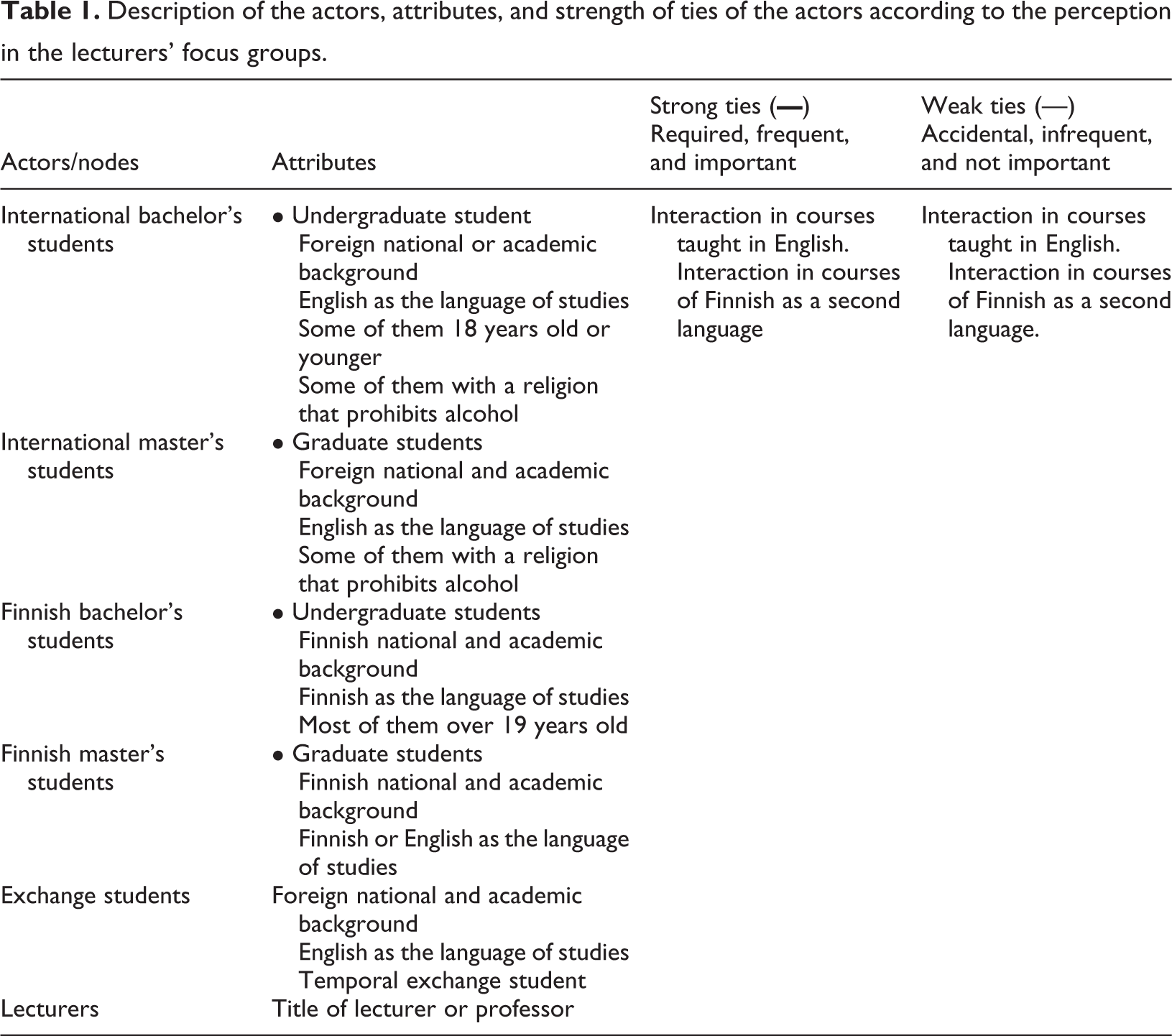
Figure 2 shows that lecturers might be the only actors with ties to all the other actors in the network. The frequent encounters that they have with different kinds of students in their courses allow them to see and evaluate the quality of (mis-)encounters among the students. The FGDs describe a monopartite network (Grunspan et al., 2014) where the students have different attributes such as having a graduate, undergraduate, or exchange status.
The lecturers’ discussions about (mis-)encounters among students and with them might have been caused by the position of betweenness (Freeman, 1977) that they have in the network. This position of high betweenness (Lipponen et al., 2003), the centrality of the lecturers, is that they are the closest actors in the paths between the different categories of students that they describe. This position gives the lecturers a broad perspective on the (missed) opportunities that students and lecturers have to meet in the network. This somewhat privileged position of observing (mis-)encounters is clear in Excerpt 4:
I don’t know if they have anything, do they have anything in common with studies with Finnish students?
Not much really.
So…this is…this…ok…these courses are also open for Finns (bachelor’s students) and they can use them as an alternative for the Finnish course, but I am afraid that most of the Finns (bachelor’s students) don’t select that. And seems this is quite new and I am afraid they are only them and perhaps some exchange students taking part of these courses. So, that is on bachelor’s level, but in Master’s level because we don’t have the Finnish equivalents, that’s completely different, then they have to mix them somewhat.
Lecturers point out the lack of contact between Finnish and IB bachelor’s students as a consequence of having access to equivalent courses in English and in Finnish. Furthermore, the international and domestic master’s students do not take the IB courses or domestic programs as their courses are not adequate for their level of studies. The only course where the students of the IB program and the international master’s programs can interact with each other and meet is in the Finnish as a second language course. As described in Excerpt 4, exchange students are the only actors who get to meet IB students in, for example, the compulsory courses (see Table 1).
Structural holes and missed opportunities
Another characteristic of the network as perceived by the lecturers in Table 1 is that of an undirected network (Grunspan et al., 2014). Although it is difficult to categorize the density of the social network without comparing it with another one (Grunspan et al., 2014), it is possible to notice that the distribution of the dyads is uneven among the actors. The opportunity for encounters is considerably less for the “Finnish” bachelor’s students and the “international” bachelor’s students than for those in the master’s programs and the lecturers.
There are several structural holes in the social network. The actor who has more constraints to have encounters with other students are the Finnish bachelor’s students. In Figure 3, it is possible to see that they do not have ties with domestic master’s, international master’s, or IB students in the network.
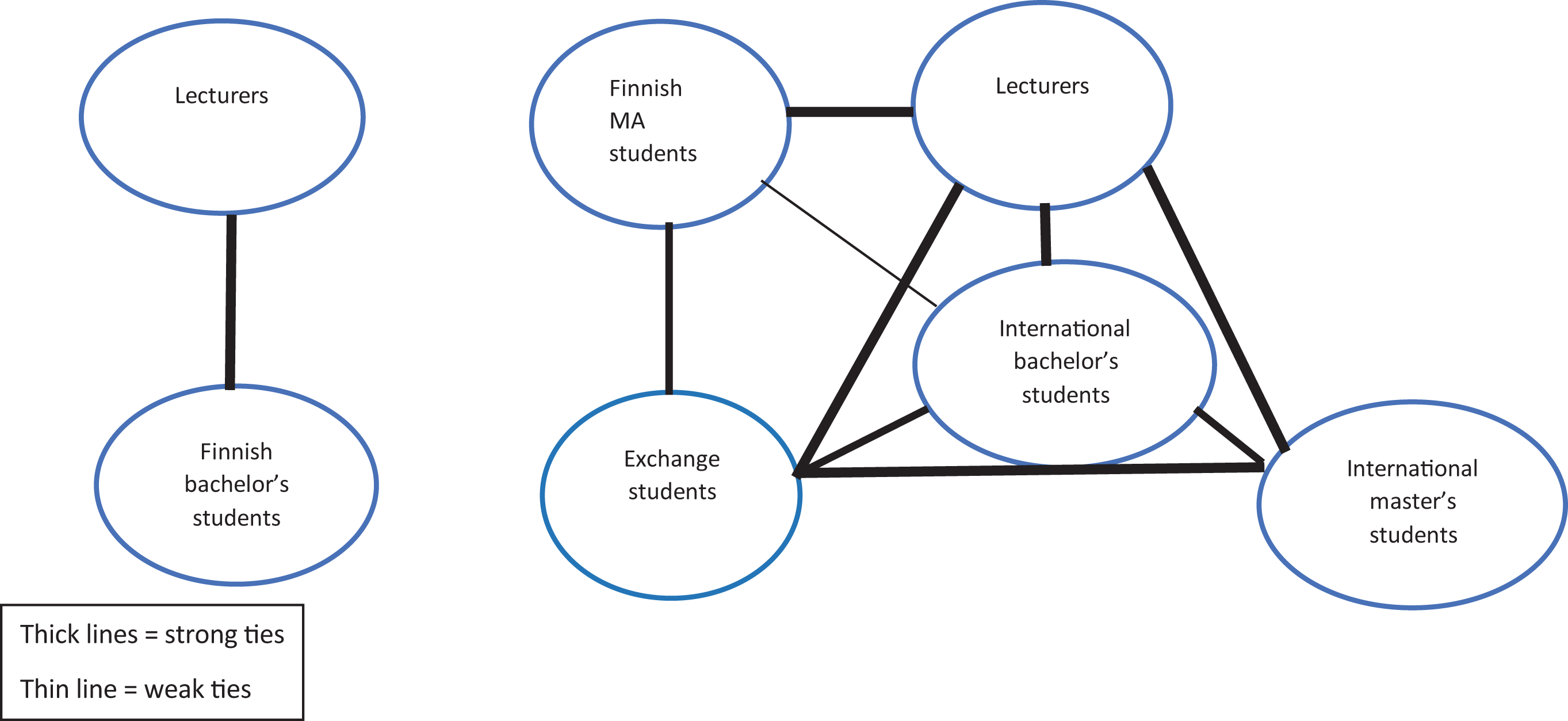
Visualization of the ego social networks of the domestic bachelor’s program and the international bachelor’s program.
The reason provided by the lecturers is that the only attribute that domestic bachelor’s and domestic master’s students share is the same nationality as well as one of their language of studies (Finnish). Surprisingly, the IB students have less structural holes and strong ties with both exchange and international master’s students. The reason is that they share attributes such as language of studies and compulsory as well as second language courses. The phenomenon of similar actors encountering with more frequency in the network is known as homophily (McPherson et al., 2001).
It is important to mention that each generation of students in the IB program consists of around 20 students, while the number of students in the domestic bachelor’s program in the same field is around 100 students. The amount of students opens up the possibility for domestic students to have access to more people in their program than for the IB students in their own—the only English bachelor’s program in the whole university.
The top half of Figure 2 shows that the lecturers accumulate the most dyads in the network, which gives them the function of gatekeepers (Lipponen et al., 2003). This position as gatekeepers provides them with the function to facilitate, create, or eliminate the possibility for encounters within the network. Lecturer 4, who teaches Finnish as a second language, talks about IB students in what follows:
So, I have met them in small groups, but so far they haven’t been in my Finnish groups. But my colleagues say…who have been teaching them…that they really noticed that they are so young, they are much more childish than the others and it is also disturbing the other students a little bit. It happens in the autumn during the academic year they grow. So, that in the spring they kind of behave the way they supposed to behave. But that is one reason we are planning to have them in one group next autumn. So that they will have their own Finnish group. There are no others, so there is…we can do it in a different way.
The ties between IB students and the other actors in Finnish as a second language classes are strong because interaction is required and frequent in the classroom as a consequence of the compulsory attendance. Nevertheless, lecturers criticize the quality of their interactions: The IB students’ behavior is seen as childish and disturbing, especially at the beginning of the program. For the lecturers, it seems that the IB students are “strangers,” “oddities” that enter the network (Park, 1928). They are close physically with other students in the classroom, but also far away from each other as a consequence of their different behaviors. In the eyes of Lecturer 4, the best way to recuperate some form of “equilibrium” is to segregate the IB students in their own group. The creation of this exclusive group demonstrates the power of lecturers to function as gatekeepers who can eliminate opportunities to encounter among the actors in the network.
The creation of the exclusive group of Finnish as a second language contracted considerably the ties of the IB students. Figure 4 represents the social networks of IB students before and after the creation of the exclusive class. It is possible to observe that the encounters between IB and IM students are not possible anymore in their courses, and it reduces the contacts with exchange students. This contraction of the network of the IB students illustrates well how quickly the path for encounters can change for students in these programs.
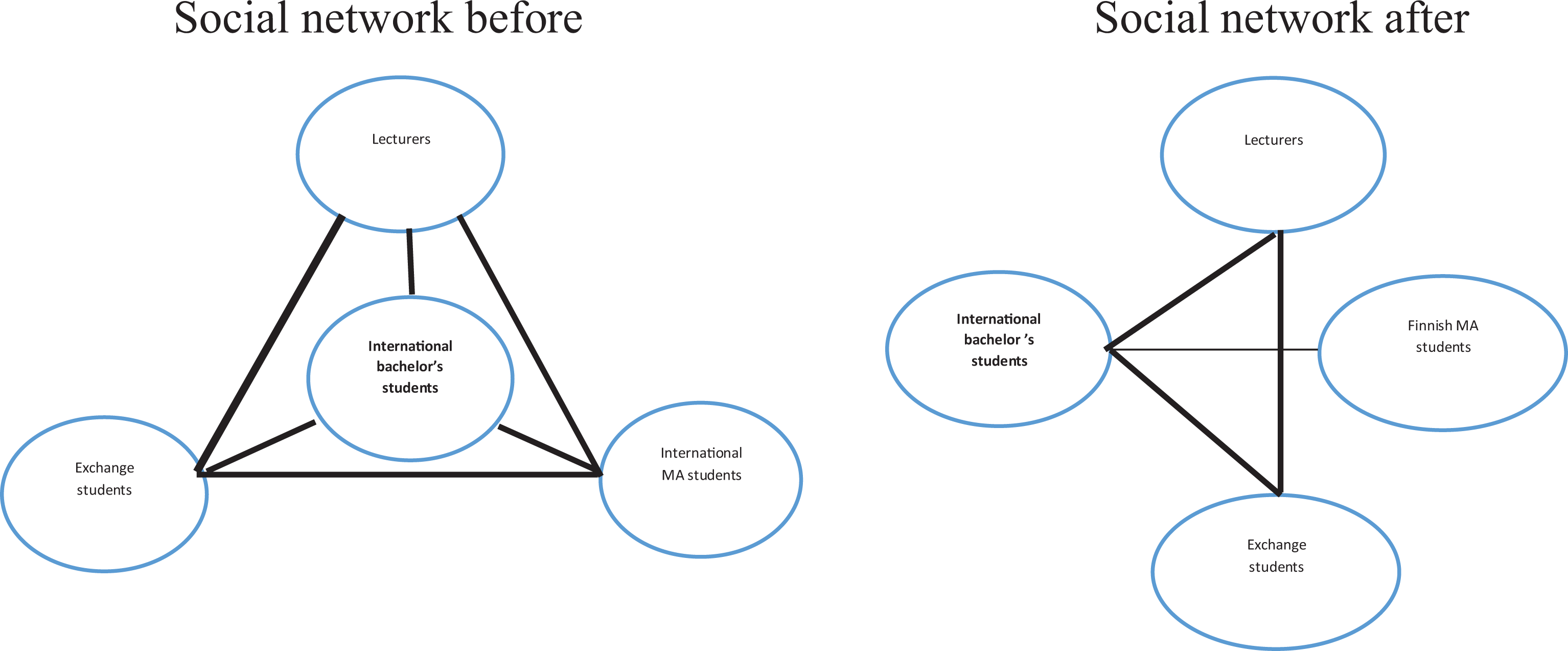
Strong ties of the ego social network (left) before and (right) after the creation of their own Finnish L2 course group.
From hierarchies to plural perceptions of students
Hierarchizing encounters
As asserted on several occasions in this article, the current dominant ideology about (mis-)encounters in the internationalization of higher education is that the sojourners should meet and spend time with people from the host society (Papatsiba, 2003). This ideology seems to be shared by the lecturers and can be seen in the excerpt below:
I don’t know how they integrate it among like the Finnish bachelor students.
(…)
There is pure Finnish students also in those international…?
Oh yes, there are a couple of Finnish students in that group.
Yeah, yeah.
I still think that they are quite in their own group. They are not mixing with others. (…)
The lecturers’ discourses in this excerpt also reflect the dominant discourse in the literature that values more encounters between domestic and international students, with the idea that these can lead to social integration and adjustment to the “host society” (e.g., Jackson, 2015). Lecturer 2 points out that the presence of a few Finnish students in the IB program (whom he referred to as “pure Finnish students”) does not solve the perceived “problem” of a lack of integration of IB students in the academic and social environment as a result of their mis-encounters.
Another common discourse in the lecturers’ FGDs is about the lesser value represented by encounters among conational students:
I am just thinking from the master people, that people of the same origin tend to collect together. So if you have people from Bangladesh, they go about and form the group. And if you have two people from Nepal, they are on the same group. So, they find each other and the…I think it is probably that they can use their native language within discussion and they just try to report in English but when they mix they have to use English all the time. So the question is should we…force mixing of nationalities?
In this excerpt, the lecturer questions the value of conational students being together (expressed as “collect together” in the excerpt) and the possibility that separating them is a “solution” to his perceived problem of the students not using English in class. The lecturer’s point of view corresponds with the literature where social connection among conationals is not as valued by, for example, policymakers as social connections between domestic and local students (Page & Chahboun, 2019). As Page and Chahboun (2019) note, the absence of contact between domestic and international students is seen as a “problem.” In this case, the lecturer sees a challenge in the collaboration of students who are conationals because they do not use English for performing the task he has set for them. The proposal of the lecturer of mixing nationalities for groupwork seems to be permeated with the ideology that encounters with multinationals’ students are preferred over encounters of students who are conationals.
It is important to note, however, that the lecturers do not always share the same views about how to deal with encounters among students. The following lecturers reflect on potential solutions to a class encounter between two international students that they perceive as “unproductive”:
Yeah, for example you know that X (international) student and Y (international) student, they are always working in pairs and I think Y cannot speak English so well than X and then it is always like X just talking and Y is just there. But of course, maybe they do the work, sometimes I think that sometimes it would be good to separate this pair and they both learn to work like individual, but…
Maybe it would be possible to solution to somehow to randomize the groups. I don’t know. I will be at the door and “you go there and you go there.”
In this excerpt, Lecturer 2 points out that he sees as “inadequate” the collaboration between two students because of the difference in their English speaking language skills—leading implicitly to one student doing all the work. The lecturer considers the possibility that limiting their encounters and making them work individually would be a better option. If the lecturer took this action, these students would be denied access to the resource of their collaboration—and maybe friendship?
A related situation with encounters that are not desired by students is reported by Lecturer 1 in group 3: “I have tried to do it a bit differently, but they are so fixed in their group they prefer working that when I tried to mix them, it was a painful process for me and for the students.” This lecturer described how giving opportunities for students to interact with other students is not desired by the students. Interacting with new actors in the network requires not only the opportunities to meet in the network, but also the willingness to negotiate successfully our interactions among new actors in the network.
When local and international students are seen as plural
The students from undergraduate, graduate, international, and domestic programs are individuals who have some similar but also different experiences, nationalities, mother tongue(s), intercultural capitals, and other elements that compose their own unique identity (Jackson, 2018). The categories of “international,” “foreign,” “Finnish,” and “local” students do not represent the diverse identities they have individually or as a group. As an example, the IB student participants in this study represent cases of “locality” and “internationality.” Some of these students are binationals with, for example, Finnish and Russian nationalities. Other students were born in China but educated in China and the United States before moving to Finland. It is necessary to complexify the ways we describe these individuals.
In their FGDs, some of the lecturers are able to shift ideological perspectives in relation to (mis-)encounters. One such case is that of characterizing Finnish students. The diversity of the students in domestic programs who are categorized as “Finnish” have also diverse experiences, have crossed different academic cultures and other complex elements that are part of their identity. This diversity is perceived in some of the lecturers’ discourses:
Some of the Finnish students are “Teitittele” [using a formal form of address in Finnish, a formal ‘you’] especially in writing?
Yeah, I noticed that they “teitittele” when they come from the army. They come to the office exactly as they come to the army, how they teach there, but they get over it very fast.
I guess it is just playing safe.
Yeah, of course there are differences between inside the school like “Teollisuus talot” (Industrial department)…is it? I hope that none of you is from there (laughing). They are pretty formal…Where are you from?
(…)
Ok, we are safe! (laughing). They are pretty formal in there, I understand you have to knock in and go in. But I guess they try to teach because in the business world you have to have some formalities.
In this excerpt, Lecturer 1 describes the formality of some Finnish students when they engage with the lecturers. He points out that this formality is a consequence of the recent experience of the students in the army, which is compulsory for men in Finland. Lecturer 2 adds that students from certain schools use more formal forms of address than other domestic students (e.g., subjects related to the “business world”). The diversities of formality and politeness for these lecturers are the result of their experiences outside the university and the academic formal culture in some specific departments and fields of expertise.
As far as heterogeneity from within groups is concerned, we note that one of the lecturers writes down during the FGDs the following: “There are not just Finns and the others but great differences within the international students. Hard to take everything into consideration.”
Discussion and conclusion
Studying in another country has often been placed within discussions of interculturality and integration. Meeting “others,” especially so-called local students during a study abroad experience, is usually seen as a sign of success for both phenomena.
In this article, our focus was on how key figures in internationalization of higher education, that is, lecturers, perceive and construct international students’ (mis-)encounters. Previous research has examined solely the voice of international students themselves. The discussions between the Finnish lecturers in FGDs seem to correspond to the dominant ideologies about the somewhat monolithic view of international versus domestic students in higher education. The domestic students are seen as a homogenous group who have similar experiences and characteristics that construct their unique identities. Although some lecturers are able to see some of the similarities and differences among some of them, differences within this group are seen as inferior qualities that need to be overcome to fit the standardized image of the “Finnish” student. The domestic students’ diverse experiences, academic culture, regionalism, or even binationalism are overshadowed by their similarities in the eyes of the lecturers. We believe that an ideological shift toward the continuum of difference–similarity (Abdallah-Pretceille, 2004) could allow lecturers to take into consideration the possible diversities of their domestic students.
Similarly, most lecturers categorize international students as a homogenous group. However, some of them identify similarities and differences among international students in terms of age, skills, nationality, and language fluency (among others). The dominant ideology among these lecturers is that encounters between international and domestic students are the most useful and desired to achieve social and intercultural integration and adjustment at the university. We agree that the opportunities for encounters between international and domestic students are important; however, an overemphasis on these encounters blinds the lecturers to acknowledge the importance of the encounters among international students and students with a different status such as exchange students.
To give importance to encounters among international students, it is necessary to avoid creating some sort of hierarchy of “others,” targeting “locals” as the ultimate goal in terms of encounters (Page & Chahboun, 2019). International students’ encounters with conationals, host nationals, and multinationals need to have the same importance if institutions want their students to develop relationships and social capitals in their academic social network. Having access to and belonging to more connected social networks cannot but improve the opportunities of international and domestic students to have more resources to succeed in their studies and integration into the academic community.
We conclude this article with some recommendations.
First of all, there is a need for lecturers to be aware of their role as gatekeepers (Lipponen et al., 2003) in the encounters between students with different attributes. Lecturers and program coordinators should create “paths” for diverse students to meet and underline the importance of students crossing paths to enlarge their possibilities of meeting different kinds of others, and thus, facilitate their adaptation to the university environment. It is important to note that we do suggest forcing students to “have encounters” but to give them opportunities to do so. We suggest a model that would help identify, in a systematic and coherent way, opportunities to meet people across the entire student community.
Our second point relates to the categories used in institutions of higher education. Lecturers and coordinators need to move beyond the dichotomy of international/domestic students to identify opportunities for encounters that all students from specific programs could have. In addition, we suggest to make a network visualization of the courses, projects, and events occurring within the university where students interact with students from other programs (see the example of students from a bachelor’s program in English in Figure 5). This simple analysis could make it easier for academic staff to identify structural holes that prevent the students from their program to have encounters with the broader student community. After identifying the (missed) opportunities for encounters in the program, lecturers can discuss possibilities to implement changes in the curriculum.
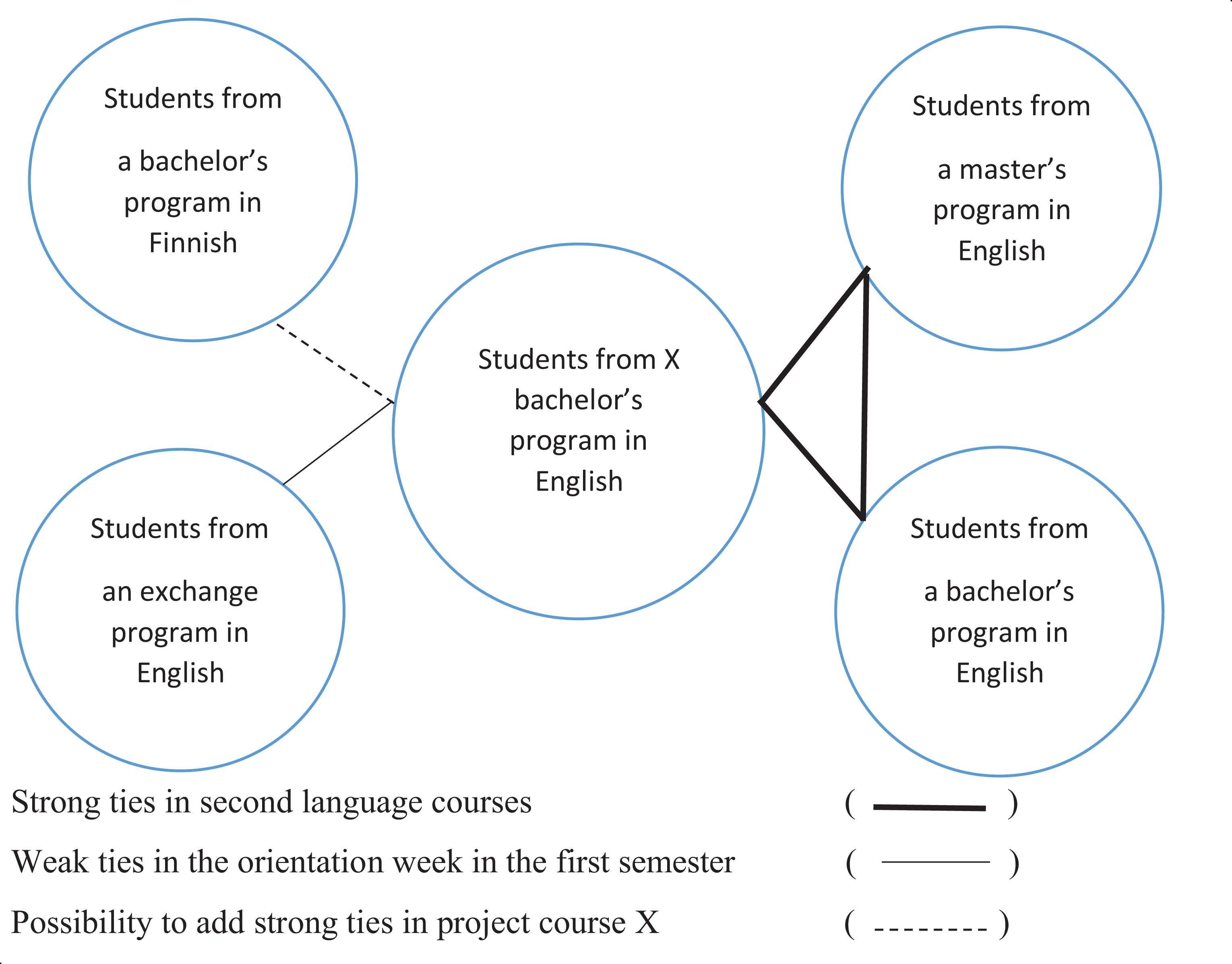
Example of a simple network analysis of the opportunities for students’ encounters.
Thinking about (mis-)encounters “beyond the box” could make internationalization more meaningful and rewarding for the inclusion of all the people involved in higher education—beyond, for example, nationality, prescribed identity, and student status. As central figures in this process, lecturers could play a key role in unthinking and rethinking the questionable positions of the “host” and the “guest” and to create reciprocity and equal positioning between them. Real internationalization can only be considered when such ideologies are remodeled.
Footnotes
Contributorship
Carlos Mendoza collected and transcribed all the data, performed the social network analysis (SNA), wrote the core of the paper with a focus on the analytical sections and responded to reviewers. Fred Dervin wrote the introduction and conclusion and was responsible for building up and writing the theoretical framework around internationalization of higher education and (mis-)encounters. He also provided adequate knowledge about using focus groups in the study and responded to reviewers. Mei Yuan commented on and contributed to draft versions of the paper, supported content analysis, wrote the abstract, and thought of recommendations. Heidi Layne identified and suggested relevant literature on the notion of encounters, read and contributed to draft versions of the paper and provided background information for the Finnish higher education context.
Declaration of conflicting interests
The authors declared no potential conflicts of interest with respect to the research, authorship, and/or publication of this article.
Funding
The authors disclosed receipt of the following financial support for the research, authorship, and/or publication of this article: The study is part of a Ministry of Education Youth Project on the Construction of Internationalization Quality Model of Teachers in Minzu Colleges and Universities (No. EMA200394).