




Abstract
Purpose:
The article focuses on the emergence of a private tutoring industry in Denmark over the last decade. Specifically, it explores how private tutoring companies legitimize themselves in a social and cultural context where education has for long predominantly been understood in egalitarian terms.
Design/Approach/Methods:
The article takes inspiration from Viviana Zelizer’s work on morally controversial markets. It explores the “moral labor” performed by private tutoring companies to redefine the exchange of private tutoring services as a socially wholesome activity. It does so through a close analysis of business information, company websites, and news media articles on private tutoring.
Findings:
The article argues that, generally, the marketing material of tutoring companies focuses more on social equality and student well-being than on academic success. Thus, the companies predominantly legitimize themselves in terms of long-standing Scandinavian ideals of education. Increasingly, these are also the terms in which the companies criticize mainstream schooling.
Originality/Value:
The article contributes new knowledge of private tutoring in a Scandinavian context where very little research on the issue has so far been conducted. Theoretically, it relates previous research on “legitimation projects” of private tutoring companies to broader sociological theories on market making.
In early 2017, public controversy erupted in Denmark over a newly established private education service. Two young students, barely out of their teens, founded a start-up company called “FixMinOpgave” (FixMyAssignment). As suggested by their name, their service consisted in “fixing” (i.e., manufacturing) student assignments, carefully differentiating fees according to the grades desired as well as the urgency of the assignment in question.
This “fixing” of assignments is not new in itself. It has always occurred in an informal way, in Denmark as elsewhere. The public outcry was caused by the conversion of this clandestine practice into an explicit business model advertised and sold openly on the market for educational services in Denmark. Liberals condemned it as “cheating”—as an assault on meritocratic principles of effort and ability, while the left was more concerned about the implication for social equality.
These critiques were hardly surprising. What made the case unusual was the way the two young entrepreneurs defended themselves. Essentially, their strategy consisted in advancing a different interpretation of the notion of “fixing.” While their detractors interpreted their offer of “fixing” along the lines of “match fixing” (corruption, a subversion of fair play), they argued themselves that “fixing” should be understood in terms of “fixing a problem” or even “healing an illness.” In Danish media, they argued that their company was not a cynical money-making scheme, but an effort to fix a broken education system. They claimed that they were simply trying to help desperate students in need of assistance: “Exam cheating is a cry for help from pressurized students.” They even presented their business model as a social critique of the state of Danish education. “I see an incredible number of young people afflicted by stress and depression and I don’t think that is okay,” one of the founders said. He elaborated: During our time in high school, we were both very critical about the way high school had been sucked up in competitive pressure and a race for grades. That provided the idea behind the company. (Raabæk, 2017)
In their defense of their company, the two students challenged the traditional division between public and private in education. In Denmark, public education is very strongly associated with egalitarian values and a focus on well-being (trivsel, in Danish), whereas private education is commonly associated with a competitive and academically focused approach to education. In defending themselves, however, the founders of FixMyAssignment turned this division on its head. They did not argue that, as private providers, they would be more efficient and secure better academic results than the public system. They argued that, as private providers, they would be an antidote to—or even “heal”—the competition and stress of the public system. As we will show below, this redrawing of the boundaries between public and private education is also crucial to the emerging private tutoring industry in Denmark.
In this article, we examine this contestation over the lines of division between public and private education in more detail. Drawing on previous research on private tutoring (e.g., Aurini, 2006; Davis, 2013), we analyze how the largest private tutoring companies legitimize their services. However, in the Danish context where commercially organized private tutoring is both very recent and very controversial, these “projects of legitimation” (Aurini, 2006) concern not only the services of individual companies but also the legitimacy of the private tutoring market as such. We therefore analyze the legitimation projects of the companies as crucial aspects of an ongoing, and highly contested, process of market making in private tutoring. For this purpose, we draw on the economic sociology of Viviana Zelizer—and, specifically, on her seminal work on the creation of markets that deal in “sacred” objects (Zelizer, 2011).
The article is divided into four parts. First we sketch the Danish social, cultural, and educational context that provides many of the crucial terms in which current contestations over private tutoring are conducted. In the second part, we give an overview of the development and organization of the Danish private tutoring industry. Subsequently, we account for the theoretical approach, which informs our analysis, focusing especially on the relationship between the concepts of “moral labor” and “market making.” The fourth and longest part of the article provides a detailed analysis of the ways in which private tutoring companies argue the “moral worth” of private tutoring in the context of more general dislocations in the Danish educational landscape.
Education reform and the obstinacy of the “Nordic model in education”
In the 1960s and 1970s, Scandinavian politicians frequently referred to their national education systems as “the best education systems in the world” (Telhaug et al., 2006). This reflected a deep-seated pride in the “Nordic model in education,” sketched in the introduction to this special issue. Their education systems were viewed as crucial levers of the ideals of equality, democracy, and social cohesion.
This feature also applied to Denmark. Yet, over the last few decades, this pride in the Danish education system has gradually paled. Danish politicians now frequently refer to the Danish education system as, not the best, but “the most expensive education system in the world.” This shift in rhetoric is an implicit allegation that Danish public schools are not delivering results at a level matching public expenditure on schooling.
Such criticisms date back to the late 1970s and are part of a more general critique of the financial burdens of the welfare state. In the last two decades, however, they have intensified through the impact of PISA and other international studies of educational achievement. Unlike Finland, the Nordic PISA star, the Scandinavian countries have consistently been performing around the OECD average. In Denmark, this has intensified critical scrutiny of public expenditure on education, which appears to deliver relatively low returns in terms of learning outcomes. Repeated “PISA shocks” have instigated a series of educational reforms seeking to raise learning outcomes. In 2010, a system of national testing was introduced. This testing system was justified with reference to OECD recommendations, and it was itself to be evaluated in terms of its success in raising Danish PISA scores.
National testing is itself just one component in a wider system of national accountability which, while formally maintaining municipal autonomy in school governance, has brought the public school system under stricter state control. Since 2001, teaching in all public schools has been standardized through a national system of highly detailed “common learning targets.” Furthermore, grades and examinations have significantly increased their importance—both as a measure of school performance and as gatekeepers for transition to upper secondary and vocational education (and not just tertiary education, as has long been the case).
In the last two decades, Danish education policy has therefore aligned itself closely with the reform pattern, which Sahlberg (2006) has labelled the “Global Education Reform Movement,” and which includes features like standardization, focus on core subjects and test-based accountability. These reforms have consistently been justified as necessary adaptations of Danish education to the conditions of globalization and intensified competition in education. In the last few years, however, a significant backlash against this seemingly irresistible trend has appeared. It has been criticized from many quarters as creating an unhealthy “performance culture” (præstationskultur) in Danish education. In the same vein, it has been criticized as part of a more general transition in Denmark from a welfare state to a “competition state” obsessed with inter/national competitiveness.
Paradoxically, the foundations for this criticism have, to a significant degree, been provided by education reform itself. In 2014, a new school reform was introduced, which centered on three “national goals.” Not surprisingly, one of these was the maximization of students’ academic proficiency. Another one, however, was the improvement of student well-being, which was henceforth to be monitored through annual “well-being surveys” (trivselsmålinger). This intensified focus on well-being has generated a host of reports on rising levels of stress, anxiety, and depression among Danish students. On this background, recent educational reforms (including the 2014 reform itself) have been widely accused of betraying the dedication to student well-being—to personal and social development as well as to joyful learning—that was once the hallmark of Danish education.
At the political level, the most important manifestation of this turn in educational debate is probably the “Paper of Agreement,” produced in the summer of 2019 by the new center-left majority in the Danish parliament. While its practical implications remain to be seen, it marks a clear shift in educational policy rhetoric. As part of its vision that Denmark “should be the best country in the world for children to grow up,” the article announces a national action plan for the mental health of children and youth. It also promises that the new parliamentary majority will identify initiatives, which will “further the well-being of students and youth and which will reduce ‘the performance culture’” (Ministry of Higher Education and Science, 2019). This includes a reduction in the use of grades and testing as well as a suspension or partial abolition of national testing. While it remains uncertain whether such programmatic statements will amount to fundamental changes in Danish education policy, they show that the myth of “the Nordic model in education” is far from dead in Denmark. It is a myth that still has the power to win “hearts and minds” in Denmark—and which can still serve as a vision not just for education policy, but for the future of Danish society more generally.
A preliminary map of the Danish private tutoring landscape
Private supplementary tutoring still leads a shadowy existence in Denmark. In contrast to Sweden (Hallsén, 2021), it remains ignored in education policy and largely unmonitored by public authorities—both in terms of regulation and data collection. Within education research, the situation is hardly different. To date, no systematic study of the Danish private tutoring landscape has been undertaken. Borrowing Bray’s (2010) metaphor, mapping shadow education in Denmark is therefore like assembling a jigsaw puzzle with most of the pieces missing.
Some data on the participation, intensity, and scale of shadow education are available from the PISA study (Entrich, 2020). However, PISA’s questions on private tutoring lack precision and shift over time, thus making comparison and estimates of developmental trends difficult (Bray & Kobakhidze, 2014). Nevertheless, based on PISA data from 2003 and 2012, Entrich (2020) found that participation in personal tutoring (paid or unpaid) in Denmark has risen from approximately 3% to 8.5%, respectively. Overall, Finland, Norway, Denmark, and Sweden place as the four lowest ranking countries in terms of institutionalization of shadow education.
Entrich’s findings appear to confirm those of Bukowski (2017) who analyzed PISA data from 2009 and 2012 and concluded that the lowest participation rates in the EU are found in Denmark, Sweden, and Finland, with the 2012 rates about 8%. Both of these studies corroborate Bray’s (2011, 2021) conclusion that the Nordic countries are less affected by private tutoring than other regions in Europe.
As for the supply side of tutoring, data for this study had to be entirely collected by ourselves. We took inspiration from previous research by Aurini and Davies (2013) who collected data on private tutoring companies in Ontario by searching phone books and business directories from Canada’s largest reference libraries. Adapting and extending this approach to the Danish context, we collected our data through: Search engines Central Business Directory (CVR) LinkedIn Phone books
The first step was a systematic block search on the search engines Bing and Google. This block search consisted of terms such as homework support (lektiehjælp), teaching (undervisning), tutoring (tutoring), mentoring (mentoring), and voluntary (frivillig), which were either combined or split (Figure 1). The first 100 hits were then checked and scrutinized based on their relevance before being selected for further examination.
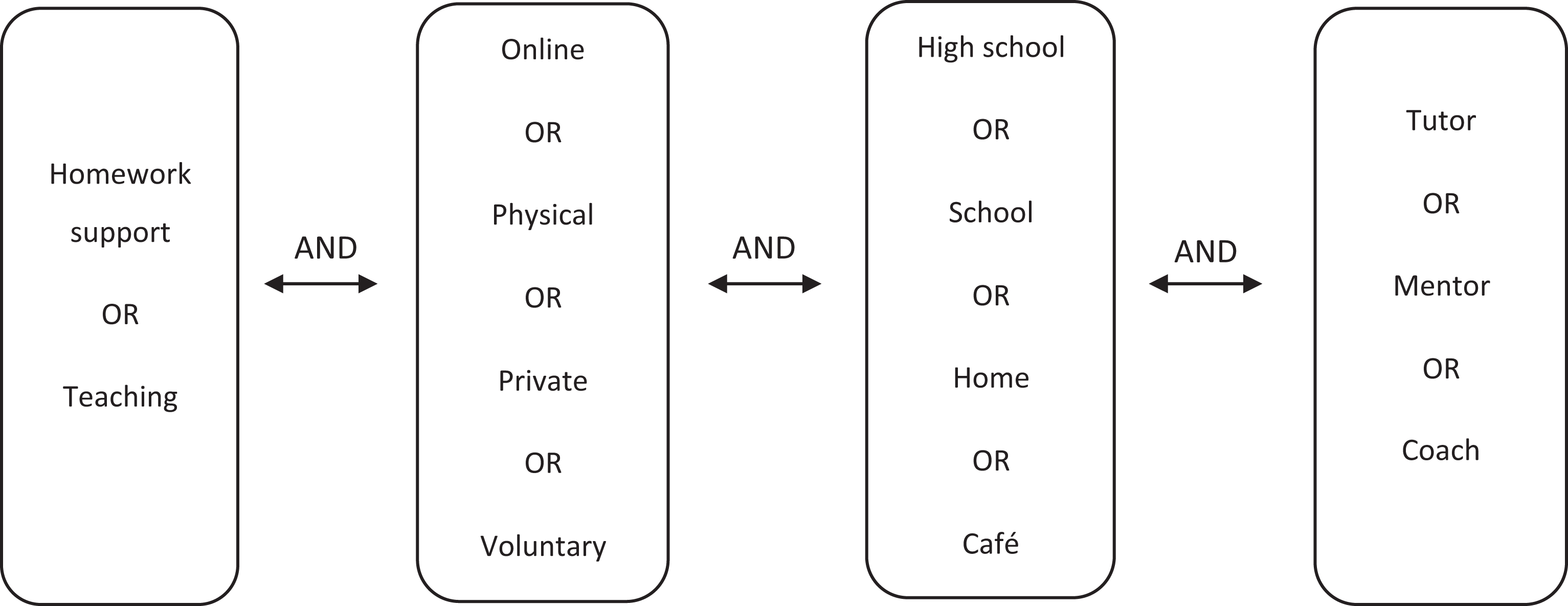
Basic key terms and combinations
The second step included an industry-subject-code search on CVR (the Central Business Directory). To define which subject code to search for, 10 of the most established commercial businesses were chosen and their industry codes used as a point of reference for investigation of these. However, only a minority of businesses within these subject codes turned out to be related to shadow education.
The third step was a business search on the platform LinkedIn. These searches were performed using the same terms as in Figure 1. The last step was a search in the most common online phone books, Krak and Degulesider, again using the key terms shown in Figure 1.
The businesses identified through these four steps were then scrutinized in more detail using the Danish Central Business Directory to gather data on their founding date, present status, and financial reports. While the data collected through these means have many limitations, they constitute the most comprehensive overview so far of the Danish private tutoring industry and can be used to suggest how the landscape of private tutoring has developed in recent years.
The development of the private tutoring industry in Denmark
Starting from 1981 (when the oldest tutoring company in our data set was founded), and up to 2018, a total of 63 unique for-profit supplementary tutoring businesses were identified. Figure 2 illustrates the development of the industry in terms of the number of new businesses per year. Fifteen of these businesses have not been included in this study since we were unable to determine when they were founded.
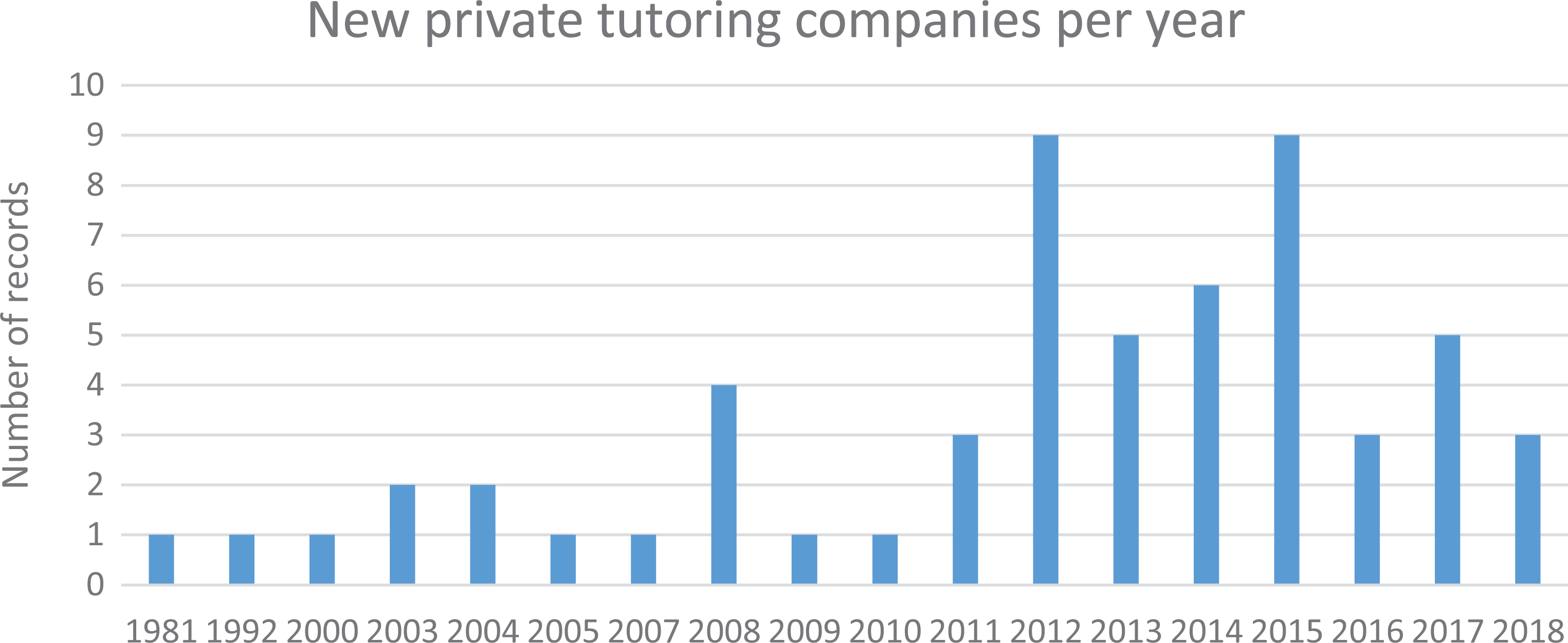
The number of new shadow education businesses per year.
The figure shows that, at least in terms of the number of new businesses, the private supplementary industry has experienced significant growth since the beginning of 2012. A comparison of active businesses in 2000–2009 with businesses active in 2018 shows a 458% increase in providers of private supplementary tutoring. However, this number should be taken with some caution since it is impossible to say how many businesses have opened and closed again in this period. Nevertheless, it suggests that there has been a significant rise in the supply of private supplementary tutoring since 2011/2012.
Mapping the growth
Looking into Denmark’s Central Business Directory, we were able to find accounting data for 10 of these 63 companies. These companies are seemingly the biggest providers of tutoring on the market, and we therefore assume that their financial development may give clues to the overall growth of the market. This assumption is based on Danish accounting laws which state that companies of a certain size must release annual financial reports. The companies that are not represented in Figure 2 should therefore be smaller.
The financial development of these 10 businesses is exhibited in Figure 3, which shows their development in terms of gross profit since 2013. In Figure 4, the gross profit of the individual companies has been added together to give an indication of how gross profits have developed on an industry scale over the last few years. Since 2013, this group of tutoring companies has experienced a massive increase in gross profits—from DKK 11.231.304 (€1.504.448) in 2014 to DKK 28.292.286 (€3.789.789) in 2018. This is an increase of 152% over 4 years. It is also noticeable, however, that growth is not evenly distributed among the 10 companies.
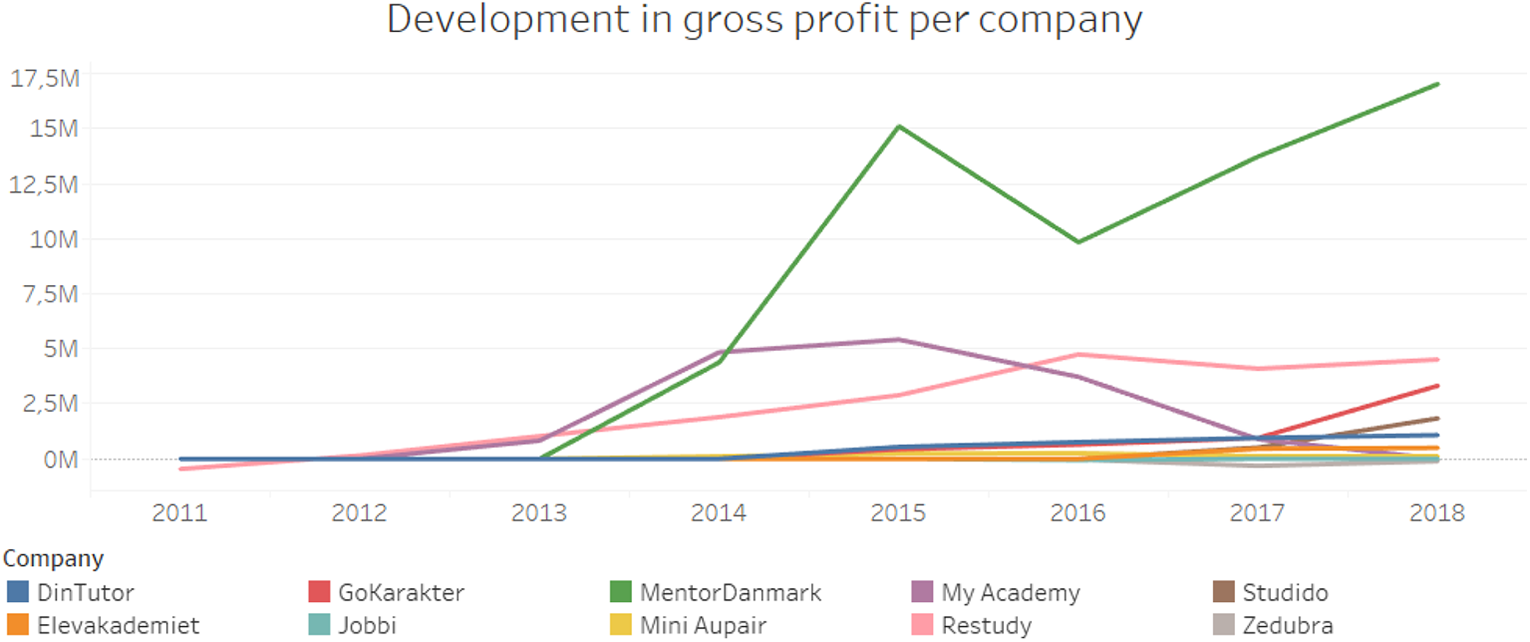
Development in gross profit per company in DKK for the period 2011–2018.
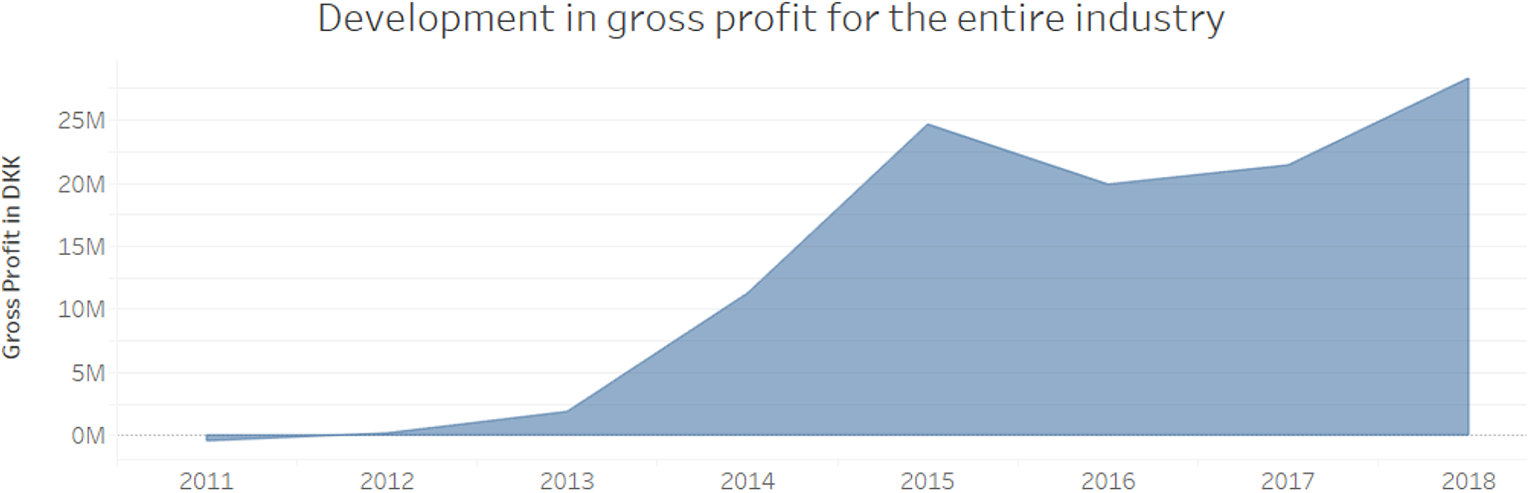
Development in gross profit for the industry in DKK for the period 2011–2018.
MentorDanmark has experienced much stronger growth than the other companies and now appears as the undisputed market leader. Compared to the operator with the second largest gross profit in 2018, Restudy, there was a difference in gross profit of 12.5 million DKK. Another point of interest is the change in gross profit for the companies GoTutor and MyAcademy. Whereas GoTutor saw a big increase from 2017 to 2018 at 351%, MyAcademy—the “first mover” on the Danish market and previously the second largest provider—saw a big decrease from 2015 to 2017 with no accounting data available for year 2018. Thus, there are indications that MyAcademy is pulling out of the Danish market. This is corroborated by the fact that MyAcademy no longer has a Danish website. One company, ElevAkademiet (The Students’ Academy) has recently been shut down, thus testifying to the volatility of the fledgling Danish market.
Types of offers in Danish private supplementary tutoring
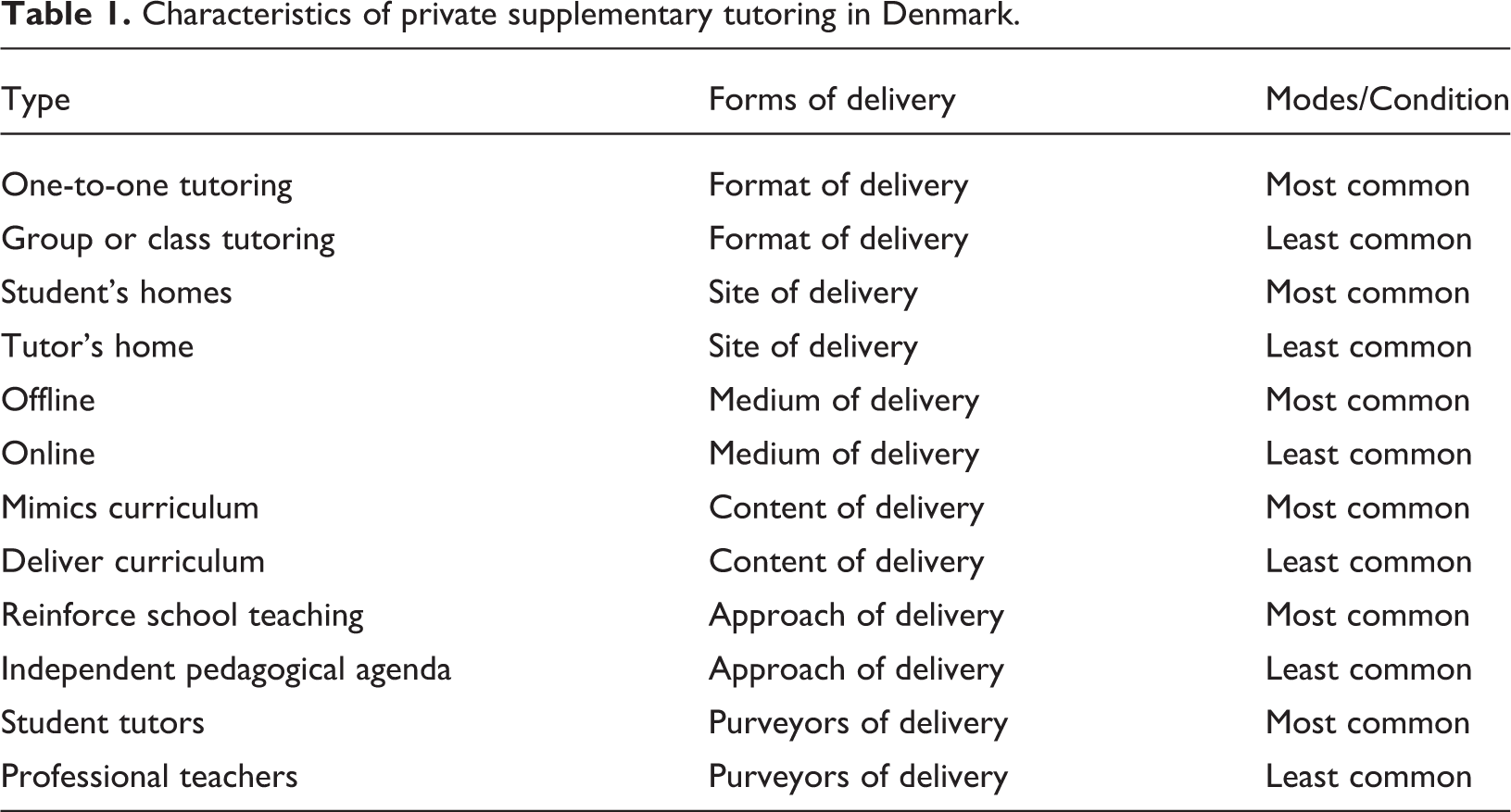
For the purposes of a preliminary overview, we have chosen to categorize the 10 private tutoring businesses along 6 different axes. Our findings below (summed up in Table 1) are based on a systematic examination of the websites of the 10 companies and may therefore not correspond precisely to actual practices.
Characteristics of private supplementary tutoring in Denmark.
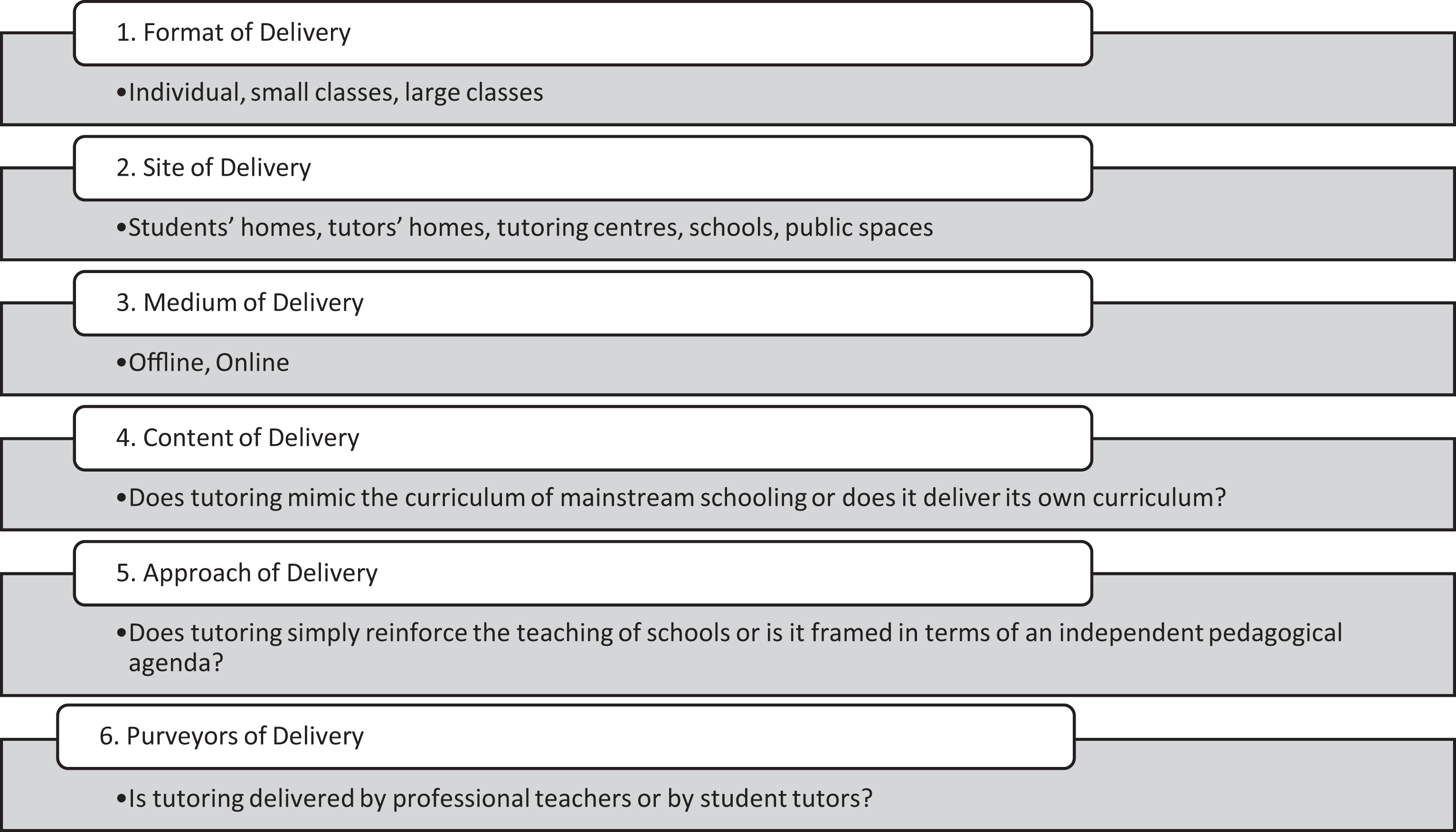
Types of offers in Danish private supplementary tutoring.
Among formats of delivery, individual tutoring is by far the most common approach. Large classes seem to be completely absent on the Danish tutoring scene. Even the use of small classes appears to be exceedingly rare. While tutoring in groups of up to three students is quite common, it is presented by the companies as a way for parents to cut costs—not as a tutoring format in its own right.
As for the site of delivery, home tutoring is predominant. None of the 10 companies examined here conduct tutoring sessions on their own premises. As we will argue below, this may be related to the dominant conception in Scandinavia of private tutoring as “private homework support.”
Among the 10 companies, offline rather than online tutoring is the most common medium. Only two companies (Restudy and Studido) provide online tutoring as their core service. Restudy’s business model is organized around the provision of instructional videos that are supplemented by personal (online) tutoring, while Studido offers personalized and customized online tutoring, allowing students and tutors to be matched and to stay in contact regardless of geographical distance. The other companies offer off-line face-to-face, individualized tutoring. While Jobbi is an online platform, it functions as a kind of “dating agency” that matches students and tutors for personal interaction, which is itself conducted offline.
The content delivered by the companies is very closely aligned with the curriculum of mainstream schooling. Here again, it is no coincidence that private tutoring is referred to as lektiehjælp (homework support) since the companies primarily offer help with daily schoolwork, using the assignments and instruction materials of schools. Most companies—like MentorDanmark and GoTutor—do not (or only to a very limited degree) develop their own instruction materials and their websites offer very little supplementary material. One exception is Restudy, who have produced thousands of instructional videos, which can be accessed on their website and which are meant to be used ahead of personal tutoring. Personal online tutoring here serves as an optional add-on to the use of their instructional videos. Even here, however, subjects and concepts of instruction are very closely aligned with the curriculum of mainstream schooling. Almost without exception, the companies are keen to assure potential customers that tutoring is organized in accordance with the “common learning targets” that frame teaching and assessment in Danish mainstream schools. The only exception is the recently demised ElevAkademiet, which also offered more enrichment-oriented services (coding, programming, etc.)
On this basis, it is hardly surprising that few companies brand themselves in terms of a pedagogical agenda distinct from that of mainstream schooling. The most obvious exception is MentorDanmark. An entire section of their website is dedicated to their “Pedagogical foundation”—a version of the popular theory on “learning styles.” To bolster the legitimacy of this approach, the company even sports an in-house learning expert—an educational researcher who is well-known from national television for his dedication to the learning style approach and who is responsible for training MentorDanmark’s tutors (https://mentordanmark.dk/paedagogisk-grundlag).
Finally, concerning the purveyors of tutoring, it is noticeable that while most founders and CEOs of the companies have some background in teaching, their tutors are overwhelmingly students rather than professional teachers. Of the 10 companies, only Restudy uses professional teachers as tutors. The late ElevAkademiet only used preservice teachers. The other companies are not very specific concerning the qualifications required from prospective tutors. In addition to a clean criminal record, the companies generally demand top grades in the subjects that tutor applicants want to teach. Furthermore, they are screened on personal and pedagogical competencies—through interviews, mock lessons, and, in some cases, personality tests. However, it is less clear what the “threshold requirement” is in terms of educational credentials. It seems clear that all these companies use both tertiary and upper secondary students. However, in one case at least (Studido), there is evidence that lower secondary students are also used as tutors.
Market making as moral labor: The analytical approach
The emergence of a private tutoring industry can be analyzed in many ways. In this article, we seek to understand it as a form of market making. Market making has itself been analyzed from many angles in economic sociology. For the purposes of this article, we are especially inspired by the economic sociology of Zelizer (2011). In her seminal work on “intimate economies,” she highlights the cultural contestations and transformations involved in making intimate and existential aspects of human life amenable to market exchange. She shows that (especially) in such cases, “marketization” is far from being straightforward. Such markets do not emerge spontaneously. Nor are they created simply by political decisions to transfer certain activities and responsibilities to market players. Rather, they require a massive amount of cultural reworking—of the market itself, as well as of those activities and aspects of human life that are opened up to market exchange.
Thus, Zelizer’s work traces, in her own words, “the particular kinds of cultural work involved in organizing markets that deal in sacred products” (2011, p. 17). Her prime example of this is the emergence of life insurance in late 19th-century America. She shows that, at first, life insurance met with heavy resistance, not least from its chief beneficiaries—that is, widowed women who were appalled by the sacrilegious association between death for their husbands and economic profit for themselves. Gradually, however, the once sacrilegious notion of life insurance became recategorized as a moral investment, a new kind of “death ritual” through which family fathers displayed their concern for their families as well as their own memory (2011, p. 16).
Of course, education cannot be understood as a sacred object on a par with death. For millennia, educational services have been exchanged for money—although often with a certain moral ambivalence: Confucius was famous for waiving fees; Socrates denigrated the Sophists as false educationists for taking fees. However, it may be argued that the modern idea of education as a “public good” has turned education into a quasi-sacred object, which should be universally available and not contaminated by the profit motive.
The “Nordic model of education” constitutes one of the most striking examples of this quasi-sacralization of education since it elevates education into the very source of democracy, equality, and social cohesion. In this context where the association between education and market has a quasi-sacrilegious status, establishing a market in private tutoring is not just a matter of developing viable business models, finding market niches, and so on. In order for such market processes to take off, a huge amount of moral labor has to be performed. Selling and buying tutoring as a market good must be recategorized as a morally worthy practice that does not simply bring profit for providers and positional goods for consumers but also contributes to the fulfillment of socially valued purposes of education. While we focus here only on the supply side—that is, the industry—creating a market in private tutoring therefore requires an intensive moral labor on the part of suppliers and consumers alike.
If there is as yet no established market in private tutoring in Denmark, it is not just because this market is still very limited in size. It is also because its moral viability and legitimacy remains very much in question. While a ban on private tutoring is not on the agenda, it remains highly contested whether private tutoring is morally feasible—that is, whether a market in private tutoring can be made consistent with commonly accepted social definitions of education, parenting, and childhood and with more general social values of fairness, equality, and social cohesion.
For such a market to take off, a “moral infrastructure” has to be created, and it is the moral labor involved in this that we explore in the following section. We will return repeatedly to the notion of the “Nordic model in education.” Our main purpose, however, is not to suggest causal explanations—how certain features and historical developments of Nordic education may have caused or impeded the growth of private supplementary tutoring. While this is an important question, our main interest is how the “myth” of a Nordic model in education is variously used to legitimize and delegitimize private tutoring—how it informs contestations over the moral viability of a market in private tutoring.
Constructing a moral market order in private tutoring: Three themes
In this section, we analyze how the largest suppliers of private tutoring in Denmark market themselves and their services on their websites and in the news media. Admittedly, marketing provides only a very restricted insight into market making. Marketing belongs to the producer side of markets and does therefore not capture the “whole” market. Furthermore, marketing projects an image of the market, which—almost by definition—does not correspond to actual market processes. Thus, company websites are replete with parental endorsements and frequently make reference to collaboration with Danish municipalities. Here, “parents” and “municipalities” are projections of marketing itself and should not be confused with “actual” relationships with parents and public authorities.
As evidenced by Zelizer’s work on life insurance (2011), marketing may nevertheless provide important insights into the justificatory and moral labor involved in market making. While marketing originates in the producer side, it constructs images of the market as a whole, including consumers’ motives and the morality of exchange relations between producers and consumers. Such images may be fundamental to the establishment and viability of markets—even if (or, in some cases, because) they do not accurately reflect what actually goes on in such markets.
In our analysis, we restrict ourselves to three themes, which have already attracted much attention in research on private tutoring, but which are elaborated in specific ways by the Danish tutoring companies as part of their efforts to provide the Danish tutoring market with moral legitimacy and sustainability.
The first theme concerns how companies position themselves between trends toward stronger academic competition on the one hand and the traditional ideal of “equality through education” on the other. The second one deals with the relationship between tutoring for the purpose of strengthening academic performance and tutoring for more holistic purposes like self-esteem, confidence, and motivation. The third and final one concerns how the companies position themselves ambivalently between denunciation and support of mainstream schooling.
Tutoring for competition or equalization?
As argued earlier in this article, the question of equality has been pivotal to the constitution of the myth of the “Nordic model in education.” While this myth has been battered over the last few decades, equality remains a basic tenet of educational debate in Denmark. Around the world, social (in)equality is an important theme in public debate on private tutoring. It is therefore no surprise that such questions have also occupied a dominant position in public debate on private tutoring in Denmark.
When public debate on private tutoring erupted in Denmark in 2014, the question of social inequality immediately came into focus. The chairman of the Association of Danish High School Students called the expansion of private tutoring “a deplorable development since it creates a distortion of our education system, which used to be equal for all” (Bergmann, 2014). This was echoed by the chairwoman of the national association of parents, who expressed her concern that private tutoring might harm children of less well-to-do parents. “It shouldn’t be the case that those who have to settle for the public school will not do well” (Bergmann, 2014). One prominent left-wing politician claimed that the expansion of private tutoring undermined the ideal of free and equal education and expressed the hope that “the private tutoring companies would go bust” (Mark, 2016).
Much of this criticism was framed within an understanding of private tutoring as an expression of “parentocracy” where parents strategically take advantage of educational opportunities to secure positional goods for their children (Brown, 1990; De Wiele & Edgerton, 2015; Tan, 2017). This perspective on private tutoring was expressed most directly by the chairman of the Association of School Leaders who rejected any suggestion that the growth of private tutoring reflected badly on Danish public schooling. Instead, he interpreted it as a sign that “parents are incredibly ambitious on behalf of their children. However, instead of spending a ton of money on private homework support, parents would do better to support the school instead.” He added that it is a “sad and frightening signal that those parents are sending to their children” (Sørensen, 2014).
In this last statement, especially, private tutoring appeared not simply as a worrying societal trend but as a downright morally reprehensible practice. By choosing private tutoring, parents assumed a moral guilt in (at least) two respects. The first one concerned the children themselves. If the purchase of private tutors was “a sad and frightening signal,” it was because it undermines the ideal of a carefree and playful childhood, which has traditionally been especially strong in Scandinavia. The second one concerned the community at large. The Danish public school is called Folkeskolen, that is, “the people’s school.” Public schooling is traditionally understood not simply as a service provided by the state but as a community project—the institution through which the national community is constituted and reinforced on a daily basis. The “sacredness” of fee-free and public education here concerns not only economic and social equality but also the cultural cohesion of the community itself. If the purchase of private tutoring is a “sad and frightening signal,” it is both because it sacrifices the individual child for the sake of parental ambition and because it erodes equality and cohesion at the community level.
In such statements, private tutoring is viewed as an expression of an individualist, performance-oriented, and competitive approach to education. However, these are generally not the terms in which the companies portray themselves. Rather, they tend to justify themselves in terms of the very ideal of equality that, in such statements, they are accused of betraying.
This applies in several ways. For the sake of clarity, we condense them here into three, increasingly strong, types of arguments. The first—and weakest—argument is that the services of tutoring companies are affordable to (just about) all Danish families. In a 2014 newspaper article, MyAcademy (the first major company on the Danish market) claimed that the affordability of homework support was “a matter of prioritization,” adding that parents could make tutoring affordable simply by purchasing fewer cable TV channels or expensive smartphones (Bergmann, 2014; Sørensen, 2014). According to this argument, any repercussions of private tutoring on social equality were an effect of parental decisions, not of the private tutoring industry itself, which is accessible to everyone.
The second and stronger argument is that Danish parents who purchase homework support do so not for competitive, but almost exclusively for remedial purposes. In 2015, CEO of MentorDanmark, Nicklas Kany, stated in a newspaper article that “around 75% of students are so-called weak students” (Ritzau Fokus, 2015). He thereby rejected the idea that parents who purchase homework support are “incredibly ambitious” parents, seeking to ensure educational advantages for their children. He portrayed them, instead, as concerned and responsible parents, helping their children to catch up, and thereby contributing positively to equality and cohesion rather than undermining them.
This leads to the third and strongest argument that, on a general basis, the private tutoring industry enhances rather than undermines equality in education. Charged with the accusation of betraying equality, Nicklas Kany claimed: There are also parents who have higher education and who can therefore help their children better. We provide an extra offer that gives you the opportunity to prioritize your domestic economy. I think we are levelling the difference by offering help to everybody so it is not dependent on parents’ [educational] backgrounds. (Hamborg, 2014)
Among the company websites, however, Restudy is the only one to explicitly emphasize this levelling mission: Restudy was established in 2009 and builds on a foundation of access to quality teaching 24/7, regardless of social background, ability, lack of [geographical] mobility, along with school choice and independently of teachers. (https://www.restudy.dk/om-restudy/) Restudy dreams that everybody should have access to qualified teaching. Regardless of your level of ambition, mental capacities or nationality, you have the right to appropriate the knowledge you want. (https://restudy.dk/om-restudy/)
Tutoring for performance or for personal development?
Traditionally, shadow education is characterized by taking “selection” rather than “education” (Christensen, 2019; Luhmann & Schorr, 2000) as its main focus. Or put differently, shadow education is more concerned with improving grades and examination scores for the purposes of educational advancement than it is with actual learning. This is the basis for the widespread criticism that shadow education is essentially about “drilling” and “rote learning.”
All the major Danish companies take pains to distance themselves from this image of shadow education. They all present private tutoring as an educational enterprise rather than simply as a strategy for successful selection within the mainstream education system. This does not mean that improvement of grades and examination results are not mentioned on company websites. They are referred to frequently, but in passing, as just one among a number of different purposes and as subordinate to the properly educational purpose of private tutoring.
MentorDanmark, the largest company in Denmark, can serve to illustrate this point. The first thing that meets the eye on their website is a headline stating “It’s all about the passion for learning” (https://mentordanmark.dk/). This message is echoed by a series of slogans continuously rolling over the screen, all introduced by the caption “We are passionate about …”—“motivating and inspiring,” “turning ‘hated subjects’ into ‘happy subjects’,” “fostering passion for learning,” “creating a better everyday life,” “strengthening academic confidence.” All these slogans focus on “the whole child” rather than simply on grades and examinations. As already suggested, this does not mean that academic results are ignored. Parents are left in no doubt that, thanks to MentorDanmark, their children will improve academically, but academic results rarely appear as an objective in their own right. If they appear important, it is mainly at a psychological level—as a crucial component of self-esteem and well-being: “[O]ur objective is to improve academic confidence, which leads also, for many students, to increased self-esteem. Private tutoring provides your child with opportunities to turn belly aches and inferiority into academic confidence and desire to learn” (https://mentordanmark.dk/privatundervisning).
This focus on well-being and self-esteem is not, in itself, unique to the Danish tutoring industry. Over the last couple of decades, more holistic and child-centered approaches have become a significant part of the private tutoring landscape around the world (Aurini & Davies, 2004; Bray, 2017; Christensen, 2019; Davies & Aurini, 2006). However, what may be distinctive to the Danish (and Scandinavian) context is the way in which the focus on well-being and “the whole child” enters into the tutoring formats and business models adopted by the companies. Returning to the categories used earlier in this article, this feature concerns, especially, the constellation between the format of delivery, the site of delivery, and the purveyors of delivery.
Here, again, MentorDanmark is a case in point. In some ways, MentorDanmark resembles what, referring to the Canadian context, Aurini and Davies have called a “learning center” (2004). It is a large and openly commercial operator, which brands itself on a holistic and child-centered approach to learning and which works on the basis of its own pedagogical approach (learning styles).
At the same time, such features are combined with features that recall the most traditional and informal modes of shadow education. First, tutoring is provided on a strictly individual basis (the only exception being small-group tutoring of up to three students). Second, no classes are conducted at MentorDanmark’s premises. Tutoring is provided almost exclusively in students’ homes. Third, tutoring is not provided by professional teachers but by older students without formal teaching qualifications.
This business model has obvious advantages. On the one hand, it keeps costs down in a context where private tutoring has not (yet) become an “economy of scale.” Since tutoring is performed in the homes of tutees, companies do not have to rent teaching facilities like classrooms and lecture halls. Even relatively large companies can therefore keep their offices reasonably small and inexpensive. At the same time, high school and university students are inexpensive compared to professional tutors and can be hired on a part-time and seasonal basis.
Simultaneously, this business model also contributes to the moral labor through which the Danish private tutoring market is shaped. This is because it embeds private tutoring within a space of intimacy, which is far removed from the coldness of market relations and which bolsters company claims to focus on the whole child rather than simply on academic performance. In this model of tutoring, the “home” is therefore much more than simply the venue of tutoring. It is the affective and moral space, which gives shape to the relationship of tutoring itself. Thus, on its website, MentorDanmark writes that “tutoring takes place in the secure environment of your home” (https://mentordanmark.dk/privatundervisning). GoTutor echoes this message, almost to the letter: “Homework support takes place in your home, in the secure environment familiar to your child” (https://gotutor.dk).
This embedding of private tutoring within the intimate space of the home is reinforced by the use of students rather than professional teachers as tutors. The use of students does not appear as a second-best solution compared to professional teachers. It appears as a different, even superior, relationship, specifically designed to enhance the personal development of tutees. The websites of GoTutor, MentorDanmark, and Din Tutor are replete with photos of tutors and tutees sitting closely together—working, smiling, and joking. In this sense, the choice of students as purveyors of tutoring corresponds with the choice of the home as the site of tutoring. In both respects, tutoring appears as a kind of extended family relationship—a relationship with an “older sibling” (Hallsén & Karlsson, 2018).
This is reflected above all in the common use of “mentoring” rather than “tutoring” as the preferred term for this relationship. MentorDanmark has played a crucial role here by turning mentoring into its very brand. Addressing itself to prospective tutors, MentorDanmark explains that: Our homework support is a youth-to-youth concept in which you help children and youth to build or regain their academic self-confidence—thus, you are not just a tutor, but a mentor and a role model. We have a wish to help and motivate children and youth for a good future in the Danish education system. Our mission is to improve the well-being of our students in school and to provide them with experiences of success, which will again make schooling fun for them. We therefore conceive of ourselves as being not only tutors, but also mentors who can guide and help your child down the road. (https://gokarakter.dk/om/go-karakter)
This intimate relationship with the mentor applies not only to the students themselves but also to their parents. This comes out very clearly in the parental endorsements cited on the company websites. Interestingly, it appears even in companies like DinTutor, which make no explicit reference to mentoring. Parental endorsements are much more concerned with the individual tutor (invariably referred to by his or her first name) than with the company itself. In many cases, endorsements are even addressed directly to the individual tutor herself: Thanks a lot, Emilie. Malene expresses nothing but enthusiasm about her collaboration with you. Dear Katrine. Thanks for the positive words about Gabriella. ☺ We are very happy that you are her tutor. Gabi seems very motivated and is looking forward to her lessons with you. (https://dintutor.dk/om_os.html)
This image of tutoring is itself an important part of the moral labor performed by the tutoring companies. In Denmark, homework is understood not simply as a matter of doing school assignments but also as a mode of parental participation in children’s school life. When compulsory, school-based homework cafés were introduced in Denmark in 2014, they were criticized (especially by conservatives) as an intrusion into family space. In this context, the mentoring model proposed by the tutoring companies serves not only to legitimize their services for parents considering private tutoring. It serves also as a legitimization of these parents themselves. Every act of marketing also projects an “implied consumer.” The “implied parent” projected here is an engaged parent who does not outsource responsibility for school work to anonymous third parties but enlists instead the help of “older siblings” or “family friends” to enrich the caring relationships of the family space. In this sense, parents who consider private tutoring appear not as “ambitious” parents but as “caring” parents who want their children to grow and build self-esteem.
Tutoring as critique and support of mainstream schooling
In Scandinavian education, Sweden has often been the first mover (Telhaug et al., 2006). This also applies to private tutoring. In 2007, the Swedish liberal–conservative government chose to include private tutoring in a comprehensive tax deduction scheme for domestic services (Hallsén & Karlsson, 2018). One of the largest players on this new government-supported market was MyAcademy, which expanded its operations to Denmark in 2012, thus becoming the first large-scale commercial operator in Denmark. MyAcademy was also the first tutoring company in Denmark to advertise openly in public space, creating unprecedented visibility around private tutoring and probably encouraging new players to enter the market.
However, in Denmark, this exogenous part of the history of private tutoring has drawn little attention. Private tutoring only became a public issue in 2014—the very year a highly contested reform of the Folkeskole came into effect. In Danish public debate, the rise of private tutoring therefore became closely related to the school reform—even if the available evidence suggests that the rise of private tutoring actually preceded the reform.
Initially, private tutoring was generally interpreted in accordance with long-standing criticisms of the Folkeskole—that is, as a consequence of inadequate academic standards in Danish schools. Niels Egelund, an influential professor of education, explained the growth of private tutoring by the fact that: There are still quite a few public schools that pay a lot of attention to student well-being [trivsel] and less attention to academics. So in some places a certain tightening-up is appropriate. (Sørensen, 2014)
Paradoxically, the school reform was itself used to strengthen this argument—even if it aimed, in part, to raise academic standards in the Folkeskole. As part of the school reform, compulsory homework cafés were introduced in schools in 2014. While they aimed to ensure adequate homework support for all students, homework cafés soon came to be criticized for their perceived lack of quality—both due to their high teacher to student ratio and due to the lack of properly educated personnel. Thus, paradoxically, the provision of public homework cafés became one of the most prominent arguments for private tutoring.
This argument was exploited in a particularly efficient manner by MentorDanmark. In a number of newspaper articles, CEO Nicklas Kany explained that: We hear from parents that homework support in schools is of extremely uneven quality. In some places there is just a single non-professional teacher [pædagog] for many students and that is not good enough for the parents. (Quass, 2014)
Since then the marketing strategies of the companies have changed noticeably. First, references to the public homework cafés have disappeared. Companies now rarely justify their services by criticizing the academic performance of public schools. Instead, they increasingly highlight a theme, which has been important to their marketing strategies all along but has now become even more pronounced: student well-being (trivsel) and joy of learning.
An apt illustration of this is the recent decision of the company previously known as GoKarakter (GoodGrade) to change its name to GoTutor. On its website, the company explains that the previous name was “misleading”: We have long known that GoodGrade is a name, which clashes with the actual problems we are solving. We think that GoodTutor is a much better match for our vision of “putting a full stop to low well-being [trivsel] in school.” Our core constituency is families where school is a challenge in the sense that lack of motivation, low well-being and lack of self-confidence is affecting everyday life. In other words, it is about being happy in school and wanting to learn in one or more subjects. GoodTutor fits much better here. (https://gotutor.dk/blog/vi-skifter-navn-fra-gokarakter-til-gotutor)
There may be at least two (partially contradictory) reasons for this. One may have to do with changing “ecosystems” (Bray & Kobakhidze, 2015) in Danish education. There are indications that tutoring companies are increasingly seeking symbiotic rather than simply supplementary relationships with the Folkeskole. Judging from their websites, the major companies have become increasingly enmeshed with the public system. On their websites, MentorDanmark and GoTutor list the largest municipalities in Denmark (Copenhagen and Aarhus) as their partners. While the nature of these partnerships is not made clear, the names and logos of municipalities are used effectively as a public endorsement of the tutoring companies. In this sense, the companies increasingly seem to position themselves in the “mixing zones” (Zhang & Bray, 2017) between public and private.
Restudy is an especially intricate example of this. Founded in 2009 as a private company, it has now developed into a public–private partnership, jointly owned by “leading staff, private investors and the Board of Research and Education under the Ministry of Higher Education and Science” (https://www.restudy.dk/om-restudy/). Accordingly, Restudy is characterized by its bifocal orientation toward families (students and parents) on the one hand and schools (teachers) on the other. Its website is divided into a section comprising resources for teachers to use in mainstream schooling and a section comprising resources for students and parents that can be used “on a stand-alone basis, without the involvement of teachers” (https://www.restudy.dk/om-restudy/). In this sense, Restudy combines a symbiotic and a supplementary relationship with the public education system.
However, this does not mean that the tutoring companies have simply “made peace” with the mainstream system. Rather, their criticism of mainstream schooling seems to be changing its focus. As Davis (2013) has argued in her study of private tutoring in Australia, criticism of mainstream schooling is inherent to private tutoring since the legitimacy of private tutoring can only be established on the basis of a perceived lack in mainstream schooling.
Our examination of the company websites suggests that, increasingly, the lack in mainstream schooling on the basis of which the companies market their services concerns low student well-being rather than low academic performance in the Folkeskole. This shift may be interpreted as a market adaptation to the recent backlash in public debate against the new “performance culture” in Danish schooling.
As discussed earlier in this article, issues of academic standards, which have long dominated public debate on the Folkeskole in Denmark, are today eclipsed by issues like stress, test anxiety, and performance pressure. By focusing so strongly on well-being and joy of learning, the tutoring companies seek to address this concern with children’s experience of schooling. Thus, when MentorDanmark states as its mission that “every single day students should experience the same joy that they did on their first day of schooling,” they suggest that the Folkeskole consistently chips away at the happiness and joy of learning of students. Likewise, GoTutor states as its mission that “No children deserve to suffer from low self-confidence or to experience performance anxiety,” thus alluding to the alleged “performance culture” afflicting the Danish education system. While there is no direct criticism of the Folkeskole in these two statements, it appears to be being incapable of taking charge of the well-being of children—thus effectively failing what has for long been considered its core mission. Conversely, private tutoring appears not only as tutoring but almost as a form of educational “therapy,” healing the emotional and motivational wounds incurred in the course of mainstream schooling.
In this respect, the companies seem, to a certain extent, to be reversing the roles between private tutoring providers and mainstream schooling. Traditionally, private tutoring focuses primarily on strategies for boosting academic results, whereas mainstream schooling also caters to the sociopsychological well-being and holistic development of children (Wang & Bray, 2016). In contrast to this, the companies here depict mainstream schooling as subjugated to a narrow performance culture, which neglects the holistic development of children—thus creating the need for a private tutoring sector, which (as the true guardians of “the Nordic model in education”!) specializes in rectifying the lack of motivation, low self-confidence, and performance anxiety produced by the mainstream system.
Conclusion
Previous research on private tutoring suggests that, like a “shadow,” it changes and adapts to different national and regional contexts (Bray, 2017). As such, it is an apt illustration of Robert Cowen’s phrase: “As it moves, it morphs” (Cowen, 2009). In this article, we have shown how the insinuation of commercially organized private tutoring into the Danish educational context is accompanied by peculiar forms of “legitimation projects” or “moral labor” that are closely tied to the Danish and, perhaps, Scandinavian cultural and political context. Drawing on Viviana Zelizer’s work on markets in “sacred objects,” we have argued that in the context of the Danish welfare state, education has for long constituted a “quasi-sacred object” that is expected to redeem social aspirations for social equality and national cohesion and which should therefore not be contaminated by the profit motive. In order for private tutoring companies to establish themselves in this context, they are therefore required to legitimize the “moral worthiness” of the very market, which they are in the process of (co-)making—that is, to show how their services are not simply opportunistic profit-seeking, but a way of safeguarding and strengthening long-standing and cherished ideals of education in the Danish context. Thus, here private tutoring “morphs” in such a way as to project images of equality, self-confidence, and well-being over images of performance orientation and status-seeking.
However, if it is true that “as it moves, it morphs,” it is probably also true that “as it morphs, it moves.” Over the last few decades, the private tutoring industry has matured and diversified—assuming new and more educationally sophisticated forms. In East Asia, this has resulted in a wide variety of different forms of tutoring, some of which stress life-long learning and holistic development rather than simply examination skills (Christensen, 2019). This “morphing” is a world-wide development (Bray, 2017) that has probably made it easier for private tutoring to “move” into contexts that might not have been susceptible to the traditional forms of shadow education.
The diversification of private tutoring also means that the division of labor between mainstream schooling and private tutoring is no longer as clear-cut as it used to be. In other words, private tutoring no longer unambiguously functions as a “shadow” of the mainstream system. In his famous fairy-tale on “The Shadow,” Hans Christian Andersen narrates how, at some point, the shadow of the human protagonist becomes independent and even ends up turning its former master into its servant. While the imagery may still be overly dramatic (not least in the Danish case), there are indications that it is becoming increasingly difficult to decide what is “body” and what is “shadow” when it comes to the relationship between the mainstream education system and the private tutoring industry.
Footnotes
Contributorship
Søren Christensen was responsible for writing the abstract, the analytical and concluding parts of the paper and for responding to reviewers' comments. He also worked out the theoretical framework of the paper. Frederik Bækdahl and Thomas Grønbek were responsible for the quantitative parts of the paper-developing ways of retrieving and analyzing quantitative data on the development on the Danish private tutoring industry.
Declaration of conflicting interests
The author(s) declared no potential conflicts of interest with respect to the research, authorship, and/or publication of this article.
Funding
The author(s) received no financial support for the research, authorship, and/or publication of this article.