




Abstract
Purpose:
This study offered insights into how Chinese college admission reform brought about school changes and influenced students’ motivation and learning behaviors.
Design/Approach/Methods:
Four classes in one public high school in the Shanghai Municipality were observed in their homeroom activities and during class breaks. Students and teachers were purposively selected and interviewed.
Findings:
Due to the more choices on national college entrance examination-examined subjects, career development courses and internships were offered to give students guidance on subject selection. A class shifting system was adopted. In response to the comprehensive evaluation criteria, more free time and club activities were offered so that students can develop their own interests in nonacademic areas. While the reform promoted some students’ intrinsic motivation and mastery goals—that is, students reported their intention to develop interests and improve competences—some students made strategic decisions (e.g., avoiding choosing Physics, intensive preparation, and extracurricular academic tutoring) to maximize college admission possibilities at the cost of ignoring their personal interests.
Originality/Value:
This is a timely study that provides insights into school changes and impacts on students’ learning in a changing educational context. Implications for future research and practices are discussed.
Introduction
China has a pyramidal education system, and students need to succeed in a highly competitive college entrance examination to enter higher education institutions. The national college entrance examination (NCEE; Gaokao) is the most influential examination for students in Chinese mainland. It is historically a one-shot examination in which students are evaluated based overwhelmingly on their scores and rankings in academic subjects. The college admission policy has been criticized for giving students few choices, stifling interest and creativity, and causing anxiety (Dello-Iacovo, 2009; Wong, 2017).
In response to these criticisms, Shanghai and Zhejiang governments announced a pilot program of major reforms to college admission procedures in 2014. Although the college admission policy experienced many small changes in the passing decades, this round of reform has been the most fundamental and comprehensive, which outlined the blueprint of China’s new Gaokao. One central goal of the reform is to offer students more choices and develop their interests, such as allowing students to retake examinations and affording them more choices in examination-examined subjects (Ministry of Education of the People’s Republic of China, 2014b). Given the importance of college admission, this reform should have a very evident backwash effect on school practices and students’ motivation and learning behaviors (Cheng et al., 2015). However, little is known about the exact corresponding school changes. Moreover, there is a lack of empirical studies investigating the impacts of college admission reform and corresponding school changes on students’ motivation and learning behaviors. Therefore, this study aims to understand the changes in the school and their impact on students’ motivation and learning behaviors since the reform of college admission. Investigating the impacts of this reform is crucial for informing policy regarding college admission reform, school and teacher practices, and future research.
Literature review
The pivotal NCEE
Chinese students normally make great efforts to enter colleges, especially prestigious ones, such as those involved in Project 985, Project 211, and the construction of world-class universities and first-class disciplines. Students can enjoy relatively more funding, better resources, and get more career development opportunities by entering higher education institutions rather than vocational schools. However, college admission is highly competitive. China has a pyramidal education system in which a diminishing number of students have the opportunities to advance to each successive level of education. In 2014, approximately 15 million students graduated from senior middle schools (including senior secondary schools and secondary vocational education), but only 7 million (47%) of them went on to further their education in higher education institutions (Ministry of Education of the People’s Republic of China, 2014a). Although students in some developed areas enjoyed more access to universities (e.g., over 90% of high school students in Shanghai enroll at colleges), the competition to get into top universities remains high.
Unlike North American students, who generally apply for colleges through personal statements, letters of recommendation, and high school academic transcripts, most Chinese students’ college admissions are exclusively based on their academic achievements in the NCEE (Hongjie & Jacob, 2015). Historically, the college entrance examination was a one-shot examination that took place at the end of senior middle school. Most Chinese students normally have three compulsory examination subjects (Mathematics, Chinese, and English) and three alternate examination subjects selected from science (i.e., Physics, Chemistry, and Biology) or the liberal arts (i.e., Politics, History, and Geography); as such, senior high school students devote more time to those subjects to obtain satisfactory examination performance in the NCEE.
Autonomy support and academic motivation
In the past decades, there has been increasing criticism of China’s college admission policy, including its lack of choices and stifling of students’ interest and creativity (Dello-Iacovo, 2009; Wong, 2017). Many researchers and educational practitioners criticized the college admission policy for predominantly focusing on academic examination performance and neglecting students’ well-rounded development (Chen & Kesten, 2017; Ministry of Education of the People’s Republic of China, 2014b). Dello-Iacovo (2009) has pointed out that the content and the format of school curricula are narrowly aligned with academic subjects tested in the examination, due to a utilitarian evaluation standard that neglects students’ nonacademic interests. Further, as students were provided only one chance to take the examination, they were weighed down by excessive homework and suffered from great anxiety in preparation for the NCEE, which increased as the examination date neared.
From the academic motivation perspective, many previous studies indicate that students should be given more choices in learning (Ames, 1992; Kaplan & Maehr, 2007). Two theories have highlighted the essential role of autonomy support in students’ motivation, learning behaviors, and achievements: self-determination theory and academic achievement goal theory (Ciani et al., 2010; Deci & Ryan, 2000; Grant & Dweck, 2003; Meece et al., 2006). Autonomy is conceptualized as striving to achieve freedom from others and is considered a universal basic human need (Deci & Ryan, 2012). According to the self-determination theory, when students have multiple choices and make their own decisions, they are more likely to feel a sense of personal causality and experience themselves as active initiators, rather than feel controlled by external forces (Deci & Ryan, 2000). Many studies have shown that providing students with multiple choices can promote their intrinsic motivation, that is, the desire to engage in learning for personal enjoyment and interest (Lepper et al., 2005; Vansteenkiste et al., 2006). Intrinsic motivation has been found to promote learning engagement (e.g., effort and use of learning strategies) and achievement (Wigfield et al., 2015).
The academic achievement goal theory also highlights the importance of autonomy support in promoting students’ mastery goals. Academic achievement goals target the reasons students engage in class work by scrutinizing which goals students are striving to achieve (Senko et al., 2011; Wang et al., 2019). Two primary goals are emphasized: mastery goals and performance goals. Mastery goals refer to those intended to improve competences and develop skills and are associated with adaptive learning patterns, such as the use of self-regulated learning strategies, persistence in the face of setbacks, enjoyment, and academic achievement (Grant & Dweck, 2003). In contrast, performance goals reflect one’s intention to outperform others and demonstrate one’s competences and are associated with negative learning patterns, such as test anxiety, cheating, and self-handicapping behaviors (Urdan, 2004; Wang et al., 2019). Research suggests that providing students with multiple choices (e.g., multiple learning materials and activities) and involving them in decision-making processes (e.g., deciding the pace of and sequence in learning) can foster mastery goals and adaptive learning and erase the negative impact of examination pressures (Ciani et al., 2010; Meece et al., 2006).
College admission reform in Shanghai
In response to criticisms of college admission procedures, and acknowledging the importance of students having choices, Shanghai government announced a pilot program of major reform to college admission procedures in 2014 (Ministry of Education of the People’s Republic of China, 2014c; Yuan, 2018), one of the most influential guiding thoughts of this reform to offer students more choices to foster their interest and encourage their well-round development. First, students are offered more choices on NCEE-examined subjects. Students in Shanghai can choose any three of the six alternative subjects (i.e., Physics, Chemistry, Biology, History, Politics, and Geography) as their NCEE-examined subjects (20 examination subject combinations). Since it is unfair to compare students’ performance across different subjects, a score of ranking is assigned to students for each alternative subject. The score of ranking is based on each student’s relative achievement level among all students who choose the subject (e.g., top 5% students get 70, top 6%–15% get 67, top 15%–25% get 64). Therefore, the total score of NCEE is made up of the raw scores of three compulsory subjects and the score of ranking of three alternative subjects (the “3 + 3” system). Second, whereas most universities still admit students according to NCEE performance, a small proportion of students are evaluated with multiple standards rather than only their NCEE performance while applying for some prestigious universities in Shanghai. Some universities (nine universities, 11 admission units, admit about 2,000 students) in Shanghai have the privilege to implement holistic admission (e.g., interview performance, leadership potential, and extracurricular activities) and hold a school test while enrolling students. This measure is supposed to support students’ interest development in multiple areas, especially for students who seek to study in prestigious university in Shanghai. Third, students in Shanghai can retake English test and submit the higher score, rather than relying on a one-shot examination. Moreover, whereas all the tests took place at the end of Grade 12 in the past, tests time for the six alternative subjects are different now. For example, geography and biology examinations take place at the end of 11th grade, which are earlier than other subjects. This is assumed to ease examination pressure and enable students to sequence their learning paces.
Altogether, it is supposed that the college admission reform in Shanghai will sustain and enhance students’ interest and foster their mastery goals by offering them multiple choices in learning content, recognizing their achievements in nonacademic domains, and allowing them to sequence their learning paces. To investigate the impacts of providing more autonomy support in college admission reform, this study addresses the following research questions:
Method
Research site and participants
This study was conducted in one elite public senior high school in Shanghai, which was recommended by personal contacts. Four 11th-grade classes were randomly selected (29 to 35 students per class; mixed-gendered). These students—who entered senior high school in 2014 and were to take their college entrance examination in 2017—were the first cohort of students to experience this college admission reform. According to participants’ report, most students came from families of middle to high socioeconomic status.
The grade manager and the homeroom teacher of each class were involved in the study. Homeroom teachers had to care for students’ school life in addition to teaching certain subjects, so they tended to have closer relationships with students than did most other teachers. There were four homeroom teachers—Miss Li (46 years old, English teacher), Miss Sheng (51 years old, Chinese teacher), Mr. Xu (37 years old, Physical Education [PE] teacher), and Mr. Bian (36 years old, Physics teacher)—who had 23, 28, 11, and 10 years of experiences in teaching, respectively. The grade manager, Mr. Zhou (56 years old), had been teaching Mathematics for 30 years. With the help of the homeroom teachers, we recruited seven students with varying levels of academic achievement from each of four classes, with each class providing two high, average, and low achievers and a classroom monitor. All students were 15–17 years of age.
Researcher
The author is a postdoctoral fellow in the department of curriculum and instruction. She is born and educated in China, and both of her parents are Chinese. She is aware that her life experience shapes her understanding of college admission reform.
Data collection
Before collecting data, ethical approval was obtained from the Human Research Ethics Committee of the university. Next, informed consent was obtained from the school principal, teachers, students, and parents. Participants were informed that the collected data were for research purposes only and would be kept confidential. Data collection lasted for two semesters—from February 2016 to January 2017—during which time students transitioned from 11th to 12th grade.
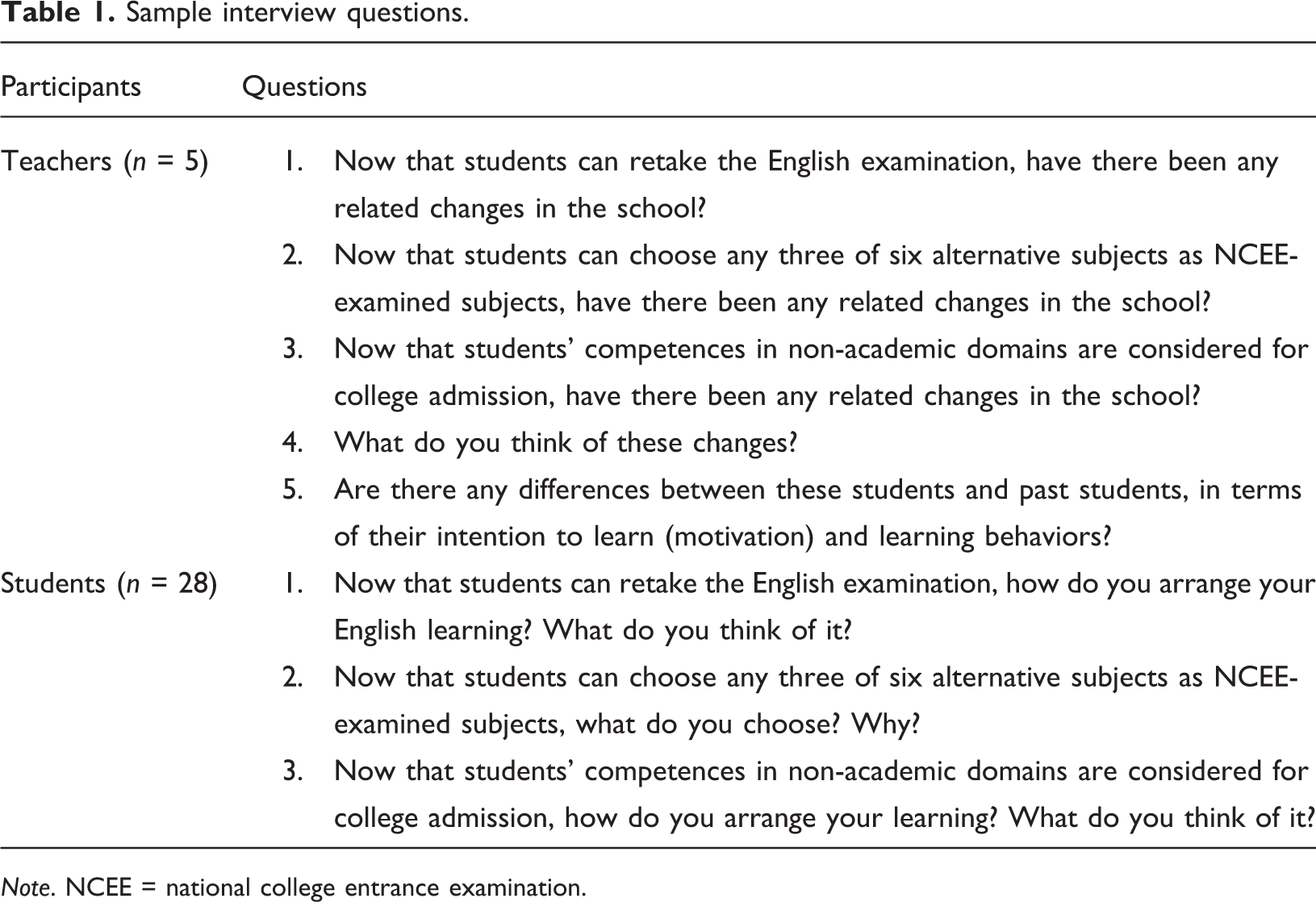
To ensure research validity, data were collected from multiple sources. The school changes (Q1) were mainly captured in teacher interviews, observations, and related documents (i.e., pamphlets and brochures). Students’ motivation and learning behaviors (Q2) were mainly captured in teachers’ and students’ interviews and observations. Each participant was interviewed in a private classroom in the school. The author developed the interview protocol under the supervision of an associate professor in the area of educational research. A senior high school teacher reviewed the interview questions to ensure they were understandable. Table 1 presents the sample interview questions.
Sample interview questions.
Note. NCEE = national college entrance examination.
The four classes were observed and audiotaped to provide rich and contextualized descriptions of the shared physical classroom setting and classroom activities. Researchers observed 24 class breaks (three 10-min observations per month for 8 months) and eight homeroom meetings (one 40-min meeting per month for 8 months) for each class. Normally, each school in China has time set aside weekly for homeroom meetings, which usually take around 40 min.
Data analysis
Following Creswell (2014) guidelines, all data—that is, interview transcripts, classroom audio recordings, pictures, and field notes—were imported into NVivo for reading, coding, and summarizing. The first author and another doctor of philosophy in educational psychology read through all data several times and coded them into categories and themes. Finally, two teachers and four students were asked to review the broad themes and confirm their accuracy and representativeness. The data collection and analysis were conducted in Chinese. The following section elucidates the themes derived from analysis. The quotations used were translated from Chinese into English by a bilingual expert.
Results
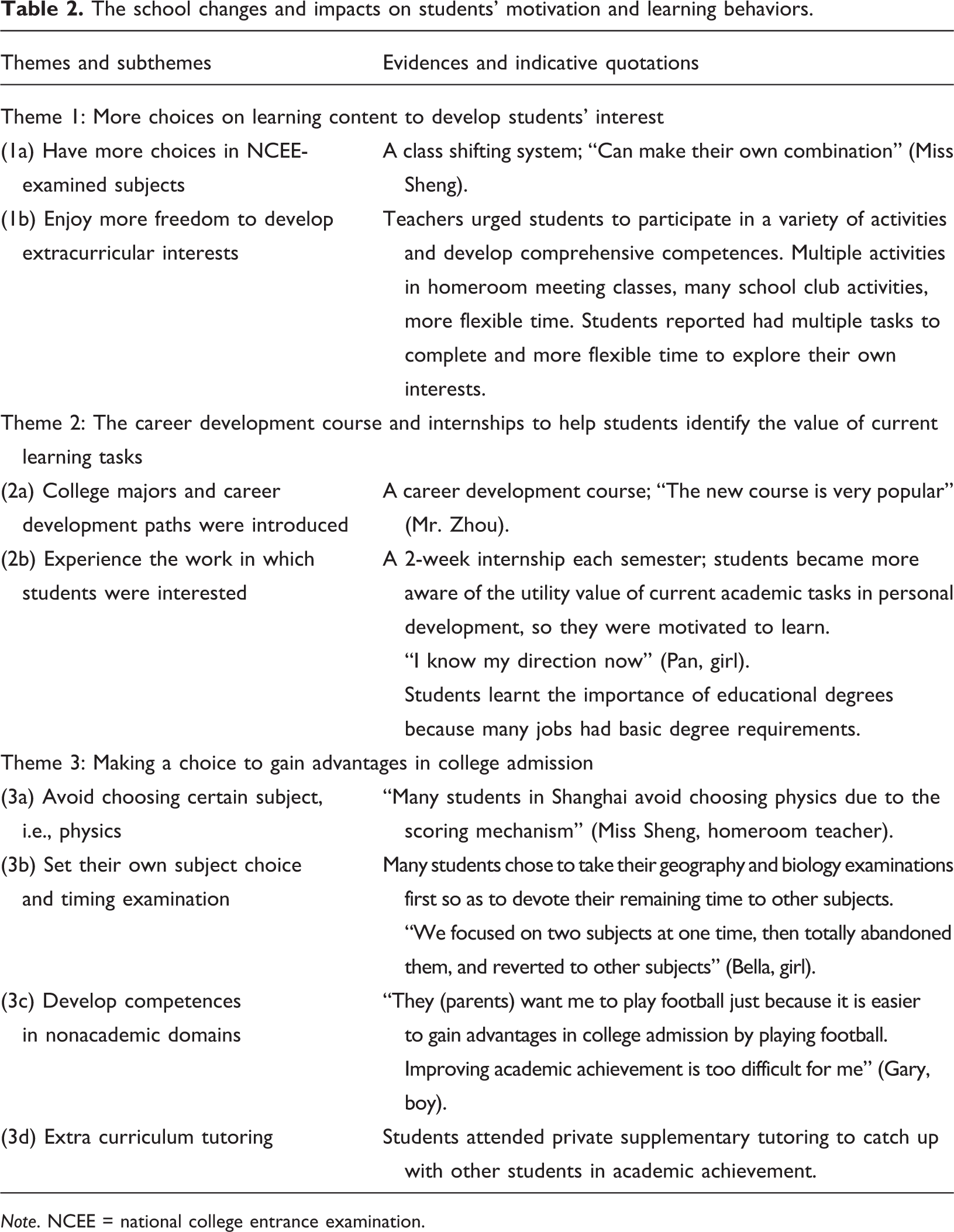
Three primary themes were identified regarding changes in the school in response to the college admission reform and the impacts of college admission reform and corresponding school changes: (1) more choices on learning content to develop students’ interest, (2) the career development course and internships to help students identify the value of current learning tasks, and (3) making a choice to gain advantages in college admission (see Table 2).
The school changes and impacts on students’ motivation and learning behaviors.
Note. NCEE = national college entrance examination.
Theme 1: More choices on learning content to develop students’ interest
Students in Shanghai can choose any three of the six alternative subjects (i.e., Physics, Chemistry, Biology, History, Politics, and Geography) as their NCEE-examined subjects. Some students appreciated this change and felt motivated. One student said, “I am interested in Physics, Biology, and History, and choose to learn these three subjects simultaneously. However, this could not be done in the past” (Yu, boy). Teachers agreed that students had more learning content choices and “can make their own combination” (Miss Sheng).
In response to the “3 + 3” system, a class shifting system (走班制) has been adopted. Before the reform, approximately 30 students who had chosen the same NCEE-examined subjects were arranged in one homeroom class. A group of fixed teachers taught these students, with teachers coming to the homeroom to give lessons. However, now students in the same homeroom class may choose different alternative subjects, which is hard for the long-standing universal administrative class system to adapt. Therefore, while students are divided into different homeroom classes to have compulsory classes together, they also have to move to other classrooms for specialized subjects. For example, the syllabus of Mr. Bian’s classes showed that there were 18 classes named “three choices out of six” out of 43 classes each week (41.9%). In these “three choices out of six” classes, students needed to go to different classes according to their personal choice.
Apart from having more choices in NCEE-examined subjects, students also enjoyed more freedom to develop extracurricular interests. In keeping with the reform, the grade manager pointed out that students’ achievements in multiple domains were recognized while applying for prestigious universities in Shanghai—not only their NCEE scores but also extracurricular awards, interview performance, social or community engagements, hobbies, and moral standards. Homeroom teachers also reported that, although much attention was still paid to examination outcomes, many other things also counted for college admission, so students were given more freedom to develop their interests in multiple domains. They strongly urged students to participate in a variety of activities and develop comprehensive competences, rather than focusing only on academic tasks. The nonacademic subjects that had been largely neglected in the past because examination pressure was emphasized. For example, Mr. Xu, a PE teacher, illustrated: It was impossible for a PE teacher to be a homeroom teacher in the past, since teachers of non-examined subjects, such as Music, Arts, and PE, had no place in the school and only teachers of NCEE-examined subjects could be homeroom teachers. Nowadays, it is quite different. Non-academic subjects are thought highly of, and I can become a homeroom teacher. (Mr. Xu, homeroom teacher) In the past, teachers required students to devote every minute to learning NCEE-examined subjects. Students’ personal interests that were not beneficial to academic performance were forbidden. But now, we want to make students’ curriculum vitae more colorful, rather than focusing on examination scores; many non-academic competences that were neglected in the past are emphasized now. You know, there are many evaluation standards. (Miss Li, homeroom teacher)
Theme 2: The career development course and internships to help students identify the value of current learning tasks
Students can choose any three of the six alternative subjects, and their choices should align with their majors for college study because due consideration will be given to both the university and major while screening students’ applications. For example, students who want to major in physics at university need to choose physics as an NCEE-examined subject. That is, students should be clear about what major to learn in university to some extent when they are still in the high school so that they can choose corresponding subjects for their NCEE examinations. It was found that the school adopted multiple measures (e.g., career development course and internships) after reform to help students choose their NCEE-examined subjects and future university majors. The grade manager reported that a career development course (职业生涯指导课) had been set up after the reform to introduce college majors and career development paths. In the course, the possible university majors and future careers for each of the six alternative subjects (Physics, Chemistry, Biology, History, Politics, and Geography) were introduced. Some university students were invited to share their learning experiences, and university teachers were invited to introduce majors. As the senior high school students were curious about university life and possible future careers, they admired these new measures greatly. Mr. Zhou stated, “Students were very excited about meeting graduated students and university teachers. The new course is very popular” (Mr. Zhou).
Additionally, in response to the reform, students were required to attend a 2-week internship each semester to experience the work in which they were interested. The back blackboard in classes presented pictures of students’ internship experience. Students reported the career development course and internship experience helped them determine which subject and major to choose. Importantly, the course and internships enabled students to link the current curriculum to their future career. They became more aware of the utility value of current academic tasks in personal development, so they were more motivated to learn. For example, Liang, who worked as an intern in a famous hospital, said, “Now I know why it is necessary to learn biology. I really want to develop new medicine to cure more people. I will make an effort to learn biology” (Liang, boy). Another student, Pan, reported that “During the 2-week internship, I build an understanding of what a film director does, and what competences and skills are important for a film director. I know my direction now” (Pan, girl). Students typically expressed their experience in terms, such as “I went to … I want to become/be … so it is important/I need to learn (certain subject) well now.” They also learned the importance of educational degrees in general, as many jobs had basic degree requirements. “Most jobs require at least a bachelor’s degree. Without it, you cannot get an interview” (Bella, girl).
The homeroom teachers also agreed that the career development course and internship experiences helped students identify the value of academic learning for future career development, which made students more motivated to develop competences. Miss Li said, Some students used to be very confused about why they need to learn. For example, why is it so important to learn English well since they do not use it in daily life? Now, they have the opportunities to go to the international companies and see how people do business. Many students understand why it is essential to learn a global language like English. So, they are more devoted to remembering the vocabularies and improving oral speaking and English writing. (Miss Li, homeroom teacher)
Theme 3: Making a choice to gain advantages in college admission
The more choices on NCEE-examined subjects and the multiple evaluation criteria were intended to develop students’ interest and promote mastery goals. However, some students focused on demonstrating competences and outperforming others and made strategic decisions to get quick payoffs on college admissions.
Firstly, some students avoided choosing certain subject, that is, Physics, although they recognized its value. According to them, it is relatively more difficult to get a high score in Physics than other subjects. Pan elaborated, “As we all know, Physics is very useful in daily life and is an important research area. Prestigious universities tend to require students to choose Physics, so top students who want to enter these universities have to choose Physics. That is, many high achievers will choose Physics. It is not wise to compete with these students.” Another student, Peter, avoided choosing Physics, although he was personally interested in it. He explained, “I did not choose Physics because it is the most difficult subject. It consumes lots of time but difficult to make it pay off. So, I choose Geography because it is easy for me to get a high score in Geography and the examination time of Geography is the earliest” (Peter, boy). Mr. Bian, who was a Physics teacher, supported Pan’s explanation, “Average students tend to avoid choosing Physics because many top students have to choose Physics due to universities’ policy. Our school is a good one, a higher proportion of students in our school choose Physics compared with other schools.” Miss Sheng made the similar point, Many students in Shanghai avoid choosing Physics due to the scoring mechanism. Our teachers also do not recommend average achievers to choose Physics. Top students are required by their target universities to choose Physics. They have many training in Physics and have attended Physics competitions. It is difficult to get a good ranking score while competing with the many high achievers although the raw score may not be so bad. (Miss Sheng, homeroom teacher)
Thirdly, whereas students’ competences in multiple domains were recognized, some students (5 of the 28, 4 low achievers and 1 average achiever), especially those with low academic achievements, found another path to colleges—by developing competences in nonacademic domains. For example, one low achiever, Gary, reported he had attended many extracurricular activities and “interest-oriented” classes in his free time to show his strength in nonacademic domains, even though he was not interested in these activities: To be frank, I am not interested in football. Why do I attend so-called interest-oriented class? I do not have advantages over others while competing on academic achievement, so my parents find another solution. They want me to play football just because it is easier to gain advantages in college admission by playing football. Improving academic achievement is too difficult for me. (Gary, boy) I am interested in painting. When I was in junior school, my parents expected me to focus on academic subjects but did not want me to learn Arts because it was too expensive and time consuming. Now that artwork is considered in college admission, my parents encourage me to focus more on painting. They find a famous teacher to teach me and make artwork portfolio for me to exhibit. (Bella, girl)
Discussion
By focusing on four classes in a high school in Shanghai, this study sheds light on changing practices in the school and on students’ motivation and learning behaviors in a changing educational context. The college admission reform and school changes enabled students to develop their interests and identify the value of academic tasks for personal development, which fostered their intrinsic motivation and mastery goals. On the other hand, some students used these opportunities to maximize admission possibilities, sometimes even at the cost of personal interests, reflecting their intention to demonstrate competences and outperform others (i.e., performance goals).
Many researchers have pointed out that classrooms are embedded in a macro sociocultural context, and thus change along with social and cultural changes such as educational reforms and economic development (Cheng et al., 2004; King & McInerney, 2014). The first research question concerned the school changes; this study showed that there were changes in the school to help students enter colleges. Specifically, in response to the more choices in NCEE-examined subjects, the school adopted a class shifting system, established a career development course, and helped students attend internships. In response to the multiple evaluation criteria, the school provided various activities and increased students’ free time so that students can promote their competences development in nonacademic domains.
Students’ motivation, learning behaviors, and achievements are shaped by school and classroom features (Ames, 1992; Kaplan & Maehr, 2007; Wang & Rao, 2019). The second research question concerned the impacts of college admission reform; results showed that students’ motivation and behaviors were influenced by college admission policy and school changes. Interest is a powerful motivator. Both students and teachers felt more choices were offered due to the college admission reform, and teachers found that students were more engaged in their interested activities. This is in line with findings in previous studies that students are more intrinsically motivated when they get autonomy supports (Urdan & Schoenfelder, 2006). Various theorists have proposed the need to give students multiple choices to sustain or enhance their interest (Ciani et al., 2010; Deci et al., 1996). According to self-determination theory, individuals have an inherent tendency to seek out novelty, challenges, and learning and feel enjoyment during the process (Deci & Ryan, 2000). Students’ interest and enjoyment play important roles in the quality and intensity of their engagement (Chirkov et al., 2003).
It is also essential to help students understand the importance and utility of learning content because not everyone can develop an interest in academic subjects despite their being necessary (Lee et al., 2010). The students got guidance on the choice of subjects and majors from the career development course and internships. More importantly, the career development course and internship experiences enabled students to identify the practical value of improving competences and developing skills for their future career development. School teaching often takes place under conditions that are artificial. The authentic context of internships gave students the opportunities to apply knowledge to solve real problems. Therefore, students were more eager to acquire skills and develop competences and were more engaged in learning. Many studies have shown that identifying the value of academic tasks for personal development can foster academic engagement and lead to higher learning outcomes (Deci & Ryan, 2012). For example, Wang et al.’s (2019) study of Chinese 11th-grade students found that students who sought to elevate their socioeconomic status through education were more likely to adopt the goal of improving their competences and skills, leading to their greater academic engagement.
Additionally, the new career development course and internships highlight the importance of the educational degree when seeking a job, which makes students more eager to enter university. Previous studies have shown that most Chinese teachers and parents continually stress the positive outcomes of obtaining a good degree and warn of the negative consequences of failing college entrance examinations (Chao, 1996; Wang et al., 2019; Zhu et al., 2008). The students in our study became more aware of the examination consequences because of the opportunity to experience the job market themselves.
Although the guiding thought of college admission reform is to offer students autonomy support and encourage their development of interest, some students made decisions designed to maximize their college admission advantages. Notably, students’ report indicated that many of them valued Physics, but some avoided choosing Physics because it may be difficult for them to get a high score. Physics is a pivotal learning area and is highly relevant to the science, engineering, and technology development, in particular. In response to the phenomenon of avoiding choosing certain alternative subjects (e.g., Physics), Shanghai government has subsequently introduced the patch mechanism to meet universities’ basic need of selecting students for the science, technology, and engineering majors (Ministry of Education of the People’s Republic of China, 2018). When more than 15,000 students choose certain subject (e.g., Physics), students will get a score of ranking according to the relative achievement level among all students who choose the subject (e.g., top 5% students get 70, top 6%–15% get 67, top 15%–25% get 64). However, when less than 15,000 students choose certain subject, the system will still assume that 15,000 students choose this subject. For example, students get 70 if they are the top 750 (5% of 15,000) and get 67 if they are the top 751–2,250 (top 6%–15% of 15,000). A more recent research has shown that the policy patch can stabilize the number of students select a certain subject and meet the needs of science, technology, and engineering development to some extent (Cui et al., 2019).
Additionally, many students attended private supplementary academic tutoring during their free time to catch up with others. Offering additional free time to students for their interest development has promoted more private supplementary tutoring, an activity that has expanded and intensified in China in the recent years (Liu, 2019; Zhang & Bray, 2019). To increase the possibility of admission, these students made the rational choice based on their understanding of their own specialty and expertise rather than out of interest. Although these decisions were made out of positive intention and should benefit students’ immediate examination performance, the choices were examination-oriented and may pose harm to their personal interest and future development. It is a question whether students can improve competences and enjoy learning through intensive preparation and exhausted measure aimed at improving performance immediately.
It was found that some students’ strategic choices were made out of teachers’ and parents’ guidance. For example, some teachers encouraged students to choose Geography and discouraged students to choose Physics and some parents forced their children to attend extra academic tutoring to improve examination performance. They kept on transmitting the performance-oriented ideology to students because they believed that examination performance was pivotal. Despite that the guiding thought of this reform to offer more choices for students to foster interest and encourage well-round development, the teachers and parents made highly rational guidance to students/children because most colleges and universities still adopt NCEE scores as the main channel. Compared to the changes of policies, it takes a much longer time to change parents’ and teachers’ beliefs and ideas. A huge challenge for the reform is that the performance-oriented ideology has taken root. The college enrollment was only based on the total scores in the past three decades. The finding signifies the need for more future research to investigate the role of parents and teachers in educational reform.
Many studies have indicated that East Asians tend to perceive education as a means to an end, rather than enjoying learning in and of itself (King & Watkins, 2012; Leung, 2006). In China, the importance of college admission examinations for upward social mobility has been historically emphasized (Wang et al., 2019). Before the NCEE, China had the civil service examination (started in the Sui Dynasty, circa 606 CE and officially ended in 1905) to select high officials to serve the emperor (Cheng et al., 2004). In the past, most people were eager to be employed in government positions, as it could bring power, wealth, social prestige, and pride to the family, as well as satisfy political ambitions. Some researchers claim that the civil service examination gives birth to China’s meritocracy (Elman, 2013; Twitchett, 1976). Individuals are given opportunities to elevate themselves based on merit and hard work, which minimizes the influence of family background. Many researchers have attributed Chinese students’ intention of elevating social status through education to the civil service examination in Imperial China (Li, 2006; Tao & Hong, 2014). While college admission reform resulted in school changes and students’ motivation and behaviors, traditional cultural values regarding education remain an enduring influence (Inglehart & Baker, 2000).
Implications
The study findings have important implications for practice and policy. First, while offering more choices to students, policymakers and schools need to provide necessary academic guidance to help students get a better understanding of themselves and majors in the university and learn to make choices. According to the Survey Report on College Enrollment in 2014, over 80% of examinees are not clear about what majors they want to learn when they need to fill out college applications (China Education Website [CEW], 2014). This study found that career development course and internships offered students guidance on the choices of subjects and facilitated the identification of the value of learning content. Students were thus more motivated to improve competence and develop skills. It is advised that policymakers promote more collaborations between universities and senior high schools so that students can be more aware of the strength and requirement of each university. For example, major introduction programs could be provided in university. University teachers explain key elements of majors and students visit university laboratories and classrooms.
Second, given the essential role of teachers and parents in shaping students’ learning, policymakers and schools should provide more family education programs and teacher development programs to introduce features and ideology of the college admission reform. The study suggests policymakers should pay attention to not only how students but also how parents and teachers perceive the reform and provide them with supports to change beliefs conflicted with reform features. It is necessary to make parents and teachers realize the importance of meeting students’ individualized needs for developing their competences, interests, and specialties. Spending time and efforts improving comprehensive quality and developing specialties can bring in lifelong benefits.
Third, policymakers and schools should be more aware of the positive effects of mastery goals and intrinsic motivation and promote these adaptive motivations. To promote students’ mastery goals and intrinsic motivation, teachers are advised to give students more autonomy support in the class, such as involving students in decision-making concerning regulations and rules and respecting their opinions. Students’ efforts, improvement, and mastering of skills should be recognized. Making mistakes should be viewed as part of learning.
Conclusion, limitations, and future directions
This study provides an in-depth examination of the school changes and students’ motivation and behaviors since the implementation of college admission reform in 2014. While the reform promoted some students’ intrinsic motivation and mastery goals—that is, students reported intention to develop interests and improve competences—some students made choices to maximize college admission possibilities at the cost of ignoring their personal interests. These findings suggest the need for additional research to more fully investigate the impact of college admission reforms.
The present study has several limitations. First, the findings of this study are limited to a small number of participants recruited from one elite public high school in Shanghai. However, only half of middle school graduates can go to academic high schools in Shanghai. Although low, average, and high achievers were recruited, the students in the elite high school were relatively high achievers citywide. College admission reform should have some general impacts on students of different academic achievements because they all seek to be admitted by universities, but the comprehensive evaluation standard should be more relevant to higher achievers who want to enter prestigious universities.
Second, most participants in our study came from middle to high socioeconomic status families. It is possible that students from families with different socioeconomic status levels may interpret the reform and school changes in different ways. For example, students from low-income families may be more likely to focus on examination performance because they should care more about changing their fate by entering college. As well, students from low-income families may not appreciate the added free time because they do not have money to attend extracurricular tutoring, which enlarges the gap between them and students from wealthier families. Future research should include participants from different bands of schools and from different socioeconomic status levels to investigate how college admission reform influences students of academic achievement levels and different levels of family socioeconomic status.
Third, the study sought to investigate the impact of college admission reform. However, due to time limits, it could not pay attention to school changes and students’ motivation and behaviors in Grade 12, when the NCEE is approaching. Future researchers investigating the impact of reform are urged to collect data for 1 or 2 years, including from students in Grade 12. Additionally, as a second pilot program for college admission reform was begun in four other provinces and municipalities (Beijing, Tianjin, Shandong, and Hainan) in 2017 (Yuan, 2018), future research should be extended to include those areas.
Footnotes
Acknowledgments
My very special thanks go to all the research participants and to Robert James for editorial assistance.
Declaration of conflicting interests
The author declared no potential conflicts of interest with respect to the research, authorship, and/or publication of this article.
Ethical statement
The study and informed consent letter were approved by the Human Research Ethics Committee of The University of Hong Kong in Hong Kong SAR, China.
Funding
The author received no financial support for the research, authorship, and/or publication of this article.
