




Abstract
Purpose:
This article develops a conceptualization of language pedagogy that engages the whole student. Instead of teaching language as if it were just a collection of grammar and vocabulary, we need to think about language as extending into many aspects of life and engaging whole people.
Design/Approach/Methods:
This article builds an original conceptualization of language learning and teaching that imagines language learning as a tool for developing whole people. It brings together research on learning culture through language, together with cultural-historical activity theory (CHAT), to develop a vision for language learning and human development.
Findings:
When we teach language, we should be helping people participate in ways of life. This goes beyond knowledge of subject matter, and it goes beyond any simple type of well-being. Language learning can immerse students in others’ worlds, and it can foster empathy and understanding across social and political divides. But it can do so only if we base our research and pedagogy on an adequate account of language and culture.
Originality/Value:
In our rapidly changing, increasingly interconnected contemporary world, we need a more dynamic conception of culture than has typically been used to design language teaching and learning. This article draws on CHAT, especially the ideas of dialogue and critique, to develop an account of language pedagogy that can engage the whole student.
Introduction
Language teachers have always known that learning an additional language requires learning about another culture. This is, in fact, one of the primary reasons for learning languages—to experience a different culture from the inside, so as to empathize with a broader range of others and to enrich one’s ability to appreciate varied human experiences. The most successful language learners learn culture and language together, such that teaching language and teaching culture cannot be separated (Ho, 2009; Valdes, 1986). Learning a language does of course require mastery of vocabulary and syntax. But language teachers sometimes underestimate the value of teaching culture, such that the potential of language learning for creating cultural understanding is not realized (Rao, 2002). In this article, I develop an account of language pedagogy that shows how culture can be central to language learning and how language learning can engage the whole student. This conceptualization provides a useful foundation for research on language teaching and a resource for practitioners working to make language learning the deeper and more enriching human experience it can be.
My argument has two interrelated dimensions. First, I show how cultural-historical activity theory (CHAT) can undergird an approach to language learning that more effectively integrates language and culture and contributes to educating the whole student. Second, I articulate a vision for language learning as intercultural communication, a vision for rapprochement across difference catalyzed by language learning. I am well aware that some contemporary political tendencies and enduring human dispositions work against my hope for increased intercultural understanding through language learning. But those of us who have dedicated our lives to research and improved practice in this field nonetheless need an ideal to work toward.
My conceptualization of language pedagogy has six key terms: intercultural communication, culture, innovation, activity, dialogue, and critique. I will define these terms and articulate their interrelations, reviewing existing literature to build an account of how language teaching and learning can live up to their potential as an educational and a human enterprise. Educating the “whole person,” when teaching language, requires engaging with the cultural ways of life within which that language lives. People use language to participate in and to create social, emotional, and ethical activities. Ignoring this and treating language as a decontextualized set of facts and techniques misses the opportunity to engage the whole student. My vision goes “beyond well-being” in advocating for respectful understanding across differences. Ideally, language learning is not just about developing a more “whole” individual. It also works toward an ideal of intercultural communication, a vision for life in a plurilingual world.
Effective intercultural communication happens when language learners have the ability to interact effectively in a new language with members of different cultures (Byram, 1997). Speakers must be aware of their own and others’ cultures, and they must have the linguistic and pragmatic skills necessary to navigate another culture (Guilherme, 2000; O’Dowd, 2003). I use “intercultural communication” in a broad sense as the overall goal of language pedagogy. Language learners ideally can use their knowledge of phonology, lexicon, grammar, and pragmatics to understand and interact empathically with diverse others, as whole human beings engaging whole others. As Hornberger (2009) argues, multilingual education offers “the best possibilities for preparing coming generations to participate in constructing democratic societies in globalized and intercultural world” (p. 197). I agree that intercultural communication is an ethical as well as a cognitive and practical goal. I envision an improved world in which more people speak multiple languages and can engage productively with others because they have learned about culture through language and language through culture.
To create language pedagogy that facilitates more effective intercultural communication, we must have an adequate account of culture. In this article, I review literature on culture and human activity, blending it with literature on language learning to develop an adequate account of language learning and intercultural understanding. Traditional definitions of culture posit patterns of human behavior that include symbols, languages, traditions, beliefs, and values shared by members of a social group (Byram & Feng, 2005; Fantini, 1999). Groups that live within bounded areas do often share practices, ideas, and values, but in recent times, it has become clear that culture cannot be construed as something shared within a contiguous, homogeneous group. Anthropologists have shown that culture moves and mixes, flowing and hybridizing, such that any group and any locale contains heterogeneous practices, ideas, and values (Appadurai, 1996; Street, 2005). CHAT makes a similar point, describing the tensions and contradictions within cultural systems and the historical change that inevitably comes about as these contradictions are resolved and new contradictions emerge (Engeström, 2001). Preparing language learners to understand culture and engage with others is not just a matter of teaching them stable, homogeneous skills but also preparing them to deploy heterogeneous linguistic and cultural repertoires such that they can effectively navigate contested spaces (Rymes, 2014).
The heterogeneous, changing nature of culture is even more important in the contemporary technology-mediated world. Globalization and new technologies have opened dramatic new opportunities for language teaching and learning (Thorne, 2003). Technology brings learners together for web-enabled interactions, provides innovative learning platforms, and offers many new ways to encounter other cultures and languages. I have done substantial research on the affordances of social media and other technologies for language learning (Fisher & Kim, 2013; Kim, 2011; Kim & Blankenship, 2013; Kim & Jang, 2014; Kim & King, 2011; Kim et al., 2018; Wang & Kim, 2014), as have many others (e.g., Belz & Thorne, 2006; Levy, 2007). We now have significant evidence that new media technologies allow learners not only to process but also to practice culturally appropriate speech and interaction autonomously and at an accelerated rate (Sercu, 2004). However, the language teaching that takes place through technology is generally focused on vocabulary and syntax and does not engage culture as effectively (i.e., Duolingo, Hellotalk). We must design ways to benefit from the potential of language learning technology while tying it to a more holistic vision of education that includes learning culture. I use the term “innovation” to capture the positive dimension of what technology can bring. To help language learners develop repertoires that facilitate intercultural engagement in the contemporary world, researchers and language teachers must move away from static conceptions of language and culture and acknowledge constant innovation. Cultures change, languages change, and the media through which we communicate also change. We are preparing language learners to navigate this innovation, hoping to expand their repertoires so that they can participate appropriately and effectively in new contexts.
The most comprehensive account of how learners deploy cultural tools like language to accomplish social action and navigate the heterogeneous, changing social world is CHAT (Cole, 1996; Engeström, 1987; Leont’ev, 1981; Vygotsky, 1978). In this article, I review key concepts from research in activity theory to show how language teaching can facilitate more robust intercultural engagement. As the name implies, the basic unit of analysis for CHAT is human activity. People achieve their goals using tools to act. Engeström distinguishes between “short-lived goal-directed actions” and “durable, object-orientated activity systems” (Engeström, 2000, p. 960). Activity systems become sedimented as many people use similar tools to accomplish similar ends, with roles and tools often becoming institutionalized. Activity systems are dynamic and internally contradictory, and they change over historical time. Productive change can occur through dialogue and critique. Dialogue allows the heterogeneous voices participating in an activity system to engage with each other and create new understandings and practices. Critique allows participants to engage with contradictions, pushing the system forward by overcoming some of them while inevitably creating new ones.
In this article, I review relevant literature to articulate a more adequate model of intercultural communication and engagement using the concepts culture, innovation, activity, dialogue, and critique. I address ways in which such communication is difficult but not impossible in contemporary political environments. This model can support both research and practice as we work together to help language learners participate more effectively in others’ worlds. By adopting such an approach, we will embrace language teaching as an opportunity to teach whole students to participate in cultural activities. We might also go beyond mere well-being to work toward a world that embraces contested, respectful, dynamic intercultural communication.
Intercultural communication in the contemporary world
Intercultural communication has been a goal for researchers and practitioners for some time, and many have recognized that we must teach language and culture simultaneously. I propose an enriched form of language pedagogy, one based in activity theory and focused on dialogue (Bakhtin, 1986) and critical consciousness (Freire, 1970). This enriched account is particularly important in the contemporary world—a world that offers opportunities because of instantaneous global communication and the rapid flow of people and ideas, but also one that poses challenges because of nativist populism in many places. I nevertheless have faith that technology-enhanced language teaching and learning can provide opportunities for learners to experience cultural encounters and become effective intercultural communicators in ways that lead to greater understanding and engagement.
A review of models for intercultural communication
The target for language pedagogy as I envision it is what Kramsch (1993) calls the “intercultural speaker”—a speaker who is able to employ linguistic and other signs to engage in effective communication with diverse others. This sort of intercultural communication demands that language learners develop both linguistic and cultural repertoires, skills that allow them to navigate linguistic and cultural expectations effectively (Rymes, 2014). White (1995) describes the cultural components of this—the behaviors, attitudes, and politics that can help people and collectives perceive, honor, and respect the cultural differences between themselves and others. Research on intercultural communication has shown that, in order for language learners to communicate effectively with others from different cultures, they must develop four things: awareness of one’s own cultural worldview, acceptance and appreciation of others’ cultural differences, knowledge of various cultural practices and worldviews, and cross-cultural skills (Byram & Feng, 2004; Gudykunst, 2005; Gudykunst & Kim, 1984).
Two classic models of intercultural communication come from Fantini (1999) and Byram (1997). Fantini (1999) emphasizes the importance of cultural awareness, cultural knowledge, and cultural skills, including linguistic competence. An educational process must address not only knowledge (through courses and formal education) and skills (through methods courses and practica) but also attitudes and awareness. From intercultural experiences, students not only learn about the target culture and language, but they can also be moved to introspection, questioning themselves and their own perspectives and cultures (Woods, 2007). Byram (1997) describes three realms of intercultural communication—linguistic, sociolinguistic, and discursive—as well as five nonlinguistic elements: knowledge (savoir), skills/behaviors (savoir comprendre, savoir apprendre/faire, and savoir s’engager), and attitudes/traits (savoir être). Woods (2007) adds the ability to negotiate meaning, skills of interpreting and relating, skills of discovery and interaction, and critical disciplinary awareness.
The knowledge, skills, and dispositions described in these established models of intercultural communication are useful. But to provide a firmer foundation for research and practice in language pedagogy, we need a more comprehensive approach, one that takes into account more dimensions of human activity. I argue that CHAT can help us create such an account. Language learning and the intercultural engagement it can make possible are not simply a matter of acquiring competencies. They also require participation by whole people in cultural activities.
Using research on activity theory to understand language learning
We need to model how language pedagogy can facilitate genuine intercultural communication in the contemporary world. Research in activity theory has shown that such a model must include but go beyond language and culture, also taking into account individual action, mediating tools and larger social realities. Engeström (1987, 2001) describes how “activity systems” provide these components. Figure 1 represents Engeström’s model of human activity. Vygotsky (1978) describes the top triangle—subject, object, and mediating artifacts—in his psychological and historical account of learning and development. Human actors try to attain an object using mediating tools, as when someone tries to influence another using language to communicate or when someone uses a mnemonic device like a string around the finger to facilitate memory. Vygotsky emphasizes “mediated” processes through which tools such as language, computers, and other artifacts allow individuals to carry out activities. The most important human tool is language (Stout & Chaminade, 2012). When we think about a complex problem, for example, we do so using linguistic categories. Like a pole vaulter using a pole (Wertsch, 1985), we seamlessly combine our own capacities with that of the tool to accomplish our goal. Vygotsky’s “first-generation” theory was limited in its unit of analysis and remained individually focused, however (Engeström, 2001). Leont’ev (1979) developed “second generation activity theory,” expanding the model to include an interrelated system of social components. Society provides not only mediating artifacts but also rules, community, and a division of labor that together facilitate and constrain the subject, the object, and the tools.
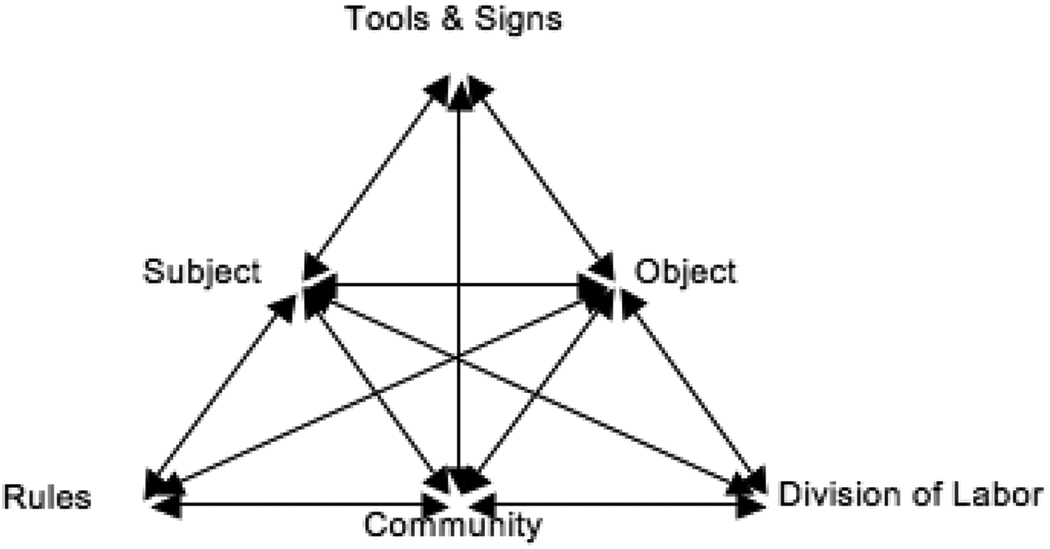
The structure of a human activity system.
Engeström (2001) summarizes subsequent research and describes five central principles of activity theory. First, a collective, artifact-mediated activity system is the prime unit of analysis. As Vygotsky (1978) describes, a “unit of analysis” is the smallest unit that preserves essential properties of the whole. The H2O molecule preserves the essential properties of water, for example, but breaking it into hydrogen and oxygen molecules would not. Hydrogen and oxygen molecules burn, but water does not. Similarly, an activity system is the smallest unit that preserves the essential properties of human action. Individual behaviors or intentions, local relationships and constraints, and other smaller scale units can be essential pieces of an activity system, but by themselves they are too small to capture the units that constitute meaningful human activity. Whatever phenomenon we are analyzing, we must look for the activity systems that constitute the relevant processes. Second, activity systems are multivoiced. They contain multiple points of view, traditions, and interests, and the synergy or tensions among these are essential to the character of the system. Other voices besides the subject’s enter through the tools and rules that have been created by others, the relevant community, and the division of labor in the larger society. As we will see in the following, the presence of multiple voices opens up possibilities for dialogue. Third, activity systems change over historical time and across geographic space. Following Hegel (1966) and Marx (1964), Vygotsky (1978), Leont’ev (1979), and Engeström (2001) emphasize the historical character of human existence. As analysts we must not assume that our constructs describe eternal, stable processes. We must instead expect and trace historical changes in key activity systems. Fourth, contradictions are inevitable in all activity systems. Contradictions are not problems or conflicts. In activity theory, a “contradiction” is a productive source of tension, as it can generate change and development (Engeström, 1999). Thus, activity theory fits with my emphasis on innovation and the fluid nature of culture. As we will see in the following, contradictions also open the possibility of critique, as people engage with contradictions and push activity systems forward through time. Fifth, activity systems can be transformed “expansively” (Engeström, 2001). Progress in human life and institutions can occur when activity systems change fundamentally, replacing outdated assumptions with new approaches to the object. I argue that language teaching and learning have reached a historical point where such transformation is both possible and necessary. Replacing outdated accounts of stable cultures and isolated language learners can transform language learning such that it produces intercultural communication and engagement. But this will require work in the material world to change relevant activity systems. In this article, I take one step toward this, offering a reconceptualization of language pedagogy that I hope can inspire research and practice. In other research and teaching, I do practical activity in language learning, working toward this larger goal.
Various scholars have applied Engeström’s model of an activity system to language teaching and learning. For example, one relevant activity system positions the language learner as the subject. The object is an abstract “‘raw material’ or ‘a problem space’ at which the activity is directed and which is molded or transformed into ‘outcomes’ with the help of…tools” (Lantolf & Thorne, 2006, p. 223). For language learning, the object is use of a language to participate in culturally effective ways. Tools and signs are symbolic and material artifacts used to attain the object. For language learning, these include the language itself, other language learners and native speakers that the learner interacts with, media in the target language, pedagogical strategies, tools and activities, and the range of resources newly available through information technology. Rules are implicit or explicit guidelines within the classroom and other spaces in which language learning occurs (Walshaw & Anthony, 2008). Community involves the developing relationships among participants who share the same object (Lantolf & Thorne, 2006), primarily those involved in language teaching and learning but also those participating in activities in the target language for other ends. Division of labor refers both to the horizontal actions and interactions among community members and to “the vertical division of power and status” (Engeström, 1993, p. 67). All activity systems involve differential status and access to resources, sometimes for good reason and sometimes not, and such hierarchies are often the source of contradictions. Language classrooms involve hierarchies between teachers and students, and language learning involves a hierarchy between fluent speakers and learners. When the target language is sociopolitically dominant, like English, language learners are often positioned as being on the global periphery, with implications for their self-image and their access to resources.
Various researchers have applied such an activity-based approach to language learning. Storch (2004) explores language learning in a university English as second language (ESL) class, for example, describing how divergent motives and goals create variations in interactional pattern. Participants enacted divergent types of dyadic interaction: (1) collaborative, (2) dominant/passive, (3) expert/novice, or (4) dominant/dominant. By tracing how these different patterns emerged, she shows how consideration of an entire activity system, including interactional and cultural context, can illuminate the different patterns learners enact and the type of language learning they do. Li and Kim (2016) extend Storch’s approach to study language learning that took place while language learners developed wikis. Examining the dynamics of peer interaction across writing tasks, this research shows how two ESL groups working on identical tasks in the same wiki space created very different interactions. The interactional patterns also changed within each group across time. With shifts in elements of the activity system, one group went from being “collaborative” in the first task to being “active/withdrawn” in the second; another group went from “dominant/defensive” to “collaborative.” Members of the groups changed how they provided scaffolding to each other, and in doing so, they changed the activity systems enough to create fundamentally different interactions. Work like this on language learning in different environments illuminates how language learning is embedded in cultural activities and identifies factors that inhibit or facilitate intercultural communication.
Thorne (2004) explores how 16 students developed, implemented, and assessed educational innovation through peer reviewing processes. Participants developed more robust dialogic interactions through peer review. Novice students received feedback and comments from more advanced students, and this helped resolve comprehension problems. The near-peer role modeling also created solidarity between beginning and advanced students. The advanced students came to identify themselves as developing language experts, using the practice of reciprocal teaching. Thorne shows how an activity theory approach captures the various components of this successful language learning pedagogy, and he uses relevant concepts to describe how in some cases language learning can facilitate intercultural communication. In a similar study, Feryok (2012) describes how Armenian English as a foreign language (EFL) teachers’ experiences and actions outside of a professional development classroom facilitated language teacher agency in the classroom. The teachers took actions that contributed to their communities, and in this way, professional development became not only a site for personal reflection but also a site for the development of professional identities that came to infuse their teaching.
Finally, Blin and Jalkanen (2014) suggest three educational design models for new digitally enhanced learning spaces and tools, describing learning spaces that offer new affordances to language teachers and learners and increase the cultural potential of language learning and teaching. Applying CHAT, they describe how design-based research has helped designers, teachers, and researchers create technology-rich environments for language learning. They provide a methodology for enabling teachers and designers to make more informed decisions in creating learning activities and interventions that make effective use of technologies. They give examples of incorporating wikis, videoconferencing, and video blogs into language teaching. All of this research illustrates how activity-theoretical designs can help practitioners create complex language learning environments that facilitate linguistic competence and intercultural communication.
Using activity theory to move toward intercultural communication
This section builds on these prior applications of activity theory to language learning, delineating key assumptions and connecting them to a vision for whole students learning language and learning culture. Activity theory has limitations, as discussed by Hartley (2009), Nicholl and Blake (2013), and others. But it nonetheless represents a promising approach for conceptualizing an ideal of learning language and learning culture.
Figure 2 represents the activity system of teaching language and teaching culture. To achieve successful intercultural communication, teachers and learners use various tools. “Linguistic Skills and Internet” at the top of the figure refers to the cultural and linguistic skills teachers make available as well as the internet-mediated tools that teachers and learners can use. Learners must become familiar with rules and cultural knowledge by participating in the realities of the new linguistic and cultural world via face-to-face or online interaction. Divisions of labor create hierarchies that teachers and learners might be aware of. They display ongoing critical awareness—including multicultural sensitivity, empathy, and responsibility—which will encourage communication and negotiation among learners and others in the community. This will yield the skills and dispositions required for deeper intercultural engagement.
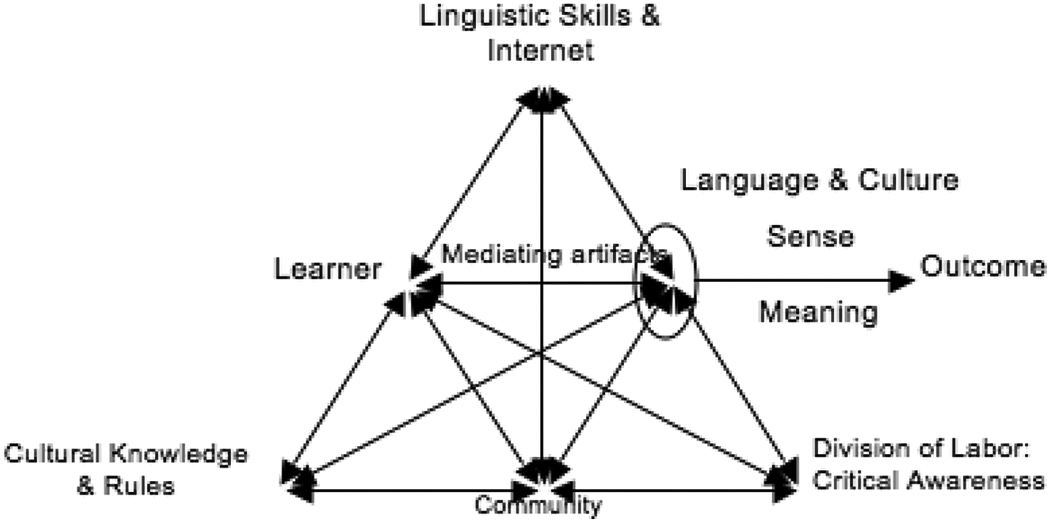
A second-generation activity-theory model based on the work of Engeström.
We often conceptualize the outcome of language learning as fluency or competence, as if this is a stable state. Some prior work has usefully represented language learning as ongoing or spiral instead. Coffman, for example, shows that some stages are continuously repeated, constituting a “spiral of learning” (Coffman, 1991, p. 52), and Kim’s (1988) model of cross-cultural adaptation contains a similar idea. Street suggests that “culture is a verb—a process that is contested, not a given inventory of characteristics” (Street, 2000, p. 19). From an activity theory perspective, fluency is always partial and new skills can always be learned—in fact, new linguistic facts are always emerging, so even native speakers have only partial and developing mastery of a language.
A language learner, then, aims to develop what Rymes (2014) calls “repertoires” in the target language. Language pedagogy facilitates this by providing tools and activities, some of them involving information technology. These tools carry social implications because they presuppose rules, communities, and a division of labor. To develop intercultural communication, the language learner must navigate these social realities and deploy new repertoires to communicate effectively in cultural context. As tools, rules, communities, and the division of labor change amidst the rapid innovations of the contemporary globalizing world, language teachers and learners must adjust both our conceptualizations and our practices. I will argue subsequently that this requires us to emphasize dialogue and critique, particularly in contemporary political environments with resurgent nativist populism. To facilitate deeper intercultural communication, language pedagogy must foster dialogue and encourage acceptance of multiple-voicedness. Learners must also engage in these dialogues with a critical attitude. Contemporary environments make this difficult, but it is nonetheless possible. As Engeström describes, any activity system “is constantly working through tensions and contradictions between its elements. Contradictions manifest themselves in disturbances and innovative solutions. In this sense, an activity system is a virtual disturbance-and-innovation-producing machine” (Engeström, 2005, p. 95). Like “contradiction,” “critique” is essential to progress, to the expansive development of activity systems. Fostering critical attitudes in language learners means preparing them to advance their own and others’ ideas and practices by noticing contradictions and facilitating advances toward greater intercultural engagement.
The next generation of activity theory
My goal is to point the way toward language teaching that can accomplish more extensive, quality intercultural communication. Language teaching and learning of this type engages whole students. To accomplish this, we must transform the activity systems through which language teaching and learning typically take place in contemporary educational settings. This requires that we attend to more than one activity system at a time because contradictions and synergies between systems can be crucial to expansive transformation of individual systems. Engeström (2001) describes this process in what he calls “third generation” activity theory, which considers relations among activity systems. Second-generation activity theory was developed by Leont’ev (1979) and added rules, community, and a division of labor to Vygotsky’s original system that included subject, tool, and object. In the last section, I have described how adding these three collective components of rules, community, and division of labor can enrich our understanding of language teaching and learning. In the third-generation activity theory, Engeström adds an additional system that interacts with the first.
As shown in Figure 3, activity systems interact with each other. Figure 3 represents three activity systems. The system on the top left is the one described above, in which the language learner is the subject and language learning is the object. The system on the top right covers the broad range of activities in which competent speakers of the target language communicate to accomplish practical, everyday objects like conducting business transactions, developing relationships, and gathering information. The tools in Activity System 1 include curriculum materials, the teacher and other students, and other familiar aspects of the language classroom. The tools in Activity System 2 include whatever tools competent users of the target language use to conduct their everyday activities. The rules, community, and division of labor in the language classroom are familiar, involving normal classroom habits and guidelines, the identities and subgroups among students, the hierarchical relationship between teacher and students, and so on. The rules, community, and division of labor in Activity System 2 involve various configurations, depending on the particular activity in question.
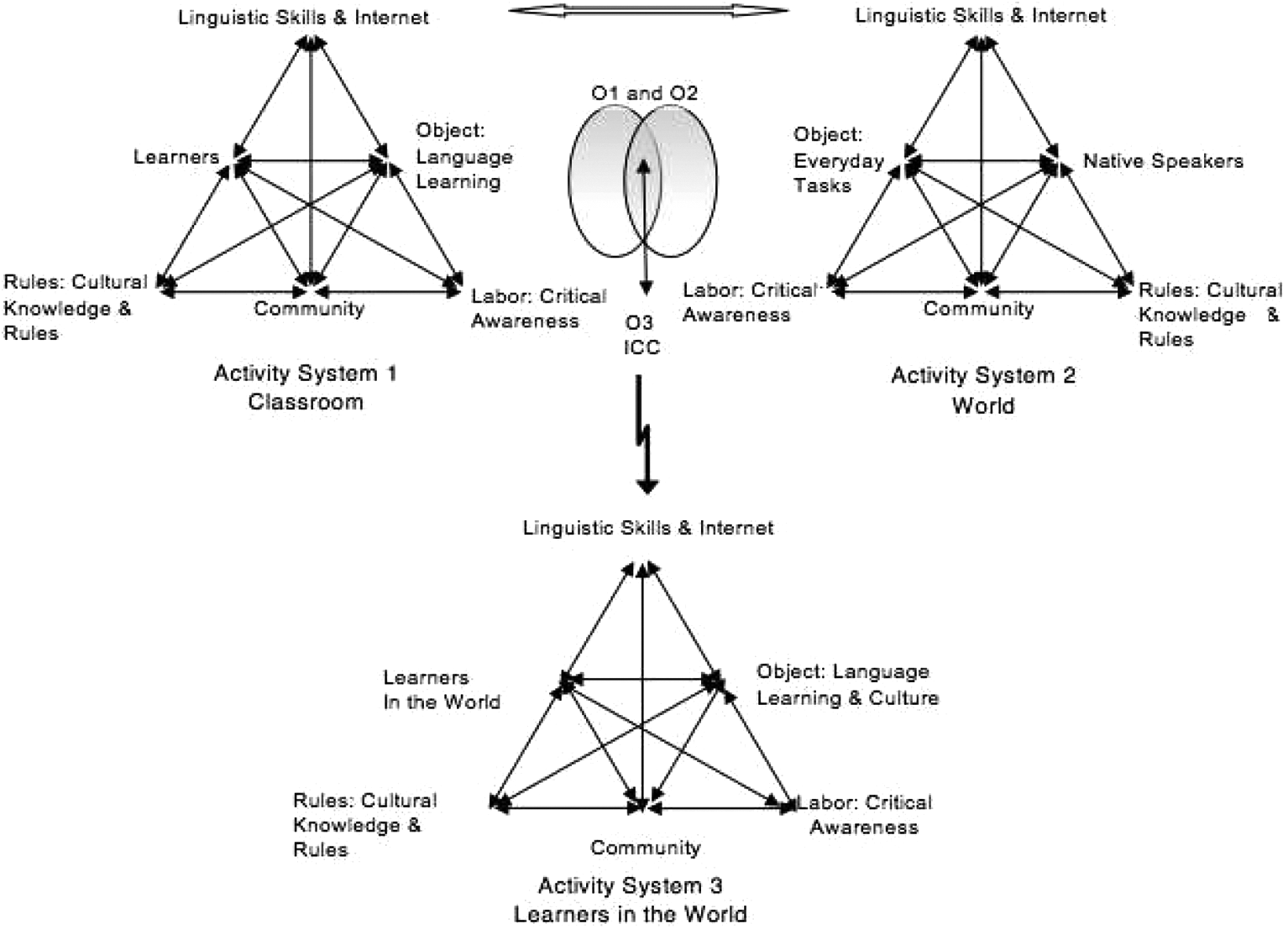
Third-generation activity theory in the language-teaching context.
The figure shows the two sets of tools in Activity Systems 1 and 2 as connected by an arrow at the top of the diagram, representing some commonality or overlap. Language teachers and learners use various props from everyday life in the target culture as part of their instructional activities. Language textbooks have for a long time included vignettes and descriptions of practices from the target culture, for example. In the contemporary world, as described earlier, technology has made extraordinary amounts of such material available to language teachers and learners. I argue that language teachers and learners should take more extensive advantage of technologically mediated material from the target culture and in the target language. The internet and the social media it facilitates provide opportunities for learners to engage in target language use and accomplish two related goals: Internet-mediated resources facilitate learners’ acquisition of phonology, grammar, lexicon, and pragmatics, and they provide opportunities to experience aspects of the target culture, as culture is woven into language use. I am arguing that learners should increase the overlap between the tools in Activity Systems 1 and 2 as a strategy for both more effective language learning and more effective development of intercultural communication and engagement.
In Engeström’s account of third-generation activity theory, activity systems ideally “expand”—they develop the capacity to accomplish new objectives as they interact with each other. Activity System 3 is a transformed activity that emerges as contradictions between Activity System 1 and Activity System 2 are worked out (Daniels & Warmington, 2007). Figure 3 represents this happening for language teaching and learning. The contemporary internet-mediated environment makes possible a fundamental change, as language teachers and learners use new technologies to expand their repertoires by experiencing and practicing the target language and culture. It is of course the case that many technologies for language learning do not include culture at all, just teaching decontextualized vocabulary and syntax. This is not the kind of technology I am envisioning. I mean, instead, the use of the internet to expose language learners to language use in context. The figure shows how tools for Activity System 1 overlap more extensively with the tools for Activity System 2, as language learning relies more heavily on technologies drawn from everyday life in the target culture. This partly overcomes a contradiction that has robustly been present in language teaching and learning, its decontextualization from authentic cultural activities. The increased overlap has the potential to transform both activity systems if technology is used to provide access to language used in cultural context instead of merely teaching it in a decontextualized way.
The figure also represents an overlap between the objects of Activity Systems 1 and 2, represented as ovals O1 and O2. The object of the first activity system is competent language use on the part of students. The object of the second activity system is whatever goal the everyday activity has—accomplishing a task at work, building a relationship, communicating information, and so on. The objects of the two systems overlap because language teachers and learners intend for learners to participate competently in some everyday activities in the target language and thus to engage with others as more whole human beings. By incorporating contemporary internet-mediated technologies into the language classroom, language teachers and learners can expand this area of overlap, expanding learners’ repertoires such that they are able to participate in more areas of everyday practice in the target language and culture.
Activity System 3 represents my vision of deeper intercultural communication, in which language learners are able to participate with target language speakers in activities to achieve everyday tasks using the target language and to develop and demonstrate their respectful engagement with the target language and culture. This third activity system emerges as a possibility, as a desired potential outcome of transformed language teaching, if language teachers and learners take fuller advantage of new technologies in ways that engage learners with contextualized activities. Using technology to connect language learners with language used in cultural contexts, educators treat students as more whole human beings. Emotional, relational, ethical, and other dimensions of human activity are accessible to language learners who use language in the context of activities. Teachers also become learners in this process. As language learners participate in more internet-mediated activities in the target language, and as teachers direct their attention to the cultural presuppositions embedded in these and other instances of target language use, deeper intercultural communication can emerge as language learners participate more effectively and sensitively in the world.
In some cases, this transformation is already happening (Daniels & Warmington, 2007). In all cases, it could happen more. Such an outcome would partly overcome what CHAT would call contradictions in traditional language teaching. Instead of decontextualized language use, learners would engage in more authentic activity and experience personal transformation. Instead of treating language as a separate system, learners would master the inextricable interconnections between language and culture. This would also overcome contradictions in everyday activity in the target language in at least one way. As language learners from other cultures become able to participate in everyday activities in a target language—with some of these activities mediated through the internet such that they can participate from home—the target culture and society may also change. Open, dialogic communication with others in a target language could change those activities in small ways. If the intercultural communication has the dialogic, critical character that I envision, then it might catalyze deeper transformation over time.
To accomplish the transformation from Activity System 1 (traditional language teaching) and Activity System 2 (traditional everyday practice in the target language) to Activity System 3 (deeper intercultural engagement as language learners interact with others in the world), language teaching and learning must change. I have argued that language teachers and learners must take advantage of new technologies to make this possible, using those technologies at least in part for engagement in whole activities and not drill in necessary but decontextualized skills. And I have argued that we need a new conception of culture, one that moves beyond bounded homogeneous groups to heterogeneous flows and hybrids. Next, I go on to argue that we must also encourage dialogue and critique in the language classroom and in second language use.
Dialogue and critique in human activity
As Engeström (2001) describes, activity systems are inherently multivoiced. Even when an actor is alone, the tools that mediate activity are borrowed from the social world. Language, for example, is an important tool in most human activities, and, as Bakhtin (1981) argues, speakers do not own language. They must “rent” it from the collective, and the words they rent “taste of” or “echo with” the uses others have made of them. All tools have a social history, carrying traces of the understandings and situations of those who created them and those who have used them for characteristic purposes. As activity theory describes, actions are also embedded in rules, communities, and the division of labor, such that others’ voices and interests influence even solitary action. This multivoicedness is to be expected, given that humans are social creatures who depend on the accomplishments of others to survive and thrive in the world.
Multivoicedness creates an opportunity. It opens up the possibility of dialogue, as Bakhtin (1981) describes. Dialogue occurs when speakers use utterances to accomplish their objects and listeners complete an active response (Bakhtin, 1986). Dialogue offers a transaction between human participants with respect to the object of their action (Wells, 2007). In my vision of language teaching and learning, language learners engage in dialogue with teachers, other learners, and competent speakers—both as a route to learning phonology, syntax, semantics, and pragmatics and as a route to understanding and respecting other languages and cultures. This does not always happen, of course, but it should be an ideal we aspire to. “Dialogue” here does not just mean “conversation,” in a narrow sense, although conversation is certainly crucial for language learning. In activity theory terms, “dialogue” means that other voices are present, both as concrete others and through the traces of their voices that are embedded in tools, rules, and habits. It also means that language learners are open and respectful toward these other voices, working with them to create respectful understanding and engagement.
In dialogic language learning, learners attend to the other voices embedded in another language and culture. This means that they open themselves and perceive reality differently, through alternative categories embedded in the other language. At the level of grammar, this means appreciating that other languages segment the world differently and that it can be reasonable to understand the world that way. Lucy (1992), for example, shows how speakers of diverse languages think about the world differently because of fundamental differences in grammatical categories. At the level of non-grammaticalized cultural understandings, language learners must attend to the voices embedded in language and other cultural tools so as to understand the alternative worldviews prevalent in another language and culture. Ochs (1988), in another example, describes alternative orientations between infants and caregivers in Samoa and in the United States. She shows how these practices are woven into widely circulating cultural beliefs about the importance of sociality and kin and how linguistic habits are inextricable from these cultural belief systems. If they engage in dialogue, language learners can come to understand social reality differently and perhaps appreciate alternative ways of imagining human nature and the social world. As language learners progress, they can move beyond understanding to modify their behavior to be more appropriate in the second language context. Ultimately, by attending to and taking on others’ voices, they can learn to think and act from another cultural perspective.
Technology can facilitate such dialogue. Wegerif describes role of technology and dialogue in education. He defines dialogue somewhat more narrowly than I do, as “chains of questions in classrooms both through teacher–pupil dialogues and through establishing communities of inquiry” (2007, p. 27), but he then extends his account from discourse between respondents to shared knowledge and communities of inquiry (Wenger, 1998). He usefully describes dialogue as “being about the open and polyphonic properties of texts and utterances,” and as facilitating “the appropriation of social discourses as a goal in education” (Wegerif, 2007, p. 27). He illustrates this by describing the potential that computer-supported collaborative learning, tutorial software, and simulations have to facilitate scaffolding and dialogue. He also shows that even simple email exchanges can open spaces for reflection within the curriculum, spaces that allow children to make learning more personally meaningful and motivating. By providing language learners with opportunities to observe and participate in more culturally appropriate activities in the target language, technology allows language learners more exposure to other voices. By making others seem closer and allowing language learners to interact with others and engage in activities characteristic of another culture, technology can encourage language learners to adopt an open, dialogic approach.
Dialogue versus dialectic in activity
Researchers have used two different terms, “dialectics” (Engeström, 1999, 2001; Roth & Lee, 2007) and “dialogue” (Walshaw & Anthony, 2008; Wells, 2007), to describe the kinds of learning and teaching that I envision. Hegel (1966) founded the relevant tradition of dialectics, and Engeström (1987) and Leont’ev (1981) have developed activity theory in this tradition. Engeström argues that “the dialectical method…is a central tool for mastering cycles of expansive learning” (1999, p. 2). Central to dialectical thought is the insight that we cannot treat two terms—like “self” and “other”—as separate entities that interact. Instead, they are woven into each other, and the tensions between them propel each forward to a new, expanded form (Engeström, 1999). According to Engeström, the dialectical method reveals the essence of an object by reviewing the logic of the object’s development and its historical formation through the exposure and resolution of its inner contradictions.
This dialectical account fits the kind of expansive, transformative language learning that I envision. But I argue that Bakhtin’s (1986) “dialogue” is a better term. On my account, contradictions in the activity system are not problems and issues to be resolved (Engeström, 2001; Lantolf & Thorne, 2006) but rather forces to continue human activity in ongoing dialogue. Clark (1990) provides a useful account of the difference between these two terms: “dialogue can be used to describe any exchange of assertions and responses,” whereas dialectic is “a particular kind of dialogue, one sustained exclusively for the purpose of constructing and revising knowledge that its participants can share” (p. 19). For Clark, dialectic is more conventional and rooted in classical rhetoric, but dialogue involves meaning construction in a situated context through interaction and reflection, with participants as equals. Bakhtin himself distinguishes clearly between dialogue and dialectics: Take a dialogue and remove the voices (the partitioning of voices), remove the intonations (emotional and individualizing ones), carve out abstract concepts and judgments from living words and responses, cram everything into one abstract consciousness, and that’s how you get dialectics. (1986, p. 147)
Critical perspectives in activity theory
Dialogue might seem an overly optimistic concept, as if language learners can disregard power relations and stereotypes, assimilating unproblematically to a target language and culture and reaching consensus with other users of the language. But this is not the kind of dialogue I imagine. My vision for language learning involves critical consciousness (Freire, 1970) as a component of the dialogue. As students learn about other languages and cultures, they must maintain and transform their own voices, and they must maintain some critical distance from the target culture as well. Critical consciousness means that students become able to read words and cultures (Freire, 1970), reading the reality of the world from their viewpoints instead of simply assimilating to another culture. In this way, students can sustain their own cultures while being empowered by their learning about the target culture. As Freire (1970) argues, learning involves rewriting, as learners create meaning from their own learning activity based on their historical, social, and cultural principles.
We can understand this in terms of the developmental account Bakhtin (1981) offers. He argues that people start out simply allowing the voices of others to speak through them. Adolescents newly aware of politics most often speak just like their parents, for example. But with maturation comes the ability to control the voices that speak through the words you use. Later in development, a person can “orchestrate” others’ voices. We must use others’ words to articulate our positions and ourselves, but we can exert a controlling hand, like a composer using the voices in an orchestra, borrowing and echoing various traditions to articulate something unique. In language learning, something similar can happen. Language learners start off only being able to reproduce simple acts by mimicry. Once they can enter into dialogue they begin by speaking with others’ voices. But if they have the benefit of dialogic and critical pedagogy, they can learn to articulate their own positions using the voices they encounter. They do not simply assimilate to the target culture but instead use voices from the language and culture to articulate their own position. They interact respectfully, as part of a genuine dialogue, but also critically, bringing something from their own and other cultures to juxtapose with the target culture. Critical language pedagogy engages learners with language and culture to help them analyze situations from multiple viewpoints, understand how these viewpoints position students in the world, and use this knowledge to reposition themselves and their actions in the world (Nieto, 1999). Through critical pedagogy, learners learn the target culture while still practicing their own, becoming bicultural or transcultural. I realize that this statement of an ideal does not describe reality in most situations. But to improve language pedagogy, we need an ideal to work toward.
Teaching culture through dialogue and critique
Both dialogue and critique are essential for language teaching in the contemporary world. Language teachers must teach both language and culture dialogically. They must take advantage of the multiple voices that can be accessed through the tools, rules, and communities inevitably present in an activity system. They must encourage students to hear and respect other voices as they engage in activities in the target language and culture. At the same time, they must encourage critique. Learning another language and culture is an opportunity to gain critical distance on both others and oneself. Dialogue in the language classroom should not lead to assimilation or uncritical acceptance. It should push forward a spiral of respectfully challenging others in a way that facilitates development of others and the self.
Others have described dialogic, critical pedagogy of the sort I advocate. Walshaw and Anthony (2008) present a CHAT-inspired approach to mathematical pedagogy. Fenner (2001) and Morgan and Cain (2000) present dialogic approaches to learning language and culture. Thorne and Payne (2005) describe how language learning can be facilitated through digital multimedia, allowing web-based teaching and learning using internet sites (podcasting, blogs, YouTube, wikis, device-agnostic forms of computer-mediated communication (CMC), and intelligent computer-assisted language learning). Lloyd and Cronin (2002) describe how one school used telecommunication and internet tools to facilitate communication between the students and their families. The innovations these educational researchers describe have the potential to facilitate critical, dialogic language pedagogy that can lead to deeper intercultural communication. These studies also show how new instructional technologies can facilitate language learning and critical, dialogic intercultural communication.
Facilitating intercultural communication and engagement
Especially in the contemporary environment, we need more intercultural engagement, more understanding of and empathy with others who speak different languages and come from different cultures. Bakhtin (1986) sees that cultural contact can generate a humanistic cultural dialogue that could enrich all participants, and this is an even more pressing need in our globalizing but troubled world. Language learning is one key practice through which we can reach the educational and ethical goal that I summarize with the term “intercultural communication.” Knowing another language fosters greater awareness of cultural diversity because individuals with foreign language skills more readily appreciate others’ values and ways of life. If we can enrich language teaching and learning, it can become central to creating a better world. This is not easy or automatic, but it is a valuable ideal. This ideal envisions the education of “whole” students, as they come to participate in activities that involve knowledge, relationship, emotion, and ethics. And it goes beyond mere “well-being” as an end, to a broader account of collective flourishing through intercultural communication.
Reenvisioning language teaching and learning, I have argued, requires more adequate conceptualizations of culture and human action. Activity theory is a powerful and effective tool for conceptualizing and working toward deeper intercultural communication. When we make language activities, the unit of analysis for language teaching and learning, we can move beyond accounts of culture as stable, bounded, and homogeneous. We can see and take advantage of the ongoing change in languages, cultures, and the media through which we use and learn them. Language learners must become participants in the ongoing processes of cultural change as they learn how to deploy appropriate repertoires and become able to engage with and critique other voices. By engaging with contradictions and the expansive development of activity systems, they can participate in cultural development. Language teachers can make this possible by engaging their students with other voices and practices through technology, expanding the traditional language learning activity system from the bounded classroom to the broader internet-mediated world in which we now live.
As I have shown in other work, and as I enact in my own teaching with preservice language teachers, my vision for language teaching and learning can help future teachers reflect critically on their own worldviews and design activities that incorporate culture into technology-rich foreign language classrooms. For teachers to interact effectively with diverse students, particularly in internet-mediated education, they must first recognize and understand their own worldviews (Bennett, 1993). When students are given the opportunity to interact with and gain critical distance on their own and others’ voices, they are able to become better global citizens. If we can teach language more effectively, we can engage students as whole human beings who seek out intercultural communication and thereby improve the larger world.
Footnotes
Declaration of conflicting interests
The author(s) declared no potential conflicts of interest with respect to the research, authorship, and/or publication of this article.
Funding
The author(s) received no financial support for the research, authorship, and/or publication of this article.