




Abstract
Purpose:
(1) Critique conventional schooling as detrimental to student well-being and learning. (2) Articulate an alternative that is more conducive to learning and well-being in classrooms, schools, and educational systems.
Design/Approach/Methods:
I review the historical functions of compulsory schooling, the main critiques to conventional schooling developed over the past century, emerging knowledge on the neuroscience of learning and well-being, and cases of large-scale pedagogical transformation from the Global South.
Findings:
I argue that conventional schooling is detrimental to well-being, that deep learning is a precursor of well-being, and that compulsory schooling is not designed to cultivate it. Well-being has to be de-schooled so that students thrive in schools: The grammar of schooling has to be replaced with the language of learning. This requires deep and widespread cultural change, and some movements of pedagogical renewal from the Global South offer important lessons on how to accomplish this.
Originality/Value:
Expanding the scope of existing debates about student well-being by questioning the assumption that compulsory schooling is inherently good and pointing out that unless the default culture of schooling is replaced with cultures of robust learning, student well-being efforts will simply reproduce the very problems they seek to solve.
Stress, anxiety, depression, and inclination to suicide are major burdens for children and youth around the world (Duffy et al., 2019; Kieling et al, 2011; OECD, 2017). And things are likely to get worse. Young people are, on average, worse off than their parents: less likely to be employed, financially stable, or own a home (OECD, 2019). The planet is in flames, flooded, and rapidly losing its biodiversity and the conditions that sustain life (United Nations Climate Change [UNCC], 2019; World Meteorological Organization [WMO], 2018). Democracies are crumbling (Moyo, 2018). Social and economic inequalities are growing at an unprecedented pace (OECD, 2016). Racism, xenophobia, and misogyny are on the rise (Edwards & Rushin, 2018; Guterres, 2019).
Throughout millennia, and across cultures in the East and West, North and South, knowing thyself 1 has been identified as a crucial pathway to wisdom, knowledge, and happiness. What the “self” is and whether and how it can be known remain contested issues, and the answers vary widely across cultures and philosophical traditions. Yet, the importance of this millenary purpose becomes more heightened now. The accelerated progress in technological innovation and artificial intelligence are leading to the creation of algorithms capable of knowing and manipulating individuals and entire societies for profit and political purposes (Harari, 2018). In this scenario, developing the internal judgment to access and discern truth, goodness, and beauty can no longer be the exclusive privilege of a handful of individuals dedicated to contemplation and spirituality, but a widely shared human endeavor. And in the current global context of environmental, societal, and political collapse, knowing thyself can no longer be limited to internal contemplation. At least two other competencies are crucial. First is the ability to learn by yourself. This means learning to access the knowledge and wisdom that lie within you and using these to make sense of the world around you. And second is bettering the world, which involves acting and reflecting on the world to transform it for the better, a process that Paulo Freire called praxis. Adults and young people alike should endeavor to understand themselves, and the world, in the deliberate quest to change each other for the better. The trinity of know thyself, learn by yourself, and better the world constitute, in my view, a good set of education priorities to pursue wholeness and purpose, the two major concepts linking together the articles in this Special Issue.
Education systems around the world have placed a new emphasis on student well-being, especially over the past decade (Cohen & Espelage, 2020; OECD, 2017). Social–emotional learning (SEL) in particular has ignited tremendous interest globally, for the demonstrated positive impact of SEL interventions on students’ social and emotional skills, attitudes, behavior, and academic performance (Durlak et al, 2011; Taylor et al, 2017). There is variation in the extent and depth with which different countries have prioritized and pursued the development of student well-being in schools, but well-being now figures prominently in the global education agenda.
In this Special Issue, my colleagues discuss the purposes of education in places such as China, Singapore, the U.K. and the U.S. Some review and discuss key limitations of existing attempts to promote well-being and competencies in countries such as Singapore and China. With this article, I seek to bring attention to what I believe is a crucial blind spot in most efforts to promote well-being in schools around the world: The basic assumption that conventional schooling is just alright, and the corollary that follows that if only we can make sure students are safer and less stressed, schools should just keep running as they always have. This assumption misses two fundamental points. First, conventional schooling itself might be a key factor undermining student well-being. Second, powerful learning cultivates well-being, but conventional schooling gets in its way. I will further unpack these two ideas and build the argument that unless we replace the default culture of schooling with cultures of robust learning, student well-being efforts are doomed to reproduce the very problems they seek to solve. This Special Issue is titled Beyond Well-being. What I argue here is that it will be hard to get anywhere beyond well-being without a deliberate collective effort to move beyond schooling and toward powerful learning.
Schooling: The elephant in the well-being room
Stress and boredom are defining features of conventional schooling (Center for Evaluation and Education Policy [CEEP], 2010; DePaoli et al., 2018). As students grow older, their engagement and enthusiasm with school decline sharply from one year to the next (Lepper et al., 2005). Not only engagement but also creativity declines sharply as students progress in school (Kim, 2011).
We are all familiar with the experience of boredom and low stimulation in school and may have come to accept it as an unavoidable reality that children should simply resign to and get over with. The problem is that chronic exposure to boredom is more damaging to well-being than once believed. Findings from neuroscience have demonstrated that in conditions of boredom when one has to maintain high levels of alertness, the brain reacts almost identically to how it responds to threat, activating the amygdala to release the very stress hormones that prompt the survival response of fight or flight (Arnsten et al., 2012; Perone et al., 2019; Thackray, 1981). Putting children and young people in situations of chronically low stimulation and affective and cognitive disengagement is, neuronally and hormonally speaking, equivalent to placing them in situations of stress. Looked at from this perspective, the possibly toxic effects of conventional schooling on young people start to become more evident.
The critique of schooling I am articulating here is nothing new. Over the last century, many critics of schooling and progressive educators have raised concerns about the damaging effects of conventional schooling on student well-being. In the 1920s, progressive education thinkers and doers such as Dewey and Montessori criticized conventional schools for prioritizing compliance, compartmentalizing knowledge, and creating fear of failure, all these detrimental both to learning and to well-being. In the 1970s, radical education thinkers such as Illich (1970), Freire (1970), and Holt (1977) pointed to and examined the alienating and dehumanizing role of traditional schooling. In the early 1990s, John Taylor Gatto, New York State Teacher of the Year, announced in an op-ed piece on the Wall Street Journal that he was quitting school because he was no longer willing to hurt children. He went on to argue that schools teach children seven key lessons: confusion, class position, indifference, emotional and intellectual dependency, conditional self-esteem, and surveillance (Gatto, 1992). In his highly popular TED talk, Sir Ken Robinson has argued that schools crash the natural creativity and curiosity of children. A decade ago, Olson (2009) set out to interview a whole range of successful professionals in search for their learning experiences in schools. The common theme found in her interviews gives title to her bestselling book: Wounded by School. More recently, Wagner and Dintersmith (2015) argued that what schools teach is for the most part irrelevant.
Compulsory schooling faces a core contradiction: The very institution created to prepare young people for the future seems to disable them from learning on their own. As just noted, this contradiction has been brought up by many critics since the emergence of compulsory schooling. Yet the current times seem to be making this core contradiction more unbearable. Young people around the world (or at least those with access to the Internet) can now access any information they need or want by themselves, anytime, yet most schools continue to operate under a logic of scarcity of information; school grades and certificates are quickly losing their value as definite tickets to opportunity and merit; and Millenials and Gen Z-ers seem less willing than previous generations to sacrifice purpose and meaning in the present by simply going through the motions of schooling. Simply trying to get children and youth to resign themselves to schooling as we know it is not realistic nor desirable. Instead, we need to turn our attention to powerful learning.
Learning feeds well-being
In most current programs, policies and practices that intend to promote well-being, there tends to be much more attention and precision on defining degrees of ill-being that children might experience than on the degrees of well-being that we should aspire to cultivate. Ill-being has been more precisely defined and intentionally dealt with than well-being.
Take for example an extensive review of well-being policies adopted by education systems around the world. Cohen and Espelage (2020) constructed a spectrum with precise and clearly defined levels of experiences that undermine the sense of safety among students. This spectrum ranges from experiencing psychological harm due to a misunderstanding to the most extreme forms of physical harm (e.g., homicide, suicide, war). But there is no similarly detailed spectrum of student experiences in the opposite direction—that is, a spectrum of positive experiences that create a sense of safety and well-being among students. In broad strokes, this spectrum could range from the absence of feeling unsafe (which would count as point zero on the spectrum of positive experiences) to experiences of flourishing and mental flow (Csikszentmihalyi, 1990). The term “flow” was coined by psychologist Mihaly Csikszentmihalyi to describe an optimal state of absorption and concentration, where people are so immersed in an activity that nothing else seems to matter. For those experiencing flow, the sense of time and consciousness disappears. This deeply fulfilling state of wholeness offers a good benchmark to define powerful learning, and a useful concept to see the connection between powerful learning and well-being.
Neuroscience is making breakthrough discoveries about our natural inclination and biological need to learn, as well as the conditions that nurture or inhibit such inclination (Doidge, 2007; Siegel & Bryson, 2012). We know, for example, that in the act of learning our brains release dopamine, a hormone that produces feelings of pleasure and fulfillment. Learning almost invariably involves encountering something we don’t fully understand or cannot initially do, but that feels within our grasp. Our brain thrives on situations where we are faced with problems situated in the zone of proximal development (Vygotsky, 1978): the border between what we know and are able to do and what we don’t. The sense of feeling close to a new understanding or solution but not yet knowing whether we will succeed produces excitement and pleasure.
The brain learns by developing increasingly dense networks of neurons and by pruning and reorganizing existing networks into more efficient forms of cognitive and affective processing. Language as the means of making sense of the world is the main vehicle through which this happens. It is through constant exposure and use of language and meaning-making that our brains create and solidify structures for future use in thinking and creating. This process of neuronal network development reaches its peak in adolescence. In order for our brains to make the neuronal connections that make learning possible, the learner needs to feel safe to take risks and fail—something that, as I will further discuss, conventional schooling is not very good at cultivating.
Certain key conditions enable powerful learning: interest, exposure, practice, feedback, reflection, and collaboration. Let’s start with interest. As Sarason (2004) argued over a decade ago, wanting to learn is a crucial precondition for learning. Said differently, we learn well what we’re interested in learning (see Cámara, 2008; Rogers, 1969).
Exposure is the second enabling condition for learning. We learn best when constantly exposed to the practice we want to learn, carried on by an expert practitioner, or at least someone more experienced than us. The emerging science of social physics (see Pentland, 2014) has demonstrated that social interaction has a far more powerful influence on individual behavior than was once believed. The likelihood that we will adopt a new behavior—everything from our diet to exercising, to wearing a helmet while riding a bike, to adopting green technologies—is a direct function of the degree to which people around us exhibit such behavior. The degree to which a person is exposed to a given behavior predicts their adoption of the behavior as accurately as IQ predicts academic performance.
Practice is the third key condition for powerful learning. The 10,000-hr rule attributed to Ericsson and popularized by Gladwell (2008) proposes that this is the number of hours of deliberate practice that are required to gain mastery of a specific skill or domain. While some have criticized this rule as too simplistic and inaccurate (see MacNamara et al., 2014), deliberate practice continues to be regarded as a crucial vehicle to mastery (see Ericsson & Pool, 2016).
Feedback and reflection are key to learning as well. Learning requires access to sources of information that allow us to know how well we’re doing, what we’re yet to learn, and what we need to change, refine, or stop doing. This information, of course, is not enough to improve. It requires active engagement of the learner with such information and intentional reflection over whether, how, how much, and how well one is learning (Fullan, 2015; Stone & Heen, 2014).
Finally, we have collaboration. Learning alongside others facilitates learning. The role of collaboration on fostering and enhancing learning has been well-documented in studies that describe and examine the practices and outcomes of effective communities of practice (Datnow & Park, 2019; Little, 1982), as well as on the causal effects of patterns of social interaction on the productivity and creativity of organizations and teams (Pentland, 2014).
These six conditions—interest, exposure, practice, feedback, reflection, and collaboration—are not only conducive to learning. They are also consistent with what is known about intrinsic motivation. A review of self-determination theory (Ryan & Deci, 2000) and its proponents (Pink, 2011) yield at least four drivers of intrinsic motivation: purpose, autonomy, mastery, and connectedness. 2 We do what we do with full intention and focus when learning and doing things that matter to us (purpose), with freedom and flexibility to decide what, how, when, and with whom to do it (autonomy), getting better over time (mastery), and doing it with others (connectedness). The direct connection between the drivers of intrinsic motivation and the conditions that enable powerful learning are pretty straightforward: Interest cultivates purpose and autonomy; exposure, practice, feedback, and reflection nurture mastery; and collaboration develops connectedness.
Schooling ≠ learning
Massive compulsory school systems were not designed to cultivate powerful learning. Their triple historical role has been control, custody, and sorting. The origins of compulsory schooling can be traced back to the late 18th-century Prussia, under the totalitarian regime of Frederick the Great (Gatto, 2009; van Horn Melton, 2003). At the time, compulsory schooling was intentionally devised as a vehicle to control and homogenize the younger generations, to shape a predictable citizenry and an easily manageable workforce. 3 This first nationwide compulsory schooling system inspired the creation of education systems across Europe, the “one best system” of schooling in the U.S. (Tyack, 1974) and around the world. While current education discourse, plans, and policies will hardly portray formal schooling as a vehicle for control and subjugation, the way it functions ends up fulfilling this role very well.
Compulsory schooling emerged and spread around the same time as the industrial revolution, and it presented an effective solution to many of the challenges that emerged when waves of immigration from the countryside started to arrive at the cities in search for opportunities to work in the newly created factories. The new industrial societies needed: (a) someone to take care of children while their parents went to work (custody), (b) a mechanism for social control to avoid the chaos that could erupt from the arrival, fast, and en masse, of waves of immigrants from the countryside (control), and (c) mechanisms of classifying kids to identify those selected few who would access leadership or managerial positions in industries and government (sorting). In addition to serving as a response to fundamental needs of the newly industrial societies, compulsory schooling across the Global South was also a perfect vehicle to further colonization, in particular to cultivate among the colonized a mindset of dependency and subjugation.
The design of compulsory schooling, as with many organizations of the time, found inspiration in the principles of scientific management attributed to Fredrick Taylor. Scientific management proposed that the best way to organize human activity was to break it down into simple, repetitive tasks, and to introduce external incentives (punishments and rewards) to ensure adequate execution. In this age, the scientific management paradigm is represented by standards, testing, and accountability (Mehta, 2013). The idea that system-wide school improvement is best achieved by rationalizing school activities through principles of scientific management took a strong hold and continues to be the dominant way to think about and promote education reform in the U.S. (Mehta, 2013) and around the globe—a trend that Pasi Sahlberg called the Global Education Reform Movement.
The philosophical foundations of education systems vary widely across countries and regions. Yet, to this day, scientific management continues to determine how classrooms, schools, and education systems are run (see Mehta, 2013; Sahlberg, 2011; Zhao, 2014). Organizing students by age, breaking down the day in timed blocks with each group following instructions from the adult in the room, and creating external incentives such as grades became, and continue to be, defining features of compulsory schooling. These features have been referred to as the “grammar of schooling” (Tyack & Cuban, 1995). They represent an effective way to manage large numbers of students. The problem is that, learning—joyful, self-directed, and ambitious learning—has been set aside in most schools and education systems. Scientific management assumes that work is inherently boring and meaningless—and thus the importance of creating external incentives for its execution. And in many ways, this is what school work has become—a series of tasks to get done for compliance, good grades, and certificates. In contrast, powerful learning is liberating, joyful, and intrinsically motivating. Making sense of questions that matter to us is inherent to our human condition. Seeing the spark in the eyes of children and youth when they figure out solutions to problems that matter to them is one of the most powerful sources of meaning for educators and administrators alike. But learning experiences of this sort are a rare occurrence in schools.
To be sure, more powerful ideas about learning have shaped the discourse around the desirability and virtues of schools since compulsory schooling was invented. Progressive educators such as John Dewey and Maria Montessori, and more recently David Perkins and Eleanor Duckworth have offered powerful insights into the nature of learning. But while ideas of this sort have existed throughout the history of compulsory schooling, they have rarely influenced more than a small proportion of educators and schools (see Elmore, 1996; Mehta & Fine, 2019). Instead, schools came to resemble factories or prisons more so than vibrant environments for learning.
Many of us have fond memories of school and might remember a teacher or two who touched our lives and changed their course for the better. There is immense value in having institutions that offer a safe and stable environment to children while parents are working. 4 There is value in having spaces where children can socialize and learn to live with others. But when it comes to learning—how much do we actually remember or use?—the balance is less encouraging.
Not only were schools not designed to foster learning. In many ways, they get in the way of learning. They do this through prioritizing compliance, compartmentalizing knowledge, creating fear of failure, and concentrating control in the hands of adults. In schools, for the most part, students learn to be taught. But learning to be taught and learning to learn are two very different things. Learning to be taught is about sitting in silence, listening attentively to the instructions of the adults in the school say, figuring out, and fulfilling their expectations. In contrast, learning to learn requires intrinsic motivation, self-regulation, and autonomy. Learning to be taught is learning to do as you’re told. Learning to learn is about taking charge of what, how, when, and with whom you learn.
I’m not arguing here that young people should not learn to be taught. It is important to learn to understand the expectations of authorities and respond accordingly. But learning to learn should be cultivated with a much stronger emphasis than it currently is. When learning to be taught is the single most pervasive lesson for students in schools, it undermines their chances to become confident, skillful learners. When you learn to be taught you learn to locate knowledge, wisdom, and understanding, outside of yourself. You develop dependence over others to tell you what’s good, what’s true, what’s beautiful. In stark contrast, learning to learn is about developing the internal judgment to access the wisdom and knowledge within yourself to find your own answers. It is about knowing yourself and using your inner and outer resources to make sense of new knowledge or solve new problems. Neuroscience is now making it crystal clear that learning is a process whereby the brain decodes new stimuli and information by comparing it and connecting it with existing memories (Doidge, 2007; Siegel & Bryson, 2012). Or said differently, key resources for learning lie within the learner, not just outside.
From the grammar of schooling to the language of learning
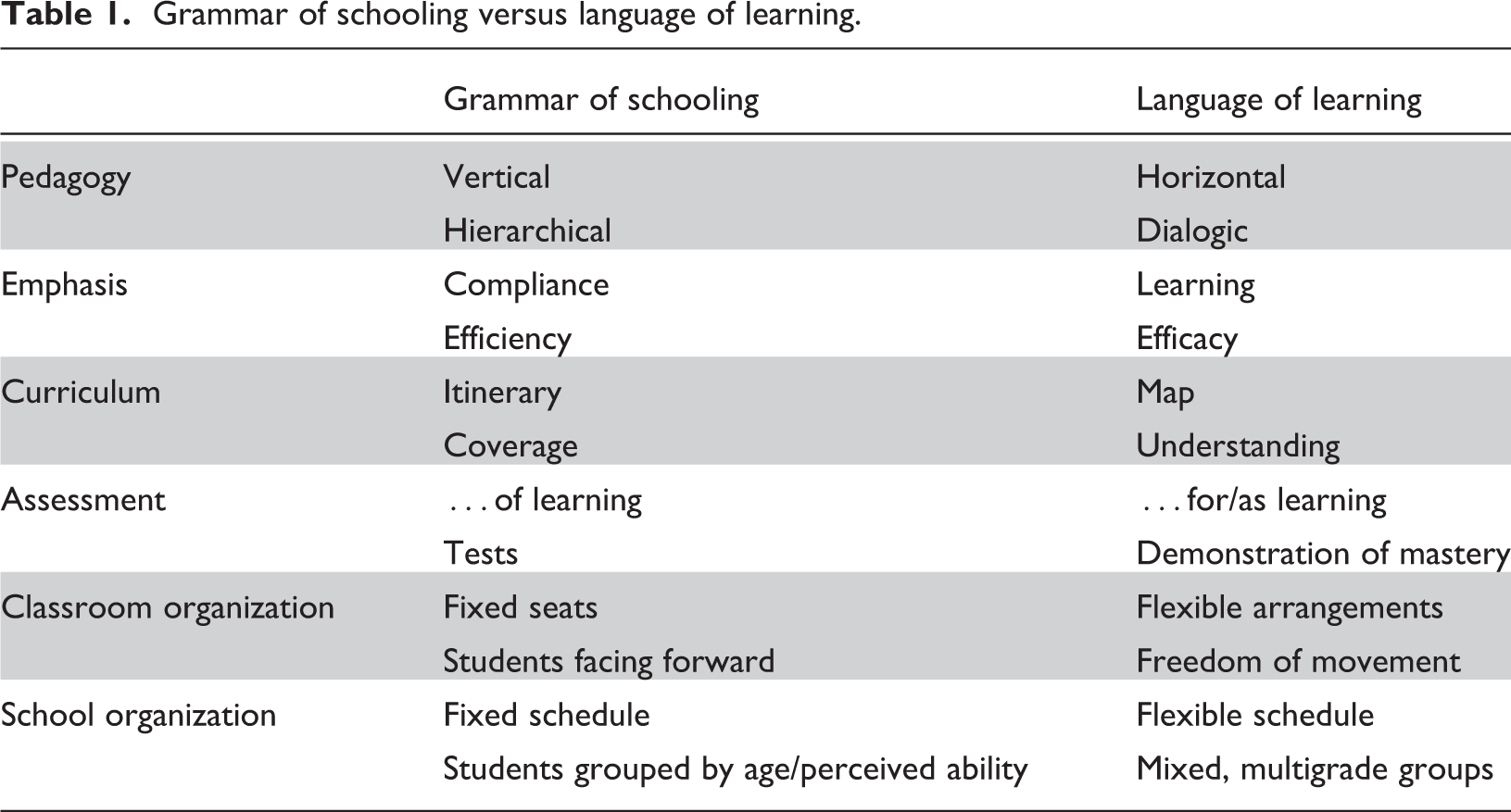
The full realization of well-being in schools and school systems, and more broadly, effectively cultivating knowing thyself, learning by yourself, and bettering the world among our younger generations, requires that we replace the grammar of schooling with the language of learning (see Table 1). Effectively moving beyond well-being requires moving beyond schooling and toward powerful learning. And this will require profound changes in how we think and go about educating young people in schools. It will require profound cultural change in classrooms, schools, and entire educational systems. This is no simple task. Several authors in the educational change field have pointed out how pervasive and highly resilient the default culture of schooling is (Elmore, 1996; Sarason, 1982). Culture is inherently a conservative force that exerts a powerful influence over the beliefs and behaviors of people to preserve continuity and oppose change, no matter how compelling the necessity for change may seem from an external perspective (Evans, 1996).
Grammar of schooling versus language of learning.
Even in cases where new ideas have sought to radically transform teaching and learning in school systems, for example, during the progressive education movement in the U.S., the pedagogical core changed very little. Noticeable changes occurred in a relatively small proportion of schools and classrooms, and they didn’t last very long in the few places where they are adopted (see Elmore, 1996). More recently, Mehta and Fine (2019) set out to map the landscape of non-elite public high schools that were enacting deeper learning. They used their considerable network to identify and visit exemplary schools across the U.S. What they found were startling gaps between aspirations and realities. They found individual classrooms here and there where deep learning was alive and well. As a rule of thumb, about one in every five classes a student attended in a regular school day would have some features of a deep learning environment (and note that these schools were purposefully selected as best examples!).
In short, most efforts to replace the grammar of schooling with the language of learning at scale have so far been difficult, slow, and short lived. But the available evidence can only take us as far as concluding that radical transformation has not occurred. It does not imply that it cannot occur. I have argued elsewhere (Rincón-Gallardo, 2019) that a new way to think about and pursue educational change is necessary to fully realize learning and well-being in schools and across entire education systems. Replacing the grammar of schooling with the language of learning is a project of widespread cultural change. Throughout history, social movements have been the most prominent vehicles for cultural renewal, and in their logic of operation lie some of the keys to fundamentally transform the culture of schooling and establish robust systems of learning all the way from classrooms to entire educational systems.
My proposition to understand and pursue educational change as social movement is not mere theoretical elucubration. It is grounded on examples of widespread pedagogical transformation in countries from the Global South (see Colbert & Arboleda, 2016; Farrell et al., 2017; Niesz & Krishnamurthy, 2013; 2014; Rincón-Gallardo, 2016, 2020; Rincón-Gallardo & Elmore, 2012; Zaalouk, 2006). While developed and studied independently from each other, different scholars have described these initiatives as social movements: as collective vehicles of widespread cultural transformation that defy and redefine existing dominant patterns of social interaction between teachers and students, and between policy and practice, with the purpose of liberating learning in classrooms and across thousands of schools (Rincón-Gallardo, 2019, 2020).
Cases like these challenge a core assumption that has been held by transnational and national education agencies working in the Global South: that the Global South should aspire to emulate the development of education systems in the Global North (see, e.g., Mourshed et al., 2010). Many countries across the Global South are still struggling to ensure adequate infrastructure and universal access to free schooling for their children and youth. Yet, the argument I’ve built here about the harmful effects of compulsory schooling on the learning and well-being of young people should invite us to question whether building compulsory education systems that emulate those of the so-called developed economies is a wise course of action for the Global South. Cases like the ones I listed above invite us instead to reinvent education in the Global South (see Rincón-Gallardo, 2014).
Describing and discussing key principles of action to replace the grammar of schooling with the language of learning is beyond the scope of this article. I will, however, outline four theses to reshape how we think about and pursue purpose and wholeness in education. I have discussed these theses elsewhere (Rincón-Gallardo, 2018), but this time I will use them to bridge the pursuit of learning, well-being, and the larger purposes of knowing thyself, learning by yourself, and bettering the world.
Four theses to move beyond schooling and toward powerful learning to get beyond well-being
Thesis 1: Learning is a practice of freedom. Powerful learning is a process and the result of making sense of questions and issues that matter to us (Rogers, 1969). It feeds and is fed by intrinsic motivation, which involves engaging in work that is meaningful to the learner(s) (purpose); with freedom to determine what, when, how, and with whom to learn (mastery); getting better over time (mastery); and learning alongside others (connectedness). At the neurological level, powerful learning releases hormones that produce feelings of pleasure and fulfillment. Needless to say, learning as a practice of freedom is seldom realized in conventional schools. How deeply well-being is realized in classrooms, schools, and school systems will be a function of the extent to which learning as a practice of freedom makes its way into the everyday work of students, teachers, school leaders, and other actors taking part in the learning of students.
5
Thesis 2: The pedagogical is political. The pedagogical core—the relationship between educator and learner in the presence of an object of knowledge—is not only the basic unit where learning happens or not (see City et al., 2009; Hawkins, 1974), but also a basic unit of relationships of power. In the default culture of schooling, the pedagogical core is characterized by a clear hierarchical separation between educator and learner, with the former in charge of telling the latter what to do and the latter expected to do as she’s told. This is not only detrimental to learning but also to well-being. Constantly exposure to uneven relationships of power—teacher over student—cultivates fear of failure, risk avoidance, and a compliance mindset, all these precursors of stress, a state that sends our brains the signal to release cortisol and activate our fight or flight response. In contrast, learning thrives in relationships of dialogue and mutual influence. And so does well-being. Horizontal conversation in relationships of care, trust, and mutual learning creates a sense of safety and connection, activating hormonal responses of pleasure, calm, and fulfillment.
Thesis 3: Good leadership is similar to good pedagogy. There is remarkable similarity among the practice of effective teachers (Hattie, 2009), effective school leaders (Robinson et al., 2008), and effective system leaders (Brandon et al., 2015; Johnson et al, 2015). Effective teaching, effective school leadership, and effective system leadership are about creating the conditions for everyone in the group to learn while learning alongside them about what works and what doesn’t. Said differently, good leadership is like good pedagogy. The link to well-being is relatively obvious. Just like students thrive in relationships of dialogue and mutual learning with their teachers, teachers thrive in relationships of dialogue and mutual learning with their principals, and principals thrive in relationships of dialogue and mutual learning with the leaders in the system.
Thesis 4: School and context should be changed in equal measure. Realizing the dual purpose of student learning and well-being requires simultaneously changing what happens inside and outside schools. These two goals are often treated as dichotomous options in a zero-sum game (Mehta, 2013), but there is no reason why the problem of changing schools and changing the context in which they operate has to stay framed in this way. School–community partnerships can take several forms. At the most basic level, networks can link schools, communities, and social agencies in such way that each part assumes direct responsibility for the portion of the problem most under its control. Another possible type of partnership might involve the creation of “education cities,” where the infrastructure and institutions of cities (e.g., libraries, public parks, government offices, laboratories) open their doors to students and thus create a much wider learning environment. Yet another type of partnership rests on creating opportunities for students to identify challenges that affect their lives and their communities, to examine their key causes, and to design, launch, test, and refine solutions.
Closing remarks: Bring the students in!
I have argued that conventional schooling is detrimental to well-being, that powerful learning is a precursor of well-being, and that compulsory schooling is not designed to cultivate, and indeed it gets in the way of, powerful learning. It follows that unless the default culture of schooling is fundamentally changed so that powerful learning becomes regular practice in classrooms, schools, and across entire educational systems, efforts to promote well-being in schools will fall short. Indeed, if contained within the default culture of schooling, efforts to promote student well-being will likely perpetuate the very problems they seek to address. Well-being has to be de-schooled and deeply intertwined with learning fully realize our intent to ensure that students thrive in schools.
In most efforts to foster well-being in schools around the world, well-being is seen and treated as separate, and as a precursor, to learning, as something to take care of so that students can more successfully go through the motions of conventional schooling. As I have argued here, moving beyond well-being requires moving beyond schooling, and toward powerful learning. Creating the conditions and environments for children and youth to experience powerful learning in schools will contribute to nurturing their well-being by feeding the four drivers of intrinsic motivation: purpose, autonomy, mastery, and connectedness. The full realization of well-being is inextricably linked to the full realization of learning, and achieving this is a matter of replacing the grammar of schooling with the language of learning. This will require profound and widespread cultural change, a pursuit more likely to be achieved if those who have in their hands the education of young people spur and sustain movements of cultural renewal aimed at cultivating the language of learning while overriding the grammar of schooling. Finally, I presented four theses to link learning and well-being.
Let me conclude with a corollary regarding the role of students, which follows almost immediately from the four theses I proposed here. Just as with the learning agenda, in the well-being agenda students are overwhelmingly seen and treated as recipients or beneficiaries of the policies and programs designed in ministries of education (Fielding, 2001; Ginwright & James, 2002). There are few exceptions. In countries like Japan, students are expected to play an active role in creating environments of caring and belonging in schools; in Sweden, meaningful student participation in school improvement efforts is promoted (Cohen & Espelage, 2020). But even in these cases, the role of students is confined to the management of individual classrooms or their schools, and little is aimed at fundamentally changing the grammar of schooling.
There are very encouraging signs that young people are eager and ready to change the world. Some of the most prominent examples include the gun violence prevention movement galvanized around March for Our Lives in the U.S., the climate change strikes that have spread across the globe, or the recent student protests in Ontario against funding cuts in education. Seeing and treating students as equals and creating conditions and environments for their active involvement in designing, carrying out, assessing, and continuously developing initiatives to simultaneously deepen their learning and their well-being represents one of the most exciting and promising opportunities moving forward. The four theses I have outlined here offer an initial set of propositions that justify and can orient the full involvement of children and young people in their quest to know themselves, learn by themselves, and better the world.
Footnotes
Declaration of conflicting interests
The author(s) declared no potential conflicts of interest with respect to the research, authorship, and/or publication of this article.
Funding
The author(s) received no financial support for the research, authorship, and/or publication of this article.