




Abstract
Few studies have investigated the effectiveness of the psychological consultation process specifically for offender managers. This study involves a total of 23 offender managers’ views and perceptions of the consultation process within four areas of the North West of England. Within each location, a focus group was conducted involving between four and eight participants and interpretative phenomenological analysis was used to analyse the responses. The analysis revealed four main themes: validation of thoughts, feelings and practice; professional support; a personal touch; and room for improvement. These findings are discussed along with implications for further research.
Introduction
The Department of Health (DH) and the National Offender Management Service (NOMS) jointly commissioned the offender personality disorder (OPD) pathway in 2011. Its aims were to provide a pathway of psychologically informed services for a highly complex and challenging offender group, those likely to have traits of personality disorder (PD) and pose a high risk of harm to others, or a high risk of reoffending in a harmful way. It is widely acknowledged that the development of PD traits can be the result of adverse life events (e.g. Bandelow et al., 2005; Pagano et al., 2004) or developmental conditions (e.g. Grant et al., 2008), and as such, impacts upon the individual’s psychology, biology and social functioning. These individuals find it difficult to relate to others, particularly those in positions of authority, which sometimes results in compromised risk management. It is important to point the reader to the wider debate surrounding the reification of PD, and the stigmatising effects of such labels. There is an increasingly vocal community of professionals and service users advocating an alternative viewpoint to that of psychiatric diagnostic nomenclature. Namely, that behaviour associated with the PD diagnosis may be better explained and responded to as an understandable reaction to trauma (see, for example, Johnstone et al., 2018).
In 2013, the OPD pathway commissioned a psychologically informed consultation service (PICS) for the Merseyside and Cheshire National Probation Service (NPS) areas. The service offers offender managers (OMs; also known as probation officers) the option of accessing a consultation and a case formulation; aiding a psychological understanding of the offender and his or her risk; and, where appropriate, the identification of appropriate pathways, which meet the needs of the individual. The service seeks to develop a more psychologically informed workforce by providing knowledge and understanding of the bio psychosocial framework in an accessible way, thus improving the quality of the professional relationship with the offender and the management across services in custody and the community. The PICS is explicit in approaching PD from a trauma and attachment framework. The main aims of the PICS are to facilitate OMs identification of offenders’ needs and risk; to identify appropriate pathways; to up-skill the workforce via teaching and training; and to promote the psychological wellbeing of OMs and offenders.
The use of psychological formulation sits at the heart of PICS. Psychological formulations may be defined as descriptive maps of clients’ cognitive, affective and behavioural patterns, which describe the origins and maintenance of presenting problems (Eells, 2007). Mental health practitioners use formulation with individuals, couples, families and groups and there has been a growing trend for using formulation within multi-disciplinary teamwork (Division of Clinical Psychology, 2011). Team formulation is recognised as a key role within clinical psychology (Division of Clinical Psychology, 2011) to lead on psychological formulation within teams (Skinner and Toogood, 2010). As highlighted within the Good Practice Guidelines on the use of psychological formulation (Division of Clinical Psychology, 2011), a number of studies have highlighted the benefits of this type of working, including helping teams adopt a psychological understanding in relation to service users, reducing negative staff perceptions of service users, processing staff counter-transference reactions and helping staff to manage risk (Berry et al., 2009; Christofides et al., 2011; Clarke, 2008; Craven-Staines et al., 2010; Hood, 2009; Kennedy, 2009; Lake, 2008; Summers, 2006; Wainwright and Bergin, 2010; Walton, 2011; Whomsley, 2009). The OPD pathway has utilised a ‘formulation through consultation approach’, with case formulation as the product of a case consultation (National Offender Management Service & Department of Health, 2015). Case consultation can occur between a psychological practitioner and an OM or as part of group work, for example, within a reflective practice session.
While generating formulations with teams is seen as a key skill for psychological practitioners, there are very few models of consultation delivery. As such, the authors have relied on practice-based evidence to inform their model, mostly utilising individual sessions with a clinical psychologist and an OM. The aim of the consultation is to generate a safe space to develop a psychological formulation of the offender’s strengths, difficulties and risks. This is done via a discussion of the offender’s history, including their childhood, key events, their relationships and offences. Interpersonal dynamics with the OM are also explored as a rich source of understanding how the supervisor’s relationship is being navigated by both parties. Although psychological practitioners can draw upon a range of clinical models and theories to inform the formulation, the authors tend to use models that largely fall within the frameworks highlighted by the OPD pathway, namely, models of attachment and trauma theory.
Few studies to date have assessed how effective the consultation model is as part of the Pathways Project. Some have focussed on its effectiveness for the offenders themselves (Minoudis et al., 2012; Nichols et al., 2016), while others have focussed on OM’s experiences (McMullan et al., 2014; Ramsden et al., 2016; Shaw et al., 2012). Before the Pathways Project was officially implemented in 2013, it was piloted in four London boroughs over a 2-year period, in order to assess the implementation of some elements of the strategy. The findings fully supported the implementation of the Pathways Project, and the consultation model was found to improve outcomes for personality disordered offenders (Minoudis et al., 2012). More recently, Nichols et al. (2016) compared the Lincolnshire Personality Disorder Pathway to the results from the London pilot. They too found that the Lincolnshire team were successfully training more staff and completing more formulations than other areas, thus demonstrating the positive impact of the Pathways Project on personality disordered offenders.
Some research has been conducted specifically assessing how effective the consultation model is for OMs. Shaw et al. (2012) assessed the competency of OMs working with PD in London using self-report measures. They followed this up a year later with the use of an open-ended questionnaire in order to evaluate their experiences of the project. They found that OMs significantly improved across a range of generic ad forensic PD-related competencies. There was also a significant improvement regarding team vision, relating to ‘work group innovativeness’ (Anderson and West, 1999: 238). Similarly, McMullan et al. (2014) assessed the effectiveness of the consultation processes within the Yorkshire and Humberside Pathway Development Service. By conducting focus groups and semi-structured interviews with OMs, content analysis revealed that OMs reported increased awareness and understanding, use of person-centred approaches, development of formulation skills and defensible practice following team consultation.
Similarly, Knauer et al. (2017) used questionnaires to assess the impact consultations had on OMs. They found that OMs rated their knowledge, confidence, motivation, understanding of offenders and satisfaction with management plans higher after they had had received a consultation meeting. Furthermore, Ramsden et al. (2016) used qualitative data from focus groups with OMs, from the Yorkshire and Humberside districts, to explore practice developments that formed since the introduction of the OPD pathway. Using thematic analysis, they found that OMs felt more skilled and competent; consultations helped change their way of thinking to better understand individual differences, and the information provided within the consultations gave them a theoretical underpinning to support their decisions, thus enhancing confidence. Despite these positive developments, they also found aspects of the pathway that OMs criticised. For example, they reported that their workloads had increased and as a result, struggled to find the time to read all necessary documents associated with their caseload. In addition, they felt the consultations were too short and did not allow them to reflect on their feelings and decisions in relation to their high-risk cases.
Indeed, reflective practices have recently been found to be the most important aspect of the OPD pathway. Webster et al. (2020) investigated the effectiveness of specific group reflective practice sessions, offered within the North and South Tyne clusters of the NPS. They found that the reflective sessions were extremely beneficial to the OMs in a number of ways. Some felt the benefits of the sessions directly affected their work with an offender. However, others felt the benefits only indirectly informed their work and instead provided more personal support to them as individuals. This research demonstrates that some aspects of the OPD pathway are perhaps more beneficial to OMs themselves than the individuals they work with, something that directly contrasts with the original aims of the OPD pathway.
To date, the few studies that have investigated the effectiveness of the consultation process specifically for OMs are limited to the areas of London (Knauer et al., 2017; Shaw et al., 2012), Yorkshire/Humberside (McMullan et al., 2014; Ramsden et al., 2016) and North and South Tyne (Webster et al., 2020). This is important because the services offered within the OPD Pathway, including the consultation services, currently vary across regions. It is clear that more research is required in order to examine the perceived effectiveness of the consultation process in other districts, and to explore stakeholders’ perceptions of a particular consultation model. This study will therefore focus on OMs’ views and perceptions of the consultation process within the areas of the North West of England.
Method
Participants
The participants were recruited from four probation offices within the North West of England. The research was advertised via email within the probation offices, and OMs who wanted to take part emailed the researcher from the details provided on the advertisement. The researcher then arranged the groupings of participants according to the office in which they were based. Due to the research only being advertised to OMs, all who volunteered were eligible to take part. A total of 23 OMs were involved (8 males, 15 females). Participants were aged between 26 and 65 (M = 46.34) years, 19 were educated to degree level, 3 had a postgraduate diploma and 1 an NVQ (National Vocational Qualification) certificate. The total amount of years they had spent working in the probation service ranged from 2 to 34 (M = 13.91) years, and had specifically worked as an OM ranged from 1 to 28 (M = 11.78) years. The number of offenders they were supervising ranged from 13 to 48 (M = 39.39), and the amount of consultations they had within PICS ranged from 2 to 15 (M = 6.00).
Design
Within each probation office, a focus group was conducted involving between four and eight participants who were based at that location. The focus group is an interview-based approach designed for small groups of individuals, formed by the researcher and led in a group discussion on some particular topic (Barbour, 2008). The aim of using this approach is to learn about conscious, semiconscious and unconscious psychological and sociocultural characteristics through discussions with various groups (Lune and Berg, 2017). Focus groups were used in this study as they offer exceptional opportunities for the in depth study of a topic due to the interactive element. This allows participants to reflect on each other’s worlds and share their experiences (Lune and Berg, 2017). More specifically, it was felt that due to the PICS being a relatively new service, there would have been much conversation between OMs regarding how it was working for them. As such, by interviewing OMs in groups, the aim was to provide a more familiar and relaxed setting that allowed them to share their experiences and feelings about PICS.
The lead researcher on the project conducted each focus group. An interview transcript was used as a guide to ensure consistency between each one and also that all questions necessary were asked to the group. The focus groups lasted between 45 and 90 minutes, and each was recorded. Subsequently, the recordings were transcribed and initial coding was undertaken using Microsoft Excel.
Analysis
Interpretative phenomenological analysis (IPA: Smith et al., 1999) was used to analyse the responses. IPA is designed to capture the richness and diversity of participants’ accounts by uncovering the central themes that emerge. While grounded in a solid theoretical foundation, IPA is flexible in both its intent and application. IPA techniques have been combined with a variety of data types (Brocki and Wearden, 2006), including focus group data. Combining IPA with focus groups has been acknowledged as a legitimate and appropriate methodology for empirical exploration (Smith et al., 1999). However, the presence of multiple voices, the complexity of their individual and shared contexts, and the interactional complexity of the discussion present theoretical methodological challenges. This is because within focus groups, any experiential claims, narratives or reflections are likely to be based on complex sets of social and contextual relationships (Tomkins and Eatough, 2010). The protocol created by Palmer et al. (2010) was used in this research. This was developed to help IPA researchers prepare to deal with some of the synergistic effects of working with groups and to permit both the experiential and interactional elements of focus group data to be explored side-by-side. Therefore, in addition to the analytical method of IPA described, the eight-step protocol developed by Palmer and colleagues (2010) was used as a prompting framework, to further elaborate on the analytical process for working with focus group data. The first step was dealt with through the ‘standard’ IPA analytical process employed. This resulted in the emergent themes described in the ‘Results’ section. The remaining seven steps are explored in the ‘Discussion’ section. These involve the following: positionality – where the position and stance of both researchers and participants are explored; roles and relationships – where the relationships between the various professionals/participants and organisations are explored; organisations and systems – where the relevance of systemic, organisational and cultural contexts are considered; participants’ narratives – where the attention turns to the content and meaning of the participants’ accounts; the use of language in participants’ accounts – where there is an increased focus on the participants’ usage of language to convey their experiences; patterns and variations in experiences – where common themes and patterns are identified between focus groups; and integrating insights from different groups – where there is an attempt to pull together the findings from this analytical process. This stepwise analytical process outlined was used to structure and guide the discussion.
Results
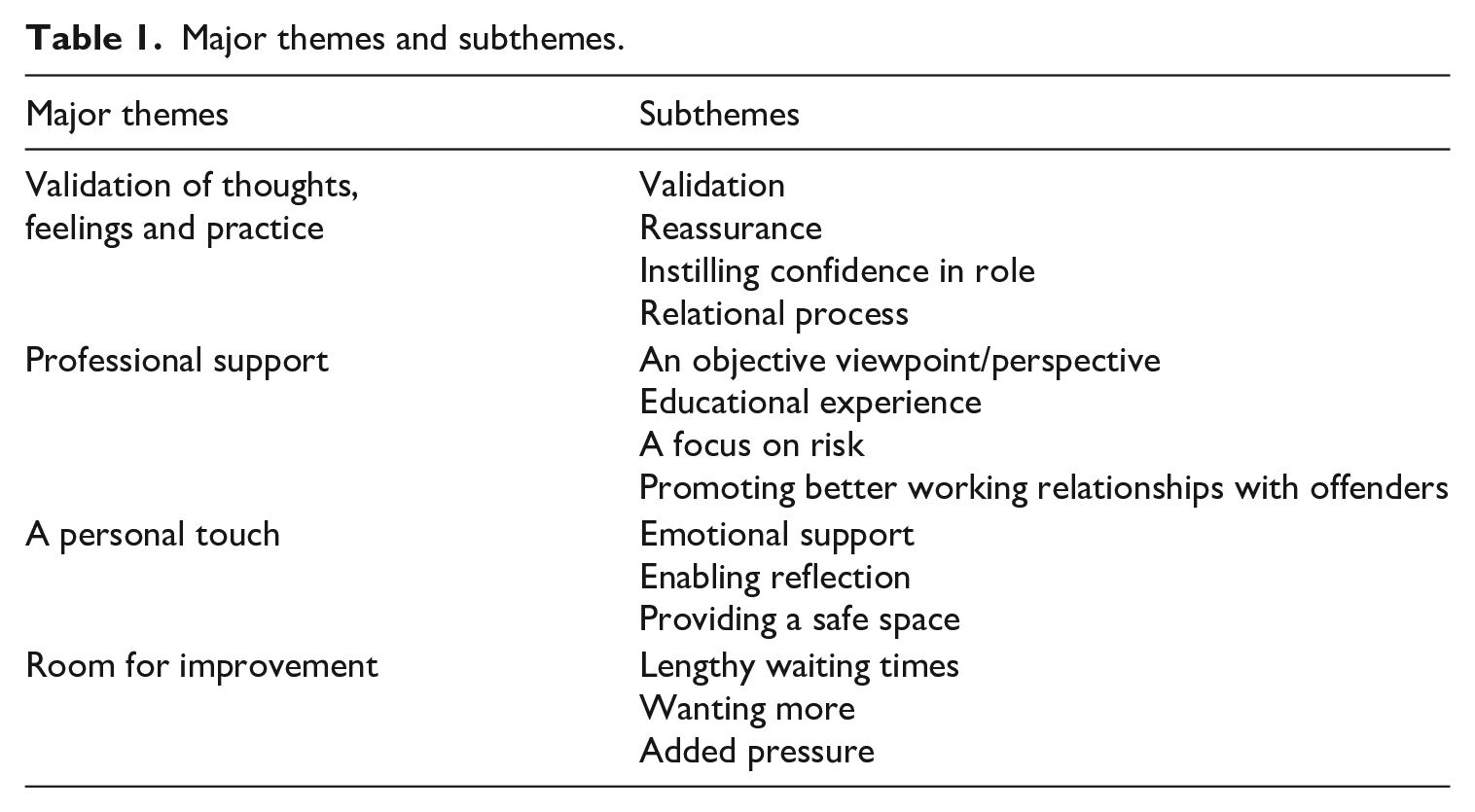
The analysis of the focus groups revealed four main themes: (1) validation of thoughts, feelings and practice – participants shared that the PICS consultations validated numerous aspects of their work; (2) professional support – the participants highlighted a variety of ways, in which the service was supportive of their professional roles; (3) a personal touch – participants discussed how they also felt supported at an emotional and personal level; and (4) room for improvement – finally, participants also spoke about their frustrations with the service; in doing so, they offered valuable feedback and a window into the interaction between PICS and their professional roles. A coding system was put in place in order to shorten the quotations presented. At the end of each quote, the participant pseudonym and group number are stated in that order (e.g. Maureen – 1). Table 1 lists the major themes and subthemes.
Major themes and subthemes.
Theme 1: Validation of thoughts, feelings and action
Validation
Participants discussed how PICS provides them with a sense of validation and verification for their thoughts, feelings and decisions made, specifically from an operational perspective.
One participant was newly appointed to the role of OM and recently employed within the service. As such, they found PICS particularly helpful: ‘. . . for me it is the face to face thing. I think maybe because I’m a lot newer to the service compared to everybody else here. So kind of having someone who does give you that validation is really key for me’ (Catherine – 1).
Other participants also agreed. For example, one stated, ‘. . . they make you feel confident, like you are doing what you should be doing, let’s just try this as well but thumbs up for what you have done’ (Shirley – 2). Similarly, another supported this: ‘I think that’s really helpful for me to just go in and feel like I’m not getting this totally wrong, I am going the right way’ (Phil – 3).
Reassurance
Participants discussed how PICS offered a sense of reassurance and removed the fear and doubt they sometimes experienced. One participant explained how PICS reassured them that it was ok to feel the way they did about a particular case: . . . after explaining certain situations I felt like, ok, that’s no me going mad, that is . . . now that it’s been explained and they’ve helped me go through it. I’ve realised it’s the situation and the individual that I’m dealing with. It’s not me. (Maureen – 1)
Similarly, another participant felt that the fears they had of not having managed an offender effectively were alleviated: . . . sometimes when you’re working with someone, it feels like you’re muddling along, but then when I’ve spoken with them, . . . they’ve sort of outlined his behaviour, or the way he’s responding as a type, like a psychological basis and it’s reassured me that I have been responding well and working quite well with them. (Steve – 3)
Instilling confidence in role
For some participants, the consultation instilled a newfound confidence in their role. One explained, . . . just feeling a bit more confident and thinking ‘right I’m not useless, I don’t have to go work on the tills again’ (laughs). I’ve got focus, I’ve offloaded there, got some feedback and I’m a bit more confident. That’s the key thing for me. (Maureen – 1)
Relational process
OMs felt that PICS staff were particularly helpful as they were relatable and they find that very important in terms of truly understanding their role as an OM. One participant explained this: I think getting input from a psychologist. Because we go on training but its training from probation so . . . it’s having somebody with that knowledge and who currently still does that job, it gives you a better . . . more rounded picture rather than probation’s point of view is . . . probation say you shouldn’t do this. So having somebody with that background who really understands . . . what you’re talking about when you explain about the case I think is the most important thing. (Bill – 2)
Theme 2: Professional support
An objective viewpoint/perspective
A total number of 13 participants referred to the value of PICS providing an objective perspective in a non-judgemental way. For one participant, this provided a sense of safety when working with emotionally intense cases: ‘I’m not saying every case I’ve taken has evoked emotions in me but some have. Some have evoked frustration, anger, erm . . . tears . . . and it’s having that objectivity there in the room and you feel safe with the service’ (Winnie – 1).
Another participant discussed having an objective and professional opinion to refer to, especially in challenging forums such as oral hearings: . . . and you can say ‘well this isn’t just my opinion, it’s also the opinion of a psychologist’ and certainly within the prison environment during oral hearings, one of the biggest difficulties that we have is the difference of opinion between ourselves, the offender and the managers and psychologists who work in a very different controlled environment within the prison. (Colin – 2)
Educational experience
Participants felt that PICS also provided an educational experience in terms of improving their understanding of PD, and consequently also their working practices. For example, one participant stated, I think with the service there’s just more knowledge out there about PD and the traits and how it can impact on us and how it can actually stir those feelings in us. So yes, beforehand we would still look at the background but we wouldn’t necessarily recognise the link between how that is stirring up those feelings in us and how we can then deal with that so I think that’s the difference now. (Maureen – 1)
Others talked about PICS offering important information about pathways: ‘They’re letting you know what pathways that people can access, which you might not have known about yourself or not been able to do yourself, and it gives you a bit of support in doing that’ (John – 2).
A focus on risk
Participants described how PICS helped them think about and readjust their focus on risk. A total number of 16 OMs referred to this. One participant explained this well by describing how a consultation helped elucidate an offender’s offence paralleling behaviour: It was only when I went to the service and they sort of picked it all apart that I realised, hang on, I’ve completely lost sight of his risk here. He’s actually quite a risky young lad and if he does this with me, then this is how he is going out into the world and being with others. (Maureen – 1)
Others felt that PICS heightened their sensitivity to risk, helping them to keep this at the forefront of their work in managing offenders. For example, one said, I think for me, it heightens your sensitivity to certain risk factors that perhaps you wouldn’t have given as much attention to. . . . triggers you to try and find them earlier on in the chain, which is what we need to do as OMs. (Jean – 2)
Promoting better working relationships with offenders
A total of 13 OMs expressed the view that PICS led to improved working relationships with offenders. For example, one participant discussed how the PICS provided tips on the use of specific strategies with an offender who was challenging to work with due to his attachment issues: For one of mine, they really picked up on his attachment issues from his background and childhood and how it was effecting just working with him on a one-to-one basis because I’d have the longest longest supervision meetings with him and he’d kick off and he wouldn’t want to do it, but he’d never leave and then he’d throw things out to sort of test the waters . . . So you know like, giving him time at the end just different techniques and things to work with him to sort of help him feel more secure. (Steve – 3)
Theme 3: A personal touch
Emotional support
One of the ways in which OMs felt that PICS provided a personal experience was by supporting them emotionally during the consultation. They felt emotionally supported when talking through issues to realise that they are doing the right thing in that given situation: ‘But certainly in terms of realising or them supporting me in the realisation that I’m doing the right thing then yes, I do find that supportive emotionally’ (Rob – 4).
Other participants felt supported by being able to talk through their feelings and access help with emotionally challenging situations. For example, One of the consultations I had recently, I got really emotional about. I was crying in the room and that’s not something that I wanted to do on a professional basis but to then talk about those feelings and why I felt like that, and talk about whether I should remove myself from the case. But I didn’t, and I am continuing, but it is a difficult, a really difficult case. (Joanne – 1)
Enabling reflection
Participants highlighted the importance of having the time and space to reflect both on past and present experiences with offenders, and their working practices. For example, one explained how it is important to understand an offender’s history and how it has contributed to their offending behaviour: And we’re dealing with people who have been coming into this office for so many years that . . . as we’ve all mentioned . . . you forget that they have got a past prior to their offending and sometimes you need to get out, off the treadmill and look back. Erm . . . as what’s formed them. (Phil – 3)
The participant goes on to discuss the rarity of such opportunities in the probation service: ‘The space to be able to reflect on your own practice . . . . It’s not something that happens often is it’ (Phil – 3).
Providing a safe space
The consultation space reportedly provided a safe and secure place for OMs to feel comfortable talking and sharing their feelings about sensitive issues relating to their work practice, without feeling scrutinised or performance managed: Having a separate place to go where you can offload and say how bad you feel in the sense of you know ‘I think I’ve done this wrong and I don’t feel professional in this way’ and to have that sort of feedback that’s not your manager so you don’t have that kind of feeling of ‘I shouldn’t really say this’ because it’s not a judgemental type of thing. (Maureen – 1)
Similarly, one participant also expressed their appreciation for having a safe space to be able to be honest and open about their practice: Erm . . . I like the idea of it being open up to scrutiny but in an environment where you can trust the people so you can even discuss possible failings of things that you think you could have done better. Erm . . . in a secure environment, which [I]may not have done otherwise. (Rob – 4)
Theme 4: Room for improvement
Lengthy waiting times
A total of 18 participants spoke about having to wait a long time for the service. Despite an understanding of the context and an acknowledgement of the possible reasons for this, participants expressed a sense of disaffection. For example, I understand that it’s resource driven and there’s so many clients that two people are trying to cover the entire area but it does take three months to get that initial consultation, and sometimes, so much could have changed in three months time that you may not be even working with that client anymore because they are that problematic. (Catherine – 1)
Wanting more
Following on from the point about lengthy waiting times, 15 OMs also expressed a wish for more frequent support, and increased contact with PICS. For example, one participant explained, . . . I’d like to see the support and be able to talk things through on a much more regular basis than . . . and maybe not for an hour at a time because we’ve just got no possibility of doing that but if we could just have like . . . someone to go to and just say ‘I’m having a few issues with this case or I can’t get my head around which way to go’ that would be great. (Mark – 3)
Participants were appealing for a service that is more present, more dynamic and responsive to their everyday needs for support.
Added pressure
A total number of three participants, mainly from the second focus group, raised concerns regarding aspects of the administrative process of PICS. There was clear frustration with the faceless process of electronic screening and identification of cases, and the perceived pressure associated with this system. This participant’s account captures this well: I do have a bit of an issue with . . . I get emails saying ‘we’ve identified this person and this person as being an appropriate referral’ and if I don’t respond, I get something else and then it’ll probably go to the manager. I think ‘just hang on a minute, I’m juggling a case load here’. I’ve prioritised those that I think erm . . . need input. So I think ‘just back off a little bit there’ . . . I don’t mind advice; it’s when I feel like I’m being put under pressure, I don’t respond well. I don’t know who does the assessments . . . (Phil –3)
Discussion
The participants’ accounts revealed how they valued greatly the benefits that they derived from the consultation service. These could be summarised as relating more to a supportive and psychologically containing role of the service, rather than more applied and clinical aspects, such as contributing to the identification and management of risk. This is a significant finding that points to the perceived main benefits of consultation relating to emotional support functions (e.g. personal support, validation), particularly in relation to the aims of the PICS, which are more operationally and practice focused. The results may be understood in the context of a lack of professional supervision opportunities coupled with increased caseloads of high risk of harm individuals. Professional supervision in probation has declined over the past two decades, replaced by line management; perhaps, the PICS consultations are substituting OMs’ unmet needs in supervision.
The team of OMs that work together in a particular local delivery unit (LDU) form a naturally occurring group; they do not just share a physical environment, management personnel and processes, but also a psychological space. It was hoped, therefore, that a group discussion might elicit more experiential perspectives than individual interviews. However, these individual and group experiences were also embedded in the interactive and social context of the probation world and its complex set of dynamics. It was important to understand the value of PICS in the context of the NPS as a system, its practices and its culture. The eight-step protocol employed in this study facilitates this task.
Positionality
There are three researchers (M.P., M.W. and J.C.) who are NHS clinical psychologists who also work in the NPS as part of their roles in the PICS. F.M. is an NHS consultant clinical psychologist who is involved in the PICS from a strategic standpoint. The lead researcher (V.B.) is a lecturer in forensic psychology, with a specialist interest in personality disorder, who is otherwise unconnected to the NPS/NHS settings. Finally, the two other researchers (S.K. and J.M.) are specialist probation officers, employed by the NPS, who also work in the PICS. The lead researcher exclusively facilitated the focus group discussions because of the distance she had to the PICS, in order to exert the least amount of influence on the participants’ views. The participants were all probation officers, carrying cases in the community, and service recipients of the PICS.
Participants across all focus groups alluded to the operational (e.g. supervision of high-risk offenders) and organisational pressures (e.g. carrying large case-loads) they faced, and the value of PICS in providing support at different levels (i.e. validation, professional and personal support). Within this was an acknowledgement of an absence of space and time to reflect upon their practice.
Roles and relationships
Understanding the relationships between the various professionals and organisations was important in order to grasp the context and better relate to the participants’ accounts. The OMs’ managing cases in the community are at the coalface of their organisation, often laden with large and complex caseloads. There is a major emphasis on the management of risk and on the adherence of the related operational and administrative processes. The PICS psychologists are frequently situated in the same physical spaces as OMs but are employed by the NHS, a different organisation altogether. The specialist PICS probation officers straddle a middle ground. Their position allows them to bridge the gap between health and probation; however, this can come at a cost; their identity is diluted – this presents a challenge when sitting opposite their case carrying colleagues, who may perceive this inequality in different ways; this includes being regarded as disconnected from the OM role. Despite the challenges, the data suggest that this dual model holds benefits for OMs.
Organisations and systems
These three roles and different perspectives converge in the consultation room. The psychological practitioners are NHS employees working in the NPS. The probation officers are NPS employees who work side-by-side with the psychological practitioners. Two different cultures, often approaching the offender and the offence from different viewpoints, meet in the consultation room. Ultimately, their input needs to be valuable to their OMs, who are managing competing demands including a focus on risk and enforcement. The dynamics in this process are further complicated by the fact that PICS has become a mandatory service, and therefore an additional task that the OM is required to undertake. This was evident in the OMs’ discontent relating to perceiving PICS as an additional demand. ‘There is a natural tension between a resource driven, process based service and a more personal, supportive, relational model’ – a tension that PICS professionals have to continually attend to and manage. The other tension concerns the disparity between the limited resource of PICS and the relatively high demand for the service. The dual model somewhat buffers this; however, this is not a model uniformly adopted in the OPD pathway.
Participants’ narratives
The participants described the demands of being an OM, the emotional impact of their work, and their support needs. They alluded to a sense of uncertainty and self-doubt, which was soothed through the validation and reassurance that the consultations offered. In their narrative, they placed PICS as being within and also separate to the system that they function in as professionals; PICS was a service for them. However, they also expressed their frustrations when they described how they had to navigate the PICS systems and processes of a service that should be there to offer support. The OMs wanted to see PICS as a space that was separate from the rigid processes of their own system; they located the value of PICS is its humane, understanding and compassionate nature. This function, of support at the human level, was reportedly paramount given the emotional impact and demands of the OM role.
The use of language in participants’ accounts
The participants at times tentative, diffident descriptions echoed the uncertainty that could be heard in their narratives: ‘I’m new to the service’ (P1 – 1); ‘I’m not getting this totally wrong’ (P3 – 3); ‘That’s not me going mad’ (P6 – 1). Their use of the second person ‘you’ and the first person plural ‘We’ was used to sometimes indicate a sense of consensus and agreement, and at other times as an attempt to gather support and test the public acceptability of their views before they could feel confident to openly express these. The OMs mostly felt confident that their views were representative; some of the issues described had been rehearsed in the confines of the open plan office. And many participants felt safe enough to progress to personal disclosures, for example, when describing occasions where they were emotionally affected, and/or overwhelmed. They showed a willingness to be vulnerable in the forum offered by the focus group.
Patterns and variations in experiences shared – the good, the bad and the ugly
There was consensus within and between focus groups around the value of feeling validated and emotionally supported, as well as the helpfulness of the service with decision-making processes. The consensus was also present, however, when OMs described the perceived pressures from and lack of support with their role, to which the mandatory referral process for PICS consultations added. Another perceived impractical and ineffectual aspect of the PICS was the perceived slow-moving referral process. The message appeared to be that the PICS was out-of-sync with the hectic, reactive, crises-managing nature of the OM role. There appeared to be a conflict between OMs’ needs and the very nature and philosophy of PICS (i.e. a planned service, aiming to cultivate reflective thinking), which at certain times made the service inaccessible, unresponsive and unavailable.
Integrating insights from different groups
The main themes described in the results were represented equally across the focus groups. It was interesting that one male participant called for more joint working, which involves the psychologist working with the OM and the offender. It is unclear whether this was because he had experienced and clearly valued the joint work, or whether he ascribed greater value to the joint work compared to the consultation model. It may be argued that the joint work is a more egalitarian way of working compared to consultations that, often unintentionally, place the PICS staff in the authoritative position of the consultant. This may evoke greater resistance from staff who do not wish to participate in a dynamic where the balance of power is perceived to be unequal. It is the authors’ experience that male OMs have been slower to take up PICS consultations, compared to their female colleagues; an anecdote that may be worth following up in future research.
Limitations and future research
The generalisability of the results is naturally limited due to the small sample size and participants’ characteristics. In addition, the overall strength of the findings could have been improved by undertaking some individual semi-structured interviews in order to compare responses on a one-to-one basis with those offered by focus groups. Furthermore, it will be interesting to know if these perceived benefits hold across time, between different teams/groups of OMs, across geographical areas, and between different consultation models. The use of qualitative analyses is a useful starting point in beginning to map out the landscape of equivalent services across the country.
Future research should further explore the reflective nature of the PICS and how it benefits the OMs in more ways than directly informing their working practices as was found in this research and recently in the work of Webster et al. (2020). In addition, the effectiveness of the PICS in relation to the aims of the service could be further explored using quantitative methods of analyses. However, it will be important to use outcome measures that capture the additional benefits that OMs discussed. Quantifying the emotional support and validation that OMs derive from the PICS will not be an easy task. Equally, attempting to understand how this type of emotional support affects practice will be challenging.
Footnotes
Funding
The author(s) received no financial support for the research, authorship and/or publication of this article.
