




Abstract
The Psychologically Informed Consultation Service (PICS), based in Merseyside and Cheshire, aims to help Probation Practitioners develop a psychological understanding of people on probation who are assessed as high risk and have been reported to have personality disorder traits. A role of high importance and benefit, but one that also sometimes involves exposure to highly emotive content. It is vital to consider PICS Practitioners’ emotional wellbeing. This research aims to explore the emotional impact PICS Practitioners experience during the consultation and formulation processes. Semi-structured interviews were conducted with seven PICS Practitioners and Interpretative Phenomenological Analysis was used to analyse the data. Five Experiential Themes were identified: Changes within PICS impacted Practitioners’ experiences of the role; advantages and disadvantages to being a removed service; high workload having negative impact on consultation and formulation process; emotional impact of the role; and an overall sense of gratitude for the role and appreciating its purpose.
Keywords
Background
In 2011, the Offender Personality Disorder Pathway (OPDP) was commissioned in the UK and Wales (Skett, 2015). Its aim was to provide psychologically informed services for people on probation (PoP) who possess traits of personality disorder and pose a high, or very high risk, of harm and re-offending (Skett, 2015). Personality disorder can develop as a result of early attachment issues (Mosquera et al., 2014; Schimmenti et al., 2014) and may result in complications such as emotion regulation difficulties (Gross and Jazaieri, 2014) and drug and alcohol abuse (Sher and Trull, 2002). HM Prison and Probation Service and NHS (2020) stated persistent non-compliance with supervision within the service may be indicative of personality disorder, and personality disorder is also linked with increased reconviction rates (Langstom et al., 2004; Martin et al., 2019). As a result of this, it is widely accepted that personality disorders and offending behaviours are associated; research suggests that 60%–70% of people in prison, and approximately 50% of PoP meet the relevant criteria for personality disorder (Skett, 2015). Highly commended, the OPDP is reported to be ‘one of the most successful and effective practice developments within Probation in recent years’ (Skett and Lewis, 2019: p. 170). Indeed, following the development of the pathway, and successful trials of Community Consultation Services in other areas, in 2013 the Psychologically Informed Consultation Service (PICS) was formed in the North West of England, as the Community Consultation Service for Merseyside and Cheshire.
The OPDP strives to improve the confidence, knowledge, attitudes and ability of Probation Practitioners (Skett and Lewis, 2019). As part of the work that PICS Practitioners do, they provide a psychological consultation and subsequent case formulation of a particular PoP within a Probation Practitioner’s caseload who presents with a personality disorder and is assessed as high risk of harm. Probation Practitioners are the appointed lead role for the management of PoP within the Criminal Justice System (Skett, 2015), therefore, the aim of the service is for the Probation Practitioner to gain a greater understanding of the PoP (Blinkhorn et al., 2021) and as such, provide a better service. Consultations are conducted between a PICS Practitioner and the Probation Practitioner. PICS Practitioners are either senior individuals within the probation service with psychological training or chartered clinical and forensic psychologists. As such, they are best understood collectively as Psychological Practitioners. Within the consultation, it is usual for the PoPs’ childhood, relationships, offending behaviour and key life events to be discussed. The Probation Practitioner identifies ‘outcomes’ that they would like to achieve during the consultation and the Probation Practitioner and PICS Practitioner work towards these, collaboratively (McMullan et al., 2014). Following consultations, formulations are written by PICS Practitioners. Formulations are the process of identifying two key areas: the underlying mechanisms of behaviours, and the relevant intervention to undertake (Bruch, 1998, as cited in Logan and Johnstone, 2010). The suggested recommendations intend to target and improve the identified needs (Wheable et al., 2022). Whilst traditional methods of risk assessment focus on risk factors, the formulation is described as the ‘process of co-constructing a hypothesis or “best guess” about the origins of a person’s difficulties in the context of their relationships, social circumstances, life events, and the sense that they have made of them’ (Johnstone, 2018: 32).
Ramsden et al. (2016) found that the consultation and formulation process helped Probation Practitioners feel more competent in their work. Participants reported that formulations supported their mindset, enabling them to better understand individual differences in the PoP and providing them with the information to understand the theoretical underpinnings of the PoP’s trauma, which supported their decision making. Similarly, Knauer et al. (2017) found that probation staff rated that their knowledge, confidence, motivation and understanding increased following consultation, displaying the service’s benefits. Ramsden et al. (2014) had previously presented similar results where the knowledge, attitudes and personal feeling of understanding had all improved post consultation. Furthermore, Blinkhorn et al. (2021) found the Probation Practitioners reported that the PICS offered validation of thoughts, feelings and practice, with participants reporting that PICS had validated their decision making, concerns and doubts, and reassured them at times when they were not confident. This had a positive impact on Probation Practitioners, as some participants reported that they often felt confident and able again, following the validation and reassurance offered by the PICS Practitioner. Emotional support was also alluded to by participants, with Probation Practitioners reporting that the service allowed them to professionally discuss areas in which they believed errors had been made and be open about their practice (Blinkhorn et al., 2021). However, emotionality has been highlighted in monthly reflective practice meetings between PICS staff. Practitioners reported that certain parts of the PICS process were particularly more emotionally laborious than others.
Practitioners experiencing an emotional impact as a result of their work is a widely recognised topic. Figley (1995) introduced the concept of ‘secondary traumatisation’, often referred to as ‘vicarious traumatization’ in which the process of helping an individual causes stress to the Practitioner. Figley (1995) suggested that professionals who hear or read traumatic information regarding suffering might absorb this information and, subsequently, absorb the suffering too. The absorption of suffering may have a negative impact on Practitioners’ wellbeing. This theory has been researched in a variety of settings. Century et al. (2007) found professionals providing counselling to refugees reported feeling ‘frustrated’, ‘exhausted’ and ‘powerless’ as a result of hearing their clients’ experiences. Although deemed somewhat beneficial, with probation officers using empathy to build strong relationships with the PoP (Burnett and McNeil, 2005), Moulden and Firestone (2007) found that secondary traumatisation can lead to long term impacts on the individuals’ thoughts, feelings and assumptions of the world, altering their perspectives entirely.
Research indicates there may be a risk of Probation Practitioners experiencing vicarious traumatisation (Lee, 2017b; Rhineberger-Dunn et al., 2016). Through the voices of Probation Practitioners and managers, Petrillo and Bradley (2022) found indicators of vicarious trauma present. The participants discussed key issues such as not having enough support in terms of dealing with traumatic information and concerns that the role is having a desensitising effect on their lives yet anticipating that this may manifest as a crisis in future. In addition, they also highlighted how pre-existing personal trauma can contribute to a significant build up which will have a detrimental impact on their mental health. Further, Severson and Pettus-Davis (2013) found that amongst parole officers and supervisors working with people with sexual convictions, participants generally reported experiencing symptoms consistent with secondary traumatisation. The symptoms reported included “somatic reactions, disrupted sex lives, pervasive thoughts, a loss of innocence, and hypervigilance in both their work and personal lives” (Severson and Pettus- Davis, 2013: 12). Ko and Memon, (2022) suggested that the prevalence of secondary traumatisation may even be higher than reported, but due to mental health stigma, criminal justice professionals may be reluctant to report it. Practitioners experiencing secondary traumatisation may experience the emotions and feelings of the individual they are working with, as though they had experienced the event that caused this emotion, personally (Moulden and Firestone, 2007). As PICS Practitioners do not work directly with PoP, this research aims to explore the extent to which they experience secondary traumatisation, if at all.
Alongside the consultation and formulation process, PICS Practitioners are involved in a series of other activities, which may be accountable for inducing emotional distress. These other responsibilities include the delivery of Mentalisation Based Treatment (MBT), joint work with Probation Practitioners and PoP, attending forums such as Multi-Agency Public Protection Arrangements (MAPPA) and providing input into Approved Premises, therefore, the role is diverse. A positive correlation has been identified between workload and its impact on burnout and stress in prison wardens (Schiff and Leip, 2019), lawyers (Nickum and Desrumaux, 2022) and medical staff (Xiaoming et al., 2014), thus presenting the effect workloads can have on professionals across settings. Similarly, the responsibility associated with the role may be a stressor for PICS Practitioners. Lewis et al. (2013) found that challenging caseloads and violent recidivism involving a child, sexual recidivism, threat, assault in the line of duty, or suicide of an offender, increased scores on measures of burnout in Probation Practitioners. As PICS Practitioners consult with Probation Practitioners, it is reasonable to assume there may be an element of emotional strain due to the stress and responsibility their role involves.
Relevant to the suggestion that particular elements of the consultation and formulation process are more emotionally laborious, research has identified high amounts of paperwork as a particular stressor and in some cases it contributes to the induction of mental health issues in Probation Practitioners (Walker et al., 2019). Alongside this, time pressure was also identified as a stressor. Participants reported the need to work outside of contracted hours to complete assessments and paperwork, however by doing so, some felt they were able to manage their workload better and it helped them feel more up to date and content (Walker et al., 2019). The formulation element of a PICS practitioner’s role incorporates considerable paperwork; setting out recommendations for the Probation Practitioner and ensuring this information is received in a timely manner. Therefore, these findings may suggest that emotion is reflected in the formulation, as opposed to the consultation.
The Transforming Rehabilitation (TR) agenda in 2013 aimed to implement changes within the Probation Service to ensure effective rehabilitation (Ministry of Justice, 2013). However, Phillips et al. (2016) conducted research with Practitioners who, post the TR agenda, worked with high-risk individuals and found recurrent issues. Along with the word ‘relentless’ used by Practitioners to describe their work, participants referenced time limitations, and continuous stress as a result of their caseload. When discussing coping with these stressors, participants reported ‘back covering’ to protect themselves, by ensuring they have done everything in their power in case of anything going wrong with an individual in their caseload. The authors stated that it was evident that participants struggled with the pressure associated with the increased volume of high-risk cases. Phillips et al. (2016) concluded that this high stress workload is unmaintainable for Practitioners, and that further support is required. These findings suggested that despite the changes implemented by the TR Agenda, little had changed in regards to staff stress and workload management issues since before the reform. Indeed, since the re-unification of the service in June 2021, the Probation Service remains challenged. Consistent with the findings of Phillips et al. (2016), Tidmarsh (2024) found that Probation Practitioners are still experiencing high levels of stress, feeling overworked and underpaid. Although some reported a reduction in caseload since the reunification, others reported the opposite. HMI Probation (2021) found that 51% of Probation Practitioners reported their caseload to be somewhat unmanageable.
In the current climate, it is important to acknowledge COVID-19 as an additional stressor to working environments, particularly roles associated with the Criminal Justice System (House of Commons Justice Committee, 2020; Phillips et al., 2020). Since the initial lockdown in England and Wales began on the 23rd of March 2020, working practices and their environments have changed significantly and probation officers, and those working within the probation system, were commended for their efficient adaptation to the new way of working, instigated by the pandemic (House of Commons Justice Committee, 2020). The Exceptional Delivery Model, introduced to manage the lockdown regulations, meant that probation officers worked mainly from home (Phillips et al., 2020) and face-to-face supervision was ceased, except for those considered to be a very high risk of harm to others (HMI Probation, 2020). Instead, contact was made via telephone. Heightened by staffing issues, with a period where 20% of staff were off sick daily (House of Commons Justice Committee, 2020), this was a very turbulent time for those working in the Criminal Justice System. Research conducted on the experiences of Probation Practitioner during the COVID-19 pandemic found this period emotionally distressing, and participants experienced difficulties with the new working environment and a lack of emotional support (Blinkhorn et al., 2023). Probation Officer Trainers also identified how during the pandemic, and amidst the struggle of the subsequent changes, staff were completely overworked and burnt out (Phillips et al., 2020). Further, Blinkhorn et al. (2023) found that participants praised the PICS for the help and support it provided during this difficult time. Probation Practitioners found comfort in the support of PICS Practitioners; therefore, it is paramount that the emotional wellbeing of PICS Practitioners is considered also.
In light of the research discussed, we aimed to explore the emotional impact PICS Practitioners experience during the consultation and formulation process.
Methodology
Interpretative Phenomenological Analysis (IPA; Smith et al., 2022) was most appropriate for this piece of research as it allowed the researchers to develop a greater understanding of how Practitioners felt as a result of their role and the meaning they made of their experiences (Smith et al., 2022). The researcher’s role is paramount in this process as Hermeneutics, the theory of interpretation, is a key underpinning of IPA. Hermeneutics is to interpret (Eatough and Smith, 2017) and the process of IPA may be considered a double hermeneutic, as the researcher attempts to understand the participant to comprehend their experience (Smith et al., 2022). It is believed that if the interpretative process is conducted accurately, thoroughly, and comprehensively, then the interpreter can ultimately develop ‘an understanding of the utterer better than he understands himself’ (Schleiermacher, 1998. p266, as cited in Smith et al., 2022). IPA focuses on lived experiences and the significance of them (Smith et al., 2022). Important to IPA is its focus on lifeworld (Lebenswelt) which means ‘a person’s subjective construction of reality, which he or she forms under the condition of his or her life circumstances’ (Kraus, 2013: 153, as cited in Kraus, 2013). The analysis process involves exploring each person’s experiences, prior to identifying patterns and differences across each case (Eatough and Smith, 2017). The purpose of this analysis is to thoroughly understand the finer detail of each individual’s experience in terms of how it has impacted them and how it has made them feel (Smith et al., 2022). IPA is an approach tailored to a relatively small sample. Having a smaller sample allows the researcher to engage in a detailed analysis of each participant’s account and to commit the necessary amount of time to understanding and presenting the views and experiences of each participant. Whilst there is not a specific sample size recommended when using IPA, it is suggested that the sample size should range between 3 and 10, depending on the level of study and the research focus (Smith et al., 2022).
Sample and recruitment
Participants were recruited from one PICS in the North West of England. Potential participants were initially identified by a gatekeeper within the service. Participants were contacted via email with information regarding the purpose of the study and what participation would involve. All potential participants were informed that their participation was voluntary and those interested were invited to respond to the email. Nine PICS Practitioners work within the service and a total of seven participated in the study. Participants’ average age was 42 years old. The participants’ mean average length of service in the PICS was 3.3 years. Gender demographics will not be reported due to the imbalance within the sample and the risk of potentially compromising anonymity.
Data collection
Semi-structured interviews were conducted via Microsoft Teams. Each interview took place between May and July 2022 and lasted approximately 20–35 minutes. A semi-structured interview schedule was used to ensure the same questions were asked across the sample, but participants had the opportunity to speak openly about their experiences, thoughts and feelings. Interviews were recorded for later analysis. In preparation for analysis, each interview was transcribed into a Microsoft Word document. Each participant is referred to using a pseudonym for the purpose of confidentiality. In light of the gender imbalance reported, gender neutral pseudonyms were selected, and are used throughout.
Ethics, validation and researcher positionality
Ethical Approval for this research was gained by (the then) Her Majesty’s Prison and Probation Service (HMPPS) and Liverpool John Moores University (reference code: 21/PSY/037). To eliminate bias, participant validation reviews were conducted. The importance of participant validation reviews is to ensure that the participants feel the overall findings reflect their voice and experiences. Four out of seven of the participants attended a participant validation review for this study and confirmed that the results accurately represented their thoughts, feelings and experiences. The principal researcher is a PhD student at Liverpool John Moores University researching the management of people on probation with personality disorders through the use of the consultation model. Working alongside the PICS team, the researcher conducts studies based on anecdotal evidence and specific direction from the management team in terms of what would be beneficial to the PICS and the wider OPDP.
Results
Themes identified regarding the emotional impact that conducting consultations and formulations has on PICS Practitioners.
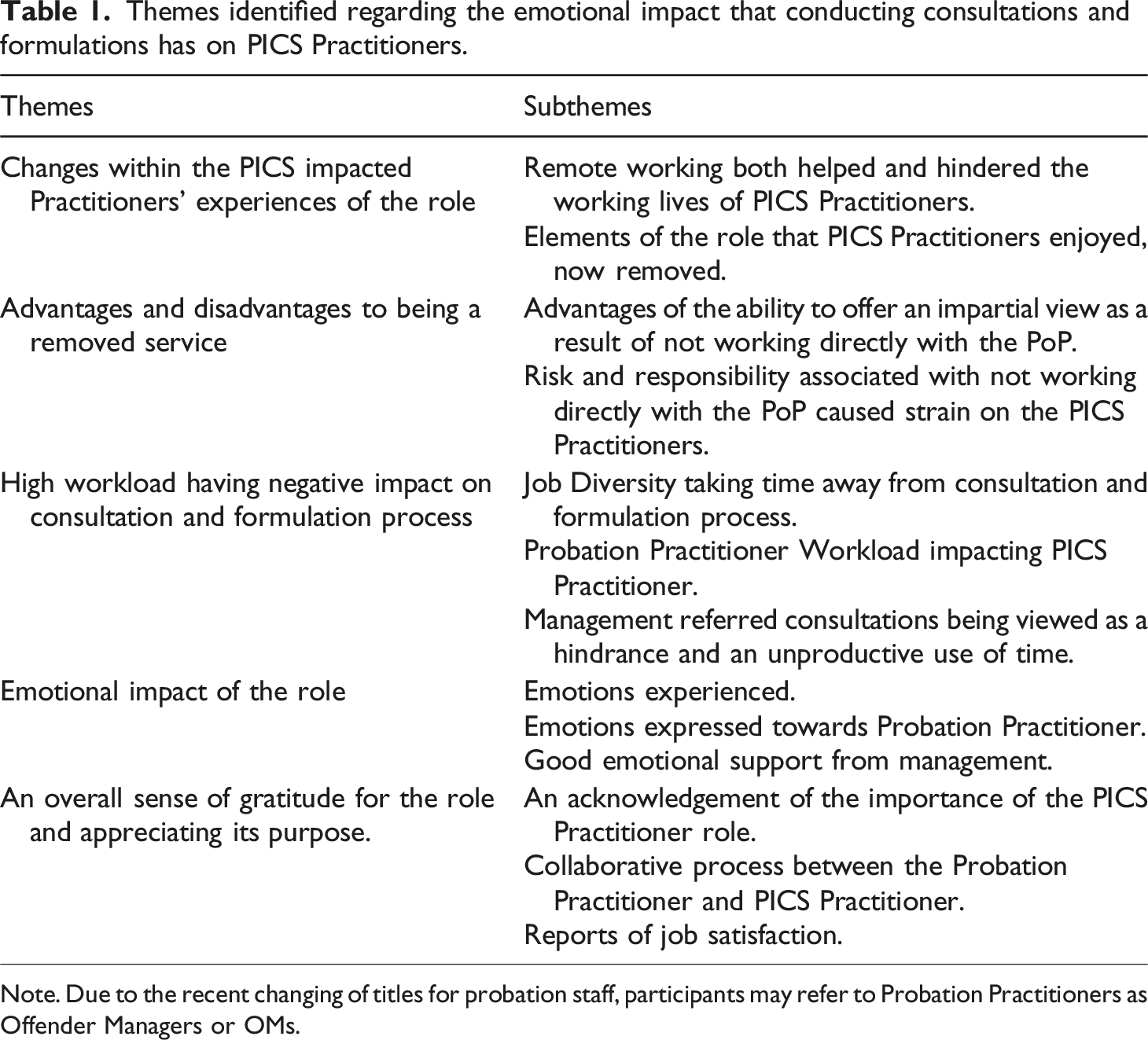
Note. Due to the recent changing of titles for probation staff, participants may refer to Probation Practitioners as Offender Managers or OMs.
Theme One: Changes within the PICS impacted Practitioners’ experiences of the role
Remote working both helped and hindered the working lives of PICS Practitioners
Participants commented on the impact remote working had on their working life. Whilst acknowledging that remote working provides many practical benefits, the negative aspects were also recognised.
Jamie discussed how they ‘like working from home; it gives me lots of flexibility in my personal life. Erm, which is giving me much better work life balance, but yeah, it doesn’t- I don’t feel like, erm, we’re a team that has to work together on a day-to-day basis to solve problems, to manage the quite complex things. It’s more like you’re sitting and doing that on your own a little bit’.
Remote working has impacted relationships with colleagues, limiting the interaction immediately available. This is contrasted with pre-pandemic times, where colleagues were physically present in the same room, sharing opinions and offering perspectives when required. Subsequently, this increased feelings of loneliness and isolation among participants.
Another participant spoke of the impact working from home had on professional boundaries, as homes became offices too. There was a sense of intrusiveness that made some tasks more difficult. As all work was now from home, removing the element of travel, it seemed to participants that they had more time which ultimately became demotivating.
Alex described how ‘at home it just felt harder. I think there’s something about boundaries and something in there, like natural boundaries was a natural one. I’m doing it at work from nine to five but then at home, was harder’.
Elements of the role that PICS Practitioners enjoyed, now removed
Due to COVID-19, the PICS service had to adapt to meet Public Health measures. In doing so, some elements that PICS Practitioners most enjoyed about their professional roles were removed. This had a detrimental effect on Practitioners’ overall job satisfaction which resulted in negative emotions towards work.
Charlie spoke of their enjoyment in the past tense, recounting how they “did enjoy it”. As they “got to see different things going around different areas, different probation offices, which I'd never worked in before, erm, worked with really helpful colleague”, highlighting a series of elements, such as the task variety and social aspects of the job that have now changed in the wake of COVID-19.
Further, Alex referenced their enjoyment for these same aspects of the role. They “loved driving around, so my job I went to four different offices every week or so and it was just really nice to meet lots of different people”. Again, speaking in the past tense, Alex enjoyed meeting new people and networking within the pathway. Networking within the pathway was beneficial to both parties, as whilst visiting probation offices, PICS Practitioners would meet with new Probation Practitioners, who may then consider using PICS for their personal caseload.
Theme Two: Advantages and disadvantages to being a removed service
Advantages of the ability to offer an impartial view as a result of not working directly with the PoP
Working as a removed service provides a variety of advantages and disadvantages for participants. One benefit is that never meeting the PoP allows PICS Practitioners to generate a formulation based on evidence, without the chance of being influenced by the person’s charisma. Indeed, as the Probation Practitioner worked directly with the PoP, there were instances where they had been blindsided whereas PICS Practitioners could look solely at the evidence, and encourage the Probation Practitioner to see this too.
Charlie highlights how “It’s about working with somebody, so just trying to promote more curiosity about risk and how maybe therapeutic gains haven’t been reached in programs and you know, he’s not evidenced anything that’s transferable to a community as yet, just to be, just to be curious about that”.
Risk and responsibility associated with not working directly with the PoP caused strain on the PICS Practitioners
Aside from the benefits of offering their impartial view, PICS Practitioners identified risks due to not meeting the PoP. Participants expressed the difficulty in generating formulations based on thirdhand information, doubting if they had all necessary and accurate information required.
Taylor notes how they “feel slightly uncomfortable sometimes formulating about a person that I’ve never met… and I might be making assumptions that aren’t correct”. This increases stress and the desire to check the validity of information or seek further information; despite this being discouraged. The model recommends working only with the information provided by the Probation Practitioner.
A particular problem associated with the issue regarding validity and only working with information provided is that “while we’re not the ones holding risk, in the event of any serious further offence, you know, our formulation letter will be looked at as part of that process…” (Charlie), thus increasing the responsibility on the PICS Practitioner. The potential risk associated with this is acknowledged as participants questioned “whether that feels slightly more risky because …you’re kind of responding to risk and having to manage it maybe without feeling like you’ve got all the information, because you’re not directly with the person” (Jamie).
Theme Three: High workload having negative impact on consultation and formulation process
Job Diversity taking time away from consultation and formulation process
The vast majority of participants discussed the high volume of work and various elements of the role. The general consensus was that the role had gradually diversified over time. Some years ago, the role was focussed on consultation and formulation, now “we can be pulled into all kinds of things which takes away the time for the consultation and all of that stuff” (Jordan). This is reportedly taking time away from the “bread and butter” (Morgan), the consultations and formulation process.
Participants report efforts to “try to retain that [consultation] as like our kind of bread and butter that’s what we’re there to, ultimately, it’s our core business, but I think as opportunities have widened, and our roles have kind of widened with that and so time and resources erm, is quite tight” (Morgan). But diversification of the role has caused emotional and personal consequences. Whilst participants recognise the ‘benefits’ to role diversity as it does “safeguard us as a team because we are doing so many different things, providing so many different services” (Ash), it increases likeliness of burnout as Practitioners become overwhelmed by the tasks they have, and the timeliness expected of them.
Participants reported that the delay in producing formulations causes a genuine stress response. The backlog of work, caused by increasing role diversity, induces anxiety, as Practitioners have difficulty producing formulations in a timely manner. Processes required of PICS Practitioners (in this study at least) appear responsible for a negative emotional impact on Practitioners. Participants catastrophise the worst-case scenario that could see them being partially responsible for a serious occurrence, and the possibility of this weighs heavily on them:
“I think it’s the pressure of not getting them done on time, that has the impact, if that makes sense. Because you look back and you think oh my god, what if something happened in the meantime there’s a serious further offence and you recommended something, and the offender manager has not picked it up and you’ve not written it down, because you’ve not sent the letter” (Jordan).
Probation practitioner workload impacts on PICS Practitioners
There was acknowledgement that Probation Practitioners have a high workload and their time is limited, with participants referring to Probation Practitioners as having “one of the most overburdened jobs I’ve come across in my professional life” (Alex). This raised a series of issues for PICS Practitioners as Probation Practitioners busy schedules often made arranging consultations difficult. The responsibility to arrange the consultation lies with the PICS Practitioner, however, sometimes Probation Practitioners fail to even respond “with offender managers not really getting back to you, which I don’t think is purposeful. I think it comes from the workload that they’ve got…” (Ash).
This leaves the PICS Practitioner with the additional task of following this up, again, increasing workload and subsequently, increasing work related stress. Similarly, once arranged, there is frequently the need to cancel on the day: “you may get an email, I can’t do it today I’ve got a recall I can’t do it because of- so you can have very sudden cancellations…” (Jordan). This becomes time consuming for the PICS Practitioner, as they then need to reschedule this consultation for another time, but due to the last-minute cancelation, it is too late for anything else to be arranged for that hour. Ultimately, this adds to the PICS Practitioner’s workload and the stress associated with this.
Management referred consultations being viewed as a hindrance and an unproductive use of time
Cases directed for consultation by management was a key issue referenced by almost all participants. In some instances, management may direct cases for consultation, rather than the request made by the Probation Practitioner. PICS Practitioners deemed this problematic as they felt that Probation Practitioners often did not necessarily see the need for this consultation, and instead, felt it was taking time away from their already busy schedule. This, at times, resulted in Probation Practitioners appearing less invested, and whilst PICS Practitioners advocate for the process to be “very… collaborative” (Morgan), these consultations did not feel this way.
In turn, this took time away from PICS Practitioners’ busy schedules and many considered it was not “the most constructive kind of use of, of anyone’s time really” (Morgan) as neither party appears to benefit. Morgan goes on to say “wherever possible, we should be led by our client base, which is the offender manager, not by the kind of erm systems around them, erm I think sometimes it can feel, for me, it can feel a little bit like the offender manager is there, but they’re there because they’ve been directed”. Thus, whilst the consultation is a space for Probation Practitioners to bring their thoughts and feelings regarding the case, the referral coming from higher management is perhaps less advantageous.
Specifically, the impact on valuable resources such as time was reported. The time spent on management referred cases is seen as time spent where it could have been better utilised elsewhere. Probation Practitioners and PICS Practitioners have high workloads, with an additional task prescribed by management, participants deemed this to be wasteful. Taylor describes where Probation Practitioners have “been told that they should have a PICS consultation” they do not benefit from the consultation because they [Probation Practitioners] “know that already” or they think “that’s not gonna make any difference is it because I’ve tried that”. Consultations are then not considered a constructive use of their time amongst their busy schedules.
Despite this, participants did feel that Probation Practitioners “always seem to find that they will find something helpful from it [the consultation]” (Ash). This is testament to the PICS, supporting how it is deemed beneficial to Probation Practitioners, and in some instances, introduces Probation Practitioners who have never used the PICS before to the consultation and formulation process, promoting the use of the PICS with other PoP in their caseload.
Theme Four: Emotional impact of the role
Emotion experienced
A range of emotions were reported to have been experienced during the consultation and formulation process. Morgan spoke of the emotions they experienced towards the PoP, directly as a result of the material discussed during the consultation process, recalling that “about three quarters of the way through kind of noticed I was really feel like my heart like really aching for him”. However, other participants normalised this emotional impact, as Ash stated “I suppose I must be affected to some extent by some of the trickier consultations where there may have been a lot of abuse or particularly sadistic violence. I think it’s natural that to some extent that will sit with us”.
Another participant described the ability to somewhat detach from the material, explaining that although they acknowledge the sadness, “It doesn’t so much shock me anymore, makes me feel a little bit sad but I can, I can definitely, erm what’s the word, detach from it when I’m at home it doesn’t it doesn’t stay with me, I don’t worry about it all the time” (Taylor). This, again, displays an element of normality due to the ability of being desensitised to the content. The participant suggested that previously they were impacted by the emotional elements, but with time this has lessened, further supporting the normalisation.
However, most emotions were induced by other factors, aside from the material regarding the PoP. Rather, the high workload and the lack of information, along with the discouragement from seeking information prior to meeting with the Probation Practitioner, induced anxiety and that ultimately “the most stressful thing was - it was never the content really” (Alex).
Similarly, there were reports of the formulation writeup process inducing anxiety due to the responsibility held by the PICS Practitioner. They are aware that their formulation will be read by different agencies and want to ensure that they have covered all relevant points, whilst remaining succinct. This indicates that the emotional elements of the role come from the tasks and responsibility associated with the role, rather than the content and information regarding the PoP.
Jamie reported experiencing “quite a lot of anxiety about making sure I’ve put it all in the letter, but I’ve done it succinctly enough, because I think that, because this man is very risky and because of what’s happened that was missed, and he’s at MAPPA level as well erm I just I think it’s really important that other professionals who will read it, understand the context of what went on, but I don’t want to put stuff in there that’s irrelevant”.
Emotions expressed towards Probation Practitioner
A theme that was identified across interviews was the sense that PICS Practitioners experienced strong emotional responses towards the Probation Practitioner. Due to the Probation Practitioner being their client and having one-to-one interactions with Probation Practitioners, PICS Practitioners reported their emotion presented in different forms ranging from sympathy to stress. One participant spoke of being “very aware that erm you know, they’ve got to carry a lot of this emotional stuff as well… so it’s, I suppose it’s getting the balance right between how much to say” (Taylor). Cognizant of Probation Practitioners emotional states, PICS Practitioners reported having to make a judgement of what to discuss in the consultation, so not to cause additional emotional strain.
Similarly, Ash reported that what they “find probably more difficult is when you’ve done a consultation and you can see that the OM is really affected themselves by what’s going on with an individual…” and feeling sad as a result of seeing the impact the PoP’s case has had on the Probation Practitioner. As the PICS client is the Probation Practitioner, relationships between the Probation and PICS Practitioner are often well established, and any emotions displayed by the Probation Practitioner have a subsequent impact on the PICS Practitioner.
Participants also identified that “some consults do stay with you longer than others… it’s the one where the ones where I might be perceiving a risk, either myself and a colleague erm and presentation from the offender manager will be, like, completely not on the same page …” (Charlie), therefore feeling stressed or anxious as a result of the Probation Practitioner not being able to see the risk presented by the PoP in the same way that they do. This, again, relates to the risk and responsibility previously mentioned; PICS Practitioners felt a responsibility to ensure Probation Practitioners identified and understood the risk presented by PoP. When this is not happening, there is a cause for concern.
Participants displayed how much emotional impact this had on them, as whilst they “can offer up suggestions and think about trying, you know, increase awareness about why that might be going on which might make it feel a little bit less personal, but you can’t wave a magic wand and take away the stress that the person might be going through in front of you” (Ash). The desire to reduce the impact this has on Probation Practitioners, ultimately affects the PICS Practitioners.
Good emotional support from management
Emotional support within the workplace was generally portrayed as strong and easily accessible. Management were highly regarded, as their approachable and supportive manner was acknowledged; Morgan reported “[manager] is genuinely like really supportive I feel like if I had something that really kind of- if I had something that had triggered me a bit and I felt like quite upset or angry or whatever, I could speak to [manager] if I felt like it was significant enough”. Responses regarding the supportiveness of both management and colleagues were answered definitively and with conviction, displaying their certainty in their response. Despite the challenges identified with remote working and the physical distance it creates between colleagues, participants still felt that “it’s a really supportive team, there’s regular reflective practice meetings. Outside of that, I know that I could contact any of them” (Taylor).
Also, participants referenced support from their colleagues. Despite the emphasis on the fact that this felt somewhat different, due to remote working, participants reported that support was still available from within their team, remotely. Jamie spoke of how if they “just want to run an idea past someone or a bit of a debrief, just to get it off my chest I will ring people on Teams or just text in our group chat ‘is anyone available for a debrief?’ and people have always been available”.
Further, participants spoke of how there are opportunities for emotional discussion. “[We] have like a reflective space. It’s not technically for consultations, but if I was finding something struggling I’d bring up in that space” (Alex). This is indicative of a supportive and understanding workplace with an approachable managerial team and colleagues.
Theme Five: An overall sense of gratitude for the role and appreciating its purpose
An acknowledgement of the importance of the PICS Practitioner role
Participants displayed an awareness of the positive impact the consultation and formulation process had on Probation Practitioners and acknowledged the benefit of the knowledge they are imparting. Taylor recognised that “people have really engaged and keen and although it does seem like I’m sometimes repeating myself, it’s like it’s all new stuff to them”. With the main aim of the PICS being to offer a psychological understanding to Probation Practitioners, who often do not have a psychology background, PICS Practitioners identify the value in the information they share to Probation Practitioners, enabling their further understanding of the PoP in their caseload.
Similarly, participants referenced how the space was developed for Probation Practitioners to speak about any concerns they had, including those personal to them. Alongside bringing the issues of PoP, PICS Practitioners were enthusiastic to make consultations a “really confidential and safe space for the Practitioner to be able to come and bring the person’s difficulties but also a little bit of themselves” (Ash). This gives the PICS consultations an additional purpose and further support its benefits.
Collaborative process between the probation practitioner and PICS Practitioner
Participants commonly discussed how the process was collaborative, with Probation Practitioners bringing information and PICS Practitioners aiding them in gaining a deeper understanding of the individual. This process was generally regarded positively, with one participant referencing consultations as the “enjoyable part” (Alex). The process of the two Practitioners working together, in a “back and forth…reflection” (Morgan) to gain a better understanding of the PoP, and “exits… from certain problems” (Morgan) was referenced as helpful by participants. This collaborative process was likened to “therapy” (Alex), by one participant, where one is aided with their issues but must contribute to gain positive outcomes. PICS Practitioners formulate with the information presented to them in consultations, therefore, substantial information must be brought by the Probation Practitioner to allow for an impactful formulation.
Reports of job satisfaction
Overwhelmingly, participants spoke fondly of their job role and their enjoyment of the role, with one participant describing it as “one of my favourite jobs I’ve ever had in my life” (Alex). The role has allowed participants to learn “so much as a professional and as a human being” (Alex). Another participant proceeded to highlight the overriding benefits of the role. Particularly, colleagues were referenced. Generally, it was regarded that this relatively new job role is a “really good team to be a part of” and “a great place to work at the minute” (Morgan).
Discussion
Our research aimed to explore the emotional impact PICS Practitioners experience during the consultation and formulation process. We found the wellbeing, mental, and emotional state of staff was impacted by the job role. We provide some discussion of this here.
Remote working was pertinent for participants, similar to the findings of Blinkhorn et al. (2023), who found that Probation Practitioners experienced difficulty when bringing their work into their home. Personal home space ought to be protected, yet we found PICS Practitioners, at times, experienced remote working as an infringement on personal boundaries. Rees (2020) also found this to be an issue, reporting Probation Practitioners found meeting with PoP, virtually from their own home ‘intrusive’ making it hard to disassociate between working hours and outside of working hours. Further issues with remote working were identified, including the impact on relationships and support from colleagues. While participants in our study reported being able to seek support even when remote working, they still preferred working alongside colleagues in a face-to-face environment, as the support available remotely was not immediately available. Instead, participants had to request to speak with one another. Mackenzie et al. (2015) found that regular discussions with colleagues were considered the most valuable support by probation staff in their study. Discussions regarding work concerns following an incident, referred to as ‘peer supervision’, were considered to be effective in managing emotional situations. This suggests that the reduced access to these kinds of discussions were likely to have an adverse effect. Collectively, research suggests that office-based work is paramount to the emotional support of Practitioners, including the PICS and the wider probation setting. Office working should be encouraged, to support working relationships and the mental health of staff.
The workload and diversity of tasks PICS Practitioners are involved in is problematic because it negatively impacts upon their ability to focus on consultations and formulations. This resulted in a backlog of formulations requiring write-up and increased stress for PICS Practitioners who carry the responsibility of knowing that Probation Practitioners were awaiting recommendations. DeMichele and Payne (2018) identified that paperwork and admin responsibilities absorbed a large proportion of Probation Practitioners’ time. These tasks took time away from their primary role. Whilst the role is person-focussed, the additional tasks meant that their attention had to be divided. Finn and Kuck (2005) stated high caseloads, excessive paperwork, and deadlines to be the main sources of stress for Probation Practitioners, therefore suggesting the high workload identified in this study would be detrimental to PICS Practitioners’ mental and emotional wellbeing. A subtheme identified in this study was the hindrance of management referred consultations. These consultations were deemed an unproductive use of time, imposing on time that could be better spent on other tasks. Similarly, the ambiguity caused by the diversity of the role may also contribute to PICS Practitioner stress. Alward and Viglione (2023) found reports of role ambiguity and role conflict to be positively correlated with greater levels of reported burnout in Probation Practitioners. Indeed, Lomas (2020) reported that the Exceptional Delivery Model, staffing issues and COVID-19 increased Probation Practitioners’ workloads, resulting in a need for support. Given that PICS Practitioner workload is directly influenced by Probation Practitioners’ needs, Probation Practitioner workload may also have an impact on PICS Practitioners. To manage this stress, PICS Practitioners often worked outside their contracted hours in order to ensure work was complete. These factors contribute to staff wellbeing, mental health, stress and chance of becoming overwhelmed.
Emotion was highlighted in both a primary and secondary form. Participants reported feeling emotions including sadness in response to the exposure to certain material, anxiety in response to the increasing workload and expected time scales for completion resulting in a stress response. Participants also experienced emotion on behalf of the Probation Practitioner. Due to the Probation Practitioner being the service user, and the person that the PICS Practitioner had direct contact with, we found PICS Practitioners felt emotional when they knew the Probation Practitioner was stressed, sad or overwhelmed. Indeed, Blinkhorn et al. (2021) found Probation Practitioners praised the emotional support they received during consultations, with one participant referencing a time where they openly cried to the PICS Practitioner. Similarly, Radcliffe et al. (2020) found that prior to the consultation, Probation Practitioners reported feeling emotionally overwhelmed and impacted by their cases, issues that they brought for discussion during the consultation of their PoP. Our results echo the idea of secondary traumatisation (Figley, 1995), as Probation Practitioners display their emotions as a result of their encounter with the PoP, PICS Practitioners internalise these, also experiencing them on behalf of the Probation Practitioner. Rather than experiencing secondary traumatisation in response to the PoP’s history and offending, PICS Practitioners interestingly identified experiencing this on behalf of their clients: the Probation Practitioners.
The risk and responsibility of not working directly with a PoP was deemed problematic by PICS Practitioners. Particularly highlighted was the strain on PICS Practitioners when the Probation Practitioner was not recognising the risk the PoP was deemed to present. This has been highlighted within Multi-Agency research previously. Multi-Agency Public Protection Arrangements (MAPPA) sees collaborations between police, prison and probation services, known as Responsible Authorities along with other services such as the NHS and local housing authorities, known as agencies with a duty to co-operate, to manage people with sexual and violent offences (HM Prison and Probation Service and NHS, 2023). However, research focussed on understanding the barriers of, and facilitators to MAPPA working found that police participants reported issues with colleagues in the prison service not appreciating the risk posed by certain people in prison and probation (Nash and Walker, 2009). Variation in risk assessment across MAPPA is a concern, and Nash and Walker (2009) highlight the need for training by MAPPA to help agencies appropriately acknowledge and effectively manage risk. More recently, Criminal Justice Joint Inspection (2022) supported this in their MAPPA report, noting that a number of Responsible Authorities, including Probation Practitioners and prison staff, would benefit from further training regarding MAPPA. Whilst this has improved somewhat as a result of academic research and new developments being implemented, information sharing regarding risk management between prison and community remains limited. While training would be helpful to ensure consistent risk management, discrepancies across agencies that work within multi-agency contexts are common. Not only do individual differences impact the risk perspective, but agency practice and approaches used may also interfere.
Aside from negative emotions experienced, there was an overwhelming sense of gratitude displayed towards the job role. Participants identified how beneficial the service was for Probation Practitioners. This is like McMullan’s (2014) work in which consultations improved Probation Practitioners’ awareness and understanding of personality disorders, the individual’s background, behaviours presented, beneficial techniques and interventions, and self-awareness. Lee (2017b) identified literature that indicated that supervision implemented with the intention of focussing on the potential impact of vicarious traumatisation reduced feelings of anxiety, acted as a protective factor and generally supported therapists by encouraging these discussions. Ramsden et al. (2016) found that participants reported the benefits of working alongside a psychologist, and how it provided ‘a more holistic service’ (p.64), positively impacting the management of individuals on the OPD pathway.
An explicit theme that emerged from our study was the positive impact the service has on Probation Practitioners. Previous research indicated that ‘when people perceive their organisations to be supportive, they experience lower levels of vicarious trauma’ (Anderson, 2004 p.2), although, problematically, Phillips et al. (2016) identified how probation officers’ wellbeing was impacted by the increased pressure, and the increased volume of their high-risk caseload, the subsequent need for further supervision was referenced. Generally, participants reported the level of supervision they received to be inadequate. That being said, two participants from the Phillips et al. (2016) study were on the personality disorders pathway training programme, therefore, receiving clinical supervision. One participant spoke highly of this, reporting that it allowed them to ‘offload’ (p.7) some of their concerns and encouraged the use of clinical supervision for Practitioners throughout the probation service (Phillips et al., 2016). This highlights the appreciation of services such as the PICS, and the significant impact that they have on Practitioners, and their wellbeing. Similarly, Lee (2017a) argues that Practitioners working with a high-risk caseload require additional space to attend to the emotional impact of their role, further displaying the need for services such as the PICS. Probation Practitioners’ ability to discuss their concerns regarding cases with the PICS Practitioner is therapeutic. Participants reported how enjoyable the role was, working alongside Probation Practitioners and colleagues within their team. Satisfaction was gained from the support they provide to Probation Practitioners. The notion that PICS Practitioners provide a beneficial service to Probation Practitioners is supported by Radcliffe et al. (2020) who found that Probation Practitioners reported an improved relationship between themselves and the PoP following the consultation and formulation process.
Conclusively, we found PICS Practitioners presented emotional responses to their role in the form of stress, anxiety and sadness. These emotions derived mainly from the backlog of work caused by job diversity, the risk associated with being a removed service, remote working, and feelings expressed on behalf of Probation Practitioners. That said, PICS Practitioners also identified positivity in their role, which should not be ignored, they reported good job satisfaction, enjoyed working alongside Probation Practitioners and emphasised service benefits as a result of their impartiality. Such strong workplace support may contribute to a reduced vulnerability to vicarious traumatisation (Lee, 2017b). Although the results of this study do not comment on ‘secondary vicarious traumatisation’, it is likely that through appropriate resource distribution, consistency in role expectations, and managerial and colleague support, stress, anxiety and traumatisation can be prevented in PICS Practitioners.
Limitations and future research
As this research was conducted with one PICS team in the North West of England, these results are not necessarily generalisable to other community consultation services nationwide. Moreover, different teams are structured in different ways and have varying ways of working. Limitations of IPA include the difficulty participants may experience in communicating their point to the researcher, therefore, vital points may have gone unreported. Due to the small number of participants used in this study, it would be beneficial to perform a dyadic study where the population is widened. This may include similar research being conducted outside of this region. There is a need to replicate this research more widely and explore the experiences of individuals working in the OPD community consultation services nationally. Further benefit may be found by progressing to examine the experience of Probation Practitioners. This may include examining conversations had between PICS Practitioners and Probation Practitioners during consultations, to analyse the depth to which emotive conversations occur regarding both the PoP and the Probation Practitioners personally.
Implications for practice
Based on the results of this research, recommendations for the PICS team include revisiting remote working for staff and offering in person consultations between themselves and Probation Practitioners, re-introducing travel and social aspects. By encouraging office-based working, the relationship can be re-established and strengthened. Similarly, PICS management should maintain the support that is offered for staff. However, a discussion regarding a review on workload and role diversity may be beneficial to the team. Reflecting on this research, and the work of Blinkhorn et al. (2021), it is also imperative, for both professions, that management referred consultations are removed, as they are deemed a poor use of time and an additional stressor for staff. The support network provided by managers and colleagues was commended; we suggest that this is continually reinforced, to grow from strength to strength.
Footnotes
Declaration of conflicting interests
The author(s) declared no potential conflicts of interest with respect to the research, authorship, and/or publication of this article.
Funding
The author(s) received no financial support for the research, authorship, and/or publication of this article.
