



Abstract
Indonesia’s growing older population and the persistence of intergenerational co-residence highlight the need for context-specific assessment tools. Yet, there remains a gap in published instruments that evaluate these experiences for older adults and their adult children. This study investigated whether valid and context-specific questionnaires could be developed to assess these experiences through expert consensus. An initial pool of 119 items for older adults and 127 items for adult children was generated from in-depth interviews exploring motives for co-residence. The items addressed domains including filial responsibility, family relationships, marital status, financial circumstances and health-related considerations. For older adults, this included relationship quality with family members and housing suitability, while for adult children, it included parent-child relationships and adaptability to health and household conditions. The Delphi method was then used, with experts in family studies and geropsychology evaluating the clarity and relevance of these items across two rounds. The process refined the instruments, in the form of questionnaires, to 84 items for older adults and 82 items for adult children. The resulting instruments are the first context-specific tools designed for assessing intergenerational co-residence in Indonesia, offering a resource for researchers and practitioners to study family living arrangements.
Keywords
Introduction
The global population of older adults is growing rapidly. According to the World Health Organization (2024), by 2030, one in six people worldwide will be aged 60 years or older, raising the global population of older adults to 1.4 billion. In Indonesia, the population aged 60 years and above is expected to comprise 12% of the total population in 2024 (Badan Pusat Statistik, 2024). This demographic shift is reshaping family dynamics, including living arrangements between older adults and their adult children. In this context, adult children generally refers to sons and daughters who are already working and earning an income, and who therefore have the potential to live independently. Given the challenging economic conditions, where younger generations struggle to afford homes, intergenerational co-residence has become an increasingly common option (United Nations Department of Economic and Social Affairs, 2020). In this arrangement, parents support their adult children, while children provide care for their ageing parents (Albertini and Semprebon, 2020; Chen and Lewis, 2015; Schwarts and Ayalon, 2015).
To date, no measurement instrument has been developed in Indonesia to evaluate the experiences of older adults and adult children living together, leaving a gap in the assessment of intergenerational co-residence. Existing scales, such as the Family Harmony Scale (FHS-24), adapted to the Indonesian context by Fauziah et al. (2021), assess family harmony, while the Dual Filial Piety Scale (DFPS), adapted by Sugianto et al. (2024), captures motivations in parent-child relationships. These tools were developed in China, where filial piety emphasises children’s responsibility to care for parents (Kavikondala et al., 2016; Yeh and Bedford, 2003). In Indonesia, however, filial piety is more broadly expressed through financial support, healthcare access and co-residence. The decision to co-reside is shaped by multiple factors beyond filial devotion, making it distinct from contexts with more rigid filial traditions. Addressing this gap is essential for equipping researchers and practitioners with tools that reflect Indonesian family living arrangements.
Literature review
Several factors influence the decision for intergenerational co-residence. A systematic review conducted prior to this study identified factors such as financial circumstances, health conditions, kinship systems, marital status, education level and the number of family members as key determinants (Hanum et al., 2024). Among a few studies of intergenerational co-residence in Indonesia, one highlighted the significant role of economic factors in parents’ decisions to live with their adult children (Johar and Maruyama, 2011). This arrangement can also affect the harmony of relationships within the household. Parents who continue to support their adult children often expect reciprocal care, and unmet expectations may reduce life satisfaction (Casares and White, 2018; Tosi and Grundy, 2018). Importantly, these themes – particularly financial circumstances, relationship quality and marital status – also emerged in our earlier interviews with older adults and adult children, which formed the basis for item development in this study.
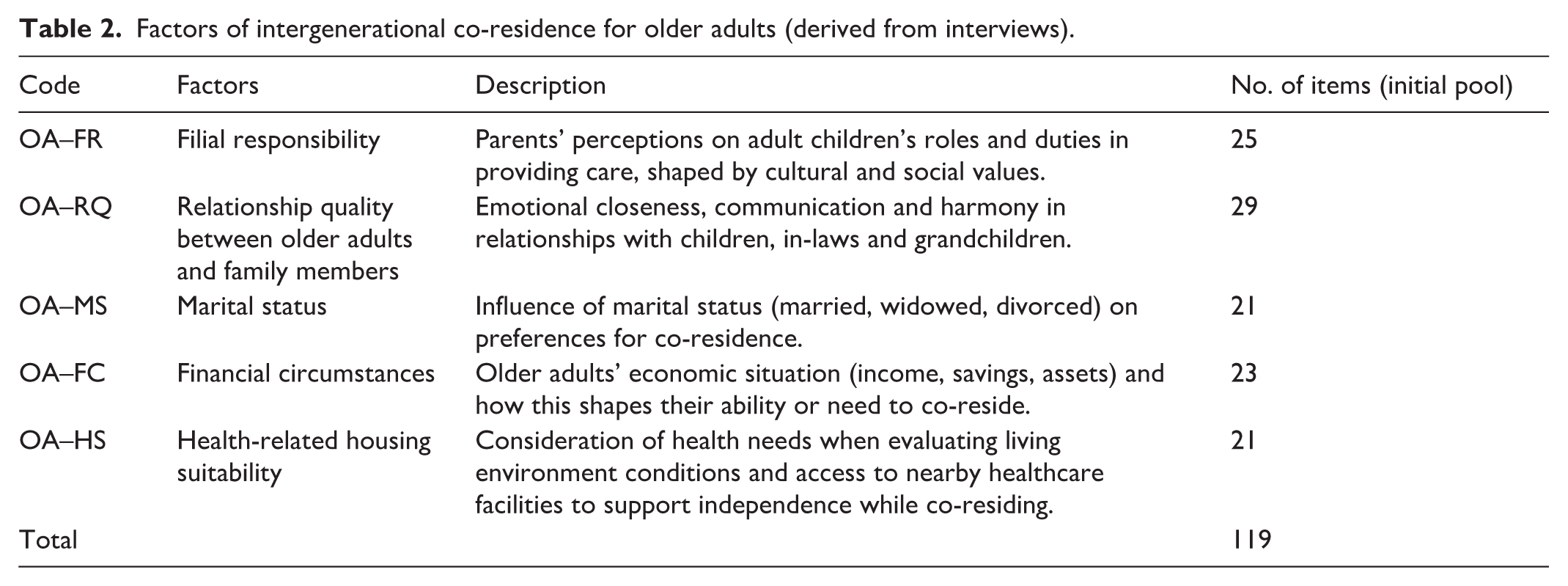
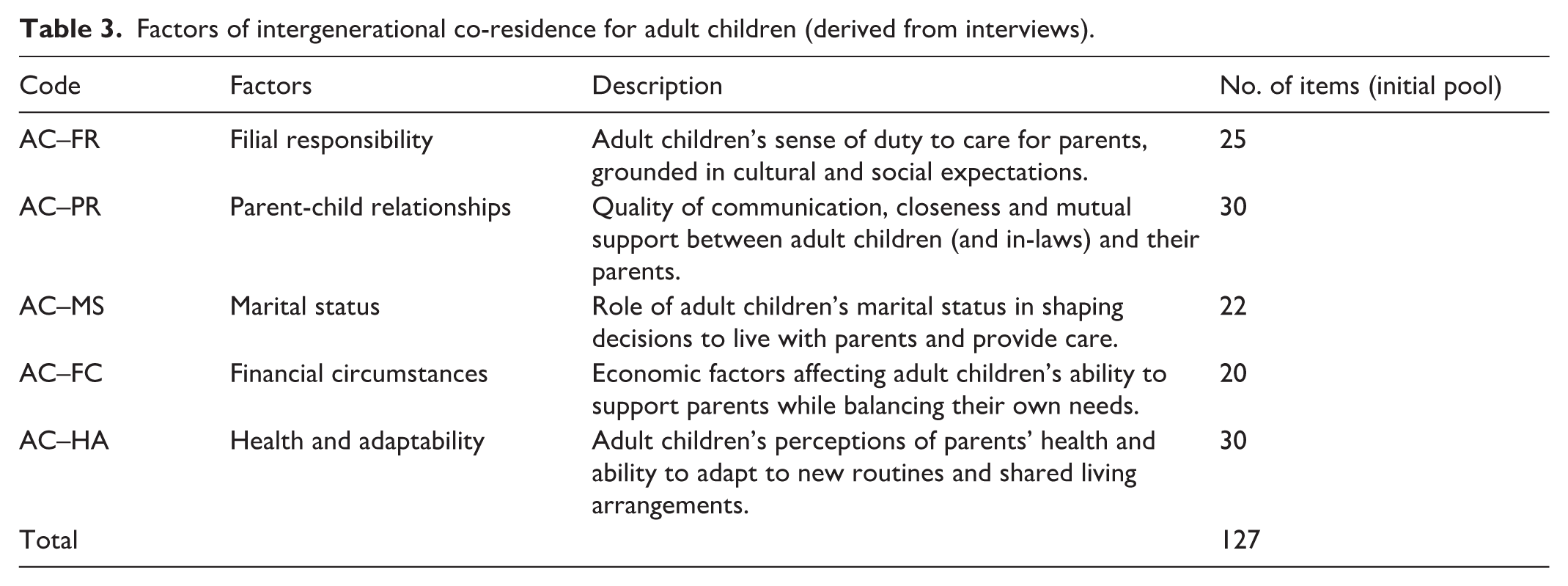
Before the Delphi process, in-depth interviews were conducted with 20 older adults and 30 adult children living in intergenerational co-residence across Indonesia. These interviews (unpublished data) identified domains influencing co-residence decisions. For older adults, the domains were filial responsibility (OA–FR), relationship quality (OA–RQ), marital status (OA–MS), financial circumstances (OA–FC) and health-related housing suitability (OA–HS). For adult children, the domains were filial responsibility (AC–FR), parent-child relationship (AC–PR), marital status (AC–MS), financial circumstances (AC–FC) and health and adaptability (AC–HA). These domains formed the coding framework for item development, resulting in an initial pool of 119 items for older adults and 127 items for adult children, which were subsequently evaluated through the Delphi process.
The Delphi method, known for its iterative approach, is designed to build expert consensus on a specific issue (Dragostinov et al., 2022; Franc et al., 2023; Peng et al., 2024). In this study, it was applied to assess the relevance of the items in the measurement tool. The process typically involves multiple survey rounds in which experts rate each item’s relevance to the domain under study (Chen et al., 2024; Dragostinov et al., 2022). Because experts play a central role, transparent criteria for participant selection are essential, and purposive sampling is commonly used. Although some studies have recruited more than 60 participants, others have demonstrated validity with as few as 15 (Hasson et al., 2008). This study engaged 24 participants, all researchers and psychologists with at least 3 years of experience in family studies and geropsychology.
In this study, adult children refers more specifically to individuals aged 21 years or older who are employed and currently living in multigenerational co-residence with their ageing parents. Therefore, the objective of this study was to develop and refine questionnaires to assess intergenerational co-residence experiences from the perspectives of both older adults and adult children. These instruments address a gap in available tools and provide a means to better understand co-residence dynamics in Indonesia, supporting both research and practice.
Methods
Participants
The experts in this study were psychologists and researchers with significant experience in gerontology and family dynamics involving older adults. Since Indonesia does not yet have specialists formally recognised in Geropsychology, the inclusion criteria for experts were developed in consultation with the Indonesian Psychological Association (HIMPSI) to ensure that panel members met the necessary qualifications.
Psychologists were required to have at least 3 years of experience working with families, particularly in the context of older adults and intergenerational relationships. They also needed a practice permit from HIMPSI and experience working with diverse family structures across Indonesia’s cultural settings. To verify these requirements, HIMPSI recommended potential experts, and their qualifications were cross-checked through the websites of affiliated organisations. Researchers were required to have a master’s degree in psychology, gerontology, family studies or social welfare, and at least 3 years of experience in researching family or older adult issues. Their qualifications were confirmed through publicly available information on their academic or professional affiliations and peer-reviewed publications.
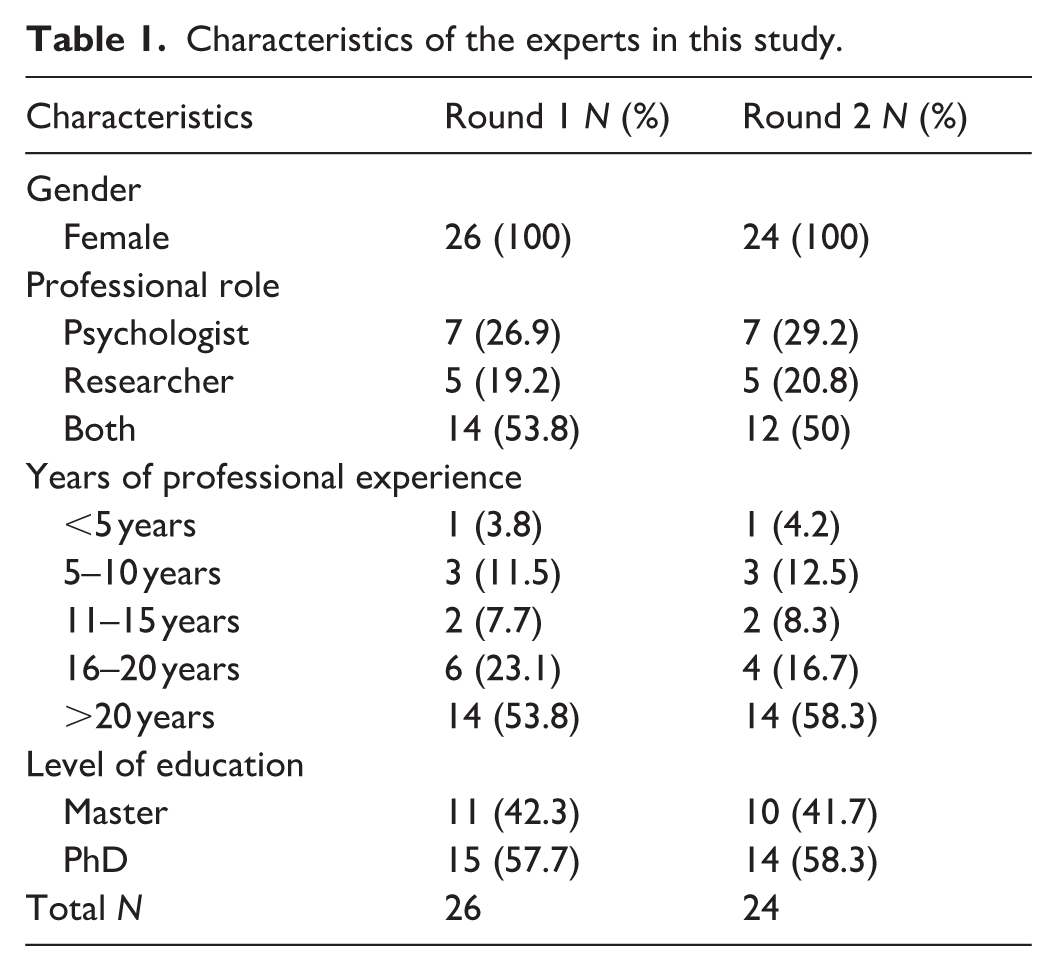
In the first round of the Delphi survey, 41 experts were invited. Of these, 30 agreed to participate, giving a response rate of 73.2%. Out of the 30 who agreed, 26 experts completed the survey, resulting in a completion rate of 63.4%. In the second round, 24 experts completed the survey, yielding a completion rate of 92.3%. Two experts withdrew due to health issues and scheduling conflicts. All experts in this study were female, a result that was incidental rather than intentional. Most had more than 20 years of experience, working primarily as both psychologists and researchers in academia (see Table 1).
Characteristics of the experts in this study.
Procedure
This study developed two instruments to evaluate intergenerational co-residence from the perspective of older adults and adult children. As part of a larger doctoral project, key factors influencing co-residence decisions in Indonesia were identified (see Tables 2 and 3). These findings formed the basis for item development. The first author extracted the factors and transformed them into indicators, which were then expanded into 119 items for older adults and 127 items for adult children, based on in-depth interviews conducted in the earlier study. All items were developed inductively from the interview findings, with each domain contributing a specific number of items as shown in Tables 2 and 3. In total, 119 items for older adults and 127 items for adult children were generated, forming the initial pool assessed in the Delphi process.
Factors of intergenerational co-residence for older adults (derived from interviews).
Factors of intergenerational co-residence for adult children (derived from interviews).
The Delphi survey was conducted online via Qualtrics and remained open for 1 month. Round 1 was organised into three sections: an introduction, items evaluating the experiences of adult children living with parents, and items assessing the experiences of older adults living with adult children. Each section began with an explanation of the relevant factors. Experts rated each item using a 4-point Likert scale (1 = strongly disagree, 4 = strongly agree) based on how well the item reflected the factor. Open-ended questions were included to gather qualitative feedback, for example: ‘If you have any suggestions or comments regarding the items above, please write them in the space provided below’. This enabled experts to identify items requiring further refinement.
Round 2 followed the same format but only included items revised from Round 1. Before completing Round 2, experts received a summary of the first-round outcomes, including the quantitative categorisation of items (accepted, needs revision or eliminated) and a general overview of the qualitative feedback. To ensure transparency, both the original and revised versions of each item were presented. Experts then re-rated the revised items and indicated whether the changes improved clarity and relevance, with the option to provide further feedback. A 4-point Likert scale was again used to encourage decisive ratings and minimise central tendency bias. While this approach restricted neutrality, open-ended comment sections allowed experts to express mixed or uncertain views.
Results
The Delphi process evaluated items that were derived exclusively from the in-depth interviews with older adults and adult children. No items were borrowed or adapted from prior instruments. Data were analysed using the Content Validity Index (CVI), Interquartile Range (IQR) and standard deviation (SD). Items with CVI < 0.78, IQR > 1.00 or SD > 1.00 were eliminated (Polit et al., 2007). Items with 0.78 ⩽ CVI < 0.85 and acceptable IQR and SD values were classified as needs revisions, while items with CVI ⩾ 0.85, IQR ⩽ 1.00 and SD ⩽ 1.00 were accepted. High IQR or SD values indicated greater variability in responses, suggesting that experts may have interpreted the items differently (Franc et al., 2023; Hasson et al., 2008; Huang et al., 2022). Qualitative feedback was also analysed thematically and used to refine items. Items initially accepted but accompanied by substantial comments were reassigned to the needs revision group for reassessment in Round 2.
In the first round, 77 of 119 items for the older adult instrument were accepted, 11 required revision and 31 were eliminated. For the adult children instrument, 73 of 127 items were accepted, 13 required revision and 41 were eliminated. Expert feedback pointed to several problems: some items encouraged extreme response bias, others contained unclear or ambiguous phrasing and some items were judged too similar in content. In addition, several health-related items were flagged as unsuitable for the Indonesian healthcare system. For example, the statement, ‘My parents are able to adapt to a new home environment’, was considered vague and was revised to ‘My parents can easily adapt to new daily routines when living with me’.
In the second round, 22 older-adult items and 24 adult-children items were reassessed, including both those originally classified as needs revision and those accepted but accompanied by strong qualitative feedback. Of these, 18 older-adult items and 19 adult-children items were accepted, while 4 and 5 items, respectively, were eliminated. The final instruments, therefore, comprised 84 items for older adults and 82 items for adult children. Table 4 summarises these outcomes across both rounds.
Summary of Delphi outcomes for older adults’ and adult children’s instruments.

‘Accepted’ = CVI ⩾ 0.85, IQR ⩽ 1.00, SD ⩽ 1.00; ‘Needs revision’ = 0.78 ⩽ CVI < 0.85 with acceptable IQR/SD; ‘Eliminated’ = CVI < 0.78 or IQR/SD > 1.00.
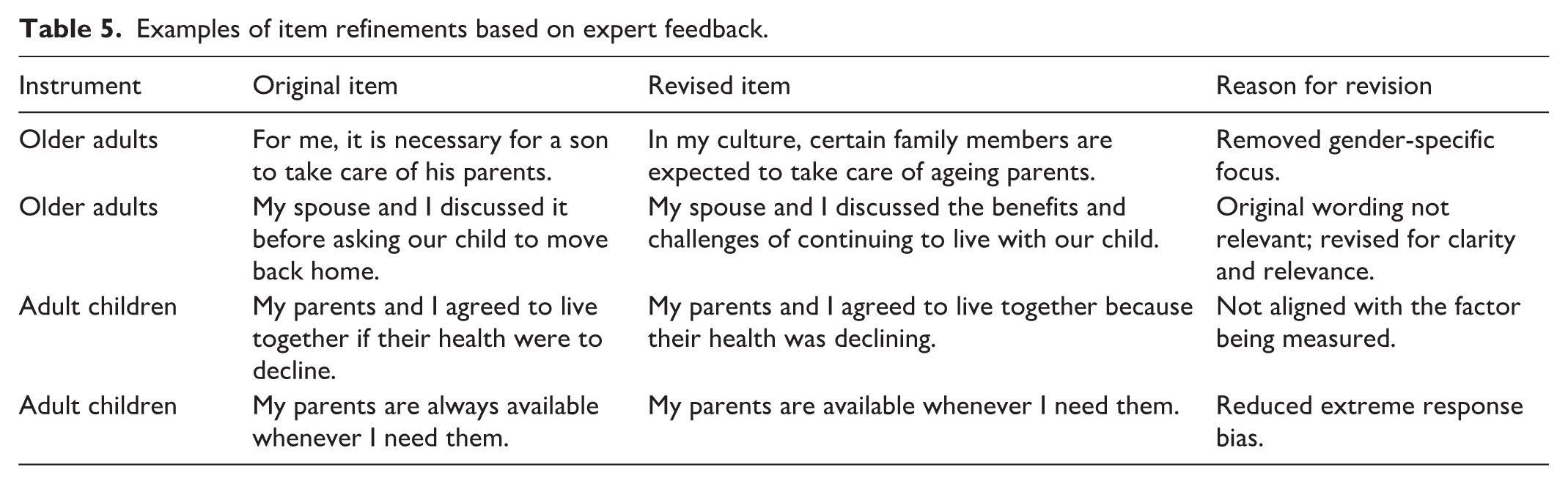
Examples of item refinements are presented in Table 5. These illustrate how expert feedback led to clearer and more context-appropriate items. For instance, items that encouraged extreme responses were rephrased in more balanced terms, while items considered ambiguous or redundant were revised for greater clarity and distinction. Full item-level results and complete revision logs are available in Supplemental Tables S1–S4.
Examples of item refinements based on expert feedback.
Discussion
This study developed two context-specific instruments to evaluate the experiences of intergenerational co-residence in Indonesia, one for older adults and one for adult children. Using the Delphi method, an initial pool of interview-derived items was refined into questionnaires that reflect multiple domains of co-residence, including financial circumstances, relationship quality, marital status and health-related considerations. These results demonstrate that co-residence in Indonesia is shaped by a combination of economic, relational and practical factors, rather than by filial responsibility alone, reinforcing insights from earlier studies (Casares and White, 2018; Johar and Maruyama, 2011; Tosi and Grundy, 2018).
A key contribution of this study is addressing the absence of tools designed to evaluate intergenerational co-residence in Indonesia. While instruments such as the Family Harmony Scale (Fauziah et al., 2021) and the Dual Filial Piety Scale (Sugianto et al., 2024) have been adapted to Indonesian contexts, they were not developed to assess co-residence directly. The instruments developed here fill this gap by integrating domains identified through interviews with older adults and adult children, capturing how co-residence decisions are negotiated in daily family life. For example, items relating to housing suitability for older adults required revision, as they assumed the availability of universal home-based healthcare, which does not reflect Indonesia’s uneven health service provision (Hakim, 2021; Syamsu, 2023). Similarly, items for adult children were adjusted to avoid absolute frequency terms such as ‘always’, which experts judged inconsistent with local realities. These refinements highlight the importance of grounding item development in the lived conditions of Indonesian families.
Expert feedback was invaluable, providing detailed insights that helped streamline the revision process. This underscores the importance of expert input in ensuring content validity (Hasson et al., 2008; Hsu and Sandford, 2007; Mitchell et al., 2021). Recruiting qualified experts, however, was shaped by Indonesia’s institutional context. HIMPSI, the Indonesian Psychological Association, is the national professional body for psychologists, but does not have a dedicated division for geropsychology or ageing-related issues (HIMPSI, 2022). This absence required broadening the inclusion criteria, with HIMPSI providing a list of researchers and practitioners with relevant experience in family and ageing studies. Although this strategy ensured that panel members were suitably qualified, it also reflects the limited professional infrastructure in this field in Indonesia. This gap may help explain why recruitment was more difficult in some regions and why the final panel was less diverse than anticipated.
The study also illustrates additional methodological challenges. Recruitment of experts was more feasible in Central Indonesia than in Western and Eastern regions, reflecting the broader scarcity of psychologists and researchers working on ageing and family dynamics in those provinces. This imbalance may have shaped the consensus and reduced the diversity of perspectives included. In addition, all experts in the Delphi panel were female. While this was incidental rather than intentional, it may have influenced the way caregiving and family responsibility were represented in the consensus process. These limitations underline the need for broader professional networks and greater gender diversity in future Delphi studies.
The choice to use a 4-point Likert scale without a neutral midpoint was another important methodological feature. This approach encouraged decisive ratings and reduced central tendency bias, but it may also have constrained experts with genuinely neutral views (Adelson and McCoach, 2010). Open-ended questions partly addressed this by giving space for nuanced or mixed responses, yet future applications of these instruments might explore alternative rating formats that balance decisiveness with flexibility. Another limitation relates to the large number of items included in the Delphi survey, which may have caused fatigue or demotivation among experts (Brosnan et al., 2021). Although experts were informed in advance about the survey’s length and were given 1 month to complete it, some still struggled and several withdrew due to time or health issues. This challenge reflects a common constraint in Delphi research but also emphasises the importance of designing instruments that are both comprehensive and manageable.
Beyond methodological lessons, the instruments developed in this study have practical implications. They provide researchers with tools to systematically assess experiences of co-residence in Indonesia, offering a foundation for future quantitative studies on family living arrangements. For practitioners and policymakers, these tools may support the identification of stressors and protective factors in multigenerational households, informing interventions that promote the well-being of both generations. At the theoretical level, the findings contribute to perspectives such as Intergenerational Solidarity Theory (Bengtson and Roberts, 1991) and Social Exchange Theory (Gergen et al., 1980), by showing that co-residence is best understood as the outcome of negotiations across multiple domains rather than as a product of filial obligation alone.
Future research should build on this work by conducting psychometric validation with larger and more diverse samples across Indonesia. The factor structure and reliability of both scales need to be tested to confirm that they accurately capture the intended domains. Establishing this evidence will be an essential next step before the instruments can be applied more widely in research and practice.
Conclusion
This study employed the Delphi method to develop two context-specific instruments for evaluating the experiences of intergenerational co-residence in Indonesia, one for older adults and one for adult children. Through the integration of quantitative ratings and qualitative feedback, the Delphi process enabled the refinement of items across multiple domains, resulting in final instruments of 84 items for older adults and 82 items for adult children. These instruments represent the first tools designed specifically for the Indonesian context to capture the complex factors influencing decisions to co-reside, moving beyond filial responsibility to include financial, relational, marital and health-related considerations.
The study faced several limitations. Recruitment of experts proved challenging, particularly in Eastern Indonesia, leading to a regional imbalance in representation. The final Delphi panel was composed entirely of female experts, which may have influenced the perspectives represented. In addition, the large number of items created potential for survey fatigue, and the use of a 4-point Likert scale without a neutral midpoint may have constrained experts with genuinely neutral views. These factors may have shaped the consensus process and should be taken into account when interpreting the findings.
Despite these limitations, the study demonstrates that valid and context-specific instruments can be developed even in contexts with limited professional infrastructure. The instruments offer researchers, practitioners and policymakers a systematic means of assessing intergenerational co-residence in Indonesia and identifying potential challenges in multigenerational households. The next step for future research will be to conduct psychometric validation with larger and more diverse samples across Indonesia to establish the validity, reliability and factor structure of the instruments before they are applied ore widely in research, practice and policy.
Highlights
Developed instruments to assess intergenerational co-residence in Indonesia.
The Delphi method was used to refine items with expert consensus.
Instruments evaluated the experiences of older adults and adult children.
The study provides a context-specific tool for examining family dynamics in Indonesia.
Supplemental Material
sj-docx-1-mio-10.1177_20597991251414966 – Supplemental material for Delphi study on developing a tool to evaluate intergenerational co-residence experiences
Supplemental material, sj-docx-1-mio-10.1177_20597991251414966 for Delphi study on developing a tool to evaluate intergenerational co-residence experiences by Lathifah Hanum, Peter Newcombe, Fivi Nurwianti and Theresa Scott in Methodological Innovations
Footnotes
Acknowledgements
We would like to express our sincere gratitude to Dr Wiwin Hendriani, S.Psi., M.Si., and the Indonesian Psychological Association (Himpunan Psikologi Indonesia) for their support in connecting us with experts whose research and practices are related to older adults and family dynamics with older adults in Indonesia. We also extend our thanks to the research assistants Fajriah Rahma B. Arafah, Kerstan Ean Irawan, Mutia Aulia Dewi, Mohammad Omar Abdurrohman and Tiara Aulia Pradina who played a crucial role in gathering data from the experts.
Author contributions
Lathifah Hanum: Conceptualisation, methodology development, formal analysis, investigation, data curation, project administration, writing – original draft and writing – review & editing, visualisation. Peter Newcombe: Supervision and writing – review & editing. Fivi Nurwianti: Project administration and funding acquisition. Theresa Scott: Supervision and writing – review & editing.
Declaration of conflicting interests
The authors declared no potential conflicts of interest with respect to the research, authorship, and/or publication of this article.
Funding
The authors disclosed receipt of the following financial support for the research, authorship, and/or publication of this article: The Faculty of Psychology Universitas Indonesia funds this research under Hibah Riset Fakultas Psikologi UI 2024 (Grant No.: NKB-188/UN2.F8.D/PPM.00.02/2024).
Ethical approval
Ethical approval was gained from The University of Queensland (2024/HE001839) and Universitas Indonesia (183/FPsi.Komite Etik/PDP.04.00/2024).

Data availability statement
Data that has been used is confidential and will be made available on request.
Supplemental material
Supplemental material for this article is available online.
Author biographies
References
Supplementary Material
Please find the following supplemental material available below.
For Open Access articles published under a Creative Commons License, all supplemental material carries the same license as the article it is associated with.
For non-Open Access articles published, all supplemental material carries a non-exclusive license, and permission requests for re-use of supplemental material or any part of supplemental material shall be sent directly to the copyright owner as specified in the copyright notice associated with the article.
