



Abstract
This article presents a qualitative methodological framework for exploring global socio-technological innovation in urban youth’s appropriation of public space. The proposed framework attempts to provide a heuristic approach for urban and youth studies scholars to better understand urban youth as key actors in the hybridisation of urban public space, without forgetting that access to and need for public space is not equally shared. Addressing gaps in intersectional youth studies and public space research, we propose a flexible, transdisciplinary approach based on intersectionality, starting questions and methodological principles. Designed to be flexible and adaptable to varying urban contexts, the proposed framework requires only minimal consensus on core concepts such as relational space and youthhood as a relational, intersectional category. Its main aim is to encourage collaboration between geographically diverse research teams to stimulate future studies on socio-technological changes in the appropriation of public space by youth around the world.
Introduction
This article contributes to strengthening young people’s voices in urban studies by addressing methodological challenges and expanding the global reach of empirical research on youthhood (Leyshon et al., 2013; Skelton and Gough, 2013). This goal required collaboration among five universities in Belo Horizonte, Tel Aviv and Vienna, as part of the CTS-funded YOUTH project, which concluded in January 2025. The project examined how urban youth engage with public spaces through digital and material experiences across different geopolitical contexts.
The article aims to identify and propose a qualitative methodological strategy or ‘framework’ for exploring local and global patterns in how urban youth navigate and appropriate public spaces, focussing on the interplay between socio-technological change and social inequality. By identifying shared methodological principles, we seek to better understand how digital and material urban experiences are increasingly interwoven, while structural inequalities continue to persist.
Our conception of space is relational; space is continuously produced through dynamic socio-material relations actualised in social practices which unfold within simultaneous heterogeneous (non)human trajectories. Space extends beyond the immediately perceivable, local surroundings. Space is emergent, interactive and open-ended and is socially produced by and within political struggles about the ways in which spatial relations are constituted and reconfigured (Massey, 2005: 9–14).
This relational perspective underscores embodied experience. Encounters and affective engagements are analysed within a conception of age as a social process not defined by developmental milestones alone (Gabauer et al., 2024: 111). Socio-technical transformations further blur boundaries between digital and material spaces, producing ‘vireal’ experiences of space (Institut für Neue Medien, 1996). Youth studies must move beyond a binary opposition between digital and face-to-face interactions. Digital media in fact reshapes our perceptions of space and social relations (Ketter, 2014).
While relational space and age allow for dynamic and open analysis, research also needs to account for ‘structured complexity’ (Jessop, 2010) and account for more durable inter- and intra-social relations, incorporating inequality. Since hierarchies are often naturalised, mystified or strategically essentialised, such relations should be understood as shaped around categories of class, gender, ethnicity and age and thus part of everyday classificatory struggles that produce but also challenge marginalisation (Tyler, 2015: 507). Intersectionality offers a conception of complex inequality by incorporating constructs such as relationality, power disparities and social justice (Collins et al., 2021: 693–694), in relation to positionality, contextuality and cross-categorical stabilisation of hierarchies which become visible in social struggles (Tyler, 2015: 507). Intersectionality also implies an awareness of the risks of simplifying inequality as additive rather than relational, a perspective that can obscure everyday mechanisms of othering, even within seemingly positive policy discourses such as gender mainstreaming (Schlamelcher, 2012: 85–87).
Recent debates in youth research highlight the role of digital media in co-constructing identity, hierarchy and relational networks (Ketter, 2014). Case studies discussed in this article aim at capturing these dynamics around public space appropriation and contribute to a methodological framework that accounts for them in future research.
The three case studies examine: (1) how socio-spatial disparities, class and racial inequalities shape youth experiences in Belo Horizonte; (2) how young activists in Tel Aviv use digital media for resistance; and (3) how self-identified female youth in Vienna navigate mobility and safety through digital platforms. Each case study design contributes empirical insights using distinct research strategies (see Table 1).
Main research strategies.
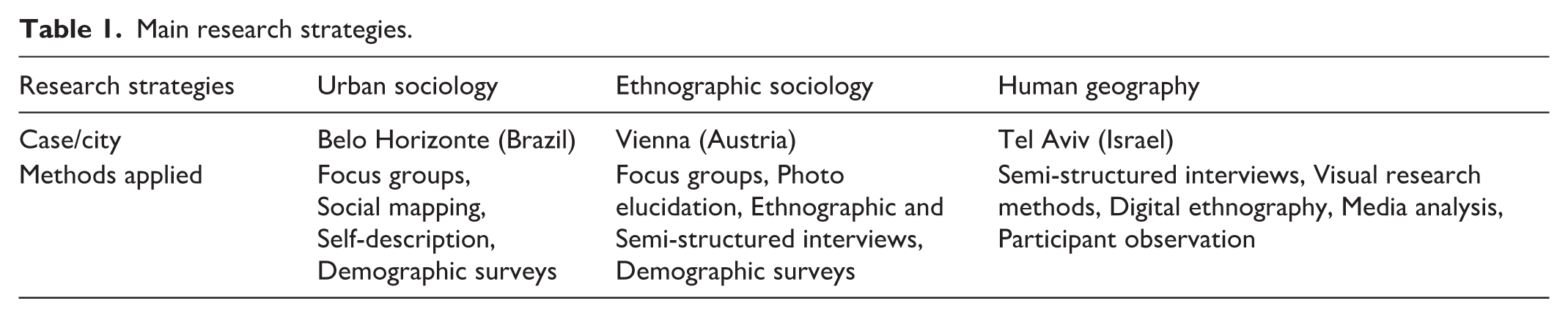
All case studies implied firm partnerships with professional youth related organisations and benefited from a continuous dialogue with applied social work which facilitated field access and enriched methodological approaches, enhancing the research’s participatory and transdisciplinary dimensions.
The article proceeds as follows: we first survey the literature about qualitative methods prevalent in urban youth research, particularly the challenges posed by the interplay between digital and material (‘vireal’) urban spaces. We then analyse how our case studies contributed to developing our methodological framework. We identify shared principles and contextual adaptations. Finally, we present a global and flexible methodological approach to studying urban youth. We emphasise intersectionality, complementarity and participatory collaboration with youth related organisations as key pillars for future research.
Studying contemporary youthhood: Analytical foundations
Qualitative research methodologies of urban youth
Empirical approaches attuned to urban contexts can engage with the digital in two ways. First, they may become digitised organically as researchers follow informants through the interconnected digital and material dimensions of everyday urban life (Thulin et al., 2020: 177). This approach necessitates that researchers adapt their methods based on empirical contexts, which can be enhanced using techniques such as time-use diaries. These diaries promote participants’ self-reflexivity and provide additional data. Second, research can begin with the digital space itself, using digitally attuned methods to explore youth practices and subsequently connecting these insights to broader socio-material contexts (Airoldi, 2018). While the choice of entry point – face-to-face or digital – depends heavily on the expertise of researchers and the objectives of the study (which also shaped our collaboration towards field-driven studies of urban youthhood), for us, as with digital ethnography (Pink et al., 2016), research cannot stop at digital engagement alone. It must, as Airoldi (2018: 8) argues, triangulate interpretations and foster trust through immersive, face-to-face research relationships and include the digital experiences of youth everyday lives.
While we acknowledge research that prioritises digital dynamics over socio-spatial contexts (Shirtcliff, 2019; Stokols, 2023), these approaches demand considerable expertise in computational and media analysis and present challenges such as algorithmic biases (Grigoropoulou and Small, 2022). While valuable entry points for situations with limited field access, such cross-sectional studies did not qualify for our own methodological elaborations. We consider face-to-face relationships and contextual engagement as important elements in enhancing the quality of qualitative data and its interpretation.
The following review outlines methodological commitments critical to youth research that engages with the virealisation of public space. Qualitative methodologies dominate this area, particularly in urban studies of youth geographies (Skelton and Gough, 2013: 461). Research typically conceptualises the empirical field through case study designs, or ‘multi-sited’ ethnographic engagements (Marcus, 1995). Some studies combine computational surveys with qualitative techniques into mixed methods strategies (Matthews, 2015; Stokols, 2023). All these strategies face the challenge of addressing an empirical field transformed by digital media technologies with socio-spatial practices of youth, constantly blurring the boundaries between localised practices and their spatially and socially unbound digital extensions when engaging with various mobile phone apps. These shifts, evident in the methodological triangulation, reveal deeper epistemological implications and point to a socio-technical transformation or new trajectories in how youth experiences, navigate and appropriate public spaces.
The literature review starts with context-driven studies focussing on spatialities such as neighbourhoods, socialisation contexts and public spaces. These studies rely on (non)digital fieldwork, typically employing ethnography and other longitudinal designs to explore evolving social networks and the relationship between place, belonging and digitised identity formation. For example, Paus-Hasebrink et al. (2019) conducted a longitudinal panel study with disadvantaged families, using interviews, observations and standardised questionnaires to examine how digital media shapes youth’s social lives. The authors (Paus-Hasebrink, et al. 2019: 91–93) also integrated methods like thinking-aloud protocols and network mapping to better understand the role of digital media during socialisation processes. Kaur and Saukko (2022) investigated the role of digital media in relation to young people with disabilities, using ethnographic methods in on/offline settings to track how they formed social networks. Roks (2019) studied the spatial practices of gang members in The Hague, exploring intersections between street culture and digital spaces. By triangulating interviews, observations and social media analysis, he demonstrated how gang culture transitions between material and digital realms. Lane (2019: 15–17) extended conventional ethnographic methods, including participant observation and interviews, to study how digital platforms like social media are embedded in street life, capturing the dynamic nature and spatial sensitivities of youth social media use. Thulin et al. (2020) examined the impact of smartphones on social dynamics in their study of co-presence with ‘absent friends’, combining classroom visits, interviews with high school students and time-use diaries to explore how mobile technology reshapes social proximity. Colombo et al. (2023) used ethnographic and digital methods to study youth in two working-class neighbourhoods in Zurich. Combining participant observation, online ethnography and focus groups, they explored how young people use embodied and digital spaces for socialising, highlighting youth’s negotiated use of public spaces and their acquisition of civic competences based on shared experiences of inclusion and exclusion. Finally, Leyshon et al. (2013) assessed how mobile technology influences youth ability to explore new places, drawing on text messaging, photography, diaries, surveys and interviews across three cases.
Qualitative research prioritising digital field-sites often adds computational tools to fieldwork and analyses online interactions related to urban environments. Studies are connected by their common trajectory: starting with data generated from online interactions and tracing their connections to urban context. Bronsvoort and Uitermark (2022), for example, analysed hundreds of Instagram posts and geotagging data to explore how they influence urban experiences and gentrification. Combining ‘meta-fieldwork’ and conventional ‘contextual fieldwork’, Airoldi (2018) examined how digital interactions, particularly on Facebook, influence students’ collective identities. His multi-sited approach managed to capture the complex interactions between digital and embodied spaces and how they help shape identity during international student mobility (Airoldi, 2018: 12). Finally, using data from Facebook, Matthews (2015) explored how digital spaces contribute to a sense of belonging in urban communities.
Despite these innovative advances, methodological engagement with social inequality remains limited even though media constructs are known to reinforce and secure social hierarchies (Tyler, 2015: 504). Studies could benefit by ‘intra-‘ and ‘inter-categorical analysis’ (Misra et al., 2021: 6): the former examines internal group power dynamics (see Crenshaw, 2006: 8), while the latter compares identity intersections across groups to analyse race, class and gender in digital and urban contexts.
Although some studies adopt a global scope (Banaji and Moreno-Almeida, 2021; Wong, 2020), trans-local urban research remains rare. Expanding such research is crucial to understanding how digitalisation shapes youth interactions with public space and refining theories of socio-material dynamics.
Further perspectives for methodological innovation can learn from enhancing validity in context-driven research through richer designs (Paus-Hasebrink et al., 2019), comparative approaches and analysis of participant practices across digital, urban and socialisation contexts (Colombo et al., 2023; Leyshon et al., 2013; Paus-Hasebrink et al., 2019). Capturing young people’s urban experiences requires empirical engagement with the interplay between embodied relational space and digitally reworked vireal experiences and needs to clarify how socio-technological change perpetuate or challenge inequalities. Methodological creativity then involves innovating research traditions by ‘blending online and face-to-face research’ (Przybylski, 2021: xv), thus extending fieldwork into digital mediascapes (Lane, 2019: 61) by incorporating multisitedness and developing strategies for working with the algorithmically driven ‘metafields’ (Airoldi, 2018).
Researching youth’s vireal appropriation of public space
Accessing empirical fields for youth research demands careful methodological choices, particularly in capturing the interwoven digital and spatial dimensions of everyday life. For digitally native youth, the vireal – the fusion of virtual and real – often operates unnoticed, embedded in constant connectivity (Roks, 2019). To study how young people appropriate urban public space, qualitative research must bridge digital and material contexts, recognising that online and offline interactions are deeply entangled and vireal, which implies the ability to navigate and connect virtual and real worlds in meaningful ways. Digital media not only extends young people’s perception of social spaces but also transforms how they construe and inhabit them, and thus how they build relationships within their everyday lives (Röll, 2014: 269). But even when acknowledging such dynamics researchers are called to adapt to the layered realities of digital environments, from algorithm-driven, anonymous platforms like TikTok to more intimate settings such as messaging groups (Airoldi, 2018). Participatory approaches that treat young people as experts of their own lives are crucial for engaging in such practices, while also improving data quality through trust and ensuring that research remains situated and relevant (Airoldi, 2018; Caliandro, 2017).
Addtitional caution must be taken when engaging with young people’s vireal appropriation, as it too is shaped by social class, race and gender. Overburdened parents may limit screen time without mediating content, which affects how youth engage and reflect on their digital environments (Paus-Hasebrink et al., 2019). Enhancing reflexivity among young participants – such as through methods that teach them to deconstruct and critically engage with space (Ketter, 2014; Thulin et al., 2020) – is therefore essential. Intersectionality offers a critical lens for linking these overlapping identities to broader systems of marginalisation (Esposito and Evans-Winters, 2022; Knapp, 2005).
To ensure ethical and context-sensitive knowledge production, it is suggested that researchers include youth NGOs and street workers as partners. These actors are at the frontier of socio-technological change and possess grounded insights into how inequality and the vireal shape youth lives. Their involvement reflects a sincere commitment to transdisciplinarity, fostering collaborative, meaningful research that bridges theoretical towards practice-based knowledge.
Towards a qualitative methodological framework for the study of youthhood
Research in Belo Horizonte, Vienna and Tel Aviv highlights how access to public space is shaped by socio-economic disparities, urban development and digitally mediated interactions. Media technologies play a deeply ambivalent role: renegotiating or overcoming socio-spatial boundaries while also creating or exacerbating them (Kaur and Saukko, 2022: 424). Social inequality guides our investigation into how media technologies influence socio-spatial dynamics in these urban and geopolitical contexts and their potential to reproduce existing obstacles and divides in social interaction and encounters.
The aim of our case studies is to provide a complementary exploration of the diverse impacts of digitalisation on young urban dwellers situated in a range of social, urban, spatial and geopolitical contexts. In doing so, we move away from comparison based on differences in isolated variables towards a more speculative and global urban studies methodological framework for exploring young people’s vireal experiences of appropriating public space: a triangulated methodology that integrates sociological, geographical, ethnographic, social work and digital media perspectives to capture social inequality in individual case studies.
Foundations of a transdisciplinary and complimentary multiple case study
Before outlining the research strategy, we explicitly note that our research was exploratory, facilitating collective exploration for methodological innovation.
The research itself was initiated with the formulation of core methodological principles, namely transdisciplinarity, geopolitical and contextual engagement and intersectionality (see Table 2). These principles were informed by existing literature and the researchers’ own expertise and perspectives, thereby forming the basis for a relational understanding of youthhood which was then translated into three ‘starting questions’.
Methodological principles.
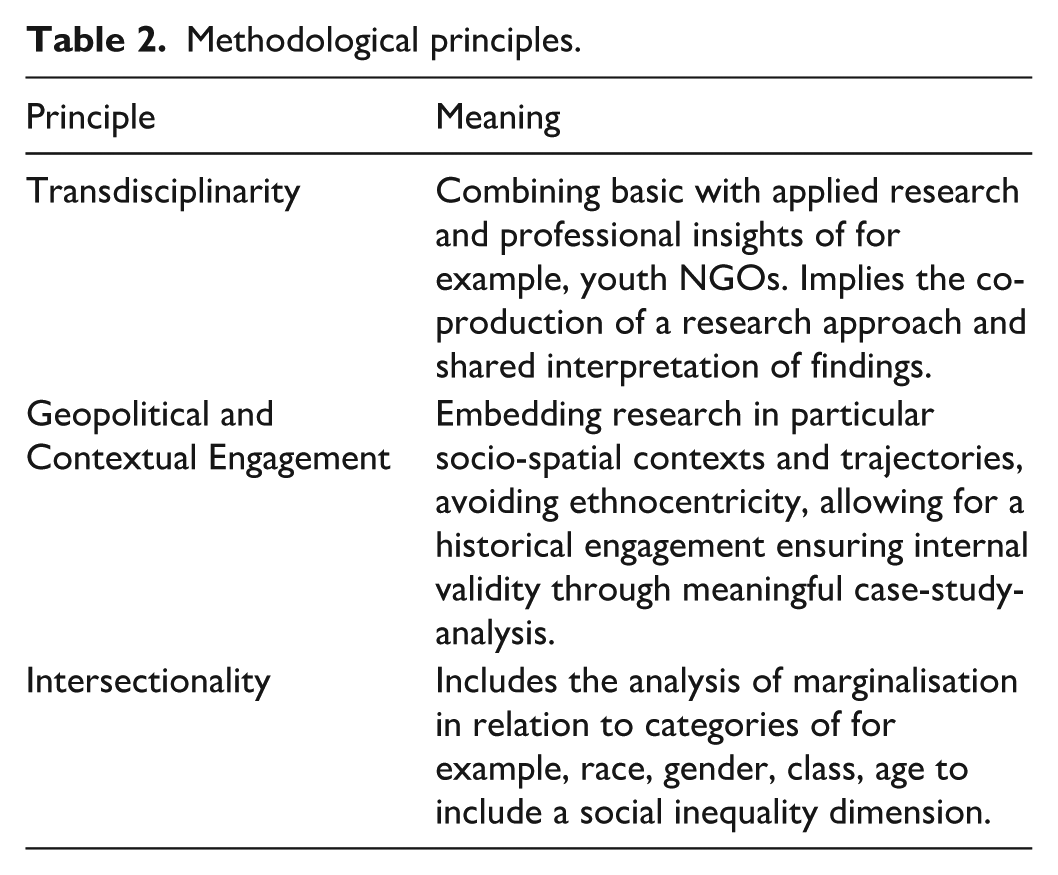
Starting questions focus on three principal realms of youthhood, while facilitating a cross-case research process by establishing a common starting and end point. The questions and the agreed adherence to the defined principles constitute the fundaments for our work towards a ‘methodological framework’. The three ‘starting questions’ are as follows:
How and in which combinations do mediatisation, social media, streaming platforms and messenger services contribute to (un)settling young people’s approach to urban public space? This question explores the multifaceted impacts of digital media technologies on young people’s interactions with urban public spaces, aiming to understand how these technologies influence their social practices and spatial engagements.
How do intersecting categories of marginalisation impact young people’s ability to engage in increasingly interwoven urban and digital public spaces, given the need to access these spaces through physical, social and digital infrastructures? This question delves into the complexities of social inequality as it relates to young people’s access to and engagement with both digital platforms and materialised public spaces, highlighting the barriers and facilitators of such engagement.
What spatial strategies and digitally informed tactics have young people employed to (un)settle new social, cultural and political routines and representations in the public realm? This question investigates the innovative ways in which young people use digital media to negotiate, challenge and reshape cultural norms, social practices and political discourse within urban public spaces, focussing on the creation of new forms of public engagement and representation.
Capturing our initial understandings and interests in general questions implied the need for a further iterative process based on the data collected within the individual case studies as suggested in the literature (Flick, 2009: 95). To enable substantial transdisciplinary engagement with youth organisations, the research teams followed a two-step process. First, an iterative exchange between empirical findings and case-specific transdisciplinary discussions was conducted. Then, conclusions were formulated to address the initial research questions while allowing for method exploration. This approach maintained flexibility within each case study while ensuring consistency by keeping the initial questions static across cases. In practice this led, due to the general quality of the starting question, to a set of associated sub questions using the implicit theoretical ideas that enabled a focus on particular threads of analyses (Table 3) that emerged from empirical research. In Belo Horizonte, the focus was on the comparison between elite and young people living in peripheral areas; in Tel Aviv, on young political activists; and in Vienna, the changing mobility patterns among self-identified female youth. The construction of the threads was carried out jointly with the intermediators (NGOs, protest organisers) involved; Together this process led to three distinct research designs limited by the questions and principles stated above. Overall, in Belo Horizonte and Vienna, research methods and protocol were extensively discussed and co-decided with NGOs. This transdisciplinary collaboration enabled researchers to dialogue, while supporting the empirical research by establishing initial contacts with youth. Furthermore, the role of these interlocutors as gatekeepers may prompt research ethics considerations regarding the overarching goal of our research project but may also introduce their own agendas that limit the research (Cuthbert et al., 2022). To give youth a voice, the studies used different approaches to engage with research participants and to build trustful relationships. Belo Horizonte relied on friendship networks, ensuring comfort but risking bias; Tel Aviv engaged with ethical challenges in politically sensitive protest groups; Vienna highlighted the value of socio-economically relatively homogeneous, smaller groups for open discussions as a complementary form of trust-building.
Three case study themes.
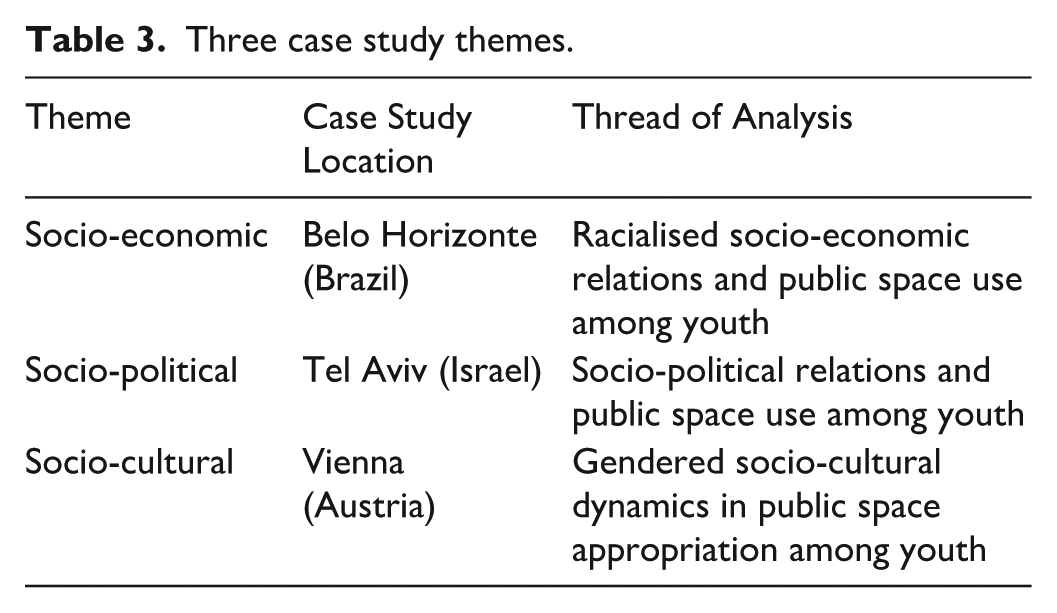
The complementary multiple case study approach explores relational space, social inequality and geopolitical diversity among urban youth without adhering strictly to comparative case study criteria such as ‘maximum variation sampling’ (Flyvbjerg, 2006: 128). The use of varied research designs – ranging from ethnographic to urban sociological and geographical – meant that direct comparison was not feasible and not desired. Instead, we employed a strategy of cross-case complementarity, emphasising exploratory insights while ensuring the internal validity of each case. This was facilitated by embedded cross-case analytical units (see Yin, 2018: 90), operationalised through the predefined starting questions, discussed above, such as increasing interwovenness of public space, spatial strategies of youth and tactical combination of digital media technologies.
To integrate findings across different designs, each case study employed audio recording, transcription and qualitative content analysis through ‘coding’ (Bryman, 2012: 298) using analogous tools, analysis workshops with NGOs and QDA software. Following suggestions of (Esposito and Evans-Winters, 2022: 128–130) codes were grouped and related to theoretical categories to explore social, cultural and spatial dynamics within the chosen theme and then related to the original starting questions. Bibliographical sources, mainly from the urban studies literature, were included to interpret findings and to ground the interpretations, understanding urban studies as a post-disciplinary field of research in which basic and applied research traditions ideally coalesce around a common focus on space. In addition, findings were reviewed with case-related NGOs to enhance validity and contextual relevance. At the initial conclusion of the research, all case study teams presented their findings – including methodological reflections – at a week-long spring school with successive collaborative co-writing exercises. A shared template structured these presentations, ensuring consistent documentation of the operationalisation of the starting questions and novel case-specific insights. It was during this event, which included several field trips to youth-related organisations in Vienna, that the conceptualisation around the ‘vireal’ experience of youth in public space was introduced and sparked further methodological discussions.
The involved flexibility of contextual-themes and the chosen case study research design allowed each case study its own peculiarities, which is typical to qualitative strategies where method-triangulation is used in accordance with the specificities of the research settings (see Bryman, 2012: 403). Methodological reflection and trials encompassed various disciplines, including digital ethnography, human geography and computer science, enabling a comprehensive engagement with the digital dimensions of youth interactions in public spaces. Overall, the methodology emphasises more explicit and digitally attuned triangulation within the case studies – specifically, the use of multiple qualitative methods to ensure a more robust and richer design, thereby enhancing the quality or ‘internal validity’ of the results (Bryman, 2012: 45; see also Flick, 2009: 475).
Presentation of the case studies
Before delving into each case study, it is important to note that ethical considerations informed all stages of research involving vulnerable groups. A detailed discussion of the ethical dimensions is presented separately.
The Belo Horizonte Case Study
The team unites experts in Architecture, Urbanism, Social Sciences and Psychology, focussing on urban studies and inequalities tied to class, race and gender. Based at the Pontifical Catholic University of Minas Gerais and with the participation of a researcher from the Federal University of Minas Gerais, it integrates learning, research, community engagement and technical advice. With a history of experimentation and collective learning, this fosters respectful exchanges between academic knowledge, popular knowledge and non-academic epistemologies.
The Metropolitan Region of Belo Horizonte (MRBH), like other major Brazilian cities, faces challenges in urban mobility, employment access, public security and environmental issues, all impacting youth. MRBH is a key research area, particularly given young people’s growing political engagement. Organised youth occupy public spaces for cultural practices like hip-hop battles and poetry slams while mobilising politically through public conferences, leading to the creation of a Youth Reference Centre. Situated in the city’s centre, the facility hosts cultural activities, meeting rooms and a library.
Transdisciplinarity, contextualisation and operationalisation of questions
The research focusses on the second and third guiding questions, examining social inequalities in youth access to and engagement with digital platforms and public spaces. It explores how digital platforms shape cultural representation, influence identity and provide opportunities to challenge dominant narratives and reclaim space.
The study compares elite youth practices with those in peripheral areas, using both inter- and intra-sectional analyses. It considers how peripheral space is shaped by material and social contexts (Bourdieu, 1978), conditioned by history (Lefebvre, 2014). The periphery is defined not just by geographic distance but also by social marginalisation.
Research design
The study employed three qualitative methods in each session: focus group debates, social mapping and self-description. Sessions included 5–15 participants, aligning with methodological recommendations (Weller, 2006; Wilkinson, 1998). Participants were recruited via snowball sampling, identifying elite youth and university students from PUC Minas who received federal scholarships aimed at expanding access to higher education for low-income and Black youth. The Youth Reference Centre helped reach peripheral youth.
Research sessions began with ice-breaking activities and informed consent, followed by a focus group where questions were adapted to the group’s interaction. To explore youth engagement in public spaces, key questions centred on ‘role’, a local term for youth gatherings. Participants then engaged in social mapping (Ribeiro et al., 2001) to support focus group narratives, aid memory and reveal spatial patterns. While Ribeiro (2012) applied social mapping to long-term, large-scale studies, this research was more localised, as participants, though from peripheral areas, had varied relationships with specific public spaces.
Using A3 paper, felt-tip pens and post-its, participants mapped their everyday experiences, commenting on their own and others’ maps. These visual representations revealed historical and social dimensions, linking digital technology use with cultural and spatial practices. Finally, a survey collected data on age, gender, sexual identity, education, occupation, family composition and family income.
Navigating virtual spaces allows youth to anticipate built environments, assess belonging, coordinate gatherings and even choose outfits. Their narratives and drawings illustrate how technology mediates these decisions, affecting mobility choices and route planning. These activities, often accompanied by music, are shared on social media, reinforcing the interaction between digital and material spaces.
This interaction aligns with the concept of vireal experiences, where youth engage with urban environments through direct presence and digital mediation, shaping spatial perception, identity and peer networks.
Empirical analysis and interpretation
Data were methodologically triangulated. Focus groups facilitated open debates, providing narratives about public and digital spaces and identity issues. Social mapping added a visual-spatial layer, comparing narrated and drawn spaces. Self-description helped identify structural aspects of intersectionality and youth perceptions of belonging. This triangulation captured the intersections of youth, social, spatial and digital inequalities.
Qualitative content analysis systematically coded and categorised findings. Key insights include: (1) peripheral youth face restrictions on public space access due to mobility costs and limited transit options; (2) their daily routines – formal/informal work, commuting and domestic duties – consume time and energy, particularly for young women, reducing public space engagement; (3) security concerns, including police violence, discrimination and gender-based harassment, deter public space use; and (4) youth creatively reclaim public spaces, organising collective occupations to assert their right to the city, foster coexistence and promote environmental care.
Looking at the research experience, the triangulated methods – focus groups, social mapping and self-descriptions – were well received. They encouraged self-reflection, helping participants recognise intra-group differences and develop critical perspectives on technology’s role in reinforcing social bubbles. This engagement enriched the study, providing a rich dataset.
The Tel Aviv Case Study
In Tel Aviv, research was conducted by two scholars from Bar Ilan University and Kinneret Academic College. They focussed on the 2023–2024 protests, particularly those led by groups of younger (<30 years old) activists. This approach combined geographical and sociological perspectives, with an emphasis on spatial and urban dynamics of youth protests. Specifically, young activists’ motivations to protest were explored, their access to and use of public space and their spatial strategies during protests were explored, as well as the ways they utilised digital means to recruit new group members and in general promote their activities spatially.
The Hamas-led attack of 7 October 2023 and the subsequent war in Gaza marked an unprecedented turning point for protest movements in Israel and for the group of protesters we were interested in. Even before these events, Israeli society was characterised by deep social, national, political, ethnic and religious divisions, as well as rising costs of living and growing income inequality (Dahan, 2021). The government’s plan to overhaul the judicial system, seen by many as a threat to Israeli democracy, and which was the backdrop of the empirical engagement, must be seen as a continuation of long-standing tensions. When the war with Hamas broke out, political movements were abruptly disrupted, forcing protests – and our research – to pause. But as the crisis deepened, protests adapted to new realities, shifting their focus to demands for a hostage deal, new elections and, ultimately, an end to the war.
Transdisciplinarity, contextualisation and operationalisation of the initial questions
Our study focusses on the spatial strategies and digitally driven tactics young activists employ in political protests, which aligns with question three about the strategic usage of digital media. We have tracked their use of digital media, especially their efforts to create engaging social media content. Additionally, we have observed shifts in their protest strategies, which have changed in response to intensified police violence and increasingly urgent protest goals due to real-world events. Through ongoing online and offline participant observation and follow-up interviews with protest leaders, we have documented these transformations. In examining how digital media influences young people’s approach to urban public spaces, we explore its role in informing, recruiting and directing activists before, during and after protests. Furthermore, we consider how social inequality impacts their motivation to protest. Although our study focusses on relatively privileged groups in socio-economic terms, their gender, sexual orientation and political (left leaning) stances make them vulnerable to police targeting, violence and arrests in the current Israeli political climate.
The transdisciplinarity of research in Tel Aviv was structured around the relations with two protest organisations composed of young people – the Pink Front and the Students’ Protest. For institutional reasons, researchers decided to focus on The Pink Front only, maintaining close contact with – and interviewing – its leaders and key activists. This implied mostly intra-intersectional work, that is focussing on that queer activist-community.
Important sources included WhatsApp groups and a large database containing photos and video clips made since the early stages of the protest. Following social media content and staying informed about the production process provided insight into key concerns and considerations. The potential for police targeting and misuse of the data generated against activists significantly influenced the choice of methods and thus made research ethics an ongoing matter. Nevertheless, collaboration and participation were secured through active involvement in the protests and by demonstrating support for their goals. Without being perceived as ‘one of them’, conducting this research would have been unlikely, highlighting critical considerations of research ethics, bias and positionality. Ethnographic researchers constantly need to navigate such positionalities in relation to their subjects and draw from the complexities of insider and outsider perspectives (see Johnson, 2007: 53).
Research design
As regards ‘method triangulation’ (Hammersley and Atkinson, 2019: 196) we conducted semi-structured interviews with leading figures from the two groups. Additionally, we employed visual research methods, including photos and video documentation of protest activities, recorded by us or protesters themselves. We also collected photos and videos from previous protests that occurred during 2023–2024. Our research involved participant observation during protests and the collection of media articles about these two groups. Furthermore, we conducted digital ethnography by ‘following’ the protestors into the digital realm through platforms such as WhatsApp, Instagram, TikTok and Facebook, analysing both past and present content posted (see Airoldi, 2018: 9).
Empirical analysis and interpretation
Our findings highlight the importance of maintaining an open mind and flexibility when conducting research in dynamic socio-political contexts. Dynamism was maintained both physically – immersing ourselves in rallies, spontaneous location changes and rapid responses to current events – and conceptually, as protest goals, strategies and practices have continuously changed, along with significant restructuring within the organisations we study.
Following our respondents over time and space generated valuable insights about how protests are shaped, designed and executed. Specifically, we explored what drives young people to action, and how youth agency during protests differs from older individuals. We have also observed the evolving relationships with the police, national media and the judicial system. Media plays a crucial role in protests. Activists try to attract mainstream coverage, build media connections and master social media to create engaging, creative content that helps recruit activists, build public support and disseminate their actions.
The Vienna Case Study
The Vienna Case Study was conducted by the Interdisciplinary Centre for Urban Culture and Public Space at TU Wien in collaboration with the NGO youngCaritas. The research unit focusses on urban studies, particularly contemporary urban development in socio-historical contexts, with themes including youth, democracy, post-political trends and urban care. YoungCaritas engages children and youth in socio-political projects through outreach and semi-public youth spaces fostering social citizenship.
Transdisciplinarity, contextualisation and operationalisation
This empirical context aligned most closely with the second research question, which explores how intersectionality influences young people’s ability to engage with public spaces and render them meaningful. The study examined the interplay between digital and urban embodied spaces and the accessibility of necessary infrastructures. Specifically, it explores how social inequalities shape vireal spaces and how self-identified female youth of different class and ethnic backgrounds navigate public spaces. Refining our focus, we conducted expert interviews with youth workers from NGOs involved in open street work, emphasising public space appropriation among female youth. Austria has the sixth-highest femicide rate among the 24 EU Member States (European Institute for Gender Equality, 2021). To address this, we developed a research design with youngCaritas, using event-like settings modelled on their school-based outreach experiences. Events took place in classrooms or at youngCaritas, an open space for youth empowerment. To enhance participation among vulnerable groups, we drew on youngCaritas’ experience with educational formats. Such events help marginal groups participate by reducing barriers for those with limited planning capacity (Pettinger et al., 2018: 10). To be effective, they should take place in a comfortable, non-school-like, non-clinical atmosphere and incorporate focus groups as a key method.
Intersectionality was assessed through demographic surveys. Gender diversity and queering space theory (Schuster, 2012) were key criteria for both collaboration and group composition, maintaining an intersectional approach while focussing on female youth.
Research design
Following expert interviews and an actor mapping of youth-related organisations in Vienna, the study centred on participatory research events using visual and discursive techniques to encourage interaction and collective meaning-making. Four research events followed a structured three-part format, with informed consent, data protection and audio recordings. After the session, interpretation of data was conducted during a field visit at youngCaritas and in online settings.
The first part used focus groups, defined as ‘a form of group interview emphasising a specific topic, participant interaction and joint meaning construction’ (Bryman, 2012: 712). Discussions often started with provocative questions about smartphone overuse and shifted towards how digital media facilitates public space appropriation.
The second part explored visual associations and public space usage with the additional aim of enhancing self-reflexivity among participants. Using visual representation with vulnerable groups fosters dialogue and recognises that social research extends beyond text (Pettinger et al., 2018: 4). Based on Harper’s (2002: 22) photo elucidation method, participants shared personal associations with urban locations or added missing images. Discussions also covered political activism and factors influencing participation.
Finally, we collected demographic data (age, residence, gender, education, parental profession and birthplace) via a brief survey to contextualise qualitative findings. Photo documentation and field notes supplemented data collection.
Empirical analysis and interpretation
Initial findings suggest media use is age-related: younger participants favour Snapchat, while older ones prefer WhatsApp. Socio-economic background influences space appropriation, with affluent youth favouring more privatised-consumerist spaces and viewing public areas used by migrant working-class peers as potentially dangerous. Gender analysis showed that self-identified female youth use digital media to explore and meet in public while relying less on geographical knowledge, suggesting increased mobility. A recent governmental study (Österreichischer Integrationsfonds and Bundeskanzleramt, 2023: 10) found that female youth were more likely to be in mixed-gender groups than in all-female groups when meeting in public. However, this expanded mobility involves managing vulnerability, such as sharing geolocation. In unsafe-feeling situations – at night, on the way home or in areas with a bad reputation – participants reported calling someone, pretending to be on the phone or sharing their location with friends. This indicates that digital media has not replaced but transformed traditional coping tactics for moving with companions (Leyshon et al., 2013: 591).
Additionally, participants noted that parents use the ‘Find My Phone’ service to monitor their location, introducing new forms of control in spaces where youth typically assert independence, adding another vireal dimension to public space appropriation. Finally, we advocate for a broader understanding of infrastructure, encompassing both digital and material aspects. A cross-case comparison with Belo Horizonte revealed the financial and locational accessibility of Vienna’s public transport as a crucial factor in youth mobility – one that might have otherwise been overlooked.
Ethical considerations
Ethics prioritises minimising harm, respecting privacy, maintaining confidentiality and obtaining consent; it should also address social justice concerns and contribute to improving young people’s lives (Skelton, 2008: 32). Youth research often assumes young people are passive or dependent, a notion critically challenged by empirical studies (Valentine et al., 1998: 24). Ethical guidelines can carry Eurocentric or adultist biases, posing challenges for international research (Skelton, 2008: 32). While children and youth are capable actors, their vulnerability to adult exploitation raises concerns about data interpretation and presentation (Morrow, 2008: 52). Given the involvement of young people, including minors, in vireal urban public spaces, ethics remained an ongoing concern, also because field access and interpretation are shaped by the researcher’s presence, which may influence participants’ behaviour. In our research participants gave written informed consent for the study’s conduct, publication and, where relevant, image use. All data were fully anonymised, and participants were informed that results lead towards scientific publication.
Informed ethical reflection required an educational format for Urban Studies Master’s students to engage fully with a situated understanding of informed consent.
Building ethical relationships with youth requires adherence to the principles of assent. As Angrosino (2009: 85) explains, assent highlights ethical responsibilities when working with minors. In contrast to informed consent, which is typically obtained from a parent or guardian, assent involves communicating voluntary, risk-free participation to young participants using age-appropriate explanations of the research project. Assent helps prevent young people from withdrawing or feeling endangered when authority is undermined (Fox, 2013: 990; Servais et al., 2024: 11). In our case studies, collaboration with professional youth organisations, schools and a renown expert in cross-disciplinary research ethics helped to mitigate vulnerabilities and balance power relations. Promoting democratic dialogue with civil society can further ensure inclusivity and transparency in the research process.
In the case study research outlined above ethical challenges arise from the intimacy of relationships with youth and the complexities of qualitative methods. For example, participatory observation and photo documentation in highly policed spaces like Tel Aviv involved insider–outsider dynamics. Focus groups in Belo Horizonte and Vienna faced challenges such as dominant voices limiting participation or discomfort tied to class and ethnic intersectionality. Even when research moves online, ethical concerns remain – data accessibility does not negate the need for ethical care (Airoldi, 2018, pp. 8–9). We suggest that whenever feasible methods that promote collective youth agency, such as focus groups, should be chosen to enhance ethical engagement.
Outlining the methodological framework
Reflection on the (transdisciplinary) research process
In this section we engage in a comparative overview of the research processes, key findings, challenges and lessons learned from the combined complementary case study research. Each case illustrates how different research designs were employed to engage youth in varied sociopolitical contexts. Each case highlights challenges unique to its context and offers valuable lessons for future research, such as the importance of adapting research tools, considering positionality and tailoring group dynamics to improve engagement and reduce bias.
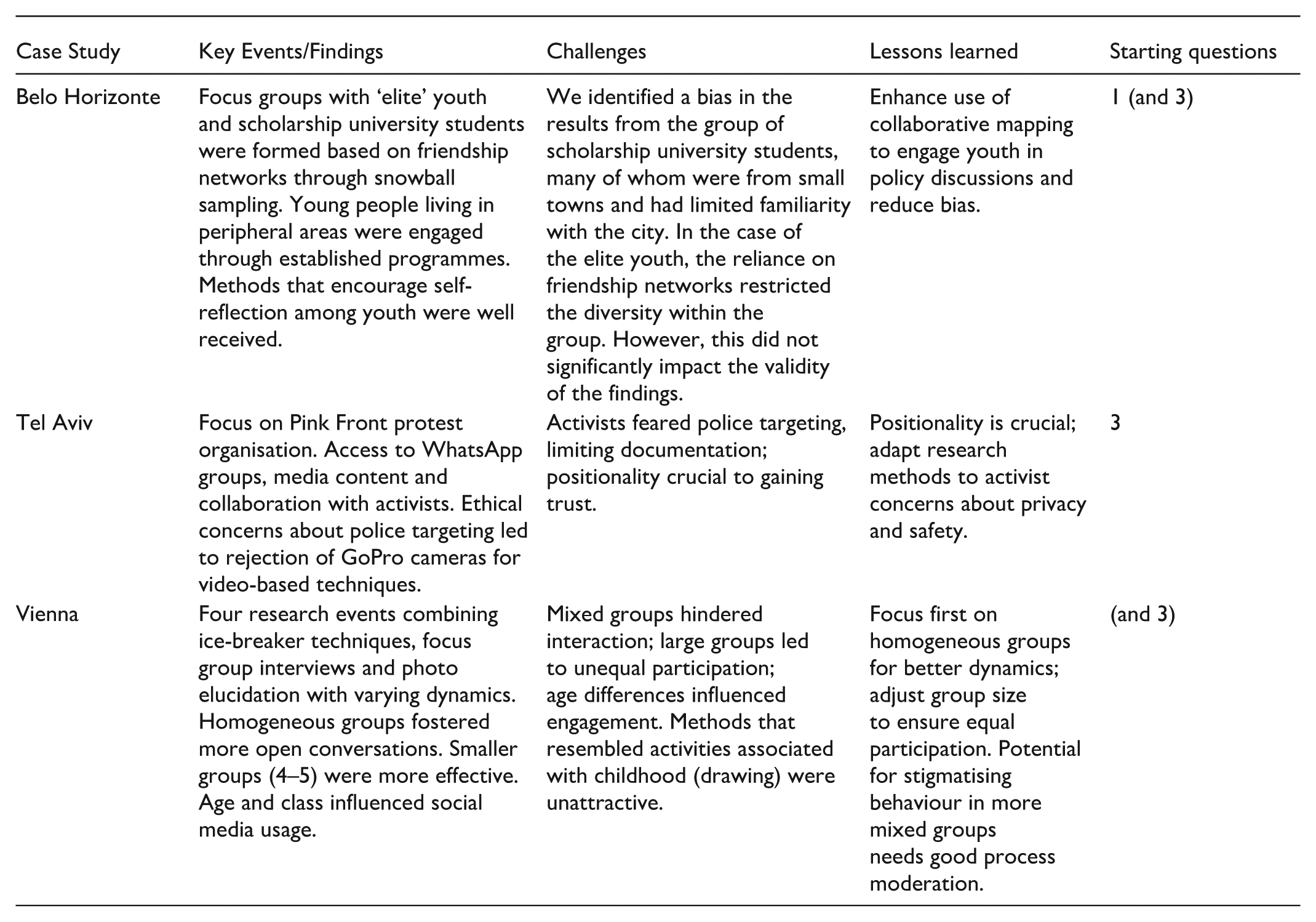
A framework organised around core principles
In this section, we propose a methodological framework based on the research experience gained from the case study experience and research process. This framework emerged as a response of the complex intersectional realities encountered during the study and is grounded in the practical, ethical and epistemological challenges that shaped our methodological decisions.
Intersectionality played a key role in shaping our methodological approach, particularly method selection, sampling and using existing social ties between young people to facilitate open dialogue. The methodological commitment needs to remain sensitive and adapt to the multiple social and political contexts that shape youth experiences. Intersectionality also implies contextual engagement with socio-technological change and ensures that it is not treated separately from the practices and involved positionalities. The latter point also involves the researchers themselves. Especially in ethnographic fieldwork research ethics and transparency need to include the ‘epistemological’ dimension of how the positionality of the researcher shapes or might have shaped the research process, that is by having affected sampling as well as analysis and theoretical ends (Dragomir, 2020: 2). Reflexivity involves recognising and addressing the beliefs, biases and positionality of researchers that influence the research process, including their relationship with participants. This is particularly critical when studying intersectional issues related to social inequality – such as race, gender and other structural disparities – where the researcher’s positionality significantly shapes interactions and interpretations (van Veggel et al., 2024: 32).
The principle of geopolitical and contextual engagement enables broader knowledge construction by highlighting differences while identifying points of convergence in experiences. This commitment not only values and communicates findings but also requires adherence to key terminology, such as ‘youthhood’, to ensure clarity and coherence. That is why this research has been based upon relational youthhood categories (Gabauer et al., 2024), which make an explicit link to relational conceptions of space (Massey, 2005). Relating findings to the starting questions has proven effective in systematically clustering and communicating ideas across cases, while ensuring context sensitivity through case-specific themes and context-appropriate research designs. Context sensitivity also implies a reflection on practices by which the digital is interwoven with embodied space, which we discussed in relation to the vireal appropriation of public space. Engagement also entails a responsibility towards participants, encompassing both ethical and practical dimensions. This was operationalised through transdisciplinary exchanges with participating NGOs and the ethical review boards of the involved universities.
The adaptability and richness of research designs imply that methodological choices must be shaped not only by the operationalisation of research questions but also by the specific circumstances in which research unfolds. As suggested here, guiding principles rather than standardised protocols ensure that research remains responsive to the dynamic and evolving nature of socio-technical change. Crucially, this responsiveness should not reproduce a rigid dualism between ‘the digital’ and ‘embodied’ space but rather recognise their vireal interweaving.
The phenomenon at hand necessitates engagement with the digital sphere, following young people in their digital environments. However, this does not mean treating the digital as a separate, detached space. Instead, it requires an approach that acknowledges how digital and embodied spaces co-constitute each other in young people’s everyday lives. This involves adapting traditional research methods to digital contexts while also developing innovative approaches rooted in the practices of urban youth. While a multi-sited approach helps trace how young people use platforms such as messenger groups and social media for cultural representation and sociability, it is slightly misleading. The digital is not a separate ‘site’ but remains co-present in embodied space, as young peoples’ highly networked identities often invoke and experience the presence of the online even when not actively engaging with it.
Transdisciplinarity plays a crucial role in negotiating power dynamics and supporting the pragmatic view that methodological adaptation and knowledge reconceptualisation must occur where change is most urgently needed – such as in youth work. Co-producing research with young protest groups, street workers and youth-focussed NGOs helps redistribute power more equitably between researchers and participants, while embedding the lived experiences of marginalised groups into the research process. However, while participatory methodologies enhance inclusivity, they may also place undue pressure on both researchers and participants, complicating dynamics by introducing high expectations on both sides. When working on the premises of partner organisations, a school-like atmosphere should be avoided. Instead, researchers should aim to create informal, comfortable environments and consider strategies for rewarding participant contributions in meaningful ways (Fox, 2013: 994).
Finally, not a principle but practical advice: Given the visual and representational nature of social media, recruiting young participants requires careful attention to design and language, especially when using outreach tools such as social media posts, posters or flyers (Cuthbert et al., 2022: 768). In addition, delegating certain research tasks to younger colleagues may improve representation and build trust with participants.
Conclusion
Rather than aiming for a comparative methodology, this study pursued a complementary approach, allowing individual case studies to highlight transformations in youthhood while remaining anchored in shared research questions and conceptual frameworks. Instead of adhering strictly to standard case study protocols, it embraced a set of methodological principles and a relational understanding of youthhood – acknowledging the dialectical imbrication of digital and embodied space and the vireal nature of youth experience. A shared epistemological stance connected the case studies through implicit themes, forming clusters that preserved contextual nuance while fostering dialogue. This approach, though exploratory, strengthened the interpretative depth of findings by enabling engagement with other teams’ results. The most modest claim that can be made is that this approach rendered visible aspects of youthhood that might otherwise have been uncritically taken for granted, by highlighting the fluid interplay between identity formation, inequality and the digital mediascapes which increasingly are interwoven with embodied public space.
Footnotes
Acknowledgements
This research collaboration, which resulted in the development of this article, was supported by the Center for Technology and Society (CTS) in Vienna. The authors acknowledge the TU Wien Bibliothek for financial support through its Open Access Funding Programme. We are grateful to Bruno Márcio de Castro Reis, M.A., from the Pontifical Catholic University of Minas Gerais, Brazil and Ísis Detomi Teixeira, M.A., from the Federal University of Minas Gerais, Brazil, Mag. Gabriele Wild from FH Campus Wien for their valuable contributions and feedback. We also thank Liz Lefebvre Dickman, M.A., for her careful proofreading and editorial support. AI tools (such as ChatGPT) were used to assist with English language editing and improving clarity in the preparation of this manuscript. All intellectual content, analysis and conclusions are the work of the authors.
Declaration of conflicting interests
The authors declared no potential conflicts of interest with respect to the research, authorship, and/or publication of this article.
Funding
The authors disclosed receipt of the following financial support for the research, authorship, and/or publication of this article: This work was part of the ‘YOUTH’ project and supported by the Vienna based Center for Technology and Society. Contact: Dr.techn. Dipl.-Ing. Anna Franzkowiak (Organisational Director).
Ethical approval and informed consent statements
Ethical research protocols were followed across participating institutions, including informed consent procedures and compliance with national and university-based ethical guidelines. These case studies form the substantia empirical part of the international research project YOUTH – Unsettled Everyday Lives and Young People’s (Non)Digital Access to Urban Public Space, which explores urban and digital inequalities among young people in diverse geopolitical contexts.

Data availability statement
Due to the inherently sensitive and context-rich nature of qualitative data collected through in-ethnographic and other interviews or in focus groups, full anonymisation is difficult to guarantee. Participants often share unique personal experiences and contextual details that may risk deductive disclosure, even when direct identifiers are removed. As such, and following the advice of the TU Wien Service Unit for Responsible Research, we do not deposit our qualitative data in public repositories. Data supporting the findings of this study are securely stored on password-protected local servers and will be retained for 5 years following the conclusion of the project (until February 2030). While we do not make our data publicly available, limited access to selected excerpts may be granted upon reasonable request. In such cases, the corresponding author or the relevant case study leaders – who ensure compliance with data safety and ethical standards – may be contacted to discuss access under appropriate conditions.
Other identifying information
This research was conducted across multiple institutions which besides of the Tel Aviv NGO, formally participated in the CTS funded YOUTH project: TU Wien (Austria), Pontifical Catholic University of Minas Gerais (Brazil), Federal University of Minas Gerais (Brazil), Bar Ilan University and Kinneret Academic College (Israel). Collaboration included partnerships with youngBallet (Belo Horizonte, Brazil), youngCaritas (Vienna, Austria), protest organisations such as the Pink Front (Tel Aviv, Israel) and the above mentioned CTS – Center for Technology and Society (Vienna, Austria).
Authorship transparency statement
This article is the result of a collaborative research process conducted within the YOUTH project, funded by the Center for Technology and Society (CTS) in Vienna. The case study descriptions and their respective interpretations were developed by the sub-teams at Bar Ilan University (Israel), the Pontifical Catholic University of Minas Gerais and the Federal University of Minas Gerais (Brazil), and TU Wien (Austria), each of whom authored the initial drafts of their respective case sections. The TU Wien team led the conceptual development of the methodological framework and authored the methodology section, in dialogue with all project partners. The introduction and conclusion were co-written by the first author and revised collaboratively. All authors engaged in iterative rounds of review and contributed to the theoretical framing and alignment of the article as a whole. In line with the journal’s policy of supporting transparency and the inclusion of early-career researchers, the first author discloses that they are currently a PhD student at TU Wien and that this is their first article as first-listed author.