



Abstract
Traditional research methods often struggle to synthesize the rich, context-dependent insights of qualitative studies into broader, integrative understandings. We introduce the construct of emergence to qualitative meta-studies, positioning it as both an epistemological foundation and a methodological principle. While emergence has been explored in complexity science, its implications for qualitative synthesis remain largely unexamined. We argue that qualitative meta-analysis, when structured around emergence, allows for the identification of higher-order patterns, relational dynamics, and conceptual advancements that transcend individual studies. Beyond its theoretical contributions, this paper serves as an actionable companion for scholars conducting qualitative meta-studies. It provides a structured, step-by-step framework designed to help researchers systematically integrate diverse qualitative traditions while preserving interpretive richness. The paper presents a taxonomy of key methodological challenges encountered in qualitative synthesis and offers concrete heuristics for fostering emergence and generating higher-order theoretical contributions. Additionally, it delivers a set of applied strategies to guide scholars in conducting qualitative meta-analysis with both rigor and adaptability. To support the broader dissemination of qualitative meta-studies, the paper also identifies suitable publication outlets. By advancing qualitative meta-analysis as both a research tool and an epistemological stance, this paper invites scholars to approach synthesis as a generative and methodologically grounded process—one that not only retains the depth and complexity of qualitative inquiry but also enables the discovery of new theoretical insights that are both meaningful and actionable for contemporary scholarship.
Keywords
Introduction
The world stands at a crossroads, shaped by forces of perhaps unprecedented complexity and unpredictability. While uncertainty has long been a defining feature of many societies, today’s global interconnectedness amplifies its scale and impact. Climate disasters, geopolitical instability, societal fragmentation, and technological upheaval are no longer abstract threats—they are the realities shaping the lives of billions. In the face of such profound challenges, it is clear that traditional research methods, often constrained by reductionism and positivist certainties, are no longer sufficient to illuminate the nuanced dynamics of a world in flux (Morin, 2008; Polanyi, 1966; Uhl-Bien and Marion, 2018). We need methodologies that can match the intricate, emergent nature of the phenomena we study—methodologies that call upon scholars to be not only rigorous but also courageous and humble in their pursuit of understanding.
We strive to make a modest but heartfelt contribution to this broader effort, advocating for qualitative meta-analysis as both a tool and a mindset for navigating complexity. Far from offering a singular solution, we view this method as one piece of a larger puzzle—a way to synthesize the textured insights of qualitative studies into patterns, theories, and frameworks that honor the richness of human experience and the intricacies of organizational and social systems. At its core, this approach challenges researchers to step out of the comfort of certainty and embrace the ambiguity, relationality, and contextual depth that characterize the real world. We are living through what Morin (2008) describes as a “polycrisis”—a confluence of interrelated global challenges that defy linear solutions and demand holistic perspectives. To address these, scholars must be willing to engage deeply with the messy, emergent properties of complex systems understanding that such work is not about control but about discovery (Goldstein, 1999), about finding new patterns and pathways that arise from the interplay of diverse elements. Qualitative meta-analysis is one such pathway, offering a means to integrate the findings of disparate studies into higher-order insights that transcend individual contexts and disciplines.
The challenges we face as researchers are dwarfed by the enormity of the global issues we seek to address. No single study, method, or paper can claim to provide definitive answers. Instead, what we offer here is an invitation to dialog—a call for scholars to join us in exploring how qualitative meta-analysis can contribute to a more nuanced and adaptive understanding of the world. It is a method that requires not only intellectual rigor but also a willingness to listen to diverse voices, to interrogate our assumptions, and to learn from the richness of others’ work. This humility, however, does not preclude bravery. On the contrary, it demands it. To challenge entrenched epistemologies, to advocate for approaches that may seem unconventional, and to take the risks inherent in synthesizing qualitative data at scale requires a steadfast commitment to the belief that knowledge is not static but evolving. It requires us to acknowledge that the most profound insights often lie in the spaces between disciplines, methodologies, and contexts. In this spirit, we position qualitative meta-analysis as more than a methodological tool—it is an ethos, a way of engaging with complexity that values interconnectedness, emergence, and the human stories that underpin organizational and societal systems. Through this lens, researchers are not merely observers but stewards of knowledge, tasked with weaving together the fragments of understanding into patterns that can guide action and reflection in an uncertain world. The contribution of this paper is humble in scope but ambitious in intent. It seeks to inspire scholars to step into this role with courage and conviction, to push the boundaries of traditional research, and to embrace complexity as a source of both challenge and possibility. In doing so, we hope to advance not only the field of qualitative meta-analysis but also a broader vision of research as a force for ethical, thoughtful, and adaptive responses to the crises of our time.
Qualitative research provides nuanced and in-depth insights into social and contextual realities, exploring the complex interplay of human behavior, organizational dynamics, and environmental factors. Unlike quantitative approaches that often simplify phenomena into numerical representations, qualitative research captures the richness of lived experiences, uncovering meanings, relationships, and processes embedded within organizational settings (Merriam, 2018). As such, it is indispensable for understanding organizational realities that are inherently social, dynamic, and complex.
Despite their strengths, qualitative studies are rarely considered for meta-analysis due to their complexity and methodological diversity (Charmaz, 2017). They often face challenges in terms of synthesis and generalization, and are therefore often excluded from meta-analytical processes (Charmaz, 2017). These challenges stem from the diversity of methodologies, philosophical orientations, and contextual particularities that characterize qualitative research. However, these very attributes—its richness and diversity—make qualitative studies a valuable yet underutilized resource for advancing organizational research. When aggregated and analyzed systematically through meta-studies, qualitative data holds the potential to uncover emergent patterns, generate higher-order insights, and contribute to the development of robust theories that resonate across contexts.
This paper advances qualitative meta-analysis as a powerful methodological approach for synthesizing qualitative studies into higher-order insights, particularly suited to addressing wicked problems—complex, multi-dimensional challenges that resist reductionist solutions (Rittel and Webber, 1973). In times of uncertainty, where organizational and societal phenomena unfold in unpredictable ways, qualitative meta-analysis enables researchers to extract deep, contextually embedded patterns that traditional methods often overlook.
To establish a rigorous foundation for this approach, this paper:
(i) first clarifies what qualitative meta-analysis is and why it is particularly relevant in researching complex, evolving issues
(ii) it then provides a structured overview of its methodological building blocks by summarizing the 16 most widely used qualitative methods and their defining characteristics.
(iii) The paper’s central contribution is the introduction of emergence as a theoretical and methodological lens in qualitative meta-analysis. While qualitative synthesis has long sought to integrate diverse findings, the concept of emergence offers a novel way to understand how new and integrative properties arise from the synthesis of multiple studies, generating theoretical advancements that transcend individual research contributions.
(iv) Building on this, the paper proposes a conceptual framework—a structured template for conducting qualitative meta-analysis—that explicitly incorporates emergence as a core analytical principle. This framework provides a systematic approach for researchers to navigate synthesis, ensuring that emergent patterns are recognized and leveraged in the construction of higher-order theory.
(v) The paper also identifies key challenges in applying qualitative meta-analysis, such as methodological heterogeneity, interpretive complexity, and the risk of over-simplification, and offers actionable heuristics to address these challenges, reinforcing qualitative meta-analysis as a rigorous and adaptive methodology for contemporary research.
(vi) Finally, the paper provides a list of suitable outlets for publishing qualitative meta-studies.
Theoretical underpinning
The value of qualitative meta-studies in organizational research
Qualitative research is firmly established as a “real-world” methodology, uniquely suited to capturing the complexity, ambiguity, and relational nature of social and organizational life. Unlike quantitative approaches that abstract phenomena into decontextualized variables, qualitative research foregrounds meaning, context, and lived experience (Merriam, 2018). It is sometimes described as being conducted “in the trenches” of organizational life. Qualitative inquiry engages directly with the social world as it unfolds, examining decision making, leadership, team dynamics, and organizational culture in diverse social settings through rich interpretive data capturing thick, rich data from interviews, participant observations, ethnographies, and case studies (Geertz, 1973; Yin, 2018). As Alvesson and Sköldberg (2018) argue, qualitative research is not merely descriptive but inherently analytical, revealing the layered complexities of organizational realities that cannot be captured through purely positivist paradigms.
Given its capacity to explore the contextual and emergent aspects of organizational life, qualitative research plays a crucial role in health, public policy, management, organizations, and social sciences, offering depth and insight that are indispensable for theory building (Denzin and Lincoln, 2018). However, despite its well-recognized strengths, qualitative research findings often remain fragmented across individual studies, limiting their broader impact. Meta-studies of qualitative research provide a unique opportunity to synthesize these scattered and diverse insights into cohesive frameworks. By systematically analyzing and integrating findings from multiple studies, researchers can transcend individual contexts to uncover patterns and relationships that are not immediately apparent within single studies (Sandelowski and Barroso, 2017). This synthesis process moves beyond the aggregation of studies; it fosters an emergent, interpretive engagement that bridges the granular, context-specific knowledge of qualitative inquiry with broader, theoretically generative insights (Paterson et al., 2016).
Systematic qualitative reviews and meta-synthesis have emerged as essential methodologies for integrating findings across qualitative studies, enabling researchers to generate higher-order theoretical insights while preserving the depth and richness of qualitative inquiry (Booth et al., 2016; Sandelowski and Barroso, 2017). These approaches address the challenge of synthesizing complex, context-dependent data while ensuring rigor and transparency. Unlike traditional literature reviews, which may lack systematic methodology, meta-synthesis employs structured strategies to aggregate, compare, and interpret qualitative findings, revealing emergent themes that transcend individual studies (Barnett-Page and Thomas, 2009).
Meta-synthesis differs from quantitative meta-analysis in that it does not rely on statistical aggregation but rather on the interpretive synthesis of findings to construct broader conceptual understandings (Thomas and Harden, 2008). Harden and Thomas (2005) delineate different approaches to synthesizing qualitative research, including meta-ethnography (Noblit and Hare, 1988), thematic synthesis (Thomas and Harden, 2008), and framework synthesis. While meta-ethnography aims to generate new theories through reciprocal translation of study findings, thematic synthesis employs systematic coding techniques to identify common themes and patterns across studies (Harden and Thomas, 2005). The framework synthesis method, often used in applied research, integrates qualitative findings within predefined conceptual frameworks, allowing for policy-relevant interpretations (Oliver et al., 2005).
The diversity of qualitative traditions poses a fundamental challenge for synthesis, as studies differ not only in methodological techniques but also in their epistemological underpinnings. Harden and Thomas (2005) and Barnett-Page and Thomas (2009) distinguish between aggregative and interpretative synthesis, where the former aims at summarization while the latter seeks conceptual innovation. The emergent approach we advocate builds upon this distinction by recognizing that patterns are not merely extracted from studies but co-constructed through their relational interplay. Rather than choosing between aggregative or interpretative paradigms, our framework embraces epistemological pluralism, allowing for the integration of diverse methodological perspectives while maintaining sensitivity to their underlying ontological assumptions.
Over time, methodological advances have refined systematic qualitative reviews, enhancing their rigor and applicability. The Campbell Collaboration, alongside the Cochrane Qualitative and Implementation Methods Group, has played a crucial role in advancing systematic qualitative reviews balancing emergency promoting rigorous methodological standards for qualitative evidence synthesis. Recognizing the importance of qualitative research in informing policy and practice, these organizations have developed structured frameworks that enhance transparency and reliability, ensuring that qualitative findings are systematically integrated into evidence-based research (Harden and Thomas, 2005; Noyes et al., 2018). Their methodological innovations have reinforced the legitimacy of qualitative synthesis, particularly in synthesizing complex, context-rich data while preserving interpretive depth (Harden et al., 2018; Oliver et al., 2005). Furthermore, Kastner et al. (2016) emphasize the need for methodological fit, offering conceptual recommendations to guide the selection of appropriate synthesis methods based on research complexity. These contributions have strengthened qualitative meta-synthesis as a credible tool for generating higher-order insights that remain both methodologically rigorous and practically relevant.
Despite these advancements, qualitative meta-studies face ongoing challenges, particularly in navigating methodological heterogeneity, ensuring interpretive rigor, and balancing context-specific insights with broader generalizability (Sandelowski and Barroso, 2017). Point et al. (2017) emphasize the importance of reflexivity and transparency in qualitative meta-analysis, warning against the risk of over-simplification. They argue that effective synthesis requires an iterative engagement with the data, allowing emergent themes to guide theoretical development rather than imposing pre-existing frameworks.
Another ongoing debate concerns the role of qualitative synthesis in informing policy and decision-making. While systematic qualitative reviews offer valuable insights into complex social and organizational phenomena, their interpretive nature poses challenges in terms of standardization and replicability (Oliver et al., 2005). Researchers have increasingly explored mixed-methods approaches that integrate qualitative synthesis with quantitative evidence, enhancing the robustness of systematic reviews while preserving the depth of qualitative inquiry (Harden et al., 2018; Harden and Thomas, 2005). Ultimately, systematic qualitative reviews and meta-synthesis contribute significantly to knowledge integration in the social sciences, organizational research, and public policy. As methodological frameworks continue to evolve, future research should focus on refining synthesis techniques, improving transparency, and addressing the epistemological tensions between qualitative richness and systematic rigor (Barnett-Page and Thomas, 2009; Noyes et al., 2018). By embracing the complexity of qualitative data, meta-synthesis enables researchers to construct nuanced, higher-order theories that are both methodologically sound and practically relevant.
Qualitative meta-studies are particularly valuable because they operate at the intersection of multiple disciplines. Organizations and their management, as fields of inquiry, inherently draw on sociology, psychology, anthropology, and even philosophy to understand organizational behavior (Alvesson and Deetz, 2020). This interdisciplinary foundation enriches meta-analytical processes, allowing researchers to incorporate diverse perspectives and theoretical frameworks. For instance, narrative analyses from literary studies (Czarniawska, 2004) or phenomenological approaches focusing on lived experiences from philosophy (Husserl, 1962) can be adapted to synthesize qualitative data in management and organizational contexts, leading to higher-order theorization that remains sensitive to contextual richness.
Far from being a secondary or auxiliary technique, qualitative meta-analysis thus represents a powerful tool for advancing knowledge in the social sciences. It enables researchers to distill complex, situated insights into theoretical contributions that retain the richness of qualitative inquiry while increasing their conceptual and practical relevance. In this way, qualitative research—already a cornerstone of real-world investigation—gains additional methodological and epistemological strength through the integrative potential of meta-studies.
Challenges and opportunities
While the potential of qualitative meta-studies is immense, challenges remain. Methodological diversity can complicate synthesis, as studies often differ in philosophical orientation, data collection methods, and analytical techniques (Sandelowski and Barroso, 2017). Additionally, the interpretive nature of qualitative research means that meta-analyses must navigate layers of subjectivity, both in the primary studies and in the synthesis process itself (Bondas and Hall, 2016). Despite these challenges, qualitative meta-studies offer unparalleled opportunities for theory development and practical application. By synthesizing rich, context-specific data, they uncover emergent phenomena that bridge the micro-macro divide in organizational research. They also encourage interdisciplinary collaboration, integrating insights from philosophy, sociology, cognitive science, and other fields to build robust, multifaceted theories.
Qualitative inquiry enables scholars to explore complex and dynamic phenomena, particularly suited to the interpretive understanding of human behavior in organizations (Chenail, 2011; Merriam, 2018). Methods such as ethnography, narrative inquiry, and grounded theory emphasize contextualized and holistic exploration of phenomena, eschewing positivist criteria like replicability. Qualitative methods provide researchers with the tools to delve deeply into the complexities of human behavior, organizational dynamics, and contextual phenomena. Unlike quantitative approaches, which prioritize statistical generalization and replicability, qualitative methods emphasize rich, detailed descriptions and interpretations of real-world experiences (Chenail, 2011; Merriam, 2018). These methods enable an exploration of the meaning-making processes and interactions that underpin management and organizational realities.
Managing organizations is inherently a social practice, shaped by the values, beliefs, and actions of individuals and groups operating within dynamic environments. Understanding this complexity requires methodologies that are sensitive to context and capable of capturing the nuances of human experience. Qualitative approaches such as ethnography, grounded theory, qualitative case study, phenomenology, narrative inquiry, action research, focus groups, discourse analysis, critical discourse analysis, thematic analysis, participatory research, and visual analysis provide diverse yet complementary perspectives for exploring organizational phenomena (Table 1):
Ethnography, rooted in anthropology and sociology, involves immersive fieldwork to understand the cultural norms, values, and practices of a particular group or organization. This method captures the “emic” perspective—the insider’s view—of organizational life (Van Maanen, 2011). Ethnographic studies have been pivotal in examining workplace cultures, leadership practices, and the informal dynamics of organizational life (Murchison, 2010). By living and interacting with study participants, ethnographers gain unparalleled access to the subtleties of behavior and interactions that quantitative methods often overlook.
Grounded theory focuses on generating theory inductively from data, making it particularly suited for studying emerging phenomena in society, in management and organizations (Charmaz, 2017; Glaser and Strauss, 1967). The method’s iterative process of data collection and analysis allows researchers to build theories “from the ground up.” Grounded theory is widely used in organizational research to explore processes like organizational change, decision-making, and leadership development. Its systematic coding procedures (open, axial, and selective coding) ensure rigor while preserving the inductive essence of qualitative inquiry.
The qualitative case study method provides a detailed examination of a single case or a small number of cases within their real-life context (Yin, 2018). This approach is particularly useful for exploring complex, context-dependent phenomena in management, such as strategic decision-making or innovation processes. By focusing on the specificities of each case, researchers can uncover insights that are both theoretically rich and practically relevant. The case study method also allows for triangulation, as multiple sources of data (e.g. interviews, documents, and observations) can be integrated to enhance the study’s validity.
Phenomenology seeks to understand lived experiences and the essence of phenomena from the perspective of those experiencing them (Husserl, 1962; Smith et al., 2009). In organizational research, phenomenology is particularly effective for exploring subjective experiences such as employee motivation, organizational identity, and the impacts of leadership styles. By employing methods such as in-depth interviews and thematic analysis, phenomenologists reveal the layers of meaning that shape organizational life.
Narrative analysis focuses on the stories individuals tell to make sense of their experiences (Czarniawska, 2004; Riessman, 2007). Narratives are a powerful means of understanding how individuals construct their identities and interpret organizational events. For example, in management studies, narrative inquiry has been used to explore organizational change by analyzing how leaders and employees frame change initiatives. Narratives provide insights into the temporal, relational, and emotional dimensions of organizational life.
Action research involves a participatory approach where researchers collaborate with practitioners to solve real-world problems while simultaneously generating theoretical insights (Argyris and Schön, 1991; Eden and Huxham, 1996). This method is particularly valuable in societal or organizational research, where the goal is often to enact change or improve practices. For example, action research has been used to develop new strategies for team management, conflict resolution, and organizational learning.
Focus groups bring together participants to discuss specific topics, allowing researchers to capture diverse perspectives in a dynamic, interactive setting (Morgan, 1997). This method is particularly useful in exploring group dynamics, decision-making processes, and organizational culture. The moderated discussions often reveal shared meanings and tensions that individual interviews may not uncover.
Discourse analysis examines how language is used to construct meanings, identities, and power relations within organizational settings (Fairclough, 1995). Critical discourse analysis (CDA) takes this a step further by interrogating the ideological underpinnings of language and its role in perpetuating or challenging power dynamics. These methods are particularly relevant in exploring leadership communication, organizational narratives, and issues of diversity and inclusion.
Thematic analysis is a flexible method for identifying, analyzing, and reporting patterns (themes) within data (Braun and Clarke, 2006). It is widely used in organizational research to explore topics ranging from employee engagement to organizational innovation. By coding and categorizing data systematically, thematic analysis enables researchers to uncover recurring patterns and generate insights that span multiple contexts.
Participatory research emphasizes collaboration with participants as co-researchers, ensuring that the research process and outcomes are relevant and empowering for those involved (Reason and Bradbury, 2008). This approach is particularly useful in studying issues related to social justice, diversity, and organizational inclusion.
Visual analysis involves the use of visual data, such as photographs, videos, and drawings, to understand organizational phenomena (Rose, 2016). This method is particularly valuable for capturing non-verbal dimensions of organizational life, such as workspace design, branding, and body language during interactions. Visual methods can complement textual and verbal data, providing a richer, multi-modal understanding of organizational dynamics.
Principal qualitative research methods and their characteristics.
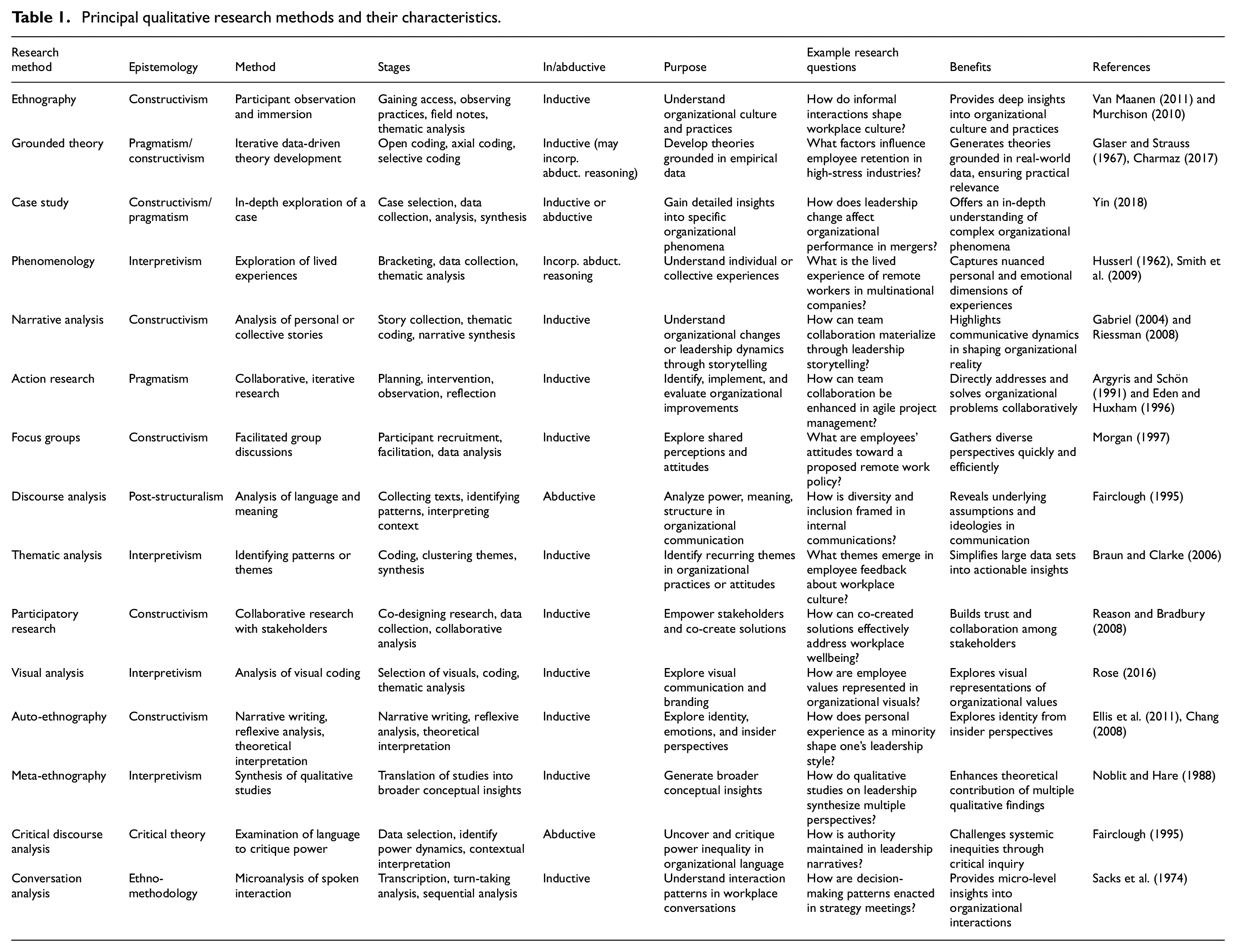
Each of these qualitative methods brings unique strengths and perspectives to the study of organizational phenomena. Together, they form a robust toolkit for capturing the complexity, context, and dynamism of organizational life. By integrating and synthesizing the findings from these diverse methods through qualitative meta-studies, researchers can uncover emergent patterns, build higher-order theories, and make meaningful contributions to both theory and practice.
Introducing emergence as a foundational concept in qualitative meta-analysis
Why emergence matters in qualitative meta-analysis
The study of complex organizational and social phenomena demands a methodological approach that moves beyond aggregation and static categorization. Traditional research synthesis methods often operate within reductionist paradigms, striving for generalizability at the expense of contextual richness. While quantitative meta-analysis effectively distills measurable patterns from numerical data, it lacks the ability to surface the novel, dynamic relationships that characterize human and organizational systems. Qualitative meta-analysis, by contrast, offers a way to embrace complexity rather than minimize it. At the heart of this approach lies the construct of emergence—a phenomenon in which new and coherent properties arise from interactions within a system, transcending the sum of its individual components (Ablowitz, 1939; Goldstein, 1999; Lichtenstein et al., 2020).
Despite its centrality to complexity theory, the role of emergence in qualitative meta-analysis remains underdeveloped in methodological discourse. This chapter contends that emergence is not merely an outcome of synthesis but a necessary epistemological lens for interpreting qualitative data at scale. By synthesizing diverse qualitative studies, researchers are not simply aggregating findings but actively revealing higher-order insights—patterns, relationships, and theoretical constructs that were not visible in the constituent studies alone. Understanding and harnessing emergence thus provides a pathway for qualitative meta-analysis to generate substantive theoretical contributions that reflect the intricacies of the phenomena under study.
Emergence as an epistemological imperative
The epistemological foundations of emergence are deeply rooted in complexity science, pragmatism, and systems thinking. Polanyi (1966) introduced the concept of tacit knowledge, suggesting that certain forms of understanding cannot be reduced to discrete components but instead arise from the holistic interaction of ideas and experiences. Similarly, Holland (1998) and Sawyer (2005) emphasize that emergent properties are irreducible to their constituent parts; they exist only when relational dynamics give rise to new structures of meaning. In qualitative research, these dynamics manifest in the layered interplay of perspectives, contexts, and methodologies. Emergence is particularly relevant for qualitative meta-analysis because the method operates at the intersection of multiple paradigms. Unlike single studies, which often focus on localized, context-specific insights, meta-analysis integrates a diversity of perspectives, enabling scholars to trace the evolution of concepts across studies. This process is not linear; rather, it reflects the self-organizing properties of complex systems, where iterative interactions generate novel understandings. Through this lens, qualitative meta-analysis is not simply a method of knowledge synthesis but a vehicle for epistemic discovery—an approach that actively seeks out and amplifies emergent insights.
Additionally, cognitive theories of schema construction reinforce the explanatory power of emergence in qualitative synthesis. Rumelhart (1980) describes schema as cognitive structures that help individuals organize and interpret information. By integrating multiple studies into a synthesized framework, qualitative meta-analysis functions as a schema-building mechanism that uncovers latent structures in diverse qualitative data. From a constructivist perspective, knowledge is not passively discovered but actively constructed through the iterative interplay of individual and collective interpretations (Guba and Lincoln, 1994). This underscores the generative function of qualitative meta-analysis in developing higher-order theoretical constructs (Figure 1).
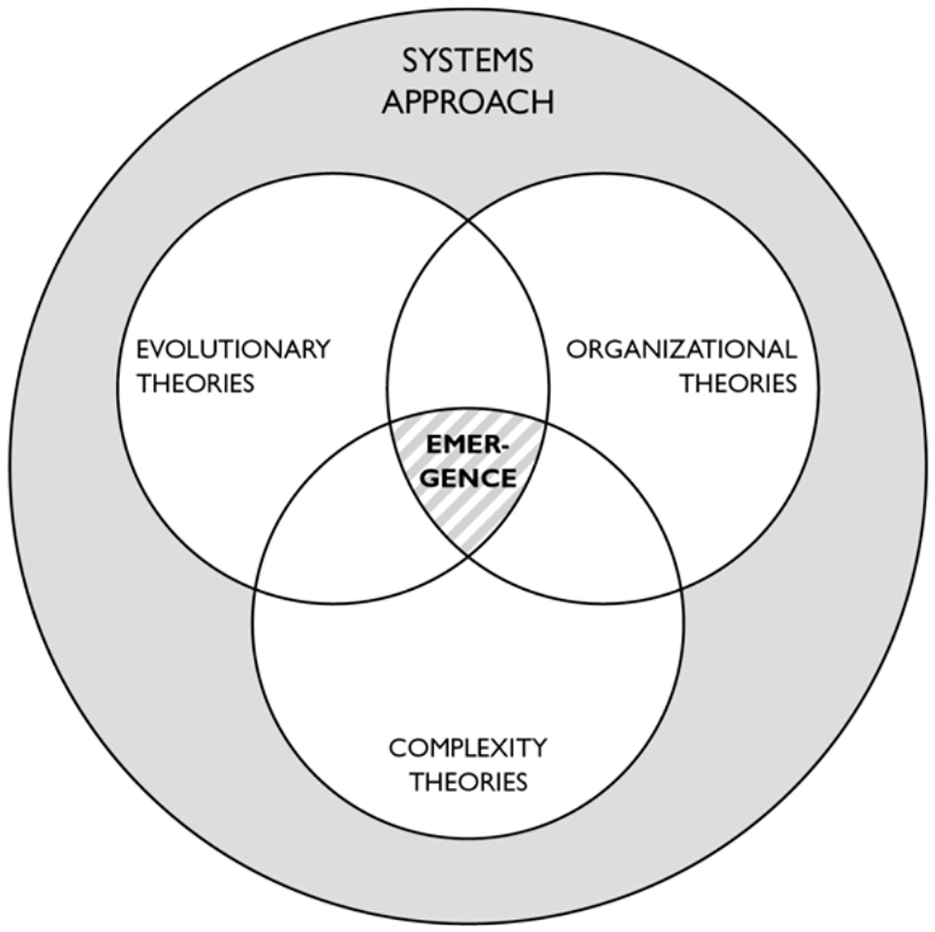
Theoretical positioning of emergence.
Emergence as a methodological imperative
To treat emergence as a core methodological principle in qualitative meta-analysis requires intentional strategies for recognizing and fostering its development. Emergent insights do not simply appear; they must be systematically uncovered through methodological rigor. This section outlines three key mechanisms through which emergence manifests in meta-analysis and how researchers can actively engage with it.
Emergence in qualitative meta-analysis occurs when patterns, relationships, or theoretical constructs arise that were not explicitly present in the individual studies (Baron, 2006). This is distinct from mere thematic aggregation; instead, it involves identifying interconnections that transform the meaning and significance of existing findings. For example, isolated qualitative studies on leadership might document distinct situational behaviors, but a meta-analysis of these studies could reveal a deeper interplay between leadership adaptability and organizational resilience in crisis settings (Uhl-Bien and Marion, 2018). This emergent understanding reshapes how leadership is conceptualized, moving beyond static traits or behaviors toward a dynamic, context-dependent model. Emergence in qualitative meta-analysis can also be compared to the concept of collective intelligence (Camazine et al., 2001), where interactions among simple agents generate complex adaptive behaviors. This parallel is evident in how multiple qualitative studies, each examining leadership or organizational culture in a specific context, collectively reveal deeper systemic patterns that were not apparent in any single study. To facilitate this process, researchers must adopt analytical strategies that allow for the detection of emergent properties. Thematic synthesis, meta-ethnography, and axial coding techniques are particularly useful for tracing latent relationships across studies (Charmaz, 2017; Noblit and Hare, 1988). By iteratively coding and re-examining relationships among themes, researchers can cultivate an analytic stance that prioritizes discovery over confirmation, allowing for emergent insights to take precedence over pre-determined categories.
A key challenge in qualitative meta-analysis is preserving the contextual richness of primary studies while uncovering broader patterns. Emergent insights often arise not within individual studies but in the spaces between them—in the tensions, contradictions, and complementarities that emerge when diverse perspectives are placed in dialog. This intertextual process mirrors the principles of symbolic interactionism (Mead, 1934) and pragmatism (Dewey, 1938), where meaning is generated through relational interactions rather than fixed categories.
Complex systems—and by extension, qualitative meta-analysis—are characterized by feedback loops, where iterative cycles of analysis refine and reshape emergent insights (Kauffman, 1993). Unlike traditional literature reviews, which often treat synthesis as a linear process, qualitative meta-analysis benefits from reflexivity—continuously revisiting and reassessing the relationships among synthesized findings. This iterative engagement aligns with the methodological ethos of grounded theory, where theoretical categories evolve through ongoing interaction with data (Glaser and Strauss, 1967). Applied to meta-analysis, this means that emergent themes should not be prematurely stabilized but allowed to evolve as new interconnections become apparent. Researchers should document these reflexive shifts through memos, theoretical diagrams, and emergent concept maps, ensuring that the synthesis remains responsive to the complexity of the studied phenomenon (Figure 2).
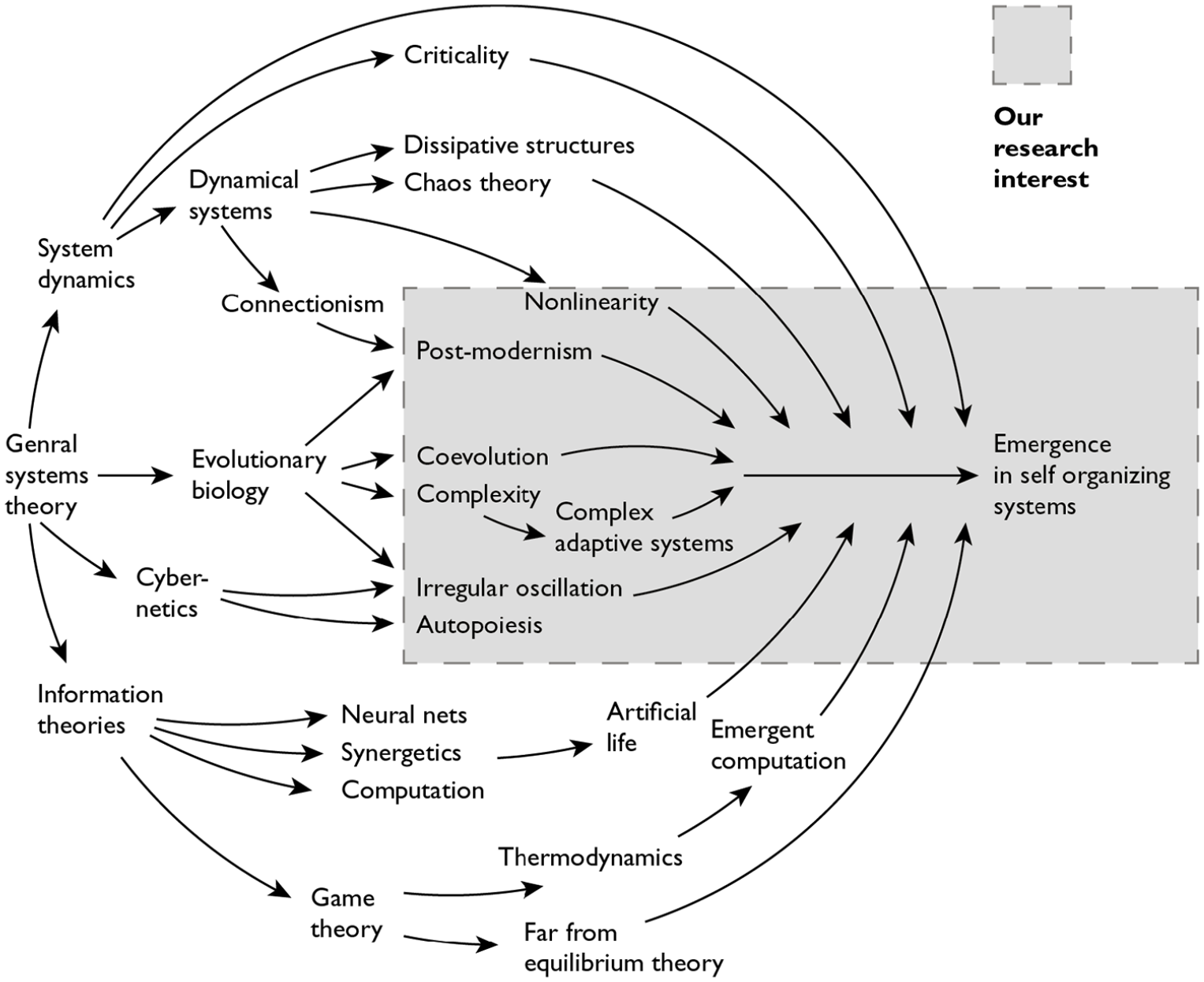
Scientific foundations of emergence (ad. from Goldstein, 1997; McKelvey, 2004).
By synthesizing rich and diverse data, qualitative meta-analysis enables scholars to uncover patterns, relationships, and theories that advance both academic knowledge and practical application (Tsoukas and Chia, 2002). Emergence is a generative force that thus transforms qualitative meta-analysis from a method of aggregation into a powerful framework for constructing new knowledge. Finally, emergence challenges researchers to rethink their role—not as detached observers, but as active participants in the co-construction of knowledge. By engaging deeply with the interplay of ideas across studies, researchers can contribute to a more reflexive and adaptive scholarly practice, one that aligns with the evolving complexities of the world it seeks to understand.
Toward an emergent framework of qualitative meta-analysis
Qualitative meta-analysis is a powerful methodology that synthesizes findings from multiple qualitative studies to uncover emergent insights and construct higher-order frameworks. Unlike traditional literature reviews, which primarily summarize existing research, qualitative meta-analysis actively integrates patterns, concepts, and theories across diverse studies to generate novel understandings that transcend individual contexts (Paterson et al., 2016). This process is particularly valuable in organizational studies, where complexity and context-specific phenomena often require interpretive depth. While aligned with general systematic review methodologies such as those outlined by Cochrane and Campbell, this framework introduces emergence as a guiding construct. Emergence allows researchers to capture higher-order knowledge, ensuring that insights evolve beyond mere aggregation of findings. Below, each step of qualitative meta-analysis is elaborated with explicit attention to emergence while clarifying where and why it diverges from standard systematic review methodologies.
STEP 1: Formulate research questions with an emergent lens
Formulating precise and meaningful research questions is the foundational step of qualitative meta-analysis. Unlike primary qualitative research, where questions are often exploratory, meta-analytic questions are shaped by the existing body of literature and aim to address theoretical gaps or synthesize findings across studies (Bondas and Hall, 2016). The shaping of research questions requires a comprehensive understanding of the field, including its unresolved debates, emerging themes, and practical challenges.
Gold Standard versus Emergent Approach
Gold Standard: Systematic reviews, such as Cochrane and Campbell, emphasize fixed, predefined research questions (Bondas and Hall, 2016).
Where We Diverge: Instead of rigidly setting research questions at the outset, we allow for iterative refinement as emergent patterns shape the inquiry. This ensures responsiveness to new insights that arise dynamically in synthesis.
How to Do It
Begin with an Initial Research Question: Identify the key phenomenon of interest. Example: What patterns of adaptive leadership emerge across qualitative studies?
Conduct a Preliminary Literature Scan: Review existing meta-analyses, theoretical debates, and conceptual models.
Use Concept Mapping: Identify how different themes connect using tools like CmapTools or Miro.
Remain Iterative: Allow new insights to refine and reshape the research question.
Example: A researcher initially sets out to analyze How do organizations maintain resilience in times of crisis? but later refines the focus to How do informal leadership networks contribute to resilience in crisis settings? as unexpected patterns emerge.
STEP 2: Select studies to enable emergent patterns
The selection of studies determines the scope, depth, and quality of the meta-analysis. Systematic and transparent criteria must be used to identify and evaluate studies for inclusion. These criteria often include methodological rigor, thematic relevance, and alignment with the research questions (Feder et al., 2018).
Gold Standard versus Emergent Approach
Gold Standard: Traditional systematic reviews rely on strict inclusion and exclusion criteria to ensure consistency and replicability (Feder et al., 2018).
Where We Diverge: While maintaining rigor, we incorporate studies that challenge dominant narratives, allowing for theoretical expansion.
How to Do It
Define Inclusion and Exclusion Criteria: Select studies based on methodological rigor and theoretical contribution.
Use Multiple Search Strategies: Database searches (e.g. Scopus and Web of Science), snowball sampling, and expert consultations.
Document Selection Decisions: Maintain a table listing excluded studies and justifications.
Example: A researcher analyzing team collaboration in remote work settings may initially focus on ethnographic studies but later includes longitudinal case studies to capture adaptation over time.
STEP 3: Extract data to surface latent structures
Data extraction involves systematically collecting relevant information from the selected studies to enable meaningful synthesis. This step requires a structured approach to ensure consistency and comprehensiveness (Charmaz, 2017).
Gold Standard versus Emergent Approach
Gold Standard: Data extraction in systematic reviews is structured, focusing on predefined categories (Charmaz, 2017).
Where We Diverge: We extend extraction beyond surface-level coding by documenting latent narratives, contradictions, and evolving insights.
How to Do It
Create a Data Extraction Matrix: Organize data into predefined categories such as methodology, participant demographics, key themes, and theoretical frameworks.
Extract Contextual Insights: Go beyond explicit findings and note underlying assumptions and contradictions.
Maybe Use Qualitative Software: Tools like NVivo, Atlas.ti, or MAXQDA facilitate data coding and pattern recognition.
Iterate Regularly: Adjust coding structures to capture unexpected patterns.
Example: A meta-analysis on employee well-being initially categorizes studies into psychological stressors and organizational support mechanisms, but a third emergent category—cultural resilience—arises during synthesis.
STEP 4: Synthesize to reveal higher-order emergent insights
Synthesis is the heart of qualitative meta-analysis, where extracted data are integrated to construct emergent theories and actionable insights. While traditional qualitative synthesis methods rely on predefined coding schemas (thematic synthesis) or comparative translation of findings (meta-ethnography; Harden and Thomas, 2005), the emergent framework introduced here advances synthesis by emphasizing self-organizing properties of qualitative data. Rather than structuring synthesis as a top-down imposition of categories, our approach adopts an adaptive, iterative stance—one that allows for the spontaneous surfacing of cross-study relational dynamics. This aligns with complexity-informed research methodologies, where higher-order insights emerge from the recursive interaction of elements rather than their simple aggregation (Goldstein, 1999). Thus, while borrowing from traditional qualitative synthesis models, this framework extends them by embedding dynamism, iterative feedback loops, and non-linearity as core methodological principles.
Gold Standard versus Emergent Approach
Gold Standard: Systematic reviews emphasize aggregative thematic synthesis (Paterson et al., 2016).
Where We Diverge: Instead of stopping at theme identification, we employ emergent theorization, uncovering unexpected synergies between disparate themes.
How to Do It
Use Thematic Coding: Identify patterns across studies and group them into categories.
Look for Unexpected Interactions: Analyze how themes influence each other in unforeseen ways.
Construct Conceptual Frameworks: Use visual models to represent emergent theoretical insights.
Example: A synthesis of entrepreneurial narratives unexpectedly reveals that serendipitous encounters play a more significant role than planned strategies in business success (Kauffman, 1993).
STEP 5: Documenting emergent insights and analytical evolution
Documenting the data and the analysis process is essential for ensuring transparency, rigor, and replicability in qualitative meta-analysis. This documentation serves as an audit trail, allowing other researchers to verify the validity of the synthesis (Patton, 2002).
Gold Standard versus Emergent Approach
Gold Standard: Systematic reviews require full documentation for replicability, including audit trails (Patton, 2002).
Where We Diverge: While maintaining transparency, we expand documentation to include reflexive accounts of interpretive shifts, making the research process itself part of the emergent synthesis.
How to Do It
Maintain an Audit Trail: ○ Keep records of inclusion and exclusion decisions, coding frameworks, and synthesis processes. ○ Store detailed notes on how themes evolved over time.
Use Reflexive Memos: ○ Write analytical memos documenting moments of surprise, new interpretations, and shifts in understanding. ○ Example: A researcher studying leadership in remote teams notices that informal social interactions emerge as a key factor in resilience—something not explicitly covered in individual studies.
Chronological Mapping of Emergent Themes: ○ Use a timeline or decision log to track when and why key theoretical insights emerged. ○ Example: A synthesis on crisis communication may reveal that early interpretations focused on formal communication channels, but later insights emphasized peer-to-peer sensemaking as crucial.
Enhance Transparency with Research Logs: ○ Maintain a research diary documenting key decision points, alternative interpretations, and methodological challenges. ○ Example: A researcher tracking meta-analysis on organizational agility keeps a reflexive log highlighting shifts from a focus on hierarchical decision-making to adaptive team collaboration as an emergent insight.
Example: A meta-analysis on healthcare collaboration initially categorizes findings into interdisciplinary teamwork and patient engagement. However, a detailed documentation process reveals a third emergent theme: the role of emotional intelligence in patient outcomes, which leads to an unexpected theoretical contribution.
STEP 6: Write up to communicate emergent contributions
The final step of qualitative meta-analysis involves not just presenting findings but articulating how emergence led to novel theoretical contributions.
Gold Standard versus Emergent Approach
Gold Standard: Systematic reviews follow a standardized structure for presenting findings.
Where We Diverge: We go beyond structured reporting by explicitly articulating how emergence shaped new theoretical insights, ensuring that results do more than confirm prior literature—they generate new paradigms.
How to Do It
Structure Your Write-Up: ○ A standard structure should include: 1. Introduction: Context and research questions. 2. Methods: How studies were selected and how emergence was incorporated. 3. Findings: Presentation of key themes and emergent insights. 4. Discussion: Includes theoretical and practical implications. 5. Limitations and Future Research: Areas for further exploration.
Emphasize the Role of Emergence: ○ Clearly state how unexpected patterns shifted the interpretation. ○ Example: A study on sustainability practices may initially focus on corporate policies, but the synthesis reveals that community partnerships play a much larger role than previously recognized.
Use Theoretical Visuals: ○ Concept maps, flowcharts, or process models help illustrate how emergent themes interact. ○ Example: A meta-analysis on crisis management might visually map how informal leadership networks emerge in response to structural failures.
Write for Different Audiences: ○ For academics: Focus on deep theorization and methodological transparency. ○ For practitioners: Highlight actionable applications of emergent insights.
Example: A meta-analysis of entrepreneurial success factors initially emphasizes resource allocation and market conditions, but an emergent theme—serendipitous encounters with mentors—becomes a crucial factor shaping entrepreneurial journeys. The final write-up explains this unexpected insight and provides a conceptual model showing how these encounters shape business trajectories.
Conclusion: Justifying our deviation from gold standards
While this framework adheres to key principles of systematic review methodologies—rigor, transparency, and systematic synthesis—it intentionally departs in three ways:
Emergence in Complex Phenomena: Traditional systematic reviews rely on predefined categories, which can limit discovery. In qualitative meta-analysis, the complexity of human and organizational dynamics requires a more flexible, emergent approach (Charmaz, 2017; Sandelowski and Barroso, 2017).
Flexibility as a Strength: Fixed inclusion criteria in standard systematic reviews may filter out studies that introduce disruptive or counterintuitive insights. By integrating studies with diverse epistemological orientations, this framework ensures higher-order knowledge construction (Feder et al., 2018; Paterson et al., 2016).
Rigor Without Restricting Theorization: Systematic reviews often emphasize reproducibility at the expense of theoretical development. By combining systematic selection and reflexive theorization, this approach retains rigor while allowing for the discovery of novel theoretical connections (Goldstein, 1999; Kauffman, 1993).
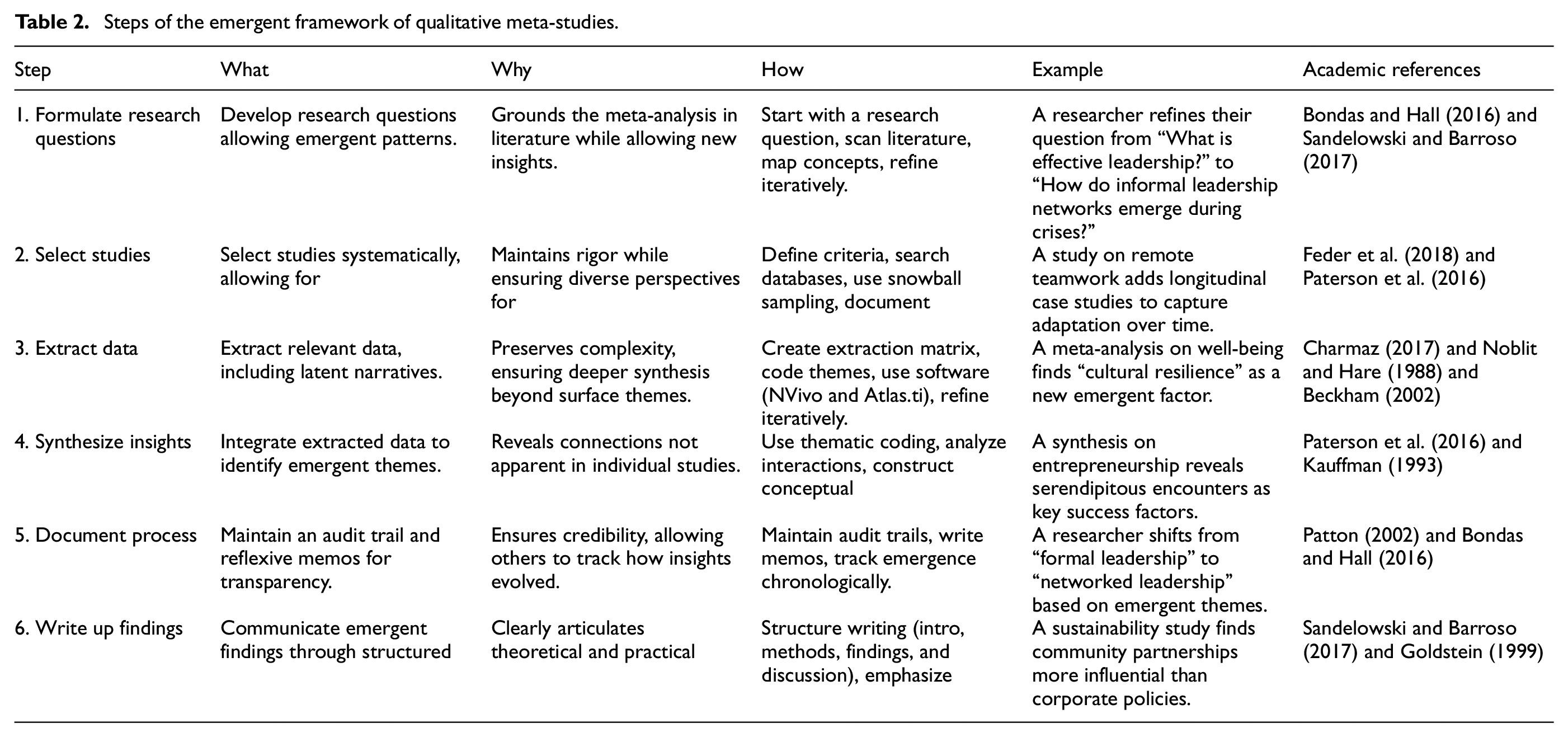
Thus, while respecting systematic review principles, this framework (summarized in Table 2 below) prioritizes knowledge emergence as a key methodological asset, ensuring that qualitative meta-analysis moves beyond aggregation toward the generative process of discovery.
Steps of the emergent framework of qualitative meta-studies.
Balancing emergence with rigor
We have outlined a framework using the construct of emergence to extract higher-order knowledge from qualitative meta-studies. This approach relies heavily on the sensing and interpreting capacities of the scholar, positioning them as an active participant in the knowledge-construction process (Paterson et al., 2016; Sandelowski and Barroso, 2017). However, this raises a critical methodological challenge: how can we ensure that we are truly identifying emergent patterns rather than imposing them? How far can we push synthesis before we risk over-interpretation, speculation, or distortion? In other words, how do we listen rigorously to the data without fabricating meaning (Bondas and Hall, 2016; Charmaz, 2017)?
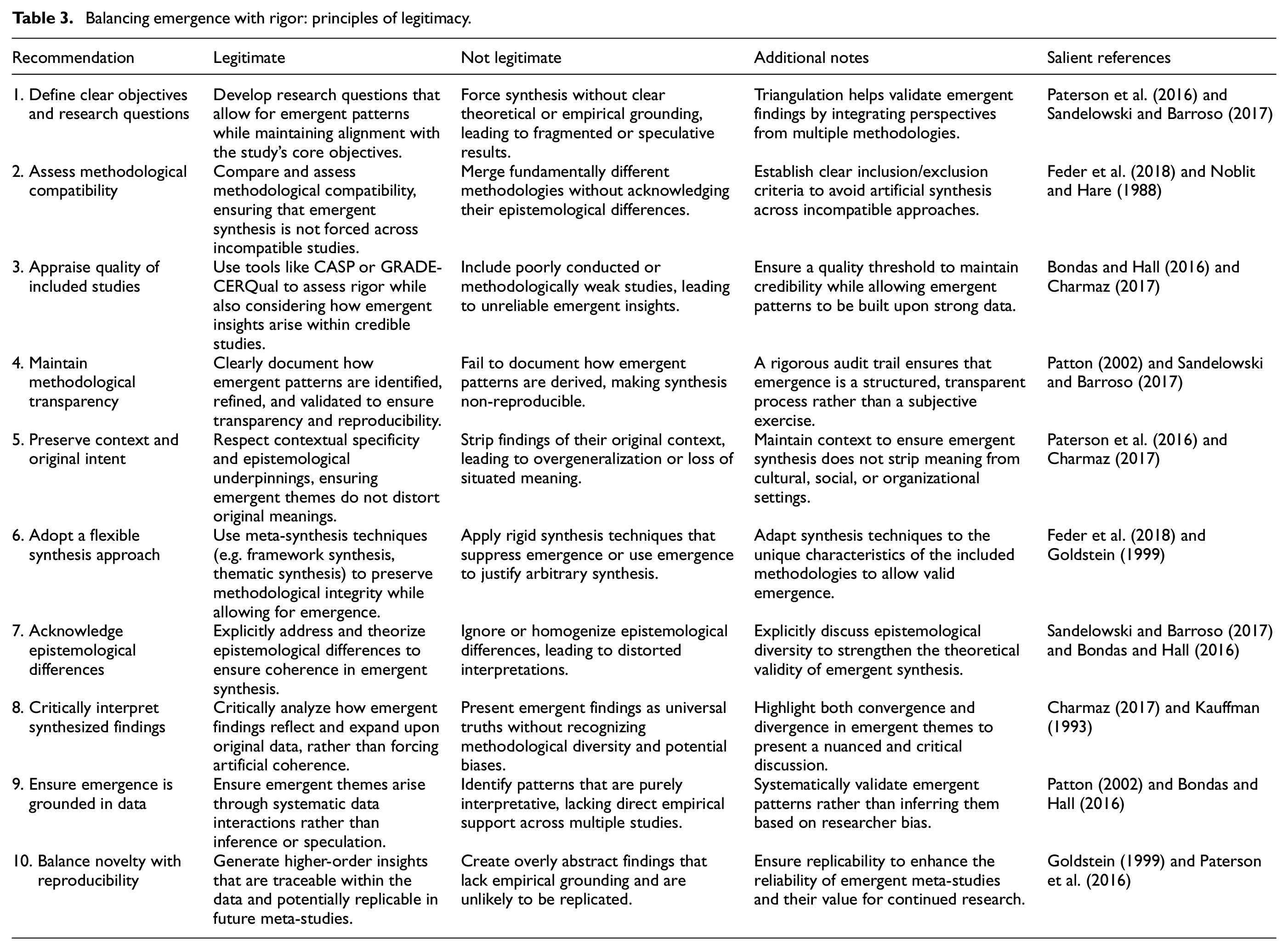
While emergent synthesis embraces complexity, it must remain methodologically anchored to avoid forced convergence, epistemological inconsistency, or abstraction without empirical grounding (Feder et al., 2018; Patton, 2002). Without safeguards, scholars risk engaging in confirmation bias, where synthesis merely reflects their preconceptions rather than genuine emergent patterns (Sandelowski and Barroso, 2017). To mitigate these risks, the following principles of legitimacy should guide emergent qualitative meta-analysis, ensuring that higher-order knowledge is systematically derived, not artificially constructed:
Maintain fidelity to original studies: Higher-order insights must remain faithful to the conceptual and empirical foundations of the included studies, avoiding misrepresentation (Bondas and Hall, 2016).
Allow emergence but avoid speculation: Patterns should surface through systematic synthesis rather than being imposed through inference or over-interpretation (Sandelowski and Barroso, 2017).
Triangulate across multiple sources: Validate emergent themes by cross-referencing different methodologies, contexts, or theoretical lenses (Noblit and Hare, 1988).
Ensure epistemological consistency: Avoid merging studies with incompatible philosophical assumptions unless explicitly theorized and justified (Feder et al., 2018).
Balance novelty with reproducibility: Higher-order knowledge should be traceable within the data and capable of replication in future meta-studies (Charmaz, 2017).
Preserve contextual sensitivity: Emergent synthesis should retain the situated meanings of the original studies, preventing overgeneralization (Paterson et al., 2016).
Prioritize methodological transparency: Clearly document how emergent patterns were identified, refined, and validated, ensuring interpretive traceability (Patton, 2002).
Acknowledge theoretical blind spots: Scholars should explicitly recognize limitations and alternative interpretations, avoiding an illusion of totalizing knowledge (Goldstein, 1999).
Recognize convergence and divergence: Instead of forcing coherence, synthesis could embrace tensions and contradictions that enrich interpretation (Sandelowski and Barroso, 2017).
Integrate reflexivity in interpretation: Researchers should continuously interrogate their own assumptions, ensuring that emergent themes are data-driven rather than ideologically shaped (Bondas and Hall, 2016; Charmaz, 2017).
A key concern in qualitative synthesis is interpretative bias, where emergent patterns may be shaped by researcher predispositions rather than genuine theoretical novelty. Harden and Thomas (2005) stress the necessity of structured synthesis techniques to mitigate subjectivity, while Barnett-Page and Thomas (2009) highlight the risks of interpretative drift when integrating diverse qualitative traditions. Our taxonomy explicitly tackles these concerns by embedding reflexive validation mechanisms—such as iterative coding cycles, triangulation matrices, and researcher memos—into the synthesis process.
By systematically tracking emergent patterns across studies and maintaining an audit trail of interpretative shifts, we ensure that the synthesis remains data-responsive rather than researcher-driven, reinforcing the epistemic legitimacy of emergent insights. By adhering to the above principles, summarized in Table 3, scholars can balance creativity with methodological discipline, ensuring that emergent insights remain valid, rigorous, and theoretically generative rather than speculative or artificially constructed (Bondas and Hall, 2002). The challenge is not to restrict emergence but to channel it in ways that enhance theoretical depth while maintaining epistemological and methodological integrity (Paterson et al., 2016).
Balancing emergence with rigor: principles of legitimacy.
A taxonomy of challenges and actionable heuristics for qualitative meta-analysis
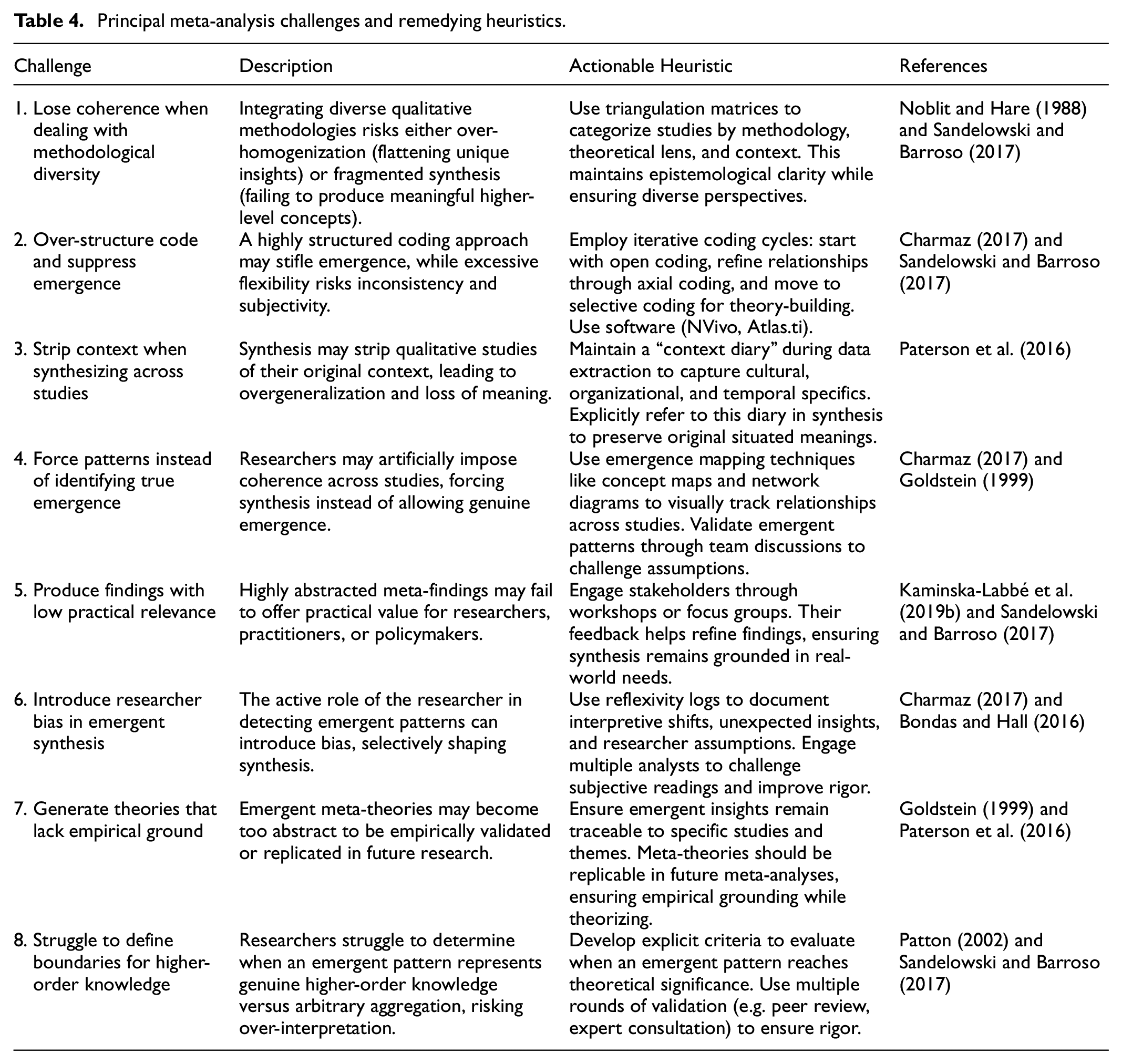
Conducting qualitative meta-analysis presents a range of methodological dilemmas, from integrating diverse qualitative methodologies to ensuring the interpretive legitimacy of synthesized insights. The construct of emergence further complicates this process—while it allows for the identification of higher-order patterns, it also increases the risk of over-interpretation, forced synthesis, or loss of contextual depth. We aim to make this framework radically actionable, ensuring that even novice scholars feel confident in undertaking qualitative meta-studies and navigating the complexities of emergent synthesis. To support them, we provide a taxonomy that outlines eight critical challenges in qualitative meta-analysis, detailing their consequences and offering actionable heuristics to mitigate these risks while maintaining rigor, transparency, and meaningful synthesis.
Challenge: How can scholars integrate findings from methodologically diverse qualitative studies while maintaining coherence in synthesis? Different epistemologies, research designs, and analytical techniques complicate integration, risking either over-homogenization (flattening unique insights) or fragmented synthesis (where findings remain disconnected).
Consequence: A poorly managed synthesis can lead to conceptual distortion (forcing different methodologies into a single frame) or lack of meaningful integration (failing to produce higher-order insights).
Actionable heuristic: Use triangulation matrices to categorize studies by methodology, theoretical lens, and context. This ensures systematic inclusion of diverse perspectives while making epistemological boundaries explicit (Noblit and Hare, 1988; Sandelowski and Barroso, 2017). Backward and forward citation tracking can help fill gaps or identify underrepresented perspectives (Conn et al., 2003).
Challenge: How can researchers retain the interpretive richness of primary studies while ensuring systematic coding? A purely deductive coding approach can stifle emergence, while too much flexibility can lead to inconsistent or subjective interpretations.
Consequence: Overly rigid coding misses emergent themes, while overly flexible coding risks arbitrary synthesis or researcher bias (Charmaz, 2017).
Actionable heuristic: Employ iterative coding cycles. Start with open coding to identify patterns inductively, refine relationships through axial coding, and move to selective coding for theory-building (Sandelowski and Barroso, 2017). Use qualitative software (e.g. NVivo and Atlas.ti) and ensure multiple researchers independently code and validate findings to enhance reliability.
Challenge: How can scholars ensure that contextual richness is not lost when aggregating findings across diverse settings? Meta-analysis risks stripping localized meanings and producing overgeneralized results.
Consequence: Findings may become decontextualized, leading to simplistic conclusions that ignore cultural, organizational, or historical nuances (Paterson et al., 2016).
Actionable heuristic: Maintain a context diary during data extraction to capture cultural, temporal, and situational factors that shape each study’s findings. Ensure that synthesis explicitly refers to these contextual markers to retain situated meanings (Paterson et al., 2016).
Challenge: How can researchers distinguish between truly emergent patterns and artificially imposed connections? There is a risk of over-synthesizing findings by forcing alignment across studies where it does not naturally exist.
Consequence: Forcing synthesis erases contradictions, leading to distorted or overly abstract conclusions that fail to reflect the true complexity of phenomena (Goldstein, 1999).
Actionable heuristic: Use emergence mapping techniques, such as concept maps and network diagrams, to visually track relationships across studies (Charmaz, 2017; Goldstein, 1999). Let patterns emerge iteratively, refining maps as new insights surface. Validate emergent patterns through team discussions to challenge assumptions and prevent premature convergence.
Challenge: How can qualitative meta-studies remain useful and actionable for researchers, practitioners, or policymakers? Some meta-studies become highly abstracted, limiting their real-world applicability.
Consequence: Findings that lack relevance fail to impact practice, reducing the utility and influence of meta-analysis in applied research (Kaminska-Labbé et al., 2019b).
Actionable heuristic: Engage stakeholders, including practitioners, policymakers, and primary researchers, through workshops or focus groups. Their feedback helps refine findings, ensuring synthesis remains grounded in real-world needs (Kaminska-Labbé et al., 2019b; Sandelowski and Barroso, 2017).
Challenge: How can researchers ensure objectivity in an approach that inherently involves interpretive subjectivity? The active role of the scholar in detecting emergent patterns introduces the risk of bias and confirmation effects.
Consequence: If researcher biases shape synthesis, findings risk being selectively interpreted, reducing credibility and replicability (Patton, 2002).
Actionable heuristic: Use reflexivity logs to document interpretive shifts, unexpected insights, and researcher assumptions. Engage in collaborative sensemaking, where multiple analysts review emergent themes to challenge subjective readings (Bondas and Hall, 2016; Charmaz, 2017).
Challenge: How can scholars ensure that emergent meta-theories offer novel contributions while still being empirically reproducible? Overly abstract theorization risks drifting too far from the primary data.
Consequence: Meta-theories that are too abstract become difficult to validate or apply, reducing their theoretical utility (Goldstein, 1999; Paterson et al., 2016).
Actionable heuristic: Ensure that emergent insights remain traceable to specific studies and themes. Findings should be replicable in future meta-analyses, ensuring they retain empirical grounding while allowing for theoretical expansion (Goldstein, 1999; Paterson et al., 2016).
Challenge: How can researchers determine when an emergent pattern represents genuine higher-order knowledge rather than arbitrary aggregation? Without clear boundaries, synthesis risks over-interpretation.
Consequence: Unclear boundaries lead to inflated theorization without sufficient empirical justification, making it difficult to distinguish real emergence from forced synthesis (Patton, 2002).
Actionable heuristic: Develop explicit criteria to evaluate when an emergent pattern reaches theoretical significance. Use multiple rounds of validation, such as peer review or expert consultation, to test the robustness of higher-order insights (Sandelowski and Barroso, 2017).
These eight heuristics strive to offer actionable strategies for addressing the methodological challenges of qualitative meta-analysis. By ensuring methodological diversity, preserving context, systematically coding data, mapping emergent patterns, and engaging stakeholders, researchers can conduct robust meta-analyses that generate novel and impactful insights. These heuristics also reinforce the importance of methodological rigor and interpretive depth in advancing qualitative synthesis as a critical tool in management research. Table 4 encapsulates the challenges, their descriptions, practical heuristics for addressing them, and the references to support each strategy.
Principal meta-analysis challenges and remedying heuristics.
Methodological challenges reinforce the necessity of a synthesis approach that avoids forced convergence while ensuring interpretative rigor. Harden and Thomas (2005) caution against synthesis models that overemphasize methodological uniformity, as they risk flattening the richness of qualitative insights. The emergent framework proposed here directly responds to this challenge by allowing patterns to surface iteratively rather than being predetermined. This is operationalized through heuristics that actively guard against interpretative bias (e.g. triangulated coding and reflexivity logs) while preserving the complexity of qualitative traditions through epistemological transparency. By structuring the synthesis process as an adaptive engagement with data rather than a linear reduction, we ensure that emergence is systematically harnessed rather than artificially imposed.
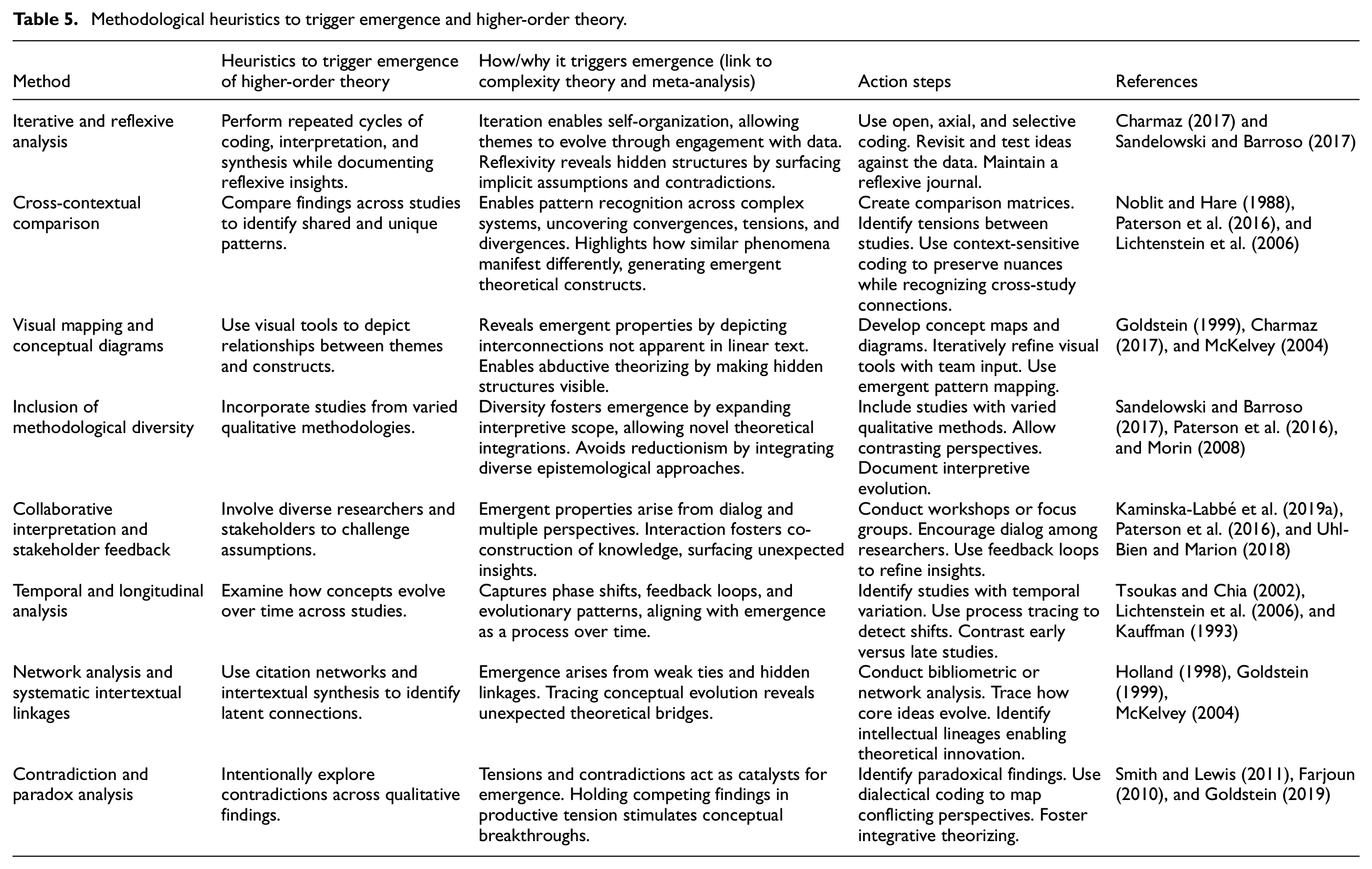
To conclude, building on the preceding discussion of challenges and heuristics in qualitative meta-analysis, and to operationalize emergence in qualitative meta-analysis, a table synthesizes methodological heuristics that actively foster higher-order theorization (Table 5). These strategies align with complexity theory by recognizing the non-linearity, interconnectedness, and dynamic evolution of emergent themes across qualitative studies. By systematically applying these heuristics, researchers can surface latent structures, reveal novel theoretical constructs, and integrate diverse epistemological perspectives into a coherent synthesis of emergent knowledge.
Methodological heuristics to trigger emergence and higher-order theory.
Discussion
The role of qualitative meta-analysis in advancing organizational and management research cannot be overstated, particularly in a world that is increasingly volatile, uncertain, complex, and ambiguous. Traditional quantitative methods, while valuable for specific types of inquiries, often struggle to account for the emergent, context-sensitive, and relational nature of contemporary organizational challenges. By prioritizing predictive certainty and generalizable laws, they risk obscuring the deeper, dynamic patterns that shape how organizations and individuals navigate complexity.
We introduce here the construct of emergence as a foundational lens for qualitative meta-analysis, positioning it as a necessary evolution in how we approach synthesis across diverse qualitative traditions. While emergence has been widely explored in complexity theory, systems thinking, and organizational studies (Goldstein, 1999; Bickhard, 2000; Lichtenstein et al., 2006; McKelvey, 2004), its implications for qualitative synthesis remain underdeveloped. This paper seeks to address that gap by demonstrating how emergence can function as both an epistemological orientation and a methodological principle in the synthesis of qualitative studies. Rather than treating qualitative meta-analysis as a process of simply summarizing existing insights, this approach foregrounds the generative potential of synthesis—how new theoretical structures and conceptual insights can arise through the interplay of multiple studies.
Contributions to theory: Emergence as a new lens for qualitative meta-analysis
Qualitative meta-analysis enables the construction of higher-order theoretical frameworks that transcend the boundaries of individual studies. While existing synthesis approaches, such as thematic synthesis (Thomas and Harden, 2008) and meta-ethnography (Noblit and Hare, 1988), have established valuable methodologies for integrating qualitative research, they often rely on predefined analytical structures. In contrast, an emergent approach to synthesis recognizes that meaning does not preexist in the data but arises through an iterative and relational process of synthesis itself. We build on the idea that emergence is not simply an outcome of synthesis but an active methodological principle. In the context of qualitative meta-analysis, emergent insights are those that cannot be reduced to their constituent studies but instead arise from their interaction, producing novel theoretical contributions that were not evident in the individual studies alone. This aligns with Polanyi’s (1966) notion of tacit knowledge, in which understanding is embedded in relational dynamics rather than in discrete, isolable facts. Similarly, Holland (1998) and Sawyer (2005) argue that emergent properties are irreducible to their component parts and instead exist in the spaces between them. This perspective has significant implications for qualitative synthesis, as it suggests that the role of meta-analysis is not merely to integrate but to actively surface new conceptual structures and theoretical insights that arise from complex interrelations among studies.
By applying emergence as a structuring principle, qualitative meta-analysis becomes a theory-building process rather than simply an aggregation of findings. For example, in studying adaptive leadership across multiple qualitative studies, an emergent approach might reveal newinteractional patterns that transcend individual cases, demonstrating how resilience is co-constructed through iterative social interactions rather than residing in static leadership traits (Uhl-Bien and Marion, 2018). This offers a more dynamic and relational understanding of leadership, one that accounts for self-organization, informal structures, and the adaptation of leadership in response to evolving contextual pressures.
The integration of emergence into qualitative meta-analysis also extends and reinforces ongoing critiques of positivist epistemologies in organizational research. As Alvesson and Sköldberg (2018) argue, the dominance of quantitative paradigms has often marginalized interpretive, relational, and process-oriented inquiries. By positioning emergence at the center of qualitative synthesis, this approach moves beyond static thematic categorization to embrace the fluid, interconnected, and adaptive nature of meaning-making in organizational and social systems.
Contributions to practice: Synthesizing complexity for organizational insight
Beyond theoretical advancements, the emergent approach to qualitative meta-analysis has direct implications for practice. In an era where organizations must contend with rapid change, deep uncertainty, and interdependent global challenges, static models and predefined best practices are insufficient. Organizations require adaptive frameworks that reflect the complexity of real-world phenomena, and qualitative meta-analysis—when informed by emergence—can provide precisely this.
For instance, in crisis management, traditional models often assume linear responses to disruption, failing to account for the spontaneous, self-organizing adaptations that occur in response to uncertainty (Lichtenstein et al., 2020). By synthesizing qualitative research through an emergent lens, it becomes possible to identify patterns of resilience and adaptation that are contextually embedded rather than universally prescribed. Similarly, in the study of innovation, an emergent approach can reveal how informal networks, unplanned encounters, and contextual improvisation contribute to entrepreneurial success in ways that are often invisible in traditional research designs. The emergent approach also holds particular relevance for understanding organizational change. While much research on change management focuses on top-down strategies and structural interventions, qualitative meta-analysis can illuminate the micro-level interactions, narratives, and cultural shifts that shape how change actually unfolds in practice. By tracing the relational dynamics between leadership, employee agency, and external uncertainty, qualitative synthesis can surface emergent conditions under which change efforts succeed or fail—providing decision-makers with more adaptable, context-sensitive strategies.
Limitations and challenges: Navigating epistemological diversity and bias
Despite its potential, qualitative meta-analysis faces several methodological challenges. One of the most fundamental issues is how to integrate studies that emerge from diverse epistemological traditions without imposing artificial coherence (Mays et al., 2005). This has been a longstanding debate in qualitative synthesis, as different methodologies—such as grounded theory, phenomenology, and discourse analysis—operate with distinct ontological and epistemic assumptions (Feyerabend, 1999; Sandelowski and Barroso, 2017). The emergent framework proposed in this paper addresses this challenge by emphasizing epistemological transparency and designing synthesis as a dialogical process rather than a rigid categorization exercise.
A second challenge concerns interpretative bias in qualitative synthesis. As Patton (2002) notes, all qualitative research is shaped by the researcher’s interpretative stance. Harden and Thomas (2005) emphasize the importance of structured synthesis techniques to mitigate imposed interpretations. This paper responds to this challenge by embedding reflexive validation mechanisms—such as iterative coding, triangulated analysis, and researcher memos—into the synthesis process, ensuring that emergent insights remain data-driven rather than researcher-imposed.
Finally, qualitative meta-analysis must contend with publication bias, where studies with null or inconclusive findings are underrepresented in synthesis, potentially skewing the perceived patterns in a given field. Addressing this requires expanding the scope of synthesis to include grey literature and unpublished research, ensuring that the resulting meta-analysis captures a fuller, more representative picture of qualitative insights (Sandelowski, 1997).
Future directions: Strengthening the role of emergence in qualitative meta-analysis
Future research should continue to refine the methodological foundation of emergent qualitative synthesis, developing structured approaches that maintain rigor while allowing for nonlinear, dynamic pattern recognition. This includes leveraging AI-assisted coding techniques to enhance the identification of emergent themes across large qualitative datasets and exploring new protocols for integrating studies with diverse epistemological orientations.
At the thematic level, future research should focus on areas where emergence is particularly relevant, such as cross-cultural leadership, digital transformation, and sustainability. Each of these domains involves complexity, uncertainty, and adaptive evolution, making them particularly well-suited for emergence-based synthesis approaches. The growing complexity of global challenges underscores the need for research approaches that do not merely seek to simplify but instead embrace the richness and unpredictability of organizational and social life. By positioning emergence as a core construct in qualitative meta-analysis, this paper advances not only the methodological possibilities of synthesis but also contributes to a broader epistemological shift toward complexity-aware, adaptive, and relational modes of knowledge production.
Last but not least: Selecting the right journal
Selecting the right journal is a crucial factor in the success of any scholarly publication, influencing not only visibility and impact but also the likelihood of acceptance. The process of journal selection should not be arbitrary; rather, it should align with the research’s epistemological stance, methodological approach, and intended audience. As Merton (1973) emphasized, the advancement of scientific knowledge is contingent on the appropriate dissemination of research findings within communities that can critically engage with them. Furthermore, Podsakoff et al. (2005) argue that the impact of a research paper is largely determined by the journal in which it is published, as top-tier journals provide a platform for greater academic engagement and citations. Given this, scholars must carefully consider journals that not only align with their discipline but also demonstrate methodological openness, particularly for qualitative research synthesis, which often faces greater scrutiny regarding rigor and generalizability (Lincoln and Guba, 1985). This is particularly true for qualitative meta-synthesis, where the need for methodological rigor and transparency has been highlighted as essential to ensuring the credibility and applicability of findings (Dixon-Woods et al., 2005).
When selecting a journal for qualitative meta-analysis or meta-synthesis, several key criteria might be prioritized. Journals with a strong reputation and impact factor are more likely to facilitate broader dissemination and scholarly engagement (Garfield, 1979). Furthermore, journals that have a history of publishing systematic qualitative work are preferable, as they demonstrate openness to qualitative methodologies and an understanding of their epistemological foundations. The interdisciplinary scope of the journal is another critical factor; given that qualitative meta-synthesis often integrates insights from multiple fields, publishing in journals with cross-disciplinary reach enhances the relevance of the findings (Tracy, 2010). Additionally, scholars might want to consider the accessibility of the journal—whether it is open access or subscription-based—since open access journals can significantly increase readership and citation rates (Björk et al., 2010).
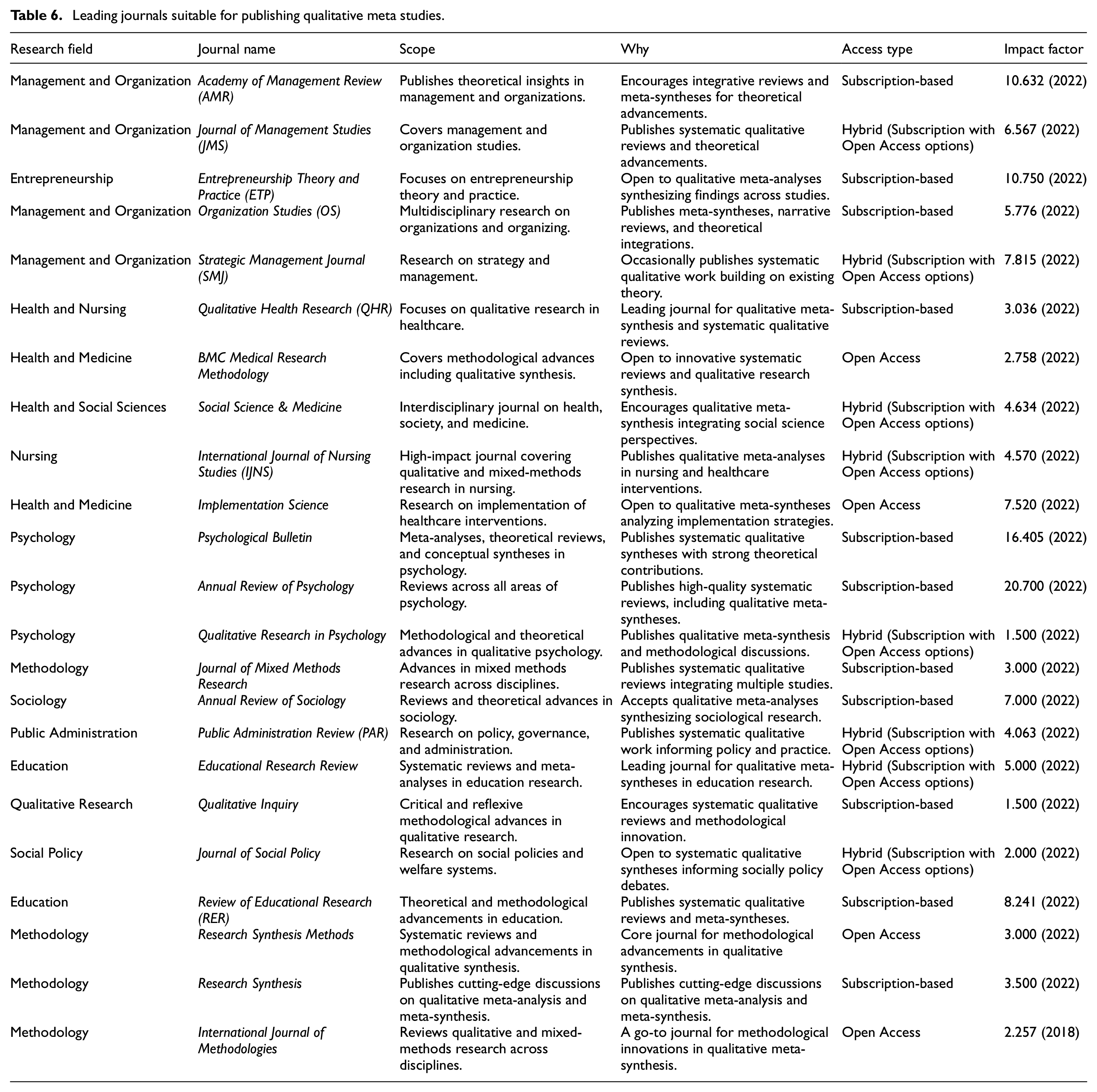
Table 6 presents 23 journals identified as particularly suitable for publishing qualitative meta-analyses and qualitative meta-syntheses across various research domains, including management, organizational science, health, nursing, psychology, education, and social policy. These journals were selected based on several key criteria. First, their reputation and impact factor were assessed to ensure they are well-regarded in their respective fields. Second, their openness to qualitative methodologies was evaluated based on their historical publication record of systematic qualitative reviews. Third, their disciplinary breadth was considered, ensuring they reach diverse scholarly audiences. Finally, accessibility (subscription vs open access) was examined, as open-access journals facilitate broader dissemination and engagement. These selection criteria are consistent with the recommendations of renowned scholars who emphasize that journal impact (Podsakoff et al., 2005), methodological fit (Tracy, 2010), and accessibility (Björk et al., 2010) are pivotal in determining a publication’s influence and reach. Thus, the 23 journals listed in Table 5 represent a strategic selection for researchers seeking to publish high-quality qualitative meta-syntheses in leading academic venues.
Leading journals suitable for publishing qualitative meta studies.
A concluding call to action: Embrace complexity
The world is changing in ways that are fundamentally interdependent and unpredictable. Organizational, technological, ecological, and geopolitical systems are evolving in ways that defy linear models, producing cascading uncertainties that demand new ways of thinking and acting. Traditional research approaches, built on static assumptions and predictive certainty, are increasingly ill-suited to this reality. As Van de Ven (2007) argues, scholarship must not merely observe complexity from a distance but actively engage with its iterative, evolving nature.
We argue that qualitative meta-analysis is not just a methodological instrument but an epistemological imperative for scholars seeking to make sense of complex, emergent phenomena. The richness of qualitative research—its capacity to capture depth, nuance, and context—is too often left fragmented, its insights buried within single-case studies or small-scale inquiries. By embracing synthesis not as a reductive exercise but as a generative process, we can move beyond isolated findings toward theories that are both rigorous and relevant, integrative and actionable (Weick, 1979). Morin (2008) reminds us that complexity is not a problem to be solved but a reality to be engaged with. Research that refuses to simplify what is inherently dynamic and interwoven is not only intellectually necessary—it is ethically imperative.
Scholars have a responsibility to matter. Our work should not exist in insular academic conversations, nor should it aspire merely to theoretical elegance. Van de Ven (2007) emphasizes that research must do more than explain; it must enable—bridging the distance between theory and the pressing demands of practice. This is not a call for simplistic, grandiose claims, nor for performative relevance, but for an ethos of inquiry that is bold yet humble, methodologically rigorous yet open to emergence, committed to knowledge that is both intellectually and socially generative.
We invite fellow researchers to take up this challenge. No single study, method, or discipline holds the answers, but through collective inquiry and methodological innovation, we can forge more adaptive and impactful understandings of the world’s unfolding complexity. The task ahead is demanding, but as Weick (1995) reminds us, small actions accumulate, shaping the larger trajectories of knowledge and practice. The responsibility is considerable—but so too is the opportunity.
Footnotes
Declaration of conflicting interests
The author declared no potential conflicts of interest with respect to the research, authorship, and/or publication of this article.
Funding
The author received no financial support for the research, authorship, and/or publication of this article.
