




Abstract
Many reviewers of applications for ethical approval of research at universities struggle to understand what is considered ethical conduct in community-based research (CBR). Their difficulty in understanding CBR and the ethics embedded within it is, in part, due to the exclusion of CBR from researchers’ mandatory research ethics training. After all, CBR challenges both pedagogically and epistemologically the dominant paradigm/s whose worldviews, values and inherent structures of power help sustain the status quo within academic institutions at large. Consequently, CBR ethics applications are often prolonged due to back-and-forth rebuttals. In this article, we analyse our experiences in a South African institution of the ethics approval process for our various CBR projects over the past couple of years. Data for this purpose was generated from analysis of our reflexive dialogues as well as our responses to feedback from the ethics review boards. To help support the trustworthiness of the study, we invited critical friends to a workshop to engage with our findings. We identified three main themes all associated with how the values, worldviews and approaches of CBR differ from those of the dominant research paradigm/s, that impeded on the progress of our applications through the ethics approval process. On the basis of our analysis, we offer guidelines and a participatory research checklist for university ethics review panels to help inform their evaluation of applications concerning CBR. While universities now actively promote community engagement initiatives, and since CBR is an efficacious approach to that end, we advocate for inclusion of CBR ethics in universities’ mandatory ethics training, to help address ethical concerns that impede CBR research.
Keywords
Introduction
Much has been written on the need for researchers to view the ethical processes for community-based research (CBR) through alternative, less traditional paradigmatic lenses and on how difficult it is to attain ethical clearance for this work in many higher education institutions (Banks and Brydon-Miller, 2018; Brydon-Miller and Wood, 2022; Wood, 2017). These publications, along with many others, argue convincingly for a participatory paradigm to inform and interpret the ethical imperatives of CBR (Lepore et al., 2021). However, since ethics review committees must work according to strict policies and procedures that require the completion of detailed forms, there is also a need to create practical guidelines that both researchers and reviewers can access to help assess whether the research aligns with the ethical principles of CBR. Here, we use CBR as an umbrella term for participatory research designs, including, but not limited to participatory action research (PAR), participatory action learning and action research (PALAR) and the many other genres of action research (AR) that involve working in partnership with others to co-generate knowledge for the public good (Zuber-Skerritt and Wood, 2019).
The authors of this article are researchers committed to advancing community-based research as a valid and necessary addition to the traditionally accepted triad of research methodologies in higher education namely, quantitative, qualitative and mixed-methods. We are also committed to building capacity among researchers to conduct ethical CBR. The first author is an experienced CBR researcher within social sciences; the second is an emerging CBR researcher in health sciences, whose original research training was grounded in a positivist paradigm but now embraces a participatory worldview. We have both experienced frustration and disappointment at having the validity and design of our research proposals questioned and contested by the ethics review boards in our respective faculties in our current institution in South Africa. Moreover, to attain the mandatory ethical clearance, we have been instructed to make changes that contradict the foundational principles of CBR. Comments such as ‘How are you going to ensure the objectivity of the researcher?’, and ‘Please remove the I from the proposal’, indicate to us that there is a lack of understanding of a participatory paradigm on the part of many reviewers. Thus, review board members have tended to use criteria related to positivist and/or traditional, objective qualitative designs to judge the quality and validity of participatory research. These experiences are not confined to our institution as we learnt from colleagues from other institutions in South Africa who attended a workshop on ethics that the first author organised to explore the issue of ethical clearance and participatory research. This also seems to be a global issue as reported in the literature (see e.g. Kwan and Walsh, 2018; Sanders and Ballengee-Morris, 2008).
Although this is frustrating for us, and we have experienced some unhappiness at having to constantly defend our philosophical assumptions concerning research, we also realise that such comments stem more from a lack of understanding, rather than actual resistance to participatory research on the part of review boards. Since ethical review boards form an important part of the quality control of the research conducted by university researchers and need to protect researchers from the possibility of accusations of unethical behaviour, they require clear guiding policies and procedures. As in all bureaucracies, this requirement inevitably means that copious amounts of documentation must be submitted to apply for ethical approval. In conversations with the chairs of the ethics committees, they have voiced the need for new documentation or ideas on how to adapt the current documents to include participatory approaches to research. Thus, in this paper we explain how we did this, through analysis of the feedback we have received from ethics committees and critical reflection on what misunderstandings about a participatory paradigm these comments revealed. The paper also responds to the call for ‘researchers to engage with ethics review committees to create a new “participant–researcher” category with its own set of protocols that recognizes the nuanced role members of disenfranchised communities play in the research process’ (McDonald and Capous-Desyllas, 2021: 364).
Based on our findings, we offer a practical example of such documentation to help both reviewers and participatory researchers understand the ethical requirements of CBR to be able to check if and how they have sufficiently addressed them in the ethics application. We do this to ensure that such research should be of the highest ethical quality. The examples provided will also enable participatory researchers to ensure they have explained sufficiently points of potential controversy in their applications. Although this research was conducted in South Africa, the struggle to have participatory research accepted as a valid and vital addition to higher education research is a global problem, perhaps even more so in developed countries (McDonald and Capous-Desyllas, 2021; Rodriguez Espinosa and Verney, 2021). The question guiding this article is: ‘What guidelines are necessary to ensure that ethics reviewers can evaluate accurately the quality and ethical standard of applications grounded in participatory research?’
We begin by explaining the theoretical underpinnings that determine the ethical imperatives of CBR and how they differ from more traditional, objective research designs. Next, we briefly clarify the methodological approach used to determine the findings and then explain how we used these findings to design the documentation we propose as useful to inform the evaluation of ethics applications for research of a participatory nature.
The ethical imperatives of CBR
CBR is an umbrella term for participatory approaches to research that acknowledge community knowledge as a valid and necessary contribution to understand and change complex social problems (Lepore et al., 2021). CBR stands in direct contrast to the centuries-old belief that only knowledge generated by the academy can be valid and ‘scientific’. This supposition informs most research training at universities; researchers may find it difficult to view CBR as a rational and acceptable research methodology. Participation, under more traditional approaches, is normally confined to the sharing of experiences with the researcher, who then takes that knowledge and interprets it through a suitable theoretical lens to suit their own purposes. This acquisition of knowledge has been described in literature as ‘parasitic and parachute research’ (Bockarie et al., 2018: 965) since the academic researcher merely feeds off the knowledge of ‘participants’ and discounts their role in the knowledge creation process. Traditional research also requires complete objectivity on the part of the researcher, whereas participatory paradigms embrace research designs based on systematic inquiry in collaboration with those affected by an issue, with the aim of bringing about change.
Participatory forms of research also aim to develop praxis which necessitates the translation of theoretical understandings into action (Friere, 1970). This requires the academic and community-based partners to collaborate, critically reflecting on their feelings, assumptions, needs and learning (Wood, 2021) to enable ‘authentic participation’ (Fals Borda, 2016) that, . . . aims at shortening the distance between superior and subaltern, between oppressor and oppressed, exploiter and exploited. Furthermore, different types of knowledge are combined or enter into dialogue, for instance, academic erudition and popular knowledge. This, in turn, made it possible to elaborate new tools for research and teaching, such as the intergenerational dialogue, surveys in groups or symposia, cultural maps, the use of archives from memory or family, imputation and triangulation. Thus, we recover the popular (unofficial) version of history and strengthen the culture and self-esteem of people at the grassroots (p. 160).
This short excerpt from one of Fals Borda’s speeches in 2007 brilliantly encapsulates the ethical imperatives of CBR that require the creation of dialogic partnerships and the convergence of different but equally valid types of knowledge and experience, generated through participatory and traditional methods, to enable educative, emancipatory and political outcomes for positive change. CBR thus aims to create synergy between ‘traditional, popular, practitioner knowledge and academic, theoretical and empiricist knowledge’ (Lepore et al., 2021: 347). In a participatory paradigm, the ability to think critically is regarded as a fundamental human capability, rather than something only learnt through formal education. The research process should awaken this criticality inherent in us all. As Friere (1970) reminded us, when people’s consciousness is raised, they have no problem in thinking critically about their situations. He quotes a factory worker who had attended his sessions as saying: ‘I can’t say that I’ve understood everything you’ve said just now, but I can say one thing-when I began this course I was naive, and when I found out how naive I was, I started to get critical’ (p. iv).
A participatory paradigm is grounded in a relational ontology, where multiple realities are understood though the experiences of people in relation to each other (Peralta, 2017). There is no one source of knowledge, rather an ecology of knowledges (de Sousa Santos, 2015), developed through critical subjectivity and reflexive dialogue, and able to be represented in multiple forms. In contrast to more traditional forms of research, where objectivity is a requirement for validity, in participatory research critical dialogue is essential for determining rigour. How well the findings reflect the reality of the participants and enable them to bring about positive change is the ultimate test of validity. The research process is grounded in life-enhancing values such as care, compassion, mutual respect, democratic participation, empathy, commitment, scientific humility and ubuntu or recognition of the interdependence of humanity (Wood, 2020). There are tensions between participatory and traditional approaches to research in regard to the role and positioning of theory and practice, the subject and object of research and between worldviews and value orientations (Fals Borda, 2016). We will use these tensions to frame our findings later in this paper.
The discussion in this section has highlighted the importance of creating ethics protocols that align with the philosophical assumptions of participatory research designs. CBR may be inherently ethical, given the humane values which underpin it, but prolonged relationship with others tends to carry more ethical risks than traditional approaches where interaction is limited to the time it takes to interview or complete a questionnaire. However, despite the difficulties in having participatory paradigms recognised as valid approaches worthy of their own ethical protocols, it is important that we find ways to do so. Today, like never before, we need to find space in academia for ‘a new science, responsible, democratic and participatory, to bring order to a world that is overexploited and in crisis, with threats of breakdown from the heavens to the caverns’ (Fals Borda, 2016: 264). In the next section, we explain our methodological approach to answering the research question.
Methodology
Following an iterative action research design (Whitehead, 2019), in the first cycle our aim was to understand why our ethical applications received comments requiring changes we knew did not align with the principles of participatory research. We generated data from thematic analysis (Braun and Clarke, 2021) of our responses to the official written feedback on six applications from the various ethics committees, as well as our reflections on the process of attaining ethical clearance. We met on three separate occasions for this purpose. Our findings indicated that the feedback revealed deep misunderstandings about the nature of participatory research on the part of the reviewers. Therefore, in the second cycle we used this knowledge to construct a preliminary table to highlight how CBR aligned with the Belmont principles of justice, respect for persons and beneficence (National Commission for the Protection of Human Subjects of Biomedical and Behavioral Research, 1979) and how this alignment should be embodied in the research process. From this table, we developed guidelines in the form of a checklist as a resource to assist in the evaluation of ethics applications for participatory research. To validate the guidelines, we invited three colleagues, well versed in participatory research, from two other institutions to join us and six other colleagues from our own research entity to critique the documents we had designed and suggest improvements. We then refined the documents and presented them to two committees (one for low-risk research and the other for medium-high risk) in the faculty where the first author conducts her research. Both authors willingly collaborated in this study. The feedback has been anonymised and the wording changed slightly so that it cannot be traced to any one person or even committee, while still retaining the original meaning. Ethical approval (NWU) had been granted for a larger NRF-funded study which sanctioned critical reflection by academic researchers on their experiences of doing CBR to generate knowledge on how to find ways to deal with the absence of a set of ethical processes that align with the principles of authentic CBR.
Discussion of findings
The themes below reveal the difference between the values, paradigm and approach of CBR and the dominant research paradigm/s that seem to inform many of the review board evaluations of the ethics applications. Such evaluations tended to impede the progress of our applications through the ethics approval process. We present the findings as an educational resource, explaining how paradigmatic clashes can be avoided if a participatory lens is used to evaluate the merit of the applications. The themes below highlight the lack of understanding of participatory research and its ethical imperatives in terms of (1) the purpose of the research; (2) subjectivity versus objectivity; and (3) the centrality of relationship within CBR. We now discuss each theme critically with reference to relevant literature and excerpts from the data where applicable.
Theme 1: CBR as praxeology to bring about positive change
This theme reflects the lack of understanding that traditionally trained researchers may have about the importance of action in participatory research. Participatory research is a praxeology, or theory of human action (Coghlan and Rigg, 2021). It is derived from the Greek, Praxis (purposeful action) and Logos (word/thought or principle of knowledge) (Rigg, 2014). Thus, the ethical imperative of participatory research is to bring about positive change and generate theory from reflection on the purposeful action. According to Fals Borda (2016) praxeology comprises three strategic tensions: ‘1) between theory and practice; 2) between the subject and object of research; and 3) between the world view and the value orientation or philosophy of life’ (p. 158). These tensions overlap, but this theme concerns particularly the first, as it was evident to us that some reviewers could not understand the ethical imperative for practical action in addition to the generation of theory.
Traditional views of research stress the generation of theory and largely ignore the need for improving practice and/or the phenomenon that is being addressed. An extract from our critical discussion (12 March 2021) illustrates this:
I wonder why the review board mentioned to you ‘what is the use of this [action] research’? This comment seems out of place and ill-informed?
I felt this was very unfair. I have seen the positive changes that CBR can have in communities. The review board did not focus on the merit of the study and instead on it meeting objective standards . . . this reviewer is not aware that the aim of action research is to bring about change. They are judging it from their own positivistic, objective lens.
A comment like this indicates lack of exposure to research that does not fall within the dominant positivist and interpretivist paradigms, leading to the devaluation of self-reflective studies to improve practice or collaborative research to improve the lives of those involved. As Fals Borda (2016) explained, academia has codified knowledge that has in fact existed for many years and turned it into abstract concepts and theories that separate the mind from the heart and the knower from the knowledge. Such decontextualisation of knowledge means that it can be generalised to provide universal answers to problems, but we know that in social sciences dealing with diverse human and environmental issues, consideration of context is vital (Cox and Bunte, 2018; Whitehead, 2019). Rather than detracting from the validity of action research, the foundational principles impose more requirements, such as the need to show positive change (outcome validity) that all decisions were arrived at collaboratively (democratic validity); that systematic processes of data generation and analysis were followed (process validity); that findings have been subjected to critical input (dialogic validity); and that participation in the research has resulted in new learning leading to new ideas for future action (catalytic validity) (Herr and Anderson, 2014). Participatory research should be judged against these stringent criteria, rather than those developed for other paradigms.
Another example of misunderstanding the purpose of participatory research is given below: It was requested I remove objective two (To challenge their existing hegemonic narratives through critical dialogue to facilitate a more intersectional understanding of HIV and AIDS) because it cannot be measured. Because action research is conducted in cycles, and each cycle informs the action to be taken in the next one, there must be some kind of action and it makes sense to put this as an objective. I have reworked the methodology section to make the cyclical nature clearer and to explain better the process (May, 2020).
This reviewer did not appreciate the importance of critical dialogue as a main source of data in action research. In advocating for the inclusion of alternative research paradigms in ethical documentation, it is obvious there is a need to explain the foundational principles and processes of CBR, rather than adopt an argumentative stance or merely comply to the requests of the reviewers just to get the project approved. According to Sanders and Ballengee-Morris (2008), changing applications to suit the more traditional paradigms in which ethics boards operate is a fairly common response, but we argue that it is unethical to alter participatory research to get it approved. If ethics committees continue to operate from a more positivist and objective paradigm as Babb et al. (2017) assert, then surely there is an ethical need for members to be educated about alternative paradigms? To gain ethical approval researchers have to prove their competence, and we argue that this should be an important consideration for approval in the case of participatory research. Therefore, why should reviewers not also be required to understand this research approach? Indeed, before we commenced on this study there was no option in any of the ethics application forms in our institution for action research, participatory research or any approach other than qualitative, quantitative and mixed methods. The very existence of this paradigm as a research option seemed to be denied. The ethical considerations to be taken from this theme include the need for the researcher to explain fully the required outcomes for CBR and how each cycle leads to the ultimate change articulated in the aims/purpose of the study. The responsibility also lies with the researcher to provide evidence of their competence in conducting participatory research. The next theme discusses the misunderstandings that arise from the second tension, that of subjectivity versus objectivity.
Theme 2: The subjective orientation of CBR
This theme centres on the difficulty some reviewers have with accepting the subjective epistemology of a participatory paradigm where ‘knowledge is developed through critical self-reflection and reflexive dialogue . . . all stakeholders are part of a larger whole with a focus on developing knowledge to take action to attain agreed-on outcomes’ (Wood, 2020: 24). Traditional approaches to research insist on objectivity of the researcher to ensure they do not influence the process in any way, indicated by the use of the third person (the researcher) and an impersonal discourse. Hence, we have received comments such as ‘Please rewrite to remove the “I” to enhance validity and objectivity’. This is not a valid request for any action research study, since the subjectivity of the design requires the use of the first person and to remove it would objectify and deny the ‘agency of the person/people conducting the research, who in PALAR philosophy need to make clear their subjectivity and humanness to reject any pretense of researcher objectivity as non-participatory approaches assert and require of research’ (Wood, 2020: 144).
Participatory researchers have to make explicit their own knowledge and feelings, be empathic, humble and try hard to understand the lived reality of fellow participants. Fals Borda (2016) coined the term sentipensante (feeling/thinking) to explain the need to engage both heart and mind when conducting research. In other words, a participatory research paradigm is more a philosophy of life, rather than merely a framework adopted to explain a particular research approach.
The following is another example of reviewers not understanding the subjective orientation of participatory research. One reviewer expressed concern that the researcher (a teacher) had pre-existing knowledge of the participants, their parents and the local culture and lived in the vicinity, and this might negatively impact on the interpretation of data and validity of the study. The first author responded: “. . . in AR subjectivity is key, so the fact that she [the student] knows the children/parents well improves her competence as a researcher and will enable her to be more sensitive to their culture. This is seen as an advantage in AR, not a threat to validity. The permission/consent forms will not be administered by her to avoid any power issues” (June, 2020).
The ethical consideration raised by a subjective epistemology concerns the need for the researchers to make their positionality clear in both the research proposal and the ethics application. Researchers in a participatory paradigm are full participants and thus influence the process (Janes, 2016). To enhance validity and integrity of the research, the researcher must reflect on their own assumptions, worldview, fears and hopes and how they may impact on the process. Positivistic and interpretive paradigms however require the researcher to be an outsider so as not to influence the outcomes and it is this understanding that continues to dominate in higher education, particularly outside of the social sciences. Students often ask us if they are ‘allowed’ to use the first person and the fact that they feel they must ask permission indicates how deeply ingrained the necessity of objectivity has been in their research training, and also the power they ascribe to the dominant academic culture within higher education (Wood, 2020). This culture also does not include the notion of relationship between researcher and participants.
Theme 3: The centrality of relationship in CBR
Relationship is paramount to CBR, as academic and community participants collaborate to investigate the issue and decide on action to attain their mutually agreed-on goals (Fine, 2017; McTaggart et al., 2017). This stands in direct contrast to traditional, objective research where the researcher is apart from the study. For example, when an applicant intends to work with a group of colleagues to improve their practice through action research, reviewers often consider this to be a conflict of interest. However, in participatory research the university researcher has to wear several hats and be able to move seamlessly between them. An example: A PhD candidate (researcher hat), who was also the principal of a college (management hat) worked with a group of students with disabilities to help them to find ways to improve the academic and social inclusion of the institution (facilitator hat). The story of how he did this can be seen in his thesis (Luthuli, 2019), but suffice to say that it required a great deal of self-reflection in each role on how he might be influencing the process and care that he did not step out of his respective roles at inopportune times. This responds to the ethical requirement of researchers who conduct participatory research being able to critically self-reflect, yet most institutions do not require specific training to do CBR.
Similarly, a comment was made on one application that it is a conflict of interest for researchers to work in their own context, for example, a teacher to work with colleagues and parents from their school. The response had to explain that, Since a PALAR study involves a small group of people with a vested interest in a specific question, the fact that she is a teacher in the school is not a conflict of interest – all the participants in the action learning set are there because they are teachers, community members or other interested parties (Nov. 2018).
Yet other feedback indicated that reviewers thought that colleagues working as a research group would give rise to dishonest reflections that would lessen validity, or true reflections leading to ‘embarrassment, anxiety . . . and the loss of reputation’ (Nov. 2021). As Author 2 reflected: Ethics require independent people to do the research on behalf of the researcher? Meaning, I cannot work with my colleagues as a facilitator and co-researcher as this is seen as a conflict of interest which may affect their reputation, anxiety levels and cause emotional distress. The role of relationships seems to be misunderstood? I have been advised to get an independent mediator to assist with the group. I’ve also been asked to include an independent researcher who will conduct the research on my behalf. Alternatively, I should include someone in our democratic discussions that prevents us (the action learning group) from going off topic (Nov. 2021).
Requests such as these are not in line with the relational ethics (Ellis, 2016) of CBR and speak to the tension between worldview and value orientations. There is an ongoing tension between relationality and criticality in action research, thus the development of trusting relationships is necessary to enhance openness to new ideas and perspectives (Bartels and Wittmayer, 2018). The request for external control of the discussion indicates that the reviewer does not understand the ontological assumptions of action research where knowledge is co-created through critical, reflexive dialogue between participants. In fact, we have often received comments suggesting that group dialogue contravenes the ethical need for anonymity and confidentiality. Such feedback implies that it is difficult for researchers versed in traditional paradigms to accept that humane values such as care, trust and mutual respect can, and indeed must, be present within the research setting.
Other tensions between traditional and participatory paradigms include participant recruitment, with ethics boards requesting that impersonal strategies be used to ensure recruitment is ‘neutral’ (Feb. 2022). However, in CBR participants normally self-select as people who are interested in addressing a specific problem and so strict criteria of inclusion and exclusion are not applicable. Often the university researcher can be part of the population or has been approached by a group to help them to improve their circumstances. The only real requirement is that participants are committed to working in partnership to bring about change (Livingston and Perkins, 2018). The researcher must of course explain this clearly and indicate how there is no intimidation to participate.
Linked to relationship is the need for negotiation of the research process with participants. However, this is problematic according to some ethics committees. As Author 2 lamented: According to the ethics training I joined, I am not allowed to work with community members before gaining ethics clearance. Community members are meant to create the research focus with me? How can I not engage them to develop relationships and understand the context if I am not allowed to approach them (Nov. 2021)
Since CBR is conducted under a participatory paradigm, there has to be ongoing negotiation of the research design. The cycles of action and reflection inherent in action research also means that questions and methods may change as new knowledge is generated. The emerging nature of such research is in contrast to the current processes in higher education where protocols have to be developed upfront by the researcher before participants are recruited. We have often been asked to provide ‘protocols to guide group dialogue’ (Feb. 2022). Such requests again imply a misunderstanding on the part of board members of the reflexive nature of dialogue as opposed to researcher determined questions.
Based on these findings we were able to summarise the main ethical principles of CBR that need to be clarified to aid understanding of a participatory paradigm. Our findings indicated a need to explain how a participatory paradigm would change how the principles must be operationalised to ensure that they cater for the dynamic, complex and political nature of such research. Table 1 explains the ethical imperatives of CBR with reference to the Belmont Principles of justice, respect for persons and beneficence, the main criteria that ethics boards use to evaluate applications. The explanation of how the central features of participatory research relationship, recognition and reciprocity (Zuber-Skerritt, 2018) address these principles, makes it clear how CBR fulfils the requirements. In fact, CBR makes more stringent demands on the researcher to negotiate and monitor ethical aspects of the relationship (Peralta, 2017). For this reason, we decided that there was a need to add to current ethics application forms, rather than delete sections.
The ethical imperatives of community-based research.
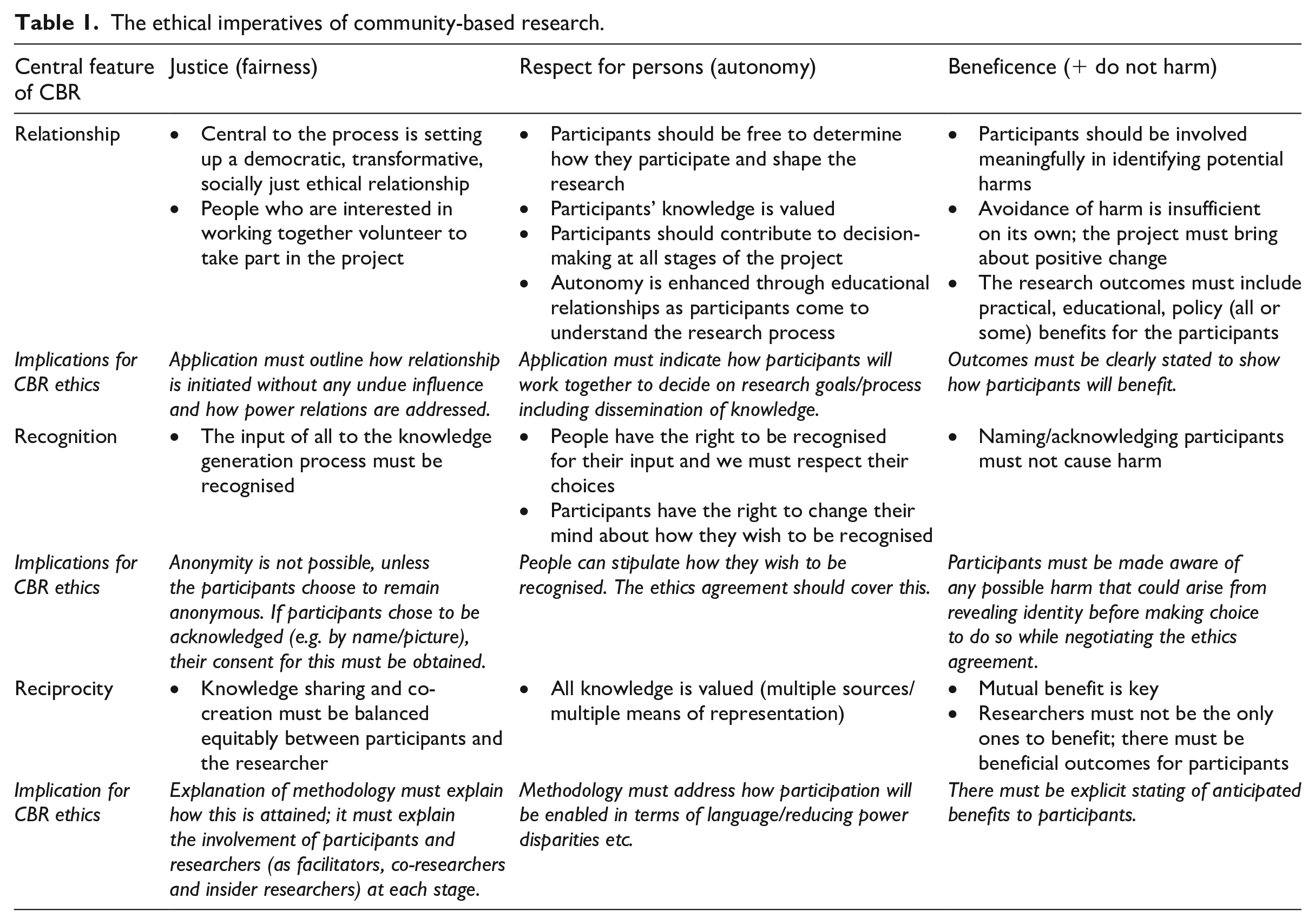
To provide guidance for both applicant and reviewer to check that the application clearly explains the ethical imperatives of CBR as detailed in Table 1, we used this summary to develop the guidelines suggested in Table 2.
Criteria checklist to aid ethical review of participatory research.
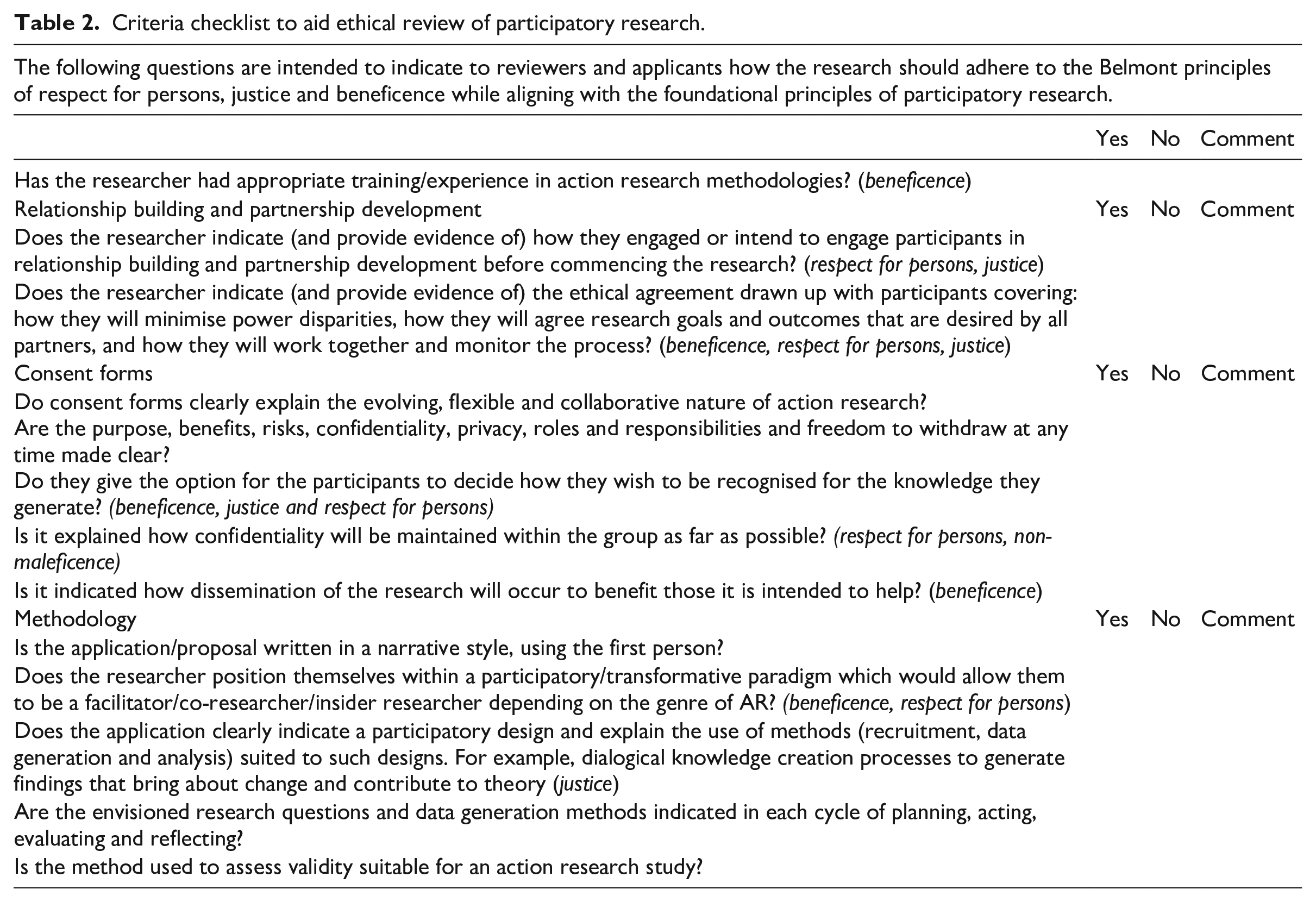
We offer these guidelines merely as suggestions and invite others to add or change them to suit their context and requirements. We are happy to report that the first author has succeeded, through persistent engagement with the chairs of the faculty’s ethics committees (low and medium/high risk committees), in having participatory research included in the ethics application forms, along with these guidelines for reviewers and applicants to consider when evaluating the ethical standard of research of a participatory nature. We attained this by inviting the chairs to a meeting to explain the implications of a participatory paradigm for research ethics and explained how the two documents we had developed (Tables 1 and 2) might be a useful guide for reviewers. They then consulted with their committee members who agreed to incorporate them into the application forms. In addition, we invite committee members to attend whenever we offer capacity development workshops for participatory research. Although not all have attended, we do now have enough researchers on the two committees who appreciate the need to evaluate participatory research through a different lens.
Conclusion
The aim of this paper was to explain how we researched and developed guidelines to enable ethics reviewers to evaluate accurately the quality and ethical standard of applications grounded in participatory research. The three overlapping themes that emerged from analysis of our responses to feedback indicate that ethics applications should clearly explain the ethical imperatives of: (1) the purpose of the research being action to bring about positive change, as well as generating theory on how this can be done; (2) the subjective nature of participatory research and how this should be operationalised; and (3) the centrality of relationship and how this influences the interpretation of concepts such as conflict of interest, inclusion/exclusion criteria and recruitment. Another important learning from this study, in our opinion, is the necessity for participatory researchers to engage with ethics committees to help improve understanding of the ethical requirements related to a participatory paradigm. Our experience is that ethics committee members are willing to listen and are open to suggestions, particularly if they are backed up with strong arguments, grounded in current literature. The literature is replete with accounts of the frustrations experienced by participatory researchers in their dealings with ethics boards. We hope that this paper will offer some insight into how they could take positive action to work with ethics boards to create space for participatory research. We believe that this will make life easier for both researchers and reviewers to the benefit of all concerned and ultimately to the flourishing of CBR in academia.
Footnotes
Author Note
Samantha Kahts-Kramer is affiliated to Physical Activity, Sport and Recreation (PhASRec), Potchefstroom Campus, North-West University, Potchefstroom 2531, South Africa.
Ethical approval
Ethical approval was granted by North-West University (N W U - 0 0 7 8 2 - 1 8 - A 2)
Funding
All articles in Research Ethics are published as open access. There are no submission charges and no Article Processing Charges as these are fully funded by institutions through Knowledge Unlatched, resulting in no direct charge to authors. For more information about Knowledge Unlatched please see here:  .
.
This research was funded by the National Research Foundation, Grant no:116261. All opinions, findings and conclusions are those of the authors and the NRF cannot accept responsibility therefore.