



Abstract
In this article we present a “methodological assemblage” and technological prototype connecting autoethnography to the practices of self-research in personal science. As an experimental process of personal data gathering, one of the authors used a low-tech device for the active registration of events and their perception, in a case study on disengaging from his smartphone. For the visualization of this data the other author developed a novel treatment of fieldnotes in analytic autoethnography through an open source, interactive notebook. As a proof of concept, we provide a detailed description of the corresponding protocol and prototype, also making available the notebook source code and the quantitative-qualitative open dataset behind its visualization. This highly personalized methodological assemblage represents a technological appropriation that combines self-research and autoethnography—two disciplinary perspectives that share a type of inquiry based on situated knowledge, departing from personal data as empirical basis. Despite recent autoethnographic literature on the phenomenon of self-tracking and the Qualified Self, our contribution addresses a lack of studies in the opposite direction: how the practice of self-research mediated by technology can lead to bridges with digital autoethnography, validating their hybrid combination. After addressing diverse conceptual, ontological and methodological similarities and differences between personal science and autoethnography, we contextualize the case study of digital disengagement and provide a detailed description of the developed self-protocol and the tools used for data gathering.
Introduction
The apparent distant practices of qualitative ethnography and quantitative self-tracking, and the supposed epistemological antagonism between fieldnotes and datasets, are put to the test with a simple, open source device and combination of methods for a low-tech and visual approach to subjective data gathering as autoethnography, applied as a proof of concept in a digital disengagement case study. Before describing the specific case and a detailed account of the protocol, the tools and the results obtained, we present a summary of the evolution, divergences and similarities between autoethnography and self-research in personal science, understood as different but complementary traditions and practices in our approach.
Parallel paths of autoethnography and personal science
Ethnography explores, mostly qualitatively, sociocultural phenomena from the point of view of the subject of the study, paying attention to other individuals and actors as research subjects in a given context, interpreting behaviors, ideas, networks, etc, through direct participation and observation (Gottlieb, 2006). Autoethnography, more specifically, stands for a relatively new qualitative research approach tied into the wider field of ethnography. Autoethnography differs from traditional ethnography by departing from researchers’ self-reflections exploring their own personal experiences, instead of primarily observing and studying others in specific settings (Chang, 2008). Although both aim to explore cultural and social phenomena based on fieldwork and interpretation of data, autoethnographers are themselves the primary inquirer and at the same time subject of the research process (Ellis et al., 2011). Similar to autobiographical research, autoethnography requires collecting anecdotal and personal stories, whereas relying on memory or other documentary sources—which can be text-based but also other types of digital media, in line with recent advances in ethnography (Ardèvol and Gómez-Cruz, 2014). Based primarily on qualitative data, the autoethnographic process typically consists of reflection (in parallel or retrospective) and writing regarding lived events, observations, feelings, emotions or other perceptions (Winkler, 2018).
As a result, autoethnography produces a storytelling format that usually addresses wider knowledge, phenomena or narratives, connecting “both the method and the product of researching and writing about personal lived experiences and their relationship to culture” (Marak, 2017). Autoethnography, as “autobiographical writing that has ethnographic interest” (Reed-Danahay, 2017), has evolved from an evocative tradition—for moving readers to engage in ad hoc self-narratives and descriptions (Gannon, 2013)—into alternative but still controversial visions of analytic ethnography—aiming at wider empirical understandings of social phenomena departing from the self (Anderson, 2006), which guides the case study we present. In both cases, however, autoethnographers can face the problem of solely relying on memory for retrospective data gathering, and for that reason scholars recommend using diaries, journals and fieldnotes to improve its reliability (Chang, 2007), as well as other types of documents or media (Atay, 2020). This is characteristic of today’s autoethnographic practices, each time more influenced by—and embedded in—digital contexts (Dunn and Myers, 2020). On the other hand, autoethnography and ethnography in general can be intense time-consuming processes, and some perspectives advocate for focused ethnography practices and strategies, for highly problem-oriented, context-specific and short-term interventions (Knoblauch, 2005).
While autoethnography refers to a widely applied methodology that departs from the self as a focal point to collect qualitative data, in recent years a distinct field that focuses more quantitatively on the self has emerged from a significatively different epistemological direction. Personal science, or self-research, has been defined as “the practice of using empirical methods to pursue personal questions” (Wolf and De Groot, 2020), and also conceptualized as “N-of-1 research” (De Groot et al., 2017). Although it can be viewed to follow the historical antecedents of self-experimentation in medicine (Weisse, 2012), personal science remains a relatively new phenomena—derived from the disruptive appropriation of new technologies like wearable gadgets and self-tracking apps—, which several authors consider as a missing link with recent movements and paradigms such as “Do-It-Yourself science” (Ferretti, 2019) or citizen science (Heyen, 2016). In the wake of pioneers like Seth Roberts and his experiments on diet, sleep and mood in the early 2000s (Roberts, 2004), self-research practices have evolved significantly around a wide self-tracking community of practice under the label Quantified Self (Lupton, 2016). Practitioners in this community constitute a diverse and dynamic network of early adopters of smart-watches, smart-rings and activity-tracking prototypes, ranging from software developers and digital technology enthusiasts to patients, as well as entrepreneurs and researchers—academics or not—from different backgrounds.
Also shared and discussed in derived subcommunities like Open Humans and other patient-led and biohacking ones, the ways in which personal science practitioners are doing self-research are evolving as a transdisciplinary phenomenon beyond consumer passive self-tracking, exploring highly personal questions about health and well-being based on sensory biometrical data gathering, life-logging activities or combining both (Heyen, 2020). Self-tracking in personal science also includes the early-adoption of digital tools like notebooks and visualization platforms for the observation of numerical variables and its interpretation (Lupton, 2019), in a flexible system of epistemological inquiry by which self-researchers frequently share their preliminary results and discuss with peers data-gathering protocols and visualizations (Ruckenstein and Pantzar, 2017). In sum, self-research in personal science takes form in an informal but iterative fashion, with abundant technological appropriations, serendipitous hacking and the development of open source digital tools, as well as dynamics of mutual ideation and inspiration among peers (Senabre Hidalgo et al., 2022).
Similarities, divergences, and alternative self-inquiry directions
If we focus further on the similarities between autoethnography and self-research, regardless of their respective disciplinary traditions as outlined above, we can consider that both are self-reflectives forms of research, departing from self-gathered data to address the understanding of specific phenomena. Both can also be characterized as exploratory and iterative forms of inquiry, in which participants are at the same time the researcher and the subject of research, usually faced with high levels of uncertainty, but also responsiveness and intuition regarding evolving research designs and protocols. Correspondingly, in both approaches these methodological and epistemological characteristics have been criticized by some scholars for its possible types of bias or even narcissistic potential (Forber-Pratt, 2015; Marcengo and Rapp, 2014). What autoethnography and personal science seem to have in common from an ontological angle is the pivotal influence of “personal knowledge” at the center of the scientific endeavor (Polanyi, 2012), and more significantly as two idiosyncratic ways of developing “situated knowledge” (Haraway, 1988) even when by very different means (see e.g. a contrast between Caretta, 2015, and Ruckenstein and Pantzar, 2017). When it comes to topics of research, similar complex or highly personal topics like mood or feelings can be entangled with “the self” in both approaches (Boncori, 2018; Lupton, 2016). Additionally, while mostly focusing on the individual, both practices in some cases have expanded to methodological strategies beyond the “n-of-1.” In the case of personal science, coordinated self-tracking has led for example to patient-led research communities (Kempner and Bailey, 2019). Analogously, new approaches like collaborative autoethnography or duoethnography are also emerging in this novel ethnographic arena (Roy and Uekusa, 2020).
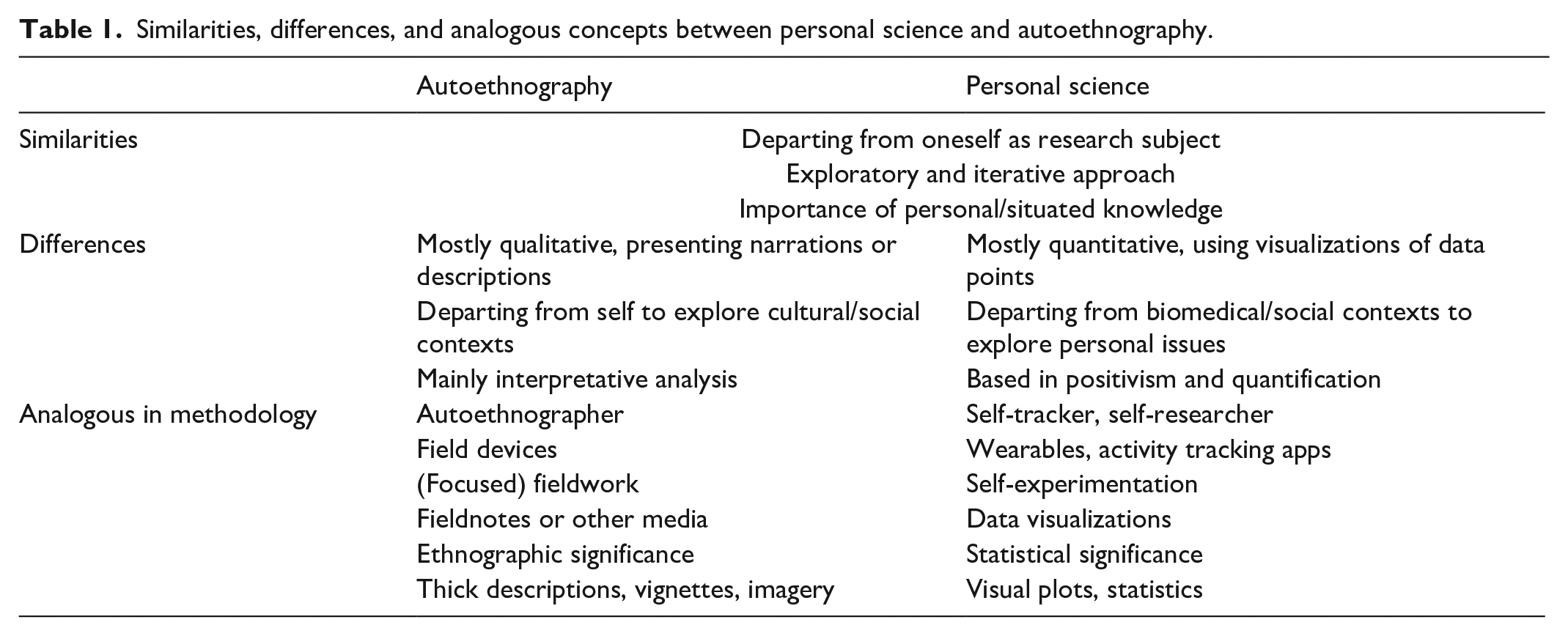
Despite these similarities, there are also relevant divergences between both research approaches. At the epistemological level, autoethnography stands for an interpretivist mode of science, usually rejecting social research as objective and reproducible knowledge derived from scientific methods (Winkler, 2018), while personal science is usually characterized by its roots in positivism and quantification (Heyen, 2020). Another key difference between both approaches is that autoethnography is typically practiced exclusively by scholars, while personal science corresponds, as mentioned above, to an emerging citizen science culture integrated by a myriad of actors beyond professional scientists and academics. Ontologically, although there are exceptions, self-research typically moves toward the “internal” and the understanding of the self, departing from highly personal questions (Wolf and De Groot, 2020). In contrast—especially in analytic autoethnography—the self is the point of departure for trying to explain the “external,” regarding wider cultural and social contexts and based on the ethnographer’s perspective in relation to them. When sharing results and experiences, relevant differences can be appreciated too. Autoethnography is typically published as narrative or descriptive content in a variety of textual formats or other outcomes from the self-inquiry process—more recently using digital media—in order to engage readers in vignettes, dialogs, imagery or “thick descriptions” (Geertz and Darnton, 2017). Self-research in personal science, on the other hand, is usually moved by and relies on a diversity of quantitative data visualizations, statistics and digital plots in order to share progress online and with peers in community channels, discussing potential findings or correlations (Ruckenstein and Pantzar, 2017). Finally, another relevant difference has to do with transparency and openness regarding data, which have become a key point of interest in the current emergence of open science practices (Williams et al., 2018). Self-research often implies a dimension of “data altruism,” of personal datasets and visualizations made available and shared online via open data repositories, analysis notebooks and blogposts (Lupton, 2016). On the other hand, autoethnography usually presents the outcomes of data derived from fieldnotes and other sources in journal publications, book chapters or other formats for evocative communication, offering a narrative or rhetoric (Berry and Patti, 2015) but not usually releasing the full open “raw” data of its qualitative sources—apart from some exceptions (Lester et al., 2021). In general terms, finally, when comparing both approaches there is also at the semantic level relevant analogous concepts about methods and tools used (autoethnographer vs self-researcher, fieldnotes vs data visualizations, etc), which differ according to their respective traditions (with variations in literature) but share as outlined above clear similarities (Table 1).
Similarities, differences, and analogous concepts between personal science and autoethnography.
An alternative approach among recent disciplinary connections
More recently, autoethnography and self-research have significantly being related to each other in a diversity of studies, in which mainly autoethnographers from fields like Science and Technology Studies (STS) and Human Computer Interaction (HCI) present qualitative accounts of their experience as self-trackers, in order to understand and share highly personal and intimate questions arising from the use of wearable technologies and digital monitoring apps. From Williams (2015) long term autoethnography experiencing diet self-tracking, O’Kane (2016) about the everyday use of a mobile medical device, or Forlano (2017) covering insulin pump and glucose monitoring as a feminist data practice, among others. Significantly, its in this domain where several approaches to collaborative autoethnography have recently sprung, in which two or more researchers embark in parallel in the adoption of a specific self-tracking technology for a contrasted and discussed interpretation of experiences, like in the combined use of several physical activity trackers (Marcengo et al., 2016), the implications of adopting smart wristbands (Fors et al., 2020) or even the complexity of duoethnography about the use of a new wearable like the Oura ring (Salmela et al., 2019).
While these later STS and HCI approaches already shed light about the potential connection between both disciplinary perspectives, their self-research processes usually depart from a similar methodological direction: (1) starting with an autoethnographic focus, they (2) generate qualitative accounts to reflect lived experiences and knowledge generation during (3) the practice of self-tracking as “quantified selves.” In contrast, to our knowledge the opposite approach remains unexplored: (1) departing from self-tracking, as (2) a form of quantitative-qualitative personal science practice, to finally (3) develop—or rather “ensemble”—a focused analytic autoethnography. Such a reversal, as we describe in the following case study, resulted from the experimental development of a “methodological assemblage,” an ad hoc way of connecting digital and material configurations (Pink et al., 2020) for a temporary and focused entanglement: a low-tech self-tracking gadget, hand-written fieldnotes, a digital spreadsheet and an online notebook for data visualization. Something that resulted in an alternative pathway of inquiry: starting from quantitative and qualitative self-tracking to address a highly personal question (about the use/abuse of the smartphone), then generating a visual outcome of that self-research data (shared openly and with self-research peers), and finally an analytic phase that incorporated analytic autoethnographic thinking and writing (additional perspectives, narratives, and sociocultural observations based on the previous).
Following a philosophy of iterative development, data gathering in this methodological assemblage, mediated by extremely basic digital and non-digital tools, represented a minimum viable form of “quantified” autoethnography, enabled by open source hardware and software prototypes. Although such assemblage relates to connecting autoethnography and quantified selves, as mentioned above, this represents a relatively unexplored methodological approach in the context of personal science and self-tracking, allowing to interpret quantitative-qualitative data for additional self-reflection usingwith the analytic lenses of autoethnography.
Autoethnographic tracking on the press of a button
The vignette below (Dataset ID #111) reflects some of the first 267 data points and 112 fieldnotes generated during a self-research intervention of one of the authors (Author#1: Senabre Hidalgo), tracking his experience of living without constant access to a smartphone for a while—more concretely, for a month.
“Squeezed among other passengers in the subway heading for Austerlitz station, it’s Monday morning and I’m on my way to the office. Most of the people around are looking at their respective mobile screens and/or with their headphones connected. Similar to a reflex action, while I grab the bar above my head, I move the other hand to my pants pocket to check my smartphone. But I remember instantly that I don’t have it with me today, either. Instead, my fingers find a small plastic object the size of a coin. It’s a button that I press lightly, for a couple of seconds –as I release it, I feel a slight click on my thumb. This is how the first of dozens of similar events will be tracked during the rest of the morning, the day and the week: whenever I realize or I’m aware of moving around without having my smartphone with me –on all those occasions, systematically– I press the white button. This little device, which records exact time stamps and duration of pressings, shares the pocket with an old Nokia feature phone –a sort of basic communication substitute, only good for calls and little else. Additionally, in another pocket I carry a pencil and a small notebook, where for a month I’m writing down on the spot, with the same commitment to systematicity, about every reaction or thought that I consider relevant to record and recall regarding this self-research. Mainly about how I feel and the problems I experience due to this self-imposed condition of living without a smartphone and other derived consequences or effects. The annotations are like descriptive footnotes of the most significant situations that I’m tracking with the button, quick fieldnotes for myself (and whoever wants to read them) similar to this one.”
Personal motivation for self-tracking and inspiration from peers
On the one hand, the interest in this first-person mode of enquiry emerged after previous unsystematic attempts over the years to reduce Author#1’s use of the smartphone and its constant connectivity, a deliberate non-use of technology which has been coined as “digital disengagement” (Kuntsman and Miyake, 2019). On the other hand, he chose this combination of tools (the button tracker, the notebook, the pen) as an experimental protocol for self-research as he progressively engaged as a participant observer in the Quantified Self (https://quantifiedself.com/) and Open Humans (https://www.openhumans.org/) communities, composed by people interested in sharing and discussing their self-research experiences and ideas—in which the other author (Author#2: Greshake Tzovaras) is an active member—and for which both researchers were in parallel studying personal motivations, goals and values for participation in personal science (Senabre Hidalgo et al., 2022). When starting that study, Author#1 was aware of a relatively common assumption about self-tracking and “quantified self” practices consisting in the passive early adoption of high-tech wearables or sensors, by which individuals interested in improving their health or well-being simply buy, wear and follow the recommendations and visualizations of commodified gadgets (Lupton, 2016). Instead, he observed a diversity of individual commitments to rigor, curiosity-driven self-experimentation, tool-hacking and distributed collaboration within these communities of practice. From that later perspective, a sort of double-sided self-research question, highly personal and at the same time methodological in nature, started to take shape after a period of immersion, community discussions and personal curiosity on “low-tech” modes of self-research: How to measure and understand the possibility of a different relationship with my smartphone? More concretely, Author#1’s personal motivation was to better understand—and first-hand experience—the known effects of behavioral addiction to smartphones (Wilcockson et al., 2019), such as the persistent access to information sources and social media (Matthes et al., 2020) and the general postdigital totalization of all spheres of life (Berry and Dieter, 2015). From a quantified self and personal science perspective, the research question required an ad hoc methodology and choice of technology away from complex apps or wearable devices, and at the same time compatible with a time-intensive interventional protocol that could work gathering data in a great level of detail. At this point it’s important to acknowledge, more concretely, how the idea of using a one button tracker for this approach to personal inquiry emerged from a series of Open Humans community calls and self-research chats, where Gary Wolf shared his experimental adoption of a similar device for investigating his arrhythmias. For his self-research he used a one button technology previously developed by Tomas B. Christiansen and Jakob Eg Larsen (Larsen et al., 2017)—who in turn shared their early work in a Quantified Self “show & tell” meeting. Additionally, in parallel to experimentation from these self-researchers, another inspiration and technical development enabling this case study was the work of Gordon Williams—the creator of the Puck button (https://www.puck-js.com/), a modular sensor that is based on open source software and hardware—, thus enabling Author#1 to use it as described in the next section.
Basic setting, sharing, and connection to analytic autoethnography
After a short period of basic testing and planning, this combination of the one button tracker for real-time capturing reactions of smartphone disengagement on spot, with a notebook for additionally writing fieldnotes, provided the basic infrastructure for the mentioned 1-month self-research in May 2021 (Figure 1), during which Author#1 switched from a smartphone to a simple feature phone with basic functionalities (phone calls and SMS messaging). Rather than expecting this delivered non-use to be possible in all moments and circumstances, two important conditions were settled at the beginning of the process: (a) the adoption of alternatives to mobile apps on his laptop (e.g. instant messaging, email, maps, etc) and (b) the possibility of using the smartphone in case of force majeure, as long as both were properly registered and documented.
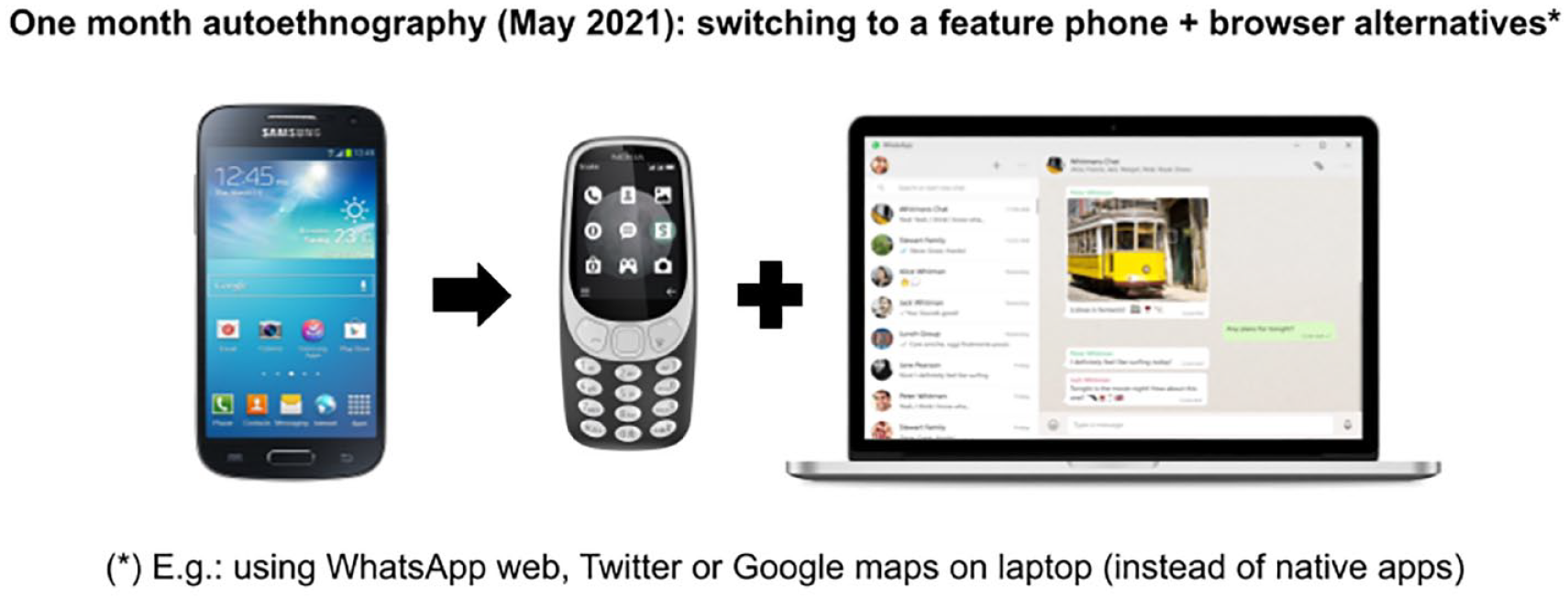
Visual description of the smartphone disengagement approach and its alternatives.
Departing from the personal questions and context outlined above—and with the active role of Author#1 as both researcher and research subject—this highly situated inquiry process was progressively shared and discussed with self-research peers along the way, especially with Author#2, and beyond community calls finally presented in the second edition of the Keating Memorial Self-Research and in the r/digitalminimalism 1 channel, as well as summarized in a blogpost about the experience. 2 This allowed, once the primary data gathering finished in June 2021, to incorporate constructive feedback when reinterpreting and analyzing both quantitative and qualitative data and, more significantly, evolve an early basic classification of events into a further detailed identification of basic themes emerging from fieldnotes, as new categories and material for further reflection. It was precisely at this point, moved by a progressive interest in ethnography, when this author started a second stage of interpretation oriented by the five basic stages of analytic autoethnography as defined by Anderson (2006): (1) complete member researcher status (obvious here due to a highly individual goal and setting), (2) analytic reflexivity (which already started with the original fieldnotes), (3) narrative visibility of the researcher’s self (both through quantitative and qualitative data in this case), (4) dialog with informants beyond the self (which was troubled, as indicated below), and (5) commitment to theoretical analysis (which required further readings and literature reviews). Therefore a later part of the research, as a sort of reflexive distillation, was informed by reading about similar experiences of digital disengagement from ethnographers and other researchers working on this topic, and correspondingly adding a retrospective interpretation of each of the 112 fieldnotes as a “grounded” approach (Pace, 2012), mainly during January 2022.
Methodological approach and field devices
Regarding the technical side of this methodological assemblage, more concretely, the main data collection tools consisted of (1) the Puck button, a javascript beacon easy to use, programmable bluetooth sensor, and (2) a paper and later on digital notebook where to write fieldnotes in parallel. As for the data analysis and visualization, results were coded using (3) a simple online spreadsheet and afterward (4) plotted with a Jupyter notebook (https://jupyter.org/), in order to generate an interactive navigation of results as a thick layout of chronological events and its intensity, as well as related fieldnotes and other annotations.
Details of the self-tracking protocol followed
The Puck one button tracker fits in a pocket, and for this specific protocol served as the basis for a precise registration of continuous and very regular events as they happened. That is, a “background” of detailed data about when and how intense were events of the specific perceived phenomena at every precise moment (in this case, regarding personal reactions to the lack of a smartphone, or finally reaching out for it). Each time the Puck is pressed it registers the timestamp and the duration of such pressure (as well as other data like light, temperature, movement, magnetic fields, and a long etcetera not used in the experimental approach described here, which only covers the basic functionality of the device). This data is recorded locally on the button itself, and can afterward be downloaded to any computer using a privacy-safe ad hoc online tool (https://tzovar.as/one-button-tracker/). This allows to collect precise time-stamped events about a specific defined phenomena and at the same time its estimated intensity (Figure 2).
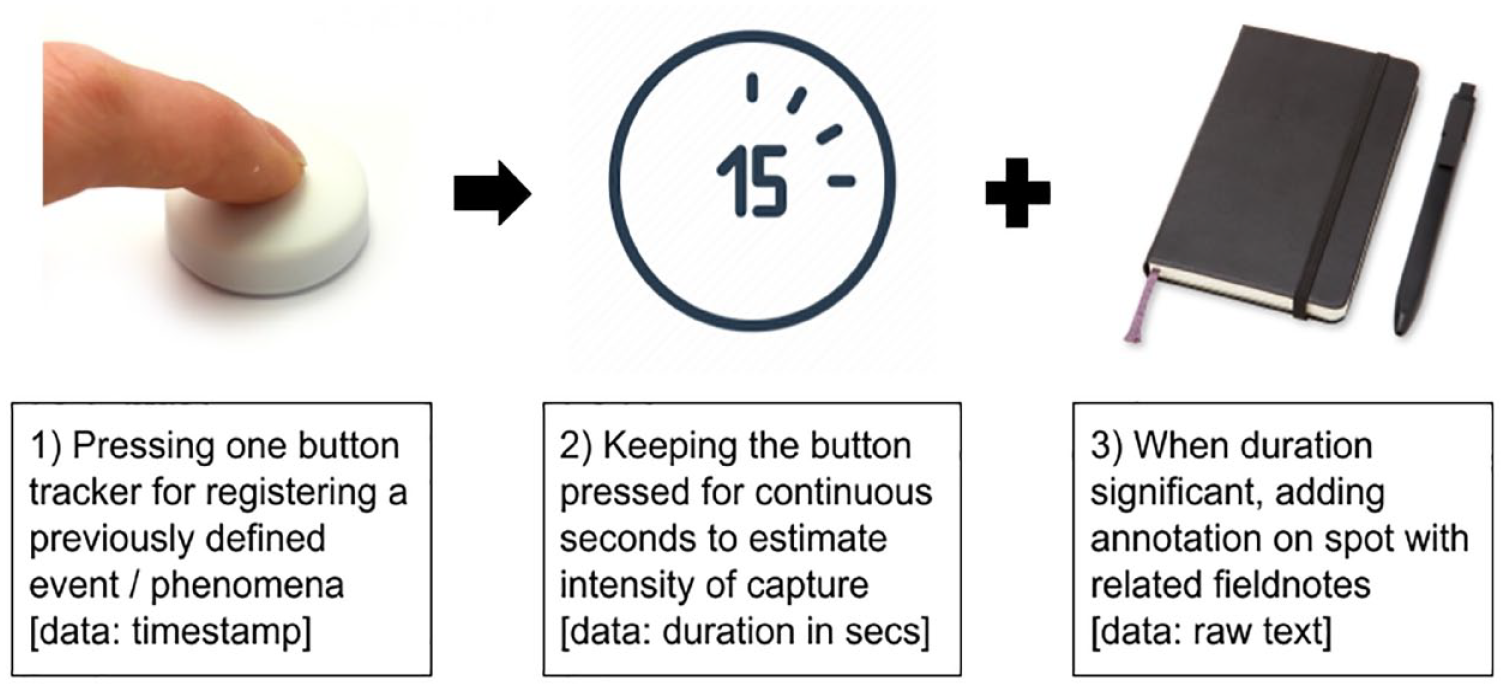
Overview of the deviced protocol for data collection.
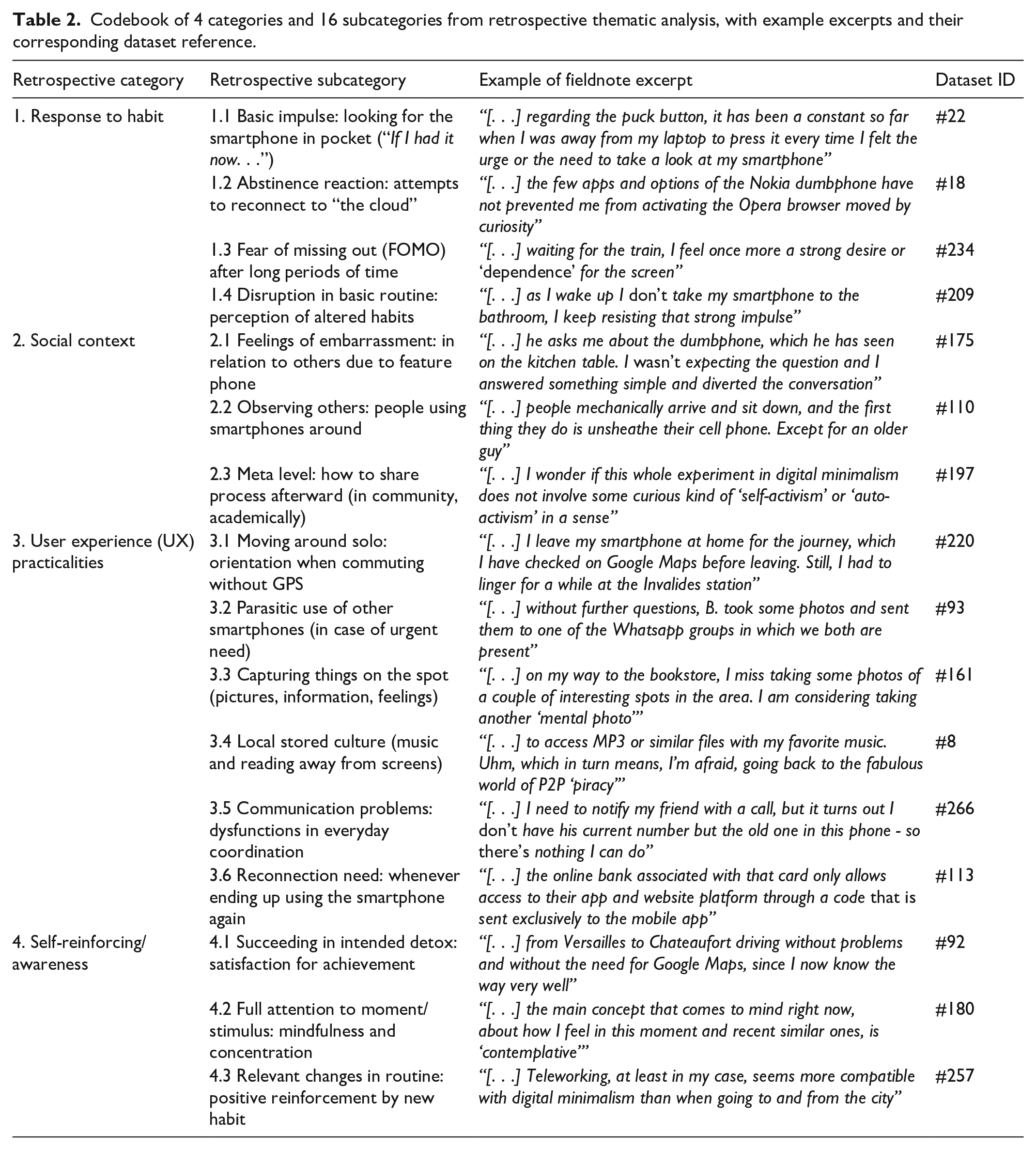
The second component of this assemblage, composed of different “field devices” (Estalella and Criado, 2018), was a small paper notebook, where specific written codes at the beginning of each fieldnote included also a timestamp (to match with the Puck button data afterward), a parallel estimation of intensity (with simple icons, stars and lines) and additional tags or categories when registering more than one type of events regarding Author#1’s smartphone disengagement. As a clarification, the default category of timestamped background data for the more regular events (which refer to similar negative reactions of “basic impulse,” see Table 2) was not always considered for annotations, and only more intense pressings—meaning significant or relevant events—described or commented in their corresponding fieldnotes. This way, as results show next, on the one hand highly recurrent data was gathered as a background of very precise events corresponding to one main category—with a high level of detail and granularity, including their perceived intensity on spot—, while in parallel generating a corpus of more relevant, annotated entries from the notebook with additional categories. For a quicker transcription and automated digitization of fieldnotes, a minimalist tablet device reMarkable 3 was used to ease text conversion from analog paper notebook to digital—as an intermediate step that also allowed for improving language precision and clarity when needed.
Codebook of 4 categories and 16 subcategories from retrospective thematic analysis, with example excerpts and their corresponding dataset reference.
Data merging, visualization sketches and initial categories for analysis
The second part of the data collection process required to merge on a spreadsheet the button data with the corresponding fieldnotes, and after that cleaning up non-relevant fields (light, temperature, movement data, etc) adding more columns for a predefined classification of events, which matched three initial categories already followed when writing the fieldnotes—described below. Although simple in principle, this part of data merging and cleaning up served also as a key moment of rereading, refining and improving the annotations, as well as reconsidering the obtained registers regarding intensity—duration of pressings—, where some data from the Puck and annotations slightly diverged. This way, the process of matching quantitative with qualitative data became a critical step for reflecting possible variations in perception between pressing the button and writing the annotations, and therefore the corresponding measurements of intensity—corresponding to numerical estimations (Figure 3).
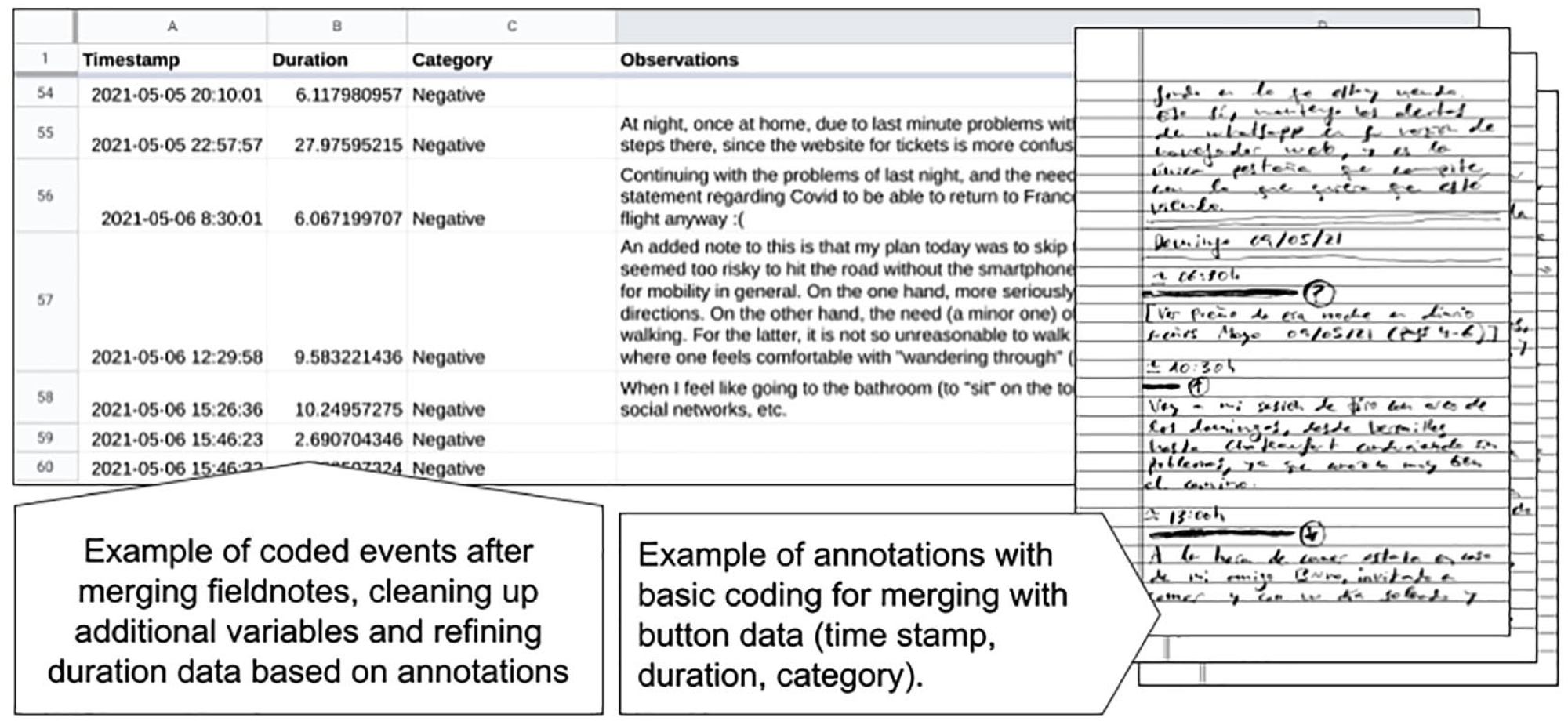
Examples of gathered quantitative-qualitative data, on notebook and afterward spreadsheet.
Finally, once the data was properly processed and coded on the spreadsheet, the next step consisted of visualizing timestamps and annotations in different interactive formats, according to both initial and retrospective classification of events. The following fieldnote (Dataset ID #139) and its attached illustration (Figure 4), sketched during the self-research process, reflects how this was also part of the iterative process of inquiry (at a “meta” level) imagining ways to visualize results while gathering data—instead of predefined in advance.
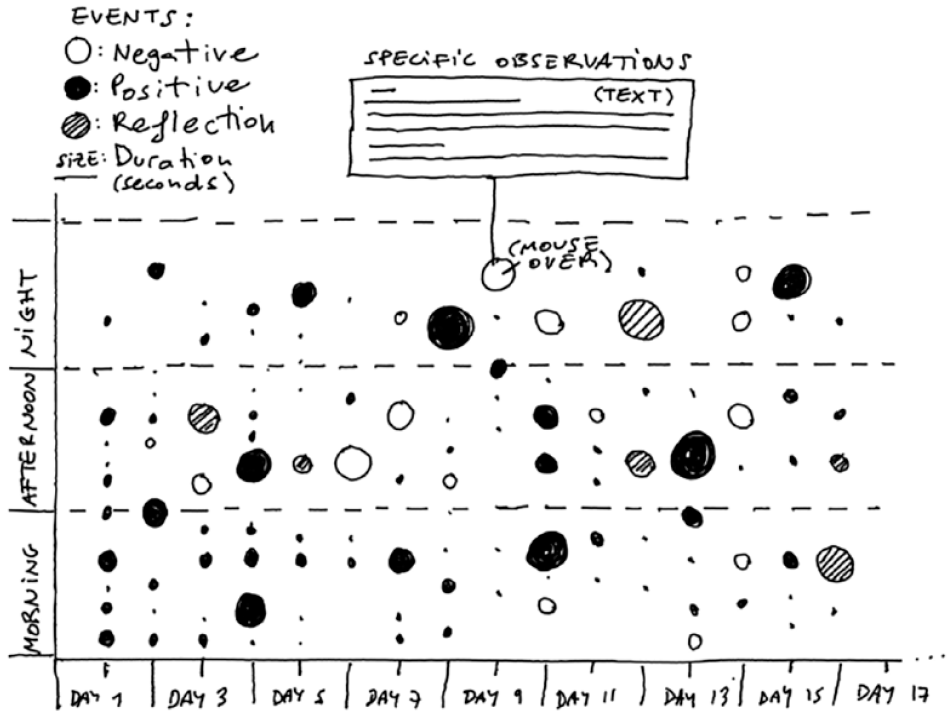
Initial sketch for data visualization (Dataset ID #139).
“At some point I will have to consider how to visualize both the notes that I am writing here and the ‘quanti’ data of the puck button. I start to imagine how the different data points could be oriented through a time sequence, day by day and by week, as well as the observations (like this one) and how they can be shown in parallel.”
Regarding the initial thematic coding for classification and derived visualizations, it was based on a tentative basic approach to “positive-negative-reflection” categories regarding smartphone disengagement as pre-defined by Author#1 (early May 2021): “negative” (reactions to not having the smartphone in the pocket or nearby), “positive” (moments of perceived benefits like concentration, mindfulness, etc.) and “reflection” (annotations related to the intervention itself, or in relation to other people). In contrast, as we will see, additional retrospective categories (during November 2021 and January 2022) were based on a later literature review and reading about other autoethnographic interventions and accounts for similar phenomena. In both classifications, a series of prototype visualizations for Jupyter notebooks developed by Author#2 allowed the presentation of data in different depths and modes of categorical navigation (Figure 5).
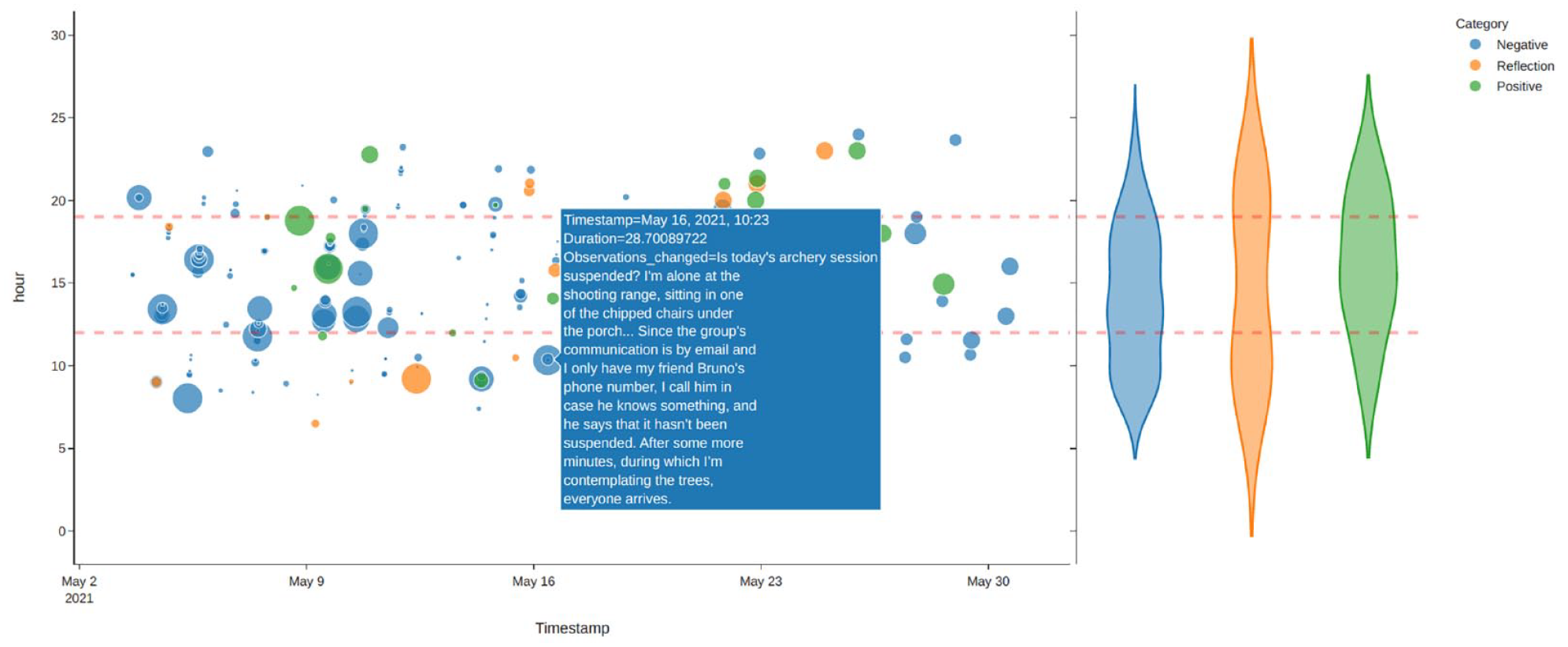
Overview of first data visualization with initial coding categories (negative-positive-reflection).
As a summary and “how-to” step-by-step guide on how to obtain, install and connect the Puck button, as well as to collect and converge data as described to visualize it on a Jupyter notebook, we provide a quick guide in the Personal Science wiki 4 and as Annex 1 of this publication.
Iterative interpretation of results
In a relatively different approach to similar ethnographic accounts (Ghita, 2019; Lucero, 2018), the duration and levels of detail and insight from this focused analytic autoethnography provide a denser account of several reactions and consequences derived from smartphone disengagement, in line with previous literature from HCI, digital media and health (Brown and Kuss, 2020; Rodríguez-García et al., 2020; Skivko et al., 2020). This iterative interpretation of results, as already mentioned, was based on retrospective classification, topic coding and visualization of the mentioned total of 267 registered events and 112 fieldnotes (Figure 6), as well as further ethnographic reading and writing derived from it, following practices of grounded theory.
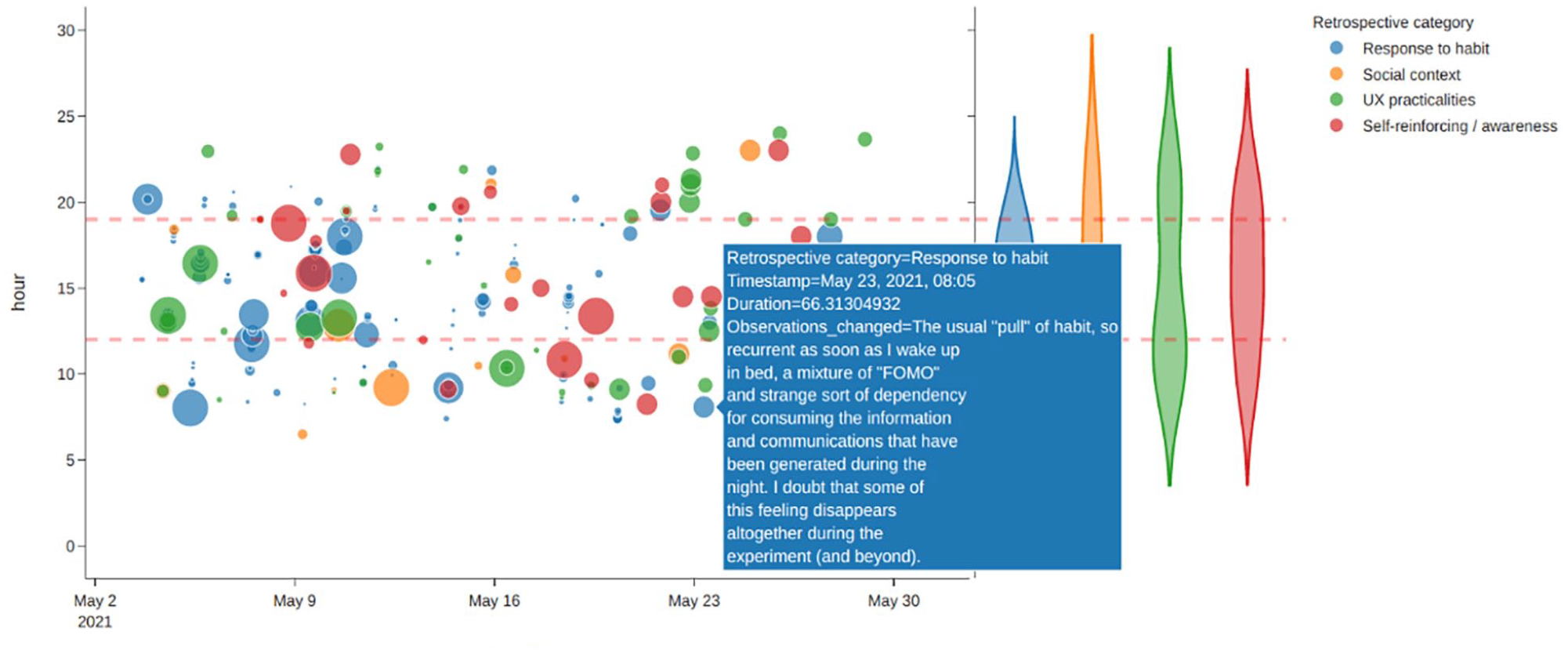
Example of one of the transcribed fieldnotes in the second coding of results, visualized following four alternative coding categories.
More concretely, beyond the initial intuitive classification of events as negative-positive-reflection, the retrospective categorization of events for that round of grounded autoethnographic analysis took place some months later following a specific self-developed codebook of 4 categories and 16 subcategories, applying a thematic analytic approach (Table 2, with example excerpts from fieldnotes):
Derived visualizations and open data from this case study
The different levels of analysis applied can be navigated in the following interactive plots, all reflecting the same data derived from both the Puck button captures and the fieldnotes, visualized in three alternative ways:
• Plot #1: initial positive/negative/reflection categories and fieldnotes, as registered on spot (May 2022).
• Plot #2: retrospective classification of fieldnotes, based on the four main categories described above (November 2021).
• Plot #3: retrospective classification of fieldnotes, here based on the derived 16 subcategories, here displaying the additional grounded autoethnographic annotations (January 2022) instead of original content from fieldnotes (as in codings #1 and #2).
○ Example of grounded autoethnographic annotation (Dataset ID #109): “[. . .] Commuting without the smartphone was challenging in a new city for me like Paris, which I barely knew. This type of dilemma made me think on several occasions about how the complexity of “moving around solo” in relation to work and professional life seems a no-go in a wide spectrum of cases and contexts. Something seems quickly changing culturally regarding what it means to move, physically or digitally, from your intimate domain (home) to the social complexity of organizations (workplaces), and how this transition is becoming literally a space of “soft resistance” (Nafus and Sherman, 2014) but at the same time something extremely complex or impossible for many people.”
Following open science practices, which usually characterize personal science projects, the full open dataset of this methodological experimentation (26,376 words between fieldnotes and annotations), which serves as the basis for the three alternative visualizations above, is available in Zenodo under a Creative Commons Attribution 4.0 International license (https://zenodo.org/record/6671291). It is within this corpus of quantitative and qualitative data where both the initial fieldnotes and all the retrospective ethnographic annotations, comments, and digressions can be additionally accessed (as well as additional bibliographical references).
Summary of main interpretations from the experience
Among the most relevant results, as a brief summary combining self-reflection with the parallel process of documenting and understanding digital disengagement from other similar studies and data, five main ones are:
Reactions of habit/dependence/addiction like nomophobia or FOMO (“Response to habit” category) appear as very intense during the first 7–10 days, but they decreased in number and intensity afterward, while some positive aspects and reflections emerged in parallel. In a way, this seems very similar to what people with addictive behaviors experience—for example when quitting smoking.
Main negative perceptions, according to fieldnotes and tracked intensity of events, were consistent over time and had to do with technical/practical/usability inconveniences (“UX practicalities” category), from non-optimal communication and information retrieval problems to finally having to reach the smartphone in specific situations—which became recurrent during the whole intervention.
Another order of regular negative events had to do with feeling uncomfortable or strange at early moments of the day (“Disruption in basic routine” subcategory), from going to the bathroom each morning without the smartphone, to waiting times in public transport, when the smartphone acquired habit resulted in uncomfortability and even anxiety sometimes.
“Positive” events of the intervention emerged progressively and incrementally, and had to do with episodes of mindfulness and being aware of living the moment, better appreciating the surroundings (“Self-reinforcing/awareness” category). From “mental photos” of this or that situation, to realizing the lack of distractions during various activities, away from the recurring distraction of the smartphone screen.
Sporadic reflections in fieldnotes in relation to other events had to do with inexperience and insecurity in the way of conducting this self-research (i.e. at a “meta” level), but also in relation to other people (“Social context” category). Especially about how they could perceive the self-researcher and react when knowing about Author #1’s choice of phone, or the case study itself.
Reflections on technical issues and study limitations
After recording events as described above, Author#1 ended up having a large volume of data about the experience, both quantitative and qualitative (755 button presses, and 112 observations that added at that stage up to around 9500 words). A couple of technical issues speak of the complexity of doing this “quantified” autoethnography for the first time—and of doing it with new and very different tools, whose data then have to be merged. On the one hand, the one button gadget ended up failing in the very last days of the intervention. After using it as usual (although less frequently, since the volume of negative events was decreasing), the last day of data collection gave the surprise that recent data points were not there when attempting to download them. This was a relatively minor but annoying incident, luckily solved by having proper fieldnotes of the last most significant events (i.e. those of specific duration) conveniently noted in the notebook as well, so it was possible to reflect them on the spreadsheet without further problem.
The second technical setback, which should have been anticipated testing the Puck button properly, is that it was incorrectly recording a significant volume of data without pressing it voluntarily. This was for a reason as obvious as always carrying it squeezed inside a jeans pocket, next to other objects such as keys, coins or the feature phone itself. When realizing such a volume of data about suspicious button presses at the end of the experiment, not fitting at all with Author#1 perception nor memory of the experience, this critical moment of the process nearly resulted in abandoning the rest of the work. However, on further checking it became clear that false pressings where either extremely short records (mostly a couple of seconds or less, due to bumps, frictions or pressing the button by mistake when looking for something else in the pocket), or events of an extremely long duration (literally thousands of seconds, in this case for sure by being seated pressing it involuntarily). After realizing both, and being able to clearly identify the “noise” from these false positives, it was just needed to perform the tedious task of removing them from the spreadsheet. There’s more detailed info in a QS Forum thread 5 on these implementation issues and the source of problems and solutions (as well as alternatives to the one-button tracker used).
Other limitations and setbacks
Regarding other limitations of this approach and study, an obvious one is the highly circumstantial setting and personal situation of the “self-ethnographer” during the intervention, living temporarily alone and abroad for a postdoc stay and with limited social face-to-face life beyond work. Although this allowed a highly intensive and regular data gathering with few distractions—as discussed in some “meta” fieldnotes and autoethnographic annotations (Dataset IDs #83, #88 or #109 for example)—it also contrasts with probable low doability of a similar approach in more “real-life” settings and routines, living with other family members in his case and still affording to dedicate significant time and attention to this type of immersive exploration. Regarding this, the literature on digital detox abounds about the concept of retreats (Syvertsen and Enli, 2020), but not usually with similar methodological approaches.
Finally, another circumstance that also speaks about the main limitations of this study has to do with the tracked and consistent presence of feelings of embarrassment in relation to others due to the choice of phone (codebook category 2.1 on Table 2), which resulted in few cases of sharing, commenting or discussing the experience with work colleagues, other friends or relatives. This seems at odds with Anderson (2006) and wider ethnographic accounts, that when possible include conversations and reactions from others as potential research subjects, in order to include as relevant data more voices and perspectives. Instead, there was a non-expected choice of a kind of “intimate” research that usually prevented that type of external accounts to be tracked and described during the process. As commented in another autoethnographic annotation after the main data gathering process, this however probably resulted in a sort of more internal or “organic” process of self-inquiry: “[. . .] Assembling a coherent methodological approach was a matter of, first, exploring the doable in connection with my expectations and few previous ideas regarding what I knew about me in relation to the topic, with some sort of priority for basic knowledge generated reacting on spot, immediate, and afterwards my future ability to make sense of that with a personal analytic lens. All this digression comes here because this reluctance to bring up the topic, which could generate interesting and constant data from others, was something I didn’t feel ready for yet – but as more ethnographic than autoethnographic, could have complimented all the fieldnotes in diverse ways. However, luckily when starting to consider the connection with similar questions regarding autoethnography (a term I didn’t strictly apply to my exploration until after the self-intervention) I have been more aware of the coherence of starting with own questions and own taxonomic interpretations, followed by sometimes adding other voices (whereas via literature or conversations) as a kind of additional layer of reflection, as I’m doing here with these retrospective annotations on early fieldnotes.” (Dataset ID #167)
Conclusions and outlook
The methodological process we have described integrates modes of self-research typical of personal science and autoethnography, two types of highly individual inquiry that have previously had few points of contact, except in some recent studies in HCI and STS. Unlike these, the approach presented here was initiated by following practices of a self-tracking community that usually shares its personal science projects, in this case drawing from the inspiration from peers who have previously used one button technology for tracking subjective experiences related to health topics. In our case a highly detailed self-tracking of the absence or need of the smartphone, aligned with other studies of technology non-use (Kuntsman and Miyake, 2019), adds to a quantified dataset the writing of fieldnotes and retrospective observations, typical of autoethnography and fieldwork (Chang, 2007). Likewise, the set of personal quantitative-qualitative data processed in the spreadsheet is subsequently expanded with additional categorization and the retrospective incorporation of additional observations and reflections derived from the fieldnotes, integrating as an analytic autoethnography further self-reflexion mechanisms and grounded approaches informed by previous studies and advances—in this case regarding digital disengagement.
Beyond reversing that methodological pathway, our approach combines a “thick data” background with annotated events of special interest on a spreadsheet for thematic analysis.
The implication of this is that the derived dataset serves, in the first place, as the basis for a novel visualization of the autoethnographic process in a chronological way, through an open source notebook that allows the dynamic exploration and reading of fieldnotes over an interactive timeline, thus following the deductive and intuitive reading typical of self-tracking culture and personal science (Heyen, 2020). Additionally, the resulting dataset—duly and iteratively reviewed and anonymized with respect to sensible data and third parties—is shared online following open knowledge and methodological transparency principles, as a sort of “data ethnography” result itself (Pink et al., 2016). Although we are aware that the reuse of “raw” qualitative open data outside its original context is often complex in qualitative research (Chauvette et al., 2019), this type of dataset alone becomes as ethnographic account an idiosyncratic digital format that requires structured and modular reading, since a database can also represent a valid form of digital textuality (Manovich, 2013). Despite making linear understanding more complex, this thematic-coded content derived from the research process represents a meta-methodological question to explore further, in a current evolution of open science practices in which open data increasingly abound, but rarely regarding experimental qualitative approaches or outcomes (DuBois et al., 2018).
Our methodological assemblage contributes with an element of systematic interpretation to the practices of self-tracking, often reflexive in depth only in community contexts such as those described, and through public presentations or summary blog posts. The collection and visualization of detailed reflections on data points, in this sense, opens up the question about the role this approach can have in current practices and perspectives of personal science, especially when based on self-tracking experimentation about psychological and subjective events. In the opposite direction, the quantification mechanism of the Puck button and the dynamic display of fieldnotes on a digital notebook represents a possible interesting avenue for more quantitatively based exploration in autoethnography, which even in absence of the low-tech button wearable can be applied to similar “fieldnote datasets”—for example for chronological thematic and sub-thematic observations, in line with some postulates of quantitative ethnography (Kaliisa et al., 2021)—and probably to new approaches like duoethnography and collaborative ethnography.
In an emerging context of individual research-led innovations and wider ecologies of testing (Marres and Stark, 2020), the described protocol and its experimental application between quanti and quali perspectives allows us to question whether, in a certain sense, this type of quantified ethnography cannot be fully considered as another example of the emerging field of personal science—and therefore in line with other extreme modalities of citizen science (Haklay, 2012). Developed at the intersection of analytic autoethnography and quantified self-research, we hope that this assembling of field devices will be useful to both academic and personal scientists by expanding their methodological toolkit and inspire future inquiries, where outcomes of this experience as replicable protocol and practice can contribute to other hybrid forms of situated knowledge in open modes of science.
Supplemental Material
sj-docx-5-mio-10.1177_20597991231161093 – Supplemental material for “One button in my pocket instead of the smartphone”: A methodological assemblage connecting self-research and autoethnography in a digital disengagement study
Supplemental material, sj-docx-5-mio-10.1177_20597991231161093 for “One button in my pocket instead of the smartphone”: A methodological assemblage connecting self-research and autoethnography in a digital disengagement study by Enric Senabre Hidalgo and Bastian Greshake Tzovaras in Methodological Innovations
Supplemental Material
sj-html-2-mio-10.1177_20597991231161093 – Supplemental material for “One button in my pocket instead of the smartphone”: A methodological assemblage connecting self-research and autoethnography in a digital disengagement study
Supplemental material, sj-html-2-mio-10.1177_20597991231161093 for “One button in my pocket instead of the smartphone”: A methodological assemblage connecting self-research and autoethnography in a digital disengagement study by Enric Senabre Hidalgo and Bastian Greshake Tzovaras in Methodological Innovations
Supplemental Material
sj-html-3-mio-10.1177_20597991231161093 – Supplemental material for “One button in my pocket instead of the smartphone”: A methodological assemblage connecting self-research and autoethnography in a digital disengagement study
Supplemental material, sj-html-3-mio-10.1177_20597991231161093 for “One button in my pocket instead of the smartphone”: A methodological assemblage connecting self-research and autoethnography in a digital disengagement study by Enric Senabre Hidalgo and Bastian Greshake Tzovaras in Methodological Innovations
Supplemental Material
sj-html-4-mio-10.1177_20597991231161093 – Supplemental material for “One button in my pocket instead of the smartphone”: A methodological assemblage connecting self-research and autoethnography in a digital disengagement study
Supplemental material, sj-html-4-mio-10.1177_20597991231161093 for “One button in my pocket instead of the smartphone”: A methodological assemblage connecting self-research and autoethnography in a digital disengagement study by Enric Senabre Hidalgo and Bastian Greshake Tzovaras in Methodological Innovations
Research Data
sj-xlsx-1-mio-10.1177_20597991231161093 – Supplemental material for “One button in my pocket instead of the smartphone”: A methodological assemblage connecting self-research and autoethnography in a digital disengagement study
sj-xlsx-1-mio-10.1177_20597991231161093 for “One button in my pocket instead of the smartphone”: A methodological assemblage connecting self-research and autoethnography in a digital disengagement study by Enric Senabre Hidalgo and Bastian Greshake Tzovaras in Methodological Innovations
Footnotes
Declaration of conflicting interests
The author(s) declared no potential conflicts of interest with respect to the research, authorship, and/or publication of this article.
Funding
The author(s) disclosed receipt of the following financial support for the research, authorship, and/or publication of this article: Enric Senabre Hidalgo received financial support from the Universitat Oberta de Catalunya for the authorship and publication of this article.

Supplemental material
Supplemental material for this article is available online.
Notes
Author Biographies
References
Supplementary Material
Please find the following supplemental material available below.
For Open Access articles published under a Creative Commons License, all supplemental material carries the same license as the article it is associated with.
For non-Open Access articles published, all supplemental material carries a non-exclusive license, and permission requests for re-use of supplemental material or any part of supplemental material shall be sent directly to the copyright owner as specified in the copyright notice associated with the article.
