




Abstract
While reliving traumatic events may initially feel agonizing, writing down our worst experiences can also offer a way to cope with some of life’s horrors. The following narrative presents and describes how one grieving mother harnessed autoethnography to process her profound grief. The researcher draws on personal experience losing her son, chronicling her thoughts and feelings in grief journals, and eventually compiling autoethnographic field notes and reflections. This article helps support the argument that weaving personal experiences with academic research can reveal an understanding of complex, painful issues, such as death, grief, and traumatic loss. The author recommends similar strategies for others examining difficult topics, as this method reveals insights about difficult experiences without infringing on the pain of other subjects.
This article details the approach of using autoethnography to help process profound grief. Pain started behind my eyes. I blinked a few times and kept writing. The researcher draws on personal experiences of surviving the loss of her son. Tears well up stronger and spilled down my face, splattering on my keyboard.
Great, I’m already crying after only two sentences, and this is just the abstract. I’ve already finished the hard part, remembering the worst times, thinking about devastating things, and writing them in my journal. I already expanded on details I would rather forget, so why is this so hard now? This should be the easy part.
Maybe I need to wait longer before I can turn this into an article.
I saved my two lines, and then stepped away from the computer to walk laps around the house, circling through the kitchen, office, living room, picking up fresh tissues along the way, blowing my nose, throwing them in the garbage can while I made another lap.
After five or ten minutes, I composed myself enough to return to the computer.
Introduction
Writing about traumatic experiences can feel excruciating, and it can also offer the writer a way of coping with life’s tragedies. When my son died, my heart broke and my brain tried to stop working. I functioned more like a zombie than a scholar, a walking, breathing, dead person incapable of deciding what to cook for dinner much less how to analyze student/faculty interaction in online classrooms. One of the few semi-intellectual activities I engaged in was writing in my grief journal. My entries were lifeless and miniscule at first, but they slowly grew and developed into a cathartic outlet that helped me understand what I felt and why I felt that way. Two years later, I discovered autoethnography, which triggered my brain out of inertia and started me on a path toward becoming a thinking, functioning, adult again. The process of reading my grief journals, remembering what happened and how I felt about it, recording field notes based on them, and then reflecting on and analyzing those experiences helped me process the tremendous pain of my grief. Writing became therapy, and that therapy helped me better understand my grief, share my experiences with others, and re-connect with the world.
Method
A combination of autobiography and ethnography, autoethnography focuses on the intersections of personal experiences and the culture in which those experiences take place. Although there are many different forms of autoethnography, Denzin (2014) refers to Mills and the sociological imagination to explain that each variation centers on a common theme, “connections between personal troubles and public issues” (p. 31). I’m not the only person who has ever grieved. Other people suffer too. That may not seem like a mind-shattering revelation, but to a grieving mother who had locked her heart inside a cage and avoided letting anyone or anything touch it, feeling connected to others through similar experiences felt good. It made sense. I could take my messy journals and use the writing as raw material for creating something analytical and useful. I tried to absorb the advice of experienced autoethnographic writers by reading how-to pieces and examples, so I soaked up Ellis (1993, 1995, 2004), Poulos (2006, 2009), Richardson (1997, 2007), and Faulkner (2014). For me, the process of reading and emulating these authors was a step toward re-building my life. It demanded so much more of me than staring out windows, my primary activity for so long after Taylor’s death. Learning autoethnography meant reading, thinking, and applying abstract ideas to develop my writing, something my zombie-self had not accomplished in a long time.
Five key features separate autoethnography from traditional ethnography: visibility of self, engagement, strong reflexivity, vulnerability, and open-endedness (Anderson and Glass-Coffin, 2013). Using these features helped give my writing, my brain, and my days a direction and purpose it lacked while I petrified in the worst stages of my grief, so I let them guide me as I worked a little each day to transform my journal entries into autoethnographic field notes. Visibility of self refers to authors’ clear presence in their work and represents the essence of autoethnographic research and writing (Meneley and Young, 2005). I exposed my life, my experiences, and my feelings on paper. I tried to show future readers what it felt like to be me during those difficult times, make my pain visible to strangers. Because autoethnographers work from inside knowledge rather than observation, they actively engage with readers, make a connection with them. This active engagement creates reciprocity with readers, which compels a response from them (Holman, 2005). I made myself visible to readers and tried to engage with them, in part, by creating a series of vignettes, such as those demonstrated by Ellis (1993, 1995, 2017), Humphreys (2005), and Johnson (2013). Each vignette captured a scene, people, and events to show readers what I felt and thought during crucial moments and, hopefully, make a connection with them.
Strong reflexivity “entails self-conscious introspection guided by a desire to better understand both self and others” (Anderson and Glass-Coffin, 2013: 73). As I wrote, I reflected on my experiences, evaluated my reactions to those experiences, and (eventually, after I pulled myself together), thought about what they could tell me about other people. True, self-conscious reflection feels incredibly draining and emotional. The word REFLECT does not remotely convey how it feels to peel away skin from our hearts and dig around in our bloody wounds, but that was how it felt to write about my son’s death. It helped me though, in small increments. Also helpful was thinking about other people who go through similar circumstances, people who lose loved ones and then keep on living. Thinking about other people suffering through similar pain gave me a new appreciation for humanity and deeper sympathy for their circumstances.
Committing our painful experiences to paper for others to read may expose imperfections and unpleasant characteristics of the author. Some readers may feel a connection to the author despite human shortcomings, but others may judge more harshly, devalue our feelings and our research. Brennan and Letherby (2017) dismiss this claim and argue that weaving the personal and the social into our research “is invaluable when researching and writing about such subjective and emotionally significant experiences” (p. 164) as death and bereavement. I concur and argue that the insights gained through autoethnography may not be uncovered through a less personal research method. The process of writing and reflecting on my son’s death felt painful; the exposure left me vulnerable, but the process was also cathartic. Writing sessions sometimes left me exhausted and sobbing, but then I felt a little better afterward, a little lighter. Some people feel extremely uncomfortable reading my work, and I still do not know how it will impact my academic career, but it was worth the risk, whatever the future implications may be.
Autoethnography examines insights about specific moments in time, open-ended possibilities rather than definitive conclusions. It stimulates discussion (Ellis and Bochner, 2000), encourages exchange, and remains fluid and flexible rather than fixed (Adams and Jones, 2008). There will certainly be no end to my grieving. I did not present a standard “how to” guide for anyone else. I am sharing my personal experiences and hoping that others may benefit from them. Bochner (2013) refers to autoethnography as “a response to an existential crisis—a desire to do meaningful work and lead a meaningful life” (p. 53). Losing her children perinatally and then being encouraged to forget about it rather than grieve for them drove Davidson (2011) toward a career examining perinatal bereavement. Similarly, Taylor’s death began an existential crisis for me, and using autoethnography was my way of doing meaningful work and living a meaningful life again. Autoethnography became a turning point in my grief (Denzin, 1989), my method and text (Reed-Danahay, 1997). I became both researcher and subject; my study became both process and product (Ellis et al., 2011).
Autoethnography can be a useful and non-invasive way of approaching painful subjects. McKenzie (2015) utilized autoethnography to reflect on her grieving process following the murder of her father. Paxton (2018) wrote about maintaining bonds with his mother after she died. Faust (2017) explored grieving in sports after the loss of a teammate. These authors used autoethnography to process their experiences and learn more about others’ experiences. I too use autoethnography to help understand the death of my son and move through my personal crisis—to understand my grief and move forward with my life and also to understand the greater world of bereavement. Although these authors and I focus on different aspects of grief, we all share pieces that weave personal experiences with academic analysis that “tells us something valuable about the self/other(s) relationship, the sociality of life, and the various losses within it” (Brennan and Letherby, 2017: 158).
Data collection
Autoethnographers’ “ethnographic data are situated within their personal experience and sense making” (Atkinson et al., 2003: 62), a methodology in which “we make ourselves experimental subjects and treat our experiences as primary data” (Jackson, 1989: 4). The researcher is already a part of the world she is studying, so observations are internal. Field notes require autoethnographers to recall memories of pivotal experiences in their lives and as many details about those experiences as possible, so rather than gathering field notes by observing others, autoethnographers gather data by looking inward at past experiences. As we write about our experiences, we reflect on them and their meaning because writing is a method of inquiry, discovery, and analysis. “By writing [about our experiences] in different ways, we discover new aspects of our topic and our relationship to it” (Richardson, 1994: 516). The writing process enhances our reflection, and we uncover meaning from our experiences.
Primary data were based on field notes (Erickson, 1986) and compiled from sources such as “diaries and free-writing, self-introspection and interactive introspection” (Smith, 1999: 267). These accounts illustrate specific episodes in the writer’s life by recreating scenes that exemplify their experiences and feelings. Field notes for this study were developed through my grief journals. Additional artifacts included saved emails, text messages, and old pictures to improve memory recall and incorporate as many specific details of past events as possible. After the field notes were compiled, I used them to create a series of vignettes, each vignette capturing a specific scene pivotal to my grief and followed by a reflection and analysis (see Figure 1).
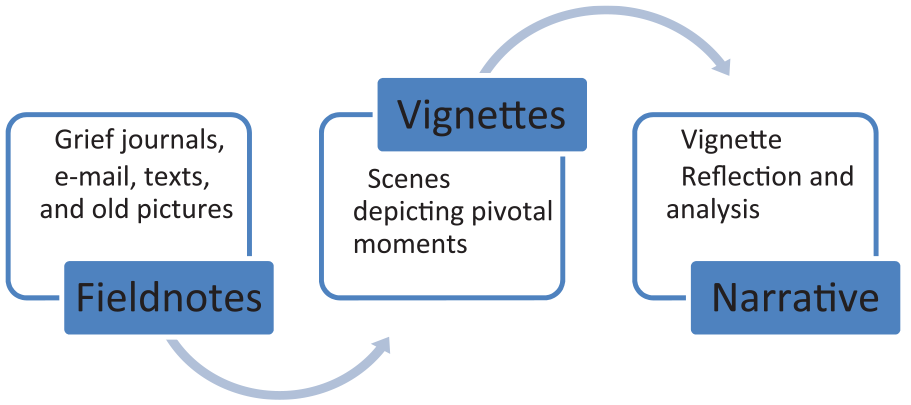
Data-to-narrative process.
Use of personal introspection instead of observations and interviews allowed me to avoid infringing on the grief of others. In this way, I avoided many ethical issues involved in gathering data from grieving participants (Balk, 1995).
Bochner (2000), Ellis (2009), and Richardson (2001) have reminded autoethnographers to be considerate of loved ones when reliving our experiences. Likewise, autoethnographers are also emotionally exposed and vulnerable, so they should exercise caution to protect themselves just as they do to protect others. Although autoethnographies presuppose the existence of others (Denzin, 2014), minor characters involved were not examined nor their identities disclosed. I used pseudonyms to protect their privacy and carefully selected which scenes to include as a means of protecting others and myself.
Limitations
The results of autoethnography are limited to the authors’ experiences, so we do not benefit from experiences of multiple participants. In addition, this method may work well for some people but not for others. It feels remarkably painful to relive and write about traumatic experiences, and not everyone wants to suffer through it.
Grief
Responses to grief are typical after significant loss, vary from person to person (Kubler-Ross and Kessler, 2014; Worden, 2009, 2015), and may include a combination of emotional, physical, and social symptoms. Many grieving people experience degrees of shock, anger, sadness, or depression. For most people, the grieving process typically begins with a significant “life-altering loss” and then moves through “a period of frequently tumultuous adjustments to a point of relative stability beyond the period of acute bereavement” (Neimeyer and Cacciatore, 2015: 3). When people suffer so deeply from their grief that they seem to get stuck in it, they may be experiencing complicated grief (Prigerson et al., 1995; Shear, 2015). Complicated grief occurs when the bereaved cannot move beyond the pain of their loss. Those with complicated grief suffer from more severe symptoms of social, general, and physical health problems than those suffering from non-complicated grief. Sufferers may experience increased anxiety and depression, preoccupation with thoughts of the deceased, frequent crying, disbelief regarding death, feeling stunned by the death, and lack of acceptance of the death (Prigerson et al., 1996). Symptoms can also include higher rates of suicidal thoughts and health-related issues, such as high blood pressure and higher rates of cancer, heart problems, stroke, smoking, and alcohol consumption (Prigerson et al., 1997).
Losing a child is typically perceived as the worst thing that can happen to a parent, so the grieving process for parents is often long and intense. Parents have reported high levels of depression, low well-being, and frequent health-related problems while grieving the death of a child (Rogers et al., 2008). Parents often have a difficult time finding meaning in the loss (Murphy, 2000) and have reported “difficulty concentrating, problem-solving, and perceptions of non-productivity at work” (p. 590) after the sudden loss of a child. They often experience marital problems (Riches and Dawson, 1996) and may have difficulty maintaining social relationships. It is the worst event that can happen to parents. Since the death of a child is such a significant loss, parents who lose a child may be at risk of complicated grief.
Talbott (1997) described two categories of grieving parents, survivors and perpetual grievers. Survivors eventually find meaning and purpose in life again after losing a child. Parents often accomplish this by maintaining bonds with their children and feel their presence as they move forward with their lives (Bailey and Kennedy, 2015; Klass, 1988; Klass et al., 1996). Parents’ sorrow may linger even after they accept their loss and reconstruct their lives and identities. The world will never be as good to them as it was with their child in it, and they perpetually feel as if they would trade their new lives, even the improvements, if they could have their lost child back with them again.
Losing Taylor: Vignettes, reflection, and analysis of loss
Several models of grief exist to help people understand the grieving process. Worden’s (2009, 2015) model of grieving was designed to help the bereaved and those attempting to support the grieving. His theory divides the grieving process into four tasks: (1) accept the reality of the loss; (2) process the pain; (3) adjust to a new environment without the loved one; and (4) emotionally relocate and memorialize the deceased in a way that allows the bereaved to move forward with their lives. How people process these tasks is different for everyone. The following vignettes, reflection, and analysis follow Worden’s model of grieving as it applied to my grieving process after my sons’ death.
Accepting the reality of the loss
The sheriff and paramedics left. My daughter cried. My husband covered his face with his hands. I stared out the window, unfocused and unthinking—uncomprehending.
Taylor was gone. Even his body was gone, and we would never see him again. Silence overwhelmed the house, suffocated it. No one had anything to say, because there was nothing good to say. He was gone. He was gone, and he left behind a tremendous hole.
My brother had left three messages on the answering machine, so I needed to call him back but dreaded the conversation. How can I put this day into words? How can I say it out loud?
He sounded so panicked during his last message, wondering why we had not called to let him know we were home, why we hadn’t picked up the phone when he called. I couldn’t delay much longer. I squeezed my husband’s hand, kissed our daughter on top of her head. “Okay, I guess I need to call Glenn now.” I carried the phone outside, closing the door behind me, so they wouldn’t hear.
His phone only rang once before he picked up. “Hello,” urgency still in his voice.
“Hey, it’s me. Sorry it took so long to get back with you.”
“That’s alright, I was just getting worried. Is everything okay?”
“No,” my throat constricted, tried to close. As I tried to form words in my mouth, tears welled up and spilled down my face. “Taylor,” I whispered. I took a deep breath, and then another, in and out, in and out, tried to work up the strength to say more. “We found him when we got home.”
“What?”
Don’t make me say it out loud! I hadn’t thought about how to say this, how to phrase it. “We found him. He had an accident.”
“Oh, no, I knew something was wrong! But he’s okay now.” It wasn’t a question. Taylor must be okay now. He needed to be.
But he wasn’t. I shook my head in slow motion, not finding any words. Glenn couldn’t see me shaking my head though. He needed me to say something out loud.
“No,” I choked in a whispered voice as tears ran faster and harder down my face. “No, he’s not okay.”
***
Speaking aloud about my son’s death startled me out of the shocked state I had been in since finding him. Putting the horror into words, saying them and hearing them out loud, wrenched my heart, left me choking and sobbing. Words made it real. My son was dead. He was really, truly dead, not a book, not a play, not a movie. Taylor was permanently and irrevocably dead. Riches and Dawson (1996) wrote about the reality of the death being difficult for parents to grasp. The loss feels too terrible to be real, so the brain does not want to accept it. Talking can become one of the ways for parents to conceptualize the death of a child, so why would I want to talk about it? I did not break down and cry until I spoke to my brother on the phone to explain what had happened. Speaking about his death on the phone, saying those terrible words out loud, made it real for me.
The initial agony came and left in waves, swapping places with periods of empty stupor as I realized the reality of my loss very slowly. Some moments felt eternal, as if I kept waiting for something to happen that never did. Other moments dragged on and on, useless, empty space stretched in front of me, never-ending-nothing. At other times, hours slipped away unnoticed while I floated mindlessly through the hours, accomplishing nothing, thinking nothing, my head and heart vacant shells. I felt “what the existential philosophers call nothingness” (Klass, 2013: 597).
***
People would arrive soon. I needed to tidy up a little, starting with my office. Three stacks of file folders stood knee deep along one side of my desk. A similar stack lined the other side, and several piles of books threatened to topple onto the floor. Research material and chapter drafts covered my desk so thoroughly I couldn’t see the wood underneath.
All of it useless. All of it needed to go. None of it mattered anymore.
I brought an empty box and a 50-gallon garbage bag into the office, sat on the floor, and started loading. One garbage bag turned into two as I stuffed all those months of work into the trash.
Garbage, useless, useless garbage! Months and years of wasted time trying to be a researcher and a writer instead spending my time being a better mother. No more. I never plan to look at any of this tedious, pedantic, trash again!
We scheduled the funeral, picked out urns, death announcements, and thank you notes. I wrote an obituary. My daughter wrote a short speech to give at his service. We picked out pictures for a slide show, music he liked, mementos to scatter around the room when people came in to pay their respects. Next, clear out my office before people arrived. I threw away papers, shelved books, tossed out the clutter. No papers covered my desk. No articles crowded my mind. Everything appeared neat and orderly. More importantly, no more worthless research would plague my sleep or distract my days. I cleaned research out of my life with no plans to resurrect it.
The absence of a loved one can leave an empty hole in the life of the bereaved, which can lead to an additional loss of goals, values, or identity (Klass, 2001). One of the changes I did not think about, or even realize at the time, was my change in identity. The day my son died, I became a different person. People often identify themselves by what they do and what roles they occupy (Parkes, 1971, 1993), so loss can cause changes in the way the grieving perceive themselves. The loss of a loved one becomes even more distressing when the bereaved have defined themselves through the deceased (Parkes and Prigerson, 2010). Losing Taylor changed the way I saw myself. Since I identified as a mother and then lost a person complementary to that role, I felt as though I lost a part of my identity. My daughter was still with us, but she was forever traumatized by the loss of her brother, the brother she adored. I failed her almost as much as I failed him. One of my babies died, and I could not prevent it. I must not be a good mother. If I could not be a good mother, how could I be a useful teacher? Certainly, I had no business trying to become a researcher. How could I? I could not even keep my first born safe.
My identity as an aspiring researcher was a secondary loss but still a loss. I had been trying to make the transition from teacher to researcher, a career move I had planned for years, working on my doctorate as soon as our youngest entered first grade. I finished my coursework and the first chapter of my dissertation. I had thought I was going to be a research writer and professor someday. How could I go back to that plan? I spent a year researching student/faculty interaction in online classes, but none of my work mattered. Without my son, nothing seemed to matter. One of my cohort peers lost her sister the previous year. Her sister and best friend died, so she felt lost and no longer cared about her research. How could she? What kind of research matters when the rest of your life falls apart? Even before my son died, I understood her decision, but I had never experienced the kind of pain she felt, pain that devastated her, left her different forever, left her not caring about her academic future. Life can never be the same as it was before such a profound loss. How can we try to go back to the way life was before?
Process the pain
Weeks after Taylor died, when people went back to their own homes, my daughter went back to school, my husband returned to work, when I was alone in the house again, a notebook rested in my lap, and I stared at the empty pages. Pencil poised in my hand, the clock ticked away minutes and hours. Finally, I connected paper and pencil. Taylor died. No other words came to me, just emptiness and tears.
***
Journal writing about my grief did not start with a bang. Throughout the first few months, I held the book but wrote very little. One year after Taylor’s death, my writing was still flat and dead, exactly how I felt. Sometimes, we can learn as much from what is not a part of the narrative as we can from what is there (Leavy, 2013). The sparseness of those early journal entries speaks volumes about my personal emptiness and unwillingness to accept my son’s death. I did not write very much about it because I did not want to believe it. Like talking, writing about something made it too real, every word on the page an acknowledgment of his death. Writing about our painful experiences can help us find or rediscover “an identifiable self somewhere in the chaos” (Riches and Dawson, 1996: 12), but my chaos felt too great. I could not situate myself in it. It took a long time for me to feel any desire to reconstruct myself, not surprising after the loss of a child. The pain was too much for me. It was not until a year after his death that I found journal writing about the experiences helpful in processing my grief, creating a new version of myself in the chaos.
***
“I’m glad to see you. I was just thinking about you the other day,” Sydney held a clipboard on her lap while she talked. “Someone donated a book about how grief changes after the first year, and it made me wonder how you were doing.”
“Better.”
“I can see that. You’re standing up straight instead of slumped over, and you look me in the eye when we talk. A year ago, you still avoided everyone’s gaze, just sat hunched over by yourself.” I didn’t know what to say to that, so I nodded.
We sat in silence for a while.
“I have an idea.” She walked to her office and came out with a blank book, the cover a shiny gold with abstract images of distant mountains, the edges rimmed with flowers, a red ribbon poked out from between the pages. “Here, take this. I’d like you to write in it.”
The book felt heavy in my hands. “Write what?”
“Happy memories with Taylor.”
***
About 18 months after Taylor died, I attended my first one-on-one session with a grief counselor. She gave me a new journal and some direction for my writing, write about happy memories with him. As soon as I returned home, I wrote about waltzing around the living room to The Blue Danube when Taylor was two, singing in the car, scraping together enough snow to build snow mice. It felt good to record happy moments. Although my mind and my words drifted into more recent memories and ended in tears, writing still felt good. I decided to make that my goal—writing daily in the journal. I wrote about how I felt, how we coped, how Sylvia sometimes seemed to crumble and say she missed her brother, how Jim tried to save his tears for the drive to work so we wouldn’t see him. Sydney’s direction had been to write about happy memories, so I returned to those often. The pages filled with fragmented scenes and feelings spanning the years, not at all chronological. Although I usually cried more than I wrote, I started to feel a little better, a little lighter, not great by any stretch of the imagination, but improved.
Writing offers a way to express ourselves without embarrassment or fear of judgment (Voskanova, 2015). It can be a way of slowly approaching a sensitive topic, eventually helping us work our way into being able to talk about something. We are safely alone when we write, so the process of writing can offer a secure way to explore issues or experiences that trouble us before we feel ready to discuss them with people (Bolton, 1999). It took over a year after her daughter died, but a submission call for essays on lies inspired Ann Hood (2008) to purge some of her feelings about that first year. She vented for pages and cried when reading it the next day, but the process helped her move forward with her life instead of getting stuck in her grief. When we share our stories with other people, the act of telling them and the context of which we tell them helps us find significance in the experiences, especially when the experiences were traumatic. This makes telling the story imperative for the author, even though the act of telling or writing becomes extremely difficult and emotionally draining (Dwivedi and Gardner, 1997).
“Traumas may be insidious because people often cannot talk about them” (Pennebaker and Smyth, 2016: 15), but not talking about them may lead to a wide range of problems, even seemingly unrelated health problems. Writing offers a way to breach that complication, providing benefits in addition to helping the author process her grief. Therapeutic writing can reduce doctor visits (Greenberg et al., 1996), improve the immune system (Halpert et al., 2010), and increase overall health and well-being (Smyth and Helm, 2003). It can improve cognitive ability (Pennebaker, 1993) and the ability to cope with complex issues (Klein and Boals, 2001). While I did not suffer from health problems, I suffered from an abundance of cognitive and psychological issues. I could sit in a room full of people and never say a word to anyone. Given a choice, I avoided people completely. I taught online, so I rarely needed to speak. I communicated with my students via email or forum posts much less than before Taylor’s death, and my brain barely processed the simple assignments they wrote. If I tried to read an article, my mind would wander away from it by the end of a single page. Grief stunted my thoughts and my emotions, almost paralyzed them. Fortunately, one of the benefits of using writing as therapy is that we don’t seem to write more than we can handle (Bolton, 1999). Sometimes I could only write one or two sentences about Taylor’s death before I needed to get up and walk away from it. That was how I coped, one tiny piece at a time.
Trying to adjust to life without my son
Men filled the waiting room at Belle Tire, all men except for me. Some of them played with their phones and others flipped through Motor Trend or Car and Driver. I pulled out my laptop. Writing on the computer instead of using a pencil and notebook changed my perception of the material, so sometimes I tried to put awful memories on the computer or take the fragmented sentences from my journal and expand them into full thoughts. While waiting for strangers to rotate my tires, I read the pages I had written the week before. My eyes watered and threatened to spill.
I didn’t even write anything yet, and I’m already crying in front of strangers. Why did I think this was a good idea?
I grabbed my computer and squeezed my eyes shut tight. Hydrogen, helium, lithium, beryllium, boron, carbon, (the crying stopped), nitrogen, oxygen, fluorine, neon, sodium, (my head started to clear), magnesium, aluminum, silicon, phosphorus . . . I opened my eyes and looked at the computer again.
Can’t write anything new today. Okay. Let’s see what happens if I move around some of the words that are already there.
***
Expressive writing helps us sort our thoughts and realize what we really think about our experiences (Pennebaker and Smyth, 2016). The physical act of writing seems to hold our attention and keep us in the “exploratory process” (Bolton, 1999: 23). Writing on the computer sometimes helped me look at my experiences from a greater distance than I felt with using a pencil and journal. After reciting as much of the periodic table as I could (I only made it to bromine), my head felt clear enough to open my eyes again and look at my writing. I controlled my initial tears but did not want them pouring out in public, so I decided to copy and paste what was already there, moving words around and putting them into an organized flow. Writing in my grief journals felt beneficial, but I needed to do more. What I started playing with that day turned into a piece of creative nonfiction that I worked on often to write something other than journal entries. The day I finished writing and submitted it for publication, I felt a heavy weight of anger leave me. Not all my anger left, of course, but I still felt different, better, triumphant in some way, like I’d climbed a mountain without falling off and crashing, like I’d accomplished something. It felt good, and I wanted to accomplish more. I knew I needed to use my brain more, start working my way back into a useful life again. I did not realize it at the time, but I was finally finding ways to cope with my trauma by writing about it and weaving that writing into my life.
The experience of losing someone close can leave the grieving feeling as if their lives no longer have meaning. As a reaction, the bereaved may look for meaning in their lives and in their loss, but the closer the relationship to the deceased, the more difficult it can be for the grieving to find significance in life without their loved one (Wheeler, 2001). I wanted to find meaning in life again but felt guilty for doing so, since one of my children could no longer find meaning in his life, no longer had a life to live.
Although often conflicted, I continued to write about happy memories, regrets, and wishes for the future. People can feel depressed, grieve deeply, and still grow. It does not need to be one or the other (Klass, 2013). I certainly felt depressed each day and continued to grieve deeply, but I was not stuck in my grief. I tried to grow. My journal entries become longer and more detailed, often they included scripts of dialogue I wished I could have shared with him, if he were still with me. When people are very close, their emotional bonds with one another do not end in death. By making a conscious effort to connect, many bereaved can maintain relationships with their loved ones while still moving forward with their lives (Klass, 1988). I kept writing to him, talking to him. I grew and moved forward but still kept him with me.
Discovering autoethnography, memorializing Taylor, and moving forward
A few months later, Sydney sat across from me, next to the electric fireplace. I sat on the loveseat by the tissues. “What did you do this week?”
“Worked during the day, took Sylvia to karate class and choir rehearsal after school, wrote in my journal. We drove up north for a long weekend. That was nice.”
“Good, getting out and having fun is healthy. Most of us don’t do it often enough. What about when you’re alone, when it’s just you? Do you ever get out of the house and do anything for yourself?”
“I come here and go to the grocery store. When the sun shines, I go for walks.”
“Walks are good, so is sunshine. They can certainly help us feel better. What about before Taylor died? What did you used to look forward to doing?”
I took classes, read books and articles, worked on my dissertation. Sometimes I wrote stories. Do I want to tell her that?
She didn’t need specifics though. My silence told her enough: Think about things you used to look forward to doing. Things you used to enjoy. Or maybe you want to start something new. Either way, I want you to think about that this week: Think about what you might look forward to doing. You can share it with me next week.
The next day, I walked to campus, a place I used to enjoy, and I thought about my assignment. Students crowded the library, taking up all the available computers. I walked to the fourth floor and sat in an oversize chair by the children’s books before pulling out my notebook.
What do I enjoy?
I used to enjoy fall, leaves turning, a new semester starting. I used to enjoy classes and books. What could I enjoy now? What interests me? Other students focused on books or printed papers. They looked productive. I might enjoy feeling focused and productive again. But doing what? I can’t pick up where I left off, studying student/faculty interaction in online classes. I don’t even care about that anymore.
Packing my notebook away, I darted to a newly vacated computer and started searching recent dissertations. Topics included gifted education, student expectations, individual beliefs, and teaching practices—all good topics, but none of them inspired ideas that might hold my interest. If I can’t feel inspired by these, how will I care about a study of my own? If I don’t care about it, how will I possibly argue a defense for it? I can’t think of anything I might care about.
My dissertation needs to be something that distracts me during the day so I catch myself thinking about it when I’m vacuuming or watering plants, something I climb out of bed at four in the morning to write about before an idea slips away from me.
Like what?
Dejected, my feet carried me to Dr. Collins’ office. I barged in without an appointment and spilled my guts. “I want to finish but don’t think I can. Changing my topic seems useless. I won’t care about a new topic any more than the old one. Nothing matters enough for me to research and write about.”
“What about grief? You care about that. Why not write about your experiences?” We had talked about this before, but it still didn’t make sense to me.
“How could I include my own experiences? Isn’t this supposed to be about other people?”
“Why?” I stared at my advisor in confusion while she talked. “Why not use a combination of methods, blend autobiography and phenomenology? Write about the phenomenon of grief and your experiences with it.”
“Can I do that?”
“Why not?” DC shrugged her shoulders and looked me in the eye. “Why can’t you do something out-of-the-ordinary?” She waited in silence for my answer.
“How? How could I get that approved?”
“I’m your chair, and I think it’s a good idea. You can find a way. Start researching.”
Back home, I pulled a heavily tabbed copy of Creswell (2007) off the bookshelf and started reading—re-reading about different approaches to qualitative research. Cognitive anthropology—interesting but not for me. Historical inquiry—very interesting but not quite right. Conversational analysis—now we’re getting warmer. Then I read it: “Studying yourself can be a different matter . . . I recommend that individuals wanting to study themselves and their own experiences turn to autoethnography or biographical memoir for scholarly procedures in how to conduct their studies” (p. 123).
Scholarly memoir? Seriously? No way.
Well, she said do something new, something different.
***
In 2015, autoethnography was not especially new or different, at least not to seasoned, qualitative researchers, but I was a doctoral candidate in a university with no record of previous autoethnographic dissertations and no faculty with autoethnographic expertise. It was new to me and new to my school. I couldn’t stop reading examples of it, a positive sign from the start, since I hadn’t felt interested in reading for years. Even though reading had been one of my great loves for most of my life, I lost interest in it after my son died. Journal writing helped me move out of my lethargy, out of the worst stages of my grief, and then reading autoethnographic work offered me another spark of my former self, not identical to the self before Taylor died, but an active participant in life again. Grief is “conditioned by society but experienced, first-hand, by the self—an embodied self that both thinks and feels—then the self, and auto/biographical writing as a vehicle for unleashing it, seemed like a logical starting point” (Brennan and Letherby, 2017: 161). Autoethnography became an invaluable starting point for me to emotionally relocate and begin living a productive life again.
Smith (1999) began an autoethnographic article on clinical depression by inviting readers into his pain. He wrote, “Come and join me. Join my pulsating body. Join my fragmented self. Join my life. Join a story. Feel a statistic” (p. 264). His emotional, personal narrative drew me into the world of clinical depression in a way that traditional studies never did. Ellis (1993) wrote about losing her brother in an airplane accident on his way to visit her. It touched me so deeply I couldn’t even finish reading it in one sitting. I needed to put it down and walk around the house crying and then pull myself together again before I could take in more of it—just like I did with my own writing. Reading these and other personal but scholarly articles held my interest, kept my attention when few things did.
Those stories unglued me, and they also shed light on a possible path forward at a time when I doubted I could ever move forward again. I lived like a zombie for so long, going through the mechanics of life without thinking or feeling or even caring whether I ever thought or felt anything again, years of stagnate time. I moved through some of the grieving process, but I couldn’t move out of it until I wrote my way out of it. When I felt ready to try dissertation writing again after my son’s death, my primary goal had nothing to do with degree completion. I just wanted to feel alive again, become productive. Journal writing helped. Reading autoethnographic articles and books helped, and then autoethnographic writing of my own helped me even more.
Although it can be extremely difficult to tell and to hear painful experiences (Frank, 1995), or to read and write about them, sharing stories has therapeutic and transformational possibilities (Smith, 1999) that can help us get through some of the difficult periods in our lives. I tried to do that with my dissertation. I wrote about pain, specific painful experiences. I forced myself to write through my crying and return to it after recuperating. I wrote about times I wanted to erase from existence. I wrote about memories I could never speak aloud. I wrote to write without caring if I ever defended the dissertation. Finally, little by little, I felt better. Writing about my pain helped me stick with it and finish the dissertation, but more importantly, writing about the agony of losing my son helped me survive his loss.
Conclusion
This article supports the argument that weaving academic research with personal experiences allows us to explore and examine difficult issues such as death, grief, and traumatic loss. Using autobiographical narrative offers perspectives beyond what can be uncovered using traditional research methods; because the researcher is personally involved with the subject, she will examine, evaluate, and analyze the experiences from a different perspective than someone outside the situation. The more perspectives we can gather, the better equipped we will be to understand our future losses and respond helpfully to those around us suffering loss. These methods also add the benefit of engaging readers in our stories, compelling a response from them (Holman, 2005), connecting readers to our stories both emotionally and intellectually. I further argue that use of therapeutic writing and autoethnography allows us to learn more about how people process significant trauma without infringing on the grief of others.
Some experiences are only understood “when feelings are a significant part of the research process” (Ellis, 1993: 724). Grief is one of those experiences. Grief is a complex and troubling issue that impacts each of us, and it is also a deeply personal issue not easily examined. It can be too difficult to talk about and potentially infringe on participants’ grief, invading or even increasing their pain. Autoethnography can help us work around that issue. I could not talk about my grief, so I read about it and wrote about it. This approach uncovered insights I may not have otherwise found. Writing my personal experiences as vignettes allowed me to process my grief instead of getting stuck in it; analyzing those experiences helped me find new purpose in life and illuminate Worden’s model of grieving without infringing on the pain of others. Woven together, the vignettes and analyses connect with readers through shared experiences. People can benefit from shared experiences both by learning how others coped with similar tragedy and by feeling a sense of community, knowing they are not alone. Reading how Richardson (2007), Hood (2008), and others processed grief in their lives helped me process the grief of losing my son. Hopefully, other grieving readers will benefit from reading about my experiences in the same way. Weaving the personal and the analytical can be a profoundly useful way to examine painful subjects and uncover insights that may not be reachable through traditional methods.
Footnotes
Declaration of conflicting interests
The author(s) declared no potential conflicts of interest with respect to the research, authorship, and/or publication of this article.
Funding
The author(s) received no financial support for the research, authorship, and/or publication of this article.
