




Abstract
This article reflects on the use of concept cards during in-depth interviews when researching reproductive decision-making in the context of neoliberalism and postfeminism. As existing literature has shown, card methods are valuable in centring participants’ individual experiences through increased control and inclusion during data collection, and attention has been drawn to their use as an ethically attentive method that can elicit richer, more complex narratives than interviews alone. While these strengths initially led me to consider the cards as an appropriate ‘fit’ with my feminist methodological approach, on reflection, the cards also illuminated the relationality of experiences that my research was concerned with. I view this as occurring in two ways. First, participants’ use of the cards helped to uncover the intertwining of their reproductive decisions with the social and political world, therefore complicating the neoliberal prioritization of the individual. Second, the cards brought the relation between myself and the participants, and between the participants, to the forefront. The reflections in this article therefore offer new insights into what concept cards can achieve, as not only validating individual accounts, but as enhancing the relationality of knowledge production.
Keywords
Introduction
Following Gill and Scharff’s (2011: 11) call for research that examines neoliberalism and postfeminism ‘‘on the ground’ and ‘in action’’, my doctoral research empirically explored the extent to which these processes are engaged with in reproductive decision-making. The intensification of neoliberalism has seen the tenets of individualized responsibility, self-investment, and entrepreneurialism operate to construct a narrow understanding of choice and are extended to a valued subjectivity that citizens are encouraged to engage with (Brown, 2003; Scharff, 2016). These processes are said to have particular relevance to women’s lives as a result of the supposed declining significance of gendered power relations, and the emphasis on empowerment through individualized choice that underpins the postfeminist sensibility (Budgeon, 2015; Gill, 2007).
This individualized construction of selfhood leaves aside accounts of hybridity and intersubjectivity, obscuring understandings where relationality is emphasized and the separate, autonomous self is less common (see Joseph, 1999; Lugones, 2010; Metz, 2013; Smith, 1999). Relationality most obviously refers to the way in which our selves are enmeshed in a web of multiple relationships with others; to go a step further is to understand the self as shaped by (and shaping) various emotions; bodies; policies; social structures; cultural beliefs; and intersecting power relations that are shifting and dynamic. Neoliberal and postfeminist processes may therefore play some role in shaping reproductive decisions, but they do not tell us the whole story, and there is a need to problematize individualized rhetoric through an understanding of decision-making as a relational process. In this way, I saw relationality as a political device that helps to ‘repoliticize’ understandings of reproductive decision-making.
Recent work on reproduction and relationality has often focused on the topics under study, such as Nordqvist’s (2021) research with families of donor conceived children; or, when aiming to develop an understanding of the self as relational during data analysis in a project exploring parental experiences of stillbirth and neonatal death (Jones, 2013). While supporting the findings of existing literature that points to the value of concept cards in centering the individual experiences of participants, in this article I will trace my use of the cards as a method that also helps to uncover the relationality of participants’ experiences in individualized contexts, and as enhancing the interconnection between researchers and participants.
A relational standpoint
My interest in relationality was sparked by G.H Mead’s (1934) conceptualization of the self as involved in an ongoing process of interpretation and interaction with others, histories, and social contexts. To unpack this idea further we can look to Mead’s phases of the self: the ‘I’ which reflects upon social situations and is in dialogue with various attitudes and other selves, and the ‘Me’, representing the multiplicity of attitudes, experiences, and relations that are observed by, reflected upon, and responded to by the ‘I’ (Da Silva, 2007). Mead’s phases of the self should not be viewed as separate, but as an ongoing dialectical relation in which attitudes and relationships with others – specific and generalized – are incorporated in the self and reflected upon: we become aware of ourselves by locating ourselves in relation to others (Da Silva, 2007).
The emphasis on the social and taking the role of others is not deterministic, but instead results in negotiations that can lead to creative responses. Therefore, in the context of my research, while neoliberal and postfeminist norms may be engaged with at times, there is the possibility of negotiating or subverting these demands through internal deliberations about decisions and actions. Mead’s relational approach allows us to draw out the ways in which the ‘I’ reflects upon and responds to the organized social attitudes of the ‘Me’, offering a deeper sociological account of how decisions are made by tracing the interconnections between the self, others, and the social world.
Relational thinking often underpins theories of knowledge and of the world we interact with. While there is no universal understanding of feminist standpoint theory, there is a shared concern to make visible the relationship between knowledge and power – knowledge that begins from women’s experiences in different social locations (Collins, 1997), and which cannot be separated from the position of the knower and their ‘bodily existence and local actualities’ (Smith, 1990: 28). Intersectional and Indigenous perspectives in particular have brought a relational focus to theorizations of standpoint theory. Collins (1997) argues from an intersectional standpoint that systems of oppression overlap and intertwine to structure experiences of inequality differently therefore creating multiple standpoints. In more recent work, Collins (2019) specifically points to relationality as key to our understandings of intersecting power relations. Bringing together what has long been considered separate (while not losing sight of how these categories have distinct origins) is said to be at the root of intersectionality, along with putting these categories into conversation to identify sites where power is operationalized and organized (Collins, 2019).
In articulating an Australian Indigenous women’s standpoint theory, Moreton-Robinson (2013) cites the principle of interconnectedness as fundamental; that is, one’s relationship to country; land; ancestors; and human and non-human beings is embodied and socially and historically situated in such a way as to define being, doing, and knowing. Moreton-Robinson argues that such understandings are absent in early iterations of standpoint theory, reinforced by a lack of recognition that the situated knowledge produced by standpoint theorists occurs within institutions often built on stolen Indigenous land. For Moreton-Robertson, an Australian Indigenous women’s standpoint is therefore grounded in intersubjectivity and interwoven with cultures and communities, as well as structures of patriarchy, class, racism, and colonialism (see also Alexander and Mohanty, 1997; Lugones, 2010).
This glimpse into relational thinking and its application within feminist standpoint theory demonstrates the possibilities that exist for holistic understandings of the self and knowledge through centring the intertwining, but distinctiveness of the local, cultural and global, and social locations as shaped by multiple systems of power. Such onto-epistemologies resonate with my own understandings of knowledge, the self and decision-making as relational, and are an important framework when researching reproduction.
Relationality is somewhat at the core of activist and academic work broadly concerned with social justice, including feminist care ethics (Barnes, 2012; Macgregor, 2020; Tronto, 1993); Black feminist theory (hooks, 1984; The Combahee River Collective, 1977); abolitionist feminism (Davis, 2003; Olufemi, 2020); feminist disability scholarship (Garland-Thomson, 2005; Thomas, 1999) and most relevant to this research, reproductive justice. The term reproductive justice was coined in 1994 by Black feminist activists (Ross, 2017; Sistersong, n.d.), but similar discussions can also be found in the earlier work of Frances Beal, Angela Davis and the Combahee River Collective, who demanded that reproductive rights be embedded within antiracist, antihomophobic, anticapitalist struggles as part of a broader socialist movement (see also Petchesky, 1980). These voices have long recognized that individual choice and rights frameworks are inadequate for grappling with intersectional inequalities that lead to the unequal distribution of choice (Ross, 2017).
Reproductive justice is concerned with the oppressive contexts and histories that shape decision-making and the violence experienced at the hands of the state and medical institutions, for example, through forced sterilization and contraceptive experimentation (Davis, 1981). Crucial then to reproductive justice is the right to: not have children; have children; and to parent children safely free from coercion (Price, 2010), all of which are connected to a broader set of issues that go beyond neoliberal constructions of choice. For example, feminist disability studies scholar Michelle Jarman (2015: 61) complicates the notion of individualized choice by critiquing the ableist social and political context in which decisions about pre-natal testing and abortion are made, showing their inseparability from access to necessary resources; transportation; healthcare; political and kinship support, and unbiased information regarding diagnoses (see also Piepmeier, 2013) 1 – all of which are crucial to ensuring just futures for disabled children and their parents.
Reproductive justice therefore draws our attention to the multiple and intersecting structural inequalities, contexts, communities, and histories that are interwoven with how reproduction is experienced (Ross, 2017), shifting the focus from neoliberal constructions of choice and the individual to allow more complex questions and concerns to arise that are politically driven and emphasize social justice (Piepmeier, 2013; Sistersong, n.d.). Resonating with the previously discussed onto-epistemologies, reproductive justice is attentive to relationality by offering a holistic view that focuses attention to the role of others and power. With these perspectives in mind, it is therefore important for researchers dealing with similar concerns to use methods that help bring relationality to the forefront.
The study
I carried out 22 2 in-depth interviews: six with sexual, reproductive and maternal health services in Scotland, and 16 with women 3 aged between 21 and 60. While the research is informed by a relational approach and acknowledges the importance of others to reproductive decision-making 4 , I focused on the perspectives of women due to their apparent increased capacity to choose in postfeminist discourse and perceptions of being ‘unconstrained by any lasting power differences or inequalities’ (Gill et al., 2017: 231). Before asking for consent, clear information on the purpose, methods, and possible uses of the research were provided, and participants were reminded that the interview could be paused or stopped at any time (as will be discussed, the use of concept cards also allowed for consent to be reestablished). Interviews lasted 90 minutes to 2 hours in duration, with rich narratives taking precedence over what may be deemed a ‘small’ sample size, and the data were analysed thematically. Further, the research was not concerned with recruiting a representative sample to generalize from or to quantify experiences, but sought to capture in-depth understandings from a particular group of participants.
A fundamental principle of feminist research is a commitment to non-exploitative research relationships that ensures participants are respected as active contributors (Oakley, 1981; Reinharz, 1992). When researching reproduction, issues of power are an important concern due to the historical legacies of violations of reproductive autonomy as outlined above, and a failure to take seriously women’s embodied knowledge (Phipps, 2014). It is necessary therefore to ensure that methods enable participants to take the research in the direction they wish (Acker et al., 1983) and prioritize agency, establish reciprocity (Oakley, 1981), are emotionally and ethically engaged (Carroll, 2013), and encourage researcher reflexivity about their position. In light of these considerations, I viewed in-depth interviews as the most suitable method for this research (Reinharz, 1992), but felt interviews alone would not bring me close enough to the complexity of experiences I was hoping to capture (see Sutton, 2011). Furthermore, while the stories that unfold during interviews are not separate from the social world or the context of the interview and interactions that occur there (England, 1994; Enosh and Buchbinder, 2005), the orientation towards interviewees and their individual experiences can lead to the relationality of interviews being understated (Hyden, 2014), with focus groups or ethnography perhaps appearing more suitable due to the clear potential for ongoing interactions and meaning making between participants and researchers (Hall, 2015; Hofmeyer and Scott, 2007).
In what follows, I will discuss the use of concepts cards as resonating with feminist methodological concerns that seek to prioritize participants’ experiences through the use of inclusive and ethically attentive methods – qualities that initially influenced my use of the cards during interviews. I will then advance these discussions by reflecting on how the cards encouraged the elicitation of rich, relational accounts and enhanced the interconnection between myself and participants, and are therefore a valuable method for researching relationality and facilitating relational knowledge production.
Concept cards
Concepts cards are cards printed with words or images related to the research and key themes from relevant literature 5 , and have been used in a multitude of ways in qualitative research. During narrative interviews exploring personal and organizational values with Israeli community centre staff, and members who experience prolonged mental distress, Karnieli-Miller et al. (2017) asked participants to choose cards with images or words based on their relevance and emotional responses to the cards. In this project, the cards were said to enhance interviews as participants were supported to express themselves more fully than traditional qualitative interviews typically allow, taking into account the potential barriers to disabled people’s participation in research. Lugina et al. (2004) and Neufeld et al. (2004) opted for an ordering or sorting approach when using cards to explore motherhood trajectories, and postpartum concerns and family caregiving arrangements respectively. In these studies, the cards were considered a more sensitive way of addressing topics than asking directly, and as facilitating increased control over narratives through topic selection which helped to centre participants’ autonomy.
My adoption of the card technique was largely influenced by the work of Barbara Sutton (2011) who used cards when exploring Argentinian women’s experiences of eating disorders, domestic violence, and abortion. During interviews, participants were asked to choose topics to discuss based on the words written on the cards, which were compiled from feminist and sociology of the body scholarship and Sutton’s own personal and academic connections to Argentine culture. The cards became an important part of a feminist project due to women’s increased involvement in selecting topics for discussion, which, as noted in previous studies, enhanced agency and control as participants articulated deeply felt perspectives and experiences most relevant to them (Sutton, 2011: 191).
Sutton also argues that the cards were attentive to the research focus on embodiment and helped to more fully explore the bodily experiences of economic and political violence; reproductive rights; and gendered norms and expectations. However, Chadwick (2017) argues that the cards are not necessarily an effective method for articulating embodiment as concept cards still rely upon talk about the body as an object, suggesting it may be more appropriate to develop analysis strategies that better represent the lived body already present in qualitative data. While the body and embodiment were important to my research, this was not the main focus, and so a desire to ‘access the body or collect bodily data outside of discourse, language or talk’ (Chadwick, 2017: 71) was not a key concern. Instead, I will reflect on how my experience of using the cards can be understood as facilitating relationality more broadly with regards to the topic under study, and between researchers and participants.
Much like the previous studies cited, I hoped the cards would encourage greater agency and ownership over women’s narratives in the research encounter and act as a more participatory and ethically attentive method for grappling with potentially sensitive experiences and topics that are socially silenced. At the same time, this article offers new insights into how the cards can also encourage accounts to unfold in such a way that highlights the intertwining of experiences with others and social and political contexts, and into the relational encounter between researchers and participants.
Following Sutton, I offered the cards prior to the interview 6 commencing with blank cards also provided for participants to include topics they felt to be relevant. I acknowledged that some women may not feel comfortable using the cards, and that this method could potentially act as a barrier to some disabled women’s participation 7 (Sutton, 2011). Participants were informed they could choose however many cards were relevant and discuss the topics in any order, and that there was the option to discard or add new topics to blank cards. These options reflected feminist ethical concerns as participants could decide to discuss what they considered important and what they wished to avoid which, as suggested by Lugina et al. (2004) and Neufeld et al. (2004), can be a less intimidating process than asking specific questions about potentially sensitive topics, and allowed for consent to be re-established throughout the interview. Participants therefore had a more active role due to their involvement in selecting/adding topics, and so the cards can be viewed as enhancing participation during data collection, as opposed to full involvement as collaborators emphasized in participatory action research (PAR) – an approach which also resonates with relational frameworks (see Datta et al., 2015). However, the emphasis on full involvement within PAR has been critiqued for conflating meaningful and consistent participation, failing at times to account for the demands research places on participants’ time and emotional wellbeing (Harding, 2020), while researcher guilt around projects not being participatory ‘enough’ may lean towards quantifying participation as opposed to focusing on quality (Janes, 2016). Despite not feeding into every stage of the research, increased participation through using the cards allowed for meaningful contributions over which the women in this study had greater control, with the cards also uncovering the relationality of knowledge production during the research encounter (Janes, 2016).
Uncovering relational accounts through the use of the cards
I anticipated that participants would select a bundle of cards and work through the topics unpacking their relevance. Some participants did use the cards in this way, while others felt more comfortable to begin telling their stories related to the cards without prompting, which was again similar to Sutton’s (2011) use of the cards but differed from Lugina et al. (2004) and Neufeld et al. (2004) who asked participants to sort cards into different categories. I perceived this approach to be less flexible, and if participants wished to make connections between the cards this should be something they actively decided. For example, Alex decided to think of overarching themes and placed cards under certain headings (e.g. ‘things that worry me’; ‘things that I struggle with’; ‘things that might be more challenging in the future’) in relation to her experience of endometriosis, but the majority of participants selected a bundle and worked their way through, moving on to different cards when they felt they had said enough.
However, some participants chose to go back to earlier cards over the course of the interview, highlighting that experiences cannot be understood in isolation but are connected in non-sequential, unstructured ways. The relation between the cards was evident when Chiara chose ‘family’ and discussed how her views on this topic had changed following economic recession in her home country of Italy, and linked this back to the ‘money’ card which she had previously discussed: I like the idea of having a family, that’s why I picked this card. My family is very close – Italian families are very close. In terms of numbers, I think 2 children is plenty (laughs). It’s a lot of work! Before, I would have said more as Italian families are traditionally quite large and I always imagined having more, but it’s not really like that since the recession and the economic crisis, which (looks for card) goes back to money. Unemployment is really high, so people tend to have children when they’re older maybe in like their late 30s or 40s and so tend to only have 1 or 2 children. But my parents’ generation: my mum has 5 siblings and my dad’s got 3. I don’t know if I’ll return to Italy but these things play on my mind – if I have a job, can I afford to have children.
Chiara’s use of the cards presents the relationship between reproduction; others; cultural norms; and neoliberal economic policies and logics that construct the notion only those who can financially afford to have children should do so (Saunders, 2020). This calls into question the individualization of reproductive decisions as we see the interweaving of politics, culture, and intimate relations in Chiara’s account as she unpacks her feelings and concerns about the future. While a criticism of the cards may be that they separate or fragment narratives, in practice the cards highlighted how decisions are interconnected and that the relationality of experiences can unfold in a non-linear way. In a later section, I will reflect further on how the cards uncovered the relationality of emotions experienced in one participant’s account of abortion.
A potential challenge that may arise when using the cards according to Sutton (2011) is the ‘chaotic’ manner in which stories are told, that may be mitigated by the use of a topic guide during interviews. From my own experience of using the cards, participants did take their discussions in multiple directions in an unstructured way that was at times challenging to keep up with. For example, though selecting a number of cards, the first card Karen picked (‘family’) led to a rich and complex discussion that moved away from this topic and on to other topics featured on the cards, such as ‘education/work’ and ‘responsibility’, causing Karen to comment, ‘I can’t believe we’ve got all that from one card!’ However, I viewed this not as a limitation, but again as reflective of participants’ interconnected experiences that could be further teased out when returning to their bundle of cards. The potential for stories to unfold in this way requires that researchers take time to go through the cards selected by participants to seek out further reflections and establish if connections can be made based on the remaining topics, and reinforces the need for attentive listening and careful data analysis.
Relational interpretations of the cards
The words on the cards were written and chosen by me based on the study aims and from existing theory and research, meaning the topics were imbued with my own understandings and perceptions, which are also tied to sociological and feminist research traditions. Lugina et al. (2004) therefore raise the concern that the topics written on the cards may appear restrictive to participants due to being pre-determined, or that they should be discussed in a particular way; however, the topics are not pre-defined and were discussed by participants in ways that differed from my understandings during interviews. My interpretations existed alongside those of the participants and the meanings they attributed to the topics through their own experiences, reflecting different but entwined perceptions of the social world that further situated the interview as a relational encounter.
An example of this can be seen when Hannah selected the ‘contraception’ card and spoke of the poor quality sex and relationship education (SRE) she received during high school, but went on to disclose that she was removed from SRE classes at primary school due to a traumatic childhood experience. Following this disclosure, I informed Hannah she did not need to say any more and that we could pause the interview or move on to a different card, but Hannah decided to speak more on this topic before choosing another card. My reasons for including the ‘contraception’ card were largely due to debates around contraceptive choice, sexual freedom and the tensions existing between this freedom and the restrictions that side effects and/or healthcare professionals and the state can impose (Tone, 2012). As evidenced in Hannah’s interview, and argued by Sutton (2011), the written topics can encourage interviewees to discuss their own meanings and experiences – positive or challenging – instead of privileging the researcher’s understandings, while the coming together of different interpretations of the cards further establishes the relationality of the interview encounter. In this example, the cards also allowed for ethical renegotiations to take place in real-time, offering a tangible point of reassurance that both researchers and participants can use to move the interview on.
There were some instances however where participants questioned what was meant by the words written on the cards which increased the potential for my understandings to take precedence:
(picks relationships/other people card) So . . . what were you thinking when you picked this?
Well, I suppose that there might be a number of people or relationships that could be important when you’re making decisions – what does it make you think of?
Though wary of leading or defining the topic for Isabel, I also recognized that our interpretations could co-exist, and so attempted to encourage her to discuss her understanding of the topic and what she felt to be relevant.
Participants also played an active role in deciding what to discuss when adding topics to the blank cards, which included religion, miscarriage, pain and IVF – some of which were then drawn upon by participants in future interviews. The cards therefore encouraged a more active role during data collection but again, relationality is clear in this process as participants and I interacted when adding cards by discussing what to include and why, and how to articulate this. For example, in Isabel’s interview we discussed her suggestion to write either ‘miscarriage’ or ‘pregnancy loss’ on the card, based on her own feelings and the potential feelings of future participants. This process also points to how a relationship forms between the participants as the new topics were added with prospective interviewees in mind and sometimes engaged with during their interviews.
Reciprocity
Despite the value placed on reciprocal exchange within feminist methodologies (England, 1994), concerns have been raised regarding the use of reciprocity as a means of coaxing data from participants through ‘faking’ friendships, and due to the greater ability researchers may possess to hide behind their ‘professional’ persona (Thwaites, 2017; Yost and Chmielewski, 2013). However, I strove to be as open and honest as possible when participants asked questions while following Reinharz and Chase’s (2003: 78) suggestion that researchers should consider ‘whether, when and how much disclosure makes sense’. Despite viewing reciprocity as central to my research practice, I felt uncomfortable answering some questions, particularly about my intention to have children when asked by participants who did have children.
One such instance occurred during Stephanie’s interview. Stephanie was a working-class woman who had her first child at the age of 19, and two more children by 23, all of whom were diagnosed with autism. When choosing the ‘planning’ card Stephanie spoke of how she had not meticulously planned when to have children and did not feel there were certain benchmarks to be achieved before doing so, but that it would not have been right for her to wait until later in life. Following this discussion, Stephanie asked if I planned to have children and if I felt I had ‘lost a lot of my life doing this?’ when referring to my time spent at university. As a first-generation university student I have become accustomed to fielding similar questions from family and some friends, and though committed to a reciprocal approach, Stephanie’s question made me uncomfortable due to my own feelings on this issue but I answered honestly.
Stephanie’s interpretation of my decisions as limiting not only demonstrates the different meanings attached to the cards as previously discussed, and how reproductive trajectories are shaped by class and other social factors, but that she felt comfortable to ask this question. This is despite initially viewing the cards with uncertainty 8 as Stephanie told me she was ‘not very good at quizzes’, later revealing that she was regularly questioned and made to feel like ‘a daft wee mum’ during interactions with those involved in her children’s lives such as social workers and psychologists. Upon expressing these concerns, I reminded Stephanie that the cards were optional and I could ask some questions instead, but she insisted that we use the cards and I suggested we work through the pile together, which Stephanie was happy to do. Despite her earlier worries, Stephanie’s comfort with asking me about my own life decisions may have resulted from increased confidence due the cards prioritizing participants’ agency, but also their relational quality in that they can enhance a connection between participants and researcher through their interactivity. A wider point can also be inferred here that resonates with Thapar-Bjorkert and Henry’s (2004) call for attention to the complexities of interactions and power relations in the research encounter that may involve participants positioning and locating researchers to varying degrees. This reassessment brings the intersubjectivity of the interactions and emotions experienced in the research encounter to the forefront and avoids the depiction of marginalized women as lacking agency (Thapar-Bjorkert and Henry, 2004), that may be facilitated through the use of concept cards.
Reciprocity and building relational understandings can also be complicated when participants unexpectedly expressed harmful views. This was the case when interviewing Pam, who responds to the ‘risk’ card in the excerpt below: I do worry that the . . . somewhat more . . . educated and . . . more . . . middle-class women- for want of a better expression- aren’t having kids. Whereas girls who haven’t had the benefits of an education or a better upbringing, they’re chucking out kids left, right and centre. And I worry that the balance will not be in favour of . . . an educated humankind . . . (Pam, 42)
I was shocked when Pam expressed these views but did nothing to challenge them, which partly resulted from feeling uncomfortable, but also due to concerns regarding how a confrontation may affect the rest of the interview. This demonstrates the messiness of the research relationship, especially when committed to feminist methodological concerns of reciprocity and rapport. A similar issue is discussed by Scharff (2010) who draws on Letherby’s (2003: 112) insights when reflecting on participants who express problematic (in Scharff’s example, xenophobic) views, to argue that listening to the perspectives of those we disagree with is a necessary step in helping to confront such views in the future. However, Thwaites (2017: 4) suggests that such encounters demonstrate the ‘surface acting’ involved in establishing reciprocal relationships, as researchers attempt to manage emotions to safeguard their work, meaning a commitment to feminist methodological and political ideals can be pushed aside. In a similar way to Scharff (2010) who did not disagree when participants voiced xenophobic views, this was an instance where I chose not to say anything, leaving me feeling disappointed and questioning the positive relational quality of the cards.
The reflections here highlight the difficulty of negotiating reciprocity and rapport when committing to a feminist and relational approach, which may be more pronounced due to the multiple interpretations of the topics and experiences written on the cards. Considering these issues helps to make clear how relational knowledge creation can occur when using this method but is not straight-forward, and the practices adopted in one research encounter cannot be easily applied to all. In the next section, I continue to discuss the role the cards played in enhancing the research relationship, while offering some brief reflections on the potential value this method holds when researching abortion as a relational decision.
Abortion, affect and relationality
When considering the use of concept cards in research deemed emotional or sensitive, Sutton (2011) ponders if the ethical attentiveness of the cards may be called into question. This is despite Lugina et al. (2004) and Neufeld et al’.s (2004) assertion that not asking directly about potentially challenging topics is an ethical strength, as participants are still confronted with sensitive issues when reading through the cards which may lead to distress. In some ways, this drawback relates to a wider point about emotions in research, as Carroll (2013) argues that the presence of emotion is not always negative, and may present opportunities for self-reflection, growth and catharsis.
Of particular relevance to this research, emotions are also profoundly relational, as discussed by Åhäll (2018: 38) who takes influence from Ahmed’s work on affect to argue, ‘how we feel (consciously or unconsciously) about the world already tells us about how the world works’. Connecting affect to the social and political suggests that even when we understand our most intimate feelings as deeply personal, they are constructed in relation to society and others – which may be difficult to articulate in the context of individualization (see Elliott, 2002). I therefore considered emotions as inseparable from decision-making and integral to researching sensitive and stigmatized topics (Carroll, 2013), while believing there to be social and political value in expressing such experiences.
In a similar way to Sutton (2011: 186), I found the cards to be a useful icebreaker that helped create a sense of comfort and rapport, yet some participants would often ‘dive’ into detailed intimate discussions upon selecting the first card. This tended to happen when participants spoke about abortion, demonstrating perhaps that this was a topic women wished to talk about and felt in control and at ease to do so, evident when Faye reflected: ‘You see it on the card and think ok, it’s ok to talk about this’. This may be why almost all participants chose this card – even if not having personally experienced abortion – further demonstrating that the cards can make topics and experiences deemed sensitive more accessible to participants than asking directly.
The cards encouraged some participants to discuss the affective and relational aspects of their abortion decisions, and allowed space for the expression of various and sometimes conflicting emotions which required that I was especially attentive to their responses, as in this example from Hannah’s interview:
And after the abortion, do you remember how you felt?
Tired. It still all felt really surreal . . . Emm . . . it was pretty . . . it was sad . . . well, not sad, sorry . . .
Do you need a minute? . . . Are you ok?
Mmm hmm . . . It was just a really . . . difficult day. But I was . . . relieved, yeah like, giddy with relief. I knew what I was doing, but . . . people assume you’ll be really upset and can’t feel anything else . . . but the only guilt I ever had about my abortion was that so many people would hate me for it [long pause]
Mmm. And, do you mind if we talk a bit more about some of what you said there, about how you felt? Or you could choose another card?
Yeah, that’s fine
Have you ever spoken about that before? That feeling of relief?
Not . . . not really. I’ve not. I . . . don’t think women are made to feel like having an abortion is a good thing or a strong decision to make. I think actually, we’re taught the very opposite, that if you have an abortion you’re weak . . . My close friends did have a little drinks session for me afterwards that I was quite grateful for. Emm but I think as a whole, I wouldn’t tell just anyone that I was relieved because . . . you’re just not made to feel like you (points to relationships/other people card) . . . The only guilt I ever had was that so many people would hate me and that so many people would attack me for it.
Abortion is subject to much debate in public forums on a global scale, but women in this research frequently revealed they had only told a few others about their abortions and that even intimate others were unaware, reminding us that abortion remains a socially silenced and taboo topic (Purcell et al., 2020). In the excerpt above, Hannah unpacks how emotions are often silenced and stigmatized, but also experienced in accordance with socio-structural feeling rules that overly associate abortion with distress, weakness, and regret (Rocca et al., 2015). This point makes clear the relationality of emotions, which is also seen in a more positive way through the affective response generated from friendship. Hannah’s account demonstrates the personal and political value of expressing the often multiple and complex emotions that may be produced in interaction with generalized and specific others regarding abortion decisions.
As in an earlier example from Hannah’s interview, the relationality of this emotional encounter in terms of our relationship is also clear, with the cards again enabling the renegotiation of consent and offering a tangible point of reassurance that can move the interview on. Furthermore, as Hannah was already unravelling an emotionally charged account, I felt it appropriate to ask in a careful way if she would like to say more about what are often constructed as taboo feelings of relief, that may have felt easier to articulate after seeing abortion written on the card. This interaction demonstrates how relational knowledge production may be facilitated through the use of the cards, but also where Hannah reveals she has expressed her relief to only a few others, including me. Returning to relational thinking and Mead’s conceptualization of the ‘I’ and the ‘Me’, we can understand the production of knowledge as focused on participants’ experiences and perspectives while also understanding these do not take place in isolation but interact, and are constructed relationally 9 with, the social world, power relations, and others – including researchers.
The option of selecting the ‘abortion’ card allowed women to decide if this was a topic they wished to discuss and those who did provided in-depth and complex emotional accounts, demonstrating that seeing the card made participants feel at ease to do so. This was also the case when participants spoke of miscarriage, which was written on a blank card by Isabel and then chosen by Kirsten who had never spoken of her experience and selected this card at the end of the interview; and IVF, which Julie added and was then selected by Alex who was struggling to discuss IVF with her partner after being diagnosed with endometriosis. The cards were therefore effective in creating a space where difficult or sensitive experiences could be discussed, and the topics included by participants in some ways signalled to future interviewees that they too can talk about these topics, creating a relation between them. Through the use of the cards, women were encouraged (and encouraged each other) to take ownership over discussing their intimate and at times secret experiences and emotions and to resist assumed feelings that may be further stigmatizing, making clear the relationality of emotions and reproductive decisions.
Conclusion
This article has sought to further demonstrate the value of concept cards as an ethically attentive method that prioritizes agency and ownership over narratives, and that can support participants to feel safe and at ease to speak openly about experiences deemed sensitive or that are socially silenced. At the same time, and what is understated in existing literature reflecting on card methods, is their potential to uncover and foreground the relationality of experiences during qualitative interviews, but also in enhancing the connection between researchers and participants, and between participants themselves.
The relational theories and epistemologies outlined offer a starting place for guiding research that understands the self and decision-making as intertwined with others; emotions; structures; and intersecting inequalities, which my research on reproductive decision-making in the context of neoliberalism aimed to explore. Resonating with these understandings, and the innovation of this method, is the way in which the cards facilitated relational knowledge production, as participants’ use of and interpretation of the cards showed that various aspects of their reproductive lives are interconnected as opposed to fragmented or individualized. Furthermore, the cards allowed for somewhat of a connection to be made between participants when adding to the blank cards, while reinforcing the relationality of the research relationship that may be understated or presented as uni-directional in previous work exploring the use of the cards.
Striving for relational knowledge production was not straight forward, shoring up the messiness of the research relationship that the cards cannot eliminate, but also the ways in which power can shift to an extent is intersubjective. The disclosure of affective experiences made clear how participants’ emotions about abortion in particular were produced in relation to and driven by the world around them and those within it – including me – while also drawing attention to the ethical renegotiations that can take place through the use of the cards which may re-establish consent or move the discussion forward. Through the reassurance afforded by the cards that encouraged participants to delve into deeply intimate narratives about their reproductive lives and emotions that they had not revealed to others, the connection between participants and myself – and future participants – was also made clear.
Concept cards are not the only method to help uncover relationality, but in this article I hope to have demonstrated their value in encouraging deep story telling that brought to the fore intimate accounts inseparable from the social, political and from others, therefore offering an innovative approach to teasing out relational complexities. I also hope to have advanced discussions about the interview as a relational encounter as the cards can enhance the connections between researcher and participants, and between interviewees. Methods that facilitate relationality are connected to epistemologies and social justice movements promoting relational understandings that go beyond and complicate individualized constructions of the self and decision-making, presenting a challenge to neoliberal discourses by ‘repoliticizing’ the social world. In addition to studies exploring sensitive or stigmatized topics, concept cards may therefore be valuable to those exploring relationality and in the vast field of social justice research, and though not taking us as far as we need to go in order to dismantle oppressive systems such as that of neoliberalism, methods that encourage relationality are necessary to grapple with in order to disrupt such systems through the relational production of knowledge.
Participant information.
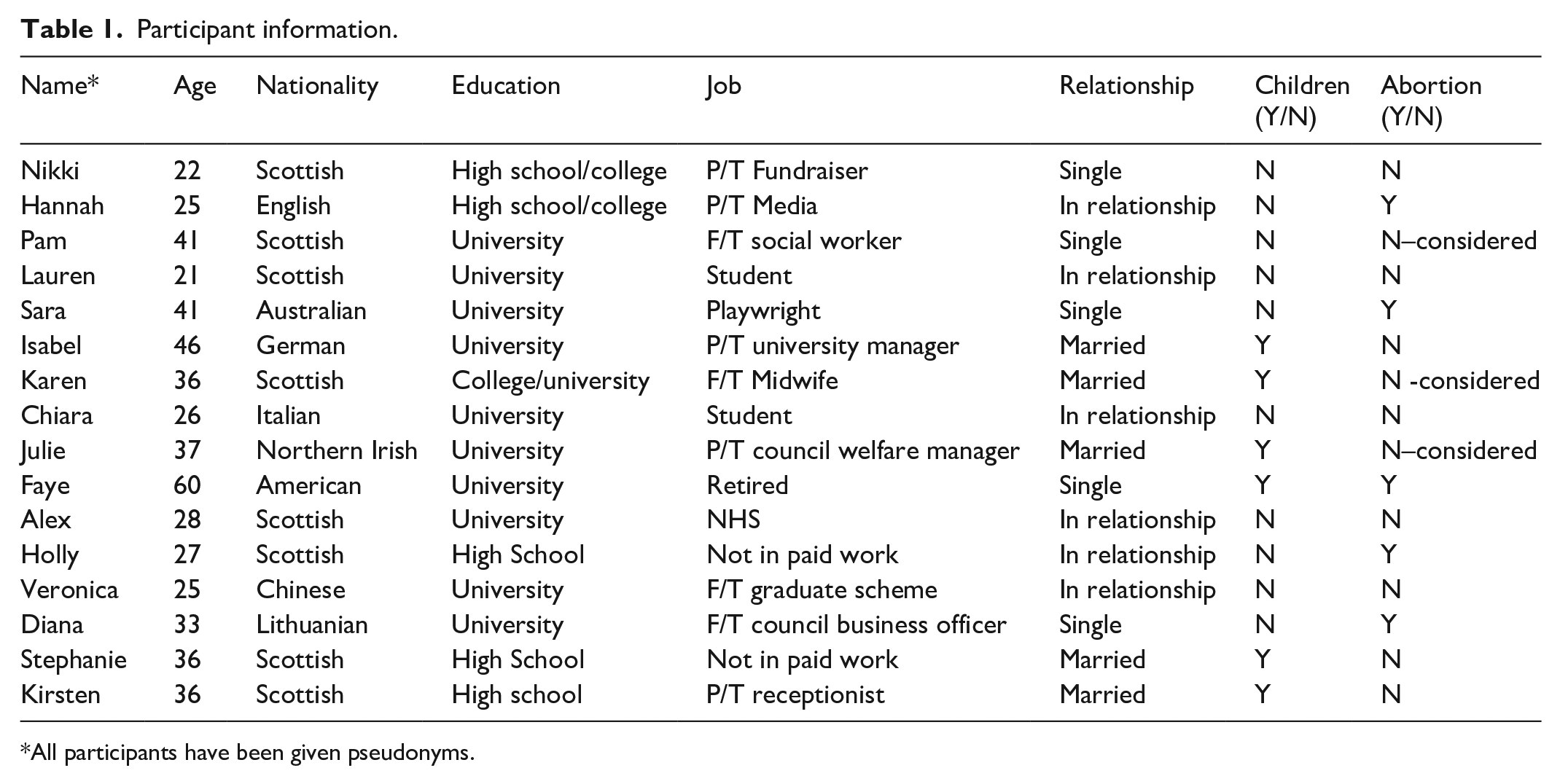
All participants have been given pseudonyms.
List of concept cards.
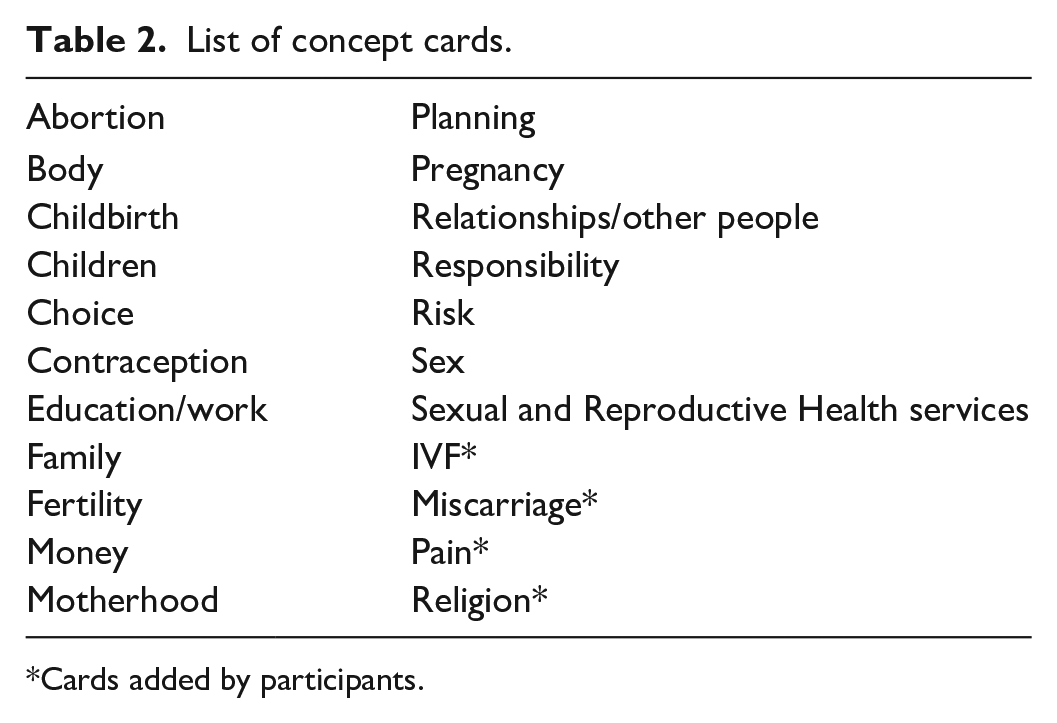
Cards added by participants.
Footnotes
Declaration of conflicting interests
The author(s) declared no potential conflicts of interest with respect to the research, authorship, and/or publication of this article.
Funding
The author(s) disclosed receipt of the following financial support for the research, authorship, and/or publication of this article: This work was supported by an Economic and Social Research Council +3 doctoral studentship (ES/J500136/1) held at the University of Glasgow.
