




Abstract
Even though transcription is a mainstay of qualitative research, transcription itself is rarely present in discussions of data collection or analysis. A meager body of literature exists that considers transcription as theory, but such literature tends to focus on the transcriptionist’s choices. We have few empirical studies on transcription and the role of the transcriptionist. Drawing on frameworks of literacy as a sociocultural process and post-structural feminism, we investigate two cases that demonstrate how the transcriptionist can assume a generative role in research projects. Our data reveal how the transcriptionist shared interpretations, helped make methodological decisions, and was a reader who knew the full body of data. We argue for a reframing of our collective understanding of the transcriptionist and consider the benefits of, limitations to, and ethical issues in involving transcriptionists explicitly as co-researchers.
Keywords
Introduction
Even though transcription is a mainstay of qualitative research, transcription itself is not often considered a method and is rarely present in discussions of data collection or analysis. For example, phrasing such as “the data were transcribed and analyzed” is not uncommon in empirical articles. A Google Scholar search reveals that this wording has been used over 20,000 times. The passive voice indicates that researchers do not even identify who—or what—transcribed those data. A meager body of literature exists that considers transcription as theory (e.g. Downs, 2010; Duranti, 2006; Ochs, 1979), but such literature tends to focus on the conscious and subconscious choices that transcriptionists make (such as in the ways the transcriptionist chooses to represent the dialect of a research subject). This literature demonstrates the ways in which transcripts are not the neutral texts we often assume them to be. We have few empirical studies on transcription beyond error analysis and particularly few on the role(s) of the transcriptionist (Davidson, 2009).
When we hear our colleagues discussing transcription, if they discuss it at all, they tend to focus on whether technologies such as Google Speech-to-Text can replace a costly human transcriptionist. These discussions illustrate how many of us think about transcription: how it seems to be more of a chore than an engaging interpretive activity, how software appears capable of everything a human transcriptionist does, and how human transcriptionists are an economic privilege.
We the authors (Heather, Sara, and Kate) met in the fall of 2008 as part of a cohort of doctoral students studying literacy as a sociocultural practice. Kate and Sara were both full-time teachers and part-time EdD students, taking fewer courses than Heather, a full-time PhD student, each semester. Heather began transcribing for research projects during her first semester of graduate school. Initially, she understood transcription as many do—as a menial task that she could do thoughtlessly and objectively. She began to trouble that idea when she took a classroom discourse analysis course and first read Ochs (1979). Ochs’ ideas were present in Heather’s mind as she began to transcribe her own raw data from her dissertation and realized that transcription served as her first level of analysis (Hurst, 2013).
We present two cases of how Heather’s participation as a transcriptionist affected Kate and Sara’s dissertation studies in surprising and very different ways and then use these cases to argue for a reframing of our collective understanding of the transcriptionist, reflecting on the humanness of our enterprise. Although we began our work together assuming that Heather would transcribe files without taking on any other role, we became co-researchers, although unbalanced in our roles. Heather transcribed Kate and Sara’s audio files while they were in the process of data collection, completing the transcription usually within a week of its being recorded. Her role as their transcriptionist had a noteworthy effect on the trajectories of their research projects. She was an insider to their raw data, and she was a (sometimes) invisible but very present member of their studies. As such, we found ourselves doing unplanned but provocative collaborative inquiry.
We hope that our work together will lead others to re-imagine not only how their transcriptionists can be drawn more explicitly into data collection, interpretation, and analysis but also how we might find other embedded tasks and individuals who can contribute to and change our research. McLaren (1995) urges us “to always be conscious of the political and ethical consequences of our own unstated assumptions as researchers” (p. 278). We believe that, in the field of qualitative research, we have built a number of assumptions around transcriptionists and transcription, and disrupting these assumptions can engender new possibilities in our research.
Theoretical frameworks
Literacy as a social practice
Although our doctoral program emphasized and favored collaboration, the dissertation remains a space in which academic traditions prevail, and as such, the dissertation process was predominantly solo. Part-time doctoral students who are physically separated from the academy during the dissertation process, as Sara and Kate were, especially experience isolation during the dissertation process, and that separation has emotional, psychological, and intellectual ramifications on their work.
Our learnings from our program led us to consider how understanding literacy as a social practice affected how we understand transcripts as texts, the role of the transcriptionist, and the process of creating a transcript. Literacies are situated in social contexts, and transcripts, therefore, are created through the influence of those social groups, and their goals and practices (Barton et al., 2000). We understand that transcripts are not neutral and are necessarily ideological (Street, 1993). We must then consider who the transcriptionist is in relationship to the text she is creating.
We know that transcription is usually perceived as a rote task. However, from his research of his mother’s surprisingly complicated work as a waitress, literacy educator Rose (2006) challenges our perceptions of “working-class academics” (p. 365). He demonstrates how her work was skilled and “webbed in experience, values, motives, and emotion, part of a complex worldview and life history” (p. 369). Like waitresses, transcriptionists have been assumed to be unskilled and are rendered invisible in final research reports, and their “experiences, values, motives, and emotion” affect the literacy practices of listening to research data and writing transcripts. Although doing so evokes in us an uneasiness, we deliberately use the word “writing” here because “typing” suggests a practice more neutral than we believe to be possible.
The transcriptionist is often someone in a “lesser” role—a research assistant, a student—or someone entirely outside of academia. But Gee (2000) aptly reminds us that knowledge and intelligence belong not to individuals but are instead shared throughout a community of practice “to carry out its characteristic activities” (p. 181). These understandings of literacy have led us to conceptualize the transcriptionist as a thinking, knowing person, and a member of the community of practice of research. We believe from our experiences that our research stands to benefit when we invite her to join us in collaborative inquiry.
Post-structural feminism
We share a post-structural feminist framework that shapes our ontology and epistemology (Burns and Walker, 2005; Lather, 1992; Pillow, 2003). Our feminist tendencies lead us to seek collaborations and reciprocal relationships (England, 1994) and to trouble the insider/outsider binary through which the academy traditionally understands the researcher/transcriptionist relationship. It is our feminist inclinations that lead us to choose female pronouns throughout this text, although we do so with hesitation, knowing that transcription might be viewed as a gendered “secretarial” task. However, this historical perception of a secretary runs counter to our argument that the transcriptionist herself engages in intellectual work.
Davis (2008) suggests that a feminist framework “means attending to multiple identities and experiences of subordination” (p. 68). We think of Heather not only as a transcriptionist but also as a teacher, a friend, a scholar, embodying “multiple and shifting identities” (Davis, 2008: 71) that can be used as “analytic resource[s] rather than just … identity marker[s]” (p. 72). We discuss Heather’s identities and their importance in a later section.
Literature review
Transcriptionists
Tilley and Powick (2002) and Wellard and McKenna (2001) note that, despite its preponderance in qualitative research, transcription is rarely included in discussions of research methodologies, and that it is historically considered a rote chore or, as Brandenburg and Davidson (2011: 703) suggest, a “taken-for-granted” practice. The common assumption is that the transcriptionist can precisely capture in text what recorded participants have orally shared (Poland, 1995), and discussions about transcription often focus on the avoidance of error (Easton et al., 2000). The idea of verbatim transcription is not often problematized.
In many cases, the transcriptionist herself is invisible (MacLean et al., 2004). Yet transcripts are always influenced by the transcriptionist’s choices and interpretive lenses and are hardly objective representations of truth (Bird, 2005; Bucholtz, 2000, 2007; Hammersley, 2010; Jaffe, 2007; Kvale, 1996; Lapadat, 2000; Tilley and Powick, 2002). Vigouroux (2007: 62) writes that transcription “is one of the most closely scrutinized activities on the data construction chain” for linguists, but the same claim cannot be made for most qualitative researchers. Gregory et al. (1997) illustrate the conflict in how we have viewed the transcriptionist: as a vulnerable person “privileged to the full range of human emotions during the transcription process” but also as a technician who serves as “a means to an end” and who is “muted within the context of qualitative research” (p. 295). Lapadat (2000) provides an especially thorough review of the positioning of transcripts, transcription, and the transcriptionist, problematizing our assumptions of the person, process, and product.
We have found that transcriptionists are often denigrated in the literature. For instance, Della Noce (2006) notes that a research methods student participating in activities designed to introduce the “theoretical dimensions and analytic value” of transcription will “inevitably” ask whether the researcher could instead hire a transcriptionist, freeing the researcher to focus on analysis. Della Noce (2006) advises that the students consider what “they might lose by hiring out the transcription” (p. 8, emphasis added). She does not consider what might be gained by hiring a transcriptionist. Similarly, Downs (2010) reflects on her decision to complete her own transcription as solely beneficial: In doing so, I feel I form a greater attachment to the words spoken and written, which in turn leads to a heightened sense of duty in how they are analysed. In a more practical sense, doing my own transcription makes analysis a less fraught and time-consuming undertaking because I “know” the transcript better. (p. 110)
Halcomb and Davidson (2006) agree that the researcher would likely benefit from transcribing her own data, with their only caveat that her clerical skills may not allow efficient production of the transcripts. They claim that the benefit to the researcher is her insider knowledge to what the participants had shared, thereby increasing the quality of the transcripts. Although they later write that “the process of transcription should be more about interpretation and generation of meanings from the data rather than being a simple clerical task” (Halcomb and Davidson, 2006: 40), they do not explore this potential benefit in their case for verbatim transcription. Novotney and Callison-Burch (2010) even suggest that speech recognition software is just as good as a professional transcriptionist.
The literature on medical transcription raises the question of who is capable of doing transcription—and whose time is spent in a worthwhile fashion when transcribing. Several texts (Alapetite et al., 2009; Pezzullo et al., 2008) argue that physicians consider their time spent transcribing or editing transcripts produced by speech recognition software as wasteful. For instance, Alapetite et al. (2009) quote one physician, “Why use a high-salary and highly qualified physician, who can type with only two fingers, to do secretarial tasks that could be done better and more cheaply by a secretary who is skilled at touch typing?’ a view shared by more than a third of that study’s participants (p. 9).
Although most qualitative researchers view the transcriptionist as detached from the research study, they still attest to her need to promise confidentiality (Wellard and McKenna, 2001). Perhaps we in qualitative research have taken comfort in imagining the transcriptionist to be intellectually disconnected from our data, because in reconceptualizing her as interpretive, the prestige of our position as researcher/academic is challenged.
Transcripts
Research on transcripts themselves problematize our tendency to think of them as representations of truth. For instance, Fraser (2003) considers the implications of interpretation in transcripts that are submitted as evidence in legal proceedings and recommends that a transcriptionist submit her degree of confidence and other possible interpretations of text of which her certainty is low. Duranti (2006) helps clarify the two main fallacies we bring to transcripts: we either hypercontextualize them by attempting to account for every mediating factor in producing a transcript, or we are virtual-realists who treat transcripts as if they are themselves the real entity. Duranti (2006) writes, If we accept that transcripts are representations, and that as such they can only give us, through a combination of symbolic, iconic, and indexical signs, a restricted, selected perspective—a stance, a point of view, often with an attitude, on what the world was like at a particular moment, then transcripts and even shadows on the wall of a cave are the kinds of objects we need in order to see properties and recurring patterns that we might (and usually do) miss with other observational techniques. (p. 309)
By theorizing transcripts as models, we open ourselves to new interpretations of these texts.
The process of transcription
Lapadat and Lindsay (1998) argue that the process of transcription—not only the product—is valuable, as analysis occurs during that slow listening and re-listening. Transcription can be, as Duranti (2006) notes, “a discovery procedure” (p. 307). Similarly, Tilley and Powick (2002) and Tilley (2010) found that transcriptionists were inevitably engaged in and by the stories they were transcribing and were therefore unable to maintain their presumed distance and objectivity. Joan, a transcriptionist who participated in Garcia et al.’s (2010) study, says, “You have to be thinking all the time, or you’ll type the wrong thing,” leading the researchers to conclude that transcriptionists are “engaged in sense-making—in interpreting, recognizing, and understanding what the doctor is saying” (p. 93). And transcriptionists who work with sensitive data have been shown to experience emotional and physical effects in response to the data (Wilkes et al., 2015). Transcription as an interpretive activity has been discussed extensively in the literature (Bucholtz, 2000, 2007; Duranti, 2006; Green et al., 1997 Grundy et al., 2003; Hammersley, 2010; Jaffe, 2007; Lapadat and Lindsay, 1998; Poland, 1995; Poland and Pederson, 1998; Skukauskaite, 2012; Witcher, 2010). A transcriptionist does not transcribe any audio, whether of class discussions or interviews, thoughtlessly; as she listens and types, she “reads” the story of the raw data. As readers do, she makes interpretations of what she hears, interpretations that are “silenced” and lost when the transcriptionist remains nameless and faceless.
We trouble this idea of silencing, however, because while the transcriptionist’s interpretations might not be articulated, her choices throughout the process of transcription have direct effects on the researcher’s view of the data. As Davidson (2010) notes, transcripts are not data in a direct sense. Rather, they provide a means to access the data. In this way, the transcriptionist is tacitly powerful because she is, in effect, creating the text upon which someone else’s analysis, conclusions, and implications are based. As such, Oliver et al. (2005) urge the transcriptionist to incorporate periods of reflection into her practice. In addition, Hammersley (2010), Duranti (2006), and Ochs (1979) argue for the necessity of selectivity in transcription. However, most hired transcriptionists are likely not engaged in lengthy conversations with the principal investigators (PIs) about the degree of selectivity they will engage in. Witcher (2010) therefore recommends that the researchers and the transcriptionist negotiate these issues at the start of the research. Rather than a unidirectional discussion in which the researcher names the ways in which she desires selectivity from her transcriptionist, this conversation could begin a collaborative enterprise in which the researcher and transcriptionist begin to discuss issues of selectivity and interpretation that will continue throughout the duration of the project. Duranti (2006) urges us to “periodically reassess the principles, conditions and consequences of our ways of seeing, hearing, and reporting,” an effect that is almost certainly achieved when the researcher-transcriptionist hierarchy is troubled and the transcriptionist is brought into discussions of interpretation and analysis (p. 306).
Collaborations with researchers and transcriptionists
Some researchers have begun to explore questions and collaborations that in some ways are similar to ours, most notably Tilley (2010). Recent research has begun to look closely at the transcriptionist’s work, but this research has typically focused on the process of transcription or the product of the transcript (Ross, 2010; Skukauskaite, 2012), not on the relationship between the transcriptionist and the researcher. MacLean et al. (2004) offer several tips for working with one’s transcriptionist, but their suggestions are geared toward producing an “accurate” transcript. By investigating the relationship among the transcription process, the validity of the data, the researcher’s analysis, and the transcriptionist’s degree of involvement, Tilley and Powick (2002) begin to consider the effect the transcriptionist might have on the research project, although they position analysis as only the researcher’s task, and the researcher and transcriptionist have disparate roles, different from the collaborative inquiry we engaged in. Grundy et al. (2003, 2005) explore the implications and process of using the participants as the transcriptionist, who are given editorial control of the transcript.
Tilley (2010) enlisted the help of a friend as transcriptionist, and she soon realized that her friend would have insights on the data to share, leading her to understand her friend as a “situated transcriber” (p. 837). She then decided to conduct four informal interviews with her friend that she audiorecorded and transcribed herself. Tilley (2010) writes, “As Debbie became more involved I used her as a sounding board” (p. 845). This role is one that Heather played in our studies, but we explore further the multiple emic and etic roles that she played in our research projects.
Context
Kate approached Heather about transcribing her data in the spring of 2013 as she began data collection for her grounded theory study, an after-school multimedia club for young adolescents. Kate had planned to utilize voice-to-text software to transcribe her data, thinking of this process as simply a technical strategy for encoding the data. However, she began to recognize the need for Heather’s help as she tried to balance the needs of her current students with the demands of data collection. Kate then added Heather’s participation as a transcriptionist to her informed consent and assent forms to ensure transparency with her research participants and their families.
Kate sent Heather digital audio and video files, including student-led interviews, workshops, and small/whole-group discussions, on a weekly basis. She listened to the files before sending them and sent the minute markers of the sections to transcribe, making initial decisions about relevance. Heather typically returned the transcribed files to her within a week. Although Kate intended not to begin data analysis until the school year had ended, she found that receiving the transcripts so soon drew her into the analytic process. Heather transcribed a total of 856 minutes of raw data for Kate from April through June of 2013.
Sara collected data for her study, an inquiry into giftedness with a fifth grade book club, during the fall of 2013. Also finding that she was unable to keep up with her teaching responsibilities, data collection, and transcription, she received advice from a colleague: “I shipped mine off to China.” Sara thus planned to use a transcription service until Kate told her that Heather was doing transcription, a discovery that Sara calls serendipitous. Sara electronically sent files on a weekly basis, including one-on-one interviews and the weekly book club meetings. As part of her methodology, Sara planned to use transcripts to help shape her research and needed to have the audiorecordings transcribed in a timely manner, and Heather typically was able to return transcripts within a week, allowing Sara to conduct member checks throughout the course of the study and embed initial analysis into the data collection process. Heather transcribed 645 audio minutes for Sara from October through December of 2013.
Our practitioner inquiry methods
Although both Sara and Kate initially designed a traditional exchange of audio files for text-based documents, Heather assumed different roles in the process that proved provocative, interpretive, and generative for their projects. To better understand what happened in these projects and in our process together, we engaged in practitioner inquiry (Anderson et al., 2007; Cochran-Smith and Lytle, 2009) together to answer three questions: (1) What roles was Heather as the transcriptionist playing in Kate and Sara’s studies? (2) What allowed for these roles to emerge and evolve? (3) How did Heather’s involvement affect Kate and Sara’s data collection and analysis?
Practitioner inquiry encourages researchers to invent and reinvent communities of inquiry. Here, we formed a community of inquiry that acknowledged that all practitioners are knowers and that troubled the traditional dichotomies of research and practice, researcher and practitioner, and local and public knowledge. We stand by the belief that all “those who work in particular educational contexts and/or who live in particular social situations have significant knowledge about those situations” (Cochran-Smith and Lytle, 2009: 42). We recognize that someone from outside our local context can bring fresh perspectives, and we drew on our community of inquiry to construct knowledge collaboratively and to supplement our independent analyses.
We knew prior to this study that Heather’s role had had unique effects on the original dissertation studies, but we did not know how Heather’s participation had evolved to lead her to make contributions beyond the physical text of the transcript. We collected data related to our interactions as researcher/transcriptionist, including emails between the PI and the transcriptionist, voice memos, text messages, transcripts from Sara’s study during which her students explicitly talked about Heather, and text from Kate and Sara’s dissertations that discussed Heather’s participation and roles. Before systematically analyzing our data, we also met several times to reflect on Heather’s contributions and then transcribed these discussions.
In our initial analysis, we conducted descriptive analysis of the two cases together to capture systematically what had happened from the transcriptionist’s involvement within the two larger dissertation studies. Stake (2000) warns that “damage occurs when the commitment to generalize or to theorize runs so strong that the researcher’s attention is drawn away from features important for understanding the case itself” (p. 439). Therefore, as we moved into thematic analysis, we dwelt within each individual case before considering those themes that were common between them.
Our interpretation and analysis of these telling cases (Mitchell, 1984) benefited from and was complicated by our nuanced roles as both insiders and outsiders to each other’s various projects. Herr and Anderson’s (2005) description of the continuum of positionality is especially helpful here. Within the dissertation studies themselves, Kate and Sara acted as insiders studying their own practice, at times in collaboration with other insiders (the participating students). Heather’s intimate familiarity with Sara and Kate’s data made her an insider of sorts, yet in other ways she acted as an outsider invited to collaborate on research: Heather had no contact with any participants and did not have access to the full body of data, nor did she have personal experience with or knowledge of the context for the study. Positionality is conceived “in regards to one’s position in the social or organizational hierarchy and position of power vis-à-vis the other stakeholders in the setting” (Herr and Anderson, 2005: 41). Although Kate and Sara held higher positions within their research contexts and studies, they considered Heather to hold more power within the context of the university and the world of academia.
Considering the data of this study, we used our various positions as insider/outsiders to facilitate theoretical triangulation (Denzin, 1978), thus creating a crystallized interpretation (Richardson, 1997) of the role of the transcriptionist. Poland (1995) warns that “the very terms validity and reliability are problematic as a basis for evaluating qualitative research, and carry considerable (if implicit) positivist and/or realist ‘baggage’” (p. 293). As with most qualitative research, results are context dependent; social context, timing, and social location must be taken into account (Hammersley and Atkinson, 2009). We acknowledge that our relationship was unique. We have not meant for this study to result in a comprehensive collection of expanded roles for transcriptionists. In fact, practitioner inquiry emphasizes the importance of the local context and challenges the notion that “knowledge can be generated in one site and directly and unproblematically generalized and transmitted to another” (Cochran-Smith and Lytle, 2009: 42). Rather, we seek to illustrate a few possibilities for this partnership and argue that researchers and transcriptionists would not need to have an identical context in order to benefit from a reimagined relationship. In our “Implications” and “Limitations and need for further research” sections, we provide additional discussion regarding the generalizability of this study.
Telling cases
Kate’s case
Kate had designed her research as a critically oriented practitioner inquiry in which self-selected middle school students used a variety of multimodal tools to compose texts focused on interrogating issues of power. The study was conducted at her current teaching placement as an after-school club in a middle class, predominantly Caucasian suburban school district just outside of Philadelphia. Kate’s feelings of vulnerability in sharing her work were amplified by the tensions inherent in engaging critical pedagogy, particularly in a context where these discussions were rare.
Early in our work together, Kate decided to send Heather an email: I’m really glad you are transcribing these but (and because) it makes me feel very vulnerable! I wouldn’t want a stranger listening to me teach, but you are also a teacher/researcher who knows both fields inside and out. I know you won’t judge … but practitioner inquiry is a bit scary!
Heather replied, I know it’s awkward to send transcription to someone you know. If it’s any consolation, I listen to [the files] in a pretty detached way. I can’t totally turn off my researcher brain, but I also save transcription work for when I’m too tired to do other work, so I am way less analytical when I transcribe for other people. Plus, I have no impulse to criticize when I’m transcribing a friend. You’ll be way more critical when you listen to yourself, if that makes sense.
Although Heather had not intended to be disingenuous, she now believes that only the second half of her reply is truthful. She instead found that she listened to Kate’s files with interest and engagement—never detachment. Receiving a new batch of files excited her, and she would often think about Kate’s data outside of the time and space used to transcribe.
In May, 4 weeks into her study, Kate found herself at a critical moment; worried that her study was not going in the direction she’d hoped, she emailed her committee and then forwarded Heather the email, asking for insight: “Do you have any suggestions for moving forward? Frankly I’m a bit stuck.” In reply, Heather sent a voice memo of her thoughts to Kate. Afterward, Kate wrote, “… thank you because talking with someone who understands this stance and this work is incredibly helpful, and I really don’t think you can do critical work alone.” Later that day, Heather sent Kate a much longer email responding to Kate’s questions and citing specific instances from Kate’s data. For instance, I’d be interested in how media affects the students’ reflections. I know you asked Neil about what he thought about the flip cam interviews, and you sounded concerned about the degree of reflection you were getting from students …
Kate replied, This is amazing. I really don’t have the opportunity for this discourse in other forums and you’re both pushing and reassuring me … I’m limited by the space of what’s in my own head … literacy and learning is a social experience as we know!
Although doing part-time dissertation work while teaching full-time allowed Kate to stay deeply connected to her practice and students, the lack of contact with an academic community left her feeling isolated from the social and intellectual support inherent in being on a university campus. Through emails, phone calls, and even voice memos with Heather, Kate was able to foster a sense of the collaborative inquiry that she was otherwise missing.
Kate found that having her data transcribed while she was in the process of data collection had two primary effects on the trajectory of her project. She originally had her students conduct daily reflective video interviews. After Heather transcribed these, Kate realized that her students were uncomfortable on camera and were providing surface-level reflections. Having that information changed her approach to her study. Kate notes that Heather appeared in her research journal and her memos, playing a role that she acknowledges that she did not know she needed until she had it. What had become so familiar to her was novel to Heather. Kate found that she sometimes worried that she was taking advantage of Heather while asking for feedback, wondering what was included in our transactions and that she was overstepping with her demands on Heather’s time.
Sara’s case
Unlike Kate, who felt vulnerable in sharing her raw data, Sara initially thought of having Heather as her transcriptionist as a security blanket. Because she was a part-time student, she felt as if she was always missing out on something but assumed Heather, a full-time student, would be more aware of policies and procedures.
As she described her project to them, Sara explicitly explained Heather’s role to her students, knowing that they would be interested in the process and believing that at least a few of her students would someday pursue research projects of their own. In addition, Sara believed that the transcriptionist should not be invisible to her students, 1 and she wanted them to remain aware that she was conducting a research project:
I’m going to use my iPad and also an audiorecorder to record our book clubs and interviews so that my colleague can later write down what we said.
You have a colleague?
The person that I’m referring to, her name is Dr. Hurst.
Oh, she’s a doctor.
[…] So she’s now a doctor, and she is being a great help to me because I am going to send her our recordings so she can type them up. The word transcribe means when you hear something, that you type up the words, and it takes a really long time, and for some reason, she loves to do it.
By explaining not only the procedure but also our relationship, Sara sought transparency in the research process. Consequently, Heather was positioned not as a disembodied other but a named (although still faceless) friend with a certain level of trustworthiness as “a doctor.” Sara emphasized the ways in which Heather’s work would offer the students a chance to confirm or revise their contributions. Transcripts allow for member checks, which not only increase the validity of the study but also help participants gain agency in the research process. Because member checks occurred shortly after the sessions, ideas were fresh in the students’ minds. At times, member checks resulted in students’ expanding upon the content of the transcript, providing a fuller picture of their thinking.
Sara also described how Heather’s role would enhance her ability to remain present as a participant in the book club, rather than distracted by her research. She brought attention to the actual audiorecorder, the physical object that becomes a sort of embodiment of the transcriptionist. The discussion continued:
Hi.
Wait, are they on?
[Overlapping voices]
[Can you hear me now?]
Hey, hey, hey, hey, hey.
Hi, Dr. Hurst.
A student here initiated a pattern that the other students take up in future book clubs: she greeted Heather on the recording. The students also wondered about the process of transcription:
Are you going to transcribe what we’re saying right now?
No, she’s not going to.
Transcribe this.
Is Dr. Hurst going to transcribe the music?
When a student engaged in some sort of nonverbal activity, such as drawing a diagram to illustrate a point, a student apologized, “Sorry, Dr. Hurst. This will take a while.” When they decided to photograph the diagram, a student said, “Oh, then you can show Dr. Hurst and explain.” They worried about what Heather heard and asked her questions. They were even concerned about her time: “You can’t leave Dr. Hurst waiting.” If Sara did not start the recorder right away, her students told each other not to “say anything great” because Dr Hurst was not listening yet. They continued this one-way conversation with Heather in all but one of the 14 book clubs.
Sara listened to the entire audio file after receiving the transcript in order to insert the students’ names and to fill in parts that were inaudible to Heather. She found that relistening to (Lapadat and Lindsay, 1998)—almost reliving—the book club with the transcript led her to conduct an initial level of analysis. She wrote a memo after completing this task. Although she reflected on discussions and wrote about them in her journal immediately afterward, she found that reading the students’ specific statements about a topic led her to think more deeply about how they were understanding a concept, shaping the direction of her study.
Because she understood her work as a “traditional” transcriptionist–researcher relationship, Heather struggled when she began to see patterns and themes emerge in Sara’s book clubs. This project was Sara’s, and she was uncertain whether Sara wanted her input or whether she would be overstepping her role. Although Kate had explicitly asked for insights, Sara had not. Heather mentioned an observation in an email while sending a batch of transcripts midway through Sara’s study, and Sara responded appreciatively.
Sara asked her students in her final interviews why they had welcomed Dr Hurst into the group, even though she was not physically present. May replied, “I felt the need to include her. If the kids really welcome you, you’d kind of feel part of it, and you’d understand a little more.” Sapphire replied, They just like the idea of having this person in there who wasn’t really there. Who just listens while I’m talking. But not really present, but would listen to them in like the future when she was typing them up.
Sapphire demonstrates an insightful perspective on the temporal nature of data collection and how research transverses spaces. We believe that Heather’s “presence” helped increase the students’ awareness of the outside audience of the book club, thereby raising the level of importance they felt their contributions had to the discussion and Sara’s research.
Discussion
Kate and Sara’s studies share a couple of similarities. They were both classroom teachers conducting practitioner inquiry studies involving students in a club-like setting. They both shared their files with Heather shortly after recording them, and Heather produced the transcripts while the studies were ongoing, usually returning them to the researcher within a week. Heather did not regularly see Kate or Sara, so all communication was mediated by technologies, usually email.
In considering what allowed Heather’s multiple roles as the transcriptionist to emerge, we conclude that mutual trust and respect were critical in developing a framework for negotiating potential pitfalls or power differences in our research relationships. It was especially helpful that one of Heather’s identities is that of a former classroom teacher, as this identity helped Sara and Kate trust that Heather understood classrooms and classroom teachers as imperfect spaces and people. The existing trust also helped Kate approach Heather about issues in her data and helped Heather approach Sara with her interpretations. Although Heather had interpretations of every transcript she made, she has not always felt comfortable in approaching other researchers with her interpretations, nor have many researchers invited Heather to share.
Heather’s identities
Although we do not believe that our many identities can be compartmentalized, Heather believes that certain identities of hers are more present when she transcribes audio files. These identities act as different lenses for interpretation and analysis as she “reads” the data on the audio files, and they affect the ways she understands what is happening in the data (Figure 1).
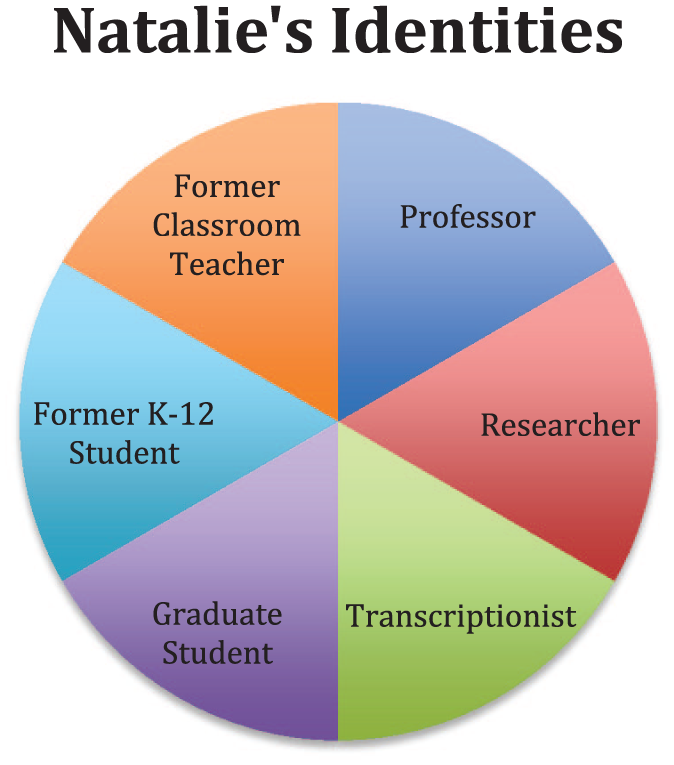
The more salient identities of the transcriptionist.
Heather’s autobiographical experiences have developed in her innumerable and perhaps even contradictory identities, too complex to be neatly rendered in a chart. However, this heuristic is useful in thinking about some of the ways that Heather approaches the texts of the raw data. For instance, when she thinks as a transcriptionist, Heather might contemplate the choices she is making in terms of the physical layout of words on the page: Should she double-space? Note a pause? But when she thinks as a former K-12 student, she might wonder how she would have enjoyed an activity, or how she might have interacted with a particular participant. In addition, Kate and Sara drew upon the identities they had constructed for Heather, as well as their assumptions about her identities, thereby influencing what happened in these telling cases.
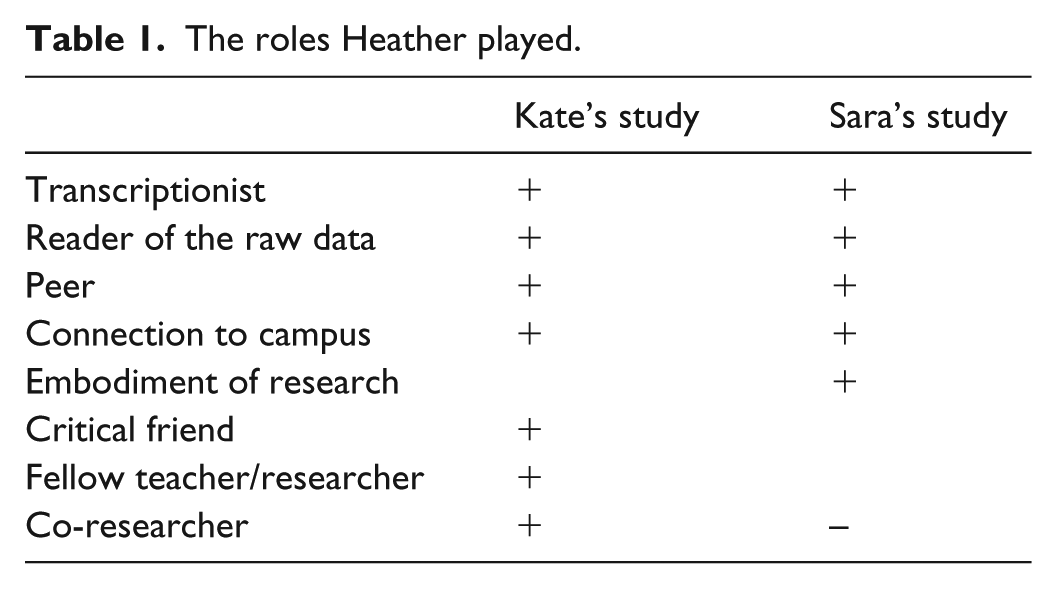
The roles Heather played in these two studies converge and diverge. For both Kate and Sara, Heather served as the transcriptionist, the primary reader of the raw data, a peer, and a connection to campus. For Sara’s students, Heather was the embodiment of the readers of the research, helping them imagine who would hear their words. For Kate, Heather was a critical friend, a fellow teacher/researcher, and a co-researcher, the latter meaning that during the process, Kate realized that Heather was helping to shape her interpretations. However, fundamental to both cases was an understanding of Heather’s work as relational rather than transactional (Table 1).
The roles Heather played.
Our analysis has also helped us to better understand some of the unspoken tensions in our work together. For instance, Heather wanted to take a submissive role in Kate and Sara’s projects by deferring to their preferences. However, Heather’s experience with discourse analysis and with transcription meant that she had spent much more time reading and thinking about transcription conventions and possibilities. Although we believe our projects ultimately benefited from the flexibility of our relationships and the organic nature of Heather’s interpretative involvement, we acknowledge that Heather often held back from sharing ideas about the mechanics of the transcription and interpretations of the data until she knew that such invitations were welcome. MacLean et al. (2004) write, “The most effective way to ensure that transcriptionists know your notation preferences is to provide them with concrete examples,” but this suggestion assumes that the researcher is more knowledgeable about the transcription process than the transcriptionist, which, in fact, is potentially not the case, especially with novice researchers or transcriptionists who are skilled in producing transcripts for academic research (p. 117).
Implications
Benefits to the researcher
In research, very few people have access to our raw data. Often, we make the mistake of thinking about transcripts themselves as the data, but they are in fact a step removed from the data. Duranti (2006) argues that transcripts are representations that “can only give us … a restricted, selected perspective—a stance, a point of view, often with an attitude, on what the world was like at a particular moment” (p. 309). Others may read our transcripts and drafts, but neither of those are the full raw data set. The transcriptionist, then, is uniquely equipped to assess the validity of the researcher’s interpretations of the data. Both Kate and Sara were relieved to have Heather’s involvement in their studies. Kate sent Heather drafts of her chapters as she completed them, and Heather’s feedback reassured Kate because Heather so intimately knew her data. Lapadat and Lindsay (1998) clarify, “Acknowledging transcription as representational avoids the mistake of taking the written record as the event, and opens the transcription process for examination of its trustworthiness as an interpretive act” (p. 12). With this in mind, it only makes sense to draw the transcriptionist more explicitly into the research enterprise. We believe having multiple reads of the raw data leads to conclusions and implications that are richer and have greater validity, especially in those instances in which the transcriptionist draws conclusions that are different from those of the primary researcher.
We realize that our prior relationship—as well as Heather’s having a PhD—is part of what made Heather so valuable to Kate and Sara and their respective projects. Therefore, we imagine that researchers who choose to do transcription themselves might team up with trusted colleagues to trade files. While it is not uncommon to have other researchers read our transcripts, it is uncommon for them to “read” the raw data of our audio files. However, we believe that the transcriptionist–researcher relationship can still be generative even when the parties involved are not personally acquainted. The transcriptionist can elucidate the choices that she made in creating the transcript, and the researcher can consider these impactful choices when conducting her own interpretations and analyses. The transcriptionist can also help the researcher with defamiliarization, offering the researcher an opportunity for theoretical triangulation (Freeman, 1998). What is so intimate and familiar to the primary researcher is an unknown world to the transcriptionist.
This expanded relationship is most beneficial in qualitative research, particularly in transformative or participatory action research or practitioner inquiry, in which the researcher hopes to support participants in creating change. Should researchers choose to take this approach from the start of their study by building the researcher–transcriptionist relationship into the research design, enhanced analysis has the potential to lead to broader perspectives, greater opportunity for transforming practices within and outcomes of the research, and an expanded audience for the research findings and implications.
Benefits to the transcriptionist
Besides enjoying the participants’ voices and stories, Heather has found that her engagement in these two projects has enhanced her teaching and research practices. First, she has gained insight into how other researchers structure their interactions and engage with participants. The microdecisions that researchers make are rarely elucidated in articles stemming from research studies, but the raw data have led Heather to think about how these microdecisions advise her own research. In addition, this access has provided Heather with innumerable anecdotes that she uses in teaching research methods (while maintaining confidentiality). She has yet to transcribe a study without learning something that now advises her own work.
Economic considerations
We have talked across time about the economics of these projects. First, Kate and Sara had to have the financial resources to hire a transcriptionist, and Heather had the tricky task of determining what to charge her friends. However, her invoices did not account for the other intellectual work that Heather did for these two projects, and we remain uncertain about how others might negotiate a price that honors the transcriptionist’s contributions. MacLean et al. (2004) argue that transcriptionists should be paid fairly for the professional work that they produce, with compensation commensurate with the level of skill and experience. While we agree, we know that qualitative research is rarely lucrative and question from where the funding might come. We also realize that Heather was not yet in a tenure-track position and was therefore able to invest in other people’s research in a way that she may not while meeting tenure requirements. Heather’s contributions as a transcriptionist are not recognized by the academy: despite her hours of work on these projects, that work would not lead to hiring, tenure, or promotion. Wilkes et al. (2015) write that these issues are common for transcriptionists, who feel undervalued because they are not acknowledged in publications.
Ethical considerations
Bucholtz (2007) writes that “thinking reflexively about entextualization, about what exactly it is that we do when we transform others’ words from spoken to written form, is an important but underappreciated part of our task as researchers,” suggesting that the transcriptionist herself is, in fact, a researcher (p. 802). Even when an outside transcriptionist is employed, that individual should perhaps be considered part of the research team. These contributions raise questions of authorship: to what degree does the transcriptionist’s work affect the trajectory of the research study or the findings themselves? We have no easy answers, but we trouble the erasure of contributors. We recognize the limitations of academic work itself with narrow definitions of authorship and limited opportunities in a journal article to recognize collaborators or contributors who are not formal authors of a paper. Lankshear and Knobel (2003), literacy educators and theorists, encourage cultural action in which people “challenge established social practices and relations that systematically benefit some individuals and groups at the expense of others—including themselves” (p. 6).
Transcription has been described as “much more than the mechanical task of writing down words from a recording” (Brandenburg and Davidson, 2011: 704). The relationship with the transcriptionist should be made explicit in the methods, institutional review board (IRB) protocol, and process of consent in order to ensure transparency. In the case of a dissertation, the transcriptionist’s role should be fully documented to make clear the extent to which she contributed to analysis.
Limitations and need for further research
We believe that our two telling cases are only the beginning of the many permutations of generativity that might come from imagining the transcriptionist as a thought partner rather than merely a ready cleric. We have begun to imagine different configurations of the transcriptionist/researcher relationship (as have Grundy et al., 2003), but much more empirical research is needed to demonstrate the wealth of benefits for the researcher, the transcriptionist, and the outcomes of the studies, as well as the ethical considerations that the researcher and transcriptionist face. We have much to learn about how other researchers and transcriptionists negotiate (and re-negotiate) their processes, and we have yet to develop a comprehensive list of the roles that the transcriptionist might play. We also believe in the potential for researchers from varying fields to work together to build similar relationships that mutually contribute to their work. More research is needed to better understand the potential (and limitations) of these types of relationships.
Conclusion
Although our belief is that the researcher–transcriptionist relationship can contribute significantly to a study, this relationship would likely be strengthened if built into the study’s design rather than emergent. First and foremost, the co-researchers would need to establish a mutual understanding of and respect for the multiple roles and contributions each person could hold and bring. The researchers must position transcription as a meaningful and critical form of interpretation and analysis. A researcher looking to establish and develop this type of research relationship with a transcriptionist should work with a colleague who is mutually interested in taking an approach to transcription with an analytical lens and willing to establish trust and mutual respect, particularly in working to accept and negotiate the shifting parameters of the research and the relationship. They might even consider exploring the possibility of a reciprocal relationship in which each researcher conducts transcription for the other. We also suggest ongoing transcription analysis and dialogue between the co-researchers as a means of shaping the direction of the work. These critical understandings can lead to a productive and generative research relationship, and future research into the affordances and limitations of these relationships with the transcriptionist can help us better conceptualize the varying roles a transcriptionist might play.
Footnotes
Author’s Note
Sara Tilles is now affiliated with The Episcopal Academy, Newtown Square, PA, USA.
Declaration of conflicting interests
The author(s) declared no potential conflicts of interest with respect to the research, authorship, and/or publication of this article.
Funding
The author(s) received no financial support for the research, authorship, and/or publication of this article.
