




Abstract
While social science research into reproduction is a vibrant and growing field of scholarly activity, the majority of research is conducted with women and focuses on women’s lives. Reproduction research which does focus on men tends to overlook aspects such as pre-conception desires for parenthood and planning. Scholars have argued for a greater inclusion of men in reproduction research, yet there is a paucity of methodological literature addressing how best to do so. This article reports methodological reflections from a qualitative study into men’s perceptions and intentions regarding the ‘right time’ to have children. It does this in reference to Critical Studies of Men and Masculinities – which foregrounds men as gendered beings and comprises the study of the gendered nature of men’s lives – as both a theoretical position influencing study conception and design and as an explanatory framework for enhancing understanding of the research encounter. The first part of the article describes the Critical Studies of Men and Masculinities–informed study conceptualisation and design, specifically the decisions to include unpartnered men in the sample and to address the absence of men in reproduction research in recruitment materials. It then goes on to discuss the most effective recruitment strategy employed, recruiting through informal gatekeepers, and to consider the consequences of this. The second part of the article presents data from the male participants pertaining to their stated motivations for participating, which relate to interest, helpfulness, and in response to perceived marginalisation, as well as their reflections on the interview encounter as enabling them to construct a narrative. It aims to extend knowledge and understanding regarding engaging men in reproduction research and to illustrate the utility of Critical Studies of Men and Masculinities for doing so, and in doing so to advance both reproduction research and discussions of Critical Studies of Men and Masculinities and methodology more broadly.
Introduction
While social science research into reproduction is a vibrant and growing field, the majority of research is concerned with women. Several scholars have argued for an expansion of reproduction research to better include men (Almeling and Waggoner, 2013; Culley et al., 2013; Greene and Biddlecom, 2000; Inhorn et al., 2009; Jamieson et al., 2010; Lohan, 2015; Morison, 2013). However, despite a growing interest in men’s experiences in recent years, the majority of reproduction research involving men has been concerned with fatherhood, leaving numerous other aspects of the reproduction process overlooked including pre-conception desires for parenthood and planning (Lohan, 2015; Morison, 2013). Critical Studies of Men and Masculinities (CSM) is an approach which foregrounds men as gendered beings and comprises the study of the gendered nature of men’s lives. It has considerable potential for advancing reproduction research: adopting this approach opens up exciting new possibilities for interrogating issues of gender and power relations within the gendered topic of reproduction. However, methodological literature on researching reproduction with men, as well as literature which interrogates the relationship between CSM theory and method, remains sparse.
This article reports methodological reflections from a qualitative study exploring men and reproductive timings. It does this in reference to CSM, as both a theoretical position influencing study conception and design and as an explanatory framework for enhancing understanding of the research encounter. It aims to extend knowledge and understanding regarding engaging men in reproduction research. It also aims to illustrate the utility of CSM for conceptualising and designing reproduction research with men and for enhancing methodological reflection, and in doing so to advance discussions of CSM and methodology more broadly.
The article begins with an overview of CSM, followed by a discussion of men’s inclusion in reproduction research. Following this, the main body of the article is divided into two sections. The first section discusses the study conceptualisation and design, and the recruitment strategies employed, in the context of CSM. I discuss how adopting a CSM approach influenced two particular aspects of design and recruitment: (1) recruiting unpartnered men and (2) addressing men’s absence in reproduction research in recruitment materials. I then to go on to reflect on the recruitment strategy which proved most effective: recruiting men through informal gatekeepers. In the second section, I present data from the male participants pertaining to their stated motivations for participating and their reflections on the interview encounter.
CSM
CSM emerges from feminist, gay and queer scholarship (Hearn, 2004; Lohan, 2007). It positions men as gendered beings and comprises ‘the study of the gendered nature of men’s lives’ (Lohan, 2007: 494). It is guided by three central principles: ‘(1) seeing gender as socially constructed, (2) challenging hegemonic masculinity and (3) challenging gender power relations’ (Lohan, 2007: 494). It is not exclusively focused on men: central to CSM is a critical concern with power (Hearn, 2004) and it is primarily concerned with advancing gender equality by challenging unequal gender power relations which disadvantage women (Pease, 2013). It seeks to break down oppositional relations between masculinities and femininities, and as such can be perceived to be part of the poststructural feminist movement (Annandale and Clark, 1996; Lohan, 2015). Despite its claim of anti-essentialism, critics have suggested that its utilisation of the concept of hegemonic masculinity – the idealised form of masculinity in a given context – serves to essentialise the masculine subject and argue that analyses should be freed from a fixed notion of ‘toxic’ masculinity (Lohan, 2015). It has been noted that there is a paucity of interrogations of epistemology, methodology and theory in relation to CSM (Pini and Pease, 2013; see their edited collection for an exception to this).
CSM has great potential for reproduction research: adopting this approach opens up exciting new possibilities for interrogating issues of gender and power relations, within the gendered topic of reproduction. While CSM is centrally concerned with ‘gendered, usually predominantly men’s power’ (Hearn, 2004: 51), reproduction is arguably the one sphere where men might be considered to be the ‘second sex’ and the marginalised actors (Goldberg, 2004; Inhorn et al., 2009; Shirani, 2011). However, the idea that men are marginalised or relatively powerless is by no means a foregone conclusion, and as such CSM has potential for enabling a detailed, critical and complex analysis of men, reproduction, gender and power. As Lohan (2015) argues, ‘while feminist scholarship has centred reproductive experiences in women’s lives, it has inadequately explored their meanings in men’s lives’ (p. 215); feminist-informed CSM provides a suitable theoretical framework for such exploration. Its poststructural, feminist underpinning positions it as ideally suited to conceptualise reproduction as an inter-relational phenomenon, as opposed to a ‘women’s issue’ (Annandale and Clark, 1996; Lohan, 2015). One example of its application in reproduction research is Deeney et al.’s (2012) study in which fathering a baby admitted to neonatal intensive care was critiqued as a gendered experience.
Despite this potential, the paucity of discussion and debate about CSM-related epistemology, methodology and theory is particularly stark in relation to reproduction research. This article aims to contribute to the development of CSM in reproduction research, by considering how adopting a CSM-informed approach can inform the recruitment and engagement of men in reproduction research.
Men in reproduction research
Recent decades have seen a burgeoning interest in the academic community in men and reproduction. Scholars have considered how particular constructions and understandings of men and reproduction have emerged (e.g. Almeling and Waggoner, 2013; Daniels, 2006), men’s relationship to the reproductive realm (e.g. Marsiglio, 1991; Marsiglio et al., 2001), men’s experiences of infertility (e.g. Barnes, 2014; Hanna and Gough, 2017) and global and cultural diversity in male reproduction (e.g. Inhorn et al., 2009) – to name just some areas explored. In particular, interest has flourished in men and fatherhood, the new cultural and policy importance of fatherhood and the newly emerged discourse of the engaged, nurturing father (Dermott and Miller, 2015; Dudgeon and Inhorn, 2004; Greene and Biddlecom, 2000; Lohan, 2015).
However, academic interest has not been evenly cast. Alongside the growing interest in men and fatherhood, numerous other aspects relating to men and reproduction have been comparatively neglected. These include men’s desires for fatherhood, perspectives on fertility and parenthood and their role, or lack thereof, in planning and preparing for parenthood, particularly in relation to ‘delayed childbearing’ (Culley et al., 2013; De Lacey, 2014; Jamieson et al., 2010; Lohan, 2015). At the broad level, scholars have illuminated the ways in which gendered assumptions have resulted in the neglect or marginalisation of men’s relationship to reproduction in social research, as well as medical research, science, politics and public understandings (Barnes, 2014; Daniels, 2006).
At the specific level of social research, scholars have considered the reasons behind men’s relative absence (Dudgeon and Inhorn, 2004; Greene and Biddlecom, 2000; Lloyd, 1996) and have questioned whether this represents a failure on the part of researchers or whether men are disinclined to participate and particularly difficult to recruit (Culley et al., 2013; De Lacey, 2014; Preloran et al., 2001). Furthermore, if the failure lies with researchers, it is not clear whether this represents a relative disinterest in men, or a failure to sufficiently address issues of recruitment and engagement in research designs (Culley et al., 2013).
While few scholars have offered empirical analyses of the factors associated with men’s lower levels of participation, there is a small body of work on this. Harrison’s (2012) quantitative psychological study suggests that men’s participation in childbearing-related research is low because when given the opportunity to participate men actively exclude themselves. Similarly, in a multi-actor survey, Slauson-Blevins and Johnson (2016) found that the main reason for men’s non-response was their own volition (as opposed to female-partner-gatekeepers denying access), either because of unavailability or refusal to participate.
However, while there has been some discussion of the reasons for men’s relative absence in reproduction research, there has been much less in the way of published methodological literature addressing how to engage men in such research. Some guidance exists regarding recruiting men in health research (Oliffe and Mróz, 2005), on sensitive topics (Yong, 2014) or on friendship (Butera, 2006) which may be usefully applied in undertaking reproduction research. Preloran et al.’s (2001) study of Latino couples’ decision making regarding amniocentesis offers one of the few methodological reflections on effective strategies to recruit men. Similarly, Hutchinson et al. (2002) offer methodological guidance on interviewing young men about (more broadly) sex and procreation. As Culley et al. (2013) argue, if we are to better include men in reproduction research, ongoing reflection and explicit discussion of appropriate research designs and recruitment strategies are needed.
Methods
The doctoral study on which this article is based sought to explore men’s perceptions and intentions regarding the ‘right time’ to have children. A total of 25 men who do not have children, but want or expect to have them in the future, provided written informed consent and took part in in-depth, semi-structured, face-to-face interviews. Ethical approval was granted by De Montfort University Faculty of Health and Life Sciences Research Ethics Committee (reference number 1729).
A purposive sampling strategy was employed, whereby participants were included based on their relation to the research topic. The study population comprised heterosexual men of any age and any relationship status. Exclusion criteria were gay men, men living with children in a parental role (e.g. step children) or men with fertility problems, because it was deemed likely that men’s perceptions and intentions would be highly influenced by these circumstances. It was expected that gay men would need to consciously plan and seek alternative routes to family building (Berkowitz and Marsiglio, 2007). It was also anticipated that infertile men’s fertility intentions would be highly influenced by their infertility (Wischmann and Thorn, 2013). Finally, research suggests that living with non-biological children affects fertility intentions (Stewart, 2002).
Multiple recruitment activities were employed: approaching personal contacts who fit the inclusion criteria directly; asking friends, family and colleagues to approach their contacts who fit the inclusion criteria; advertising the study to various staff (n = 7) 1 and student (n = 3) mailings at the host university; employing snowball sampling; posting on Facebook, Twitter and Mumsnet; sending information to a local employer (waste and recycling services); posting to JISCMail lists (n = 2) to request people disseminate; disseminating information to local football clubs (n = 7), community or leisure centres in areas of higher deprivation (n = 10) and Black and Minority Ethnic community centres (n = 2) in the host city; and disseminating information to contacts in the construction industry.
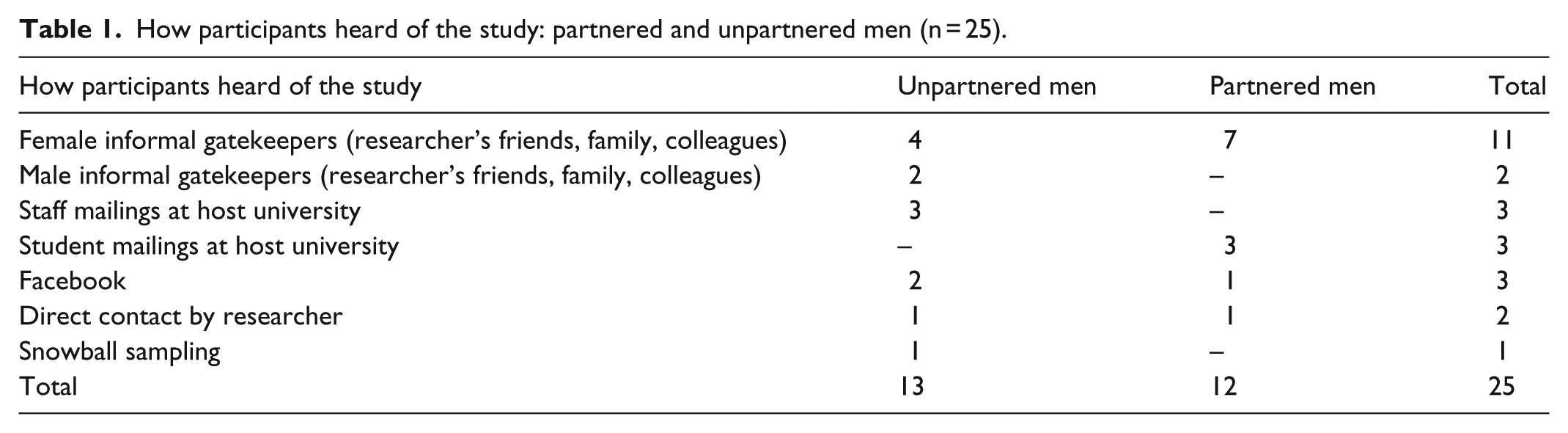
Men who participated reported having heard about the study via personal contact from friends, family members or colleagues (n = 13), staff (n = 3) or student (n = 3) mailings at the host university, Facebook (n = 3), direct personal contact from the researcher (n = 2) or snowball sampling (n = 1) (see Table 1).
How participants heard of the study: partnered and unpartnered men (n = 25).
In the final sample, the age range of men was 22–47 years, with a mean age of 31.72. In all, 13 men were single (unpartnered) at the point of interview and 12 were in a relationship (partnered); 15 were White British, 6 were Asian/Asian British Indian, 3 were Black/Black British Caribbean, and 1 was Black/Black British African. Overall, the sample was highly educated with 20 men stating their highest qualification was an undergraduate degree or higher qualification. Interviews ranged from 39 to 122 minutes in length, with the mean length as 88 minutes. Interviews were audio recorded and transcribed verbatim. Data were subject to thematic analysis, utilising NVivo 11.
The following discussion is based upon three sets of data: qualitative reflective data in the form of field notes, a reflective research diary and records of research supervisory meetings; 2 quantitative data regarding the composition of the sample (biographical data) and the ways participants heard about the study; and qualitative data from semi-structured interviews.
CSM, study conceptualisation and design and recruitment
In what follows, I discuss how adopting a CSM approach influenced two particular aspects of conceptualisation, design and recruitment, before reflecting on the most effective recruitment strategy employed: recruiting through informal gatekeepers.
CSM-influenced conceptualisation and design and recruitment strategies
The study was originally conceived as a feminist study, seeking to challenge the overemphasis on women in reproduction research, and research on delayed childbearing in particular, which overemphasises female responsibility (Culley et al., 2013; Jamieson et al., 2010; Lloyd, 1996). In both academic and popular discourse, discussion and debate have focused on the factors that contribute to women ‘delaying childbearing’ and how this ‘problem’ can be addressed (e.g. Boivin et al., 2013; Everywoman, 2013; Marteau, 2013) and men’s roles in delayed parenthood have received scant attention. Following this initial feminist conception, during the early stages of study design it became apparent that feminist-informed CSM would be an appropriate framework for the study – enabling a critical investigation of men, reproductive timings and gender power relations. The research scope, aims and objectives were constructed over time and developed in accordance with principles of CSM. Adopting a CSM approach encouraged me to conceptualise and foreground men as gendered beings, critically consider the relationship between men as gendered beings and the research topic as a gendered topic (i.e. a topic traditionally associated with women) and build this conceptualisation into the study throughout including design and recruitment. The following section describes two deliberate strategies undertaken in designing and conducting the study in accordance with CSM: (1) including unpartnered men in the sample and (2) addressing men’s absence in reproduction research in recruitment materials.
Recruiting unpartnered men
Social studies of reproduction which do include men often include partnered men only and do so in the context of their couplehood, for example, recruiting both woman and their male partners to take part in research, either in joint or separate data collection activities, or recruiting men through their female partners (i.e. female partner as gatekeeper). This is entirely understandable, for both practical reasons (as a means of reaching and recruiting men) and because it may be appropriate given the study aims. However, this excludes unpartnered men rendering them invisible and, particularly when recruitment occurs with or through female partners, this is problematic for reproductive justice and may serve to reinforce a gender order in which women are positioned as central in matters of reproduction (Fledderjohann and Roberts, 2018). Recruiting men with or through female partners presupposes that orientation to reproduction is something that only comes into existence for men in the context of a romantic relationship or is only of importance to researchers at this stage. While intimate partners are instrumental in the construction of men’s procreative consciousness (Marsiglio et al., 2001), a reductionist interpretation of this denies men any views, attitudes or imaginaries prior to the onset of an intimate relationship.
I actively sought to include unpartnered men in my sample. In coming to this decision, I considered several study designs which would all enable me to investigate the broad topic of men and reproductive timings, including recruiting both partners in a couple unit for data collection potentially using joint interviews and recruiting existing fathers to elicit retrospective accounts. The decision to include unpartnered men was heavily influenced by my engagement with CSM: I was keen to avoid reinforcing gendered scripts which align women with reproduction and which position reproduction as peripheral for men – whereby men become a ‘bolt on’ in research. This approach also enables a focus on men-as-individuals as opposed to men-as-partners. In addition, with regard to considering undertaking joint interviews, while this can allow for observations of interaction and negotiation, it may also result in women dominating the interview, particularly when relating to family building, whereas individual interviews are advised when seeking to focus on men and men’s experiences (Seale et al., 2008). Finally, my decision was further supported by the literature on men and reproductive timings, which highlights the importance of relationship status as a factor influencing men’s decisions about whether and when to have children (Parker and Alexander, 2004; Shirani, 2011).
I also felt this approach was particularly important in a study of reproductive timings in the context of delayed childbearing. It has been suggested that men not living in co-resident partnerships may act as a downward drag on women’s fertility (Jamieson et al., 2010). In addition, recent research on social egg freezing suggests that a common reason cited by women to freeze their eggs is because they are not able to find a suitable male partner (Baldwin, 2017; Inhorn et al., 2017). This suggests that the views of unpartnered men regarding partnership formation and family building are of significance in understanding the wider phenomenon of ‘delayed childbearing’, and that failing to include unpartnered men in research leaves important questions about delayed childbearing underexplored (Thompson et al., 2013).
Among my final sample, over half of the men (n = 13) were unpartnered. This strategy resulted in the collection of novel, rich and detailed data regarding relationship formation and reproductive timings and men’s associated experiences, perceptions, hopes and fears. It resulted in enlightening data regarding the extent to which unpartnered men might indeed, as noted above, be seen to be ‘reducing fertility by being a drag on the process of forming partnerships and parenting with women’ (Jamieson et al., 2010: 482).
Addressing men’s absence in reproduction research in recruitment materials
Taking a CSM approach encouraged me to consider how the gendered cultural scripts which align women with reproduction and disassociate men with reproduction might result in men being less inclined to take part in reproduction research. I was concerned, despite empirical evidence to the contrary (Slauson-Blevins and Johnson, 2016), that men would be disinclined to participate in research concerned with what is widely perceived as a ‘women’s topic’ (Culley et al., 2013; Lloyd, 1996). This may appear an obvious concern, but taking a CSM approach sharpened my awareness of this and my consciousness to address this in recruitment.
I chose to explicitly address this in my recruitment materials. Recruitment text (used in the study website, leaflets, emails, Facebook posts, etc.) and the participant information sheet explicitly stated that ‘most research is carried out with women’ and ‘we know very little about men’s views and opinions’ on the topic of reproductive timings. These sentiments were repeated in interviews, although I did not elaborate further or more formally discuss my feminist-informed CSM position. 3 In adopting this approach, I made transparent the relative absence of men in reproduction research, discussion and debate. I sought to appeal to both men’s sense of helpfulness and their potential perception that this absence was problematic and needed to be addressed. I followed advice from Oliffe and Mróz (2005) that research can be enhanced by ‘providing explicit permission for men to break with the ideals of what men talk about’ (p. 257).
It appears that many participants responded to this strategy. A significant minority discussed their motivations for taking part as relating to the perceived marginalisation of men in reproduction (discussed in more detail below). Introducing the research field in this way – as something in which men are largely absent – also opened up conversations about what this absence, or perceived marginalisation, meant to men, and their related views around gender roles, relations and equality. However, this strategy may have resulted in a biased sample: an over-recruitment of men for whom this idea of men-as-marginalised resonated. The recruitment text may also have stimulated men’s thinking about this, resulting in an over-reporting of this as a motivation for taking part and in a greater proportion of interview being dedicated to discussing this perceived marginalisation than would have otherwise occurred. The potential benefits and drawbacks of this strategy need to be carefully considered in designing recruitment materials and borne in mind in analysis and reporting.
The effectiveness of recruitment strategies
Comparing how I publicised the study with the ways in which participants reported having heard about the study (see section ‘Methods’ above), it is apparent that while some approaches were ineffective (e.g. snowball sampling, publicising via Twitter, Mumsnet and JISCMail groups and advertising via local clubs and centres), others were very effective, particularly recruiting men through informal gatekeepers, which is reflected on in the following section.
Recruiting men through informal gatekeepers
Oliffe and Mróz (2005) argue that ‘men don’t volunteer – they are recruited’ (p. 257), for example, by introduction via mutual friends, colleagues or partners. I sought to recruit participants through my friends, family members and colleagues, that is, engaging these people as informal gatekeepers or mediators to facilitate access with potential participants. I asked friends, family members and colleagues to disseminate information about the study to their social networks. Because my friends, family and colleagues are mainly female, I predominantly engaged female informal gatekeepers. This strategy proved particularly effective: 13 men in my final sample were recruited through female (n = 11) and male (n = 2) informal gatekeepers (see Table 1). These men were the partners, brothers, cousins, friends and colleagues of my friends, family and colleagues. I sought to avoid overly relying on women to recruit their partners, to retain a focus on men-as-individuals rather than men-as partners, and in the final sample, three men were recruited in this way.
However, recruiting in this way can of course have significant implications. For example, by attracting certain types of people and excluding others, this approach is likely to affect sample composition (Browne, 2005; Preloran et al., 2001). In addition, the presence of some form of pre-existing relationship or social connection between the researcher and participant is likely to affect interview dynamics (Browne, 2005). In this study, this was somewhat minimised by the vast range of ways in which participants were socially connected to me: at one end of the spectrum were partners of close female friends; at the other end of the spectrum were more distant acquaintances of acquaintances of mine, and many men fell in between these two poles of ‘social connectedness’ to me.
Furthermore, the use of gatekeepers raises issues of power, coercion and voluntary consent. Researchers have drawn attention to the ways in which gatekeepers’ power may influence potential participants to participate in research – particularly among less powerful groups (Miller and Bell, 2002). While men are not typically considered a powerless group, intimate and family relationships may be highly influential. In this study, while participants were forthcoming in voicing a range of reasons (see below) for participating which appeared to be self-determined, the exact interaction which took place between gatekeepers and participants, and the power dynamics, cannot be known.
There were also positive and unexpected consequences of recruiting part of the sample in this way. Among the final sample, several people – both those recruited through personal contacts and those not – reported taking part because of the salience of the topic of reproductive timings to their lives or to address the perceived marginalisation of men in reproduction. While the views of these men are of great value, I was also interested in collecting data from men less engaged with the topic. Hutchinson et al. (2002) differentiate between two types of narratives pertaining to procreative consciousness among men – those ‘that men had processed prior to interview and those that were generated in the interview itself’ (p. 51) – and given the exploratory nature of the study I was interested in both. I was keen to interrogate the taken-for-granted assumptions of men who assumed they would have children at some point but had given the topic little consideration prior to interview, and to critically explore how these assumptions might reinforce and perpetuate unequal relations between men and women regarding responsibility for reproductive timings. Recruiting through informal gatekeepers meant I interviewed not only men whom the research topic ‘spoke’ to but also men who expected to have children in the future but for whom the topic was peripheral to their everyday thinking. Accessing such data goes some way to addressing what Morison (2013) terms the ‘heteronormative blind spot’ in reproduction research: ‘the general failure to question or to critically consider the parenthood decision-making process of married heterosexuals, albeit passive for the majority’ (p. 1127).
In addition, if we can assume the relationship between gatekeepers and participants were characterised by trust, this may have facilitated trust between the participant and researcher (Emmel et al., 2007). Indeed, the ease at which men spoke about personal and sometimes sensitive issues, and the length of interviews, may suggest a fairly high level of trust.
There are, however, negative consequences of taking this approach in relation to gendered power relations. If we adhere to the notion that an increased focus on men in reproduction research is a positive development because it reduces the burden of responsibility on women, then it is tempting to think that any recruitment strategy which is effective is desirable. However, if this relies largely on using female gatekeepers, such actions may further burden women, whose reproductive workload is further increased by the activity associated with recruiting men into reproductive research. It may reinforce notions that women are responsible for reproduction by being the point of access for recruitment. It could be argued that utilising female gatekeepers exploits existing gender relations and reinforces unequal power relations to the detriment of women.
Men’s motivations for participating
In response to the need to better understand participants’ motivations for participating in qualitative research (Clark, 2010; Peel et al., 2006), and to the paucity of methodological literature regarding men’s participation in reproduction research, specific interview-reflective questions were built into the interview schedule. One of these questions, asked at the commencement of the interview, pertained to men’s motivations to taking part. Many men gave multiple responses and responses can be broadly grouped into three categories: interest, helpfulness and in response to perceived marginalisation.
Interest
When asked why they participated in the study, 16 of the 25 participants reflected that ‘interest’ was one of their motivating factors. This included interest in the topic generally or specifically in relation to them as it was something they were considering at that time: I guess the topic of having children is on my mind because it is sort of planned quite soon … this one I guess caught my eye because it spoke about men’s attitudes to having children which is something quite topical for me in my life so I thought yeah I’ll get involved. (White British male, married, age 30)
Other researchers have identified interest as a motivating factor for research participation more generally (Clark, 2010) and have identified salience of topic as a factor which positively correlates with men’s participation in reproduction research (Harrison, 2012; Slauson-Blevins and Johnson, 2016). The length of interviews (see above) and the fact that men talked a great deal and there were few silences also indicate that this was a topic of great interest to men. I found, as Oliffe and Mróz (2005) did, that ‘most men enjoy having someone attentively listen to their point of view, and the interview provides a unique opportunity to be heard’ (p. 258). Considering this from a CSM perspective, this may be because talking about reproduction was a welcome novelty for men in part because such opportunities are rare in their gendered lives.
Men also reported taking part because they were interested to see how they would respond to the questions, in having the opportunity to reflect and in how the interview might prove revealing: It’s a subject that is very close to my heart at the minute so it is something that I was interested to see how I reacted to some of the questions, what questions you were going to ask. So yes I am intrigued by it definitely. (White British male, not in a relationship, age 38) I am interested in reflecting on children … I think that this interview will allow or provide some kind of stimulus to frame or structure my own thinking about having children which is a serious topic I am considering. So I think that I am (pause) using you as much as you are using me. (White British male, not in a relationship, age 30)
This idea of the interview as something revealing for men, and an opportunity to frame their thinking, was an unexpected and particularly striking set of responses. Particularly interesting was that this was not only something that men reflected on at the end of the interview (although this was indeed the case as well – see below) but that men also actively choose to participate for these reasons. Overall, it was apparent that having children did matter to these men and was of interest to them, and that this was one of the key motivating factors for participation. This suggests the absence of men in reproduction research should not be automatically misinterpreted as resulting from men’s disinterest in this topic.
Helpfulness
Men’s desire to be helpful, either in a general sense to help me personally or to help advance knowledge and society, was also a motivating factor with 12 men reporting this motivation. This suggests that the strategy described above – referring to the absence of men’s voices in reproduction research and thereby appealing to men’s sense of helpfulness and desire to contribute – was somewhat effective: the opportunity to be helpful appeared to appeal to men: I am quite happy to help out on things like this because if no one volunteers, no one gets any information, you can’t progress. (White British male, not in a relationship, age 47) I just wanted to help out somebody who wanted some research, it’s just nice to help out with those sort of things. And if nobody volunteered then nothing would get, no knowledge would get accrued. (White British male, in a cohabiting relationship, age 37)
That men were motivated by a sense of helpfulness can be interpreted in several ways. On one hand, it echoes dominant masculine scripts which place value upon instrumentality, productivity and contribution (Fournier and Smith, 2006). It echoes findings from other researchers that appealing to men’s ‘courage and strength’ by positioning oneself as ‘in a major spot of bother’ in need of their help (Butera, 2006: 1276) is an effective strategy. On the other hand, however, helpfulness is often considered a feminine trait (Walkerdine, 1989). That it can be interpreted in different ways illuminates the danger of, when studying men and masculinity, falling into the trap of uncritically interpreting men’s behaviours as performances of hegemonic masculinity and thereby re-essentialising men. Indeed, literature suggests that altruism is a key reason why people in general participate in research (Peel et al., 2006); as such, it may be that over-attributing altruistic motivations to gendered subjectivities amounts to a misconstruction.
In response to perceived marginalisation
A smaller proportion of men (n = 7) reported that their motivation to take part was in some way political. Men described taking part because of a perceived marginalisation of men in reproduction, in general, or in the topic of reproductive timings specifically. This may be indicative that the reference to the absence of men in reproduction research in recruitment materials (described above) resonated with some men. Men felt there should be a greater focus on men in reproduction research and/or public discourse around reproduction more generally. Several reported feeling that men are somewhat excluded and their role in reproduction invisible and under-acknowledged: It’s good that you are doing it with men because a lot of people when it comes to children they are like ‘no men don’t matter we don’t want to hear about what men have to think, we are not interested it’s all a women’s subject’ … So this is probably the main reason why I agreed to do it because I feel like men have to have a voice. (Black/Black British Caribbean male, in a relationship but living separately, age 29) A lot of people always consider the female point of view and ignore the male point of view with regards to when is the right time to have kids … obviously women have a biological clock whereas men don’t but within there is still a clock I think, it’s not exactly biological, but it’s a more of an emotional and a social clock, that is still ticking. And I think it would be nice to explore those in society, let people understand there are those elements more so than has really been acknowledged in the past. (White British male, in a cohabiting relationship, age 37)
This suggests that men recognised the social construction of gender in ways that felt disadvantageous to them and sought to challenge, resist and unsettle this perceived marginalisation and make their voices heard.
However, a CSM approach necessitates the need to examine this more critically. In designing the study, I sought to challenge gender power relations and the gender order – a key feature of CSM. However, while several men participated for political reasons, only one man positioned this in terms of reducing the burden on women. It became apparent that the absence of men was perceived by many as disadvantageous to and unfair on men – and it was this they sought to challenge. They were less concerned with the ways in which the absence of men might disadvantage women and the need to address this. As such, as identified by Beck and Beck-Gernshein (1995), men may be reaping the benefits of feminism-informed CSM without ‘any of the struggle’ (Deeney et al., 2012).
In summary, the range of men’s stated motivations, while in some senses particular to the participation of men in research on a gendered topic (e.g. men’s keenness to challenge a perceived margination of men), also echo other literature regarding research participation among a variety of groups across a range of topics (Clark, 2010; Peel et al., 2006). That men’s motivations align closely to research participation motivation among other groups goes some way to debunking the assumption that men are ‘hard to reach’.
Men’s reflections on the interview
To further contribute to methodological considerations of engaging men in reproduction research, at the end of the interviews, men were asked to reflect on their experience of taking part. While this type of questioning may be more likely to elicit positive responses, as a form of social desirability bias (Bryman, 2012; Peel et al., 2006), it is not possible to ascertain the precise extent of this. With this limitation in mind, the data were nevertheless revealing about men’s engagement in reproduction research.
A considerable proportion of participants reflected on the interview as stimulating in some way and as providing an opportunity for them to develop (rather than report) their views and future imaginaries. A total of 10 men reported that the interview had enabled them to challenge and form their views and plans, to consider things previously unconsidered and to achieve clarity of thought: It’s been fun, definitely fun, I got to learn a lot about myself. And I can go back home now and reflect and think ‘hmm when do I want to have children? … So yes it’s been very very, very exciting for me just to be part of it and get to learn about myself as well as give you my thoughts. (Black/Black British African male, not in a relationship, age 23) It’s like therapy because I can talk about it and discuss, you know, that’s why I was being quite rambling because you are circling round and working out your own viewpoints. (White British male, in a cohabiting relationship, age 37)
Indeed, it became increasingly apparent to me as the researcher that frequently men were considering and forming their views and their ideas about the future within the discussion, as opposed to presenting pre-formed views. The interview was a site not for reporting narratives but for constructing narratives, for simultaneously developing and articulating procreative consciousness (Marsiglio, 1991). As Marsiglio (1991) argues, procreative consciousness is likely to be dynamic, fragmented and potentially ‘nebulous, temporary and unstructured’ (p. 270). The fragmented and under-developed nature of procreative consciousness was particularly evident in men’s reflections on the interview experience and suggests that research interviews may be an effective way of stimulating this consciousness. While it is well recognised that all interview narratives are constructions, and all interview encounters produce a particular kind of construction (Silverman, 2017), the interview-situated construction and men’s awareness of this was particularly striking in this study. While critics might question the value of narratives that are developed within the interview, taking a constructivist approach (Layder, 2006), I would argue that all research narratives are accounts, co-constructed within the research setting, and well-rehearsed accounts are no more or less ‘authentic’.
If, as using a CSM-informed approach would suggest, gender operates in men’s lives to suppress considerations of reproduction and men have less opportunity than women to construct a narrative on this topic in ‘real life’, then participating in a reproduction focused interview enables them to deviate from this gendered script. While men did not explicitly relate this to gender themselves, some did identify a lack of discourse upon this topic in their everyday lives: It was quite interesting actually, it made me think about what I was doing myself because if someone asks you a question you have to think about your response to it. Whereas if no one asks you sometimes you don’t think about things like that. (White British male, not in a relationship, age 47)
This absence-of-discourse regarding wider aspects of reproduction, in particular, desire and planning or preparing for parenthood, is in contrast to the growing discourse of the engaged nurturing father (Culley et al., 2013; Dermott and Miller, 2015). In designing studies, researchers might benefit from actively considering in advance how aspects of reproduction feature or do not feature in the gendered constructions of men’s lives, and how this might produce a particular type of data (Hutchinson et al., 2002).
Discussion
There is debate as to whether it is indeed desirable to include men in reproduction research. Some have argued that the predominant focus on women overemphasises female responsibility, implicates women’s behaviours in reproduction-related ‘problems’ (e.g. ‘delayed childbearing’) and reinforces the burden on women (Culley et al., 2013; Jamieson et al., 2010; Lloyd, 1996). However, others warn that the increased interest in and emphasis on the importance of fatherhood brings dangers in terms of reinforcing men’s control and women’s dependence, asserting the traditional heterosexual nuclear family and strengthening the pro-family and anti-welfare rhetoric of the right (Segal, 2007). I would argue that it is essential to include men in reproduction research, in order to address the unequal power relations which burden women, while marginalising men, and that adopting a CSM approach offers a way forward in guarding against these dangers because of its critical lens on asymmetrical relationships between men and women (Lohan, 2007) and its constant examination of power within analyses (Hearn, 2004). As Hearn (2004) argues, one way to mitigate against risk of re-excluding women ‘is to consistently examine the specific ways in which men exist as and in gendered power relations, with women, children, young people and each other’ (p. 50) – a central pillar of CSM. It is also essential for reproduction research to be inclusive of men in order to ensure the evidence base used for reproductive or family-related policy does not reinforce the female reproductive burden (Fledderjohann and Roberts, 2018).
An additional danger, one associated with adopting a gender-critical analysis to the study of men, is that in doing so we re-essentialise men. This concern is particularly pertinent given the wider deconstruction of gender and gendered identifies occurring in academic and political spheres (Josephson et al., 2016). However, I would agree with Lohan (2015) that it is necessary to study men and masculinities in this way, albeit seeking to constantly critically consider what constitutes hegemonic masculinity and the ways this concept is challenged and disjointed, as doing so enables us to address ‘questions concerning the salient cultural and symbolic ideals of masculinities in a given context and how power relations among men may be structured around such ideals’ (p. 219). As Fournier and Smith (2006) assert, a concern with dualism is necessary if we are to understand and challenge relationships of dominance and inequality between men and women; indeed, progressive gender politics depends on this.
Despite the great potential CSM holds for reproduction research, there is a paucity of interrogations of epistemology, methodology and theory within CSM (Pini and Pease, 2013). This article has advanced discussions of CSM-informed methodology by demonstrating how it can be applied to study conceptualisation and design and considering how it can enhance understanding of participants’ motivations for participating in, and reflections on, the research process. The opportunities afforded by CSM in reproduction research and the ways in which it can be incorporated methodologically are ripe for further exploration.
The article has aimed to advance methodological insights and understandings in two ways. First, it presents an account of design and recruitment which may be of value to future researchers in designing studies. The second is by demonstrating the value of incorporating methodology-reflective data collection into study designs, in this case, including questions about motivations and reflections. This approach is seldom adopted by researchers, and while findings must of course be read with caution, it can offer rich and valuable insights in order to advance methodological understandings, influence the design and conduct of future studies and address the paucity of methodological literature regarding men’s participation in reproduction research.
The strategies discussed and reflections offered in this article are by no means a comprehensive guide as to how to conduct reproduction research with men. Rather I seek to add to the small but growing literature which considers how to include men in research, particularly those concerned with topics traditionally dissociated with men. If and how reproduction researchers seek to include men will be highly dictated by a given study’s aims and philosophical positioning. However, if these allow, researchers might want to consider including unpartnered men in their sample and recruiting heterosexual partnered men independently of their female partner, appealing to men’s sense of helpfulness and the absence of men’s voices in recruitment materials and recruiting men through friends, family and colleagues. Approaches which treat men as individuals, rather than men as partners, which address the absence or marginalisation of men and which acknowledge men’s interest in having children might also have value in the development of men’s health policies and reproduction service design. Researchers might also consider asking participants about motivations, reflections and other methodological aspects to improve our understanding of ‘what works’. Scholars seeking to adopt a CSM approach might find it beneficial to explicitly consider how this can influence study design from the outset.
Limitations
Despite efforts to recruit a diverse sample in terms of socioeconomic status, my final sample was predominantly middle class and this was likely enhanced by a strong reliance on recruiting through my predominantly middle-class family, friends and colleagues. Further work is needed to explore how reproduction researchers can better engage a diverse range of men. In addition, the majority of research exploring reproductive timings neglects to explore the ‘couple’ perspective; further research is required to investigate this and to interrogate intra-partner negotiations.
Conclusion
This article has drawn on reflections from a qualitative study into men’s perceptions and intentions regarding the ‘right time’ to have children in order to advance discussions about how we can better include and engage men in reproduction research. It has presented these reflections in relation to CSM, as both a theoretical position influencing the conception and design of the study and as an explanatory framework for enhancing methodological understanding. It has sought to contribute to knowledge of both men and reproduction research, and CSM and methods. It is essential that reproduction research better include men in order to challenge the overemphasis on female responsibility and the marginalisation of men, and that reproduction researchers expand this methodologically reflective dialogue in order to advance this important agenda.
Footnotes
Acknowledgements
My sincere thanks to all the men who gave of their time to participate in this study. Thank you also to De Montfort University, Leicester, UK, for funding and supporting the PhD study. I am extremely grateful to those who provided feedback on earlier versions of this manuscript, in particular, Prof Lorraine Culley, as well as Prof Nicky Hudson and the Centre for Reproduction Research Writing Group, as well as the anonymous reviewers who provided very helpful comments, and to my supervisors Prof Nicky Hudson and Dr Sally Ruane for their guidance and support throughout the study.
Declaration of conflicting interests
The author(s) declared no potential conflicts of interest with respect to the research, authorship and/or publication of this article.
Funding
The author(s) disclosed receipt of the following financial support for the research, authorship, and/or publication of this article: This work was supported by De Montfort University, Leicester, UK.