




Abstract
In this article, I discuss a queer method for uniting visual sociology, digital sociology, and constructivist grounded theory to conduct innovative research into how lesbian couples experience the transition to first-time parenthood, based on my longitudinal doctoral research in sociology. I first attend to the complex and unexpected unfolding of the research design, which evolved with the needs of the population to move from adapted photovoice interviews to the use of textual–visual online pregnancy journal data in a process emblematic of queer methodology. I then consider the contributions that visual data can make to the study of reproduction, especially where marginalized populations are concerned, by using my data to demonstrate how visuals create what is possible, rework oppressive versions of time, and challenge controlling images imposed on reproducing bodies. I argue here not just for the significance of images but for the significance of taking seriously the products and processes that communities find meaningful, and for evolving our research methods and methodologies to centralize marginalized ways of existing, knowing, and archiving experiences of reproduction and family life.
Keywords
Introduction
A significant portion of lesbian women who are navigating reproduction are building their own visual archive comprising virtual pregnancy journals, photographic and videographic blog posts, image-driven conversations, and many forms of artwork, and are making their challenge to the naturalized link between heterosexuality and family visual through images they create and share on their own terms. Examples of this visual archive abound: From graphic novels like Pregnant Butch (Summers, 2014) to the 12-part weblog Queer Mama for Autostraddle to the images tagged with #twomoms on Instagram, what Gabb (1999) calls “the imag(in)ed queer lesbian family” is certainly growing in visibility. To establish the importance of these queer-created visuals, especially in social science inquiry surrounding reproduction and family life, I draw here on my own methodologically innovative research with and for lesbian couples across the transition to parenthood, to argue for not just the significance of images but for the significance of taking seriously the artifacts, and the archiving of them, that communities find meaningful and for evolving our research methods and methodologies to centralize marginalized ways of existing, knowing, and archiving.
Both substantively and methodologically, my research benefits from the foundation laid by scholars of lesbian parenting and its gendered (Sullivan, 2004), reproductive (Mamo, 2007), familial (Agigian, 2004), and social (Goldberg, 2006) aspects. I also am indebted to the growing field of lesbian, gay, bisexual, transgender, and queer (LGBTQ) families research (e.g. Bos, 2013; Gabb, 2013; Nordqvist, 2014; Patterson and Riskind, 2010), which, although at times is heteronormative and limited, has named and claimed a space for LGBTQ families within social science inquiry. While much of the valuable knowledge developed by these and other researchers relies on traditional interviews, ethnography, and surveys, most also leverages a combination of methods across multiple sites and with varying invested parties, and so a queer method comprising visual and digital data and striving to explicate new researcher/participant relations is hopefully a welcome addition along the path they have forged. By focusing my research around visual and digital data, I have constructed a deeper, more nuanced understanding of the transition to parenthood for lesbian couples and have prioritized data from materials that queer women asserted were meaningful to them by engaging visuals; this approach allows me to expand our knowledge of lesbian family building by, for instance, furthering Hayman and Wilkes’ (2017) three central processes—becoming mothers, constructing motherhood, and legitimizing our family—into richer processes such as constructing and validating the queer pregnant body; negotiating with medical authority and its normalizing, yet exclusionary, functions; and navigating emotional complexities that result from reproductive inequalities, each of which I discuss in my broader research. While my substantive agenda lies in exploring the intersecting familial, reproductive, gendered, and sexual processes that lesbian couples experience as they become first-time parents, my methodological agenda is to centralize and advocate for tools that marginalize communities have created for themselves and to take seriously the artifacts that result when marginalized communities document their lived realities in empowered and empowering ways.
With this background in mind, the contention of this article is twofold. First, I argue that the visual, as it is constructed in its sociohistorical moment, reveals something about the current social world that relying solely on the textual, whether written or spoken, cannot, and, thus, the visual is a key component of constructing research with, about, and for marginalized groups. Second, I argue that queer 1 women are archiving their experiences with familial, reproductive, and gendered processes in unique visual ways that research(ers) should engage with seriously. In this article, I draw on my doctoral research with lesbian couples across the transition to parenthood in order to demonstrate the above arguments. Such a contention hopefully will shed light on the potential substantive contributions that can result from engagement with visuals and will facilitate deeper conversation among researchers around how to collaborate with marginalized groups in antioppressive ways.
A queer methodological journey
The argument presented in this article forms the methodological basis of my doctoral research in sociology and is drawn directly from the data I have worked with in researching and writing my dissertation. Over the course of 2 years, I constructed visual and textual data from 20 long-term, cohabiting lesbian couples residing in the United States during most or all of their transitions to first-time parenthood. The data compiled span the course of trying to conceive (TTC), pregnancy, birth, and early parenthood, and, thus, account for 1.5 to 2 years’ worth of data from each couple. I conducted “photo-rich” interviews, adapted from Wang and Burris’ (1997) photovoice technique, with three couples across this time span, and constructed data from 17 couples using publicly accessible online pregnancy journals, where the authors identified themselves as lesbian women in a long-term partnership during the transition to parenthood.
The needs of this population drove the unfolding of the research design, which I adapted several times in order to innovate in the area of recruitment and better align the goals of my research with the meaning-making and archiving processes already occurring. In particular, couples who could not invest time and energy in photo-rich interviews but had been or would be keeping a textual/visual online journal of their experiences shifted my approach midproject and guided my methods down a path that is emblematic of Halberstam’s (1998) characterization of queer methodology as a “scavenger methodology,” which “uses different methods to collect and produce information on subjects who have been deliberately or accidentally excluded from traditional studies of human behavior” and “attempts to combine methods that are often cast as being at odds with each other” (p. 13). My research invokes a similar process, but one that I instead term a “preservation methodology” in order to highlight the vitality and liveliness of what I have collected. Bringing together the visual, textual, and digital in this way is a rare approach in my home discipline of sociology, but is what the population and research question have, in a winding and unpredictable way, demanded of my research. Building my methods around the needs of queer women by following their ways of conceptualizing and archiving their experiences is made possible by adopting such a queer method.
As Ward (2016) argues, Queer methods can certainly offer us new research techniques, such as including an expansive list of genders on one’s survey questionnaire. But queer methodology is also more than this; it is a praxis aimed at undoing prevailing assumptions about epistemic authority, legitimate knowledge, and the very meaning of research. (p. 71)
In keeping with this assertion, my research contains more than a strategy for tapping into a more inclusive idea of family life—it is an attempt to create and prioritize devalued knowledge from the places and experiences that queer people consider meaningful to them/us, and also a challenge to “traditional” methods that limit our ways of seeing the social world in favor of an innovative scavenger or preservation methods that queer research. My research, thus, adds to a small but tenacious—and recently reinvigorated (Brim and Ghaziani, 2016)—tradition of innovating with and for queer people in research, building on, for instance, the use of desire and flirtation to critically engage with power in research relationships (Tweedy, 2016), the use of geographical–spatial research based on queer–feminist principles (Misgav, 2016), the use of queer theory to trouble the public/private binary in equality discourse (Dadas, 2016), the use of community-led storytelling (Valentine, 2016), and even the reclamation of quantitative methods and emergent technologies to promote queer indeterminacy (Haber, 2016), to name but a few recent examples of queer methods. Furthermore, my queer method emanates from my own community, as much research with LGBTQ+ individuals does, and so resonates with Dahl’s (2016) observations about what she terms queer femme-inist research: It seems to me that while queer theory is growing increasingly salient in interdisciplinary gender studies, to ‘straight’ science there is always something academically queer about the desire to be with and write about one’s own, even if it is not a territorialized, localized or even always visibly recognizable stable community. (p. 144)
Such a lack of recognition—of methodology, of community, of population, and even of researcher identity—creates the conditions for me as a queer femme (and feminist) woman-identified researcher to pursue a deeper understanding of the transition to parenthood for lesbian couples through a preservation methodology of photos, blog posts, interviews, field notes, and time spent holding the babies of queer women who create families together.
Queering photovoice: photo-rich interviews with lesbian parents-to-be
A queer method that centralizes a visual archive necessitates a queering of how visual methods have been taken up in the social sciences, beginning from the basic assumptions of researching (with) the visual and extending them toward queer participants and a queer process. In terms of epistemology, visual sociology first and foremost carries the assumption that “the world that is seen, photographed, drawn or otherwise represented visually is different than the world that is represented through words and numbers” (Harper, 2012: 4). That is to say, as researchers we are able to construct different, if overlapping, data from visual and textual sources. For researchers interested in constructing understandings of the social world, there are more tools available than (merely) text and numbers. A further assumption of visual sociology is that images are never neutral, but are constructed and produced by individuals; indeed, “what you expect to see and what, even if you did not expect it, you can understand and make sense of—your theory—shape the images you finally produce” (Becker, 1974: 11). Finally, visual research has evolved such that a critical visual approach is common in the field, which rests on three tenets (Rose, 2012: 16): taking images seriously (centrality), thinking about the social conditions and effects of visual objects (contextuality), and considering the researcher’s own way of looking at images (reflexivity). These epistemological assumptions guided my research at every stage, from inception to writing.
A major component of the data in my research is what I have termed “photo-rich” interviews, inspired by and adapted from Wang and Burris’ (1997) photovoice technique, originally designed to assess women’s community health concerns through images and narratives produced by the women themselves. Based on both feminist theory and Freire’s (1974) education for critical consciousness, photovoice was created as a process by which people can identify, represent, and enhance their community through a specific photographic technique. It entrusts cameras to the hands of people to enable them to act as recorders, and potential catalysts for change, in their own communities. (p. 369)
In short, the method involves a series of photographic assignments that are meant to be completed individually but discussed in small groups led by the researcher in order to craft visual and textual narratives about the needs of a particular community—in the original case, women’s health in China and the United States—and then to convey those community needs to individuals, organizations, and groups with the power to act on them (Wang, 1999). In recent years, photovoice has been developed beyond its initial conceptualization, but retains the feminist and critical underpinnings in much of the research that falls under its umbrella. For instance, Nash (2012) adapted photovoice in her research with pregnant bodies by employing a feminist phenomenological interviewing style with open-ended questions rather than utilizing the more procedural “SHOWeD” method detailed by Wang (1999). Nash’s participants also selected their most important photos as individuals for display at a public exhibition, rather than deciding as a group which photos to present to policy makers, as recommended in the photovoice method.
As Nash (2012) and other researchers have done (e.g. Bonmatí-Tomás et al., 2016; Williams et al., 2016), I adapted several of Wang and Burris’ (1997) initial components based on the needs of my participants and the constraints of the study. This led me to a technique I call “photo-rich” interviews, which takes some assumptions and processes from photovoice but makes important departures, based on both a queering of the process and the input of queer participants. My research relies on couple-centered interviews rather than the prescribed small-group interviews, a choice I made based on the disparate geographic locations of the couples, a desire to understand their couple context, and the understanding that queer couples remain overlooked in social science research. I gleaned important information from the couple context that likely would have been less apparent in small-group settings and was able to develop strong rapport and gain a glimpse into their family life while interviewing—both of which furthered the queer goals of my research. As the couples did not all reside in the same location, I used online technology like Skype to interview some of the couples, which is a technology that traditional photovoice typically does not employ. In addition, I found the “SHOWeD” method to be formulaic and not compatible with the emergent and open-ended nature of my research, informed by Charmaz’s (2014) emergent and iterative version of constructivist grounded theory, and so, instead, I allowed each couple to speak first once the photograph was shared. I then followed up on the answers they gave with probing questions such as “what were you feeling when you/your partner took this photo?” and “what was happening just outside the frame of this photo?” to ensure that both the formal and substantive qualities of each photo were attended to. In sum, my photo-rich interviews proceeded as follows: after agreeing to participate in the study, I conducted initial interviews with each couple, during which I became familiar with their couple context, their history, their reproductive journeys thus far, and their family-building plans. At this initial interview, I also conducted a brief training on the ethics of photography, institutional review board stipulations, and the process we were embarking on together. In the following 4 to 6 weeks, each couple took a series of photographs relating to a theme of their choosing—for instance, “celebration,” “holiday traditions,” or “family”—and shared them with me. We scheduled an interview to discuss the photographs and any changes or progress in their journeys. This proceeded in a cyclical manner until approximately 1 month after the birth, when I had a final photo-rich interview with each couple.
Three couples were willing to invest their time and energy into the above process, and I conducted multiple interviews with each of them over the course of pregnancy, birth, and early parenthood. I focused my recruitment efforts on birthing centers, LGBTQ+ resource centers, and online support groups; yet, given the investment the research required, the overburdening of queer individuals in research, and the reality that queer women were already archiving their experiences elsewhere, I experienced challenges securing participants. In the midst of my struggle to garner interest in my research, one trying-to-conceive lesbian couple expressed a desire to participate but could not commit to the time-intensive process of ongoing photo data collection and interviews, and instead, referred me to follow along with their online pregnancy journal. This referral opened up a new data source that I was previously unfamiliar with, yet represented a significant space where lesbian couples were already doing what my photo-rich interviews were designed to do: archiving their transition to parenthood in visual and textual ways, on their own terms. This couple shaped my research in an important way and invited me into a network of lesbian parents-to-be who were already sharing their experiences visually and online. From this couple’s online journal, I used the “blogs I follow” or blogroll feature to assess the breadth of the community and snowball sample 17 further blogs that met the criteria for inclusion in this research. “Following” the data—and the community—in this way bore out my dedication to emergent and queer research, and so, despite the lack of validation for such preservation methods, I pursued digital and visual research in combination.
Queering, again: online pregnancy journals and the (digital) transition to parenthood
Health-related events and life transitions, such as most events in our current time, are experienced both online and offline for many individuals and families (Kivits, 2009). In particular, constructing communal knowledge about families and health and accessing support from those engaged in similar processes from similar social locations can empower and validate those navigating the transition to parenthood with little offline social support, and can reclaim the experiential knowledge that women and mothers create about their own reproductive journeys (Madge and O’Connor, 2006; Zaslow, 2012). Lesbian women, who find themselves lacking the information, resources, and support that opposite-sex couples find for their family-building, are constructing dynamic and engaged online community archives that are based on longitudinal explorations of their own experiences. The digital data in my research, then, meet lesbian couples where they are at, in both understanding and process, and take seriously what is important to them.
Several researchers have identified the potential for digital methods to make difficult-to-find populations, like LGBTQ+ youth, more accessible (Brownlow and O’Dell, 2002), while also lowering the risk to them and facilitating healthy research participation that overcomes barriers and stigma (McInroy, 2016). This was certainly the case in my research, as lesbian couples communicated that their online pregnancy journals were an already-established community where they felt secure in sharing their experiences, in contrast to the perceived risk that participating in interviews with a researcher might entail. Because LGBTQ+ populations are overburdened in research—or experience what Clark (2008) calls “research fatigue”—and have faced particularly oppressive relations to scientific and medical research, especially with regard to reproduction and family life, I see the use of digital data as a benefit to my research, the larger bodies of work that it intersects with, and the lesbian mothers themselves.
Despite these benefits of adding digital data to my queer preservation method, scholars have aptly identified the limitations of and differences between online and offline data, which I have carefully considered in my research. For instance, without researchers shaping the dialogue, the themes explored are within the control of the blog authors rather than researchers, which Bone et al. (2016) and Roberts (2015) both cite as a possible limitation due to the fact that topics of interest to researchers may not be pursued when blog authors control the dialogue; however, in this case, such a condition is ideal since it connects with my goal of having participants demonstrate to me what is important about their transition to parenthood experiences. While I was not afforded the opportunity to probe statements of interest, I did receive in-depth insight into how lesbian couples experienced, conceptualized, and conveyed their transitions, and did have some hand in constructing the data as I located, collected, and analyzed them. Similarly, online and offline data might not be comparable—in form, in construction, or in content—yet, this also does not necessarily function as a setback. As I discovered during analysis, the themes explored in the digital data and the interview data are strikingly similar; for instance, the interview data and the online data are both preoccupied with forging mother identities and establishing motherhood in the face of challenges, constructing and validating a body that is simultaneously queer and pregnant, and negotiating different relationships to pregnancy, birth, and parenting based on relationship to the child. Furthermore, the online data are richly visual, just as the interview data, and so they work well as complementary sources. The 1460 visual/textual online journal entries joined 67 interview photos and textual data from interviews with three couples (a total of 13 interviews, taken all together), to form a varied and vibrant body of longitudinal data that spans between 1 and 2 years of each couple’s life and is constructed by and for lesbian women. Each piece of data in my research represents a moment or an experience that lesbian couples consider significant, and each centers the marginalized as the creators and bearers of their own knowledge, both central tenets of a resilient and emergent queer method.
I collected the full data set in MAXQDA, a popular qualitative data analysis software that is capable of processing not only text but also images, sound files, and other nontextual pieces of data. The expansive functionality of MAXQDA allowed me to deidentify and analyze the data both as an integrated body and as a collection of individual pieces simultaneously. I analyzed the textual data in the tradition of Charmaz’s (2014) constructivist grounded theory, an inductive and iterative coding scheme that attends to processes in the data. Coding in constructivist grounded theory typically begins with line-by-line assignment of gerunds that identify processes occurring in each line of data, and increases in abstraction with subsequent passes over the data such that interactions and connections between codes begin to explain a larger category that emerges from the data. For instance, the category “validating the queer pregnant body” includes the processes of “performing appropriate size and shape” and “having the right to ‘family’ spaces challenged by others.” For the visual data, I used a social semiotics approach (Van Leeuwen, 2005) to code the images for sociocultural meanings embedded within them and processes depicted by them. I considered both the formal elements of the images along with the content portrayed within them, and sought to understand the photos as both stand-alone data and as intertwined with the textual data the couples shared while discussing the photos, with the photos always relying on shared meanings to communicate experience. To maintain continuity with constructivist grounded theory used to analyze the textual data, I coded the photos with gerunds in order to construct processes related to doing family via images (Finch, 2007). The significance of doing the research in this way, rather than the categories and processes to emerge from my analysis, form the argument below concerning what the use of visuals in a queer method for studying reproduction can contribute to our substantive and methodological knowledge.
Visuals create what is possible
By Bourdieu’s (1990) account, that which is not photographed in society is that which is not photographable; thus, by denying visibility and visualization to lesbian mothers-to-be in social science research, via erasure, marginalization, or forced assimilation, these women become unrepresentable. When we refuse to visualize an experience, or deny the visuals that individuals are producing around an experience, we are communicating that the experience and its corresponding identities should not be represented—an assumption that much social science research on families has long perpetuated by implicitly and explicitly associating “family” with heterosexuality and denying the long, rich history of women parenting together (Rivers, 2013). To this point, Bourdieu (1990) argues that a visual represents the “ontological choice of an object which is perceived as worthy of being photographed, which is captured, stored, communicated, shown and admired” (p. 6). And so, the inverse—if it is not and should not be visualized, then it is not and should not be worthy.
In this way, visuals of queer reproduction and family building provide an opportunity for those cast as unrepresentable, by both society and research, to represent themselves on their own terms. The images in my research were constructed by lesbian women and, more important, were curated by them as well. That is, the women intentionally chose which visuals to share with me and with a broadly accessible public forum (the Internet) as representations of themselves and their experiences. This process of curating images is akin to that of reflecting on how the world will see you and constructing a desired physical or bodily appearance, which, for queer women, is often an agentic, defiant, or otherwise significant way of communicating information about oneself (Halberstam, 1998), can serve to establish expectations and structure interactions (Moore, 2006), and frequently creates new and dynamic links between gender identity and sexual orientation (Rossiter, 2016). Curating and presenting an image, whether it be an embodied gender presentation or a family photo, is a way of broadening the realm of the possible and taking ownership of how one is seen in the world.
Experiences of queer reproduction particularly lack visual schema, and so, the creation and dissemination of images can create pathways into both queer families and communities—including biological and “fictive” or chosen (Weston, 1991)—for those who otherwise do not see themselves represented. Visuals of opposite-sex reproduction and family building are ubiquitous; our visual field is saturated with ostensibly happy women and men raising children and building healthy families, which communicates strong social support for such a practice and further enshrines such a family structure as “normal.” In contrast, visuals of happy, healthy same-sex families are incredibly limited in US media, potentially weaponized against queer individuals, and ultimately lacking in the diversity of race, class, religion, nation, and structure that queer individuals and our families represent. 2 As Mitchell (2005) argues in What Do Pictures Want? “we don’t just evaluate images, but rather images introduce new forms of value into the world, contesting our criteria, forcing us to change our minds” (p. 92). If images indeed produce new arrangements and perceptions of the world through their world-making capabilities, and if values about who can and should reproduce are circulated through visual representations, then queer reproduction enters the realm of the possible and the valuable through the visual.
Visuals created by and for queer individuals, then, pose challenges to hegemonic notions of gender and gender presentation, sexuality, and family. They disrupt what is enforced and replace it with what is experienced—the messiness of gender, the networked-ness of family, and the myriad confluences of sex, gender identity, gender presentation, and sexuality that individuals inhabit within their families. In this photo from my research, gestational parent Vanessa forces us to reevaluate how we sort bodies and activities into a feminine/masculine dichotomy (Figure 1). We lack schema for a White masculine-of-center pregnant woman baking with her feet propped up, and so Vanessa challenges assumptions that masculine women do not desire to become pregnant, that masculine women do not perform care work but are rather cared for by feminine women, and that the definition of “family” does not include pregnant White masculine women who enjoy baking. Seeing Vanessa’s body in this position, taking these actions, provides information about sex, gender, gender presentation, and pregnancy beyond what textual narratives solicited in research can provide. Consider, for instance, the difference in richness between this photo and the statement, “I baked a cake when I was 8 months pregnant.”
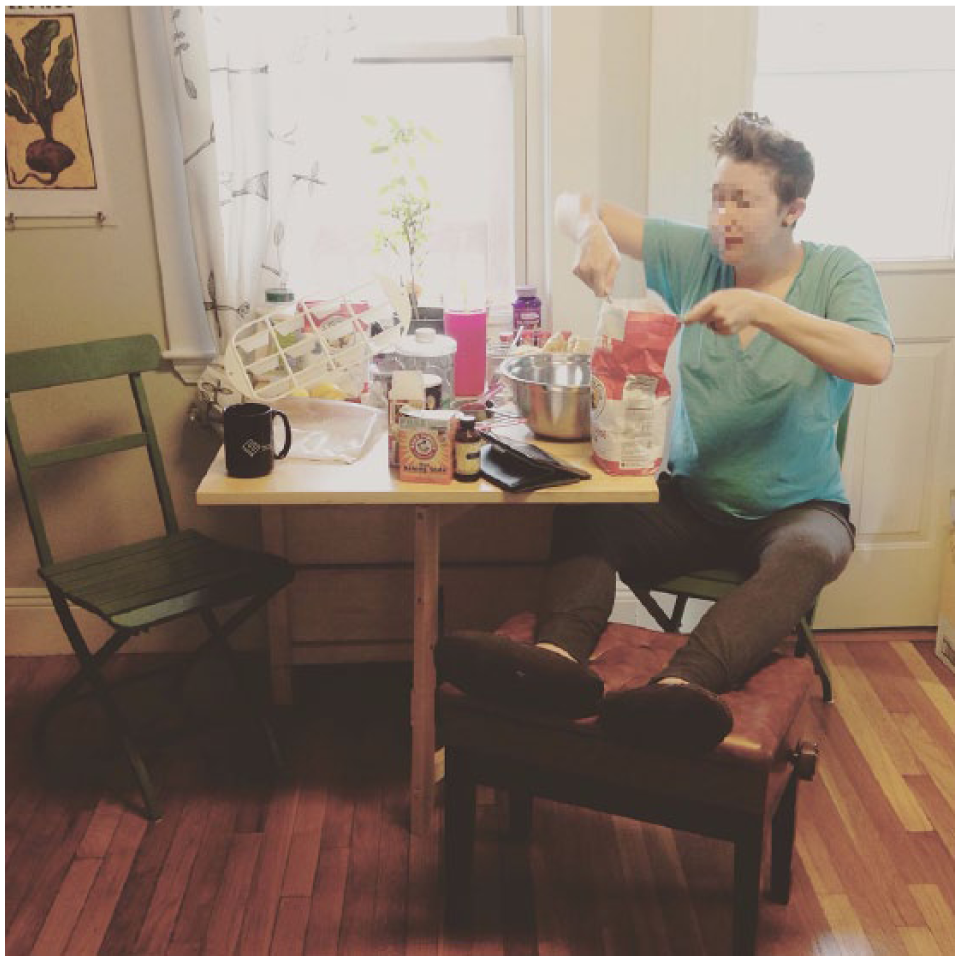
Gestational parent Vanessa.
Furthermore, such visuals reveal new family patterns and ways of using space, and function to normalize identities, families, and experiences that are labeled as deviant. The daily workings of queer family life, in all their radical mundanity, are a very visual challenge to “doing family” in the ways that have been ideologically coded and prioritized within what Smith (1993) calls the “standard North American family” (SNAF)—idealized as an opposite-sex, legally married couple sharing a household, with paid work and care work being differentiated by gender. Visuals can, in relation to SNAF and other assumptions about families, show us something about how family life is spatially organized, and how that dominant organization is rearranged by queer families. We cannot see how queer family life disrupts patterns of heterosexual family life until we can see those patterns at all. Take, for instance, how two traditionally feminine women side by side in a friendly pose are easily perceived as sisters, a frustrating occurrence that young, feminine-presenting lesbian couples frequently report. This photo produced by Kelsie and Tina, mothers to baby Reagan, challenges assumptions about what “family” can and should mean and renegotiates how gender identity and relationship intersect (Figure 2). If Kelsie, Tina, and Reagan do not read as a family, then it is because of the heteronormative baggage that is brought to bear upon the reading of their bodies in time and space. This queering of the traditional family photo reveals the heteronormativity of the family photo as a form, and in forcing a sort of double-take viewing Kelsie and Tina create the wedge space needed to renegotiate family meanings. In that moment of uncertainty about the relationship of the women to one another and to the baby, the viewer is confronted with his or her own assumptions about how the world should work, and this visual confrontation produces new meanings.
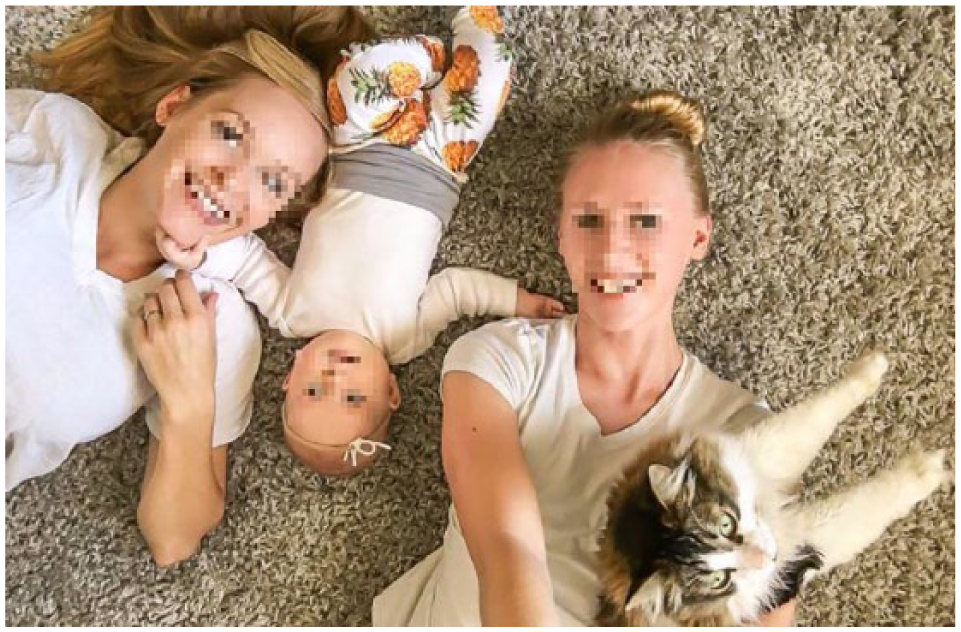
Photo by Kelsie and Tina, mothers to baby Reagan.
The images produced by the lesbian couples in my research add important dimensions to our understandings of family life while also asserting the potential for lesbian couples to form healthy, successful families that are no less valuable and real than those of their opposite-sex counterparts. Images of pregnant masculine women baking and feminine women cuddling their baby challenge expectations of how gendered bodies should move through space, interact with one another, and present themselves in relation to gendered, familial, and reproductive discourses that are also racialized, classed, and embodied. These images emphasize the flexibility and possibility experienced by the lesbian couples in my research and, in doing so, create new potentialities both for research and for lived experience by forging new visual schema for family life.
Visuals challenge heteronormative time
If queer people are, as Freeman (2010) argues, “denizens of times out of joint” (p. 19), then linear conceptions of time will fail to contain our experiences. The images produced by the lesbian couples in my research also demonstrate the constraints of a very linear progression of time, as they use visual space to chart new pathways through time—winding, unpredictable, and fragmented pathways—toward queer family-building goals. Visually demonstrating the timing of reproductive experiences and narratives, especially the ways in which the choices and options (un)available to couples shape their experiences of time, provides a challenge to simplistic and linear motions of moving through one’s life toward concrete, imaginable goals. While at least one member of each couple in my research desired to build a family, their pathways to parenthood were each unique based on the resources they brought to the process, their geographic locations and the attending laws and services, their individual desires, and their bodies; in many cases, family building shaped how the couples moved through time and space with regard to their employment, families of origin, location, and bodies, as they made decisions to relocate for easier access to resources, take new or different jobs for better insurance coverage, and embark on healthier lifestyle choices such as eating organic foods and exercising. In these and other ways, family building created winding paths through not only the process of TTC but also the longitudinal voyages of the couples more generally.
As Halberstam (2005) argues, (hetero) normative time is centered on “repro-time,” which is “ruled by a biological clock for women and strict bourgeois rules of respectability and scheduling for married couples” (p. 5). Berlant (2012) similarly describes repro-time when she notes, even though the shapes desire takes can be infinite, one plot dominates scenes of proper fantasy and expectation. It is a plot in which the patterns of infantile desire develop into a love plot that will be sutured by the institutions of intimacy and the fantasy of familial continuity that links historical pasts to futures through kinship chains worked out in smooth ongoing relations. (p. 44)
What seems “natural,” “normal,” and inevitable is, for Halberstam and Berlant, a construction of heteronormativity and dynastic privilege that is enacted by a narrow range of people but is extrapolated to apply to all. By existing apart from heteronormativity and, further, by being socially constructed as antithetical to family, queer individuals can gain access to liberatory timelines of their own construction in their defiance of repro-time. Their negotiations with, conflict over, abandonment of, and resistance to existing family scripts are (inter)actions most fully explored within the visual realm, where their queer bodies and reproductive experiences can be unsilenced, unerased, and unashamedly (re)presented. A photo like this one, constructed by Steph and Lena and discussed during our interview early in Lena’s pregnancy, shows not only the winding pathways to pregnancy but also the complex interaction of hope, anticipation, disappointment, frustration, and renewal that TTC brings to a couple (Figure 3). Lena shared this photo with me and conveyed her disbelief at actually becoming pregnant, noting that she had to take multiple tests to confirm the pregnancy before she was able to celebrate and enjoy the good news. After unsuccessful TTC attempts with frozen sperm and then a known donor, Lena achieved a “big fat positive” (BFP), indicative of pregnancy, through her third insemination. By this time, Lena and Steph had exhausted the financial resources they were willing to commit to achieving pregnancy, and were becoming frustrated with the process when they agreed to give TTC one more attempt, restructuring their expectations to fit with a winding and unpredictable timeline. Similarly, you can visualize the “toolkit” or medical items that Jane and Mel accumulated while TTC, which demonstrates that the couple lacks the required credentials for admission into both repro-time and normative conceptions of family life (Figure 4). Jane and Mel writing on their online journal or telling a researcher in an interview that the required medications and supplies seemed to start colonizing space in their house is different from being able to see the supplies in their sterile packaging, the pills lined up ready to be swallowed at the prescribed time, the countless syringes with their shiny needles, and the biohazard symbol that reminds them that queer family building is dangerous and “out of joint” while opposite-sex reproduction is natural.
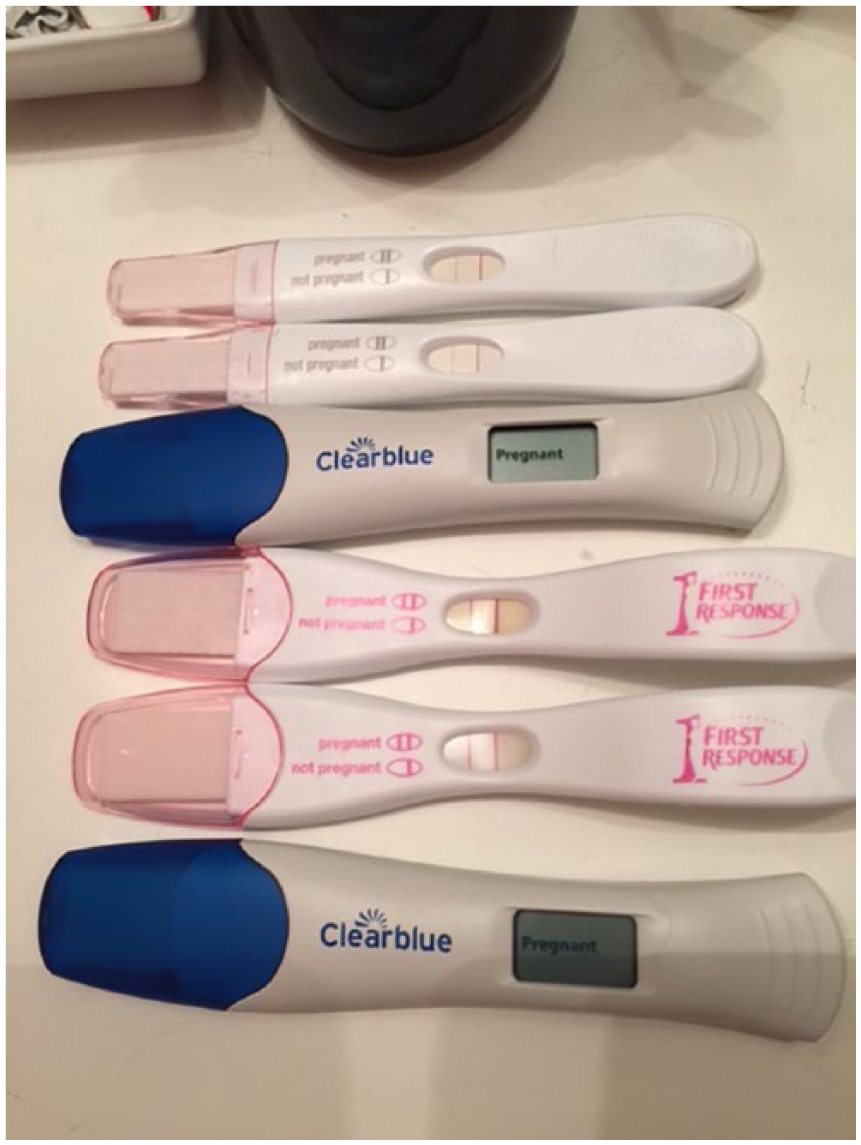
Photo constructed by Steph and Lena.
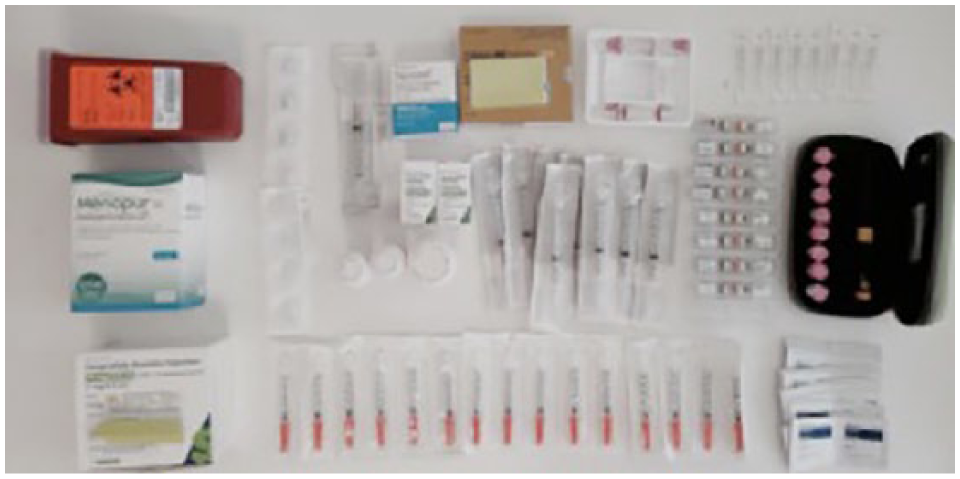
“Toolkit” or medical items that Jane and Mel accumulated while trying to conceive.
By virtue of being queer, women partnered with women are automatically disqualified from repro-time; in this way, they have failed at a crucial expectation of appropriate womanhood, since “reproductive time and family time are, above all, heteronormative time/space constructs” (Halberstam, 2005: 10). Even in conceiving success, queer women fail—their processes of redefining “failure” and reconceptualizing “success” by keeping queer time form the essence of the photos in my research. Queer women’s movements through time and space are not recognized or validated by larger society, and so, they must create validation for themselves by building a visual archive within and for their communities that documents and reclaims their ways of becoming parents and existing in the world—and, as a researcher and a queer feminist, I must see and take seriously this archive, substantively and methodologically.
Visuals defy controlling images
In Black Feminist Thought, Collins (2000) argues that women—especially Black women and women belonging to other marginalized groups—are defined by “controlling images,” or stereotypical visual and discursive constructs that are based on oppositional difference and become part of a generalized ideology of domination. These images serve to mask social relations since, as Collins notes, “controlling images are designed to make racism, sexism, poverty, and other forms of social injustice appear to be natural, normal, and inevitable parts of everyday life” (p. 77). At their core, controlling images reflect the dominant interest in controlling bodies, especially where containment of female sexuality is concerned. 3 The use of queer-created visuals such as those in my research challenges controlling images imposed on pregnant bodies by the medical model as well as those imposed on nonheterosexual women by larger society, by empowering women to represent their own unique reproductive experiences as resistance.
Recently, research has extended Collins’ controlling images to address advertising and media images of women that construct appropriate womanhood, especially where behavior relating to class and motherhood is concerned (Dow, 2015; Kelly, 2010; Sandlin and Maudlin, 2012). However, discussions of how images of queer women as antithetical to family and queer mothers as asexual are operating to constrain the possibilities for queer family life remain limited. A significant controlling image for lesbian women is childlessness or antifamilyness, in which we are constructed as simultaneously unable to conceive children due to “social infertility”—which results from the lack of access to sperm that occurs when two female-bodied people try to conceive (Mamo, 2007)—and unable to properly raise and gender-socialize children (Sullivan, 2004). When lesbian women do challenge these images, their motherness often is exchanged for their sexuality, in terms of both their nonheterosexual identity and the quality of being sexual. As Gabb (1999) argues in her work on visualizing the queer family, images of maternal devotion “obscure our sexuality beneath the shroud of selfless maternal love” (p. 16). That is, controlling images may force lesbian women into the “eternal mother” role and erase the difference that comotherhood brings to family life while also erasing the sexual needs and desires of mothers, who persist as complex human beings even as they are mothers.
As an answer to controlling images, Collins argues that multiply marginalized women must endeavor to form positive self-definitions by chronicling experiences that challenge such controlling images. This, I argue, is exactly what queer women are doing when they visually archive their reproductive, sexual, and familial experiences. Queer women do not produce these images only for themselves, but for their communities in a dynamic process of archive building and maintaining. The collective quality of queer negotiations with reproduction indicates a deep need for queer preservation, as women are documenting their experiences not only for themselves but also for the purposes of forming relationships and interactions around the uniqueness, yet commonality, of such experiences. They are constructing the spaces that Collins positions as essential to resistance—communities where queer individuals have the agency to collectively challenge controlling images and create positive self-definitions. These communities also satisfy Gabb’s (1999) call to embrace complexity and resist fragmentation by “represent[ing] lesbian families as simultaneously loving, nurturing, and sexual environments” (p. 17). This is exemplified by the following photo from my research, produced by nongestational parent Violet (Figure 5). In this photo, Violet epitomizes the multifaceted queer family by appearing as a sexual being (by wearing only a bra and slim-fitting jeans), as a nurturing being (by crafting a nursery for the coming baby), and as a queer being (by revealing her triangle tattoo, which is historically a symbol of defiant nonheterosexuality, and by hanging a piece of fabric from her pocket, which resonates with gay “flagging” culture and the hanky system). As all these activities are marked on or facilitated by the body, bringing Violet’s embodiment into focus as the site of her experiences is an addition that the visual is particularly equipped to provide. Violet also described this photo as her one “butch moment” during her wife’s pregnancy, and, thus, a notable occasion for her as a femme-identified lesbian woman—a distinction that would rely on stereotyped imaginings of butch and femme, had Violet not shown me what meanings she invests in each of those categories.
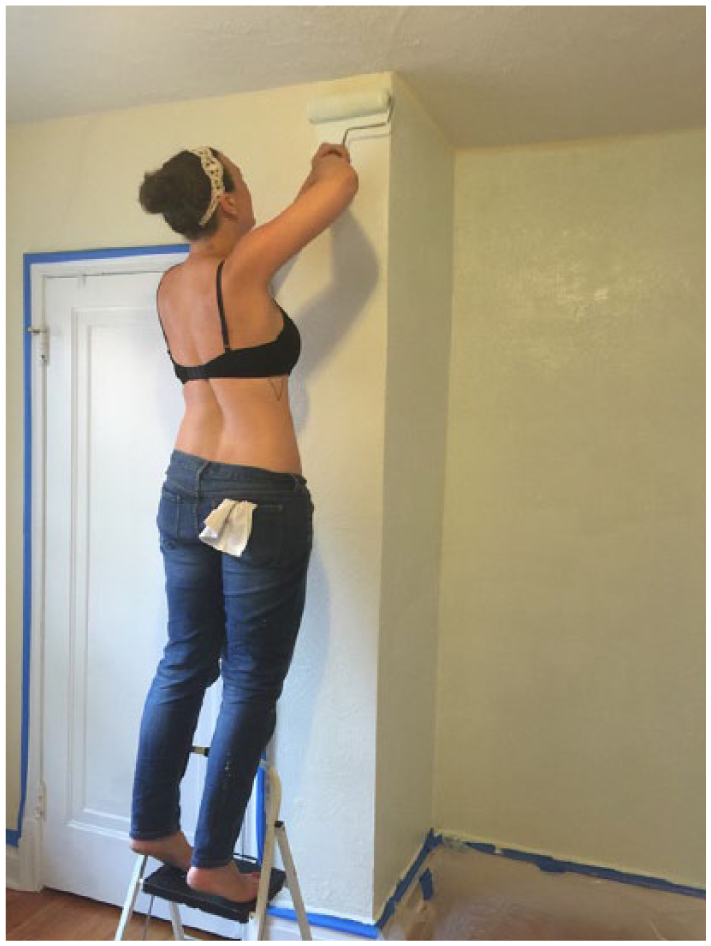
Photo by nongestational parent Violet.
Queer women like Violet and their families are compiling these rich visual data and are putting it forth as meaningful to their experiences. Such visuals allow lesbian women to challenge the reducing and flattening that occurs around them by representing themselves as multidimensional and complex, and also allow women to build community and create an archive of experiences as they navigate reproductive inequalities and forge paths through unknown territory. These visuals give researchers the opportunity to become aligned in the struggle against controlling images and to prioritize material representations that queer women are creating about themselves.
Concluding thoughts
The way that queer women archive and organize around visual products can shed light on many social processes, including family- and community building, parenting, caring for bodies and emotions, and negotiating with racialized and gendered sexual identities. The substantive possibilities are vast; yet, the literature on queer family building and the attention to queer family archives remains underdeveloped. Methodologically, doing research with such an archive provides valuable lessons in meeting individuals and groups where they are and taking the tools they find meaningful seriously in our social science inquiries. Far too little research begins by asking participants how they would like to participate, what they see coming of the research, and how they will be represented; although we, as researchers, report to oversight organizations (such as institutional review boards in the United States), we should exceed those standards in order to make participant-centered and antioppressive research decisions. Centering the visualized queer body as a valid and valued form of knowing at every stage of the research process is an important step in researching reproduction from a perspective that prioritizes the marginalized and combats assumptions about whose knowledges and lives are significant to understanding the social world. Specifically, the use of visual data in such research can create expansive images of gendered, reproductive, and familial possibilities; can challenge the figuring of time around heteronormative and repronormative models; can defy images created and deployed to control the sexualities of already-marginalized women; and can disrupt the dominance of textual and numerical data in the social sciences.
The implications of my research are certainly substantive and methodological, but they are also political, as I prioritize working with queer women as they construct visual representations of their experiences across the transition to parenthood. Queer women creating visuals by, for, and about themselves and their community present a challenge to models of scientific inquiry that marginalize, devalue, or erase their family- and community building. The power of photo-rich interviews and online pregnancy journals is that the creation of visual representations of lesbian couples across the transition to parenthood lies entirely with those who are experiencing it as they are experiencing it; images that emerge from queer women are agentic, as the women create and share images of themselves as they want to be seen. This measure of control, in a society where queer people may have little, is a political act that my research makes consciously and intentionally.
My research with lesbian couples across the transition to parenthood is but one example of the successful use of preservation methods in a way that is queer, flexible, and emergent. Future research might take up the spirit of the argument laid forth here in varied and dynamic ways, in keeping with the evolving “tradition”—which I say quite loosely—of queer methods. In any research, beginning with the concerns of the marginalized and following their voices at each step is essential. In reproduction research specifically, this means unsettling our assumptions about “appropriate” bodies, families, processes, timelines, emotions, and choices and then following marginalized voices to create new understandings from the artifacts that they choose to produce. Furthermore, this means constructing data that are guided by our population’s needs rather than tradition, and producing work that is rigorous yet as innovative, creative, and unbounded as those we study.
Footnotes
Authors Note
Sierra Holland is now an Independent Researcher.
Declaration of conflicting interests
The author(s) declared no potential conflicts of interest with respect to the research, authorship, and/or publication of this article.
Funding
The author(s) received no financial support for the research, authorship, and/or publication of this article.
