



Abstract
Despite its intuitive allure, complexity is problematic to define, assess, and measure objectively. This counterintuitive realization clashes with the fact that complexity and its evaluation play a relevant, if not vital, role in everyday life and almost every kind of endeavor. Within the broad study of the different types of complexity, topological complexity refers to how intricate shapes and forms are, a highly relevant parameter for design and production. This paper advances a functional approach to define, delimit, and evaluate topological complexity for manufacturing purposes. Based on this assessment, we discuss how additive manufacturing (AM) technologies can be used to deal with the research, design, and production hurdles that topological complexity poses. Finally, experimentation with AM wind musical instruments is presented and discussed as a case study of how this has been achieved in practice.
Keywords
Introduction
“Cars are complex, trains are complex, aeroplanes are complex. Very few people would disagree with this statement, but many would not be able to express the nature this intuitively understood complexity” (Alexiou et al., 2010, p. 37).
Evaluating complexity is a daily task of high relevance for essential functional operation in society. However, this assessment is limited and depends on subjective elements, such as our individual capacity to understand objects and systems, as well as field-specific training and expertise. Studying complexity as a subject in itself is the attempt to understand and evaluate it more objectively and verifiably, but this proves to be notoriously challenging in practice (Mitchell, 2009), as Alexiou et al. point out in simple terms.
Topological complexity is the analysis of how intricate shapes and forms are, covering a broad spectrum from the very intuitive manner in which we understand everyday objects to mathematical analysis in higher dimensions (Arkhangel'skiǐ & Fedorchuk, 1990). Surprisingly enough, even the apparently more straightforward end of this spectrum—towards the intuitive understanding of basic shapes—can be challenging to define rigorously and assess objectively. A dive into the complexity analysis will be required to emerge with a functional approach to deliver such evaluations.
Additive Manufacturing (AM) is a set of technologies which allow the production of physical objects directly from digital 3D models (Gibson et al., 2020). AM comprehends a broad palette of very different methods, yet some of their key features are shared. Among those features, one of the most salient ones is how AM dissects topologies layer-by-layer, dismissing many practical limitations of traditional manufacturing methods (such as extruding, molding, and lathing). This article analyzes how AM can be used to tackle topological complexity from the manufacturing perspective, how this operates, and the implications of such an approach.
Finally, exemplary case studies of using AM to deal with manufacturing topological complexity will be presented. These case studies come from the unusual research niche dedicated to early wind music instruments.
Complexity in Musical Instruments
Musical instruments are a particular design category at the intersection of many fields, including acoustics, aesthetics, ergonomics, materials, manufacturing possibilities, manufacturing limitations, and cultural tradition and inheritance. Furthermore, musical instruments are living objects, requiring composers to write for them, performers to play on them, and teachers to ensure that there will be a next generation to pass on the knowledge, keeping them in use rather than becoming museum objects. Considering how tradition-oriented this environment is in general (Almqvist & Werner, 2024), the chances for radical innovation in the field are minimal. It is no coincidence that many of the most prestigious musical institutions are called “conservatories.”
Furthermore, given the subjective and emotional intrinsic component attached to performance, attempting to measure musical instruments objectively to develop scientific models about them often turns into a very challenging endeavor: Musicians sometimes look with scorn on simplified models that physicists use to explore the fundamental principles of an instrument's behavior. Scientists need to explain that the models are steps along a route that could ultimately lead to insights of great value to a maker or player. On the other side, scientists can be dismissive of performers whose evaluations of instruments are biased and inconsistent, but it is essential to remember that it is the performer who brings the instrument to musical life and who must be the ultimate arbiter of its quality. (Campbell, 2014, p. 40)
Recent robust studies have shown that Campbell's respectful appreciation of the situation may be too kind towards the musical community. Even when solid evidence that debunks a prevailing consensus amongst musicians is presented, for instance regarding the almost sacred belief regarding the superiority of old Italian violins in relation to modern copies of them, the myth tends to prevail (Fritz et al., 2014a; Fritz et al., 2014b; Fritz et al., 2017).
But leaving aside the added layers of complexity derived from subjective appreciation and the weight of established myth and tradition, as well as the difficulties in collecting data to develop models, acoustic objects remain intrinsically complex despite the simplicity of their output, as Fletcher points out: While the systems themselves consist of complex interacting nonlinear elements, the interesting outcome is that these often act together to produce a deceptively simple outcome, with strictly harmonic waveforms and well controlled behaviour. (Fletcher, 2012, p. 193)
Possible examples of the complexity of musical instruments and the difficulties in modeling them are easy to find. For instance, a standard issue for most bowed string instruments is the so-called “wolf note, a disturbing resonance phenomenon that makes it difficult to stabilize the bow.” This issue is usually corrected, or at least toned down, by adding “wolf catchers,” which are carefully placed small weights attached to the non-vibrating part of the string after the bridge. Despite the relevance and prevalence of this problem, scientists are still fighting to develop models to predict and correct wolf notes (Ogura et al., 2010; Zhang & Woodhouse, 2018). Performers and luthiers disturbed by a wolf note will more likely solve the problem by a combination of experience, intuition, and trial and error rather than referring to scientific charts, tables, and formulas on the topic.
Modern acoustic musical instruments, also due to mass production, have standardized and regularized many elements, sometimes simplifying acoustics thanks to technical developments. A modern traverse flute superficially looks more intricate than a classical or a baroque model due to the keywork and the many moving pieces not present in the earlier versions. From an acoustic perspective, though, the “simpler” earlier flutes, having irregular conic inner bores and non-cylindrical and non-perpendicular fingerholes, are much more complicated to model mathematically than their modern cylindrical counterparts. Indeed, the extensive keywork introduced by Böhm while developing what has become the modern flute allows the instrument to have an almost straight bore and the holes to be placed at their optimal acoustic spots, regularizing tuning and timbre of most notes (Dikicigiller, 2014; Kachmarchyk & Kachmarchyk, 2022). Instead, earlier models without keys had to compensate by enlarging, reducing, and angling the holes, using undercutting, modifying the bore, and requiring forked fingerings to produce all the required frequencies (Figure 1) (Rindel, 2021). This leads to unavoidable irregularities in tuning and timbre, which modern players usually experience as flaws, while for early music enthusiasts are qualities, precious nuances, and personality. Also, let us not forget that for most of musical history, non-equal-temperament tunings have been the norm (Barbour, 2004), not to mention that early solmization theory described each step of the hexachord having a different timbre (“voice”) (Finck, 1556, section “de vocibvs”).

German traverse flute, late 18th or early nineteenth century (MET 89.4.491), alongside modern flute (Buffet Crampon). Images by MET Museum and Buffet Crampon (used under license).
Without further indulging in the discussion between “historically informed” and “modern” music performance and performers, the early music, folk music, and, in general terms, hand-crafted musical instruments are fascinating from a complexity perspective. Is it possible to differentiate between unwanted irregularities in their construction (such as deviations from a circular bore) and masterfully controlled interventions by the makers to achieve the desired tuning or timbre? If the piece of wood presents a crack, or if a crack appeared during the wood-turning process, and then hole undercutting was applied to compensate and fine-tune the instrument, do we need to copy both of them whenever attempting a replica? Which elements are relevant and desired, and which are unwanted accidents? How can we use museum instruments as a reference if their materials have shrunk and deformed during the centuries that have elapsed since their construction? How can we test these elements if performers are reactionary to systematic and scientific measurements, as Campbell pointed out?
It should be noted that the fine-tuning interventions and the irregularities and deformations mentioned find themselves well within a practical, measurable, and observable realm. As we shall see under “Delimiting Complexity,” natural materials may as well have endless micro-fractal surfaces that no data sampling could cover in perfect detail, but hole undercutting and similar fine-tuning interventions by definition do not belong to this microscopic realm since they are made with practical, physical tools. Similarly, wood shrinkage and deformation due to aging also becomes macroscopic, even self-evident to the uninformed naked eye (Bucur, 2016a, 2016b). Defining a limit between the microscopic theoretical realm of complexity and a minimum relevant scale for practical purposes will be a key element to be developed in the following sections.
All the previously mentioned intertwined elements, from objective acoustic phenomena, to materials science, to very subjective cultural and individual appreciations, further convoluted by the difficulties in even attempting to measure them, make musical instruments a vibrant field of study for complexity. The different layers of intricacy, each highly complex on its own, obscure and muddle each other, increasing the overall crypticity of the field. Whenever evaluating musical instruments in depth under most of the criteria to be discussed in the following section, musical instruments will tend to score very high. Let us now take a dive into the definition of complexity, a prerequisite to discuss the topic in a relevant manner.
Defining Complexity
In her book Complexity: A Guided Tour, Mitchel attempts a tour de force to cover all aspects of what we—often nonchalantly—drop under the umbrella category of “complex” (Mitchell, 2009). To call this effort “complex” would be an understatement. The following episode, narrated by Mitchell, sums up the difficulty of such an attempt: In 2004 I organised a panel discussion on complexity at the Santa Fe Institute's annual Complex Systems Summer School… The students at the school—young scientists at the graduate or postdoctoral level—were given the opportunity to ask any question of the panel. The first question was, “How do you define complexity?” Everyone on the panel laughed, because the question was at once so straightforward, so expected, and yet so difficult to answer. Each panel member then proceeded to give a different definition of the term. A few arguments even broke out between members of the faculty over their respective definitions (Mitchell, 2009, p. 94).
In everyday language and daily life, we call “complex” objects, descriptions, situations, explanations, processes, actions, and basically everything we perceive as non-trivial. This intuitive definition is, nevertheless, terribly subjective and flawed. Things which are non-trivial to one person can be banal to another simply thanks to their training or individual skills. Another possible path could be to identify and understand complex phenomena by dissecting them to their roots. Nevertheless, when doing so, we discover that highly complex behaviors can unpredictably emerge from banal, single interactions. Staggering examples of this can be found everywhere, both in the natural world and in abstract human creations. For instance, the straightforward equation Xn + 1 = Xn2 + c, if iterated with starting Xn = 0, either explodes into infinity or stays within a bounded range depending on the value of c. If we map this result for c being a complex number, we obtain the stunning Mandelbrot set, whose fractal edge unveils new and unpredictable surprises at every scale (Figure 2) (Devaney, 2006; Harris, 2012, p. 15). 1

Mandelbrot set (left), zoom into one section (upper right), and further zoom in (bottom right). Black regions belong to the set, while the color gradient shows how fast those areas diverge into infinity. Images by Wolfgang Beyer (used under license).
How can we carve a meaningful or applicable definition for complexity if we struggle to define it properly? Even if we set a boundary to our field of interest, attempting to avoid complexities from other areas of knowledge, the result tends to be the same. In the case of this paper, we would like to have an operational definition of complexity within manufacturing and design. But alas, even within this specific field, we land in a similar miasma of undefinition: “complexity in design is a term used in various often poorly defined contexts” (Frydenberg, 2024, p. 29).
In his brief paper “Measures of complexity: A non-exhaustive list,” Lloyd proposes to group the different fields of complexity into three categories (Lloyd, 2001). Each category addresses one of the following questions: How hard is it to describe? How hard is it to create? And what is its degree of organization? For each of these questions, a list of possible measures of complexity is provided. For instance, for the second question, computational complexity, time computational complexity, space computational complexity, information-based complexity, logical depth, cost, and crypticity are mentioned.
The present paper aims to tackle manufacturing and design complexity, which mainly involves two components: the topological description of the object to be manufactured and the manufacturing process itself. Therefore, for the purposes of this analysis, we are interested in Lloyd's first two categories: how hard it is to describe and how hard it is to create.
By evaluating the objects we wish to analyze from the perspective of how hard they are to describe and craft, we can obtain a measure of their complexity in manufacturing terms. This does not hinder the fact that many other possible layers of complexity are related to them. In the case of musical instruments, for instance, a “simple” object to manufacture can have a very complex playing technique or a very intricate cultural inheritance and significance. Nevertheless, we now wish to focus on the complexity of manufacturing an object and how this changes when we introduce AM and its related digital tools as the production method.
Delimiting Complexity
Euclidean geometric shapes, as well as the most used mathematical functions, have well-defined contours and dimensions. Such idealized shapes can be functional approximations of reality, depending on what is expected from the model. To know how many glasses we can fill with the content of one bucket, the Euclidean volume calculation (or a calculus integration), which assumes perfectly smooth surfaces, will suffice. Instead, if we wish to model the evaporation of liquids from different surfaces, more sophisticated models of reality will be required (Chalmers et al., 2017). Fractal or recursive geometries, for instance, can deliver a better approximation of reality in such cases (Liebovitch & Shehadeh, 2003, p. 178).
Different models of reality lead to very different outcomes, both in the quality of the predictions that the model can produce and in the measurements themselves. Let us take, for example, the apparently trivial task of measuring the length of a coastline. Figure 3 shows central Oslo's coastline measured by placing reference points at regular intervals and then interpolating the best-fitting curve through them. The three iterations shown use reference points at 1000, 500, and 100 meters, for which the resulting lengths are 18.52, 20.11, and 29.28 kilometers, respectively.

Three iterations of measuring the coastline of central Oslo. Image by Ricardo Simian.
This iterative process can continue with smaller intervals, delivering higher accuracies and longer measurement results. Given that we could continue with ever-increasing resolutions—measuring the contour of every stone, every grain of sand, or indeed every molecule—the length of a coastline could reach any arbitrary value, not converging to an objective number but rather diverging into infinity. This phenomenon was studied by Mandelbrot himself, leading to what is known as the “coastline paradox” (Mandelbrot, 1967; Stoa, 2019). Mandelbrot saw the similarity between the endless micro-contour of fractal geometries and natural objects. Indeed, the set bearing his name, depicted in an A4 format, could provide a “coastline” measurement larger than any number given enough computation capacity to reach the necessary resolution.
Considering the importance of knowing the measure of coastlines—if for no other reason than simply due to basic urban planning necessities—one could expect that an international standard definition and measurement method would be in place rather than having arbitrarily increasing values depending on the measuring resolution. In reality, the CIA's World Factbook states that the Norwegian mainland coastline measures 25,148 km (CIA, 2024), while the Store Norske Leksikon states this very same length to be 29,775 (SNL, 2024). To put this error margin into context, the difference between the numbers provided equals more than twice what the Swiss Federal Department of Foreign Affairs claims Switzerland's entire borderline amounts to (EDA, 2024). Therefore, according to these accuracy-oriented institutions, the Norwegian coastline measures 27,000 km, give or take one Switzerland.
The detail in which natural objects can be described, including their basic defining measurements, can, therefore, arbitrarily approach infinity. If how hard it is to describe an object is a measure of its complexity, then, computational power and measuring resolution allowing, real objects can become infinitely complex, making this evaluation useless for any practical purpose.
The way out of this dead end and absurd results, as well as the practical solution to the coastline paradox, is to define a meaningful sampling resolution, “the smallest relevant measured size” proposed by McNamara and Vieira da Silva (McNamara & Da Silva, 2023). This unit will be, of course, variable according to the endeavor in question. While the James Webb Space Telescope mirror is managed with an accuracy of 10 nanometers (10−8 meters), for most normal production purposes, accuracy between 1/10 and 1/100 of a millimeter (10−4 to 10−5 meters) will suffice. This resolution finds itself several orders of magnitude above Webb's mirror and is accessible with hand-held measuring devices. Translating this resolution into digital information, a 10-millimeter radius sphere drawn as an STL object, with edges within this very accurate 10−4 to 10−5 meters range, will not exceed a gigabyte of information. 2 Considering that STL is one of the least information-efficient formats to describe topologies, we have, therefore, a practical digital information upper limit for real-world objects for our smallest relevant manufacturing measure. This limit is not tiny but remains within existing and accessible computing and storage capacities. Such an upper bound defines a practical cap on how hard it can be to describe an object as a 3D model.
Measuring Topological Complexity
Even if we manage to avoid the unbounded complexity of fractal micro geometries and endless coastlines by defining a minimum relevant size, topologies can be more or less intricate in the macro realm. A sphere with radius R can be described in a Euclidean manner by the sentence “the collection of all points at distance R from a given point.” In Cartesian terms, this translates to x2 + y2 + z2 = R2. But how can we geometrically describe an irregular foam-like structure? Or a musical instrument, full of relevant irregularities and fine-tuning interventions? The length of all necessary elements to create such a description is what we usually understand as “shape complexity.” The good news at this point is that while the geometric description of ever more intricate topologies can increase, eventually to the point of becoming unfeasible to manage, the amount of information necessary to describe an object in STL or similar format increases only proportionally to the area of the described surface but not to its intricacy, once a minimum relevant size has been defined. If the parameters are forced to reflect the minimum relevant size, an STL mesh will require the same amount of information to describe a 1 mt2 textured slab as a rocket nozzle with integrated cooling systems with an overall surface of 1 mt2.
Moving to the focus of this paper, when it comes to manufacturing objects, topological complexity is tightly correlated with how much effort it takes to craft them. Cutting a marble cube 1280 cm in side will require few instructions and, depending on the cutting gear, just a few minutes. Sculpting Michelangelo's David, which has an equivalent volume, took the Florentine master over two years of hard work instead. This way of evaluating complexity is somehow disappointing, though. Given a high-resolution 3D scan of the David 3 and a large and precise enough CNC machine with sufficient axes of freedom, 4 most of the work could be done within days. 5 This is, by the way, the method now being used to craft Gaudi's complex organic stonework designs to complete the Sagrada Familia basilica in a shorter time than anyone could have anticipated (Burry, 2016). Does this mean that the complexity of the David or the Sagrada Familia has decreased since the invention of CNC machines? Is topological intricacy not an objective, inherent measure independent from available manufacturing technologies?
In “Metrics for measuring complexity of geometric models,” Globa et al. propose a “practical methodology for measuring the level of complexity of geometric patterns in architecture” (Globa et al., 2016). To achieve this, they put forward a scoring system based on different evaluation parameters. For instance, shapes fall under standard and primitive (such as circles, cubes, spheres, etc.), non-standard simple shapes (like “rhombus-shaped surfaces with filleted corners”), or complex shapes (for instance “extruded sections of a bubble-shaped volume”). This intuitive evaluation aligns with what we usually mean when considering that a shape is complex in everyday use. However, is there a philosophical or technical ground to state that a sphere is less complex than an extruded section of it? Within the literature covered while researching for this paper, no answer to this question emerged, but also no objective evaluation system for the inherent complexity of macroscopic topologies beyond approaches of the like proposed by Globa et al. was found.
I argue that the time, work, energy, and money spent crafting an object are indeed good measures of its complexity when manufacturing it. The previously mentioned conundrum of man versus machine working time is only apparent, a confusion that emerges when comparing apples with bananas. Crafting the David by hand remains unchangeably complex after an alternative crafting model, for instance, by CNC machine, becomes available. That is precisely why we are so eager to know whether an object was made by hand or by mass production when we buy it. Prices usually correlate with the fact that we tend to assign more value to the hand-made version, similar to the way we treasure more a poem delivered to us by our beloved one if we know it was human-made rather than AI-baked. Therefore, I propose that we can perfectly use manufacturing time—assuming we specify the manufacturing method—as a meaningful measure of the complexity of an object. The fact that moving from Rome to Santiago de Compostela on foot takes months, while doing it by plane takes only a few hours, does not change the distance between the two cities. We can even estimate that distance based on the time required and the means of transport. We may have difficulties objectively measuring topological intricacy the way we measure the self-evident distance between two cities, yet measuring the required manufacturing time with a specific manufacturing process (such as by hand or by CNC machine) can provide a meaningful implicit measure of this complexity.
The relationship between our appreciation of topological complexity and the crafting methods available runs even deeper, and it does not necessarily progress linearly towards facilitating the handling of ever more intricate shapes. For instance, car shaping used to be a very crafty task, where hand-drawn designs were sculpted into full-sized casting molds. This form-giving freedom gave us the elegant, curvy outlines of iconic cars such as the Ford A and the Volkswagen Beetle. But when the car design and manufacturing processes were digitalized starting in the 1970s, available CAD software did not provide solutions to draw complex double-curved surfaces, leading to a pragmatic aesthetic shift into single curves and trimmed lines (Killi, 2013, p. 83). This leap could not be made more evident than through the transition from Volkswagen's Beetle to Golf models, both of which aimed at the same market niche (Figure 4). The re-emergence of topologically intricate curvy cars would have to wait until more powerful software became available. Still, in the meantime, a whole generation of drivers re-learned and re-defined what was expected from a car and which shapes they considered acceptable or beautiful, and the 1980s aesthetics explored innovative, if somehow topologically less complex, territories.

Volkswagen Beetle (left), and Volkswagen Golf 1C (right). Photos by Lothar Spurzem and Niels de Wit (used under license).
Additive Manufacturing and Complexity
[when using AM] complexity is for free (Killi, 2017, p. 76)
For many years, many have claimed AM offers “complexity for free”. It is true that building parts layer-by-layer is largely independent of part complexity, but other elements of the start-to-finish process are not. (Wohlers Report, 2023, p. 64)
The fact that the second quotation comes from the “myths and misconceptions around AM” section in the Wohlers Report 2023 already implies that the generalization “when using AM complexity is for free” requires some context and caveats. Killi himself provides such caveats, particularly when addressing how the initialization costs of AM production are not zero, another typical, misleading generalization (Killi, 2017, p. 17). Still, even considering these admonitions, there is something special and disruptive about AM and complexity. Returning to Michelangelo's David example, once the necessary 3D model is ready, producing such a shape through AM, for most AM methods, 6 will require similar production time and costs than making a cube with the same material volume. 7
The appreciation that adding additional topological features for the same material volume does not affect the production time nor requires additional work does justify the optimistic appreciation that “with AM complexity is for free.” Without contradicting this, a similarly justified half-empty-glass assessment could be “with AM simple shapes are very expensive,” which is also true. AM production of simple shapes that could be crafted by extrusion or molding often tends to be like killing a fly with a cannon. Using an FDM 8 machine to create a simple, solid block of material will most likely be more expensive and time-consuming than simpler manufacturing technologies. Therefore, maybe a more holistic evaluation of AM's production matrix would be that AM is indifferent to complexity, its costs being closely proportional to the material volume and mostly independent from the complexity of the shape in which this material is arranged.
Knowing that AM is relatively indifferent to complexity, it should not be surprising that manufacturing complex designs is one of the fields where these technologies have spontaneously flourished. Some of the most successful commercial fields for AM as an end-product manufacturing method make use of this feature. For instance, medical prostheses, hearing aids, and rocket nozzles with intricate embedded cooling structures are among the most successful commercial case studies (Madan et al., 2022; Reeves, 2013).
AM is, therefore, a set of tools seemingly conceived for tackling complexity when it comes to production, a manufacturing process which breaks everything down to a layer-by-layer understanding of topology rather than losing itself in how to craft a complex shape through a combination of drilling, carving, extruding, gluing, molding, lathing, welding, and more. Ignoring the topological complexity of a design and, in practical terms, providing a flat evaluation of the manufacturing time and costs, has the potential to become a true manufacturing revolution, possibly representing AM's strongest innovation in manufacturing terms. There are also, of course, downsides to this one-tool-fits-them-all machine. The palette of available materials is limited and tightly connected to the type of AM being used. Mixing materials is difficult. Maximum production volumes are limited and unflexible. Accuracies are limited and often below what would be required in traditional manufacturing (Simian, 2024, pp. 1306–1307). This list could go on, and analyzing each mentioned downside could take an entire article. For this paper, the last-mentioned element, accuracy, deserves further study.
Under “Delimiting Complexity,” a minimum relevant size was defined, limiting topological micro-complexities. As previously said, in traditional manufacturing, an accuracy between 1/10 and 1/100 of a millimeter is usually required. There are many types of AM units, ranging from atom-by-atom devices to concrete-pouring robot arms designed for architectural purposes. The accuracy of AM changes, therefore, greatly depending on the scale and the type of technology being used. Nevertheless, for the most accessible and used units, when it comes to manufacturing, accuracies below 1/10 of a millimeter either become unreliable or come with a high price tag. In his writings on the topic, Killi has argued that whenever integrating AM as the manufacturing method, the design process should include and integrate such elements rather than fighting them (Killi, 2013). A revision of a design, adjusting it to the tolerances that AM can provide, is more likely to succeed than a complex post-production process attempting to compensate for the shortcomings. Also, a design process that integrates these elements early in the process rather than in the end is crucial when trying to make use of AM for end-product purposes. Possible upcoming further developments in AM technologies may increase reliability and accuracy. Still, given that AM operates completely differently from traditional fabrication, it would be unwise to expect that the results will become interchangeable soon. As the Wohlers Report 2023 wisely sentences, “AM is not a replacement technology” (Wohlers Report, 2023, p. 167).
Nevertheless, even considering and accepting these shortcomings, AM can be a formidable tool to tackle complexity as it is now. Confronted with the task of creating a shape particularly suitable for SLS, 9 one student at The Oslo School of Architecture and Design came up with the design on the left in Figure 5. The word “complexity” was not mentioned as an objective for the task, yet this shape—created using parametric design tools—would undoubtedly qualify as highly complex according to the criteria defined by Globa et al.

Two versions of a complex shape designed for SLS AM production. Design by Theodor Daniel Burås (used under permission).
Indeed, it would be difficult to imagine a suitable production method other than some type of AM for this shape unless we are willing to embrace enormous amounts of handwork and basically sculpt it. When challenged to manufacture such topologies, the existing options would be either by hand—with an exceeding price per unit—or AM. Traditional mass production alternatives would require assembling many pieces or creating an overcomplex and costly injection molding form, if this were technically feasible at all. The second iteration of the design, on the right side of Figure 5, was instead an attempt to re-create this shape using AI tools. The result is certainly different than the original, although some basic features are recognizable. In case any further proof that this design has some implicit complex features, the prompt used to motivate the AI to generate this result (after many different attempts) was “perforated, organic, parametric, hollow, tween, sculptural, distorted-warped, patterned, geometric object, cube Modular Cube Tesselation Cube Lattice Cube Fractal CubeCellular Cube Grid Cube Recursive Cube Matrix Cube Component Cube Pattern Cube Replicative Cube Mosaic Cube warped, smaller in middle, distorted, fancy design, clean, repetitive.”
In the case of this object, which serves as an excellent example for intricate designs in general, AM drastically changes the manufacturing possibilities. This disruptive production approach virtually disregards a high complexity evaluation, which would likely have rendered the whole endeavor unfeasible with traditional manufacturing methods.
Tackling Complexity in Musical Instruments with Additive Manufacturing
Given the tradition-oriented spirit which prevails in the field, as explained before, it should not surprise that concrete examples of established AM musical instruments are difficult to find (Simian, 2023). In a field where craft and tradition in the making are so highly esteemed, Sennett's comment on the introduction of machines resounds loud and clear: “The greatest dilemma faced by the modern artisan-craftsman is the machine. Is it a friendly tool or an enemy replacing work of the human hand?” (Sennett, 2008, p. 81). Indeed, musicians looking for a sounding vehicle for their souls are often unwelcoming to replacing traditionally crafted creations with AM soulless machine-baked objects. Most existing examples of AM musical instruments are either one-of-a-kind experiments or research objects. Furthermore, the integration of AM into musical instrument making and research is not a straightforward process. As Wheeldon describes in “3D digital technologies for studying historical musical instruments”: Hyperbole and misinformed communication about the available applications of digital manufacturing technologies puts the wrong emphasis on their benefits and threatens to damage confidence in technological innovation in a field already with a tendency toward romantic ideals of handicraft. The inflated expectations of the benefits of technology have meant that some projects unaccountably attempt to rely solely on 3D digital technologies. All the while, others avoid technologies altogether. (Wheeldon, 2024, p. 198)
The discussion about whether AM objects are soulless or can be artistic and crafty has been followed by several authors in different fields (Bernabei & Power, 2020; Hansen & Falin, 2016; McNaughton, 2021; Takahashi & Kim, 2019), including music (Savan & Simian, 2014; Simian, 2023). I will not deepen this discussion here but instead focus on a few case studies that exemplify the attempts at tackling complexity in wind musical instruments through AM technologies. Although experiments have been conducted to develop all sorts of musical instruments using AM technologies, the inherent characteristics and limitations of currently available AM units and materials (maximum size and production costs in the foreground) make wind instruments more practical to produce with these technologies since they tend to be more compact. This explains why commercial endeavors aimed at producing AM musical instruments have been more successful in the wind family (Simian, 2023), and also why wind musical instruments were chosen as a case study in this article. This realization aligns with the remarks by Wheeldon, who explains the same practical results from a different perspective: “3D printing has most effectively been applied to wind instruments, perhaps because the acoustical properties of the material are less important than the airspace” 10 (Wheeldon, 2024, p. 199).
It may sound counterintuitive, but the most past-oriented branch of musical research and performance—namely the early music scene—has possibly been amongst the quickest to integrate AM to tackle complexity in musical research. The first paper discussing AM and early music research was published in 2014 (Savan & Simian, 2014), and ever since, several research projects have made extensive use of it (Agrell & Domínguez, 2018, 2019; Agrell et al., 2024; Domínguez, 2025b; Jossic et al., 2022; Simian, 2023, 2025; Verdegem & Simian, 2022; Viola, 2025). Also, an international conference dedicated to the subject was held at the Royal College of Music in London in early 2024, further showing that the field is developing (Rossi, 2024).
Of particular interest is the fact that AM provides, arguably for the first time, the possibility to systematically analyze the irregularities which were identified under “Complexity in Musical Instruments” as a vital element of the inherent complexity of musical instruments. Whereas before it was technically impossible to isolate, repeat, or modify irregularities, AM renders this feasible. For example, for the study on the fagottini and tenoroons 11 at the Schola Cantorum Basiliensis, twin AM copies of the same museum instrument were made (Figure 6), one as the instruments are now (deformed with ovalized inner bores) and one with only this element corrected (rounded as they came out of the lathe) (Domínguez, 2025b; Simian, 2025). Given the consistency of AM and the fact that the bore differences are only inside the instruments, the twin copies can even be used for double-blind testing, requiring simpler test designs than before, or directly allowing for tests that were not feasible with hand-made instruments.

Original fagottino alongside AM twin copy. 3D model, AM production, and photo by Ricardo Simian.
Although double-blind tests in a proper setting are yet to be conducted, whenever I have used AM instruments to test musicians’ perceptions, the results have corroborated the high degree of subjectivity measured by Fritz et al. and described by Campbell in this field (Campbell, 2014; Fritz et al., 2014b; Fritz et al., 2017). Similar to other perception studies (Morrot et al., 2001), in my informal tests, the color of musical instruments strongly influences the perceived characteristics of the sounds they produce. Likewise, instruments that were evaluated as markedly different became undistinguishable to the player once physical markings that allowed identification were hidden (as was the case with the fagottini twin copies). However, further study and proper testing are needed here, and for the time being, these findings remain anecdotal.
In terms of resolution, the data to replicate the original fagottini were acquired with computer tomography, to be translated into detailed STL files that approximate the original object within the minimum relevant size that was defined before. Given the fact that I was responsible for processing the 3D files for this project, I must admit that the excess of data points was often more of an issue than the opposite. Small indentations in the surfaces even allowed me to follow the hands of the instrument maker, the crafting processes, and the mistakes. For example, in many places where fingerholes were drilled, minuscule but systematic scratches showed that once the drilling head cleared its way through the wood, it went out of control, hitting the opposite wall in the inner bore. Having inspected and measured many museum originals directly, I had never been able to see this. In a certain way, the digital version on my screen gave me a deeper understanding of the object than directly examining the object itself. 12 Processing all these data points and then selecting specific features, isolating and modifying them, was a task which brought CAD software and a strong desktop computer to its limits. Nevertheless, it was possible to end the process satisfactorily using accessible technology (Figure 7).
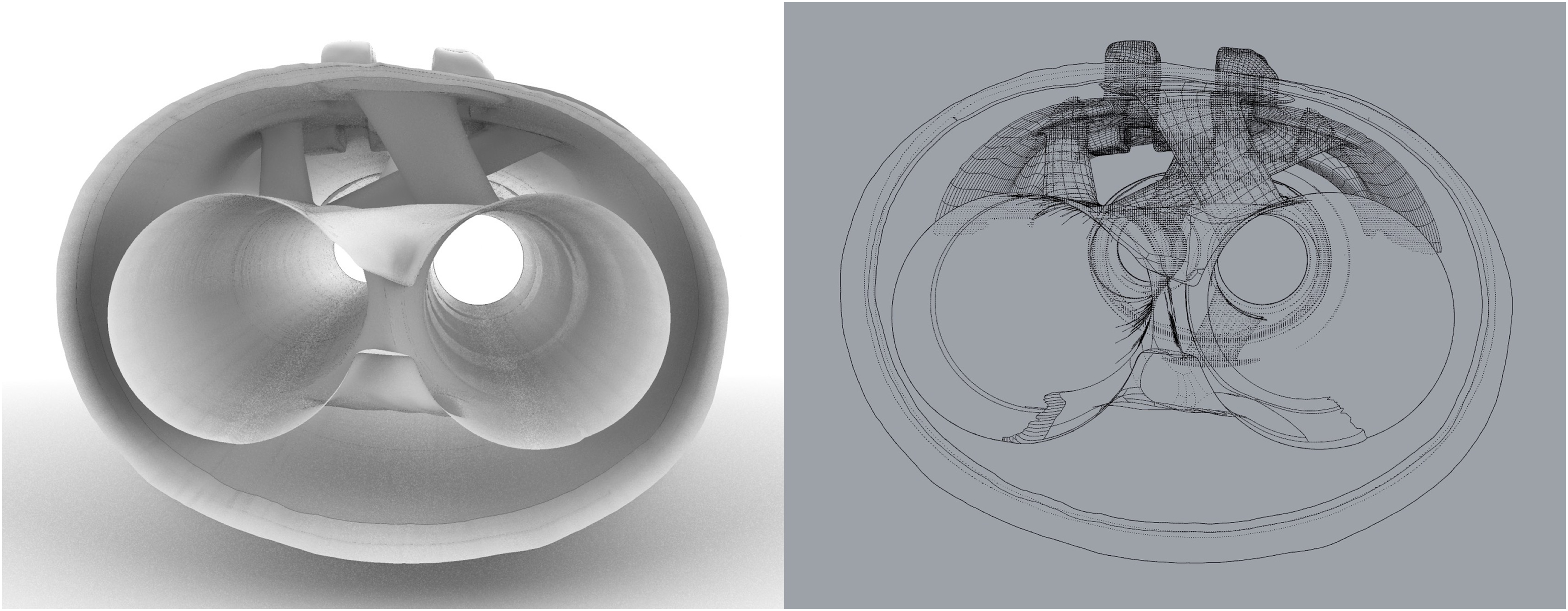
Two visualizations of the transversal cut of a fagottino U-joint 3D model. 3D model and image by Ricardo Simian.
Organic materials add an extra layer of complexity to many, if not most, early music instruments. Wood is an anisotropic material with complex microstructures that change over time. This evolution manifests itself at the macroscopic level, visibly altering shapes—as seen in the ovalization of the fagottini's inner bore—but also at the microscopic level, potentially affecting the acoustic properties of the objects. Digital scanning tools can provide unmatched insight when analyzing this aspect, as described by Loomis et al. in “The Lamont and Queen Mary harps” (Loomis et al., 2012).
One of the salient points from the case studies presented here is that AM has unparalleled potential to systematically dissect complex topologies by being able to selectively isolate, modify, and reproduce shapes, connecting accurate measurements with physical, repeatable objects in innovative manners. We have only scratched the surface regarding the testing and research possibilities AM opens regarding complex topologies, as well as using AM for developing entirely new musical instrument designs with intricate topological features. As previously quoted from the Wohlers Report, AM is not a replacement technology (Wohlers Report, 2023, p. 167), and its—still mostly underdeveloped—potential when it comes to crafting end-products lies in the development of entirely new designs that were not feasible to manufacture with traditional methods. If a new acoustic musical instrument is to emerge thanks to AM technologies, it is not difficult to predict that topological complexity will be one of its defining features.
Conclusions
Complexity is an umbrella category that is used daily in an intuitive manner but, at the same time, is very hard to define and measure. It can comprise many different phenomena, from emerging complex behaviors with simple elements at their base, to algorithmic computational time, to intricate topological shapes. Furthermore, if minimum resolution limits are not defined, micro-complexities can bring measurements and analysis into infinite singularities.
Inspired by Lloyd's paper, this article uses a pragmatic approach to assess the complexity of objects based on how hard it is to describe and manufacture them. This approach reduces the endless possible perspectives related to complexity to a pragmatic analysis that can assess relevant aspects within a manufacturing framework.
AM is a set of technologies that, in many regards, disrupts standard complexity analysis in manufacturing. AM has been promoted to allow the manufacture of complexity without the increasing costs traditionally associated with increasing topological intricacy. This is correct with some reservations and caveats. However, the analysis here presented points towards the assessment that AM is indifferent to complexity more than offering it for free since, in practice, it tends to flatten the manufacturing cost versus topological intricacy curve. This curve, whenever AM is involved, relates more directly to the amount of material used rather than the degree of complexity with which this material is distributed. This particular and genuinely innovative feature of AM makes it a game-changing player when tackling manufacturing complexity.
Musical instruments are proposed as a case study for practical complexity in topological and manufacturing terms. These objects’ unique, multidisciplinary nature, at the intersection between design, acoustics, materials, ergonomics, manufacturing, and cultural elements, make them a vibrant research niche for this purpose. The different layers of complexity that can be appreciated in musical instruments were dissected, isolating the relevant elements for manufacturing them.
Finally, a selection of case studies of wind AM musical instruments is presented and discussed. These case studies come from the early music research field, which must deal with irregular, unique surviving originals with challenging topological complexities. AM has been successfully used to isolate, analyze, reproduce, and test these topological complexities in a way that no other existing manufacturing technique could have allowed. Nevertheless, these tests and experiments only scratch the surface regarding the potential in the field. More and better tests could be done, helping to elucidate areas of research that are stagnant between the difficulty of making properly controlled tests and the weight of tradition and myths. Furthermore, there is still a primarily unused potential to develop entirely new musical instrument designs, profiting from the access to complex topologies that AM can provide.
Footnotes
Acknowledgments
The author would like to thank Steinar Killi and AHO for allowing this research. Further gratitude is due to Donna Agrell and the Schola Cantorum Basiliensis for the very productive research collaboration behind the case studies portrayed. Finally, the author would like to thank Jamie Savan for the friendly and constructive research collaboration over the years.
Action Editor
Gabriele Ricchiardi, University of Turin, Department of Chemistry.
Peer Review
Daniel Wheeldon, The Metropolitan Museum of Art, Musical Instruments.
One anonymous reviewer.
Declaration of Conflicting Interests
There are no conflicts of interest to be declared beyond the before-mentioned AHO's PhD funding and the participation in the research projects conducted by the Schola Cantorum Basiliensis.
Ethical Approval
This research did not require ethics committee or IRB approval. It did not involve the use of personal data, fieldwork, experiments involving human or animal participants, or work with children, vulnerable individuals, or clinical populations.

Data Availability
Data sharing not applicable to this article as no datasets were generated or analyzed during the current study.