




Abstract
This article examines the ethical, technical, and cultural dimensions of creating 3D-printed replicas of Indigenous musical instruments in museum collections. It centers on a prototype reproduction of a 19th-century Kiowa courting flute at Brown University's Haffenreffer Museum of Anthropology. The purpose of this project was to explore how digital replication technologies such as computer tomography (CT) scanning, modeling, and additive manufacturing can support Indigenous-led cultural revitalization while respecting community protocols. Drawing from sound studies, ethnomusicology, museum studies, and organology, the research advances the concept of acoustic sovereignty: the right of Indigenous communities to determine how, when, and whether their instruments in museum collections are sounded, shared, or withheld. Findings highlight the limits of technocratic approaches to replication. While the digital replica achieved acoustic functionality, the project prioritized ethical accountability over sonic demonstration. This commitment was modeled publicly at the Royal College of Music's 2024 “3D Printing and Musical Heritage” symposium, where the Kiowa flute replica was presented but not played, pending Indigenous community consent. Instead, a 3D-printed replica of a tourist-grade Native American flute was used to illustrate the replication process without violating cultural protocols. This article foregrounds Indigenous sovereignty in replication practices, in contrast to Western classical approaches that prioritize historical accuracy and acoustic fidelity for replicas. In Indigenous contexts, replication must also be rooted in consultation, relational accountability, and cultural protocols. The study concludes that ethical replication is not simply a technical process but a relational and political act. When Indigenous-led, and carried out collaboratively and with care, replication can support community authority, challenge museum norms, and open new pathways for cultural resurgence and repair.
Keywords
Introduction
Through sameness of language is produced sameness of sentiment, and thought; customs and habits are molded and assimilated in the same way… Schools should be established, which [Indigenous] children should be required to attend; their barbarous dialect should be blotted out and the English language substituted.
4th. The “sun-dance,” the “scalp-dance,” the “war-dance,” and all other so-called feasts assimilating thereto, shall be considered “Indian offenses,” and any Indian found guilty of being a participant in any one or more of these “offenses” … shall be punished by withholding his or their rations for a period not less than fifteen days, nor more than thirty days, or by incarceration in the agency prison for a period not exceeding thirty days.
The anti-Indigenous legislation crafted by the United States government is extensive. Laws against speaking Indigenous languages were strictly enforced at the prison camps (“schools”) for Indigenous children in the 19th and 20th centuries, and the US government used the “Code of Indian Offenses,” the “Indian Termination Policy,” and other legal restrictions to curtail pre-reservation era, Indigenous cultural practices including music, dance, and religion. From the time that the colonizers began oppressing Native communities, Indigenous people have been resisting, keeping their traditions and languages alive, often in secret. It was not until 1978 that the American Indian Religious Freedom Act became law, and Indigenous people in the US could engage in their cultural practices without intervention from the US government.
After generations of having to hide their songs, language, and ceremonial objects, Native communities around the US are working together to revive and reawaken their languages and cultural practices. Numerous Native and non-Native scholars have written about these movements (Fenelon, 2008; Hermes, 2012). Some programs focus on music and dance (Fenelon, 2011), Indigenous health care (Corntassel, 2011), and shamanism (Jacob, 2013), while other activists have organized to revitalize Native culinary heritage (Figueroa-Helland, 2018). Other efforts focus on suicide prevention (Barker, 2017) and making Native languages attractive and practical for young people by using hip hop as a tool for language reawakening (Przybylski, 2018). In addition to these and other decolonizing methodologies (Tuhiwai Smith, 1999), I propose that 3D scanning and printing of replicas of Indigenous wind instruments in museum collections, through collaborative methodologies, can be another means of reawakening. This article explores how creating playable replicas of Indigenous wind instruments can serve as a decolonial tool for cultural revitalization, restoring access to the sonic and cultural significance of flutes housed in museums. While full repatriation remains the ideal outcome, playable replicas offer a tangible means of supporting Indigenous flute-playing and making, fostering continuity and innovation in Native American musical traditions.
Replicating Instruments and Acoustic Sovereignty
This project engages theory in sound studies, ethnomusicology, organology, and museum studies, not as a survey of approaches but as a site of methodological and ethical entanglement. Indigenous sound studies scholars such as Dylan Robinson (2020) and Trevor Reed (2019) emphasize that sound is not merely acoustic but socially and politically governed—embedded within systems of relational accountability where silence, refusal, and listening function as expressions of Indigenous sovereignty, as do speaking and singing in Indigenous languages. Related scholarship by Jessica Bissett Perea (2021) and Aaron Fox (2013) explores how sound carries language, memory, and cultural reawakening, emerging not as isolated artistic expression but as a lived, community-rooted practice. Others such as Kristina M. Jacobsen (2017) and Keola Donaghy (2024) further demonstrate how Indigenous musical practices index belonging and mobilize ancestral presence in response to settler colonialism. These scholars collectively shift attention away from extractive or technocratic models of sound reproduction toward frameworks that foreground self-determination, epistemic plurality, and the interdependence of people, land, and sounding. Organological perspectives from Tresch and Emily Dolan (2013) and Gabriele Rossi Rognoni (2019) highlight the acoustic and material affordances of instruments, and the social stakes of who makes, plays, or reproduces them. Museum scholars like Robert Preucel (2011), Chip Colwell (2017), and Christina Kreps (2003) have called for collaborative, community-driven approaches to collection stewardship that foregrounds Indigenous authority. This article does not attempt to reconcile these traditions into a single framework. Rather, I explore how 3D instrument replication inspires a cross-disciplinary ethic that treats sounding objects as socially entangled technologies that highlight questions of access, voice, and accountability. I also engage discussions on Indigenous agency in sound and material culture through the concept of “acoustic sovereignty,” that is, the right of Indigenous individuals and communities to determine how their instruments in museum collections are sounded, or remain silent. Inspired by Trevor Reed's concept of sonic sovereignty (2019), and Dylan Robinson's “hungry listening,” which emphasize relational listening and the refusal of extractive sonic practices (2020), the term “acoustic sovereignty” focuses more specifically on the acoustic conditions and material mediations through which Indigenous instruments in museums are heard, replicated, or withheld. In this project, acoustic sovereignty refers to the ways ethically and collaboratively executed 3D-replication can uphold Indigenous control over the sound, reproduction, and circulation of their instruments and replicas.
Musical instruments are more than material artifacts; they are sounding objects that act in dynamic relationships with their players, environments, and cultural contexts. As ethnomusicologist Regula Qureshi (1997) argues, instruments serve as “privileged sites for retaining cultural memory,” preserving their physical form, sounds, techniques for playing, and traditions they embody. The knowledge held by musical instruments is activated relationally, through acts of playing, listening, and sharing music; their role as carriers of cultural memory depends not only on their materiality but also on the social and acoustic conditions that allow them to be sounded. Karl Neuenfeldt explores this idea in his article “Notes on Old Instruments in New Contexts,” where he describes musical instruments as existing within a dual framework: their physicality as constructed objects and their “embodied acoustic identity.” He argues that while the materiality of an instrument may belong to the past, its sound exists in the present (Neuenfeldt, 1998). This distinction highlights why the ability to create music is essential to an instrument's cultural role. A flute, for instance, is not merely a tool for producing sound; it is a vehicle for storytelling, ceremony, healing, and personal expression. When an Indigenous instrument is held in a museum, whether through colonial dispossession or ongoing institutional custody, it is physically separated from its community and silenced. Even when repatriated, if it is no longer playable, its cultural and musical significance can remain out of reach. Digital replication offers one way to restore its voice, enabling Indigenous musicians and makers to reconnect with its sound and meaning. This highlights the importance of Indigenous-led approaches to instrument replication and repatriation, ensuring that such efforts support meaningful cultural revitalization, continuity, and Native sovereignty.
While both virtual and physical approaches to replication offer powerful tools for Indigenous cultural revitalization, they come with ethical limitations and complexities. Some institutions treat digital repatriation, through high-resolution scans, online archives, and 3D models, as sufficient substitutes for physical returns, a position that Boast & Enote reject (2013). Other critics similarly argue that such approaches often reinforce institutional control rather than restoring the embodied, relational ties between communities and their objects (Bell et al., 2013). For example, a 3D scan of a flute may enable visual study, but it cannot restore sound, breath, or performance practices, which are all vital to the instrument's cultural meaning. Native American instruments are not inert sounding objects; their value lies in being played, heard, and situated within ceremonial, pedagogical, and expressive contexts. While virtual copies and 3D scans can increase access to artifacts, they cannot replace the full sensory and social presence of a playable instrument. Similarly, debates around 3D-printed replicas often hinge on questions of authenticity and material legitimacy. Some argue that replicas lack cultural authority if they do not use traditional materials or construction techniques. But such critiques risk imposing static definitions of authenticity, overlooking how Indigenous musicians and makers have long embraced adaptation and innovation. When Indigenous people lead replication efforts, they shape how replicas function in the present, ensuring they remain living instruments embedded in evolving traditions. In this sense, ethical replication supports cultural continuity and what I described above as acoustic sovereignty.
Digital and Physical Approaches to Repatriation
Decolonization is not an abstract concept; it requires tangible, structural changes in the institutions that have long controlled Indigenous cultural heritage. Museums, central to this colonial legacy, house thousands of Indigenous artifacts, including musical instruments, sometimes without the consent of the communities from which they were taken. This continued custody reflects a historical pattern of dispossession, where Indigenous material culture has been collected, studied, and exhibited under the authority of academic and institutional frameworks, rather than being governed by Indigenous communities themselves. Repatriation is one of the most immediate and necessary decolonial methodologies available to museums and educational institutions, although many factors can delay compliance. Recent scholarship on repatriation frames the return of Indigenous objects in terms of restitution, healing, and reconciliation (Colwell, 2019; Simpson, 2009), and as restorative justice in the face of the traumas of colonialism (Thornton, 2002). For years, scholars have emphasized the importance of the Native American Graves Protection and Repatriation Act (NAGPRA) for the return of human remains (Colwell, 2017; NMAI, 2017; Preucel, 2011; Talbot, 1985), while other studies examine how specific repatriation projects can promote healing by restoring access to ceremonial objects in museums (Chatterjee et al., 2009; Hollinger, 2015). The tangible, reparative aspects of returning objects to Indigenous communities reflects core characteristics of effective decolonization, which are outlined in referential works on the topic in general (Tuck & Yang, 2012; Tuhiwai Smith, 1999) and specifically in museology (Conn, 2010; Colwell, 2017; Lonetree, 2012; Preucel, 2011). Although much scholarly debate has taken place regarding the merits of digital versus physical repatriation (Bell et al., 2013; Boast & Enote, 2013; Fitch, 2013; Powell, 2011) and on the return of Indigenous sonic archives (Fox, 2013; Gray, 2019; Reed, 2019), writing on the repatriation of Indigenous musical instruments is less common (Gunderson et al., 2019; NMAI Repatriation Annual Report, 2017).
While NAGPRA has enabled the return of thousands of Indigenous ancestors and sacred objects (Colwell, 2017; Preucel, 2011; Talbot, 1985), museums can invoke conservation needs, educational value, or uncertain provenance to justify continued retention (Bell et al., 2013; Lonetree, 2012). For Indigenous communities, however, these objects are not merely historical artifacts but living components of ritual, spiritual, and cultural practice; their absence constitutes an ongoing form of dispossession. In response to these challenges, several collaborative initiatives between Indigenous communities and museums are demonstrating how digital and traditional fabrication methods can support repatriation projects (Hollinger, 2015; Olsen, 2022). Rather than positioning physical and digital approaches to replication in opposition, successful efforts often integrate both, using them to restore access, affirm sovereignty, and foster institutional accountability (Bell et al., 2013; Boast & Enote, 2013; Powell, 2011). The projects discussed below prioritize Indigenous knowledge systems, uphold community decision-making, and pair digital technologies with traditional craftsmanship to support cultural resurgence. In some cases, 3D scanning and fabrication have produced detailed replicas of culturally significant objects (Hollinger, 2015; NMAI Repatriation Annual Report, 2017); in others, digital returns have centered on high-resolution scans, audio and video recordings, and online archives to reconnect communities with their tangible and intangible heritage (Fox, 2013; Reed, 2019).
For example, The Smithsonian Museum's collaboration with Tlingit communities on the replication and repatriation of a ceremonial killer whale hat illustrates how digital fabrication can support Indigenous cultural heritage renewal (Hollinger, 2015). When the Smithsonian returned the original hat to the Tlingit community in Alaska, the museum retained a precise 3D-printed replica for their collection (with permission). A remarkable aspect of this project was Tlingit leader Harold Jacobs’ declaration that the replica should be danced before being placed in the museum (Jacobs, 2015), infusing it with cultural and spiritual significance (Hollinger, 2015). This collaborative approach not only ensured the rightful return of the original but also created an opportunity for museum visitors to witness an object that had been ritually engaged rather than displayed as an inert artifact. The exhibit recounts the hat's repatriation and its renewed role in cultural practices, reinforcing the importance of returning ritual objects to their communities of origin. Similarly, the University of Maine's Hudson Museum responded to a 2018 request from the Central Council of the Tlingit and Haida Indian Tribes of Alaska to repatriate a 19th-century Tlingit frog clan helmet. Before its return, museum staff collaborated with engineers at UMaine's Advanced Structures and Composites Center to create a detailed 3D-printed replica. The team scanned, digitized, and printed a thermoplastic replica, refining and painting it to match the original's intricate carvings (Olsen, 2022). This project, like the Smithsonian's, highlights how digital replication can complement physical repatriation, ensuring that cultural heritage remains accessible while respecting Indigenous sovereignty. By integrating Indigenous leadership with advanced fabrication techniques, both initiatives challenge traditional museum narratives that frame restitution as a loss, instead presenting it as an opportunity for ethical stewardship and institutional accountability. These projects set a precedent for balancing museum responsibilities with Indigenous-led heritage restoration.
Projects like those at the Smithsonian and the University of Maine demonstrate how digital replication can complement the physical return of cultural objects. In contrast, other repatriation efforts focus on intangible heritage like Indigenous music and oral history, where digital returns play a distinct and vital role in cultural revitalization. Archival sound recordings, in particular, provide another realm where museums and Indigenous communities can collaborate to facilitate digital access and renewed cultural use. For example, in his chapter in the Oxford Handbook of Musical Repatriation (2019), Indigenous music scholar and lawyer, Dr. Trevor Reed (Hopi), recalls a moment when he played a decades-old recording of Hopi music to a group of elders: “the replaying of the song… performed a kind of meaningful connecting that acquired affective power through the revoicing of the past into the present” (Reed, 2019), which is an important theme throughout Reed's chapter. In the opening pages Reed states his intention to explore the “reincorporation [and recirculation] of archived ancestral voices back into Indigenous communities” (Reed, 2019), which is similar to what I hope to do with my work making playable replicas; but instead of repatriating recordings, I want to return instruments and their sounds through replication.
Aaron Fox's work on the repatriation of Indigenous sound archives demonstrates how digital tools can facilitate the return of cultural knowledge. In Repatriation as Reanimation Through Reciprocity, Fox explores the complexities of repatriation in his experience with the Laura Boulton Collection of Traditional and Liturgical Music at Columbia University (Fox, 2013). When Fox became the curator and administrator of the archive in 2003, he began to explore possibilities for repatriation, specifically for the Indigenous holdings, including recordings of the Iñupiat people in Alaska. Laura Boulton, the namesake of the collection, practiced salvage ethnography, and she was often convinced that she was capturing the songs of supposedly disappearing cultures, but this was far from the case. Fox describes Columbia University's repatriation efforts: They sent CDs of Boulton's recordings back to the Iñupiat community, and “a group of young Iñupiat dancers confidently [took] possession of their family and community legacy from Boulton's archive and they [developed] it, on their own, into the repertory for a new dance group” (Fox, 2013).
Similarly, the repatriation of Frances Densmore's early 20th-century recordings has allowed Indigenous communities to reclaim songs that were once deemed lost, illustrating how digital resources can serve as a bridge to revitalization. Densmore was a consummate salvage ethnographer who amassed an extensive collection of wax cylinder recordings and artifacts including 3,500 recorded songs, 2,500 transcriptions, and hundreds of physical objects that she collected from Native communities all across America in the early 1900s (Troutman, 2013). Densmore is only one of many anthropologists and collectors who gathered artifacts throughout the 20th century, and their efforts as collectors have filled museums across America with more objects than can be displayed. Vast archives and museum cabinets are full of Native American cultural productions, including audio stored on obsolete media that can no longer be easily reproduced. At the same time, some of Densmore's recordings have been digitized and returned to Native communities and individuals; for example, in 2004 American Public Media Radio produced a documentary on Frances Densmore that included an interview with a Lakota singer, Dale Weasel, from the Standing Rock Sioux Reservation in South Dakota (American Public Media “Sundance”, 2016). In this interview Mr. Weasel expressed great appreciation for Densmore's work. He explained that thanks to her audio archive, he can hear his great grandmother, Hattie Lawrence, sing (Weasel, 2004). What's more, he did not simply listen to her song to enjoy the sound of it; he learned it to pass it on to the next generation (American Public Media “Sundance”, 2016). These repatriation projects show that digital and physical returns can re-activate cultural practice, and my Kiowa flute replication work builds on this principle.
Native American Courting Flutes
Among Plains Indigenous nations, one family of end-blown wind instruments is distinguished by a small, removable block that sits atop the flute's body near the mouthpiece and directs the airstream when blowing. Because this block is structurally and acoustically indispensable, and easily visible, Jemez Pueblo flute maker and educator Marlon Magdalena favors the precise term “block flute” over the generic label “Native American flute” (Magdalena, 2021). I adopt Magdalena's terminology here, while noting that the same instruments are often called “courting flutes” in reference to their historical use in courtship songs. Both names appear interchangeably in this article. The Kiowa term for courting flute is do’mba’, while in Lakota it's called Šiyótȟaŋka, in Dakota ćotaŋke, in Cheyenne tâhpeno, and in Chippewa bĭbĭ’gwûn (Hail, 1983). Though often grouped together under the generic label, Native American flute, these instruments emerge from culturally specific worlds and are not interchangeable. Despite this cultural specificity, museum collecting practices historically detached flutes from their community contexts, affecting how they were documented and perceived. In the late 1800s and early 1900s, many block flutes were acquired by early anthropologists, among them Fletcher and La Flesche (1911), Francis La Flesche (1921), Frances Densmore (1910; 1913; 1922), and George Dorsey (1906), contributing to the large presence of flutes in museum collections today. For instance, the Dayton C. Miller Collection at the Library of Congress contains over 50 Indigenous North American courting flutes. Similar instruments are also housed at institutions such as the National Museum of the American Indian, the Field Museum of Chicago, the Milwaukee Public Museum, and the Metropolitan Museum of Art. While existing scholarship and collections contribute important insights into Native American flute construction methods and evolving uses and meanings, such knowledge production has often emerged from research contexts that were not Indigenous-led. The historical placement of these instruments in museums significantly influenced scholarly inquiry, often limiting research to archival and textual interpretations rather than active musical or community engagement. 1 My project seeks to build on previous work by approaching the Kiowa flute at the Haffenreffer Museum through a practice-based lens, grounded in relational accountability and committed to Indigenous-centered engagement. In doing so, this project aligns with broader Indigenous-led movements to revitalize traditional musics and sustain cultural sovereignty through methods that combine material care, sonic inquiry, and collaborative design.
Scholarly literature on Indigenous flutes spans topics from historical function to therapeutic use in contemporary settings. Burton (1993; 1998) surveys Indigenous musical traditions broadly, including flute genres across the Plains. Riemer (1978) documents love songs and instrumental styles in several Indigenous communities, while others, such as Kacanek (2011), Winslow and Winslow (2006), and Miller and Goss (2014), explore the use of flutes in education, wellness, and music therapy. More recent scholarship by Conlon (2002; 2014) and Scales (2013) critiques the commercialization and aesthetic transformation of the flute in popular and New Age genres. The sharp divide between commercialized flute use and community-rooted practice underscores what is at stake in Indigenous cultural revitalization, which is why Kevin Locke's efforts to return the flute to its original Indigenous contexts are so consequential.
Kevin Locke and the North American Indigenous Flute
In an interview for the Smithsonian Institution, flute player and educator Kevin Locke (Lakota) demonstrates how traditional Indigenous flute practices intertwine instrumental performance with sung verses. Locke was a Lakota “cultural ambassador, recording artist and educator” who received a National Endowment for the Arts National Heritage Fellowship for his sustained efforts to teach Indigenous youth about Native flute traditions as part of broader language revitalization initiatives. In the Smithsonian Folklife Magazine, Locke distinguishes between the “North American Indigenous Flute” (Šiyótȟaŋka) and what has become commercially known as the “Native American flute” (Chrysler, 2020). For Locke, the widely marketed “Native American flute” is disconnected from Indigenous musical practices, despite its ubiquity in New Age circles and fusion projects since the 1980s. Locke cites Navajo musician R. Carlos Nakai as a central figure in popularizing this commercial version of the Indigenous courting instrument (Locke, 2020). By contrast, Locke's work sought to revitalize the traditional “North American Indigenous flute,” in Lakota communities by specifically highlighting its historical role in courting practices (wiilowan) across various tribes. In the Smithsonian interview, Locke explains the performance practices of this tradition by singing a courting song and playing the same melody on a courting flute, illustrating how Indigenous instrumental flute performance is closely linked to vocal courting genres (Chrysler, 2020).
Locke further emphasizes the cultural significance of these songs, explaining their critical role in language revitalization, saying, “These songs are very good in that they preserve in many cases unique vocabulary, also grammatical structures or forms and sentence structures—so they are very key for language revitalization since most of these songs originated from the pre-reservation era… so they’re very valuable songs” (Locke, 2020). Locke's cultural revitalization efforts therefore unfolded on two interconnected fronts: clarifying the historical and contemporary distinctions between traditional Indigenous courting flutes and their commercialized counterparts (so called Native American flutes), and leveraging traditional Native flute music as a powerful tool for language revitalization. Through his dedicated teaching, Locke aimed to revive traditional practices by reintroducing their original contexts and meanings to younger generations.
Kevin Locke's Lakota language revitalization work demonstrates how a well-documented flute tradition can become a catalyst for broader cultural renewal, linking language, song, and instrument making in ways that reach new generations. Although the historical circumstances and repertories of the Kiowa differ from those of the Lakota, Locke's project offers a useful model: It shows that when community members regain access to local instruments and repertoires, musical knowledge can move from museum shelves back into lived practice. With that principle in mind, my Kiowa flute replication seeks not to reproduce Lakota methods but to create similar conditions of access, returning a historically significant instrument to a context where Kiowa makers, singers, and learners can decide how its voice should sound in the present.
Kiowa Block Flute at the Haffenreffer Museum
The Kiowa flute at the center of the project at the Haffenreffer Museum of Anthropology, like many Indigenous flutes across North America, has historically been used in courting practices. As discussed above, such flutes carry both musical and social meanings deeply embedded in community traditions, and my work with the Kiowa flute at the Haffenreffer Museum serves as an example of how emerging instrument replication technologies can ethically engage historically and culturally significant instruments. Originally collected by O. Fulda and entered into the Haffenreffer Museum's Plains Indian Collection through an exchange with George Heye in 1943, the flute's provenance is documented in Barbara Hail's catalog, Hau Kola! The Plains Indian Collection of the Haffenreffer Museum of Anthropology (1983). This publication identifies the instrument as Kiowa, dating approximately from 1875–1910. Hail describes it as a red cedar courting flute, often referred to in literature as a “love flute” or “flageolet,” and it is historically associated with courting practices (Hail, 1983). While similar block flutes exist across various Plains communities, the detailed provenance of this particular Kiowa flute significantly enhances the ability to ethically engage with its community of origin by grounding the replication process in a clear historical record. This level of documentation not only helps confirm the flute's cultural authenticity but also guides respectful, informed dialogue with Kiowa collaborators about the flute's history, significance, and contemporary cultural value.
Because of this documentation, detailed replication efforts can contribute to reconstructing both the physical form and the acoustic significance of the instrument. The careful craftsmanship of the original Kiowa flute, evidenced in features such as the seven finger holes, the sealing mechanism of the block, and the placement of leather ties, offers an invaluable opportunity to explore how digital replication might accurately reproduce its form and foster renewed cultural engagement. These structural elements are not merely aesthetic; they embody acoustic, functional, and relational logics that guide ethical and technical replication decisions. In this way, 3D replication becomes more than a tool for precise technical reproduction; it is a methodological approach that supports community-centered revitalization by making both sonic and material dimensions of culturally significant instruments accessible to Indigenous communities once more, after generations of isolation in museum storage. By closely attending to these details, this project explicitly aligns replication practices with broader goals of Indigenous cultural revitalization and decolonization, emphasizing the imperative to reconnect communities with ancestral musical traditions in ethical, accountable ways.
Kiowa Block Flute Replication
Our project began when I found an image of the Kiowa flute in the Haffenreffer Museum's online database. As a flute maker and instrument collector with years of experience studying museum holdings and experimenting with diverse materials and design techniques, I immediately recognized it as an exceptional piece: not a tourist object or decorative copy but a carefully crafted and well-used instrument rooted in Indigenous performance traditions. At the time, I was enrolled in a course taught by Dr. Robert Preucel, director of the Haffenreffer Museum, and I asked him if I could see the flute in person and explore the feasibility of a 3D printing replication project. We approached this work as a proof-of-concept, hoping to confirm the possibility of creating a reproduction of the Kiowa instrument that would revive the sound of the original flute, since it is no longer playable. Dr. Preucel and the museum collections committee supported the idea; they facilitated my access to the flute, and we discussed how this replication project might unfold ethically and collaboratively, in consultation with Indigenous makers and scholars. Dr. Preucel put me in contact with a Native American flute maker and educator from Jemez Pueblo, Marlon Magdalena, with whom I began initial conversations about design, crafting techniques, and replication protocols (Magdalena, 2020). As the project progressed, these initial exchanges laid the groundwork for present conversations taking place between the Haffenreffer Museum and members of the Kiowa community. Any further work on this project will take place only in collaboration and leadership from the Kiowa Tribe.
The images in Figure 1 mark an important milestone in this 3D fabrication project: In 2023, after many hours of research and trial and error, a playable 3D-printed reproduction of the Native American Kiowa flute was accepted into the collection of Brown University's Haffenreffer Museum of Anthropology. This approximate replica was not acquired as a display object but as a research and teaching tool, a proof-of-concept model designed to explore how digital fabrication can support ethical engagement with Indigenous material culture and sound. Here, the term replica refers not to an exact copy but to a carefully constructed interpretation that reactivates the acoustic and relational dimensions of the original flute while acknowledging the limitations and responsibilities inherent in reproducing culturally significant objects. In this case, only the sound-producing mechanism required significant digital repair using 3D-modeling software; the rest of the body remained structurally intact in the scan and thus required minimal intervention.

Original Kiowa flute, 3D-printed replica, and CT scan images.
This project exemplifies how digital tools can enhance museum documentation. If museums aim to register a wide range of information that an artifact contains, then sounding objects in their collections deserve particular attention. Instruments are made to be heard, and yet most remain silent in storage. This replica helps address that gap by producing sonic data that expands the museum's archival record. Even when repatriation or revitalization efforts are slow to materialize, projects like this can provide valuable insights for Indigenous scholars, musicians, and community members seeking to better understand an instrument's design, function, and sound. At the same time, this work extended beyond technical feasibility. The process of creating this prototype sparked ongoing, meaningful conversations with Indigenous collaborators about the broader implications of replication, especially its potential to support cultural revitalization, repatriation, and renewed access for Native people to local Indigenous music-making practices and instruments.
Technical Considerations
The original Indigenous block flute in the Haffenreffer's collection is not playable because its cedar wood has splits, and the attached block that should make it possible to create musical sound is slightly separated from the body, allowing air to leak, drastically affecting the voice of the flute. Figure 1 shows the Kiowa block flute, which is made of red cedar, and below it is a gray, 3D-printed reproduction, made of polymer resins from Formlabs, a leading, professional grade 3D printing company. 2 The images also include the computer tomography (CT) scan and 3D rendering of the original instrument after we scanned it. 3 I imported this data into the 3D-modeling software Autodesk Fusion 360 to modify the design where necessary, before printing.
Replicating the Kiowa flute was a complex process that involved a combination of careful scanning, 3D modeling, and precise printing. Dr. Preucel facilitated collaboration with Scott Collins, Imaging Clinical Specialist at Rhode Island Hospital with experience scanning museum artifacts (Collins, 2023; 2025); but it was not as simple as CT scanning the artifact and directly printing a playable flute. It was a trial-and-error process, and in this project I faced various challenges. For example, I had to accommodate for the limitations of my 3D printer's build volume, so I designed precisely fitted tenon joints that allowed the flute to be printed in five separate sections, which can be seamlessly assembled. The mouthpiece was printed using Formlabs's biocompatible, non-toxic resin, ensuring safety for contact with the lips, while the main body of the flute was fabricated with draft resin, a material safe for handling. During the scan, a key metal component integral to the flute's body posed a difficulty since the CT scanner couldn’t capture it accurately. This part is often known as “the ramp,” but the image capture was distorted, as was the rest of the flute's embouchure, which required me to take precise measurements and make design adjustments using Autodesk Fusion 360 to ensure that the flute would sound as intended (Figures 2, 3, and 4).

CT scan revealing separated block, which required digital repair.

Design work in Fusion 360, creating the structure for printing a functioning embouchure, integrated into the scan of the original artifact.
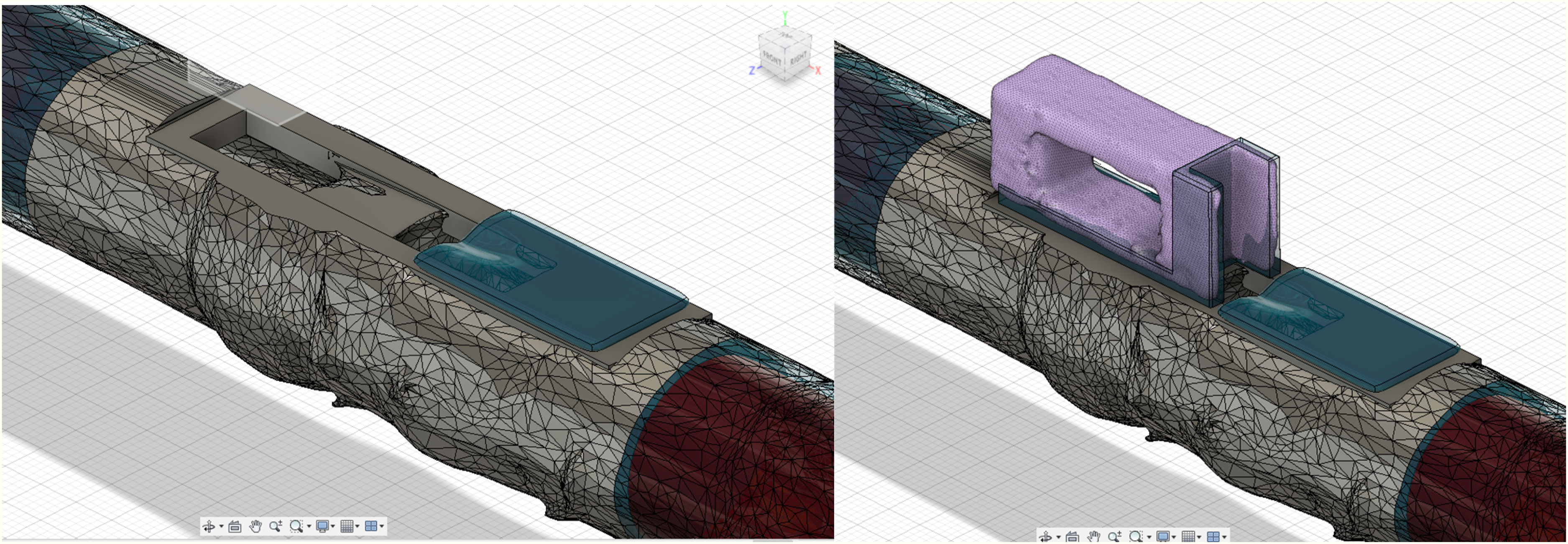
Design work in Fusion 360, creating the place for the block to attach to the flute body with a tight seal for effective sound production.
To emulate features found on the original instrument, I cut eight strips of leather and tied them around the body of the 3D-printed prototype in the same locations as on the original Kiowa flute (Figure 1). This decision was not incidental. Leather ties appear on several documented Kiowa flutes and distinguish them from other Native American flute traditions, where such bindings are less prominent. Their consistent presence across Kiowa examples suggests a culturally specific convention that may serve a functional purpose (reinforcing the flute's body or securing the block), a protective role (guarding against wear or damage), or a symbolic one embedded in social or ceremonial practice. By including these ties in the replica, I aimed to achieve greater material fidelity and honor the relational and cultural systems through which meaning is expressed in object design. Their inclusion reflects how this replication project is not merely about acoustic utility; it is also about interpretive care, recognizing that these design features carry cultural significance even when their meanings are not fully understood.
Ultimately, the prototype reproduction of the Kiowa courting flute demonstrates that high-resolution CT scanning, careful digital repair, and additive manufacturing can reproduce the sound and playability of a broken pre-reservation-era instrument. The success of this technical approach, however, also clarified that beyond the proof-of-concept stage, any subsequent refinement, whether in wood choice, block geometry, or leather-tie placement, must proceed only under Kiowa authority and on Kiowa time. The recent 2024 revisions to NAGPRA now codify that principle (Owens-Barber, 2025), in this case, affirming that the Kiowa community of origin of the do’mba’ should determine which elements of its voice may be reconstructed, which details remain in confidence, and how new Kiowa makers might adapt the design for contemporary use. The replicated model is already a playable study instrument, providing a reference point for the pre-reservation acoustics that were previously inaccessible; now Kiowa community members can examine the design and determine how, or whether, it should be adapted for contemporary use. In Kiowa hands the reproduction has the potential to help reactivate language, ceremony, and pedagogy, and in this way the 3D-printed proof of concept flute is a catalyst, not a final product. It can also serve as a prompt for Kiowa-led decision making about how, when, or whether its voice should be further refined with more precise attention to the embouchure in any further replication processes. Any future work will reflect respect for acoustic sovereignty, giving the Kiowa Tribe leadership regarding where and if any work develops from here. Highlighting these ethical imperatives that guide my research on Indigenous material culture invites a generative comparison: How do replication practices unfold when scholars and curators are not accountable to community sovereignty, as is often true when replicating Western classical instruments?
3D-Replication of Western and Indigenous Instruments
Replication practices involving musical instruments are common in museum and academic contexts (Brenna et al., 2018; Howe et al., 2014; Savan & Simian, 2014; Wachowiak & Karas, 2009). Typically, 3D-scanning and printing projects focusing on Western classical instruments prioritize technical accuracy, historical fidelity, and acoustic precision. Particularly within the Historically Informed Performance (HIP) movement (Bowan, 2019), scholars reconstruct baroque recorders, Renaissance flutes, clarinets, and even ancient Greek auloi, using advanced digital modeling to reproduce their original sound qualities (Hagel, 2017; Kantaros et al., 2023; Roda et al., 2021; Simian, 2023). Though issues of authenticity, forgery, or market exploitation occasionally surface, particularly with iconic instruments such as Stradivari violins (Dolan et al., 2020), the primary focus remains technical and scholarly rather than explicitly ethical or community driven. Even when Western scholars replicate instruments originating outside Europe, these replicas often become historical artifacts detached from contemporary community contexts, treated primarily as research objects rather than as elements of living cultural traditions. In contrast, the replication of Indigenous musical instruments necessarily engages questions of community sovereignty, accountability, and relational ethics. Indigenous instruments housed in museums were sometimes collected without consent, and institutions historically displayed them as ethnographic curiosities rather than functional, meaningful sounding objects. Unlike Western classical instruments replicated primarily for research or performance contexts, Indigenous instruments carry cultural sensitivities, ceremonial responsibilities, kinship obligations, and context-specific knowledge that complicate replication. For Indigenous communities, instruments are not merely relics but active elements of cultural continuity, intimately tied to present-day identity, ceremony, and governance. Consequently, 3D-replication of Indigenous instruments demands protocols of consultation, consent, and cultural authority. In the United States, NAGPRA explicitly mandates community oversight, consultation, and consent, adding ethical complexity to replication efforts.
My replication project involving the Kiowa block flute at the Haffenreffer Museum exemplifies these ethical considerations. Initially approved as a proof-of-concept study of a non-sacred, personal instrument historically used in courting practices, the project quickly revealed that technical feasibility alone was insufficient. Ethical replication required dialogue with Indigenous collaborators and affirmed that any subsequent efforts must occur under Kiowa community oversight, on Kiowa terms. This approach reflects Dylan Robinson's (2020) critique of “hungry listening” and reaffirms refusal and consent as sovereign acts, marking replication as relational rather than merely technical. The replication of both Indigenous and Western instruments involves common material challenges, such as addressing physical fragility, age-related deterioration, and prior harmful conservation treatments (Simms & McIntyre, 2014); yet organizational inequalities persist: Western instrument replication projects typically enjoy robust institutional funding and fewer ethical constraints, while Indigenous-led projects can encounter limited resources, administrative hesitancy, and significant ethical responsibilities. This comparative perspective clarifies that while Western classical instrument replication often emphasizes technical fidelity and historical authenticity, Indigenous instrument replication centers on ethical relationships, cultural sovereignty, and community-defined protocols. Ultimately, the legitimacy of Indigenous replication lies not merely in technical sophistication but in sustained accountability to the communities whose knowledge, identities, and futures are materially and sonically entwined with their instruments.
Acoustic Sovereignty in Practice
This project began with a desire to restore sound and hear someone play a silenced Native American flute again; yet, that goal carried the risk of enacting what Dylan Robinson (2020) calls hungry listening, the settler impulse to access and consume Indigenous cultural expressions without consent, context, or care. From the outset, I tried to confront this tension directly, shifting academic and aesthetic interest into a practice of relational listening, an approach rooted not in entitlement, but in accountability. One of the clearest expressions of that commitment came when I presented my research at the Royal College of Music's “3D Printing and Musical Heritage” conference in London in 2024. This international gathering brought together a community of musicologists, instrument makers, acousticians, and museum curators to share cutting-edge research on the replication of historical instruments. The conference highlighted projects focused primarily on Western instruments, each defined by meticulous attention to scientific accuracy and acoustic fidelity. Presenters emphasized close attention to timbres, tunings, scales, and the acoustic architectures of instruments, celebrating the potential of digital modeling and additive manufacturing to produce near-exact sonic copies of historical instruments.
Within this context, the Kiowa flute project stood out not only for its distinct cultural origin but for the different ethical stakes that guided its development. The audience at the Royal College of Music was naturally eager to hear the results of my technical process: How accurately did the replica capture the timbre and pitch range of the original flute? Did it successfully reproduce historical acoustic properties? These questions, necessary within the broader field of instrument replication, highlighted an assumption common to most instrument replication projects, that sonic accuracy is both the primary goal and a self-evident good.
Yet I chose not to play the Kiowa flute reproduction, because, despite its technical functionality, I had not yet received explicit consent from Kiowa representatives to publicly sound the instrument. That silence was not an evasion; instead it marked an ethical boundary. At the same time I wanted to acknowledge the legitimate curiosity regarding my replication methods of Native American flutes, so I demonstrated my attention to airflow, tuning, and acoustic functionality with a different Indigenous inspired, tourist grade flute from my own collection, of which I had made an approximate replica using similar techniques including digital modeling and 3D printing. My alternative of playing this tourist block flute did not carry the same cultural sensitivity or ceremonial restrictions as the Kiowa flute, which allowed me to showcase my replication methods and acoustic precision without transgressing ethical boundaries.
This deliberate contrast between the two block flutes, one sounded and one respectfully withheld, made explicit the ethical framework that I have discussed throughout this article regarding acoustic sovereignty: Technical success cannot override the need for community consent. In Indigenous contexts replication is not just about acoustics; it is fundamentally about relations. The Kiowa prototype emerged from a desire to repair and rediscover, but that impulse had to be tempered and redirected toward consultation, consent, and the recognition of refusal as a valid and sovereign response. These commitments became even more urgent in light of the 2024 revisions to NAGPRA, which now require prior consultation and consent for any research, digitization, and reproduction of culturally affiliated belongings (Owens-Barber, 2025). Though the Kiowa project was initiated before these revisions, we had already taken into account their core principles: transparency, collaboration, and Indigenous consultation. The approximate replica that I produced is therefore not a substitute for the original, nor a definitive reproduction. It is a relational gesture and an invitation rather than a conclusion. Because this near copy is a playable instrument, Kiowa people can now directly engage with a pre-reservation design previously isolated in museum storage. However, as mentioned, any future work with this replication process will proceed only on Kiowa time, under Kiowa authority. In this light, acoustic sovereignty emerges not merely as a theoretical lens but as a lived framework for care, governance, and belonging. To replicate ethically is not simply to reproduce a sounding object; it is to act in relation to the community to whom that instrument matters and to whom it ultimately belongs.
Footnotes
Action Editor
Gabriele Rossi Rognoni, Royal College of Music.
Peer Review
Althea SullyCole, McGill University, Schulich School of Music; Jennifer Brian, Royal College of Music.
Data Availability Statement
Data sharing not applicable to this article as no datasets were generated or analyzed during the current study.
Declaration of Conflicting Interests
The author declared no potential conflicts of interest with respect to the research, authorship, and/or publication of this article.
Ethical Approval
This research did not require ethics committee or IRB approval. This research did not involve the use of personal data, fieldwork, or experiments involving human or animal participants, or work with children, vulnerable individuals, or clinical populations.
Funding
The author received no financial support for the research, authorship, and/or publication of this article.
