



Abstract
The music field is lively and creative, and innovation in the final product is a leading force in the sector. However, the physical instruments used by musicians to produce their craft are highly conservative and have developed little over the last centuries. Computers, audio software, and electronic musical instruments have been integrated into musical practice, but acoustic instrument design has remained virtually frozen. Although mass production methods are frequently applied to musical instrument production nowadays, the designs have changed minimally, which makes the musical landscape unique. Additive manufacturing (AM) provides novel possibilities that can be of interest in music and musical research. In this article, we present the results of five case studies on AM use within specific musical niches. Each niche represents a unique market space and cultural background that is critical in tradition-oriented environments. Starting from the analysis of these five case studies, we extract lessons on AM application to unique environments. From these, we discuss the potential for AM-driven innovation in design and production in general and propose a holistic evaluation matrix for identifying suitable market niches.
Introduction
Additive manufacturing (AM) is a powerful set of tools that enable the materialization of physical objects from digital three-dimensional (3D) models. This set of technologies, even though still in development and often related to innovation projects, is not new at all. The first AM patent was introduced in 1984 by C. Hull, who invented stereolithography (STL), an AM method that operates by solidifying liquid polymers layer by layer using ultraviolet light. Laser sintering (SLS), a method for crafting objects by sintering (melting) powder particles with a laser beam, was patented in 1989 by C.R. Deckard. C.S. Crump further expanded the family of technologies by creating the fused deposition modeling (FDM) method and patenting it in 1992. FDM operates by extruding molten filaments through a computer-controlled moving nozzle, which somewhat ironically is technically a simpler AM method than the previous ones (Savini & Savini, 2015). Other AM technologies with a smaller share of the current production volume include laminated object manufacturing (LOM), continuous liquid interface production (CLIP), muti-jet fusion (MJF), polyjet, direct metal laser sintering (DMLS), electron beam melting (EBM), and countless variations of similar production processes. Each of these methods have unique matrixes of advantages and disadvantages, degrees of freedom and limitations, maximum and minimum output sizes, qualities and flaws, and available materials, as well as very divergent production times and costs.
The FDM patent fell into the public domain in 2009, leading to a myriad of companies and start-ups developing their own versions of these machines, which can operate at room temperature and even become desktop devices. This expansion powered the do-it-yourself (DIY) movement, which through an open-source philosophy of sharing 3D models led to speculation on the imminent arrival of nothing less than a “makers’ industrial revolution” (Anderson, 2012).
The musical world has not remained untouched by this sudden expansion of available manufacturing possibilities. Yet the musical instrument making environment is deeply rooted in tradition, despite the musical scene being so lively and innovative in its final output. Computers, audio software, and electronic musical instruments have been integrated into musical practice, but acoustic instrument design has remained virtually frozen for centuries. This fact alone makes music quite unique as a milieu, an outlier in a world where new production possibilities have boosted design evolution in almost every possible niche.
The reasons behind this design evolutionary stagnation are multiple and complex, involving tradition, pedagogy, aesthetics, culture, psychology, research (and the lack thereof), among other things, and go beyond the scope of this article. Instead, our goal is to present a selection of five case studies attempting to innovate in musical instrument production and design through AM. The analysis covers the efforts made, the results obtained, the reactions from the musical community, and plausible future developments within the specific niches defined by each experiment. From those elements we attempt to propose a general theory of suitability and unsuitability of AM as a production method for musical instruments based on the characteristics of the niches they inhabit, as well as the implications for possible future design evolution this brings.
Using AM as a production method for musical instruments is not a novel idea, and several experiments in this area have been conducted and reported. 1 Our contribution to the field derives from the new niches being explored, from the attempt to build a generalized theory of AM suitability, and from the analysis of future expansion and development possibilities. The five case studies were chosen because the experimentation was carried out by ourselves (which gives us first-hand data) and because they have not yet been fully reported in an academic format. Our report covers not only early but also long-term results, including commercial developments, up to years after the initial release of the instruments in some cases.
An in-depth analysis and discussion of the different AM technologies and their possibilities also goes beyond the scope of this article, while several reviews of this kind can be easily found.
2
In this regard we would only like to mention the reasons behind the technologies chosen for the experimentation. SLS technology was the main AM tool used for the five case studies for the following reasons:
-SLS does not impose topological limitations, even allowing for interlocking geometries. -SLS does not require support structures during manufacturing, thus eliminating surface scarring upon removal. -SLS can build the selected instruments in a single piece, eliminating gluing lines. -SLS allows for a high degree of accuracy. -SLS allows for materials that have densities and mechanical properties well suited for the task. -SLS production costs have notoriously decreased, making it a plausible competitive manufacturing method rather than a mere research tool.
Case Studies
Cornett
Our research project on AM within the music field can be directly traced to two case studies conducted in parallel by Jamie Savan and Ricardo Simian without their mutual knowledge. Their experiments aimed at crafting 3D printed replicas of the cornett, a Renaissance wind instrument. 3 Savan and Simian reported on the early progress of this experimentation in a co-authored article for the Oxford Early Music Journal in 2014, which also speculated on the generalized future possibilities of this novel research method (Savan & Simian, 2014).
The cornett is an unusual instrument in many regards. First, it went out of fashion centuries ago, becoming a museum object, called back into action almost exclusively for historical musical performances. Second, it is a cross-family instrument: it is typically made of wood but has a mouthpiece, which defines it as a member of the brass rather than the woodwind family. Third, it is one of the most recent early music instruments to have been resurrected to active performance. While baroque trumpets, gambas, and harpsichords became common in music schools in the 50s, the first recordings of Monteverdi's Vespers featuring cornetts came several decades later. Only very recently did this instrument become popular enough for musicians outside a handful of specialized institutions around the world to learn it. Fourth, the cornett has an unusual shape for a wooden wind instrument: It is slightly curved to the side, resembling instruments carved out of animal horns (hence its name, corno = horn, cornetto = little horn).
Rediscovering a musical instrument is challenging. Musicians must develop the necessary technique without living tutors or reference audio recordings, and instrument makers must produce playable instruments based on remaining traces. For some early music instruments, the organological research may become mainly speculative (for instance, when no instruments of their kind survived to the present, and only drawings or written descriptions remain). However, in the case of the cornett, a wide sample of the original objects survive, many of which are in playable condition. Nevertheless, reconstructing an instrument remains difficult, and obtaining access to the reference objects, or even their measurements, is often a lengthy and frustrating process. Fortunately, digital measurements of instrument collections are becoming increasingly common, and the impossibility of directly accessing precious originals, like the ones preserved in the Vienna Museum, may not necessarily curtail research efforts (Darmstädter et al., 2011).
The soprano cornett is between 50 and 60 cm long and slightly curved. The inner bore is always round, and the exterior shape is often octagonal, making it a difficult object to build by hand. Since long, conical, and curved drilling is technically impossible (even with modern standard workshop tooling), the most used technique for manually achieving such a craft is to cut the instrument in half along the main axis, carve the interior by hand, and glue it back together, hoping that both halves will be symmetrical. 4 While this requires tremendous skill from the craftsmen, it would be even more arduous to perform this with 16th-century tools (fish skin instead of sandpaper, crude hand saws, foot-powered lathes, and bone-based glues). The results achieved with such technologies were impressive but, understandably, sometimes flawed. “As is normal with old cornetts, a regular and craftsmanlike exterior conceals an irregular interior… The bore, in cross section, is perhaps nowhere a true circle, and reference to exterior diameters will suggest that the maker, rather than warping, was responsible” (Drake, 1981).
All these unique elements and parameters make the cornett an excellent candidate for AM. A soprano cornett just fits a large SLS printing chamber in one piece, which would allow it to be built without cutting and gluing lines or postproduction bending. Savan and Simian conducted their experiments by starting from different reference models and approaches. While Savan focused on the Christ Church cornetts (Drake, 1981), Simian took the Vienna Collection as a starting reference (Darmstädter et al., 2011). The main AM technology used was SLS, with some minor SLA and FDM inclusions. The main postproduction and finishing techniques utilized for achieving smooth waterproof surfaces were abrasive polishing and acrylic coating (Figure 1).

AM cornetts by Ricardo Simian. 3D models, 3D print, and photo by Ricardo Simian.
Both projects were successful in attracting attention from researchers specialized in early music as well as the general public. Media coverage has been unusually high and regular for such a niche topic (Beha, 2018; Garus, 2019; Goeth, 2020; Kübler, 2018; Russell, 2019). Since the beginning of the project, Simian's efforts transformed into a start-up that regularly receives orders for AM cornetts in volumes comparable with, if not larger than, those that traditional makers currently have. 5 This topic will be revisited later.
Shakuhachi
The shakuhachi is a traditional Japanese bamboo flute with a long and rich tradition. As with many Japanese cultural elements, it is not possible to understand the shakuhachi only as a musical instrument; rather, it is a holistic embodiment of Zen meditation, Japanese aesthetics, and music.
6
In Japanese philosophy one seeks to understand reality in a holistic manner, not through a dissection or disaggregation of phenomena. In Buddhism, this is referred to as the “thus-ness.” One should be able to grasp the substance of anything without thinking. Therefore, an explanation is not necessary, especially a written one, and should not be given by a teacher or by others. This may be considered the “intuitive tradition.” Thus, we do not find a well-documented history of the shakuhachi to draw upon, and even the oral tradition is vague and partial in character. (
Koga, 1979
)
Despite the vagueness of these descriptions, at least by Western musicological standards, the modern shakuhachi has developed into a standard model that can interact with Western scales and pitches. Advanced players usually also master microtonal intervals, glissandi, and many other techniques, which are rarely used in Western classical repertoire, making the shakuhachi and shakuhachi players very attractive to many contemporary composers looking for alternatives to traditional musical codes and limitations. All these elements simultaneously make the shakuhachi a fascinating musical instrument and a very interesting challenge for testing AM capacities for (re)producing musical objects.
The modern (fuke) shakuhachi is made of a piece of bamboo 54.54 cm long, which is usually split into two parts with a joint in the middle, with five fingerholes (one thumbhole at the back and four at the front). 7 Sound is produced by blowing straight into a razor-sharp edge cut (utaguchi) at the upper end. The inside is often treated with varnish and compounds to produce a very smooth surface, which, according to tradition, deeply influences the sound quality. Shakuhachi luthiers tend to keep their varnishes, compound recipes, and production techniques a secret (Koga, 1979). 8
A plastic shakuhachi (shakuhachi yuu) already exists and is well established in the market. Performers consider its quality to be good, and the only common complaint is that the instrument tends to be much heavier than a traditional bamboo one. Traditional shakuhachis have a bulky bamboo knot at the lower end, which can be quite voluminous. The shakuhachi yuu imitates this esthetic feature using solid plastic, as opposed to the natural bamboo structure, which is full of air bubbles, markedly increasing its weight.
The key challenges in developing an AM version of a shakuhachi were, therefore, to produce a thin, accurate, and sharp blowing end from a biocompatible material that could be safely placed against the lips and craft a very smooth interior surface. Additionally, we also aimed to produce as light an instrument as possible – even lighter than traditional ones if achievable.
After some tests, the most successful blowing end was achieved using SLS PA11 and intensive postprint abrasive polishing by hand. The body of the instrument was produced with SLS PA12 instead, which delivers a very rough surface. 9 Because polishing did not deliver a smooth enough surface, different acrylic varnishes were tested to identify the appropriate one. These tests were very interesting because they confirmed that the interior smoothness, far from being a musician's myth, greatly affects sound production. This will be discussed later (Figure 2).
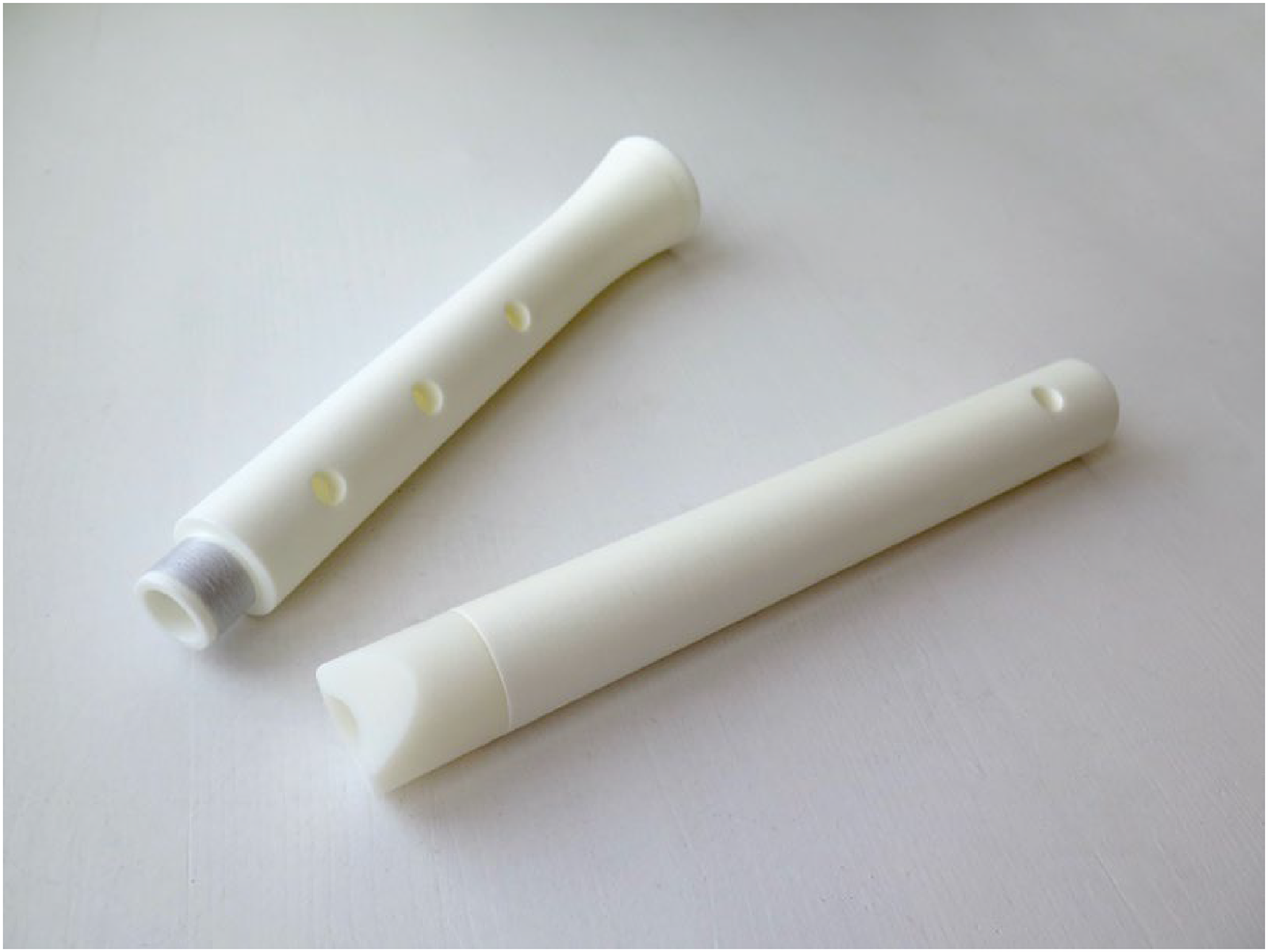
AM shakuhachi by Ricardo Simian. 3D model, 3D print, and photo by Ricardo Simian.
The resulting instrument was deemed satisfactory by the performers who motivated this research. Our AM shakuhachi, which has the same shape and size as a traditional one, weighed ca. 270 g instead of the ca. 400 g of the traditional instruments measured in the project. A video of Ueli Fuyûru Derendinger playing the AM instrument alongside a traditional one can be found here: https://www.youtube.com/watch?v=7U-YUNLXa5U
This research was a success in terms of developing a playable instrument and solving all the technical challenges. The resulting product is more expensive than a shakuhachi yuu, however (even though it is considerably cheaper than a traditionally made instrument). Requests for further copies of the AM shakuhachi have been few, mostly through word-of-mouth communication from the performers who have played the few copies produced so far.
Fagottini and Tenoroons
Almost every modern musical instrument evolved from a previous one. The extant instrumental families (strings, brass, woodwinds, etc.) can be traced back to the Renaissance period. However, yet in a similar fashion to what occurs when rewinding biological evolutionary history, many surprises, in-between exemplars, evolutionary dead-ends, and extinct lineages (like the cornett) can be found. Renaissance musical practice often involved the use of “consorts,” or families of the same instrument of different sizes to play the different voices – that is, an instrumental choir. This meant that during that period, assorted sizes of almost every instrument could be found, ranging from bass to soprano. The acoustics of the different instruments are not necessarily suited to all sizes, however, and the sizes that survived to our time are the ones that worked best. For instance, the modern traverso flute was tenor-sized in the Renaissance consort, the oboe is a development of the soprano shawm, and the bassoon evolved from the family of curtal bass instruments (Wainwright, 2017).
The smaller members of the bassoon/curtal family did not suddenly disappear immediately after the Renaissance, however. Small-sized bassoons remained in use, although seldom, as late as the early 19th century. Tenor-sized instruments (“tenoroons”) and alto-sized ones (“fagottini”) were the topics of interest of two research projects at the Schola Cantorum Basiliensis between 2017 and 2023, which mapped surviving exemplars (surprisingly, in the hundreds), placed them in context, and attempted to reconstruct their musical function (Agrell et al., 2023; Agrell & Domínguez, 2018, 2019).
AM was focal in these projects in several ways. AM replicas of selected instruments were made to perform tests whenever the originals were not in playable condition or were unavailable for long-term direct testing. Additionally, 3D modeling allowed the production of repaired and altered versions of surviving instruments. A particularly interesting test involved producing twin copies, with one representing the instruments in their present condition, namely internally ovalized due to wooden shrinkage, and one corrected with a rounded inner bore, as they presumably were originally. Needless to say, it would be impossible, or at least very impractical, to produce irregular, ovalized instruments with traditional lathes and wood (Figure 3).

Fagottino CHB alongside AM replica. 3D model, 3D print, and photo by Ricardo Simian.
Because playable small bassoons are rare, the AM fagottini and tenoroons produced for this project have been used several times during the past few years in normal concerts alongside traditionally made instruments. There is indeed a repertoire that was meant to be played with these instruments, and conductors have been eager to see and hear the original orchestration rather than replacing them with another instrument that can play in the same register, which has been the pragmatic solution for lack of a better one.
The digital research did not end at this point, however. For the final stage of the project, a few wooden copies of the instruments that were identified to be the best were produced. The reamers for lathing the inner bore of these instruments were directly extracted from the 3D models and produced with laser-cut steel, a time- and money-saving decision by luthier Vincenzo Onida, which happens to also yield higher accuracy than that which hand-made reamers could offer.
The results of both research projects were presented at the symposium “Forgotten relatives, small bassoons of the 18th and 19th centuries on stage again” at the Schola Cantorum Basiliensis on February 24 and 25, 2023. As is customary for research projects financed by the Swiss National Science Foundation, all data will be made publicly available as soon as the project is closed. Although several players have expressed interest in acquiring AM copies of the fagottini and tenoroons produced during the project, the measurements belong to museums and private collections and were collected based on limited research agreements, which for the time being do not allow for commercial uses of the data.
Ukulele
The ukulele, even though it was developed into the instrument we know today only by the end of the 19th century, can be considered a traditional Hawaiian musical instrument. Derived from the Portuguese “braga,” the ukulele is a small guitar with four strings. The fact that its name means “leaping flea” should be enough to give an idea that the instrument has a somewhat charming and humorous character (Elbert & Knowlton, 1957). Maybe because of this fact, its portability, or portrayal in Israel Kamakawiwo’ole's hit cover of the song “Somewhere over the rainbow,” this instrument has gained worldwide popularity (Kois, 2009). 10
Such is the demand for ukuleles worldwide that mass-production lines nowadays deliver whole beginner kits (complete with a case and tutorial) for even less than €50, a stunningly low price tag for a musical instrument with assembled movable parts. On the other end of the spectrum, as is usual for musical instruments, there is no cap to the price luthiers may charge for noble wood hand-crafted ukuleles. Various intermediate alternatives are also available.
Being such an efficiently covered market, the contribution of AM ukuleles to the domain of this instrument would seem to be very limited or simply nonexistent, at least from the perspective of introducing a potential commercial product. The interest behind this research revolved around testing how AM material would emulate the structural and resonance properties of wood. The ukulele produces sound through string vibration, an entirely different physical principle from those of the aforementioned case studies. Furthermore, the tension in the strings requires a firm and strong structure. These elements, in addition to the design of the mechanical tuning system to be solved, make a stringed instrument an interesting new field of research and testing for AM independent of the market possibilities.
The ukulele comes in different sizes, with the “concert” version being the most popular one. This size requires ca. 40.5 cm of vibrating string, which brings the whole instrument, depending on the design, to an overall length ranging between 55 and 60 cm. This makes the ukulele suitable for printing in a large SLS machine in a single piece, which is an interesting design possibility in contrast to that of traditional instruments, which require assembling several pieces of wood.
The design concept was therefore shaped by the following goals, criteria, and conditions:
-The resulting instrument should emulate the sound and playability of a traditional ukulele. -The whole instrument (except strings and tuning pegs) should be built in a single AM piece. -The shape of the ukulele should remain functional yet make use of AM potential to deliver a design that would be impossible, or at least difficult, using traditional production methods.
The first prototype yielded a playable instrument, but the tension in the strings bent the neck slightly, lifting their height from the frets beyond the ideal range. This problem is often encountered in low-priced traditionally made instruments as well. The second prototype was built with a counter curve to the bending direction and calibrated according to experimentation on prototype 1. This adjustment led to a stable instrument within standard parameters. Prototype 2 has been regularly played with tensioned strings since November 2019 without further deformation or bending.
Further experimentation was conducted to also develop an AM tuning mechanism. The mechanical parts, consisting of a worm drive (worm gear matching a worm screw), required several iterations to find the correct clearance and thickness parameters. The result was a fully functional, preassembled AM tuning mechanism that can bring ukulele strings to, and hold them at, pitch; it has also remained operational for years.
A further iteration in the design introduced a second piece for the fingerboard and frets, made of different AM materials, which must withstand great friction and collects dirt from the fingers during playing. This undermines the single-piece starting concept but enhances the overall playability and durability of the instrument (Figure 4).
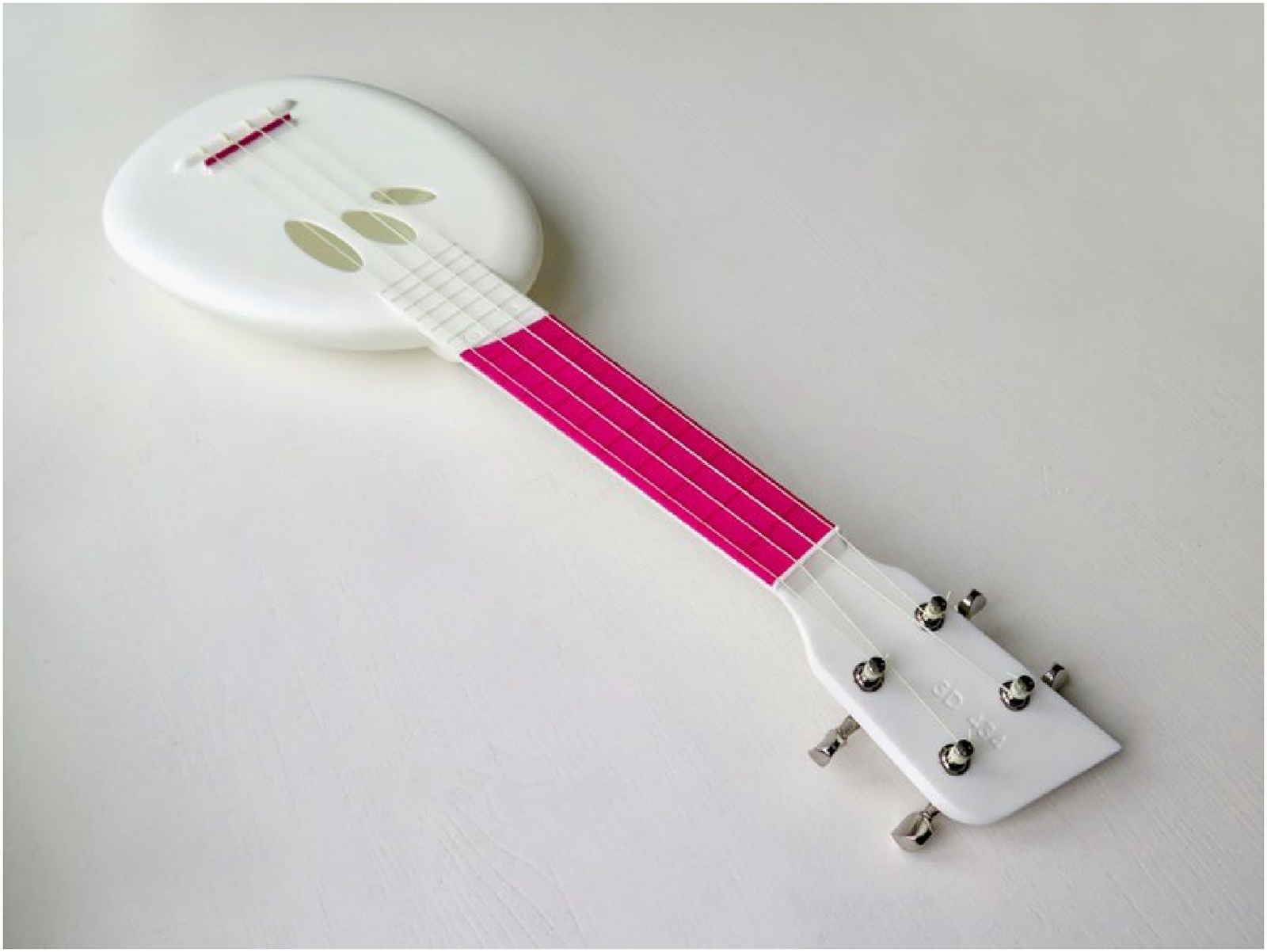
AM ukulele by Ricardo Simian. 3D model, 3D print, and photo by Ricardo Simian.
Although the AM ukulele, nicknamed “Dr.Ukulele,” has been highly praised for its aesthetics and sound by musicians and design afficionados, there have been no requests for further copies of the different iterations developed. 11 The Dr.Ukulele has been presented in several exhibitions around Europe, but unsurprisingly, no market niche for it has been identified: it is too expensive to produce when compared to the average traditional instrument without offering enough advantages to motivate high-end performers to make such an investment. 12 This AM instrument has been a success in terms of achieving the set research and experimental goals; however, it remains an oddity of the research realm.
Slide Pipe Consort
Composer Jasper Vanpaemel wrote the piece “XYZ” in 2019 for a trio of instruments that did not yet exist. He defined the concept for the instruments as “slide pipes,” which are whistle-like instruments that produce different notes by altering their resonance length through a push/pull slide. He wanted the pipes to play in a low register, however, ideally having the bass instrument going down to a C2 (the lowest note a violoncello can play). Because nothing close to this exists in the market, Vanpaemel approached 3D Music Instruments and asked if the required instruments could be developed and produced within a few months (the deadline was clearly defined for the premiere, which was already booked at the Concertgebouw).
Basic acoustics requires a closed 4-ft pipe to produce a C2. Therefore, a combined approach of mixing AM parts and standard building materials (polyvinylchloride tubes, wooden sticks, and polyurethane hoses) was chosen. This decision was not only based on the size of the pipes (which would not fit inside an SLS printing chamber) but also on the very smooth surface needed to allow the slide to move and create a tight seal. However, such surfaces are difficult to produce via AM. This approach also made the project noticeably cheaper. Thus, AM was only used to make the head of the pipes (including the sound-producing labium) and the head, positioner, and elbow of the slide (Simian, 2019).
The most delicate part of the instrument is the pipe head, which was modeled on traditional organ pipes. AM allows for quick test iterations, which is crucial in a piece requiring a high level of fine-tuning. The instruments were delivered in time for the musicians to practice the composition and perform the premiere as planned. The piece has since been played in several concerts (Figure 5).

Apsara Trio performing XYZ at the Concerthall Ghent, 17.10.2019. Photo by Jasper Vanpaemel.
This quick development and delivery can be understood as either an isolated, one-time experience or as a model for the efficient delivery of unique, customized objects.
Discussion of Case Studies
Reactions from the Milieu
Culture- and tradition-oriented topics usually have many intertwined layers of complexity when it comes to objectivity. Authority in fields where subjectivity is a key element, as it always is in the arts, is built upon expertise in the topic, which requires a degree of objectivity. This expertise is fragile, however, constantly verging on collapsing like the illusion of the emperor's new clothes in the face of solid debunking.
Such episodes are extremely traumatic for the fields involved. The wine world was shaken to its roots when a 2001 study demonstrated that sommeliers could be tricked into believing white wine was red wine by simply coloring it. The remarkable study even collected in detail their nuanced appreciation of red wine qualities (“chocolate,” “coal,” “prune,” etc.) in colored whites (Morrot et al., 2001). The authors took a very constructive approach with the results, opening a discussion on synaesthesia between the brain’s processing of visual and taste information (hence the title of the study, “the color of odors”). An even more illuminating investigation in this line may be the 2008 study by Plassmann et al., which performed live MRI scans during wine tastings, involving measuring the activation of the pleasure centers in the brain, which is as close as researchers can get to objectivity when measuring enjoyment by an individual. The study demonstrated that the degree of enjoyment of a bottle of wine correlates to the communicated price tag and not to the real price. This means people enjoy cheap wines more than expensive ones if they believe they are savoring a highly priced bottle (Plassmann et al., 2008). In both cases, beyond simply dismantling a field of expertise (which inevitably happened), it is far more interesting to learn from the insight how the human brain works and how this reality relates to our cultural constructs.
A concept behind this analysis is the question of legitimacy. Is good wine legitimized because an authority declares it so, because of its provenance and price tag, because someone subjectively enjoys it, or because an MRI shows that more pleasure neurons were activated? This question becomes even more crucial within the artistic world, where verifying that the signature behind a scratched white canvas is Fontana or not can make the difference between it being worthless or costing a fortune.
The musical world has not been immune to such legitimacy- and authority-debunking episodes. Many elements in music come from well-established traditions and are taken for granted. As Richard Sennett states in his book The Craftsman, regarding old Italian violins and modern copies of them, “the violinist Arnold Steinhardt of the Guarneri String Quartet has remarked, the professional musician can almost instantly distinguish between the original and any copy” (Sennett, 2008). The source provided by Sennett for this statement does not link to a scientific study or something similar but simply to the statement “almost every issue of the luthiers’ professional journal, The Strad, is occupied with these problems.” In other words, the presence of authoritative literature on the topic proves it true. One would then expect The Strad to be full of scientific studies on the matter, which is the case, but they all pose the question “How are old Italian violins better than modern copies?” rather than “Are they better at all?”
Claudia Fritz from the acoustic research department of the Sorbonne University decided to tackle the question of whether old Italian violins are better than modern copies through a double-blind study where players had the opportunity to test both Stradivari and modern instruments. They were then asked to say in each case what they believed they had under their chins. The result, known as the 2012 Paris experiment, revealed that the emperor was naked and that professional violinists cannot distinguish old Italian violins from modern ones. The tsunami of critique was swift, and the study was repeated by addressing the issues raised (a hall with concert-quality acoustics for the test, more time per instrument, etc.). The resulting study was even worse for the old instruments: In answer to the additional question, “Which one of the twelve sampled instruments would you take home if you had the chance?”, a modern one was the clear winner (Fritz, Curtin, Poitevineau et al., 2014). This study has, unsurprisingly, generated a great deal of controversy and replies (Fritz, Curtin & Poitevineau, 2014) and was followed by an analysis of modern vs. old violins from the perspective of the audience rather than the player (Fritz et al., 2017). At this point, the reader may already know the results of that study. Puzzlingly, despite the discussions triggered by these articles, common knowledge (expert or not) will largely take as an indisputable fact exactly what Sennett stated, namely, that old Italian violins are evidently better than modern ones.
Fritz and her team have tried to apply these results constructively, however, by aiming to improve the definitions of poorly framed concepts such as “better sound” through a matrix of parameters including loudness, timbre, projection, and overtones. A good summary of the difficulty of objectively reviewing musical instruments can be found in the Physics Today article Evaluating Musical Instruments by Murray Campbell (Campbell, 2014). 13 As previously mentioned, untangling cultural, subjective, and objective elements is arduous. Furthermore, fully achieving such a goal may be undesirable because an element of the artistic enjoyment may well be related to it.
AM musical instruments introduce another layer of complexity into this discourse. In an environment that has dedicated decades of expertise to analyzing different types of violin varnish to imitate Stradivari, SLS-Nylon is not expected to spontaneously thrive. Having acknowledged the starting point, it would be fair to say that the welcome AM cornetts received surpassed expectations. Purists will never embrace them, but enough interest around the different endeavors exists to sustain ongoing project development. The success of the AM cornetts piqued the curiosity of some shakuhachi players regarding developing that instrument as well. Although this endeavor was successful in developing a functional instrument, the market niche did not flourish afterward in a similar manner to that of the cornetts. The ukulele experiment has been highly praised in many regards, and players are very interested in putting their hands on this unusual object; but it has remained mostly an exhibition object.
Furthermore, AM opens entirely new worlds of research possibilities in the musical field. For instance, we are now able to produce traditional designs with a great degree of accuracy but using entirely new materials. Until now, many designs and shapes could only be produced with certain materials – for instance, metal for thin structures such as trumpets – which made testing whether or how the choice of material influenced the sound impossible. This research process is not easy, however. In the words of Campbell: Musicians sometimes look with scorn on simplified models that physicists use to explore the fundamental principles of an instrument's behavior. Scientists need to explain that the models are steps along a route that could ultimately lead to insights of great value to a maker or player. On the other side, scientists can be dismissive of performers whose evaluations of instruments are biased and inconsistent, but it is essential to remember that it is the performer who brings the instrument to musical life and who must be the ultimate arbiter of its quality. (Campbell, 2014)
AM cornetts and fagottini have been widely used for different tests and comparisons. Almost every audience member and journalist learning about the topic demands a live test. However, these numerous examples remain anecdotal and lacking in scientific rigor. Proper testing is yet to be conducted in the field. If verifying fundamental questions related to mainstream instruments such as the violin has taken so long and has been so sporadically performed, that interest and funding will soon be directed to researching AM instruments is highly unlikely.
In 2018, 3D Music Instruments received the first prize at the Purmundus Challenge design competition at Formnext Frankfurt (Manglani, 2018). The winning model was a further development of the cornett, which integrated keys in a similar fashion to that in other modern wind instruments. The novelty of the proposed design was in the mechanism of the keys, which did not require assemblage or springs. Instead, it utilized the natural flexibility of PA12 for the movement, and the whole object was produced in a single print. In this regard, it could be said that the industrial design department has expressed more interest in AM musical instruments than the music community.
Sweet Spot
The case studies presented provide some elements regarding a sweet spot analysis for AM musical instruments in general. To begin, two potential lines can be broadly identified. The first one would be to innovate and develop an entirely new, AM-native instrument (which could only be manufactured through AM) successfully. If such a stunt could be achieved and the resulting instrument became successful, such a design would remain an AM exclusive. This is easier said than done, however: For such a design to become popular, it should not be a high-end product, something that would remain for any foreseeable future beyond the budget of orchestras and musicians. Arguably, the last time a new acoustic musical instrument was successfully introduced was in 1846, when Adolphe Sax patented the saxophone. Even then, the process was not easy. 14 Sax experienced strong resistance and competition, went into bankruptcy several times, and died in poverty, with his creation being relegated almost exclusively to military bands. Only later on, also due to the adoption of the instrument within jazz, did the saxophone become the beloved instrument we know today (Russ, 2000).
The second possible line for an AM musical instrument to be successful would be through a fitting market niche, similar to the one AM hearing aids and dental implants have found. The cornett happens to be in such a niche (Berlin et al., 2016). The commercial niche of the cornett can be described as follows:
-The demand for cornetts is large enough to require several luthiers worldwide while staying at least one order of magnitude below numbers that could justify mass-production lines. -The size and density of the cornett allows for efficient production with existing AM technologies, and the resulting price is competitive, if not advantageous, compared to that of traditional alternatives. -The design of the cornett, with its complex, conical, and curved internal bore, is particularly suitable for AM production. -Professional cornett performance and academic research requires many different models at different pitches, which translates into highly customized production.
Most musical instruments have evolved into standard versions with production numbers that can justify mass-production methods or a wise combination of mass-producing parts and luthier expertise in assembly and finishing (the way most pianos are manufactured). On the other end of the spectrum, the most appreciated musical instruments in the market tend to be custom crafted by luxury luthiers, if not priceless antiques like Stradivari. This would seem to preclude most musical instruments from ever becoming an AM product. On the other hand, because the possibilities offered by AM are relatively new to the field, the customization possibilities now available arguably still require time to be understood and adopted, as with the saxophone. Real-life examples, such as Vanpaemel's slide pipe consort, are slowly spreading the possibilities, contributing to this process.
Outside of the potential future success of AM integration in specific niches within the musical landscape, no novel elements to be learned from this market seemingly exist in comparison to prosperous sweet spots. The sweet spot analysis for AM within music is similar to that for other contexts, and finding suitable niches with the current technology and its foreseeable developments is difficult (Berlin et al., 2016).
Complexity
The ease with which AM technologies can produce complex geometries is often mentioned as one of the strongest points of the technology. Unlike in traditional production methods, complexity is free in AM (Killi, 2017). The thought of complexity and AM may, however, conjure the image of overly twisted, curvy objects courtesy of Pinterest and similar platforms that tend to indulge this aspect of aesthetics. However, complexity does not only come in eye-catching shapes. Humans have a bias toward “beautiful” complexity, such as that produced by the Mandelbrot set, and easily forget that any fractal shape, even ugly or banal-looking ones, like a random stone or grain of sand, can also be endlessly complex (Fredriksson, 2015).
The complexity of musical instruments can be analyzed on two levels. On a superficial level, the idealized shapes of the design of a musical instrument can have different degrees of intricacy, particularly when it comes to producing them. An ideal shape that can be drilled, such as a straight, cylindrical hole, is less complex than a shape that must be carved by hand or using computer numerically controlled (CNC) machinery, such as the soundboard of a violin or the inner bore of a cornett. The second level of complexity, instead of ideal shapes, pertains to irregularities. Small irregularities in the materials and the craftsmanship of musical instruments naturally and inevitably diverge from the ideal form, with the platonic body being the desired and superior result in theory. However, experts will argue that precisely these irregularities are responsible in many cases for many of the qualities of the instruments. Some of these irregularities are intrinsic to the materials and crafting methods themselves, while others are carefully introduced by luthiers for fine-tuning purposes, such as undercutting in woodwind fingerholes (Darmstädter et al., 2011). Considering this type of complexity, even a simple recorder can be an endlessly complex object to copy, and if every irregularity were to be considered crucial to the final output, then only a Star Trek replicator could deliver it.
Therefore, the issue of complexity in musical instruments research and replication somewhat ironically gives AM an advantage over both traditional crafting and mass production. The aforementioned research projects “Out of the register” and “Fagottini and tenoroons” explicitly aimed to investigate the role of irregularities in the originals. These deviations came in many forms: wooden ovalization and bending due to shrinkage, small deviations in the inner bores, cracks, and undercutting. Such imperfections, beyond a certain point, cannot be measured even by the most experienced eye and can be reproduced even less in a controlled manner with traditional tooling. Computer tomography (CT) scans and AM were key to delivering such types of complexity at higher standards than those previously possible within these projects.
Emerging Possibilities
Musical Research Through AM
Musical research is deeply connected to sounding practice. While musicological studies could remain a purely theoretical endeavor, sooner or later, the question “how does it sound?” arises, even with seemingly entirely abstract topics, such as Pythagoras’ mathematical approach to musical scales. Musicians visiting instrument museums are often comparable to frustrated children at a toy store: If left unattended, they would certainly put their fingers (and lips) to the precious objects. Most museums and collections do not allow this for very good reasons. 15 How can musical research be done if testing the instruments is not allowed? The traditional answer to this puzzle has been to make replicas of the original objects, a lengthy and costly effort, the results of which are continuously questioned (Verdegem & Simian, 2022). If two “exact replicas” by the same instrument maker differ from one another, which is usually the case, how can we be sure that the original is similar to either of them? Furthermore, and almost on a philosophical line, can modern tools and materials produce a replica of an object built centuries ago with a nonelectrical set of tools? Some luthiers take the reasonable approach of not using any modern tool in their work as a way of legitimizing it, yet even this extreme philology involves some compromises and contradictions at a certain point. 16
The following is the analysis of a concrete example. The Vienna Collection holds 19 cornetts, which were thoughtfully measured and are under no circumstance available for direct testing. The quality, the plausible makers, and the state of preservation of these instruments make them one of the most valuable references when attempting to research this fossil instrument. The traditional approach, namely producing replicas of the instruments based on available measurements, would be too lengthy and costly for any practical purpose for almost any musical institution, let alone an individual researcher. For this reason, testing has focused on specific instruments that have acquired a reputation for being “good instruments,” such as SAM 230 (Darmstädter et al., 2011). Further, “replicas” have been mostly based on previous copies, leading to an evolutionary process, including feedback from performers, which may produce satisfactory results for contemporary users but inevitably diverges further from the original with each iteration (Howe et al., 2014).
Current AM technologies facilitate very accurate reproductions of these original objects, eventually even directly from CT measurements, virtually eliminating the middleman instrument maker and the biases in the process. As previously mentioned, in a field where minuscule irregularities and anomalies are arguably a key element of the sound properties of the object, the level of accuracy that 3D scanning and AM can offer is unparalleled by even the most skilled craftsman. However, if original materials, oils, and pigments are important to philologists in the field, how could SLS-PA12 be a satisfactory alternative? One could argue from a technical perspective by comparing material densities and other parameters, which surprisingly places PA12 as quite close to some historical woods. Nonetheless, this logically is, and will likely remain, a point of critique against the use of AM as a research method in this area.
Against the very reasonable purist critique of the endeavor, AM cornetts have become a common research tool. While they have not established themselves as the preferred concert alternative, they are being widely used as a ready, economically attractive tool for analyzing instrument collections, producing prototypes, and performing experiments that otherwise would not be undertaken. The great potential of this palette of tools beyond the cornett has been identified by other instrumentalists and, accordingly, been integrated into their research processes. Good examples are the previously mentioned “Out of the register” and “Fagottini and tenoroons” research projects hosted at the Schola Cantorum Basiliensis (Agrell & Domínguez, 2018, 2019). These projects were of particular interest because 3D modeling and AM were used to their best advantage, producing accurate replicas of originals both in their present state (ovalized due to wooden shrinkage) and as they likely were originally (with circular inner bores).
As previously mentioned, proper double-blind tests of the type that would allow further investigations into whether these instruments are comparable in sound and playability to traditionally made ones are yet to be conducted. Therefore, the many times this type of testing has been undertaken remains anecdotal and unsystematic for every scientific purpose. Nevertheless, had these experiments been disastrous or a noticeable difference been systematically exposed, the whole operation would have been ridiculed by the experts instead of gradually being incorporated into the field, as has been the case (Simian, 2016). Proper testing would be very welcome at this point, however; still, as previously demonstrated, the musical community often fails to acknowledge scientific testing findings (Campbell, 2014).
AM as an End Product in Music
AM has not yet entirely detached itself from its “rapid prototyping” origins. Specific niches, where obtaining an extra 0.1% efficiency regardless of the price tag is relevant, are happy to exploit AM for their final products. Accordingly, new-generation rocket nozzles and customized, record-beating bicycles are now mostly produced through AM (Attanasio, 2022). Meanwhile, in areas closer to everyday reality, AM has taken over products that happen to be small, expensive, and require customization, such as hearing aids and dental implants (Killi, 2017). For larger objects and mass-production sectors, however, AM is unlikely to go beyond the prototyping step within product development in the near future (Wanke, 2019).
The music field is no exception to this rule. Furthermore, its tradition-rooted idiosyncrasy strongly supports old-fashioned production methods and materials. The synaesthesia between sound quality and material in the field distils to the fusion of both aspects, for instance, when certain sounds are termed “brassy.” Although evaluations have demonstrated that a brassy sound emerges from saturated, nonlinear sound propagation in the air column (not the instrument walls), common belief still attributes this characteristic to the material no matter how evidently brassy plastic trombones and trumpets sound (Campbell, 2014).
The analysis around the research possibilities presented in the previous section is difficult to neatly classify as a prototype or end product. In terms of rigor, most of the mentioned experiments produced AM musical objects that were not used as prototypes for future “proper” production but rather as final test objects. However, they were not intended as commercial products, an area that modestly developed as a spin-off from the research.
The output of Simian's start-up has been comparable to what other established cornett makers annually produce (Kübler, 2018). Nevertheless, this appears to be an exception in the wider musical world, which remains largely immune to technical innovation in general. If the previous sentence seems like an overstatement, imagine running a marathon today with 17th-century shoes; however, violin players do largely the same thing daily. The usual counterargument is that violin design is already perfect and needs no further development, despite the number of players who develop neck problems or other injuries. The stubbornness to acknowledge that every design is perfectible and that modern techniques could at least enhance ergonomics can only be explained by a deep attachment to tradition (Campbell, 2014). Despite the virtues and value of tradition, it is striking to think that if Johann Sebastian Bach had the opportunity to time-travel to the present, he would need assistance putting on modern underwear or opening a water faucet, but he could immediately play on the latest electronic keyboard.
The cornett case study is interesting because it has changed the market landscape of the instrument. However, because this market is such a small and particular niche, it would be unsurprising if it were a solitary example within the musical world in general. As far as we are aware, no similar examples can be found for other instruments. Furthermore, it can be argued that the cornett market was unique from the very beginning of its rediscovery, with Christopher Monk pioneering the very popular resin cornetts already in the 1960s (Savan, 2016).
The world still awaits a successful AM-native musical instrument – one entirely developed off the unique capabilities of AM rather than an “imitation” of a traditional instrument – which will almost always by definition struggle to establish itself as legitimate.
Future Possibilities
Hybrid Manufacturing and Neocrafts
Hybrid manufacturing is generally defined as the combined use of additive and subtractive manufacturing in an integrated process (Merklein et al., 2016), something that can be particularly practical for metal parts and industrial tooling. Within this article, we use the term with a different meaning, namely combining traditional craftsmanship and modern production methods, such as in the example of the previously mentioned modern piano assembly line. 17
Some musical instruments, such as harpsichords and church organs, are still mostly produced by single luthiers or small workshops of luthiers. Even though such workshops can resemble an assembly line, their production outputs total to a few units per year, and they would not take offense at being called a craft endeavor. On the contrary, they usually pride themselves in being a surviving example of old-style craftsmanship.
On the other end of the spectrum, companies like Yamaha have an annual revenue in the billions for their musical instrument production, with fully developed mass production assembly lines. 18 Yet even such giants embrace craftsmanship for certain niches. Many readers may be familiar with the affordable Yamaha plastic recorders from school days, but their deluxe wooden models are fine-tuned by old-fashioned luthiers and cover an entirely different price range, as well as being strongly appreciated among professional performers. Such a product, where assembly-line methods are used for the basic woodturning and fine handwork is saved for voicing and tuning, is a well-established example of what we term hybrid manufacturing in this article.
Musical instruments, their designs, the tools to produce them, and their users are a symbiotic system. Changes in designs require new tooling and vice versa, whereas evolving requirements from users push new designs. This symbiosis goes even further: Whenever a luthier retires, younger colleagues rush to take over the workshop, something also linked to inheriting customers and obtaining the tools, which in many cases are unique or self-made. These tools, like the craftsmanship they allow and the secrets they hide, in many cases have remained largely unaltered for centuries, with electric motors having only potentiated existing procedures.
The design of musical instruments has evolved as a pragmatic compromise between function, aesthetics, and plausibility of production. Surprisingly, the honest answer to basic design questions in this area is often “that was the only technical solution available when that instrument was developed.” For instance, why are woodwind instruments always built around straight sections? The answer is that the only way to drill long holes in a piece of wood was in straight lines (with some rare exceptions, like the cornett or the serpent). Why are keys in a keyboard always parallelepipeds? This is because mass-carving any other shape other than cutting straight lines with a saw would have demanded too much time and effort. This goes back to the already-mentioned issue of tradition and innovation avoidance in the field. The problem is not only related to a reactionary decision against innovation. The technical means of innovation were not available for centuries, something that inevitably leads to a settling tradition. The real question is why did evolution not restart when the technical means became available a long time ago? Keyboards remain very nonergonomic parallelepipeds, but any shape can now be mass-produced, which is just one of the endless examples.
CNC, laser cutting, and AM, among other modern techniques, have allowed artisans (luthiers included) to save time and access production qualities that were otherwise only accessible through mass-production machinery. Seen from this perspective, it is not a surprise that artisans in general have smoothly integrated these tools into their arsenal in a similar manner to how electric lathes replaced foot or animal-powered ones. Who would keep cutting hundreds of small metal pieces from a sheet by hand when a laser cutter does the job very accurately in far less time? Similarly, small and complex custom pieces like joints are being increasingly produced through AM – even with small desktop 3D printers – by artisans who are happy to embrace hybrid production.
The “Out of the register” and “Fagottini and tenoroons” research projects are also interesting examples of hybrid production. As previously mentioned, digital manufacturing was used as a research tool in several phases of the project. AM helped to map and test surviving instruments and allowed for comparison analysis, which would have been very difficult to conduct through other means. For the final phase of the project, AM and 3D modeling delivered the tools to produce traditional instruments in a faster, more accurate, and cheaper way than through the traditional options.
Reflecting on machines in relation to crafts, Sennett writes that "the greatest dilemma faced by the modern artisan-craftsman is the machine. Is it a friendly tool or an enemy replacing work of the human hand? In the economic history of skilled manual labor, machinery that began as a friend has often ended up as an enemy. Weavers, bakers, and steel-workers have all embraced tools that eventually turned against them (Sennett, 2008). The ominous idea of machines killing the craft always looms when criticizing the integration of modern technology. Undoubtedly, simple and repetitive tasks formerly performed by humans are increasingly being taken over by machines, something that traditional nail makers learned some centuries ago. No artisan wants to end up like the nail makers, but hopefully, not many artisans still make a living out of similar crafts. For everyone else, producing complex objects, which requires far more expertise, facilitates the integration of new technical possibilities and even the improvement of their craft through them.
The literature on this new scene, which can be termed neocrafts (Killi, 2013) or hypercrafts (Russo, 2017), is scarce. The previously mentioned divide between small-scale crafts and mass production, of which musical instrument production is a prime example, still monopolizes current thinking around production and implementation. In his book 3D Printing for Artists, Designers and Makers, Stephen Hoskins writes “…I feel that 3D printing's influence should and will have a fundamental impact on the area of ‘making’ that has been traditionally known as the ‘crafts’. I argue that until very recently, this area of the visual arts has had the lowest public profile for adopting digital technology – apart from a few rare examples…” (Hoskins, 2018). This revolution is indeed happening very slowly, and the field is not only very far from having a 3D-printer that can produce a Stradivarius ready to use but will arguably never see such a disruptive technology. The path to developing new AM-native musical instruments, something that would be the crowning product of this development line, looks as uncertain as it is bumpy. Nevertheless, it can be easy to miss their contribution by only inspecting the final product. Digital technologies and AM are becoming commonplace in modern workshops, even those that produce very traditional objects, such as musical instruments.
Going Out of the Box
As has been demonstrated, the design of musical instruments has been historically shaped not only by aesthetic choices but also by pragmatism and limitations imposed by the materials themselves. In many cases, the exterior shape of a musical instrument is already defined by its interior and material. For instance, if a brass instrument must have a certain internal resonance shape, the exterior will be defined by this chamber plus the metal's thickness. AM can make these elements independent, or at least allow for far more freedom and flexibility.
Double musical instruments, that is, two musical instruments fused into one, are not a novel idea. Medieval iconography portraying fiddle–flute hybrids or similar concepts can be found in several sources. However, it is difficult to determine whether these were real objects or a display of the artist's fantasy (they are usually depicted as being played by flying angels, after all). Two double bombards can be found in the collection at the Accademia Filarmonica in Verona, confirming that such instruments did exist already in the Renaissance, although arguably more as a rarity than anything else (Van Der Meer et al., 1982). 19
The (im)practicalities of building double or poly-instruments quite likely played a role in limiting the proliferation of such designs, but AM could help push the boundaries here. For testing and amusement, we developed a hybrid ukulele + cornett instrument, also known as a cornelele (Simian, 2021). The experiment aimed to push the design flexibility of AM to its limits by entirely hiding a cornett inside a ukulele while keeping both instruments functional and ergonomic. The experiment was so successful that the Youtube video showing the instrument was believed to be an April Fools’ prank by some viewers because the exterior shape of the ukulele shows no signs of the cornett within it, and the sound cannot be distinguished from that from the normal (single) versions (Figure 6). 20

Cornett placed inside ukulele body. 3D model by Ricardo Simian.
In a similar fashion to previous “chimera” instruments, we do not expect the cornelele to become an established design. The purpose of this experiment was first to test the new possibilities of 3D modeling and AM within the musical environment and second to inspire creative ideas by demonstrating that an “out of the box” concept can become a practical reality thanks to this new set of tools. In an area where design evolution mostly stopped centuries ago, fresh ideas could be seen as progress of some kind (Figure 7).

Cornelele by Ricardo Simian. 3D model, 3D print, and photo by Ricardo Simian.
Toward a Holistic Matrix for AM Niches
The different elements analyzed in the previous sections demonstrated that the musical instrument environment, as a market field for AM, has a complex matrix at the intersection between technical and cultural elements. Making sense of this matrix and attempting to individuate fitting niches for AM within it cannot be achieved by looking at the individual parameters mentioned. Instead, a holistic approach is required (Figure 8).

Five-axis “star” matrix for the evaluation of musical instrument AM niches. Diagram by Ricardo Simian.
A possible approach for this analysis can be attempted through a multiaxis area analysis. Based on the selected case studies, we propose the following five axes:
-Complexity: degree of complexity of the AM objects to be produced. -Personalization: requested degree of personalization of the AM objects to be produced. -Innovation prone: openness to innovation within the specific niche. Strongly tradition-oriented niches will score low on this axis. -Price competitive: degree of price competitiveness of the resulting AM object in relation to existing alternatives. -Volume: whether the analyzed niche is suitable for an AM neocraft and in-between production volume. Both low and high production volumes will score low on this axis, whereas medium production volumes will score high.
Within this star matrix, the combined axes personalization/innovation give insight into the customer, innovation/price denotes the opportunity of the niche, price/volume describes the market, volume/complexity denotes the type of production, and complexity/personalization relates to the type of product. The analysis of the five case studies within this star diagram yields the following results (Figure 9):

Niche analysis of the five case studies. Diagram by Ricardo Simian.
On a basic level, the larger the surface covered by each niche, the more likely AM will provide a successful solution for it. Indeed, the success and failure of the different experiments correlate with this result, and cornetts have the largest surface overall and lead in the volume and price axes (market), which mirrors reality. An important element of this analysis, however, is that in addition to the overall surface determining the likelihood of success, so does not scoring very low on any axis. High scores on several axes, unfortunately, do not compensate for a critically low score in one axis. For instance, even when everything else is in place, if a particular niche is strongly reactionary toward innovation, as sometimes happens within cultural environments, technical and economic advantages may not automatically convince users to change mediums. Further axes can be added to this star analysis, and different market environments may have several crucial aspects to be integrated into the matrix.
Conclusions
Musical instrument design can be considered a rarity in that very little evolution has occurred in the last few centuries despite all the manufacturing and technical developments that have shaped modern society since the industrial revolution. The reasons for this design stagnation are multiple and complex, ranging from cultural tradition to a plain denial of scientific findings. This kind of resistance to objectivity is not unique to the musical field as it can be found in other niches where culture, tradition, and subjective taste overlap.
AM can open new possibilities for musical instrument development and production, although finding fitting niches for these new alternatives can be challenging. The current state of affairs polarizes production into two extremes: boutique luthier production and factory mass production. The natural sweet spot of AM is somewhere in between those extremes in a yet-to-be-developed middle-range market space. This new production paradigm can be described as hybrid manufacturing or neocraft, where luthier expertise makes use of AM to expand production possibilities, both in terms of production numbers and by integrating new shapes and materials, ideally leading to creative design approaches.
This AM neocraft revolution, if it takes place within music (or beyond), will likely arise in a bottom-up fashion, by luthiers and makers integrating the new technical possibilities and scaling up their output. The cornett niche demonstrates an organic growth and development of this kind, where a small start-up can become a relevant player in a specific musical environment worldwide. However, not all musical instruments occupy a niche similar to the cornett, and careful product–user–market analysis is advised before launching musical AM projects.
We propose multiaxis-area analysis as a tool for holistically analyzing product–user–market niches. In the specific case of musical instruments, illustrated by the five case studies presented in this article, the five-axis star matrix described herein seems suitable for the task. The results of this analysis applied to the case studies strongly correlate with the observed results. We hope that this analysis, done retroactively for the vast accumulated experience gathered in these five case studies, will be useful for future AM neocraft endeavors in the early planning phase instead, thus increasing the chances of success.
Supplemental Material
Footnotes
Acknowledgments
This article covers a large volume of research done within collaboration projects, for customers and partners, as well as individually. We thank the Musik Akademie Basel, the Schola Cantorum Basiliensis, and its cornetto class for the many collaboration opportunities and constructive feedback. We thank Donna Agrell and the Fagottini team for the invitation to be a part of the research project. We thank Jamie Savan and Stefan Verdegem for the inspiring conversations and articles written in collaboration. We thank Miriam Walter and Elisa Berlin for the productive collaboration. We thank the foundations Landis & Gyr, Sophie und Karl Binding, Corymbo, and Ernst Göhner for their generous contributions to 3D Music Instruments’ research. We thank Jasper Vanpaemel for his creative musical vision. We thank Marianne Ostermayer and Ueli Fuyûru Derendinger for their willingness to innovate within the shakuhachi world. Finally, we thank Steinar Killi and AHO Oslo for providing a marvellous new platform to continue this research.
Action Editor
Claudia Fritz, Sorbonne Université, Institut Jean Le Rond d'Alembert.
Peer Review
Gabriele Rossi Rognoni, Royal College of Music.
Murray Campbell, University of Edinburgh, School of Physics and Astronomy.
Declaration of Conflicting Interests
The author declares being the founder and director of 3D Music Instruments, the start up at the core of the research presented in this article.
Ethical Approval
This research did not require ethics committee or IRB approval. This research did not involve the use of personal data, fieldwork, or experiments involving human or animal participants or work with children, vulnerable individuals, or clinical populations.
Funding
The author received no financial support for the research, authorship, and/or publication of this article.

Supplemental Material
Supplemental material for this article is available online.
Notes
References
Supplementary Material
Please find the following supplemental material available below.
For Open Access articles published under a Creative Commons License, all supplemental material carries the same license as the article it is associated with.
For non-Open Access articles published, all supplemental material carries a non-exclusive license, and permission requests for re-use of supplemental material or any part of supplemental material shall be sent directly to the copyright owner as specified in the copyright notice associated with the article.
