



Abstract
Flow is a psychological state characterized by intense concentration and intrinsic pleasure during deep engagement in an activity. Singing is particularly conducive to inducing flow, yet individual differences in flow proneness among singers remain unexplored. This study examined how emotional intelligence (EI), inspiration, and music performance anxiety (MPA) influence flow experiences in singers, both in singing-related and daily activities. We found that singing flow was strongly associated with daily flow, suggesting that optimal performance experiences may generalize to broader life contexts. EI and inspiration were positively correlated with both singing and daily flow, while MPA was negatively associated with flow in both domains. Mediation analysis revealed that EI and inspiration significantly buffered the detrimental effects of MPA, particularly in daily contexts. Hierarchical regressions further showed that inspiration was the most robust predictor of singing flow, whereas EI more robustly predicted daily flow. These findings highlight the complementary roles of EI and inspiration in boosting optimal engagement and mitigating MPA, offering new insights for supporting well-being and artistic resilience in high-pressure musical settings.
Keywords
Introduction
Flow is a psychological state characterized by deep engagement, singular focus, and intense pleasure in an activity (Csikszentmihalyi & Csikszentmihalyi, 1988). This optimal experience can arise from various activities, including sports, professional work, and artistic performance (Csikszentmihalyi & Csikszentmihalyi, 1988; Csikszentmihalyi & LeFevre, 1989; Jackson & Marsh, 1996; Kowal & Fortier, 1999). To induce flow, activities must present challenges and demand skills just above the individual’s current level (Moneta, 2021). This delicate balance between challenge and skill differentiates flow from other engagement-related states; insufficient challenge can lead to disengagement or apathy, whereas excessive difficulty without requisite skill can result in anxiety (Csikszentmihalyi, 2009). Additionally, activities that induce flow must captivate the individual’s interest, bear personal significance, and allow autonomy (Durcan et al., 2024).
Music performance is especially conducive to flow, with musicians frequently reporting such flow experiences, although their predisposition varies. For instance, those with more musical training are more flow-prone, as expertise may enable effortless engagement in performance (Marin & Bhattacharya, 2013; Tan et al., 2021). Flow is particularly prevalent in improvisational contexts (Rakei et al., 2022), where performers must remain intensely focused and adapt in real-time to evolving complex, spontaneous musical structures (Forbes, 2021). However, most existing studies on musical flow have focused on instrumentalists, leaving a notable gap in the literature concerning vocalists. Singing involves distinct physiological and expressive processes—including breath control, vocal technique, lyrical interpretation, and performance expressivity—that may shape flow differently. Therefore, the primary focus of this study is to investigate individual differences in flow proneness among vocalists.
Flow is generally conceptualized as comprising nine dimensions (Nakamura & Csikszentmihalyi, 2014), organized into three pre-conditions: perceived skill/challenge balance, clear goals, and clear immediate feedback; and six experiential characteristics: focused concentration, intrinsic reward, merging of action and awareness, sense of control, lack of self-consciousness, and distortion of temporal experience (Norsworthy et al., 2021). While flow is most commonly studied in active performance settings, research has demonstrated that deep musical engagement—such as analytical listening—can also induce flow (Diaz, 2013). For example, a focused approach to musical structure during listening boosts flow experiences, whereas a more passive form of engagement tends to diminish them (Ruth et al., 2017). Moreover, flow can occur in both solitary and social contexts, such as listening to music or dancing to it alone (Bernardi et al., 2018) or in a group setting (Łucznik & May, 2021; MacDonald et al., 2006).
Critically, the benefits of musical flow may extend beyond the immediate performance setting. Emerging evidence indicates a transfer effect from domain-specific flow (such as that in music performance) to daily life experiences. For example, research on elite musicians and athletes has shown that frequent flow experiences are linked to higher life satisfaction, underscoring the significance of flow in everyday life (Habe et al., 2019). Nevertheless, whether this relationship specifically applies to singing contexts remains uninvestigated.
Despite the generalizability of flow, individuals vary widely in their proneness to enter such states. These individual differences are shaped by stable personality dispositions, cognitive styles, and affective tendencies. Research suggests that individuals with high openness to experience, conscientiousness, and intrinsic motivation are more likely to experience flow, as these individuals seek out and sustain engagement in complex and meaningful activities (Heller et al., 2015). The “autotelic personality”, a concept central to flow theory, describes individuals who naturally gravitate toward challenge, maintain high persistence, and engage deeply in activities for their inherent rewards (Csikszentmihalyi, 2009; Nakamura & Csikszentmihalyi, 2014). Autotelic individuals exhibit low anxiety, higher self-regulation, and a capacity to remain absorbed in demanding tasks (Eisenberger et al., 2005). Research studies also indicate the role of self-efficacy—one's belief in their own competence—as a crucial predictor of flow, as it enhances sustained effort and resilience in challenging contexts (Jia et al., 2024; Rodríguez-Sánchez et al., 2011). These findings highlight the complex interplay between individual traits and the likelihood of achieving flow, suggesting that flow proneness is not merely situational but also a function of dispositional traits and motivational orientations (Matute-Vallejo & Melero-Polo, 2019; Oliveira et al., 2022; Volk & Savelieva, 2017).
Beyond broad personality traits, more specific psychological constructs such as emotional intelligence (EI) and inspiration may also affect flow experiences in different ways. EI, the ability to perceive, manage, and regulate emotional information, has consistently been linked to greater flow proneness across creative and performance domains. The positive relationship between EI and flow proneness in pianists was first demonstrated (Marin & Bhattacharya, 2013), a finding replicated in several independent samples of musicians (Rakei et al., 2022; Tan et al., 2021). More recent research has extended these findings to work-related contexts, showing that individuals with higher EI are more likely to achieve a state of deep engagement and optimal performance (Schutte & Loi, 2014). Similarly, inspiration, which is defined as an epistemic-motivational episode characterized by evocation, motivation, and transcendence (Thrash & Elliot, 2003, 2004), and more recently conceptualized as a state triggered by the recognition of value (Thrash, 2021), reveals intriguing similarities with flow phenomenology—particularly intense engagement and self-forgetfulness—though their empirical relationship awaits systematic investigation.
Music performance anxiety (MPA) is a highly prevalent and multifaceted condition that affects musicians across all levels of expertise, from professionals (Cohen & Bodner, 2019; Kenny et al., 2014), to music students (Biasutti & Concina, 2014; Osborne et al., 2014), and amateur performers (Hoffman & Hanrahan, 2012). MPA is conceptualized as a specific subset of social phobia (Osborne & Franklin, 2002); MPA typically does not imply that the affected individuals experience anxiety or dysfunction in other aspects of their lives (Hoffman & Hanrahan, 2012). This complex phenomenon encompasses emotional (e.g., fear of negative evaluation), physiological (e.g., autonomic response), and cognitive-behavioral symptoms (e.g., intrusive thoughts, avoidance) that collectively undermine both performance capabilities (Bissonnette et al., 2016; Spahn et al., 2016) and psychological well-being (Matei et al., 2018).
A well-documented inverse relationship exists between MPA and flow states, with research consistently showing that heightened anxiety diminishes optimal performance experiences. Higher levels of MPA are consistently linked to diminished flow experiences, in both music students (Fullagar et al., 2013; Kirchner et al., 2008) and professional musicians (Cohen & Bodner, 2019). For example, orchestral musicians report higher flow levels than the general population, with functional coping strategies and self-efficacy positively correlating with performance flow, while MPA symptoms showed a negative association (Spahn et al., 2021). It was found that general MPA levels specifically reduced concentration, sense of control, and autotelic experience dimensions of flow, with these effects being exacerbated by audience presence for anxiety-prone performers (Guyon et al., 2022). Among music students, psychological capital was shown to indirectly affect MPA through sequential mediation by self-esteem and flow experience (Jiang & Tong, 2024).
The relationship between practice hours and flow proneness in musicians has been examined, with significant correlations being identified (Rakei et al., 2022; Tan et al., 2021). While increased practice duration has been associated with greater flow experiences, this relationship has been shown to be negatively impacted by performance anxiety as well as by low emotional intelligence (Rakei et al., 2022). The correlation between musical training and flow proneness has been consistently observed, though it has been noted to operate within a broader network of psychological variables (Tan et al., 2021).
The Present Study and Hypotheses
In this study, we investigated individual differences in flow proneness among singers. Specifically, we examined the relationships between singing flow, daily flow, EI, inspiration, and MPA. We are also interested in the mediating roles of EI and inspiration in mitigating the detrimental effects of MPA on flow experiences.
Before presenting the study’s hypotheses, it is necessary to operationalize the key constructs of singing flow and daily flow as examined in this research. Singing flow refers to a domain-specific state during vocal performance/practice, characterized by intense focus on musical expression, harmony of technical and artistic skills, and a sense of mastery. It occurs when singing challenges match singing abilities, often leading to altered time perception and reduced self-consciousness, and is uniquely tied to music's aesthetic and physical demands. In contrast, daily flow describes similar states of deep absorption and intrinsic motivation during everyday non-musical activities (e.g., work, hobbies). While sharing core features with singing flow, daily flow reflects broader engagement across life contexts and has been linked to greater well-being and life satisfaction.
Our hypotheses are as follows:
Materials and Methods
Design
This quantitative, non-experimental study investigates how three psychological traits, music performance anxiety (MPA), emotional intelligence (EI), and inspiration, relate to flow proneness in singers and influence the generalization of flow to everyday activities. Additionally, the study conducts exploratory correlation analyses between the nine dimensions of flow (challenge-skill balance, merging action-awareness, clear goals, unambiguous feedback, concentration on the task at hand, sense of control, loss of self-consciousness, transformation of time, autotelic experience) (Jackson & Eklund, 2002; Jackson & Marsh, 1996; Nakamura & Csikszentmihalyi, 2014), in both singing and daily life, and the above psychological traits. The study further explores how MPA, singing flow, and daily flow interact, particularly focusing on the mediating roles of EI and inspiration in these relationships. Finally, hierarchical regression analyses were conducted to examine how well these psychological traits would predict singing and daily flow proneness.
Participants
The study included 104 participants (see Table 1 for a full description), after removing six participants flagged as multivariate outliers. All participants were singers; the majority (62%) were female, and most (92%) were from Asia. Participants were recruited mainly from the Department of Voice, Music Theater and Dance, University of the Philippines, as well as through social media. Data were collected between June 28, 2022 and October 26, 2023. The sample size was adequate to detect an effect size of r = .30 with a power of 80% (α = .05, two-tailed) for bivariate correlation studies (Faul et al., 2007).
Participant summary including totals and percentages.

Materials
The study included three blocks of questionnaires as follows: Block-1 recorded participants’ demographics and singing-related background information; Block-2 assessed flow proneness in singing, daily flow proneness, and inspiration; and Block-3 measured music performance anxiety. Block-1 was always presented first, while the other two blocks were randomized. At the end of the survey, participants were debriefed and offered a Thank You e-certificate (optional). No monetary or other incentives were offered. The following sections outline the questionnaires used in the study.
Demographic and Singing Background
Participants first provided standard demographic information. To assess their singing background, they completed a comprehensive questionnaire covering: (1) musical genre specialization and training history, (2) practice routines and performance frequency, and (3) singing status and family musical background. For example, questions included: “Which genre of music do you mainly sing?”, “Besides your main singing style, are there any other styles you are also good at?”, “Which voice category are you in?”, “At which age did you start your singing lesson?”, “How many hours do you usually practice on a normal day?”.
Flow Proneness
We used the Dispositional Flow Scale-2 (DFS-2) (Jackson & Eklund, 2002), a 36-item scale based on the nine dimensions of flow: challenge-skill balance, clear goals, unambiguous feedback, sense of control, concentration on the task at hand, loss of self-consciousness, merging action-awareness, transformation of time, and autotelic experience. There were four items for each dimension, and each item was rated on a five-point scale (1 = Never to 5 = Always). Though the DFS-2 was initially developed for sports contexts, it has been widely used in music-related contexts (Rakei & Bhattacharya, 2024; Sinnamon et al., 2012; Tan et al., 2024; Wrigley & Emmerson, 2013). Participants completed the scale twice: once in the context of singing activities (singing flow) and once in the context of general daily activities (daily flow).
Emotional Intelligence (EI)
Trait EI was measured using the Trait Emotional Intelligence Questionnaire-Short Form (TEIQue-SF) (Petrides, 2009). This questionnaire included 30 items, including statements like “I usually find it difficult to regulate my emotions,” and “Generally, I’m able to adapt to new environments.”, rated on a 7-point Likert scale (1 = Completely Disagree to 7 = Completely Agree). The TEIQue-SF demonstrates strong reliability (α=0.86) across diverse populations, with particularly robust psychometric properties in adult samples (Orhan, 2024).
Inspiration Scale (IS)
Inspiration was measured using the eight-item Inspiration Scale (Thrash & Elliot, 2003), which measures both the frequency and intensity of inspired states. The scale is grounded in a tripartite model of inspiration: evocation, motivation, and transcendence. The Inspiration Scale (IS) demonstrates strong reliability (α=0.90–0.95) and has been widely used in studies investigating creativity and optimal performance states (Thrash & Elliot, 2003).
Music Performance Anxiety Inventory (K-MPAI)
Music performance anxiety was measured by the Music Performance Anxiety Inventory (K-MPAI) (Kenny et al., 2004). This is a 26-item scale measuring performance anxiety, tension, memory alterations, and negative cognitions associated with music performance. Although the K-MPAI is applicable to all music performance contexts (e.g., instrumentalists), our study specifically examined its manifestations in singing performance. The K-MPAI demonstrated excellent internal consistency in the original validation study (α=0.94), confirming its reliability as a measure of performance anxiety in musicians (Kenny et al., 2004).
Procedure
The data were collected via the online platform, Qualtrics®. The survey was primarily conducted with participants from Department of Voice, Music Theater and Dance, University of the Philippines College of Music and was also distributed via social media platforms like Facebook and Instagram. Participants completed the survey in an average of 28.53 min. All participants provided online consent before beginning the survey. Upon completion, participants could choose to provide their email addresses to receive a “Thank You” e-certificate. To ensure strict confidentiality, all responses were anonymized before analysis.
Statistical Analyses
To investigate the relationships between personality traits and dispositional flow, we utilized a combination of bivariate correlations, mediation analysis, and hierarchical regression models. The statistical analyses were conducted using the open-source software jamovi for macOS (The jamovi project, 2024). Using Mahalanobis Distance analysis, six multivariate outliers were identified and removed, resulting in a final sample size of 104. To correct for multiple comparisons in bivariate correlation analysis, we applied the false discovery rate (Benjamini & Hochberg, 1995), setting the two-tailed α level at .045. Pearson's r was used for bivariate correlation analysis, as the data met the required assumptions. Simple mediation analysis was conducted to test whether EI and inspiration mediated the relationship between MPA and both singing and daily flow proneness. Finally, hierarchical linear regression was conducted with flow proneness as the dependent variable; predictors were entered sequentially after prior flow studies (Marin & Bhattacharya, 2013; Tan et al., 2021) in the following order: MPA, EI, and inspiration.
Results
Table 2 shows the descriptive statistics of the study's main variables. Internal consistency, measured by McDonald's ω (McDonald, 2013), ranged from 0.69 to 0.79, indicating acceptable reliability across all scales. Notably, MPA exhibited high reliability (ω=0.79).
Descriptive statistics of all main variables: singing flow, daily flow, music performance anxiety, emotional intelligence, inspiration, and practice hours in singing.

N = 104; standard deviation (SD), minimum (Min), maximum (Max), ω= McDonald's omega.
Table 3 presents the bivariate correlations between the primary variables. A significant positive correlation was observed between the singing flow and daily flow (r = 0.88, p < .001), supporting Hypothesis 1. MPA showed a significant negative correlation with both singing flow (r = −0.42, p < .001) and daily flow (r = −0.44, p < .001), consistent with Hypothesis 3. Singing flow exhibited a significant positive correlation with EI (r = 0 .42, p < .001) and inspiration (r = 0.41, p < .001), and daily flow also demonstrated significant positive correlations with EI (r = 0.51, p < .001) and inspiration (r = 0.38, p < .001), lending support to Hypothesis 2. No significant correlations were observed between practice hours and any other primary variable.
Pearson's correlations among the primary variables.
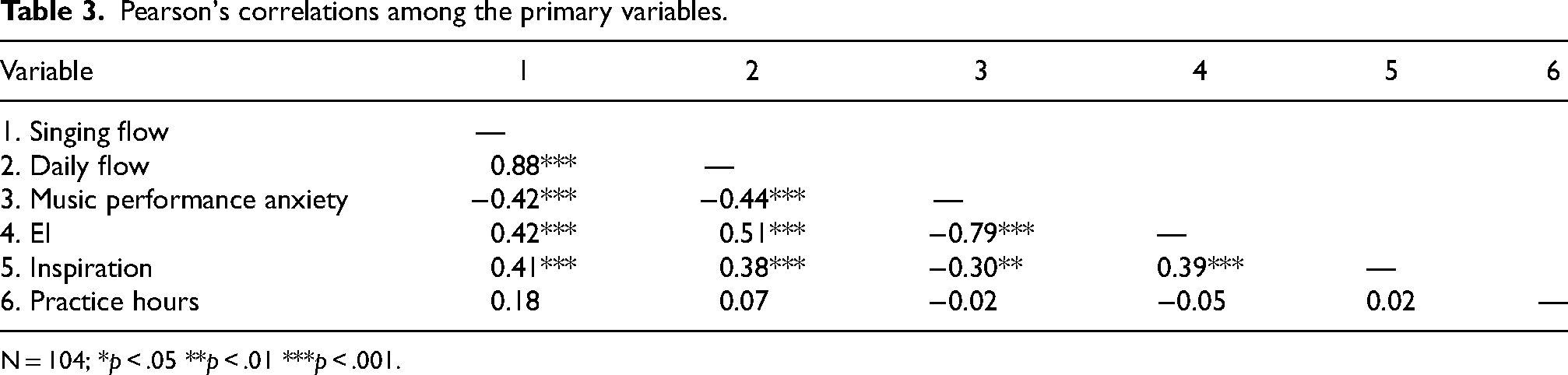
N = 104; *p < .05 **p < .01 ***p < .001.
Tables 4 and 5 detail the correlations between the nine dimensions of flow, singing flow and daily flow, and all other variables. Most flow dimensions related to singing flow showed a negative correlation with MPA, except for loss of self-consciousness and transformation of time. EI was positively correlated with all dimensions except the transformation of time. A similar pattern was observed in the correlations of daily flow dimensions with MPA and EI (Table 5). An intriguing observation was that inspiration exhibited a strong positive correlation with many of the singing and daily flow dimensions except for the loss of self-consciousness. Finally, concentration on the task was significantly correlated with inspiration in the singing flow dimensions (r = 0.29, p = .003) but not in the daily flow dimensions (r = 0 .16, p = .097).
Pearson's correlations among the nine flow dimensions of singing flow and all primary variables.

N = 104; *p < .05 **p < .01 ***p < .001.
Pearson's correlations among the nine flow dimensions of daily flow and all primary variables.

N = 104; *p < .05 **p < .01 ***p < .001.
To further test our hypotheses, we conducted mediation analyses. EI partially mediated the relationship between singing flow and daily flow (Table 6, indirect effect: B = 0.070, t = 2.82, p = .005). Moreover, EI and inspiration mediated the relationship between MPA and singing flow: EI fully (B = −0.008, t = 2.82, p = .006) and inspiration partially (B = −0.002, t = −2.56, p = 0.011), supporting Hypothesis 4.
Mediation indirect effect table with music performance anxiety as predictors, singing flow and daily flow as dependent variables and EI and inspiration as mediators.
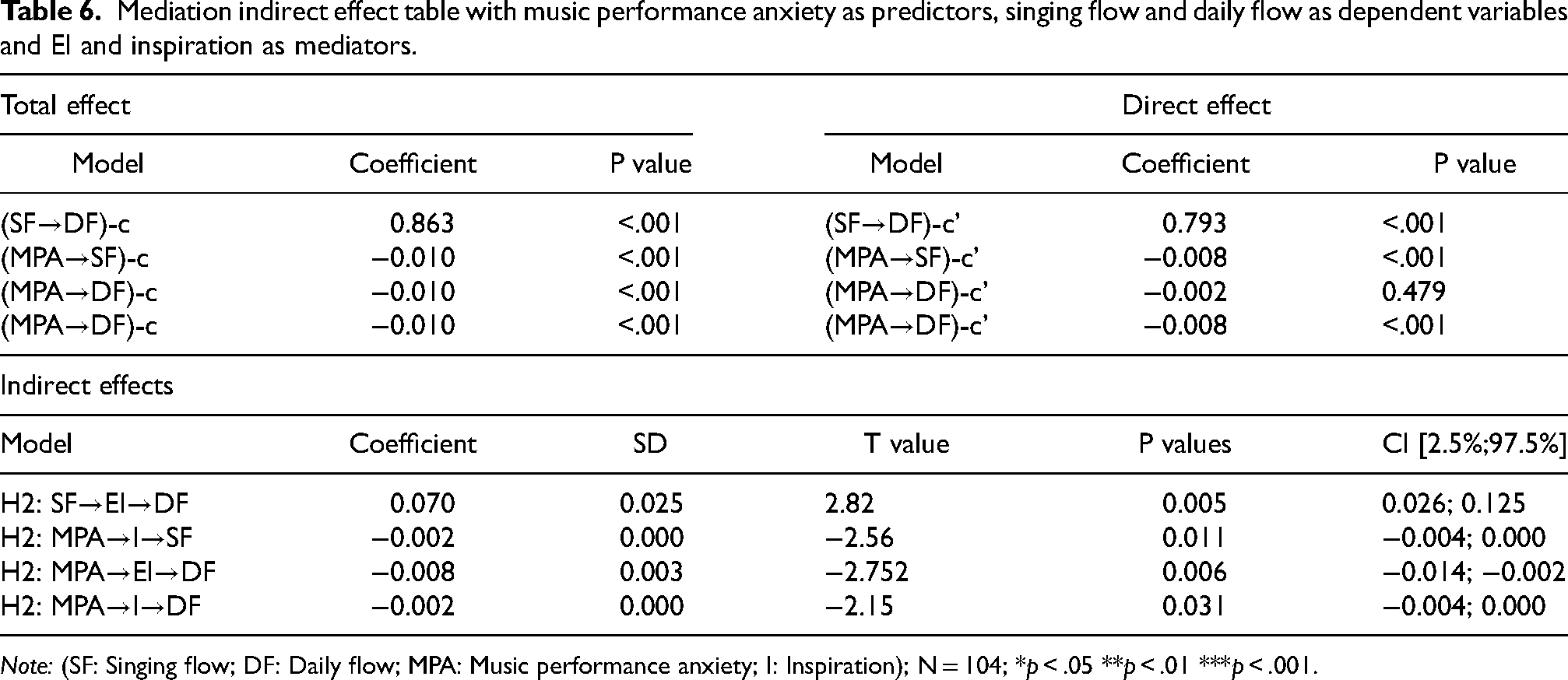
Note: (SF: Singing flow; DF: Daily flow; MPA: Music performance anxiety; I: Inspiration); N = 104; *p < .05 **p < .01 ***p < .001.
Next, we conducted a hierarchical regression analysis to investigate the effects of MPA, EI and inspiration, in this specific order, on singing flow (Table 7) and daily flow (Table 8). Each table shows how much variance (%) in flow proneness is explained by these factors, and whether their effects are statistically significant. The overall regression models were able to predict 25% of the variance in singing flow and 28% of the variance in daily flow. MPA accounted for 17% of the variance in singing flow (Table 7) (adjusted R2= 0.17, F (1, 102) = 21.4, p < .001). The inclusion of EI did not significantly increase explained variance. However, inspiration added a significant 8% variance (adjusted R2= 0.25, F (3, 100) = 12.3, p < .001), and emerged as the only significant predictor in the final model.
Hierarchical regression predicting singing flow proneness including various predictors.

N = 104; *p < .05 **p < .01 ***p < .001.
Hierarchical regression predicting daily flow proneness including various predictors.
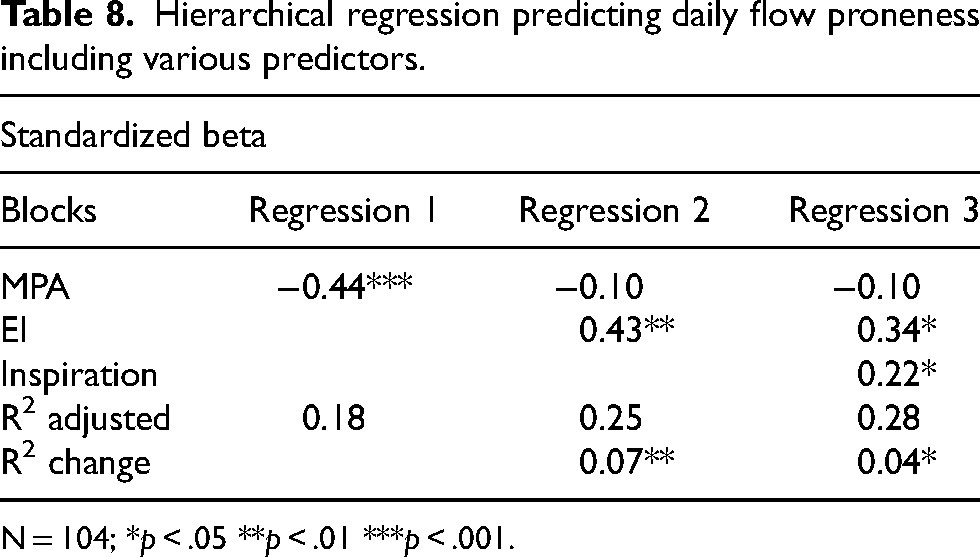
N = 104; *p < .05 **p < .01 ***p < .001.
For daily flow, MPA explained 18% of the variance (Table 8) (adjusted R2= 0.18, F (1, 102) = 24.0, p < .001). The subsequent addition of EI accounted for another 7% increase in explained variance (adjusted R2= 0.25, F (2, 101) = 17.8, p < .001), and inspiration added 3% (adjusted R2= 0.28, F (3, 100) = 14.4, p < .001). In the final model, both EI and inspiration significantly predicted daily flow, while the effect of MPA was no longer significant, supporting Hypothesis 5.
These findings highlight the specific roles of emotional intelligence (EI) and inspiration in our study, demonstrating their importance for enhancing flow proneness and buffering against performance anxiety effects. While other traits may also influence flow experiences, our current analysis focused specifically on these two factors based on their theoretical relevance to musical performance contexts.
Discussion
This study investigated the psychological factors influencing flow proneness in singers, with a particular emphasis on emotional intelligence (EI), inspiration, and music performance anxiety (MPA). Our findings provide empirical support for the proposed hypotheses and offer new insights into the psychological mechanisms underlying the experience of flow in vocal performances and the daily lives of singers.
First, as predicted by Hypothesis 1, singing flow was strongly and positively correlated with daily flow. This suggests the broader benefits of flow that extend from singing to everyday activities. Interestingly, the correlation between singing flow and daily flow in singers (r = 0.88) is much higher than that between musical flow and daily flow in musicians (r = 0.57) (Rakei et al., 2022). These findings suggest a strong, potentially mutually reinforcing relationship between singing and daily flow experiences. Prior research has established that flow in musical activities enhances life meaning and subjective well-being (Habe et al., 2019). Our results not only align with these observations but also reveal a novel insight: the embodied and social dimensions of singing may amplify daily flow resilience. Singing involves synchronized breathing, vocal vibration, and often shared rhythmic engagement, which together induces measurable psychobiological effects. For instance, structured singing has been shown to synchronize heart rate variability among singers (Vickhoff et al., 2013), while group singing elevates oxytocin levels and enhances social bonding more effectively than verbal interaction (Kreutz, 2014). Moreover, large-scale studies have demonstrated that group singing significantly enhances both psychological well-being and physical health, especially for those with pre-existing health conditions (Clift et al., 2010).
In support of our second hypothesis, our study showed that both EI and inspiration are positively associated with flow in singing and daily activities. It is suggested that the enhancement of flow experiences through EI may be mediated by improved emotional regulation capabilities and sustained focus. The ability to regulate emotions effectively is critical for maintaining the challenge-skill balance essential for flow states (Gross, 2015), whereas sustained task focus is essential for achieving autotelic experiences (Marin & Bhattacharya, 2013). Similarly, inspiration has been demonstrated to increase sustained attention and enhance immersion, thereby facilitating flow (Oleynick et al., 2014; Thrash & Elliot, 2003). Our data reveal a strong association between singing flow and daily flow (r = .88), suggesting that singers with frequent flow experiences tend to report higher flow in daily activities. This pattern aligns with broader evidence that emotional intelligence facilitates flow across domains (Marin & Bhattacharya, 2013; Tse et al., 2021), although the causal direction of this relationship remains to be tested in longitudinal designs. Together, these findings highlight the critical role of positive psychological resources in facilitating optimal experience.
Hypothesis 3 was also supported, with MPA demonstrating stronger negative correlations with singing flow (r = −.52) than daily flow (r = −.44). While this pattern aligns with established findings that performance anxiety disrupts flow prerequisites like sense of control and goal clarity (Cohen & Bodner, 2019), the observed association with daily flow requires careful consideration. We suggest two explanatory mechanisms: first, the emotional resource depletion hypothesis, whereby MPA exhausts the regulatory capacity necessary for daily flow states; second, the potential confounding influence of unmeasured generalized anxiety traits. These possibilities point to an important limitation of our study-the absence of generalized anxiety assessments prevents definitive conclusions about MPA’s unique cross-domain effects. Future research should incorporate standardized anxiety inventories to better isolate performance-specific effects.
Our mediation analysis offered nuanced insights supporting Hypothesis 4. While EI and inspiration both mediated the negative impact of MPA on daily flow, only inspiration partially mediated its effects on singing flow. This suggests that while EI promotes sustained engagement in general daily situations, its protective effects may be less potent in high-stakes performance situations where performance anxiety is acute. Conversely, inspiration may buffer the negative impacts of MPA by redirecting focus from fear to purpose and artistic meaning (Thrash et al., 2014). These findings extend previous work on positive psychological interventions for performance anxiety (Braden et al., 2015; Stanton, 1994) by demonstrating that inspiration specifically buffers MPA’s detrimental effects on singing flow, while EI primarily protects daily functioning.
Finally, the hierarchical regression confirmed Hypothesis 5. Inspiration emerged as the strongest predictor of singing flow, particularly in dimensions like autotelic experience and focused concentration. This finding is in line with previous research framing inspiration as a key driver of creative and expressive engagement. By contrast, EI more robustly predicted daily flow, reflecting its broader relevance for self-regulation and emotional adaption in everyday contexts. These differentiated patterns reinforce the idea that the mechanisms underlying flow may also vary by context, with inspiration fueling creative immersion and EI sustaining general well-being and attentional control.
An exploratory comparison of the nine flow dimensions further highlighted subtle but notable differences in how inspiration and EI related to singing versus daily flow. For example, inspiration was significantly associated with task concentration during singing but not daily life, while EI showed consistent associations with nearly all dimensions except time transformation. These results reinforce the value of examining the multidimensional structure of flow, as different traits may support specific facets of the experience.
We also note two practical considerations. First, we found no significant correlation between singing practice time and flow proneness. This suggests that deliberate vocal training may not directly predict psychological immersion. However, this contrasts with previous findings in instrumental contexts (Tan et al., 2021) and may reflect the physical limitations of vocal practice, which cannot be sustained for extended periods without risking vocal health (Titze, 1994; Verdolini & Ramig, 2001). Second, although our sample comprised individuals with considerable signing experiences (mean singing experience of 9.57 years), including those actively engaged in professional and semi-professional contexts, it also included student singers in formal training programs. The distinction between student and professional musicians is not trivial, as prior research highlights potential differences in emotional and cognitive traits such as MPA, EI, and flow proneness (Barros et al., 2022; Papageorgi et al., 2013; Rakei et al., 2022). However, our subgroup sizes (e.g., n = 25 singers vs. n = 18 voice students) were insufficient for conducting stratified analysis; however, the overall sample size (N = 104) provided adequate power for the primary regression and mediation analyses. Future studies would benefit from larger samples that allow for comparisons between singing students and professionals.
In conclusion, our study sheds light on the psychological architecture of flow proneness in singers. We highlighted the dual protective roles of emotional intelligence and inspiration in enhancing flow and mitigating performance anxiety. These findings could inform new interventions aimed at boosting performance and well-being in high-pressure creative contexts. Further, they will have implications for training programs, therapeutic practices, and educational strategies to support resilience, emotional adaptability, and flourishing among artists—both at stage and beyond.
Footnotes
Action Editor
Graham Welch, University College London, Institute of Education.
Peer Review
Gillyanne Kayes, Vocal Process
Melissa Toy, BIMM Institute London
Declaration of Conflicting Interests
The authors declared no potential conflicts of interest with respect to the research, authorship, and/or publication of this article.
Ethical Approval Statement
The study protocol was approved by the Research Ethics Sub-Committee (ID: 423364, Date of approval: 20-06-2022) of the Goldsmiths University of London. All participants provided informed consent.
Funding
The authors received no financial support for the research, authorship, and/or publication of this article.

Data Availability Statement
The datasets generated during or analyzed during the current study are not publicly available due to ethical constraints (in line with the commitments made in the ethical approval process). However, the datasets are available from the corresponding author on reasonable request, and we will discuss the usability of the data with the requester accordingly.