



Abstract
There is growing interest in understanding the relationship between language, music, and cognitive skills, particularly in typical and atypical populations, with implications for academic achievement and therapeutic interventions. While previous research has largely focused on correlating individual language and music skills, it often lacks a comprehensive approach to exploring the interactions among multiple variables. This study aimed to explore the predictors of beat perception and rhythm discrimination in typically developing children, with a focus on language and working memory abilities. We further used supervised and unsupervised learning techniques to explore sub-groups of participants with different performance. Thirty-seven typically developing monolingual Greek preschool children completed the protocol, covering language skills (morphosyntax production and morphosyntax and syntax comprehension, phonological awareness), cognitive (verbal and phonological working memory, visuospatial working memory), and music/temporal processing skills (melody and rhythm discrimination, beat perception). Our findings show that working memory was a significant predictor for rhythm discrimination, underscoring the possible implication of domain-general cognitive abilities. Language skills (morphosyntax production, morphosyntax and syntax comprehension, syllable manipulation) contributed minimally to predicting both beat perception and rhythm discrimination, with standardized effects indicating moderate associations in some cases. In reversing the direction of prediction, beat perception—but not rhythm discrimination—significantly predicted morphosyntax/syntax comprehension performance. Hierarchical cluster analysis (HCA) revealed individual differences within the sample, identifying two sub-groups with differing language and cognitive performance, emphasizing the need to further investigate individual variability in typically developing populations. These results suggest that beat perception and rhythm discrimination tap into different mechanisms, with working memory being critical for rhythm discrimination, and highlight the importance of distinguishing these constructs for future diagnostic and therapeutic applications. These findings need to be confirmed in future studies including larger sample sizes.
Keywords
Introduction
The relationship between children's language, music, and cognitive abilities has been studied in both typical and atypical development, particularly regarding the auditory processing and music perception deficits in developmental dyslexia and Developmental Language Disorder (DLD), as well as the potential benefits of musical training for language and literacy (Goswami, 2011; Kraus et al., 2014; Ladányi et al., 2020; Tierney & Kraus, 2013, 2014). This aspect of research has roots in questions about the nature of the relationship between language and music on a theoretical level and an empirical level (Asano & Boeckx, 2015; Drakoulaki et al., 2024; Lerdahl & Jackendoff, 1983; Patel, 2008).
Research on the relationship between language and music has been developed under two underlying alternative assumptions: (1) language and music share common structure building mechanisms that are independent of general cognitive skills and (2) language and music processing are dependent on general cognitive skills such as prediction, cognitive control, and dynamic attention (Drakoulaki et al., 2024). Correlational studies focusing on the interaction between language and rhythm skills in typically and atypically developing children have followed similar paths. Some experimental designs have focused primarily on revealing a connection between language and music structure building (Cohrdes et al., 2016; Gordon et al., 2015; Lee et al., 2020; Persici et al., 2023), while others have considered more widely other domain-general cognitive explanations or interactions with language and music processing (Politimou et al., 2019; Swaminathan & Schellenberg, 2020). In this study, we will focus only on research investigating typically developing children's language and music skills, with an interest on the pre-literacy period, as we believe that a link between language and music will be found in spontaneously developing skills. More specifically, the relation seen between literacy skills and music skills/music training (particularly phonological awareness and language comprehension) might emerge on the basis of spontaneously (and not taught) abilities of oral language and music perception.
Investigating Children's Language and Music Processing
Most studies have shown that language and rhythm skills are related—even when controlling for certain overarching factors, such as non-verbal IQ (NVIQ) and age (Gordon et al., 2015; Persici et al., 2023). However, different studies have included different constructs as to what ‘language’ and ‘rhythm’ skills are and how they are tested. If rhythm is to be considered a potential risk factor for atypical language development (Ladányi et al., 2020; Pagliarini et al., 2020), it is important to establish clear, operational definitions of these constructs. To this end, we adopt Grahn's (2012, p. 586) definitions, in which ‘rhythm is defined as the pattern of time intervals in a stimulus sequence,’ and ‘beat is a series of regularly recurring psychological events that arise in response to a musical rhythm.’ Based on these definitions, rhythm discrimination tasks typically assess a participant's ability to distinguish between different patterns of time intervals, while beat perception tasks assess their sensitivity to the presence or characteristics of an underlying temporal regularity. Language is also organized rhythmically; on the segmental level vowels and consonants alternate, making in turn stressed and unstressed syllables to also alternate, whereas on the suprasegmental level, prosodic phrases alternate with pauses (Fiveash et al., 2021; Langus et al., 2017; Patel, 2003).
Previous research has investigated the potential link between language and music processing capacities in typically developing children by including a wide range of language tasks. Research has thus covered both perception, production and literacy skills, together with general musical abilities and training (Dellatolas et al., 2009; Gordon et al., 2015; Lee et al., 2020; Politimou et al., 2019; Swaminathan & Schellenberg, 2020).
Early investigations into the connection between language and music skills examined children's processing of a wide range of stimuli. Measures of receptive vocabulary were significantly correlated with measures assessing pitch and rhythm discrimination in young children (N = 78, Mage = 8;0) (Douglas & Willatts, 1994). When controlling for vocabulary abilities, only rhythmic abilities remained correlated with reading and spelling measures. In a large sample size study (N = 100), 4-year-olds’ and 5-year-olds’ phonological awareness, receptive vocabulary, and digit recall correlated significantly with their music abilities (i.e., melody, rhythm, and chord discrimination, rhythm reproduction, single tone–chord discrimination) (Anvari et al., 2002). In a study with an even larger sample size (N = 1028, Mage = 5;5), preschoolers’ word and sentence repetition significantly correlated with their rhythm production skills (Dellatolas et al., 2009).
When investigating core language abilities (morphosyntactic production) and rhythm abilities (rhythm discrimination), positive correlations were found between the two, even when controlling for non-verbal IQ (Gordon et al., 2015). However, when assessing phonological awareness, Gordon et al. (2015) found no correlation with rhythm discrimination in the entire group of typically developing children (N = 25, Mage = 6;6), but only in those with high phonological awareness scores. In Woodruff Carr et al.’s (2014) study, preschoolers’ language (phonological awareness and sentence repetition) and music skills (melody and rhythm discrimination) (N = 35, Mage = 4;3) were correlated with their ability to synchronize to a beat produced by the experimenter. The researchers also identified high- and low-scorer groups, with children able to synchronize showing better language and music discrimination skills.
Cohrdes et al. (2016) investigated language and music skills in a sample of 5- to 7-year-old children (N = 44, Mage = 6;5), examining abilities from auditory processing to higher-level cognitive processing and emotion perception. In the language domain, assessments covered phonemic discrimination, pseudoword repetition, grammaticality judgments, narrative comprehension, and sentential emotional prosody. In the music domain, assessments covered sound detection, pitch discrimination, rhythm and melody repetition, harmonic acceptability judgments, and emotion detection in melodic sequences. Significant correlations between abilities on similar levels of linguistic and musical analysis were reported: Phoneme discrimination and pseudoword repetition correlated with melody and rhythm repetition, and grammaticality judgments correlated with harmonic acceptability judgments. The study by Cohrdes et al. compares skills in terms of levels of processing (from low-level auditory processing to higher-level well-formedness judgments). More specifically, the authors draw parallels in language and music processing in terms of sound/phoneme discrimination, word/small musical phrase processing, and sentence/chord progression processing. However, so far there are no models of language and music processing which make direct comparisons between these levels in this detail (Cohrdes et al., 2016).
In a more recent study, different aspects of preschoolers’ language and music skills were assessed (N = 40, Mage = 4;0) (Politimou et al., 2019). Language skills included phonological awareness and grammatical structure knowledge, and music skills included pitch, melody, rhythm and tempo discrimination, as well as song production and synchronization to the beat. Rhythm discrimination was significantly correlated with phonological awareness, and melody discrimination was significantly correlated with measures of grammatical knowledge (including both production and comprehension). Lee et al. (2020) investigated children’s comprehension of complex syntax related to their rhythm discrimination skills. Children and adolescents (N = 96, Mage = 11;1), aged 7 to 17 years old, listened to subject- and object-right-branching relative clauses that were either acoustically clear or manipulated (in terms of intelligibility), and also completed a rhythm discrimination task (taken from Grahn and Brett (2009)). In agreement with previous research, subject-relatives were easier than object-relatives and performance on the rhythm task was the second-best predictor after age for sentence comprehension (Lee et al., 2020). Swaminathan and Schellenberg (2020) tested a sample of 6- to 9-year-old children (N = 91, Mage = 7;8) with assessments targeting speech perception, syntax comprehension, rhythm and melody discrimination, general cognitive ability, and personality traits. They found (uncorrected) correlations between speech perception, musical competence, IQ, and working memory. Syntax comprehension was also significantly correlated with reported musical training, as well as with all other aforementioned measures. Correlations between speech perception, syntax comprehension and music competence (both rhythm- and melody-based) remained significant after controlling for age. In recent electroencephalography analyses published with the same group of children as in Gordon et al., (2015), children’s brain responses to rhythmic sequences (alternation of strong-weak beats with loudness indicating metrical hierarchy) explained additional variance of the rhythm discrimination task beyond behavioral measures (see Gordon et al. (2015) for the behavioral data of this participant group) (Persici et al., 2023).
In summary, studies in typical development have targeted both production and comprehension/discrimination skills in language and music, with diverse findings. Relations between language and music emerge mostly in pairs; for example, language comprehension and rhythm discrimination (Lee et al., 2020) or language comprehension and production with melody perception (Politimou et al., 2019). Despite detailed assessments, not all studies investigate the same language and music skills, and questions remain as to which skills are related and in what way, especially in terms of the directionality of the effect (see analyses used in Table 1). While most studies report correlations without addressing direction, some suggest that children's performance in rhythm- and melody-related tasks may predict language skills, hinting at a directional effect. So far, there have not been studies who test the directionality both ways. Even though it might be argued that strict causation cannot be determined, as most studies to date are correlational and lack experimental manipulation or longitudinal designs, recent studies suggest that language experience may also affect music perception (Liu et al., 2023). Therefore, we aimed to explore this in the present study.
Outline of the extent of language skills related with music skills in past research (using correlation and regression analyses). Asterisks refer to correlations only in the high-scorers group (as defined by authors).

If rhythm or music abilities are markers for developmental disorders, the related language skills need clarification, particularly regarding which language skills contribute to the relationship. Table 1 outlines the relations found in recent studies between language and music skills. The extent of reported skills being correlated with music skills covers processing speech in noise, phonological awareness, receptive vocabulary, grammaticality judgments, and comprehension of complex syntactic structures. Most studies use rhythm discrimination as a measure of temporal processing, though some tasks, like sentence repetition, assess multiple abilities, including verbal memory and grammatical knowledge (Moll et al., 2015; Montgomery, 2003).
While revealing a relation between language and music skills, there are still numerous questions arising from previous research. Two key questions are:
Production versus comprehension. Although temporal processing is the focus in all studies, it is not yet clear whether its relationship with language skills differs depending on whether the outcome is language production or comprehension. Some studies report stronger associations with comprehension, while others find links to production-based tasks. Phonological awareness versus (morpho)syntax. It also remains unclear whether temporal processing is more closely associated with phonological awareness, morphosyntax, or both. As outlined in above, both phonological awareness and morphosyntax are the most often investigated skills and the most frequently correlated with temporal processing skills.
Examining Children's Cognitive Skills in Language and Music Processing
The role of general cognitive skills such as attention, working memory, and overall IQ in the language-music relationship has been less explored, with major findings reported in Table 2. The most commonly used domain-general skills in previous research are digit span and NVIQ, while other measures of executive function (go/ no-go task and cancellation task), visuospatial working memory tasks, and auditory (non-verbal) working memory tasks are less frequent. At least three studies have reported correlations between digit span and language and music skills (Anvari et al., 2002; Dellatolas et al., 2009; Politimou et al., 2019), and NVIQ was used to control partial correlations between language and music skills, though it did not contribute significantly (Cohrdes et al., 2016; Gordon et al., 2015). Politimou et al. (2019) showed that a linear regression model that included melody discrimination, digit span, and non-verbal IQ best predicted variability in language tasks. In another study, an auditory working memory task was included in testing children's sentence comprehension and rhythm perception abilities. Auditory working memory was correlated only with sentence comprehension and not rhythm discrimination, and this relation disappeared when controlling for age (Lee et al., 2020). Methodological concerns also arise, particularly regarding the treatment of cognitive skills in statistical analyses. For example, controlling for non-verbal IQ may inadvertently remove variance that is meaningfully shared between language, music, and general cognitive functioning (Gordon et al., 2015). Similarly, grouping verbal and non-verbal IQ into a single composite score prior to analysis can obscure distinct contributions of each component to language or music outcomes, limiting interpretability (Swaminathan & Schellenberg, 2020). Finally, the choice of working memory measures, such as including only backward digit span, or inconsistently including both backward and forward spans can influence findings, as backward span taps executive processes while forward span reflects short-term memory (Nitin et al., 2023).
Outline of the range of cognitive skills used to investigate the relationship between language and music skills (using correlation and regression analyses).

Although investigated less frequently, the involvement of cognitive skills in the language-music relationship seems more straightforward, with contributions from working memory, as well as verbal and non-verbal IQ. The implication of auditory working memory in music discrimination tasks has previously been discussed in the music cognition literature (Peretz et al., 2003, 2013), and the broader contribution of working memory to vocabulary acquisition, sentence comprehension, and overall literacy skills has also been well documented (for example, Baddeley (2003) and Gathercole and Baddeley (2014)).
Research between language and music processing in typical and atypical development has benefited from both fields bidirectionally, on the one hand establishing typical processing and developmental milestones, and on the other hand investigating specific difficulties in developmental disorders like dyslexia and DLD. Early research focused on temporal auditory deficits (e.g., Tallal, (1976)), whereas more recent studies have examined both low-level auditory processing and higher-level musical processing abilities, such as melody discrimination, singing, and chord progression judgments alongside broader global temporal processing, such as rhythm and beat perception. Goswami’s Temporal Sampling Framework (Goswami, 2011; Goswami et al., 2002) proposes that deficits in amplitude modulation perception underlie rhythm processing difficulties in language and music. Supporting this, studies have linked difficulties in amplitude rise time detection, beat perception, syllabic stress, and beat entrainment to language measures such as rapid naming, memory, pseudoword repetition, and core language skills (Corriveau & Goswami, 2009; Di Liberto et al., 2018). Other studies found differences between DLD and typically developing children for tasks like melody discrimination, rhythm reproduction, and singing, with correlations between music tasks and language measures (Sallat & Jentschke, 2015). Neural evidence also suggests impaired music processing in DLD, as shown by responses to unexpected chord progressions in typically developing but not DLD children (Jentschke et al., 2008). In summary, research in typical and atypical development can be informative about relations between rhythm and language skills, suggesting rhythm deficits as a potential risk factor for language disorders (Ladányi et al., 2020). Better understanding both typical and atypical processing can help diagnostic definitions and intervention design.
Aims and Research Questions
The present study has a twofold aim: (1) to explore which aspects of language abilities (phonological awareness, morphosyntax production or morphosyntax comprehension skills) can predict performance in rhythm tasks (beat perception and rhythm discrimination) and vice versa, especially as previously reported relations have been inconsistent (summarized in Table 1), and (2) to elucidate the implication of working memory covering auditory and visuospatial modalities, as their implication has not been systematically studied (summarized in Table 2). We argue that while previous research has identified links between specific language and music skills, a broader assessment that also includes cognitive skills is needed to better understand the underlying mechanisms involved. Furthermore, we attempted to replicate finding differences in a typically developing sample to explore individual variation in assessing language and music skills (Gordon et al., 2015; Woodruff Carr et al., 2014). We aim to uncover inter-individual differences between our participants by using unsupervised learning techniques, such as hierarchical cluster analysis, which use unlabeled variables to extract patterns and cluster data (Malik & Tuckfield, 2019). To our knowledge, previous research has not used such techniques; they identify high- and low-scorers based on task-related thresholds defined in each study.
More specifically, our research questions (RQs) were:
Previous research has reported temporal processing abilities predicting language processing skills in typically developing children, while the reversed direction has not yet been tested. Going beyond previous research, we will test in the same children how two types of temporal processing skills (rhythm discrimination and beat perception) predict various language skills (e.g., morphosyntax and syntax production and comprehension, phonological awareness), expecting shared competences across domains. In addition, we will also test this relation by testing which aspect of language abilities predicts better each of the temporal processing capacities. Are aspects of working memory related with language and music tasks, and if so, which of these aspects predict better the performance in beat perception and rhythm discrimination? We hypothesize that aspects of verbal working memory will predict performance in the rhythm discrimination task. This expectation is grounded in prior research suggesting that rhythm discrimination tasks often require listeners to compare two sequences of intervals presented in succession, placing demands on a tonal equivalent of the phonological loop and executive control components of working memory (Berz, 1995; Peretz et al., 2013). In contrast, beat perception tasks in their implementation rely more on entrained processing of periodicity and require working memory capacity less strongly (Einarson & Trainor, 2016; Grahn & Brett, 2007). Can unsupervised learning techniques allow for revealing sub-groups within the participants? We hypothesize that data-driven clustering will uncover latent groupings, particularly for the language measures, by identifying participants with similar cognitive-linguistic profiles, rather than relying on pre-defined thresholds or categorical cut-offs. This approach can provide a more nuanced understanding of individual variability and the co-occurrence of language and cognitive traits. Although previous studies (Gordon et al., 2015; Woodruff Carr et al., 2014) did not use unsupervised learning, they highlight the presence of meaningful individual differences in language and music-related tasks, which motivates the exploration of whether sub-groups with distinct profiles can be identified using data-driven techniques.
Materials and Methods
Participants
Thirty-seven (N = 37) monolingual, typically developing children were recruited for the study, but due to COVID-19 restrictions, only 22 (N = 22) of them completed the protocol. During a later data collection period when COVID-19 restrictions were lifted, another 15 (N = 15) children participated in the protocol. For the total of children completing the protocol (N = 37) (females = 20) age range was 5;0–6;7 (year;month), Mage = 5;8, SDage = 3.7 months. Children were recruited from public and private nursery schools and primary schools of Attica, Greece 2 . Children were recruited on the condition that they were not receiving any type of intervention and no concerns were being posed about their overall development by the teachers. Socioeconomic status was assessed by maternal education. Basic demographic information (age in years;months, gender, maternal education, and information about extracurricular music/dance or musical instruments activities) is available in supplementary materials (S1). Ten children participated in music/dance activities or were learning a musical instrument.
Permission to access and conduct research was given by the Educational Policy Institute of the Ministry of Education of Greece (protocol number: Φ15/160225/ΓΜ/1320/Δ1). The overall project conformed with the Declaration of Helsinki for experimentation with human participants and was also approved by the Ethics Committee for Research of the National and Kapodistrian University of Athens (protocol number: 33966/6.4.2022). All staff, parents, and children gave informed consent to participate in the experiment.
Materials
During the first testing session we assessed non-verbal intelligence (Raven’s Colored Progressive Matrices) (Raven, 2003), receptive vocabulary (Peabody Picture Vocabulary Test-Revised in Greek) (Simos et al., 2011), and sentence repetition as a measure of syntactic knowledge and working memory (Prentza et al., 2022). Where available, the psychometric properties of the materials reported below are available in supplementary material (S2).
Language Tasks
Phonological Awareness
For phonological awareness, a subset of a larger phonological awareness battery was administered. From the MetaPHON test (Giannetopoulou & Kirpotin, 2007), a standardized assessment tool for screening and diagnostic purposes, the following subsections were selected: initial syllable manipulation (including syllable addition, deletion, and replacement) and initial phoneme manipulation, including phoneme addition and deletion. Visual cues were used, as phonemes and syllables were symbolized in small and big cards, in order to explain the different manipulations to the children. Each subsection consisted of three trials (in which correct responses are given by the experimenter) followed by four experimental stimuli, resulting in 20 experimental stimuli (4 stimuli × 5 subsections) (scored out of 20).
Morphosyntax Production and Morphosyntax and Syntax Comprehension
Morphosyntactic abilities were assessed using the Developmental Verbal IQ (DVIQ) for preschoolers battery (Stavrakaki & Tsimpli, 2000), using the subtests on morphosyntax production and the morphosyntax and syntax comprehension. The morphosyntax production subtest assesses agreement, tense, and pronoun production. It is scored out of 24 possible correct responses. The morphosyntax and syntax comprehension subtest (referred to below as morphosyntax/syntax comprehension) assesses children’s comprehension with a sentence-picture matching task investigating tense, passive voice, pronouns, comparatives, prepositions, negation, relative and wh-sentences. It is scored out of 31 possible correct responses.
Working Memory Tasks
Phonological WM
Phonological WM was assessed using a pseudoword repetition task, thought to tap into phonological awareness and phonological working memory skills (Baddeley, 2003). The task was scored based on correct/incorrect repetitions and had 48 possible correct responses. It ranges from 2-syllable CVCV words to 4-syllable words containing consonantal clusters following Greek phonotactic organization of up to three consonants (Masoura, 1999; Masoura et al., 2021).
Digit Span
Forward and backward digit span tests were administered to children, asking them to listen to a sequence of digits and then repeat it either in the same order or the reversed order (Masoura et al., 2021). The maximum score possible was 36 correct trials for forward digit span and 28 correct trials for backward digit span. The procedure of Masoura et al. (2021) was followed, during which children had to first repeat digits in the same and then in the reversed order. Each mnemonic span (e.g., two digits, three digits, etc.) consisted of six trials, at least half of which children had to successfully repeat in order to move to the next span.
Visuospatial WM
For visuospatial WM, the Corsi block task was administered (Gathercole, 1995; Gathercole & Pickering, 2000; Masoura et al., 2021). Children were presented with a wooden board with nine wooden blocks (cubes) that were irregularly placed on the board and had to actively point to either the same or backward order that they were shown. For both digit recall and visuospatial WM task, each mnemonic span (e.g., two digits, three digits, etc.) consisted of six trials, at least half of which children had to successfully repeat in order to move to the next range. Each task included a total of six blocks (range of digits 2–7), with 36 correct trials for forward recall and 28 correct trials for backward recall. As in Masoura and colleagues (2021), both the total number of correct trials and the highest mnemonic span completed were recorded for each child.
Music Tasks
Music/rhythm skills were assessed with the Montreal Battery for Evaluating Music Abilities (MBEMA) (Peretz et al., 2013) and the complex Beat Alignment Test (cBAT) (Einarson & Trainor, 2016), described below in detail. Both tasks were presented as audio/video Windows playlists correspondingly, pausing between trials for children to give their response, which was recorded on response sheets.
Melody & Rhythm Discrimination
From the MBEMA (Peretz et al., 2013), we selected the melody and rhythm discrimination tasks. In both tasks, participants listened to pairs of short melodies and judged whether the pairs were the same or different. In the melody discrimination task, the manipulations for the different pairs cover changes in pitch, contour, and interval. In the rhythm discrimination task, the manipulations cover differences in rhythmic structure. As the participants in the present project were slightly younger than the participants in the original study (Mage = 6;0), a scenario with visual aids was also introduced to them, similar to Ireland et al. (2018): The researcher explained that they were going to listen to a music class, where the teacher was Mr. Elephant. Mr. Elephant had two pupils, a young elephant and a young monkey. The young elephant was a very good pupil and always copied their teacher, while the young monkey was cheeky and always played differently (images available in supplemental materials S3). The images were created by a graphic designer; they were piloted with similarly-aged children and their appropriateness was verified by all authors. When the scenario and the visual aids were presented, the researcher presented the two trial pairs and then the 20 experimental pairs for each task.
Beat Perception
The complex Beat Alignment Test (cBAT) (Einarson & Trainor, 2016) was devised as a children’s adaptation of the Beat Alignment Test (Iversen & Patel, 2010) and it includes complex and simple meters. It has been previously administered successfully to typically developing 5- to 7-year-old children and is designed as a fun activity for children of this age. The perception component is thought to measure children’s rhythm perception in terms of a beat that is superimposed over excerpts of music that range from pop to rock, classical, and Indian and Hawaiian music. It uses a forced choice paradigm in which, in every trial, children listen to and watch two tracks (presented as videos of different puppets drumming) and must judge which puppet is the best drummer by giving them a reward. Two blocks of five trials are preceded by one practice trial relative to the type of meter that is going to follow (e.g., a simple practice trial precedes a simple meter block of experimental trials), resulting in 10 experimental trials. The manipulations in the incorrect stimuli are either phase or tempo changes of the superimposed beat. Thus, the superimposed beat in the incorrect stimuli is either +/−25% misaligned in terms of phase, or +/−10% misaligned in terms of tempo. The test includes not only simple meters, which are the standard in Western music, but also complex meters in 7/8 and 5/8 that are also present in Greek folk music. Similar to the original design, half of the children were randomly allocated to a phase manipulation and the other half to a tempo manipulation. In order to avoid any difficulties in naming the animals playing drums, each pair of puppets was also presented visually as a printed screenshot in front of the child so that they could point to their choice.
Procedure
The experimental protocol consisted of four 45-min sessions carried out in a quiet room on school grounds. The first session assessing non-verbal IQ, receptive vocabulary, and sentence repetition was the same for all children; the order of the other three sessions was pseudorandomized with a Latin-squares design. These three sessions included the assessments described in the Language, Working Memory, and Music tasks sections correspondingly. A table that presents the assessments used in the three sessions, their targeted skills and the raw scoring is available in supplemental materials (S4). Data collection was done by the corresponding author and also by trained undergraduate students under the author's supervision.
Results
Descriptive Statistics
Data were analyzed with R, version 4.0.3 (R Core Team, 2020). 3 Means and standard deviations for all materials are available in Τable 3. To determine the most effective data transformation for our dataset, we conducted a comprehensive comparison of several popular methods: (a) log, (b) quantile, (c) reciprocal, (d) square root, (e) Yeo–Johnson, and (f) Box–Cox transformations. We evaluated each transformation’s efficacy by calculating the average Shapiro–Wilk test p-value across all variables in our dataset, using this as a proxy for how well each method shaped our data towards normality. The Box–Cox transformation emerged as the superior method yielding an average of p = 0.205 across all variables, indicating the best approximation to normality among the tested transformations. This approach aligns with the recommendation to use the Box–Cox transformation for optimizing normality across diverse datasets and stabilizing data variance (Atkinson et al., 2021; Blum et al., 2022). All further analyses were conducted only with Box–Cox transformed values.
We observed large standard deviations in phonological awareness tasks and hypothesized that this was related to the administration time. To clarify, data collection happened at two time points: towards the end of the school year (and with at least 6 months of normal schooling prior to school closures due to COVID-19) and at the start of the school year (from subsequent cohorts of children). We performed a Wilcoxon–Mann Whitney test for children’s performance on syllable manipulation relative to the group they belonged to (late vs. early), with W = 94.5, p = 0.02, suggesting a statistically significant difference between the two groups. We also performed a Wilcoxon–Mann Whitney test for the phonological manipulation data and reported a W = 88.5, p = 0.01, suggesting a significant difference between the two groups. We attribute this difference to potential learning effects, with children tested at the end of the school year having received a full year of phonological awareness instruction, while those tested at the beginning of the year had not received the same level of instruction.
Which Were the Best Predictors of Beat Perception and Rhythm Discrimination (RQ1 & 2)?
We first aimed to answer which language skill previously used in research can better predict performance on beat perception (cBAT) and rhythm discrimination (MBEMA rhythm subtest). For all comparisons reported below, we entered all variables included in Table 3 alongside receptive vocabulary and non-verbal IQ in a stepwise-selected linear regression model that included both forward and backward directions, using the MASS package in R (version 7.3–58.1) 4 (stepAIC()). The model, on each step, selects predictors based on Akaike Information Criterion (AIC) values and constructs the final regression model (full model results and model structure in supplementary materials S6). For all models reported, we conducted post-hoc sensitivity analyses using G*Power (Faul et al., 2007) to determine the minimum detectable effect size for each multiple regression model based on the number of predictors. These analyses, performed with an alpha level of 0.05 and a power of 0.80, confirmed that all reported effect sizes were detectable (statistics found in supplementary materials S5).
Means and Standard Deviations of the Language, Music, and Cognitive Tasks.

Note. All recall task scores are reported in mean items correct and all other scores are reported in mean percentages. MBEMA = Montreal Battery for the Evaluation of Musical Abilities (Peretz et al., 2013); cBAT = complex Beat Alignment Test (Einarson & Trainor, 2016).
The final predictors for beat perception are shown in Table 4. Predictors included (1) language variables (morphosyntax/syntax comprehension, syllable manipulation) and (2) rhythm discrimination. Although the language-based variables’ contribution to the model was statistically significant, their overall contribution to explaining beat perception was limited. Specifically, the raw regression coefficient for morphosyntax/syntax comprehension was small (b = –0.00), but the standardized beta coefficient (β = –0.37) indicates a moderate negative relationship with beat perception. No working memory components were associated with predicting beat perception; this is in line with Einarson & Trainor (2016) showing that working memory was not correlated with performance on this beat alignment task. Unsurprisingly, rhythm discrimination was a significant predictor, considering that both tasks rely on temporal processing, and listener's beat perception might facilitate the rhythm discrimination task (Gordon et al., 2015; Grahn & Brett, 2007). The effect size reported for the beat perception model was small, with an adjusted R2 = 0.245 (Cohen, 1988).
Predictors and regression coefficients for beat perception as predicted variable.

We then ran a stepwise-selected linear regression model that included both forward and backward directions with rhythm discrimination as the predicted variable (Table 5). Compared to beat perception, more variables predicted performance on rhythm discrimination with a better fit, as indicated by the larger adjusted R2; both aspects of phonological awareness (phoneme and syllable manipulation), morphosyntax/syntax comprehension, and sentence repetition predicted rhythm discrimination. We believe that the implication of working memory components (pseudoword and sentence repetition) was what resulted in a better fit of the model; because rhythm discrimination employs working memory, performance on rhythm discrimination was better explained by the (plethora) of working memory tasks in our study. Among the predictors, syllable manipulation and pseudoword repetition were negative predictors of rhythm discrimination. Although their raw regression coefficients were relatively small (b = –0.00 and b = –2.35, respectively), the standardized beta for syllable manipulation (β = –0.49) indicates a moderate negative association, while pseudoword repetition (β = –0.24) shows a small effect. The effect size reported for the rhythm discrimination model was medium, with an adjusted R2 = 0.413 (Cohen, 1988).
Predictors and regression coefficients for rhythm discrimination as predicted variable.

From both regressions predicting temporal processing skills, we can see that although the language-based predictors were close to zero in their contribution, their contribution was still considered significant for the model. We also observed that working memory components were only related with rhythm discrimination, confirming previous research (Einarson & Trainor, 2016; Peretz et al., 2013).
Which Were the Best Predictors of Language Skills (RQ1 & 2)?
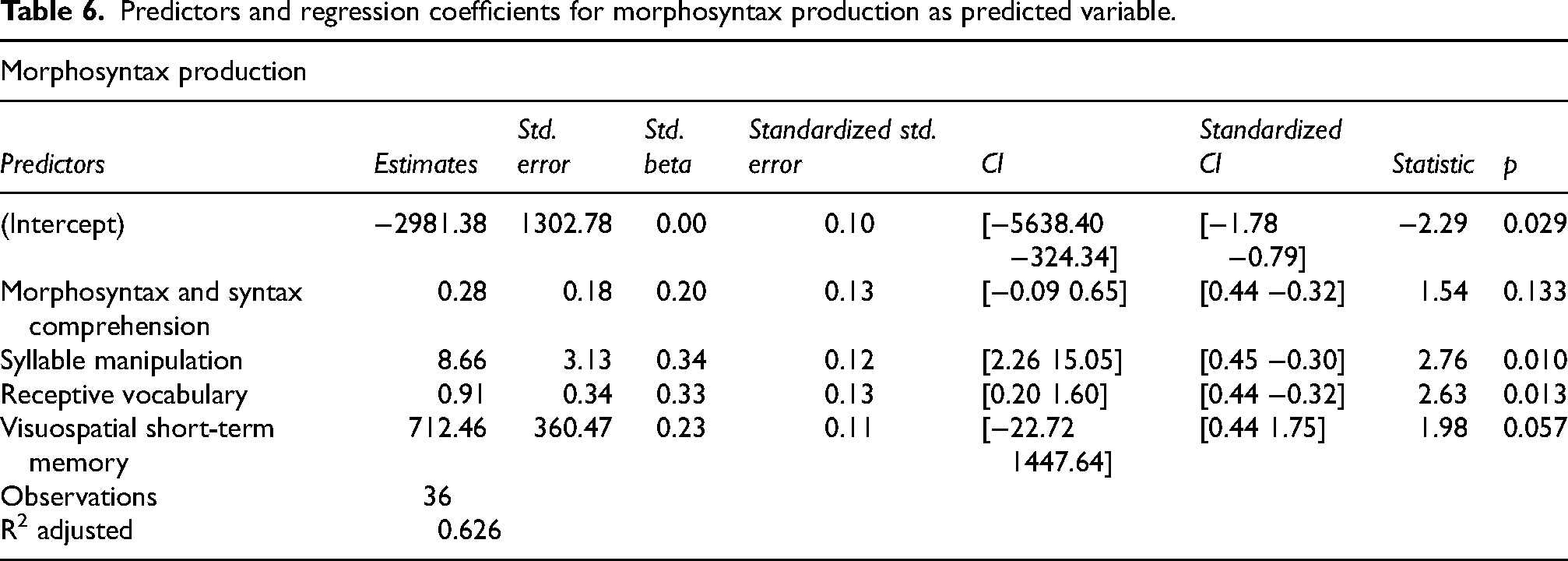
We then turned our predictions to the opposite direction; we ran stepwise-selected linear regression models to predict our language-based variables (morphosyntax production, morphosyntax/syntax comprehension, syllable manipulation, phoneme manipulation), to see whether temporal processing skills will be involved in these regressions. Predictors for morphosyntax production did not include temporal processing variables (Table 6); they included morphosyntax/syntax comprehension, syllable manipulation, receptive vocabulary, and visuospatial short-term memory. The involvement of the first three variables was expected, based on the tight interrelationship between them. The involvement of visuospatial short-term memory was indeed interesting, and something that has been previously reported by Politimou and colleagues (2019) (see footnote 1). The effect size reported for morphosyntax production model was medium, with an adjusted R2 = 0.626 (Cohen, 1988).
Predictors and regression coefficients for morphosyntax production as predicted variable.
Predictors for morphosyntax/syntax comprehension included both language-based variables (morphosyntax production), cognitive variables (working memory marginally), as well as beat perception (Table 7). Although rhythm discrimination was included in the model, its contribution did not reach significance. There is some evidence in previous literature showing (positive) relationships between rhythm discrimination and morphosyntax/syntax comprehension only (Lee et al., 2020); however, in our case a negative relationship was shown for beat perception. The reported effect size for the morphosyntax/syntax comprehension model was medium with an adjusted R2 = 0.447 (Cohen, 1988).
Predictors and regression coefficients for morphosyntax and syntax comprehension as predicted variable.

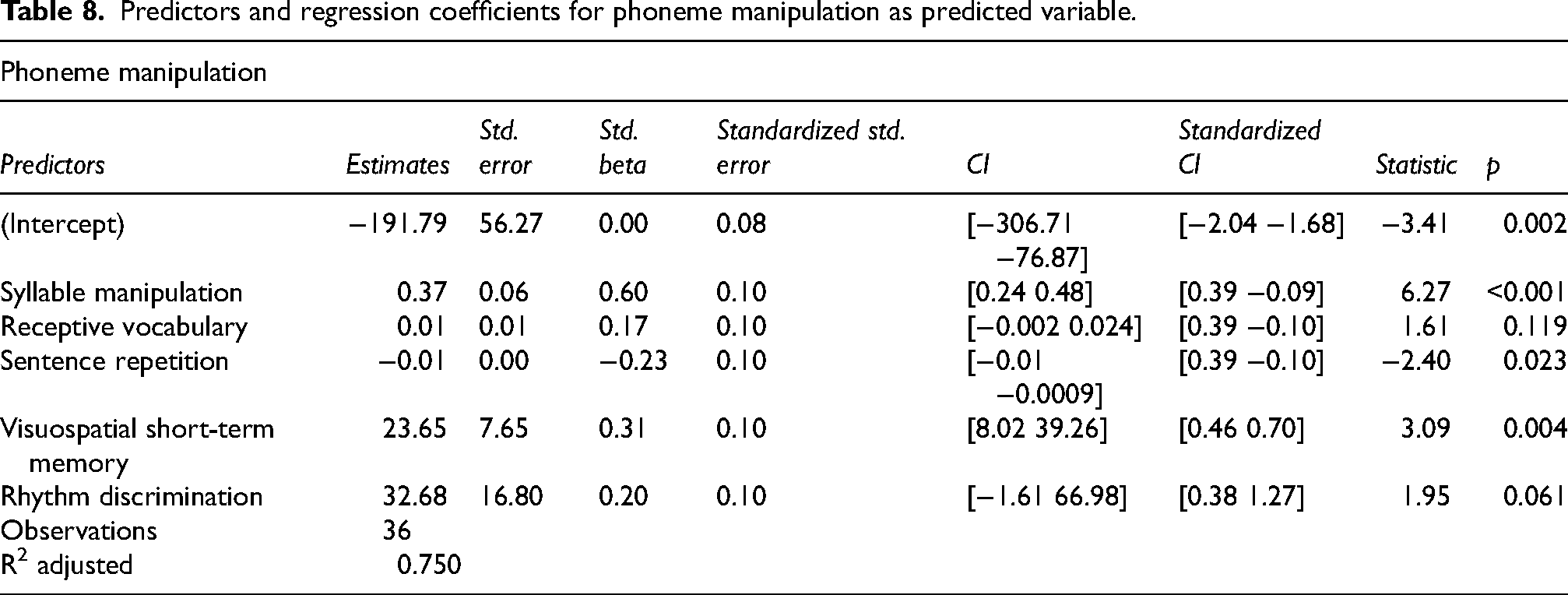
Predictors for phoneme manipulation included syllable manipulation and memory components (Table 8). Rhythm discrimination was marginally significant positive predictor, while syllable manipulation, sentence repetition, and visuospatial short-term memory were significant predictors. The reported effect size for the phoneme manipulation model was medium with an adjusted R2 = 0.75 (Cohen, 1988).
Predictors and regression coefficients for phoneme manipulation as predicted variable.
Predictors for syllable manipulation were phoneme manipulation, morphosyntax production and verbal short-term memory (Table 9). Although rhythm discrimination contributes to the model by explaining some variance in the outcome, its effect did not reach statistical significance. The reported effect size for the syllable manipulation model was medium with an adjusted R2 = 0.71 (Cohen, 1988).
Predictors and regression coefficients for syllable manipulation as predicted variable.

Interim Summary
Our study aimed to identify the language skills that best predict performance on beat perception and rhythm discrimination. For beat perception, we found that while language variables such as morphosyntax production and syllable manipulation made minimal contributions to the model, the standardized betas indicate they made meaningful contributions to the model. For rhythm discrimination, language variables had minimal contributions, while additional predictors such as (phonological) working memory were significant, highlighting the role of auditory working memory in this task. We also ran the models in the opposite direction to predict language variables previously studied (language production and comprehension, and phonological awareness). Notably, the model predicting morphosyntax production did not include temporal processing variables, while beat perception, but not rhythm discrimination, emerged as a significant (negative) predictor for morphosyntax comprehension. Finally, although rhythm discrimination marginally contributed to the models for phoneme and syllable manipulation, its effect was not consistently significant across all tasks. Overall, specific working memory components and beat perception emerged as key predictors for rhythm discrimination and morphosyntax and syntax comprehension respectively. Sensitivity analyses indicated that our effect sizes were either near or exceeded the thresholds for detection, suggesting that the models were sensitive enough to capture meaningful relationships between the predictors and outcomes.
How Does Unsupervised Learning Cluster Participants Based on Performance (RQ 3)?
Based on previous research findings reporting discrepancies between high- and low-scorers in language tasks (Anvari et al., 2002; Gordon et al., 2015), we conducted a (agglomerative) hierarchical cluster analysis (HCA) based on subjects’ performance in all tasks, using the cluster package (version 2.1.4). HCA results revealed two sub-groups within the sample of participants as Figure 1 shows the grouping of participants.

Dendrogram of participants after hierarchical cluster analysis. Group 1 contains participants in the left branch (green box) and group 2 contains participants in the right branch (blue box).
The unsupervised learning method identified two distinct sub-groups within our sample, which we further analyzed for performance differences, labeling them as “high-” and “low-”scorers. We found significant differences between the two groups, in most tasks, with group 2 (blue box) having worse mean performance than group 1 (green box). However, no differences were observed in beat perception, rhythm discrimination, sentence repetition, visuospatial short-term memory, and receptive vocabulary. Welch two sample t-tests revealed significant differences in the other variables, as shown in Table 10. In summary, although these groups did not differ on temporal processing skills, visuospatial WM, sentence repetition, and receptive vocabulary, they did differ in all other tested measures. The two sub-groups were not related to the data collection time points as mentioned above and do not show differences in terms of maternal education or extracurricular activities.
Significant differences between groups in language, cognitive, and music perception skills.
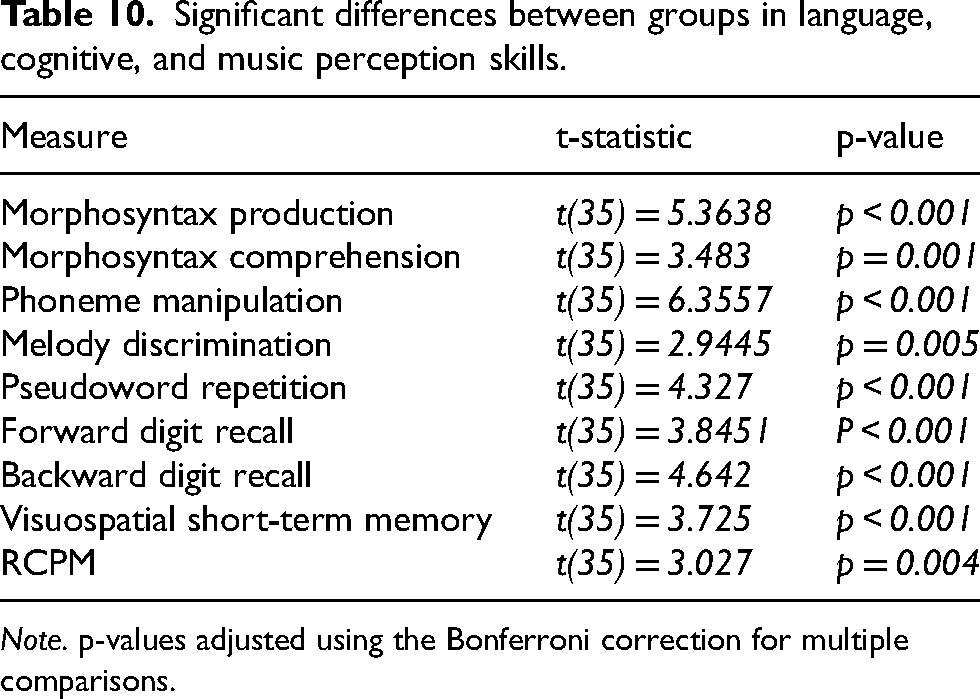
Note. p-values adjusted using the Bonferroni correction for multiple comparisons.
Discussion
There is an increased interest in investigating the relationship between language, music, and cognitive skills in typical and atypical populations, with implications in academic attainment, literacy, and therapeutic interventions. Past research has shown that there is indeed a connection between language and music skills in preschool and school-aged children; however, several unanswered questions have remained: first, testing the direction of predictions, second, finding which specific components of language and cognitive skills are implicated, and third, determining whether individual differences in language, music, and cognitive performance form distinct profiles within typically developing children, and whether such profiles are meaningfully related to performance across tasks.
Testing the Direction of Predictions
As seen in Tables 1 and 2, the majority of previously reported literature has conducted correlations (and have thus no statistical or theoretical direction), while some have tried to predict the contribution of music-related skills in predicting language skills (Nitin et al., 2023; Persici et al., 2023; Politimou et al., 2019). Similarly, work relating atypical rhythm with atypical language skills assumes that rhythm-related skills will predict subsequent language-related skills (Ladányi et al., 2020; Nitin et al., 2023). However, other recent research has taken the opposite direction. Liu et al. (2023) tested whether language experience (i.e., tonal language experience) would be a differentiating factor in an array of music perception assessments, with differences observed only for melodic processing and beat perception, but not for fine-grained auditory perception skills. Interestingly, they found tonal language experience as an advantage for melodic processing but as a disadvantage for beat perception. This large sample study showed a strong link connecting language experience to music skills.
To answer research questions 1 and 2 we tested the predictions in both directions. We first investigated the potential predictors of rhythm discrimination and beat perception. We found evidence of working memory being a significant predictor only in rhythm discrimination performance, specifically with sentence repetition emerging as a significant predictor, and pseudoword repetition included in the model but not reaching significance. The implication of working memory in rhythm discrimination tasks has been hinted by previous research (Peretz et al., 2013), and emerges with the task implementation requiring the comparison of two sequences. This finding should further motivate future research designing working-memory-load-free assessments including beat perception, especially with populations with working memory deficits. While language variables significantly contributed in predicting both rhythm discrimination and beat perception, their raw regression coefficients were close to zero; however, the standardized betas showed a meaningful contribution to the models. Syllable manipulation (an aspect of phonological awareness) predicted positively beat perception, although its contribution to the regression model was minimal.
Morphosyntax/syntax comprehension was a minimally negative predictor of beat perception, and syllable manipulation and pseudoword repetition were minimally negative predictors of rhythm discrimination. Since, to our knowledge, this is the first study that reports language and working memory predictors of temporal processing skills in non-tonal-language speaking preschoolers, we need to consider probable reasons for these somewhat surprising findings. First, although our sensitivity analyses showed that our sample size was sufficient to detect an effect, for the case of beat perception only, this was near the detection threshold, meaning that a larger sample size may have been more informative. Second, especially for the morphosyntax/syntax assessments, the particular diagnostic tool we used has not been standardized although it is widely used in Greek language research; this is a wider problem of generalizing research findings in other less-researched languages (reliability and validity metrics for all available measures, see supplementary materials) (Hudley et al., 2024). Moreover, it is known that linguistic characteristics differ across languages; similar to findings showing that morphosyntactic deficits are core features in diagnosing language disorders in English (Leonard, 2014), this is not the case in languages with richer morphosyntax, such as Greek and Italian (Stavrakaki et al., 2015). In languages like Greek, where morphosyntax is richer and children typically develop strong morphosyntactic skills early on, these skills may not serve as sensitive enough markers for individual differences in related tasks, such as beat perception. Instead, other linguistic and cognitive predictors, such as phonological awareness or working memory, might play a more prominent role in these languages. This suggests that diagnostic frameworks incorporating temporal processing deficits need to consider linguistic variation and may benefit from prioritizing these alternative predictors over morphosyntactic deficits. Future studies should replicate our findings with larger samples but also with alternative language assessments for reliability and validity reasons and in other languages than English, which has been the target language in numerous previous research. Furthermore, we argue that a possible future direction for investigating the relationship between language and music would be to focus on skills that have the least involvement of domain-general processes such as working memory, as in our case the beat perception task.
Implication of Specific Language Components
We investigated previously reported associations between specific variables (e.g., comprehension versus production, phonological awareness versus grammatical knowledge) and other general cognitive variables (e.g., working memory) related with temporal processing. In this investigation, we also distinguished between beat perception and rhythm discrimination as measures assessing different underlying skills—differentiating stimuli with distinct regularly recurring events vs. identifying differences in patterns of time intervals (Grahn, 2012).
In our findings, only morphosyntax/syntax comprehension was related with both beat perception and rhythm discrimination in either direction. Beat perception was found to (negatively) predict performance in morphosyntax/syntax comprehension and vice versa. Although larger samples and robust assessment materials would provide more insight, this finding paves the way for cross-linguistic investigations into different language components associated with temporal processing. Similar to descriptions of the rhythmic characteristics of languages (Arvaniti, 2009), the morphosyntactic characteristics of languages (and their acquisition) should be explored further in the context of language and music. We also found rhythm discrimination contributing to predicting morphosyntax/syntax comprehension although this failed to reach significance. This may align with Lee and colleagues (2020), who reported rhythm discrimination predicting performance in sentence comprehension in a sample of older children. We suggest that future studies with larger samples of comparable age should investigate this further. Additionally, the involvement of more language and cognitive skills in predicting morphosyntax production may reflect our experimental design, which included a wide range of related language and cognitive abilities, making these variables more prominent in the regression models.
We did not find phonological awareness implicated in beat perception: we found that only (morpho)syntax measures were predicted by beat perception tasks (in comprehension). Rhythm discrimination showed a marginally significant relationship with phoneme manipulation, alongside working memory variables like visuospatial short-term memory and sentence repetition, indicating shared working memory demands. Similarly, phoneme manipulation significantly contributed to predicting rhythm discrimination, along with other working memory tasks, such as pseudoword and sentence repetition (Table 5).
Individual Variability
To answer research question 3, HCA revealed possible individual differences within participants. Following previous literature reporting sub-groups (e.g., Gordon et al., 2015; Woodruff Carr et al., 2014), HCA detected two sub-groups within our sample. These groups differed significantly in language and cognitive performance, with group 2 showing overall weaker scores across most measures, but no significant differences in rhythm discrimination or beat perception. This finding suggests that temporal processing skills may be more uniformly distributed in typically developing children, while language and cognitive skills show greater individual variability. One interpretation is that while rhythm and beat tasks capture domain-general auditory processing abilities, the cognitive-linguistic skills (e.g., working memory, morphosyntax) needed to scaffold these abilities into language outcomes vary more widely across children. Due to our modest sample size, we refrained from further subgroup analyses, but this pattern supports ongoing work on identifying developmental profiles in typical populations (Nitin et al., 2023). Future studies with larger samples could examine whether the language and cognitive profiles revealed through unsupervised methods predict later outcomes or differential responsiveness to rhythm-based interventions.
The novelty of our study is centered around three key aspects. First, we conducted a simultaneous investigation of multiple variables, targeting both language, temporal processing, and cognitive skills in preschoolers. We moved beyond pairwise comparisons by incorporating cognitive skills in our analyses. We believe that in this way we have stepped away from oversimplifying the complexity of this relationship, allowing for a more nuanced understanding. Second, we examined both directions of prediction. While language variables significantly contributed to temporal processing skills, albeit minimally, we also tested the reverse direction, following the majority of previous literature. Third, we experimentally showed that rhythm discrimination and beat perception are separate constructs that may tap into different cognitive mechanisms, at least in the way these two processing capacities have been tested here (see also Fiveash et al., (2022)). This may be crucial for future diagnostic use, as beat perception, as tested here, seems to be influenced less by working memory factors, providing an insight into examining individual differences and clinical applications.
Limitations and Future Directions
This study faced challenges in data collection due to COVID-19 and timing limitations. Sample sizes and statistical power are one of the biggest issues in psychological research (Button et al., 2013). Bigger samples can give more information about individual differences and possibly about the role of abilities such as visuospatial memory. While previous research has primarily focused on the link between literacy and music-related skills, exploring connections between oral language and temporal processing may offer key insights into the foundational skills that support reading. Furthermore, studying preschoolers, rather than older children or adults, helps us understand the relationship between language and music processing earlier in development, providing valuable insights for future longitudinal studies and intervention studies, particularly for early detection and intervention for children at-risk for developmental disorders (Kalashnikova et al., 2021; Ríos-López et al., 2019). Another limitation of the study has been the relatively high reported socioeconomic status of the participants’ caregivers; future studies should aim for greater diversity in socioeconomic backgrounds to improve the generalizability of findings.
This study highlights individual differences in language and music abilities within typically developing children, suggesting a spectrum of language and music abilities beyond developmental disorders to typical development. Children on the low end of language and music abilities may benefit from a rhythmic training, potentially improving academic success. Several researchers have proposed hypotheses about transfer effects between music training and language (Fujii & Wan, 2014; Kraus & Chandrasekaran, 2010; Patel, 2012). As interest in music-based interventions grows, particularly for children with dyslexia (Overy, 2003), children with cochlear implants and language disorders (Hidalgo et al., 2017), and typical readers (Moreno et al., 2009), future studies could compare rhythmic training effects across groups—children with DLD/dyslexia, low-scorers, and high-scorers—to better understand the impact of training and group-specific strengths and weaknesses.
Beyond increasing sample sizes, future research should develop a theoretical framework for language and music processing to explain diverse result patterns, particularly in predicting individual differences and processing mechanisms in typical development. While separate models of language and music processing exist (Friederici, 2002; Hagoort, 2016; Koelsch, 2011; Peretz et al., 2003), models addressing their shared aspects—incorporating recent findings on language-rhythm correlations (Fiveash et al., 2021; Nitin et al., 2023)—can refine future research questions. Notable progress has been made in this direction, with hypotheses on atypical rhythm and language skills in developmental disorders (Ladányi et al., 2020; Pagliarini et al., 2020) and shared syntactic processing resources, but a model of typical development could be equally informative given the variability in typical performance.
In addition to individual differences, future models must consider cross-cultural variability in linguistic and musical characteristics, including rhythm and tonal/melodic structures. Do language- or culture-specific traits shape the relationship between language and music skills (Hannon et al., 2018; Hannon & Trainor, 2007)? Cross-cultural findings further highlight the need to address the directionality of these relationships in theoretical accounts (Liu et al., 2023). Additionally, our findings suggest that in languages with richer morphosyntax, such as Greek, morphosyntactic skills may not be sensitive markers for temporal processing abilities, as children in these linguistic contexts develop strong morphosyntactic skills early (Stavrakaki et al., 2015). Future research should examine whether predictors like phonological awareness or working memory play a more central role in these languages and explore cross-linguistic differences to clarify how linguistic structure shapes the language-music relationship.
To conclude, this study has shown that: (1) language skills make modest contributions to rhythm discrimination and beat perception, with some showing moderate standardized effects in a sample of typically developing preschoolers. (2) Working memory emerged as a significant predictor for rhythm discrimination only, reinforcing that rhythm discrimination tasks are an inherently working memory task. (3) When we reversed the prediction direction, beat perception was a significant (negative) predictor for morphosyntax/syntax comprehension performance only. (4) Similar to previous research, HCA revealed two sub-groups of high- and low-scorers, highlighting potential individual differences even within typically developing populations.
Supplemental Material
sj-docx-1-mns-10.1177_20592043251383292 - Supplemental material for Unveiling Predictors of Beat Perception and Rhythm Discrimination in Typically Developing Preschoolers
Supplemental material, sj-docx-1-mns-10.1177_20592043251383292 for Unveiling Predictors of Beat Perception and Rhythm Discrimination in Typically Developing Preschoolers by Katerina Drakoulaki, Christina Anagnostopoulou, Maria Teresa Guasti, George Mikros, Barbara Tillmann and Spyridoula Varlokosta in Music & Science
Supplemental Material
sj-docx-2-mns-10.1177_20592043251383292 - Supplemental material for Unveiling Predictors of Beat Perception and Rhythm Discrimination in Typically Developing Preschoolers
Supplemental material, sj-docx-2-mns-10.1177_20592043251383292 for Unveiling Predictors of Beat Perception and Rhythm Discrimination in Typically Developing Preschoolers by Katerina Drakoulaki, Christina Anagnostopoulou, Maria Teresa Guasti, George Mikros, Barbara Tillmann and Spyridoula Varlokosta in Music & Science
Footnotes
Acknowledgments
The authors would like to thank Kate Einarson and Laurel Trainor for sharing materials and instructions for the cBAT assessment.
Author Contributions
KD researched the literature and conceived the study. BT, MTG, SV, and CA were involved in study design. KD did the data collection, the data preprocessing, and data analysis. GM consulted with the data analysis and provided code. KD wrote the first draft of the manuscript. All authors reviewed and edited the manuscript and approved the final version of the manuscript.
Action Editor
Andrew Goldman, Indiana University, Jacobs School of Music, Department of Music Theory
Peer Review
Valentina Persici, University of Verona Laura Cirelli, University of Toronto - Mississauga, Psychology
Data Availability Statement

Declaration of Conflicting Interests
The authors do not have a known conflict of interest to disclose.
Ethical Approval
Permission to access schools and conduct research was given by the Educational Policy Institute of the Ministry of Education of Greece (protocol number: Φ15/160225/ΓΜ/1320/Δ1). The overall project conformed with the Declaration of Helsinki for experimentation with human participants and was also approved by the Ethics Committee for Research of the National and Kapodistrian University of Athens (protocol number: 33966/6.4.2022). All staff, parents, and children gave informed consent and assent respectively to participate in the experiment.
Funding
The authors disclosed receipt of the following financial support for the research, authorship, and/or publication of this article: KD: This research was co-financed by Greece and the European Union (European Social Fund- ESF) through the Operational Programme “Human Resources Development, Education and Lifelong Learning” in the context of the project “Strengthening Human Resources Research Potential via Doctorate Research” (MIS-5000432), implemented by the State Scholarships Foundation (ΙΚΥ). BT was supported by an ANER grant of the Region Bourgogne–Franche Comté (‘‘MusiC”). Open access was supported by a small grant to SV from the National and Kapodistrian University of Athens.
Supplemental Material
Supplemental material for this article is available online.
Notes
References
Supplementary Material
Please find the following supplemental material available below.
For Open Access articles published under a Creative Commons License, all supplemental material carries the same license as the article it is associated with.
For non-Open Access articles published, all supplemental material carries a non-exclusive license, and permission requests for re-use of supplemental material or any part of supplemental material shall be sent directly to the copyright owner as specified in the copyright notice associated with the article.
